Archive for the ‘Space News’ Category
 Author:
  July 18th, 2018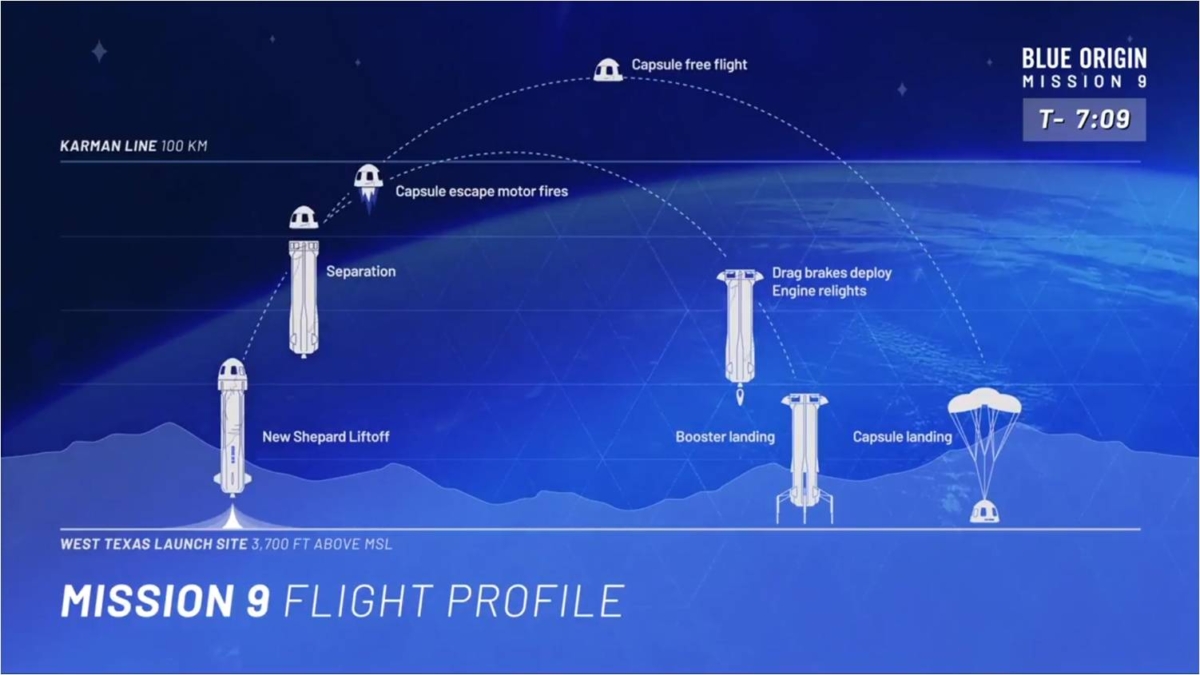
Credit: Blue Origin/Screengrab
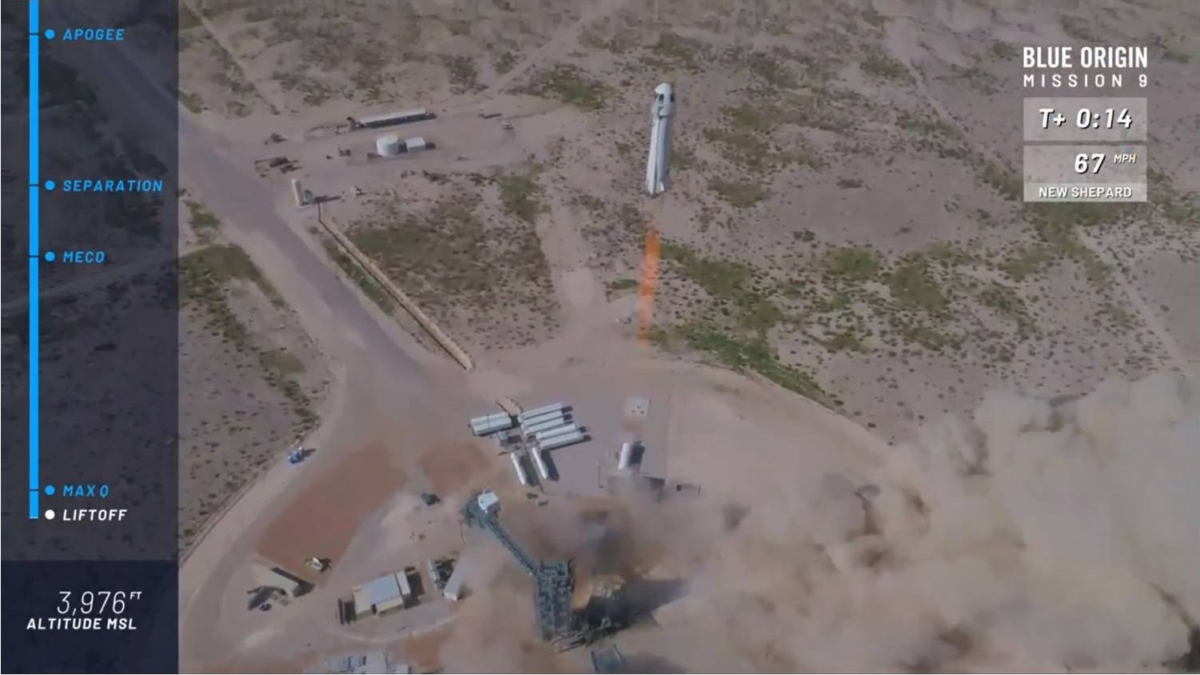
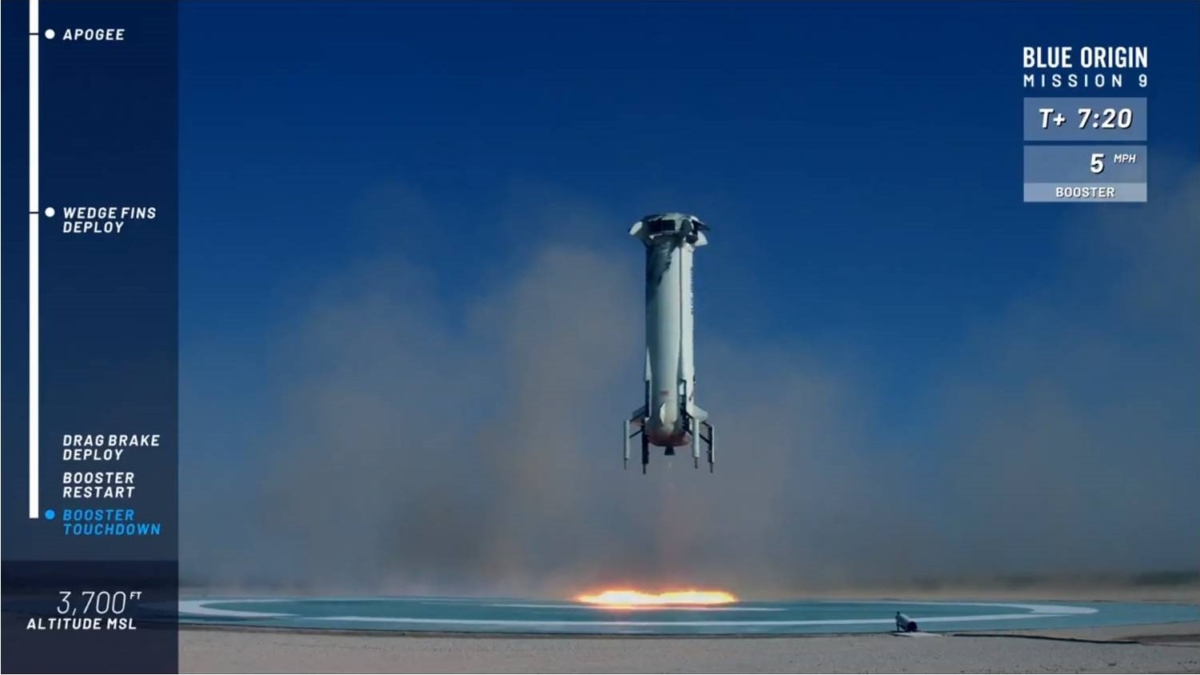
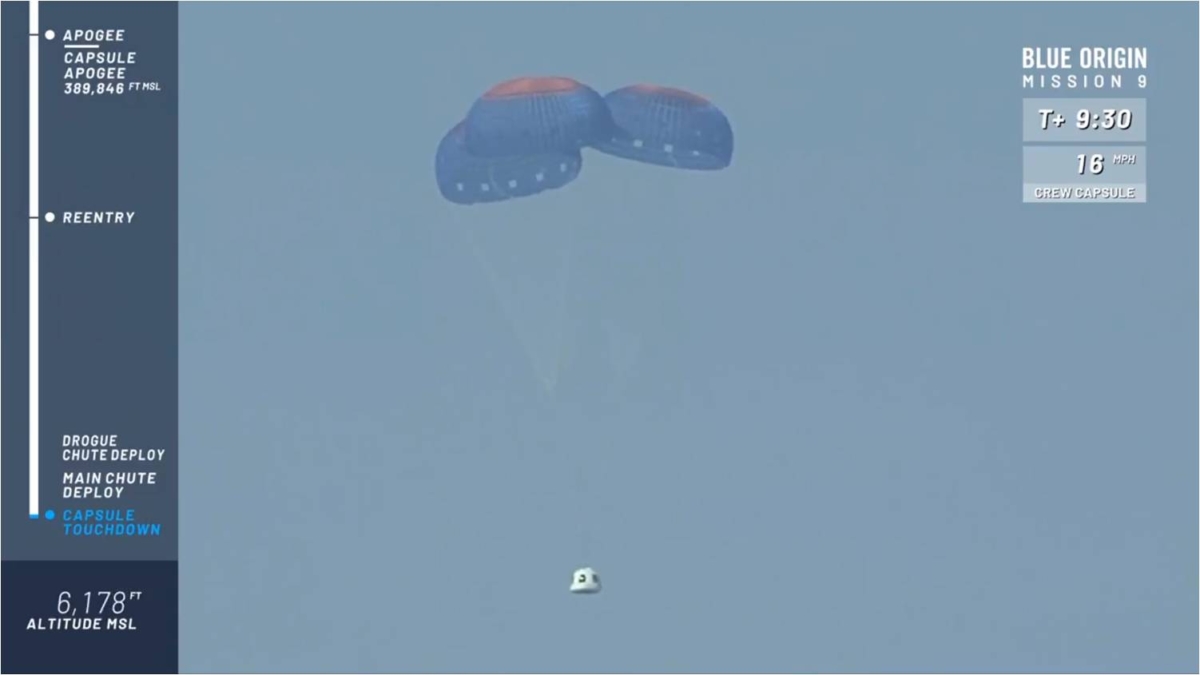
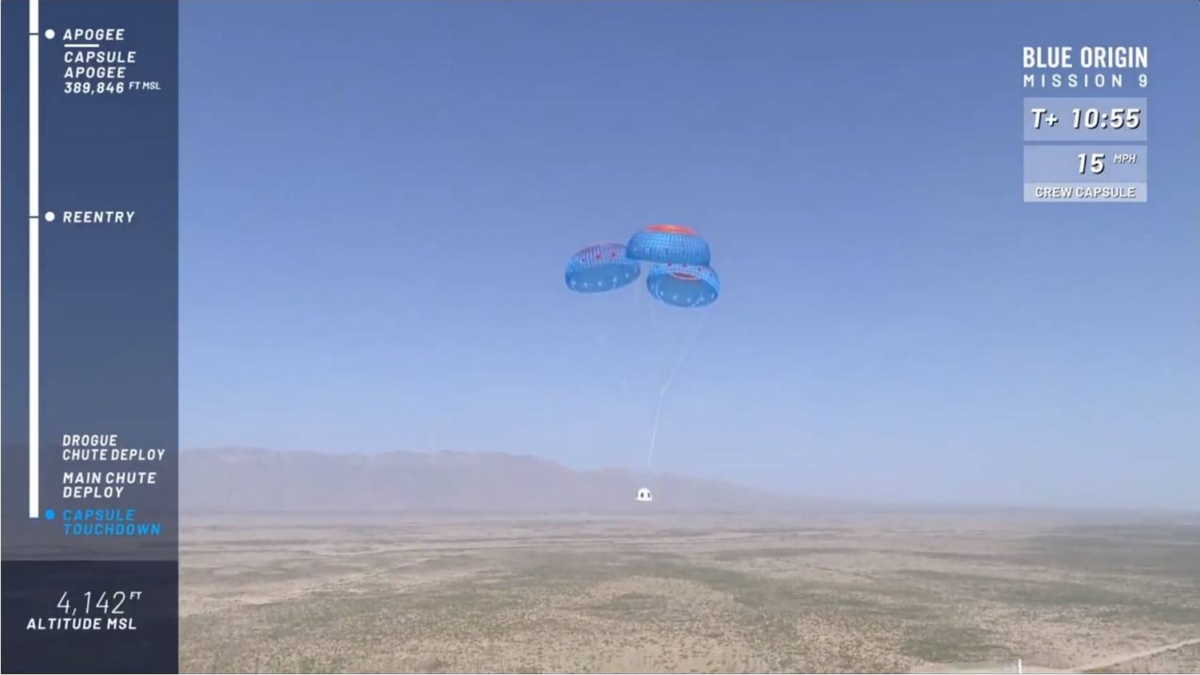
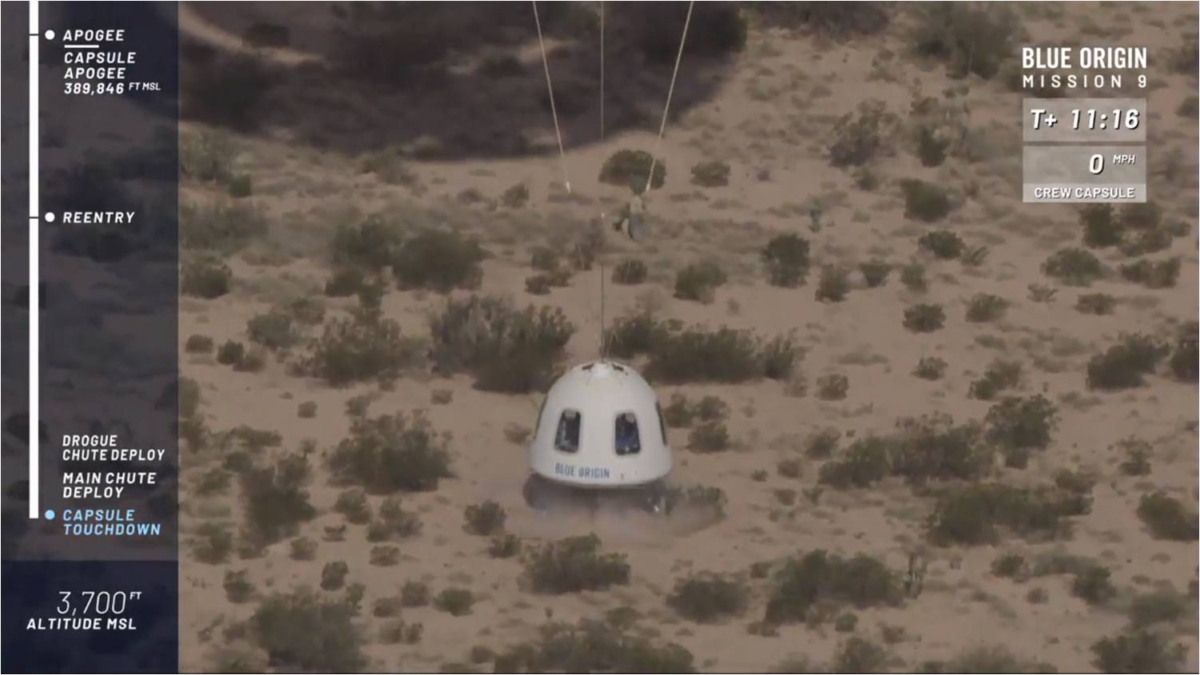
Blue Origin’s New Shepard vehicle successfully flew today, a step closer to providing pay-for-ticket human space travel on suborbital treks.
Exhilarating ride
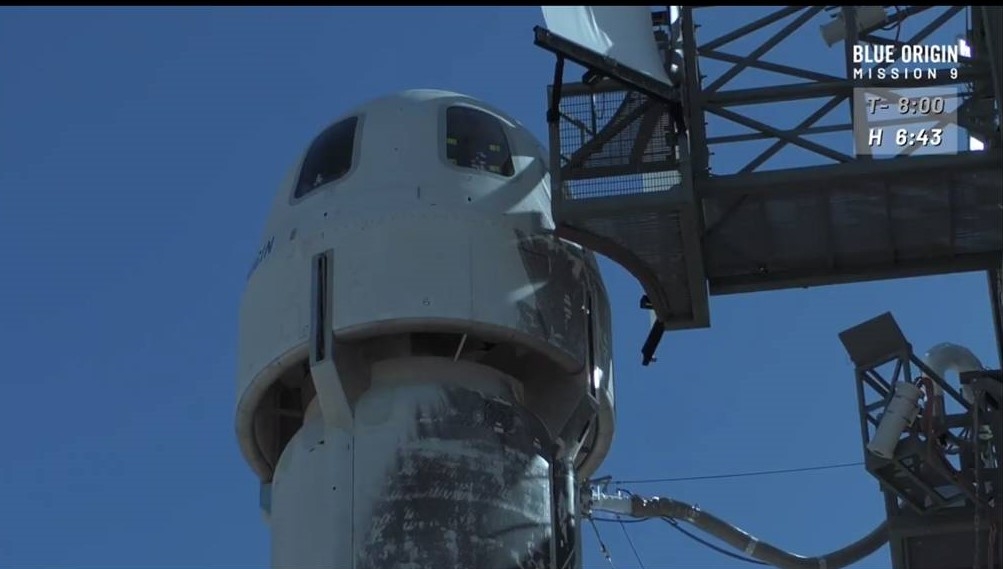
As posted by Blue Origin: “During this mission, known as Mission 9 (M9), the escape motor was fired shortly after booster separation. The Crew Capsule was pushed hard by the escape test and we stressed the rocket to test that astronauts can get away from an anomaly at any time during flight. The mission was a success for both the booster and capsule. Most importantly, astronauts would have had an exhilarating ride and safe landing.”
Credit: Blue Origin/Screengrab
“This isn’t the first time we’ve done this type of extreme testing on New Shepard. In October of 2012, we simulated a booster failure on the launch pad and had a successful escape. Then in October of 2016, we simulated a booster failure in-flight at Max Q, which is the most physically strenuous point in the flight for the rocket, and had a completely successful escape of the capsule.”
“This test on M9 allowed us to finally characterize escape motor performance in the near-vacuum of space and guarantee that we can safely return our astronauts in any phase of flight.”
Credit: Blue Origin/Screengrab
Customers
On today’s Mission 9, a third round of payload customers from commercial companies, universities and space agencies shared the cabin with Blue Origin’s Mannequin Skywalker for their flight to
Here is a selection of customers that flew on Mission 9:
Schmitt Space Communicator Xperimental (SC1-x) by Solstar (Santa Fe, NM), developed with private funding and with support from NASA’s Flight Opportunities Program. On New Shepard Mission 8, Solstar demonstrated the first commercial WiFi in space. On this reflight, they will take advantage of the Crew Capsule’s high altitude escape and continue testing WiFi access throughout the flight.
Credit: Blue Origin/Screengrab
GAGa (Granular Anisotropic Gases) is from Otto-von-Guericke University (Magdeburg, Germany) with end-to-end service provider OLYMPIASPACE (Darmstadt, Germany) and funding from the German space agency, DLR. The GAGa payload investigates the statistics of granular gases, dilute collections of solid grains that interact by random collisions. Data from GAGa on New Shepard Mission 9 will help validate existing theoretical models and contribute to understanding the dynamics of related systems like avalanches and cosmic dust clouds.
Credit: Blue Origin/Screengrab
Suborbital Flight Experiment Monitor-2 (SFEM-2) is from NASA Johnson Space Center (Houston, TX). SFEM-2 was first flown on Mission 8 of New Shepard, and will collect additional data on Mission 9. The experiment will record vehicle conditions including cabin pressure, temperature, CO2, acoustic conditions, and acceleration.
Condensed Droplet Experiment for NASA in Sub-Orbital Spaceflight (ConDENSS) from Purdue University (West Lafayette, IN), funded through NASA Flight Opportunities Program. ConDENSS will examine the behavior of small droplets of water in order to support the development of small and efficient heat transfer systems for spaceflight. These systems, called phase change heat transfer systems, provide more uniform surface temperatures and higher power capacities.
APL Electromagnetic Field Experiment by Johns Hopkins University Applied Physics Laboratory (APL), funded through NASA Flight Opportunities Program. This experiment marks the first flight of the JANUS 2.1 platform with sensors to monitor magnetic fields and ambient pressure inside the vehicle. Previous versions of JANUS were flown on New Shepard Missions 6 and 7.
Credit: Blue Origin/Screengrab
Vibration Isolation Platform Data Logger by Controlled Dynamics, funded through NASA Flight Opportunities Program. VIP DL is a technology demo for an active stabilization platform that aims to allow the most sensitive payloads flying on New Shepard to be isolated from ambient vibrations, allowing for even higher precision microgravity studies.
mu Space-1 by mu Space Corporation (Bangkok, Thailand). The first of Blue Origin’s New Glenn customers to purchase a slot on New Shepard, mu Space’s payload includes an assortment of scientific and medical items, several textile materials they plan to use on their future space suit and apparel, and other special articles for their community partners.
Credit: Blue Origin/Screengrab
Blue Origin “Fly My Stuff” is tagged as a special addition to the Mission 9 payload manifest and is a suite of payloads from Blue Origin employees as a part of the group’s internal “Fly My Stuff” program.
 Posted in
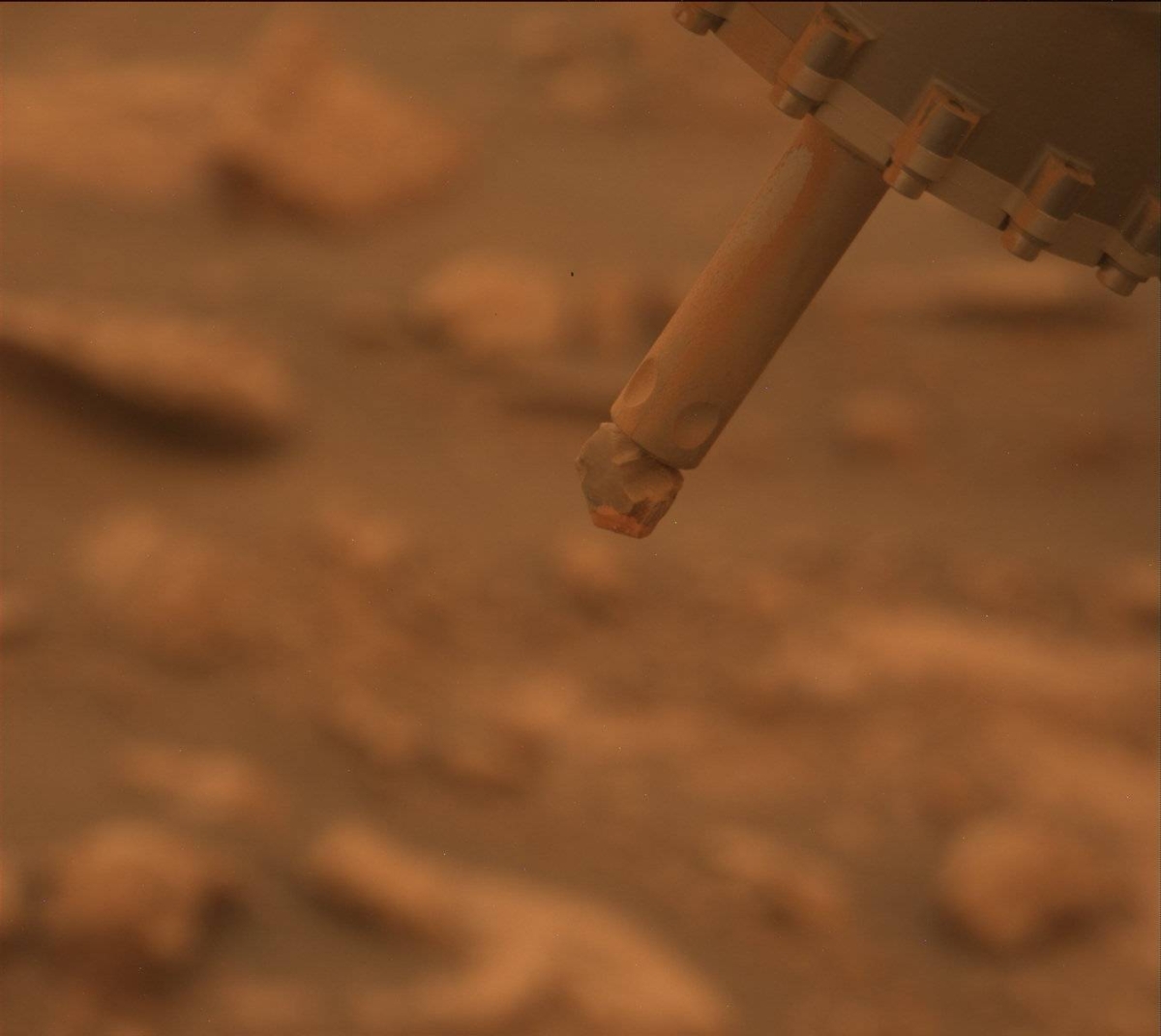
Rover drill checkup. Curiosity Mastcam Right image taken on Sol 2113, July 17, 2018.
Credit: NASA/JPL-Caltech/MSSS
NASA’s Curiosity Mars rover is engaged in Sol 2114 duties, finishing up at the Voyageurs drill site.
Reports Mark Salvatore, a planetary geologist at the University of Michigan in Dearborn: “After our attempt to drill the Voyageurs target did not reach sufficient depth due to the impressive hardness of the rock, the team is beginning to finish up its activities at this location before heading a bit further uphill to find a more suitable (i.e., softer) drill target.”
Hardest yet observed
Salvatore notes that all evidence suggests that this rock target is one of the hardest yet observed in Gale crater, a property that may be indicative of this entire section of the Vera Rubin Ridge.
“To a geologist, variations in rock hardness could indicate several different physical and chemical properties about a rock,” Salvatore adds. “It is important for us to further characterize and understand why this rock unit is so much harder than the underlying rocks within the Murray formation.”
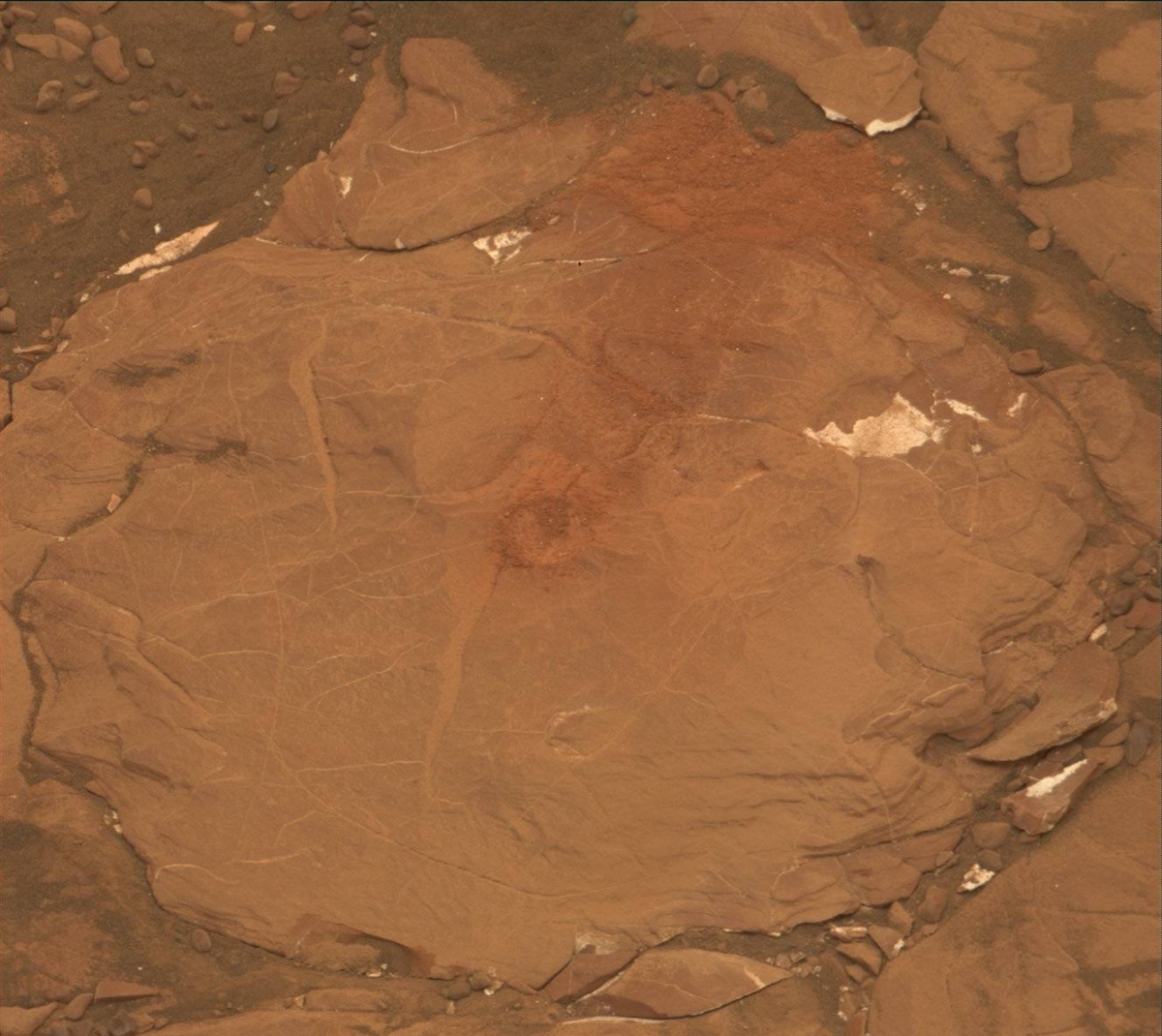
Voyageurs drill site. Curiosity Mastcam Right image taken on Sol 2113, July 17, 2018.
Credit: NASA/JPL-Caltech/MSSS
Formation mechanisms
Salvatore speculates, could this increased hardness be related to changes in water chemistry as the sedimentary rocks were being deposited? Or, could this increased hardness be due to subsequent cementation as iron-rich water was injected into the previously deposited sedimentary rocks?
“In order to address these possible formation mechanisms (and countless others), we must continue to gather data on the physical, chemical, and mineralogical properties of this portion of the Vera Rubin Ridge,” Salvatore explains.
New plans
A new set of Curiosity activities contain a combination of scientific investigations and engineering activities.
The plan starts with a short imaging science block where Mastcam will be used to acquire images of the surrounding landscape to search for short-term changes to the surface, including sand migration and changes to dust cover.
The robot’s Navcam will also be used to investigate the atmospheric dust content and to search for nearby dust devils.
Following this block of observations, Curiosity will use the Mars Hand Lens Imager (MAHLI) high-resolution camera to investigate the shallow Voyageurs drill hole and to image the rover wheels with its dust cover closed (to avoid dirtying the camera lens).
Drill hole documentation
“After a short nap and a data uplink to the Mars Reconnaissance Orbiter as it passes overhead,” Salvatore says that Curiosity is slated to embark on another block of science activities. This second suite will include Mastcam images of the dusty atmosphere, a Chemistry and Camera (ChemCam) laser-induced breakdown spectroscopy (LIBS) chemical analysis of the Voyageurs drill hole, a LIBS measurements of the ChemCam calibration target, and a follow-up Mastcam documentation image of the drill hole.
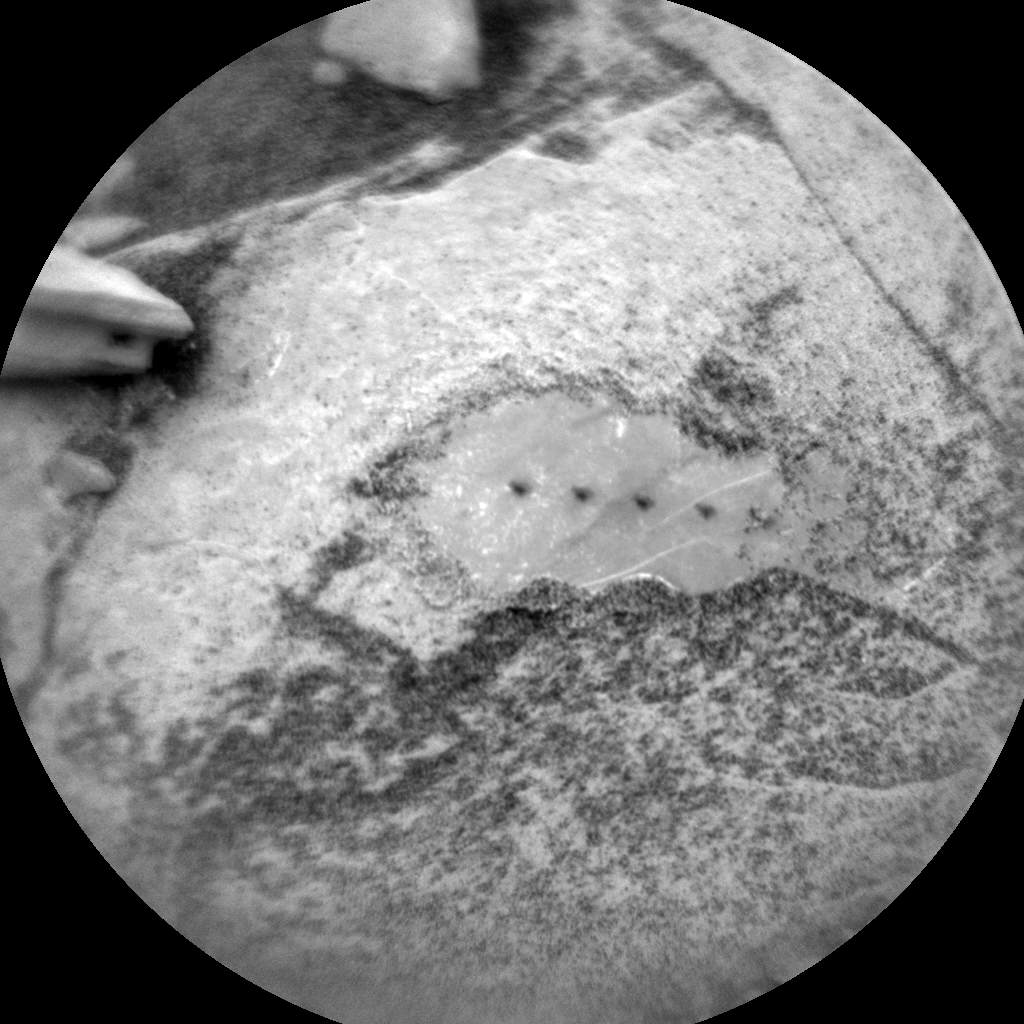
Laser shots. Curiosity ChemCam Remote Micro-Imager photo acquired on Sol 2113, July 17, 2018
Credit: NASA/JPL-Caltech/LANL
This will conclude the sol 2114 science activities.
Deluge of discussions
The team first had to deal with the realization that the drill activities at the Voyageurs target did not penetrate deep enough into the target to acquire materials for analysis onboard the rover.
“While disappointing, the information gathered about the rock properties and drill activities led to a deluge of productive scientific discussions about how to proceed and what these observations tell us about the geologic environment that Curiosity is investigating,” Salvatore reports.
Scientists and engineers can collectively turn a “frustrating sigh into a gasp of excitement” as researchers think about next observations and what more they have to learn about this interesting and foreign environment, Salvatore concludes.

Rocketeer Jeff Bezos and his commercial rocket firm, Blue Origin.
Credit: Blue Origin
Launch tomorrow of the New Shepard is slated for 9:00 am CT / 14:00 UTC. Live webcast begins at T-20 minutes on http://BlueOrigin.com
On Mission 9 a third round of payload customers from commercial companies, universities and space agencies will share the cabin with Blue Origin’s Mannequin Skywalker for their flight to space.

Ready for re-flight – Blue Origin’s Mannequin Skywalker
Credit: Blue Origin/Screen Grab
Customers
Here is a selection of customers slated to fly on Mission 9:
Schmitt Space Communicator Xperimental (SC1-x) by Solstar (Santa Fe, NM), developed with private funding and with support from NASA’s Flight Opportunities Program. On New Shepard Mission 8, Solstar demonstrated the first commercial WiFi in space. On this reflight, they will take advantage of the Crew Capsule’s high altitude escape and continue testing WiFi access throughout the flight.
GAGa (Granular Anisotropic Gases) is from Otto-von-Guericke University (Magdeburg, Germany) with end-to-end service provider OLYMPIASPACE (Darmstadt, Germany) and funding from the German space agency, DLR. The GAGa payload investigates the statistics of granular gases, dilute collections of solid grains that interact by random collisions. Data from GAGa on New Shepard Mission 9 will help validate existing theoretical models and contribute to understanding the dynamics of related systems like avalanches and cosmic dust clouds.
Suborbital Flight Experiment Monitor-2 (SFEM-2) is from NASA Johnson Space Center (Houston, TX). SFEM-2 was first flown on Mission 8 of New Shepard, and will collect additional data on Mission 9. The experiment will record vehicle conditions including cabin pressure, temperature, CO2, acoustic conditions, and acceleration.
Condensed Droplet Experiment for NASA in Sub-Orbital Spaceflight (ConDENSS) from Purdue University (West Lafayette, IN), funded through NASA Flight Opportunities Program. ConDENSS will examine the behavior of small droplets of water in order to support the development of small and efficient heat transfer systems for spaceflight. These systems, called phase change heat transfer systems, provide more uniform surface temperatures and higher power capacities.
APL Electromagnetic Field Experiment by Johns Hopkins University Applied Physics Laboratory (APL), funded through NASA Flight Opportunities Program. This experiment marks the first flight of the JANUS 2.1 platform with sensors to monitor magnetic fields and ambient pressure inside the vehicle. Previous versions of JANUS were flown on New Shepard Missions 6 and 7.
Vibration Isolation Platform Data Logger by Controlled Dynamics, funded through NASA Flight Opportunities Program. VIP DL is a technology demo for an active stabilization platform that aims to allow the most sensitive payloads flying on New Shepard to be isolated from ambient vibrations, allowing for even higher precision microgravity studies.
mu Space-1 by mu Space Corporation (Bangkok, Thailand). The first of Blue Origin’s New Glenn customers to purchase a slot on New Shepard, mu Space’s payload includes an assortment of scientific and medical items, several textile materials they plan to use on their future space suit and apparel, and other special articles for their community partners.
Blue Origin “Fly My Stuff” is tagged as a special addition to the Mission 9 payload manifest and is a suite of payloads from Blue Origin employees as a part of the group’s internal “Fly My Stuff” program.

Blue Origin’s crew capsule – a suborbital six-seater craft.
Credit: Blue Origin

NASA Curiosity rover on the Red Planet prowl since August 2012 and assessing the habitability of Mars.
Credit: NASA/JPL-Caltech/MSSS
Back in June, NASA held a press meeting to detail new findings from the space agency’s Curiosity Mars rover.
The Mars machinery had found new evidence preserved in rocks on Mars that suggests the planet could have supported ancient life, as well as new evidence in the Martian atmosphere that relates to the search for current life on the Red Planet. While not necessarily evidence of life itself, these findings are a good sign for future missions exploring the planet’s surface and subsurface.
“Are there signs of life on Mars?” said Michael Meyer, lead scientist for NASA’s Mars Exploration Program, at NASA Headquarters. “We don’t know, but these results tell us we are on the right track.”

History-making Viking Mars landers touched down on the Red Planet in 1976.
Credit: NASA
Critical review
A critique of that NASA announcement and related scientific papers has been written by former Viking experimenters. After landing in 1976, the two Viking craft carried out dedicated life-detection investigations.
Gilbert V. Levin was the leader of the Viking Labeled Release (LR) Life Detection Experiment and Patricia Ann Straat was a Viking co-experimenter.
Writing a Forum article in the journal Astrobiology, the two scientists note that the June 7, 2018, NASA news conference and two related papers in Science regarding the findings of organic molecules and methane on Mars “are exciting for the possibility of both ancient and current life on Mars.”
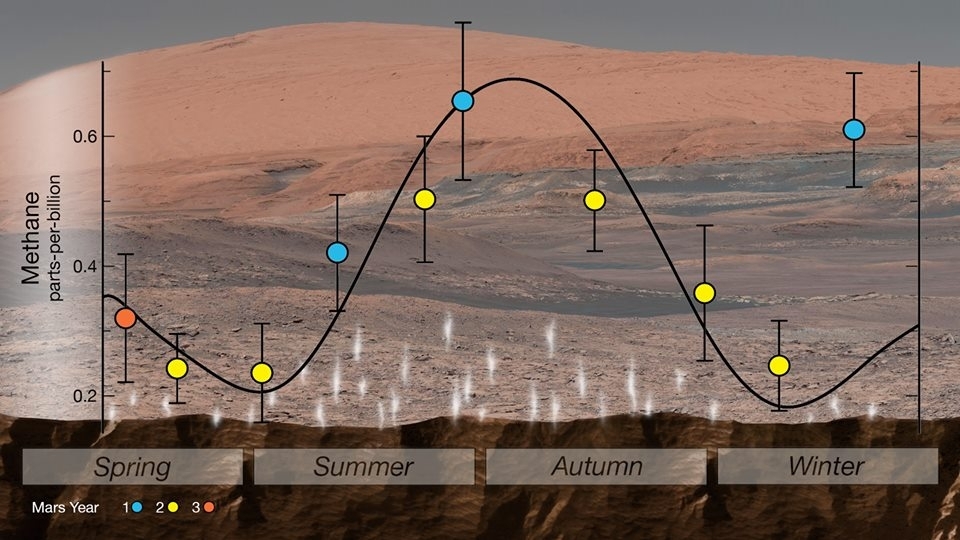
NASA’s Curiosity rover used an instrument called SAM (Sample Analysis at Mars) to detect seasonal changes in atmospheric methane in Gale Crater. The methane signal has been observed for nearly three Martian years (nearly six Earth years), peaking each summer.
Credit: NASA/JPL-Caltech
Indication of current life
That said, Levin and Straat write: “While ostensibly contending they are seeking life, each finding pointing in that direction seems to be immediately contra-indicated by the finders and in all of NASA’s releases and supported scientific publications.”
For instance, the paper on methane in the atmosphere of Mars did provide important new information, they add. That is, monitoring the localized seasonal cycling of atmospheric methane, with substantial and repetitive amplitudes over the three Martian years (six Earth years).
But while acknowledging that almost all methane in Earth’s atmosphere is of biological origin, the authors of that paper propose an abiotic scenario “to explain away this strong indication of current life,” Levin and Straat point out. “On the other hand, this new result makes a possible biological source proposed to explain the cyclical methane on Mars even more tantalizing,” the Viking scientists add.
Strong evidence
NASA has not dispatched another life-detection experiment to Mars since the 1976 Viking mission Labeled Release (LR) experiment, Levin and Straat write, despite that experiment obtaining “strong evidence” for current microbial life on the Red Planet.

Credit: NASA/Ben Clark
“At that time, this evidence was overridden by the presumed lack of liquid water and the failure of the Viking GCMS [Gas Chromatograph Mass Spectrometer] to find any organic matter. Both have now been found,” Levin and Straat point out.
“In the 41 years since Viking, none of the many attempts to explain away the LR results nonbiologically has withstood scientific scrutiny, so no barrier remains to preclude the possibility of extant microbial life on Mars, or that the LR experiment detected it,” Levin and Straat conclude.
Go to this NASA June 7, 2018 release regarding Curiosity’s findings at:
https://mars.nasa.gov/news/8347/nasa-finds-ancient-organic-material-mysterious-methane-on-mars/
“Comments on the June 7, 2018, NASA News Release and Papers” by Gilbert V. Levin and Patricia Ann Straat has been published online: July 16, 2018 in Astrobiology at:
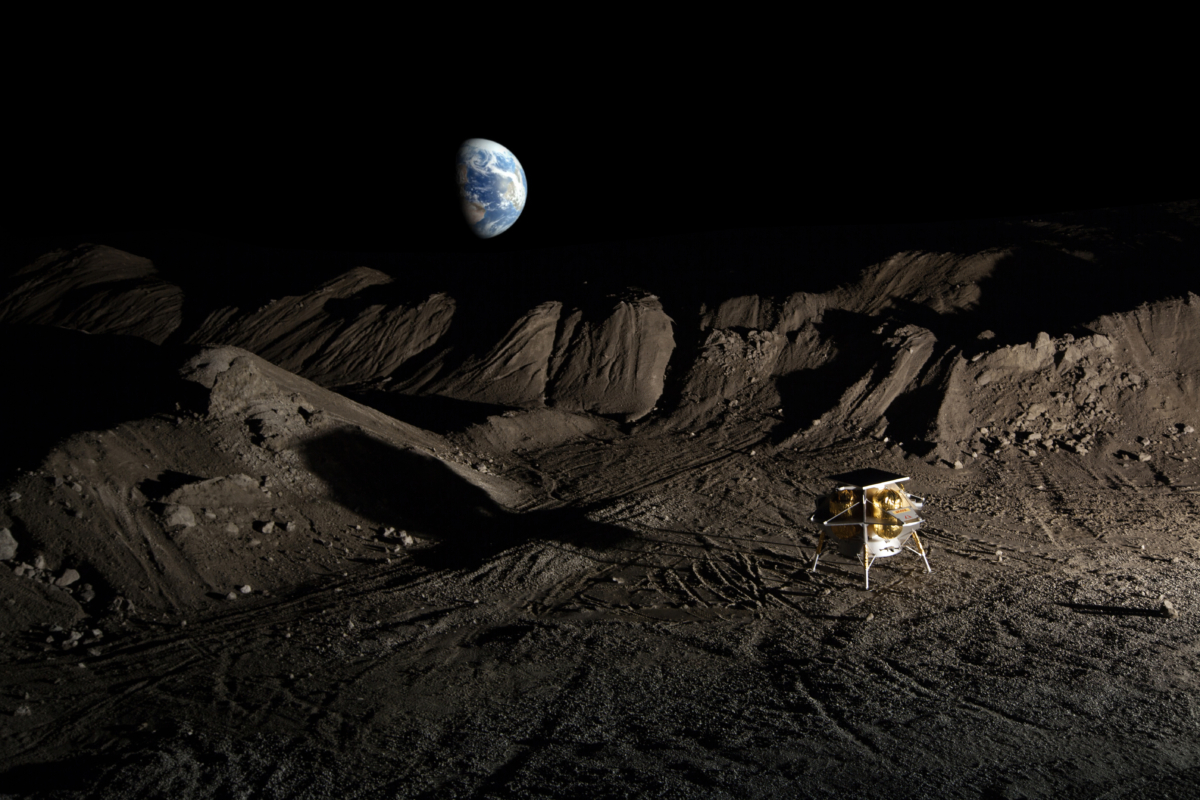
Credit: Astrobotic
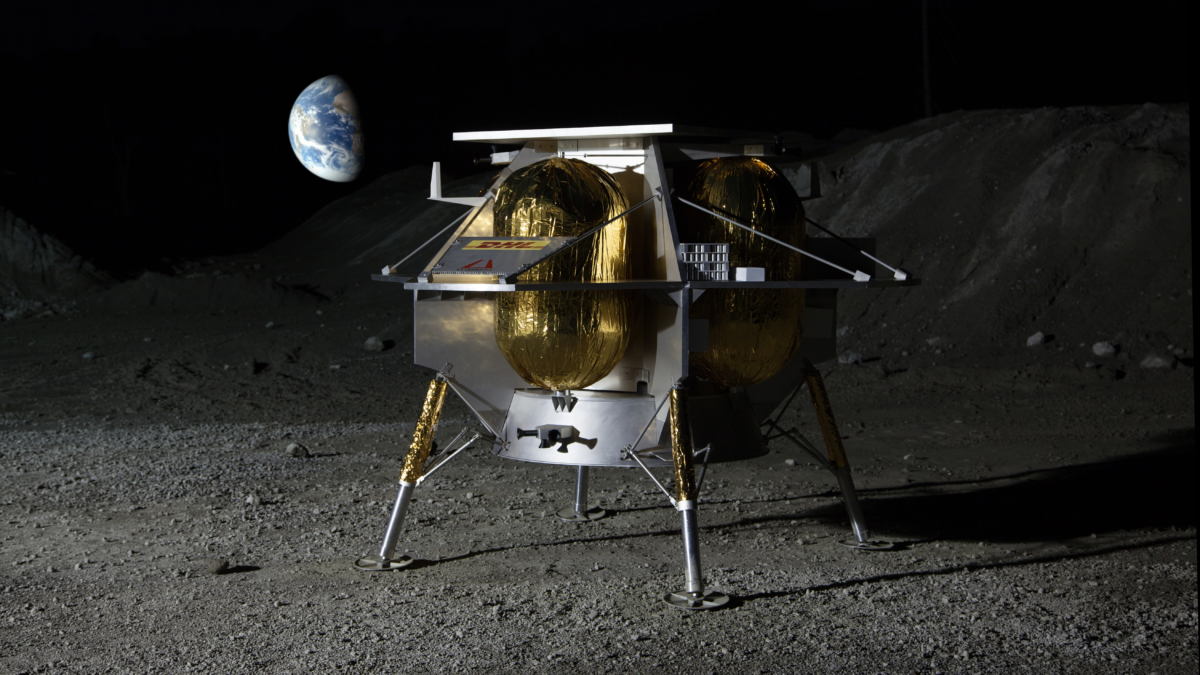
Astrobotic’s Peregrine lunar lander is to soft land on the Moon courtesy of propulsion provider, Dynetics of Huntsville, Alabama.
The Pittsburgh, Pennsylvania-based Astrobotic plans to start delivering customer payloads once a year starting in 2020.
In a multi-mission deal announced today, Dynetics will integrate Peregrine’s main engines and attitude control thrusters, controller electronics, tanks, and feed system into a single system that performs all propulsive maneuvers from cruise to soft landing on the Moon.
Astrobotic-Dynetics agreement
According to an Astrobotic press statement, the Dynetics-led system will feature a propellant with a next-generation oxidizer called MON-25, which has a higher nitric oxide content to provide better thermal capability to operate more efficiently in deep space environments than previous oxidizers.
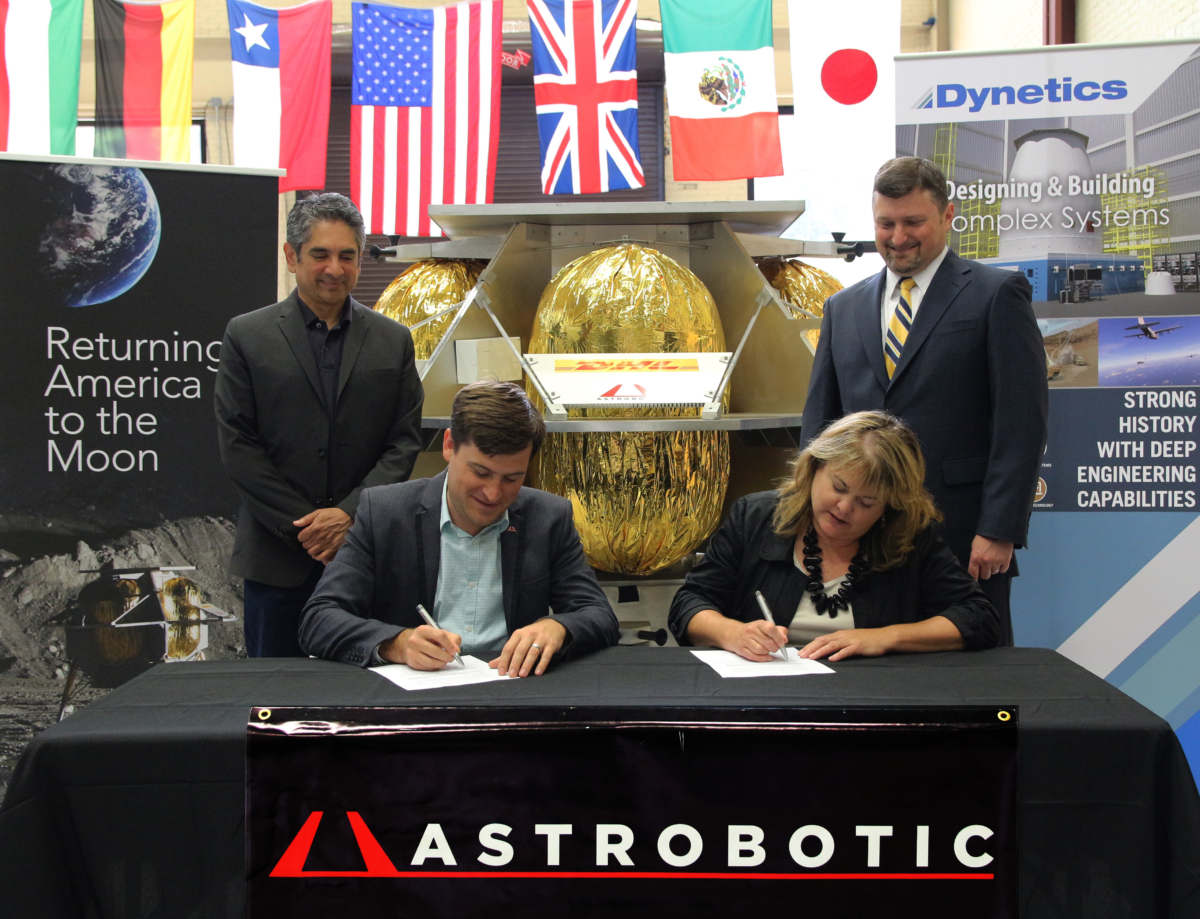
Astrobotic CEO John Thornton and Dynetics Space Division Manager Kim Doering sign the Peregrine Propulsion Teaming Agreement at Astrobotic’s Spacecraft High Bay in Pittsburgh, Pennsylvania.
Credit: Astrobotic
Dynetics will procure the engines from Simi Valley, California-based Frontier Aerospace, which is under contract with NASA to qualify the engines for lunar missions.
The new Astrobotic-Dynetics agreement is geared to support a dependable, low-cost manifest of missions that enables companies, governments, universities, and nonprofits to plan their campaigns of science, exploration, and commerce on the Moon.
Customer payloads
The Astrobotic lunar lander is designed to accommodate multiple customer payloads on a single flight, price-tagged at $1.2 million per kilogram.
Credit: Astrobotic
Founded in 2007, Astrobotic is an official partner with NASA through the Lunar CATALYST program, has 26 prior and ongoing NASA contracts, a commercial partnership with Airbus DS, a corporate sponsorship with DHL, 12 deals for its first mission to the Moon, and 130 customer payloads in the pipeline for upcoming missions.
A video depicting a Peregrine lander touching down on the Moon can be viewed at:
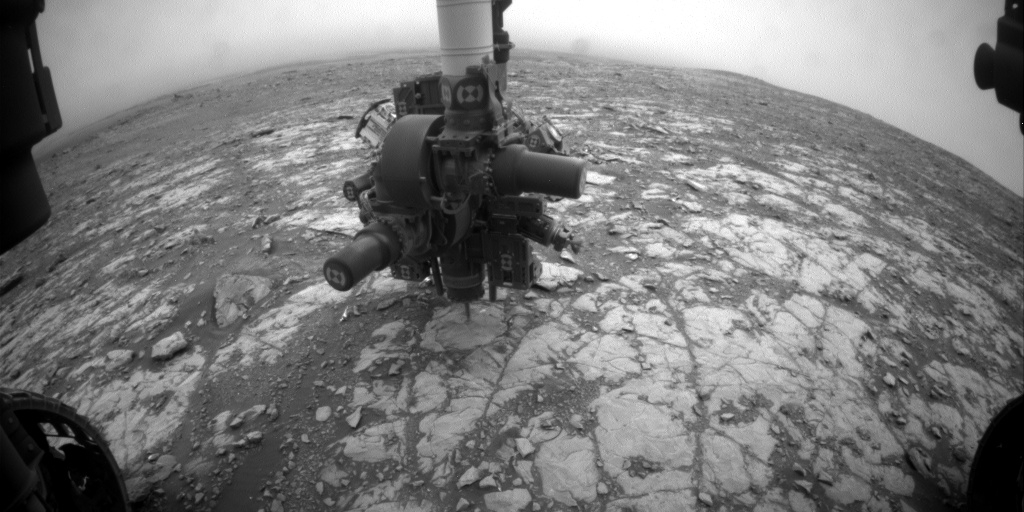
Curiosity Front Hazcam Left B image acquired on Sol 2112, July 16, 2018.
Credit: NASA/JPL-Caltech
NASA’s Curiosity Mars rover is carrying out Sol 2113 science tasks after being thwarted in performing new drilling in a selected target.
“Hard as a rock,” reports Lauren Edgar, planetary geologist at the USGS in Flagstaff, Arizona. “Unfortunately, we found out this morning that the ‘Voyageurs’ drill target was a much harder rock than expected. While our drill plan executed perfectly, our bit stopped short of the full depth we need for sampling. The engineers are still evaluating the data to better understand the target,” Edgar adds.
Longer-term strategy
The Curiosity science team is coming up with a new plan, and also thinking about a longer-term strategy. “Ultimately, we decided to focus on contact science and documenting the mini drill hole in today’s plan,” Edgar notes.
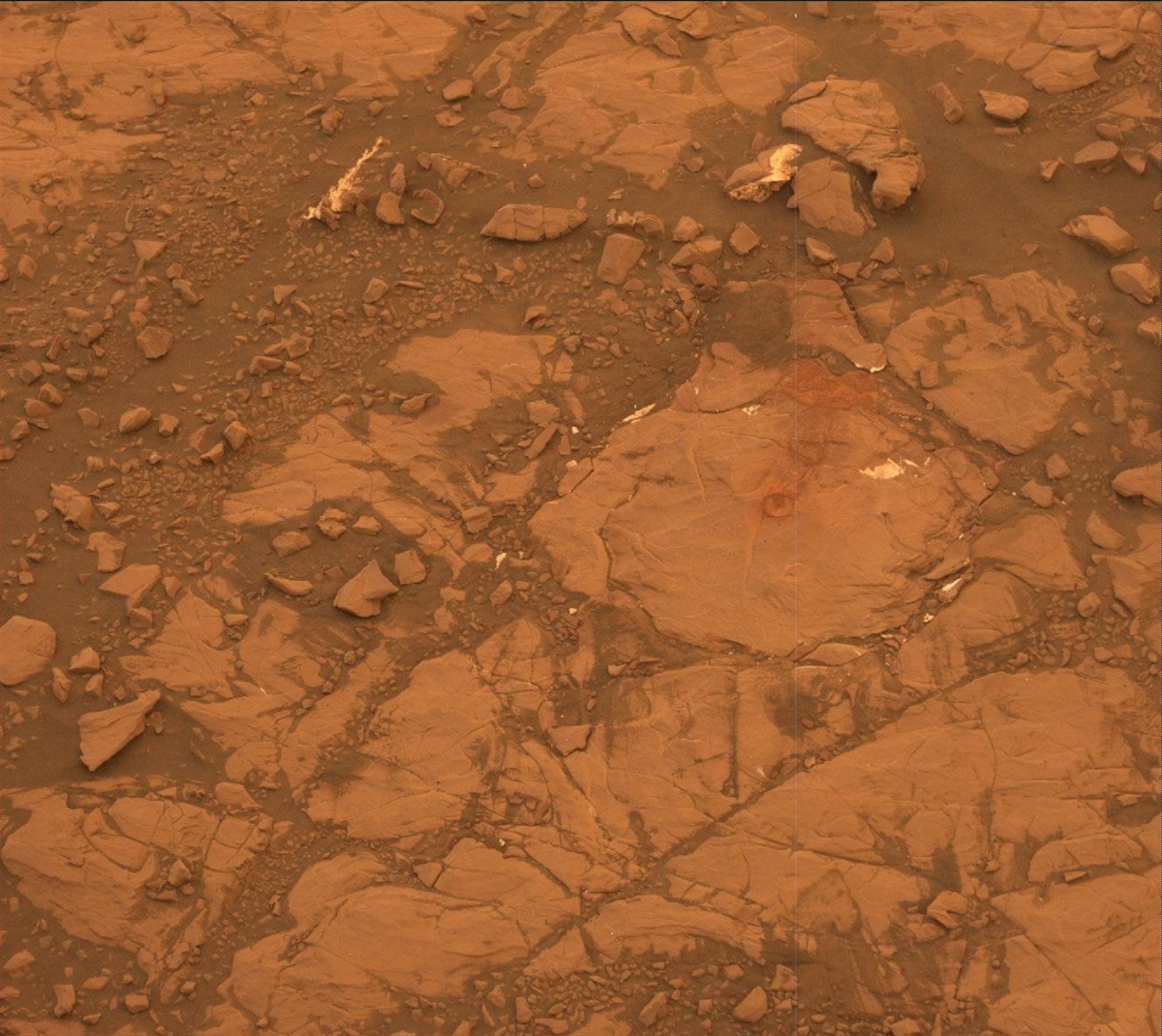
New drill hole captured in this Curiosity Mastcam Left image acquired on Sol 2112, July 16, 2018.
Credit: NASA/JPL-Caltech/MSSS
The new plan involves several Navcam observations to monitor atmospheric opacity during the ongoing dust storm. Also on tap is use of the rover’s Mastcam in change detection observations mode to characterize the movement of sand.
These observations will be followed by several Chemistry and Camera (ChemCam) scans to assess the diversity of color and composition in nearby bedrock.
Additionally, ChemCam Remote Micro-Imager (RMI) imagery of the “Voyageurs” target will be taken to help with targeting the drill hole with ChemCam in a follow-on plan.
Drill hole inspection
A few more environmental monitoring activities are part of the plan, including a Navcam line-of-sight image, Mastcam tau, and crater rim extinction observation, Edgar adds. “Then Curiosity will image the drill chuck, drill bit, and turret, to monitor our tools.”
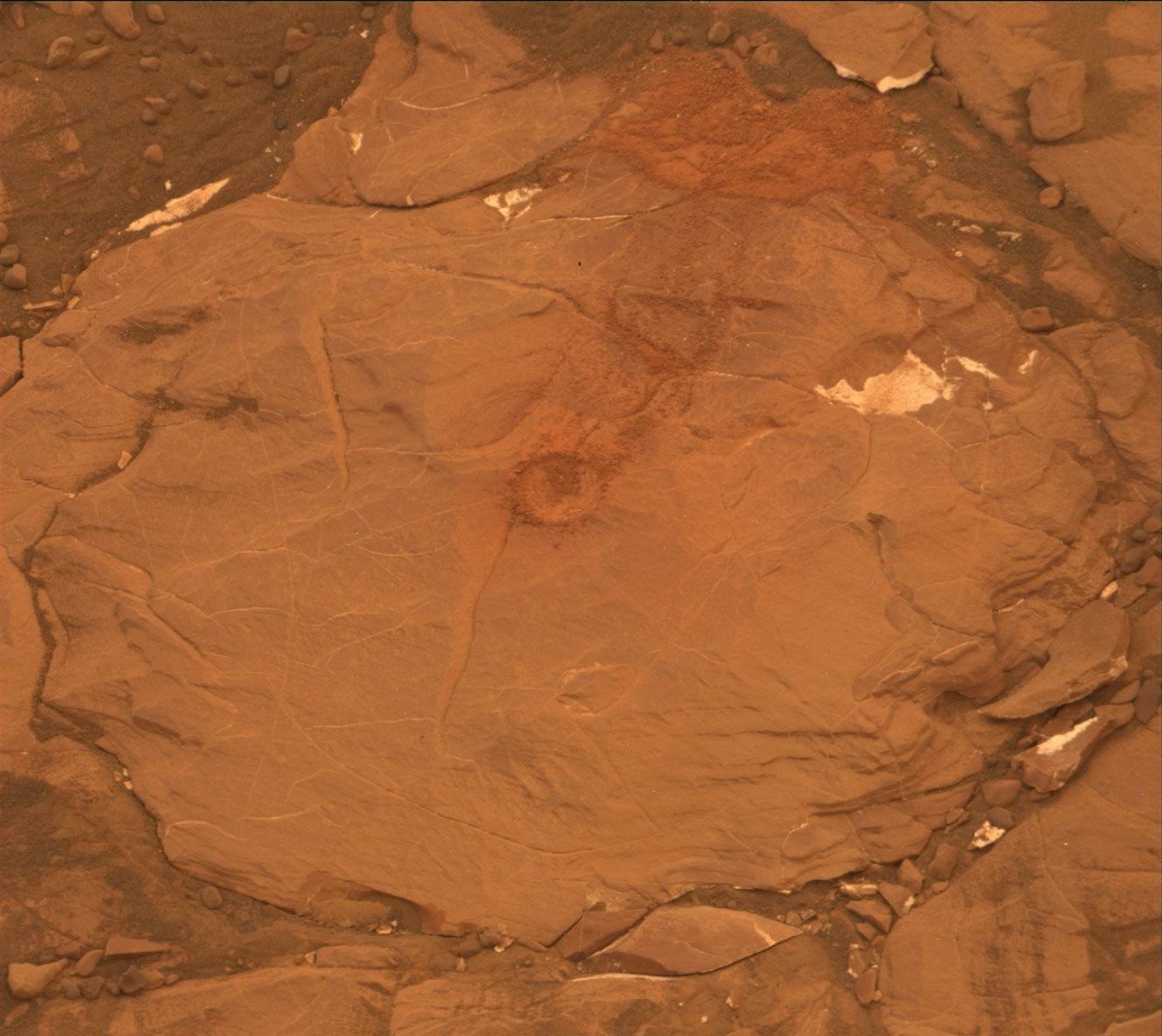
Drill hole in view in this photo taken by Curiosity Mastcam Right camera on Sol 2112, July 16, 2018.
Credit: NASA/JPL-Caltech/MSSS
An evening Alpha Particle X-Ray Spectrometer (APXS) integration on the drill tailings is scheduled, and overnight a longer APXS integration on the drill hole is slated.
Summing up, Edgar concludes: “Today is a reminder that it’s hard to operate a rover and drill on another planet, but I’m hopeful that we’ll find a way to sample this part of the ridge!”
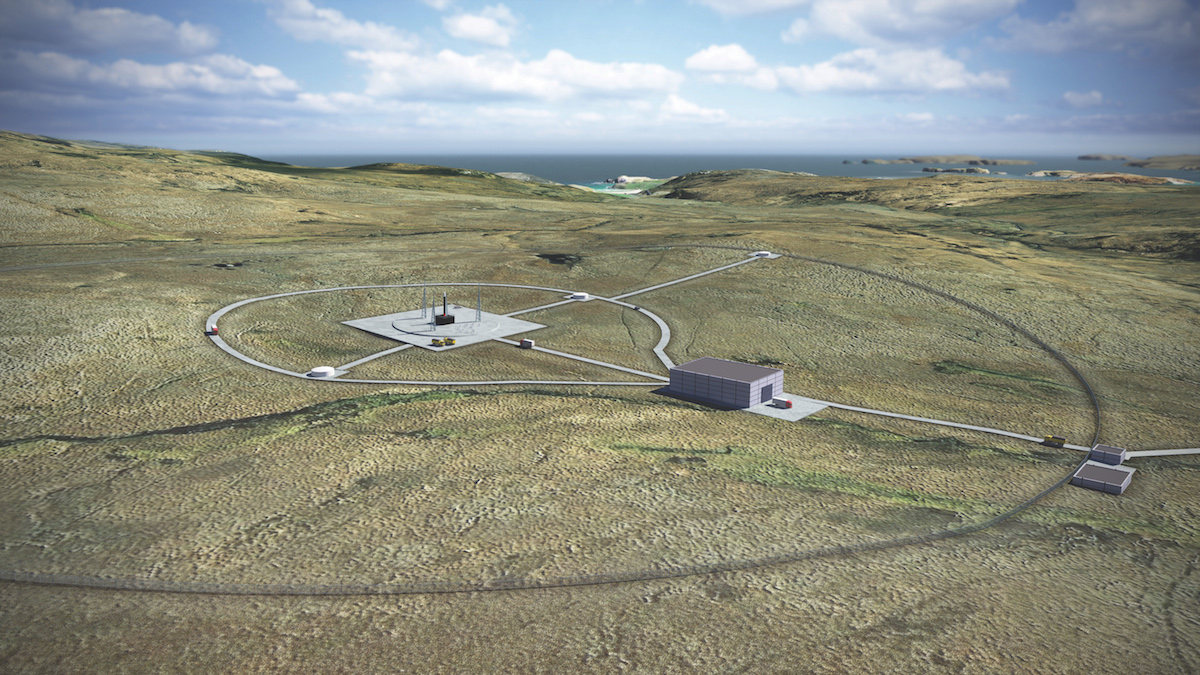
Artist impression of spaceport.
Credit: Perfect Circle PV
The UK Space Agency has awarded a contract to Lockheed Martin to develop the UK’s first spaceport in Sutherland, on the north coast of Scotland.
Pegged at $31 million total, the two contract deal has Lockheed Martin establishing vertical launch operations in Sutherland, Scotland and to develop innovative technologies in Reading, Berkshire with support from two UK Space Agency grants.
Artist’s impression of vertical launch from UK spaceport.
Credit: Lockheed Martin.
Prime time rocket
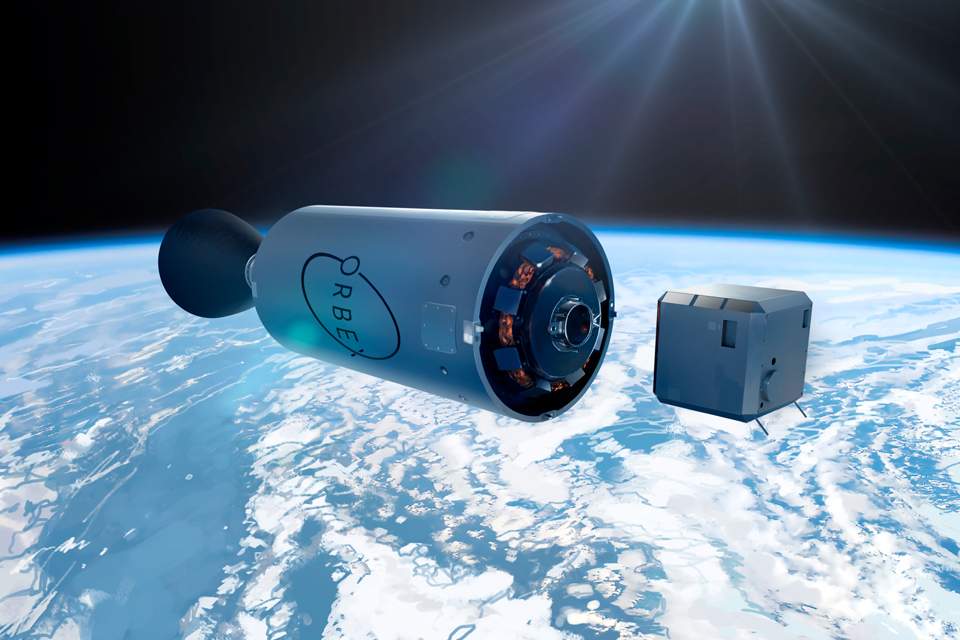
A further $7 million will go to Orbex, a UK-based spaceflight company, to build an innovative new rocket dubbed Prime for launch from Sutherland, as well as $3 million to Highlands and Islands Enterprise to develop the spaceport. The spaceport could see rocket lift-offs from the early 2020s.
With its high northern inclination, the UK is a geographically strategic location for launch, and the north of Scotland is well-placed to reach highly sought-after satellite orbits such as polar and near-polar orbit.
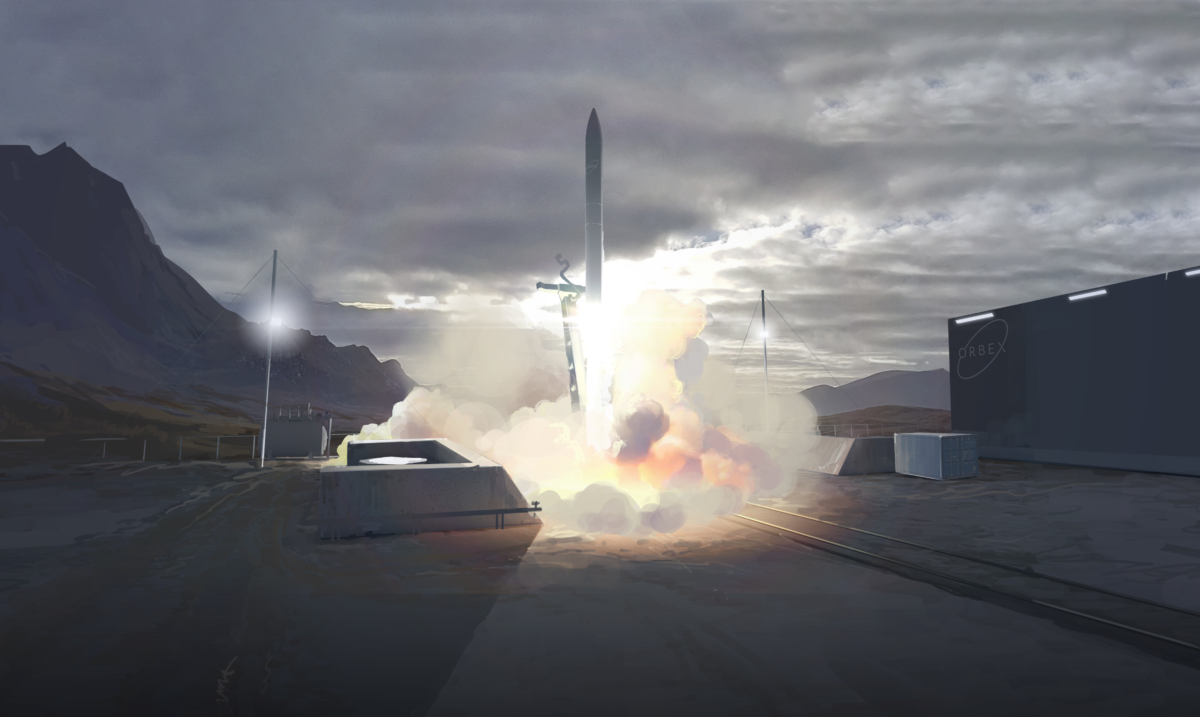
Credit: Orbex/Anders Bøggild
The Prime booster would deliver small satellites into Earth’s orbit using a single renewable fuel, bio-propane engine that cuts carbon emissions by 90% compared to hydrocarbon fuels, according to a press statement.
According to Orbex, Prime uses a novel zero-shock staging system called Magic, which leaves zero orbital debris. It also features a novel reusability concept, with an innovative new low mass recovery and reflight system.
Credit: Orbex/Anders Bøggild
One-stop-shop
The UK Space Agency announced at the Farnborough International Airshow a total of $41 million in government grants to establish the UK’s first spaceport in Sutherland.
A number of sites across the UK are developing their spaceport plans. Sites such as Newquay, Glasgow Prestwick and Snowdonia will be boosted by a new $3 million strategic development fund to grow their sub-orbital flight, satellite launch and spaceplane ambitions.
The announcement to develop launch capability is being viewed as Europe’s first one-stop-shop for building, launching and operating satellites.
For more detail, go to this press statement at:
https://www.gov.uk/government/news/lockheed-martin-and-orbex-to-launch-uk-into-new-space-age
For more information on Orbex, go to:
Also go to this video at:

Chelyabinsk sky rendering is a reconstruction of the asteroid that exploded over Chelyabinsk, Russia on Feb. 15, 2013.
Credit: Sandia National Laboratories.
The consequences of incoming space objects plowing into Earth’s atmosphere and resulting human injuries are being spotlighted during the upcoming 81st Annual Meeting of The Meteoritical Society, being held July 22-27 in Moscow, Russia.
The entry of the roughly 65-foot (20-meter) sized meteoroid at Chelyabinsk on February 15, 2013, stands out from other fireballs for its magnitude and the large zone of destruction on the ground caused by its airburst.
That’s the word from researcher Anna P. Kartashova of the Institute of Astronomy within the Russian Academy of Sciences. In a paper by Kartashova and colleagues to be presented at the scientific gathering, the Chelyabinsk event was extremely well documented. The observational database includes photos, video, infrasound, seismic data and more – including eyewitness accounts of the airburst that provide information not recorded by instrumental devices.
Type of injuries
“According to the interviews conducted via the internet, respondents had cuts or bruises, reported sunburn, hurt their eyes, mentioned retina burns (no official verification), were briefly stunned by the shockwave, or reported a brain injury in the form of a concussion or headache,” Kartashova and colleagues report.
In-person and phone interviews, along with internet surveys add up to about 3,000 accounts being collected. “They provide information about sensations of heat, smells, sounds, the occurrence of sunburn, and the type of injuries sustained,” Kartashova and collaborators explain.
The Chelyabinsk event proved that the meteoroid, previously not classified as hazardous under Asteroid/Comet Hazardous classification, “can cause significant damage” and a “significant number of injuries” if the impact occurs near a populated area, the research team concludes.

Earth has been on the receiving end of several incoming objects resulting in human injury.
Credit: NASA
Tunguska impact
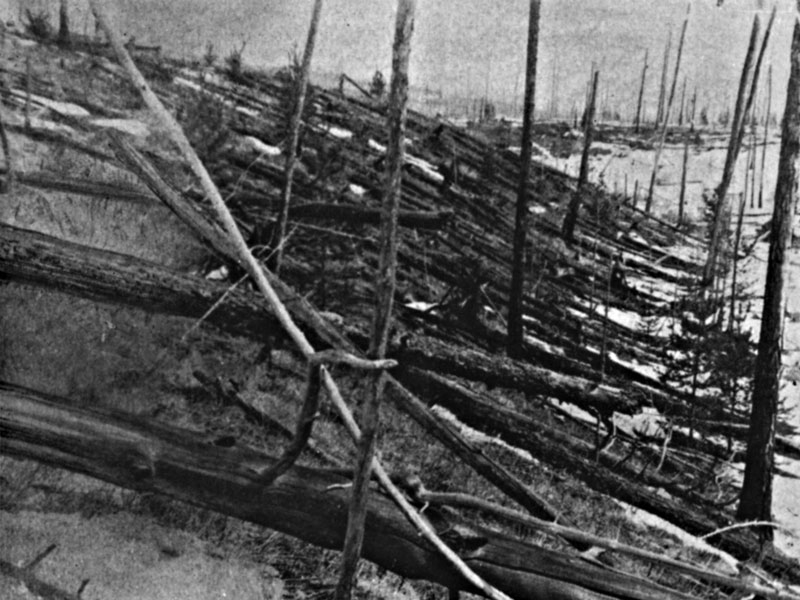
Peter Jenniskens of the SETI Institute in Mountain View, California has led a look back in time, documenting the Tunguska event in Siberia on June 30, 1908.
“The eye witness accounts of the Tunguska event at various distances from the epicenter confirm a more significant impact than the recent Chelyabinsk airburst event, with more dramatic consequences,” Jenniskens and his fellow researchers report.

Credit: NASA/JPL
Even though Tunguska impact was in a sparsely populated region, Jenniskens and colleagues say there is strong evidence in the written record of at least three casualties from this event.
Epicenter effects
Recorded eye witness reports were mostly collected long after the event in 1921-1930, 1938, 1959-1969 and many accounts retell the stories of other people.
Scattered in the region were local reindeer nomads, Evenks – the most numerous and widely strewn of the many small ethnic groups of northern Siberia.
Credit: Leonid Kulik Expedition, Wikipedia
The trading post Vanavara was located at about 40 miles (65 kilometers) from the epicenter of the event.
Eyewitness reports that contained information on injuries were extracted from a catalogue of eyewitness accounts. The locations of reported injuries are only approximately known, mainly in the region up to 186–310 miles (300-500 kilometers from the epicenter.
Stress and panic
Furthest from the event, injuries were mainly in the form of signs of stress and panic, sometimes accompanied by reports of objects falling from high places (bench, roof, Russian stove).
About 50 eyewitness reports describe events in locations closer than 80 miles (130 kilometers) from the blast.
“More serious injuries occurred there,” the Jenniskens-led paper notes. “The injuries mentioned include concussions, being stunned or fainting, a broken arm, burns, aphasia and blindness. Concussion and fainting were the most often mentioned. Fainting could be long lasting, up to two days,” Jenniskens and colleagues say.
Rare opportunities
The effect of thermal radiation from nuclear explosions is often used in radiation hazard assessments. However, the Jenniskens-led paper adds that the spectral dependence of radiation emitted during an asteroid impact can be different from the spectral radiation emitted by a nuclear explosion.
“Therefore, all theoretical approaches to risk assessment should be verified by observations, and the Chelyabinsk and Tunguska events provide rare opportunities to do so,” Jenniskens and his fellow scientists conclude.

Earth’s Moon as seen from the International Space Station.
Credit: NASA/ESA
Why should we be warming up to ultra-cold lunar ice?
Permanently shadowed craters at the polar regions of the Moon are eyed as repositories of water ice. That resource can be converted to oxygen, water, and rocket fuel.
Exploiting these stores of water ice is a big plus to assure humans not only can survive and thrive on the Moon, but also turn a profit.

Newly developed extraction technique for the Moon, thermal mining, makes use of mirrors to exploit sun-shy, water ice-laden polar craters.
Credit: School of Mines/Dreyer, Williams, Sowers
Economic resource
Experts gathered last month for a Space Resources Roundtable, held at the Colorado School of Mines in Golden, Colorado.
A key objective discussed in the gathering is to characterize lunar ice as an economic resource.

Image details water ice mining at Shackleton crater on the Moon.
Credit: School of Mines/Dreyer, Williams, Sowers
To do so, however, more data is needed about lunar ice deposits, its distribution, concentration, quantity, disposition, depth, geotechnical properties and any other characteristics necessary to design and develop extraction and processing systems.
For more information on the future of Moon mining, go to my new Space.com story at:
Mining Moon Ice: Prospecting Plans Starting to Take Shape
July 13, 2018 04:04pm ET
https://www.space.com/41164-mining-moon-water-plans-take-shape.html
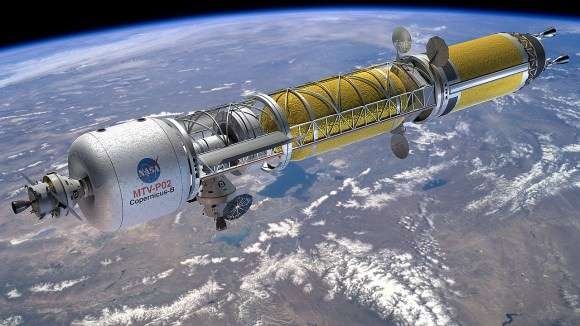
Artist’s concept of a Bimodal Nuclear Thermal Rocket in low Earth orbit.
Credit: NASA
The nuclear power sector is seeing resurgence in innovation, supported by new policies and emerging technologies.
BWX Technologies, Inc. (BWXT) is a major supplier of nuclear components and fuel to the U.S. government. As such, BWXT envisions a path forward in two of the U.S. government’s top priorities: space exploration and national security.
Compact nuclear reactor
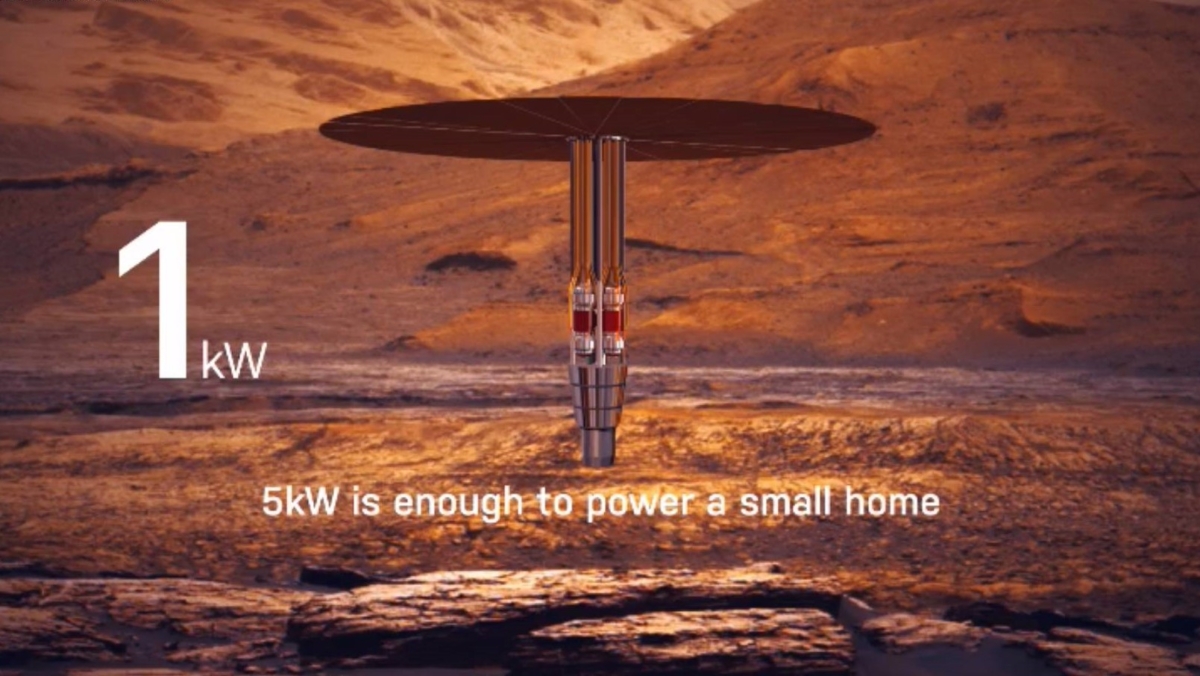
BWXT is currently building a compact nuclear reactor for use by expeditionary crews on Mars and possibly even explore Jupiter’s moons by 2024.
Credit: LANL/NASA
Revolutions in nuclear reactors come at the optimal time as the great power competition evolves into space, according to BWXT.
Go to this story by Rathna Muralidharan — a program director at the Lexington Institute — with a focus on global security. Written for RealClearEnergy at:
For more information on BWXT go to their website at:
https://www.bwxt.com/what-we-do/nuclear-thermal-propulsion-ntp

