Archive for the ‘Space News’ Category
 Author:
  August 12th, 2018

Credit: International Space Exploration Coordination Group (ISECG)
The European Space Agency (ESA) and Russia are working together to investigate the Moon’s resources – specifically water ice and other volatiles at the lunar poles.
Called the Package for Resource Observation and in-Situ Prospecting for Exploration, Commercial exploitation and Transportation (PROSPECT), this package will access and assess potential resources on the Moon and to prepare technologies that may be used to extract these resources in the future.

Credit: ESA
PROSPECT is a lunar drilling and sample analysis package provided by ESA to Russia’s Luna 27 mission, designed to operate at the surface of the Moon in 2022 – 2023, according to ESA. PROSPECT will enter its detailed design (Phase C) at the start of 2019.
ESA on August 10 released an Announcement of Opportunity, open to scientists working in ESA member states, for membership in the PROSPECT science team.

Credit: ESA
The Luna 27 mission is being orchestrated by the Russian Federal Space Agency, Roscosmos, a lander expected to touch down at the Moon’s South Pole–Aitken basin, an unexplored area on the far side of the Moon.
Drill, laboratory
As a package of gear, PROSPECT’s drill is called ProSEED. It will drill beneath the surface in the South Pole region of the Moon and extract samples, expected to contain water ice and other chemicals that can become trapped at the extremely low temperatures expected; typically -150 °C beneath the surface to lower than -200 °C in some areas.

Credit: ESA
Samples taken by the drill will then be passed to a chemical laboratory dubbed ProSPA. Once lunar specimens are in the lab they will be heated to extract cold-trapped volatiles. Thermochemical processes, at temperatures of up to 1000 °C, can then be used to further extract chemical species, including oxygen. This will test processes that could be applied for resource extraction in the future.
Extractability?
Cold-trapped volatiles at the lunar poles are potential resources for human exploration and provide a record of volatiles in the inner Solar System. However, we do not understand their origins, distribution, abundance, extractability, or the processes that put volatiles in place within the Earth-Moon system.

Credit: ESA
A volatile is a substance that changes readily from solid or liquid to a vapor.
Global effort
This investigation is part of a global effort to coordinate prospecting activities at the lunar poles where extreme cold conditions can trap water ice. Space exploration planners see these resources as enabling sustainable space exploration, but much remains unknown.
Luna 27 is part of a grander roster of Moon orbiters, landers, rovers and return sample spacecraft provided by Russia’s Roscosmos.
Reportedly, Luna 25 is planned to be launched very soon, perhaps next year. ESA’s contribution to Luna 25 includes PILOT-D, a demonstrator terrain relative navigation system that acts as a precursor to PILOT, which is the navigation and hazard detection and avoidance system included on Luna 27. Also in the works, Luna 26 in 2022, Luna 27 in 2022-2023, Luna 28 in 2024, and Lunas 29-31 in 2026.
 Posted in

DoD/Screengrab
On June 18, 2018, U.S. President Trump directed the Department of Defense to immediately begin the important process of establishing Space Force as the sixth branch of the armed forces. “I’m hereby directing the Department of Defense and Pentagon to immediately begin the process necessary to establish a space force as the sixth branch of the armed forces.”
Vice President Mike Pence spoke to a Pentagon audience to announce the administration’s plans to stand up a U.S. Space Force and related organizations on Aug. 9, 2018.

VP Pence introduced by Defense Secretary James Mattis.
Credit: DoD/Screengrab
Report issued
The Department of Defense issued a report, pursuant to the National Defense Authorization Act for Fiscal Year 2018, describing the following five actions that can be taken immediately to begin building the Space Force:
- Accelerate space technology and development initiatives, which were modernization priorities laid out in President Trump’s National Defense Strategy;
- Establish a Space Development Agency charged with developing and fielding new next-generation capabilities for national security space development;
- Establish a Space Operations Force of professionals who will form a new community of experts working to lead America’s national security space efforts into the future;
- Establish an operating structure and accountable civilian oversight for Space Force; and
- Create a United States Space Command, a unified combatant command, to improve, evolve, and plan space warfighting.
Private industry
“Space is also invaluable to American private industry, which is developing revolutionary technologies that will utilize space for exploration, resource extraction, and tourism,” noted a White House statement on the Space Force.
“The time has come to establish the United States Space Force,” Pence told a packed Pentagon auditorium.
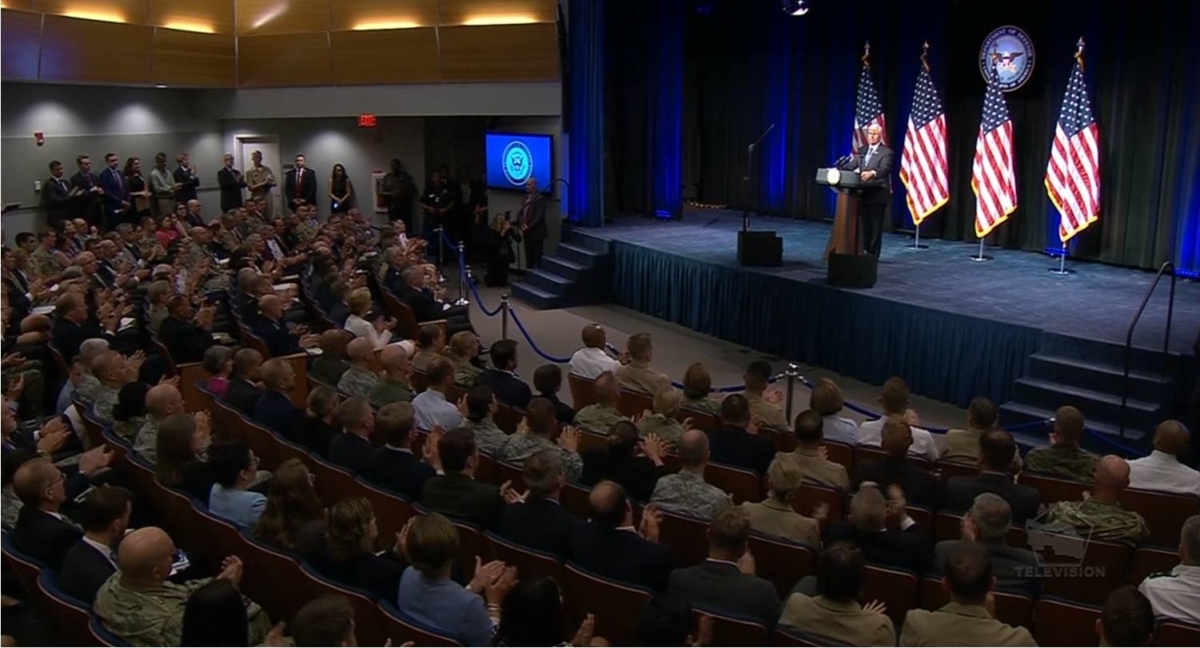
Space Force announcement at packed Pentagon auditorium.
Credit: DoD/Screengrab
The new branch will be separate from, but equal to, the five other branches, the Vice President said. “Creating a new branch of the military is not a simple process,” he noted. “It will require collaboration, diligence and, above all, leadership. As challenges arise and deadlines approach, there must be someone in charge who can execute, hold others accountable, and be responsible for the results.”
Congress: Marshal the resources
Ultimately, Congress must establish the new department, Pence said.
“Next February, in the president’s budget, we will call on the Congress to marshal the resources we need to stand up the Space Force, and before the end of next year, our administration will work with the congress to enact the statutory authority for the space force in the National Defense Authorization Act,” he said.
Final Report on Organizational and Management Structure for the National Security Space Components of the Department of Defense (August 9, 2018)
Go to:
To watch the Vice President’s Space Force speech, go to this video at:
https://www.defense.gov/Videos/videoid/618204/
Also, transcript of remarks by Vice President Pence on the Future of the U.S. Military in Space issued on: August 9, 2018. Go to:
Lastly, go to this policy paper:
Organizing Spacepower: Conditions for Creating a US Space Force
http://docs.wixstatic.com/ugd/a2dd91_2ff8dfe95e694f80b4139d05650843ed.pdf
As well as:
Space Farce? The Challenges of Creating a New Military Department in Just 2 Years: Podcast

Curiosity Front Hazcam Left B photo taken on Sol 2135, August 8, 2018.
Credit: NASA/JPL-Caltech
NASA’s Curiosity rover is now performing Sol 2136 duties.
Sarah Lamm, a planetary geologist at Los Alamos National Laboratory in New Mexico reports that after two sols of analyzing an intended drill site in the Pettegrove Point member, plans are to drill the target “Stoer.”
Stoer has had Mastcam, Mars Hand Lens Imager (MAHLI), Alpha Particle X-Ray Spectrometer (APXS), and Chemistry and Camera (ChemCam) observations acquired over the past two sols.
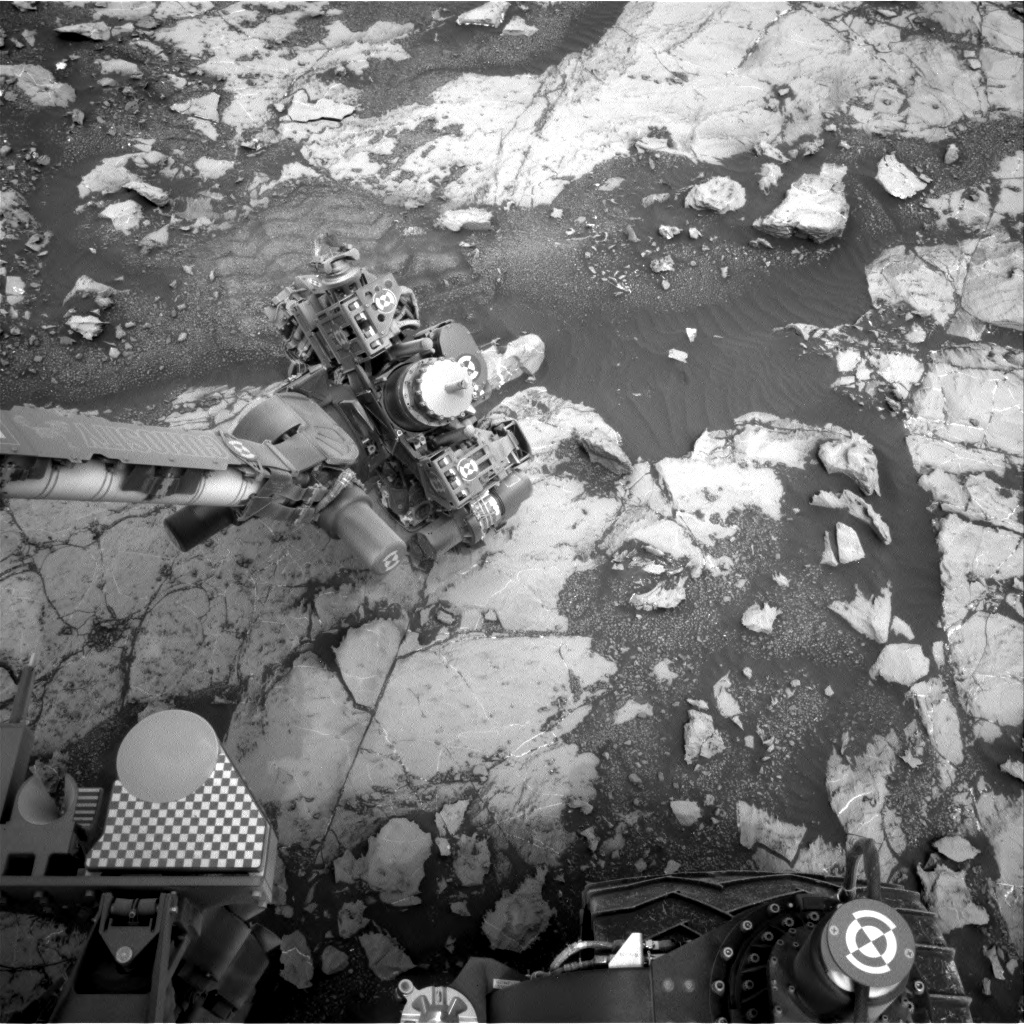
Curiosity Navcam Right B image acquired on Sol 2135, August 8, 2018.
Credit: NASA/JPL-Caltech
Previous attempts
“The two previous drill attempts in this geologic member have not been able to get to successful depth since the rocks have been more resistant than what we saw earlier in the mission,” Lamm explains. “Pettegrove Point is an important area to get a drill sample from because it is categorized as lower Vera Rubin Ridge.”
Curiosity has previously visited this area of Pettegrove Point on Sol 2097. On that sol, the target was “Caithness” close to the new intended drill hole, Stoer.
Other targets
“This is the last drill attempt in Pettegrove Point,” Lamm adds.

Curiosity ChemCam Remote Micro-Imager photo taken on Sol 2135, August 8, 2018.
Credit: NASA/JPL-Caltech/LANL
“Besides drilling Stoer,” Lamm explains, “we have four other targets planned for these two sols.” The plan calls for one ChemCam target named “Glen Brittle,” and three Mastcam targets named “Belhelvie,” “Camas Mor,” and “Sandray.”

Mastcam Left image taken on Sol 2134, August 7, 2018.
Credit: NASA/JPL-Caltech/MSSS
Data backlog
Lamm adds that Curiosity data is currently backlogged.
“The downlink data is slowly trickling in, but uplink operations have not been slowed down. We still have enough information from the rover’s current location to send commands to the rover. Hopefully we can get all of the backlogged data soon and get caught up again,” Lamm concludes.

Blue Origin is one of six companies selected for NASA’s Tipping Point solicitation. Pictured here, Blue Origin’s New Shepard rocket lifted off July 18 carrying five NASA-supported technologies to flight test in space.
Credit: Blue Origin
Here’s an upshot from Blue Origin work in landing the group’s New Shepard suborbital rocketry.
NASA has announced new partnerships to develop space exploration technologies.
A new award to Blue Origin is to advance sensor technologies to enable landing anywhere on the Moon’s surface.
This project will mature critical technologies that enable precision and soft landing on the Moon.
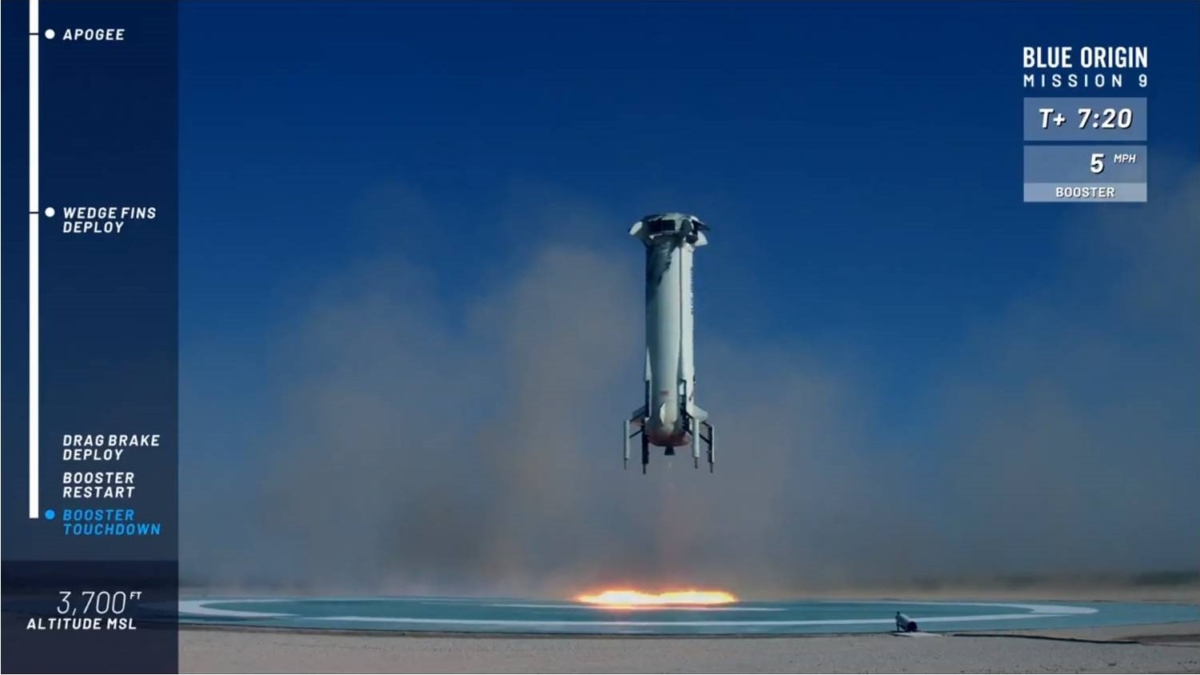
Credit: Blue Origin/Screengrab
Navigation sensor work
The project team will integrate Terrain Relative Navigation (TRN), navigation doppler lidar, and altimetry sensors and conduct flight tests prior to lunar mission Pimplementation.
Testing will be performed at approximately 100 km altitude on board the Blue Origin New Shepard vertical takeoff vertical landing suborbital vehicle that has already undergone multiple test flights. The resulting sensor suite would exercise the ability to make precision landing anywhere on the lunar surface.
Ostensibly , this new award fits well within Blue Origin’s Blue Moon plans – an effort by the group to prepare the Earth’s Moon for an Amazon.com-like delivery service to the lunar surface, furthering the permanent settlement of humans on the lunar landscape.
Tipping point .
Blue Origin was one of six companies selected for NASA’s Tipping Point solicitation announced today.
According to a NASA statement, a technology is considered at a “tipping point” if investment in a ground or flight demonstration will result in significantly maturing the technology and improving the company’s ability to bring it to market.

Commercial TRN
Similarly, Astrobotic will lead a public-private partnership team that includes Moog Space and Defense, Moog Broad Reach, NASA Jet Propulsion Laboratory (JPL), and NASA Johnson Space Center (JSC) to develop a commercial TRN and visual velocimetry sensor for lunar and planetary landers.
The sensor will provide real-time vision-based navigation measurements, enabling a spacecraft to autonomously land within 100 meters of any destination on a mapped planetary surface.
This level of precision is orders of magnitude better than conventional landing systems, according to a statement by Astrobotic.

Astronaut Bob Behnken emerges from the top hatch of a new SpaceX Crew Dragon capsule at the company’s headquarters and factory in California. Astronaut Eric Boe (left) observes.
Credit: SpaceX/NASA
For the first time since NASA retired its space shuttle fleet in 2011, American astronauts will once again launch to the International Space Station from U.S. soil.
The U.S. space agency on August 3 named the teams of astronauts who will fly aboard the first “commercial crew missions” to and from low Earth orbit.

From left: Eric Boe, Nicole Mann, Chris Ferguson
New spacecraft
This time, it won’t be NASA providing the ride to space. Private companies SpaceX and Boeing have developed new spacecraft, the Crew Dragon and Starliner, respectively. Both are designed to launch from Kennedy Space Center in Florida to the space station, which orbits about 400 kilometers above the planet.
At an event announcing the newest commercial crew astronauts, space agency leader Jim Bridenstine said investment in NASA has kept America the leader in space. From the way we communicate to the way we produce food, “space has transformed the lives of not only every American, but every person on the face of the planet in so many ways that people usually don’t even recognize it,” he said.

Bob Behnken (left) and Doug Hurley
Credit: SpaceX/NASA
2019: target dates
Target dates for the new spacecraft are next year: SpaceX’s Crew Dragon is expected to launch with astronauts in April, and the Boeing Starliner is looking to launch in mid-2019.
For Starliner’s first crewed flight in mid-2019, Eric Boe, Nicole Aunapu Mann and Christopher Ferguson will put the craft through its paces. Boe and Ferguson flew on the space shuttle, and Mann is a U.S. Marine Corps pilot preparing for her first flight in space.
“As a test pilot, it doesn’t get any better than this,” she said.
More automation
Veteran astronauts Bob Behnken and Doug Hurley will pilot the first crewed mission of the SpaceX Crew Dragon. Behnken said he’s excited about the cutting-edge software on the spacecraft. In the space shuttle, with its thousands of controls, “there was no situation that the astronauts couldn’t make worse by touching the wrong switch at the wrong time,” Behnken said. The Crew Dragon incorporates much more automation.
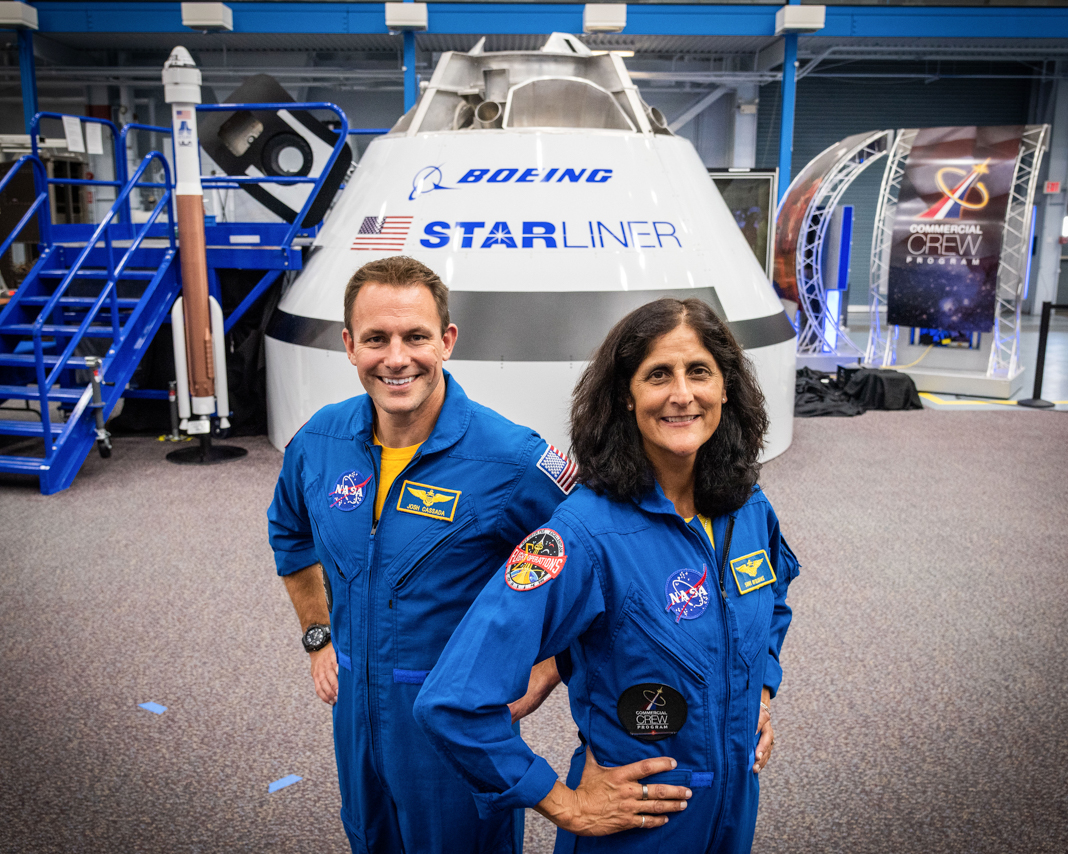
Josh Cassada (left) and Suni Williams
Credit: Boeing/NASA
Starliner: first mission
Josh Cassada and Suni Williams both have backgrounds as U.S. Navy test pilots.
Cassada joined the astronaut corps in 2013, when astronauts expected to fly to the International Space Station on Russia’s Soyuz rockets. “I’m sure that there’s at least one Russian-language instructor out there who thinks that having me fly on a U.S. vehicle is not a terrible idea,” he quipped. Williams said she is excited about showing off the spacecraft to international partners. “There’s a lot to be done, and we’re just the beginning,” she said.

Victor Glover (left) and Mike Hopkins
Credit: SpaceX/NASA
Dragon to ISS
Astronauts Victor Glover and Michael Hopkins will lead SpaceX’s first full mission to the International Space Station. Glover, who has flown more than 40 different aircraft for the U.S. Navy, said he is honored to be a part of a new chapter of American spaceflight. “This is the stuff of dreams,” he said.

The first U.S. astronauts who will fly on American-made, commercial spacecraft to and from the International Space Station, wave after being announced, Friday, Aug. 3, 2018 at NASA’s Johnson Space Center in Houston, Texas. The astronauts are, from left to right: Victor Glover, Mike Hopkins, Bob Behnken, Doug Hurley, Nicole Aunapu Mann, Chris Ferguson, Eric Boe, Josh Cassada, and Suni Williams. The agency assigned the nine astronauts to crew the first flight tests and missions of the Boeing CST-100 Starliner and SpaceX Crew Dragon.
Credit: NASA/Bill Ingalls
Note: Adapted from story written by Michael Buchanan/ShareAmerica, U.S. Department of State

Mars 2020 rover is a first step in bringing back specimens from the Red Planet to Earth.
Credit: NASA/JPL
A new sweeping assessment from the National Academies regarding future space exploration planning has noted its concern about the aging infrastructure orbiting Mars, which is vital for communicating with the landers and rovers, on the surface of the Red Planet.
NASA currently operates Mars Odyssey, Mars Reconnaissance Orbiter (MRO), and Mars Atmosphere and Volatile Evolution mission (MAVEN) around Mars, all of which have exceeded their design lifetimes. In addition to performing science, these missions also provide vital telecommunications support with surface assets.

Old, but still on duty: Mars Reconnaissance Orbiter yields unmatched views of layered materials, gullies, channels, and other science targets and also characterizing possible future landing sites for robotic and human missions.
Credit: NASA
The loss of one or more of these spacecraft could make it difficult for NASA to support the return of samples from the surface of Mars, the report explains.
Technologically difficult
NASA’s Mars 2020 rover is to collect samples for eventual return to Earth, but the return portion of that effort will be technologically difficult. The committee concluded that the space agency’s Planetary Science Division’s Mars sample return technology development plan is on the right track, and endorsed its proposed “focused Mars sample return” strategy.
The report also notes that going forward beyond Mars 2020, NASA is focused entirely on sample return.

NASA Mars 2020 rover is designed to collect samples, store the specimens in tubes, then deposit the tubes on the surface for later pick-up.
Credit: NASA/ESA
“There is currently no vision for a program beyond sample return, either for scientific investigation or to prepare for future human exploration,” the report advises.
Wanted: strategic plan
NASA’s Mars Exploration Program “has not yet put forward a complete architecture and attendant strategic plan that addresses the long-term goals of Mars exploration and optimizes science return across the spectrum of past, current, and future missions,” the report states.

Credit: NASA
While Mars plans are evaluated, the Academies report looks at a wide array of planetary science missions, including investigation of Europa and other worlds, and the needed technological developments necessary to further NASA’s exploration agenda.
To read the entire report and recommendations — “Visions into Voyages for Planetary Sciences in the Decade 2013-2022: A Midterm Review” — go to:
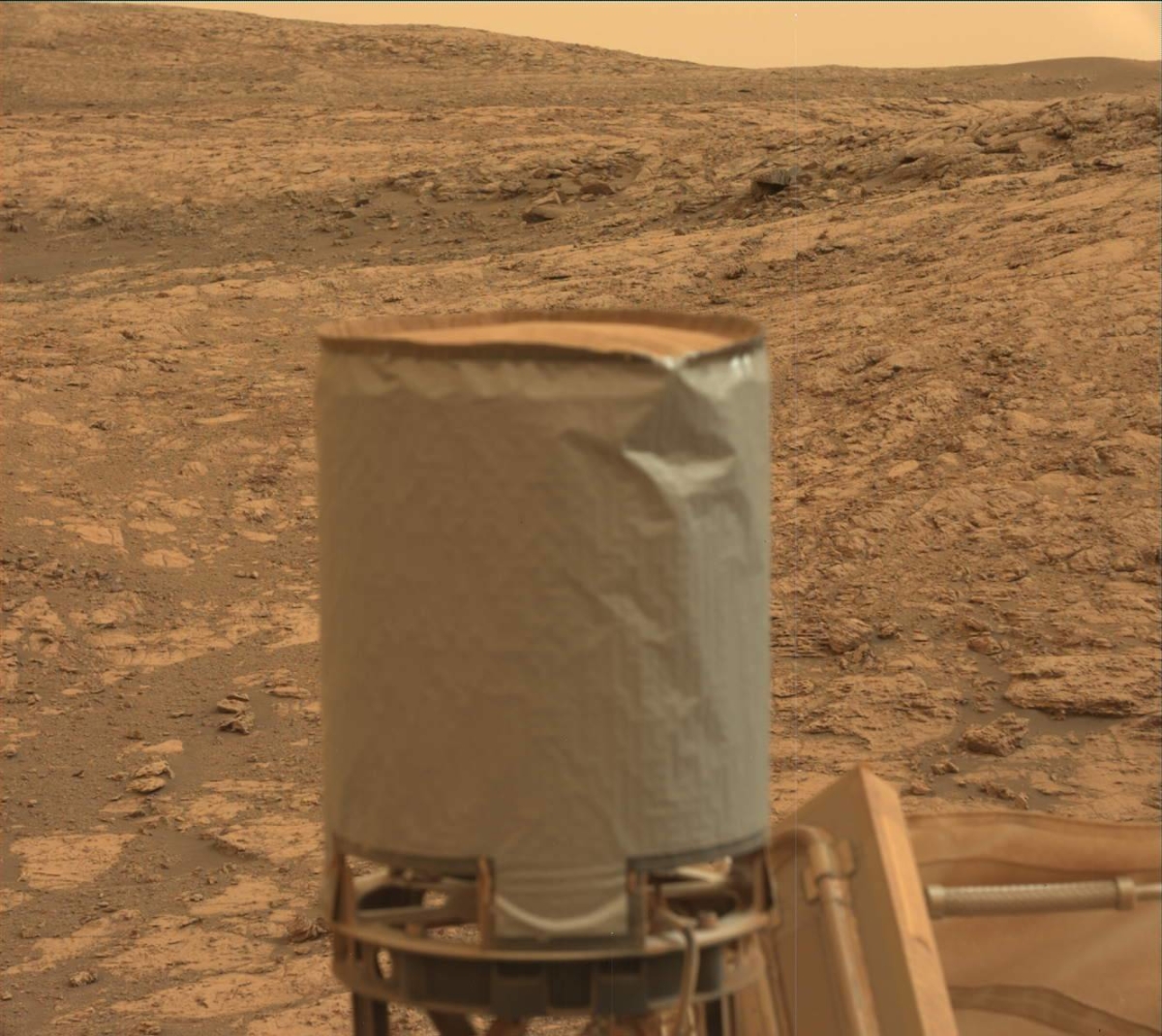
Curiosity Mastcam Left image acquired on Sol 2132, August 5, 2018.
Credit: NASA/JPL-Caltech/MSSS
Now in Sol 2134 Third time’s a charm? That’s the question posed by Rachel Kronyak, a planetary geologist at the University of Tennessee in Knoxville.
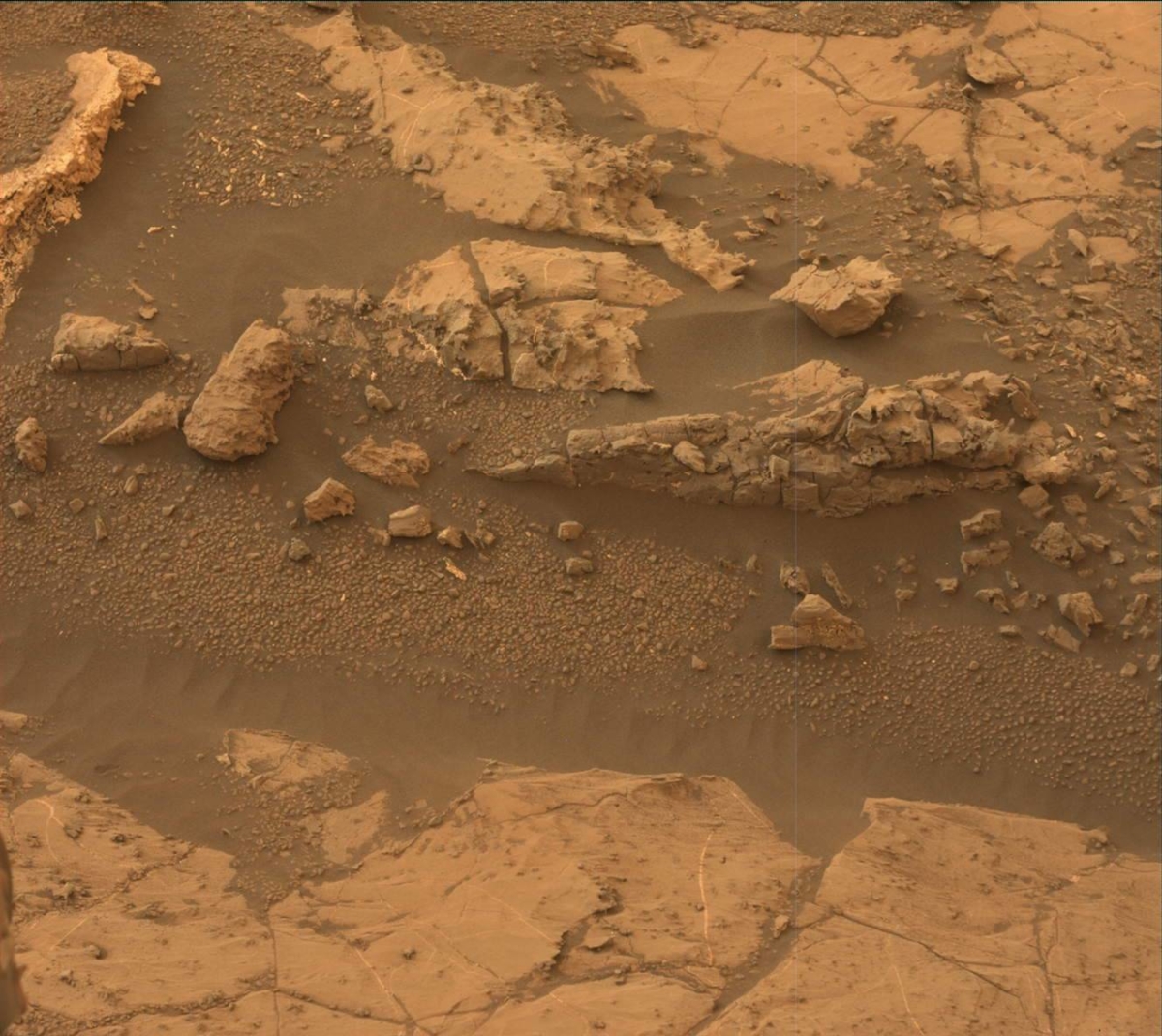
Curiosity Mastcam Left image acquired on Sol 2132, August 5, 2018.
Credit: NASA/JPL-Caltech/MSSS
“After a weekend full of contact science, remote science, and driving, Curiosity arrived at her next drill site within the Pettegrove Point member,” Kronyak adds. “Our previous two drilling attempts within the Pettegrove Point member haven’t been as successful as we’d have hoped; the rocks in this area are much harder than we’re used to – all the more reason to acquire and analyze a drill sample. We’re hopeful that our third drilling attempt does the trick!”
Drilling campaign
Curiosity planning for two sols was to kick off the robot’s drilling campaign.

Curiosity Mars Hand Lens Imager (MAHLI) photo acquired on Sol 2132, August 5, 2018.
Credit: NASA/JPL-Caltech/MSSS
On Sol 2134, the schedule calls for performing triage contact science observations to document the new drill target which has been named “Stoer.”
First the robot’s Dust Removal Tool (DRT) is to brush away some of the surface dust over Stoer before imaging it with the Mars Hand Lens Imager (MAHLI) camera and performing chemical analyses with the Alpha Particle X-Ray Spectrometer (APXS) instrument.

Curiosity Mars Hand Lens Imager (MAHLI) photo acquired on Sol 2132, August 5, 2018.
Credit: NASA/JPL-Caltech/MSSS
Stable rock?
“To prepare for drilling, we’ll then perform a ‘pre-load’ test, where we position the drill in contact with the Stoer rock surface and press down,” Kronyak points out. “This allows our mission engineers to verify that the rock is stable enough for drilling.”
Later in the afternoon, researchers will assess the Stoer area with a Mastcam mosaic and perform environmental monitoring observations with Navcam. They will then place the APXS instrument on Stoer overnight to get a long chemical observation.
Environmental observations
On Sol 2135, the script calls for a suite of remote science observations, including Rover Environmental Monitoring Station (REMS), Dynamic Albedo of Neutrons (DAN), and Navcam atmospheric observations.
After Curiosity’s robotic arm is moved out of the way, Kronyak explains that the rover is to perform two Chemistry and Camera (ChemCam) laser-induced breakdown spectroscopy (LIBS) analyses: one on Stoer, the other on the target “Strontian,” a nearby darker gray bedrock target.
“We’ll document both targets with Mastcam images and use additional camera filters to analyze Stoer; we call this observation a “multispectral” observation,” Kronyak notes.
That Sol ends with a Sample Analysis at Mars (SAM) Instrument Suite electrical baseline test (EBT), which is periodically performed to monitor the SAM instrument’s electrical functions.

Credit: NASA/JPL-Caltech/Univ. of Arizona
New road map
Meanwhile, a new Curiosity traverse map through Sol 2132 has been issued.
The map shows the route driven by NASA’s Mars rover Curiosity through the 2132 Martian day, or sol, of the rover’s mission on Mars (August 06, 2018).
Numbering of the dots along the line indicate the sol number of each drive. North is up. The scale bar is 1 kilometer (~0.62 mile).
From Sol 2128 to Sol 2132, Curiosity had driven a straight line distance of about 12.50 feet (3.81 meters), bringing the rover’s total odometry for the mission to 12.18 miles (19.60 kilometers).
The base image from the map is from the High Resolution Imaging Science Experiment Camera (HiRISE) in NASA’s Mars Reconnaissance Orbiter.

Curiosity Front Hazcam Left B image taken on Sol 2132, August 5, 2018.
Credit: NASA/JPL-Caltech
NASA’s Curiosity Mars rover is now performing Sol 2133 duties.
Curiosity is ready to bump to a new drill site in the Pettegrove Point member, but not before gathering many observations at the rover’s current location.

Curiosity Navcam Right B photo taken on Sol 2132, August 5, 2018.
Credit: NASA/JPL-Caltech
Reports Vivian Sun, a planetary geologist at NASA/JPL in Pasadena, California: “There are interesting color variations in today’s workspace, with grey, tan, and red gradients across the outcrop.”
The robot is set to document these color variations in detail with images from Mastcam and the Mars Hand Lens Imager (MAHLI) and chemical measurements from the Chemistry and Camera (ChemCam) and Alpha Particle X-Ray Spectrometer (APXS) instruments.

Curiosity Navcam Left B photo acquired on Sol 2132, August 5, 2018.
Credit: NASA/JPL-Caltech
“This is a lot of data to relay, but we expect downlinks from both the Mars Odyssey and the ExoMars Trace Gas Orbiter spacecrafts” – an action that was to take place over last weekend, Sun adds.
Laser shots
On Sol 2131, the geology theme group planned ChemCam measurements of the targets “Shiant Isles” and “Inchnadamph,” which are grey-toned rocks.
“The observation on Inchnadamph is especially interesting because ChemCam will shoot two sets of 150 laser shots into the rock to see if there are chemical variations with depth,” Sun points out. The APXS instrument will also make chemical measurements on a darker grey target “Mount Battock” and a lighter grey target “Scourie More,” in addition to a red target “Dobbs Linn” which will be brushed beforehand with the Dust Removal Tool (DRT).
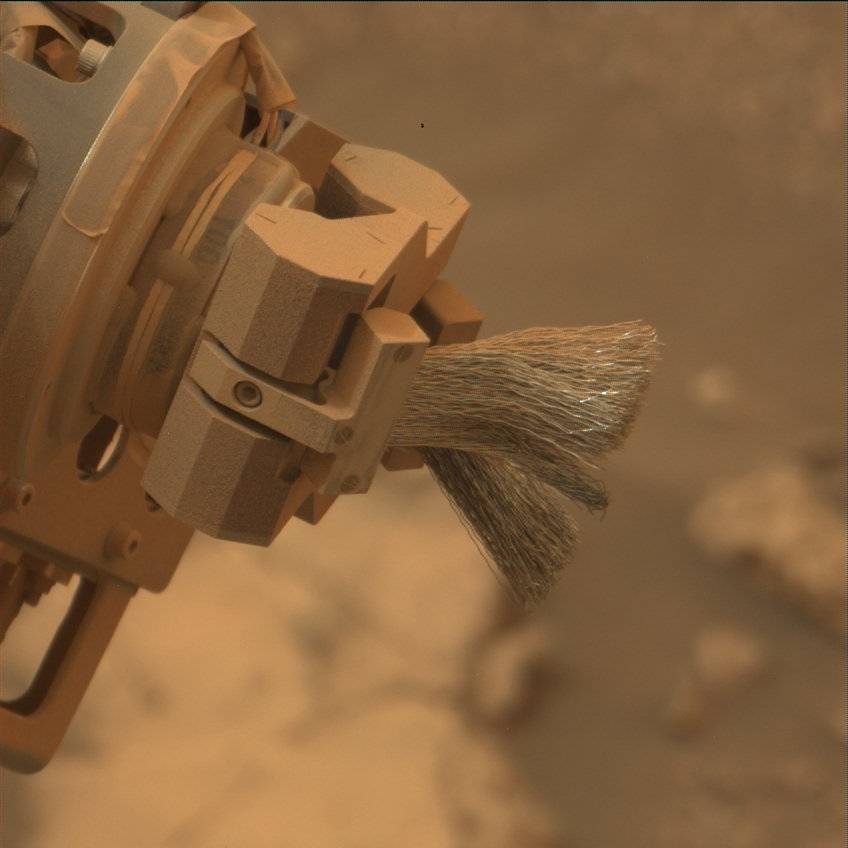
Curiosity Mastcam Right image taken on Sol 2131, August 4, 2018.
Credit: NASA/JPL-Caltech/MSSS
All of these targets will be documented with high-resolution Mastcam and MAHLI images.
Color variations
On Sol 2132, Curiosity is scheduled to acquire a Mastcam multispectral observation of all these targets to enable a detailed assessment of these color variations. Mastcam will also image the “Bullers of Buchan” target, which is an outcrop that may expose layering and nodules. Curiosity will then drive a few meters to our drill site.
Sun reports that Sol 2133 is packed with three science blocks filled with activities from the environmental theme group: Mastcam tau and crater rim extinction observations, Navcam zenith, suprahorizon, and dust devil movies, and Navcam line of sight observations. Curiosity will also make ChemCam passive measurements and an APXS atmospheric measurement.
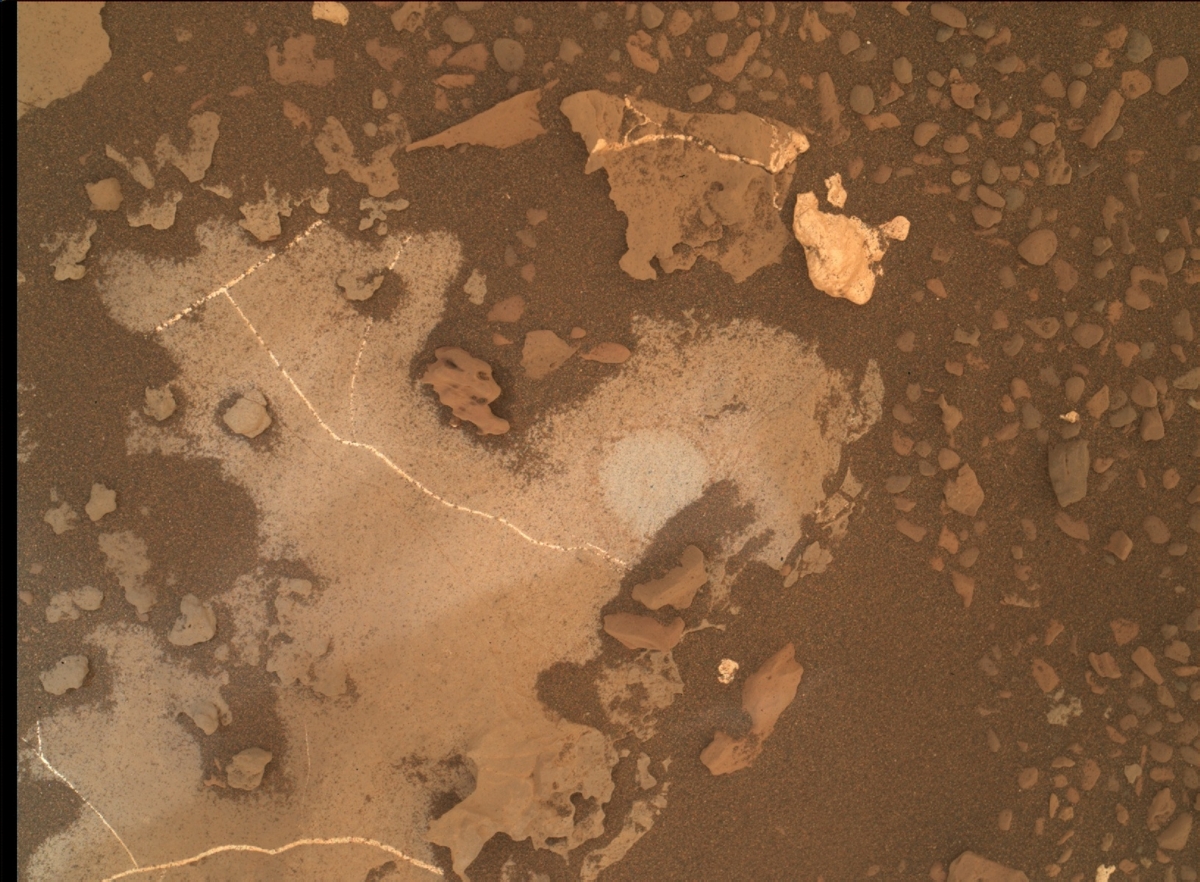
Curiosity Mars Hand Lens Imager (MAHLI) image produced on Sol 2132, August 5, 2018.
Credit: NASA/JPL-Caltech/MSSS
“All of these observations will help with our ongoing monitoring of the atmosphere as the dust storm settles,” Sun concludes. “After all of this, we look forward to seeing our drill workspace on Monday!”
Credit: Euroconsult
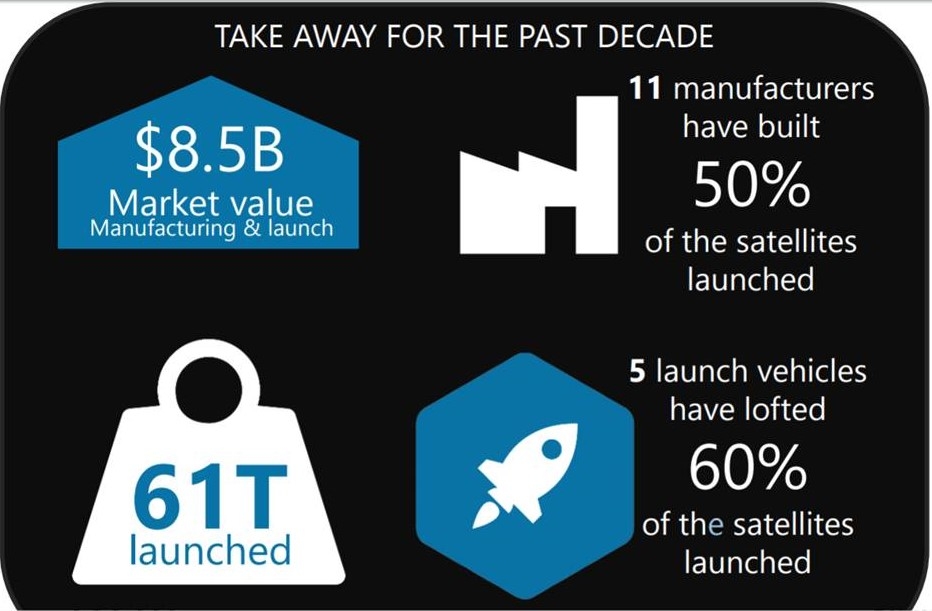
About 7,000 smallsats are due to be launched over the next ten years, i.e. a six-fold increase from the 1,200 units launched over the past decade. About 50 constellations, two of which are mega constellations, account for over 80% of the smallsat count.
That’s the news from Euroconsult, an independent, privately-owned firm.
Other revelations in their assessment include:
- By 2022, an average of 580 smallsats will be launched every year as a result of initial constellation deployment
- The average will then jump to 850 satellites per year on subsequent years up to 2027 because of the deployment of one mega constellation
- Smallsats are now able to perform missions that were only achievable in the past by satellites heavier that 500 kilograms
- Broadband communication is by far the largest application with close to 3,500 satellites expected from 2018 to 2027 (of which 92% for two mega constellations)
- Earth observation will almost triple, from 540 satellites in the past to 1,400 anticipated from 2018 to 2027. Three constellations alone plan to launch more than 800 satellites during this period, of which two are cubesat-based
- The 7,000 smallsats that are due to be launched over 2018-2027 are valued at $38 billion for satellite manufacturing and launch, almost a quintupling decade-to-decade
- The launch services of smallsats are expected to generate $16 billion in the next ten years i.e. strong growth over that of the past decade
For more information on this appraisal by Euroconsult, go to:
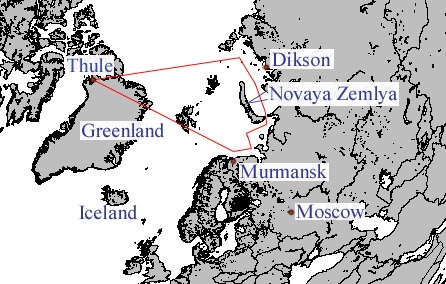
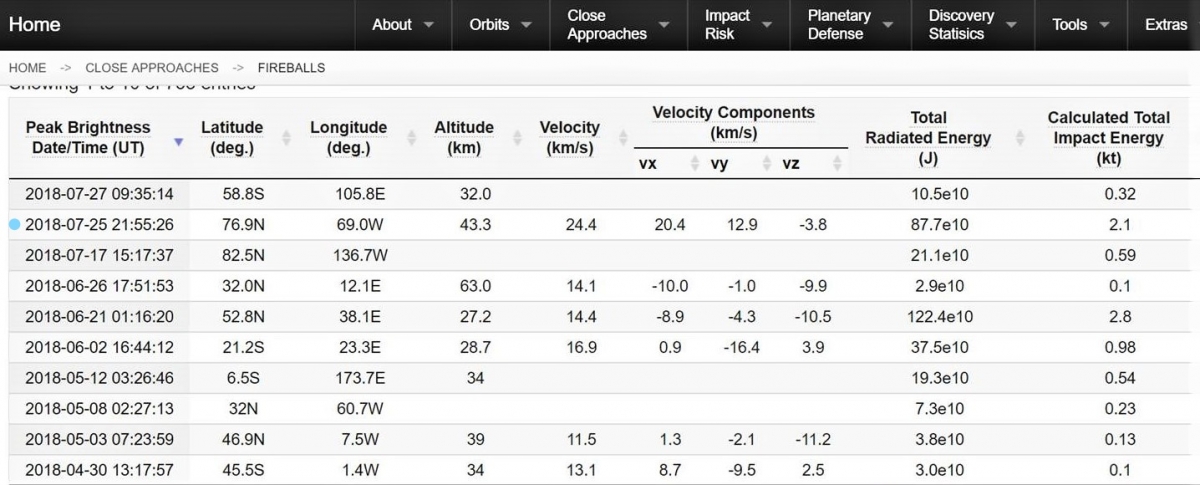
Report: Meteor made 2.1 kiloton explosion over Air Force Space Command Base, Thule, Greenland on July 25, 2018. The high-altitude explosion at 27 miles (43.3 kilometers) was detected by US Government sensors at an altitude of 43.3 km.
The Jet Propulsion Laboratory’s Center for Near Earth Object Studies lists the incident in its Fireball and Bolide Data section.
21st Space Wing
Thule Air Base is home to the 21st Space Wing’s global network of sensors providing missile warning, space surveillance and space control to North American Aerospace Defense Command and Air Force Space Command.

Credit: JPL Center for Near Earth Object Studies
Thule Air Base is the United States Department of Defense’s northernmost installation at (76 32′ North latitude, 68 50′ West longitude) located 750 miles north of the Arctic Circle, and 947 miles south of the North Pole on the northwest side of the island of Greenland. It is approximately 550 miles east of the North Magnetic Pole.
Go to this informative report by The Aviationist at:

