Archive for the ‘Space News’ Category
 Author:
  August 21st, 2018
Lunar ice exposures (black dots) and cold traps not showing ice (cyan circles)
Credit: Shuai Li, et al.
The view that Earth’s Moon is a foreboding, dried out, desolate world may be all wet.
The first direct and definitive evidence for surface-exposed water ice in areas of permanent shadow at the moon’s polar regions is being claimed by a research team.

NASA’s Moon Mineralogy Mapper, or M3, instrument flew aboard Chandrayaan-1, India’s first mission to the moon, and provided the first mineralogical map of the lunar surface.
Credit: NASA/JPL
The finding is based on detection of near-infrared absorption features of water ice in reflectance spectra acquired by NASA’s Moon Mineralogy Mapper (M3) instrument. It flew as part of the scientific payload onboard the Indian Space Research Organization’s Chandrayaan-1 spacecraft that circuited the moon in 2008-2009.
Check out my new Scientific American article that details the new finding and its significance. Go to:
Beyond the Shadow of a Doubt, Water Ice Exists on the Moon – Deposited in perpetually dark craters around the poles, the ice could be a boon for future crewed lunar outposts
 Posted in

Credit: NASA/JPL-Caltech/MSSS
Recent Curiosity Mars images of a “foreign object” on Vera Rubin Ridge show it moved from spot to spot. But why and what is it?
It’s an alien gum wrapper or a Martian band-aid, declared a few observers. “Now I know where my lost sock went,” decried one Mars photo onlooker.

Credit: NASA/JPL-Caltech/MSSS
Spacecraft debris?
Reported a few days ago, Brittney Cooper, an atmospheric scientist working on the Curiosity mission from York University in Toronto, Canada, identified the “Pettegrove Point Foreign Object Debris” (PPFOD).
At first, it was speculated, Cooper said, to be a piece of spacecraft debris. In fact the object has been identified as a very thin flake of rock. “We can all rest easy tonight,” Cooper added, “Curiosity has not begun to shed its skin!”
“I can simply say that the foreign object debris (FOD) was confirmed to be a rock with further analysis,” Brittney Cooper told Inside Outer Space.
Rock fragment
But the quarry quandary is that this object did definitely move across the Martian surface. Why?
“The rock fragment was not present when we were in the area around Sol 2095. The rock fragment was still not there when we returned to the area a few weeks later on Sol 2130. It was present after the final drive to the drill target on Sol 2132,” said Ashwin Vasavada, the Jet Propulsion Laboratory’s project scientist for Mars Rover Curiosity.

ChemCam: Remote Micro-Imager photo.
Credit: NASA/JPL-Caltech/LANL
During drilling, the fragment, thought to be FOD at the time, “was predicted to move, since previous drilling attempts all showed movement of small pebbles due to vibration from the percussive drilling,” Vasavada said.
The dimensions of the rock were estimated to be 8 millimeters by 20 millimeters, 0.3 – 0.8 inches.
Not wind
Mars researchers intentionally delayed close-up imaging and use of the robot’s Chemistry and Camera’s Laser-Induced Breakdown Spectrometer (LIBS) Vasavada said, until after drilling because of this.
“It did move, as expected, but not from wind,” said Vasavada in information provided to Inside Outer Space. “It appears to be a fragment of rock that has a typical appearance and composition to other rocks encountered on the ridge,” he said.

Wu Weiren, chief designer of the lunar exploration program, presents the Chang’e-4 rover.
Credit: CCTV/Screengrab
The rover for China’s Chang’e-4 lunar mission was presented in Beijing on August 14. 2018.

Credit: CCTV/Screengrab
The Chang’e-4 lunar mission — lander and rover — is scheduled to launch in December 2018 and will land in the Aitken crater, located in the Aitken Basin, in the South Pole region on the far side of the Moon, according to China Central Television (CCTV).
Reliability improvements
Wu Weiren, chief designer of the lunar exploration program, presented the rover. Wu said that the rover is modeled after the Yutu rover that was dispatched by the Chang’e-3 lander in December 2013.
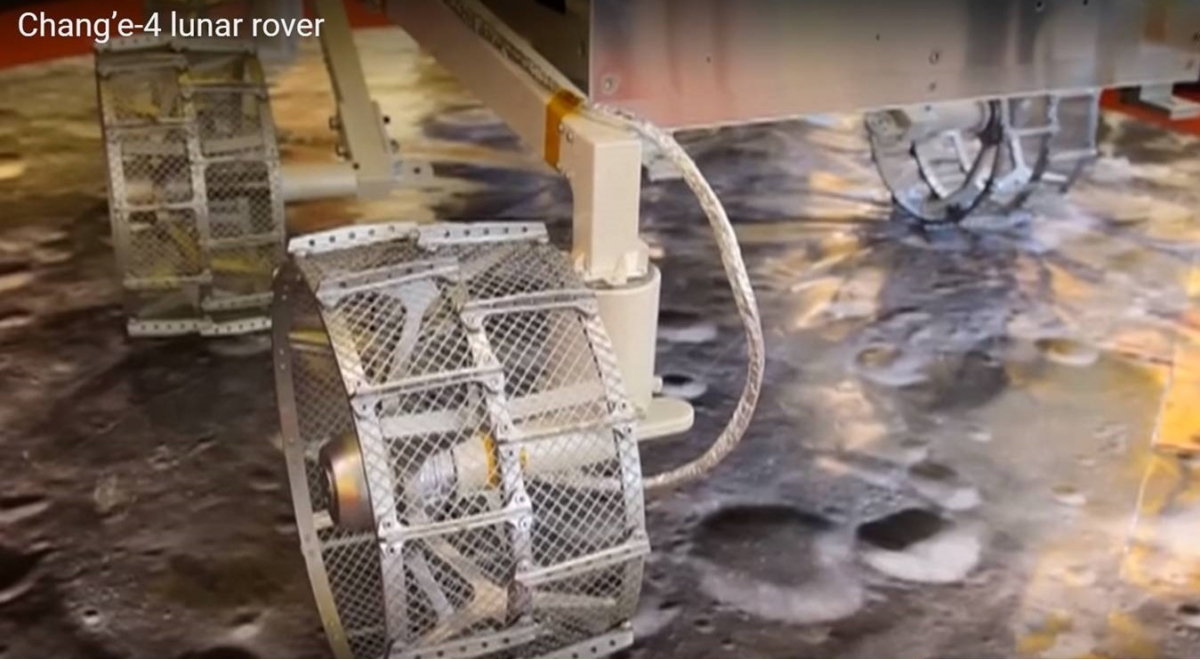
Close-up of Chang’e-4 rover wheel, one of six on the Moon machinery.
Credit: CCTV/Screengrab
“We have made great efforts to improve its reliability,” Wu said, “even conducting over 1,000 tests to make sure it can operate in the long-term on the Moon while protecting itself from the stones and gullies there.”

Apollo 17 image of Aitken Crater that defines the northern rim of the South Pole-Aitken basin.
Credit: NASA/JSC/Arizona State University
Crater info
Aitken crater is about 84 miles (135 kilometers) in diameter.
It is located on the northern rim of the South Pole-Aitken Basin, the largest preserved basin on the Moon. The crater has a central peak and much of its original floor has been buried by younger rock.
Go to this China Central Television (CCTV) video showing the presentation of the Change’-4 rover.
https://www.youtube.com/watch?v=yUjHTYtcxcQ&list=PLpGTA7wMEDFjz0Zx93ifOsi92FwylSAS3&t=0s&index=2

The U.S. Department of Defense’s 2018 report to Congress on Military and Security Developments Involving the People’s Republic of China has been issued, an annual look that includes a review of China’s space prowess.
In the report several sections deal with China’s space activities, a program that “continues to mature rapidly,” the document notes.
China’s People’s Liberation Army (PLA) has historically managed the country’s space effort, and continues to invest in improving its capabilities in space-based intelligence, surveillance and reconnaissance (ISR), satellite communication, satellite navigation, and meteorology, as well as human spaceflight and robotic space exploration.
China has built an expansive ground support infrastructure to support its growing on-orbit fleet and related functions including spacecraft and space launch vehicle manufacture, launch, command and control, and data downlink.
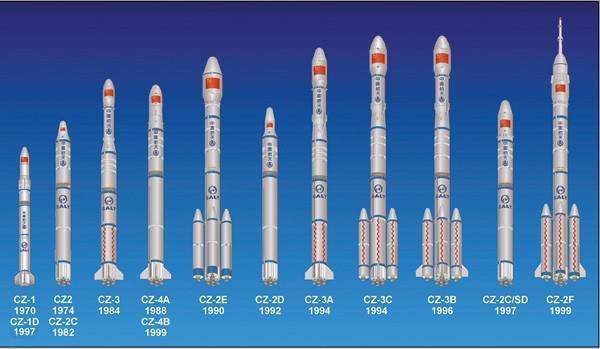
China is building upon a heritage of Long March boosters.
Credit: CALT
Degrade and deny
China is developing multiple counterspace capabilities, the report states, “to degrade and deny adversary use of space-based assets during a crisis or conflict.”
PLA strategists regard the ability to use space-based systems – and to deny them to adversaries – as “central to modern warfare,” the report observes. “The PLA continues to strengthen its military space capabilities despite its public stance against the militarization of space.”
According to the Pentagon report, space operations are viewed as a key enabler of PLA campaigns aimed at countering third-party intervention, although PLA doctrine has not elevated them to the level of a separate “campaign.”
Real-time surveillance
China seeks to enhance Command & Control (C2) in joint operations and establish a “real-time” surveillance, reconnaissance, and warning system and is increasing the number and capabilities of its space systems, including various communications and intelligence satellites and the Beidou navigation satellite system.
“China also continues to develop counterspace capabilities, including kinetic-kill missiles, ground-based lasers, and orbiting space robots,” the new report explains, “as well as to expand space surveillance capabilities that can monitor objects across the globe and in space and enable counterspace actions.”
China’s development of quantum satellites are also highlighted. The country’s priorities include “unconditional security of network data across long distances, ultimately creating a global quantum network of classical (i.e., non-quantum) data secured by quantum cryptographic keys,” the report says.
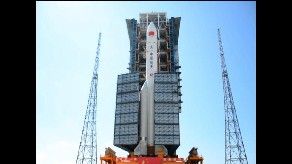
Credit: CCTV-Plus
Launch failures
In 2017, China launched 18 space launch vehicles, of which 16 were successful, orbiting some 31 spacecraft, including communications, navigation, ISR, and test/engineering satellites.
Other activities highlighted in the Pentagon report include space launch failures.
In 2017, China suffered two SLV failures within two weeks, creating significant delays in China’s national space program, according to key government officials.

Credit: China Manned Space Agency
A Long March (LM)-3B partially failed due to faulty guidance, navigation, and control. A Long March-5 (LM-5) launch then catastrophically failed due to a manufacturing defect.
The LM-5 is to become China’s new heavy-lift SLV, launching up to 25,000 kg into low Earth orbit and will play an important role in the assembly of the Chinese Space Station starting around 2018.
To read the full report — Military and Security Developments Involving the People’s Republic of China – go to:
https://media.defense.gov/2018/Aug/16/2001955282/-1/-1/1/2018-CHINA-MILITARY-POWER-REPORT.PDF

Curiosity Mastcam Right image taken on Sol 2139, August 13, 2018
Credit: NASA/JPL-Caltech/MSSS
Reports Brittney Cooper, an atmospheric scientist from York University in Toronto, Canada: Identified as the “Pettegrove Point Foreign Object Debris” (PPFOD), it was speculated to be a piece of spacecraft debris. In fact the object has been identified as a very thin flake of rock.
“We can all rest easy tonight,” Cooper explains, “Curiosity has not begun to shed its skin!”
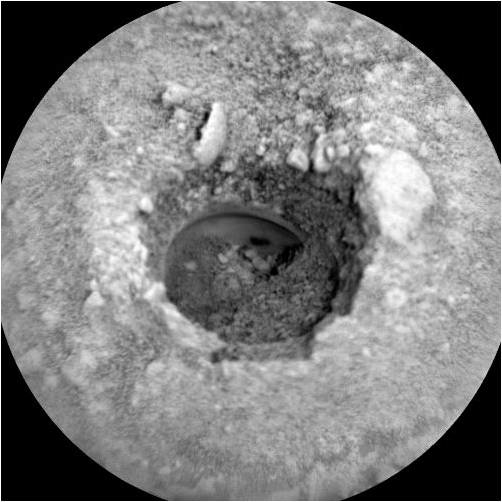
Curiosity ChemCam Remote Micro-Imager photo acquired on Sol 2142, August 15, 2018.
Credit: NASA/JPL-Caltech/LANL
NASA’s Curiosity Mars rover has just begun Sol 2143 operations.
Work is underway on the recent Stoer drill sample says Ashley Stroupe, a mission operations engineer at NASA/JPL in Pasadena, California, in a recent report.
The main activity is the drop-off of sample to the Chemistry & Mineralogy X-Ray Diffraction/X-Ray Fluorescence Instrument (CheMin), based on the characterization of the drop-off portion size done last weekend.

Curiosity Mastcam Left photo taken on Sol 2141, August 14, 2018.
Credit: NASA/JPL-Caltech/MSSS
Sample drop-off
Stroupe notes that care was to be taken in CheMin sample drop-off as there’s still a good bit of wind, so the drop-off was to take place around noon on Mars, during the calmest time.
A recent plan had Curiosity’s set to analyze the sample. Results from that action were to reach Earth late yesterday. That data can then inform decisions about dropping off sample material to the robot’s Sample Analysis at Mars (SAM) Instrument Suite “as early as this weekend’s plan for analysis early next week,” Stroupe adds.
Dust storm abating
Meanwhile, Curiosity was to continue atmospheric observations to monitor the dust storm “as it continues to abate,” Stroupe points out, with dust devil surveys, and zenith and horizon opacity imaging.
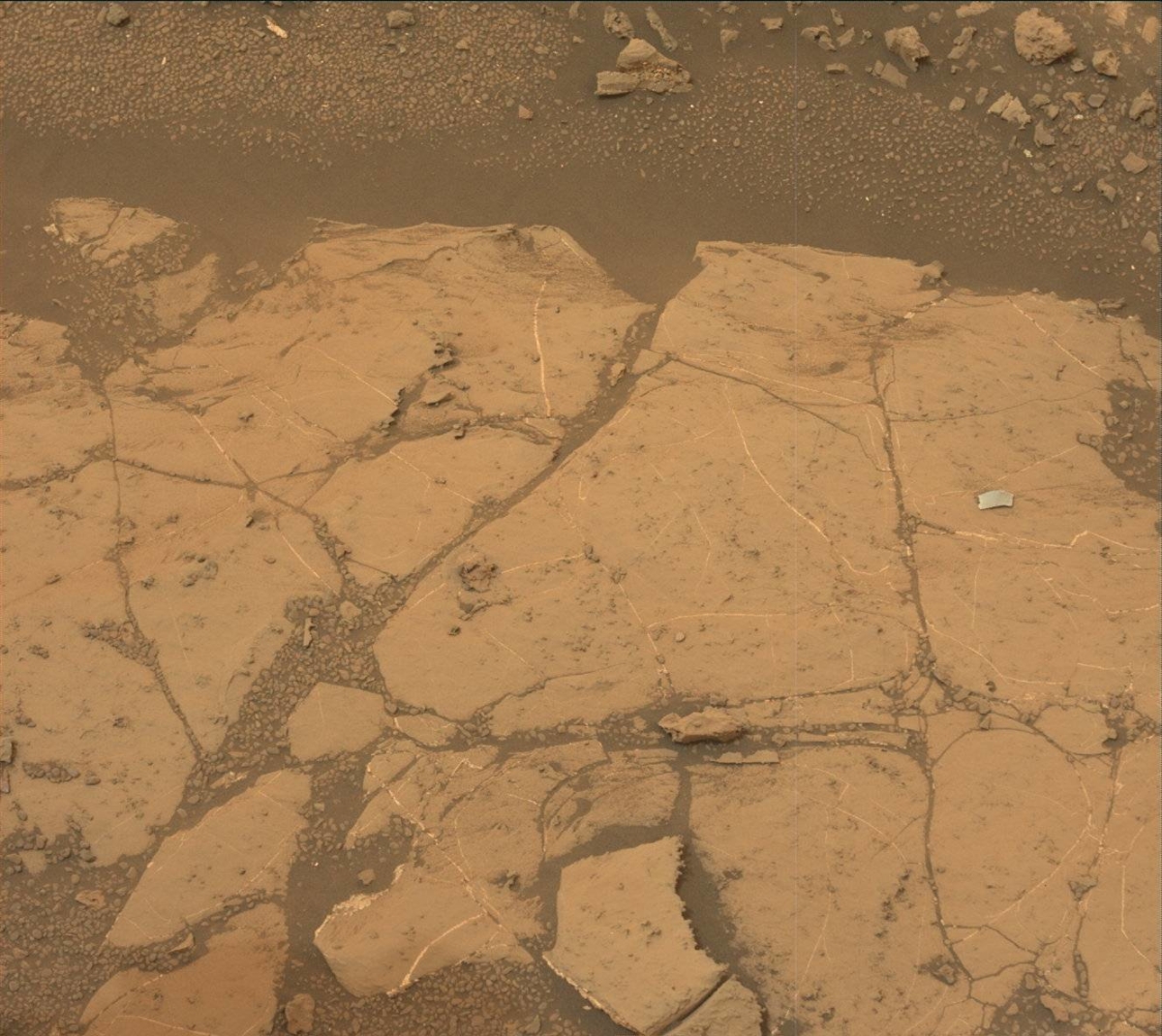
Mars oddity: Curiosity Mastcam Left image taken on Sol 2135, August 8, 2018.
Credit: NASA/JPL-Caltech/MSSS
Also on tap, collecting additional Chemistry and Camera (ChemCam) and Mastcam images of the drill hole, to look for vertical variability, and of the tailings, for change detection.
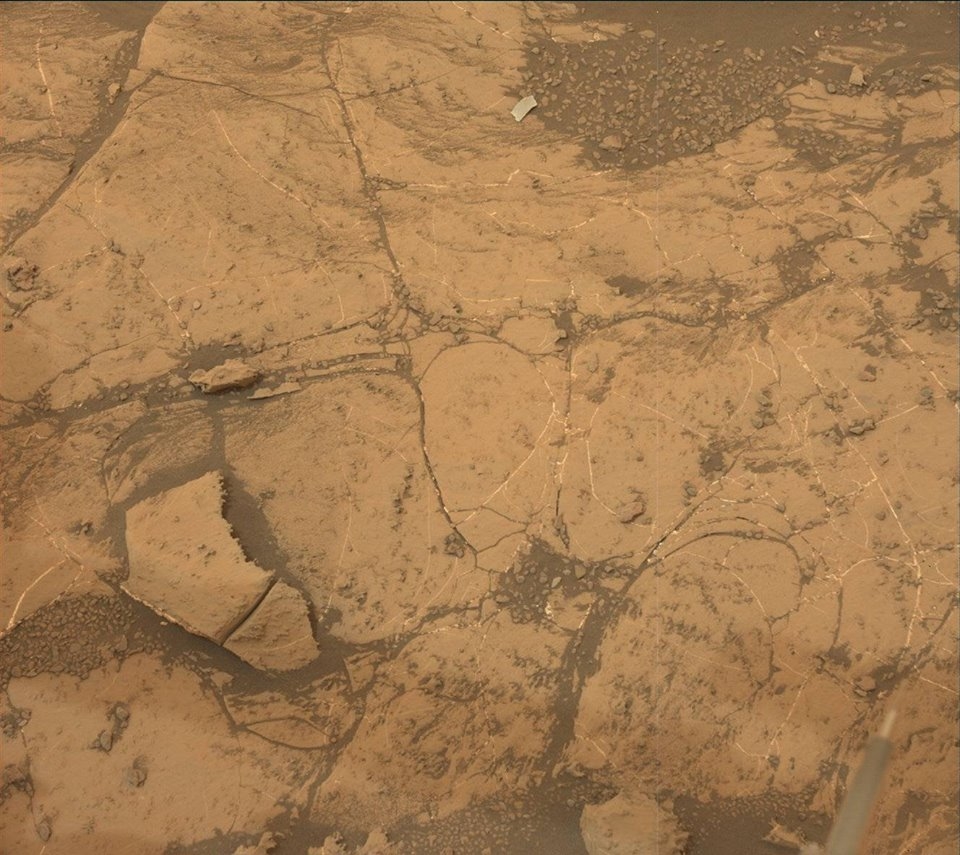
Movement of object. Photo taken by Curiosity Mastcam Left on Sol 2138, August 11, 2018.
Credit: NASA/JPL-Caltech/MSSS
Stroupe says that the rover’s ChemCam was also to focus on mapping the bedrock variability by looking at several targets at various distances from the drill hole: “Pitlochry,” “Ben Lui,” and “Caltron Hill.” Mastcam will be taking supporting documentation and additional change detection images on targets “Belhelvie,” “Camas Mor,” and “Sandray.”

Apollo 15 image captures landing locale of China’s Chang’e-5 Moon lander – the Mons Rümker region in the northern part of Oceanus Procellarum.
Credit: NASA
China’s bid to return to Earth samples from the Moon since the 1970s is slated for next year.
The 2019 liftoff of the highly complex mission of Chang’e-5 on a Long March 5 booster is targeted for the Moon’s Rümker region in Northern Oceanus Procellarum. Mons Rümker is seen as the most distinctive geological feature in the area, characterized by prolonged lunar volcanism forming multiple geologic units in the area.

Location of the Rümker region and previous landing sites. The Rümker region is located in northern Oceanus
Procellarum, away from previous sampling sites. The basemap is a Lunar Orbiter Laser Altimeter and Kaguya Terrain
Camera merged hillshade map (simple cylindrical projection).
Credit: Barker, et al., 2016
Four-part spacecraft
According to Chinese news services, Chang’e-5 is comprised of four parts: the orbiter, lander, ascender, and Earth reentry module.
The lander and ascender form a combination that will touch down on the Moon to conduct robotic lunar sampling duties. The specimens will then be rocketed into lunar orbit, followed by an auto-pilot docking and transfer of those collectibles into the mission’s Earth reentry module.
Large volcanic complexes
The significance of the Chang’e-5 return sample mission has been detailed in a new research paper, led by Yuqi Qian of the State Key Laboratory of Geological Processes and Mineral Resources, Planetary Science Institute, School of Earth Sciences at China University of Geosciences in Wuhan, China.

Chang’e-5 mission rocket’s lunar samples into Moon orbit.
Credit: CCTV/Screengrab
“Recent studies find that the geological features and volcanic history of the Moon are far more complex than previously thought,” the paper explains, “and many of the most interesting areas have been neither explored nor sampled.” One such area is the northern Oceanus Procellarum region which consists of very young mare materials and hosts one of the largest volcanic complexes on the Moon, Mons Rümker. The steep-sided domes and shallow domes on Mons Rümker were likely formed at different stages of evolution of this volcanic complex.

The location of proposed Chang’e-5 landing sites. Landing site A indicates the region of the Em4 mare unit, considered both the science-richest unit and also an area that’s suitable for landing.
Credit: Qian, et al.
Detailed mapping
The landing region for China’s Chang’E-5 lunar sample return mission has undergone detailed geological mapping using image, spectral, and altimetry data. Fourteen geological units were defined, a geologic map was constructed, and the geologic history has been outlined. To maximize the scientific value of the returned samples, lunar researchers assessed the scientific importance of each unit, suggesting that the young mare basalt unit is the most valuable for sample return and is a top priority.
Laboratory studies
A little over 4 pounds (2 kilograms) of lunar samples from the surface and subsurface — up to 6.5 feet (2 meters) in depth — are planned to be collected and returned to the Earth. Accomplishing that feat provides an opportunity to study new lunar samples in terrestrial laboratories since the former Soviet Union’s Luna-24 samples mission in 1976.
Laboratory studies of lunar samples from Apollo and Luna missions solved numerous fundamental scientific issues of selenology and heralded the beginning of a golden age of lunar research that continues to this day, the research paper explains. “However, most of the Moon remains unexplored and there are still many unanswered scientific questions that remain to be addressed by returned samples.”
China’s Chang’e-5 lunar sample return mission to the Rümker region provides a great opportunity to solve some of the significant outstanding questions of lunar science. Samples from each geologic unit in the area have specific scientific importance, which should be ranked to maximize the science outcomes.

Terrane camera (TC) morning map of the Rümker region (Lambert conformal conic projection). The white
box denotes the Chang’e-5 landing region. The yellow boxes represent other locations noted in the research paper. The yellow
dashed lines denote the ejecta from Harpalus carter. The blue dashed lines denote ejecta from Pythagoras crater. The
green dashed lines denote ejecta probably from Copernicus crater. Credit: Qian, et al.
Science-rich and safe site
The proposed landing site A (Em4) “is not only the very highest scientific priority but also very favorable from an engineering and landing safety point of view,” the research paper points out. “It offers a relatively safe landing site, which is regionally flat, young, and is really homogeneous and so does not require pin-point landing.” The research paper observes that Em4 is both the science-richest unit and also an area that’s suitable for landing.
To date, no samples have been returned from such young lunar units, and, thus, there is a high level of uncertainty in the size-frequency distribution ages in the last half of lunar impact chronology
If successful, Chang’e-5’s return of samples from these young basalts would provide an absolute calibration for the cratering flux, an accomplishment that will assist in understanding the geological evolution of planetary bodies throughout the Solar System.
To read the paper – “Geology and Scientific Significance of the Rümker Region in Northern Oceanus Procellarum: China’s Chang’E-5 Landing Region” — go to the American Geophysical Union’s Journal of Geophysical Research: Planets at:
https://agupubs.onlinelibrary.wiley.com/doi/abs/10.1029/2018JE005595
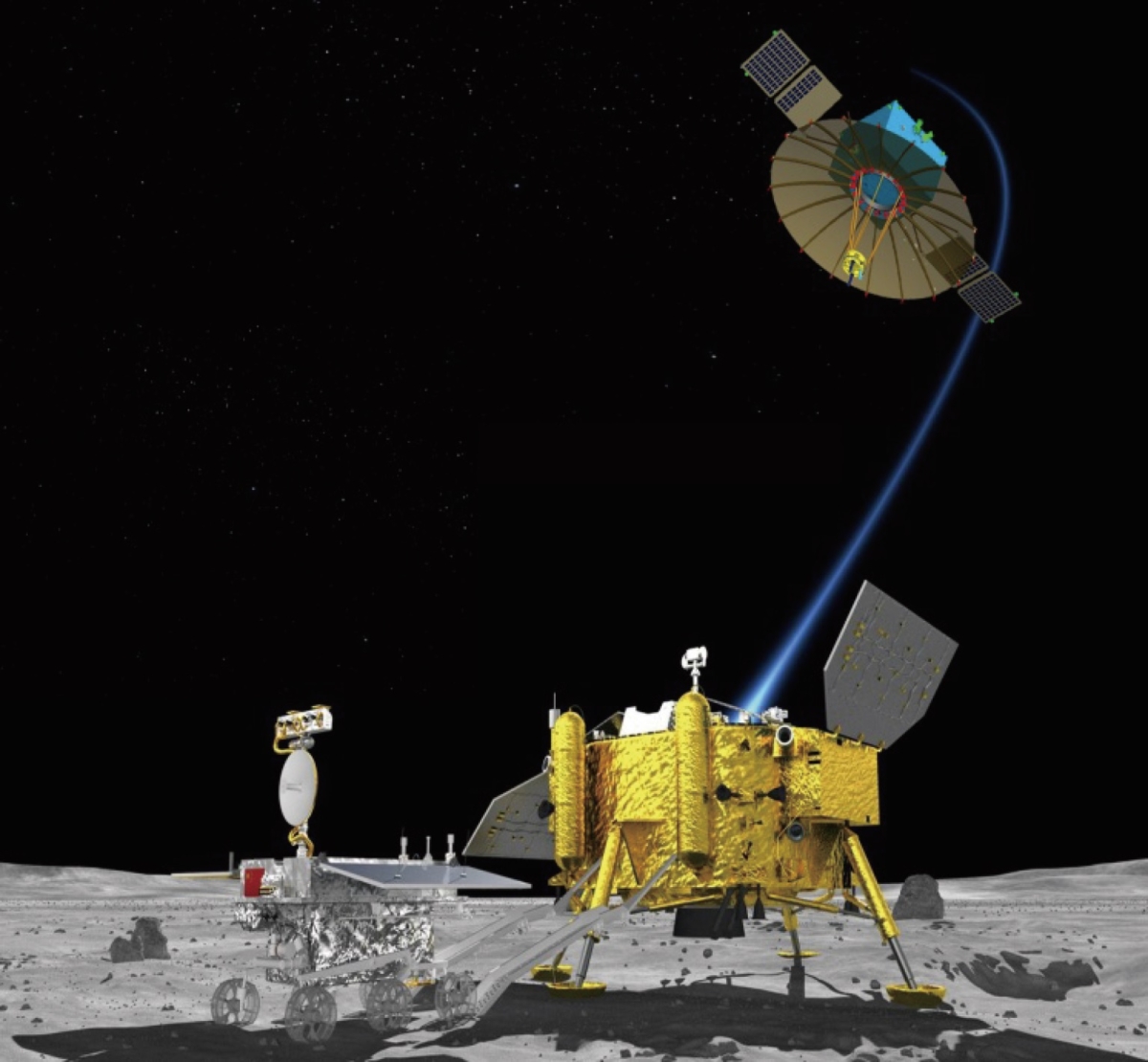
Chang’e-4 Moon lander and rover.
Credit: Chinese Academy of Sciences
If all remains on track, a new Chinese Moon mission, Chang’e‐4, will be launched in late 2018 to attempt the first farside landing in history, headed for the Von Kármán crater, within the South Pole‐Aitken (SPA) basin. The scientific instruments of China’s farside spacecraft, mounted on a lander and a rover, will analyze both surface and subsurface of this region.
The SPA basin on the farside of the Moon is the largest known impact structure in the solar system. It is the key area to answer several important questions about the Moon, including its internal structure and thermal evolution.

Secondary craters within the landing region of Chang’e-4 that are formed by the Antoniadi crater. (a) Great elliptic circle that linked the center of the Antoniadi crater to the selected Chang’E-4 landing site. The base image is from the global mosaic obtained by China’s Chang’e-2 mission. (b) Secondaries within the Chang’E-4 landing region that are delivered by the Antoniadi crater. White arrows mark the secondaries, and the yellow line is the possible trajectory of ejecta launched by Antoniadi. The location of this area is denoted as the white box in (a). The base image is obtained by Japan’s Kaguya lunar orbiter.
Credit: Jun Huang, et al.
Source craters
The Von Kármán crater is approximately 115 miles (186 kilometers) in diameter, lying in the northwestern SPA basin. The topography of the landing region is generally flat.
Secondary craters and ejecta materials have covered most of the mare unit and can be traced back to at least four source craters: Finsen, Von Kármán L, Von Kármán L’, and Antoniadi). Extensive sinuous ridges and troughs in the area are identified spatially related to Ba Jie crater.

Secondaries within the proposed Chang’e-4 landing region that are formed by the Von Karman L and Von Karman L’ craters. The two source craters are located to the south of the landing region. The great elliptic circles represent possible ballistic trajectories (blue lines) of impact ejecta from the source craters. (a) The NW – SE trending secondaries that are formed by the Von Karman L’ crater. (b) The NE–SW trending secondaries that are formed by the Von Karman L crater. Both the images are obtained by NASA’s Lunar Reconnaissance Orbiter Camera (LROC WAC) operated by Arizona State University.
Credit: Jun Huang, et al.
New paper
The Chang’e-4 mission has been addressed in a recent paper led by Jun Huang State Key Laboratory of Geological Processes and Mineral Resources, Planetary Science Institute, School of Earth Sciences, China University of Geosciences, Wuhan, China.
The paper’s key points are that a detailed 3-D geological analysis of the nature and history of Von Kármán crater has been done; the region contains farside mare basalts affected by linear features and ejecta material from a wide range of surrounding craters; and a new geological analysis provides a framework for the Chang’e-4 mission to carry out on-the-spot exploration.
Relay satellite
Already in place for the upcoming mission is the Chinese relay satellite Queqiao. It will enable farside communications for the Chang’e-4 and future farside missions.

Credit: CNSA
Queqiao was successfully launched in May on a Long March 4C from the Xichang Satellite Launch Center. That relay spacecraft has successfully reached an Earth-Moon L2 halo orbit to support communications between Earth and the Moon’s farside.

Group shot…China’s Chang’e 3 lander and Yutu rover.
Credit: Chinese Academy of Sciences
Lander, rover instruments
Since both the lander and the rover were designed as a backup for the December 2013 Chang’e-3 mission – a lander carrying the Yutu rover — some of the science payloads on Chang’e-4 are similar, such as a landing camera, a terrain camera, a panorama camera on the lander and a visible/near infrared imaging spectrometer, along with two ground penetrating radars able to reveal the subsurface structure of the landing area.
Additional instruments on the lander a low-frequency radio spectrometer to perform joint space physics observations with the low-frequency radio spectrometer on the Queqiao relay satellite.
Also onboard is a German lunar neutron and radiation dose detector to explore the farside surface radioactive environment. In addition, a lunar microecosystem is included for astrobiology experiments and public outreach.
A new instrument on the rover is the Swedish neutral atom detector designed to study the interaction between the solar wind and lunar surface materials.
Mini-biosphere
According to the state-run Xinhua news agency, the probe will carry a tin containing seeds of potato and arabidopsis, a small flowering plant related to cabbage and mustard. It may also tote along silkworm eggs to conduct the first biological experiment on the Moon.
This “lunar mini biosphere” experiment was designed by 28 Chinese universities, led by southwest China’s Chongqing University, The cylindrical tin, made from special aluminum alloy materials, weighs roughly 7 pounds (3 kilograms).
The tin also contains water, a nutrient solution, and air. A tiny camera and data transmission system allows researchers to keep an eye on the seeds and see if they blossom on the Moon.
The paper – “Geological Characteristics of Von Kármán Crater, Northwestern South Pole-Aitken Basin: Chang’E-4 Landing Site Region” – has been published in the American Geophysical Union’s Journal of Geophysical Research: Planets.
It can be found here:

Curiosity Mastcam Right photo taken on Sol 2138, August 11, 2018.
Credit: NASA/JPL-Caltech/MSSS
NASA’s Curiosity Mars rover is now performing Sol 2140 duties, and there’s confirmation of new drilling.
“Success at Pettegrove Point,” reports Catherine O’Connell-Cooper, a planetary geologist at the University of New Brunswick, New Brunswick, Canada.
On our third attempt at drilling within the Pettegrove Point member on the Vera Rubin Ridge, we have success! Curiosity has successfully drilled, and generated a pile of drill tailings.
Tailings
At the new Stoer drill hole, the tailings derived from the drill are under observation. A portion characterization is also being done prior to sending samples to the robot’s analytical instruments, the Sample Analysis at Mars (SAM) Instrument Suite and the Chemistry & Mineralogy X-Ray Diffraction/X-Ray Fluorescence Instrument (CheMin).
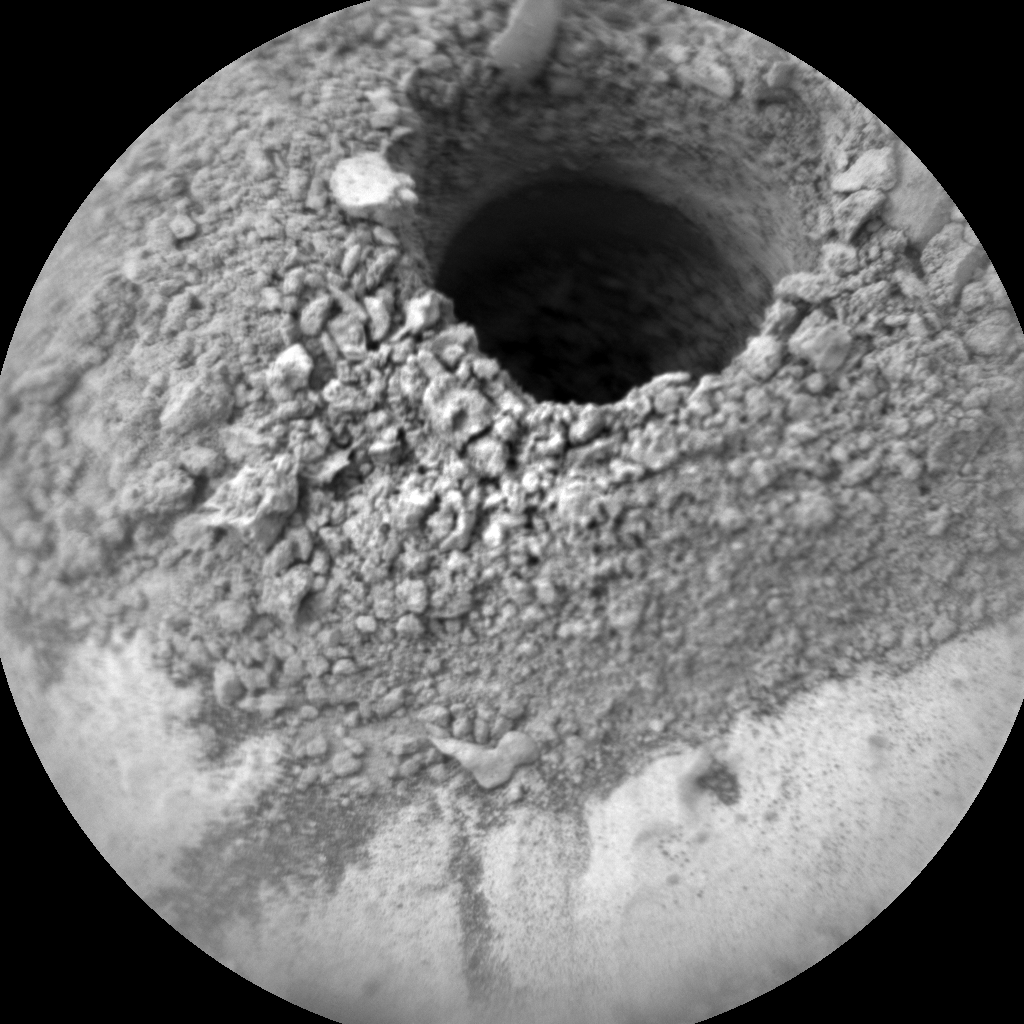
Curiosity ChemCam Remote Micro-Imager photo acquired on Sol 2136, August 9, 2018.
Credit: NASA/JPL-Caltech/LANL
This is being done to ensure that the materials will not pose any threat to the instruments, adds O’Connell-Cooper.
Chemistry and Camera (ChemCam) passive and Mastcam multispectral imaging will be taken of the drill tailings, O’Connell-Cooper explains, “to identify any potential differences between the surface and material from deeper within the drill hole.
The ChemCam laser (LIBS) will be used to characterize the Stoer drill hole and a bedrock target “Greian,” which appears to show some color variations. Mastcam will provide color documentation for Greian.

Curiosity Front Hazcam Right B image acquired on Sol 2139, August 13, 2018.
Credit: NASA/JPL-Caltech
Change detection
O’Connell-Cooper adds that there will also be Mastcam change detection on the drill tailings (to identify if there is any movement of the drill tailings) and continuing change detection on three targets (“Camas Mor,” “Belhelvie” and “Sandray”).
Environmental measurements are also planned to search for both cloud motion and dust devils.

Credit: Boeing
The U.S. Air Force X-37B mini-space plane has winged past 340 days of flight performing secretive duties during the program’s fifth flight.
Labeled the Orbital Test Vehicle (OTV-5), the robotic craft was rocketed into Earth orbit on September 7, 2017 atop a SpaceX Falcon 9 booster from Launch Complex 39A at NASA’s Kennedy Space Center in Florida.
Payload bay
On this latest clandestine mission of the space plane, all that’s known according to Air Force officials is that one payload flying on OTV-5 is the Advanced Structurally Embedded Thermal Spreader, or ASETS-11. Developed by the U.S. Air Force Research Laboratory (AFRL), this cargo is testing experimental electronics and oscillating heat pipes for long durations in the space environment.

Credit: Boeing
The X-37B space plane has a payload bay about the size of a pickup-truck bed, which can be outfitted with a robotic arm. X-37B has a launch weight of 11,000 lbs. (4,990 kilograms) and is powered on orbit by gallium-arsenide solar cells with lithium-ion batteries.
Record setting history
Each X-37B/OTV mission has set a new flight-duration record for the program:
OTV-1 began April 22, 2010, and concluded on Dec. 3, 2010, after 224 days in orbit.
OTV-2 began March 5, 2011, and concluded on June 16, 2012, after 468 days on orbit.
OTV-3 chalked up nearly 675 days in orbit before finally coming down on Oct. 17, 2014.
OTV-4 conducted on-orbit experiments for 718 days during its mission, extending the total number of days spent in space for the OTV program to 2,085 days.

Last Air Force’s X-37B Orbital Test Vehicle mission touched down at NASA ‘s Kennedy Space Center Shuttle Landing Facility May 7, 2017.
Credit: Michael Martin/USAF
Tarmac touchdown
After eclipsing 11 months in orbit, how long the unpiloted, reusable craft will stay aloft is unknown. The robotic vehicle is likely to land at Kennedy Space Center’s Shuttle Landing Facility, as the OTV-4 mission did back on May 7, 2017. That was a first for the program. All prior missions had ended with a tarmac touchdown at Vandenberg Air Force Base in California.
The classified X-37B program “fleet” consists of two known reusable vehicles, both of which were built by Boeing. Looking like a miniature version of NASA’s now-retired space shuttle orbiter, the military space plane is 29 feet (8.8 meters) long and 9.6 feet (2.9 m) tall, with a wingspan of nearly 15 feet (4.6 m).

The first X-37B Orbital Test Vehicle waits in the encapsulation cell of the Evolved Expendable Launch vehicle on April 5, 2010 at the Astrotech facility in Titusville, Fla. Half of the Atlas V five-meter fairing is visible in the background.
Credit: U.S. Air Force
Ground tracks
Ted Molczan, a Toronto-based satellite analyst, told Inside Outer Space that OTV 5’s initial orbit was about 220 miles (355 kilometers) high, inclined 54.5 degrees to the equator. “Its ground track nearly repeated every two days, after 31 revolutions.”
On April 19, the space drone lowered its orbit by 24 miles (39 kilometers) which caused its ground track to exactly repeat every five days, after 78 revolutions, Molczan said – a first for an OTV mission.
“Repeating ground tracks are very common,” Molczan added, “especially for spacecraft that observe the Earth. That said, I do not know why OTV has repeating ground tracks.”
Space force
Does the X-37B program fit into the Trump Administration’s call for a Space Force?
Responds Joan Johnson-Freese, a professor in the National Security Affairs Department at the Naval War College in Newport, Rhode Island: “Ironically, the X-37B is exactly the type of program — toward giving the U.S. flexibility of operations in space — that seems to be prompting the current push for a Space Force, yet are already underway.”

