Archive for the ‘Space News’ Category
 Author:
  August 28th, 2018
Credit: NASA
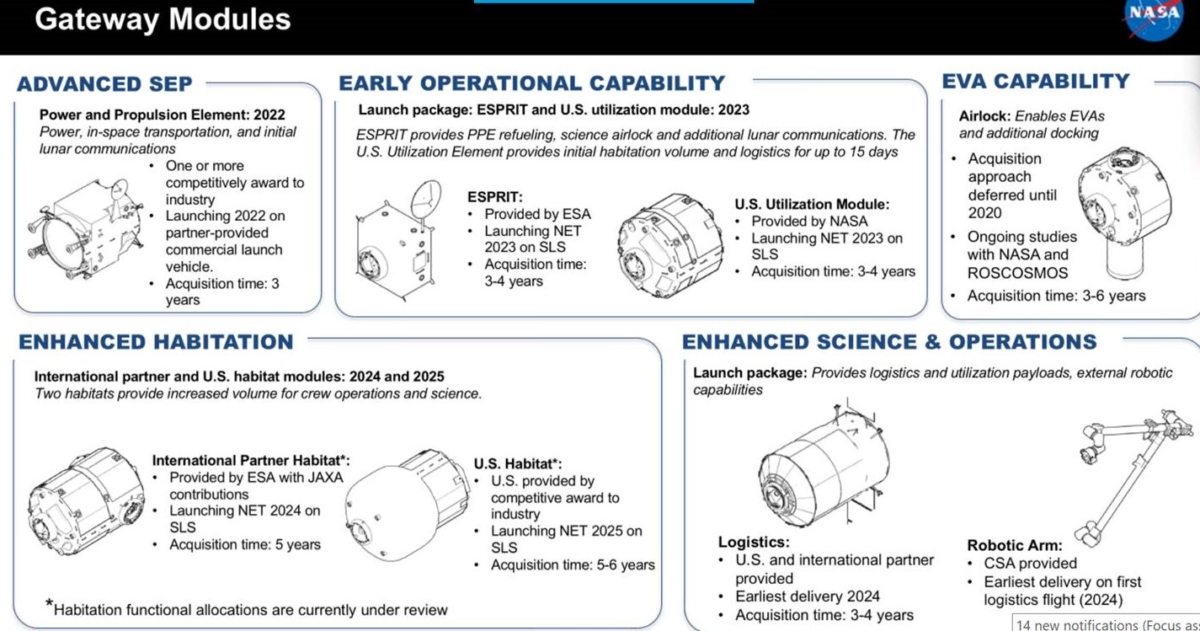
The NASA Advisory Council’s (NAC’s) Human Exploration and Operations Committee has been meeting August 27-28 at NASA’s Ames Research Center in Moffett Field, California.
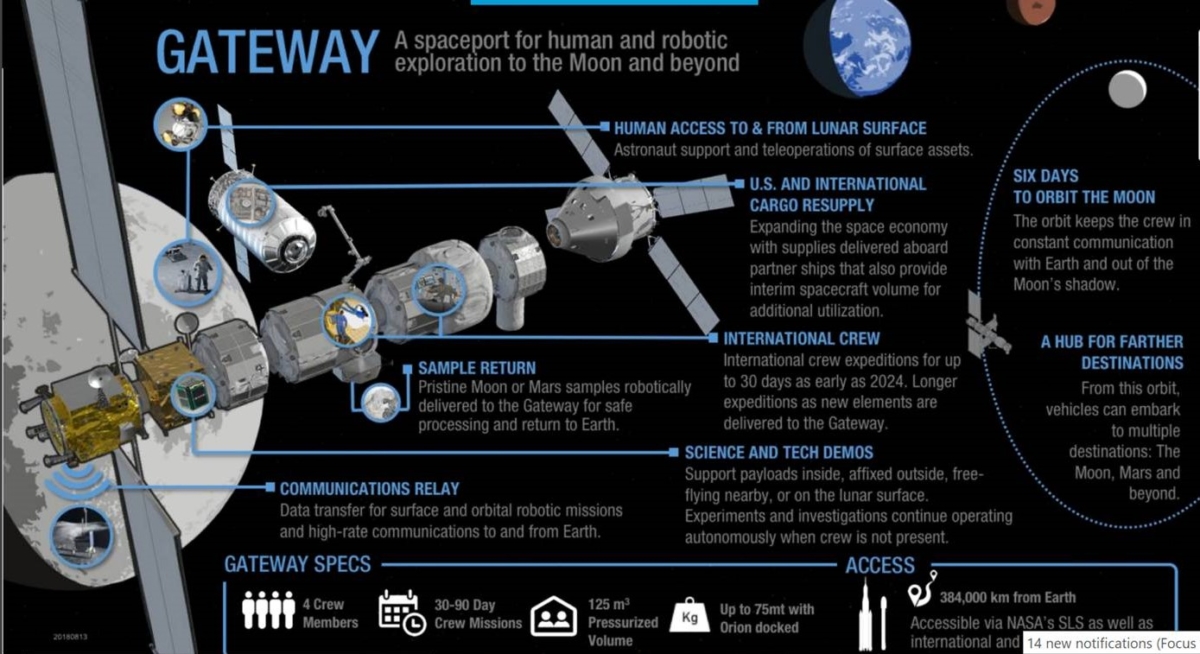
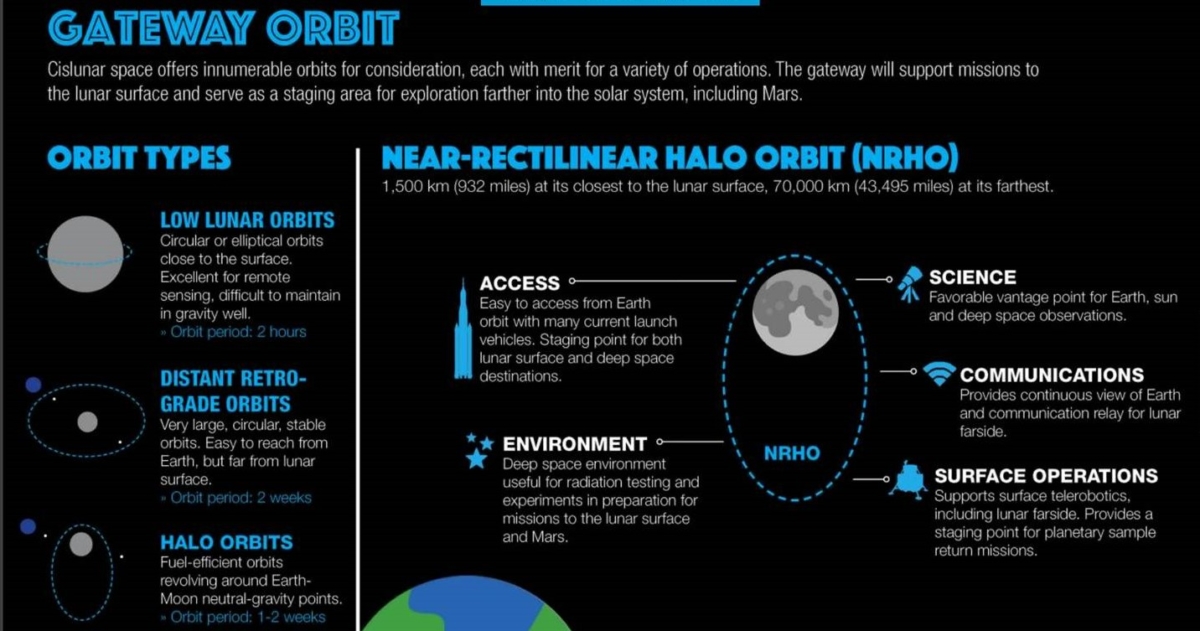
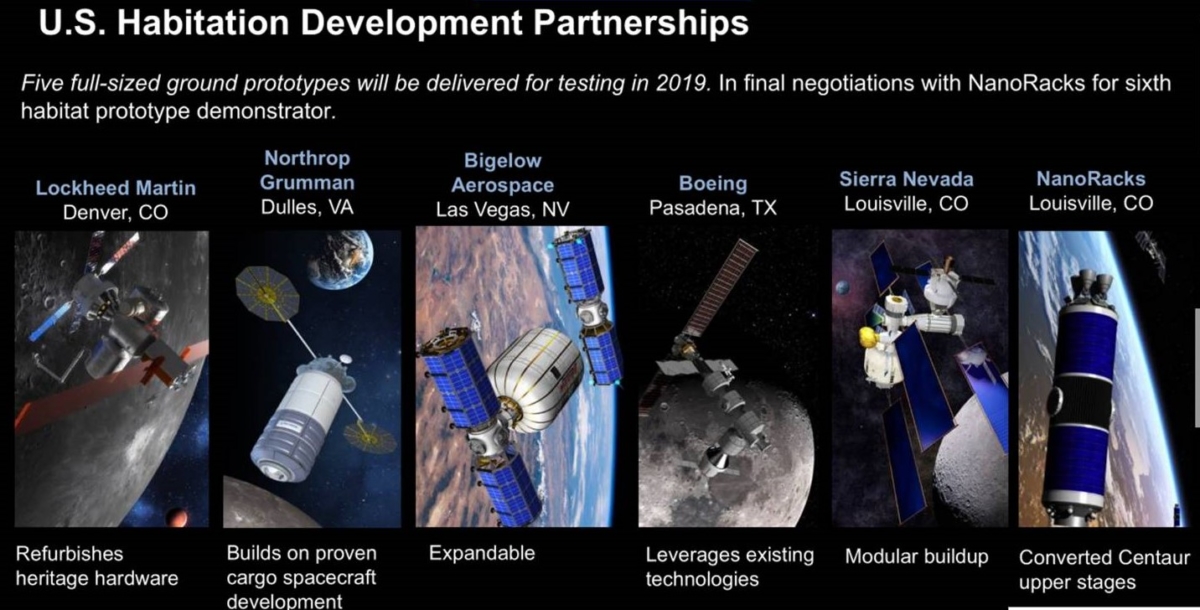
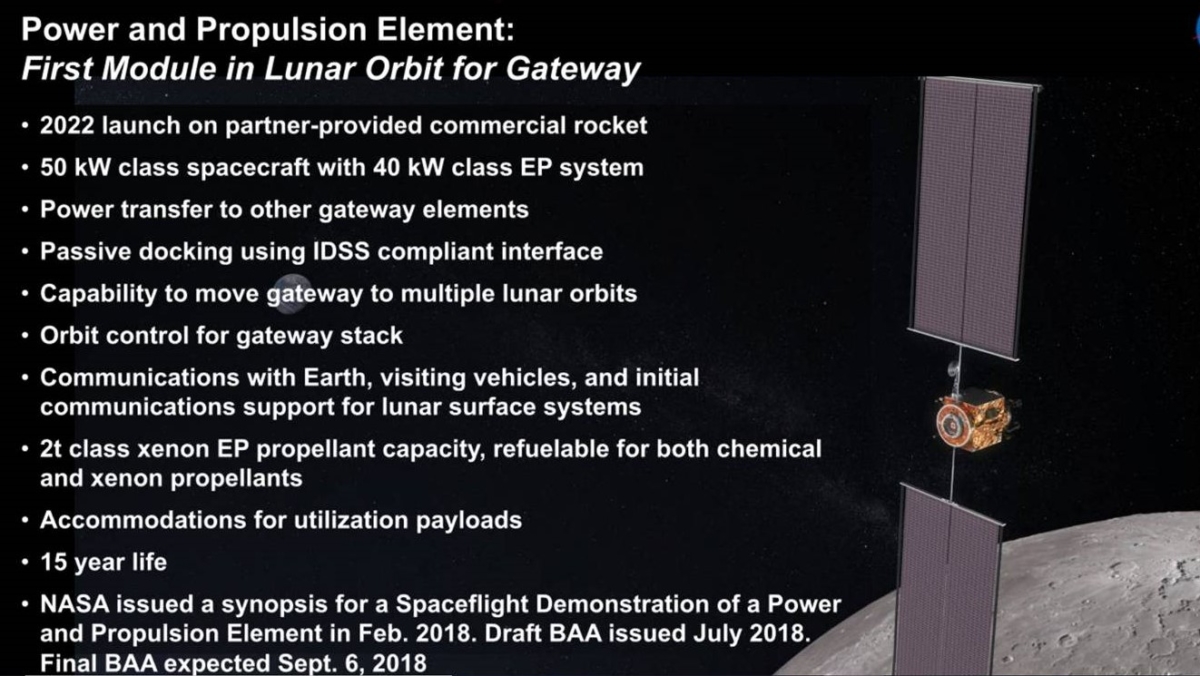
Today, NASA’s Human Exploration and Operations (HEO) Mission Directorate leaders, William Gerstenmaier and Jason Crusan, presented a detailed look at the Lunar Gateway.
Here are some key charts used in the meeting today.


 Posted in

Credit: CSPS
The Department of Commerce has been charged with the complex mission of establishing a new U.S. space traffic management (STM) approach for commercial space activities. What existing practices and standards could help fulfill that mission and maintain U.S. leadership in space?
On June 18, 2018, the White House released Space Policy Directive-3, National Space Traffic Management Policy. It states that to maintain leadership in space the United States must develop a new approach to space traffic management (STM).

U.S. President Trump signs Space Policy Directive-3.
Credit: NASA/Bill Ingalls
Lead civil agency
This new approach includes designating the Department of Commerce as the lead civil agency responsible for creating a new approach to STM, including the development of STM standards and best practices.
This paper by The Aerospace Corporation’s Center for Space Policy and Strategy provides a baseline by describing current standards, best practices, guidelines, and international agreements and treaties.
Scope of the task
The authors conclude that, hopefully, this brief paper reveals significant features of the landscape into which Commerce is involved, and helps the Department of Commerce, and the Office of Space Commerce understand the scope of its task, prioritize its efforts, and contribute to the overall success of its STM mission.
For a copy of this report, go to:
Credit: Trevor Paglen/Nevada Museum of Art
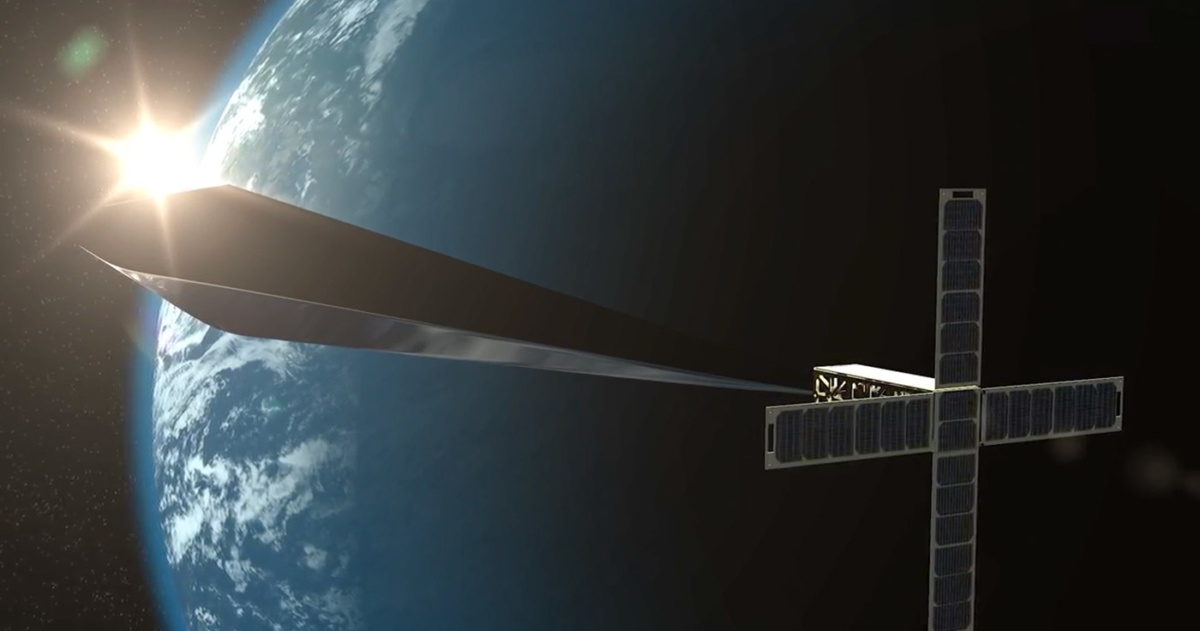
Contemporary artist Trevor Paglen’s Orbital Reflector, the satellite, will have no commercial, military, or scientific purpose. Instead, it will be a public sculpture, visible from the ground without a telescope — a satellite that belongs to everyone, the artist explains.
Credit: Trevor Paglen/Nevada Museum of Art
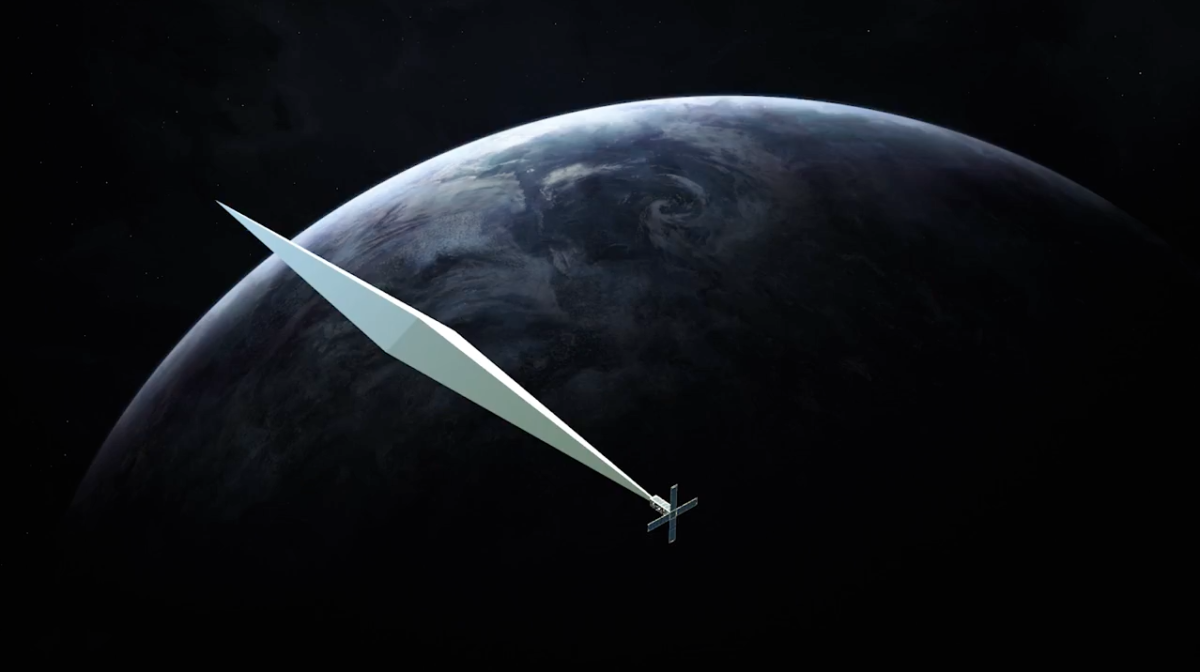
In partnership with the Nevada Museum of Art and in collaboration with aerospace engineers, Paglen will launch via SpaceX a balloon into orbit as a purely artistic gesture.
“Orbital Reflector is a work of aerospace engineering for aerospace engineering’s sake,” explains Paglen.

Credit: Trevor Paglen/Nevada Museum of Art/Screengrab
Cubesat deployed
Orbital Reflector is a sculpture constructed of a lightweight material similar to Mylar. It is housed within a small box-like CubeSat. Once in low Earth orbit at a distance of about 350 miles (575 kilometers) from Earth, the CubeSat opens and releases the sculpture, which self-inflates like a balloon.
Sunlight reflects onto the sculpture making it visible from Earth with the naked eye — like a slowly moving artificial star as bright as a star in the Big Dipper.
Aerospace firms
Global Western is an aerospace firm working with Trevor Paglen and the Nevada Museum of Art to design and manufacture Orbital Reflector.
Spaceflight Industries will arrange for the launch of Orbital Reflector on board a SpaceX Falcon 9 rocket targeted for Fall 2018.
For more information, go to:
https://www.orbitalreflector.com/
Also, go to this informative video at:
Curiosity Mastcam Right image taken on Sol 2150, August 24, 2018
Credit: NASA/JPL-Caltech/MSSS
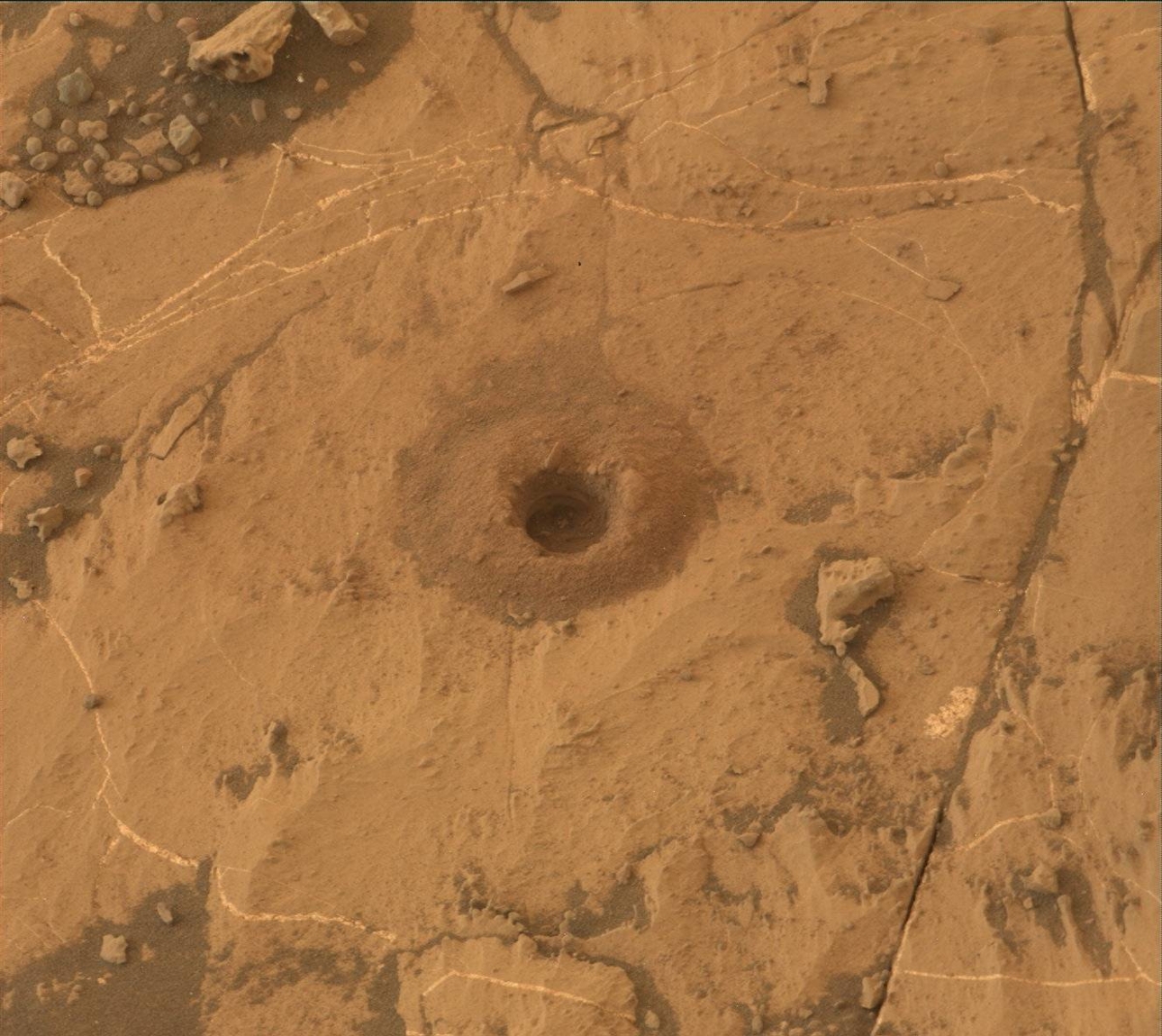
In a Sol 2150 report, Roger Wiens, a geochemist at Los Alamos National Laboratory in New Mexico said a decision was forthcoming whether to re-do the Sample Analysis at Mars (SAM) Instrument Suite analysis or not.
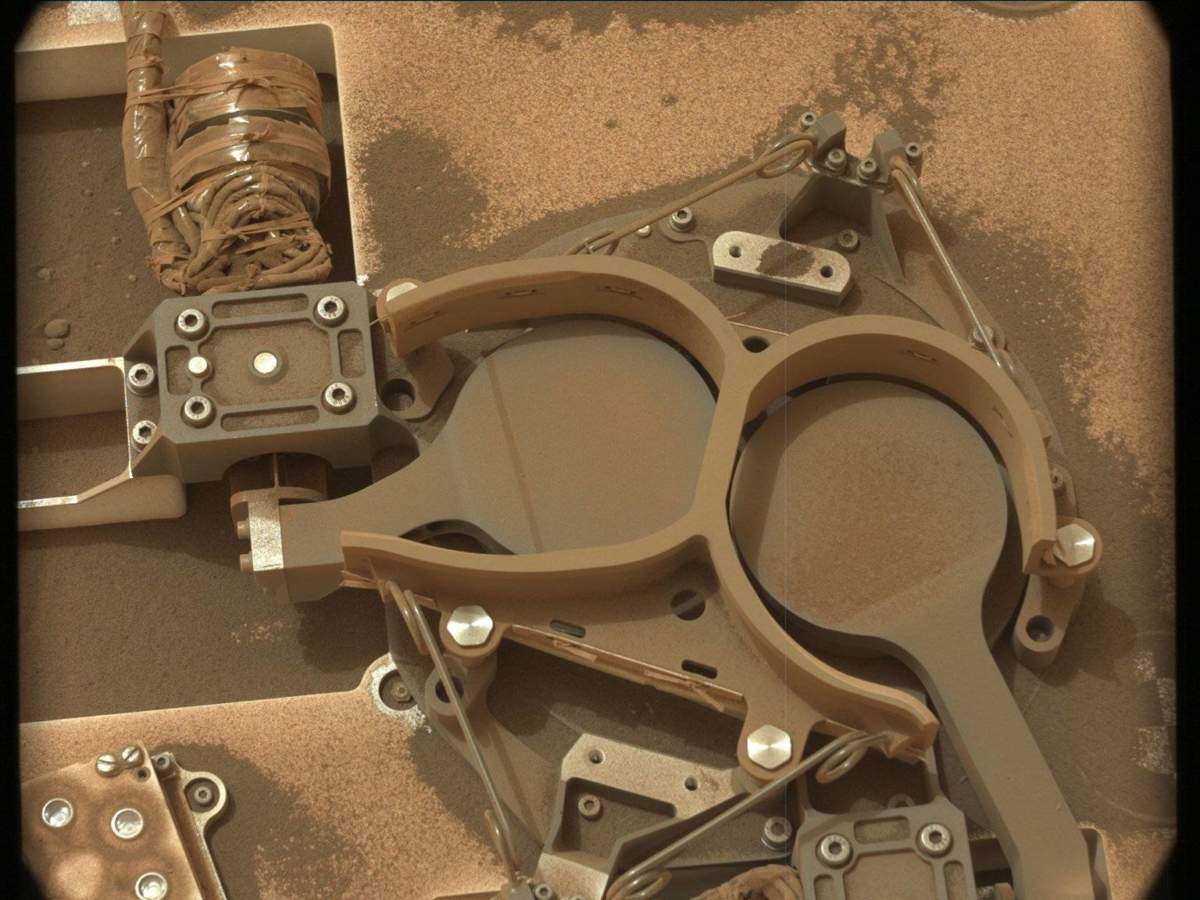
Curiosity Mastcam Left photo acquired on Sol 2146, August 20, 2018.
Credit: NASA/JPL-Caltech/MSSS
Now that the rover’s drill is being operated with the feed immobile in the extended position, Wiens said the portions (amount of drill tailings) that are delivered to Chemistry & Mineralogy X-Ray Diffraction/X-Ray Fluorescence Instrument (CheMin) and SAM are less accurate than before.
“Duluth was the only previous drill attempt to reach sampling depth with the feed immobile. In that case several attempts were made to deliver proper portions to the in-situ instrument funnels,” Wiens explained.
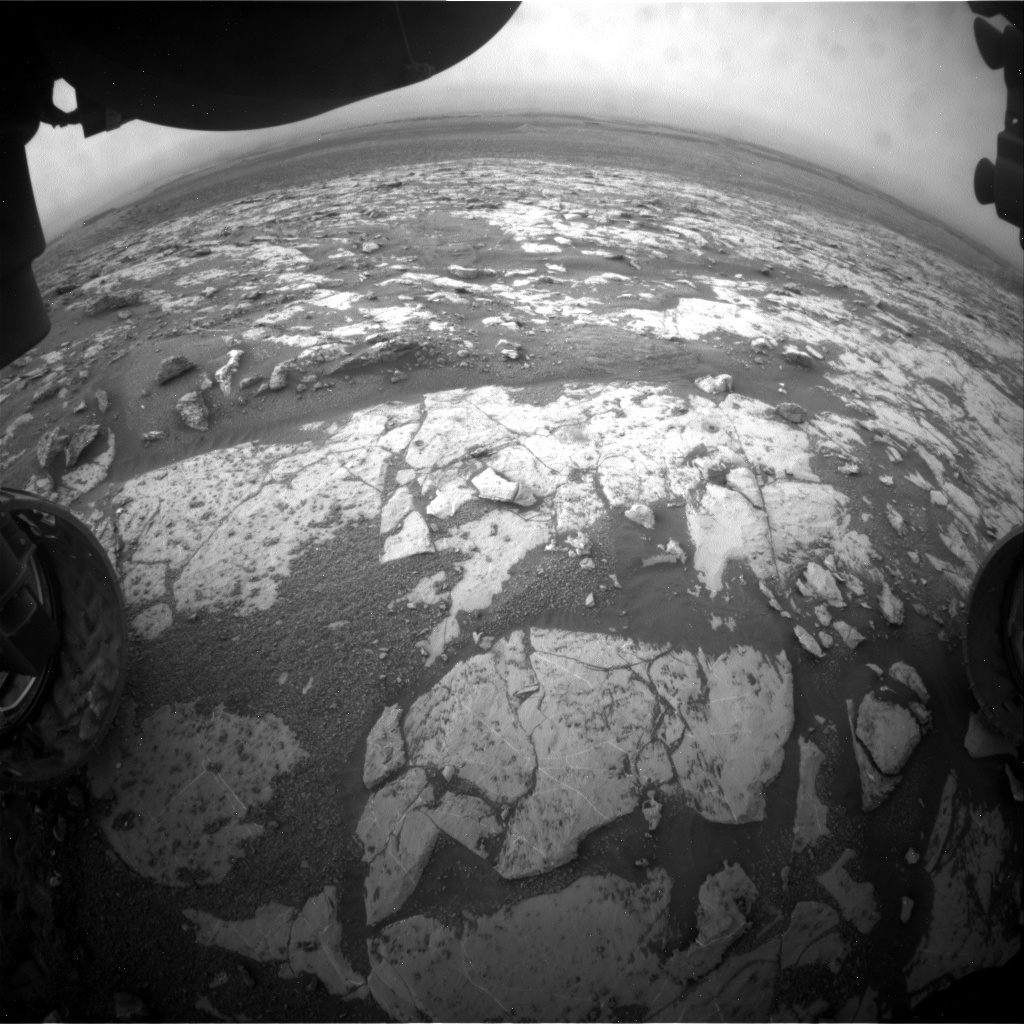
Curiosity Front Hazcam Left B image taken on Sol 2151, August 25, 2018.
Credit: NASA/JPL-Caltech
Successful analysis
Noting the SAM inlets on the rover deck, with the covers closed, Wiens said that the rover team seems to have learned quite quickly how to get the portions to these instruments. Mars researchers did learn that SAM completed a successful analysis.
“The other part of the decision was whether to repeat SAM’s analysis with different parameters, but the team decided not to do so at this time, so now we can continue with the drill analysis sequence,” Wiens explained. “That will include dumping the rest of the material so we can see how much was left in the drill chambers. The operation will be carried out using two dozen separate portion drop-off sequences with Mastcam images in between to check how much material comes out.”
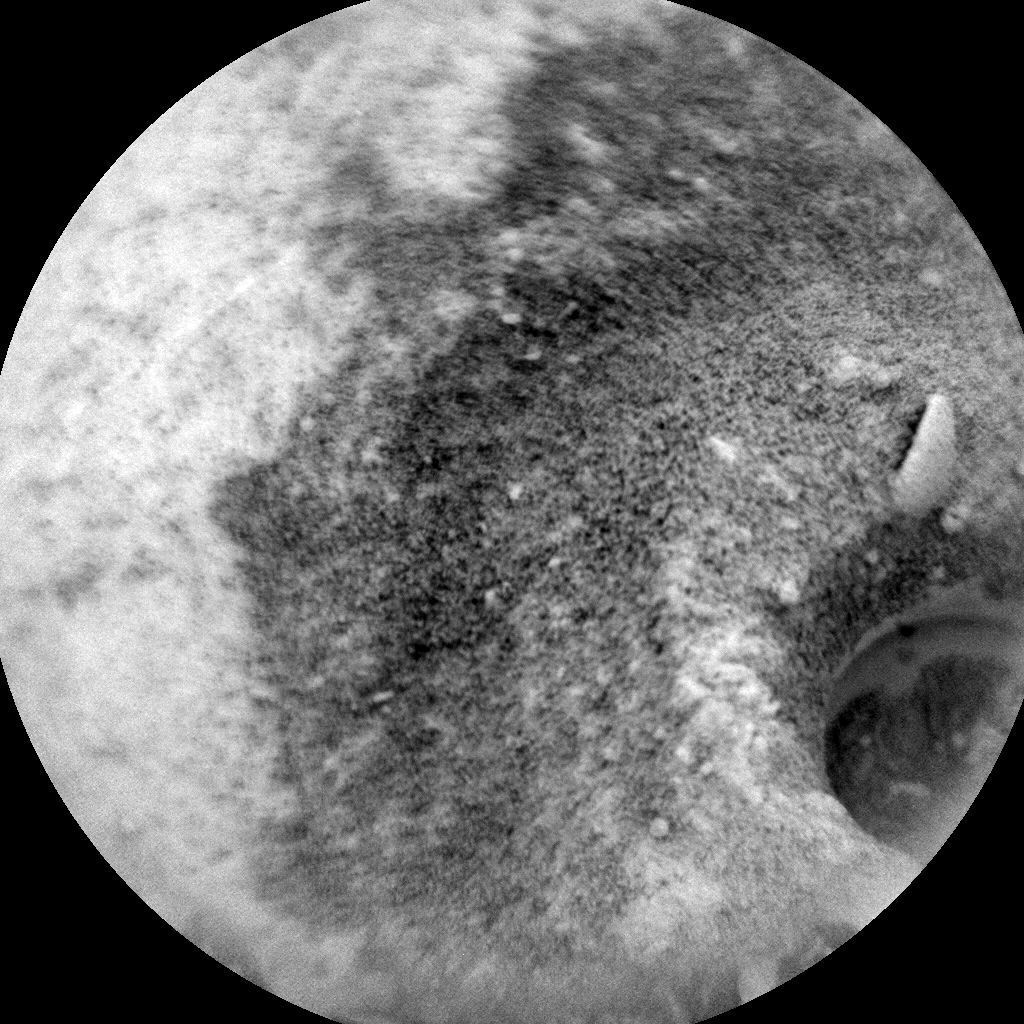
Curiosity ChemCam Remote Micro-Imager photo taken on Sol 2152, August 26, 2018.
Credit: NASA/JPL-Caltech/LANL
Down the drill hole
Wiens said that the sequence “looks pretty cool.”
The arm swings down near the ground for each drop-off, then moves out of the way, and the mast points Mastcam to take an image. Then the mast turns away-to avoid any possible dust-while the arm swings down for the next drop off. Every drop-off is done in a slightly different location on rock surfaces, some being spaced 7 millimeters away from each other around a circle. Each little portion gets imaged.
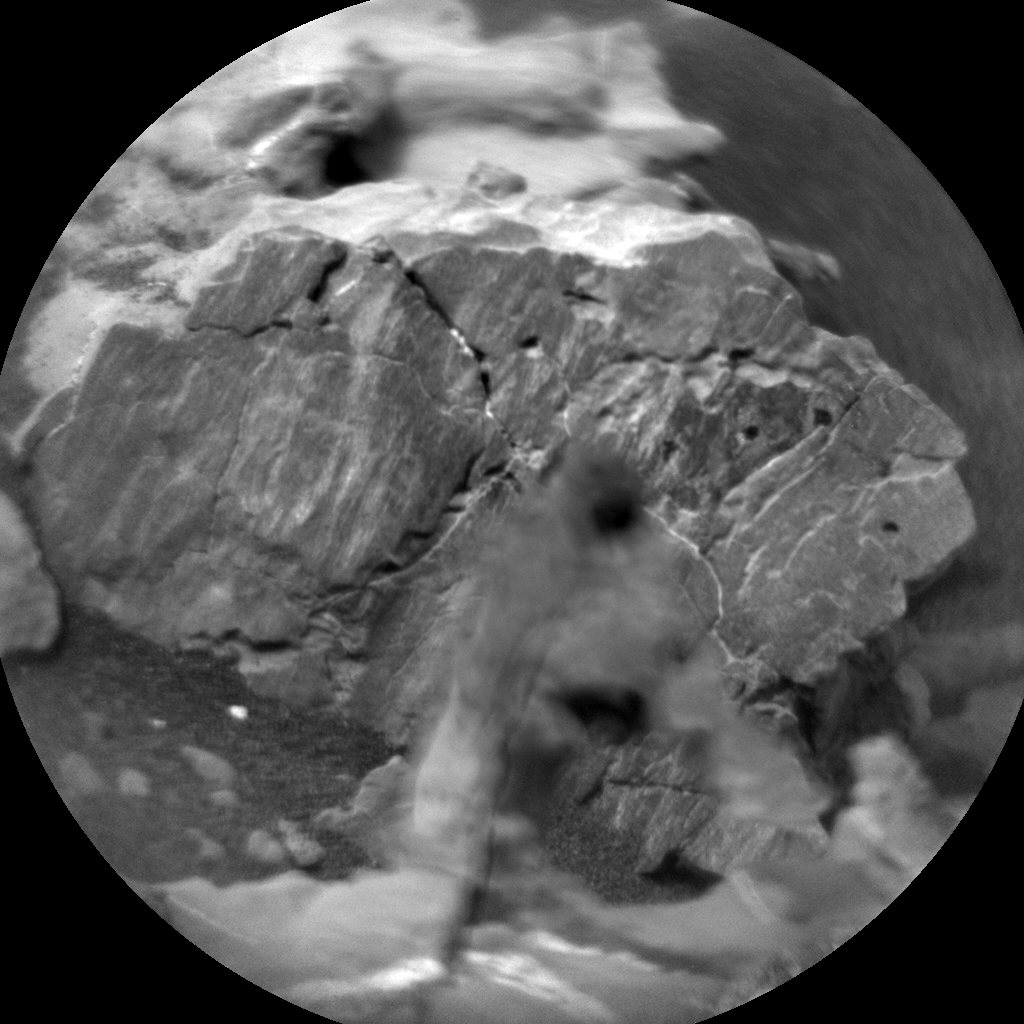
Curiosity ChemCam Remote Micro-Imager photo taken on Sol 2152, August 26, 2018.
Credit: NASA/JPL-Caltech/LANL
Other activities planned was for the robot to observe the Chemistry and Camera (ChemCam) bedrock target “Papa Little” and another ChemCam raster down the drill hole, with accompanying Mastcam documentation. There will also be half a dozen Mars Descent Imager (MARDI) change-detection images spaced throughout the day. Lastly, Radiation Assessment Detector (RAD), Dynamic Albedo of Neutrons (DAN) and Rover Environmental Monitoring Station (REMS) will continue taking data.
Curiosity is now in Sol 2152.
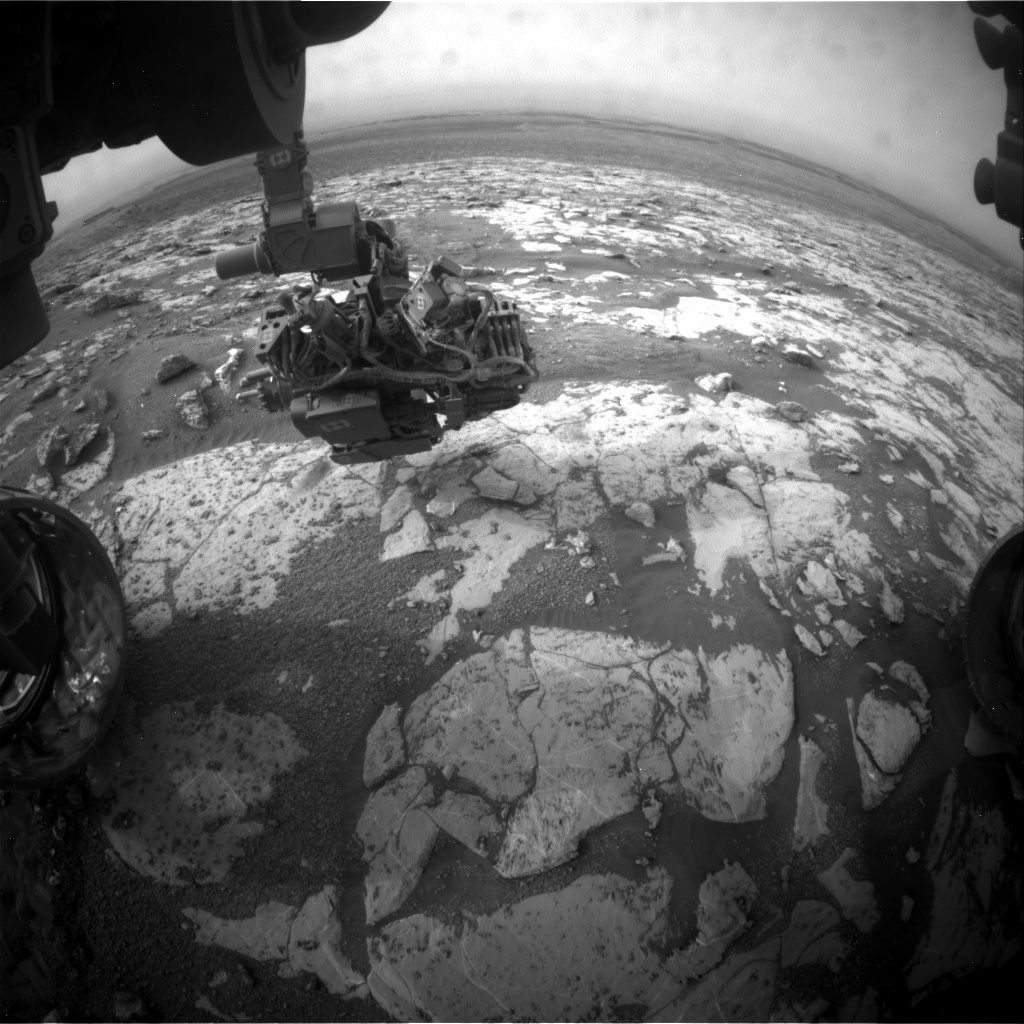
Curiosity Front Hazcam Left B image taken on Sol 2152, August 26, 2018
Credit: NASA/Joel Kowsky
REMARKS
Remarks by Vice President Pence on the Administration’s Space Policy Priorities
Issued on: August 23, 2018
Johnson Space Center
Houston, Texas
12:51 P.M. CDT
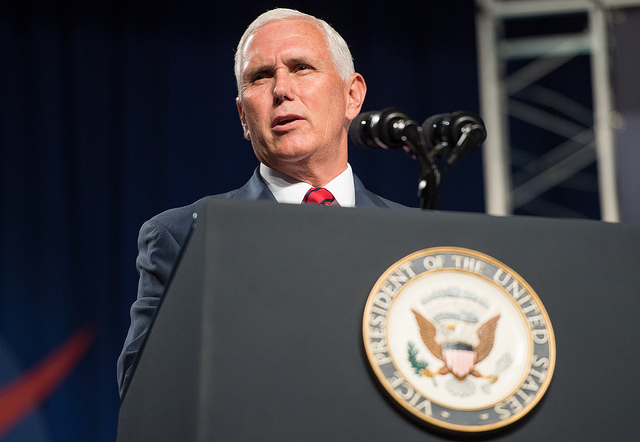
THE VICE PRESIDENT: Well, thank you, Administrator Bridenstine. To the members of Congress who are here; Director Geyer; to all our distinguished guests, including the Chief of the Astronaut Office, Pat Forrester, and nine members of the Astronaut Corps who are with us today; to all the men and women of NASA who are here in this hall and watching around the country, men and women who push the boundaries of human knowledge for the benefit of all: It is my great honor to be here at the “home of human spaceflight,” the Johnson Space Center. (Applause.) So proud of you.

Credit: NASA/Joel Kowsky
It’s great to be back. And before I begin, let me bring greetings from a great champion of American leadership at home and in the boundless expanse of space. I bring greetings from the 45th President of the United States, President Donald Trump. (Applause.)
It really is an honor to be with you today, at such a time as this in the life of our space program and in the life of our nation. Thanks to President Trump’s vision and decisive action, with strong support from our partners in Congress, and thanks to the pioneering work and courage of the innovators and astronauts represented here, past, present, and future, and because of the enduring commitment of the Johnson Space Center and NASA, America is leading in space once again. (Applause.) It’s true.
And we’re grateful to all of you. But let me begin tonight — today as well — by saying how grateful we are for our NASA Administrator, Jim Bridenstine. He served as a Lieutenant Commander in the United States Navy, he served in the Congress, and now he is leading NASA with distinction at the dawn of a renewed age of human space exploration, led by the United States of America. Jim, thank you for your leadership. (Applause.) Great job.
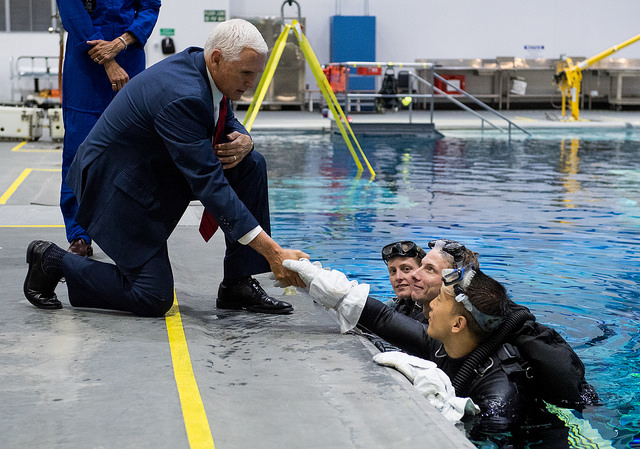
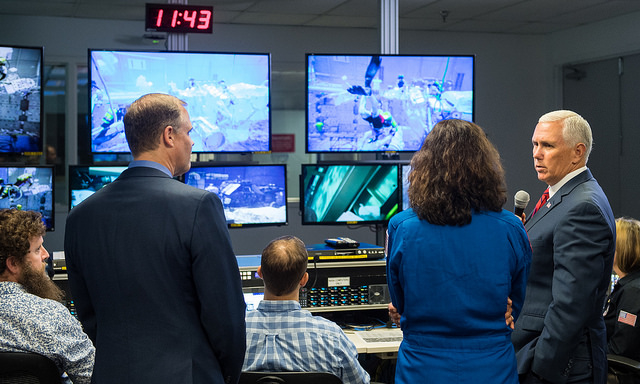
Vice President Mike Pence is seen with NASA astronaut candidates Loral O’Hara, Woody Hoburg, and Jonny Kim during a tour of the Neutral Buoyancy Laboratory at NASA’s Johnson Space Center, Thursday, Aug. 23, 2018 in Houston, Texas.
Credit: NASA/Joel Kowsky
And I also want to thank the still-kind-of-new Director here at Johnson Space Center, Mark Geyer, recipient of NASA’s Distinguished Service Medal. His career here has actually spanned more than three decades and I couldn’t be more impressed with the job that Mark Geyer is doing or the fact that he’s a graduate of Purdue University. (Applause.) Join me in thanking — Mark, stand up. Stand up. Take a bow. (Laughs.)
I also want to thank a few other people before we get going. I want to acknowledge your two senators, who are champions of this space program. I know they’re not with us today — they’re working on Capitol Hill — but join me in thanking Senator John Cornyn and Senator Ted Cruz. They fight for this space program every day. (Applause.)
And I know it got mentioned before, but we actually served together when I was in the Congress. And I just want to give some special recognition to someone who I’ve known since the first day we met in 2001 has been a passionate champion of NASA and of the Johnson Space Center, and of American leadership in space: Congressman John Culberson. (Applause.) It’s true.
You got to know, Congressman Culberson is not just a congressman from Texas, he’s the chairman of the subcommittee that oversees the budget for NASA. And because of President Trump’s leadership and vision, and because of the strong support of Congressman Culberson and our bipartisan support in the Congress, President Trump signed the largest budget for NASA since the days of the Apollo Program. Thank you, John. (Applause.) Great. We really thank them all.
So it’s great to be back at the Johnson Space Center. Today, I got to look around a little bit and I was like a kid in a candy store. (Laughter.) I’m telling you what — it was amazing talking to astronauts training at the Neutral Buoyancy Lab. I looked at some lunar samples. I was told that the samples we were looking at, still encased, haven’t been opened since they were gathered nearly a half a century ago.
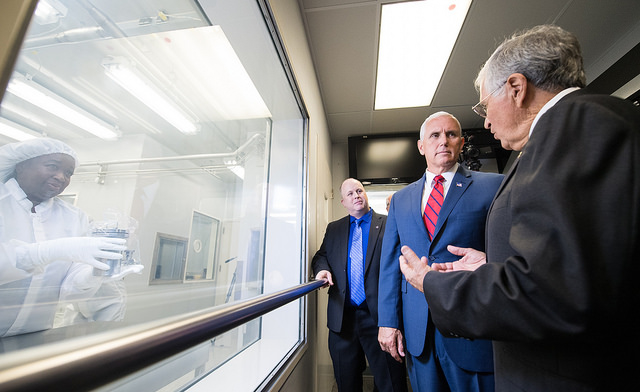
Vice President Mike Pence, center, views Sample 15014, which was collected during Apollo 15 with NASA’s Apollo Sample Curator Ryan Zeigler, left, and Apollo 17 astronaut and geologist Dr. Harrison Schmitt, right, in Lunar Curation Laboratory at NASA’s Johnson Space Center, Thursday, Aug. 23, 2018 in Houston, Texas. Sample 15014 is one of nine samples out of the 2,196 collected during the Apollo missions that was sealed inside its container on the Moon and still containes gasses from the Moon. Credit: NASA/Joel Kowsky
And it was my privilege to wander around this place with a great American, a hero of Apollo 17, and a man that all America is proud of — one of the last two men to walk on the moon — Jack Schmitt. It is always an honor to be with you. (Applause.) Thank you for your leadership.
We rode over in my car together, which is kind of cozy — lots of stuff piled in there. And I was just imagining, maybe I was in the — (laughter) — me and Jack Schmitt in close quarters. (Laughs.) As close as I’ll ever get, Jack. (Laughter.) Thank you.
Thank you for your leadership and your courage, and your commitment — a member of the User Advisory Group, advising the National Space Council to take NASA to even higher levels. Thank you again, Jack.
With the strong support of all these leaders, I’m pleased to report to the whole team here at NASA, President Trump has brought renewed vision and renewed action to America’s space program.
Last summer, as Jim mentioned, after it had lain dormant for nearly a quarter of a century, President Trump revived the National Space Council, and put us all to work. (Applause.)
As we speak, the National Space Council — bringing together all different agencies of government that bear on this program, and bringing together the best minds in and around American space leadership — we’re forming a cohesive and comprehensive strategy for America’s space activities.
It’s my honor to serve as Chairman, and we’ve already forged new partnerships between the federal government, leaders in industry, and academia. We’re enacting new space traffic management policies to protect our assets in that crowded realm. We’re rolling back stifling red tape so we can tap the bottomless well of American innovation.
We’re also renewing our national commitment to discovery and to exploration, and to write the next great chapter of our nation’s journey into space. That’s why, last December — 45 years almost to the minute since Jack Schmitt and Gene Cernan landed on the moon — President Donald Trump signed Space Policy Directive-1. It is now the official policy of the United States of America that we will return to the moon, put Americans on Mars, and once again explore the farthest depths of outer space. (Applause.)

U.S. President Donald Trump holds up the Space Policy Directive – 1 after signing it, directing NASA to return to the Moon, alongside members of the Senate, Congress, NASA, and commercial space companies in the Roosevelt room of the White House in Washington, Monday, Dec. 11, 2017.
Credit: NASA/Aubrey Gemignani
And the President’s leadership and all of your great work is the cause of what brings me here today, for this is the mission; this is future of the Johnson Space Center.
For more than 50 years, this storied center has been at the forefront of America’s journey to the stars. This is the “home of the Astronaut Corps.” And, here, from the Mission Control Center, you have guided every American-crewed space expedition since 1965.
The names and the voyages that you directed from this place adorn the mantle of American greatness. In Project Gemini, you steered some of our earliest astronauts high above what they called the “Blue Marble,” into low Earth orbit.
In the Apollo Program, you navigated the first members of the human family to the moon and back.
At this very hour, you walk with our astronauts through their duties as they walk 200 miles above us, orbiting the Earth every 90 minutes, on the International Space Station.
The Johnson Space Center is a national treasure, and all the men and women who work here are a national asset. (Applause.)
NASA Administrator Jim Bridenstine and NASA astronaut Suni Williams with Vice President Mike Pence. Credit: NASA/Joel Kowsky
I have to tell you, I’m just speaking as a small-town guy from southern Indiana, but I know the American people admire — they admire the work done here — past, present — and they look for even greater things in the future here at Johnson Space Center.
And let me to say to all of you, and all of those that might be looking on: The most important work and the best days for the Johnson Space Center are yet to come. (Applause.) Count on it.
Our administration has laid out a new vision for space. President Trump’s vision to push our nation farther, get there faster than ever before, is being implemented even as we speak. And unlike prior administrations, we have a vision with the budget to match.
As I mentioned, thanks to Congressman Culberson’s leadership and the strong bipartisan support in the Congress, President Trump already signed into law historic funding for NASA. And we’ve also fully funded NASA’s most important endeavors from deep-space human exploration: America’s rocket, the Space Launch System, and the Orion space capsule.
These projects, as you all well know, are emblematic of American leadership in the cosmos. The Space Launch System will be the largest and most powerful rocket ever built. It will generate a staggering 11.9 million pounds of thrust and reach speeds of nearly 7 miles per second. And all this force, all this energy, will lift American astronauts into space aboard the Orion capsule. (Applause.)
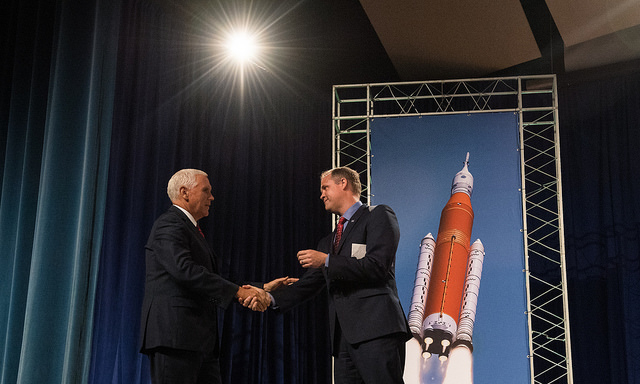
Vice President Mike Pence shakes hands with NASA Administrator Jim Bridenstine after being introduced prior to speaking in the Teague Auditorium at NASA’s Johnson Space Center, Thursday, Aug. 23, 2018 in Houston, Texas. Vice President Pence spoke about the future of human space exploration and the agency’s plans to return to the Moon as a forerunner to future human missions to Mars, stating that “soon and very soon American astronauts will return to space on American rockets launched from American soil.”
Credit: NASA/Joel Kowsky
I just saw one of those Orion capsules floating out in that big tank. (Laughter.) I know we’re getting ready to put that thing up in the air. And it will be up before you know it.
The next Americans who set foot on the moon will start their journey by stepping through Orion’s hatch. And this extraordinary spacecraft will one day bridge the gap between our planet and the next, for the Orion will be a critical part of the vessel that carries American astronauts to Mars. (Applause.)
And you, here at the Johnson Space Center will guide these journeys. For while our sights are once again set on our lunar neighbor, this time we’re not content with just leaving behind footprints, or even to leave at all. This time has — a time has come, we really believe, for the United States of America to take what we have learned over these so many decades, put your ingenuity and creativity to work, and establish a permanent presence around and on the moon. (Applause.) We’re going to do it. We’re going to do it.
Now, some say that America doesn’t need to go back to the moon; that we ought to focus on issues closer to home. That attitude was probably best described in one of my favorite movies, called Interstellar. (Laughter.) Remember that scene on the front porch? It was an incredible quote. One of the characters in the movie said, and I quote, “We used to look up at the sky and wonder at our place in the stars. Now we just look down and worry about our place in the dirt.” That’s not how Americans think.
Truthfully, that kind of thinking led people in the past to even cancel the Constellation Program. That would have put Americans back on the moon by 2020 and set the stage for exploration to Mars and beyond.
That decision was a mistake. It said to NASA, it said to our country, to the entire world, that America was no longer serious about human space exploration. We talked about going to Mars, but without the moon as the stepping stone, without stronger commercial partnerships to help us get there, a crewed mission to the red planet was not much more than a mirage.
But those days are over. America will lead mankind to the stars once again. (Applause.) We will. We will.

“The moon sits at the edge of the known and the unknown.” Credit: NASA/ESA
Our administration has restored the moon as the focal point of our national space activities because we recognize its pivotal importance. And that’s why, under President Trump’s leadership, our administration is swiftly advancing the most important precursor to outposts on the moon and the mission to Mars — the first space station that will orbit our nearest neighbor the Lunar Orbital Platform.
Last year, NASA began to work with American innovators to design this gateway’s unique electric propulsion system. We’re working with the Congress to provide an unprecedented $500 million to move the Lunar Orbital Platform from proposal to production.
We’re only a few short years away from launching the gateway’s first building blocks into space, turning science fiction into science fact. And our administration is working tirelessly to put an American crew aboard the Lunar Orbital Platform before the end of 2024. Men and women of the Johnson Space Center: It’s not a question of if; it’s just a question of when. (Applause.)
Now, we’re on the cusp of a new golden age of exploration. I believe it with all my heart. And we’ve got the courageous astronauts that are ready to lead us there again. As NASA continues to push back the borders of this still-new frontier, we will empower America’s private pioneers as well to cultivate the vast expanses that we’ve already explored. We’ll ensure that American security in space is attended to as well.
You know, the moon sits at the edge of the known and the unknown. But between here and there, there are some 240,000 miles. The region between the Earth and the moon is ripe for opportunity, and nowhere is that more apparent than immediately beyond our atmosphere.
Low Earth orbit is critical to America’s national interests. It holds immense strategic, scientific, and commercial value. And we know this because of your work here at the Johnson Space Center, with the International Space Station.
You know, ever since Bill Shepherd first floated aboard the ISS in the year 2000, there’s been a continuous human presence in low Earth orbit, and the results have really been extraordinary.
The ISS has conducted groundbreaking research on microgravity, life support systems. It’s been a testbed for cutting-edge space technologies and systems, including 3D printers in zero gravity; fostered medical discoveries for cancer and other diseases; and given us new ways to treat our nation’s veterans. The International Space Station has spurred unprecedented collaboration between our federal government and a new generation of innovative American companies, as well.
Let me say this clearly: The International Space Station has been an unqualified success, and the men and women of Johnson Space Center deserve the credit for the history you’ve made. (Applause.) You do.
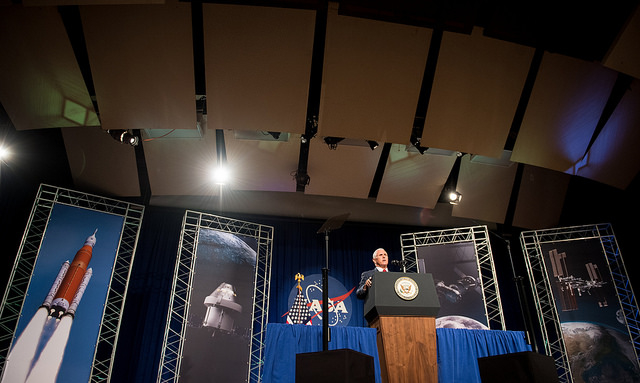
Credit: NASA/Joel Kowsky
But like Skylab before it, the ISS, as you all know, has a finite lifetime. And with the deadline for direct funding set for 2025, we have to prepare immediately for what comes next. To ensure American leadership in low Earth orbit tomorrow, we are taking action today.
In the words of mission controller and legendary leader Gene Kranz, we need to be “tough and competent” to achieve our goals. And together with NASA, we’re already developing a comprehensive plan to do just that.
The Johnson Space Center knows well the high cost of inaction. The men and women of NASA have always been committed to American leadership in space, but too often, our policymakers have failed to match your conviction with action and investment for the future. The last decade is proof.
The end of the Space Shuttle Program in 2011 left America without a viable human space launch program. While I was a member of Congress, I actually had the opportunity to attend three different shuttle launches — some of the most inspiring experiences of my little family’s lives.
Sadly, for more than seven years, we’ve been forced to hitch a ride to space. Many Americans don’t know that we’ve actually been forced to pay Russia to carry American astronauts to the International Space Station. And today, that cost runs about $82 million per seat. Those days are about to be over. (Applause.)
I’m going to make you a promise: Soon, and very soon, American astronauts will return to space on American rockets launched from American soil. (Applause.) And when they go, of course they’ll be guided by the dedicated team here at the Johnson Space Center.
You know, when we ended the Shuttle Program, it was more than a loss of momentum, though. It was really a tremendous loss for America’s space workforce. You all know that better than me.
The end of the Space Shuttle Program meant that many of our leading researchers, technicians, and space professionals no longer had a mission. Here at the Johnson Space Center alone, some 3,200 contractors were laid off, cutbacks and consequences rippled through universities, research labs, our space industrial base, and even the Department of Defense.
These were men and women who you knew, you worked with. They were men and women of creativity, and intellect, and unparalleled skill. But they were, frankly, victims — victims of our government’s shortsightedness in those days. America lost nearly a decade of space experience. And, frankly, we’ll never know the opportunities that we missed and the progress that was missed at that time.

Acting director of the Exploration Integration and Science Directorate and Chief Scientist at NASA’s Johnson Space Center Dr. Eileen Stansbery, left, is seen with Vice President Mike Pence and Apollo 17 astronaut and geologist Dr. Harrison Schmitt in the Astromaterials Curation Laboratory at NASA’s Johnson Space Center, Thursday, Aug. 23, 2018 in Houston, Texas. Credit: NASA/Joel Kowsky
But let me promise all of you, and all of the men and women of NASA and our national space enterprise: Our administration will not repeat the mistakes of the past. We will forge this new era of American leadership in space on your innovation, and the extraordinary integrity and intellect and innovation of our space workforce. (Applause.)
The Johnson Space Center has already given us a glimpse of what the future will hold. This center is now a thriving hub of partnership between the federal government and America’s pioneering space companies.
You’ve worked closely — and Mark and I were just talking about this — you’ve worked very closely with private industry to deliver critical cargo and material to the International Space Station through the Commercial Resupply Services, which has already successfully completed 23 different missions, with more on the way.
As we speak, you’re making remarkable progress on the Commercial Crew Program. Earlier this month, as President Trump celebrated himself, NASA announced the astronauts who will conduct the first flights on Boeing’s Starliner and SpaceX Dragon. And they’ll be going as early as next year. (Applause.)
But, really, we’re just getting started. This is just the beginning. As NASA reorients toward human space exploration, our private companies and visionary innovators are going to take the lead in developing the regions closer to home. They will do as Americans have always done — will inspire the world with their ability to create opportunity and, frankly, prosperity. Not out of thin air — out of no air. (Laughter.)
Our administration, as we speak, is working with the Congress to give NASA the funding you need to ensure that these new space pioneers are given the freedom and flexibility to be able to develop what they should develop, and make it a smooth transition to an exciting future of collaboration.
The Johnson Space Center is going to continue to play an essential and irreplaceable role in navigating America’s future in low Earth orbit. You can count on it. America will not ever abandon the critical domain of space. We will open the way for innovators and development, and we will lead once again in human exploration. (Applause.)
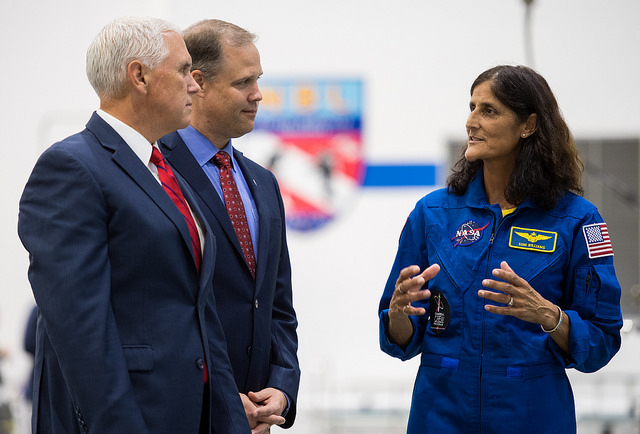
NASA astronaut Suni Williams speaks with Vice President Mike Pence and NASA Administrator Jim Bridenstine during a tour of the Neutral Buoyancy Laboratory at NASA’s Johnson Space Center, Thursday, Aug. 23, 2018 in Houston, Texas. Credit: NASA/Joel Kowsky
And as I stand here today at the home of our civilian spaceflight program, let me also assure my fellow Americans that, under President Trump’s leadership, we’re also taking steps, as we speak, to ensure that American national security is as dominant in space as it is here on Earth.
We’re already deploying new technologies and more resilient satellites. Earlier this month, at the Pentagon, it was my privilege to lay out President Trump’s plan to establish a sixth branch of our armed forces: the United States Space Force.
The United States Space Force, we believe, is an idea whose time has come. Just as our nation established the Air Force to ensure American dominance in the skies in the mid-20th century, in this still-new century, we will create an armed service devoted solely to advancing American security in space.
And the need is real. Just this week, the Pentagon released a report showing that China is aggressively weaponizing space. Russia, too, is developing and testing new and dangerous weapons and technologies to counter America’s space capabilities.
Now let me assure my fellow Americans here, our administration is committed to keep America ahead of our adversaries in this critical domain. And as we speak, the Department of Defense is moving forward with initial steps to strengthen American security in space, and we will continue to work with both parties in Congress to provide the necessary authorities and funding to stand up a new branch of our armed forces. And the United States Department of Space Force will be a reality by the year 2020. (Applause.)
You know, it really is incredible to think about the history you all have made here. And it’s humbling for me to serve as your Vice President, but also to have been asked by the President to serve in the role as Chairman of the National Space Council.
The truth is, our nation has not only inspired our people, but we’ve inspired the world by the progress that we’ve made. And it’s been because of all of you, because of the work that you’ve done here, because of the tireless and peerless work of NASA.
But the truth is, as much as it’s been important for NASA to lead in the past, you are the linchpin to American success in the future. The truth is, with all of you, we will go farther — farther than even before. We will bring distant places and opportunities closer to the grasp of future Americans. We’ll be remembered in our time for having done our part for the ongoing and limitless reach of the American Dream.
So today, I just simply want to leave you with a challenge. As we write this new chapter of American exploration, I urge you to embrace this new energy and these new opportunities. Rededicate yourselves to the mission of NASA after you leave here today.
Know that you have, in this President and our entire administration, and, I believe, in the hearts of the American people and those that represent them, you have great champions and great advocates that are anxious to see your work expand.
I just know in my heart, in our lifetimes, with your renewed energy and creativity and dedication, we will do as Americans have always done. NASA will awe the world with our daring heroes, with our discoveries, and with our relentless determination to bring new horizons and new vistas within the reach of mankind.
This is a fitting time to rededicate ourselves to the noble mission of this agency, for this year marks the 50th anniversary of, really, a seminal moment of American leadership in space — an achievement that inspired not only our nation, but all the world.
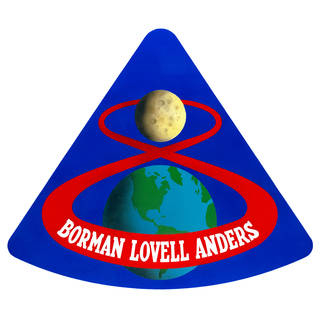
It was Christmas Eve, 1968. The heroes of Apollo 8 — Bill Anders, Jim Lovell, and Frank Borman — were orbiting their craft above the moon’s foreboding surface. History records, as they rounded the moon on that fateful night, on the horizon, they saw home — an oasis of light and color and warmth, floating untethered in the dark void. They were the first to catch a glimpse of our world as Heaven sees it.
Through the ingenuity and courage of your predecessors, they were further away from us than any humans had ever been. And on that night, they spoke to the world from that spacecraft — not about the grey moon that was beneath them, but about the miracle that rose from the horizon before them.
As the world listened, history records they read ancient verses from the Book of Genesis that “In the beginning, God created the heavens and the earth,” and they closed with the verse, “and God saw it was good.”
Those pioneers saw from that far perspective that however deep into the cosmos we may reach, our destiny — mankind’s destiny, is not only here on Earth, it is in the heavens as well. (Applause.)
So men and women of the Johnson Space Center, men and women of NASA here and watching around the country, let’s go forth and meet that destiny together to do what Americans have always done. Let’s seize it with ingenuity and courage, and let’s seize it with faith.
You can be confident in the — the American people have faith in all of you. We’ve seen what you’ve done before in those that have served in your positions before, pushing the boundaries of human knowledge, forging a new era of American leadership in space. You’ve done it before; we know you’ll do it again. To go forth with faith in the ideals that bind us together as a nation and give us purpose as a people — ideals that America will take freedom into the farthest reaches of this new frontier as well.
And finally, to those of you who will guide this mission, on a personal level, I just — I want to assure you that millions of Americans will carry you in their prayers. And they have faith and hope you have confidence that, as you go, you do not go alone. That millions of Americans will claim that ancient promise that if you “rise on the wings of the dawn”, if you “go up to the heavens,” “even there His hand will guide you,” and “His right hand will hold us fast.” Our heroes will go with the prayers of the American people. (Applause.)
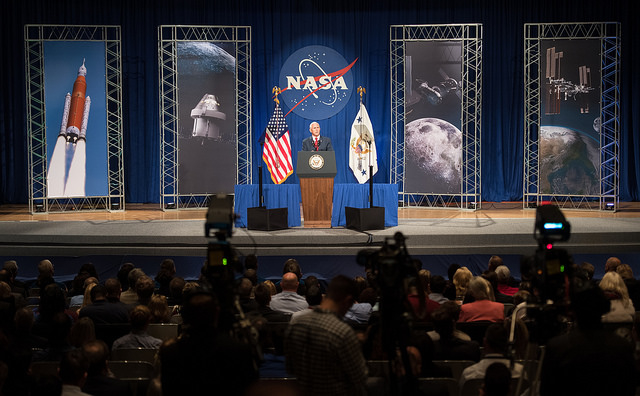
Credit: NASA/Joel Kowsky
So thank you for — thank you for the warm welcome today. Thank you for your extraordinary work. I leave here today more confident than ever. With the renewed commitment of all of you here at the Johnson Space Center, and all the men and women of NASA who are advancing America’s space enterprise every single hour of the day; with the strong leadership of President Donald Trump; and a renewed vision for American leadership in space, led by the President supported in our Congress; with the strong support of the American people; and with God’s help, I know that our nation has a brighter future than ever in the boundless expanse of space and we will lead into that future together.
Thank you. God bless you. And God bless America. (Applause.)
END
1:22 P.M. CDT
The Fifth Community Workshop on Achievability and Sustainability of Human Exploration of Mars: Three Scenarios for the 2030s.
Based on work accomplished in four previous workshops and other related activities, participants in this workshop developed three architectures that span the range of plausible options for human missions to Mars, with each of these missions leading eventually to crews that would be away from Earth for roughly 1,000 days.
Scenarios
The first scenario involves sortie missions, with a two-week stay on the surface.
The second concept is a semi-permanent base or “field camp” on the surface, with a stay of a year and a half, and is analogous to early Antarctic exploration.
The third concept is a sustained, permanent habitation analogous to current Antarctic exploration, setting the stage for potential settlements.
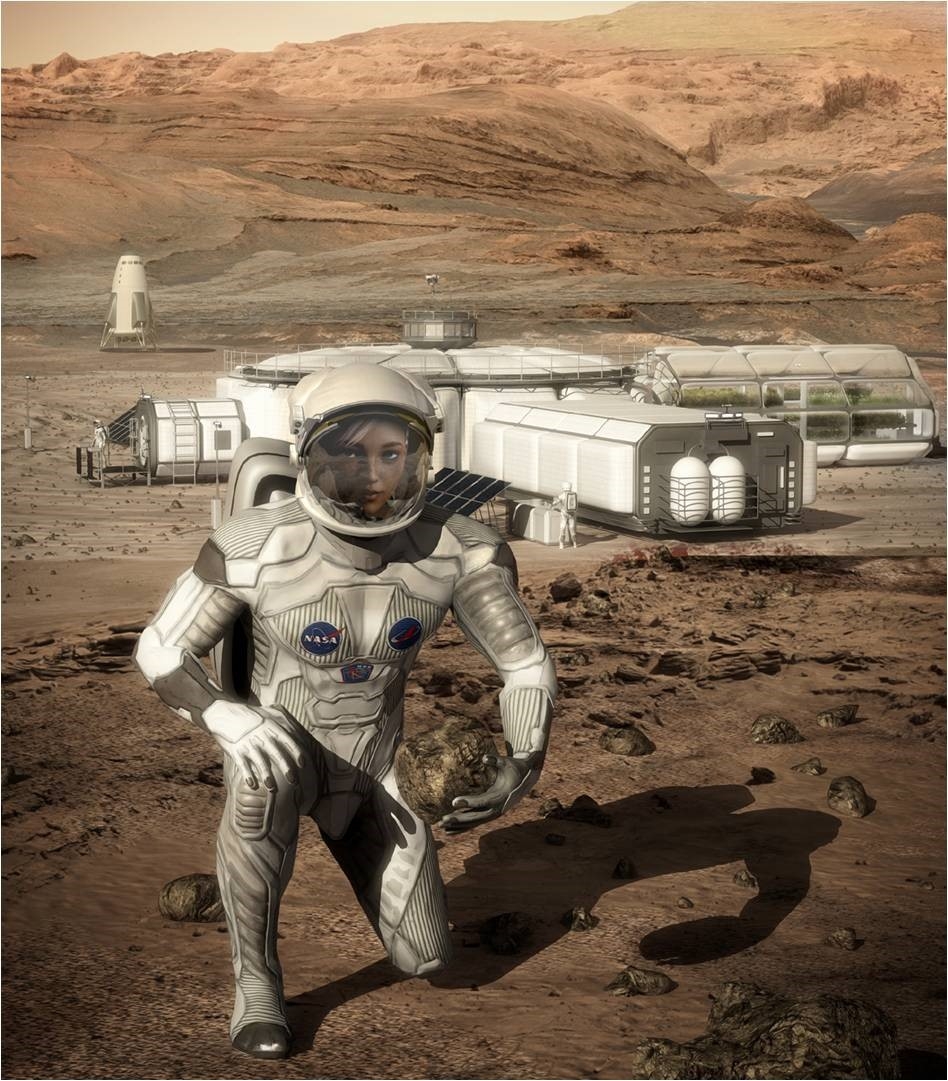
Credit: Bryan Versteeg
End states
This report discusses the trio of “End States,” as well as points of agreement and points of departure: Breakout 1: A Series of Sortie Missions; Breakout 2: Research Station on Mars; and Breakout 3: Permanent Human Habitation.
To read the full report, go to:
https://www.exploremars.org/wp-content/uploads/2018/08/AM-V-Report_Design_v2.pdf
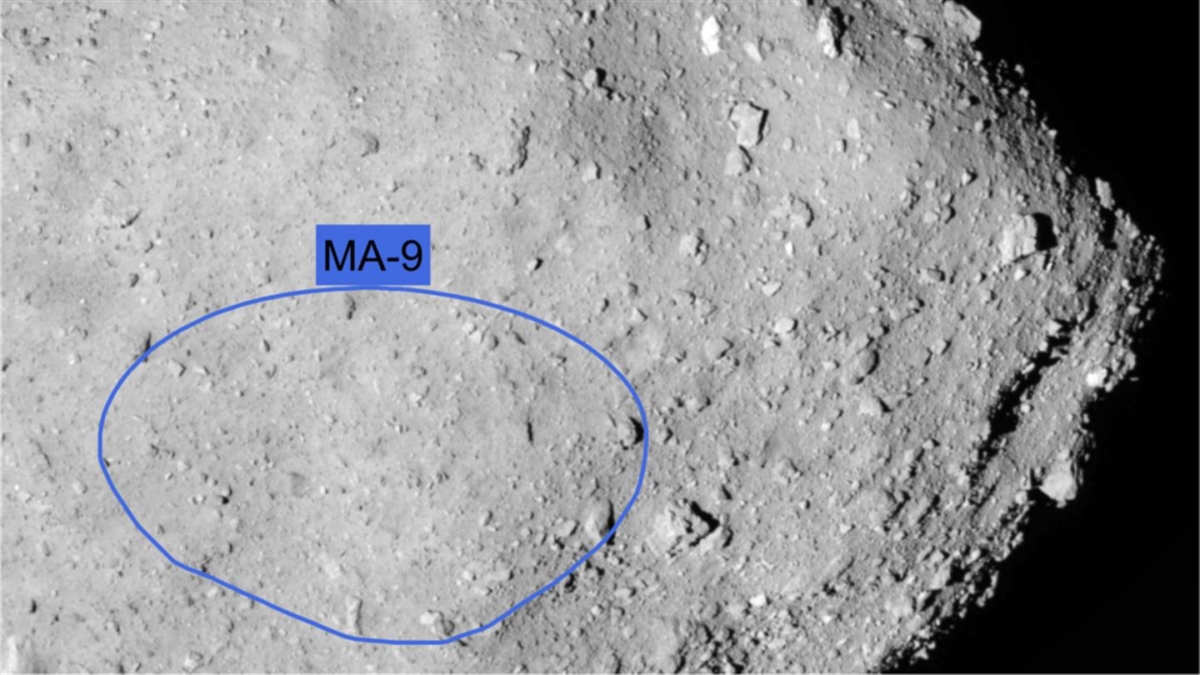
Mobile Asteroid Surface Scout (MASCOT) landing site.
Credit: JAXA, University of Tokyo and collaborators
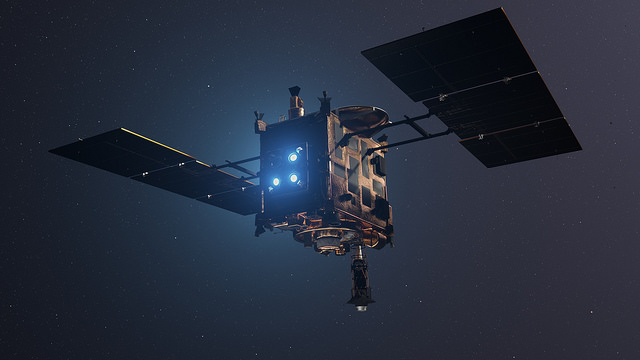
Japan Aerospace Exploration Agency’s (JAXA) Hayabusa2 spacecraft.
Credit: DLR (CC-BY 3.0)
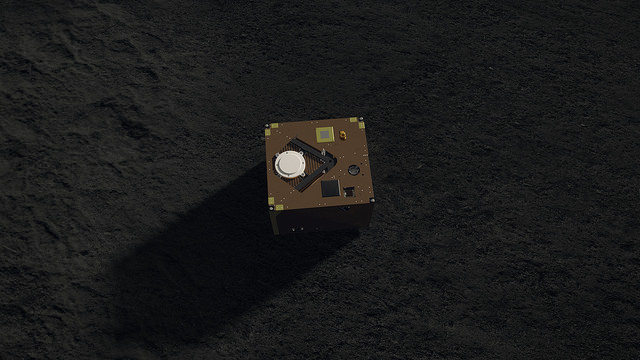
The Japan Aerospace Exploration Agency’s (JAXA) Hayabusa2 spacecraft will deploy in October the Mobile Asteroid Surface Scout (MASCOT).
In consultation with more than 100 international and national partners, the MASCOT landing site was selected. MASCOT’s landing is scheduled for October 3, 2018.
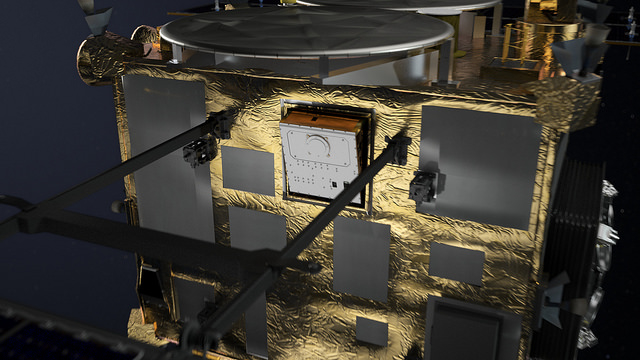
Mobile Asteroid Surface Scout (MASCOT) tucked in on Hayabusa2.
Credit: DLR (CC-BY 3.0)
Rover landing spots
Also, the locations at which the Hayabusa2 spacecraft is expected to take soil samples have been designated, as have the sites where the three MINVERVA-II rovers will be placed on the asteroid’s surface.
MINERVA-II-1 is a container that will deploy two rovers, ROVER-1A and ROVER-1B, developed by JAXA and the University of Aizu. The MINERVA-II-2 container holds the ROVER-2, developed by a consortium of universities led by Tohoku University.
Credit: DLR (CC-BY 3.0)
MA-9
Located at approximately 315 degrees east and 30 degrees south, the place at which MASCOT is to land and carry out measurements on the asteroid’s surface using four instruments is, at the moment, still simply called “MA-9.”
The landing site area has several advantages.
Firstly, it is far enough from the regions in which Hayabusa2 will descend to the surface and take soil samples, therefore MASCOT and Hayabusa2 will not get in each other’s way as they perform their activities.
Secondly, the landing site lies in Ryugu’s southern hemisphere, so with the data collected by Hayabusa2 at the equator and MINERVA in the northern hemisphere, scientists will be able to gain good coverage of and investigate the over half-mile (950-meter-diameter) asteroid.

The MASCOT lander is set to land on the blue-marked ellipse MA-9. The Hayabusa2 probe will approach the asteroid surface at location L07 (L08 and M04 are substitute landing sites, where it will take samples. The MINERVA rovers will be dropped off at the red marked landing N6.
Credit: JAXA, University of Tokyo and collaborators
Numerous boulders
According to a DLR press statement, in the vicinity of the MASCOT landing site, there are numerous boulders up to 30 meters tall. But the really big rocks are not located in the MA-9 region.
Images acquired by the optical navigation camera on the Hayabusa2 probe, explains the DLR, indicate that the landing site area probably holds fresher material that had little exposure to cosmic radiation, the particle flow of solar winds, as well as interplanetary dust – and is therefore still very primordial and in an unchanged state.
Close cooperation
The German-French lander MASCOT on board Hayabusa2 was developed by the German Aerospace Center (Deutsches Zentrum für Luft- und Raumfahrt; DLR). It was built in close cooperation with the French space agency, Centre National d’Etudes Spatiales (CNES).
On December 3, 2014, the Japanese space probe Hayabusa2 embarked on a sample return mission to asteroid (162173) Ryugu (formerly designated 1999 JU3).

Curiosity Front Hazcam Left B image acquired on Sol 2148, August 22, 2018.
Credit: NASA/JPL-Caltech
NASA’s Curiosity rover is performing Sol 2149 duties.
“With seventeen sampling holes and several test holes, you might imagine that Curiosity is creating a rather long and erratic golf course in Gale crater,” explains Roger Wiens, a geochemist at Los Alamos National Laboratory in New Mexico. “After all, Alan Shepard shot a golf ball on the Moon.”
The first two martian sampling holes, at Yellowknife Bay, are several kilometers away from the third hole, at Kimberley, Wiens adds, which is several kilometers from all the subsequent ones in the Murray formation.

Curiosity Mastcam Right photo taken on Sol 2148, August 22, 2018.
Credit: NASA/JPL-Caltech/MSSS
“The distances between the first several holes might be too long for golf links on Earth, but maybe with reduced gravity and very little wind resistance, a mighty drive of over a kilometer might be possible,” Wiens notes. Unfortunately, the size of the holes drilled by Curiosity, at roughly 16 millimeters diameter, are too small for golf balls…so golf enthusiasts will have to wait a little longer to play on Mars.
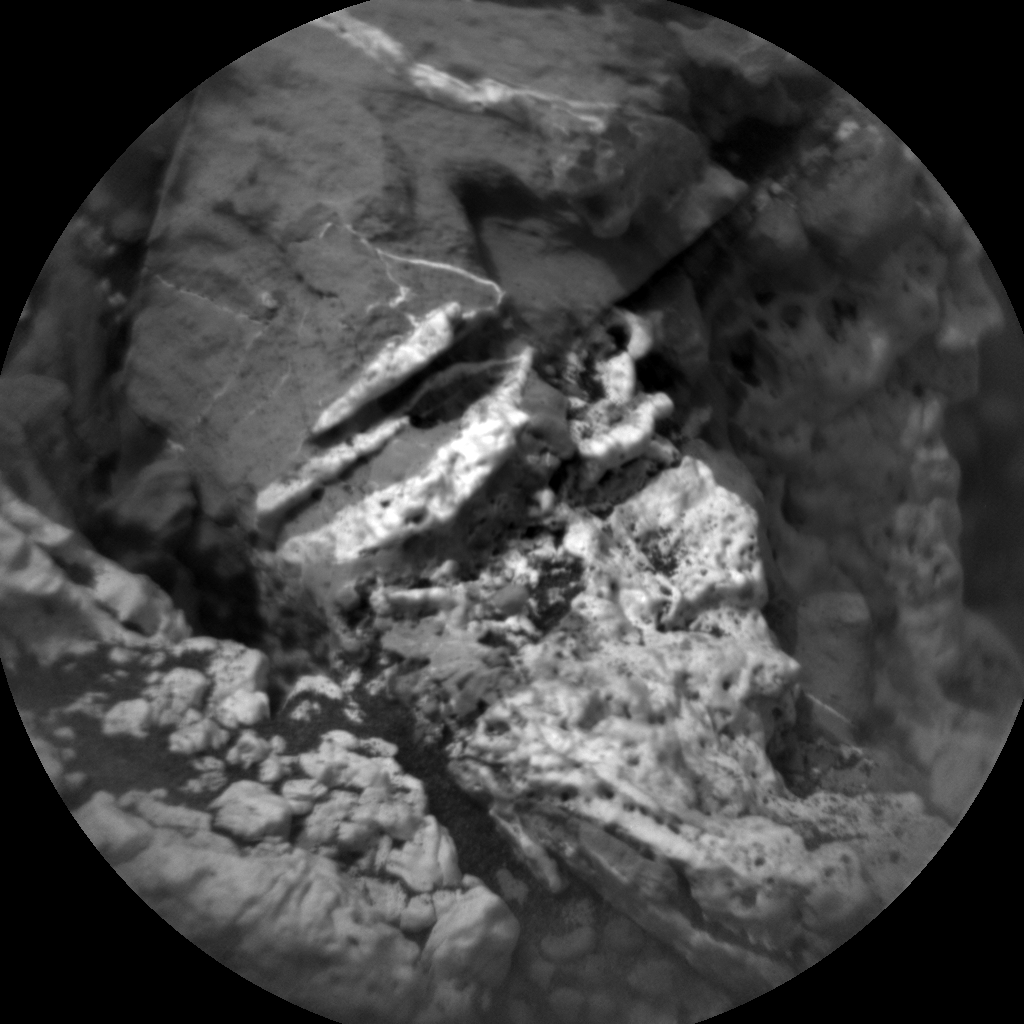
Curiosity ChemCam Remote Micro-Imager photo acquired on Sol 2149, August 23, 2018.
Credit: NASA/JPL-Caltech/LANL
Drill hole
Golfing aside, Curiosity continues to analyze the samples from the Stoer drill hole.
The rover and its robotic arm are stationary until scientists receive a green light from the Sample Analysis at Mars (SAM) Instrument Suite and Chemistry & Mineralogy X-Ray Diffraction/X-Ray Fluorescence Instrument (CheMin) analyses.
The main activity of Curiosity recently is more analysis time for CheMin, which will run in the background, adds Wiens.
Vein and concretion features
In the meantime, Wiens reports, ChemCam gets to shoot its laser at “Ainshval,” “Tarskavaig,” and “Loch Aline,” which are interesting vein and concretion features on the rock surface in the vicinity of the drill hole.
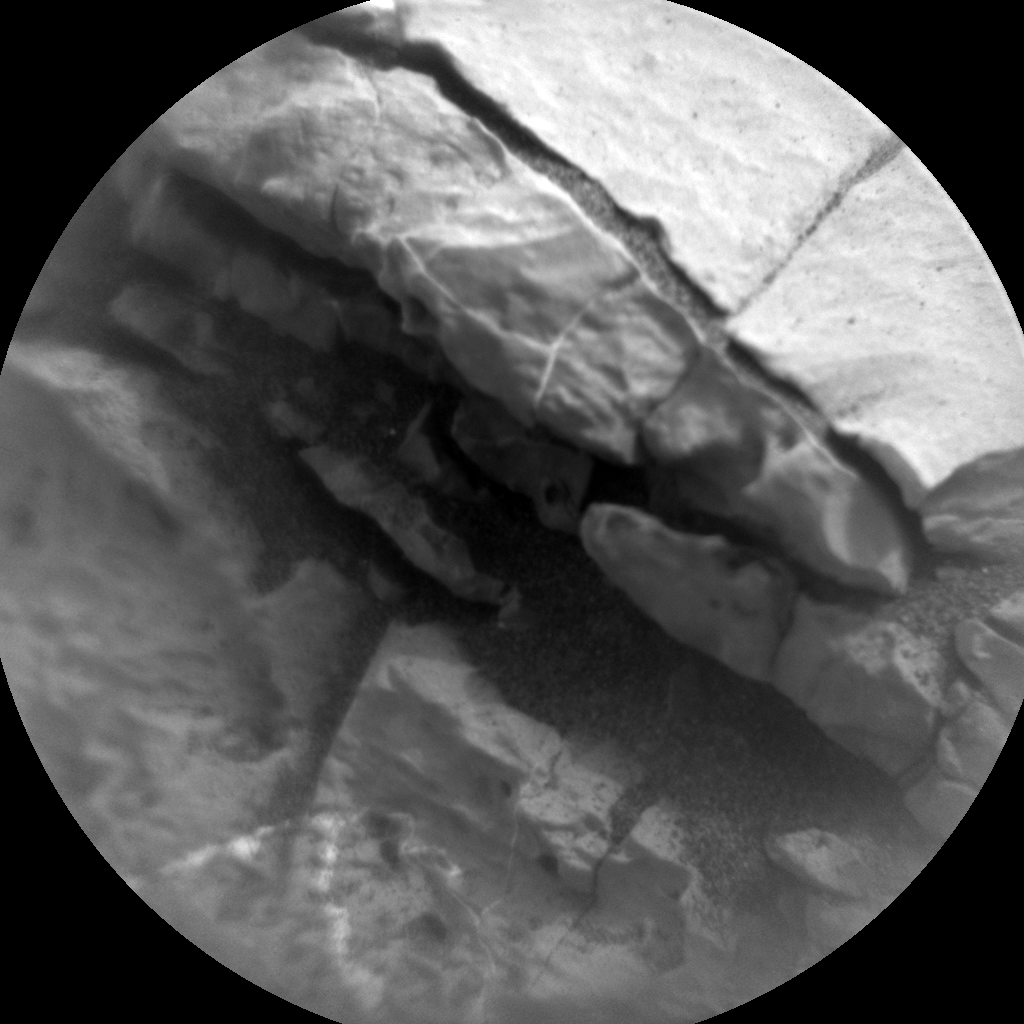
Curiosity ChemCam Remote Micro-Imager photo acquired on Sol 2149, August 23, 2018.
Credit: NASA/JPL-Caltech/LANL
The robot has recently-imaged vein material and the rover’s Mastcam is set to image the new targets and also take another picture of the drill tailings.
There are Mars Descent Imager (MARDI) change-detection images to be taken just after sunset and just before sunrise, Dynamic Albedo of Neutrons (DAN) active and passive observations are to be done, a dust-devil survey by Navcam, and Rover Environmental Monitoring Station (REMS) and Radiation Assessment Detector (RAD) data collects are also on the schedule.
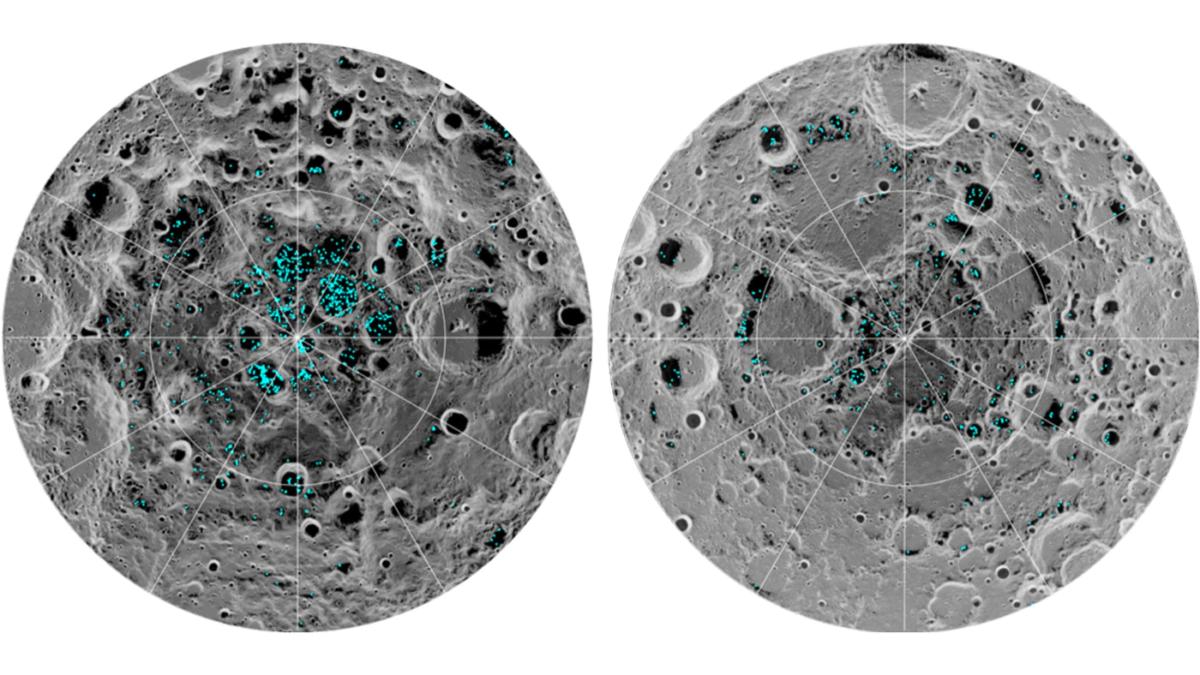
The image shows the distribution of surface ice at the Moon’s south pole (left) and north pole (right), detected by NASA’s Moon Mineralogy Mapper instrument. Blue represents the ice locations, plotted over an image of the lunar surface, where the gray scale corresponds to surface temperature (darker representing colder areas and lighter shades indicating warmer zones). The ice is concentrated at the darkest and coldest locations, in the shadows of craters.
Because of the very small tilt of the Moon’s rotation axis, sunlight never reaches these regions.
Credits: NASA/Elphic
The Moon research community is beaming about the new evidence of exposed water ice in the lunar polar regions.
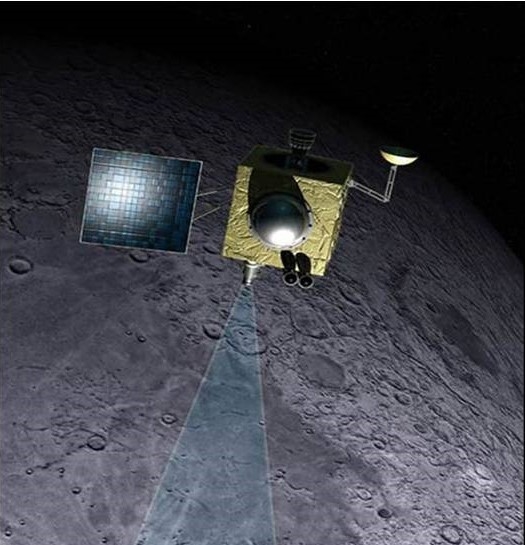
NASA’s Moon Mineralogy Mapper, or M3, instrument flew aboard Chandrayaan-1, India’s first mission to the moon, and provided the first mineralogical map of the lunar surface.
Credit: NASA/JPL
Using data from the NASA’s Moon Mineralogy Mapper (M3) spectrometer experiment, a team of researchers — led by Shuai Li of the Hawaii Institute of Geophysics and Planetology in Honolulu, Hawaii — searched for and found direct evidence for the presence of water in the permanently shadowed areas in polar craters on the Moon.
M3 flew as part of the scientific payload onboard the Indian Space Research Organization’s Chandrayaan-1 spacecraft that circuited the moon in 2008-2009.
Previous data could not specifically verify the existence of water ice, but Li et al. provide “robust evidence” for its presence on the Moon’s surface.
Lines of evidence
“This is a critical paper as it demonstrates that we have four independent lines of evidence that there are surface ice exposures at the lunar poles,” explains Clive Neal, a leading lunar expert at the University of Notre Dame.
“With the neutron data, we also know that these deposits extend into the subsurface. Therefore, we now have great maps that we can use to target prospecting surface rovers,” Neal told Inside Outer Space.
What’s not known
Neal said as far as on-the-spot use of the water ice reserves, what still needs to known is the size of the deposits, the geomechanical properties of the regolith it is in, ease of extraction, bulk composition (impurities and the refining process necessary to produce clean water of life support and rocket fuel, etc.).
Bottom line for Neal: “It is time to get to the surface of the Moon and start prospecting!”

Artist’s rendering of the LCROSS spacecraft and Centaur separation.
Credit: NASA
North and south poles
Angel Abbud-Madrid, Director of the Center for Space Resources at the Colorado School of Mines in Golden, Colorado, also finds the new research exciting.
“This new piece of evidence is valuable in that it provides additional confirmation on not just the presence of ice on permanently shadowed regions — which was obtained from previous instruments and from NASA’s Lunar CRater Observation and Sensing Satellite (LCROSS) impact mission in 2009 on Cabeus crater — but of water ice exposed on the surface in various well-defined spots on both the North and South poles,” Abbud-Madrid tells Inside Outer Space.
Water extraction
“These data are of importance for prospecting and in-situ resource utilization operations related to water extraction from the lunar poles,”Abbud-Madrid adds. The locations of surface-exposed water ice described in the new study, he said, could be used to select potential sites for more extensive ground truth exploration to qualify and quantify the ice content on these regions.
“This information is crucial to select the most appropriate extraction method to be used for ice exposed on the surface, as opposed to techniques to drill and recover subsurface ice,” Abbud-Madrid concludes.

Credit: LIQUIFER Systems Group 2018/René Waclavicek (used with permission)
Lunar bases
The new research provides “robust evidence” for the presence of water ice on the Moon’s surface, notes James Head at the Department of Earth, Environmental and Planetary Sciences at Brown University in Providence, Rhode Island.
“If ice is at the surface, this means that much more could be buried at depth and covered and preserved below insulating soil, or diffused into and frozen in the soil layers,” Head advises. “This is very exciting news, and provides significant impetus for future international landings in the polar regions to drill and return samples of this ice. Ice deposits in significant quantities on the Moon could provide resources for future lunar bases and for fuel for future human exploration of deep space,” he states.
To read the original research paper in the Proceedings of the National Academy of Sciences, “Direct evidence of surface exposed water ice in the lunar polar regions” by Shuai Li, Paul G. Lucey, Ralph E. Milliken, Paul O. Hayne, Elizabeth Fisher, Jean-Pierre Williams, Dana M. Hurley, and Richard C. Elphic, go to:
www.pnas.org/cgi/doi/10.1073/pnas.1802345115

As multiple nations have exploration crosshairs on Earth’s Moon, there’s also increasing discussion of the military utility of cis-lunar space and lunar territory too.
Moon expert, Paul Spudis of the Lunar and Planetary Institute, has written this reflective piece:
The Moon’s Role in the New U.S. Space Force – The military implications of a lunar return
Go to:
Also, go to this 21st Century Technology story:
Holding the Moon: The High Ground of Space
Go to:
http://www.21stcentech.com/holding-moon-high-ground-space/
U.S. President Donald Trump holds up the Space Policy Directive – 1 after signing it, directing NASA to return to the Moon, alongside members of the Senate, Congress, NASA, and commercial space companies in the Roosevelt room of the White House in Washington, Monday, Dec. 11, 2017.
Credit: NASA/Aubrey Gemignani
Assets in space
Meanwhile, a new Congressional Research Service (CRS) document says that, as a constitutional matter, it will be up to Congress to determine whether and how to reorganize the management of US national security assets in space, and whether to establish a new “space force,” as the Trump Administration has proposed.
“The constitutional framework appears to contemplate that the role of establishing, organizing, regulating, and providing resources for the Armed Forces belongs to Congress, while the President is in charge of commanding the forces Congress has established using the funds Congress has provided,” CRS said in a new publication.
Go to:
Toward the Creation of a U.S. “Space Force”

