Archive for the ‘Space News’ Category
 Author:
 November 28th, 2018
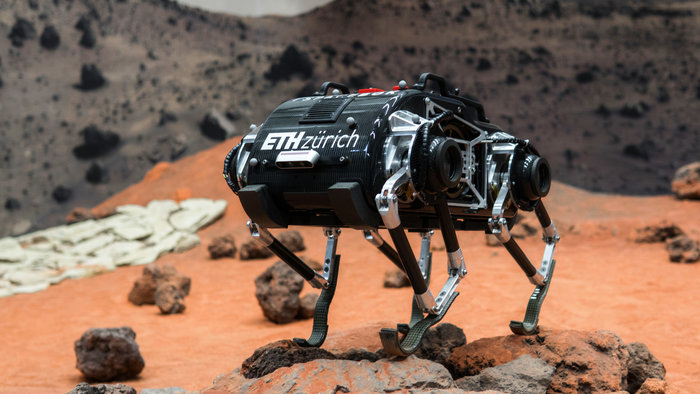
Credit: ESA
The walking and hopping quadruped robot is currently being tested in the European Space Agency’s (ESA) Mars Yard.
“Legged robots can traverse unstructured terrain and could be used to explore areas of interest, such as craters, which rovers are unable to reach,” explains team member Patrick Barton. “As they are very versatile, they can change gait to adapt to different terrain.”
SpaceBok has been designed by a Swiss student team from ETH Zurich and ZHAW Zurich, under the supervision of Professor Marco Hutter and PhD student Hendrik Kolvenbach.
Built for hopping
SpaceBok is primarily built for hopping and on the Moon the robot could reach a height of four meters off the lunar terrain. “This would allow for a fast and efficient way of moving forward,” says team member Elias Hampp in an ESA press statement.
In low gravity environments hopping proves to be energetically more efficient than walking.
The aim of the research effort is to build a jumping robot capable of overcoming large obstacles and thus increase the operation range of mobile robots for data collection.
To see SpaceBok in action, go to this video:
 Posted in


Credit: Trailer – The Wandering Earth/Screengrab/Inside Outer Space
Forget about shooting off interstellar probes, chips, plaques and records, or keepsake mementos…whatever.
How about launching the Earth outward?
China’s “The Wandering Earth,” is set to hit Chinese movie screens on February 5 of next year – Chinese New Year in Chinese theaters.

The film is adapted from a same name short story novel in 2000 by Hugo Award winner Liu Cixin.
The movie stars Guangjie Li, Chuxiao Qu, Man Tat Ng, Jinmai Zhao, Jing Wu.

Credit: Trailer – The Wandering Earth/Screengrab/Inside Outer Space
Centuries-long journey
Liu’s “Wandering Earth” depicts how humans, endangered by a dying and swelling Sun, erect gigantic engines to hurl the planet out of the solar system, setting it on a centuries-long journey in search of a new sun.
Gong Geer, the producer of the film, told Xinhua news agency: “We hope the plot, characters and scenes in the film can impress our audience as being Chinese, as this is a very Chinese story.”
“Westerners may be surprised by the idea of humans leaving with the Earth instead of fleeing in spacecraft,” Gong told Xinhua.”What they may see in this film is the Chineses’ dedication to the land, as nurtured in the country’s long agricultural history.”

Credit: Trailer – The Wandering Earth/Screengrab/Inside Outer Space
Trailers
The official trailers have been released, offering a look at various scenes, including a frozen “2044 Shanghai Olympic Mansion” and a massive “Earth Engine” towering over the Great Wall.
Take a look at these videos at:

Credits: NASA/JPL-Caltech
The entry of the InSight Mars lander may be caught by NASA’s Mars Reconnaissance Orbiter (MRO).

Credit: NASA/JPL/USGS (MOLA)
“The parachute image will be a distant view and probably smeared, so not a good looking image but still useful for engineering evaluation,” explains Alfred McEwen, the Principal Investigator of the High Resolution Imaging Science Experiment (HiRISE) for the MRO.
McEwen said that after InSight is on the Red Planet, a first post-landing image attempt is 3 days afterward, and most likely HiRISE will miss it on that first attempt, he told Inside Outer Space.

Credit: Werenbach
A Swiss space startup produces wristwatches made from the “upcycled” material of flown space rockets.
Zurich-based Werenbach is the start-up company offering “Race to Space Editions” of watches that incorporate materials from two rockets.

Credit: Werenbach
The watches belong to the MACH33 family. All models contain not just material from the respective space rocket but symbolic sections of the rocket: they are cut from the flag prints on the rocket faring as well as from the very tip of the rocket itself.

Credit: Werenbach
Watch 1: RTS1 RUS – Russia Flag Soyuz MS-04, 99 pcs
Watch 2: RTS2 USA – USA Flag Soyuz MS-04, 199 pcs
Watch 3: RTS5 GER – front of rocket Soyuz MS-09 (in reference to the first German ISS commander), 199 pcs

Credit: Werenbach
Special feature
Each of the watches in the MACH33 collection has a special feature: an integrated microchip that allows you to be connected to the livestream of Earth from the International Space Station, thanks to your smartphone. With these real-time video feeds, the watch-wearers can share a view that previously was only available to the astronauts aboard the ISS, but now can be accessed thanks to the watch on your wrist.
The watch straps, also made new for the collection, are each made in the respective national colors of the three countries.
The models are manufactured in limited quantities due to the very limited resources used for the editions.
For more information, go to:
Also, take a view of the video at:

Pangaea-X Moon base
Credit: ESA–A. Romeo
Future extraterrestrial romps by humans on the Moon can get a lunar leg up by training on Lanzarote, part of the Canary Islands. A European Space Agency (ESA) test campaign combines geology and space exploration with high-tech equipment.
The Pangaea geology field course is called Pangaea-X.
Moon-targeted experiments
For example, the week-long dry-run includes an experiment that ESA astronaut Luca Parmitano will carry out next year but this time from the International Space Station. The intent is to take Moon-targeted operations out into space.
Communications delays are to be included in the campaign. Astronauts operating rovers on the surface of the Moon, for example, must contend with low-quality links and delays in space.
Rover driving
Over the course of the week ESA astronaut Matthias Maurer, scientists, operations experts and engineers will work side-by-side on eight experiments and technology demonstrations to advance European know-how of human and robotic mission operations.
From Lanzarote, Matthias will drive a rover located at ESA’s main technology centre in The Netherlands.

Habitat modules are seen beside ‘garages’ for rovers, with an adjacent launch site. Note the robotic vehicles on the surface, proceeding with base construction.
Credit: RegoLight, visualization: Liquifer Systems Group, 2018
A team of scientists will advise Matthias on the most interesting samples from a scientific point of view. He will use a tool that integrates real-time positioning, data sharing, voice chat and much more.
3D printing
Meanwhile, a new ESA-led project is investigating the ways that 3D printing could be used to create and run a habitat on the Moon, reducing logistical dependency on Earth.
Everything from building materials to solar panels, equipment and tools to clothes, even nutrients and food ingredients can potentially be 3D printed.
The aim of 3D printing on the Moon would be to ‘live off the land’ as much as possible, by printing as many structures, items and spares out of lunar regolith as possible, or by using and reusing materials brought for the mission, rather than continuously relying on the long, expensive supply line from Earth.

Curiosity Front Hazcam Left A image taken on Sol 2236, November 20, 2018.
Credit: NASA/JPL-Caltech
NASA’s Curiosity Mars rover is now performing Sol 2237 tasks.
“Curiosity is planning a smorgasbord of science over the next few days as it awaits results from digesting the ‘Highfield’ drill target material,” reports Fred Calef, a planetary geologist at NASA’s Jet Propulsion Laboratory in Pasadena, California.

Curiosity ChemCam Remote Micro-Imager photo taken on Sol 2235, November 19, 2018.
Credit: NASA/JPL-Caltech/LANL
Also on tap is continuing change detection observations including subdiurnal (i.e. several times a martian day) Mastcam observations of “Sand Loch” and “Windyedge”, as well as use of the Mars Descent Imager (MARDI) to watch moving sand grains beneath the rover, throughout the planning cycle.

Curiosity Mars Descent Imager (MARDI) image acquired on Sol 2235, November 19, 2018.
Credit: NASA/JPL-Caltech/MSSS
Atmospherics
“There’s also a good helping of Mastcam sky column, Navcam sky flats, crater rim extinction, and suprahorizon and zenith movies to round out the meal of atmospheric events,” Calef adds. “Repeating observations during the day of the same locations are one of the unique ways the rover can provide an hourly view of Mars’ surface that only a spacecraft on the ground can.”
Planned is use of the Chemistry & Camera (ChemCam) instrument, targeting scattered pebbles nearby: reddish/pink rocks named appropriately “Rosemarkie” and some more bluish toned rocks called “Grey Mares Tail.”

Curiosity Mastcam Right photo taken on Sol 2235, November 19, 2018.
Credit: NASA/JPL-Caltech/MSSS
Suspected meteorite
There will also be a look at the suspected meteorite “Little Todday” with a ChemCam Z-Stack (to measure its compositional variation with depth) and repeat Mastcam observations of the Highfield drill tailings to see if it’s still being pushed around by daily winds, Calef explains.
A Curiosity Mastcam color image of “Greenheugh”, a special type of ripple uniquely spaced apart and only seen on Mars, will be taken. “The last image of that target was from over 250 sols ago (!), which may allow us to determine how fast they move across the surface,” Calef adds.

Credit: Euroconsult, China Space Industry 2018 (used with permission)
A new deep dive report on China’s space industry has been completed by Euroconsult.
The report — China Space Industry 2018 – notes that the China space value chain had an estimated size of more than $16 billion in 2017, with the downstream market accounting for just over 85%.
Satellite Navigation, one of the key satellite applications in China, was the main revenue generator in 2017, ahead of Satellite Communications and Earth Observation.
The analysis looks into the current Chinese space ecosystem and future expected evolutions, from upstream to downstream, and covers these space segments:
- Satellite Manufacturing
- Launch
- Satellite Communications
- Earth Observation
- Satellite Navigation
- Space Exploration

Credit: CCTV/Screengrab/Inside Outer Space
Rapidly evolving
“China’s space industry is rapidly evolving, with an increasing number of nominally private companies competing in different parts of the space industry in both China and abroad, and with the Chinese space industry starting to play a bigger role in cutting-edge technology,” explains Dimitri Buchs, Senior Consultant at Euroconsult and editor of the report. “Changes are occurring at a rapid pace across the value chain, for both upstream and downstream activities and for all application domains,” he adds.
According to a Euroconsult statement, the current changes in the space ecosystem are being brought about using different strategies, “such as the opening of some markets to private enterprises and greater competition among incumbents, all of which are aimed at fostering greater innovation among companies within China.”

Credit: China Manned Space Agency
Grander ambitions
Moving forward, Euroconsult adds it is expected that the Chinese government will continue to open different parts of the space industry.
“Indeed, with the state-owned giants more recently focusing on grander ambitions, such as China’s space station, the Chang’e moon mission, and eventually human missions to the Moon and Mars, it is possible that much of what is considered traditional commercial space, and even new space, will become more open to the private sector as the state sets its sights on bigger targets.”
For more information on China Space Industry 2018, go to:
http://euroconsult-ec.com/research/China-space-industry-2018-brochure.pdf

A United Launch Alliance (ULA) Atlas V rocket successfully launches the U.S. Air Force X-37B space plane.
Credit: ULA
A new analysis by the Center for Strategic and International Studies (CSIS) in Washington, D.C. focuses on the cost of creating a new military service for space, known as the Space Force.
Doing so is likely to be a hotly debated issue in the FY 2020 legislative cycle.
According to the CSIS report, one of the central questions about this proposal is how much it will cost and what the overall size and scope of the Space Force will be.
This just-issued brief provides rough estimates for the number of military and civilian personnel, the number and locations of bases, the budget lines that would transfer to the new organization, and the additional personnel and headquarters organization that would be needed for the new military service.

Credit: CSIS
Annual budget
This analysis finds that the total annual budget of the new service would range from $11.3 billion to $21.5 billion under the three options considered, more than 96 percent of which would be transferred from existing budget accounts within the Department of Defense.
Of these totals, only $0.30 billion to $0.55 billion would be new funding (or $1.5 to $2.7 billion over five years).
The report by Todd Harrison, director of Defense Budget Analysis and the director of the Aerospace Security Project at the CSIS, as well as research support provided by Nigel Mease, a Defense Budget Analysis intern at CSIS, is available at:
https://www.csis.org/analysis/how-much-will-space-force-cost

Credit: The Aerospace Corporation’s Center for Space Policy and Strategy
Even for technical experts in one of the many scientific and engineering disciplines central to space activity, it can be hard to make sense of how underlying policy direction is fundamentally shaping the art of the possible.
That’s the premise behind a newly issued primer that concisely identifies key concepts, issues, and organizational actors involved in space policy. Furthermore, a number of difficult policy questions face the United States and other spacefaring nations.
How should goals be defined for the next chapter in space exploration, commercialization, and security?
Space policy essentials
The document — Space Policy Primer: Key Concepts, Issues, and Actors — has been issued by The Aerospace Corporation’s Center for Space Policy and Strategy, written by James Alver and Michael Gleason.
“This primer lays out the essentials on the participants and processes of space policy, with minimal jargon and acronyms,” explains Jamie Morin, Executive Director of the Center for Space Policy and Strategy. “We hope this primer becomes a useful reference document for everyone from space policy novices to those with extensive experience with space issues.”

NASA astronaut Tracy Caldwell Dyson, Expedition 24 flight engineer, looks through a window in the Cupola of the International Space Station. A blue and white part of Earth and the blackness of space are visible through the windows.
Credit: NASA
Complexities
While the primer is somewhat U.S.-centric, it reflects the global environment and should be useful for non-U.S. observers seeking to understand the complexities of U.S. space policy, Morin adds.
The primer contents include looks at rationales for spaceflight, international space law and international organizations, civil, commercial and national security space, as well as national cross-cutting issues.
For the document, go to:
https://aerospace.org/sites/default/files/2018-11/Gleason-Alver_SpacePolicy_11162018.pdf

Aerospace’s artist rendering of the Solar Gravity Lens concept which will enable enhanced viewing of potentially habitable exoplanets.
Credit: The Aerospace Corporation
An innovative deep-space concept that relies on a solar gravity lens (SGL) to enable enhanced viewing of exoplanets is under study by NASA’s Jet Propulsion Laboratory and The Aerospace Corporation.
The SGL would provide 100-billion optical magnification, allowing it to show details as small as 10 kilometers across – similar to being able to spot something the size of New York City on an exoplanet.
As detailed in a press statement from The Aerospace Corporation, according to Einstein’s theory of relativity, light traveling through space will bend if it passes near sufficiently massive objects. This means that distant light will bend around the periphery of the sun, eventually converging toward a focal region as if it had passed through a lens.
The SGL mission would send spacecraft to that region to view the focused light.

Aerospace’s artist rendering of a swarm of spacecraft flying out of the solar system at a velocity of over 75 miles per second to reach the solar gravity line.
Credit: The Aerospace Corporation
Array of detectors
“SGL requires placement of an array of detectors that starts to observe the light from exoplanets once they arrive at a distance of approximately 50 billion miles or 550 astronomical units (AU) away from Earth,” said Tom Heinsheimer, Aerospace’s technical co-lead for SGL.
“To get to that solar gravity line,” Heinsheimer says, “the swarm of spacecraft will need to use a solar sail to fly out of the solar system at a velocity of over 75 miles per second.”
Stay in line!
Navigation and propulsion technologies will need to keep the sensors on the spacecraft flying in the one-mile-wide line that contains the light from the exoplanet. The roundtrip communications link of six light days will make ground control of the spacecraft impractical, so the spacecraft will need to be adaptable and able to learn from experience.
To undertake the two-year SGL study, Aerospace was awarded $130,000 from Phase II of NASA’s Innovative Advanced Concepts (NIAC) program through a contract with JPL which leads the overall NIAC study.

