Archive for the ‘Space News’ Category
 Author:
  December 13th, 2018
Virgin Galactic’s First Spaceflight on December 13th 2018.
Credit: Virgin Galactic/Quasar Media 2018
Today, Virgin Galactic conducted its fourth powered test flight and first space flight of its commercial SpaceShipTwo, VSS Unity.
The achievement has been recognized by the Federal Aviation Administration (FAA) who announced today that early next year they will present pilots Mark Stucky and Frederick Sturckow with FAA Commercial Astronaut Wings at a ceremony in Washington DC. Sturckow as a four-time Space Shuttle pilot will become the only person to have been awarded NASA and FAA wings.
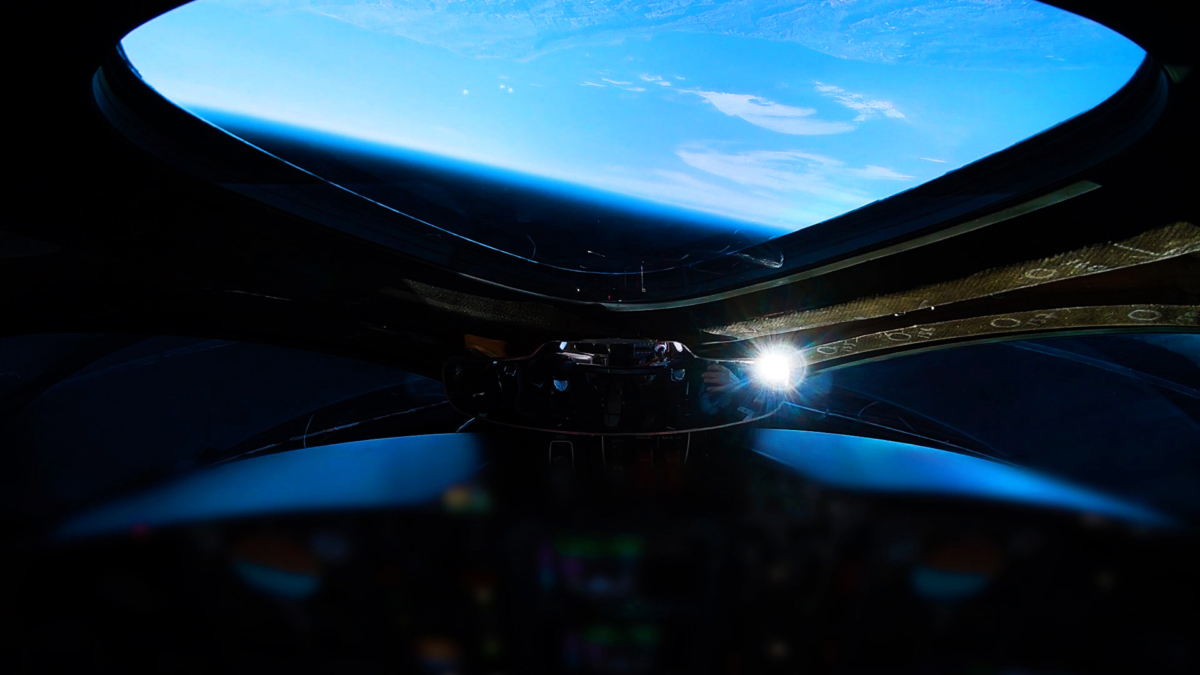
View from the heights.
Credit: Virgin Galactic/Quasar Media 2018
Mach 2.5
Today’s flight also involved the NASA Flight Opportunities Program which flew four space science and technology experiments on VSS Unity, making this Virgin Galactic’s first revenue generating flight.
A 60-second planned rocket motor burn propelled VSS Unity to almost three times the speed of sound and to an apogee of 51.4 miles.
After a Mach 2.5 supersonic re-entry into the atmosphere, which utilized Unity’s novel “feathering” configuration, the pilots guided the spaceship down to a smooth runway landing at the Mojave Air and Space Port in California.
Remaining test flight program
Said Richard Branson, the entrepreneurial backer of the project: “Today, for the first time in history, a crewed spaceship, built to carry private passengers, reached space. Today we completed our first revenue generating flight and our pilots earned their Commercial Astronaut Wings,” he said.

Richard Branson (center) and Virgin Galactic’s first two astronauts.
Credit: Virgin Galactic/Quasar Media 2018
“We will now push on with the remaining portion of our flight test program, which will see the rocket motor burn for longer and VSS Unity fly still faster and higher towards giving thousands of private astronauts an experience which provides a new, planetary perspective to our relationship with the Earth and the cosmos,” Branson said in a Virgin Galactic press statement.
 Posted in
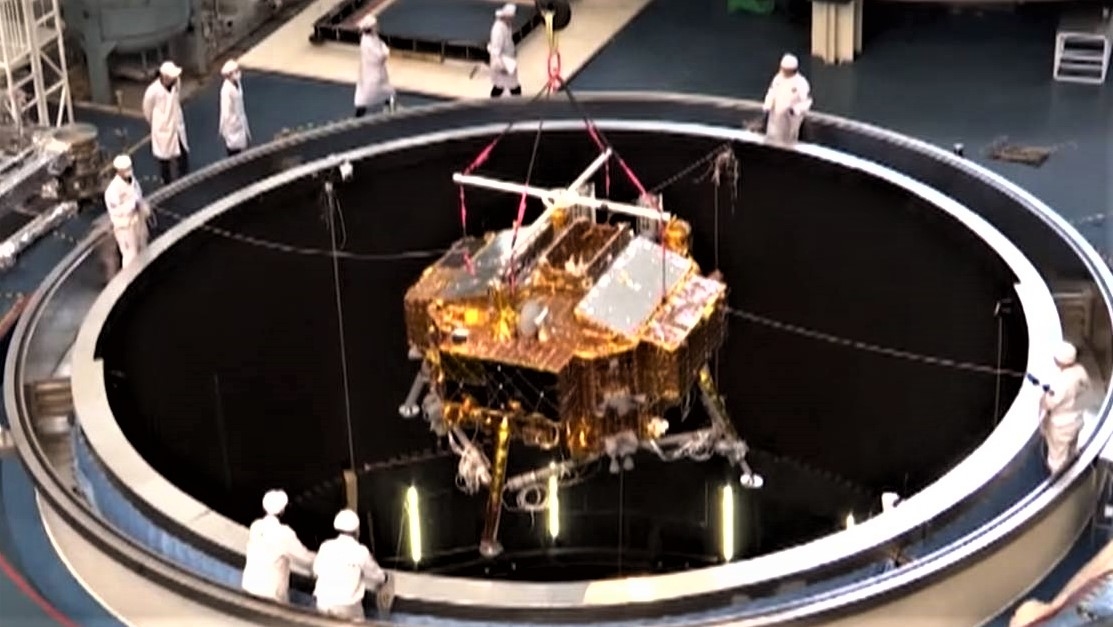
Credit: New China TV
China Central Television (CCTV) reports that the country’s Chang’e-4 lunar probe has successfully decelerated near the Moon Wednesday
This is a vital step forward leading to the spacecraft’s attempt to make the first-ever soft landing on the farside of the Moon, the China National Space Administration (CNSA) announced.
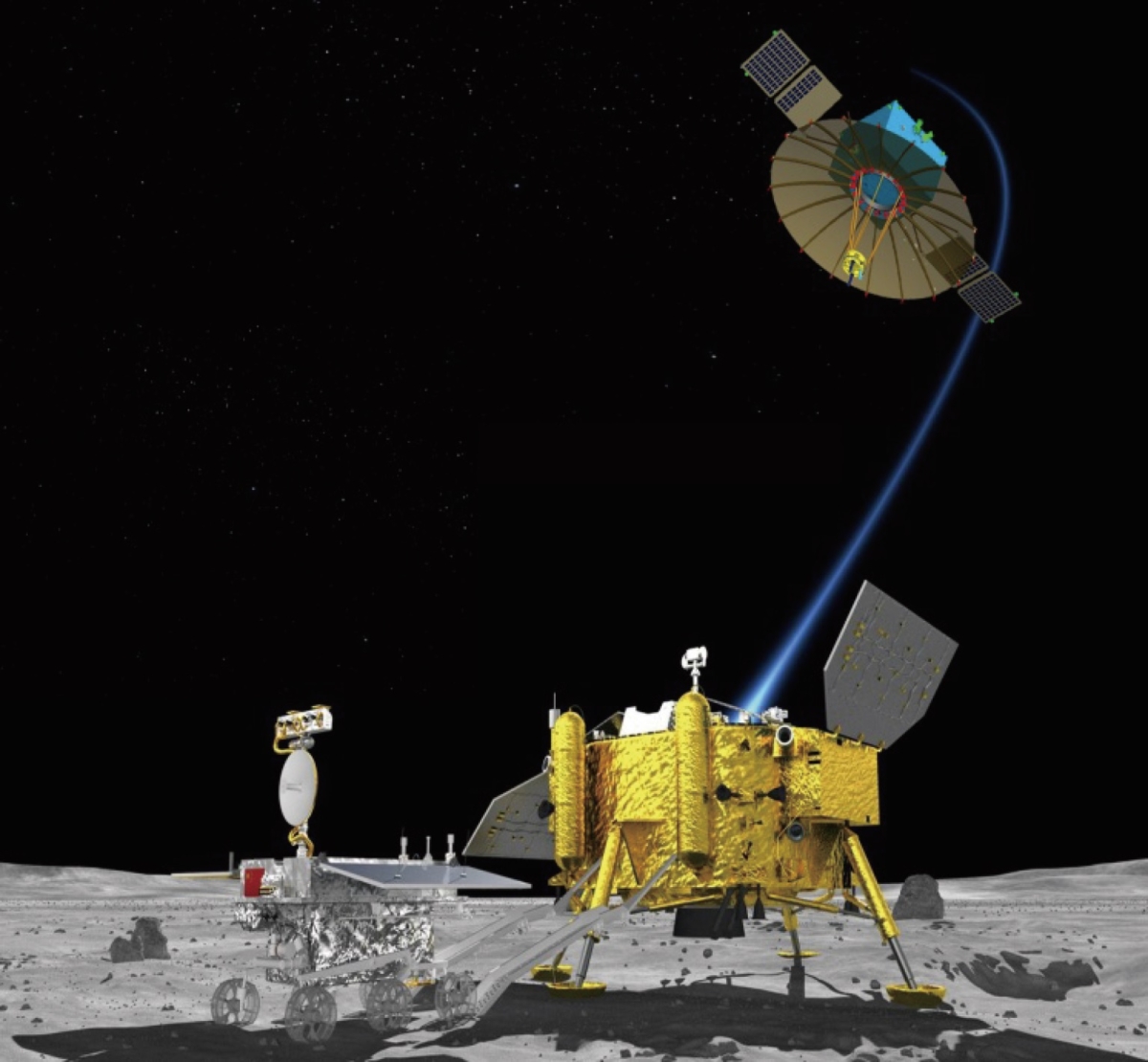
Chang’e-4 Moon lander and rover.
Credit: Chinese Academy of Sciences
Elliptical lunar orbit
CCTV reports that after flying about 110 hours from the Earth, an engine on the probe was ignited when it was 80 miles (129 kilometers) above the lunar surface, in line with instructions sent from a control center in Beijing at 16:39. Then the probe slowed and entered an elliptical lunar orbit with the perilune (low point) at about 62 miles (100 kilometers) at 16:45, said CNSA.
The probe, including a lander and a rover, was launched by a Long March-3B carrier rocket last Saturday from the Xichang Satellite Launch Center in southwest China’s Sichuan Province.

Candidate landing region of China’s Chang’e-4 lander within Von Kármán crater in SPA basin.
Credit: Jun Huang, et al.
Communication link testing
As the rocket was able to send the probe into orbit precisely as planned, CCTV reports, the control center only adjusted the probe’s orbit once on Sunday and also canceled two pre-planned orbit trimmings before the near-Moon deceleration, according to CNSA.
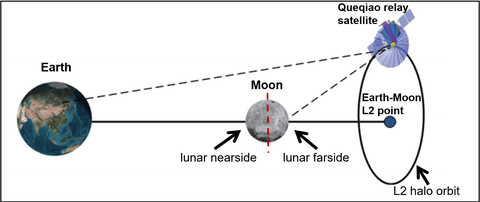
Next, the control center will adjust the probe’s orbit around the moon and test the communication link between the probe and the relay satellite “Queqiao,” which is operating in the halo orbit around the second Lagrangian (L2) point of the earth-moon system. The relay satellite was launched last May.
“Afterward, the control center will choose a proper time to land the probe on the farside of the Moon,” CCTV reports.
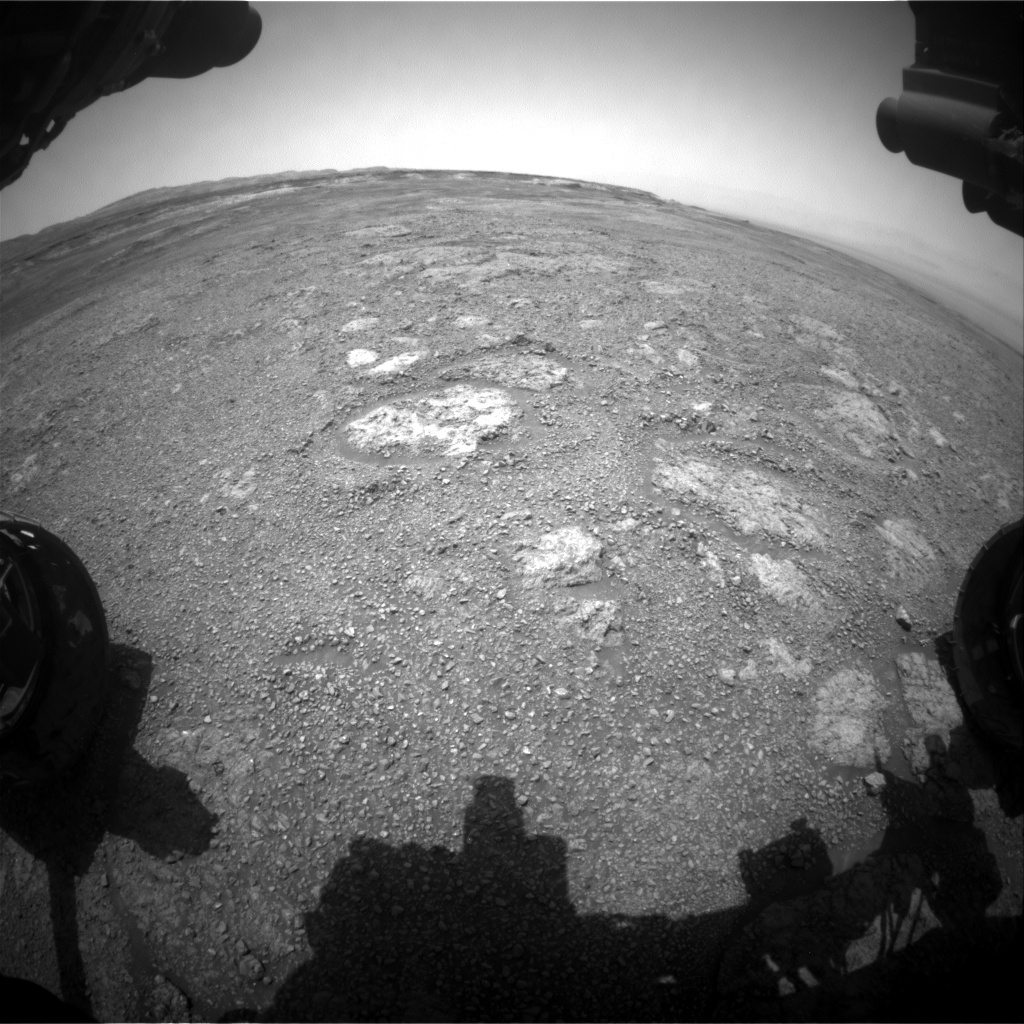
Curiosity Front Hazcam Left A photo acquired on Sol 2257, December 12, 2018.
Credit: NASA/JPL-Caltech
NASA’s Curiosity Mars rover is wrapping up Sol 2257 tasks.
Reports Brittney Cooper, an atmospheric scientist at York University, Toronto, Ontario, Canada: “Even on Mars, where every second of Curiosity’s sol is planned, things don’t always go quite as expected.”
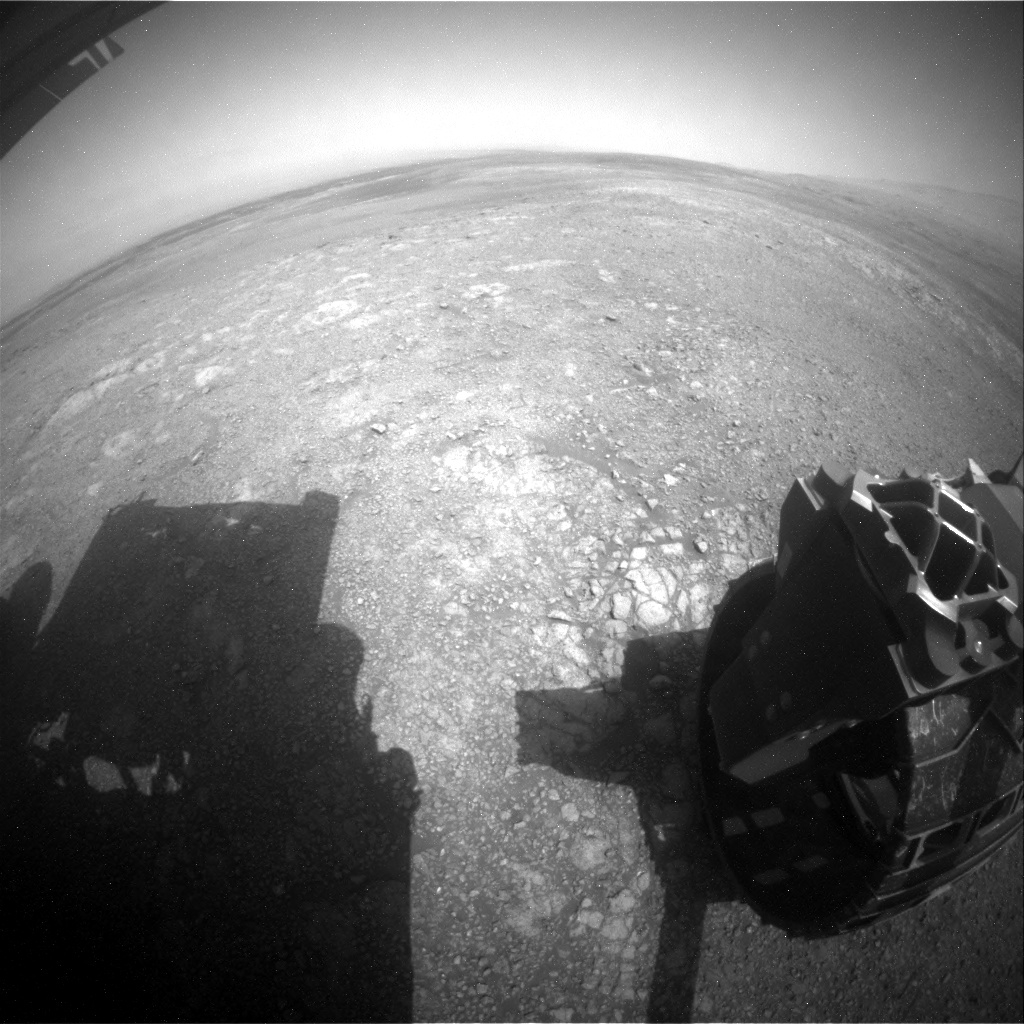
Curiosity Rear Hazcam Right A image taken on Sol 2257, December 12, 2018.
Credit: NASA/JPL-Caltech
In this case, a planned drive of the robot stopped at the mid-drive point.
Bump to target
“We had to decide whether to finish the remainder of the previously planned drive, or bump towards a red Jura candidate and potential drill target,” Cooper adds. “After some thoughtful discussion, we decided to make the most of where Curiosity ended up, and planned a bump toward the nearby target “Rock Hall.”
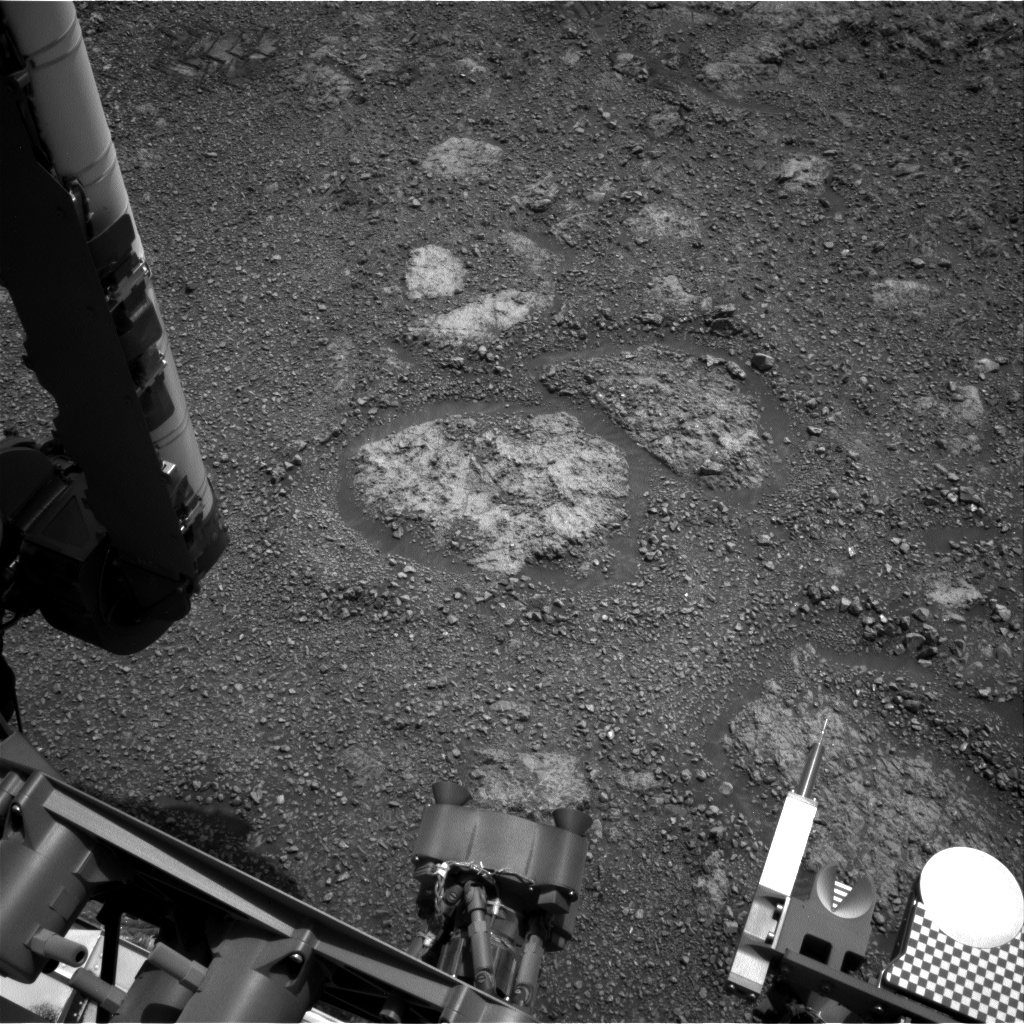
“Rock Hall” is seen in this Curiosity Navcam Left A image acquired on Sol 2257, December 12, 2018.
Credit: NASA/JPL-Caltech
Targeted Chemistry and Camera (ChemCam) Laser-induced Breakdown Spectroscopy (LIBS) capabilities and Mastcam multispectral observations were then planned to characterize Rock Hall and confirm if it’s a member of the red Jura, Cooper explains.
Pre-load test
On the schedule is a bump (short drive) to have Curiosity set up for drilling and in position to test the hardness of Rock Hall with a drill pre-load test and ChemCam LIBS tomorrow, if need-be.
“Unfortunately, the amount of pebbles on top of Rock Hall,” Cooper points out, “will likely prevent our ability to use the Dust Removal Tool (DRT) on the surface, but that doesn’t mean that it can’t be drilled.”
In addition to the targeted Mastcam and ChemCam activities, a 360° Navcam dust devil survey rounded off a one-hour science block to try and catch some late morning dust devils, Cooper concludes.
Credit: NASA/JPL-Caltech/Univ. of Arizona
New roadmap
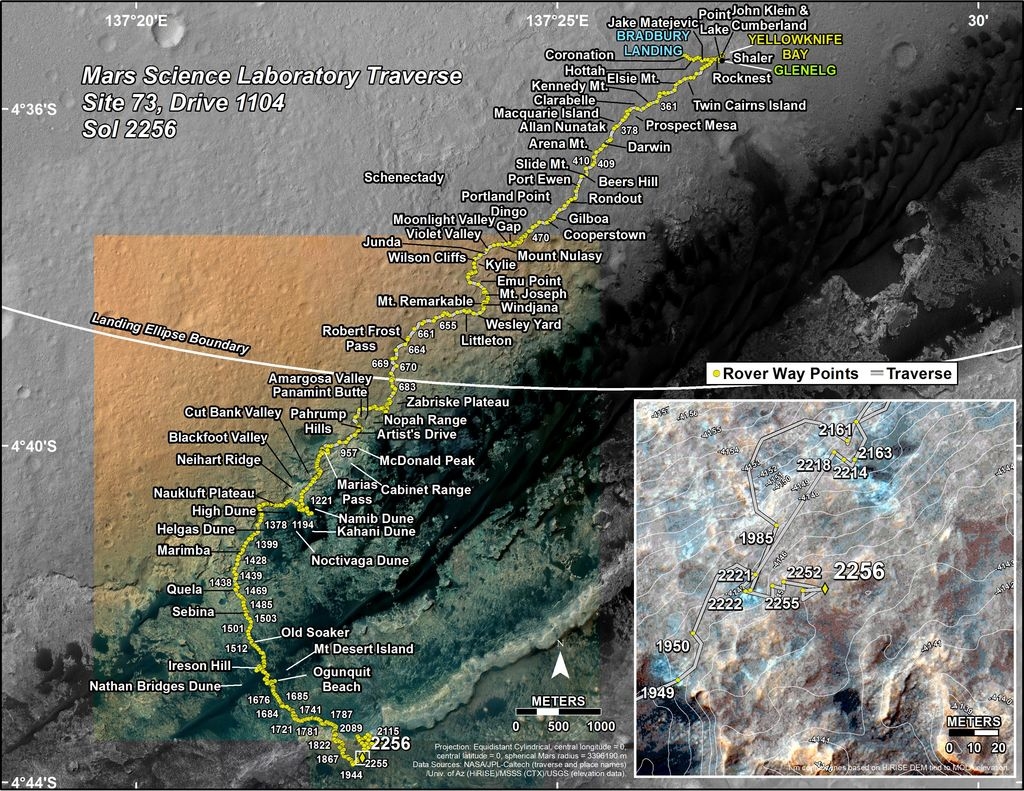
Meanwhile, a new Curiosity traverse map through Sol 2256 shows the route driven by the Mars rover through the 2256 Martian day, or sol, of its mission on Mars (December 11, 2018).
Numbering of the dots along the line indicate the sol number of each drive. North is up. The scale bar is 1 kilometer (~0.62 mile).
From Sol 2255 to Sol 2256, Curiosity had driven a straight line distance of about 29.78 feet (9.08 meters), bringing the rover’s total odometry for the mission to 12.35 miles (19.88 kilometers).
The base image from the map is from the High Resolution Imaging Science Experiment Camera (HiRISE) in NASA’s Mars Reconnaissance Orbiter.
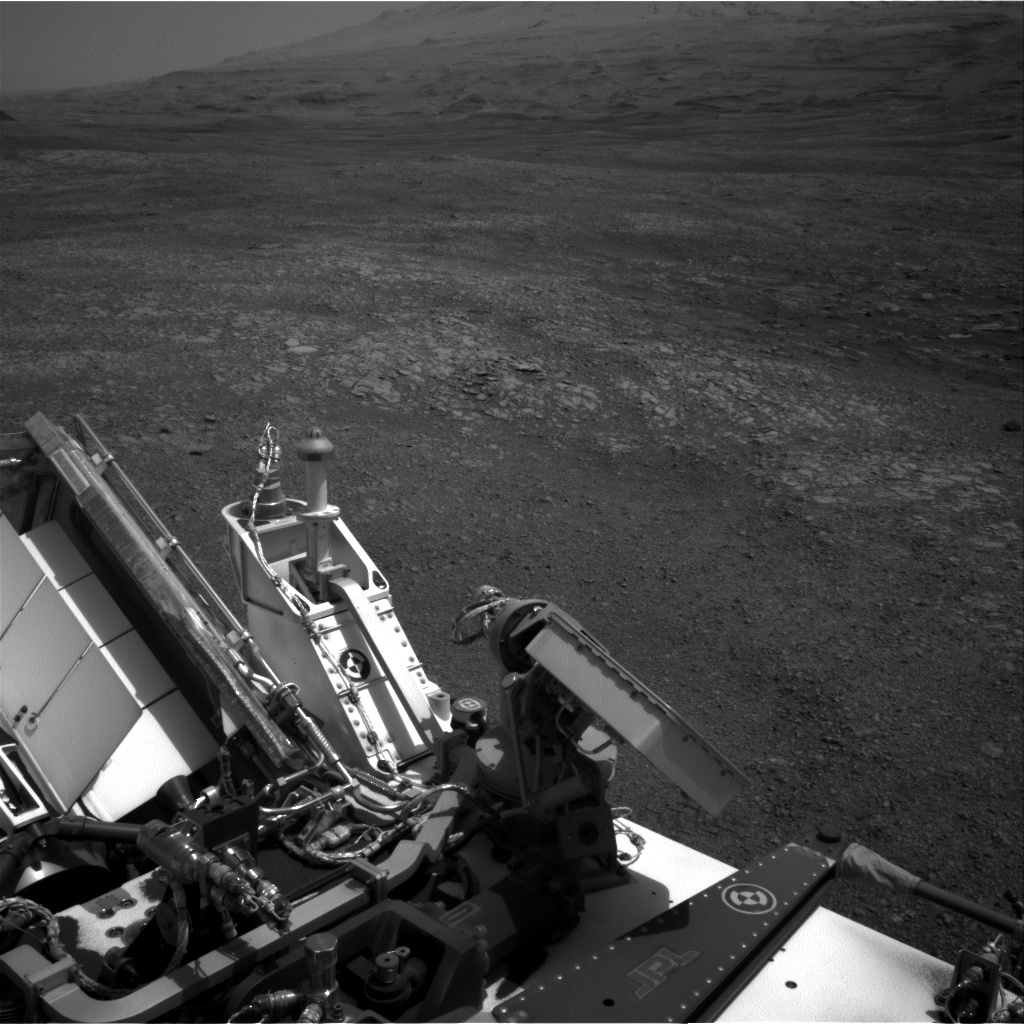
Curiosity Navcam Left A image acquired on Sol 2257, December 12, 2018.
Credit: NASA/JPL-Caltech
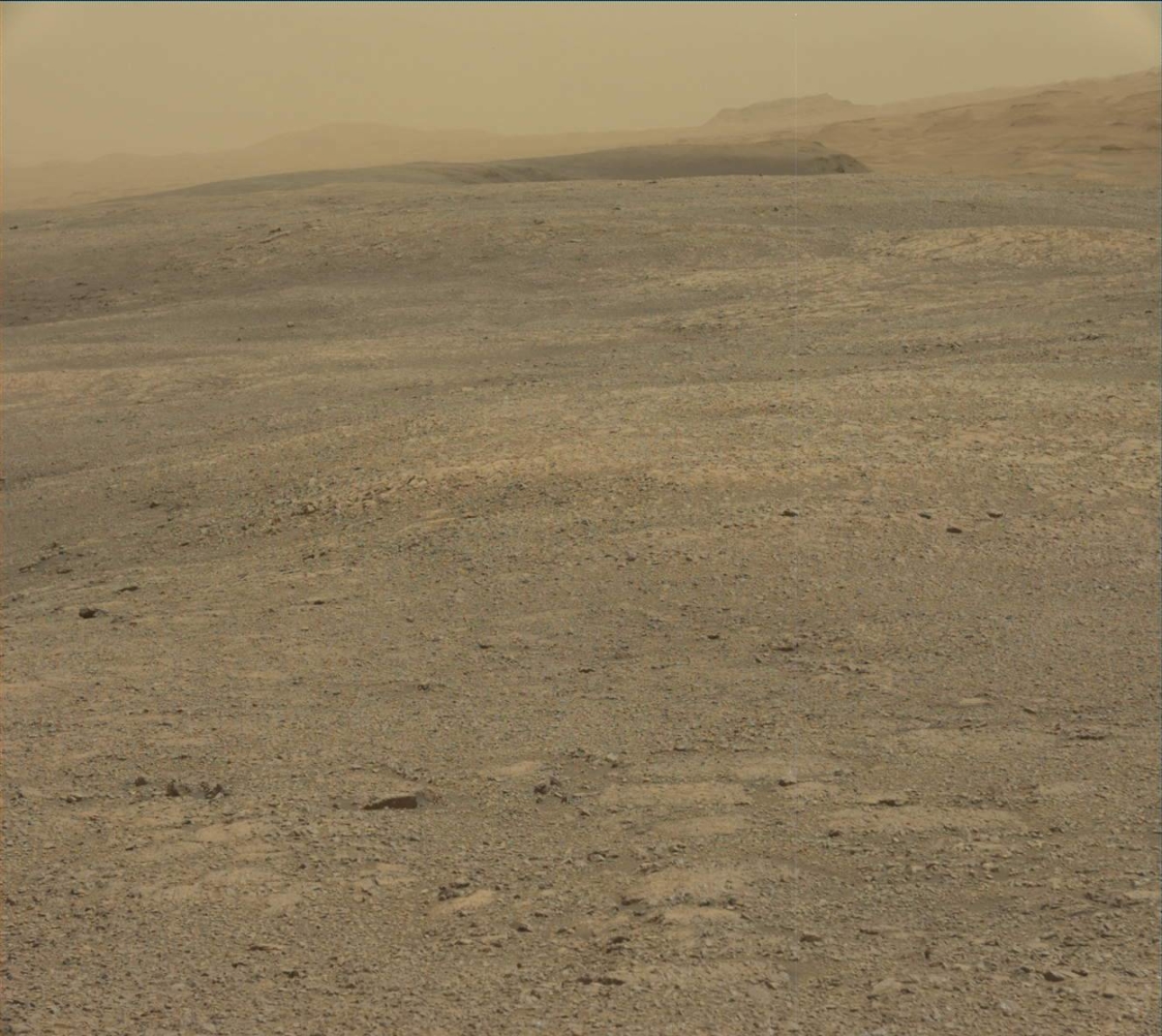
Curiosity Mastcam Left image taken on Sol 2256, December 11, 2018.
Credit: NASA/JPL-Caltech/MSSS
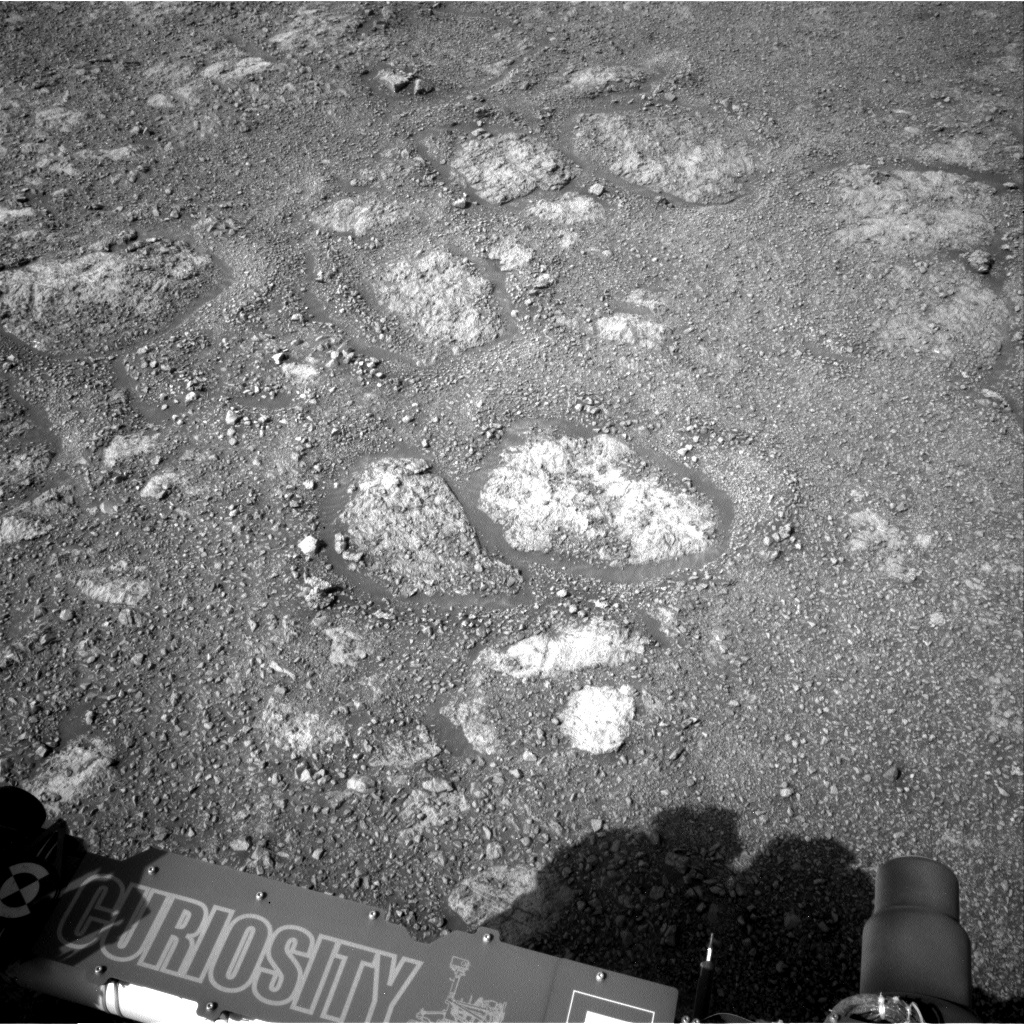
Curiosity Navcam Left A photo acquired on Sol 2256, December 11, 2018.
Credit: NASA/JPL-Caltech
NASA’s Curiosity Mars rover is now performing Sol 2256 tasks.
The hunt for red Jura continues reports Rachel Kronyak, a planetary geologist; University of Tennessee in Knoxville.
“After a successful weekend of activities and driving, we were hopeful that we would wake up on Sol 2256 and be ready for contact science and drilling,” Kronyak adds. “Unfortunately, Mars had other plans; similar to Friday’s planning, our workspace turned out to be just as fractured and unsuitable for drilling, so onward we go in search for a drill target elsewhere (again)!”
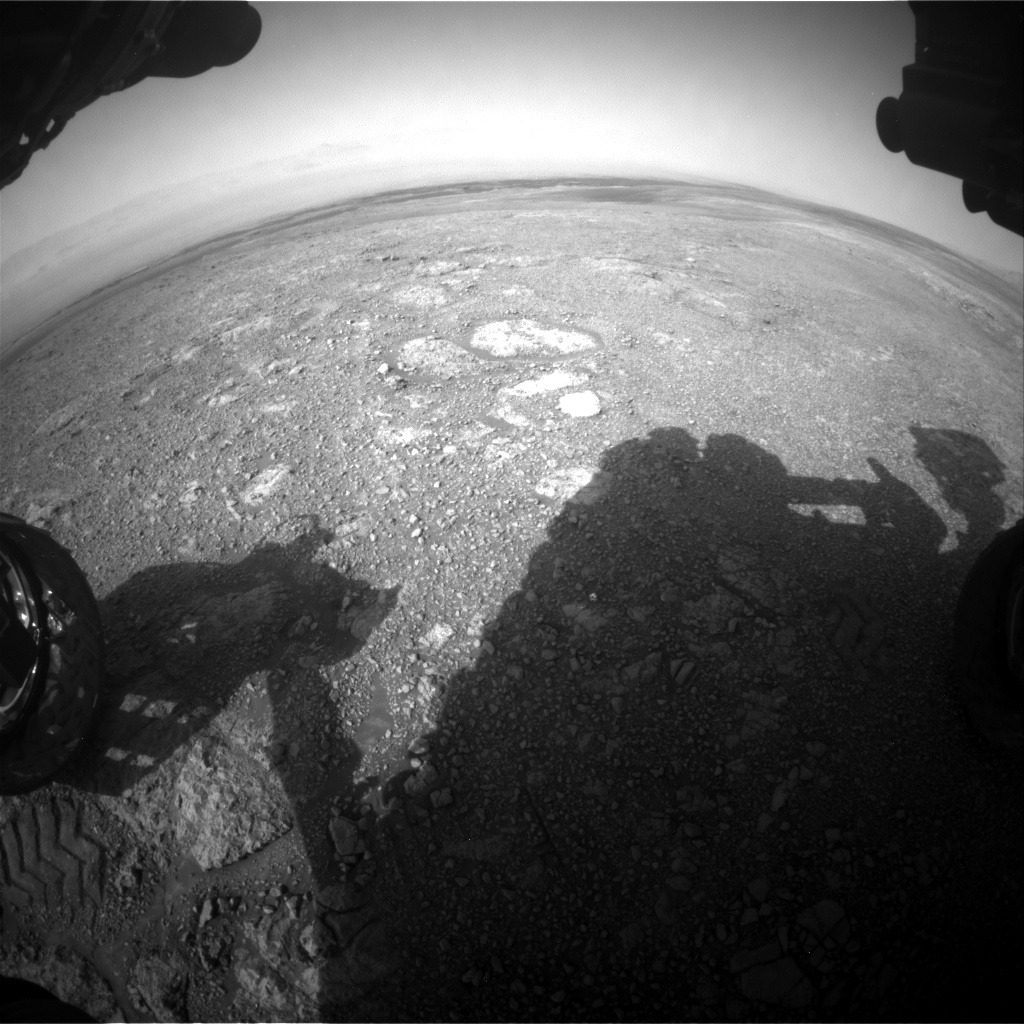
Curiosity Front Hazcam Left A image acquired on Sol 2256, December 11, 2018.
Credit: NASA/JPL-Caltech
Third time’s the charm?
The first two attempts at finding drillable red Jura were unlucky, so this time, Curiosity will try its luck and head towards a third candidate drill location, called “Region C.”
“Fingers crossed that the third time’s the charm,” Kronyak says.
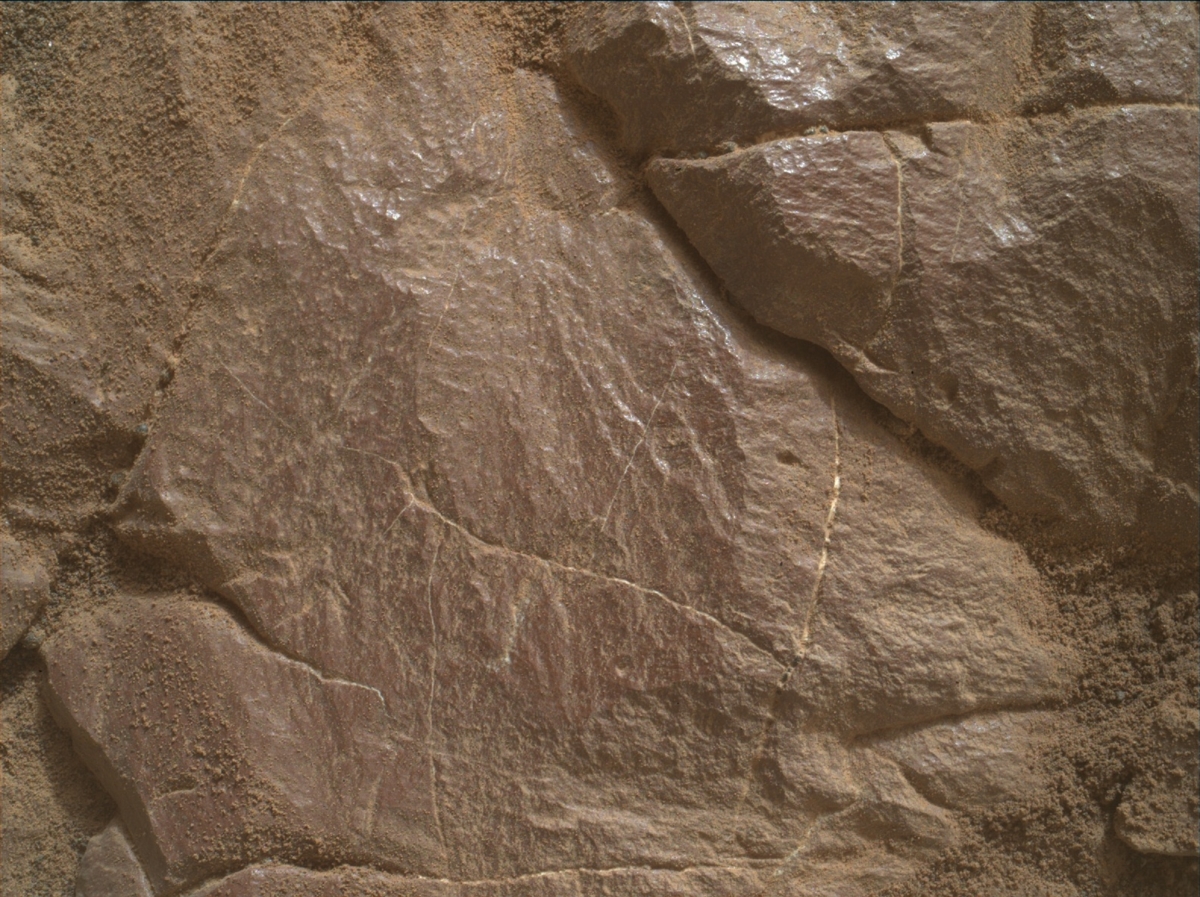
Curiosity Mars Hand Lens Imager (MAHLI) photo produced on Sol 2255, December 10, 2018. MAHLI is located on the turret at the end of the rover’s robotic arm.
Credit: NASA/JPL-Caltech/MSSS
The plan for Sol 2256 includes a nice long science block before the rover’s drive. During the science block, the robot’s Chemistry and Camera (ChemCam) will collect data on two targets: “Sandy Haven,” a small soil patch, and “Tarness Haven,” a block of reddish outcrop in front of the rover.
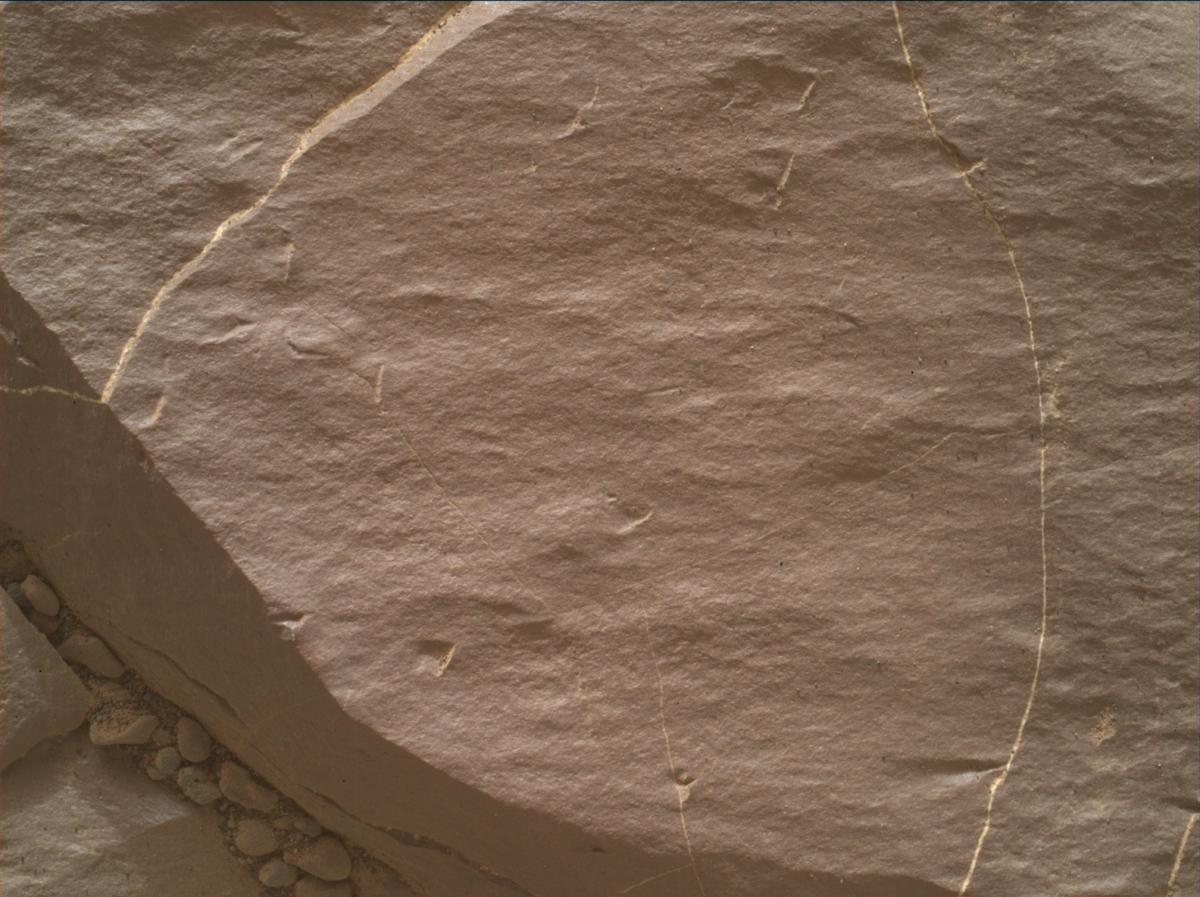
Curiosity Mars Hand Lens Imager (MAHLI) photo produced on Sol 2255, December 10, 2018. MAHLI is located on the turret at the end of the rover’s robotic arm.
Credit: NASA/JPL-Caltech/MSSS
Line of sight
“We’ll also acquire a Mastcam multispectral mosaic looking ahead towards Region C to assess for color variations that will help us determine where the best red Jura location for drilling may be,” Kronyak points out. “The environmental group will also be acquiring some Navcam observations to monitor the atmosphere; these include a line of sight image and a dust devil movie.”
After the science block, Curiosity will drive towards Region C. Halfway through the drive Curiosity will stop for some Mastcam and Navcam imaging to assess the upcoming terrain.
Parking spot
“Once we get to our final parking spot, we’ll take some additional images to assess the ground in front of us,” Kronyak concludes. “Together, these mid- and post-drive images will inform whether we drill at Region C or continue on in the search for red Jura. Stay tuned!”
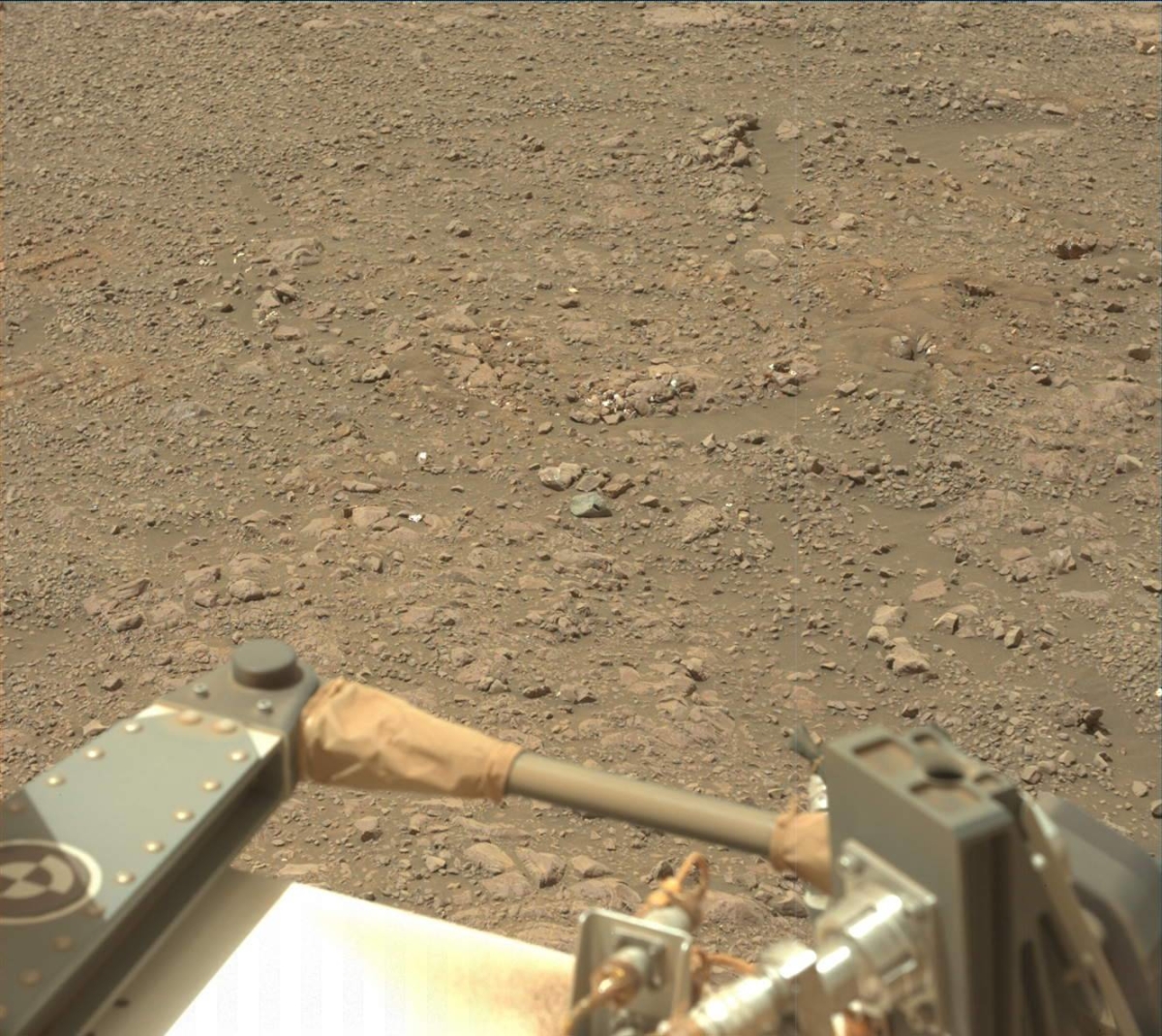
Curiosity Mastcam Left photo taken on Sol 2255, December 10, 2018.
Credit: NASA/JPL-Caltech/MSSS
Tactical decisions
In an earlier report, Mariah Baker, a planetary geologist at Johns Hopkins University in Baltimore, Maryland, obtaining higher resolution images of the exposure of red Jura will help the team determine if it could be drilled next week.
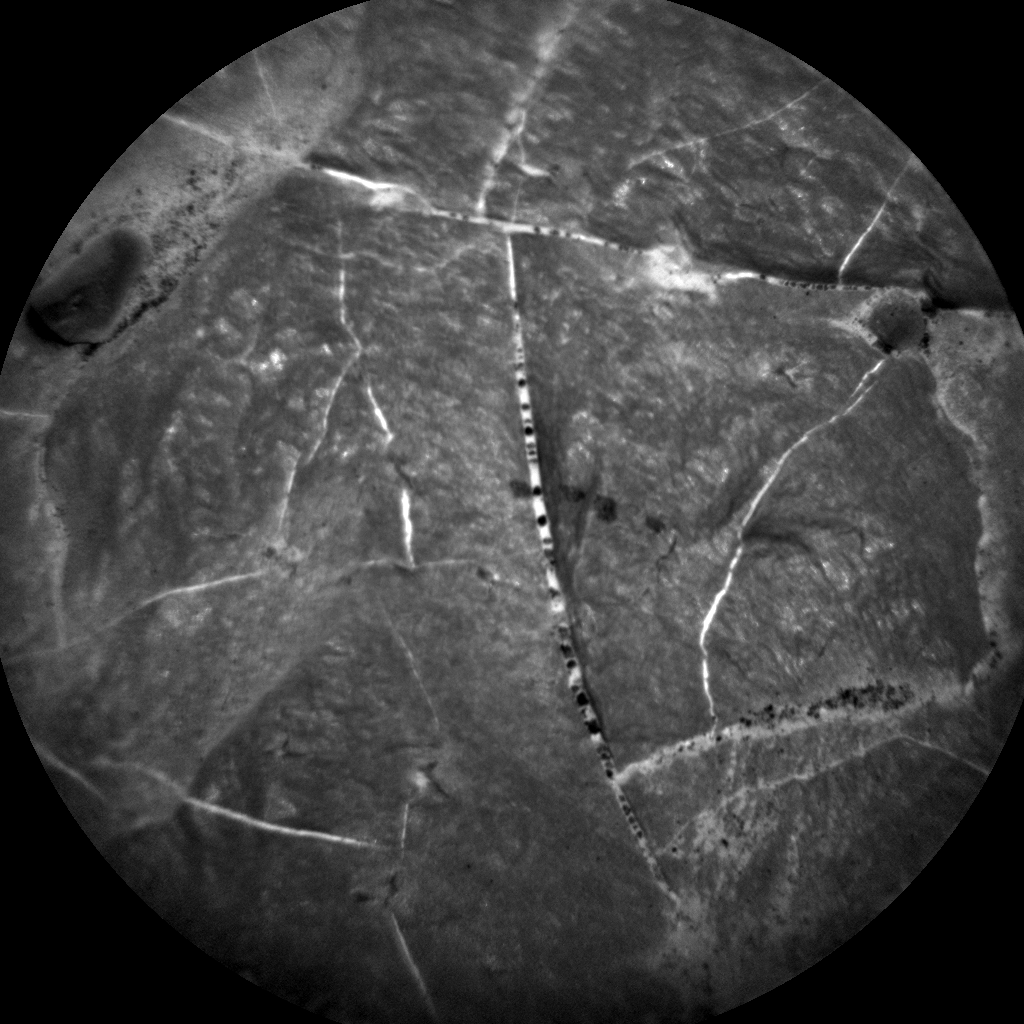
Curiosity ChemCam Remote Micro-Imager photo acquired on Sol 2256, December 11, 2018.
Credit: NASA/JPL-Caltech/LANL
“Making these tactical decisions requires a lot of quick thinking; the team must weigh immediate scientific priorities with long-term goals, and must try to determine the best potential drill target with limited data,” Baker notes.
“We never know exactly what we will find when we arrive at a new site, so the best we can do is use long distance imaging and lessons learned from previous sites to make an educated decision on where to send the rover next,” Baker concludes. “Hopefully this plan will put us in a good position on Monday to either drill the new outcrop or continue on our strategic path.”

China’s Chang’e-4 Moon lander – farside bound
Credit: China National Space Administration (CNSA)/China Central Television (CCTV)/Screengrab Inside Outer Space
China’s adventurous mission to the farside of the Moon attained its second orbit trimming on Sunday afternoon
The Chang’e-4 lunar probe was launched in the early hours of Saturday from the Xichang Satellite Launch Center in southwest China’s Sichuan Province.
If all goes well, the lander/rover will touch down on the farside of the Moon for the very first time, reportedly early next month.
Ground control
As reported on China Central Television (CCTV):
“We have just completed the second orbit modification for Cheng’e-4 and then we will conduct the third one to ensure that it can precisely enter the lunar orbit and prepare for a soft landing of the probe,” said Li Peng, an assistant engineer with Kashgar Observation and Control Station.
In the next month, ground controllers will invoke important movements of Chang’e-4 during the flight, such as orbit correction and near-Moon braking, and adjusting the final attitude of the probe through a relay satellite launched last May named “Queqiao” to ensure a successful lunar landing.
“In the 110-hour-long orbit transfer from the Earth to the Moon, we will seize every second to upload the orbit parameters in time and ensure the third orbital transfer to be successful,” said Liu Qing, an engineer in Kashgar Observation and Control Station.
Chang’e-4 Moon lander and rover.
Credit: Chinese Academy of Sciences
Rugged terrain
“Most of the farside of the Moon are covered with high mountains, impact craters and lunar craters. It is difficult to find a large and flat area. This requires that we must be more accurate in fixing the landing site,” said Sun Zezhou, chief designer of Chang’e-4.
As reported on CCTV, the rugged terrain of the Moon has not only increased the difficulty in locating the best landing point, but also will affect the probe’s judgment of its distance to the lunar surface and the relative velocity. As a result, a special design in the navigation control of the probe was adopted.
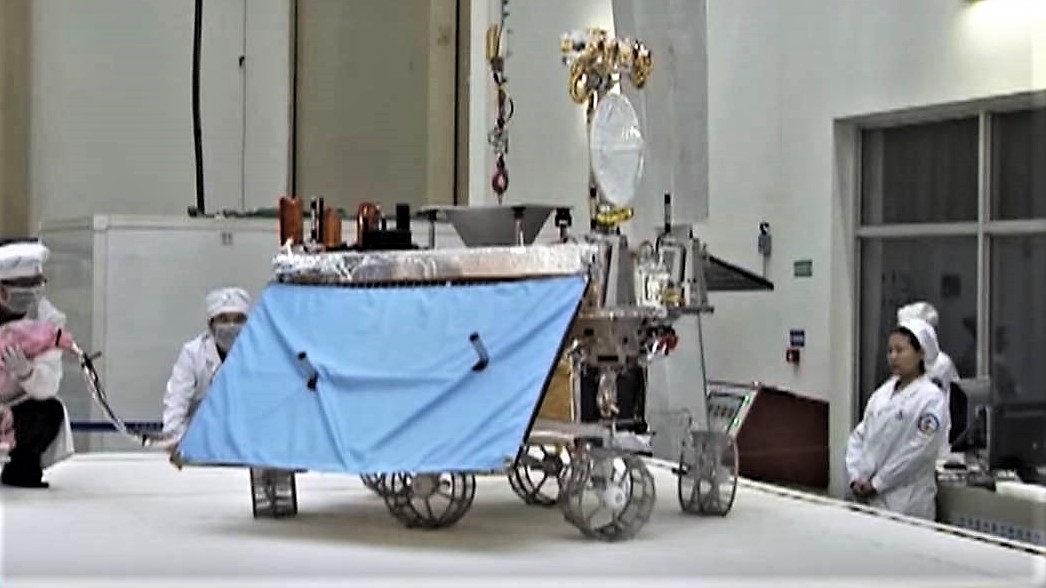
Credit: China National Space Administration (CNSA)/China Central Television (CCTV)/Screengrab Inside Outer Space
Day/night operations
There are some differences between the December 2013 Chang’e-3 lander/rover mission and Chang’e-4.
“The Chang’e-3 landed on the Moon following a parabolic path, but our Chang’e-4 will primary land vertically,” said Sun. To assure day/night operations, Chang’e-4 is equipped with a heating supply system, aimed to power the equipment.
“Based on the supply of heat energy, we also try to use thermoelectric effect to generate power for the electronic equipment,” said Sun.
The probe is expected to make the first-ever soft landing on the far side of the Moon within 30 days, and will undertake a variety of tasks including conducting surveys on the terrain and landforms.
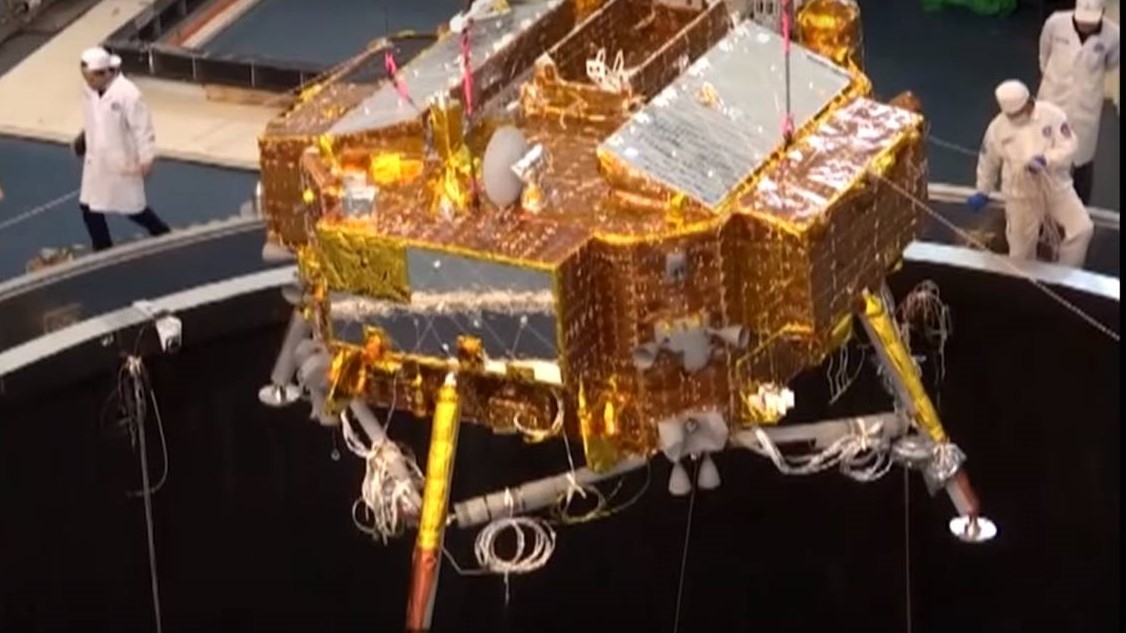
Credit: China National Space Administration (CNSA)/China Central Television (CCTV)/Screengrab Inside Outer Space
Communication issues
CCTV notes that this first time farside landing may encounter some communication difficulties.
“If it lands on the farside of the Moon, there might be a delay on the measurement and control [systems] after it connects to the relay satellite,” said Li Benqi, deputy director of the Xichang Satellite Launch Center.
“We are not sure whether the delay will cause troubles to the landing and image transmission. This [mission] will help us accumulate more experience for future lunar exploration,” Li said.
Radio astronomical observations
One of the main tasks the probe will conduct is its investigation into the radio environment of the farside of the Moon, the first time that low-frequency radio astronomical observations have been tested.
“Especially by making using of the clean electromagnetic environment on the far side of the moon, the probe will achieve observation of low-frequency radio ranging from 0.1 to 0.4 megahertz for the first time,” said Yu Guobin, a spokesman for the Chang’e-4 lunar exploration project.
In addition to its panoramic camera, lunar penetrating radar and topographic camera, the probe is also equipped with a low-frequency radio spectrometer to help it better detect the low-frequency signals.
Credit: China National Space Administration (CNSA)/China Central Television (CCTV)/Screengrab Inside Outer Space
“The (farside of the) Moon can well shield the Earth’s own low-frequency radiation and create a better environment with low frequency and noise. This could help the probe detect the low-frequency signals from the sun more effectively,” said Sun, the lunar probe’s chief designer.
In addition, China has promoted international cooperation in its lunar exploration program, with four scientific payloads in the Chang’e-4 mission developed by scientists from the Netherlands, Germany, Sweden and Saudi Arabia.
For video views of the Chang’e-4 project and launch, go to:
https://youtu.be/cGp7WySaVW4?list=PLpGTA7wMEDFjz0Zx93ifOsi92FwylSAS3
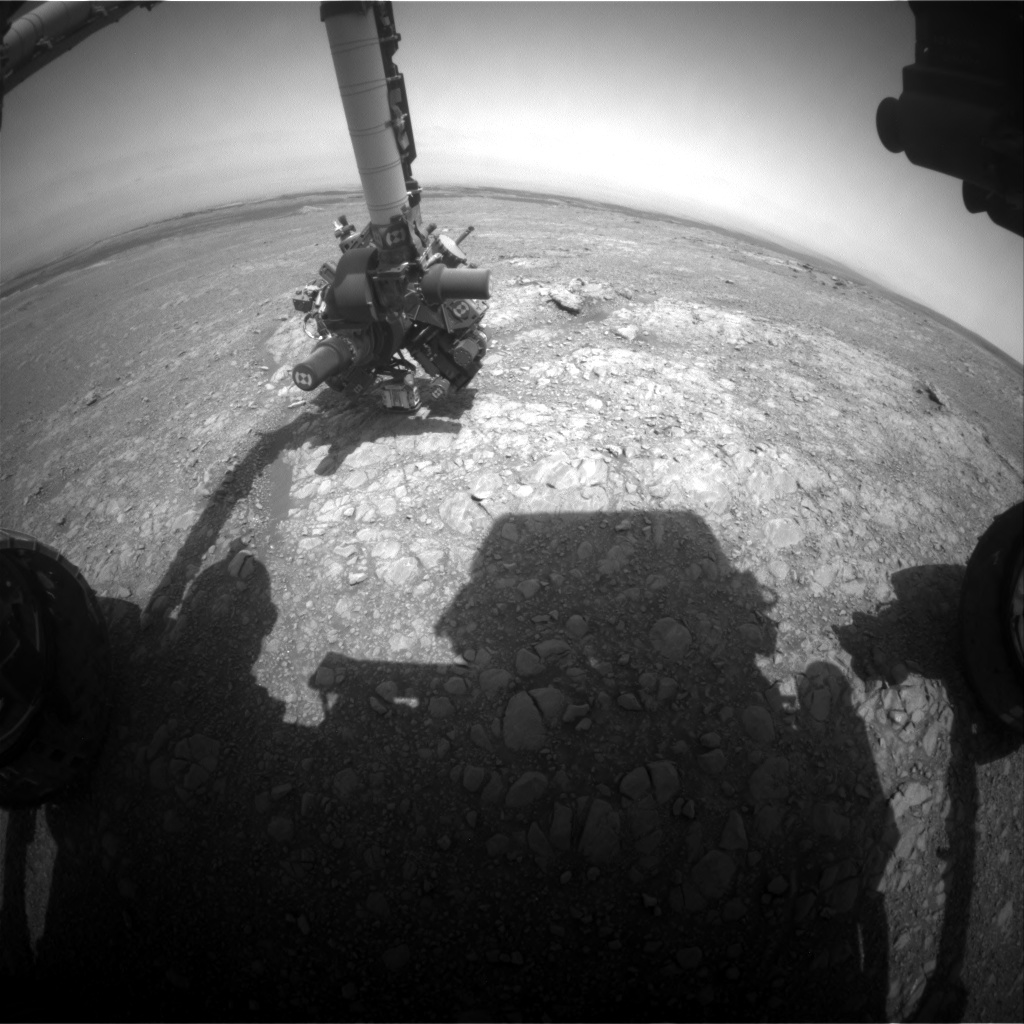
Curiosity Front Hazcam Left A photo acquired on Sol 2255, December 10, 2018.
Credit: NASA/JPL-Caltech
NASA’s Curiosity Mars rover is wrapping up Sol 2255 duties.
Reports Abigail Fraeman, a planetary geologist at NASA/JPL in Pasadena, California, even though they looked promising, the red Jura rocks scientists had hoped to drill are too fractured to drill safely.
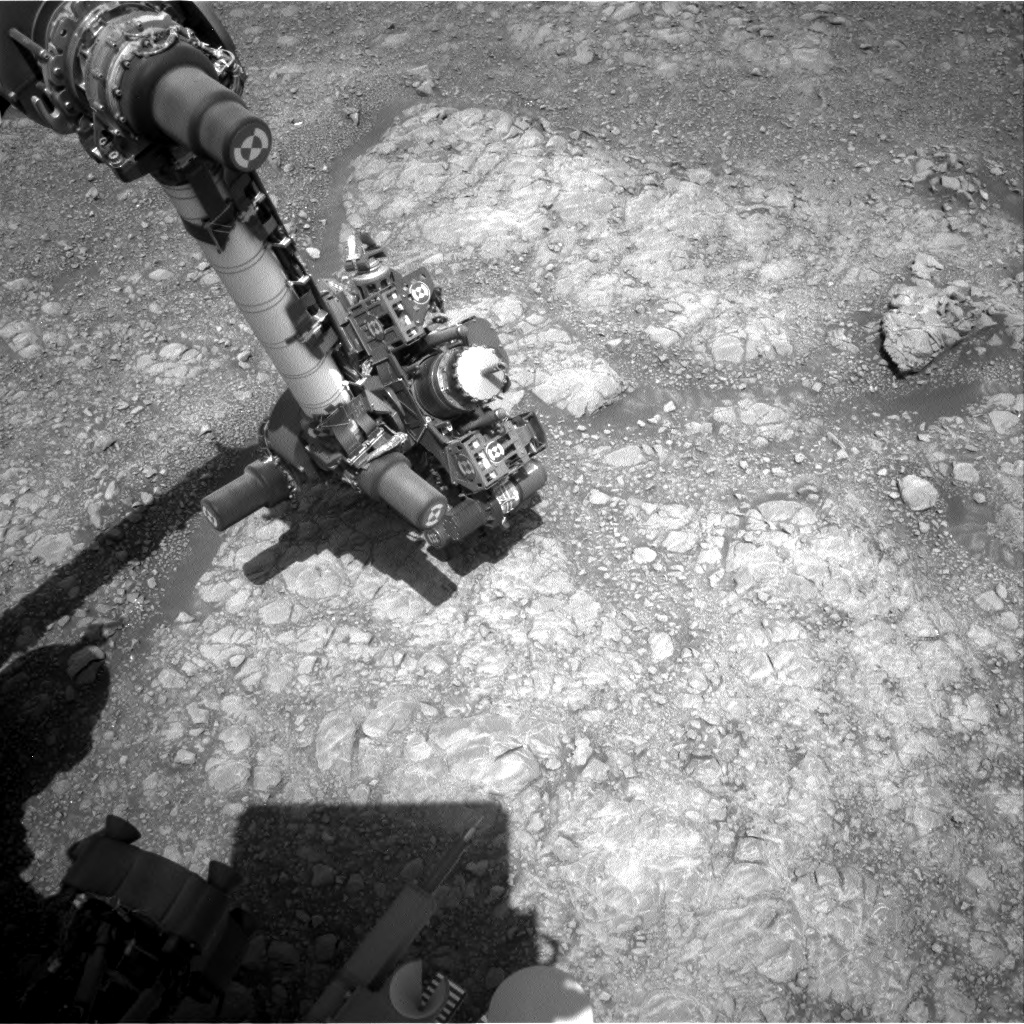
Curiosity Navcam Right A photo taken on Sol 2255, December 10, 2018.
Credit: NASA/JPL-Caltech
“The texture of these rocks is actually fairly typical of the red Jura rocks, so finding one that is drillable may be challenging,” Fraeman notes. “But we’re not giving up right away!”
The science and engineering teams identified another promising rock candidate just a few meters away. The plan calls for the robot to “bump” towards that area to take a closer look.
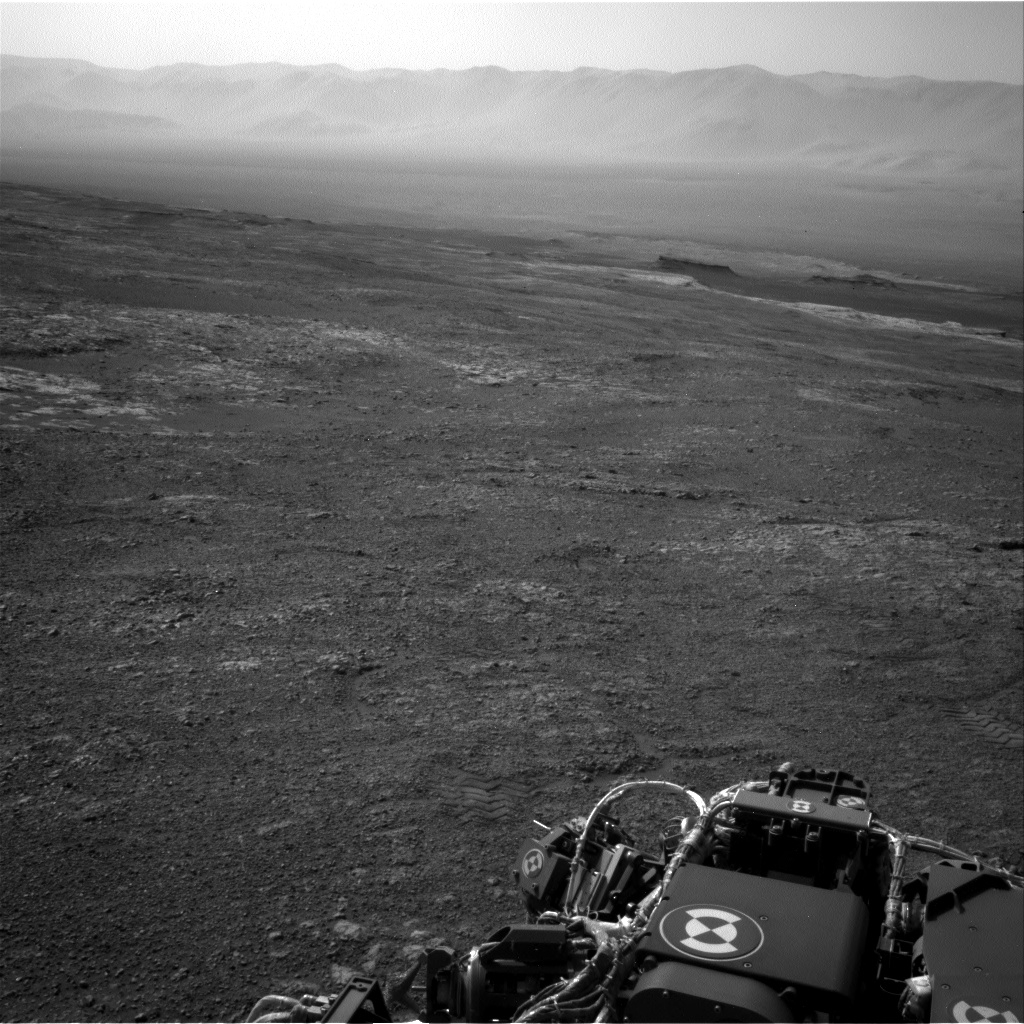
Curiosity Navcam Left A image acquired on Sol 2255, December 10, 2018.
Credit: NASA/JPL-Caltech
Geological properties
Curiosity science team members have worked with the rover drivers to evaluate the geological properties of the terrain the robot will cross during the planned drive. Doing so is to ensure the vehicle doesn’t drive over any hazards.
“We will take some time to do science before the drive,” Fraeman adds. In the morning of sol 2252, the plan called for a long remote sensing science block where Chemistry and Camera (ChemCam) and Mastcam observations were to be collected of targets named “Knochan Crag,” “Skatie Shore,” and “Conan Mains.”
Also on tap were Mastcam stereo images of additional potential drill targets in the area named “Dunecht” and “Stronecraigs.”
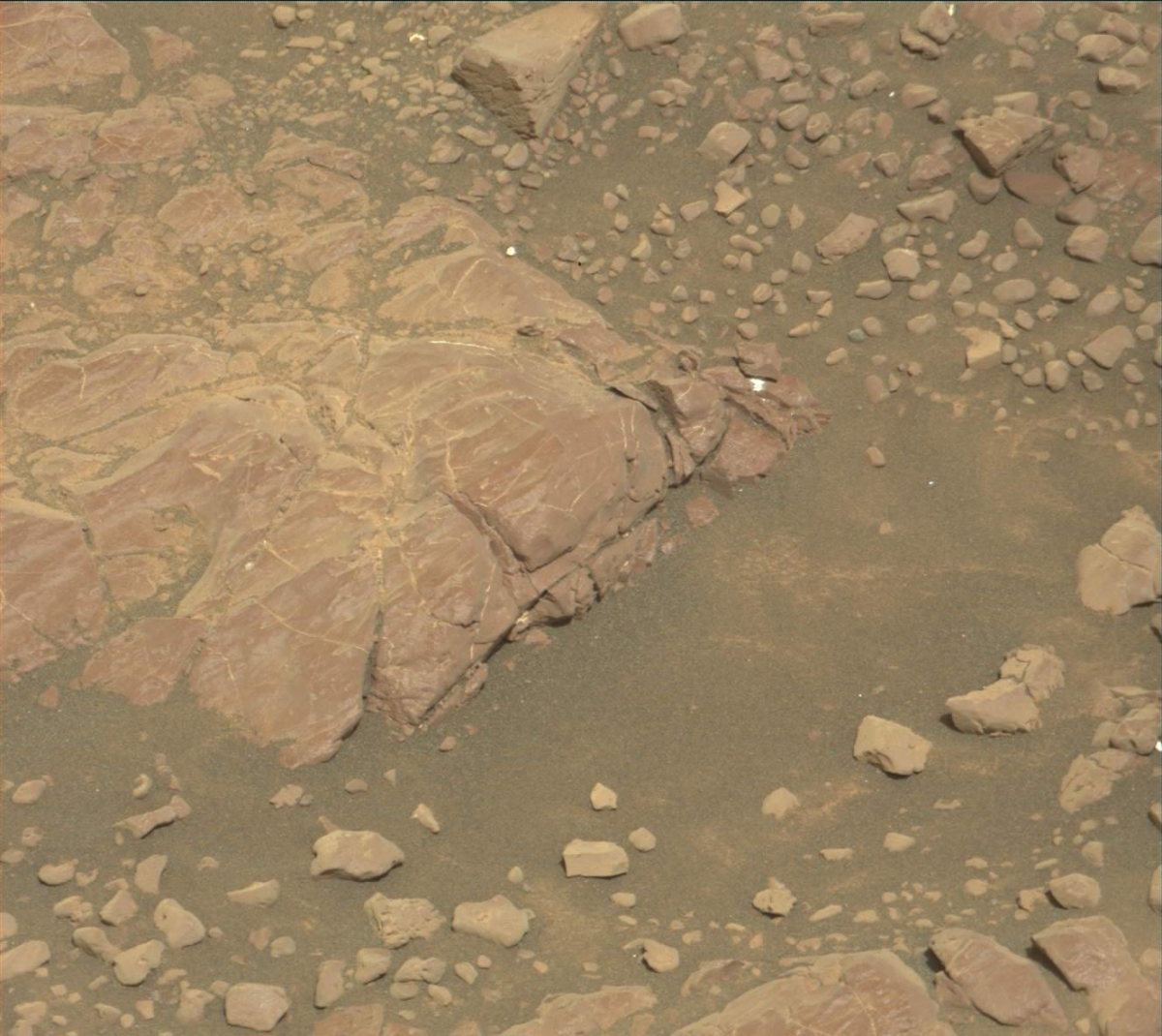
Curiosity Mastcam Right image taken on Sol 2254, December 9, 2018.
Credit: NASA/JPL-Caltech/MSSS
Blowing dust
After the drive on sol 2253, the plan called for an observation of the sky using ChemCam in passive (no laser) mode, along with additional environmental science measurements that include some taus, sky survey, crater rim extinction image, and dust devil searches.
“Dust has certainly been blowing around in Gale Crater lately,” Fraeman reports. An image of the Mars Hand Lens Imager (MAHLI) calibration target was much cleaner than an image of the same target taken a few weeks ago when the planet-wide dust storm had just started to abate (Sol 2161), Fraeman concludes.
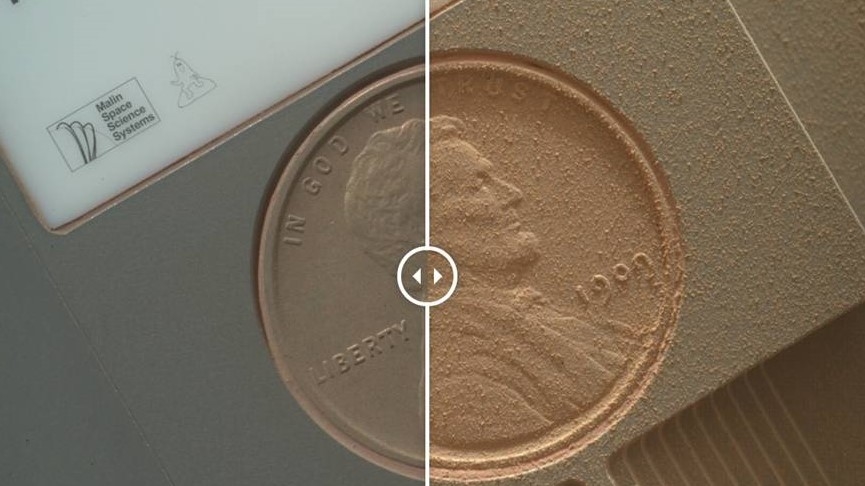
Images of the Mars Hand Lens Imager (MAHLI) calibration target and comparative dust levels.
Credit: NASA/JPL-Caltech/MSSS
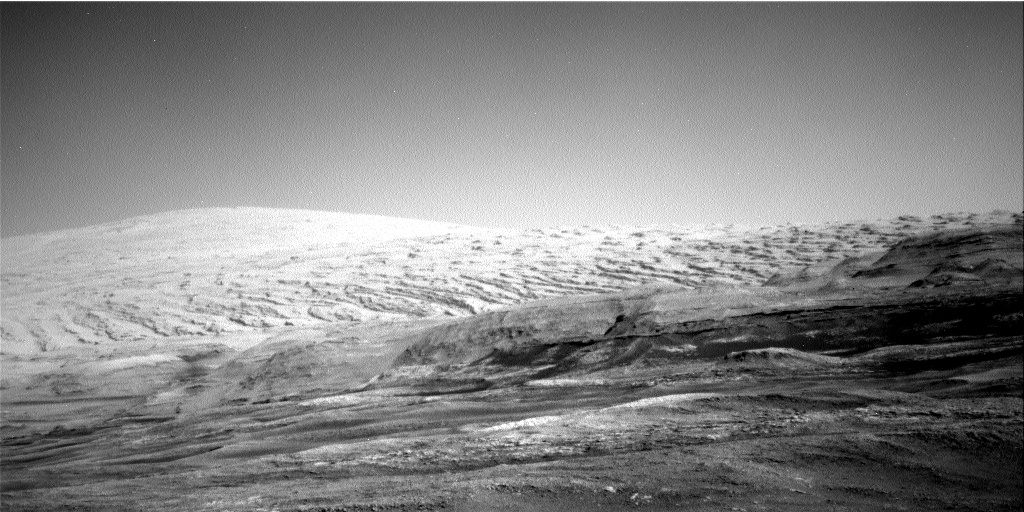
Curiosity Navcam Left A image acquired on Sol 2255, December 10, 2018.
Credit: NASA/JPL-Caltech
Credit: NASA/JPL-Caltech/Univ. of Arizona
Traverse map
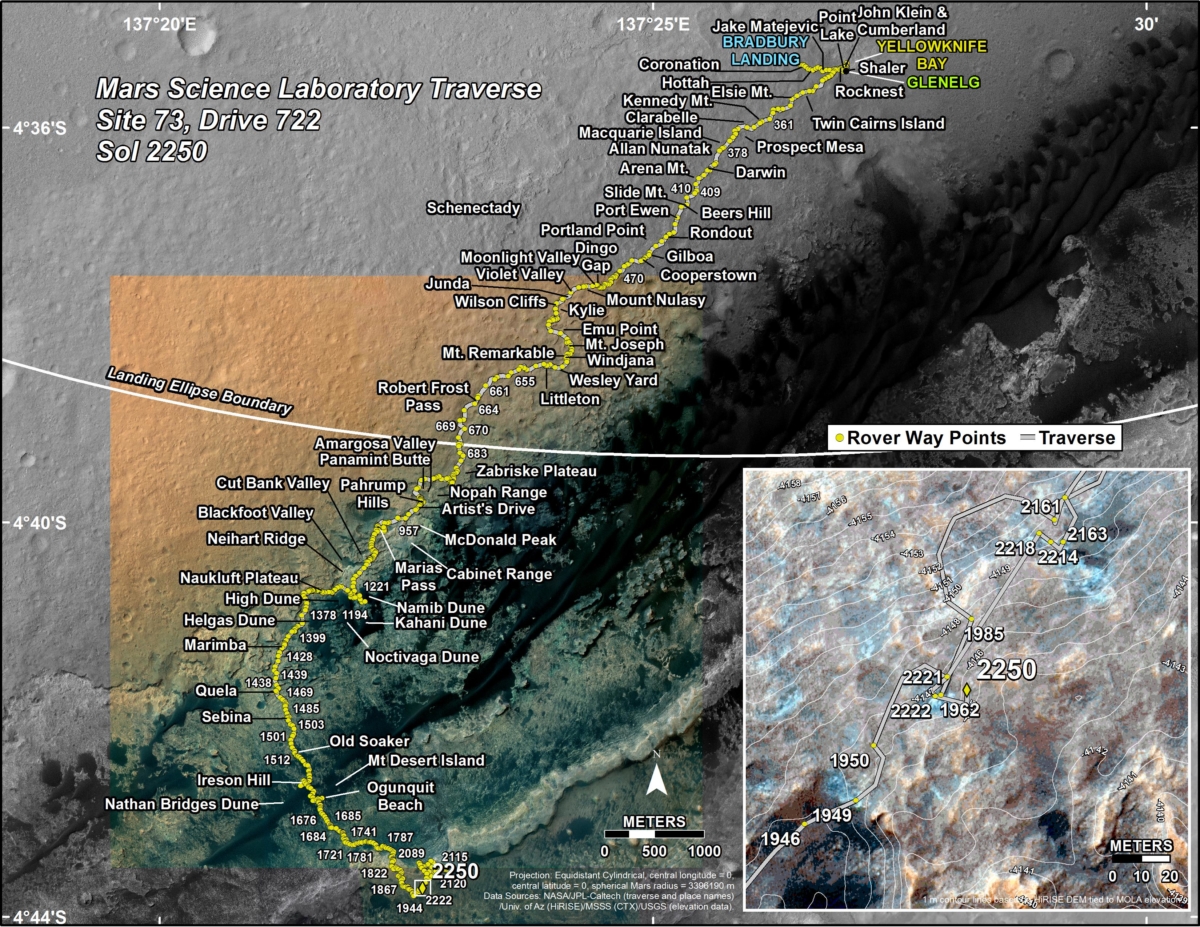
Meanwhile, a recently released Curiosity traverse map through Sol 2250 shows the route driven by Curiosity through the 2250 Martian day, or sol, of the rover’s mission on Mars (December 06, 2018).
Numbering of the dots along the line indicate the sol number of each drive. North is up. The scale bar is 1 kilometer (~0.62 mile).
From Sol 2222 to Sol 2250, Curiosity had driven a straight line distance of about 36.80 feet (11.22 meters), bringing the rover’s total odometry for the mission to 12.33 miles (19.84 kilometers).
The base image from the map is from the High Resolution Imaging Science Experiment Camera (HiRISE) in NASA’s Mars Reconnaissance Orbiter.
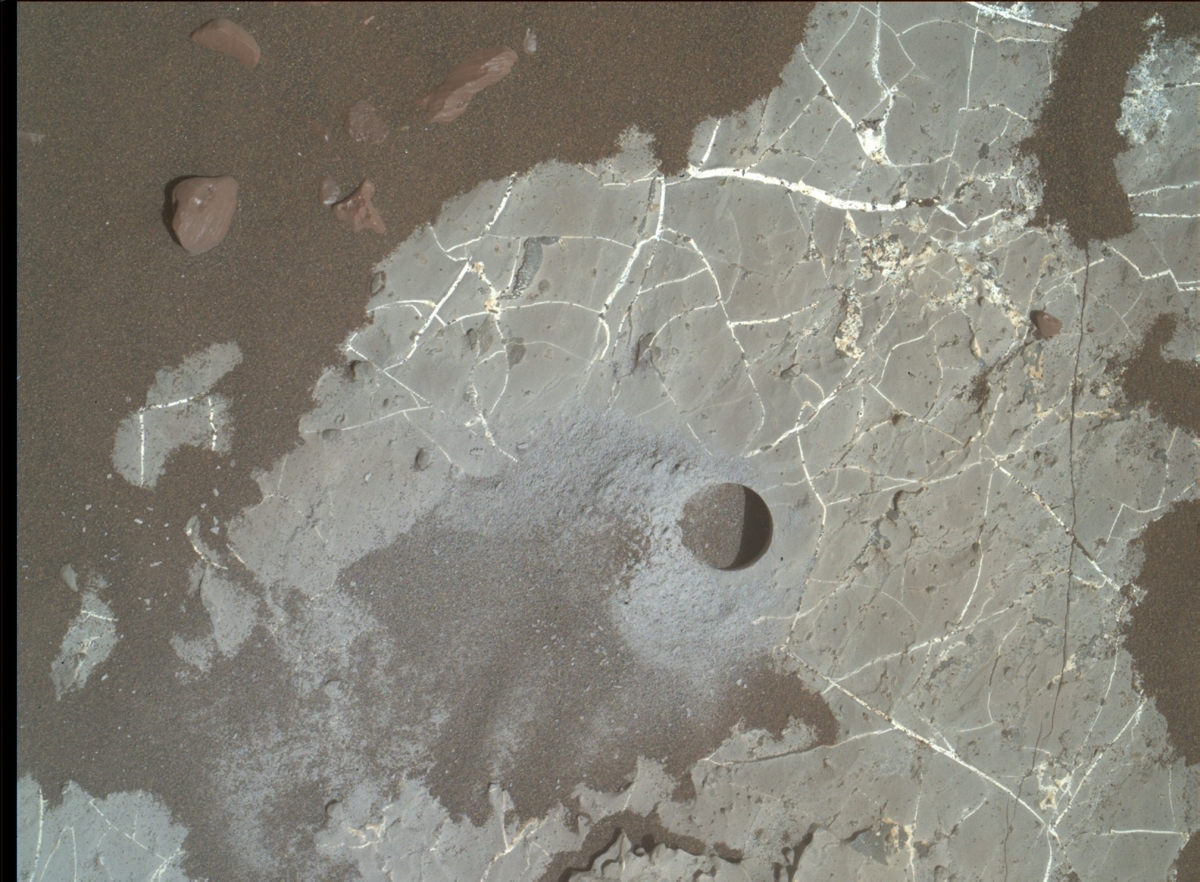
Curiosity Mars Hand Lens Imager (MAHLI) photo produced on Sol 2248, December 2, 2018. MAHLI is located on the turret at the end of the rover’s robotic arm.
Credit: NASA/JPL-Caltech/MSSS
NASA’s Curiosity Mars rover is now performing Sol 2250 duties.
Susanne Schwenzer, a planetary geologist at the Open University, Milton Keynes, in the U.K., reports that on sol 2250 the rover is to finish observations on and around the Highfield drill hole and drive to an area where red Jura is exposed.
Change detection
“The dataset Curiosity collected at the Highfield location is very informative,” Schwenzer notes, as it includes observations that especially benefit from the longer stay, such as the change detection imaging experiments.
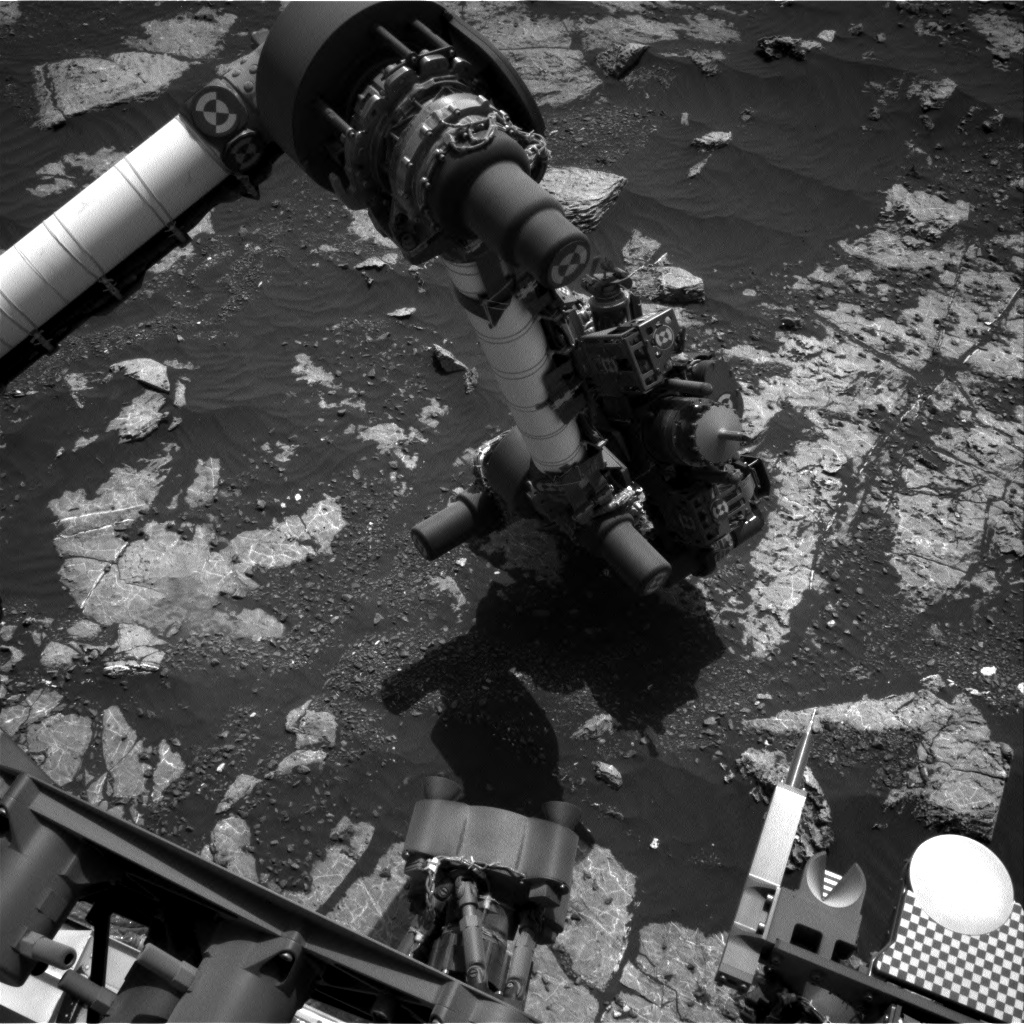
Curiosity Navcam Left A photo taken on Sol 2248, December 2, 2018.
Credit: NASA/JPL-Caltech
“In one of the images, the sand movements became very apparent by the drill hole already starting to fill in – not a planned change detection, but an interesting one nonetheless,” Schwenzer adds. “It is just a few sols since we drilled, yet sand has drifted in and parts of the drill fines have blown away. We were once more reminded, just how active Mars is!”
Drill site context
Recently, Curiosity was set to make the two last Chemistry and Camera (ChemCam) observations in the Highfield area: one measurement will be taken of the Highfield dump pile, and one of a vein target called “Niddrie.”
“Those will help us to better understand the drilled sample itself, and also the geologic and geochemical context of the drill site. Mastcam will document the activities as usual,” Schwenzer points out.
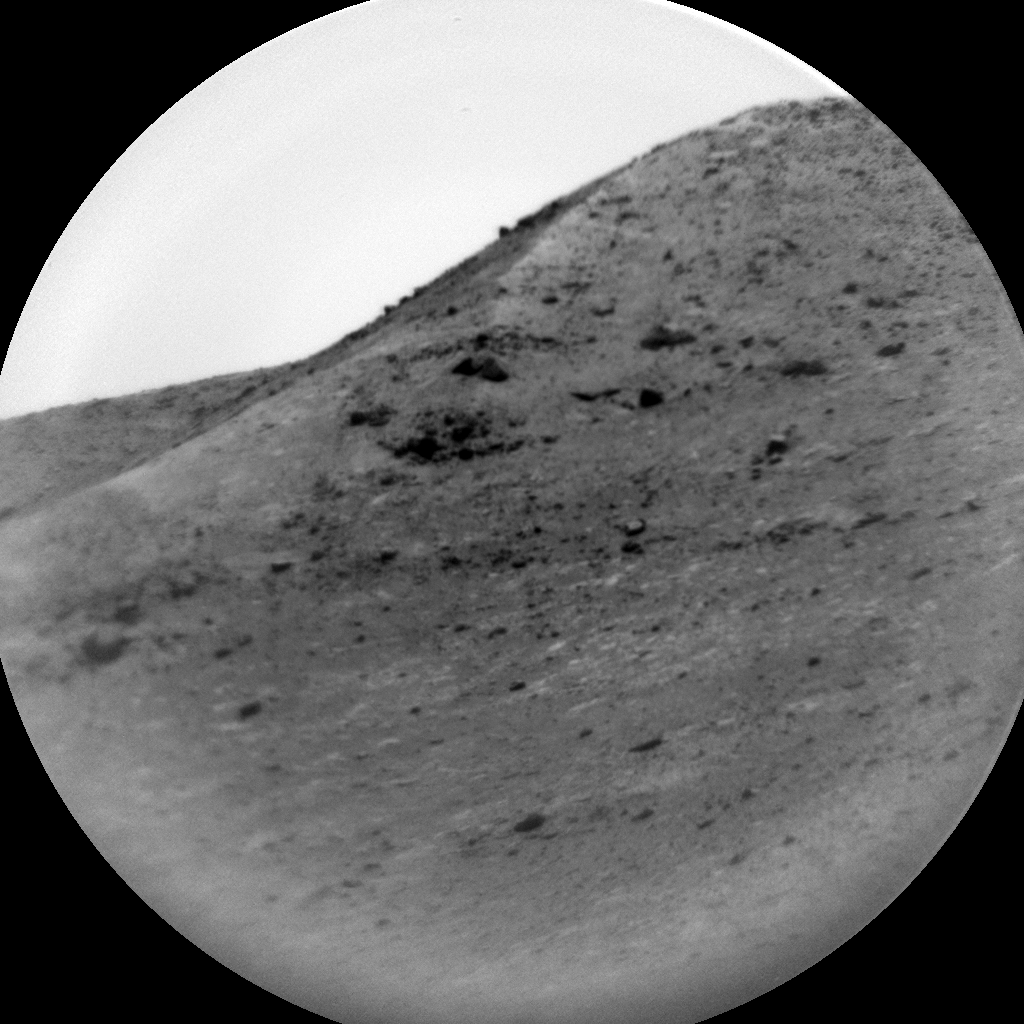
ChemCam Remote Micro-Imager photo acquired on Sol 2249, December 3, 2018.
Credit: NASA/JPL-Caltech/LANL
Next drill site
“Then we will head off to the next potential drill site to find a good place to drill the red Jura,” Schwenzer says. The team has extensively surveyed the area, and Curiosity is heading to a site called “Lothian.”
“After the drive, Curiosity will gather as much information as she can by doing a large workspace Mastcam mosaic,” Schwenzer reports. Other activities are Navcam post drive imaging and use of AEGIS, the Autonomous Exploration for Gathering Increased Science (AEGIS) software.
“On to new adventures,” Schwenzer concludes, “red Jura, here we come!”
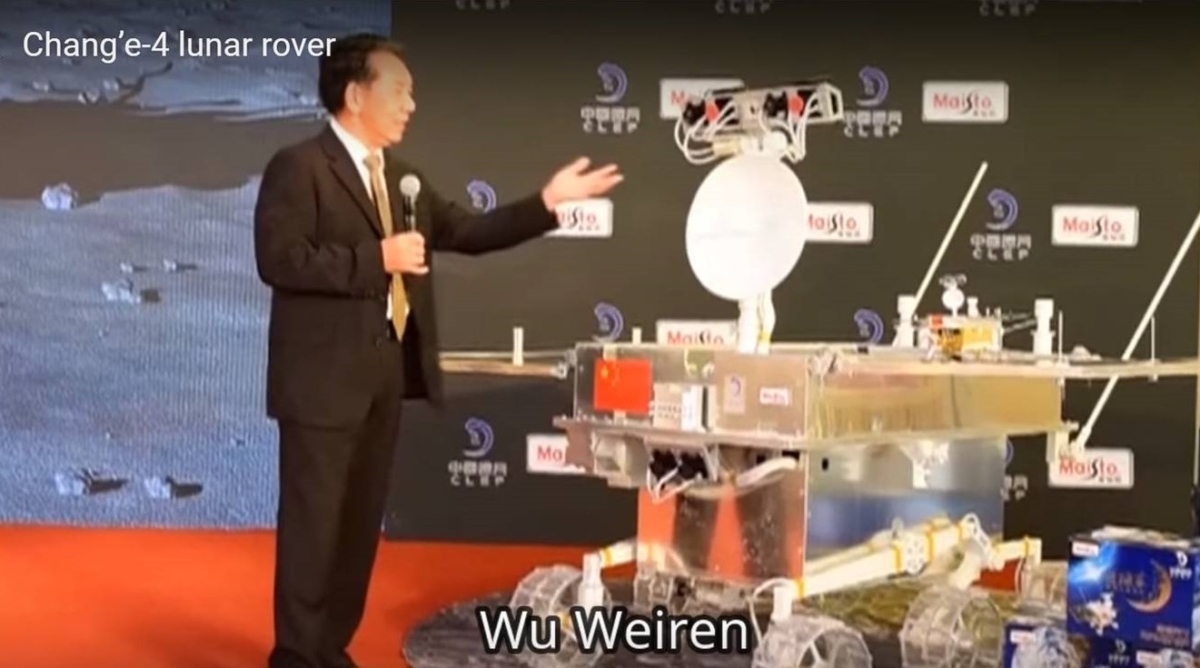
Wu Weiren, chief designer of the lunar exploration program, presents the Chang’e-4 rover.
Credit: CCTV/Screengrab
China is set to launch on December 8 the first farside lunar landing mission in history, headed for a touchdown within the South Pole‐Aitken (SPA) basin following a 27-day flight.
The scientific instruments of China’s robotic Chang’e-4 lander/rover will analyze both surface and subsurface of this region. Both the lander and the rover were designed as a backup for the successful December 2013 Chang’e-3 lander and Yutu rover mission.
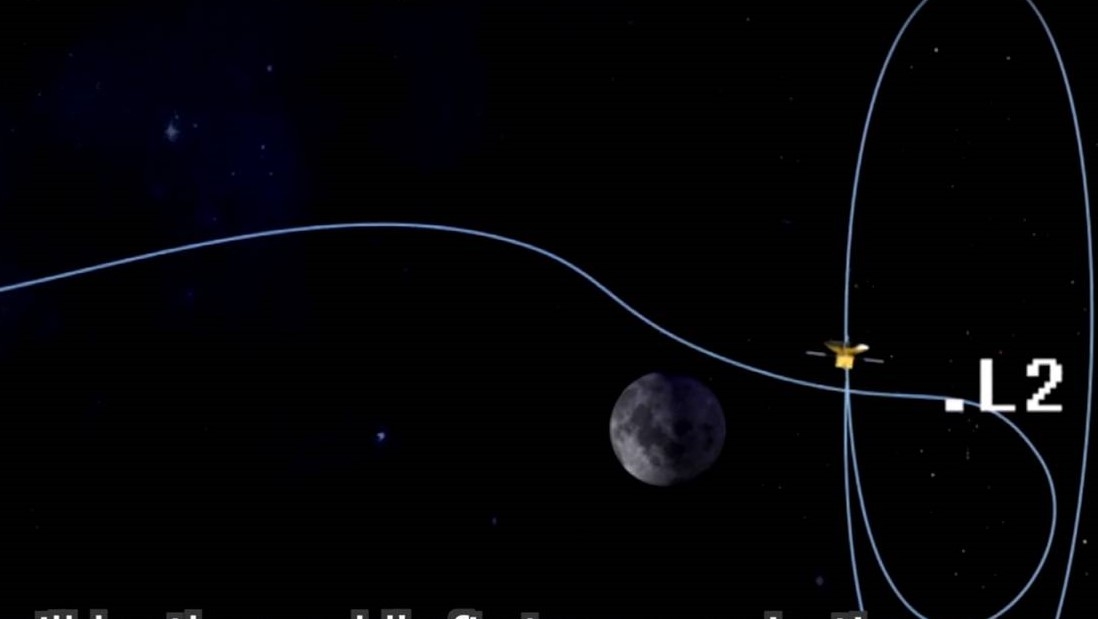
Credit: New China/Screengrab/Inside Outer Space
As prelude to the upcoming Moon mission, China launched the Queqiao relay satellite last May. It is now positioned in an Earth-Moon L2 Lagrange point – a place in space where the spacecraft can handle communications between ground controllers and the farside lander/rover mission.
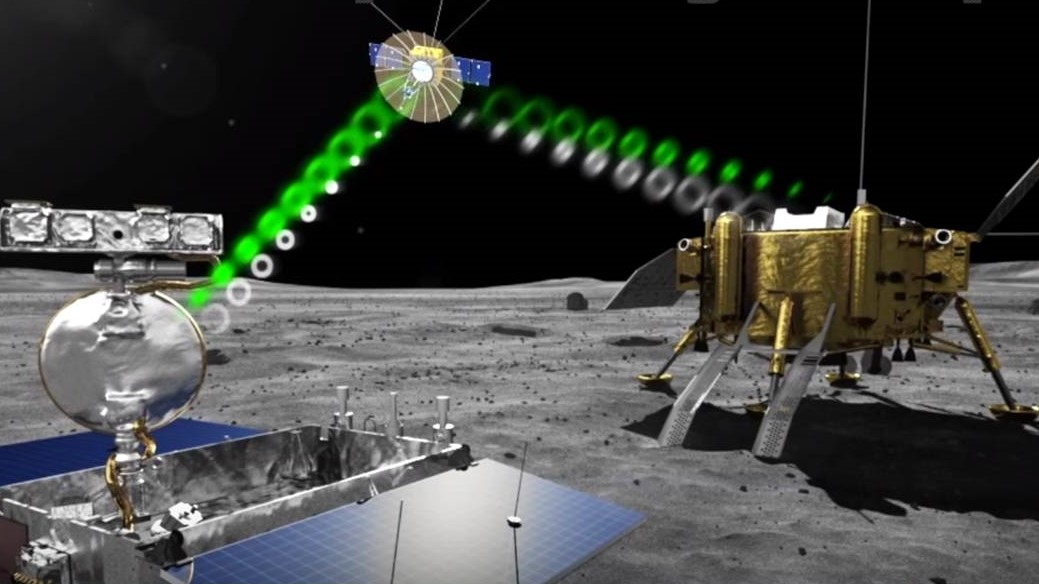
Credit: New China/Screengrab/Inside Outer Space
Biological experiment
According to an earlier Xinhua news agency story, the Chang’e-4 will carry a tin containing seeds of potato and arabidopsis, a small flowering plant related to cabbage and mustard. It may also tote along silkworm eggs to conduct the first biological experiment on the Moon.
This “lunar mini biosphere” experiment was designed by 28 Chinese universities, led by southwest China’s Chongqing University, The cylindrical tin, made from special aluminum alloy materials, weighs roughly 7 pounds (3 kilograms).
Candidate landing region of China’s Chang’e-4 lander within Von Kármán crater in SPA basin.
Credit: Jun Huang, et al.
Lander, rover payloads
The Von Kármán Crater in the Moon’s Aitken Basin is the anticipated landing site for Chang’e-4.
In a recently published paper – “The scientific objectives and payloads of Chang’e-4 mission”, led by Yingzhuo Jia of the University of Chinese Academy of Sciences in Beijing, details are offered regarding the forthcoming lunar exploration goals of the lander/rover. Jia is also with the State Key Laboratory of Space Weather, National Space Science Center of the Chinese Academy of Sciences.
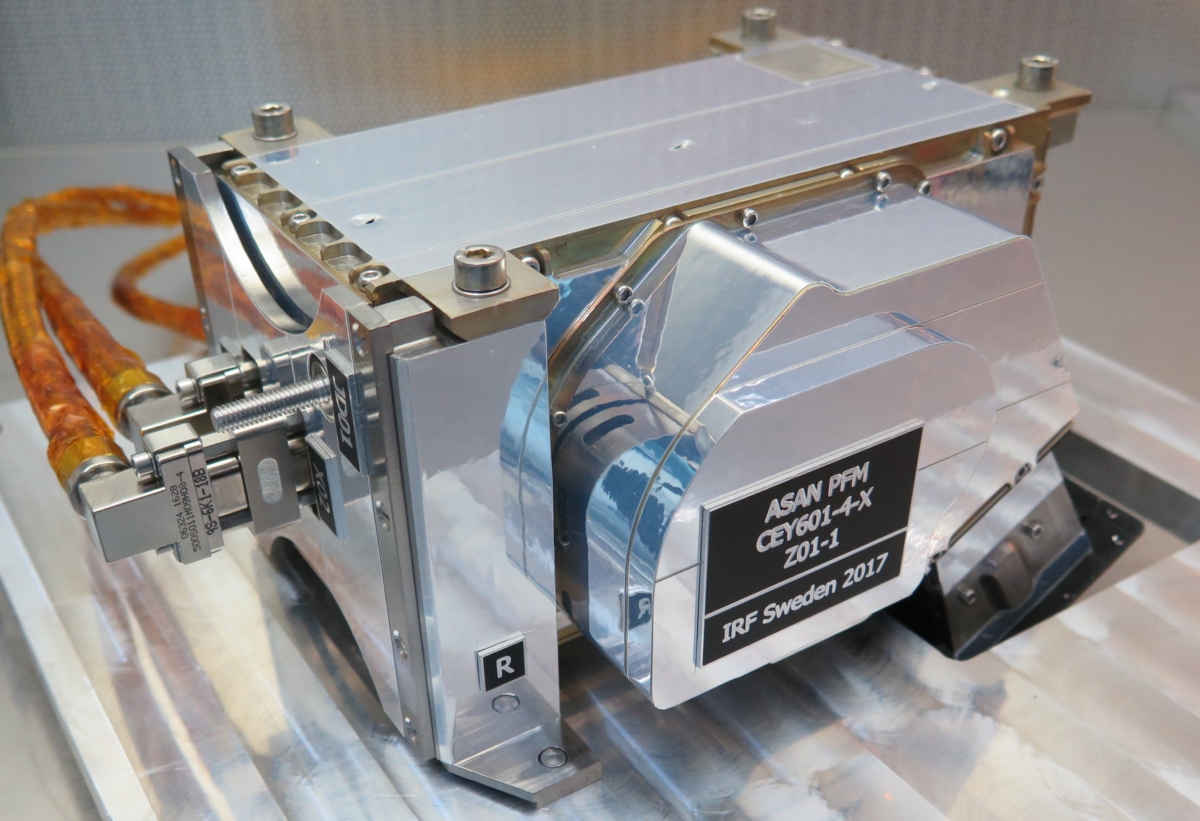
Swedish Institute of Space Physics Advanced Small Analyzer for Neutrals (ASAN) instrument for Chang’e-4 rover.
Credit: Institutet för rymdfysik, IRF
The Chang’e-4 mission totes six kinds of scientific payloads.
On the lander, it carries the Landing Camera (LCAM), the Terrain Camera (TCAM), and the Low Frequency Spectrometer (LFS). There are three kinds of payloads on the rover, the Panoramic Camera (PCAM), the Lunar Penetrating Radar (LPR), and the Visible and Near-Infrared Imaging Spectrometer (VNIS).
That Low Frequency Spectrometer is newly developed for Chang’e-4 lander; the other payloads are inherited instruments from Chang’e-3 lunar mission.
There are also three international joint collaboration payloads within the Chang’e-4 explorer mission:
- Germany’s Lunar Lander Neutrons and Dosimetry (LND) installed on the lander
- Sweden’s Advanced Small Analyzer for Neutrals (ASAN) installed on the rover
- Netherlands-China Low-Frequency Explorer (NCLE) installed on the relay satellite
Overall, the scientific objectives for the Chang’e-4 are:
- Low-frequency radio astronomical study on the lunar surface
- Shallow structure investigation at the lunar farside within the roving area
- Topographic and mineralogical composition studies of the lunar farside within the rover’s patrol area
The Chang’e-4 mission carrying out low-frequency radio astronomical studies on the lunar surface is intriguing.
The lunar farside blocks the Earth’s ionosphere, human-made radio frequency interference, and the auroral kilometric radiation noise. Additionally, also blocked is the solar radio emission during the night time.
“Hence, the lunar farside has been believed as the best place for the low-frequency radio astronomical observation,” the paper notes. The Low Frequency Spectrometer on the lander and the Netherlands-China Low-Frequency Explorer installed on the relay satellite are slated to carry out joint low frequency radio astronomical observations.

Group shot…China’s Chang’e 3 lander and Yutu rover in December 2013 mission.
Credit: Chinese Academy of Sciences
Penetrating look
Another aspect of the Chang’e-4 rover is use of a Lunar Penetrating Radar, able to detect the lunar subsurface structure on the robot’s patrol route, and to detect the thickness and structure of the lunar regolith. The device is a nanosecond impulse radar with bistatic antennas.
A similar device was utilized on the Chang’e-3 rover, Yutu.
It works like this: An ultra-wideband nanosecond impulse is produced by a transmitter, sent through the transmitting antenna down to lunar surface. The receiving antenna receives the reflected signal. The echo signal from the underground target is received by the receiving antenna, amplified in the receiver and then restored as data record.

South Pole-Aitken (SPA) basin.
Credit: NASA/Goddard
Impact basin
The SPA basin is the largest and oldest impact basin of the Moon. Although the terrain is low, this region is not filled with mare basalts as other Moon basins, Yingzhuo and colleagues note, suggesting its special thermal history and unique evolution features. The materials in the region are likely to be of great significance to reveal the compositions of the crust and even the mantle of the Moon. All kinds of lunar exploration data show that SPA basin possesses unique geochemical characteristics.
China’s next lunar probe, Chang’e-5, is designed to bring select samples from the Moon back to Earth. It builds upon a progression of Chinese Moon explorers: Chang’e-1 and Chang’e-2 orbiters in 2007 and 2010, respectively, and the Chang’e-3 lunar lander/rover mission in December 2013.
To access the paper, “The scientific objectives and payloads of Chang’e-4 mission,” go to the Planetary and Space Science journal, Volume 162, 1 November 2018, Pages 207-215 at:
https://www.sciencedirect.com/science/article/pii/S0032063317300211?via%3Dihub

Credit: NASA/JPL-Caltech
NASA’s InSight spacecraft operations are moving forward, as indicated by a set of November 30th images.
A lens cover was flipped open on InSight’s Instrument Context Camera (ICC) on Nov. 30, 2018. Located below the deck of the InSight lander, the ICC has a fisheye view, creating a curved horizon.
Some clumps of dust are still visible on the camera’s lens. One of the spacecraft’s footpads can be seen in the lower right corner. The seismometer’s tether box is in the upper left corner.

Credit: NASA/JPL-Caltech
Robotic arm
Other activities by InSight on Sol 4 include articulation of the lander’s critical robotic arm. Imagery was taken using its robotic arm-mounted, Instrument Deployment Camera (IDC).
Data downlinked from the lander also indicate that during its first full day on Mars, the solar-powered InSight spacecraft generated more electrical power than any previous vehicle on the surface of Mars.

Two-frame set of images shows NASA’s InSight spacecraft unlatching its robotic arm on Nov. 27, 2018, the day after it landed on Mars. Click on image.
Credit: NASA/JPL-Caltech
Slightly tilted
Higher-resolution images are expected to begin arriving over the coming days.
It has also been determined that the vehicle sits slightly tilted (about 4 degrees) in a shallow dust- and sand-filled impact crater known as a “hollow.” InSight has been engineered to operate on a surface with an inclination up to 15 degrees.
NASA’s Mars Curiosity rover is now carrying out Sol 2246 duties.
Shown here are just-in images from the Mars machinery:

“Little Colonsay,” a potential meteorite. Photo taken by Curiosity ChemCam Remote Micro-Imager, acquired on Sol 2245 November 29, 2018.
Credit: NASA/JPL-Caltech/LANL

Curiosity Front Hazcam Left A photo taken on Sol 2245, November 30, 2018.
Credit: NASA/JPL-Caltech
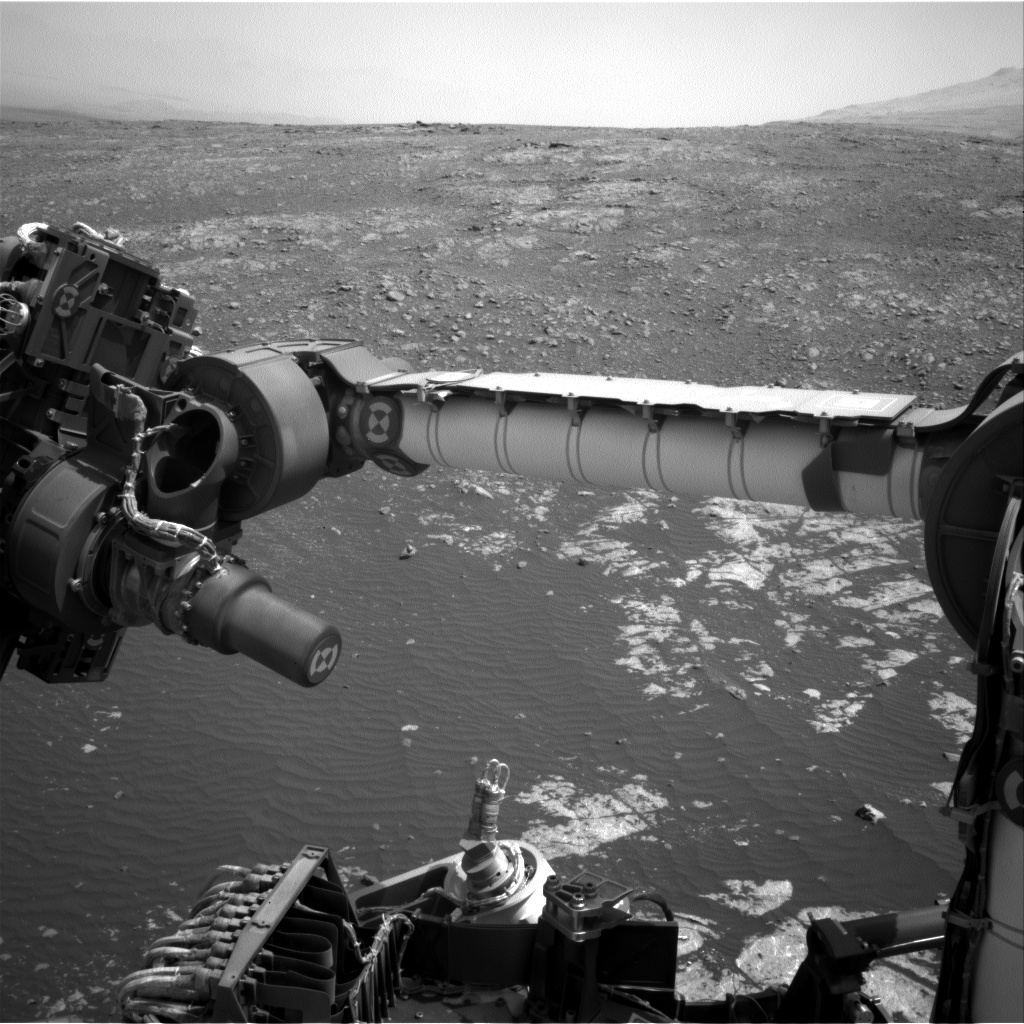
Curiosity Navcam Left A image acquired on Sol 2245, November 30, 2018.
Credit: NASA/JPL-Caltech
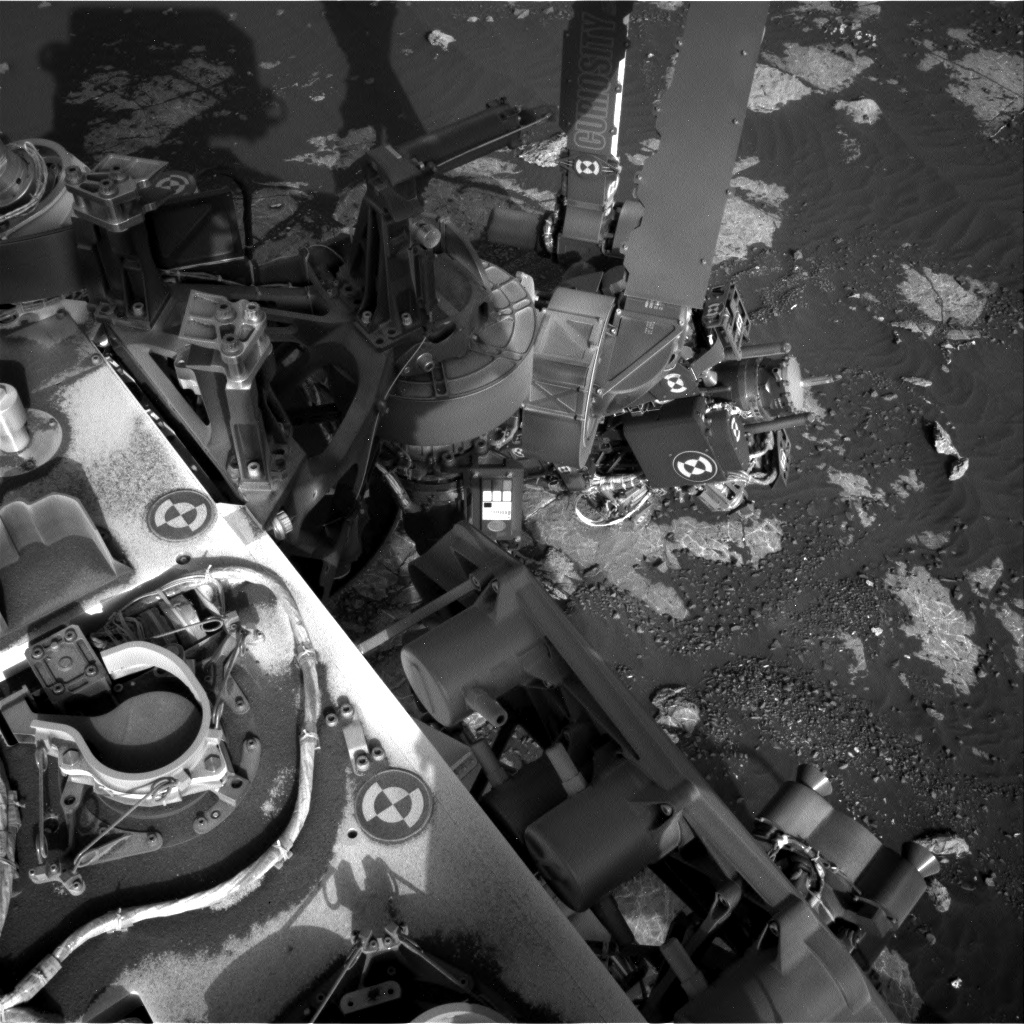
Curiosity Navcam Left A image acquired on Sol 2245, November 30, 2018.
Credit: NASA/JPL-Caltech
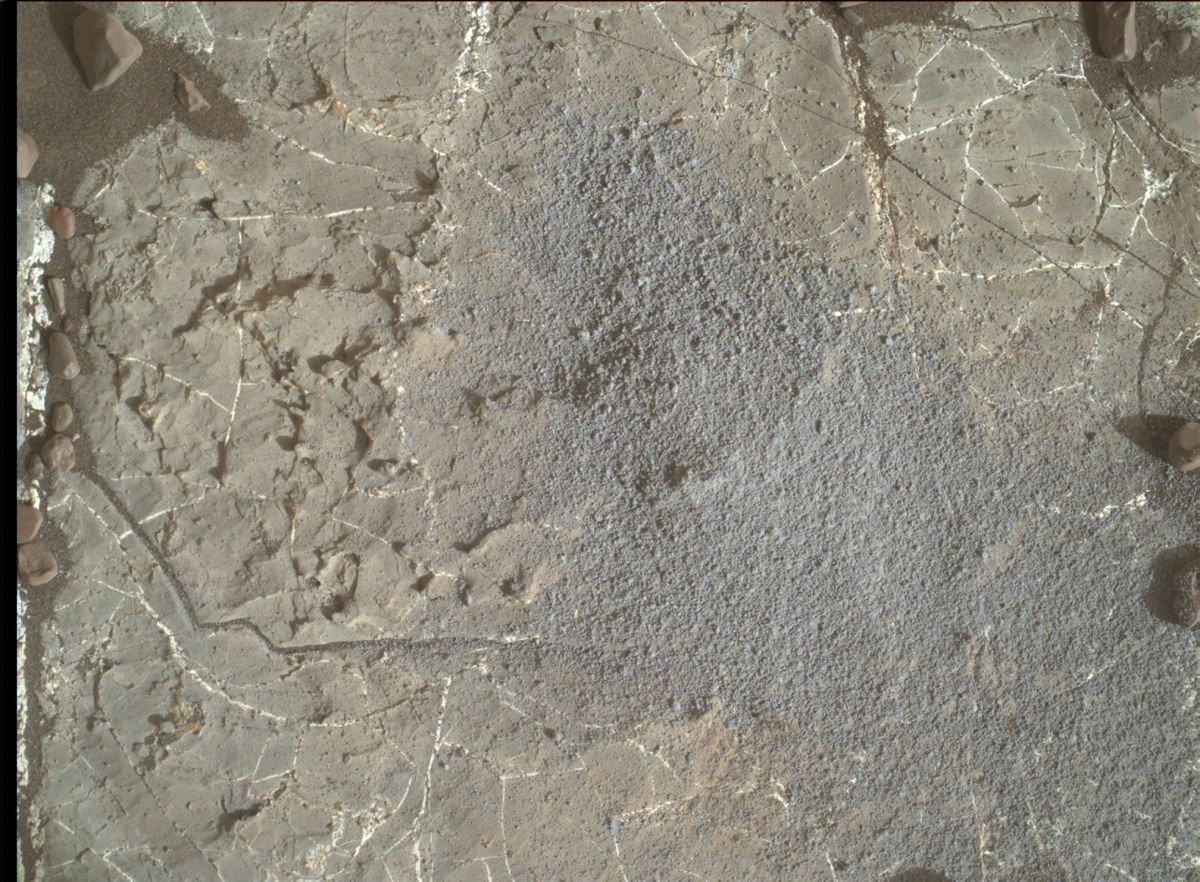
Curiosity dump site of the Highfield sample. Photo taken by Mars Hand Lens Imager (MAHLI), acquired on Sol 2245, November 29, 2018.
Credit: NASA/JPL-Caltech/MSSS

