Archive for the ‘Space News’ Category
 Author:
  December 30th, 2018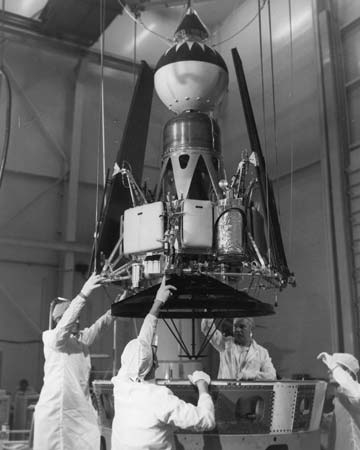
Ranger 4 topped by lightweight balsa wood impact limiter that encapsulated a transmitter and a seismometer.
Credit: NASA/JPL
There’s an interesting historical side note given China’s imminent, milestone making robotic landing on the farside of the Moon.
The U.S. Ranger spacecraft series was a set of kamikaze-like missions, hurled to the Moon to take photos of the lunar surface before a high-speed crash.
NASA’s Block 2, Ranger 4 was launched on April 23, 1962, rocketed moonward via an Atlas Agena-B booster from Cape Canaveral Air Force Station, Florida. This craft carried a unique scientific experiment – a lightweight balsa wood impact limiter that encapsulated a transmitter and a seismometer designed by the Caltech Seismological Laboratory.

Credit: NASA/JPL
Rough landing

Credit: NASA/JPL
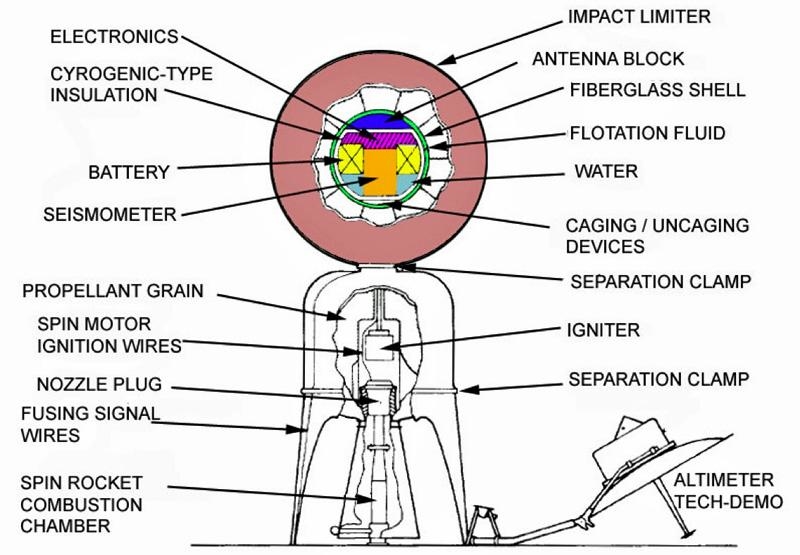
According to Julie Cooper of the Jet Propulsion Laboratory’s (JPL) Library and Archives Group, the sphere was 25.5 inches (65 centimeters) in diameter. The seismometer within the separate capsule was to be slowed by a rocket motor and separate from the spacecraft shortly before Ranger 4’s impact and survive the rough landing on the Moon.
The capsule was also vacuum-filled with a protective fluid to reduce movement during impact. After landing, the instrument was to float to an upright position. Then the fluid would be drained out so it could settle and switch on.
Credit: NASA/JPL
Seismometer signals
While Ranger 4 had a perfect launch, the craft apparently suffered a main timer failure. Ranger 4’s computer had stopped, disabling the probe’s telemetry system; preprogrammed events such as solar panel deployment did not occur, and the probe became completely unresponsive to manual commands.
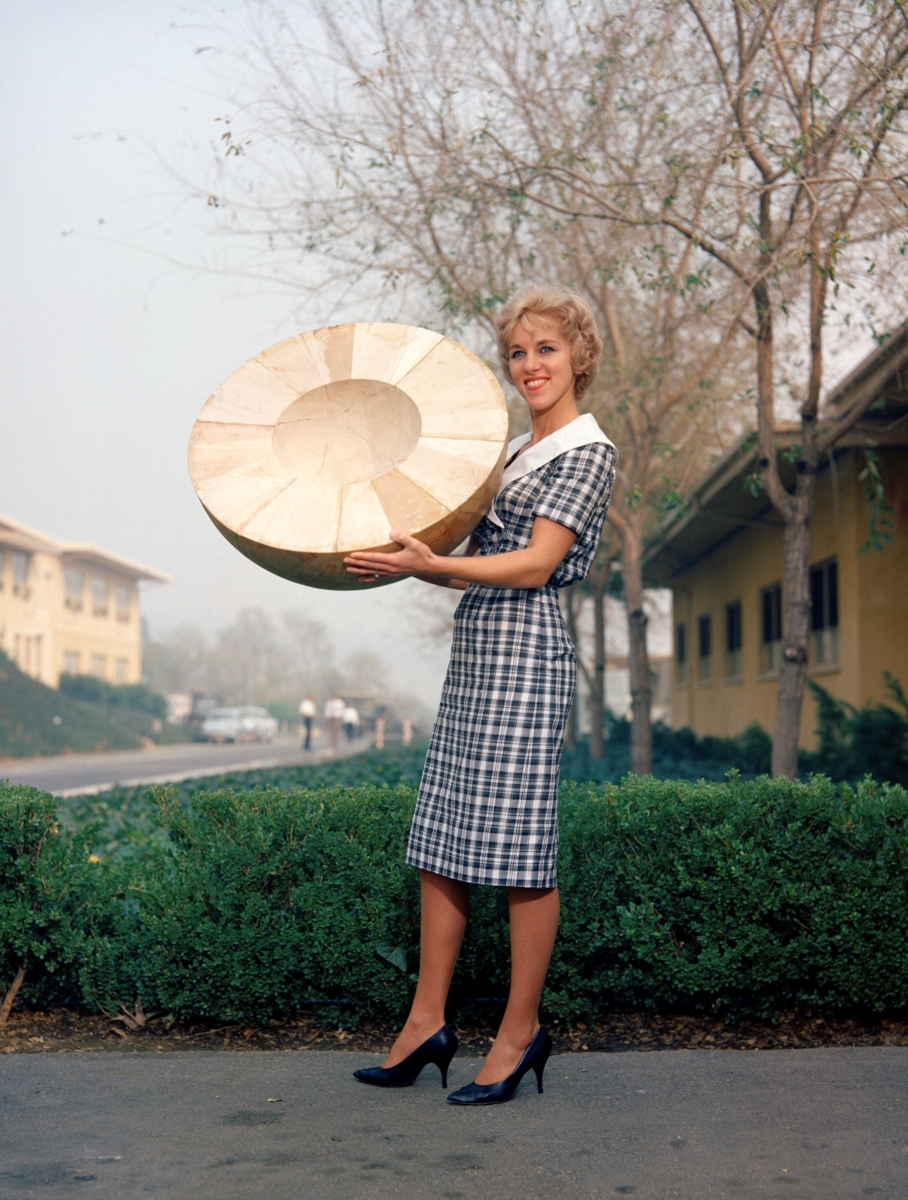
JPL’s Systems Design secretary Pat McKibben holds Ranger sphere.
Credit: NASA/JPL/Julie Cooper, JPL, Library and Archives Group.
Although Ranger 4’s transponder had ceased to operate, stations within the Deep Space Network continued their radio tracking nonetheless, homing on the 50-milliwatt signal produced by the tiny battery-powered transmitter in the seismometer capsule.
The Ranger project team tracked the seismometer capsule to impact just out of sight on the lunar farside, validating the spacecraft’s communications and navigation system.

Ranger 4 impact site?
Credit: GeoHack
Rest in pieces
On April 26, 1962, Ranger 4 impacted the farside of the Moon. A guesstimate placed the crash site at 15.5°S 130.7°W.
“You could confidentially state it crashed on the western eject of the Orientale basin,” explains Mark Robinson of Arizona State University’s School of Earth and Space Exploration in Tempe, Arizona. He is also the principal investigator of NASA’s Lunar Reconnaissance Orbiter’s (LRO) LROC camera system.
To date, no LRO imagery has identified Ranger 4’s final “rest in pieces” landing spot.
“It was a blind crash on the farside,” Robinson told Inside Outer Space. “How could anybody positively identify the crash site…there is no before image. The problem is the sheer number of 10 to 20 meter diameter fresh craters. How would you ever confirm [the crash site] without a before and after image, or a precise coordinate…short of going to the crater and digging around looking for spacecraft wreckage?”
Difficult to spot
It would be very difficult to identify any specific impact crater associated with Ranger 4 says noted Moon expert, Philip Stooke. He is Professor Emeritus and Adjunct Research Professor within the Department of Geography, and Center for Planetary Science and Exploration, at the University of Western Ontario.
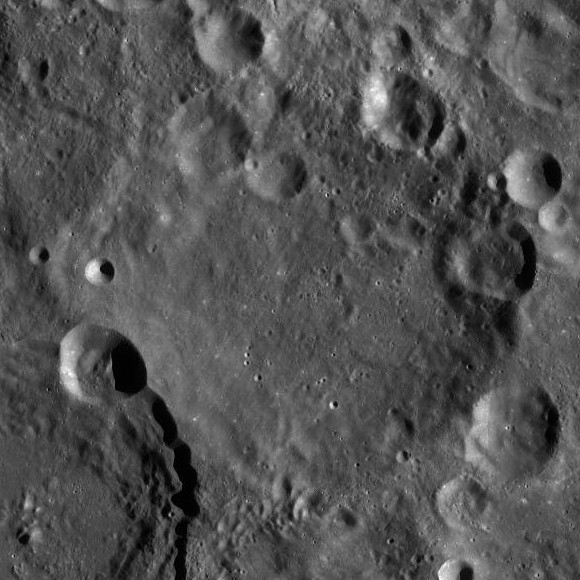
Possible Ranger-4 crash site somewhere in the Loffe and Fridman Friedmann crater area?
Credit: NASA/GSFC/Arizona State University
“The whole area has been imaged at high resolution by LRO so we probably have a picture of the crater,” Stooke told Inside Outer Space.
Stooke points out one thing to consider.
“What did people know about the farside at that time? Practically nothing! So, to calculate an impact location, you plot the trajectory, as well as you know it, and see where it intersects the lunar surface,” Stooke says. But if you know nothing at all about the topography, he continues, you have to use an approximation – it would have just been a sphere the mean size of the Moon. The actual point would vary a bit if there is a difference between the real topography and the assumed sphere.
“I don’t think anyone has ever gone back and recalculated the impact point for this or other missions like the NASA Lunar Orbiters using modern topography. If they did I think the orbiters could be found eventually, but I think the Ranger 4 location is probably still too uncertain to find it,” Stooke concludes.
 Posted in
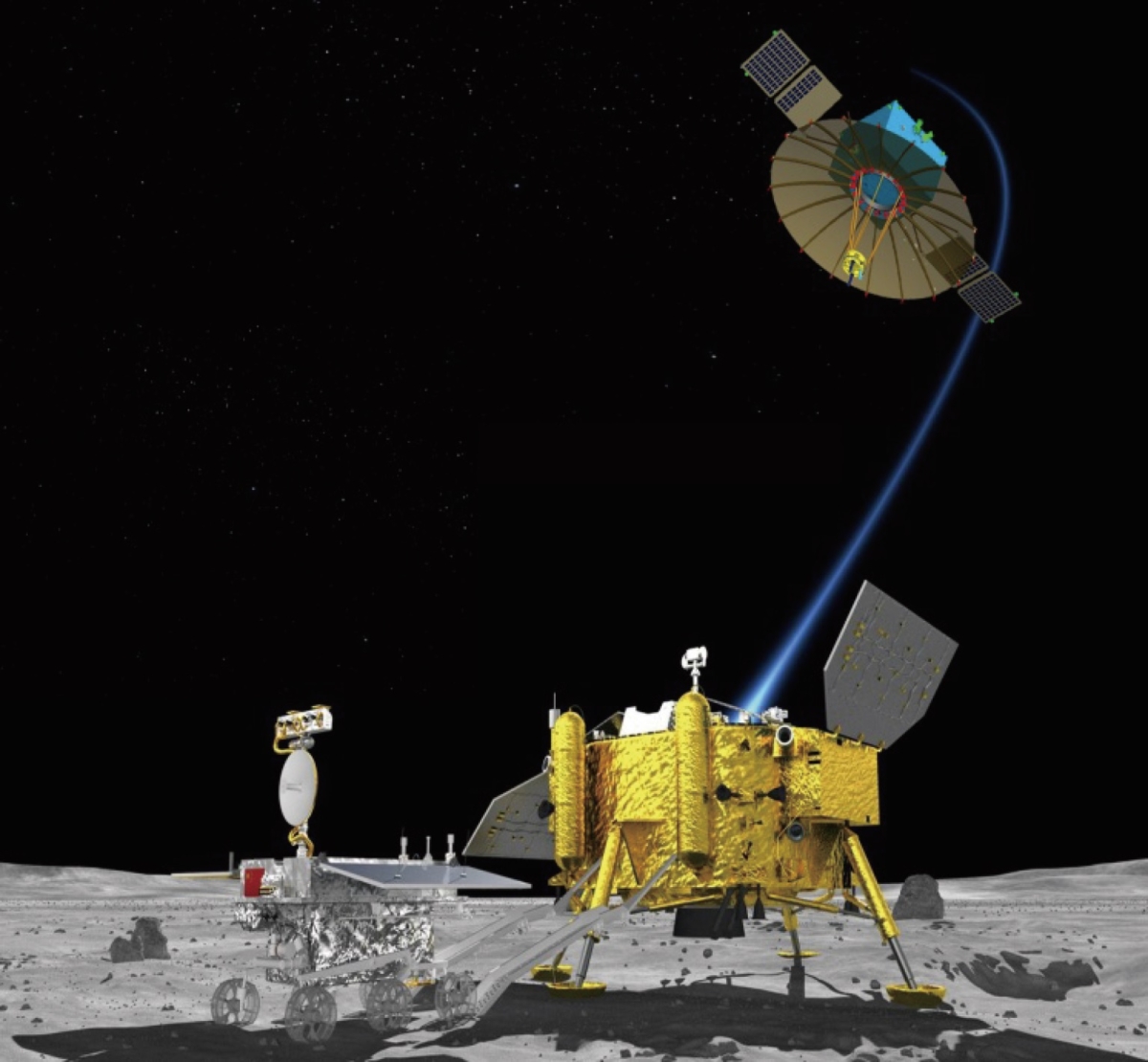
Chang’e-4 Moon lander, rover and relay satellite.
Credit: Chinese Academy of Sciences
The China National Space Administration (CNSA) has announced that the country’s Chang’e-4 probe has entered a planned orbit Sunday morning to prepare for the first-ever soft landing on the farside of the Moon.
Chang’e-4 entered a new lunar orbit with the low point at roughly 9.3 miles (15 kilometers), and about 62 miles (100 kilometers) at its high point.
Orbital adjustments
This lander/rover mission was launched by a Long March-3B carrier rocket on December 8 from the Xichang Satellite Launch Center in southwest China’s Sichuan Province. Chang’e-4 then entered lunar orbit on December 12.

China’s Chang’e-4 Moon lander – far side bound.
Credit: New China TV/Screengrab/Inside Outer Space
The probe then made two orbital adjustments, along with testing the Queqiao relay satellite communications link. That satellite was launched last May and was nudged into a halo orbit around the second Lagrangian (L2) point of the earth-moon system.
Landing date to come
Ground control engineers also checked the imaging instruments and ranging detectors on the probe to prepare for the landing. The control center will choose a proper time to land the probe on the farside of the moon, according to CNSA – reportedly within the next few days.
For more details on the implications of Chang’e-4, go to my Scientific American story:
With First-Ever Landing on Moon’s Farside, China Enters “Luna Incognita”
The Chang’e-4 mission could have major effects on Earthbound science and politics
Also, go to this CCTV Video about the mission:
https://youtu.be/cGp7WySaVW4?list=PLpGTA7wMEDFjz0Zx93ifOsi92FwylSAS3
In addition, go to this informative video:
More China-EU space program co-op expected as Chang’e-4 probe prepares for moon-landing
https://www.youtube.com/watch?v=sR4jiNMcBYg
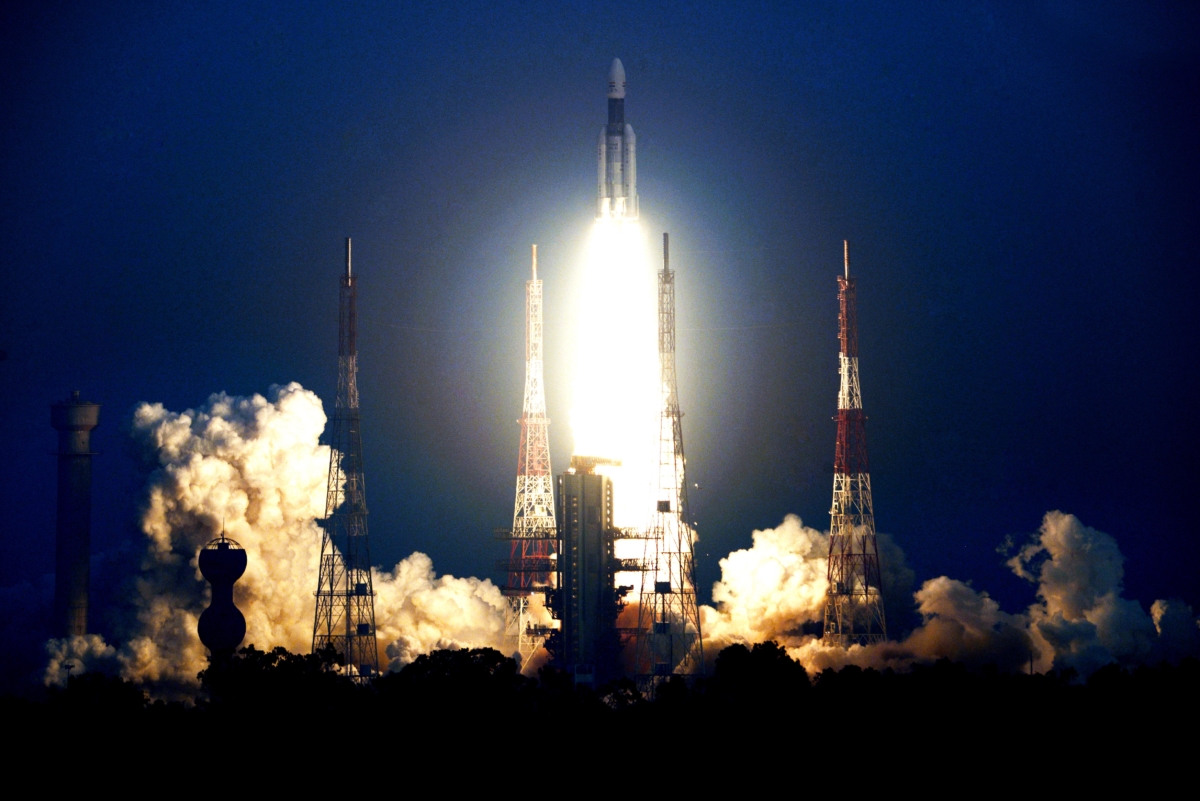
Credit: ISRO
Media outlets in India are reporting that the country is moving forward on its Gaganyaan project – a plan by the Indian Space Research Organization (ISRO) to help India become the fourth nation able to independently rocket humans into Earth orbit by 2022.
Law Minister Ravi Shankar Prasad announced that the Union cabinet has approved a budget for the program.
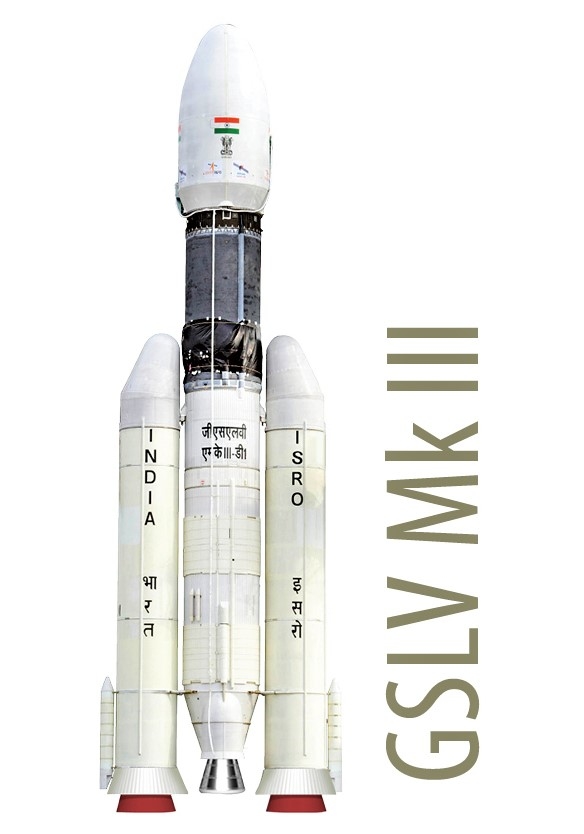
Credit: ISRO
Large launcher
India’s NDTV reports there have been a number of developments within India’s Gaganyaan program.
India’s space agency ISRO hopes to deploy its biggest rocket, the Geosynchronous Satellite Launch Vehicle Mark III (GSLV Mk III), to send three Indians into space from the Sriharikota space port in Andhra Pradesh. GSLV Mk III is a three-stage heavy lift launch vehicle developed by ISRO. The vehicle has two solid strap-ons, a core liquid booster, and a cryogenic upper stage.
The space agency hopes to launch the first mission within 40 months. The plans in the “demonstration phase” includes undertaking two unmanned flights and one human flight using Indian technology to catapult a crew of three into a low earth orbit for 5-7 days.
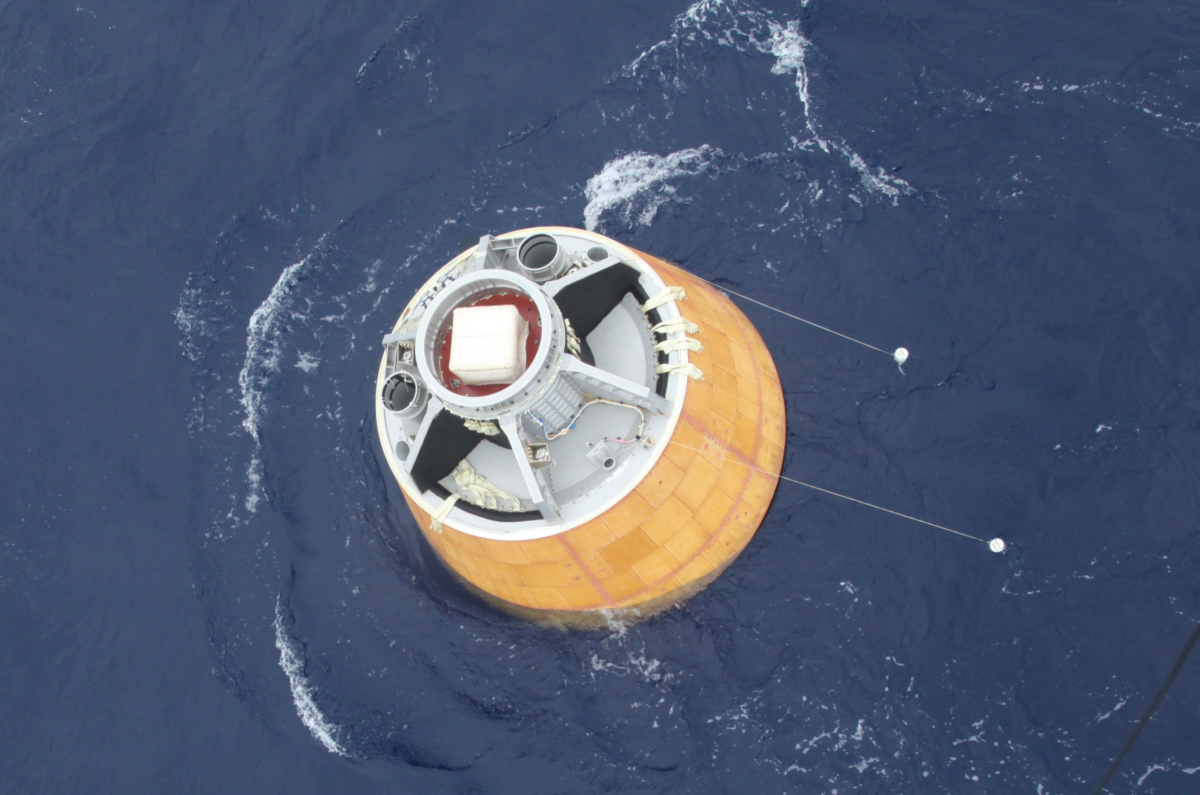
Crew Module Atmospheric Re-entry Experiment (CARE).
Credit: ISRO
Tight schedule
Dr K Sivan, Chairman of the Indian Space Research Organization (ISRO), commenting on the 2022 deadline, had earlier said it was a “very, very tight schedule but ISRO will do it.” India has inked agreements with Russia and France for assistance in Gaganyaan.
India plans to call its astronauts “Vyomnauts” since “Vyom” in Sanskrit means space.
ISRO has spent Rs. 173 crore developing critical technologies for human space flight. The plan was first pitched in 2008 but was put on the backburner as the economy and Indian rockets experienced setbacks.
Stepping stone successes
In 2014, India tested a Crew Module Atmospheric Re-entry Experiment (CARE), where a 3,745 kg space capsule – a prototype of the crew module that will be used by the Indian astronauts – was launched into the atmosphere on the first flight of the GSLV Mk III and then safely recovered from the Bay of Bengal. CARE was designed to showcase blunt body re-entry aerothermodynamics and parachute deployment in cluster configuration.
Since then, ISRO has also mastered the art of making a spacesuit to be used by Indian astronauts.
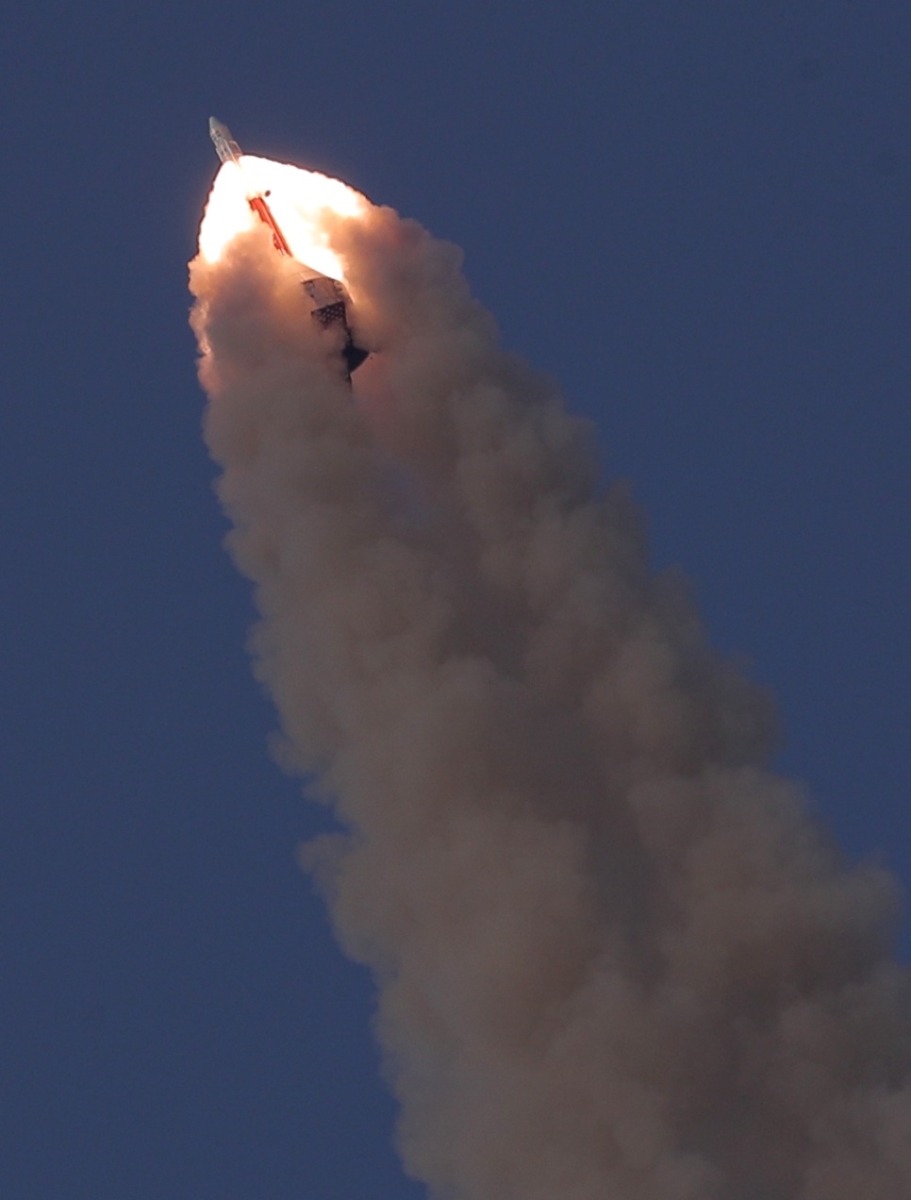
Pad Abort Test.
Credit: ISRO
Earlier this year, ISRO carried out a crucial Pad Abort Test on July 5, using a 12.6-ton crew module. This escape measure is designed to quickly pull the astronaut-carrying crew module to a safe distance from the launch vehicle in the event of a launch abort.
The test took place at Satish Dhawan Space Center, Sriharikota.
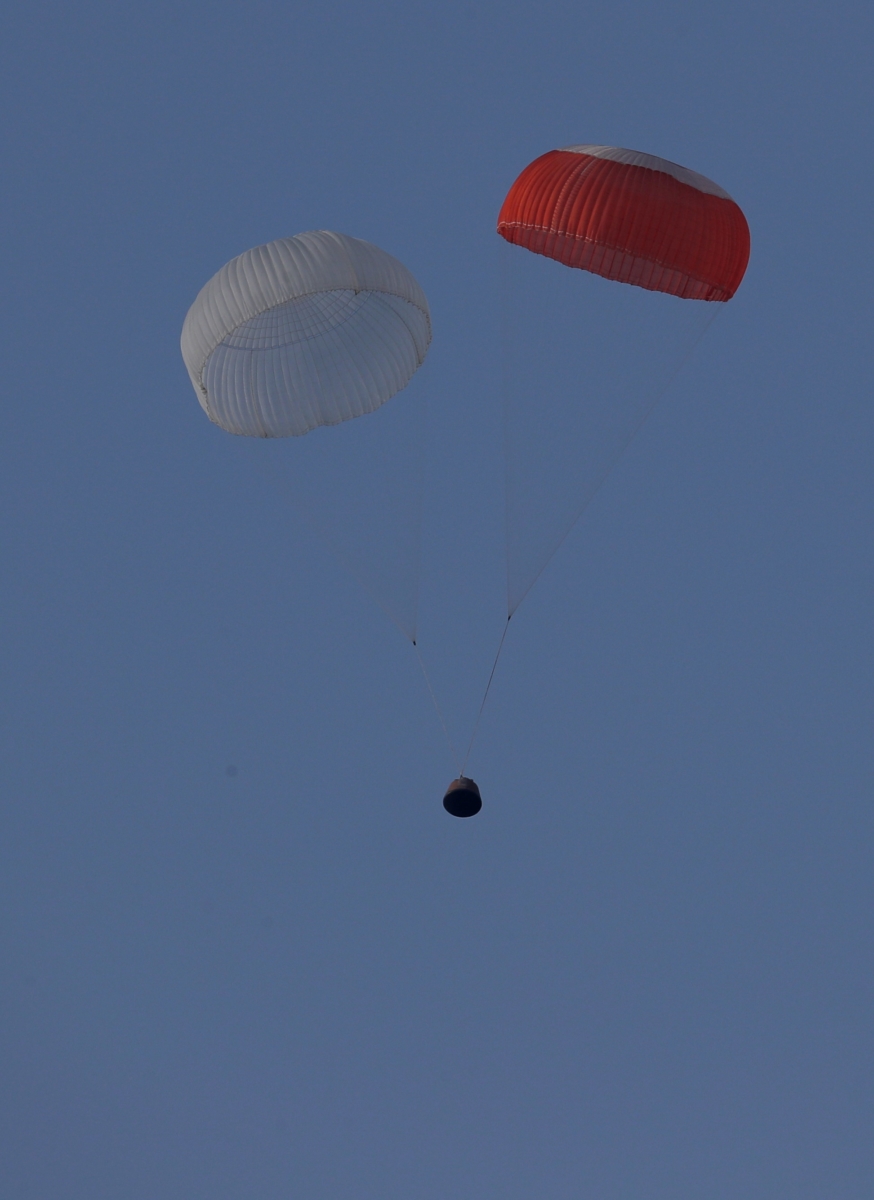
Pad Abort Test capsule parachutes to watery touchdown.
Credit: ISRO
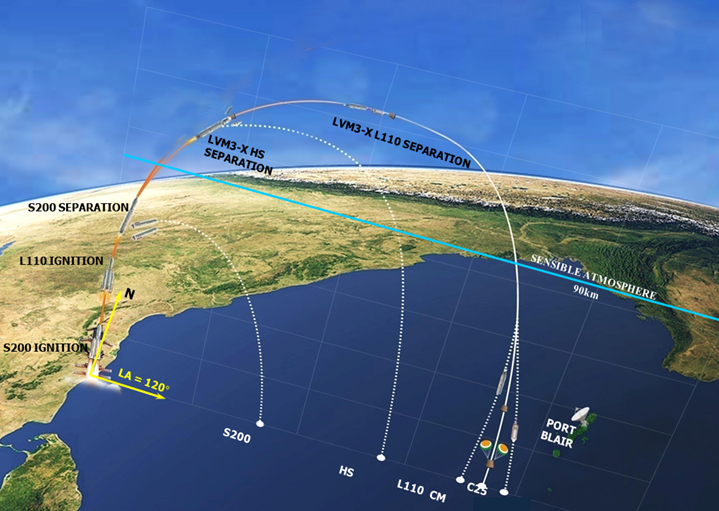
The crew module reached an altitude of nearly 1.7 miles (2.7 kilometers) under the power of its seven quick acting solid rocket motors.
Nearly 300 sensors recorded various mission performance parameters during the test flight.
The test was over in 259 seconds, during which the Crew Escape System along with crew module soared skyward, racing out over the Bay of Bengal and floated back to Earth under its parachutes about 2 miles ( 2.9 kilometers) from Sriharikota.
Credit: ISRO
Recovery experiment
In a human spaceflight-related test, back on January 10, 2007, ISRO launched the Space capsule Recovery Experiment (SRE-1).
Launched by a Polar Satellite Launch Vehicle (PSLV-C7) from Satish Dhawan Space Center (SDSC) SHAR, Sriharikota, SRE-1 was successfully recovered today on January 22, 2007 after being maneuvered to reenter the Earth’s atmosphere and descend over the Bay of Bengal.
The SRE – 1 capsule weighed 1,213 pounds (550 kilograms) and demonstrated, among a host of technologies, development of reusable thermal protection system (TPS). The experiment tested lightweight silicon tiles that can protect a spaceship as it re-enters the Earth’s atmosphere.
Go to this NDTV video about India’s human spaceflight plans:
Here’s a video of the pad abort test:
https://www.isro.gov.in/sites/default/files/videos/pat_test_video.mp4.mp4
Credit: JAXA/NHK
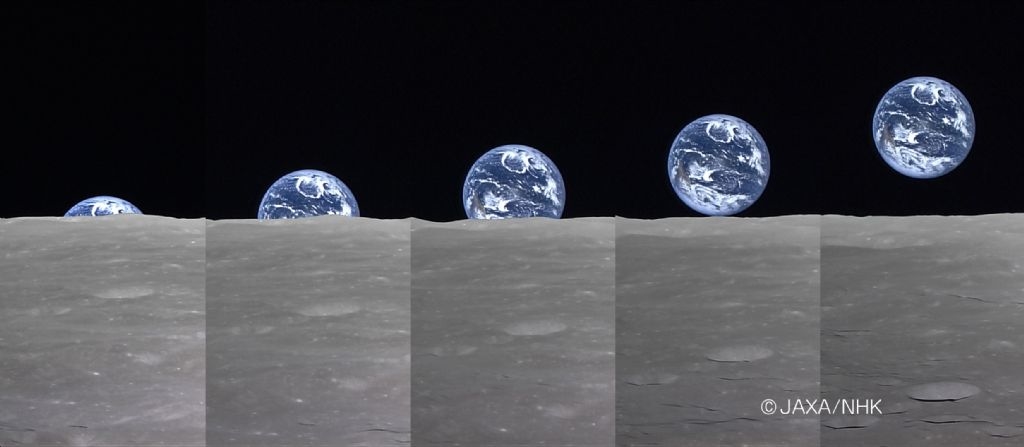
The Moon is a scene of aggravated assault.
It has been flown by, orbited, crashed into, landed upon, and also stepped on.
Fast forward to now and the next few years, there’s a pilgrimage of robots and humans set to touch down on the lunar surface by different national and collaborative space agencies.
A new paper calls for consideration of the fragility and pristine nature of the lunar surface.

Signing of Outer Space Treaty.
Credit: United Nations
Immediate action
“Current international treaties are outdated and require immediate action for their update and amendment. This should be taken as an opportunity for self-reflection and potential censoring, enabling a mature, responsible, and iterated sequence of decisions prior to returning.”
That’s the view espoused by Vera Assis Fernandes of the School of Earth and Environmental Sciences, The University of Manchester in the UK, that makes the case in the paper: “Ethical and Social Aspects of a Return to the Moon—A Geological Perspective.”
The paper has been published in Geosciences, an interdisciplinary, international peer-reviewed open access journal published monthly online by MDPI in Basel, Switzerland.
Assess the consequences
In preparation for the next round of exploration of the Moon and the Solar System, humankind needs time to assess the consequences, the paper suggests.

Next up to get down and dirty: China’s Chang’e-4 moon lander and rover. Credit: CNSA
For one, the paper asks, what kind of effects on the Moon and its stable and pristine environment will be caused by a return there (robotic and/or human)?
“As we plan the next steps in the cosmic venture, we also need to be able to acknowledge celestial bodies as entities that need to be respected, irrespective of their having life or not,” notes the paper.
Avenue of debate
One avenue of debate that is underscored in the paper is “an urgent need” to update and amend both the United Nations Moon Treaty of 1979 (i.e., Agreement Governing The Activities Of States On the Moon And Other Celestial Bodies) and the Outer Space Treaty of 1967 (i.e., Treaty on Principles Governing the Activities of States in the Exploration and Use of Outer Space, including the Moon and Other Celestial Bodies).
As pointed out in the paper, the USA, China, India, Japan and Europe are well represented, mainly by pioneering, engineering and scientific minds in terms of Moon exploration. “However, the world is a vast place with many peoples, needs, wishes, and points of view,” the researchers explain.
Wanted: mental infrastructure
From a geological view, their Moon view is that there’s need for not limiting the planning to 5 to 10 years as most businesses practice. Instead, it would allow longer term planning or at least the development of “a more solid mental infrastructure.”

Credit: NASA/ESA
“There is a need to acknowledge the Moon as an entity beyond ourselves that needs to be respected. What are the opinions of all the nations and cultures of the world on a return to the Moon? And how are the voices of their citizens being taken into consideration and included? In a globally shared endeavour, it is necessary to take into account different philosophies and approaches to what science and the cosmos are. We need to collectively look at the current world situation and think how we want it in the future!”
For a view of this informative, thought-stirring paper, go to:
“Ethical and Social Aspects of a Return to the Moon—A Geological Perspective,” go to:
https://www.mdpi.com/2076-3263/9/1/12

New Horizons Principal Investigator Alan Stern of Southwest Research Institute (SwRI), Boulder, CO., left, with print of a U.S. stamp with suggested update since the New Horizons spacecraft explored Pluto in July 2015.
Credit: NASA/Bill Ingalls
NASA’s New Horizons spacecraft encounter with “Ultima Thule” – a Kuiper Belt object that orbits one billion miles beyond Pluto – and the farthest space probe flyby in history.
Added good news is that New Horizons principal investigator and planetary scientist, Alan Stern, is prepared for puzzlement.

Artist’s concept of the New Horizons spacecraft encountering Pluto and its largest moon, Charon (foreground) in July 2015.
Credit: NASA/Johns Hopkins University Applied Physics Laboratory/Southwest Research Institute/Steve Gribben/Alex Parker
I discussed this new and imminent record-setting flyby with Stern, fleshing out what’s ahead for this trailblazing probe – at Ultima Thule…and beyond.
Go to my new Space.com story:
Encounters with Distant Worlds: An Interview with New Horizons’ Alan Stern (Exclusive)
https://www.space.com/42843-new-horizons-alan-stern-ultima-thule-interview.html

Credit: JAXA/NHK
The Moon Village Association (MVA) has issued for review a set of Moon Village Principles.
Giuseppe Reibaldi, President of the Moon Village Association, stated in a press statement: “The Principles are the first concrete step in the implementation of the Moon Village concept and this is why they are important. The public will be able to relate the concept of the Moon Village with specific activities carried out in 2019, not in a distant future.”
In 2019, the MVA intends to produce other specific contributions to foster global cooperation for the Moon Village.

Credit: NASA
The Moon Village Association was created in 2017 as non-governmental organization based in Vienna. Its goal is the creation of a permanent global informal forum for stakeholders like governments, industry, academia and the general public interested in the development of the Moon Village.
General consensus
The Moon Village Principles represent a general consensus point-of-view of the Moon Village Association but are strictly non-binding.

Lunar base made with 3D printing
Credit: ESA/Foster + Partners
The MVA will assess annually the missions and activities of various organizations with respect to the “Moon Village Principles” and state in a highly public way whether or not those missions and activities are (or are not) in line with the Principles.
Principles
Principle 1: Adhere to applicable International Rules and Agreements dealing with human activities in space, such as the Outer Space Treaty of 1967 and others, and conduct peaceful activities with thoughtful consideration and respect for the cultural heritage of humanity on the Moon.
Principle 2: Improve Knowledge of the lunar environment and its use for scientific research.
Principle 3: Reduce the Cost and Risk of transport to and from Earth and the Moon, and within cis-Lunar space.
Principle 4: Support the Economic Development of the lunar community.

Shackleton Crater located on the south pole of the Moon. The Lunar Temple visible as bright dot on the left side.
Credit: Jorge Mañes Rubio/DITISHOE
Principle 5: Employ or establish and document open-source engineering Standards of broad applicability and/or usefulness.
Principle 6: Develop and build elements / systems that provide Critical Services for lunar missions and activities, such as navigation, communications, power, and resources.
Principle 7: Develop and demonstrate Technology enabling cost-effective, reliable and safe robotic and human operations on the Moon’s surface and surroundings.
Principle 8: Make available sufficient information to allow global cooperation and engagement involving the general public in the expansion of human activities to, and eventual settlement of the Moon.

Habitat modules are seen beside ‘garages’ for rovers, with an adjacent launch site. Note the robotic vehicles on the surface, proceeding with base construction.
Credit: RegoLight, visualization: Liquifer Systems Group, 2018/Used with permission.
Principle 9: Contribute ethically to human society in terms of Culture, the Arts, Education or other fundamentals.
For more information on the MVA and the set of principles, go to:

Credit: Marta Flisykowska
How could long-term habitation of Mars impact our bodies?
“I propose a futuristic vision of how our noses could look if we lived on Mars,” says Marta Flisykowska of the Academy of Fine Arts, Architecture and Design Faculty in Gdańsk, Poland.
Based on the “Who nose” project, Flisykowska has published an intriguing paper — Application of Incremental Technologies in Considerations of Transhumanist Aesthetics – within the pages of the Journal of Science and Technology of the Arts.
Tip of the iceberg
Let’s face facts.
Mars is not a hospitable planet: It’s a lot cooler than Earth; the atmosphere on Mars is very thin; the amount of solar energy entering its upper atmosphere is half of that entering Earth’s upper; atmosphere; the local pressure of carbon dioxide on the surface is 52 times higher than on Earth – and then there’s that different gravity attraction due to the size of the Mars.
“This is just the tip of the iceberg of problems that we will have to deal with if we want to create a habitat on Mars and realistically think about its colonization or a regular life there,” Flisykowska points out.
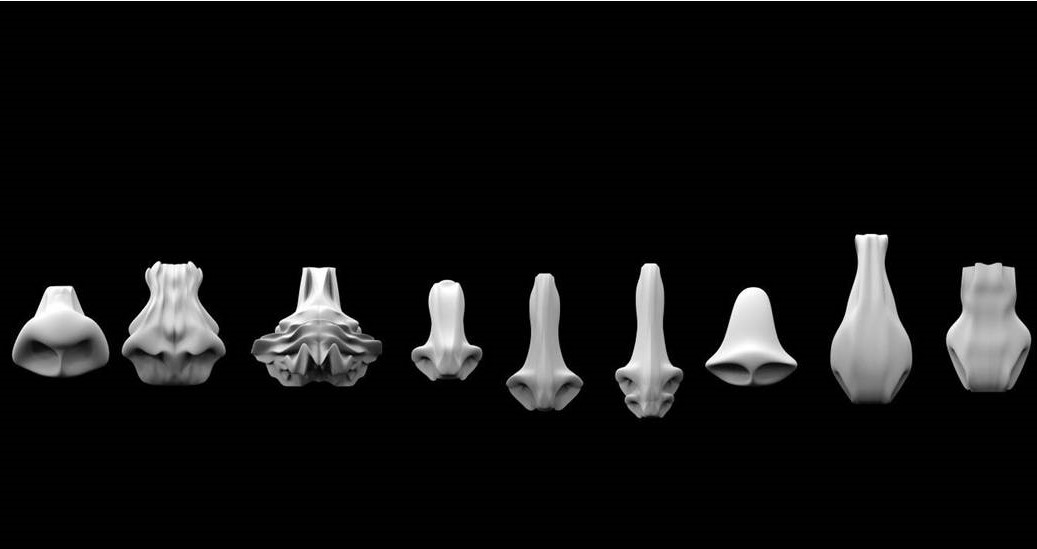
Credit: Marta Flisykowska
New physical conditions
“The human body will have to change if we are to adapt to new physical conditions. Are these the new challenges for medicine or a direction of evolution? Undoubtedly, environmental conditions affect the body and in the course of time, in line with the law of evolution, adapting to changes is inevitable,” Flisykowska says.
The “Who nose” project refers to the possibilities of 3D printing and plastic surgery in the context of challenges that we will all face, Flisykowska concludes. “It does not mean that people will grow such noses in an evolutionary way on Mars.”
Nosing around
But a nosey look at our own noses here on Earth, here are some face facts:
- The structure of the nose enables to warm up or cool down air adjusting it to the body temperature before it reaches the lungs;
- The nose also acts as a filter so that it catches small particles preventing them from reaching the lungs;
- The nose moisturizes air adding humidity to pre-vent the respiratory tract from drying;
- It strengthens and impacts one’s voice;
- It supports the sense of smell;
- It can attract and impact the biology of attraction
Aesthetic considerations
At this stage of “medical development”, Flisykowska says, humankind introduces many changes into our individual bodies, be they artificial eyes, mechanical prostheses, bypasses etc.

Credit: Bob Sauls – XP4D/Explore Mars, Inc. (used with permission)
“Both in literature and in pop culture, the image of extra-terrestrial creatures often extended to the point of kitsch,” Flisykowska notes. “However, in the context of aesthetic considerations it is worth recalling that the creators of fairy-tale creatures and humanoid characters based their creations on assumptions that concerned the environment they existed in.”
For a copy of this informative and speculative paper, go to:
https://dx.doi.org/10.7559/citarj.v10i3.568
Also, go to this video at:
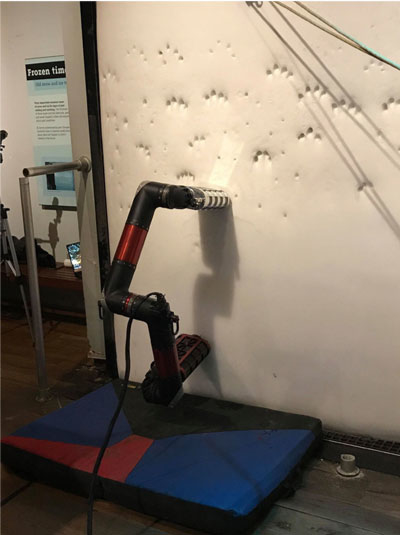
IceWorm ascending an ice wall in the California Science Center in Los Angeles. Researchers used the frozen vertical surface as a testing ground for the robot before it went into the field.
Credit: NASA/JPL-Caltech
What do you need for exploration of icy worlds in our solar system – IceWorm of course!
Robotic work is underway that could lead to automaton treks to the frozen plains of Enceladus, Eruopa or Pluto, as well as the polar ice canyons of Mars.
The robot is the first of its kind designed to scale up icy cliffs; someday, the robot may take samples in places that scientists have never reached before.
IceWorm could crawl off a lander to scoop up samples deep in ice fissures for later scientific analysis.
Microbial life
Aaron Curtis, the lead designer behind IceWorm and a postdoctoral scholar at NASA’s Jet Propulsion Laboratory (JPL) in Pasadena, California, detailed how IceWorm works at the recent American Geophysical Union (AGU) Fall Meeting 2018.
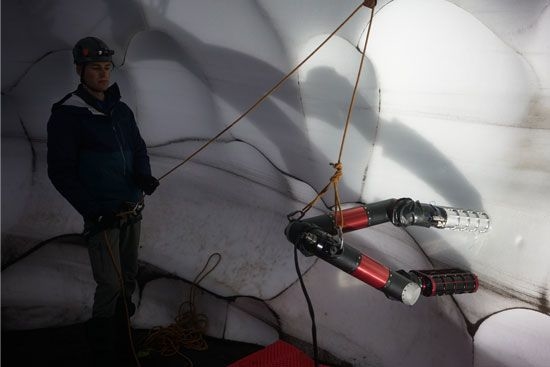
The ice-climbing robot IceWorm scales a scalloped wall of glacial ice in a cave at Mount St. Helens in August 2018.
Credit: NASA/JPL-Caltech
In an informative article by AGU’s Jenessa Duncombe in the group’s Eos Buzz newsletter, Curtis hopes that IceWorm will someday climb in the caves that inspired it. “I would be really interested to see a trip go back to Mount Erebus [in Antarctica] and explore a pristine cave where no one’s entered,” Curtis explains. He tested prototype robot “feet” with anchoring and ice sampling capabilities in fumarolic ice caves on Mt. Erebus in 2016.
“The caves that have higher levels of volcanic gases might be the ones that are more fertile for microbial life,” Curtis adds. “I would be very fascinated to see what lives in them.”
Inchworm science
The 1.4-meter robot is made of hollow aluminum tubes and rotary joints, holds on to the icy wall by nesting its two feet into the ice with steel alpinist screws.
To climb, the robot simply unscrews one foot, curls its body until the two feet are near each other, and refastens its free foot to the wall. It then unscrews the second foot, lengthens its body forward toward its destination, and screws back into the wall. It repeats the dance over and over, says Curtis, so that the robot “inchworms up the wall.”
Dexterous feet
IceWorm’s success lies in its dexterous feet. Each foot is outfitted with ice screws equipped with a pressure sensor that directs how hard to drill into the ice, striving for the right balance between rotation and forward thrust.
A 3-D rendering on the researchers’ computers shows IceWorm’s body position in real time and lets researchers drag its free foot to the next stop on the wall.

Base camp in the crater of Mount St. Helens in August 2018. Researchers explored the fumarolic ice caves to test IceWorm in action.
Credit: NASA/JPL-Caltech
Successful testing
In June 2018, an ice climbing robot inside firn caves and glacier caves of Mount St Helens. The crater area has been progressively covered by a layer of snow, firn, and glacier ice since as early as 1986.
After 8 hours of testing at Mount St. Helens, Curtis called it IceWorm’s first “successful test,” and he looks ahead to future development.
Curtis also brought an ice-climbing robot to Mount Rainier — the highest mountain in the U.S. state of Washington — this past July and August and demonstrated the success of robotic “hands” containing ice screws. He showed that the fasteners penetrated into the icy walls and ceilings of the fumarole caves, providing a grip strong enough to hold the robot and a backpack.

InSight Sol 26 image taken by Instrument Context Camera (ICC), acquired on December 23, 2018.
Credit: NASA/JPL-Caltech
NASA’s newest Mars lander is continuing to install on the Red Planet a set of scientific devices via its robotic arm.
New imagery shows the robotic arm departing the recently planted seismometer provided by France.
The InSight team worked on leveling the seismometer, which is sitting on ground that is tilted 2 to 3 degrees.

InSight Sol 26 image of tether taken by Instrument Deployment Camera (IDC) on December 23, 2018.
Credit: NASA/JPL-Caltech
Seismometer data flow
The first seismometer science data should begin to flow back to Earth after the seismometer is in the right position.
Also underway is adjusting the seismometer’s long, wire-lined tether to minimize noise that could travel along it to the seismometer.
Then, in early January, engineers expect to command the robotic arm to place the Wind and Thermal Shield over the seismometer to stabilize the environment around the sensors.

The wind and thermal shield (WTS).
Credit: Agence Idé/CNES).
Heat probe
Assuming that there are no unexpected issues, the InSight team plans to deploy Germany’s HP3 heat probe onto the Martian surface by late January.
HP3 will be on the east side of the lander’s work space, roughly the same distance away from the lander as the seismometer.
Wind shield
The wind and thermal shield (WTS) consists of an aerodynamically shaped aluminum cover with a honeycomb structure to which is attached a gold-coated thermal skirt.
The whole assembly rests on three legs that are to deploy automatically once the robotic arm lifts the dome off the lander’s platform.

Artist concept showing the protective role of the wind and thermal shield (WTS) at the martian surface.
Credit: IPGP/David Ducros
The WTS will be brought to above the seismometer, now deployed on the ground, before being slowly lowered.
Despite its design, the WTS could be struck by violent gusts of wind or a dust devil, forces that might dislodge or even lift the dome, causing it to fly away.
The shield has nonetheless been developed to withstand squalls of 60 meters per second and should even be able to survive winds of 100 meters per second.

NASA’s Mars 2020 rover on the prowl and geared to collect and cache samples for future return to Earth.
Image Credit: NASA/JPL-Caltech
Exploration in our sights – the Moon, Mars, asteroids and elsewhere.
But is NASA ready to analyze extraterrestrial samples? A new study from the National Academies of Sciences, Engineering, and Medicine says no.
The U.S. space agency’s investment in new instruments to analyze extraterrestrial samples is “insufficient” to provide for replacement of existing instruments, says the report.

Mars Ascent Vehicle lifts off from Mars carrying soil samples.
Credit: NASA/ESA
Furthermore, if NASA does not invest additional funds into the replacement of current instrumentation and development of new technologies, technical staff support, and training for the next generation of analysts, current capabilities cannot be sustained, and the full scientific impact afforded by returned samples might not be realized, explains an Academies press statement.
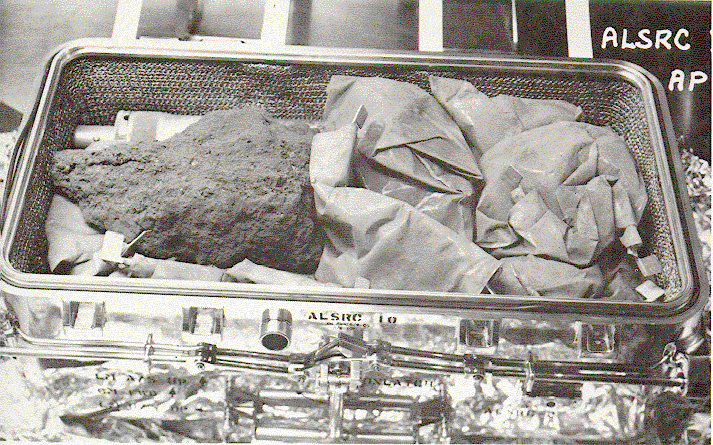
One of the Apollo 16 sample boxes being opened in the Lunar Receiving Laboratory on Earth. The box contains a large rock and many small sample bags.
Credit: NASA/Johnson Space Center
Paramount importance
A major point: The United States possesses a treasure-trove of extraterrestrial samples brought to Earth by space missions over the past four decades.
Right now, there are two asteroid missions underway – Japan’s Hayabusa2 and NASA’s OSIRIS-Rex.
Both are expected to return asteroid samples in the 2020s, remnants from early in the formation of the solar system.

Japan’s Hayabusa2 is pulling up to Ryugu – a C-type asteroid – for detailed study.
Artwork: Akihiro Ikeshita
As the report observes, having the instrumentation, facilities, and qualified personnel to undertake analysis of returned samples, especially from missions that take up to a decade or longer from launch to return, is of paramount importance if NASA is to capitalize fully on the investment made in these missions.
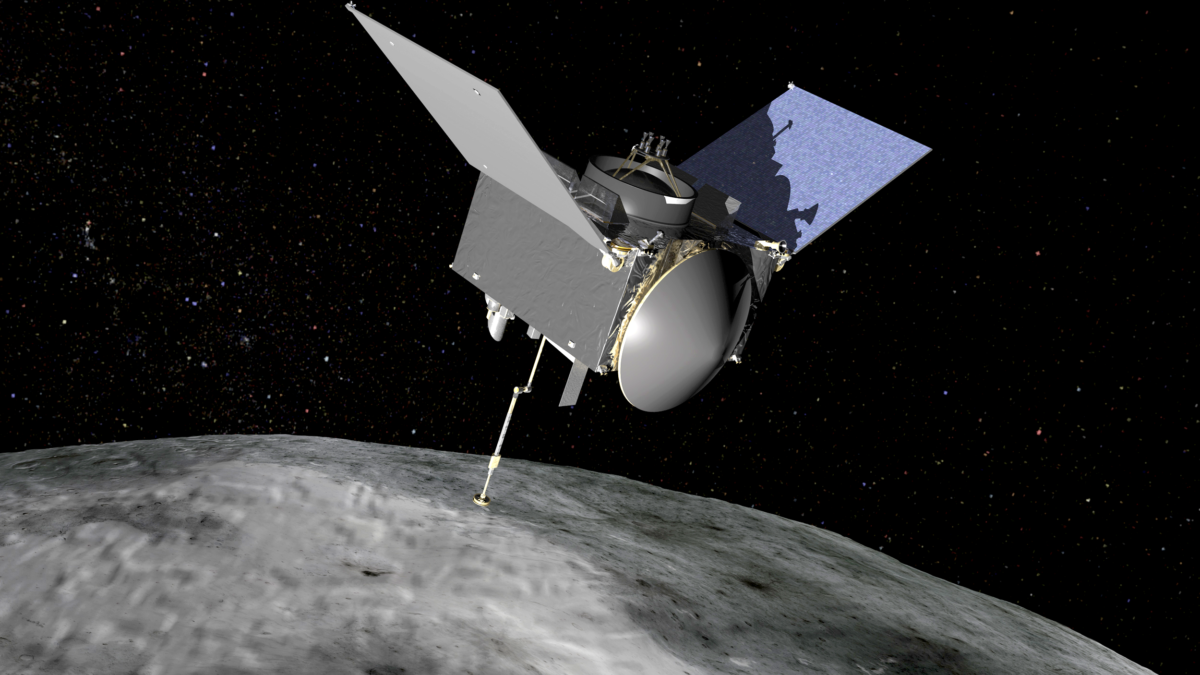
OSIRIS-REx spacecraft at Bennu.
Credit: NASA/University of Arizona
Another “now is the time”
According to Roberta Rudnick, chair of the committee that wrote the report and professor at the University of California, Santa Barbara: “Now is the time to assess how prepared the scientific community is to take advantage of these opportunities.”
Explains the report: Without changes in the funding program, currently robust analytical infrastructure for the study of extraterrestrial samples could suffer from attrition and the addition of new technological innovations could stretch current funding programs.
Wanted: significant investment
The just-issued report recommends that the NASA Planetary Science Division place high priority on investment in analytical instrumentation and curation sufficient to provide for both replacement of existing capacity and development of new capabilities.
Doing so will maximize the benefit from the significant investment necessary to return samples for laboratory analysis from asteroids, comets, the Moon, and eventually Mars and outer solar system moons.
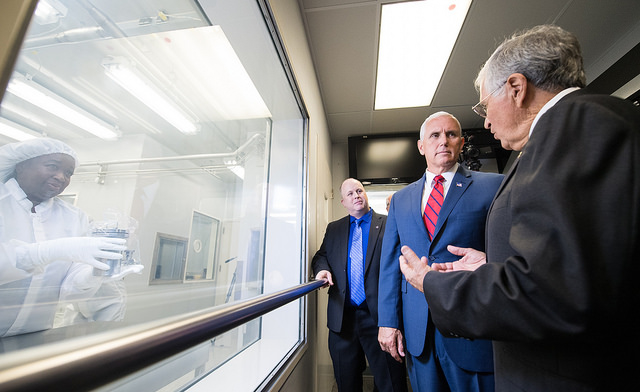
Vice President Mike Pence, center, views Sample 15014, which was collected during Apollo 15 with NASA’s Apollo Sample Curator Ryan Zeigler, left, and Apollo 17 astronaut and geologist Dr. Harrison Schmitt, right, in Lunar Curation Laboratory at NASA’s Johnson Space Center, Thursday, Aug. 23, 2018 in Houston, Texas. Sample 15014 is one of nine samples out of the 2,196 collected during the Apollo missions that was sealed inside its container on the Moon and still containes gasses from the Moon. Credit: NASA/Joel Kowsky
Novel instrumentation
Another key report view: No current missions include the return of extraterrestrial cryogenic materials, but efforts are underway to design missions that could, within the next few decades, return gases and eventually ice from Earth’s Moon, comets, or the icy moons of outer planets.
If one or more of these mission concepts is pursued, it could reap tremendous scientific advances. Samples returned would likely include gases, ice, and organic matter. Appropriate investments in the development of novel instrumentation and analytical techniques, specifically for curation as well as characterization and analysis of non-traditional samples, must start now because they will take decades to complete.
What now?
Flagged in the report is the stalwart work of the Astromaterials Acquisition and Curation Office at NASA’s Johnson Space Center (JSC) in Houston, Texas.
The NASA Planetary Science Division should increase support for JSC to develop appropriate facilities necessary for future sample returns of organic matter, ice, and gases, says the report.
The division should also accelerate planning for curation of returned Martian samples, seeking partnerships with other countries as appropriate, the report notes.
For your copy of the new report, Strategic Investments in Instrumentation and Facilities for Extraterrestrial Sample Curation and Analysis, go to:
https://www.nap.edu/download/25312

