Archive for the ‘Space News’ Category
 Author:
  January 26th, 2019
Curiosity Mastcam Left image taken on Sol 2299, January 24, 2019.
Credit: NASA/JPL-Caltech/MSSS
This image looks along the back edge of the Vera Rubin Ridge (top left to top center) down into the clay-bearing unit.
NASA’s Curiosity rover is now performing Sol 2301 tasks.
“Curiosity is on the brink of descending down off the Vera Rubin Ridge (VRR) onto the clay-bearing unit,” reports Lucy Thompson, a planetary geologist at the University of New Brunswick, Fredericton, New Brunswick, Canada.

Curiosity Mastcam Left image taken on Sol 2299, January 24, 2019.
Credit: NASA/JPL-Caltech/MSSS
“We are hoping to ‘beam up’ lots of interesting new data to the Mars orbiters, to be relayed to Earth after executing our plan on Mars tosol,” Thompson adds.
Touch and go tactic
Scientists have planned a typical “Touch and Go” sol, which includes using the arm to place contact science instruments – the Alpha Particle X-Ray Spectrometer (APXS) and the Mars Hand Lens Imager (MAHLI) — on a rock target to document chemistry and texture, Thompson explains. That is followed by remote science by Chemistry and Camera (ChemCam) instrument and the rover’s Mastcam to also look at chemistry and the larger scale view out the front window, before a drive.

Curiosity Mastcam Left image taken on Sol 2299, January 24, 2019.
Credit: NASA/JPL-Caltech/MSSS
“We are documenting how the chemistry and appearance of the rock is changing as we transition from the resistant VRR to the less resistant, orbitally distinct clay-bearing unit, and taking larger-scale images and mosaics to assist in future planning of our investigation of the clay-bearing unit,” Thompson notes.

Curiosity Front Hazcam Left A image acquired on Sol 2300, January 25, 2019.
Credit: NASA/JPL-Caltech
Looking for spectral variations
A reddish-purple, laminated bedrock target has been selected for APXS and MAHLI and tagged with the name “Linlithgow,” which is apparently the birthplace of Mary Queen of Scots and the future birthplace (in 2222) of Montgomery “Scotty” Scott, chief engineer of Star Trek’s Enterprise (hence the title)!

Curiosity Mastcam Left image taken on Sol 2299, January 24, 2019. MAHLI is located on the turret at the end of the rover’s robotic arm.
Credit: NASA/JPL-Caltech/MSSS
“The great grandfather of one of our science team members also compiled an anthology of poetry from the area in 1896, so a popular choice of name! Mastcam images will be taken of this target and an adjacent, rougher textured and different colored bedrock target, “Stoneywood” (also a ChemCam target), to look for spectral variations between the two areas,” Thompson adds.
Planned drive
The more typical bedrock target, “Stornoway” will be analyzed for composition by the robot’s ChemCam instrument. “A large Mastcam mosaic of 21×2 images was also planned of an area named ‘Boyndie Bay,’ says Thompson, “to document some interesting features that we are thinking of visiting during our investigation of the clay-bearing unit.”

Curiosity Mastcam Right image acquired on Sol 2300, January 25, 2019.
Credit: NASA/JPL-Caltech/MSSS
The planned drive should take Curiosity to the very edge of the VRR, and that will likely be its last stop before the rover drives down onto the clay-bearing unit. The plan calls for acquiring images to facilitate a full weekend of science activities at this important location, as well as a post-drive Dynamic Albedo of Neutrons (DAN) active measurement to investigate the distribution of subsurface hydrogen.
Additional Mastcam images and Rover Environmental Monitoring Station (REMS) meteorological observations were planned to monitor dust in the Martian atmosphere, Thompson concludes.

Credit: NASA/JPL-Caltech/Univ. of Arizona
New traverse map
A newly issued Curiosity traverse map shows the robot’s movements through Sol 2299 (January 24, 2019).
Numbering of the dots along the line indicate the sol number of each drive. North is up. The scale bar is 1 kilometer (~0.62 mile).
From Sol 2298 to Sol 2299, Curiosity had driven a straight line distance of about 88.19 feet (26.88 meters), bringing the rover’s total odometry for the mission to 12.42 miles (19.99 kilometers). The rover landed on Mars in August 2012.
The base image from the map is from the High Resolution Imaging Science Experiment Camera (HiRISE) in NASA’s Mars Reconnaissance Orbiter.
 Posted in

Credit: NASA/ESA
Another casualty of the government shutdown: The Lunar and Planetary Institute in Houston, Texas.
Founded at the height of the Apollo program in 1968, the Lunar and Planetary Institute (LPI) is pushing forward on its celebration this year of the 50th anniversary of Apollo and look to the future.
Still, the message from LPI’s Louise Prockter: “I am closing the LPI today at 5 pm, until further notice. Some staff are fully furloughed, some are partially furloughed. Some of our scientists and educators have grants that will continue to fund them for a while, but the rest of the staff do not have a charge code, unfortunately,” Prockter told Inside Outer Space.
“At some point we will no longer be able to pay even those who have grants, since we are not getting paid by the government. This shutdown is starting to have a significantly negative effect on contractors like ourselves.”

Credit: LPI
March event
Prockter said that she wants to stress that currently it is a mixture of non, partial and full furloughs (the science staff have grants so are unfurloughed for the next few weeks. Also, she adds that “we still expect the 50th Lunar and Planetary Science Conference (LPSC) to continue as planned.”
That major event is slated for March 18–22, 2019, held at The Woodlands Waterway Marriott Hotel and Convention Center, The Woodlands, Texas. This 4.5-day conference brings together international specialists in petrology, geochemistry, geophysics, geology, and astronomy to present the latest results of research in planetary science.
Although President Trump lifted the government shutdown today, Prockter said she has to go ahead with the furlough plans until receipt of authorization from NASA to continue funding the LPI.
“Hopefully that will come very early next week,” Prockter said.

Newly developed extraction technique for the Moon, thermal mining, makes use of mirrors to exploit sun-shy, water ice-laden polar craters.
Credit: School of Mines/Dreyer, Williams, Sowers
Cislunar side-step
In a similar predicament is the first lunar In Situ Resource Utilization (ISRU) workshop, “Developing a New Space Economy Through Lunar Resources and Their Utilization: A Stepped Approach to Establishing Cislunar Commerce Through Science and Exploration.”
It was to be held February 20–22, 2019 at the Universities Space Research Association (USRA) Headquarters in Columbia, Maryland.
“It is unfortunate that the government shutdown in the United States continues unabated. Despite the recent announcement of a temporary funding measure to open the government there is no guarantee that this will become permanent,” explained steering committee member, Clive Neal.
“This situation has had a debilitating effect on our Lunar ISRU Workshop, not only in terms of getting NASA participation, but also support from USRA. At this time, we have no choice but to postpone the workshop,” Neal explained in a statement.
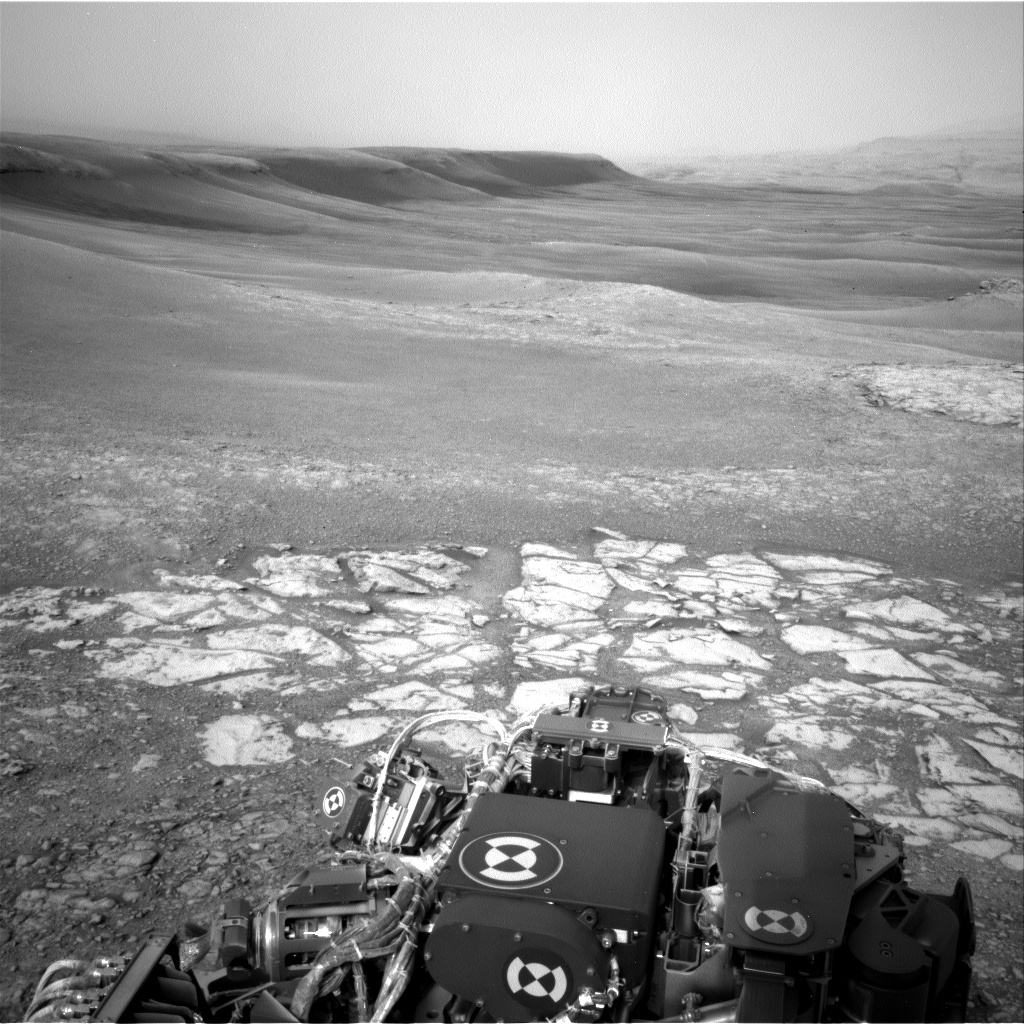
Curiosity Navcam Left A photo taken on Sol 2299, January 24, 2019.
Credit: NASA/JPL-Caltech
NASA’s Curiosity Mars rover is carrying out Sol 2299 duties.
The robot has moved for the first time since December 13, 2018 moving toward a new geological unit that scientists label as the “Clay-Bearing Unit” (CBU).

Curiosity Front Hazcam Left A photo taken on Sol 2299, January 24, 2019.
Credit: NASA/JPL-Caltech
Scott Guzewich, an atmospheric scientist at NASA’s Goddard Space Flight Center in Greenbelt, Maryland reports: “Curiosity is continuing the first phase of its journey to the clay-bearing unit…with a series of ‘touch-and-go’ driving sols.”
Melrose place
During these sols, the rover does contact science with its Mars Hand Lens Imager (MAHLI) and Alpha Particle X-Ray Spectrometer (APXS) in the morning, some additional remote sensing as time permits, and then drives away to a new location during the afternoon.

Curiosity Navcam Right A image taken on Sol 2299, January 24, 2019.
Credit: NASA/JPL-Caltech
“We want to closely examine the bedrock as we drive to help understand how the Vera Rubin Ridge and the clay unit are related,” Guzewich adds.
“Melrose” was the target for contact science. Additional Mastcam and Chemistry and Camera (ChemCam) observations were taken of other nearby geological targets.
“Curiosity is continuing to monitor a strong late-season dust storm,” Guzewich notes, “that’s increased the amount of dust locally for the last 1-2 weeks with Navcam and Mastcam observations of the atmosphere as well as an increased cadence of [Rover Environmental Monitoring Station] REMS meteorological observations.”
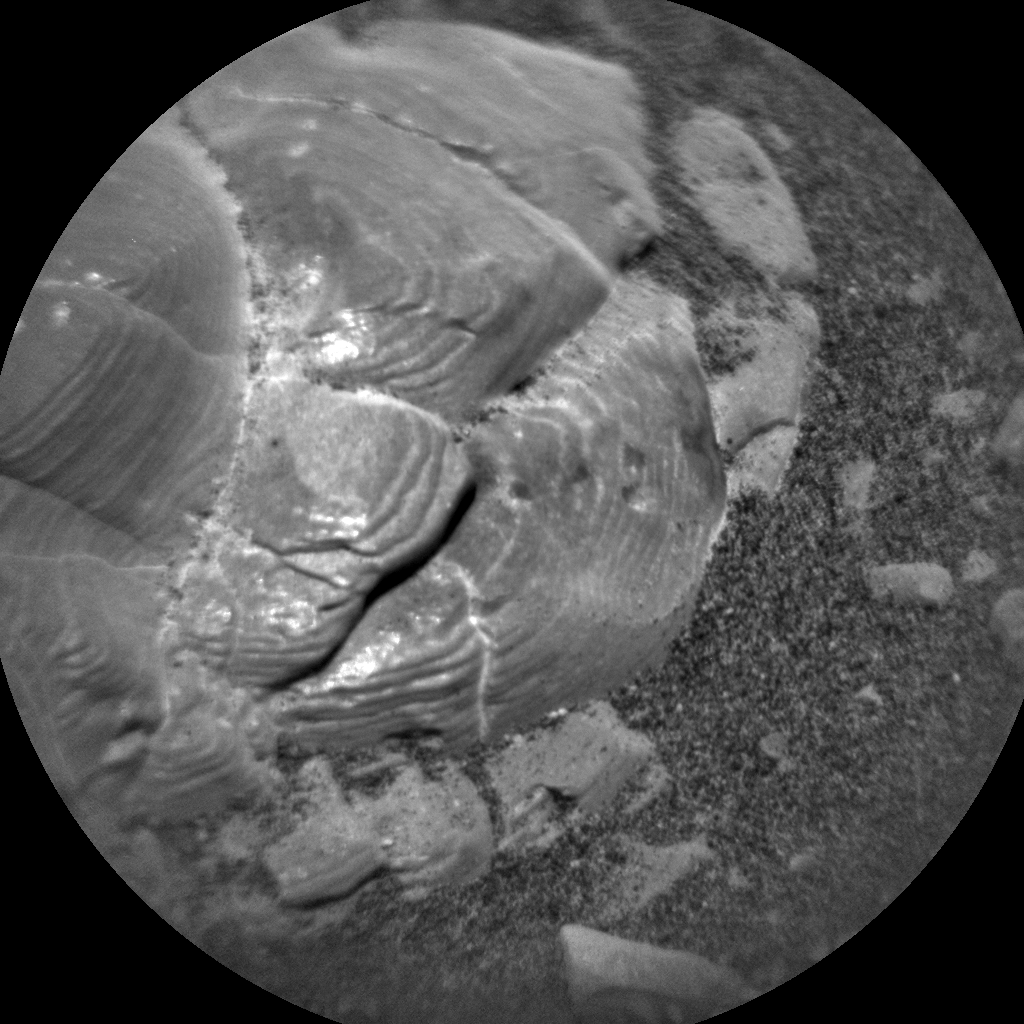
Curiosity ChemCam Remote Micro-Imager photo acquired on Sol 2299, January 24, 2019.
Credit: NASA/JPL-Caltech/LANL
Synergistic, collaborative discoveries
Roger Wiens, a geochemist at the Los Alamos National Laboratory in New Mexico, also notes that the Curiosity rover team, following previous rover teams, has organized itself into different campaigns to explore different geological units.
“Organizers are nominated to lead these campaigns, and their job is to help coordinate among the competing interests of the different instrument teams, helping to make synergistic, collaborative discoveries,” Wiens points out. “The organizers of the CBU campaign have been patiently waiting for their turn to lead the campaign. After all, their first meeting was well over a year ago, on October 3, 2017.”
Geological contact
The rover team is searching for the geological contact between bedrock of Vera Rubin Ridge and that of the Clay-Bearing Unit.
“The precise boundary is not clear from orbit, and it could also be a relatively gradual change as seen from rover images,” Wiens reports. “To have the best chance at observing the transition, Curiosity is doing relatively short drives, interspersed with frequent observations by both remote and contact instruments, as the terrain allows.”

Credit: NASA/JPL-Caltech/Univ. of Arizona
For example, the rover drove about 125 feet (38 meters) over the holiday weekend.
New road map
A new Curiosity traverse map through Sol 2297 has been posted.
The map shows the route driven by NASA’s Mars rover Curiosity through the 2297 Martian day, or sol, of the rover’s mission on Mars (January 22, 2019).
Numbering of the dots along the line indicate the sol number of each drive. North is up. The scale bar is 1 kilometer (~0.62 mile).
From Sol 2257 to Sol 2297, Curiosity had driven a straight line distance of about 115.54 feet (35.22 meters), bringing the rover’s total odometry for the mission that began in August 2012 to 12.38 miles (19.93 kilometers).
The base image from the map is from the High Resolution Imaging Science Experiment Camera (HiRISE) in NASA’s Mars Reconnaissance Orbiter.

Jeff Bezos, founder of Blue Origin.
Credit: Blue Origin
Blue Origin’s 10th flight yesterday of the New Shepard system was the 4th flight for this vehicle.

New Shepard liftoff on January 23, 2019.
Credit: Blue Origin/Screengrab/Inside Outer Space
The vehicle carried 8 NASA-sponsored research and technology payloads under the space agency’s Flight Opportunities program. In an upcoming mission, New Shepard will take payloads to space from around the world.
Step by step
From Jeff Bezos of Amazon.com fame and fortune and founder of Blue Origin: “A perfect day. New Shepard has now racked up 10 consecutive successful launches, 9 consecutive successful booster landings, 3 consecutive successful escape tests, and 11 consecutive successful crew capsule landings (including a pad escape),” Bezos explains.
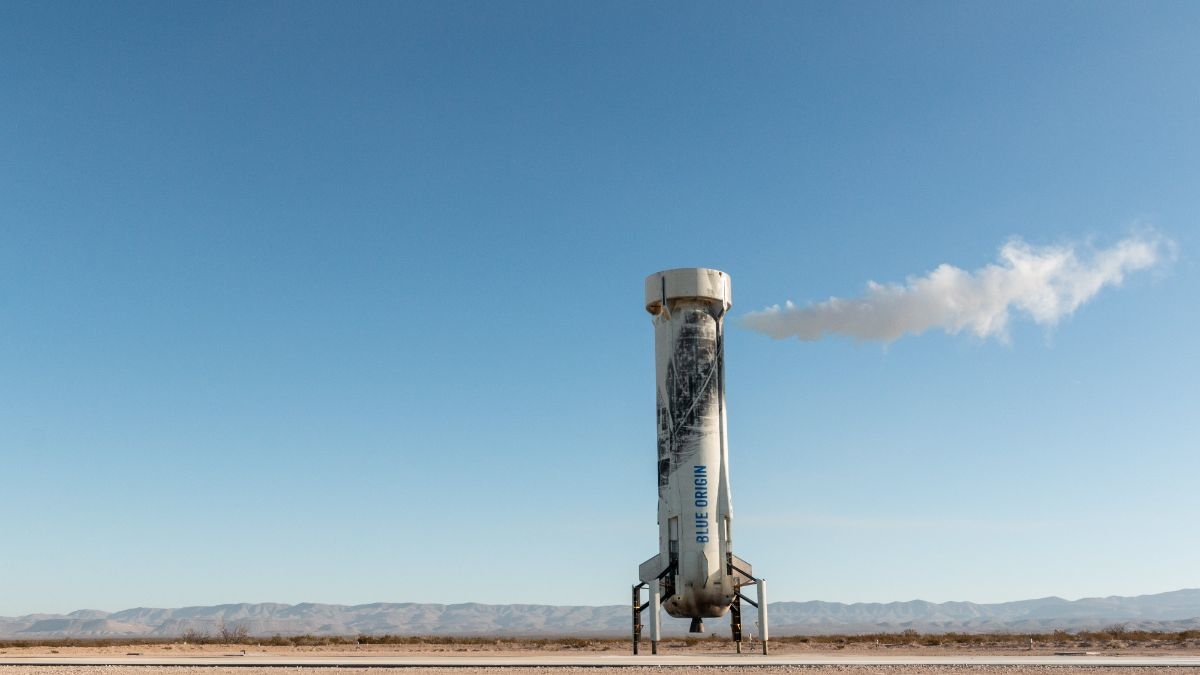
Perfect landing.
Credit: Blue Origin
Yesterday’s mission, Bezos adds, “was the 4th flight of this particular tail number — all with minimal refurbishment between flights. Step by step, we’re getting close to human flight. And all of this learning is being incorporated into New Glenn too. I did wear my lucky boots today, but I’m pretty sure it’s actually the incredible Blue Origin team.”

Passenger capsule back on Earth after suborbital voyage.
Credit: Blue Origin
Videos available
Go to this set of videos that details the recent flight.
Science and Research Payloads on New Shepard:
Building the New Shepard Fleet:
NS-10: New Shepard Flies 8 NASA Payloads to Space:
Replay of the NS-10 flight on January 23, 2019:

Richard Branson and founder of Under Armour, Kevin Plank.
Credit: Virgin Galactic
What can the well-dressed commercial space traveler expect in apparel?
A next generation of spacewear and astronaut performance programs is being scoped by way of collaboration between Sir Richard Branson’s Virgin Galactic and Under Armour.

Virgin Galactic Unveils Under Armour as Exclusive Technical Spacewear Partner.
Credit: Virgin Galactic
As Under Armour crafts the Virgin Galactic collection, it draws upon a heritage of innovative performance solutions for some of the world’s top athletes.
Feel good, look good
The partnership will also see Under Armour create uniforms for Virgin Galactic’s team at Spaceport America in New Mexico, be they engineers, astronaut trainers and hosts, or mission control staff.

Virgin Galactic’s suborbital plans include well-dressed space travelers.
Credit: Virgin Galactic/Quasar Media 2018
The custom-fitted Under Armour spacesuits “will inspire confidence through comfort and practicality without compromising the natural desire of every Virgin Galactic astronaut both to feel good and look good” as individuals head for the suborbital heights, notes a press statement.
Earth-bound masses
“The full range of apparel and footwear is set to be revealed later this year, ahead of Richard Branson’s inaugural commercial flight,” the Virgin Galactic statement explains.
“In the 1960’s, pop culture declared space ‘the final frontier.’ Over the 50-plus years since space travel began, only 559 people have ever been to space. The game is changing in 2019, as visionaries and leaders come together, innovating to make space accessible to the Earth-bound masses,” observes the Under Armour website.

The Red Planet as seen by Europe’s Mars Express.
Credit: ESA/D. O’Donnell – CC BY-SA IGO
As the shutdown of the U.S. government continues — and the State of the “Dis-Union” address is under back and forth banter – yet another space causality: A major meeting on Mars Extant Life has gone extinct.
A Mars Extant Life Conference, scheduled next week for Carlsbad, New Mexico has been postponed.
Conference organizers today said it is “with pain and regret” the meeting has been postponed.
Consequences
“The current shutdown of the U.S. government is exacting a toll on increasing numbers of people, and these consequences have now extended to many people involved in this conference.”
Despite a possible resolution of the shutdown, the organizers could not wait any longer.
“Unless something changes, our current estimate is that ~15% of our expected attendees (many of them civil servants) will be unable to attend on our currently scheduled dates. An additional 35% have sufficient worries or concerns that they have recommended postponing the conference to a later date,” meeting organizers explained.
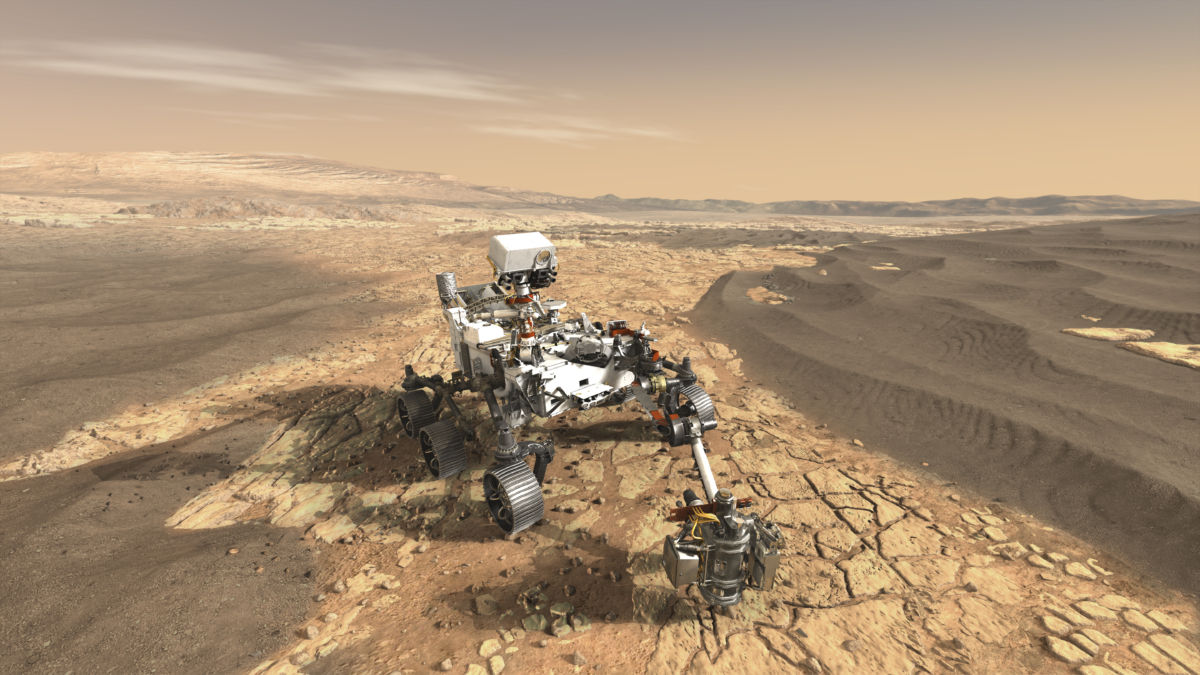
NASA Mars 2020 rover searches for postponed conference agenda in 2019.
Credit: NASA/JPL
Nationwide challenges
“Because of financial concerns many of us in the NASA system need to be careful with cash flow. We are seeing nationwide challenges with the airport security system involving the TSA [Transportation Security Administration] workers, and most of our registrants would be travelling by air to the conference venue. Our conference speakers have started to drop out at an alarming level,” advised the organizers.
“We apologize for the postponement of this conference, which is an action we have not taken lightly,” explained the meeting organizers. “We know all of you have made plans, and that this may cause unwanted disruptions to those plans. However, this decision seems to result in the greatest good for the greatest number. We will be in touch with you once things settle down, and we can focus on re-planning.”
Yes, life on Mars – so goes life on Earth.

“Horning in” on an asteroid. Sampler horn will be used to gather up space rock material.
Credit: JAXA/Screengrab/Inside Outer Space
Japan’s Hayabusa2 continues to make progress in preparing for its first touchdown (TD1) on asteroid Ryugu, planned for the week of February 18.
A backup week is March 4.
Newly posted status reports from the Hayabusa2 team explain that a prolonged injection test of the spacecraft’s thrusters has been conducted. This test is in connection with deploying the small carry-on impactor (SCI) that will create a crater on the space rock.

Following the small carry-on impactor (SCI) explosion, Hayabusa2 will sample the crater.
Credit: JAXA/Screengrab/Inside Outer Space
Seek and hide
After separating the impactor in the SCI operation, Hayabusa2 needs to swiftly hide behind the asteroid to avoid flying debris generated by the SCI explosion.
The recent test checked whether attitude control and the reaction control system (RCS) subsystem functions worked as expected under a strong disturbance that is not usually experienced.
Although the test was run for about half the final injection time, both the attitude control and RCS subsystem worked almost as expected, the Hayabusa2 controllers report, and they acquired valuable data for the actual SCI operation.

Hayabusa2 sampler arm operations.
Credit: JAXA/Screengrab/Inside Outer Space
Sampler horn
In addition, there’s also been an appraisal of the vibration the sampler horn may encounter.
This vibration test was to confirm that Hayabusa2 will not perform an emergency escape if it incorrectly detects the vibration of the sampler before landing.
With solar conjunction and the New Year holiday now over, Hayabusa2 operations have begun to ramp up.
First was the tour operation, moving Hayabusa2 to a region (so-called BOX-B) that is shifted slightly from the usual home position of the spacecraft – (so-called BOX-A).
A series of scientific observations were carried out, with the Sun directly behind the spacecraft.
From the Hayabusa2 team: “Let’s safely land! Hayabusa2 is working hard to realize the hope of the New Year after a refreshing rest!”
Go to this Japan Aerospace Exploration Agency (JAXA)-supplied video for a perspective on the upcoming touchdown operations:
https://youtu.be/OR-vN1xyfF0?list=PLCQJJ3lTBuyCtMDbvkQcg4fb7yAHheqyN
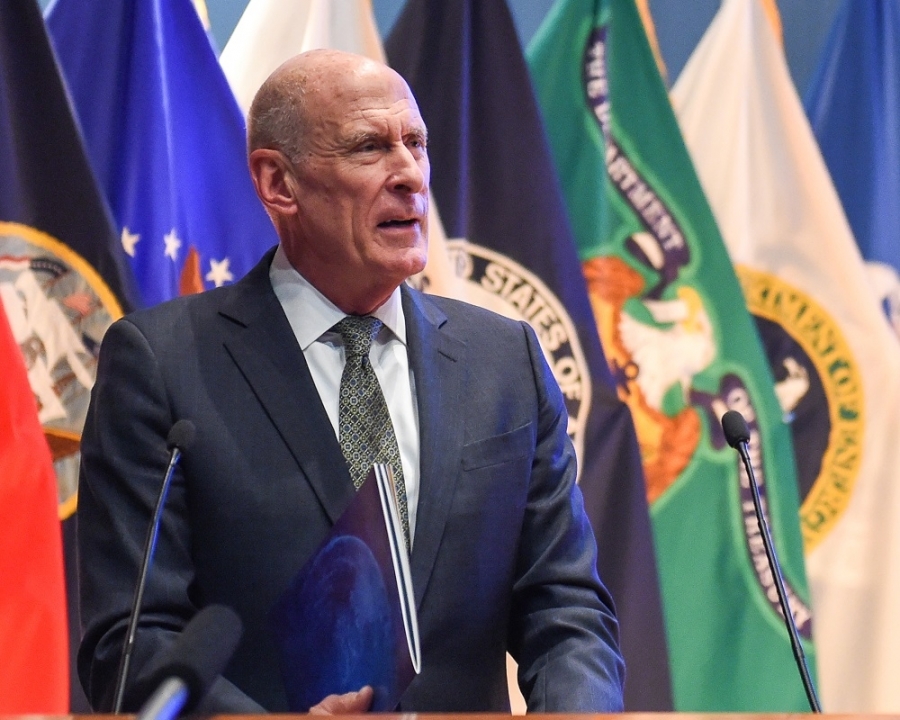
Director of National Intelligence, Daniel R. Coats
Credit: DNI
Director of National Intelligence Daniel R. Coats has unveiled the 2019 National Intelligence Strategy (NIS), noting the democratization of space and challenges ahead.
The NIS is the guiding strategy for the U.S. Intelligence Community (IC) and will drive the strategic direction for the Nation’s 17 IC elements for the next four years.
No longer a solely U.S. domain, the democratization of space poses significant challenges for the United States and the IC.

Credit: DNI
Anti-satellite weapons
“Adversaries are increasing their presence in this domain with plans to reach or exceed parity in some areas. For example, Russia and China will continue to pursue a full range of anti-satellite weapons as a means to reduce U.S. military effectiveness and overall security.”
“Increasing commercialization of space now provides capabilities that were once limited to global powers to anyone that can afford to buy them. Many aspects of modern society—to include our ability to conduct military operations—rely on our access to and equipment in space.”
For complete report, go to:

Lunar building block
Credit: ESA–G. Porter
3D printing on the Moon is getting a boost thanks to demonstration work by the European Space Agency.
For example, a 1.5 ton block has been 3D printed using simulated lunar dust. The structure spotlights the feasibility of constructing a Moon base using local materials.
The structure was produced using a binding salt as ‘ink’; its design is based on a hollow closed-cell structure – combining strength with low weight, similar to bird bones.

3D printing is gaining traction as a technique of choice for establishing Moon base structures.
Credit: LIQUIFER Systems Group 2018/René Waclavicek
The block was made during an initial feasibility project on lunar 3D printing. ESA has subsequently investigated other types of lunar 3D printing, including solar sintering and ceramics.
Setting up a lunar base could be made much simpler by using a 3D printer to build it from local materials.
Home away from home
While studying lunar base concepts, ESA ran a competition, asking: what would you 3D print on the Moon, to make it feel like home?

Like real flowers and plants, their 3D printed equivalents would be aromatic, to freshen the air, and perform the work of an air recycling unit changing carbon dioxide to oxygen. They would also ‘grow’ as each plant would be made up of smaller components that could be rearranged or added to over time, as if growing in nature.
Credit: Helen Schell
Responses came from all across the globe, two winners have been selected, both with ideas linked to nature.
The adult category was won by Helen Schell from the UK, proposing a ‘magic Moon garden’, printed from recycled colored plastics. “This is an idea for a colorful carpet of interchangeable color and design, which can be moved and the scale changed wherever you want to site it in your lunar habitat.”

Plant pot for the Moon.
Credit: Judith de Santiago
The under 18 category was won by Judith de Santiago, a 17-year-old student from Madrid, Spain, who presented a dodecahedron (or 12-sided) plant pot – ideally for a real plant – that also incorporates symbols of distant Earth. “The blue curves of the bottom represent the waves of the sea,” she explains, “and the green badge with a small plant located at the centre, inspired by Disney’s movie WALL·E, represents the Earth in general.”

Lunar base made with 3D printing as viewed by architectural firm Foster + Partners.
Credit: ESA/Foster + Partners
Cutting Earth resupply
Global space agencies are considering a lunar base as a possible next step in human space exploration, explains Advenit Makaya, overseeing the lunar 3D printing study.
“3D printing is one of the key building blocks for future space settlement, if we can find ways to make the stuff we need as we go along, rather than rely on costly resupply from Earth,” Makaya adds. “And the Moon, at just a few days away from Earth, represents an ideal test case. Nobody else has run such a detailed system level study, looking at lunar 3D printing of everything from large infrastructure and building blocks down to tiny electronic components.”
The “Conceiving a Lunar Base Using 3D Printing Technologies” project was run by the URBAN consortium led by Germany’s OHB System AG, with extreme environment specialist Comex in France, Austrian space design company Liquifer Systems Group and spacecraft structure manufacturer Sonaca Space in Germany.

International Space Station – Microbial matters.
Credit: Roscosmos
A new Northwestern University study has found that — despite its seemingly harsh conditions — the International Space Station (ISS) is not causing bacteria to mutate into dangerous, antibiotic-resistant superbugs.
However, the bacteria are instead simply responding, and perhaps evolving, to survive in a stressful environment.
The new findings suggest that the most crucial bacterial functions involved in this potential adaptive response are specific to bacterial lifestyle and do not appear to have direct impacts on human health.
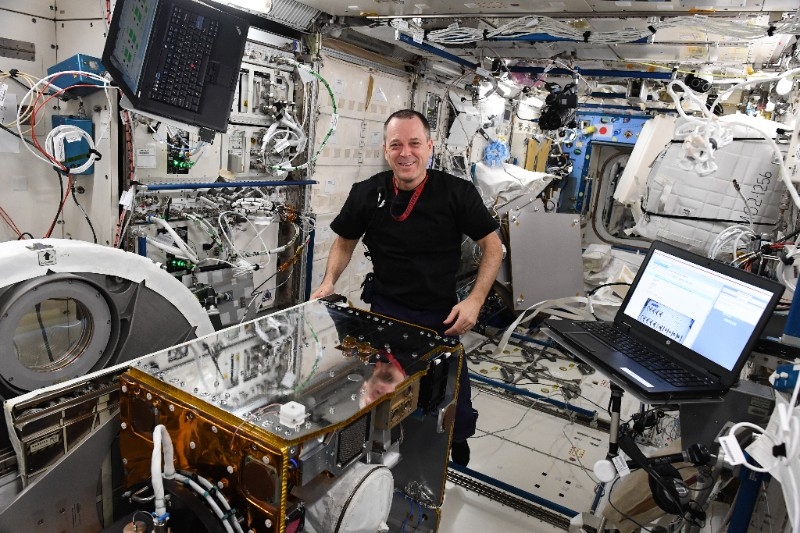
Onboard the ISS.
Credit: NASA
Stressful, harsh conditions
“There has been a lot of speculation about radiation, microgravity and the lack of ventilation and how that might affect living organisms, including bacteria,” said Northwestern’s Erica Hartmann, who led the study.
“These are stressful, harsh conditions,” Hartmann adds in a university press statement. “ Does the environment select for superbugs because they have an advantage? The answer appears to be ‘no.’”
Hartmann is an assistant professor of environmental engineering in Northwestern’s McCormick School of Engineering. The research was published earlier this month in the journal mSystems, a publication of the American Society for Microbiology.
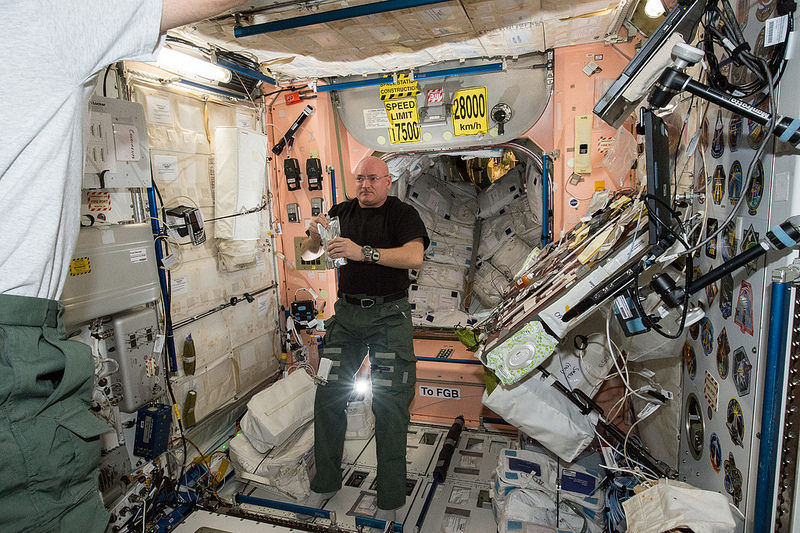
NASA astronaut Scott Kelly, a flight engineer for Expedition 43 and a member of the one-year crew, is seen here inside the ISS Unity module.
Credit: NASA
Microbial housing
The ISS houses thousands of different microbes, which have traveled into space either on astronauts or in cargo. The National Center for Biotechnology Information maintains a publicly available database, containing the genomic analyses of many of bacteria isolated from the orbiting outpost.
Hartmann’s team used that data to compare the strains of Staphylococcus aureus and Bacillus cereus on the ISS to those on Earth.
Enclosed environments
As the prospect of sending travelers to Mars gain momentum, there has been an increasing interest in understanding how microbes behave in enclosed environments.

Credit: Blaustein, Ryan et al.
“People will be in little capsules where they cannot open windows, go outside or circulate the air for long periods of time,” Hartmann points out. “We’re genuinely concerned about how this could affect microbes.”
Closer to home, Hartmann also notes: “Everywhere you go, you bring your microbes with you. Astronauts are exceedingly healthy people. But as we talk about expanding space flight to tourists who do not necessarily meet astronaut criteria, we don’t know what will happen.”
Research findings
“Based on genomic analysis, it looks like bacteria are adapting to live — not evolving to cause disease,” adds Ryan Blaustein, a postdoctoral fellow in Hartmann’s laboratory and the study’s first author. “We didn’t see anything special about antibiotic resistance or virulence in the space station’s bacteria.”
Although this is good news for astronauts and potential space tourists, Hartmann and Blaustein are careful to point out that unhealthy people can still spread illness on space stations and space shuttles.
For a look at the research findings — Pangenomic Approach To Understanding Microbial Adaptations within a Model Built Environment, the International Space Station, Relative to Human Hosts and Soil – go to:
https://msystems.asm.org/content/4/1/e00281-18
Also, take a look at this informative video about the new study results:

