Archive for the ‘Space News’ Category
 Author:
  December 21st, 2025
Image credit: Blue Origin/Inside Outer Space screengrab
Blue Origin successfully launched the 37th flight of the New Shepard program on December 20, 2025.

Image credit: Blue Origin/Inside Outer Space screengrab
The crew included: Michaela (Michi) Benthaus, Joey Hyde, Hans Koenigsmann, Neal Milch, Adonis Pouroulis, and Jason Stansell.

Image credit: Blue Origin/Inside Outer Space screengrab
This mission marked the first time a wheelchair user has flown above the Kármán Line, the internationally recognized boundary of space.
Go to in-flight video of crew at:
https://x.com/i/status/2002454714575692119
 Posted in

Image credit: Philippine Space Agency
China on Saturday sent a new communication technology test satellite via a Long March-5 booster into space from the Wenchang Space Launch Site in south China’s Hainan Province.
Meanwhile, the Philippine Space Agency (PhilSA) confirmed the launch and expected launch leftovers to careen within identified drop zones: approximately 69 nautical miles away from Burgos, Ilocos Norte, and 94 nautical miles away from Dalupiri Island, Cagayan; and 117 nautical miles away from Santa Ana, Cagayan, and 130 nautical miles away from Camiguin Norte.
Details of the rocket drop zone were disclosed through a Notice to Airmen (NOTAM) warning of an “aerospace flight activity.”
Potential risk
PhilSA disseminated a pre-launch report to relevant government agencies and authorities prior to the launch.

Rocket debris recovered in 2022.
Image credit: Philippine Coast Guard
“While not projected to fall on land features or inhabited areas, falling debris poses danger and potential risk to ships, aircraft, fishing boats, and other vessels that will pass through the drop zone,” PhilSA posted on their website.
“There is also a possibility for the debris to float around the area and wash toward nearby coasts. Additionally, the possibility of an uncontrolled re-entry to the atmosphere of the rocket’s upper stages returning from outer space cannot be ruled out at this time,” PhilSA added.
Furthermore, PhilSA reiterated its advice for the public to inform local authorities if suspected debris is sighted. “PhilSA also cautions against retrieving or coming in close contact with these materials that may contain remnants of toxic substances such as rocket fuel.”

Image credit: White House
Today, President Donald J. Trump signed an Executive Order that sets a bold vision for an “America First space policy,” ensuring the United States leads the world in space exploration, security, and commerce.
Described by the White House as launching a “New Age of American Space Achievement,” the Order calls for Americans’ return to the Moon by 2028.

Image credit: NASA
Furthermore, the Order calls for the establishment of “initial elements” of a permanent lunar outpost by 2030.
The Order also directs the deployment of nuclear reactors on the Moon and in orbit, including a lunar surface reactor ready for launch by 2030.

International Space Station.
Image credit: Roscosmos
Replacing the ISS
The wide-ranging Order also spurs private sector innovation and investment by upgrading launch infrastructure and developing a commercial pathway to replace the International Space Station by 2030.
To read the entire Executive Order issued December 18 by the White House – “Ensuring American Space Superiority” – go to:
https://www.whitehouse.gov/presidential-actions/2025/12/ensuring-american-space-superiority/

Artist’s concept shows Blue Origin’s Blue Moon Mark 1 lander and NASA’s VIPER (Volatiles Investigating Polar Exploration Rover) on the lunar surface.
Image credit: Blue Origin
A few months ago, NASA announced that the Volatiles Investigating Polar Exploration Rover (VIPER) has been green-lighted to set down at the Moon’s south pole region. The space agency awarded Blue Origin a CLPS (Commercial Lunar Payload Services) task order to deliver the Moon machinery.
Blue Moon’s MK1 lander, which is in production, would be used to deploy VIPER.
Headed for a late 2027 landing, NASA’s VIPER is designed to search for volatile resources, such as ice, on the lunar surface and gather science data to support long-term human exploration of the Moon.
Major milestone
VIPER’s lunar journey has reached a major milestone via the Sandia National Laboratories in Albuquerque, New Mexico.

Testing of the VIPER rover at Sandia’s Superfuge
Image credit: Sandia/Craig Fritz
Sandia’s Large Centrifuge, or Superfuge, has been used to help certify VIPER for its mission, validating that the rover’s structure can undergo a launch environment.
The 29-foot underground centrifuge can subject test items to inertial forces up to 300 Gs — 300 times the force of the Earth’s gravity — while integrating vibration, spin, thermal and shock environments simultaneously, mimicking flight conditions.
The Superfuge team spent months preparing for the NASA tests, explains a Sandia press statement.
Testing process
“This is a 1,000-pound article and it has to be oriented in a number of ways throughout the testing process,” said Ben Quasius, VIPER lead stress analyst.
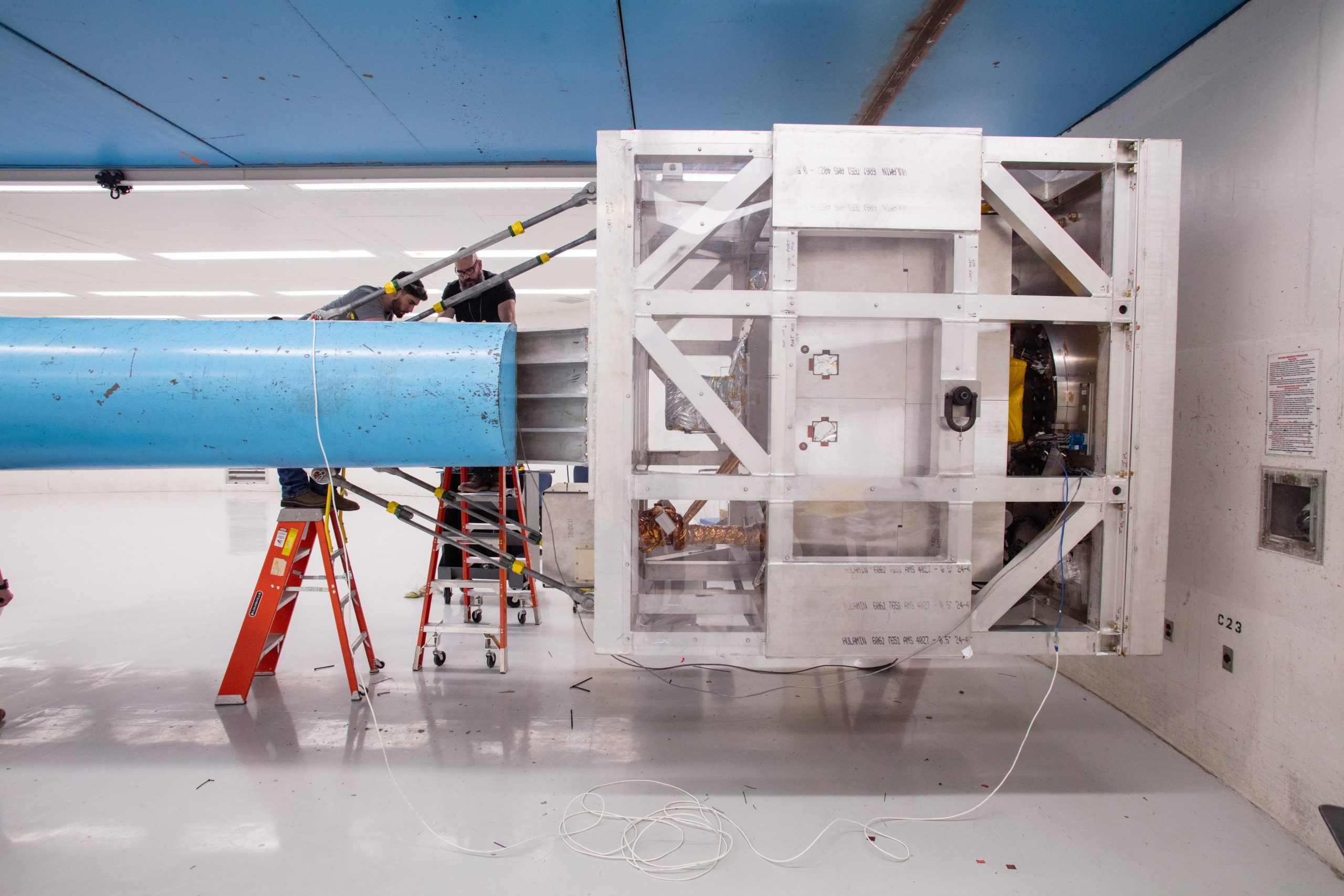
VIPER rover is suspended in a cage at the end of the Superfuge arm at Sandia National Laboratories.
Image credit: Sandia/Dave Linneman
“In many cases we would do a static qualification test where we use pistons to push on certain locations of the article to test flex of the body,” Quasius added, “but there are sensitive things in the way. You have solar panels in prime locations and a drill in the middle that can’t be compromised during flight.”
On the VIPER rover, there were 48 different points of data to be collected and analyzed by the Sandia testing.
Concentrations of water
VIPER is equipped with three scientific instruments: a mass spectrometer, a near-infrared spectrometer and a neutron spectrometer. An onboard drill is capable of reaching one meter beneath the lunar surface to pull up samples of any existing water remnants.
The rover’s mission is to investigate the Moon’s south pole, an expanse of real estate where permanently shadowed craters are believed to contain large concentrations of water. Such a resource could be transformed into oxygen, drinkable water by future crews, as well as rocket fuel.
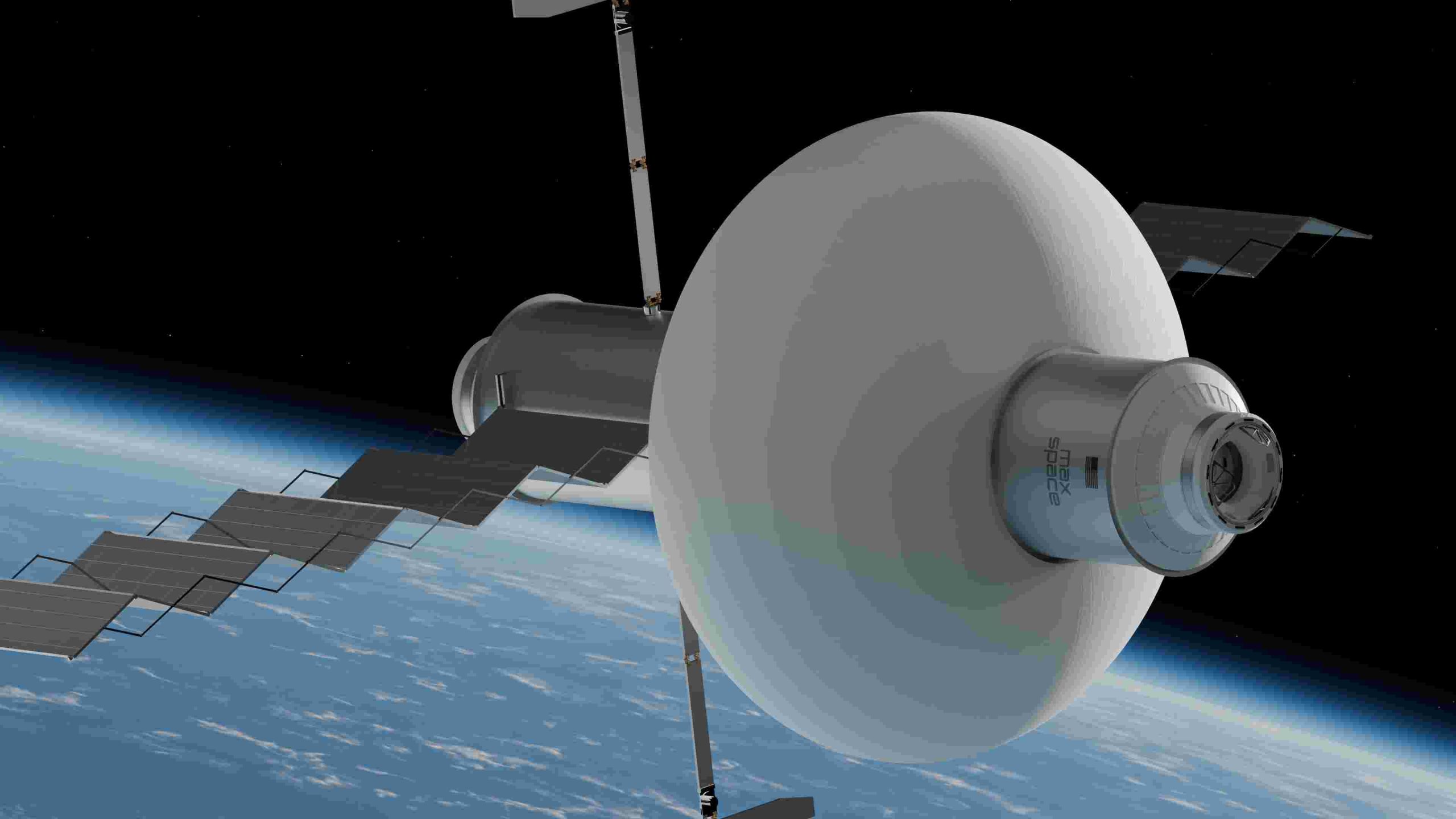
Image credit: Max Space
The private group, Max Space, has turned up the volume on inflatable habitats announcing today its “Thunderbird Station.”
Designed around a large expandable habitat, the station offers more usable volume per launch than any traditional metallic module.
Max Space also stated that its first in-orbit expandable habitat is manifested on a SpaceX rideshare launch in the first quarter of 2027.

Image credit: Max Space
For more information, go to the Max Space website at:
A study from the Royal Bank of Canada (RBC) notes that the global space economy is poised to nearly triple to $1.8 trillion by 2035, making the value derived from orbital assets equivalent to that of some G20 economies.
“We’ve entered an ambitious new space age—and Canada needs an ambitious new space strategy,” the study explains. As for what’s at stake?
“Our sovereignty in a more divided world…our prosperity in a new tech universe…and our relevance to allies when the ‘final frontier’ is suddenly the next economic and strategic frontier,” suggests the study.
Essential pillars
According to the RBC, Canada can seize this moment by building a space strategy around five essential pillars:
- Sovereignty: Building a space industrial base
- Defense: Becoming an essential ally in the Arctic
- Technology: Using satellites to secure a digital leap
- Commercialization: Breakthrough research and development
- Climate: Protecting Earth from the sky
To access the full Royal Bank of Canada report – “A Higher Orbit: How Canada can build and finance a bolder space strategy” – go to:

Blazing a trail…of debris. Soyuz MS-28 spacecraft departs Russia’s Baikonur cosmodrome, leaving in its wake launch pad damage.
Image credit: Ivan Timoshenko/Roscosmos
With the launch on November 27 of Russia’s crewed Soyuz MS-28 spacecraft to the International Space Station (ISS), it turned out there was more “blast” to their “blastoff,” so much so that the liftoff caused pad damage at Russia’s Baikonur cosmodrome.
The event happened after the rocket was well clear of the pad, so the crew was not in danger. But left in the wake of the booster sendoff was damage to the launch pad’s service cabin.

Image credit: NASA/Bill Ingalls
Cosmonauts Sergey Kud-Sverchkov and Sergei Mikaev, along with NASA astronaut Chris Williams, later docked to the ISS.
Pad repairs
Roscosmos, the lead Russian space agency, has noted that a pad repair work schedule has been drawn up and approved and is being strictly controlled.
A complete replacement kit for the service cabin on the #31 launch pad has arrived at Baikonur. Moreover, readiness for launch from that pad is now scheduled for the end of February 2026, according to a December 16 Roscosmos statement.
Eighteen heavy-duty vehicles carrying components and equipment for the restoration of the service cabin have arrived at the Baikonur Cosmodrome.

Image credit: Roscosmos/Inside Outer Space screengrab
Two shifts
Roscosmos adds that more than 130 employees of Roscosmos enterprises are involved in the work, who, observing safety measures, are working in two shifts – from 8 a.m. to midnight.
“Work has begun on priming and painting the cabin components,” explains Roscosmos. “Once completed, they will be transported to the launch pad. Some equipment is already there. After priming and painting the parts, specialists will begin installing the cabin and conducting autonomous tests,” the Russian space agency explains.

Image credit: Roscosmos/Inside Outer Space screengrab
“The manned program continues,” says Roscosmos.
For more details, go to my recent Space.com posting – “Damaged launch pad: How long before Russia can send astronauts to the ISS again?” — at:

Wait-a-Minute!
Image credit: Barbara David
Image credit: UN
In a “breakthrough” (my term) document, the United Nations environment program has grown some space legs.
A new report from them is titled “Safeguarding Space Environmental issues, risks and responsibilities.”
That group took the high road and dubbed them “Emerging Issues.”
World embrace
The report explains that the space sector is growing exponentially, with over 12,000 spacecraft deployed in the past decade and many more planned as the world embraces the benefits provided by satellite services.
“This growth presents significant environmental challenges at all layers of the atmosphere,” the report notes.

Image credit: Chelsea Thompson/NOAA
Challenges
Those ticked-off challenges include
- air pollution from launch emissions
- spacecraft emissions in the stratosphere
- spacecraft demise
- orbital debris (legacy and new)
- increased risk of collision creating more debris
- the potential to alter atmospheric chemistry and dynamics, climate change and deplete stratospheric ozone
Marine ecosystems
Moreover, they add that “objects that do not disintegrate on re-entry into Earth’s atmosphere pose threats to ground safety and marine ecosystems.”
A forthcoming intrusion into the marine ecosystem is the dumping of the International Space Station, just a few years away says NASA.

SpaceX-provided deorbiting of the International Space Station under NASA contract.
Image credit: SpaceX
Lastly, the document notes that the increase in space objects in orbit is also affecting the darkness and quietness of the sky and Earth-based astronomical observations.
“Emerging” – but years-in-the-making?
What took me back a bit is the “emerging issues” subtheme by the United Nations report.
It is a “wait a minute” moment as the UN realizes that these problems are emerging – more in the global community’s face and for many years in the making.

Captured by astronaut Don Pettit aboard the International Space Station (ISS), this long-exposure photograph showcases Earth’s city lights, the upper atmosphere’s airglow, and streaked stars. The bright flashes at the center are reflections of sunlight from SpaceX’s Starlink satellites in low-Earth orbit.
Image credit: NASA
To their credit, they conclude that a multilateral, interdisciplinary approach is needed “to better understand the risks and impacts and how to balance them with the essential daily services and benefits that space activity brings to humanity.”
That said, too little attention…too late?
For the full report – “Safeguarding Space Environmental issues, risks and responsibilities” — go to:
https://wedocs.unep.org/rest/api/core/bitstreams/c45c0309-971e-4ea8-aad3-cd2b053d394e/content

Wait-a-Minute!
Image credit: Barbara David

Image credit: Mars Guy/NASA/JPL-Caltech/Inside Outer Space screengrab
Mars Guy explores the never before seen face of NASA’s Perseverance rover, now on duty at Jezero Crater on the Red Planet.
“Having a two-meter-long arm with a camera on it provides the opportunity for some really great selfies, which Perseverance has used for both hero shots and serious self-inspection,” Mars Guy explains. “But it has never before looked so closely into its own eyes.”
Go to this new video at:

Image credit: Jimmy Catanzaro/NASA 2024 architecture artToday, NASA released its 2025 Architecture Concept Review on its Moon to Mars Architecture website.
Today, NASA released its 2025 Architecture Concept Review on its Moon to Mars Architecture website.
Revision C of the Architecture Definition Document is a snapshot of the current state of the architecture.
Image credit: NASA
The document captures two new elements — the lunar utility rover and lunar nuclear fission system — as well as new architecture-driven data gaps, updated architecture-driven technology gaps, and updated objective decomposition.
Go to:
https://www.nasa.gov/wp-content/uploads/2025/12/add-revision-c-20251211.pdf?emrc=02371b

