Archive for the ‘Space News’ Category
 Author:
  May 2nd, 2019
Credit: Humans to Mars
Space is vast but seating is limited, register today!
I am very excited to be taking part in the upcoming Humans to Mars Summit 2019, being held at the prestigious National Academy of Sciences Building, Washington D.C. on May 14-16, 2019.
As the luncheon speaker on May 15, 2019, I’ll be focused on my new National Geographic book — Moon Rush: The New Space Race.
Spoiler alert: Subtitle – Back to the Moon – This Time to Stray?
Space protagonists
What better way to have a frank and open discussion with fellow space protagonists than to join for lunch?
Bound to be a food fight…I’m old, grumpy and still have a memory of space programs past. I’ve got things to say, and so do you!
Come join us.
Go to: https://h2m.exploremars.org/
 Posted in
Credit: Blue Origin/Screengrab Inside Outer Space

Credit: Blue Origin/Screengrab Inside Outer Space

Credit: Blue Origin/Screengrab Inside Outer Space
Credit: Blue Origin/Screengrab Inside Outer Space

Credit: Blue Origin/Screengrab Inside Outer Space
Credit: Blue Origin/Screengrab Inside Outer Space
Credit: Blue Origin/Screengrab Inside Outer Space
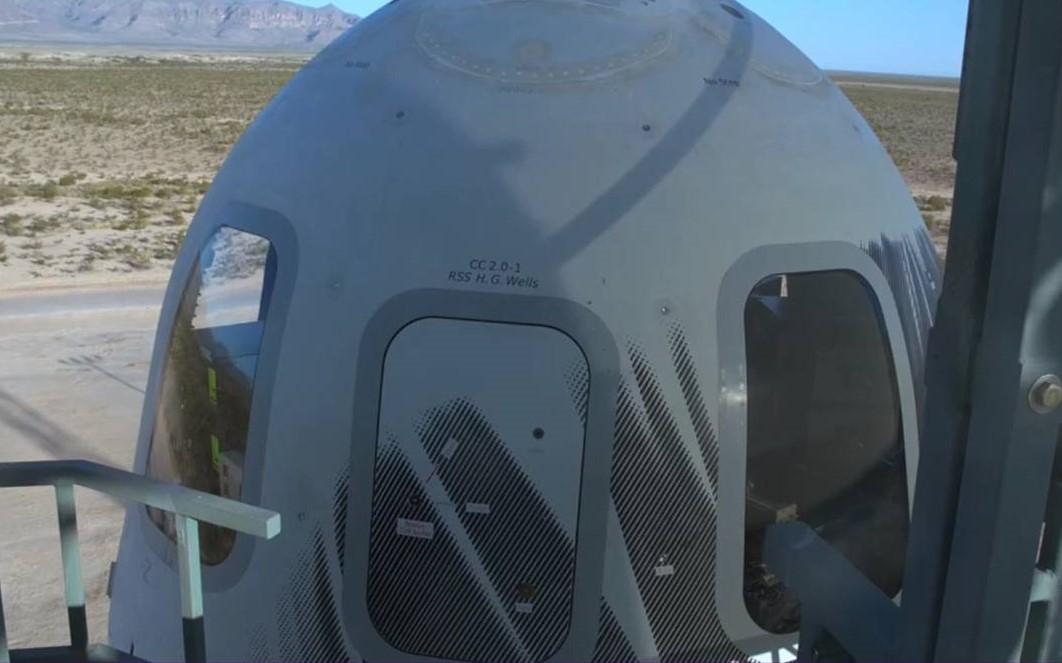
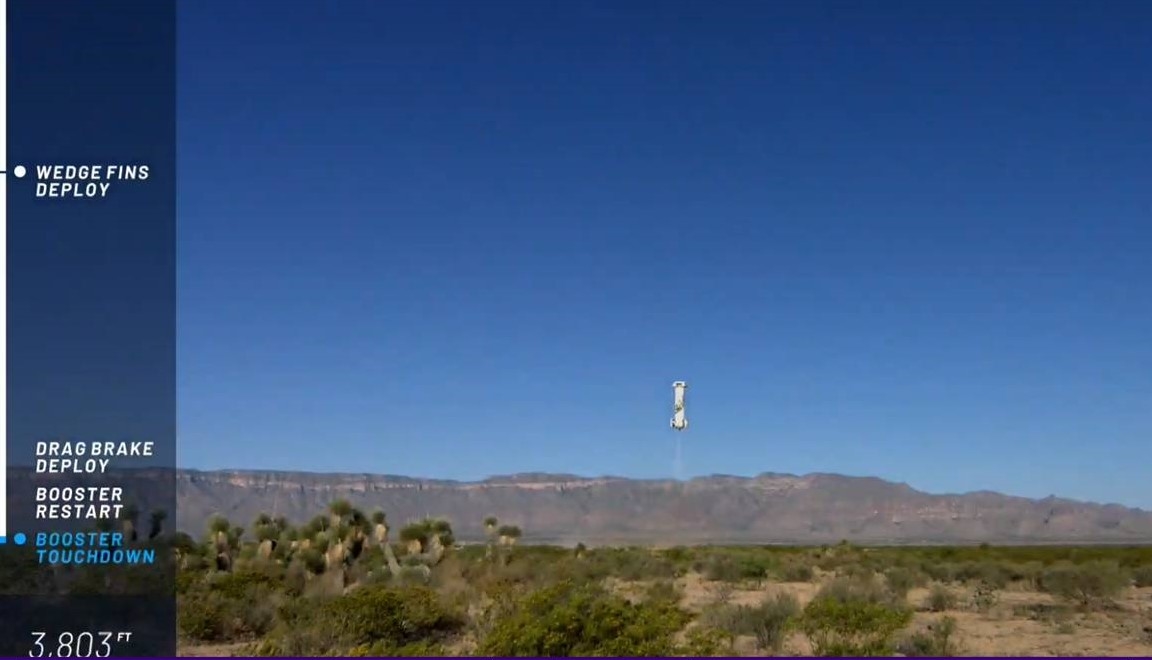
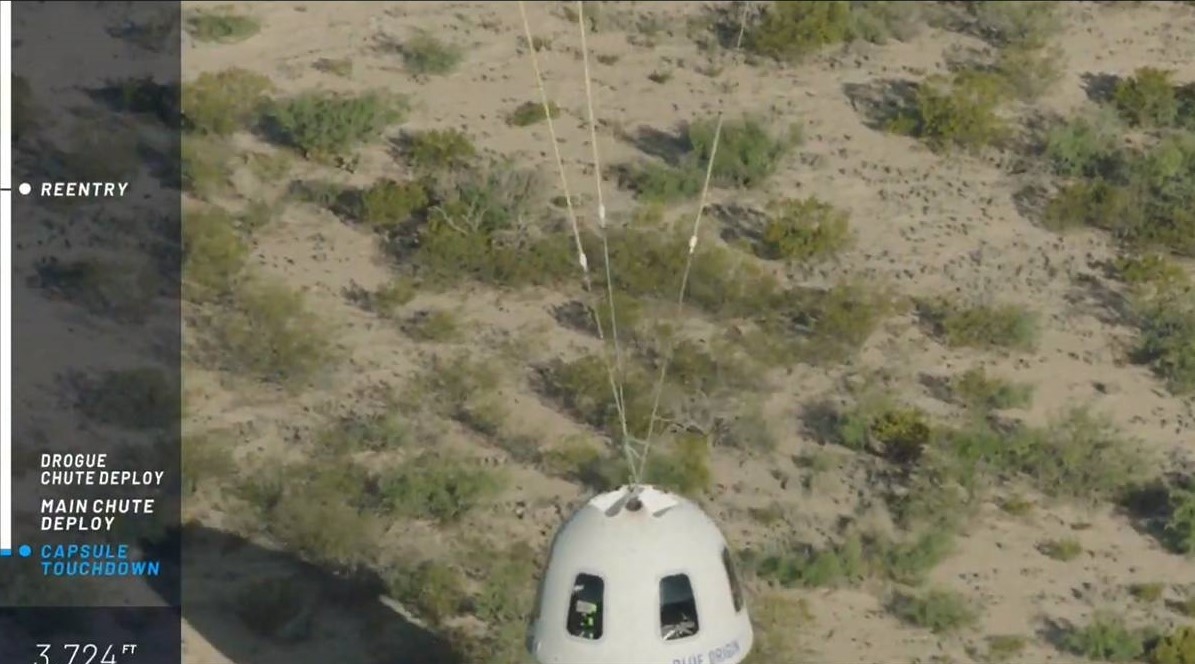
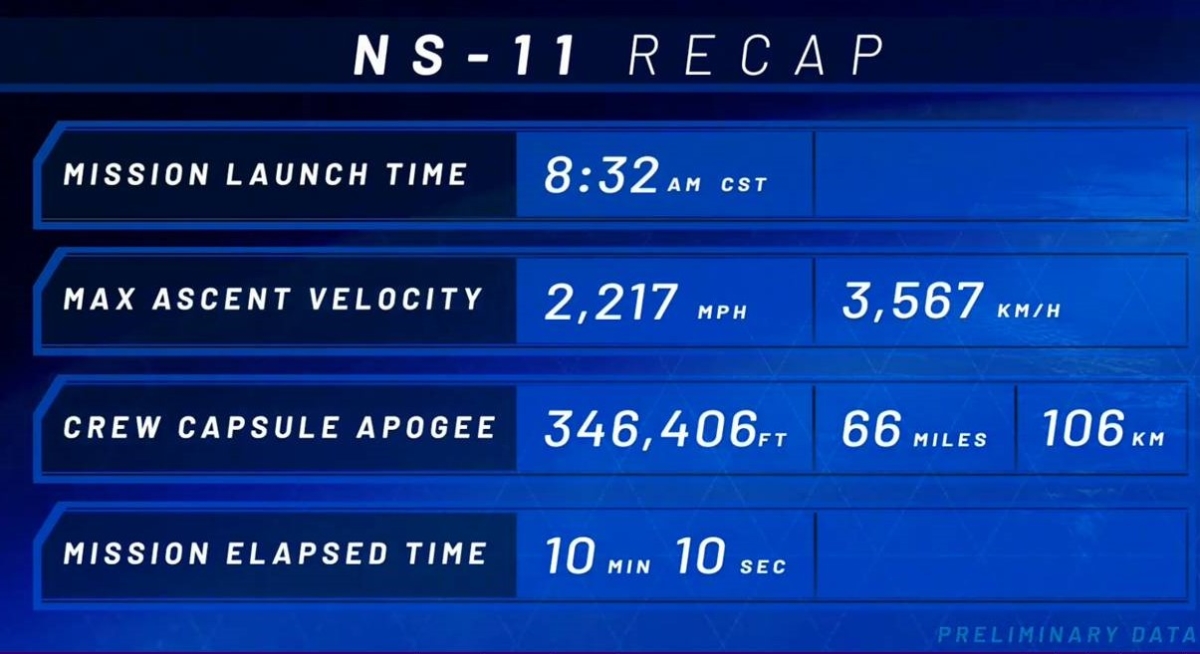
The mission, named NS-11, took 38 payloads above the Kármán line into space.
Some of the payloads flying with us include:
Orbital Medicine – Orbital Medicine, a small business focused on aerospace medicine, comes to us through funding from NASA’s Flight Opportunities Program. On NS-11, Marsh Cuttino, MD, will demonstrate an experimental medical technology designed to treat a collapsed lung in zero gravity (which is a gravity-dependent procedure). Thanks to a previous flight on New Shepard, Dr. Cuttino has been able to evolve the technology and this flight will prove a near-final version that could one day save lives in space.
New Century Technology High School – A group of students from Huntsville, AL have designed an experiment to test temperature fluctuations in microgravity. The students were excited to get hands-on experience for a project they’ll be able to launch to space and worked with NASA engineers to perfect their design. By lowering launch costs, more and more students will have the chance to design, build and send technology to space.
MIT Media Lab Space Exploration Initiative – The Space Exploration Initiative is built on the spirit of the MIT Media Lab, uniting artists, engineers, scientists, and designers. As the first MIT flight with New Shepard, the Space Exploration Initiative is flying several scientific payloads, as well as two projects that use zero gravity as a medium for works of art. Telepresent Drawings in Space uses graphite to create a drawing that could only have been made in space.
Living Distance: A Spider-Inspired Robotic Dance in Weightlessness demonstrates a crystalline robotic device that navigates zero gravity, similar to a performance.
Other payloads include TESSERAE: Self Assembling Space Architecture, Floral Cosmonauts: Crystal Electro-Nucleation and Queen Bee Maiden Flight.

Credit: Jose Maria Madiedo/Jose L. Ortiz/MIDAS
The reported flash on the lunar surface during January’s total eclipse of the Moon was the result from a meteorite smacking into the Moon at roughly 38,000 miles per hour.
This event excavated a crater some 33 feet to 50 feet (10 to 15 meters) across.
Happening on January 21st — just after the total phase of the eclipse began – widespread reports from amateur astronomers indicated the flash was bright enough to be seen with the naked eye.
MIDAS touch
The Moon Impacts Detection and Analysis System (MIDAS), using eight telescopes in south of Spain recorded the moment of impact.
Jose Maria Madiedo of the University of Huelva, and Jose L. Ortiz of the Institute of Astrophysics of Andalusia, have published study results about the lunar impactor in a paper in Monthly Notices of the Royal Astronomical Society.

Credit: JM Madiedo
The impact flash lasted 0.28 second and is the first ever filmed during a lunar eclipse, despite a number of earlier attempts.
MIDAS telescopes observed the impact flash at multiple wavelengths improving the analysis of the event. Madiedo and Ortiz conclude that the incoming rock had a mass of 100 pounds (45 kilograms), measured 30 to 60 centimeters across, and hit the surface at 38,000 miles per hour (61,000 kilometers an hour). The impact site is close to the crater Lagrange H, near the west-south-west portion of the lunar limb.
Peak temperature
The two scientists assess the impact energy as equivalent to 1.5 tons of TNT, enough to create a crater up to 15 meters across, or about the size of two double decker buses side by side.
The debris ejected is estimated to have reached a peak temperature of 5,400 degrees Celsius, roughly the same as the surface of the Sun.
To read their paper — Multiwavelength observations of a bright impact flash during the 2019 January total lunar eclipse — go to:
https://academic.oup.com/mnras/article/486/3/3380/5480892
Also, go to this informative outreach video describing the event at:
https://www.youtube.com/watch?v=5ir8nPSSLYQ&feature=youtu.be

Credit: Joe Merrell
In the world of Unidentified Flying Object (UFO) research, there are those close encounter witnesses that report unknown fuming odors!
Los Angeles artist Joe Merrell has worked with perfumer Chris Gordon to create an eau de parfum called what else: “Abduction.”
The project started in 2016 with Saskia Wilson-Brown, founder and director of The Institute for Art and Olfaction, the two artisans working collaboratively to make several scents for Merrell’s art installation at Machine Project in Echo Park. One of these was based on what people report smelling during close encounter experiences.

Credit: Joe Merrell
Wearable fragrance
“There is very little research specifically related to scent and reported ufo/abduction phenomena,” Merrell told Inside Outer Space, “so I spent a great deal of time combing through books and talking to several people who report close encounters.”
Merrell adds, as is the case with other aspects of the UFO phenomenon, there was a fair amount of consistency in the reports.
“The challenge in this most recent iteration of the project was in making a perfume that stayed true to what was in the research and still worked on its own as a wearable fragrance,” Merrell said.

Credit: Joe Merrell
Sniff test
Merrell points to the research work of Antonio Rullán published in July 2000: Odors from UFOs: Deducing Odorant Chemistry and Causation from Available Data. The paper examines scents associated with physical craft.

Courtesy: Joe Merrell
As for the scents most often described in relation to abduction experiences, Merrell says they include cinnamon with a distinct cloying aspect, yeast, as well as damp organic/earthiness, even burning cardboard or paper.
The perfume that has been produced is reportedly true enough that it invokes feelings of familiarity from those that have experienced alien abduction.
For more information on Merrell’s work, as well as a posted copy of Rullán’s Odors from UFOs paper, go to his website, The Eyes Are Always There at:

Curiosity Navcam Right B image taken on April 23 showing the newest “Kilmarie” drill hole on the right, less than one meter away from the “Aberlady” drill hole on the left.
Credit: NASA/JPL-Caltech
NASA’s Curiosity Mars rover is now carrying out Sol 2390 duties.
Curiosity’s first night of analysis of the recently obtained “Kilmarie” drill sample has shown there’s enough material to study. The robot is using its Chemistry & Mineralogy X-Ray Diffraction/X-Ray Fluorescence Instrument (CheMin) to assess the new sample.

Curiosity Front Hazcam Right B image taken on Sol 2389, April 26, 2019.
Credit: NASA/JPL-Caltech
“Less than 40 minutes after downlink, we got confirmation from the CheMin team that they did indeed receive enough material,” reports Lucy Thompson, a planetary geologist at the University of New Brunswick, Fredericton, New Brunswick, Canada.
“This meant that we could proceed with the two highest priority activities in the plan; the second night of CheMin analysis of the Kilmarie drill sample, Thompson adds, and a Sample Analysis at Mars (SAM) Instrument Suite preconditioning activity in preparation for delivery of sample for a SAM Evolved Gas Analysis (EGA) experiment in the coming week’s plan.

Curiosity ChemCam Remote Micro-Imager photo taken on Sol 2389, April 26, 2019.
Credit: NASA/JPL-Caltech/LANL
Rock sample clues
“The CheMin instrument informs us of the mineralogy of the sample, which can give us clues about the source of the rock sample, the conditions under which it formed and any subsequent alteration events,” Thompson explains. “It will be interesting to compare the mineralogy of Kilmarie with the nearby ‘Aberlady’ drill hole.”
Thompson adds that the SAM EGA experiment will measure the composition of the different gases evolved at different temperatures as the sample is heated in the SAM oven.
This complements the CheMin data and can help refine the mineralogy and tell us about the amount and nature of various minerals.

Curiosity Rear Hazcam Left B image taken on Sol 2389, April 26, 2019.
Credit: NASA/JPL-Caltech
Clay mineral
Mars scientists are particularly interested in whether this sample from the ‘Clay-Bearing Unit,’ Glen Torridon area, does in fact contain clay (as have the majority of drilled samples), and if it does, how much is present and what type of clay mineral is it?
The science team also planned ChemCam Laser-Induced Breakdown Spectrometer (LIBS) on four rock targets (“Mile End,” “Tillyfourie,” “Tillybrachty” and “Tillymorgan”) in the vicinity of the drill hole to continue to monitor compositional variation between relatively coherent and more rubbly bedrock than has been observed within Glen Torridon.

Curiosity Navcam Right B image taken on Sol 2389, April 26, 2019.
Credit: NASA/JPL-Caltech
Different colored strata
“We will also acquire Mastcam support imaging for the ChemCam targets as well as a large multispectral mosaic in the direction of the “Greenheugh Pediment” and “Sulfate-Bearing Unit” that we will eventually drive to,” Thompson reports. “The multispectral mosaic will help to highlight possible spectral and mineralogical differences between the different colored strata we observe in this area.”
Curiosity researchers recently undertook a busy planning day for environmental observations with three science blocks devoted to these activities.
A ChemCam passive sky measurement was included to look at water vapor and aerosols in the atmosphere above Curiosity, as well as Mastcam tau observations to measure the atmospheric opacity and a large Navcam dust devil survey.

Curiosity Navcam Right B image taken on Sol 2389, April 26, 2019.
Credit: NASA/JPL-Caltech
Ongoing campaign
Navcam zenith observations were also planned as part of the ongoing campaign to monitor martian clouds, Thompson says. Standard background Rover Environmental Monitoring Station (REMS) activities monitor the daily martian weather and also continue to monitor the radiation environment with Radiation Assessment Detector (RAD) and the abundance and distribution of hydrogen and hydroxide-bearing materials within the subsurface with Dynamic Albedo of Neutrons (DAN) passive activities.

Curiosity Navcam Right B image taken on Sol 2389, April 26, 2019.
Credit: NASA/JPL-Caltech
Mars researchers have to wait to use the robot’s arm, and Mars Hand Lens Imager (MAHLI) and APXS on the end of the arm, “until after we have dumped the Kilmarie drill fines from the drill bit assembly,” Thompson adds. “This does not occur until the SAM and CheMin instrument teams confirm that they do not require any more sample. Both the MAHLI and APXS teams eagerly await the chance to analyze the drill fines from this latest hole on Mars.”

Curiosity Navcam Right B image taken on Sol 2389, April 26, 2019.
Credit: NASA/JPL-Caltech

Crater Search Operation, (CRA2).
Credit: JAXA
Japan’s Hayabusa2 asteroid explorer deployed the Small Carry-on Impactor (SCI) on April 5.
That successful operation involved a 4.4 pound (2 kilogram) copper mass that collided with asteroid Ryugu. The gravel released from the surface of Ryugu was photographed by the deployable camera, DCAM3.
However, the images from DCAM3 do not show how Ryugu’s surface has been altered by the impact. Hayabusa2 is now in a Crater Search Operation, (CRA2). The spacecraft is under command to descend and make observations in the vicinity of the SCI collision area.

Schematic diagram of the CRA2 operation. Credit: JAXA)
Low altitude
Hayabusa2 officials say the CRA2 operation took place from April 23 – 25, with preparation for the descent beginning on April 23.
That descent placed the spacecraft at the lowest altitude of roughly a mile (1.7 kilometers) above the space rock on April 25. The spacecraft has imaged the impact area, and is moving back to a home position.
[CRA2] Crater formation where the Small Carry-on Impactor collided with Ryugu has been confirmed! These images compare the surface before and after the SCI collision. pic.twitter.com/BZPYlHhSjs
— HAYABUSA2@JAXA (@haya2e_jaxa) April 25, 2019
Terrain changed
According to Hayabusa2 controllers, the exact size and shape of the artificial crater will be examined in detail in the future, but then can see that the terrain of an area about 66 feet (20 meters) wide has changed.
“We did not expect such a big alternation, so a lively debate has been initiated in the project!”

Curiosity Mastcam Right image taken on Sol 2384, April 21, 2019.
Credit: NASA/JPL-Caltech/MSSS
NASA’s Curiosity Mars rover is now performing Sol 2387 duties.
“The drilling planned for last weekend was successful,” reports Ken Herkenhoff, a planetary geologist at the USGS in Flagstaff, Arizona.

Curiosity Mastcam Left image taken on Sol 2384, April 21, 2019.
Credit: NASA/JPL-Caltech/MSSS
The recent top priority for the robot is to drop portions of the Kilmarie sample onto a closed Sample Analysis at Mars (SAM) Instrument Suite inlet cover and take Mastcam images after each dropoff to characterize the size of each portion.
“The results of this portioning test will be used to decide how many portions to eventually drop into SAM,” Herkenhoff adds. After this testing is completed, Mastcam will measure the amount of dust in the atmosphere above the robot by imaging the Sun through neutral-density filters, and Navcam will search for clouds.

Curiosity ChemCam Remote Micro-Imager photo taken on Sol 2386, April 23, 2019.
Credit: NASA/JPL-Caltech/LANL
Aberlady in focus
The Chemistry and Camera (ChemCam) Remote Micro-Imager (RMI) is scheduled to acquire a “stack” of images of the Aberlady drill hole at various focus settings to find the best focus setting for future Laser Induced Breakdown Spectroscopy (LIBS) elemental chemistry measurements from the rover’s new vantage point, Herkenhoff explains.
“The RMI will also acquire a couple mosaics of the sulfate-rich rocks exposed in the distance southeast of the rover. Mastcam will measure variations in sky brightness to constrain the size of dust grains suspended in the atmosphere before the rover takes a long nap,” Herkenhoff reports.
Also on tap is use of Curiosity’s Chemistry & Mineralogy X-Ray Diffraction/X-Ray Fluorescence Instrument (CheMin). This instrument will vibrate its inlet sieve and dump the Aberlady sample in preparation for analysis of the Kilmarie drill sample.
Dust opacity
Slated for Sol 2387 tasks, the robot’s Mastcam will again measure dust opacity and Navcam will search for dust devils and clouds.

Curiosity Front Hazcam Left B image acquired on Sol 2386, April 23, 2019.
Credit: NASA/JPL-Caltech
“ChemCam will then use its laser to measure the elemental chemistry in the wall of the new Kilmarie drill hole,” Herkenhoff notes, “and of a nearby pebble named ‘Quirang’ and a bedrock outcrop named ‘Caledonian Canal.’”
Also scheduled is use of the Right Mastcam to image all of the ChemCam targets before Dynamic Albedo of Neutrons (DAN) turns on its neutron generator to search for hydrogen up to half a meter below the surface.

Curiosity Navcam Right B image taken on Sol 2386, April 23, 2019.
Credit: NASA/JPL-Caltech
Herkenhoff concludes by noting that Mars Hand Lens Imager (MAHLI) activities are precluded while there is sample in the drill stem.
Credit: CMSA
A crucial flight of China’s Long March-5B carrier rocket is slated for launch in the first half of 2020, according to the China Manned Space Engineering Office (CMSEO).
The maiden flight of this class of Long March booster is critical to China’s human and robotic space exploration plans.
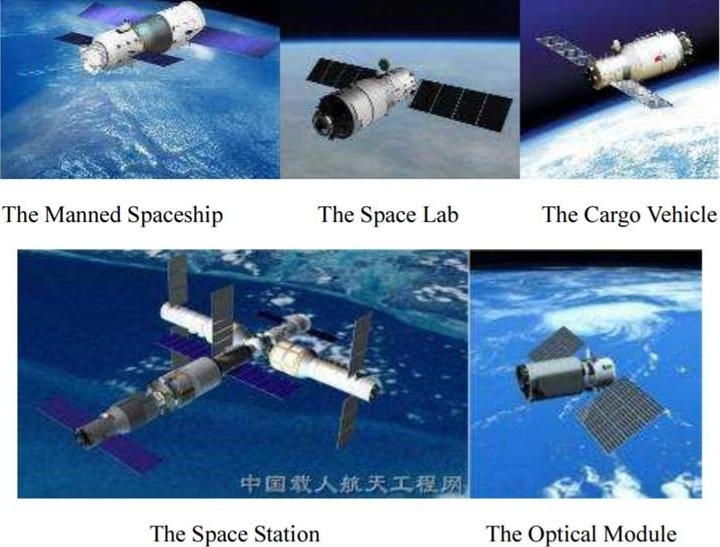
China’s state-run Xinhua News Agency reports that the Long March-5B will carry the core capsule and experiment capsules of China’s space station, expected to be completed in 2022.

Prototype of the Tianhe core module. China’s space station is expected to be operational around 2022. CCTV/Screengrab
Three phases
The country’s Tiangong space station is mainly comprised of the Core Capsule, Experiment Capsule I and Experiment Capsule II, with the aim of building a reliable operating space station and providing long-term support for the onboard astronauts.

Testing of Tianhe core module.
Credit: China Manned Space Agency (CMS) via Andrew Jones
According to Xinhua, the space station project will be implemented in three phases: key technology validation, construction and operation.
Six flight missions, including the maiden flight of the Long March-5B rocket and launch of the test core capsule, have been scheduled in the first phase, and launches of experiment capsules in the second phase.
Each capsule will weigh about 20 tons. After a series of tests, the core capsule will be transferred into the flight model phase. The two experiment capsules are ready undergoing final assembly, according to China’s Science and Technology Daily.

Credit: China Manned Space Agency
Experiment racks
Xinhua News Agency also reports that there are sixteen experiment racks installed within the core module and two lab capsules of the space station, and an extravehicular experiment platform will be built.
Each rack is regarded as a lab that can support various space experiments, and astronauts can upgrade and replace the experiments.
In addition, a capsule holding a large optical telescope will fly in the same orbit as the station.

Robot arm under development for use in China’s station effort.
Credit: CGTN/screengrab
Cold atomic experiment system
The space station will carry a hydrogen clock, a cold atomic clock, and an optical clock to establish a high-precision time and frequency system.
The time and frequency system, as well as an ultra-low temperature cold atomic experiment system, will support research in general relativity, gravitational physics, and quantum physics, said Zhang Wei, director of the Utilization Development Center of the Technology and Engineering Center for Space Utilization (CSU).
China’s space station program will host international collaboration in experiments on the orbiting complex. Nearly 100 international cooperation proposals have been received, and about 30 have passed the initial evaluation, Zhang added.

Credit: Lu Liangliang/CNSA
Moon exploration
In related work, China aims to build a scientific research station in the south polar region of the Moon and realize a crewed lunar exploration mission in about ten years, reports Zhang Kejian, head of the China National Space Administration.
China will launch the Chang’e-5 lunar probe to collect and return lunar samples back to Earth at the end of 2019, Zhang said, according to Xhinua News Agency.

China’s next Moon exploration phase: Sample return from the Moon.
Credit: CCTV/Screengrab/Inside Outer Space
Shaoshan, the hometown of China’s late leader Mao Zedong, will be one of the permanent storage centers of the lunar samples, Zhang said.
Lastly, since 2016, China has set April 24 as the country’s Space Day. The theme of this year’s activities is to “pursue space dreams for win-win cooperation.”

Mars Base 1 Camp in Jinchang City of northwest China’s Gansu Province.
Credit: New China TV/Screengrab by Inside Outer Space
China has opened Mars Base 1 Camp in Jinchang City of northwest China’s Gansu Province, an expansive facility to popularize science and boost interest in space exploration.
Located in the Gobi desert of Jinchang some 12 miles (20 kilometers) from Jinchang’s urban area, the simulation camp will become an astronaut training facility in the future.

Credit: New China TV/Screengrab by Inside Outer Space
Survival, training facility
Covering 67 square kilometers, and costing $373 million, “Mars Base 1 is the most authentic Martian survival simulation facility in the country by far,” Li Tanqiu, deputy chief designer for China’s astronaut system department, said at the opening ceremony in a press statement.

Credit: New China TV/Screengrab by Inside Outer Space
“The base was developed and built with full technical support from the China Astronaut Research and Training Center,” Li added, “which means it has the scientific logic system of the aerospace team and the valuable experience accumulated by astronauts who have trained in the past.”
Go to this informative New China TV video that features an Xinhua News Agency reporter touring the Mars camp.

Fixed image of March 27th showing individual pieces of fragmented U.S. rocket stage detected for tagging and identification.
Credit: Deimos Sky Survey
A discarded upper stage from a rocket launched nearly a decade ago has fragmented, adding to ongoing growth of orbital debris encircling Earth.
The large Atlas V Centaur upper stage, for an as-yet-unknown reason, broke up between March 23 – March 25.
At a recent meeting of space debris specialists, Vladimir Agapov of Keldysh Institute of Applied Mathematics unveiled the fragmentation event of object 2009-047B, estimated to have taken place on March 25th.

Crumbling culprit: Atlas V Centaur upper stage.
Credit: NASA/Roy Allison
2009-047B is the second stage of the Atlas V launcher which put in orbit USA 207, an American military communications satellite on September 8, 2009.
Detailed images
Just hours after learning of the breakup, the Zimmerwald Observatory in Switzerland scheduled immediate observations of the cloud of fragments, and by March 26 had acquired the first views.

Deimos Sky Survey observatory.
Credit: Elecnor Deimos Sky Survey
Also following the announcement, the Deimos Sky Survey observatory provided detailed images of the central body and between 40 and 60 fragments larger than 30 centimeters in size.
Deimos Sky Survey (DeSS) is an advanced complex in Spain equipped with the latest technology for the observation (surveillance and tracking) and catalog of near-Earth space objects. These objects can be natural, such as near asteroids also known as NEOs (Near Earth Objects), or human-made, like satellites and space debris.
Results of the Elecnor Deimos Space Situational Awareness (SSA) team analyses, — such as the expected evolution of the fragments cloud around the Earth or the spatial density at different altitudes and timeframe — are being shared with the space surveillance and tracking international community.

In-orbit explosions can be related to the mixing of residual fuel that remain in tanks or fuel lines once a rocket stage or satellite is discarded in Earth orbit. The resulting explosion can destroy the object and spread its mass across numerous fragments with a wide spectrum of masses and imparted speeds.
Credit: ESA
Technological trash
“Leaving a trail of debris in its wake, this fragmentation event provides space debris experts with a rare opportunity to test their understanding of such hugely important processes,” explains Tim Flohrer, a European Space Agency (ESA) senior space debris monitoring expert in an ESA statement.
Fragmentation events like this one – either break ups or collisions – are the primary source of debris objects in space in the range of a few millimeters to tens of centimeters in size.
Travelling at high speeds, these bits of “technological trash” pose a threat to crucial space infrastructure, such as satellites providing weather and navigation services – including astronauts aboard the International Space Station, the ESA statement points out.
Video captured by the Deimos Sky Survey in Spain showing the stream of newly-made debris objects as they rush across the sky:


