Archive for the ‘Space News’ Category
 Author:
  May 10th, 2019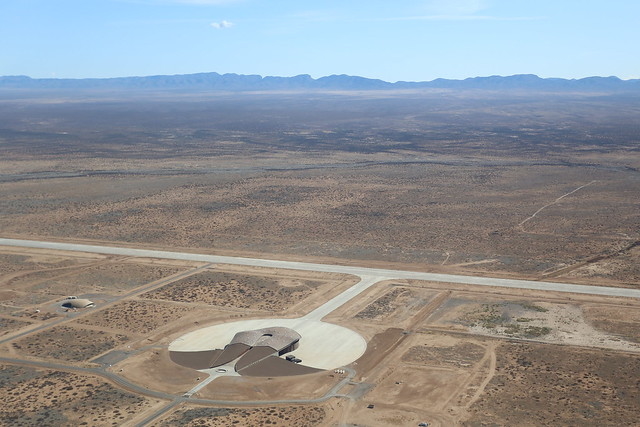
Aerial view of New Mexico’s Spaceport America.
Credit: Spaceport America
Richard Branson’s Virgin Galactic and Gov. Michelle Lujan Grisham announced today that the space company plans to relocate more than 100 employees to New Mexico’s Spaceport America as it begins to ramp up operations for commercial flights.
Virgin Founder Sir Richard Branson announced that Virgin Galactic’s development and testing program had advanced sufficiently to move the spaceline staff and space vehicles to their commercial operations headquarters at Spaceport America, New Mexico.
The move, which involves more than 100 staff, will commence imm

Credit: Spaceport America
ediately and continue through the summer.
$218 million investment
Spaceport America represents a $218 million investment by the state of New Mexico. The 18,000-acre FAA-licensed facility sits adjacent to the U.S. Army’s White Sands Missile Range and has three vertical launch complexes and a 12,000-foot runway.
Just 45 miles north of Las Cruces, Spaceport America has the most restricted airspace in the Unites States except for the sky over the White House.
To date, Spaceport America has hosted 204 vertical launches as well as student rocket and science competitions.

Virgin Galactic’s WhiteKnightTwo/SpaceShipTwo launch system flies above New Mexico’s Spaceport America – at that time, still under construction.
Credit: Virgin Galactic/Mark Greenberg
Coming home
“New Mexico delivered on its promise to build a world-first and world-class spaceport,” said Branson. “Today, I could not be more excited to announce that in return, we are now ready to bring New Mexico a world-first, world-class spaceline. Virgin Galactic is coming home to New Mexico, where together we will open space to change the world for good.”
Branson made the announcement in a ceremony at the New Mexico state capitol in Santa Fe. He said more than 100 employees will be moving to New Mexico to support the current staff bringing employment for Virgin Galactic at Spaceport America to approximately 150.
More jobs will follow as operations progress into commercial service in the coming year, Branson said.
Video: https://www.facebook.com/NewMexicoEconomicDevelopment/videos/420010298822223/
 Posted in

Curiosity Front Hazcam Right B image taken on Sol 2402, May 10, 2019.
Credit: NASA/JPL-Caltech
NASA’s Curiosity Mars rover has just started to perform Sol 2403 duties.
Reports Lucy Thompson, a planetary geologist at the University of New Brunswick, Fredericton, New Brunswick, Canada: The go ahead has been given to start planning to proceed with dumping the Kilmarie drill fines from the robot’s drill bit assembly.

Curiosity Mars Hand Lens Imager (MAHLI) image produced on Sol 2402, May 10, 2019. MAHLI is located on the turret at the end of the rover’s robotic arm.
Credit: NASA/JPL-Caltech/MSSS
Pulverized sample
Both the Sample Analysis at Mars (SAM) Instrument Suite and Chemistry & Mineralogy X-Ray Diffraction/X-Ray Fluorescence Instrument (CheMin) instrument have completed or are nearing completion of analyses of the pulverized Kilmarie sample, Thompson adds. Now it’s the turn of the Alpha Particle X-Ray Spectrometer (APXS) and Mars Hand Lens Imager (MAHLI) to analyze the material.

Curiosity Mastcam Right photo acquired on Sol 2401, May 9, 2019.
Credit: NASA/JPL-Caltech/MSSS
“As a member of the APXS team and the strategic planner today for our instrument, I was excited to use APXS and to start analyzing the drill fines,” Thompson explains.
“We have been waiting patiently to use APXS and MAHLI, because any arm activity is precluded while sample is in the drill bit assembly.”
Comparing drill holes
The chemical analysis of the dumped material by APXS and eventually the Chemistry and Camera (ChemCam) will be compared with that of the bedrock surface prior to drilling, as well as to the nearby “Aberlady” drill fines, “to look for variations in composition with depth and between the two drill holes,” Thompson adds.

Curiosity Navcam Right B image taken on Sol 2402, May 10, 2019.
Credit: NASA/JPL-Caltech
Specifically, the APXS-derived chemistry of the dumped material will be used by the Chemistry & Mineralogy X-Ray Diffraction/X-Ray Fluorescence Instrument (CheMin) team to refine their mineralogical analysis.

Curiosity Navcam Right B image taken on Sol 2402, May 10, 2019.
Credit: NASA/JPL-Caltech
Dumped material
“The close-up imaging by MAHLI will tell us about the texture and color of the fines in detail and assist the APXS team in determining exactly where our instrument was placed,” Thompson notes.

Curiosity Navcam Right B image taken on Sol 2402, May 10, 2019.
Credit: NASA/JPL-Caltech
Curiosity’s MAHLI will also image the drill hole and tailings (powdered rock material surrounding the drill hole) at a 25 centimeter standoff to assist placement of APXS and closer-up MAHLI imaging in the next plan.
Mastcam multispectral imaging and ChemCam passive spectroscopy of the Kilmarie dumped material will aid in further elucidating mineralogy.
Bedrock types
Aside from concentrating on the dumped Kilmarie drill fines, the plan included two ChemCam 5×1 active Laser Induced Breakdown Spectroscopy (LIBS) analyses to further characterize the transition between compositional end-member bedrock types exposed in the area (targets “Valtos” and “Wishaw”).
“A ChemCam experiment was also planned,” Thompson points out, “in order to test a new way of protecting ChemCam from being damaged by inadvertently pointing at the sun.”
The new method allows ChemCam to take advantage of local terrain features to block the sun, allowing the instrument to target more distant features than if it had to stay below an imaginary, level horizon.
Ripple field
“A Mastcam mosaic will add to images already acquired of a nearby ripple field, where we are planning to conduct a more detailed study in the near future,” Thompson reports.
The robot’s environmental observations included standard background Rover Environmental Monitoring Station (REMS) activities to monitor the daily martian weather; use of the Radiation Assessment Detector (RAD) to monitor the radiation environment; and Dynamic Albedo of Neutrons (DAN) passive measurements to study the abundance and distribution of subsurface H- and OH-bearing materials.
Lastly, Thompson says that a Navcam suprahorizon movie will look for clouds and optical depth of the atmosphere and a Mastcam tau observation pointed towards the sun will measure atmospheric opacity.

Credit: Blue Origin/Blue Moon
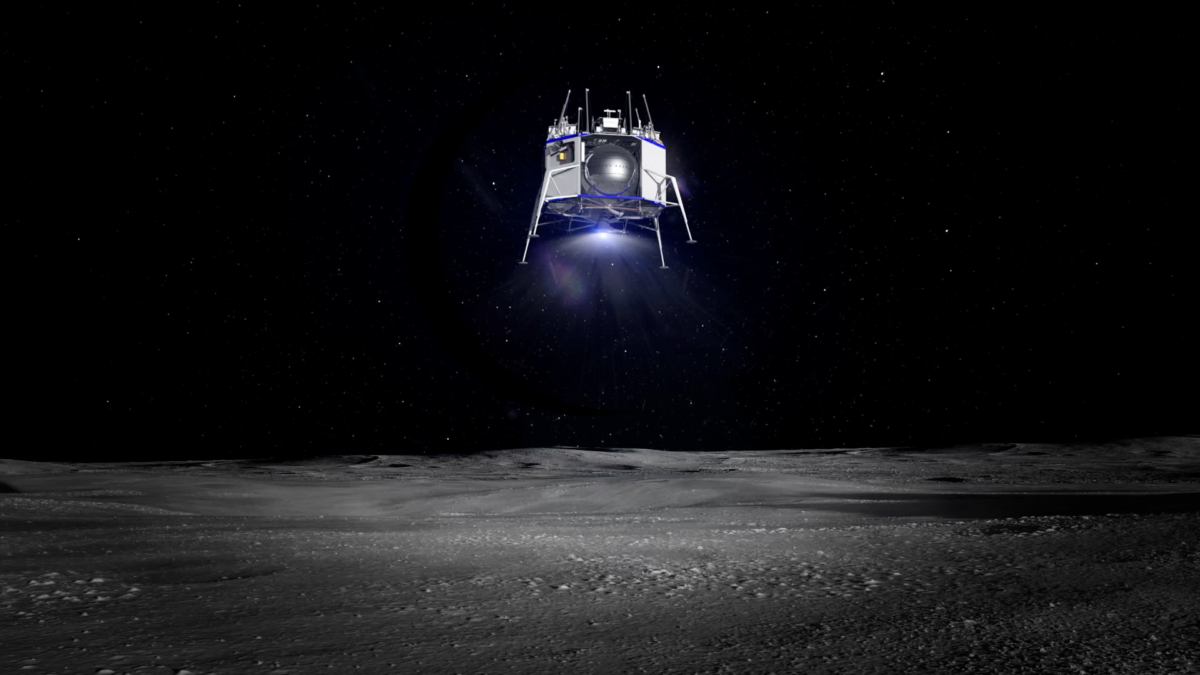
Jeff Bezos of Amazon.com fame and fortune detailed his company’s Blue Moon plans for flying cargo and crew to the Moon. The lunar strategy of the Bezos-backed Blue Origin group was revealed May 9 at the Walter E. Washington Convention Center in Washington, D.C.
Credit: Blue Origin/Blue Moon
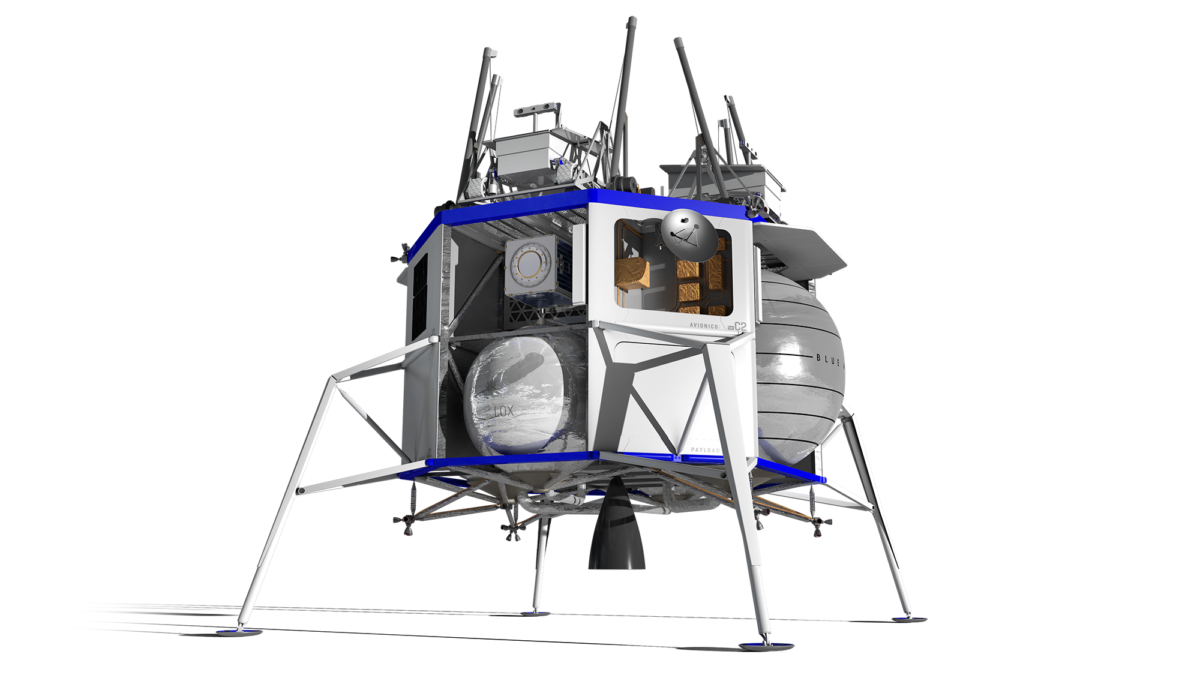
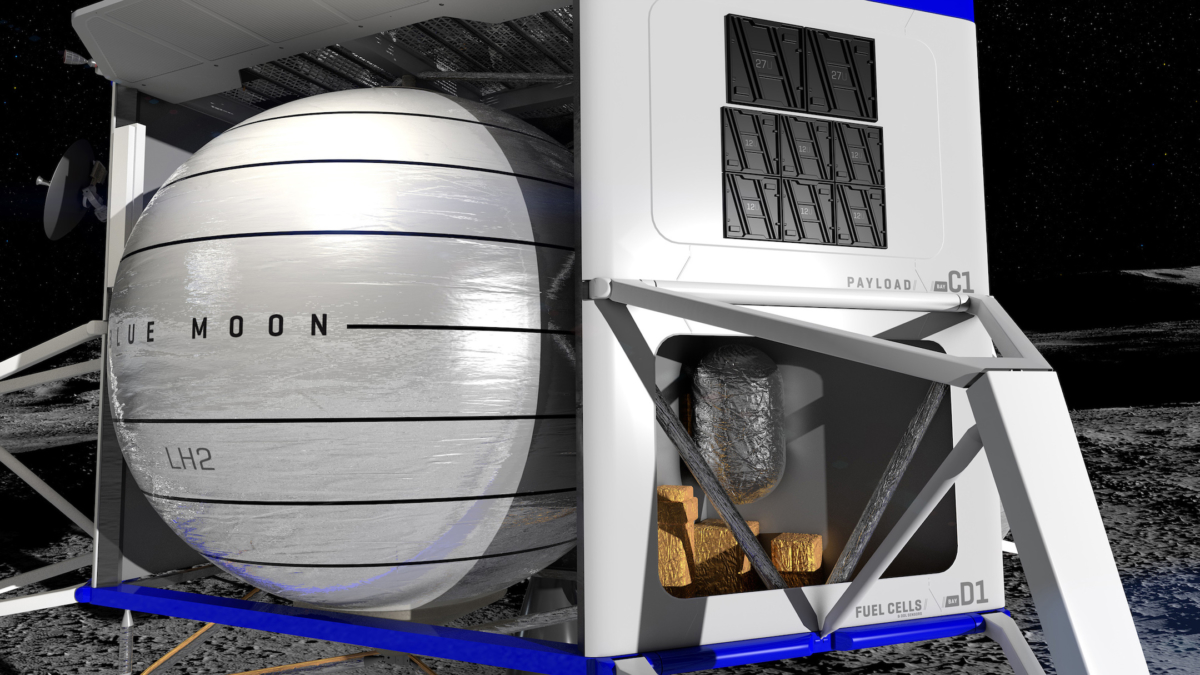
Blue Moon is a flexible lander that can deliver a wide variety of small, medium and large payloads to the Moon’s surface. “Its capability to provide precise and soft landings will enable a sustained human presence on the Moon,” according to Blue Origin’s website, now populated with details of the Blue Moon venture.
Credit: Blue Origin/Blue Moon
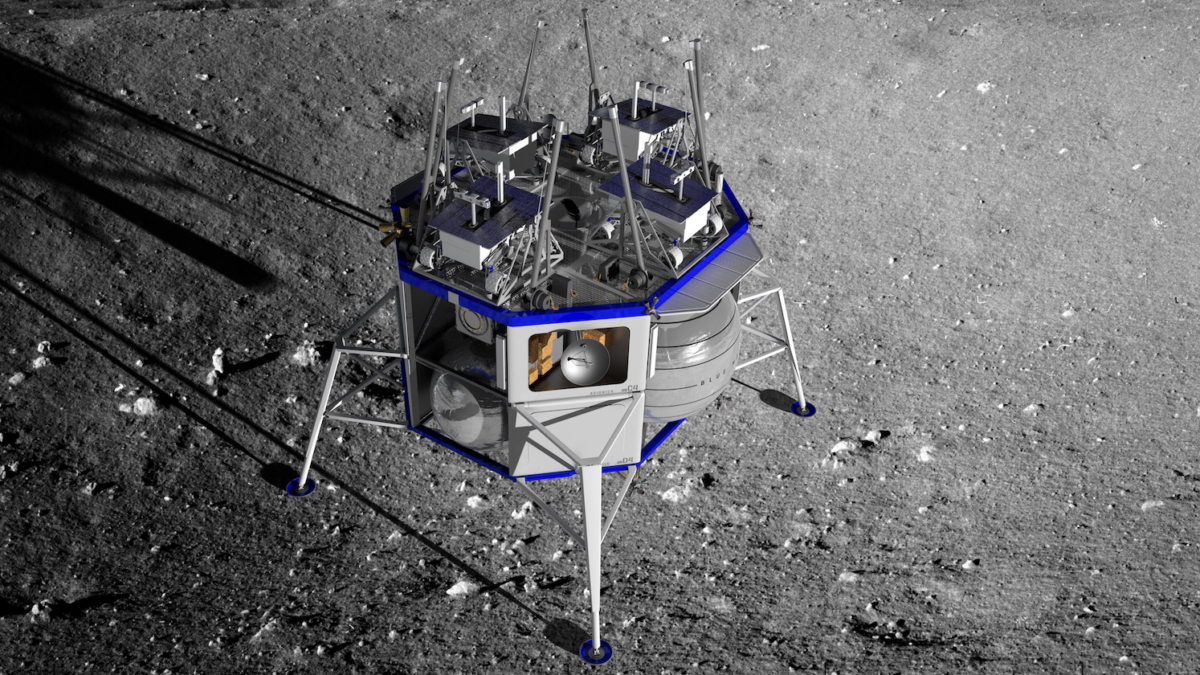
The Blue Moon lander can deliver large infrastructure payloads with high accuracy to pre-position systems for future missions. “The larger variant of Blue Moon has been designed to land an ascent vehicle that will allow us to return Americans to the Moon by 2024,” explains the Blue Origin website.
Credit: Blue Origin/Blue Moon
Science advisory board
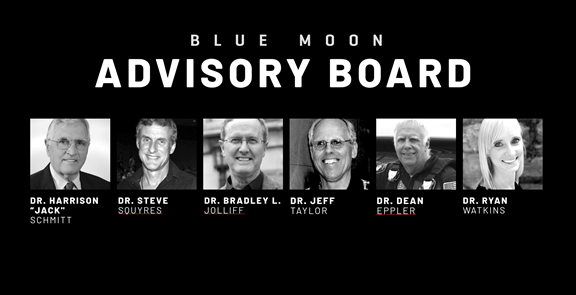
Meanwhile, Inside Outer Space has been advised about the members of a Science Advisory Board for the Blue Origin lunar transportation service:
- Bradley Jolliff, the Scott Rudolph Professor of Earth and Planetary Sciences at Washington University in St. Louis
- Apollo 17’s Harrison “Jack” Schmitt, geologist and former New Mexico Senator
- Dean Eppler, a former geologist at the Johnson Space Center in Houston, Texas and a participant in field tests of experimental spacesuits as part of the Desert RATS program
- Jeffrey Taylor of the Hawai‘i Institute of Geophysics and Planetology at the University of Hawai‘i
- Steve Squyres, professor of astronomy at Cornell University, Ithaca, N.Y.
- Ryan Watkins, a Planetary Science Institute research scientist in Tucson, Arizona
Science Advisory Board members are consultants to Blue Origin, not full-time employees.
Credit: Blue Origin/Blue Moon
Feedback
In a statement from Watkins, she described the role of the advisory group:
“My role has been to provide feedback regarding the Blue Moon lander design and landing site selection. The Board members provide feedback on their subsystem designs and payload capabilities,” Watkins said.
“My expertise has mainly been on landing site selection and some general feedback related to plume effects during landing – but at this stage we are all providing any kind of input we can regarding what we think is feasible and reasonable for their design concepts, from a science perspective,” Watkins added.

New Shepard reusable booster design has undergone a series of flights.
Credit: Blue Origin/Screengrab Inside Outer Space
Building on New Shepard
According to Blue Origin’s website: Years in development, the lander can deliver payloads to the lunar surface, host payloads and even deploy payloads during its journey to the Moon.
Its technology builds on the experience gained with the New Shepard reusable booster, with respect to LH2/LOX propulsion, precision guidance, vertical landing and landing gear systems.
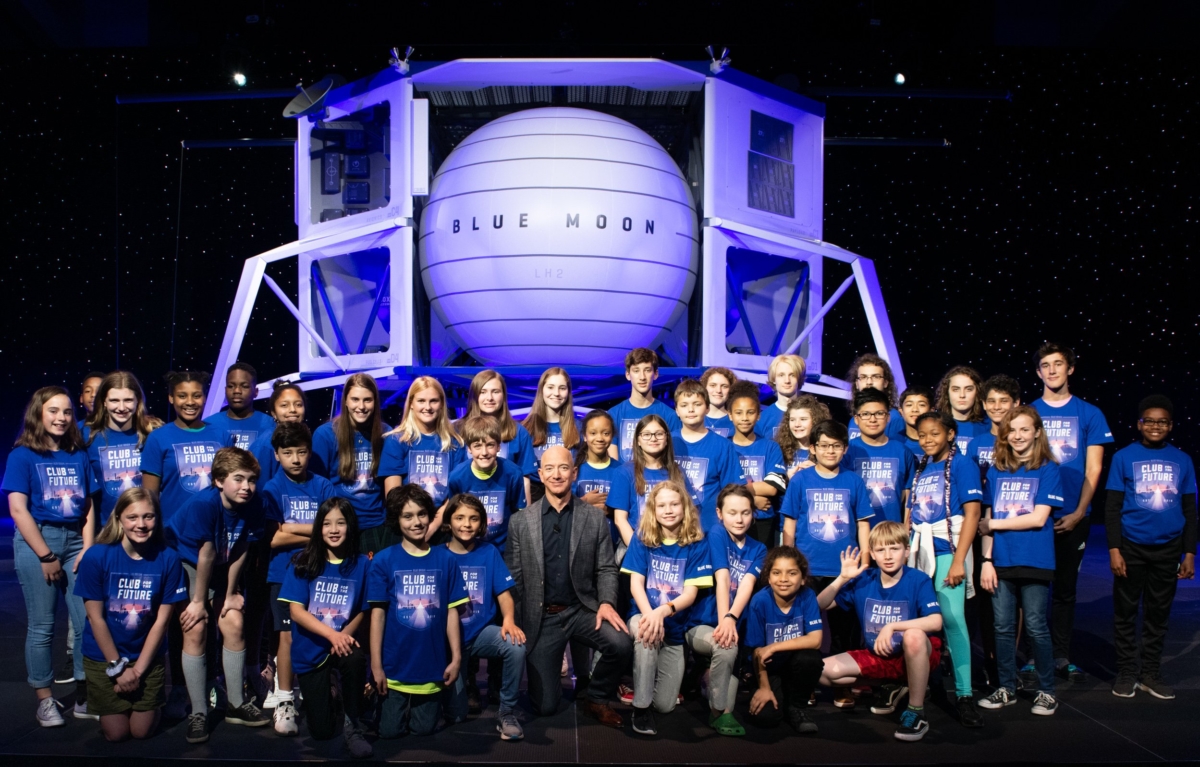
Jeff Bezos with students at Washington, D.C. event.
Credit: Blue Origin/Blue Moon
Metric tons
Blue Moon can land multiple metric tons of payload on the lunar surface.
The top deck and lower bays easily accommodate a wide variety of payloads, including large payloads and ESPA-class payloads with standard ring port interfaces.
ESPA stands for EELV Secondary Payload Adapter – a payload adapter ring for launching secondary payloads.

Credit: NASA
Day/night duration
There are lower mounting locations for payloads on the lunar lander, useful for closer access to the lunar surface and off-loading. The Blue Moon lander will provide kilowatts of power to payloads using its fuel cells, allowing for long mission durations and the ability to last through the lunar night.
Lastly, Blue Moon’s precision guidance and descent sensors are to utilize machine learning technology to accurately land anywhere on the lunar surface, starting with its first mission.
Jeff Bezos has previously identified Shackleton crater as an ideal locale to establish a base camp, a sun-shy feature thought loaded with water-ice for exploitation purposes and also a site that offers near-constant sun light at the crater’s rim.
Video of the May 9, 2019 event with Jeff Bezos discussing his vision to go to space to benefit Earth is available here:
https://www.youtube.com/watch?v=GQ98hGUe6FM&feature=youtu.be
For information on Blue Moon, go to:
Credit: AI SpaceFactory
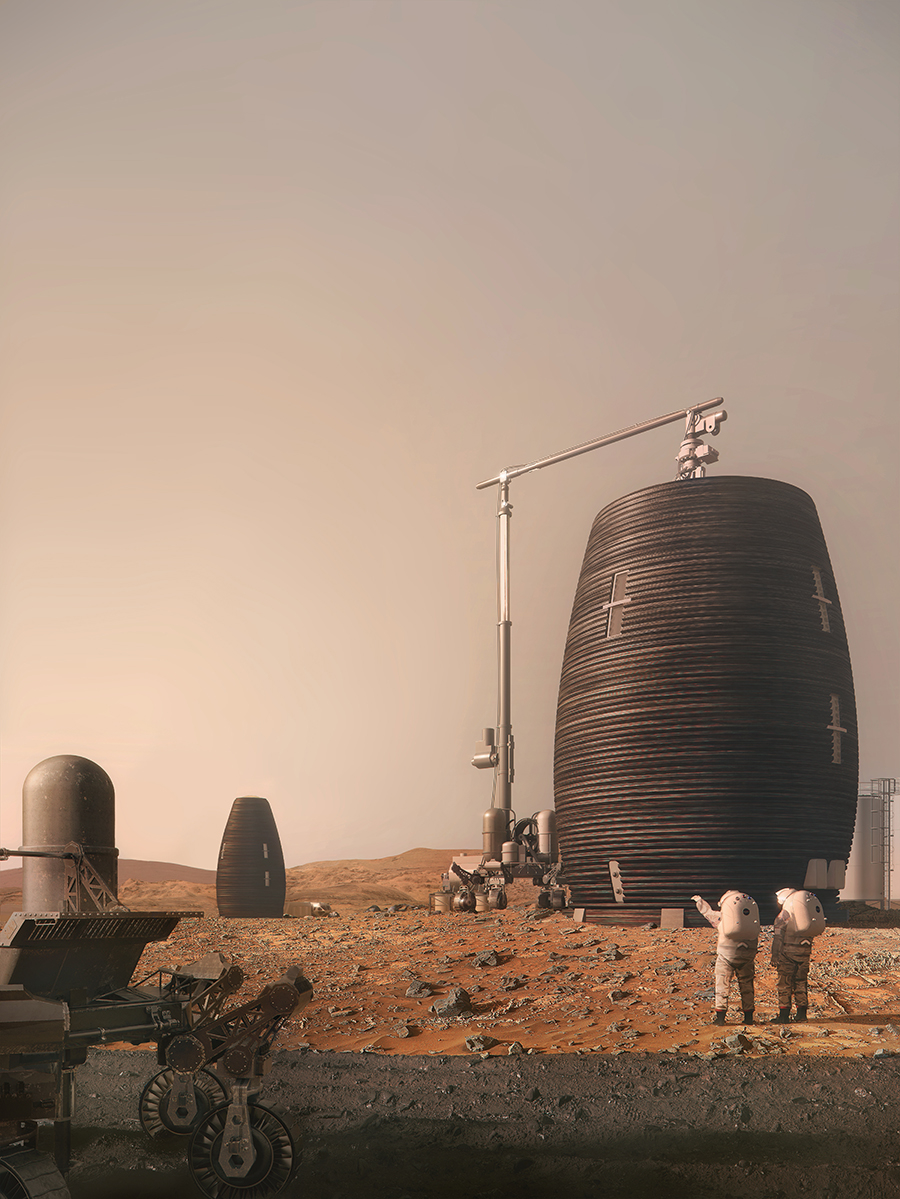
NASA has awarded multi-planetary architectural and technology design agency, AI SpaceFactory, $500,000 for the successful construction of its Mars habitat (MARSHA).
The habitat was 3D printed during the final phase of NASA’s Centennial Challenge.

Credit: AI SpaceFactory
Innovative composite
AI SpaceFactory, headquartered in New York, was announced the 1st place winner out of over 60 challengers for the automation of its print – completed with nearly no human assistance in 30 hours – as well as its innovative biopolymer basalt composite, a biodegradable and recyclable material derived from natural materials found on Mars.
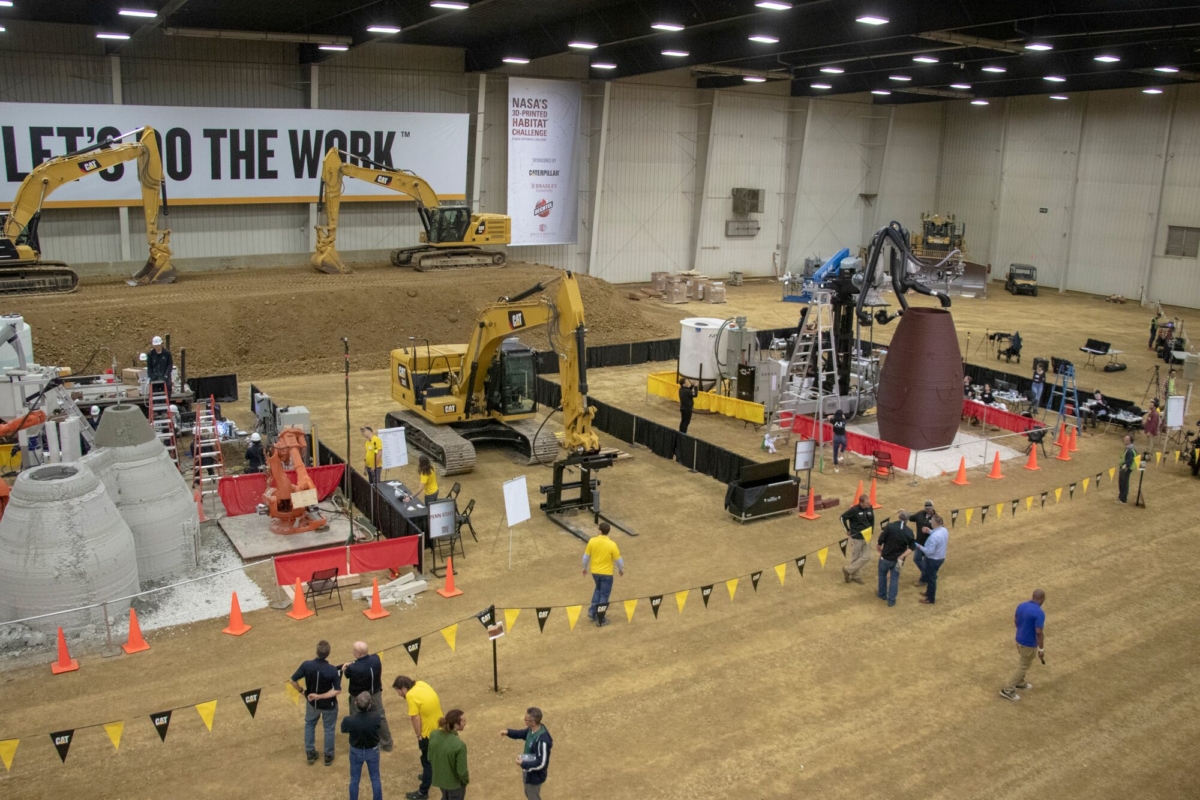
Credit: AI SpaceFactory
MARSHA’s vertical shape and human-centric design marks a radical departure from previous, home away from home Martian designs.
After withstanding NASA’s pressure, smoke, and impact testing, this material was found to be stronger and more durable than its concrete competitors.
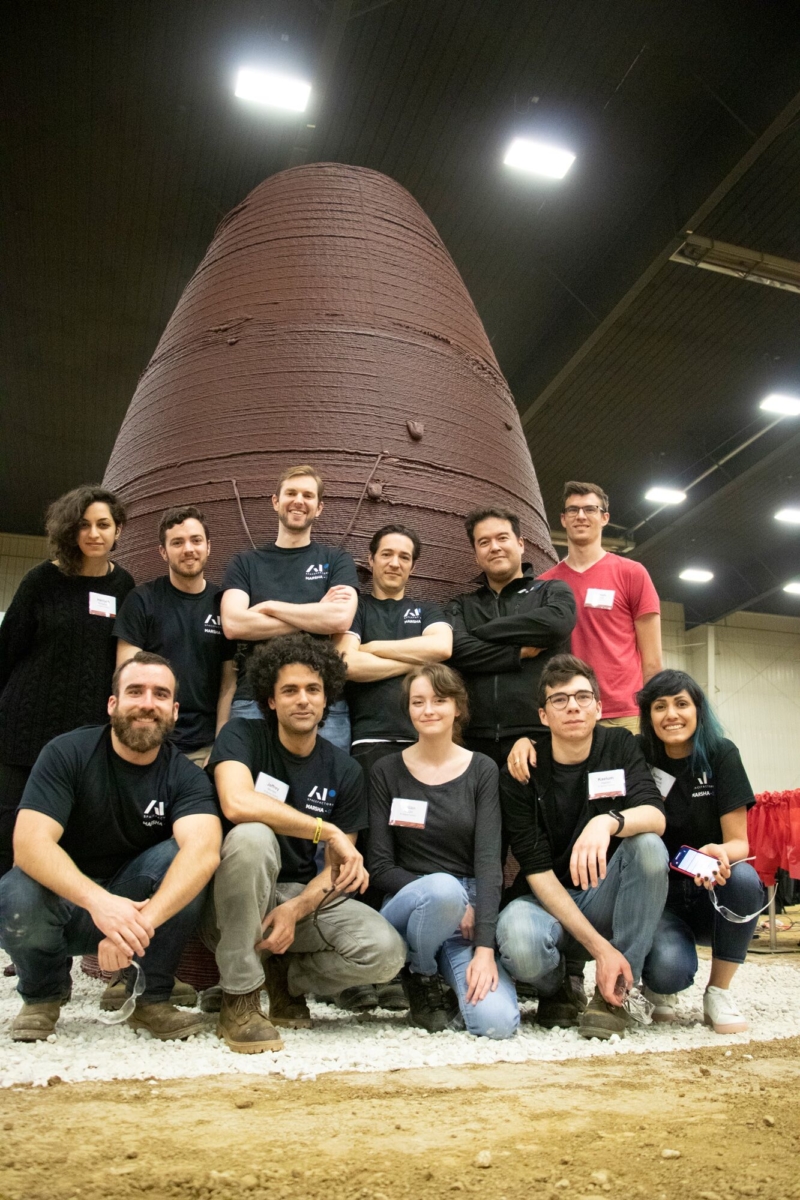
Winners all – AI SpaceFactory team. Credit: AI SpaceFactory
Eye on Earth construction
“We developed these technologies for space, but they have the potential to transform the way we build on Earth,” said David Malott, CEO and Founder of AI SpaceFactory. “By using natural, biodegradable materials grown from crops, we could eliminate the building industry’s massive waste of unrecyclable concrete and restore our planet.”

MARSHA will be recycled into TERA, the world’s first 3D printed space-tech eco habitat.
Credit: AI SpaceFactory
As early as this year, MARSHA will be recycled into TERA, the world’s first 3D printed space-tech eco habitat, and earthlings will finally be able to experience what life might be like on Mars, here on Earth. “It could change the way we build buildings,” said Lex Akers, Dean of the Caterpillar College of Engineering and Technology at Bradley University in Peoria, Illinois.
NASA/university partnership
The 3D-Printed Habitat Challenge is managed in partnership with NASA’s Centennial Challenges program and Bradley University.
NASA’s Centennial Challenges program is part of the agency’s Space Technology Mission Directorate (STMD), and is managed at NASA’s Marshall Space Flight Center in Huntsville, Alabama.
For more information on MARSHA, go to:

Credit: CBO
The Trump Administration has proposed creating what it calls a space force—an independent military service within the Department of the Air Force.
The Administration has also proposed two more space organizations in its budget proposal for fiscal year 2020: a new combatant command and a new agency that would be responsible for the development and acquisition of space systems.
Furthermore, the Administration has proposed creating a civilian Under Secretary for Space who would supervise the space service, report to the
Secretary of the Air Force, and perhaps make policy about space.
The Congressional Budget Office (CBO) issued its own estimates of the costs of the proposed Space Force and other new space organizations.
To read this report, go to:
https://www.cbo.gov/system/files/2019-05/55178-SpaceForce.pdf
Subcommittee on Space Hearing – Keeping Our Sights on Mars: A Review of NASA’s Deep Space Exploration Programs and Lunar Proposal
Date: Wednesday, May 8, 2019
Witnesses:
Mr. William H. Gerstenmaier, Associate Administrator, Human Exploration and Operations, National Aeronautics and Space Administration
Mr. Mark Sirangelo, Special Assistant to the Administrator, National Aeronautics and Space Administration
Dr. Jonathan Lunine, Director, Cornell Center for Astrophysics and Planetary Science, Co-Chair of the Former Committee on Human Spaceflight, National Academies of Sciences, Engineering, and Medicine
Dr. Patricia Sanders, Chair, Aerospace Safety Advisory Panel
Mr. Walt Faulconer, President, Faulconer Consulting Group, LLC (Republican Witness)
Go to this video of the hearing:

Credit: CCTV-Plus
At China’s Beihang University, two groups of volunteers have broken a world record by working rotations in China’s Lunar Base experiment cabin, Yuegong-1.
They stayed in a 150-square meter bio-regenerative life support system for a combined 370 days.
Notes Yi Zhihao, a participant, to work in an isolated lab for more than six months, he sometimes gets emotional.
“It’s incredible, I really did not expect to be able to make it for 200 days,” said Yi.

Credit: CNSA/China News Service Screengrab
Simulated space lab
Yuegong-1 is a simulated space lab, designed to observe how animals, plants and micro-organisms can co-exist in a lunar environment.
The volunteers planted crops and managed waste according to a recycling system. Only two percent of the supplies came from outside.
For Yi and his team, everything takes place here in this 150-square meter lab, from making moon cakes to hosting a birthday party.
Yi said more has to be done, as the space lab program should anticipate many more of the conditions that outer space has to offer.

China’s Lunar Palace 1 – an experimental biosphere here on Earth.
Credit: CMSE
Self-contained cabin project
Yi specializes in agriculture. His education background qualifies him for this interdisciplinary project.
According to the story posted by Global Television Network (CGTN) on May 2, China plans to send astronauts to the Moon by 2036.
“This project gives us a better understanding of what it’s like to live and conduct explorations on the Moon over a longer period of time. We’ll also need this kind of system if we go to Mars,” said Wang Jun, academician at the Chinese Academy of Engineering.
According to the CGTN report, so far, 30 student researchers are committed to the self-contained cabin project, as more and more young people are interested in the nation’s space industry.
“Young people dream big, and they are ambitious. They are not afraid of making mistakes. I have confidence in China’s space exploration career,” said Li Hong, chief designer of Yuegong-1.
Yi said more has to be done, as the space lab program should anticipate many more of the conditions that outer space has to offer.

Credit: SpinLaunch Inc.
Albuquerque Business First has reported that SpinLaunch is to break ground on a new Spaceport America facility in New Mexico.
The idea behind SpinLaunch is to provide the world’s lowest-cost orbital launch service for the rapidly growing small satellite industry.
Kinetic energy
To do so, SpinLaunch is creating a system that accelerates the launch vehicle to hypersonic speeds using ground-based electricity. Applying the initial performance boost from a terrestrial-based launch platform enables the group to lower the cost by orders of magnitude and launch many times per day.

From years ago, an artist’s concept for a full scale “Slingatron.” Credit: Nextbigfuture
As reported earlier by Albuquerque Business First, SpinLaunch was founded in 2015 and is gunning to create a kinetic energy launch system not dependent on fossil fuels. The technology would spin spacecraft at high speeds on the ground and use that energy to catapult them into the atmosphere.
The new Albuquerque Business First story regarding SpinLaunch facility building is based on a media advisory from the New Mexico Spaceport
Space startup
SpinLaunch Inc., a Silicon Valley startup, announced last June the closing of a $35 million Series A funding round with a group of investors, including Airbus Ventures, GV (formerly Google Ventures), and Kleiner Perkins. This collective joins institutional investors including Lauder Partners, ATW Partners, Bolt, and Starlight Ventures to total $40M.
Investment funds will be used to scale the team and technology, through first launch by 2022.
Aerial view of New Mexico’s Spaceport America.
Credit: Spaceport America
Groundbreaking ceremony
A SpinLaunch groundbreaking of its future test facility at Spaceport America is slated for May 7, 2019, according to a SpinLaunch press statement.
Dan Hicks, CEO, Spaceport America, will welcome SpinLaunch to the Spaceport as the newest member of the family of innovators at the New Mexico test site.
In January, Spaceport America announced a new lease agreement with SpinLaunch that will facilitate a new program of testing for the innovative new space company.
Spaceport America is the first purpose-built commercial spaceport in the world. The FAA-licensed launch complex, situated on 18,000 acres adjacent to the U.S. Army White Sands Missile Range in southern New Mexico, has a rocket friendly environment of 6,000 square miles of restricted airspace, low population density, a 12,000-foot spaceway, and 340 days of sunshine and low humidity.
For more information regarding SpinLaunch, go to:

Credit: DoD
The U.S. Office of the Secretary of Defense has issued its annual report: Military and Security Developments Involving the People’s Republic of China 2019.
As part of the report, a section on China’s Moon exploration program notes the farside Chang’e-4 lunar and rover.
“Building on the enabling capabilities such as lunar orbiting, soft landing, and sample return mastered through the legacy Chang’e program, China plans to assemble a lunar research station on the Moon around 2025 and a lunar research and development base around 2050.
Anti-satellite technologies
The report also notes that the Chinese People’s Liberation Army (PLA) is acquiring a range of technologies to improve China’s counterspace capabilities.
“In addition to the development of directed energy weapons and satellite jammers, China is also developing anti-satellite capabilities and has probably made progress on the anti-satellite missile system it tested in July 2014,” the report explains.
Although China has not publicly acknowledged the existence of any new programs since it confirmed it used an anti-satellite missile to destroy a weather satellite in 2007, Chinese defense academics often publish on counterspace threat technologies. These scholars stress the necessity of ‘destroying, damaging, and interfering with the enemy’s reconnaissance . . . and communications satellites,’ suggesting that such systems, as well as navigation and early warning satellites, could be among the targets of attacks designed to ‘blind and deafen the enemy.’
For the full report, go to:
https://media.defense.gov/2019/May/02/2002127082/-1/-1/1/2019_CHINA_MILITARY_POWER_REPORT.pdf

Curiosity Front Hazcam Left B image taken on Sol 2395, May 2, 2019.
Credit: NASA/JPL-Caltech
NASA’s Curiosity Mars rover has just begun Sol 2396 duties.
The drop off of “Kilmarie” drill sample to the robot’s Sample Analysis at Mars (SAM) Instrument Suite on Sol 2293 appeared to be successful, reports Michelle Minitti, a planetary geologist at Framework in Silver Spring, Maryland.
Full results of the SAM analysis to be assessed.

Curiosity Mastcam Left image taken on Sol 2393 April 30, 2019, show sample inlet (one open) of the rover’s Sample Analysis at Mars (SAM) instrument suite.
Credit: NASA/JPL-Caltech/MSSS
Volatile, organic makeup
“The results are needed to help determine if we will dive even further into the volatile and organic makeup of the Kilmarie sample,” Minitti adds. “There was no sitting around and twiddling actuators, however, even though the amount of power available was limited.”

Curiosity ChemCam Remote Micro-Imager photo acquired on Sol 2394, May 1, 2019.
Credit: NASA/JPL-Caltech/LANL
Curiosity will gather more details about the Kilmarie sample mineralogy via another Chemistry & Mineralogy X-Ray Diffraction/X-Ray Fluorescence Instrument (CheMin) integration, and also pepper a suite of broken up bedrock fragments around the rover – “Deinabo,” “Durnhill,” and “Dumyat” – with Chemistry and Camera (ChemCam) shots to compare their chemistry to that of the more-coherent bedrock that Kilmarie represents.
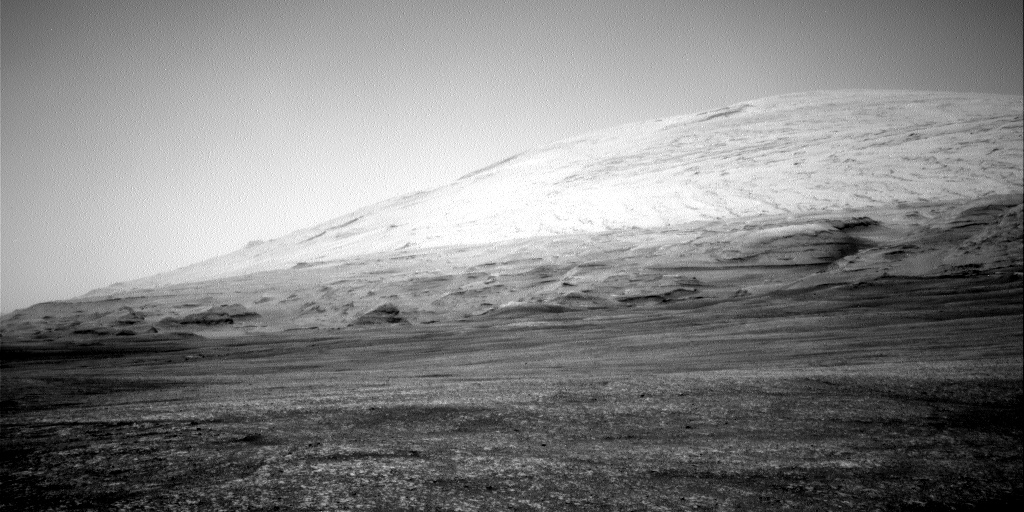
Curiosity Navcam Right B image taken on Sol 2394, May 1, 2019.
Credit: NASA/JPL-Caltech
Looking uphill
The rover is slated to acquire a long distance Remote Micro-Imager (RMI) mosaic, Minitti explains, “looking uphill toward the part of the Mount Sharp stratigraphy that is observed to have a strong spectral signature of sulfate from orbit.”
Changes caused by the wind are to be monitored by comparing the single Mars Descent Imager (MARDI) image acquired in a new plan to one acquired right after Curiosity’s arrival at Kilmarie on Sol 2381.
Changes in the environment will be monitored with a Navcam cloud movie and regular Rover Environmental Monitoring Station (REMS) and Radiation Assessment Detector (RAD) measurements.

