Archive for the ‘Space News’ Category
 Author:
  September 15th, 2019
Curiosity Front Hazcam Left B image taken on Sol 2526, September 14, 2019.
Credit: NASA/JPL-Caltech
NASA’s Curiosity Mars rover is now wrapping up Sol 2527 duties.
The Red Planet machinery has returned to operations after standing down during the recent opposition from August 28 to September 7, 2019 – a period when Mars is on the opposite side of the Sun from Earth and curtails communications between Earth and the Red Planet.
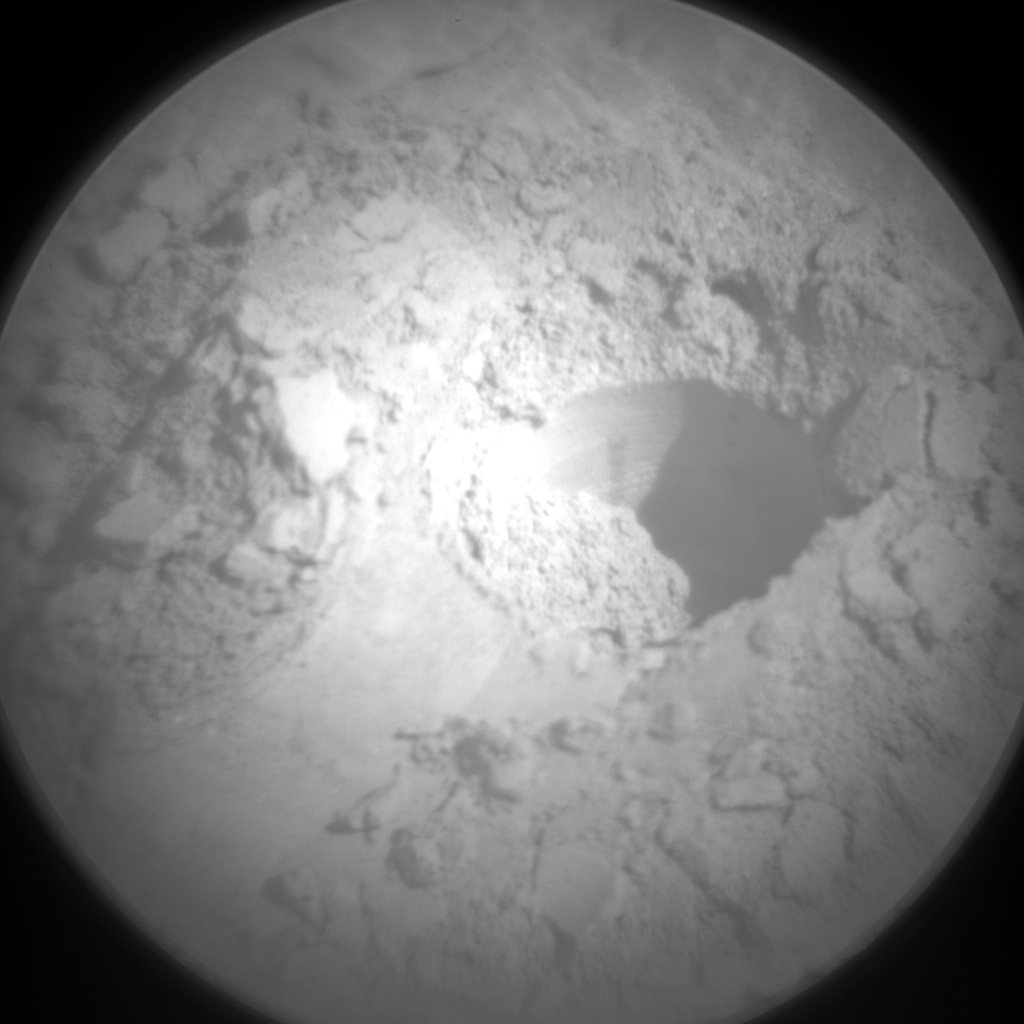
Curiosity ChemCam Remote Micro-Imager photo acquired on Sol 2526, September 14, 2019.
Credit: NASA/JPL-Caltech/LANL
Reports Lucy Thompson, a planetary geologist at University of New Brunswick, the current focus of Curiosity’s activities is to finish up the analyses associated with the drilling campaign at “Glen Etive 1.”

Curiosity Navcam Right B photo taken on Sol 2526, September 14, 2019.
Credit: NASA/JPL-Caltech
Chemistry, color and texture
Recently, dump drill fines from the drill bit assembly (DBA) and the analyses of those fines have been done with the rover’s Alpha Particle X-Ray Spectrometer (APXS) (for chemistry) and the Mars Hand Lens Imager (MAHLI) (for close up color and texture), as well as obtaining MAHLI images of the drill hole and associated fines surrounding the hole (tailings). The hole is roughly 1.6 centimeters in diameter.
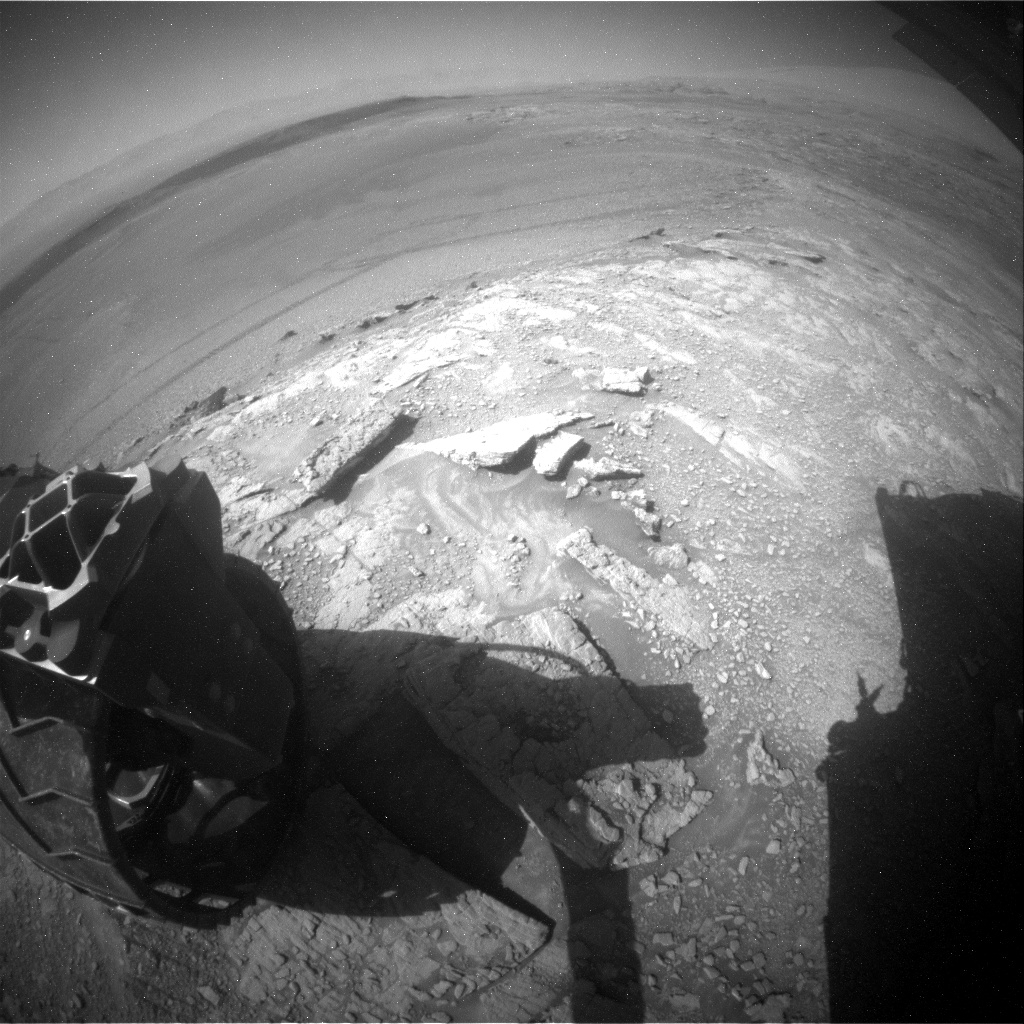
Curiosity Rear Hazcam Left B image taken on Sol 2526, September 14, 2019.
Credit: NASA/JPL-Caltech
“The MAHLI images of the drill tailings allowed us to choose the best location on the tailings to analyze with APXS,” Thompson notes. “We are interested in comparing the chemistry of the tailings, versus the DBA fines, versus the brushed surface prior to drilling to look for variations in composition with depth. We may have intersected different layers during drilling; the tailings are typically derived from the top 2 centimeters of the drill hole, while the DBA fines are derived from the lower several centimeters.”

Curiosity Mars Hand Lens Imager (MAHLI) photo produced on Sol 2524, September 12, 2019. MAHLI is located on the turret at the end of the rover’s robotic arm.
Credit: NASA/JPL-Caltech/MSSS
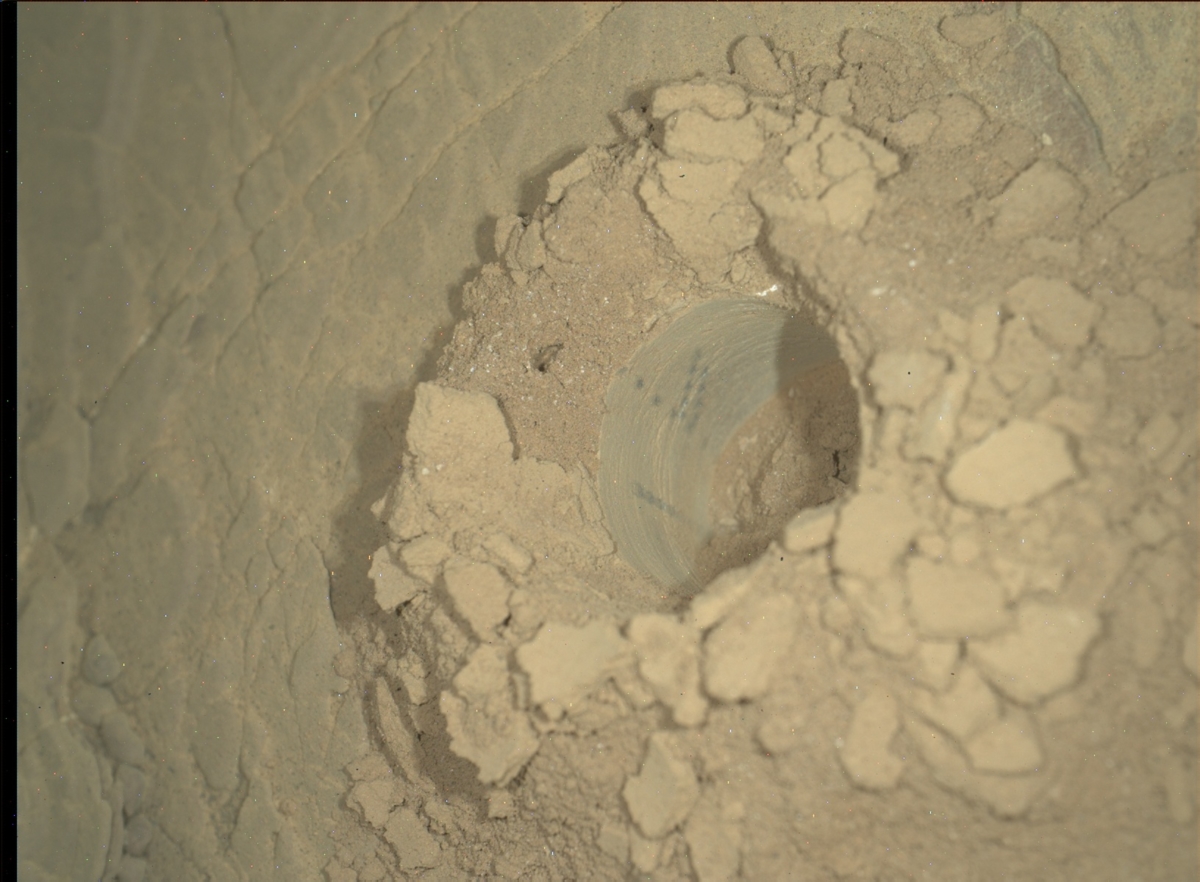
Curiosity Mars Hand Lens Imager (MAHLI) photo produced on Sol 2524, September 12, 2019.
Credit: NASA/JPL-Caltech/MSSS
Down the hole
Additional MAHLI imaging of the drill hole was also planned, including angled night time imaging down the hole to look for any obvious layering or veins, Thompson adds.
“The team is looking forward to wrapping up here at Glen Etive 1,” Thompson concludes, and drilling another hole close by to enable a more detailed study of this material with the internal rover laboratory instruments, the Chemistry & Mineralogy X-Ray Diffraction/X-Ray Fluorescence Instrument (CheMin) and the Sample Analysis at Mars (SAM) Instrument Suite.
 Posted in

Credit: Storm Area 51/Facebook
Aliens of all stripes are zeroing in on the secretive Area 51 next week.
Area 51 is the hush-hush U.S. Air Force military installation located at Groom Lake in southern Nevada.

Credit: Little A’Le’Inn
The installation has been the focus of numerous conspiracies involving the base’s extraterrestrial connection – a locale for captured flying saucers and surely an alien holding site.
The target dates of September 20-22 will see several activities, including “Storm Area 51, They Can’t Stop All of Us.”

Credit: Little A’Le’Inn
Mecca for believers
The town of Rachel is an unincorporated portion of Lincoln County, Nevada. As the closest habitation to the Nellis Air Force Range and Area 51, the area has become a Mecca for inquisitive UFO believers.
The town is roughly three hours drive north of Las Vegas along Nevada Highway 375, also called the “Extraterrestrial Highway.” Rachel is home base for Little A’Le’Inn that has been selling tickets for “ALIENSTOCK.”

Credit: Storm Area 51 Website
Be forewarned: There is no gas available in Rachel. Incoming alien hunters are urged to fill their tank in Alamo/Ash Springs from the east or Tonopah from the west.

Credit: Little A’Le’Inn
Getting heavy with Bud Light
Meanwhile, instead of storming a secretive government base, the Downtown Las Vegas Events Center is partnering with Collective Zoo and Bud Light to host an evening of top-secret entertainment on Thursday, September 19 with the Area 51 Celebration.

Credit: Downtown Las Vegas Events Center
“The time has come to sit back, share a beer, and talk all things aliens,” exclaims the associated website. “Come in peace, we have everything you need to make this celebration a blowout, including a classified lineup of music artists specially curated by Collective Zoo.”
Matty Roberts, the man behind the virtual “Storm Area 51” movement has been abducted to host the alien-themed event in downtown Las Vegas.

Gate-crashing no-no
Overall, there’s no telling how many are truly expected to populate the Area 51 festivities. As of this posting, it remains unclear what events may have been cancelled or are still planned in light of an alien free-for-all, even legal fights over events.
In the meantime, for those wishing to storm a highly-classified military base, UFO devotees are being warned that any gate-crashing is a no-no and will be deterred.
For more information, go to
Little A’Le’Inn at:
Storm Area 51 at:
https://www.stormarea51.us/?fbclid=IwAR20JzL7H_z5vSpBUbvsDS4revBE0Oa1NnoHguAB07BMy8wNBeVXndN1bmE
For the official anthem for the raid event by Finderz Keeperz, go to:
https://soundcloud.com/finderzkeeperz/theycantstopusall
For the Area 51 Celebration at the Downtown Las Vegas Events Center, go to:
https://dlvec.com/event/area-51-celebration/
Lastly, go to these informative videos at:

Credit: Boeing/Inside Outer Space Screengrab
The classified U.S. Air Force X-37B space plane program has winged its way to a new milestone in its hush-hush current flight – winging past two years in Earth orbit.
Also tagged as the Orbital Test Vehicle (OTV) – 5 mission, this currently orbiting space plane was rocketed into low Earth orbit back on September 7, 2017 – speeding around the planet now for over 730 days.
The now-orbiting, Boeing-built OTV-5 spacecraft, was lofted skyward atop a SpaceX Falcon 9 booster from Launch Complex 39A at NASA’s Kennedy Space Center in Florida.

Credit: Boeing/Inside Outer Space Screengrab
Milestone setting
Each X-37B/OTV mission has set a new flight-duration record for the program:
OTV-1 began April 22, 2010, and concluded on Dec. 3, 2010, after 224 days in orbit.
OTV-2 began March 5, 2011, and concluded on June 16, 2012, after 468 days on orbit.
OTV-3 chalked up nearly 675 days in orbit before finally coming down on Oct. 17, 2014.
OTV-4 flew for nearly 718 days during its mission, extending the total number of days spent in space for the OTV program at that point to 2,085 days. It was launched in May 2015 and landed in May 2017.

The X-37B Orbital Test Vehicle mission 4 (OTV-4), the Air Force’s unmanned, reusable space plane, landed at NASA’s Kennedy Space Center Shuttle Landing Facility May 7, 2017.
Credit: USAF
Landing when?
Exactly when the OTV-5 space plane will land is unknown. What is know is that the last Air Force’s X-37B mission, OTV-4 — after 718 days of flight — glided into NASA’s Kennedy Space Center Shuttle Landing Facility on May 7, 2017 – a first for the program. Previous landings of the space drone took place at Vandenberg Air Force Base in California.
Prior to launch of OTV-5, Randy Walden, the director of the Air Force Rapid Capabilities Office, said there were many firsts on this mission, making it a milestone for the program. “It is our goal to continue advancing the X-37B OTV so it can more fully support the growing space community.”

X-37B handout.
Credit: Boeing
Pushing the boundaries
In the personal view of Joan Johnson-Freese, a professor in the National Security Affairs Department at the Naval War College in Newport, Rhode Island:
“With each flight the Air Force appears to be pushing the boundaries of what the OTV can do – or what they hope it can do. What the eventual plans for the vehicle are remain unknown – maybe even by the Air Force,” Johnson-Freese told Inside Outer Space.
“But, as a test vehicle, the Air Force and Boeing are trying to determine its flexibility, capabilities, and duration. These test flights began going on 10 years ago so they’ve clearly gathered a considerable amount of information,” Johnson-Freese adds. In addressing the classified nature of the project, understandably it raises concerns in some other countries, she notes.
“When there is mystery there is speculation, and often of a worst-case basis when militaries are involved. Certainly if China were conducting these kinds of tests, there would be lots of worst-case speculation from the Pentagon,” Johnson-Freese concludes.

The U.S. Air Force’s X-37B Orbital Test Vehicle 4 is seen after landing at NASA ‘s Kennedy Space Center Shuttle Landing Facility in Florida on May 7, 2017.
Credit: U.S. Air Force courtesy photo
“Fleet of foot”
The classified X-37B program “fleet” consists of two known reusable vehicles, both of which were built by Boeing.
The X-37B Orbital Test Vehicle was fabricated at several Boeing locations in Southern California, including Huntington Beach, Seal Beach and El Segundo. The program transitioned to the U.S. Air Force in 2004 after earlier funded research efforts by Boeing, NASA and the Defense Advanced Research Projects Agency.
Looking like a miniature version of NASA’s now-retired space shuttle orbiter, the military space plane is 29 feet (8.8 meters) long and 9.6 feet (2.9 m) tall, with a wingspan of nearly 15 feet (4.6 m).
The X-37B space plane has a payload bay of 7 feet (2.1 meters) by 4 feet (1.2 meters), a bay that can be outfitted with a robotic arm. X-37B has a launch weight of 11,000 lbs. (4,990 kilograms) and is powered on orbit by gallium-arsenide solar cells with lithium-ion batteries.
The Air Force also noted that the fifth OTV mission was launched into, and will be landed from, a higher inclination orbit than prior missions to further expand the X-37B’s orbital envelope.
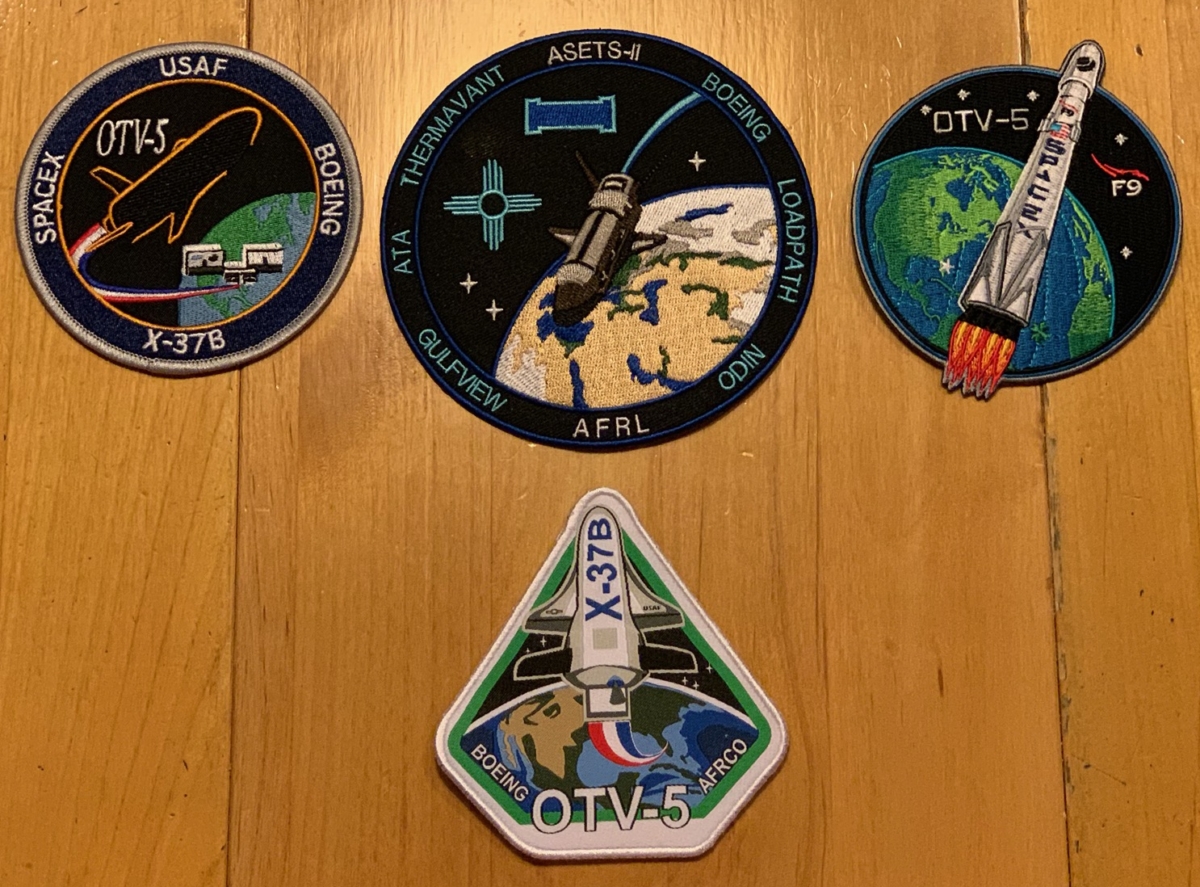
Credit: Michael & Loretta Rose
Space-based demonstrations
The missions of the X-37B space planes are carried out under the auspices of the Air Force Rapid Capabilities Office, and mission control for OTV flights are handled by the 3rd Space Experimentation Squadron at Schriever Air Force Base in Colorado. This squadron oversees operations of the X-37B Orbital Test Vehicle.
This Schriever Air Force Base unit is tagged as the Air Force Space Command’s premier organization for space-based demonstrations, pathfinders and experiment testing, gathering information on objects high above Earth and carrying out other intelligence-gathering duties.
And that may be a signal as to what the robotic craft is doing — both looking down at Earth and upward.

Asets-II payload logo.
Credit: AFRL
Heat pipes
On this latest clandestine mission of the space plane, all that’s known according to Air Force officials is that one payload flying on OTV-5 is the Advanced Structurally Embedded Thermal Spreader, or ASETS-II.
Developed by the U.S. Air Force Research Laboratory (AFRL), this cargo was to test experimental electronics and oscillating heat pipes for long duration stints in the space environment.
According to AFRL, the payload’s three primary science objectives are to measure the initial on-orbit thermal performance, to measure long duration thermal performance, and to assess any lifetime degradation.

The Pentagon’s Advanced Aerospace Threat Identification Program (AATIP) was created to research and investigate Unidentified Aerial Phenomena (UAP) including numerous videos of reported encounters, three of which were released to the public in 2017.
Credit: U.S. Department of Defense/To The Stars Academy of Arts & Science
A new Gallup poll finds two-thirds of Americans believe the government knows more about UFOs than it has conveyed. One-third of those polled think some UFOs are actual sightings of alien spacecraft.
Gallup’s Lydia Saad details poll findings in a September 6th communiqué:
“For decades, UFO enthusiasts have claimed the government is warehousing crashed UFOs, and possibly aliens, at Area 51, part of an Air Force base in southern Nevada. In other UFO news, the Navy recently issued new guidance for personnel to report ‘unexplained aerial phenomena’ after a spate of unusual sightings by Navy pilots,” Saad explains.

Credit: MUFON
Gallup findings
Other Gallup poll findings include:
- The 68% today who believe the government is withholding information about UFOs is comparable to the 71% found in 1996. Both times, the results were similar among all main demographic groups, including by age, education and party identification.
- However, it appears that only about half the number who think the government is hiding something about UFOs think it is covering up information about alien space landings, specifically. This conclusion is based on the finding that far fewer people give credence to UFO sightings or have witnessed them, personally, than think the government knows more than it’s telling.
- 33% of U.S. adults believe that some UFO sightings over the years have in fact been alien spacecraft visiting Earth from other planets or galaxies.
- The majority, 60%, are skeptical, saying that all UFO sightings can be explained by human activity or natural phenomenon, while another 7% are unsure.
- Separate from possible space landings on Earth, about half of Americans, 49% think that people somewhat like ourselves exist elsewhere in the universe. Even more, 75%, believe that some form of life exists on other planets.
- UFO believers are found in all demographic and political segments of society, but are particularly likely to be residents of the West. That is the home of Area 51, as well as nearby Roswell, New Mexico — where a crash of some kind in 1947 sparked the Area 51 conspiracy theories that persist to this day.
- Forty percent of residents of the West believe some UFOs can be attributed to alien visitors. This compares with 32% of residents in the East and South and 27% in the Midwest.

Credit: Orbitz
Bottom line observations
According to Saad, the bottom line of the new UFO poll:
“While not a majority, 33% of Americans believe alien spacecraft have visited Earth at some point. This group is potentially sympathetic to those who want to uncover what the government knows about alien landings, once and for all.”
“Another third or so of Americans may assume the government isn’t being completely transparent about what it knows, but not because it is hiding something. For example, they may believe officials are keeping quiet because unidentified sightings could unnecessarily alarm the public, or because refuting UFOs would require disclosing sensitive military information.”

Up close contact! Scene from Earth vs. the Flying Saucers circa 1956.
Credit: Columbia Pictures
“Regardless of what Americans think of UFOs or the government’s awareness of them, the subject is part of the nation’s consciousness with 86% of U.S. adults saying they have heard of or read about unidentified flying objects.”
To read the full report, go to:
https://news.gallup.com/poll/266441/americans-skeptical-ufos-say-government-knows.aspx
Also, go to this September 6th Newsweek story by Andrew Whalen:

Credit: ISRO/Inside Outer Space Screengrab
The Indian Space Research Organization (ISRO) has issued a September 7th update on the fate of the country’s Vikram lunar lander:
“Chandrayaan-2 mission was a highly complex mission, which represented a significant technological leap compared to the previous missions of ISRO, which brought together an Orbiter, Lander and Rover to explore the unexplored south pole of the Moon.
Since the launch of Chandrayaan-2 on July 22, 2019, not only India but the whole world watched its progress from one phase to the next with great expectations and excitement.
This was a unique mission which aimed at studying not just one area of the Moon but all the areas combining the exosphere, the surface as well as the sub-surface of the moon in a single mission.
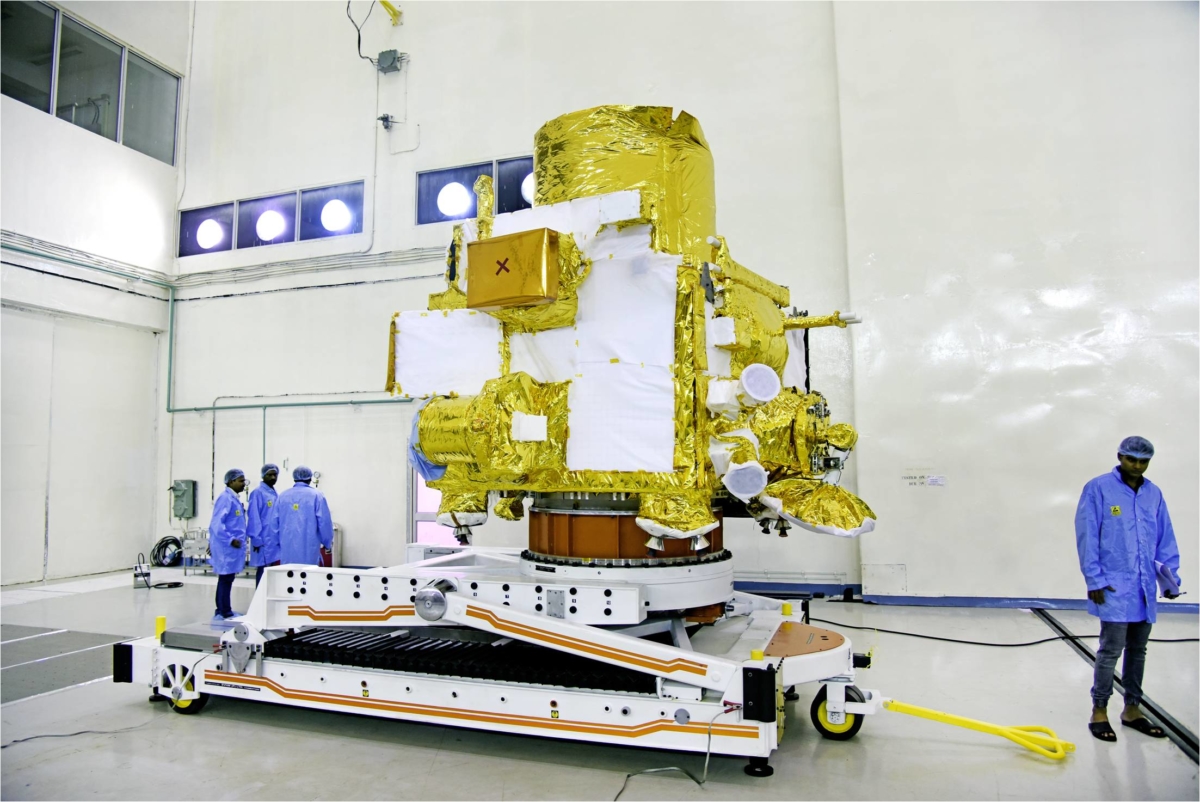
India’s Chandrayaan-2 lunar orbiter is loaded with scientific gear.
Credit: ISRO
The Orbiter has already been placed in its intended orbit around the Moon and shall enrich our understanding of the moon’s evolution and mapping of the minerals and water molecules in the Polar Regions, using its eight state-of-the-art scientific instruments.
The Orbiter camera is the highest resolution camera (0.3m) in any lunar mission so far and shall provide high resolution images which will be immensely useful to the global scientific community. The precise launch and mission management has ensured a long life of almost 7 years instead of the planned one year.

ISRO chief Kailasavadivoo Sivan announcing loss of signal with Vikram lander.
Credit: ISRO/Inside Outer Space Screengrab
The Vikram Lander followed the planned descent trajectory from its orbit of 35 km to just below 2 km above the surface. All the systems and sensors of the Lander functioned excellently until this point and proved many new technologies such as variable thrust propulsion technology used in the Lander.
The success criteria was defined for each and every phase of the mission and till date 90 to 95% of the mission objectives have been accomplished and will continue contribute to Lunar science, notwithstanding the loss of communication with the Lander.”
ISRO chief Kailasavadivoo Sivan announcing loss of signal with Vikram lander.
Credit: ISRO
India’s mission control lost communications with its Chandrayaan-2 lunar lander at roughly 1.3 miles (2.1 kilometers) from its lunar touchdown.
The true fate of the Vikram lander carrying the Pragyan rover is being reviewed by engineers at the Indian Space Research Organization (ISRO).
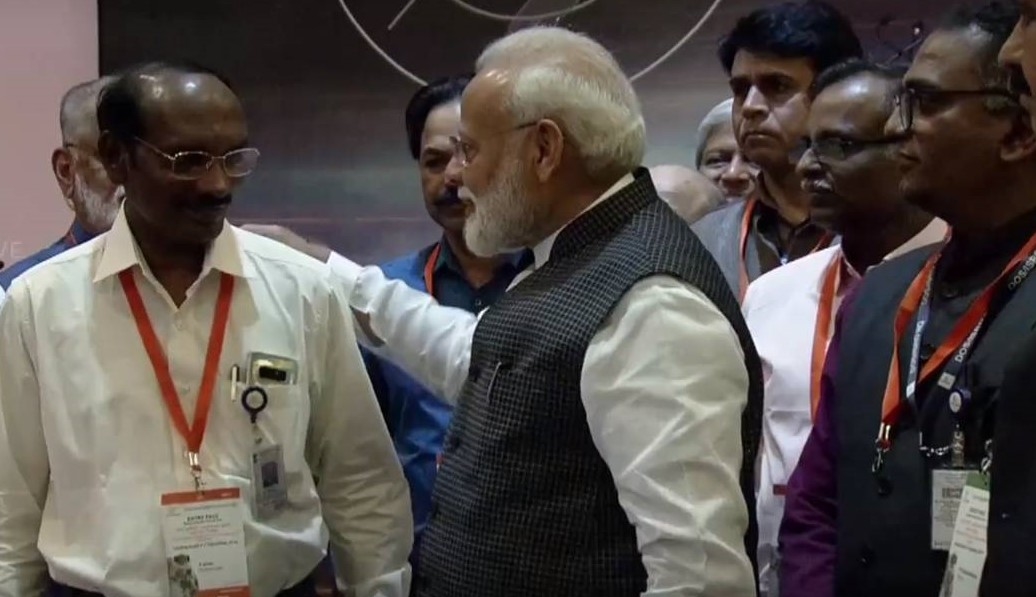
Indian Prime Minister Narendra Modi comforts ISRO leader.
Credit: ISRO
Under investigation
“The communications from the lander to ground station was lost. The data is being analyzed,” said ISRO chief Kailasavadivoo Sivan. Indian Prime Minister Narendra Modi was at mission control in the southern city of Bangalore.
What occurred during the Vikram lander’s powered descent remains under investigation.

Credit: ISRO
Orbiter capabilities
Meanwhile, the Chandrayaan-2 orbiter is circling the Moon, with an expected mission life of one year. It is toting an array of scientific instruments that promises to reveal the Moon from on-high, given a 100 x 100 kilometer lunar polar orbit.
The orbiter instruments are:
— Terrain Mapping Camera 2 (TMC 2)
— Chandrayaan 2 Large Area Soft X-ray Spectrometer (CLASS)
— Solar X-ray Monitor (XSM)
— Orbiter High Resolution Camera (OHRC)
— Imaging IR Spectrometer (IIRS)
— Dual Frequency Synthetic Aperture Radar (DFSAR)
India’s Chandrayaan-2 lunar orbiter is loaded with scientific gear.
Credit: ISRO
On-high investigations
The orbiter’s TMC 2 is a miniature version of the Terrain Mapping Camera used onboard India’s Chandrayaan-1 mission. Its primary objective is mapping the lunar surface to provide clues about the Moon’s evolution and help prepare 3D maps of the lunar surface.
Meanwhile, the OHRC is built to provide high-resolution images of the Vikram lander’s touchdown site, powerful enough to detect any craters or boulders in the landing area. The images it captures, taken from two different look angles, will serve several purposes. For one, they can be used to generate DEMs (Digital Elevation Models) of the landing site.
The dual frequency (L and S) SAR will provide enhanced capabilities to provide high-resolution lunar mapping in the polar regions; quantitative estimation of water-ice in the polar regions; and help estimate regolith thickness and its distribution.
If the ISRO Chandrayaan-2 lander/rover indeed cratered, the mission’s orbiter is in position and in good health to generate significant lunar science.

Credit: Air Force Space Command
The Air Force Space Command hosted a Space Futures Workshop (SFW) to explore the role of space to the year 2060.
Key workshop conclusions reached were:
- The U.S. must recognize that in 2060, space will be a major engine of national political, economic, and military power for whichever nations best organize and operate to exploit that potential.
- The U.S. faces growing competition from allies, rivals, and adversaries for leadership in the exploration and exploitation of space.
- China is executing a long-term civil, commercial, and military strategy to explore and economically develop the cislunar domain with the explicit aim of displacing the U.S. as the leading space power. Other nations are developing similar national strategies.
- A failure to remain a leading space power will place U.S. national power at risk. To avert this, the U.S. coalition must promote and optimize the combined civil, military, and commercial exploitation of space to best serves the nation’s interests.
- The U.S. military must define and execute its role in promoting, exploiting, and defending the expanded military, civil, and commercial U.S. activities and human presence in space.

Credit: U.S. Air Force/Tech. Sgt. David Salanitri
Thought leaders
The SFW was conducted at the U.S. Air Force Academy over three days, with 52 senior scientists, decision makers, leaders, and professors participating.
Participants were from the Air Force Air University, the Air Force Space Command, the Air Force Research Laboratory, the Defense Innovation Unit, the National Aeronautics and Space Administration, industry, federally funded research and development corporations, and academia.
The Air Force Space Command issued on September 5th a report — The Future of Space 2060 and Implications for U.S. Strategy: Report on the Space Futures Workshop – and can be viewed by going to this Politico.com site:
https://www.politico.com/f/?id=0000016d-0513-d6ab-a97f-4f93520b0001
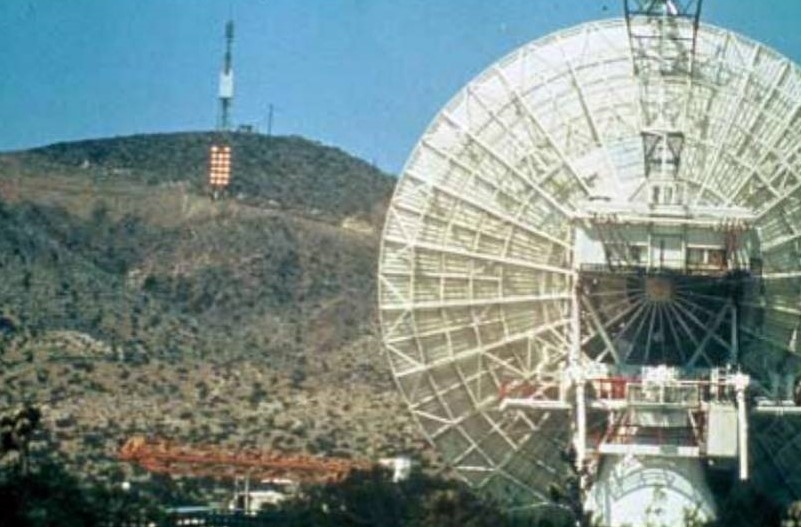
Credit: JPL
The ability to transmit energy over long distances without wires — known as “power beaming” — has been getting second looks + both in the U.S. and abroad.
To this point, the US Naval Research Laboratory (NRL) has issued a Request For Information (RFI) seeking inputs for how best “to implement a demonstration of a power beaming capability that is safe for users and bystanders,” and that delivers on an ongoing basis at least one kilowatt (kW) at a distance of at least one kilometer.

Peter Glaser, the father of the solar power satellite concept.
Credit: Arthur D. Little Inc.
History machine
Turning on the history machine, the idea of wireless power transmission began with Nikola Tesla near the end of the nineteenth century.
Then in 1968, the concept of a solar power satellite was detailed by U.S. space pioneer, Peter Glaser. It would harvest energy from sunlight using solar cells and beam it down to Earth as microwaves to receiving antennas (rectennas), which would convert those microwaves to electrical energy on the electric power grid.
Jump to the mid-1970s microwave power transmission experiments in the tens of kilowatts were conducted at the JPL Goldstone Deep Space Communications Complex in California.

Power beaming from space to Earth is attracting technologists.
Credit: John Mankins
Moon powersat
In more recent times, Mitsubishi Heavy Industries, Ltd. (MHI) announced in 2015 it had conducted ground demonstration testing of wireless power transmission to serve as the core technology of space solar power systems “that are expected to be the power generation systems of the future.”
Over the years, power beaming from the Moon to the Earth has been advocated.
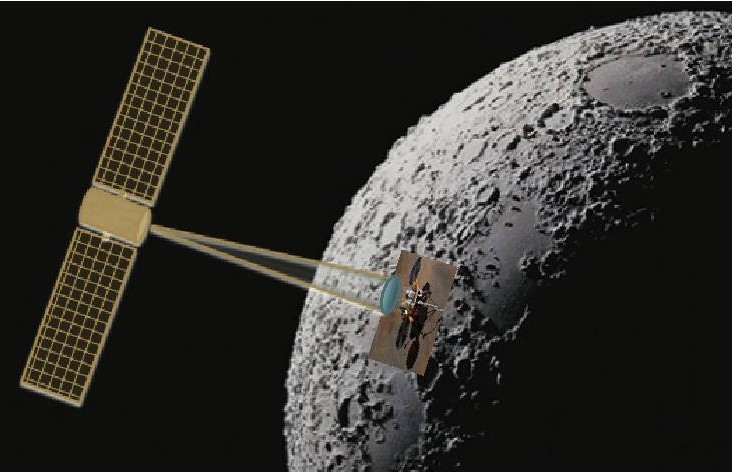
Earlier this year, at a Colorado School of Mines Space Resources meeting, using a space solar power satellite as an alternative power strategy for supporting lunar operations, was advocated by Michael Hecht of the MIT Haystack Observatory and Phil Lubin of the University of California, Santa Barbara.
Defense purposes
In the NRL RFI solicitation of August 30, it’s noted that power beaming interest by the Defense Advanced Research Projects Agency (DARPA), the Office of the Deputy Assistant Secretary of Defense for Operational Energy, the Institute of Electrical and Electronics Engineers and others, have gained “momentum, currency, and recognition.”
For defense purposes, the RFI states that a number of application areas are of immediate interest: swarming, teamed, and individual autonomous air, ground, and sea vehicles, off board countermeasures, unattended ground and sea sensors, explosive ordnance disposal, and camp/convoy/port/fleet security.
“These cover a range of mission areas, including providing communications, intelligence, surveillance, target acquisition, and reconnaissance. They are applicable in numerous military contexts, such as forward operating bases, combat outposts, landing parties, fleet operations, and distributed sensor networks. Power beaming can also be used to enhance energy harvesting or traditional solar energy collection,” the RFI explains.
Perhaps this new look at power beaming will breathe new life into both Earth and space settings?
To view the Power Beaming – Request for Information Solicitation, go to:
https://www.fbo.gov/spg/DON/ONR/N00173/N00173-19-RFI-AL06/listing.html
Credit: ISRO
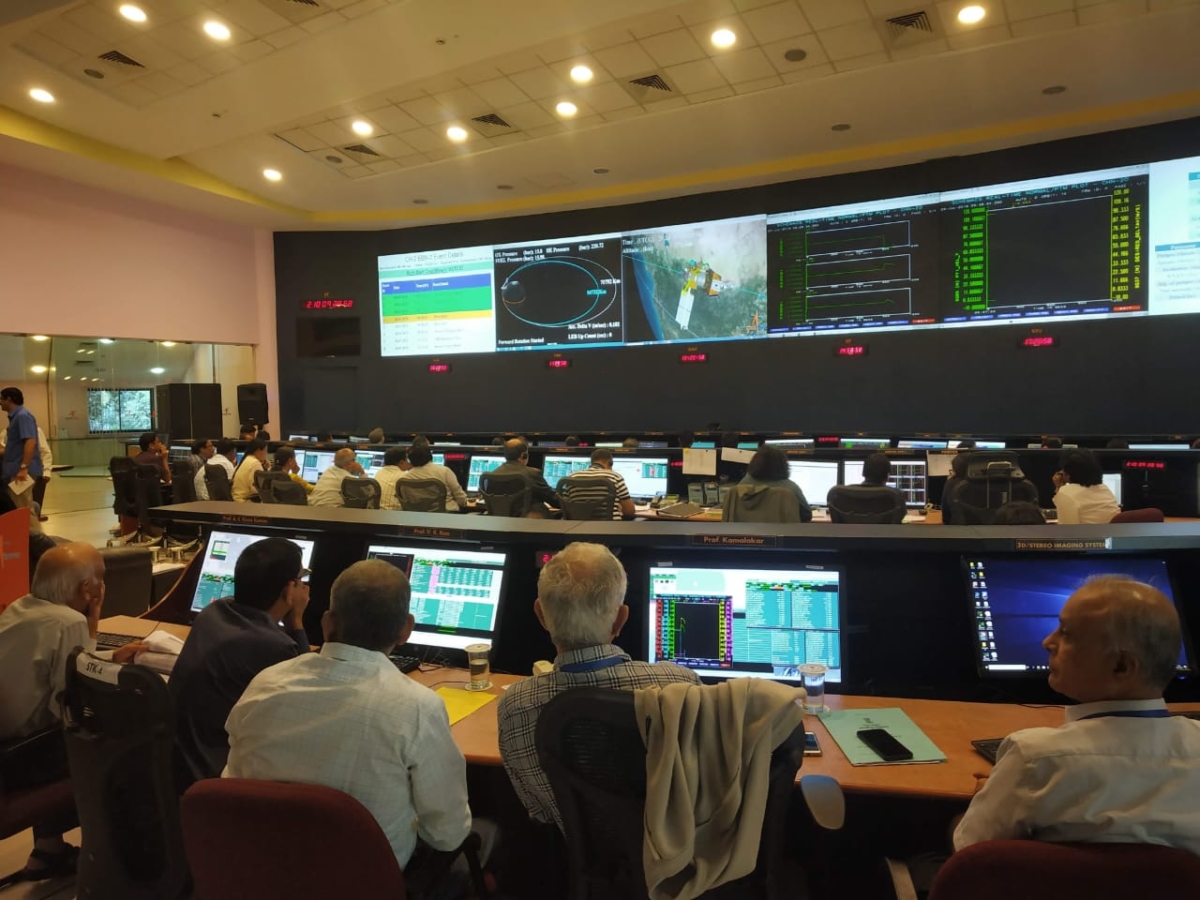
A nine-second de-orbiting maneuver for Chandrayaan-2 spacecraft was performed successfully today (September 04, 2019) beginning at 0342 hrs India Standard Time (IST) as planned, using the onboard propulsion system.
The completion of this maneuver has placed the Vikram lander into the required orbit for it to commence its descent toward the surface of the Moon.

Credit: ISRO/Inside Outer Space Screengrab
The orbit of the lunar lander is now 22 x 63 miles (35 x 101 kilometers).
Meanwhile, the Chandrayaan-2 orbiter continues to circle the Moon in an orbit of 60 x 78 miles (96 x 125 kilometers).
Both the orbiter and lander are healthy, reports the Indian Space Research Organization (ISRO).
Powered descent
The lander is scheduled to begin its powered descent between 0100 – 0200 hrs IST on September 07, 2019, which is then followed by touchdown of the Vikram lander between 0130 – 0230 hrs IST (between 4 and 5 p.m. U.S. Eastern, Sept. 6).

Chandrayaan-2 landing site in the highland plain between the craters Manzinus C and Simpelius N. Simpelius N crater is about 6 miles (9 kilometers) across.
Source: LROC Quickmap
Credit: Jatan Mehta/Moon Monday
The lander is targeted to plop down near the Moon’s south pole.
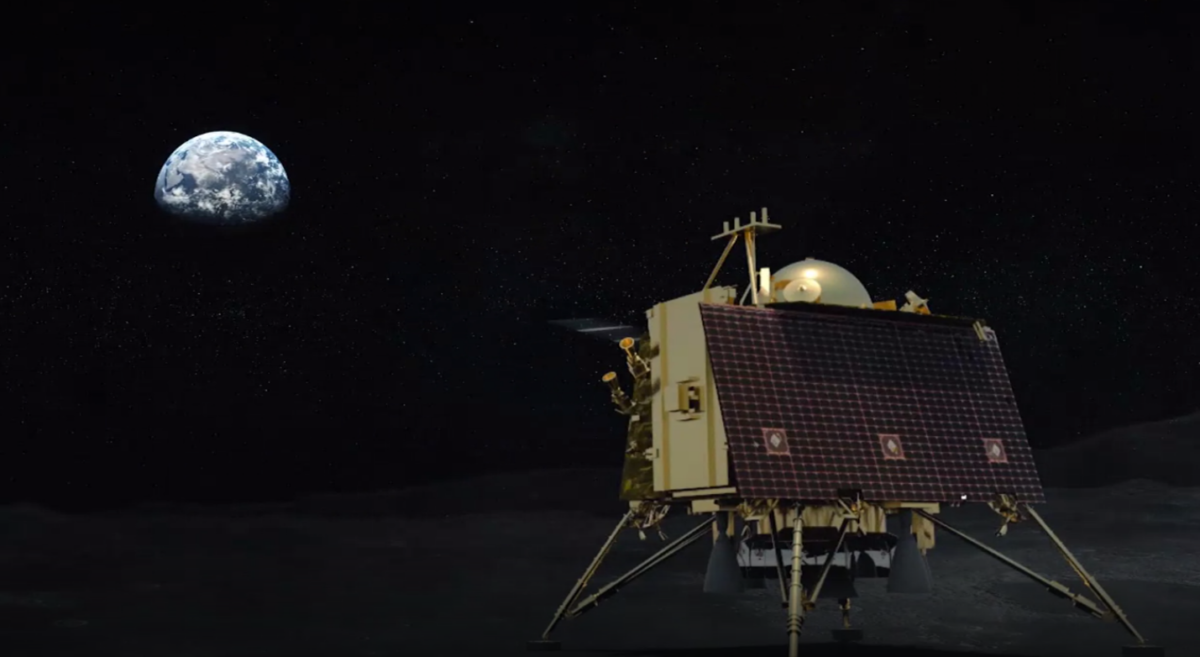
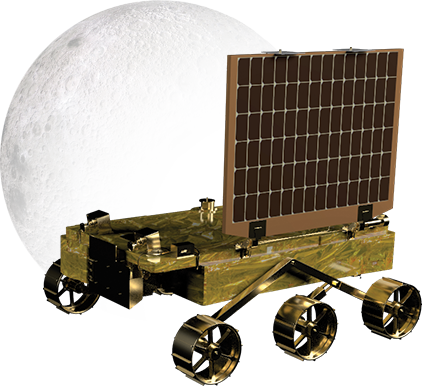
Given a successful touchdown by the lander, weighing 3,243 pounds (1,471 kilograms), its onboard Pragyan rover, weighing 60 pounds (27 kilograms), is to roll out onto the lunar surface between 5:30 am to 6:30 am.
The 6-wheeled rover can travel up to 1,640 feet (500 meters) from the landing spot on the Moon.
Credit: ISRO
Experiments
Onboard the Vikram lander is a Radio Anatomy of Moon Bound Hypersensitive ionosphere and Atmosphere (RAMBHA). This experiment is to measure factors such as ambient electron density/temperature near the lunar surface. Also, this experiment can provide a temporal evolution of lunar plasma density for the first time near the surface under varying solar conditions.
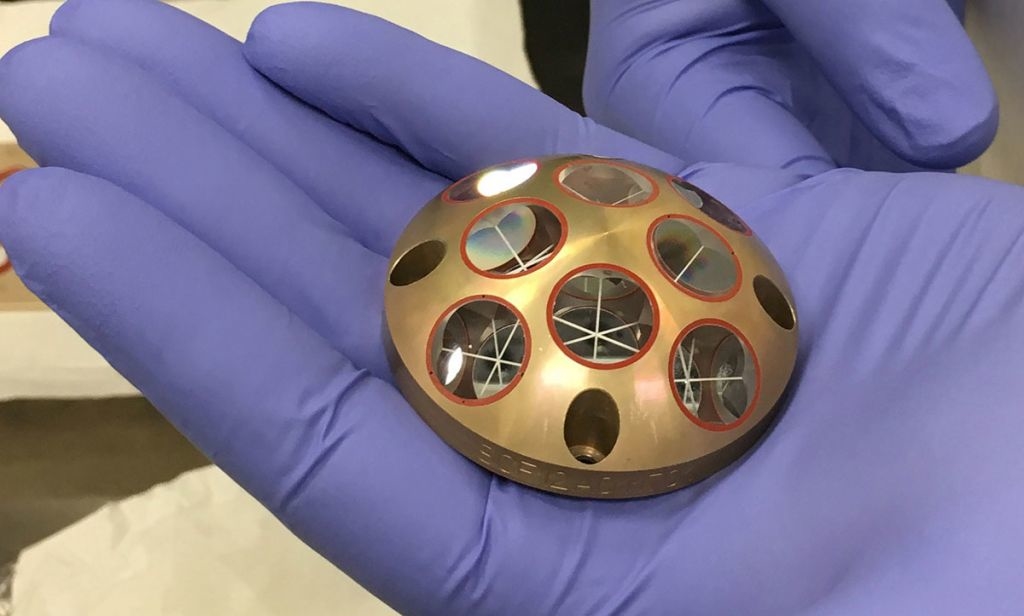
NASA-supplied Laser Retroreflector Array.
Credit: NASA/Goddard Space Flight Center
Chandra’s Surface Thermo-physical Experiment (ChaSTE) is to measure the vertical temperature gradient and thermal conductivity of the lunar surface.
Instrument for Lunar Seismic Activity (ILSA) is a Microelectromechanical systems (MEMS)-based seismometer that can detect minute ground displacement, velocity, or acceleration caused by lunar quakes.
Also onboard the lander is a NASA-supplied Laser Retroreflector Array to understand the dynamics of Earth’s Moon system and also derive clues on the lunar interior.
Credit: ISRO
The rover carries an Alpha Particle X-ray Spectrometer (APXS) to determine the elemental composition of the Moon’s surface near the landing site.
A Laser Induced Breakdown Spectrometer (LIBS) is to identify and determine the abundance of elements near the landing site.
Credit: U.S. Air Force/Tech. Sgt. David Salanitri
The Air Force Space Command is set to conduct the 13th Schriever Wargame at Maxwell Air Force Base, Alabama.
The Wargame scenario is set in the year 2029 and will explore critical space issues and examine the integration activities of multiple agencies associated with space systems and services.
Starting on September 4th, roughly 350 military and civilian experts from more than 27 commands and agencies around the country, as well as four international partners — Australia, Canada, New Zealand, the United Kingdom, as well as the United States.

Credit: U.S. Space Command
Wargame objectives
According to the Air Force Space Command, this iteration of the wargame is centered on the following objectives:
- Inform people, processes, and technologies to advance the United States Space Command’s (USSPACECOM) joint/combined operational missions.
- Explore opportunities and challenges of national, commercial, and coalition architectures to synchronize effects that protect and defend the space enterprise.
- Examine unity of command/effort to seamlessly integrate space operations and authorities across multiple classification and organizational levels.
- Advance shared understanding of responsible behaviors in the space domain and impacts on national and coalition decision-making, and
- Investigate whole-of-government(s) and coalition options to control escalation across all domains.

Notional space architecture.
Credit: Space Development Agency
Notional peer competitor
The scenario depicts a notional peer competitor seeking to achieve strategic goals by exploiting multi-domain operations.
Additionally, the scenario will also include a full spectrum of threats across diverse, multi-domain operating environments to challenge civilian and military leaders, planners and space system operators, as well as the capabilities they employ.
The Schriever Wargame 19 team will conduct this wargame on behalf of Air Force Space Command, headquartered in Colorado Springs, Colorado.

