Archive for the ‘Space News’ Category
 Author:
  October 15th, 2019
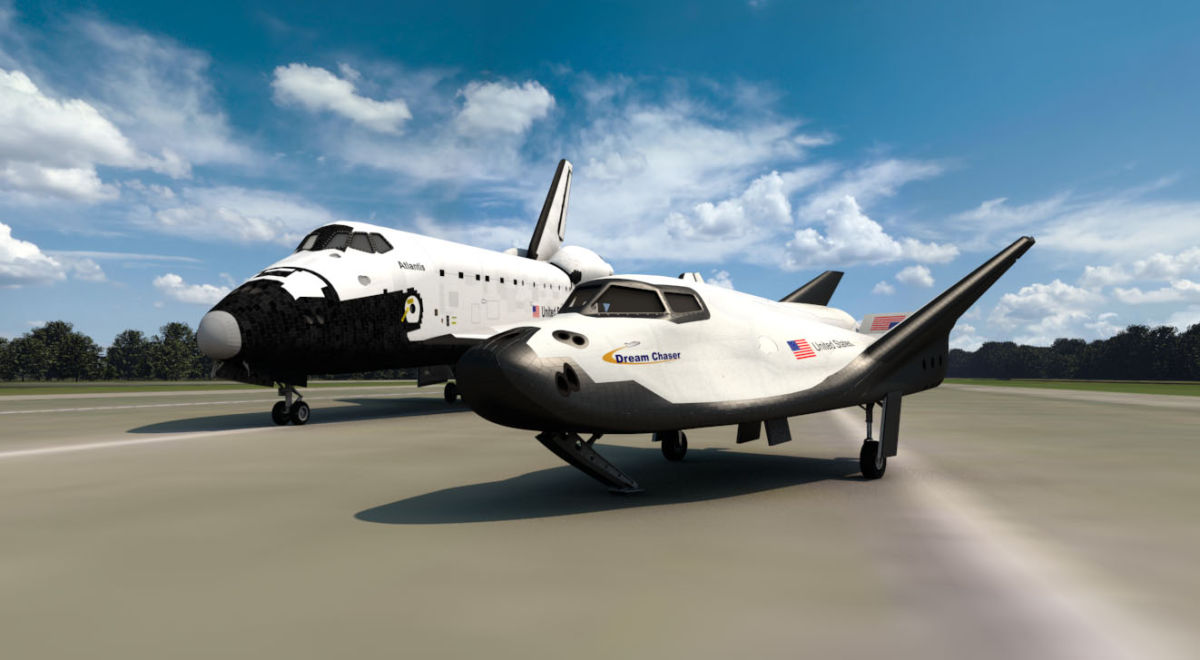
Contrast between smaller Dream Chaser and now scuttled Space Shuttle orbiter.
Credit: SNC
Sierra Nevada Corporation (SNC) in Louisville, Colorado has received the largest piece of technology to make up Dream Chaser.
It’s the most advanced high-temperature composite space frame ever built, according to SNC.
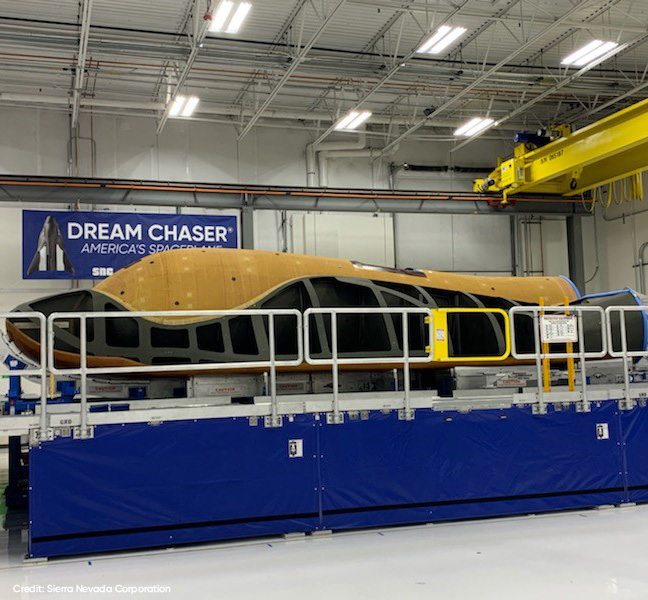
The primary structure is a pressurized composite structure.
Credit: SNC
Reports Eren Ozmen, chairwoman and president of SNC: “Our team has been looking forward to this day for a long time so that we can fully assemble America’s spaceplane in preparation for its first mission for NASA.”
Primary structure
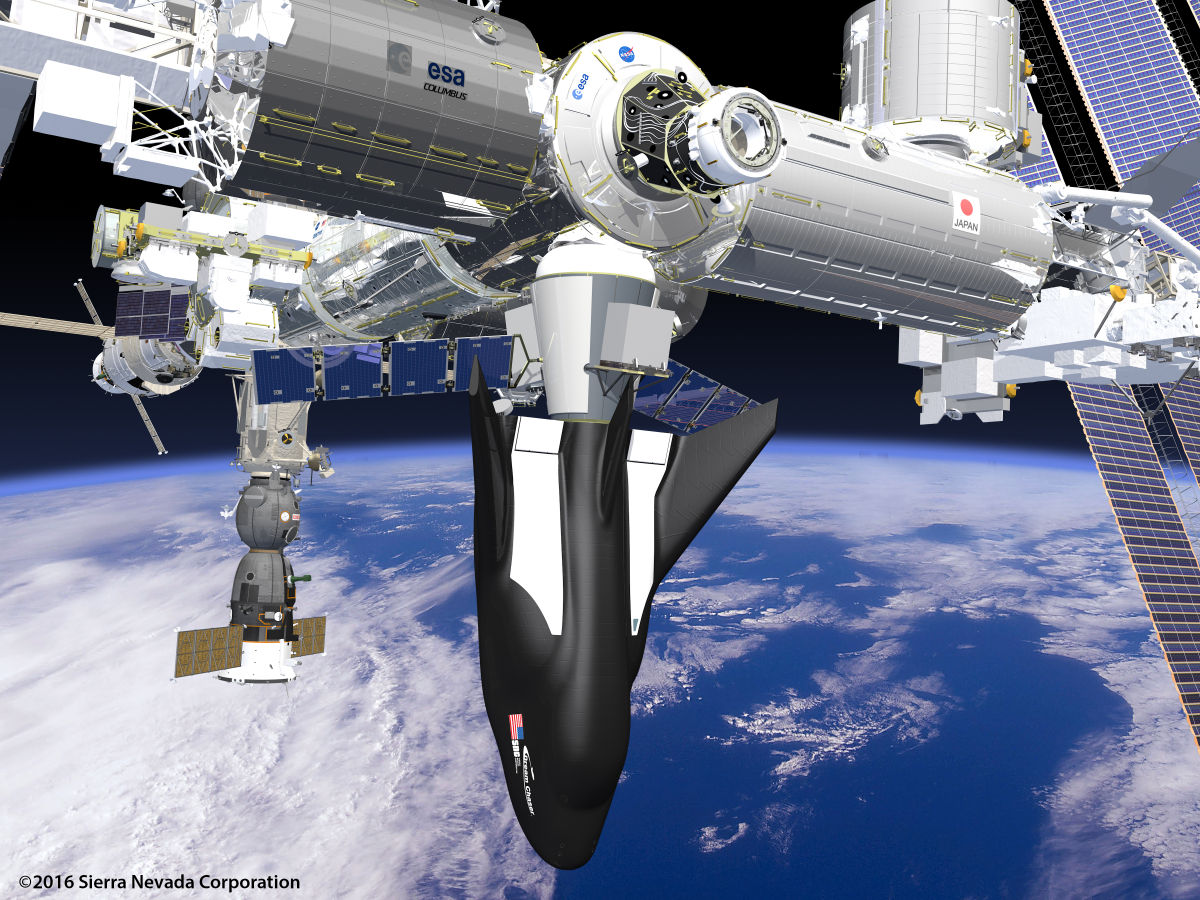
The primary structure is a pressurized composite structure that will contain pressurized payloads heading to the International Space Station.
The structure was manufactured by subcontractor Lockheed Martin and recently shipped from their Fort Worth, Texas facility to Louisville, Colorado, where Dream Chaser is being built and integrated by SNC.
Credit: NASA
Building block
“As the first building block of the spacecraft, it represents the first critical path hardware to be received in Colorado and launch of the assembly, integration and test (AI&T) phase of the program,” said former NASA space shuttle commander, astronaut and retired USAF pilot Steve Lindsey, now senior vice president of strategy for SNC’s Space Systems business area.
Dream Chaser is scheduled to launch starting in late 2021 for at least six cargo resupply and return services to the International Space Station for NASA under the Commercial Resupply Services 2 (CRS-2) contract.

Credit: SNC
The Dream Chaser Cargo System can carry up to 12,000 pounds of supplies and other cargo, and can return science experiments to Earth with a mild, wheels-down, runway landing.
 Posted in
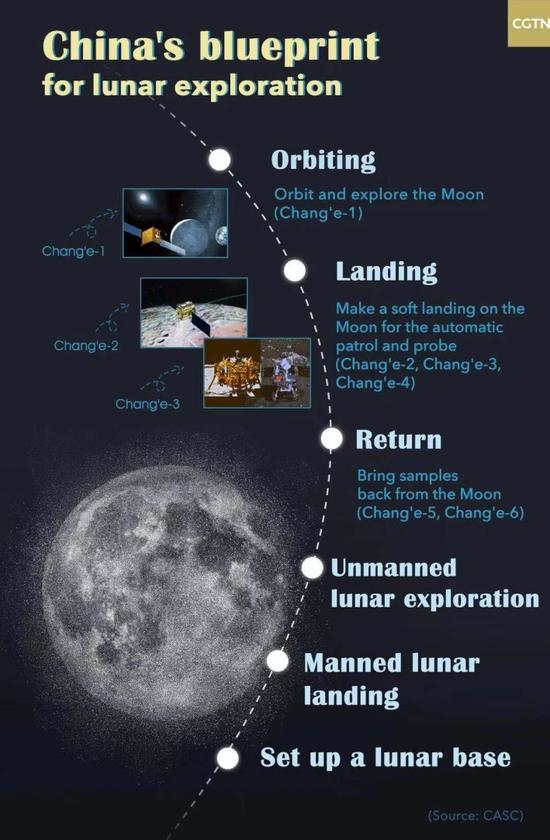
“Planned new rocket carries hope for China’s manned lunar landing program,” is the headline on a China Global Television Network (CGTN) story.
The Xinhua news agency-sourced story notes that Chinese space engineers have taken a key step in designing a new generation launch vehicle that could help start China’s manned lunar exploration program, citing the China Aerospace Science and Technology Corporation (CASC).
A pre-study for the carrier rocket, conducted by the China Academy of Launch Vehicle Technology (CALT) under the CASC, has passed a review by the China Manned Space Agency.
The mega-booster is to be about 285 feet (87 meters) long, having a liftoff weight of roughly 2,200 tons. It could carry payloads of more than 25 tons to the lunar transfer orbit and would have a new escape system to improve astronaut safety, the Xinhua story explains. “China is pushing forward the pre-study of a manned lunar landing program,” the posting notes.

Long March-5 booster’s first liftoff occurred in early November 2016. Mishap on launcher’s second flight in July 2017. Progress for a return-to-flight Long March-5 mission appears to be underway for possible flight late this year.
Credit: CASC
Grand road map
In a similar story, China Daily reports today that the new booster is almost twice as tall as the Long March 5, currently the largest of China’s booster series.
“China is making a grand road map for its manned lunar programs,” the China Daily story explains, citing China Space News, the flagship newspaper in the country’s space industry.
“However, the maximum carrying capacity of any existing Chinese rocket on a lunar transfer trajectory – the gateway for spacecraft to the Moon – is only 8 tons, which is just enough for robotic missions. To fulfill manned missions, Chinese scientists have to develop a mightier rocket to transport the country’s new-generation manned spacecraft,” the newspaper explained.

Credit: CNSA/China News Service Screengrab
According to China Daily, Hu Xiaojun, a rocket researcher at the China Academy of Launch Vehicle Technology, said earlier that over the long term the new rocket will be used in conjunction with the Long March 9 – a rocket that is also under development at his academy and that will be China’s most powerful rocket – to transport construction materials to the Moon for a permanent base.

Shown here is a skylight in the Moon’s Marius Hills.
Credit: NASA/GSFC/Arizona State University
Earth’s Moon is peppered with potential ready and waiting subsurface habitats in the form of lava tubes.
These features are good candidates for permanent human shelters. Moreover, these underground niches could reduce hazards to crews from lunar temperature swings, radiation, seismic activity, and meteorite impacts.
Evidence for their existence under the surface of the Moon has been provided by NASA’s GRAIL mission, Japan’s SELENE spacecraft, and NASA’s Lunar Reconnaissance Orbiter (LRO). Data from GRAIL suggests that lava tubes can be more than 3,000 feet to over 6,500 feet (1–2 kilometers) in width.

NASA’s twin Gravity Recovery and Interior Laboratory (GRAIL) probes.
Credit: NASA
Stability and safety
Still, the safety and resilience of those habitats are main concerns.
The size and geometry configurations under which the lava tubes are stable are not well-defined and there are no well-established criteria for their steadiness. A cave in would mean a bad day for Moon underground crews.
New research provides analytical and numerical solutions to estimate the size and stability of lunar lava tubes.

Deep diving into the Moon’s underground lava tubes. Entrances or “skylights” to lava tubes might provide future explorers a comfy safe haven.
Credit: Pascal Lee/Mars Institute/SETI Institute
Roof work
In work led by Audai Theinat of the Lyles School of Civil Engineering at Purdue University, a research team has used the flow characteristics of molten lava and the limit equilibrium analysis of the collapsed pits to estimate the size of the lunar lava tubes. Different sizes were considered, from 985 feet (300 meters) up to 13,000 feet (4,000 meters) in width.
According to the investigation by Theinat and team, the results show that the key parameters for the stability of the tubes are the roof thicknesses and the strength of the lava, in particular, its tensile strength. As the lava tube gets wider, a larger tensile strength and roof thicknesses are needed for the tube to remain stable, they report in the online journal, Icarus.
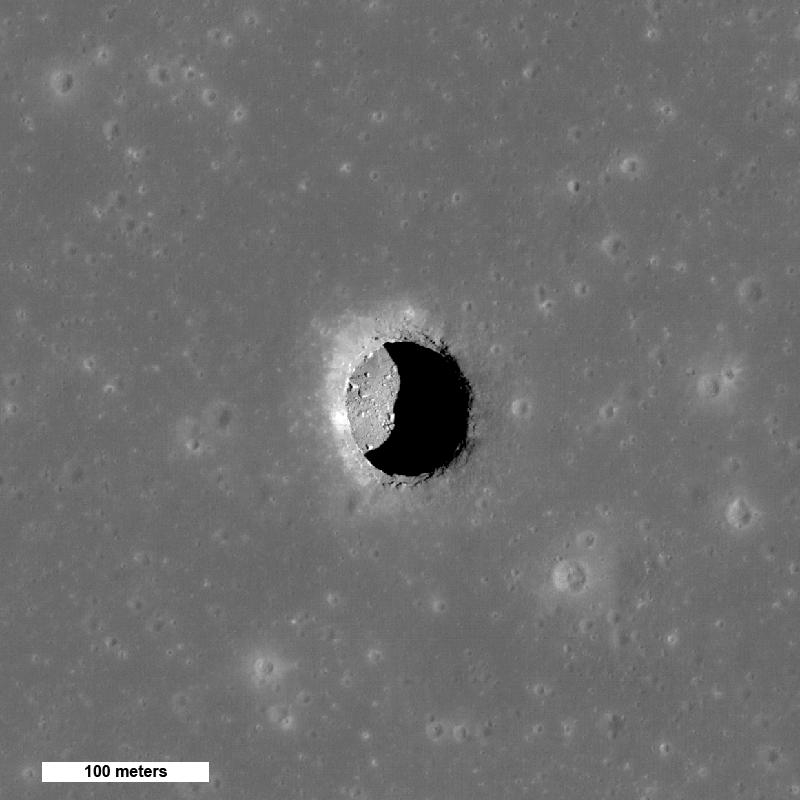
High Sun view of the Mare Tranquillitatis pit crater revealing boulders on an otherwise smooth floor.
NASA/GSFC/Arizona State University
The study indicates that 1 kilometer wide lava tubes are likely to exist and remain stable. For larger widths, however, minimum roof thicknesses of few hundred meters might be necessary to preserve their stability.
Skylight
Meanwhile, how best to “ground truth” lunar lava tubes earned the attention of NASA’s Innovation Advanced Concepts (NIAC) program. Recently receiving a NIAC Phase III award is robotic pioneer, William “Red” Whittaker, a professor at Carnegie Mellon University’s Robotics Institute.
Skylight is a fast, autonomous micro-roving mission concept to explore and model these features that might be gateways to caves on the Moon.
Skylights on the Moon are collapses that come about over subsurface voids. Here on Earth, skylights occur in many lava tubes, providing access to underground caves.
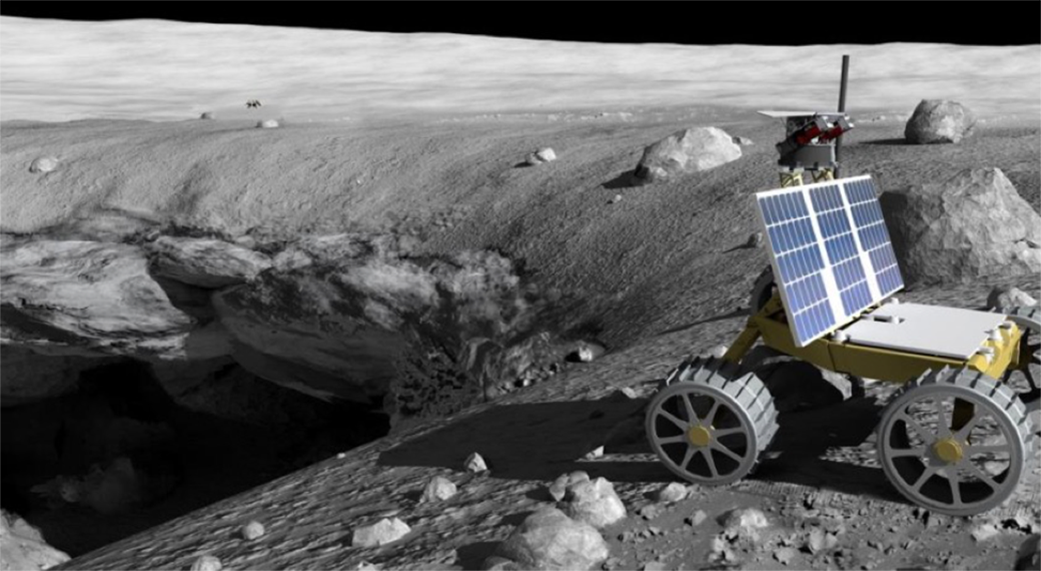
Skylight is a fast, autonomous micro-roving mission concept to explore and model these features that might be gateways to caves on the Moon.
Credit: William Whittaker
Smart and speedy robots
Whittaker’s NIAC-supported work is evaluating use of one or more “smart and speedy” robots to inspect and quickly generate on-the-spot, computer-generated models of craters on the Moon.
These craters, up to now only spotted by Moon-orbiting spacecraft, may be sites of caves that could offer future explorers underground shelter, as well as access to minerals, ice and other resources.
It is essential to develop small autonomous robots, Whittaker says, self-thinking machinery that’s fast and can achieve lunar crater investigations in just a week. After that period of time, he points out that the solar-energized equipment would be exposed to the ultra-chilly lunar night that would permanently disable them.
Rim reasoning
“The idea here is that a rover coming onto a pit is akin to seeing the Grand Canyon for the first time,” Whittaker suggests. “The robot will be constantly reasoning to occupy the vantage points at the pit’s rim, then game the risk. Acquiring thousands of images, the robot would generate high-fidelity scientific models that are the purpose of this exploration.”
“The game is on,” underscores Whittaker in terms of renewed human exploration of the Moon.
For more information on the research paper – “Lunar lava tubes: Morphology to structural stability” – go to:
https://www.sciencedirect.com/science/article/abs/pii/S0019103518307826#ab0005
Additional information on NIAC and the Whittaker work can be found at:
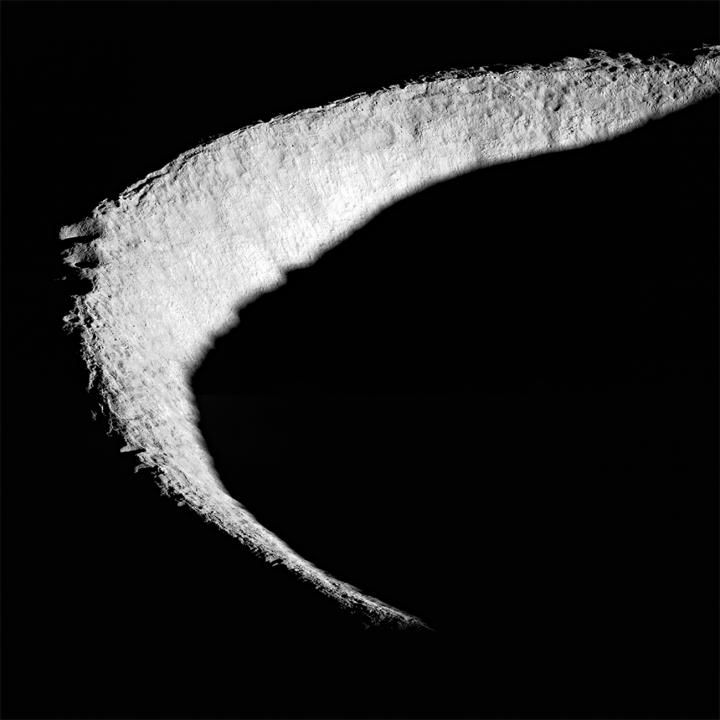
Shackleton Crater, the floor of which is permanently shadowed from the Sun, appears to be home to deposits of water ice. A new study sheds light on how old these and other deposits on the Moon’s south pole might be.
Credit: NASA/GSFC/Arizona State University
A new study sheds light on how old deposits of water ice at the Moon’s south pole might be.
Observations are mounting regarding ice deposits in craters scattered across the Moon’s south pole, also dubbed as “cold traps.” However, when or how that ice got there remains puzzling.

Credit: NASA
A new study published in the journal Icarus suggests that while a majority of those deposits are likely billions of years old, some may be much more recent.
Ice as a resource
Ariel Deutsch, a graduate student in Brown University’s Department of Earth, Environmental and Planetary Sciences and the study’s lead author, says that constraining the ages of the deposits is important both for basic science and for future lunar explorers who might process that ice for oxygen, water, rocket fuel, and other purposes.
For the study, Deutsch worked with Jim Head, a professor at Brown, and Gregory Neumann from the NASA Goddard Space Flight Center.
“When we think about sending humans back to the Moon for long-term exploration, we need to know what resources are there that we can count on, and we currently don’t know,” Head said. “Studies like this one help us make predictions about where we need to go to answer those questions,” he said in a Brown University statement.

Lunar Reconnaissance Orbiter flies over Shackleton crater near the lunar south pole in this computer rendering.
Credit: NASA’s Scientific Visualization Studio
Orbiter data
“For exploration purposes,” Deutsch adds in the university statement, “we need to understand the lateral and vertical distributions of these deposits to figure out how best to access them. These distributions evolve with time, so having an idea of the age is important.”
Using data from NASA’s Lunar Reconnaissance Orbiter (LRO) — which has been orbiting the Moon since 2009 — large craters were assessed in which evidence for south pole ice deposits was found.
To age-date the craters, the number of smaller craters were counted that have accrued inside the larger ones. Scientists have an approximate idea of the pace of impacts over time, so counting craters can help establish the ages of terrains.
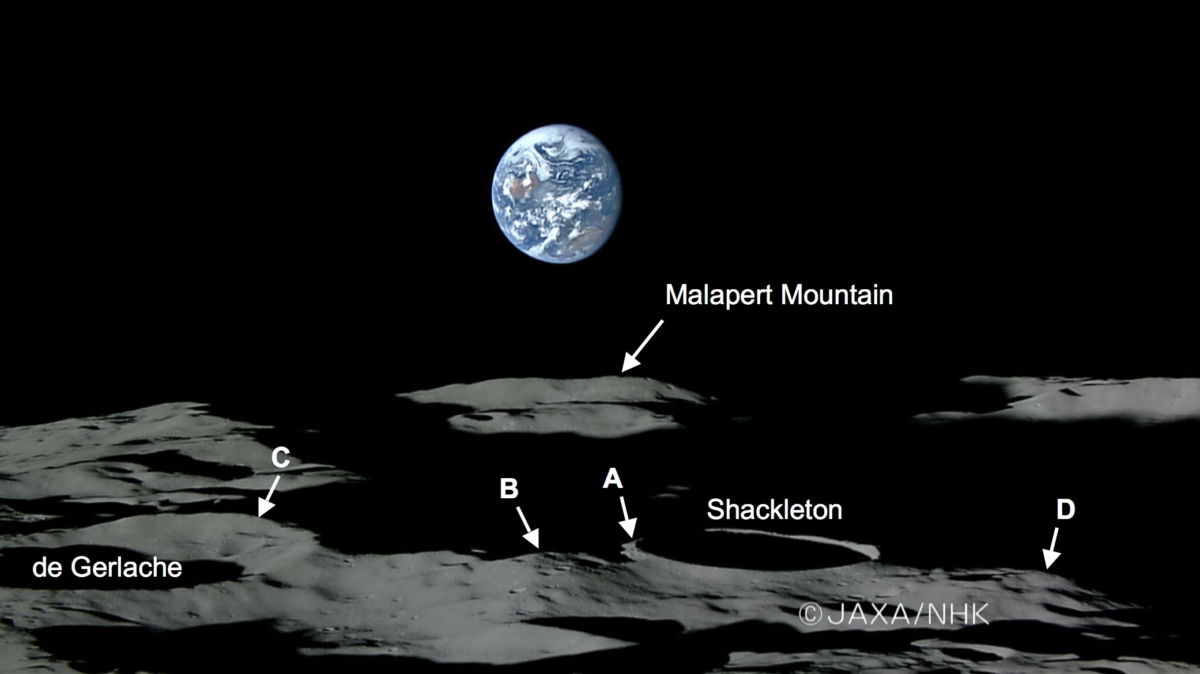
Lunar South Pole, 4 peaks are identified which are illuminated more than 80% of the time.
Credit: JAXA
Aging the ice
The majority of the reported ice deposits are found within large craters formed about 3.1 billion years or longer ago, the study found. Since the ice can’t be any older than the crater, that puts an upper bound on the age of the ice. Just because the crater is old doesn’t mean that the ice within it is also that old too, but in this case there’s reason to believe the ice is indeed old.
The deposits have a patchy distribution across crater floors. This suggests that the ice has been battered by micrometeorite impacts and other debris over a long period of time.

Newly developed extraction technique for the Moon, thermal mining, makes use of mirrors to exploit sun-shy, water ice-laden polar craters.
Credit: School of Mines/Dreyer, Williams, Sowers
Significant implications
If those reported ice deposits are indeed ancient, that could have significant implications in terms of exploration and potential resource utilization.
“There have been models of bombardment through time showing that ice starts to concentrate with depth,” Deutsch said. “So if you have a surface layer that’s old, you’d expect more underneath.”
While the majority of ice was in the ancient craters, the researchers also found evidence for ice in smaller craters that, judging by their sharp, well-defined features, appear to be quite fresh. That suggests that some of the deposits on the south pole got there relatively recently.
“That was a surprise,” Deutsch said. “There hadn’t really been any observations of ice in younger cold traps before.”
If there are indeed deposits of different ages, the researchers say, that suggests they may also have different sources.

Exploration of south pole crater. Water ice-rich resource ready for processing?
Credit: NASA
Different sources
Older ice could have been sourced from water-bearing comets and asteroids impacting the surface, or through volcanic activity that drew water from deep within the Moon.
But there aren’t many big water-bearing impactors around in recent times, and volcanism is thought to have ceased on the Moon over a billion years ago. So more recent ice deposits would require different sources — perhaps bombardment from pea-sized micrometeorites or implantation by solar wind.

NASA’s Artemis program – back to the Moon by female/male astronaut crew in 2024.
Credit: NASA
Next steps
The best way to find out for sure, the researchers say, is to send spacecraft there to get some samples.
NASA’s Artemis program aims to put humans on the Moon by 2024, and plans to fly numerous precursor missions with robotic spacecraft in the meantime.
Head says studies like this recently completed work will help to shape those future missions.
The new research in Icarus – “Analyzing the ages of south polar craters on the Moon: Implications for the sources and evolution of surface water ice” – is available here:
https://www.sciencedirect.com/science/article/abs/pii/S0019103519303689?via%3Dihub

NASA’s Curiosity Mars rover is now performing Sol 2554 duties.
A set of scenic images shows the robot’s current surroundings.
A number of close-up images of the rover taken by the Mars Hand Lens Imager (MAHLI) appear to indicate a new selfie may be in production.

Curiosity Mars Hand Lens Imager (MAHLI) photo produced on Sol 2553, October 12, 2019.
Credit: NASA/JPL-Caltech/MSSS
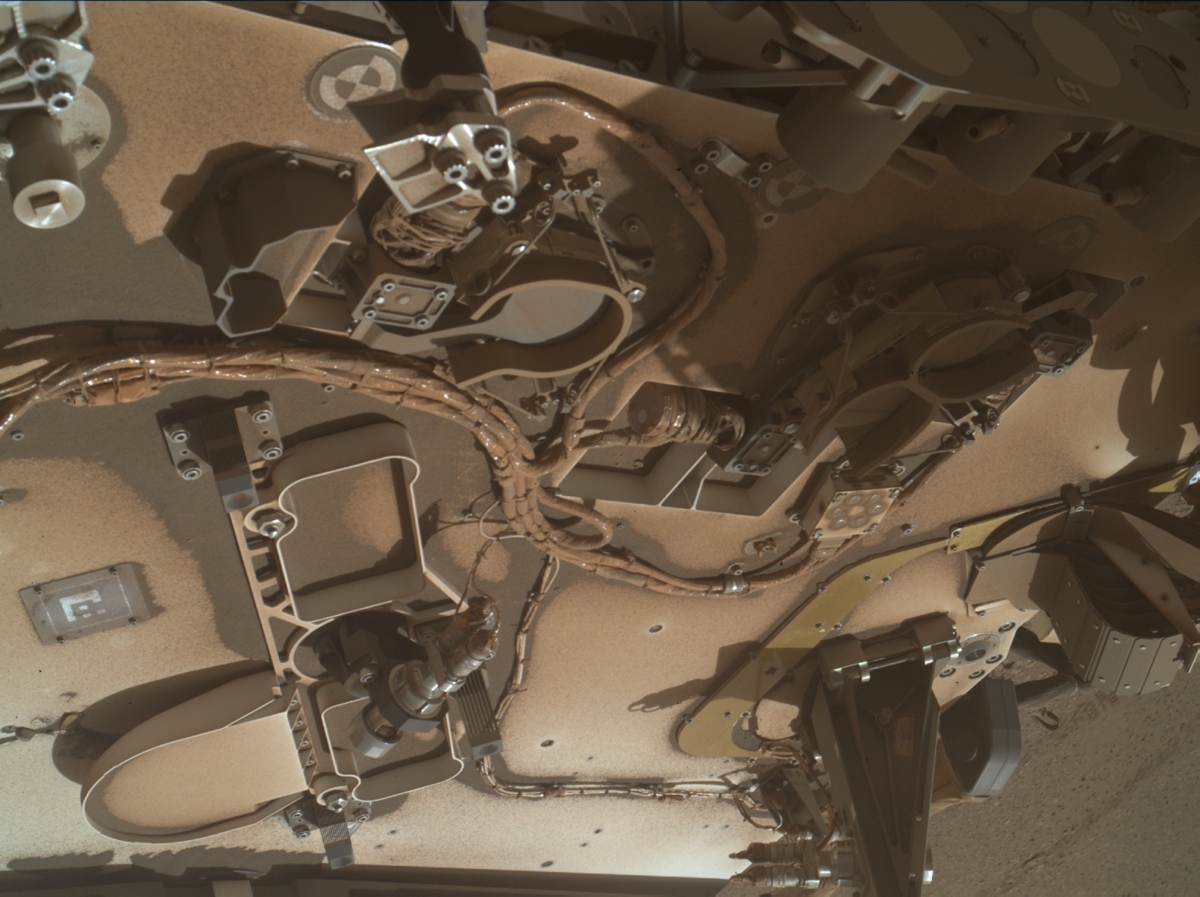
Curiosity Mars Hand Lens Imager (MAHLI) photo produced on Sol 2553, October 12, 2019.
Credit: NASA/JPL-Caltech/MSSS

Curiosity Mars Hand Lens Imager (MAHLI) photo produced on Sol 2553, October 12, 2019.
Credit: NASA/JPL-Caltech/MSSS
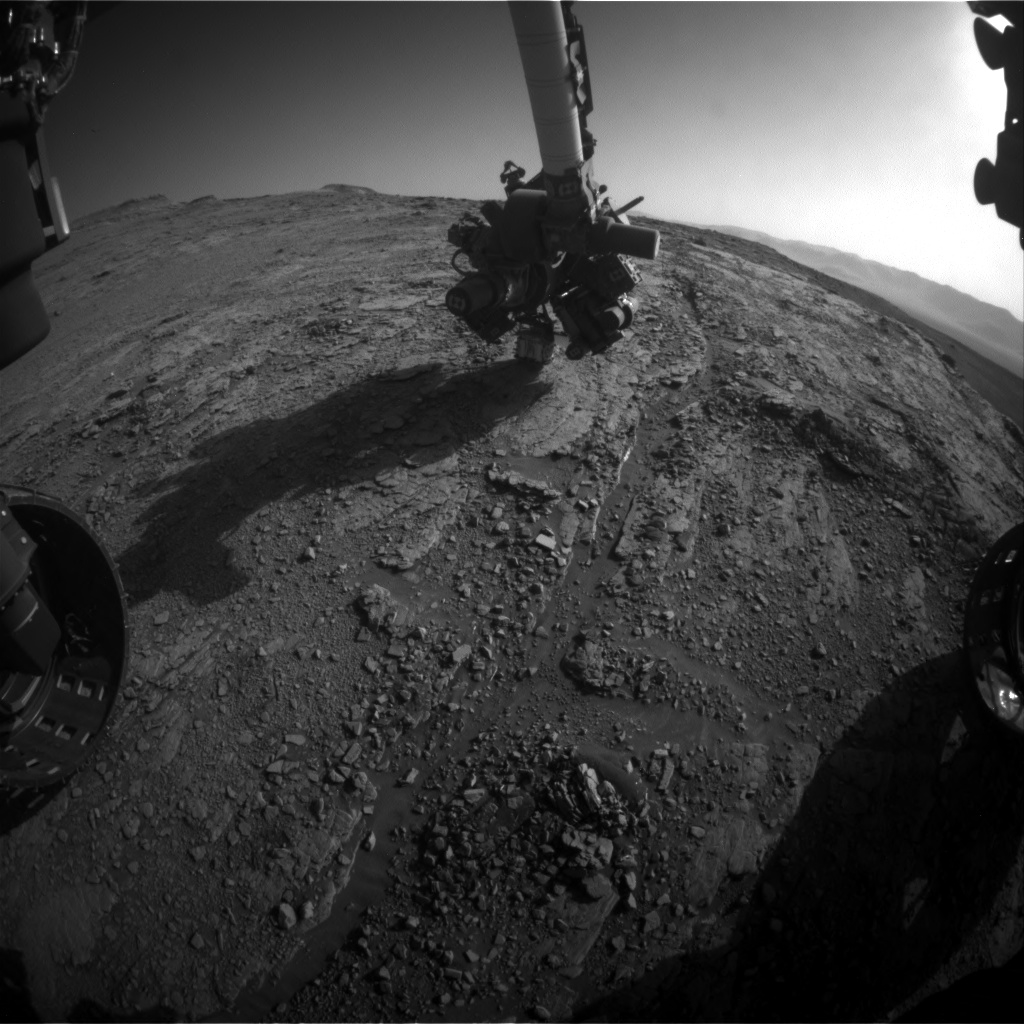
Curiosity Front Hazard Avoidance Camera Left B image taken on Sol 2553, October 12, 2019.
Credit: NASA/JPL-Caltech
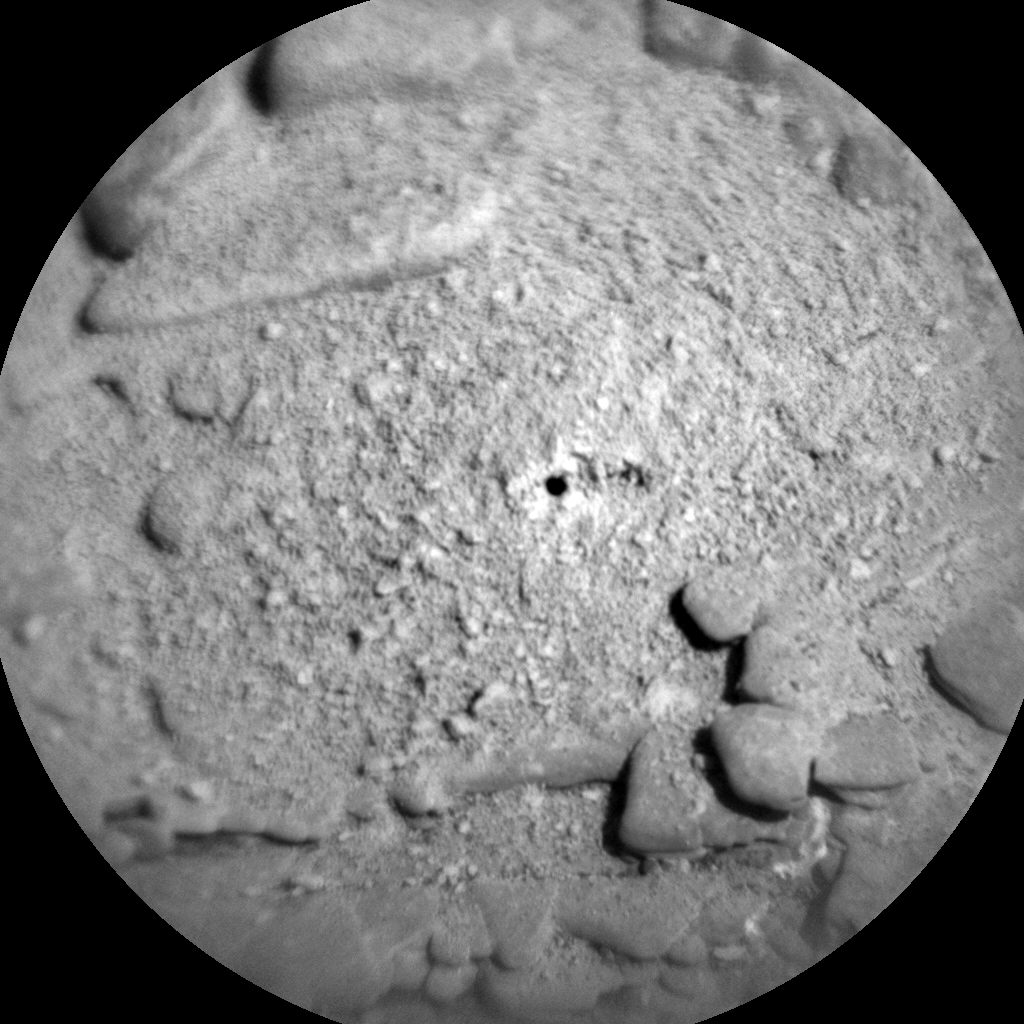
Curiosity Chemistry & Camera (ChemCam) image shows laser hits on the target. Photo taken on Sol 2554, October 13, 2019.
Credit: NASA/JPL-Caltech/LANL
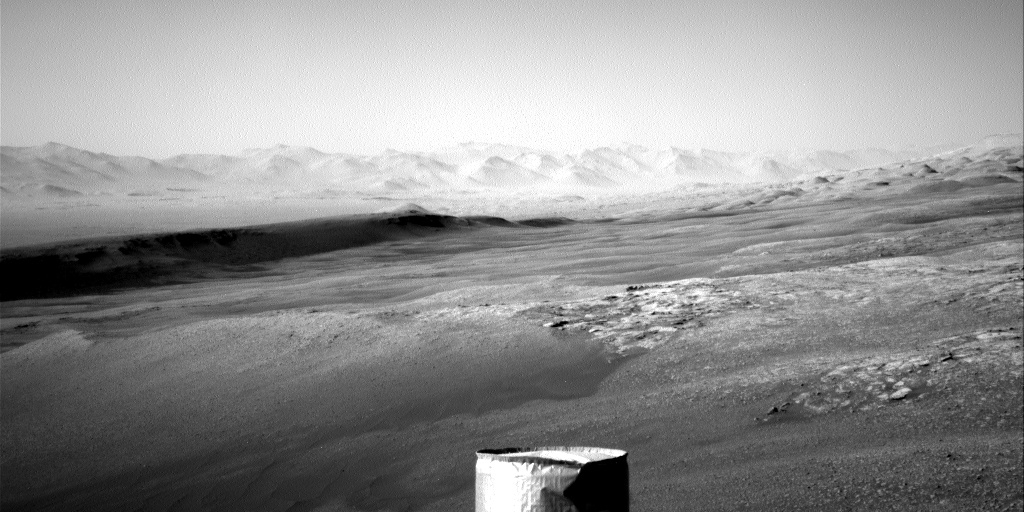
Curiosity Right Navigation Camera B image acquired on Sol 2552, October 11, 2019.
Credit: NASA/JPL-Caltech

Block II prototype Apollo Guidance Computer.
Credit: RR Auction/Don Eyles Collection
RR Auction is offering the Don Eyles Collection in its Fall Space Exploration sale with online bidding running October 11- October 17.
As a 27-year-old MIT computer expert, Don Eyles worked at Draper Labs, the place commissioned by NASA to write the computer code that would take us to the Moon.
Highlights from the collection include; an extremely rare Apollo Guidance Computer prototype—the brain behind the lunar landing.
Electric brain
The Apollo Guidance Computer was in the era of room-sized computers, NASA allocated one cubic foot on their spacecraft for the electric brain that would be responsible for guiding humans to the lunar surface and safely returning them home.
Rather than using the large vacuum tubes or big discrete transistors typical in computers of the time, MIT engineers pioneered the application of integrated circuits—microchips—to accomplish the same task in a diminutive package.
Among additional highlights from the Don Eyles Collection; various mission-used manuals, along with unique computer program printouts.

Book of Mormon carried to the Moon on Apollo 16 by Commander John Young.
Credit: RR Auction/M. Edward Thomas Collection
Book of Mormon
Additional items in the space exploration sale include an extraordinary “Book of Mormon” carried to the Moon on Apollo 16 by Commander John Young, part of the M. Edward Thomas Collection. It was presented to NASA photographer M. Edward Thomas following the mission, signed and flight-certified.
In his capacity as NASA’s astronaut photographer, Marion Edward Thomas (known as “Ed”) worked with John Young in 1972. He was inspired to ask if the Apollo 16 commander planned to take a bible to the Moon with him. Young agreed that having the Lord’s book with him on the momentous occasion was a good idea, and Ed promised to provide him with one.
But fearing that the family’s heirloom bible may not return if tragedy struck, his wife — a devout member of the LDS Church — lent her personal, purse-sized Book of Mormon for the task.
The Space & Aviation Auction from RR Auction began on October 11 and will conclude on October 17.
For more information, go to:

Credit: China Aerospace Technology Corporation
The first picture of China’s Mars explorer has been unveiled, a spacecraft set to be lobbed toward Mars next year.
In a China Global Television Network (CGTV) story, Ye Jianpei, chief scientist of Space Science and Deep-space Exploration with the Chinese Space Technology Academy, said: “The mission is going smoothly. If no surprise, the Mars explorer is going to be launched in 2020, and land before 2021.”

Credit: CCTV America/Screengrab Inside Outer Space
The image of an encapsulated spacecraft within its cocoon-like aeroshell was issued by the China Aerospace Technology Corporation. Earlier stories by Chinese space officials said the mission includes an orbiter, lander, and a rover.

Credit: CCTV America
Triple tasks, one mission
The mission is designed to examine the Red Planet’s atmosphere, landscape, geological and magnetic characteristics, which could provide clues to the origin and evolution of Mars and the solar system, Ye said.
“Mars exploration is very innovative. If it proves to be a success, it will be the world’s first time a country completes the three tasks in one mission,” Ye added.
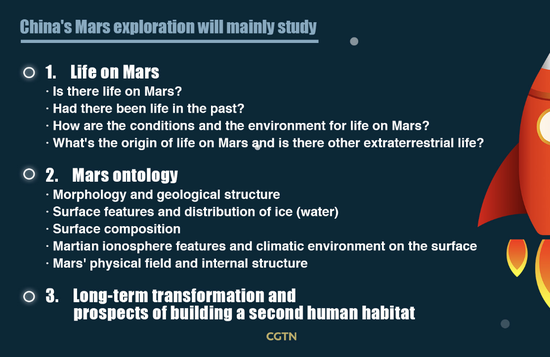
Credit: CGTN Infographic
To reach Mars, the spacecraft will be sent into geosynchronous orbit via the heavy-lift Long March 5 liquid carrier rocket – a booster that is up for reflight to certify it is ready to carry Moon/Mars payloads.
Following that phase, the Mars probe will have a seven-month flight to the Red Planet.
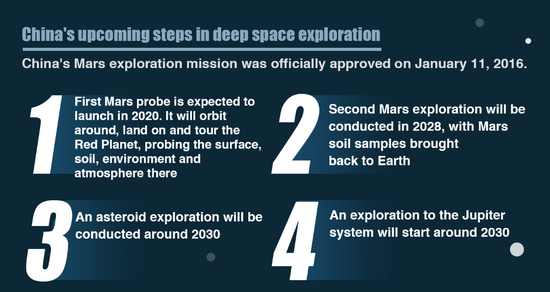
Credit: CGTV Infographic
In an August 2016 video, China’s upcoming Mars mission was said to feature an orbiter, lander and a rover.
Multiple Mars launches
China’s Mars explorer will have company.
The favorable Mars opposition launch window in 2020 is the target for the European Space Agency’s ExoMars lander mission (now facing parachute test issues); NASA’s Mars 2020 mega-rover; as well as the UAE’s Hope Mars orbiter.
Go to this video for a preview of China’s mission to Mars:
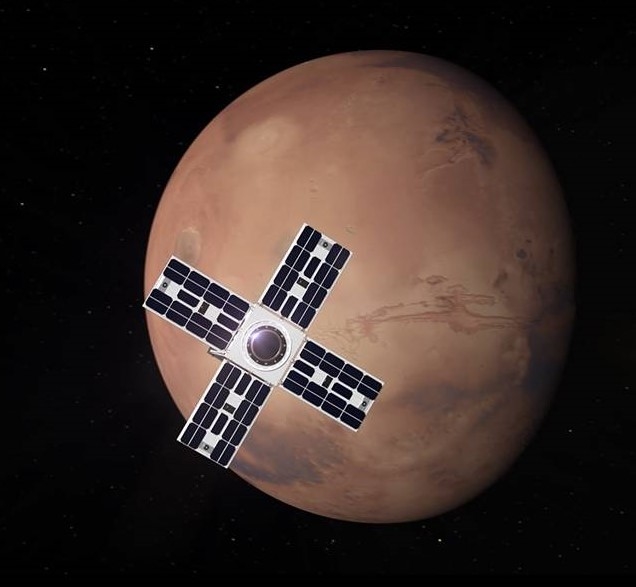
Credit: SatRevolution/Virgin Orbit/Screengrab Inside Outer Space
A new consortium has been established to design and carry out the world’s first dedicated commercial small satellite mission to Mars.
Nearly a dozen Polish universities have teamed up with Poland-based satellite company SatRevolution and Sir Richard Branson’s small satellite launch company, Virgin Orbit, to carry out the task.

Credit: SatRevolution/Virgin Orbit/Screengrab Inside Outer Space
First of up to three
The parties established the consortium this week at a formal signing ceremony during the Impact Mobility’19 rEVolution conference in Katowice, Poland. The consortium will jointly develop the first in a series of up to three Mars missions, with the initial launch expected as early as three years from now.
According to a statement, preliminary work conducted by the consortium has shown that spacecraft as small as 110 pounds (50 kilogram) or less can be used for a broad range of opportunities for scientific study, such as collecting imagery of Mars and its moon Phobos, analyzing the Martian atmosphere, or even such an ambitious endeavor as looking for underground reservoirs of water.

Credit: SatRevolution/Virgin Orbit
Go-to country
SatRevolution is headquartered in Wroclaw, Poland. The group will be primarily responsible for the design and manufacturing of the small satellite, providing its basic subsystems.
In April 2019, SatRevolution sent its Światowid spacecraft into Earth orbit, Poland’s first commercial nanosatellite. “We want Poland to be ‘the go-to’ country for small interplanetary spacecraft,” said Grzegorz Zwoliński, SatRevolution president.

Credit: Timothy Warchocki/National Academies of Sciences, Engineering, and Medicine.
In December 2018, an asteroid exploded in the upper atmosphere over the Bering Sea (western Pacific Ocean).
That incoming object unleashed an explosive force initially estimated to be nearly 200 kilotons, or over 10 times that of the Hiroshima bomb.
Spotted by various sensors
This event, which was detected by various sensors and spotted by a Japanese weather satellite, demonstrates that Earth is frequently hit by objects, some of which could cause significant damage if they hit a populated area.

Chelyabinsk sky rendering is a reconstruction of the asteroid that exploded over Chelyabinsk, Russia on Feb. 15, 2013. Scientific study of the airburst has provided information about the origin, trajectory and power of the explosion. This simulation of the Chelyabinsk meteor explosion by Mark Boslough was rendered by Brad Carvey using the CTH code on Sandia National Laboratories’ Red Sky supercomputer. Andrea Carvey composited the wireframe tail. Photo by Olga Kruglova.
Credit: Sandia National Laboratories.
The 2018 event occurred almost 6 years later when another incident over the Russian city of Chelyabinsk caused serious damage.
Currently, NASA funds a network of ground-based telescopes and a single, soon-to-expire space-based asset to detect and track large asteroids that could cause major damage if they struck Earth.
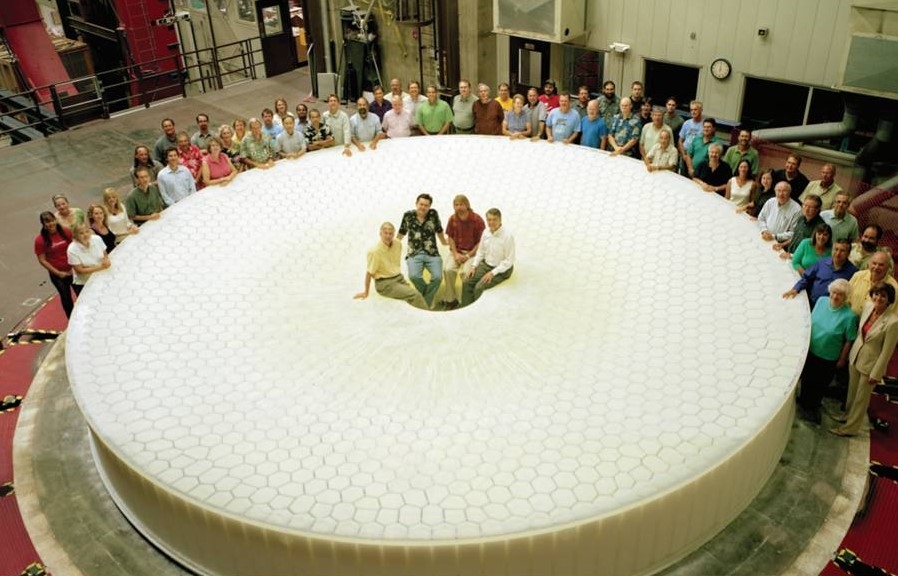
The mirror for the Large Synoptic Survey Telescope early in production.
Source: Howard Lester/LSST Project/NSF/AURA
Report tasks
In 2018, NASA asked the National Academies of Sciences, Engineering, and Medicine to establish the ad hoc Committee on Near Earth Object Observations in the Infrared and Visible Wavelengths to investigate and make recommendations about a space-based telescope’s capabilities, focusing on the following tasks:
— Explore the relative advantages and disadvantages of infrared (IR) and visible observations of near Earth objects (NEOs).
— Review and describe the techniques that could be used to obtain NEO sizes from an infrared spectrum and delineate the associated errors in determining the size.
— Evaluate the strengths and weaknesses of these techniques and recommend the most valid techniques that give reproducible results with quantifiable errors.
This consensus report — Finding Hazardous Asteroids Using Infrared and Visible Wavelength Telescopes – is available for free download at:

Mission Extension Vehicle (MEV-1).
Credit: Northrop Grumman
A Proton-M launch vehicle, with a Briz-M upper stage launched the EUTELSAT 5 West B communications satellite along with the Mission Extension Vehicle-1 (MEV-1) from the Baikonur Cosmodrome in Kazakhstan on October 9, 2019, local time.
If all goes well, Mission Extension Vehicle (MEV-1) will provide a satellite life-extension service by docking to the Intelsat 901 satellite in geosynchronous orbit to provide attitude and orbit control. Intelsat 901 was lofted back in mid-2001.
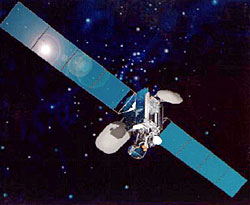
Intelsat 901 satellite.
Credit: Intelsat/Loral
Rendezvous and docking
The MEV-1 mission is to extend the life of the Intelsat 901 satellite for five years, or an estimated 25 percent of its life, and also help mitigate the increasing congestion in Earth orbit.
Intelsat and MEV-1’s manufacturer — Northrop Grumman — will now begin to prepare for the most critical part of the mission—rendezvous and docking. To start, over the next three months, Northrop Grumman will perform orbit-raising maneuvers and raise the MEV-1 to 186 miles (300 kilometers) above Geo Synchronous Orbit.
During the same time, Intelsat will raise the position of Intelsat 901 from GEO to the docking orbit which will be about 186 miles (300 kilometers) higher than its traditional orbital location.

Ground testing of docking technique.
Credit: Northrop Grumman/Space Logistics Services
Abundance of caution
Multiple cameras, laser range-finders and on-board computers will allow MEV-1 to detect, track and rendezvous with Intelsat 901 at the docking orbit.
“As this is the first mission of its kind, out of an abundance of caution, we are operating these maneuvers above the normal orbital slot. This will ensure there is no disruption to any neighboring satellites,” explains Jean-Luc Froeliger, Vice President, Space Systems Engineering & Operations at Intelsat.
Docking mechanism
The final rendezvous between the craft will take place roughly three and a half months after MEV-1’s launch.
At that time, MEV-1 will insert a docking mechanism into Intelsat 901 apogee thruster and mechanically couple the two vehicles together. Once docked, the MEV will take over the attitude and orbit maintenance of the combined vehicle stack.
The combined MEV-1 and Intelsat 901 stack will be brought back to a geostationary orbit slot. Intelsat will then begin the transfer of services for their customers.
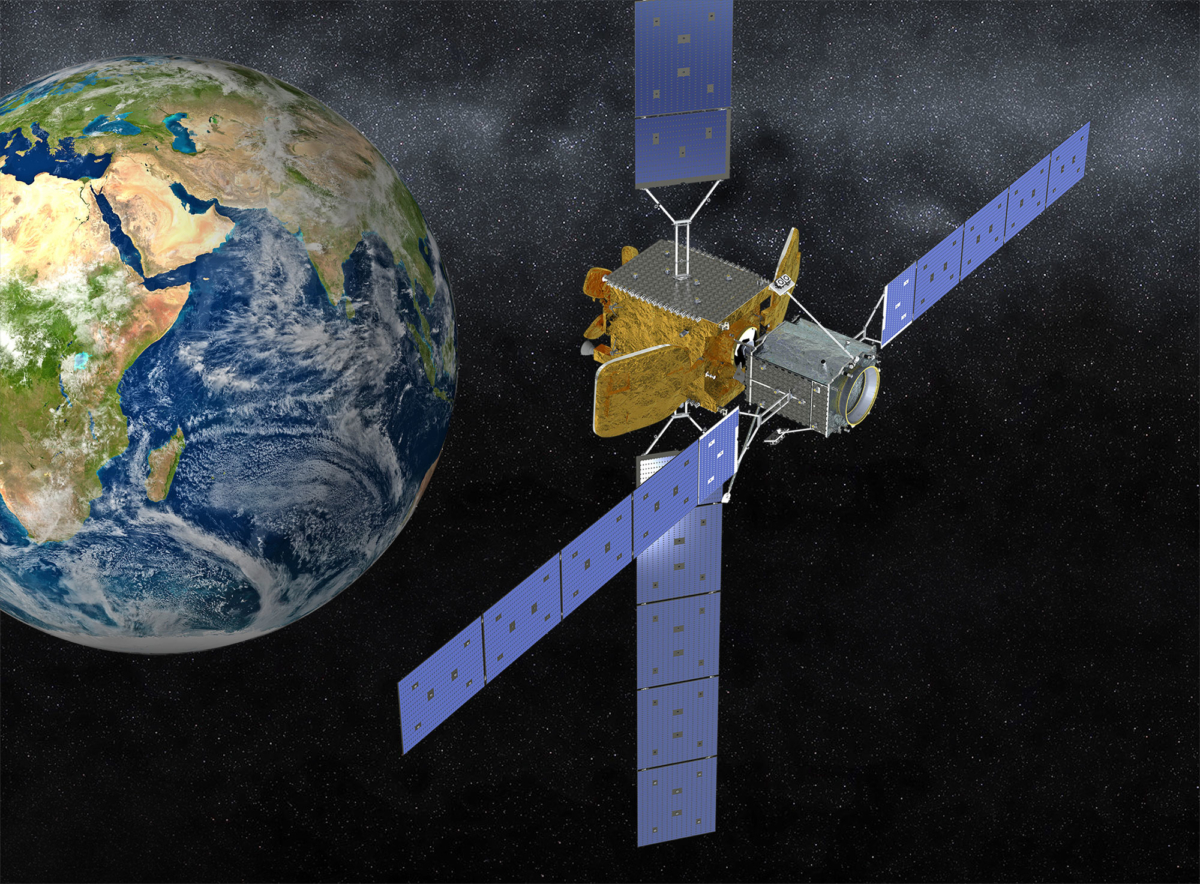
A couple of spacecraft: MEV-1/Intelsat 901
Credit: Northrop Grumman
Keep-it-simple approach
“The MEV spacecraft provides rendezvous, proximity operations and docking features to enable a keep-it-simple approach to satellite life extension,” explains Northrop Grumman.
SpaceLogistics LLC, a wholly owned subsidiary of Northrop Grumman, is providing cooperative in-orbit satellite servicing to geosynchronous satellite operators. Their initial servicing vehicle is the now in orbit MEV.
For more information on launch of this milestone mission, go to:

