Archive for the ‘Space News’ Category
 Author:
  November 12th, 2019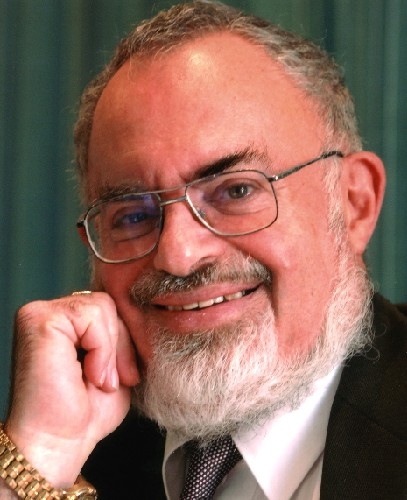
Leading UFO researcher, Stanton Friedman.
Credit: Stanton Friedman website
If you are sky-eyed and hooked by “UFO-ology,” a leading spokesperson on the topic was nuclear physicist and lecturer Stanton T. Friedman.
As a scientist that had a serious interest in flying saucers since 1958, he will be missed by researchers given his untimely death in May of this year at the age of 84.
Extensive work
I met Friedman several times over the years, and found him captivating and a believable UFO investigator. His legacy lives on…thanks to the Provincial Archives of New Brunswick, Canada.
Stanton Friedman donated his invaluable research papers to the archive – a donation that filled five cargo vans, explains Joanna Aiton Kerr of the archives.
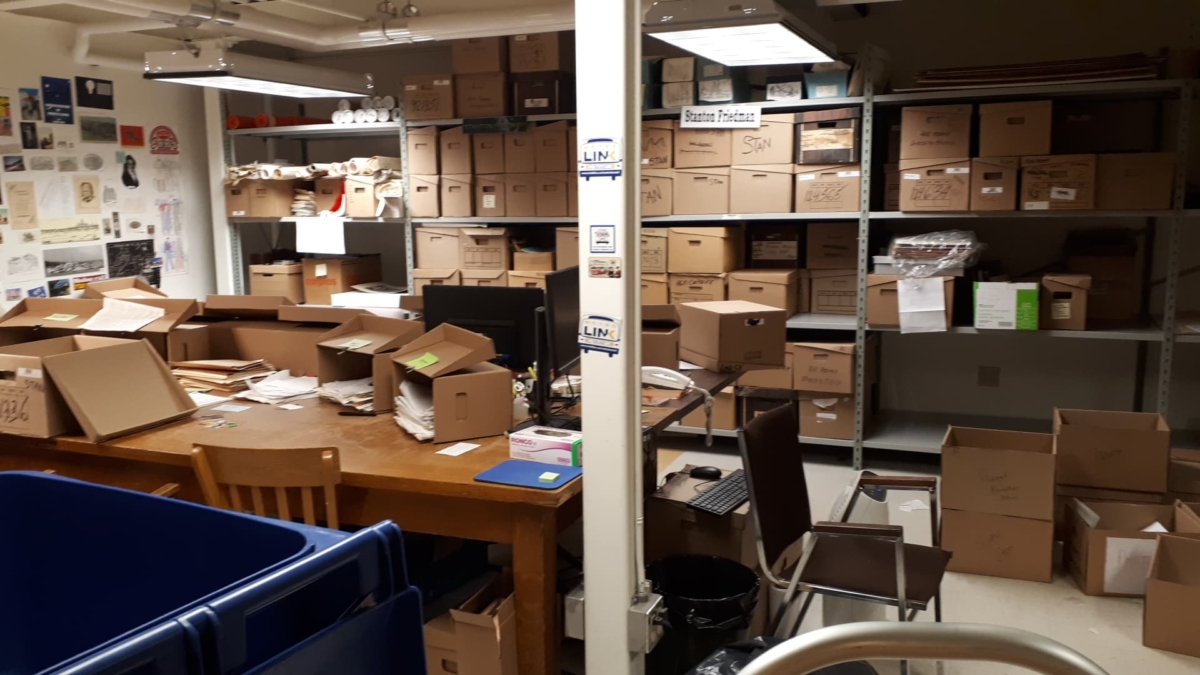
The archival room being used to process the Stanton Friedman material acquired from his home – three rooms worth, and what is shown is about 1/6th of his research collection.
Credit: Joanna Aiton Kerr/Provincial Archives of New Brunswick, Canada
“Due to the volume of the material and the need to do extensive work to make it available to researchers it would probably take about 10 years with the resources we currently have available to focus on it,” Kerr told Inside Outer Space.
“In a perfect world, we would have two archivists working on it and nothing else full time,” Kerr said, [and] if that happened it would still take two to three years – there is that much of it.”
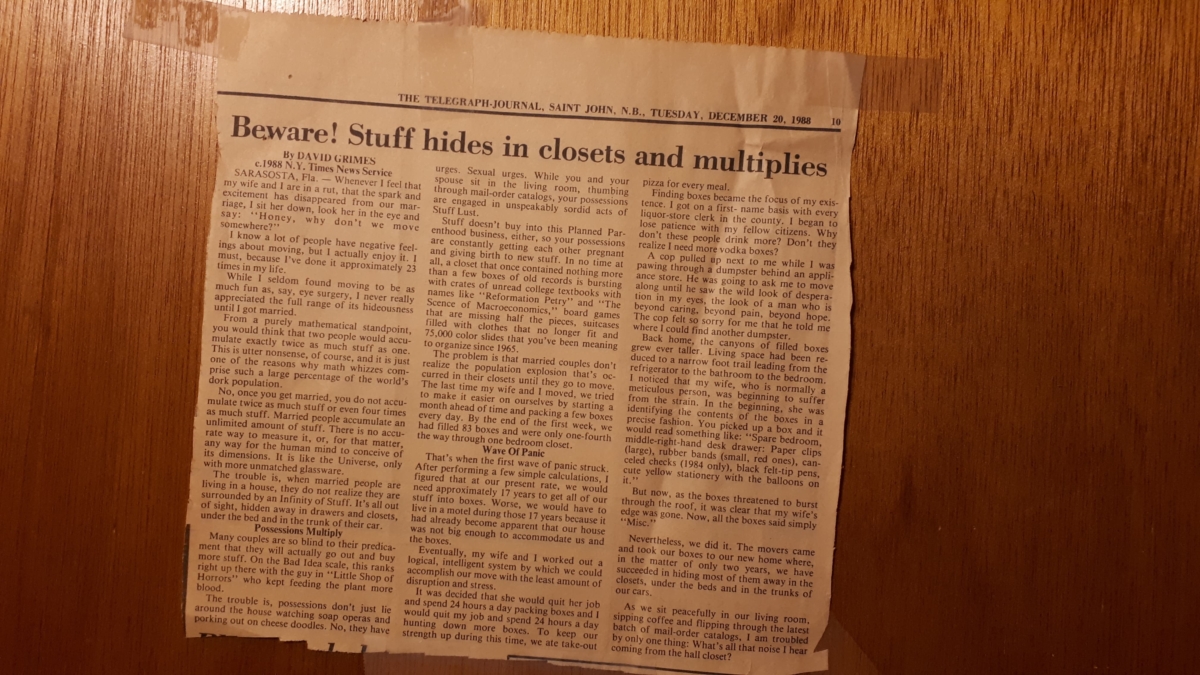
Photo of newspaper clipping on the door to one of the rooms in Friedman’s home where he kept some of his UFO research material.
Courtesy: Joanna Aiton Kerr/Provincial Archives of New Brunswick, Canada
Archival pressure
Kerr said that the records are so interesting, and the interest from the public is such that the archive feels the pressure and need to make sure that they do everything as quickly as they can…”but it also needs to be done right!”
Records are available to researchers as they are processed, Kerr added. “However we are not digitizing – this would be a mammoth task and frankly pointless until the actual paper/photographs, etc, are physically organized and listed. Otherwise it would just be a big digital mess.”
The challenge
Friedman had posted in December 1997 that he had reached four major conclusions, under the title of “The UFO Challenge”:
— The evidence is overwhelming that Planet Earth is being visited by intelligently controlled extraterrestrial spacecraft. In other words, SOME UFOs are alien spacecraft. Most are not.
— The subject of flying saucers represents a kind of Cosmic Watergate, meaning that some few people in major governments have known since July, 1947, when two crashed saucers and several alien bodies were recovered in New Mexico, that indeed SOME UFOs are ET. As noted in 1950, it’s the most classified U.S. topic.
— None of the arguments made against conclusions One and Two by a small group of debunkers such as Carl Sagan, my University of Chicago classmate for three years, can stand up to careful scrutiny.
— The Flying Saucer story is the biggest story of the millennium: visits to Planet Earth by aliens and the U.S. government’s cover-up of the best data (the bodies and wreckage) for over fifty years.
Public defense
“Stan Friedman’s most important contribution was his vigorous and intellectually sound public defense of the continuing mystery of the UFO phenomenon, the utter failure of science to recognize this, and thus the need for a serious sustained scientific investigation,” explains Mark Rodeghier, Scientific Director of the J. Allen Hynek Center for UFO Studies.
“His most important research was done on government documents and on the fabled Roswell UFO crash, which he demonstrated is not easily explained,” Rodeghier told Inside Outer Space.
For more information regarding Friedman and his UFO research, go to:
 Posted in

Lunar sample curators Charis Krysher, Juliane Gross, and Andrea Mosie were involved in extruding Apollo 17 sample 73002 from its container.
Credit: NASA
Scientists at NASA’s Johnson Space Center (JSC) in Houston, Texas have opened untouched samples brought back from the Moon during the Apollo era.
The rock and soil samples will be studied as part of the Apollo Next Generation Sample Analysis (ANGSA) initiative, which is leveraging advanced technologies to study Apollo samples by using new tools that were not available when the samples were originally returned to Earth.

Apollo 17 imagery from December 1972 mission: Sample 73001 – 809 grams; Sample
73002 – 430 grams. Core, double drive tube, unopened until November 5, 2019. Credit: Apollo 17/NASA
Nerve-wracking
Rutgers University scholar Juliane Gross was one of three women scientists who opened the pristine Apollo 17 sample on November 5th. Apollo 17 moonwalkers collected the lunar specimens in December 1972.
“It was such a humbling experience to be part of this and totally nerve-wracking because we couldn’t make any mistakes,” said Gross, an associate professor at Rutgers in the Department of Earth and Planetary Sciences in the School of Arts and Sciences. “But it was absolutely mind-blowing and so exciting at the same time.”
Gross said in a Rutgers University statement that it was hard and awkward to open and extrude the core sample. The reason: “everything had to be done inside a nitrogen-gas filled glovebox and we wore big gloves that made it hard to feel and grab tools,” Gross said. “But we had practiced a lot with a practice glovebox, so we worked really well together and all went smoothly with opening and extruding the core.”

Location of double drive tube at station 3, Apollo 17.
Credit: Apollo 17/NASA
New insights
The ANGSA multigenerational and multidisciplinary team will systematically examine samples 73002 and 73001, part of a two-foot long “drive tube” of regolith, collected by astronauts Harrison Schmitt and Gene Cernan from a landslide deposit near Lara Crater at the Apollo 17 site.
“The findings from these samples will provide NASA new insights into the Moon, including the history of impacts on the lunar surface, how landslides occur on the lunar surface, and how the Moon’s crust has evolved over time,” adds Chip Shearer, science co-lead for ANGSA in the Lunar Curation Laboratory at NASA’s JSC and a visiting scientist at the Lunar and Planetary Institute (LPI). “This research will help NASA better understand how volatile reservoirs develop, evolve and interact on the Moon and other planetary bodies, in an LPI statement.

NASA’s Artemis return humans to the Moon by 2024 program.
Credit: NASA
The ANGSA team is functioning as participants in a low-cost lunar sample return mission. This is a vital link between the Apollo Program and the future exploration of the Moon by the Artemis Program.
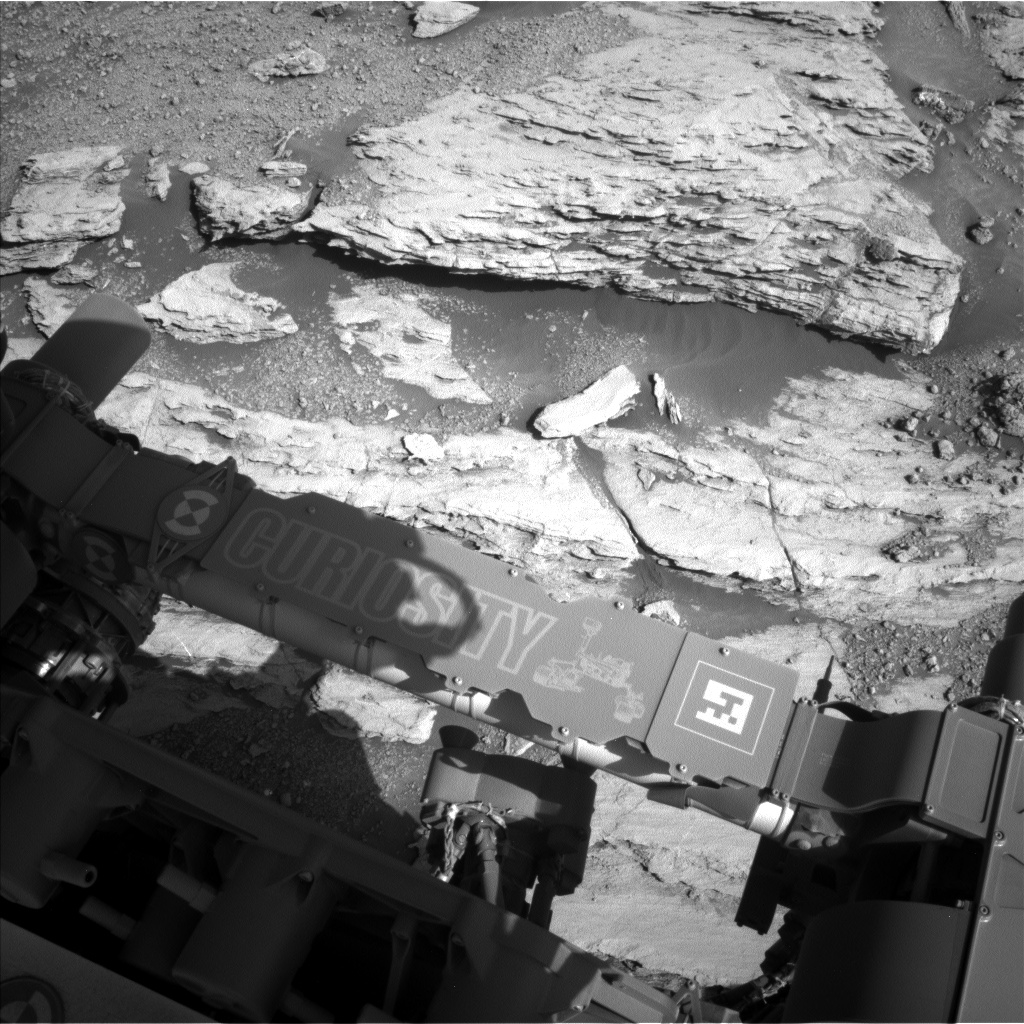
Curiosity Navigation Camera Left B image taken on Sol 2582, November 11, 2019.
Credit: NASA/JPL-Caltech
NASA’s Curiosity Mars rover is now wrapping up Sol 2583 duties.
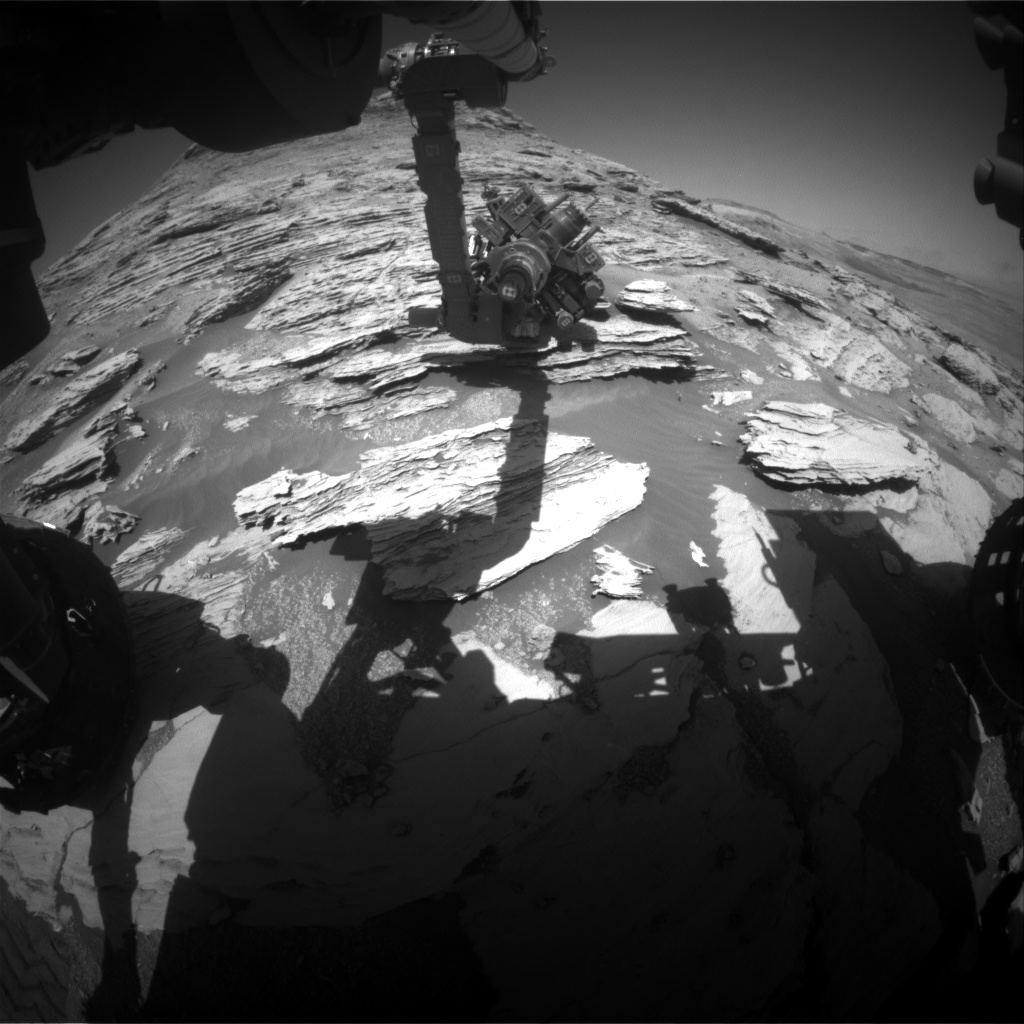
Curiosity Front Hazard Avoidance Camera Left B image acquired on Sol 2582, November 11, 2019.
Credit: NASA/JPL-Caltech
Scott Guzewich, an atmospheric scientist at NASA’s Goddard Space Flight Center, reports that over the weekend, the robot drove further uphill on Central Butte.
The Mars machinery is examining the complex layering that seems to be present at the butte.
Compelling workspace
Guzewich notes that imagery of the rover’s compelling workspace shows that the location was worth a few days of investigation.
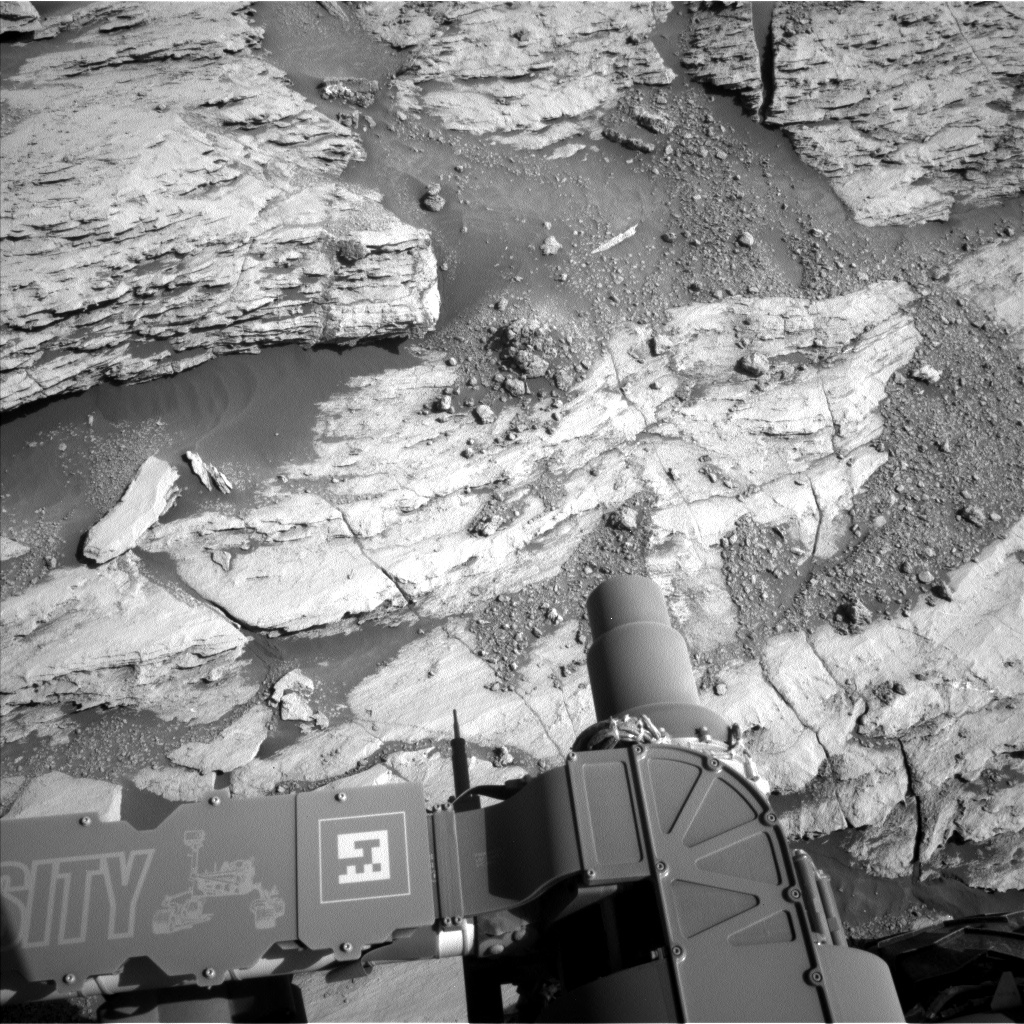
Curiosity Navigation Camera Left B image taken on Sol 2582, November 11, 2019.
Credit: NASA/JPL-Caltech
“However, Curiosity is on a rather steep slope and tilted somewhat, which prevented us from being able to use the dust removal tool in this plan,” Guzewich adds.
Sample tactic
The plan is to use the Mars Hand Lens Imager (MAHLI) and the Alpha Particle X-Ray Spectrometer (APXS) on “Sourhope,” a vertically-oriented just below a dark-colored knob.
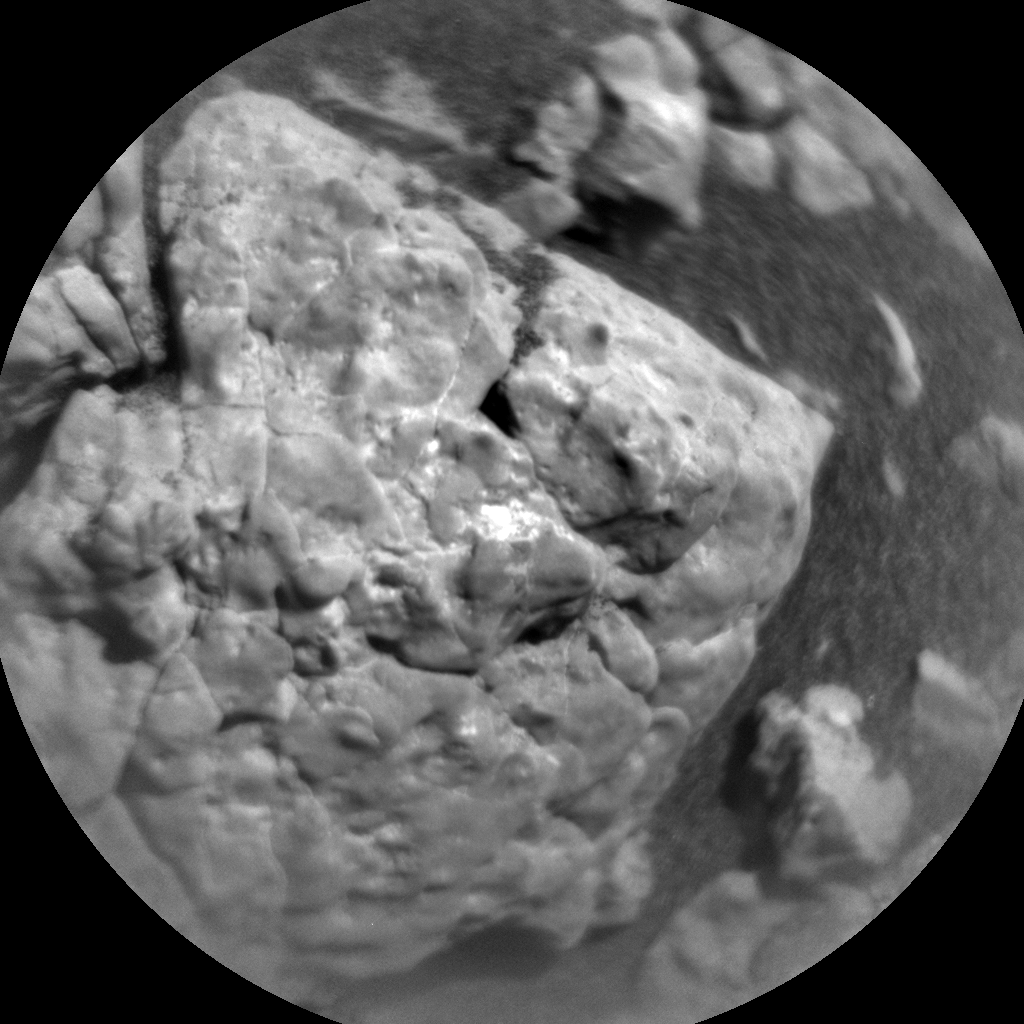
Curiosity Chemistry & Camera (ChemCam) Remote Micro-Imager (RMI) photo taken on Sol 2583, November 12, 2019.
Credit: NASA/JPL-Caltech/LANL
Also planned, Guzewich continues, is use of the Chemistry and Camera (ChemCam) on Sourhope in addition to “Foggy Moss” and “Hoxa.”
“The goal is to see if some of the material at the top of the butte (which we can’t directly reach), might have fallen down to this location where we can sample it,” Guzewich explains.
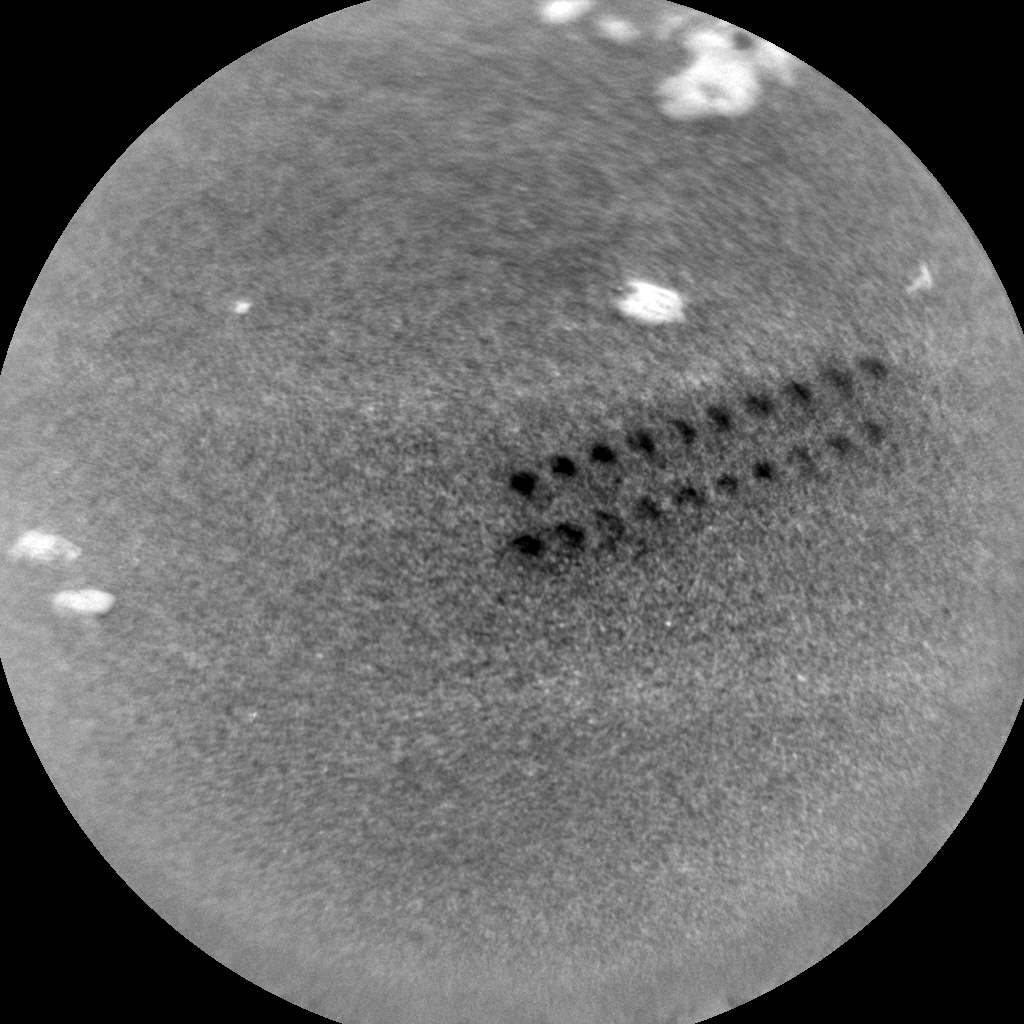
Curiosity Chemistry & Camera (ChemCam) RMI photo showing laser shots acquired on Sol 2582, November 11, 2019.
Credit: NASA/JPL-Caltech/LANL
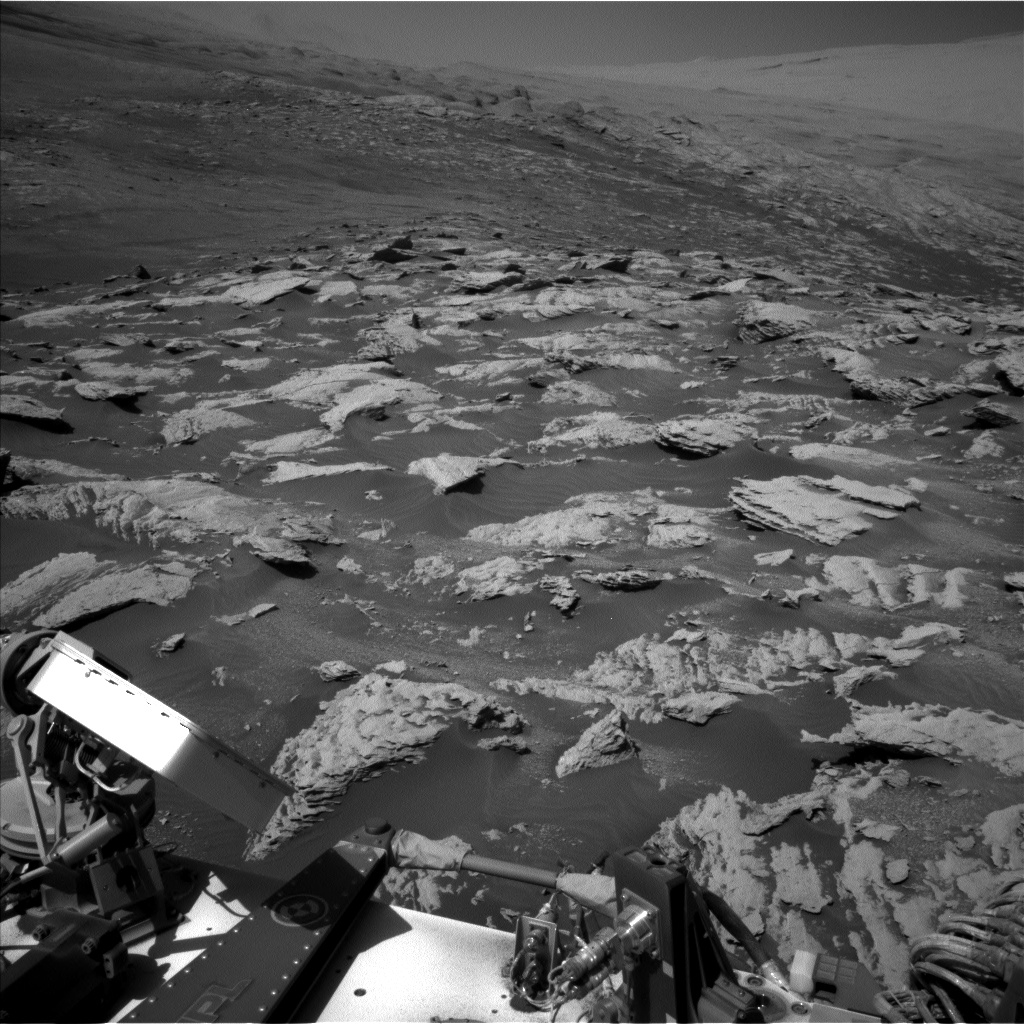
Curiosity Navigation Camera Left B image taken on Sol 2582, November 11, 2019.
Credit: NASA/JPL-Caltech
On the second sol of the current plan, Mastcam images of these targets will be taken in addition to the top of the butte, and then search for dust devils and water ice clouds with Navcam, Guzewich concludes.
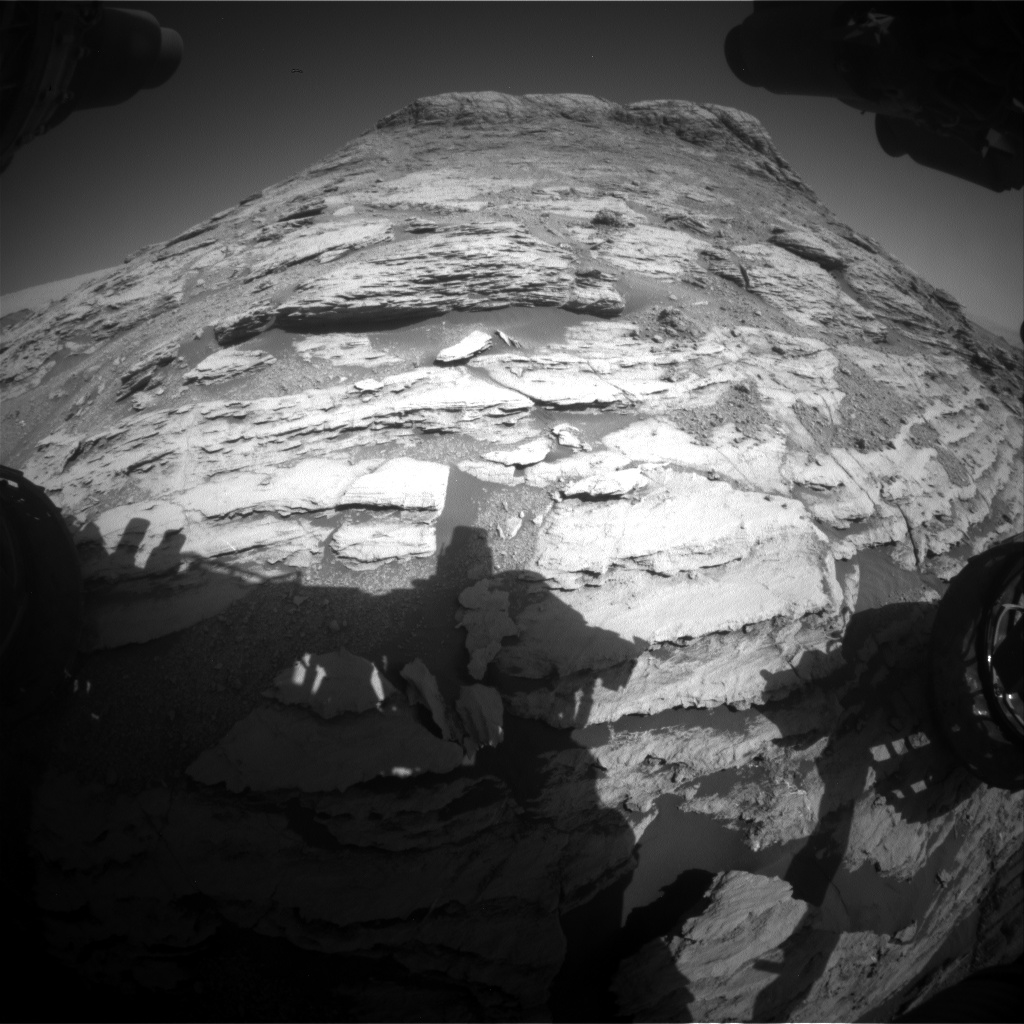
Curiosity Front Hazard Avoidance Camera Right B image taken on Sol 2582, November 11, 2019.
Credit: NASA/JPL-Caltech
NASA’s Curiosity Mars rover is now wrapping up Sol 2582 tasks. New imagery shows the robot carrying out science duties in exploring its local surroundings:
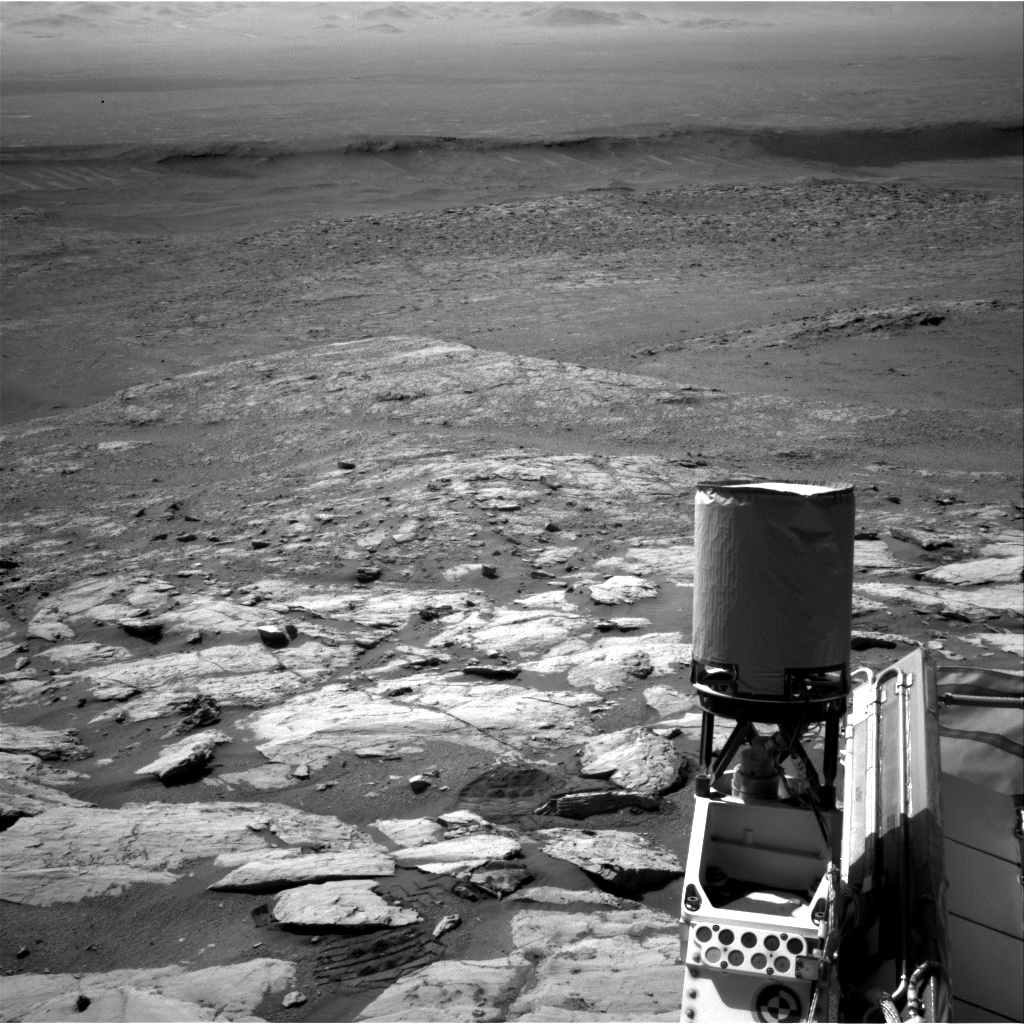
Curosity Right B Navigation Camera photo taken on Sol 2582, November 11, 2019.
Credit: NASA/JPL-Caltech
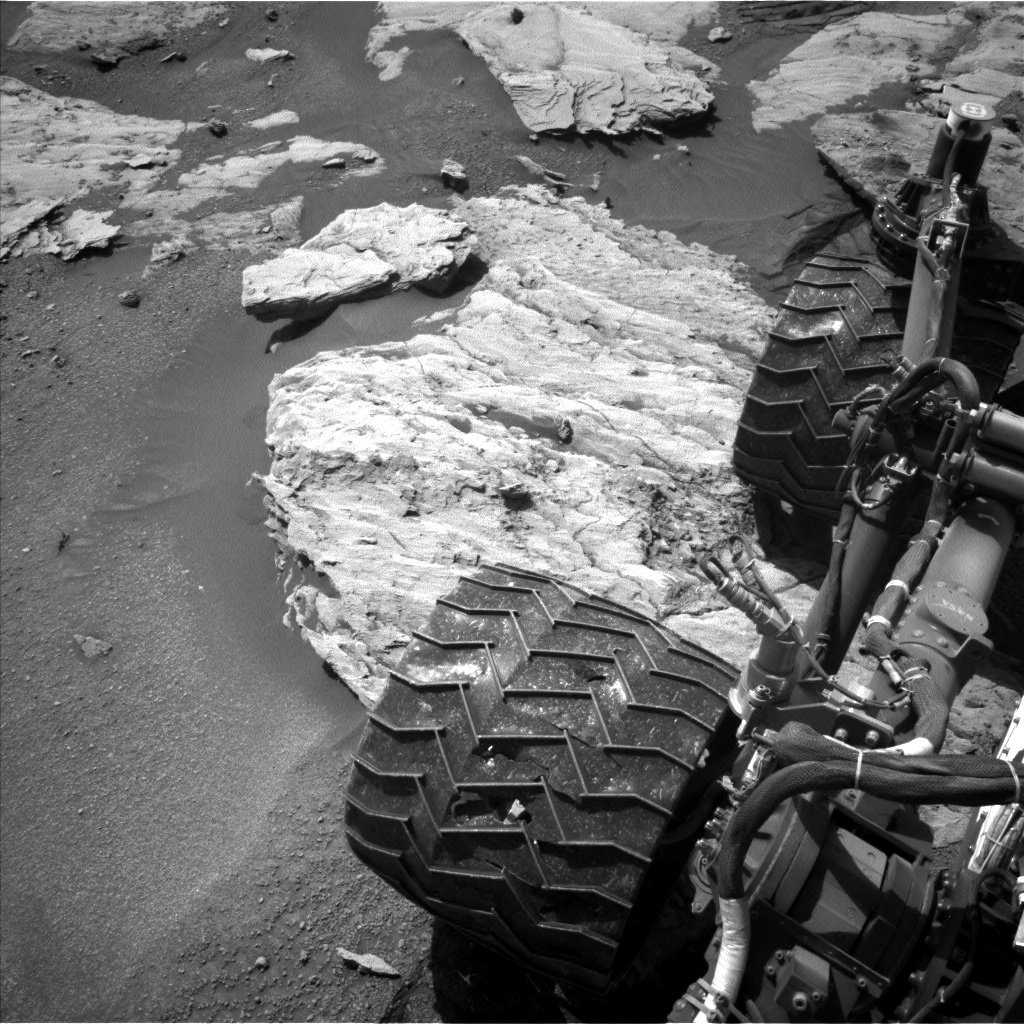
Curiosity Left B Navigation Camera image acquired on Sol 2582, November 11, 2019.
Credit: NASA/JPL-Caltech
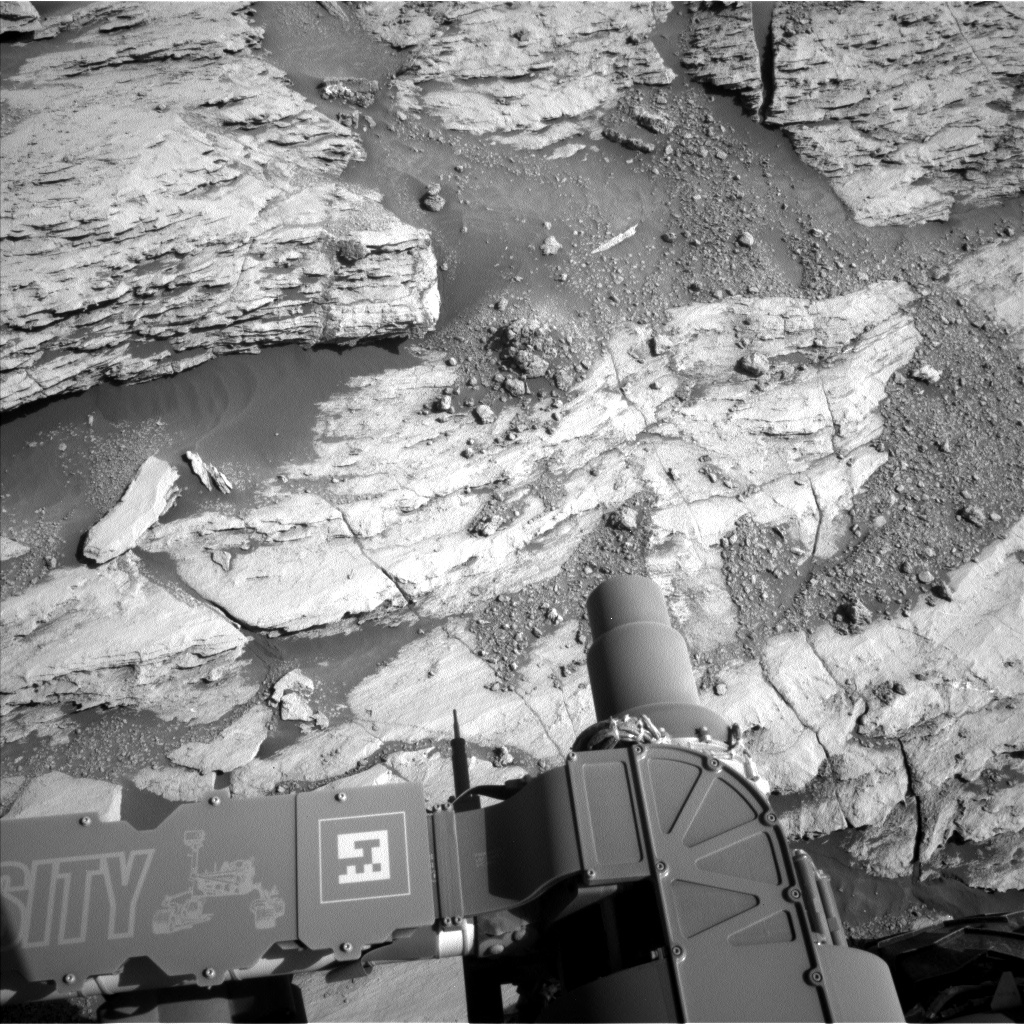
Curiosity Left B Navigation Camera image taken on Sol 2582, November 11, 2019.
Credit: NASA/JPL-Caltech
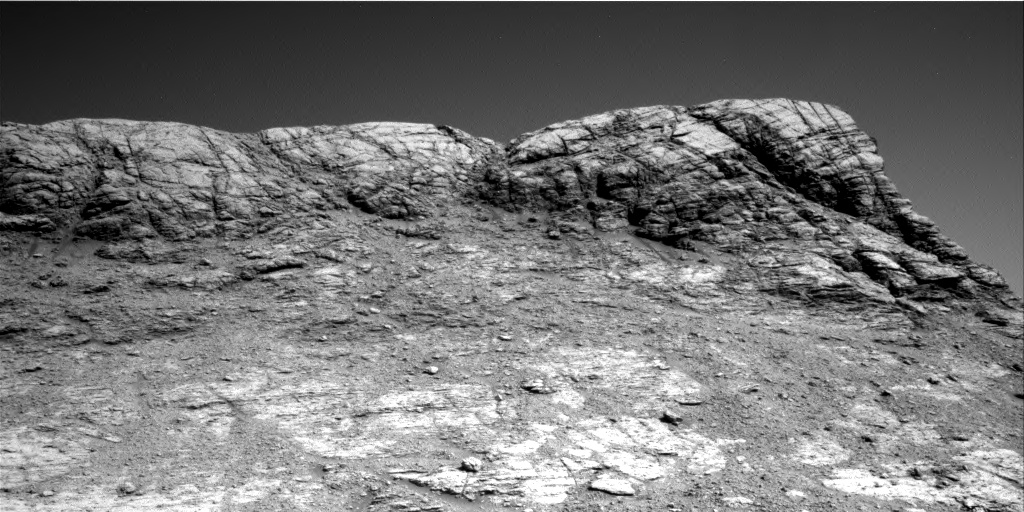
Curosity Right B Navigation Camera photo acquired on Sol 2582, November 11, 2019.
Credit: NASA/JPL-Caltech
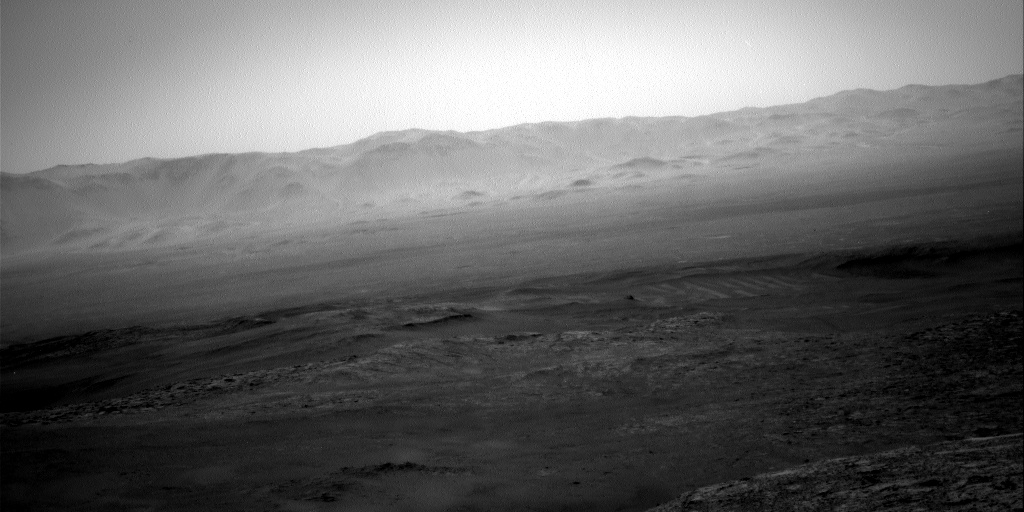
Curiosity Right B Navigation Camera image acquired on Sol 2580, November 9, 2019.
Credit: NASA/JPL-Caltech
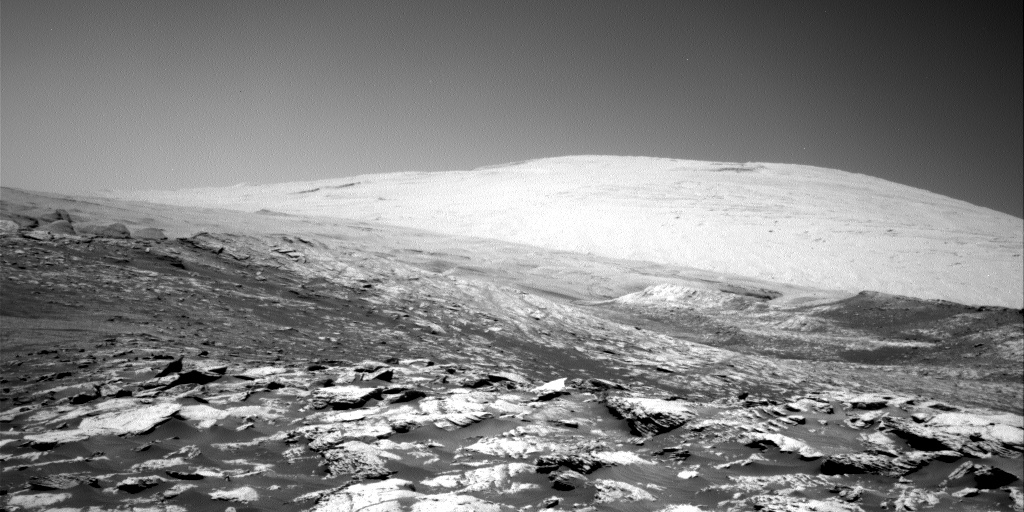
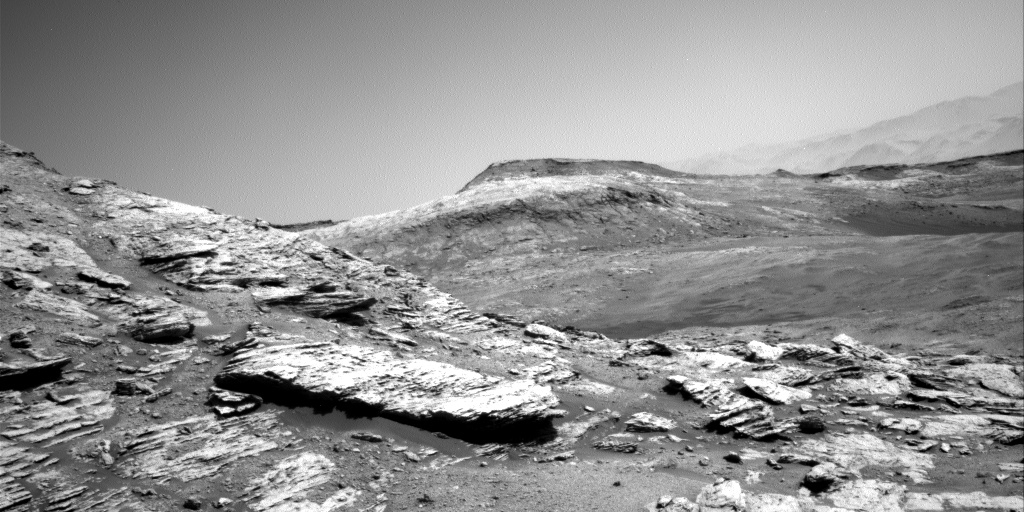
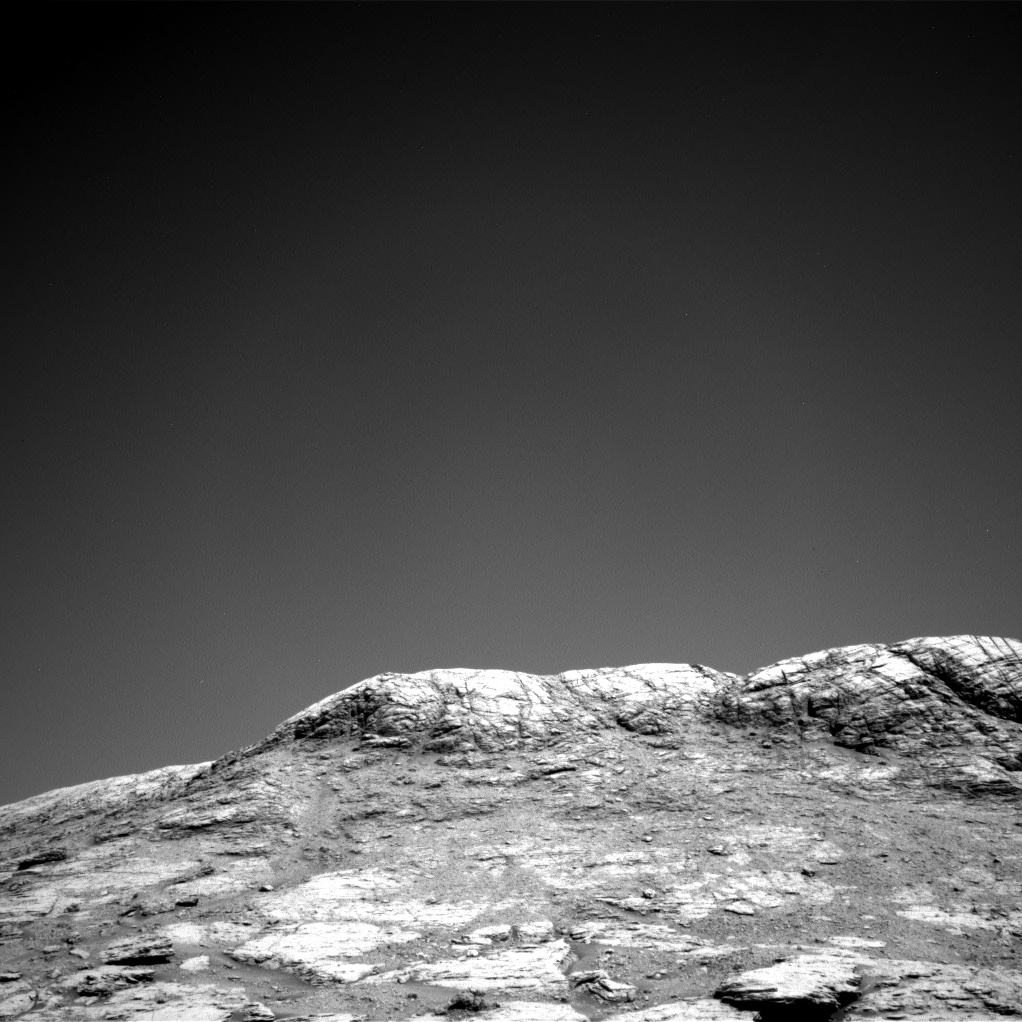
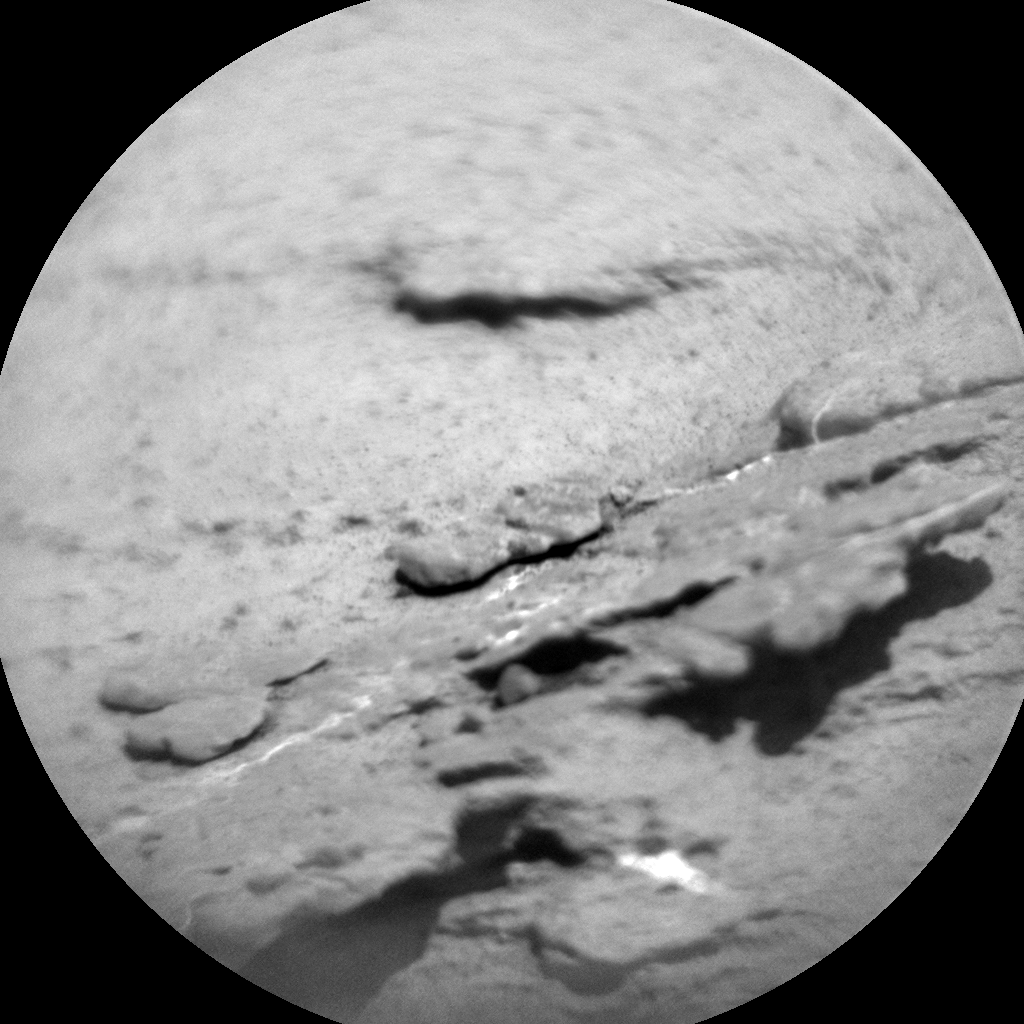
NASA’s Curiosity Mars rover is now wrapping up Sol 2581 tasks.
A sampling of imagery from the robot shows its current surroundings:
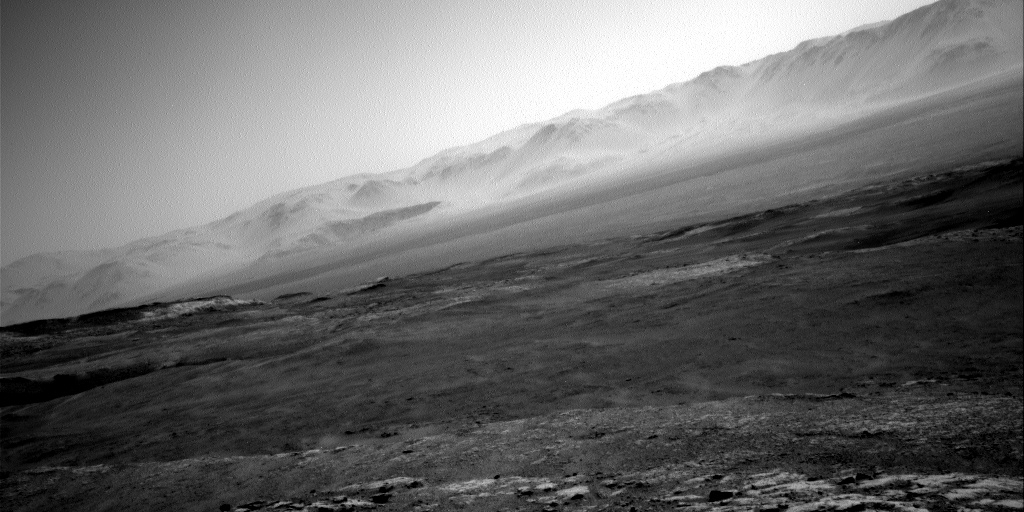
Curiosity Right B Navigation Camera image taken on Sol 2580, November 9, 2019.
Credit: NASA/JPL-Caltech
Curiosity Right B Navigation Camera image acquired on Sol 2580, November 9, 2019.
Credit: NASA/JPL-Caltech
Curiosity Right B Navigation Camera image taken on Sol 2580, November 9, 2019.
Credit: NASA/JPL-Caltech
Curiosity Right B Navigation Camera image acquired on Sol 2580, November 9, 2019.
Credit: NASA/JPL-Caltech
Curiosity Chemistry & Camera (ChemCam) Remote Micro-Imager (RMI) photo taken on Sol 2581, November 10, 2019.
Credit: NASA/JPL-Caltech/LANL
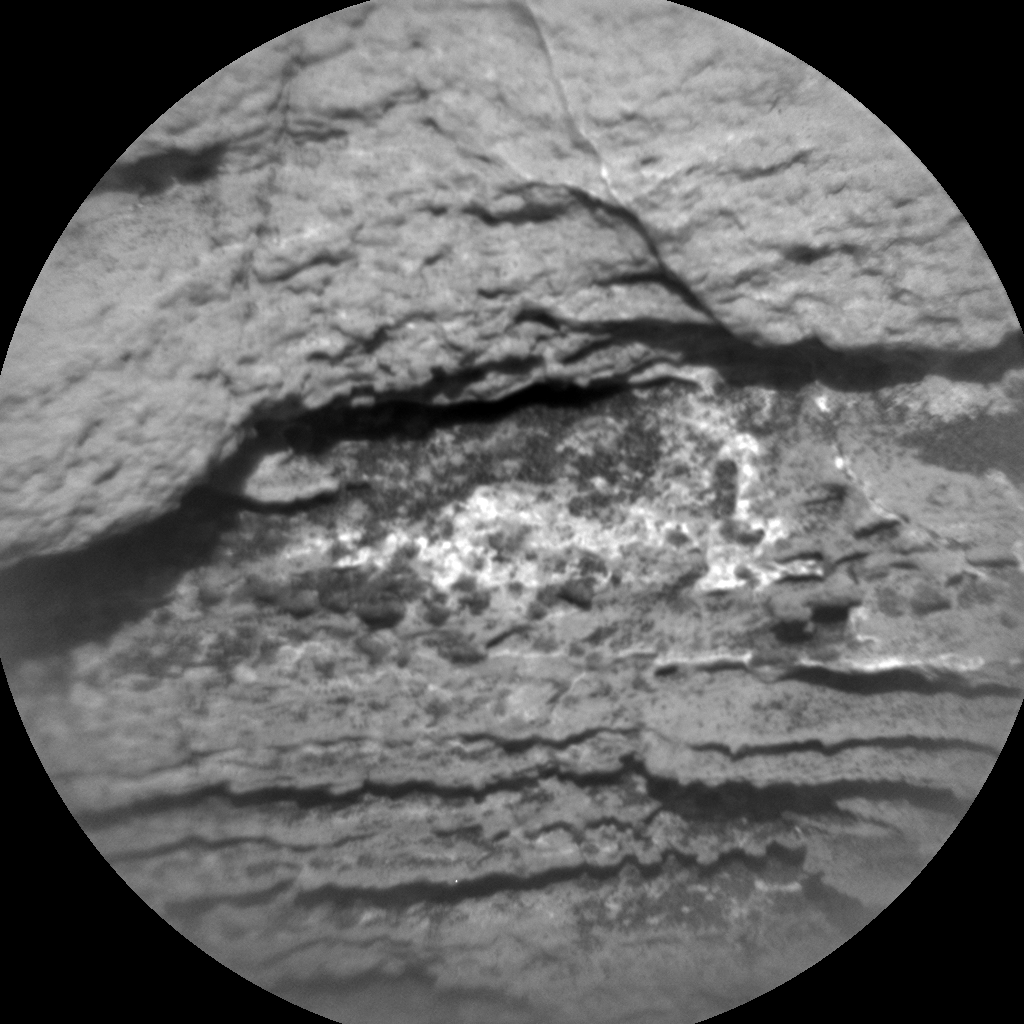
Curiosity Chemistry & Camera (ChemCam) Remote Micro-Imager (RMI) photo acquired on Sol 2581, November 10, 2019.
Credit: NASA/JPL-Caltech/LANL
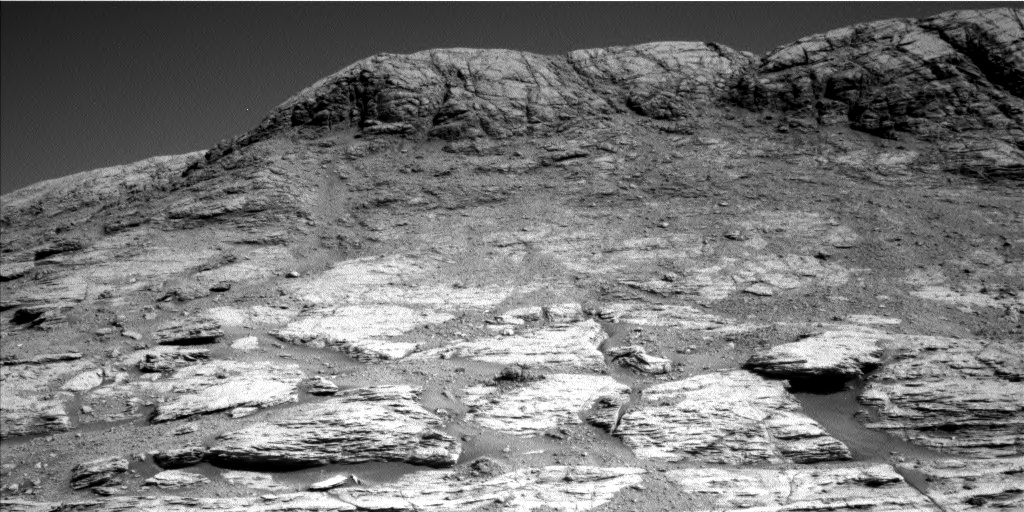
Left Navigation Camera Left B image taken on Sol 2577, November 6, 2019.
Credit: NASA/JPL-Caltech
NASA’s Curiosity Mars rover, now in Sol 2578, is continuing its exploration of Central Butte with a two-sol “touch-and-go” plan.
That means that the rover will have one sol of contact science at its current stop before the robot continues on her drive around the base of the butte.
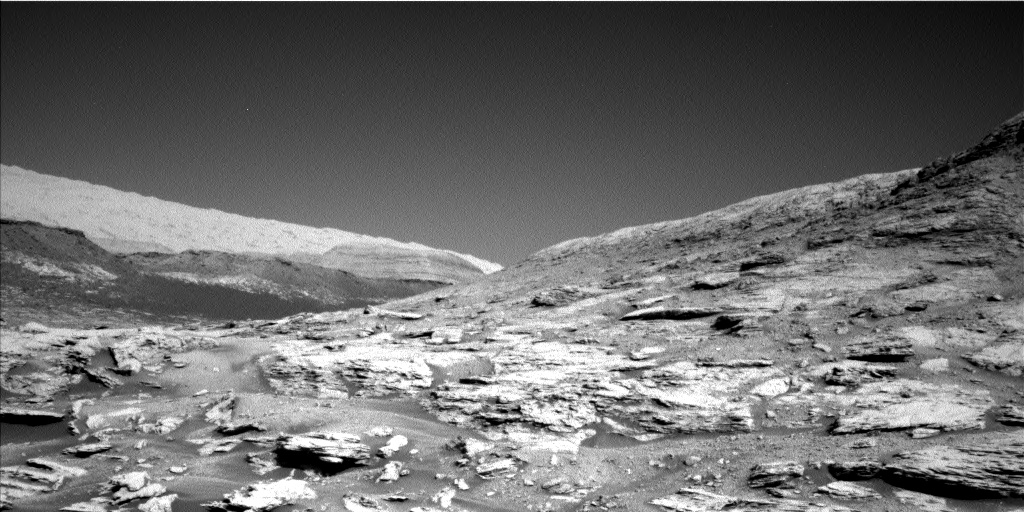
Left Navigation Camera Left B image taken on Sol 2577, November 6, 2019.
Credit: NASA/JPL-Caltech
“Early on in planning, there was some discussion about the drive route; ultimately, the team decided to head south to get a closer view of some of the exposed layering within the butte,” reports Mariah Baker, Planetary Geologist at Johns Hopkins University.
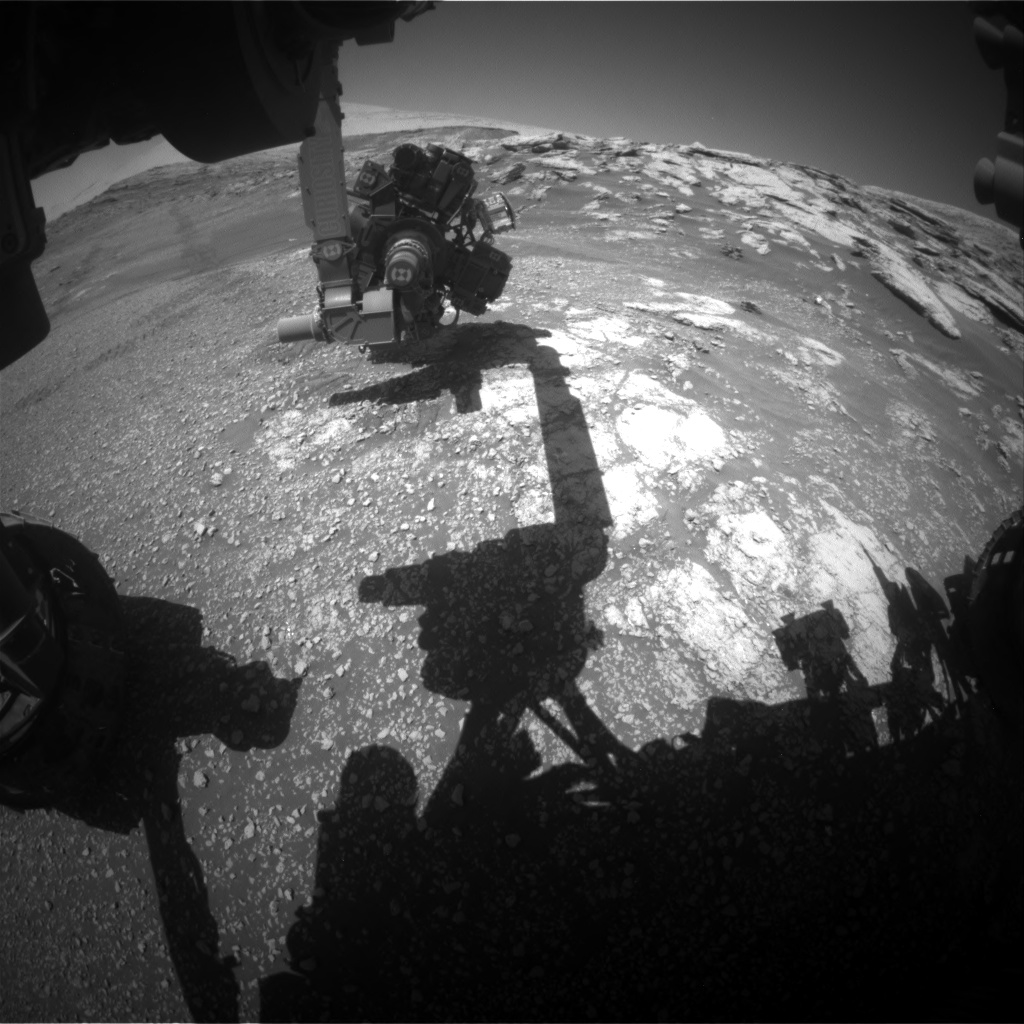
Curiosity Front Hazard Avoidance Camera Left B photo taken on Sol 2577, November 5, 2019.
Credit: NASA/JPL-Caltech
Drive direction
A new plan included time for a short science block before the drive, which the rover science team filled with a Chemistry and Camera (ChemCam) Remote Micro-Imaging (RMI) camera mosaic of target “Crimond” and a Mastcam mosaic that will provide increased coverage of Curiosity’s drive direction.
Mars Hand Lens Imager (MAHLI) and Alpha Particle X-Ray Spectrometer (APXS) measurements were also planned for the bedrock target “Pobie Bank,” comprising the “touch” part of this plan.
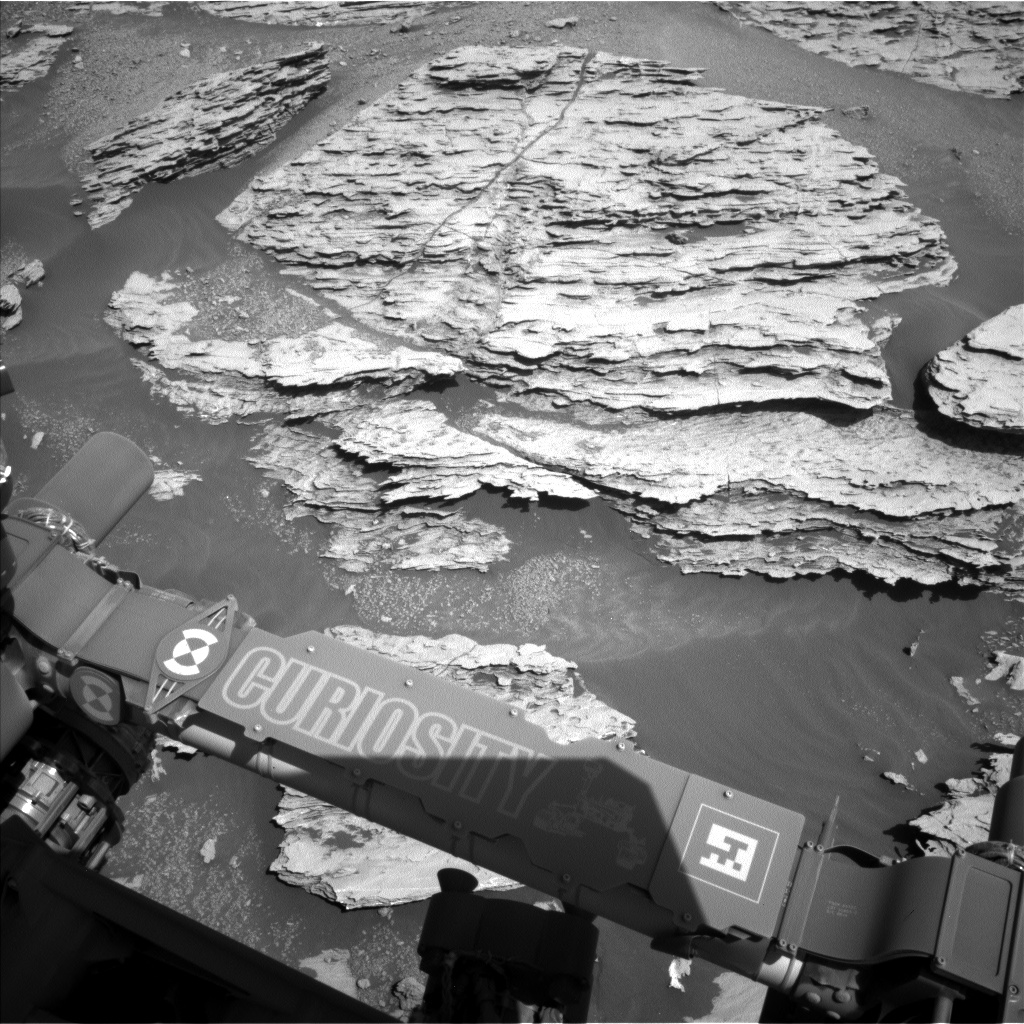
Curiosity Left Navigation Camera Left B photo acquired on Sol 2577, November 5, 2019.
Credit: NASA/JPL-Caltech
After this science block, the rover was set to “go” to her next stop, which will bring it a little further up the base of the butte.
New workspace
Standard post-drive imaging using Navcam, Mastcam, and Mars Descent Imager (MARDI) will round out the first sol and will provide a better look at its new workspace.
The second sol in the plan contains one untargeted science block, which will include a ChemCam passive measurement, a ChemCam Autonomous Exploration for Gathering of Increased Science (AEGIS) observation, and a Mastcam stereo mosaic of the top of the butte.
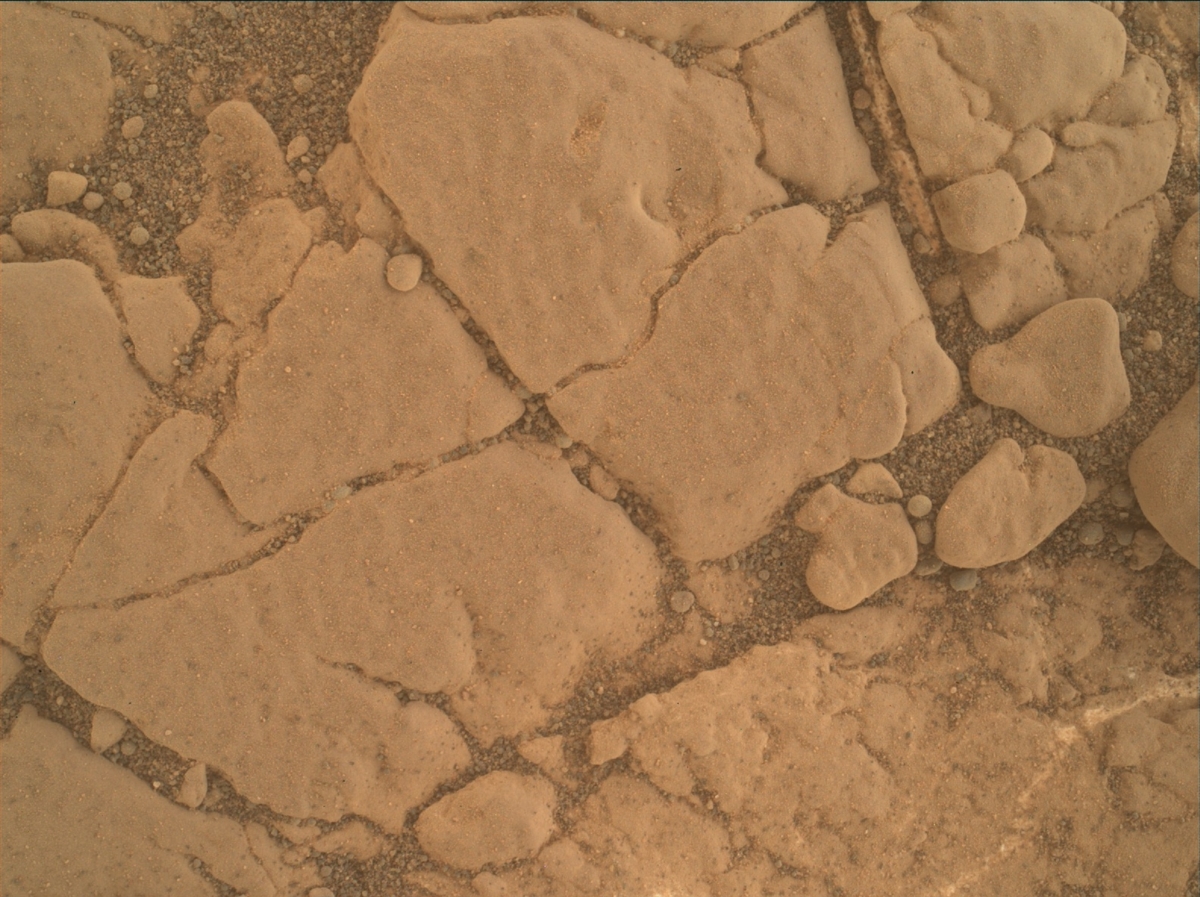
Curiosity Mars Hand Lens Imager (MAHLI) photo produced on Sol 2577, November 6, 2019.
Credit: NASA/JPL-Caltech/MSSS
Environmental observations
The team also planned a set of environmental observations including Rover Environmental Monitoring Station (REMS) and Dynamic Albedo of Neutrons (DAN) measurements, as well as Mastcam images of the crater rim, a Mastcam sky survey, a Navcam line-of-sight observation, and a Navcam supra horizon movie.
“This data will help give us a head start on our next plan so that we can use our time to examine Central Butte more closely,” Baker notes. “In order to accomplish all of our science goals at this location, the rover will make a couple more stops along the side of the butte before continuing along the long-term strategic route.”

India’s Chandrayaan-2 orbiter – up and operating.
Credit: ISRO
India’s Chandrayaan-2 orbiter is chalking up scientific findings as it circles the Moon, making use of eight state-of-the-art scientific instruments.

Schematic of the origin and dynamics of 40Ar in lunar exosphere.
As part of its early operation, India’s Moon orbiter has detected 40Ar in the lunar exosphere from an altitude of roughly 62 miles (100 kilometers), capturing the day-night variations of concentration. 40Ar being a condensable gas at the temperatures and pressures that prevail on the lunar surface, condenses during lunar night. After lunar dawn, the 40Ar starts getting released to the lunar exosphere (blue shaded region in figure).
Credit: ISRO
The orbiter’s Chandra Atmospheric Composition Explorer-2 (CHACE-2) payload has detected Argon-40 in the tenuous lunar exosphere – so thin that gas atoms very rarely collide with each other.
Argon-40 (40Ar), which is one of the isotopes of the noble gas Argon, is an important constituent of the lunar exosphere. The radioactive 40K nuclide, which is present deep below the lunar surface, disintegrates to 40Ar, which, in turn, diffuses through the intergranular space and makes its way up to the lunar exosphere through seepages and faults on the Moon’s landscape.

Chandrayaan-2’s Dual-Frequency Synthetic Aperture Radar (DF-SAR) payload can help unambiguously identify and quantitatively estimate lunar polar water-ice in permanently shadowed regions.
Credit: ISRO
Radar remote sensing
The Chandrayaan-2 orbiter has also made initial images and observations by its Dual-Frequency Synthetic Aperture Radar (DF-SAR).
SAR is a powerful remote sensing instrument for studying planetary surfaces and subsurface due to the ability of the radar signal to penetrate the surface. It is also sensitive to the roughness, structure and composition of the surface material and the buried terrain.
The main scientific objectives of this SAR payload are:
— High-resolution lunar mapping in the polar regions
— Quantitative estimation of water-ice in the polar regions
— Estimation of regolith thickness and its distribution
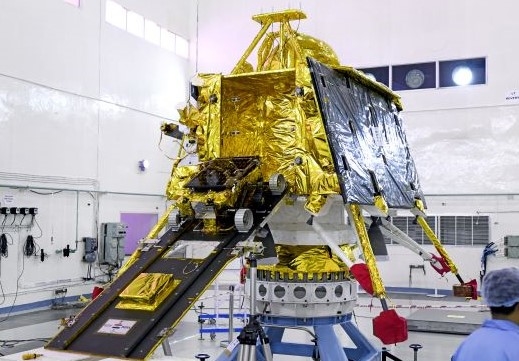
Pre-launch photo shows India’s Pragyan rover mounted on the ramp projecting from out of the sides of Vikram lunar lander. Vikram and the rover were scheduled on September 6 to land on near the Moon’s south polar region – but crashed onto the lunar surface.
Credit: ISRO
Lander lost
Chandrayaan-2 was launched by the Indian Space Research Organization (ISRO) on July 22, 2019. The craft entered lunar orbit on August 20, 2019.
At liftoff, this spacecraft mission consisted of a lunar orbiter, the Vikram Moon lander, and the Pragyan lunar rover. Vikram and the rover were scheduled on September 6 to land on near the Moon’s south polar region – but crashed onto the lunar surface.
Meanwhile, the orbiter experiments are to be operational for 7 years, according to ISRO.
A Chandrayaan-2 data users meeting was held on October 22, 2019 in New Delhi.

Chandrayaan-2 data users meeting.
Credit: ISRO

MINERVA-II2 rover successfully reached asteroid Ryugu.
Credit: JAXA
Japan’s Hayabusa2 continues to be an impressive asteroid mission.
The MINERVA-II2 rover was released from Hayabusa2 back on October 2, 2019.

MINERVA-II2 rover release from Hayabusa2 asteroid explorer.
Credit: JAXA/Tohoku University/Screengrab Inside Outer Space
Based on the optical observation results using a set of spacecraft-mounted cameras and radio signals from the deployed rover, the device reached the asteroid’s surface on October 3rd.
The rover orbited around asteroid Ryugu 1.25 times before landing on the space rock, reports Kazuya Yoshida, Professor and Director of the Space Robotics Lab at Tohoku University.
The rover was named ULULA (University-made Landing Unit for Locomotion on Asteroid) which is a Latin word meaning owl.
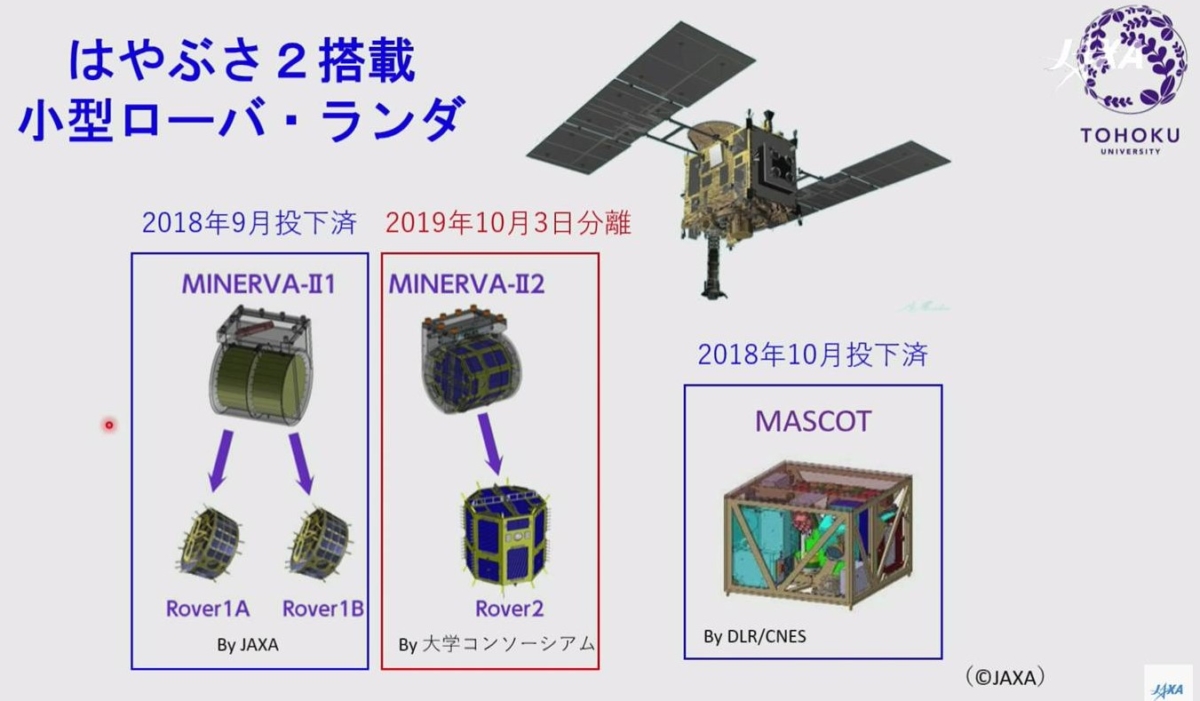
Hardware successfully deployed from Hayabusa2.
Credit: JAXA/Screengrab Inside Outer Space
Rover 1a and 1b were already named Hibou and Owl, Yoshida told Inside Outer Space.
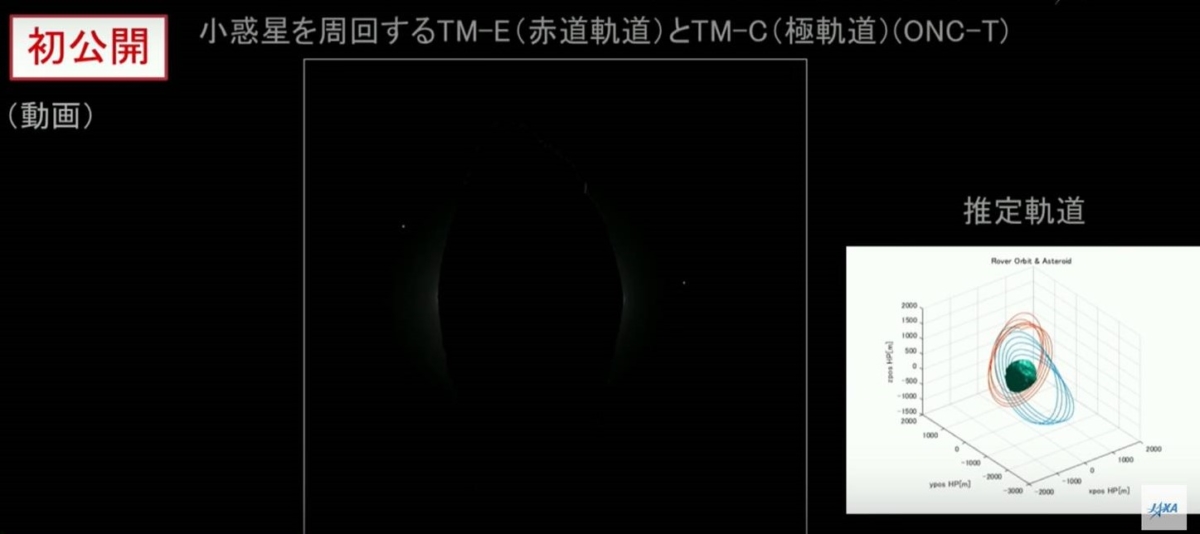
Credit: JAXA/Screengrab Inside Outer Space
Gravity field
Including the target makers, named Sputnik and Explorer, which were inserted into polar and equatorial orbits at the asteroid, “we obtained a good amount of data for the analysis of anomaly of the gravity field of Ryugu,” he said.
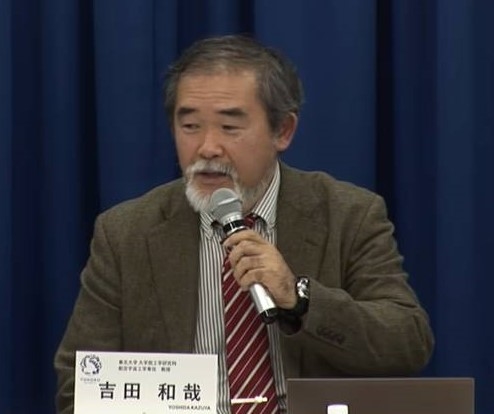
Kazuya Yoshida, Professor and Director of the Space Robotics Lab at Tohoku University. Credit: JAXA/Screengrab Inside Outer Space
On October 28, there was a Japan Aerospace Exploration Agency (JAXA) press conference in Tokyo to provide a quick summary of the target markers and the MINERVA-II2.
Spoken in Japanese, this press event can be seen here at:
https://www.youtube.com/watch?v=y1mzFMk3Tf0
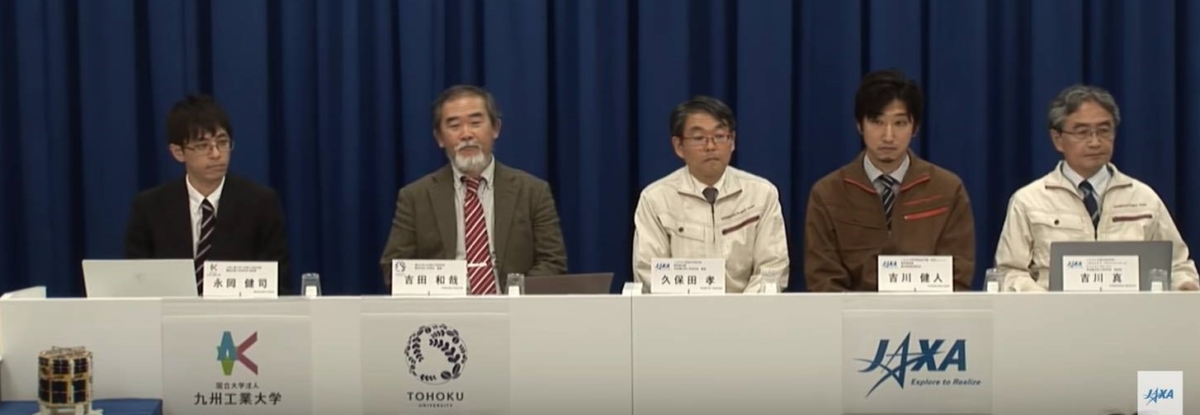
Press event details deployment of MINERVA-II2.
Credit: JAXA/Screengrab Inside Outer Space
Special thanks to professor Kazuya Yoshida for the updated information.
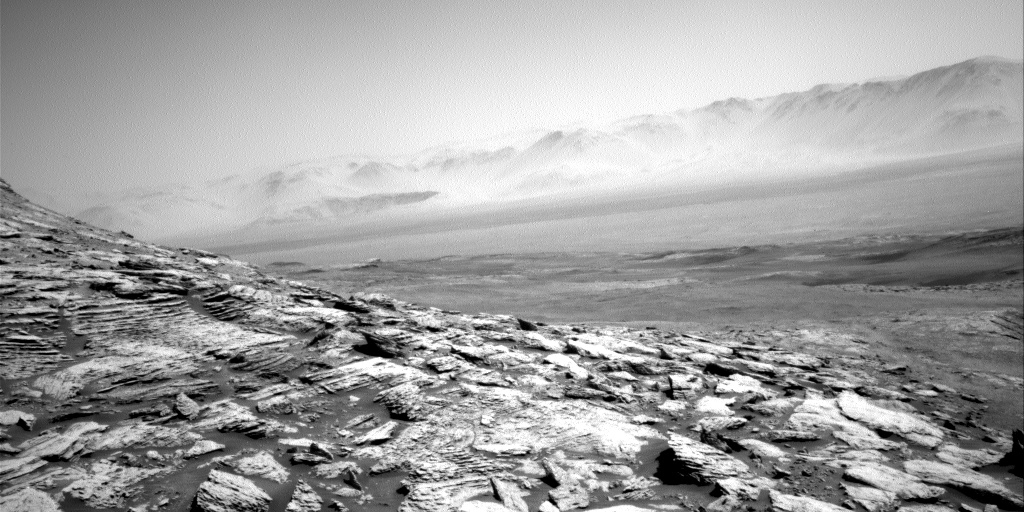
Curiosity Right Navigation Camera B image taken on Sol 2573, November 1, 2019.
Credit: NASA/JPL-Caltech
NASA’s Curiosity Mars rover is now performing Sol 2574 tasks.
Curiosity is still in investigative mode characterizing Central Butte.
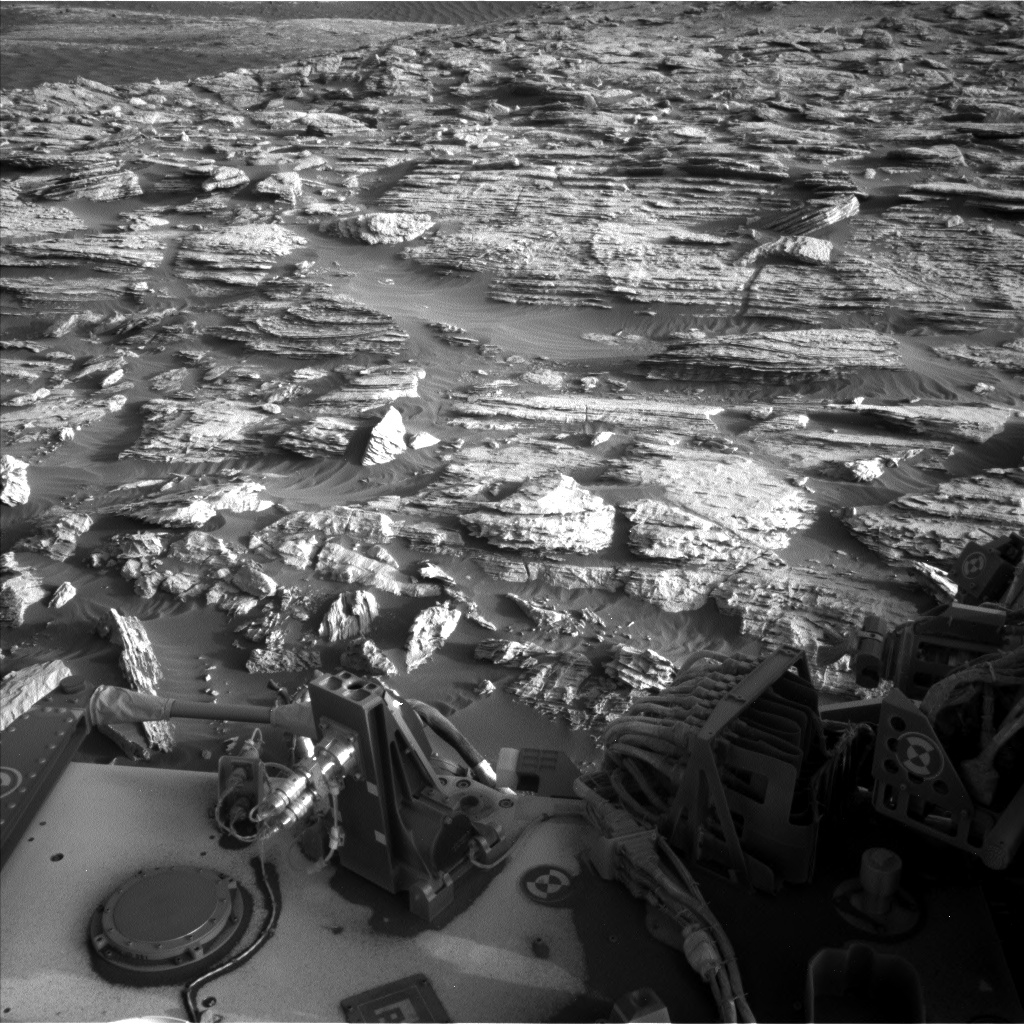
Curiosity Left Navigation Camera B photo acquired on Sol 2572, November 1, 2019.
Credit: NASA/JPL-Caltech
“The rover is a little further up the side of the butte, and the goal is to characterize the different units that we can observe,” reports Kristen Bennett, a planetary geologist at the USGS Astrogeology Science Center in Flagstaff, Arizona.
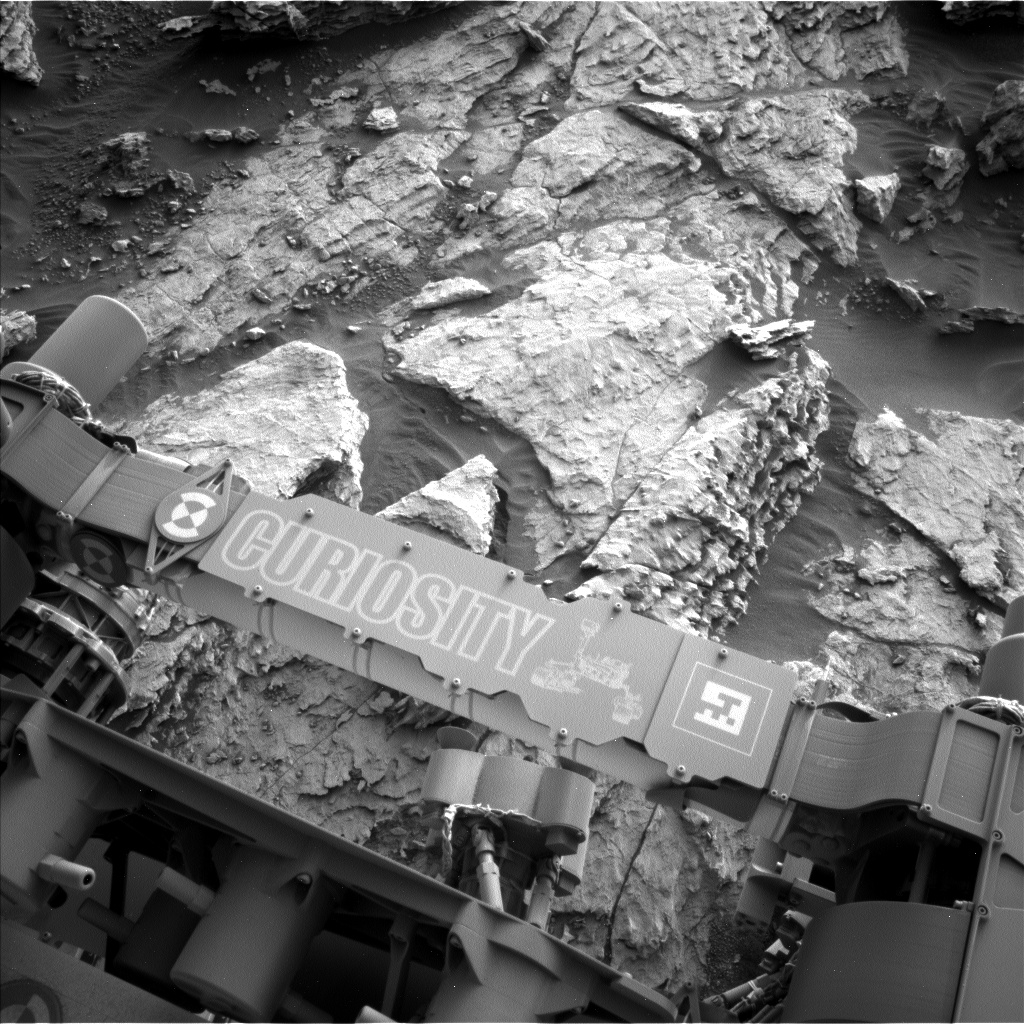
Curiosity Left Navigation Camera B photo taken on Sol 2572, November 1, 2019.
Credit: NASA/JPL-Caltech
Rover targets
A weekend plan calls for plenty of contact science by the robot.
“Upperhill” will be targeted with both the rover’s Mars Hand Lens Imager (MAHLI) and the Alpha Particle X-Ray Spectrometer (APXS) after the Dust Removal Tool (DRT) removes dust from the surface.
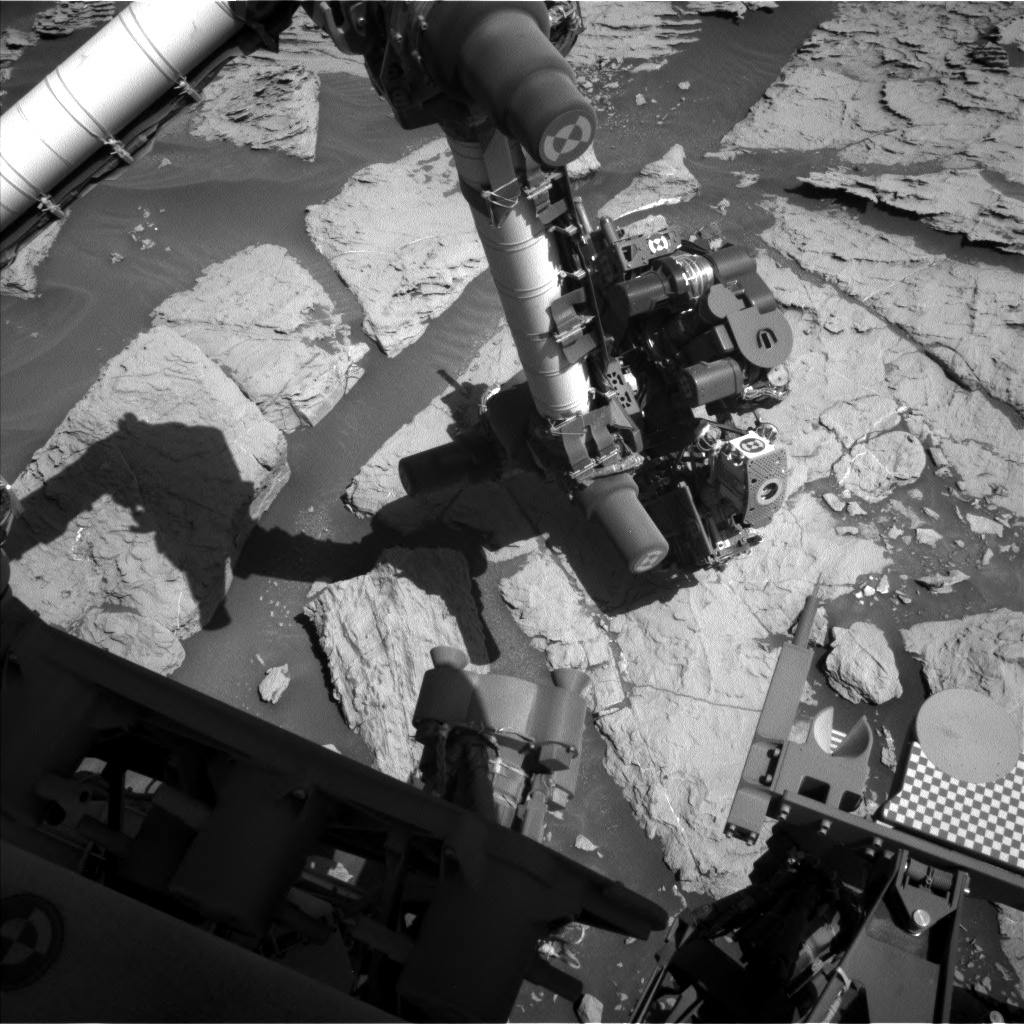
Curiosity Left Navigation Camera B photo acquired on Sol 2572, October 31, 2019.
Credit: NASA/JPL-Caltech
“Stonehive” is an additional MAHLI and APXS target in the plan. Finally, “Kenmore” is a MAHLI-only target that will look at the side of a block to help scientists investigate sedimentary structures in this area, Bennett adds.
Variations in the workplace
Curiosity’s Chemistry and Camera (ChemCam) has four targets in the weekend plan including Stonehive, which is also a contact science target.
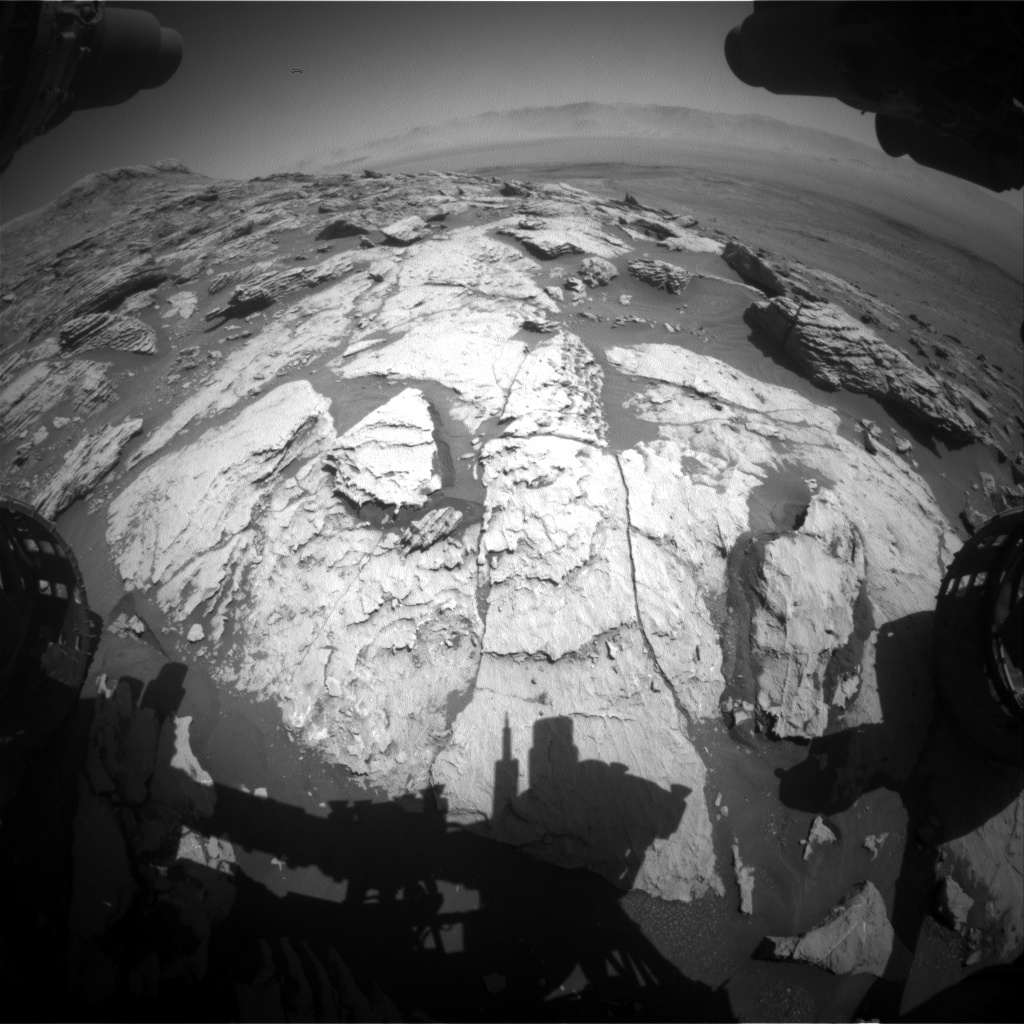
Curiosity Front Hazard Avoidance Camera Right B image taken on Sol 2573, November 1, 2019.
Credit: NASA/JPL-Caltech
ChemCam will also target “Ericht,” “Biggar,” and “Reay” to document any variations present in the workspace.
Mastcam will take documentation images of all the ChemCam targets. Mastcam will also take a multispectral observation of Upperhill.
Sedimentary structures
“This observation will take advantage of the DRT target to obtain multispectral data of a dust-cleared area. Additionally, Mastcam will take several mosaics of the butte,” Bennett explains.
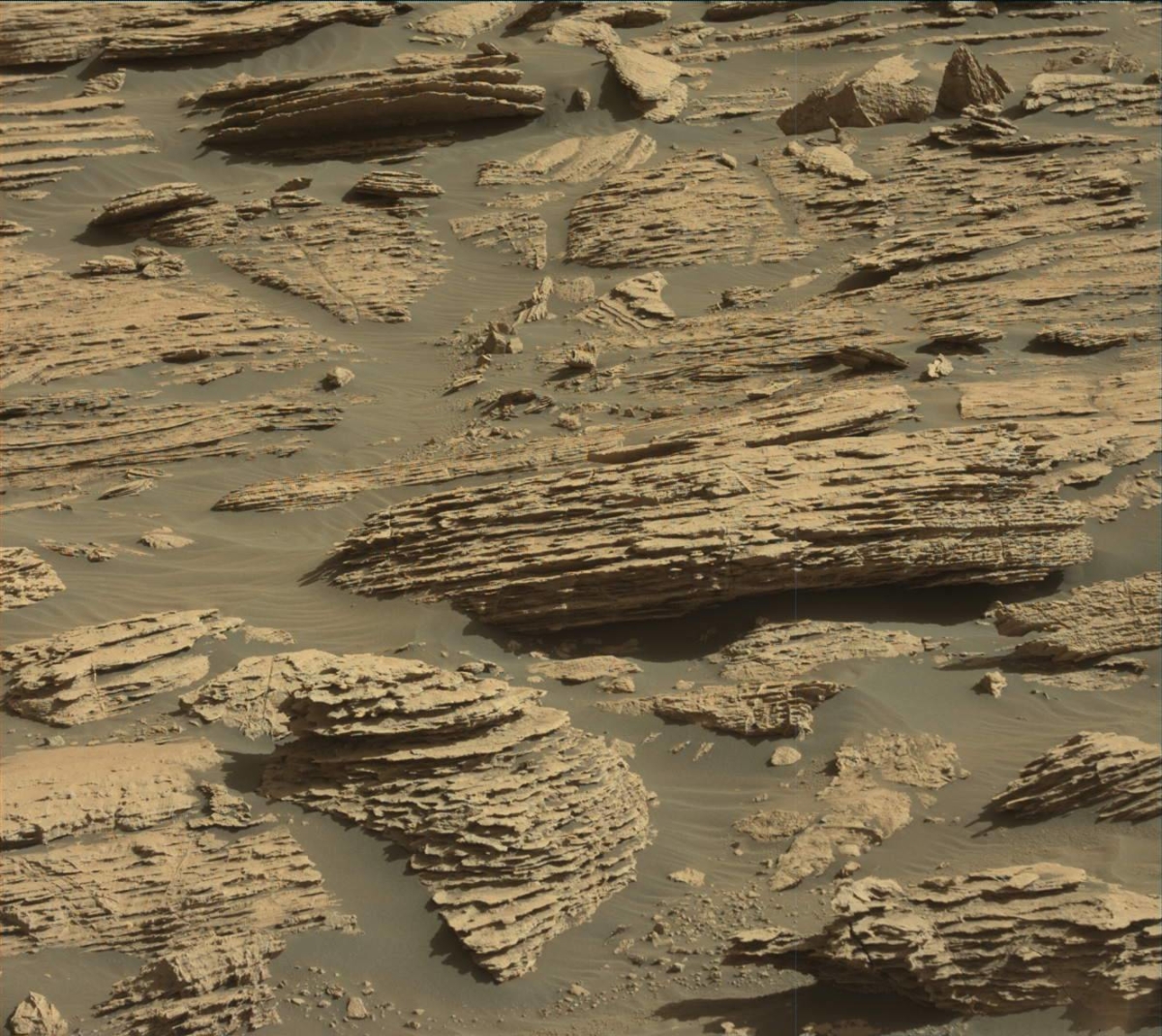
Curiosity Mast Camera Left photo taken on Sol 2570, October 29, 2019.
Credit: NASA/JPL-Caltech/MSSS
“Hunda” is an expansion of a previous mosaic with the same name.
“Interesting sedimentary structures were identified in the original mosaic,” Bennett adds, “so the expanded mosaic will help us understand the extent of these sedimentary structures.”
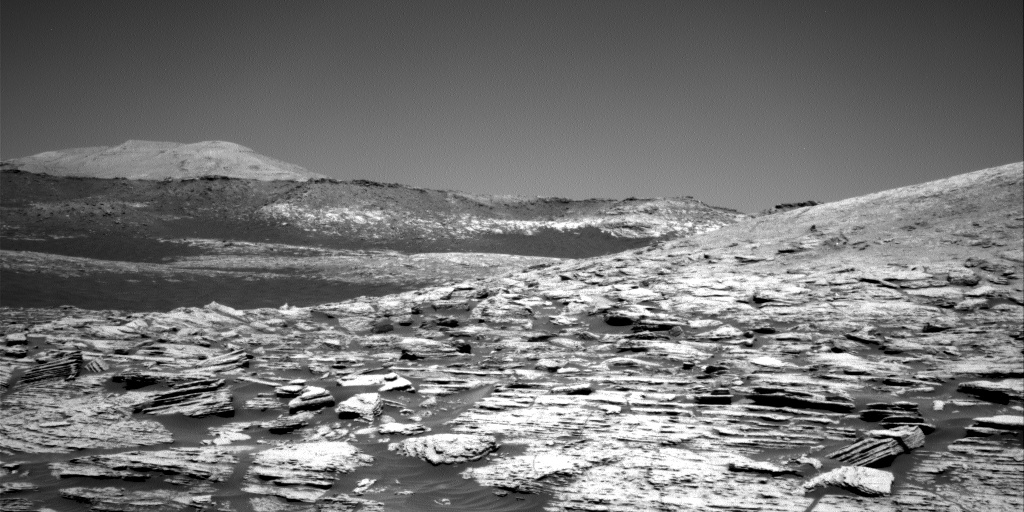
Curiosity Right Navigation Camera B image taken on Sol 2573, November 1, 2019.
Credit: NASA/JPL-Caltech
Outcropping laminations
“Carstairs” is a mosaic that is looking along the side of the butte in order to look at the outcropping laminations from a different angle. “The final mosaic will be of the top of Central Butte to capture an area that we will not be able to drive up to,” Bennett points out.
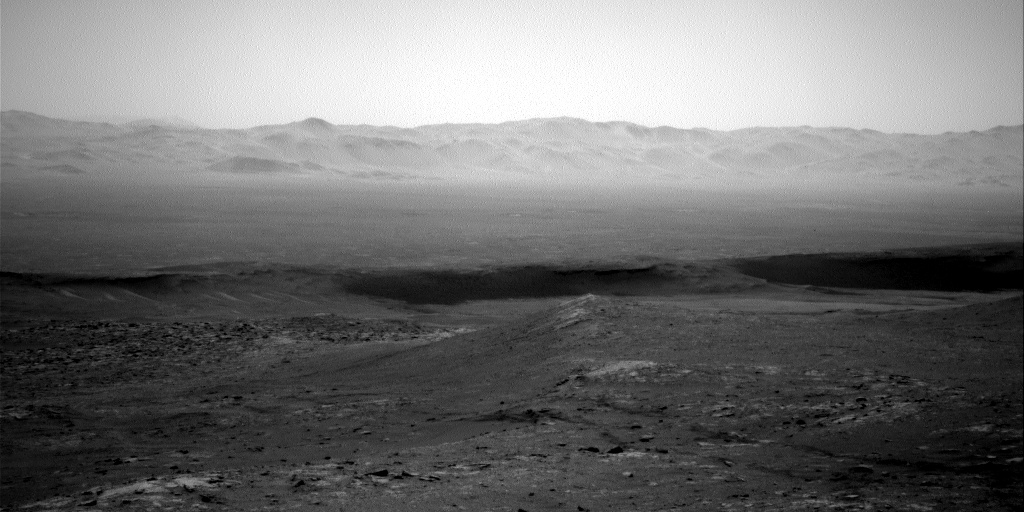
Curiosity Right Navigation Camera B image taken on Sol 2573, November 1, 2019.
Credit: NASA/JPL-Caltech
“After all of these observations, Curiosity will start driving around the butte to look at it from the other side,” Bennett concludes. “We expect to continue having amazing views of Central Butte at our next stop!”
Erosional remnant
In another Curiosity mission update, Fred Calef, a planetary geologist at NASA’s Jet Propulsion Laboratory, Curiosity recently made an almost 33 feet (10 meters) drive “to approach a “‘butte’iful” outcrop at the base of “Central” butte, an erosional remnant of the pediment in front of the rover, Calef explains.
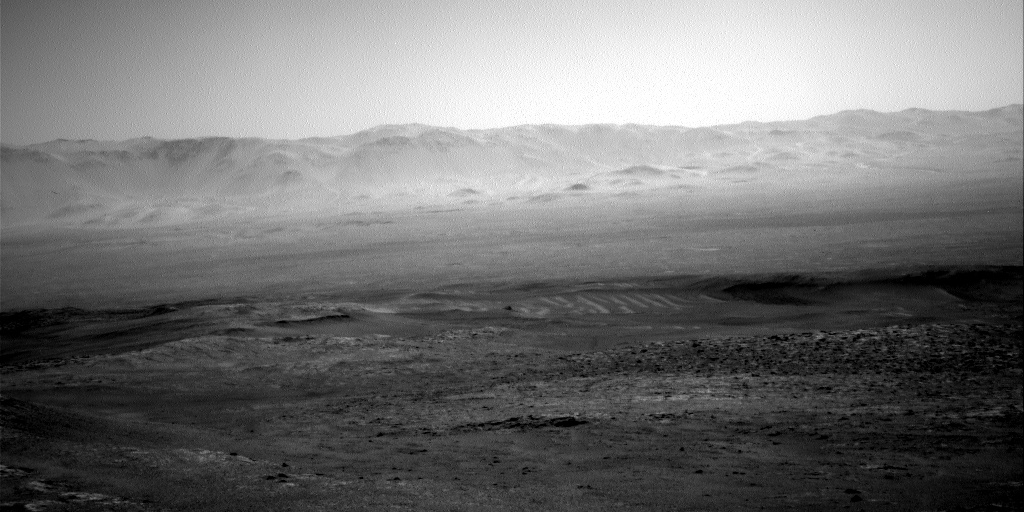
Curiosity Right Navigation Camera B image taken on Sol 2573, November 1, 2019.
Credit: NASA/JPL-Caltech
With a key geologic contact between two different layers a few meters ahead, Calef adds, that a recent plan called for a “touch-n-go” on sol 2572 with two APXS measurements, ChemCam, MAHLI, and Mastcam on rock “Glen Mark,” an additional ChemCam on “Fourpenny”, a Mastcam of nearby “Pittodrie” looking for nodules in the rock, and a Mastcam mosaic of layered outcrop “Hunda” in front of the rover which is composed of fine layered bedding.
Next drill location
“We’re also firing up CheMin [Chemistry & Mineralogy X-Ray Diffraction/X-Ray Fluorescence Instrument] for an empty cell analysis to get ready for the next drill location,” Calef reports.
On sol 2773, the rover was slated to go through its nominal list of untargeted ChemCam acquisitions, a dust-devil survey, and Mastcam line-of-sight extinction to measure dust in the atmosphere.
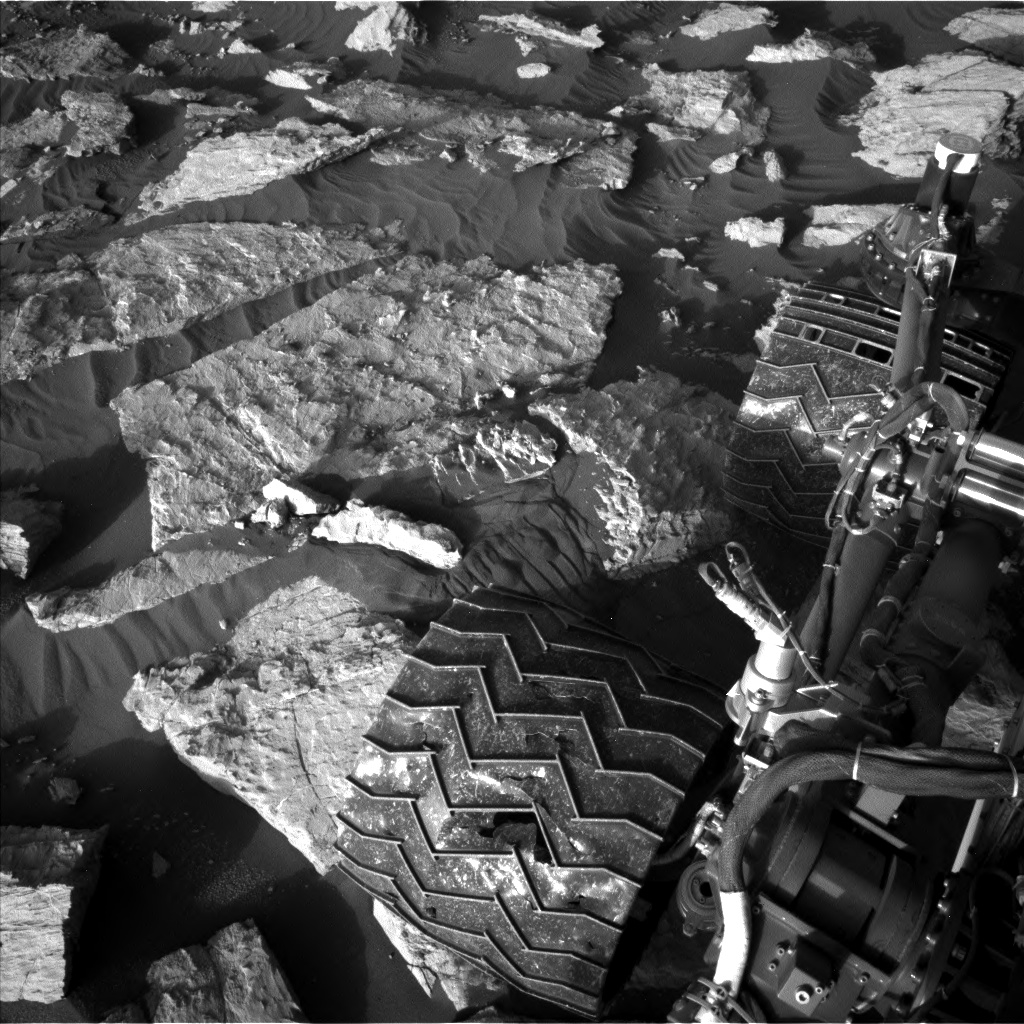
Curiosity Left Navigation Camera B photo taken on Sol 2572, October 31, 2019.
Credit: NASA/JPL-Caltech

Credit: NASA Haughton-Mars Project
If you’re a Spinal Tap aficionado like me, “Smell the Glove” always brings back palpable music memories played by that mock heavy-metal band.
But for future human exploration of the Moon, Mars and beyond one expects more from a glove!
And that’s the promise of an “astronaut smart glove” – a human-machine interface to wirelessly operate a wide array of robotic assets, like flying drones via simple single-hand gestures.

Devon Island in the High Arctic, home base for the NASA Haughton-Mars Project (HMP) encampment.
Credit: HMP/Screengrab Inside Outer Space
High arctic testing
That technology has been evaluated on Devon Island in the High Arctic, home base for the NASA Haughton-Mars Project (HMP) encampment.
In a 2019 field test, smart glove technology was integrated to an existing spacesuit used in analog studies at HMP. With it, astronauts could easily control a range of robotic assets, making science and exploration operations on the Moon, Mars and at other destinations more effective and productive.
That’s the word from Pascal Lee, a planetary scientist with the SETI Institute and the Mars Institute, and director of the NASA Haughton-Mars Project at NASA Ames Research Center.
“When I first saw Ntention’s smart glove in action, I immediately thought of Arthur C. Clarke’s Third Law: ‘Any sufficiently advanced technology is indistinguishable from magic,’” recalled Lee.

Credit: HMP
“A pressurized spacesuit is relatively rigid, and hand and finger motions meet with substantial resistance, notes Lee. By using the Astronaut Smart Glove the sensitivity of hand motions is adjustable and can be set high, which means the technology might be adaptable to a stiff pressurized spacesuit,” he said.
Nimbleness and comfort
Future planetary spacesuits are expected to improve in nimbleness and comfort over time. But, as pressurized vessels, spacesuits are likely to remain fundamentally cumbersome, limiting the dexterity and precision with which astronauts may perform tasks such as collecting samples and operating robots.
Giving a hand on this issue is Ntention, a forward thinking group that developed the smart glove technology tested during this year’s HMP-2019 summer field campaign.
“Our philosophy is to create technology that makes human-machine interfacing intuitive and seamless,” said Moina Medboe Tamuly, COO and co-founder of the Norway-based Ntention, and a field participant at HMP-2019.
The Ntention smart glove uses a micro-controller to read different kinds of sensors, capturing even the subtlest of motions of the hand and fingers, and wirelessly transfer these to a mobile device that controls the drone or any other robot.
Single-handedly
HMP-2019 team members evaluated the Astronaut Smart Glove technology through a series of field tests involving the tele-operation of commercial drones.

In the NASA Artemis era, smart hands do smart things on the Moon.
Credit: NASA
On the Moon, the lack of a substantial atmosphere on the Moon means that drones there might use propulsive gas thrusters.
On Mars, where there is a substantial atmosphere, albeit thinner than Earth’s, drones might use either rotors or thrusters, depending on the altitude of the sites where they would fly, explains a NASA Haughton-Mars Project statement.
The HMP worked with the SETI Institute, the Mars Institute, NASA Ames Research Center, along with Collins Aerospace and Ntention on the astronaut smart glove.
Field tests at HMP-2019 showcased how an astronaut in a spacesuit would be able to single-handedly perform several key science and exploration tasks with ease using the smart glove and an augmented reality visualization interface.
Other tests at HMP-2019 quantitatively rated the drone handling qualities allowed by the smart glove interface using standardized flight test metrics.
Go to this informative video: Mars On Earth – Astronaut Smart Glove

