Archive for the ‘Space News’ Category
 Author:
  November 30th, 2019
Credit: LandSpace
An appraisal of China’s commercial space sector provides a review of the current landscape of China’s nascent but growing commercial space sector.
The report — Evaluation of China’s Commercial Space Sector – has been issued by the Institute for Defense Analyses (IDA) Science and Technology Policy Institute in Washington, D.C.
Key questions
The assessment uses original documents and first-hand Chinese-language interviews with Chinese companies and China’s industry experts.
The report addresses three questions:
- What factors are driving the development of China’s emerging commercial space sector?
- What are the key characteristics of this sector?
- What are its strengths and weaknesses, and where do we expect Chinese commercial space companies to be in the next 5–10 years?

Locations of commercial space companies. Credit: IDA’s Science and Technology Policy
Institute
Critical mass
The report concludes that, while China’s commercial space sector is presently in an embryonic stage and many appear to be struggling, some are slowly gaining their footing.
A small number of Chinese commercial space companies could grow to a point where they have critical mass, especially if markets that benefit from the launch and use of small satellites grow rapidly.
“If this is the case, the Chinese government is likely to take a greater role in ensuring the success—and contribution to the Chinese economy and national security—of the commercial space sector, as it has done in adjacent sectors such as telecommunications and IT,” the report observes.
If, space applications of interest to businesses and households (rather than governments) emerge, the report continues, “China can leverage its capabilities in rapid mass production, its skilled space industry workforce, and its ability to quickly develop products—similar to what China has done in telecommunications and IT sectors.”
To access this report, go to:
 Posted in

Ion engine propulsion unit on Hayabusa2, shown in pre-launch photo.
Credit: JAXA
Japan’s Hayabusa2 asteroid explorer is homeward bound, a cruise phase back to Earth nudged by ion engine propulsion.
Hayabusa2 operators report that an ion engine test operation has ended.
“This trial run has not had any problems and the preparations for the ion engine operation during the cruise phase of the return journey are complete,” a Japan Aerospace Exploration Agency (JAXA) tweet explains.

Hayabusa2 controllers applaud the asteroid explorer’s departure back to Earth.
Credit: Institute of Space and Astronautical Science (ISAS)/JAXA
Ion engine operation for the Earth return cruise operation will start on December 3.
“We are finally beginning full-scale return operations,” a JAXA tweet adds. “Incidentally, December 3 is also the 5th anniversary of the launch of Hayabusa2!”
Departure
Earlier, JAXA confirmed that Hayabusa2 left the target asteroid Ryugu on November 13, 2019 utilizing chemical propulsion thrusters for the spacecraft’s orbit control.

Credit: JAXA
At the end of 2020, Hayabusa2 plans to return to the Earth with the samples collected from asteroid Ryugu.
JAXA is currently working with the Australian Government to support the recovery of the Hayabusa2 re-entry capsule in late 2020 at the Woomera Prohibited Area (WPA) located in the outback desert of South Australia.

Credit: ESA
The European Space Agency’s (ESA) Council at Ministerial Level, Space19+, has concluded in Seville, Spain.
For the first time in 25 years, there will be a significant boost in funding for ESA’s world-class science program and stresses that the Program will also address requirements for
developing in-situ resource utilization on the Moon.
Among spotlighted ESA activities:

Gateway
Credit: NASA
A continuation of commitment to the International Space Station until 2030.
Contributing vital transportation and habitation modules for the Gateway, the first space station to orbit the Moon.
Begin the process of recruiting a new class of astronauts to continue European exploration in low Earth orbit and beyond. European astronauts will fly to the Moon for the first time.
Member States have confirmed European support for a ground-breaking Mars Sample Return mission, in cooperation with NASA.

ESA’s Space Rider.
Credit: ESA
A green light has been given to Space Rider, ESA’s new reusable spaceship.
Adoption of Space Safety as a new basic pillar of ESA’s activities that includes removal of dangerous debris and plans for automation of space traffic control – and early warnings and mitigation of damage to Earth from hazards from space such as asteroids and solar flares. The Hera mission marks a joint collaboration with NASA to test asteroid deflection capabilities.
ESA has 22 Member States: Austria, Belgium, the Czech Republic, Denmark, Estonia, Finland, France, Germany, Greece, Hungary, Ireland, Italy, Luxembourg, the Netherlands, Norway, Poland, Portugal, Romania, Spain, Sweden, Switzerland and the United Kingdom, of which 20 are Member States of the EU.
For more details on United Space in Europe, go to:
For an interview with ESA Director General Jan Wörner following the conclusion of Space19+, the ESA Council at Ministerial Level, held in Seville, Spain, November 27-28. He calls it the “European New Space Agency.” Go to:
https://www.youtube.com/watch?time_continue=7&v=HcFWOF7uNuY&feature=emb_logo

Curiosity Front Hazard Avoidance Camera Right B image taken on Sol 2598, November 27, 2019.
Credit: NASA/JPL-Caltech
NASA’s Curiosity Mars rover is now performing Sol 2599 duties, ready for a “feast for the eyes” during Sols 2600-2603.
“Curiosity will be gorging on a feast of data this holiday weekend,” reports Melissa Rice, a planetary geologist at Western Washington University in Bellingham, Washington.

Curiosity Right Navigation Camera Right B photo acquired on Sol 2598, November 27, 2019.
Credit: NASA/JPL-Caltech
“We plan to acquire over 12,000 Mb of data in the four sols covering the U.S. Thanksgiving holiday, which could be a new record for the mission,” adds Rice. The rover will be “stuffed,” and scientists will be digesting the results for months to come.

Curiosity Mast Camera Right photo taken on Sol 2597, November 26, 2019.
Credit: NASA/JPL-Caltech/MSSS
Main dish
Rice explains: “The main dish is an enormous color image mosaic. To capture the full 360 degrees of terrain surrounding the rover, Curiosity will take 850 individual images with each of its Mastcam cameras. It will take roughly eight hours to capture all of those images, so to spread out the work over multiple sols, we have divided the full scene into four segments.”

Curiosity Mast Camera Right photo taken on Sol 2597, November 26, 2019.
Credit: NASA/JPL-Caltech/MSSS
Scientists will capture each segment around local noon so that the lighting will be consistent, Rice notes, which will make it easier to stitch all of the individual pieces together into a seamless panoramic image.
Final product, side dishes
“We included the first segment in the previous plan for sols 2597-2599, and this weekend we will capture the last three segments,” Rice reports. “The final product will be a sight to behold: a gigapixel stereo image of dramatic desert landscape, with buttes of crumbling sandstone in the foreground and Mt. Sharp towering in the distance.”

Curiosity Chemistry & Camera (ChemCam)Remote Micro Imager (RMI) photo acquired on Sol 2598, November 27, 2019.
Credit: NASA/JPL-Caltech/LANL
Side dishes at Curiosity’s feast, Rice adds, include Navcam images looking towards the horizon to search for dust devils, and close-up investigations of two rock targets using the Mars Hand Lens Imager (MAHLI) and Alpha Particle X-Ray Spectrometer (APXS) instruments: one named “Inverurie” with a rough texture, and another named “Latheron” with a smoother, layered texture.
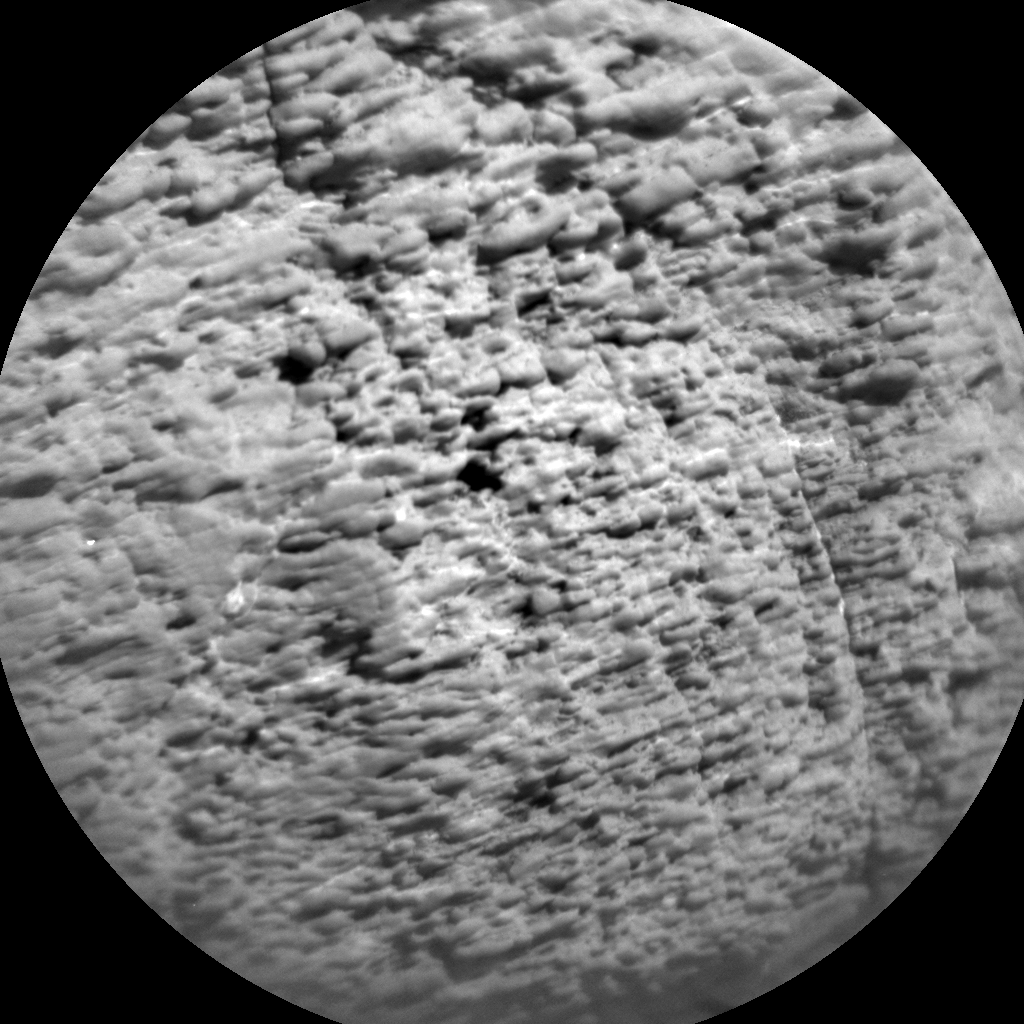
Curiosity Chemistry & Camera (ChemCam)Remote Micro Imager (RMI) photo acquired on Sol 2598, November 27, 2019.
Credit: NASA/JPL-Caltech/LANL
Dessert serving
On sol 2602, Curiosity is slated to drive closer to the base of Western Butte. “Then for dessert, we will use the APXS instrument overnight to monitor the concentration of argon in Mars’ atmosphere,” Rice says. After such an overindulgence, on sol 2603 Curiosity will do the rover equivalent of laying comatose on the couch: a full sol of sitting still and monitoring the weather with the Rover Environmental Monitoring Station (REMS) instrument.
“We have quite a lot to be thankful for this holiday weekend! November 26 marks the eight-year anniversary of Curiosity’s launch in 2011. After more than seven years of exploring Mars, our rover is still strong and healthy and the views just keep getting better,” Rice concludes.

Late afternoon of Sol 2595. Mosaic of twelve NavCam Gauche pictures taken on sol 2595 at approximately 16h30 local time.
Credit: NASA/JPL-Caltech/MSSS/Thomas Appéré
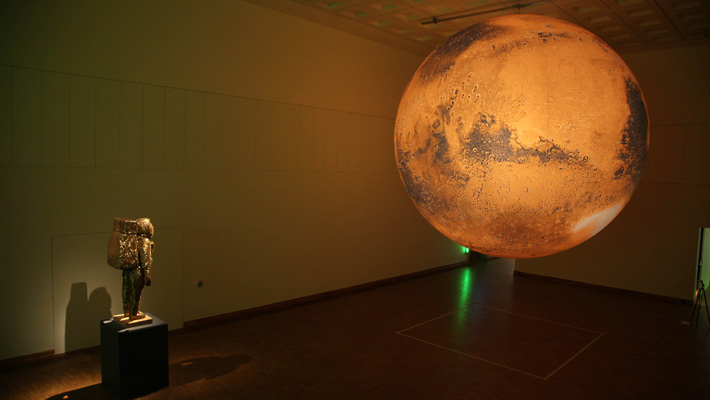
Credit: Luke Jerram Studio
A new sculpture of Mars is ideal for studying the surface of the Red Planet up close and in three dimensions.
Artist Luke Jerram, based in the U.K. was commissioned by the Kunsthal KAdE museum in the Netherlands for a group exhibition, One Way Ticket to Mars. In the dark main room, the luminous colossal Mars globe floats in the space. The story of the trip to Mars unfolds in four narratives: the desire, the journey, the stay and homesickness.
The huge Mars work by Jerram is created from high resolution NASA data. At 20 feet (6 meters) in diameter, each centimeter of the Mars artwork details 7 miles (11 kilometers) of the surface of Mars.
On tour
A new ambient surround sound composition by Dan Jones is currently in development, and is to feature NASA recordings and sounds of the desert. After Kunsthal KAdE, the sculpture of Mars will tour and be presented with this new composition.

Artist Luke Jerram
Credit: Luke Jerram Studio
Like Luke Jerram’s other artworks, Museum of the Moon and Gaia, this new Mars piece is designed to tour and be presented in a range of different contexts and cultures. Over the coming months Jerram will be researching humanity’s historical relationship with Mars, drawing out the stories, myths and beliefs which he hopes to present back to the public.
Jerram’s multidisciplinary practice involves the creation of sculptures, installations and live arts projects.

Angelo Vermeulen, HI-SEAS Mission 1, 2013.
Courtesy: Kunsthal KAdE
Group exhibition
The One Way Ticket to Mars exhibition at Kunsthal KAdE in Holland is a group exhibition about Mars, featuring both artists and scientists who have made art and studied this planet. This exhibition has been on view since September 2019 and ends January 12, 2020.
For more information on the Mars sculpture, go to:
For details on the exhibition, go to:
https://www.kunsthalkade.nl/en/exhibitions/one-way-ticket-to-mars
A video showing the Mars sculpture can be viewed here:
https://www.youtube.com/watch?v=3wPIWSMCZXE&feature=emb_logo
Note: Contact studio@lukejerram.com if you’d like to be one of the first organizations to present the artwork!

The Consequential Frontier: Challenging the Privatization of Space by Peter Ward, Melville House Publishing, New York & UK; October 2019; hardcover, 224 pages, $26.99.
As 2020 promises to loom large for the commercial space sector, this book is a timely read regarding the privatization of outer space.
The book’s title speaks volumes with Peter Ward taking an investigative look at a key question: If humankind and their private wealth have made such a mess of Earth, who can say we won’t do the same in space?
Your favorite rocketeers are included – Musk, Branson, Bezos – but Ward also introduces activists attempting to keep private space groups from rushing irresponsibly into the cosmos.
The book is divided up into three parts, covering such topics as the Cold War and the Outer Space Treaty, space tourism, orbital debris, and the perils and profits of mining the Moon, along with a look at NASA, from contractor to client.
Authoring articles in The Economist, Newsweek and Bloomberg Businessweek, the author writes that “space, despite being a cold, harsh environment full of danger, still represents something of a blank slate for humanity,” but warns “we’re not off to the best start.”
The Consequential Frontier offers cautionary flags about rocket billionaires, smaller entrepreneurial groups, and the overall privatization and “democratization” of low Earth orbit and beyond.
Will space be a “shining beacon” of cooperation…or a “mash-up of corporate interest and a repetition of generations of mistakes,” questions Ward.
Readers will find this book thought-provoking and also disquieting, but a helpful reminder that a productive and trouble-free space future comes at a price.
For more information on this book, go to:

Curiosity Front Hazard Avoidance Camera Right B image taken on Sol 2597, November 26, 2019.
Credit: NASA/JPL-Caltech
NASA’s Curiosity Mars rover is now carrying out Sol 2598 tasks.
“We arrived at our parking spot for the U.S. Thanksgiving holiday, and Mars gave us plenty to be grateful for in and around the workspace,” reports Michelle Minitti, a planetary geologist at Framework in Silver Springs, Maryland.

Curiosity Right B Navigation Camera photo acquired on Sol 2597, November 26, 2019.
Credit: NASA/JPL-Caltech
Each bedrock slab in the workspace, Minitti adds, seems to have something different to offer, “Western Butte” looms just 82 feet (25 meters) off to rover left, and dark sand ripples lap up against the small rise the robot is perched on.
“It is an ideal spot at which to spend some quality time. We start off the plan by acquiring the first of part of a 360° panorama that we will accumulate in four parts over the Thanksgiving holiday,” Minitti explains.
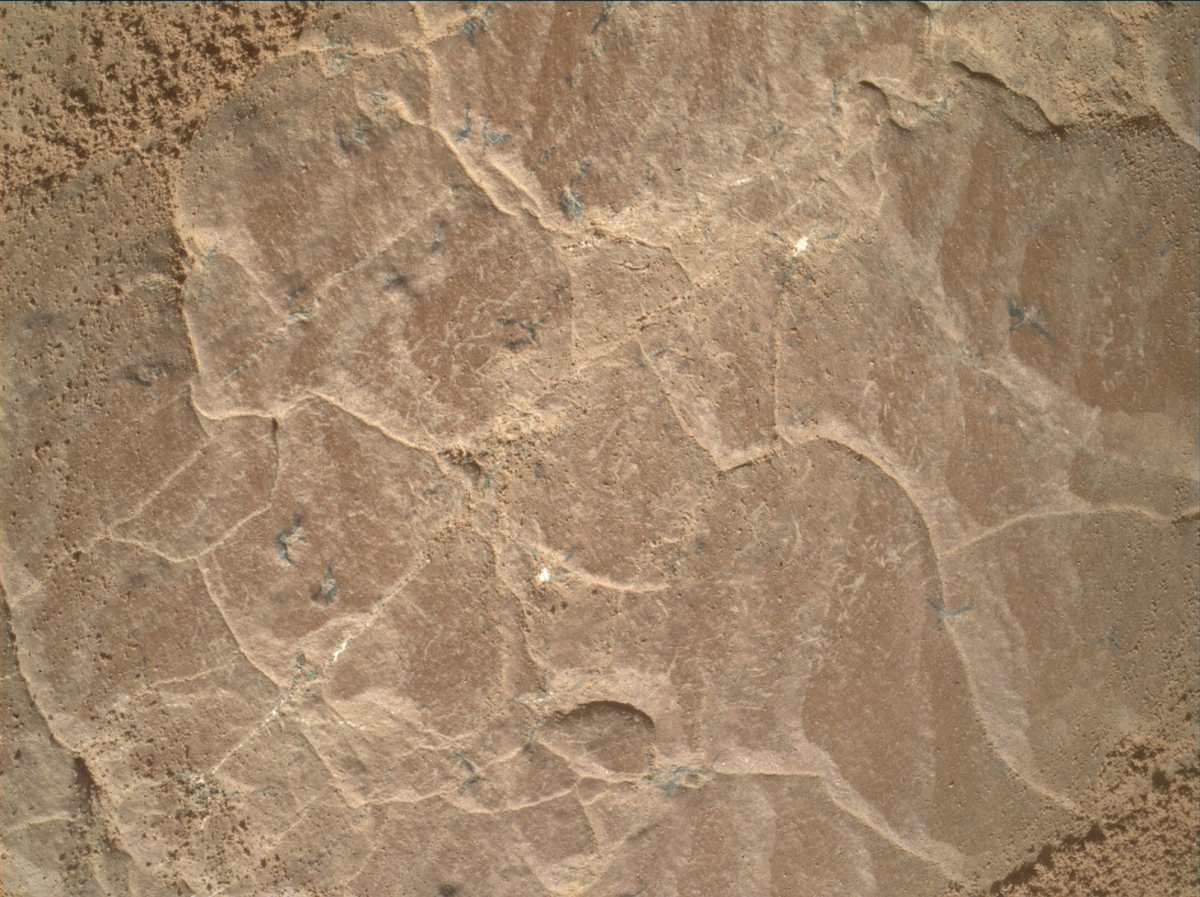
Curiosity Mars Hand Lens Imager (MAHLI) photo produced on Sol 2597, November 26, 2019.
Credit: NASA/JPL-Caltech/MSSS
Left eye, right eye
Normally, Mars scientists collect 360° mosaics with Curiosity’s wider field of view Mastcam left eye. This time, the plan calls for capturing the 360° mosaic using the left eye and the narrower field of view Mastcam right eye.
Minitti adds that this will result in a ripe-for-zooming-in stereo mosaic that includes our recent focus of exploration, “Central Butte,” and the clay-bearing unit, “Vera Rubin Ridge,” the “Greenheugh pediment,” the distant Gale crater rim, and (looming above all) Mount Sharp.
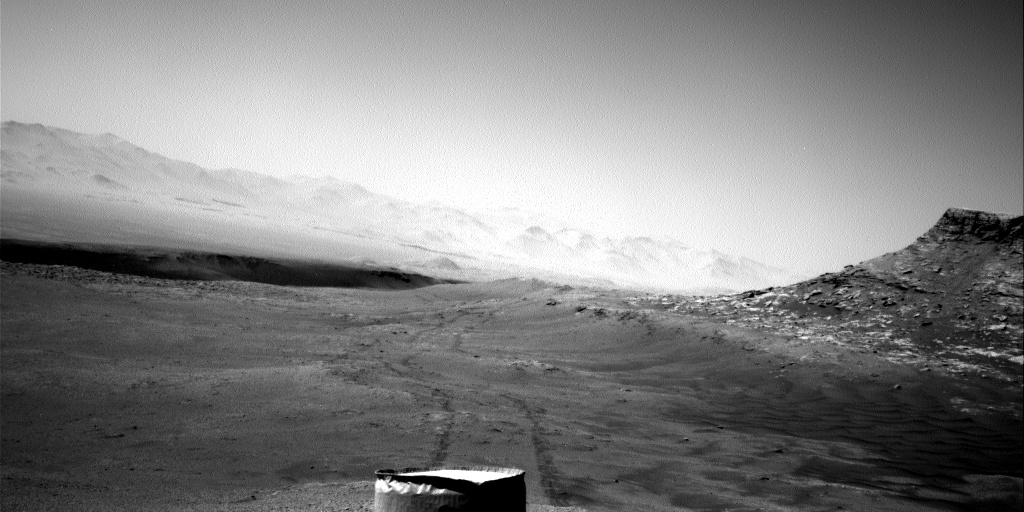
Curiosity Right B Navigation Camera photo acquired on Sol 2597, November 26, 2019.
Credit: NASA/JPL-Caltech
Bedrock targets
Through the rest of a three sol plan (Sols 2597-2599), “our focus falls slightly closer to the rover than the surrounding vista” Minitti reports.
That plan includes brushing the target “Everbay — which has a polygonal fracture pattern — with the Dust Removal Tool (DRT) and follow up with Mars Hand Lens Imager (MAHLI) imaging and an Alpha Particle X-Ray Spectrometer (APXS) analysis.
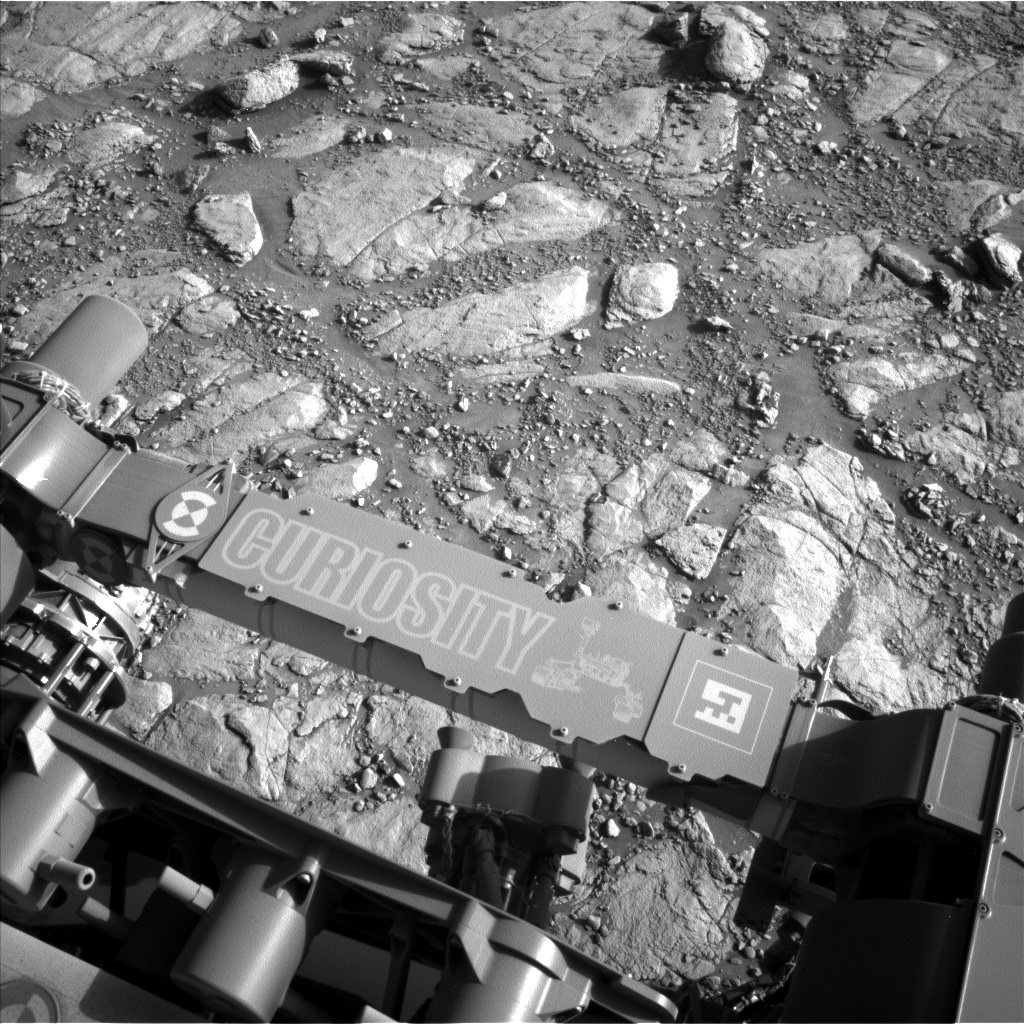
“Fidra” is visible in the upper left corner of this image taken by Curiosity’s Left B Navigation Camera on Sol 2595, November 24, 2019.
Credit: NASA/JPL-Caltech
MAHLI will also image the targets “Carlops” and “Inverurie,” bedrock targets with different textures than Everbay, to help plan more detailed investigation of these targets with MAHLI and APXS in the next plan.
Chemistry and Camera (ChemCam) will shoot Everbay, Inverurie, “Latheron” (yet another variety of bedrock texture!), and “Fidra,” whose vertical gives rover scientists a perfect cross section to look at.

Curiosity Right B Navigation Camera photo acquired on Sol 2597, November 26, 2019.
Credit: NASA/JPL-Caltech
Tunable laser test
Rounding out the plan on Sol 2599, Sample Analysis at Mars (SAM) Instrument Suite will run a test of its tunable laser spectrometer, Minitti says.

Curiosity Right B Navigation Camera photo acquired on Sol 2597, November 26, 2019.
Credit: NASA/JPL-Caltech
“The environment around and above the rocks gets attention in this plan, as well,” Minitti concludes. The plan involves acquiring regular Rover Environmental Monitoring Station (REMS), Radiation Assessment Detector (RAD) and Dynamic Albedo of Neutrons (DAN) measurements, and images and movies of clouds and dust devils.

Curiosity Right B Navigation Camera photo acquired on Sol 2597, November 26, 2019.
Credit: NASA/JPL-Caltech

Gemini Observatory operated by a partnership of six countries including the United States, Canada, Chile, Brazil, Argentina and Korea.
Credit: Joy Pollard
In the past three decades over 4,000 exoplanets have been revealed. This “discovery rate” will surely grow unabated year after year. Some researchers now estimate that the average number of planets per star is greater than one.
Given a convergence of ground and space-based capability, AI/machine learning research and other tools, are we on the verge of identifying what is universally possible for life, perhaps confirming the existence of extraterrestrial intelligence?

NASA’s Transiting Exoplanet Survey Satellite (TESS) is on the search for planets outside of our solar system, including those that could support life. The mission will find exoplanets that periodically block part of the light from their host stars, events called transits.
Credit: NASA/GSFC
Is 2020 the celestial payoff year in which objects of interest are found to offer “technosignatures” – indicators of technology that may have been developed by advanced civilizations?
What do leading experts think? Go to my new Space.com story:
Will 2020 Be the Year We Find Intelligent Alien Life?

The unfolding of one of the three antennas. This series of three photographs was taken during the unfolding of an antenna on the Queqiao satellite, which is located behind the Moon at around 450 thousand kilometers from Earth. The antenna is the black-and-white rod pointed away from the camera. The gilded cube is the casing in which the antenna has waited to be unfolded for 18 months.
Credit: Marc Klein Wolt/Radboud University
The antennas of a radio astronomy experiment have been deployed from China’s Queqiao lunar relay satellite.
The detector is a joint development by Dutch and Chinese scientists, designed to measure radio waves originating from the period directly after the Big Bang, when the first stars and galaxies were formed.
Queqiao, meaning Magpie Bridge, was launched on May 21, 2018. It was then maneuvered into a halo orbit around the second Lagrangian point of the Earth-Moon system.

An earlier image from Queqiao relay satellite shows Netherlands Chinese Low-Frequency Explorer (NCLE) stowed antenna, the Earth, and farside of the Moon. Queqiao is in a halo orbit at L2 Lagrange point.
Courtesy: Radboud Radio Lab
Communication link
From its Earth-Moon position, the satellite provides a communication link between the Earth and the Moon’s farside, and has been instrumental in the continuing operation of China’s Chang’e-4 lander and Yutu-2 rover.
Chang’e-4 soft landed within Von Karman Crater in the South Pole-Aitken Basin on the farside of the Moon on January 3, 2019.

Radio antennas of the Netherlands Chinese Low-Frequency Explorer (NCLE), developed by ASTRON, Radboud Radio Lab, ISIS and the National Astronomical Observatories of China (NAOC).
Credit: Radboud Radio Lab/ASTRON/Albert-Jan Boonstra
Start of science observations
The radio antenna — Netherlands Chinese Low-Frequency Explorer (NCLE) — was developed by Radboud Radio Lab of Radboud University, ASTRON, the Netherlands Institute for Radio Astronomy in Dwingeloo, and the Delft-based company ISIS, along with the Chinese National Astronomical Observatory of the Chinese Academy of Sciences (NAOC).
Tweets Marc Klein Wolt, managing director of the Radboud Radio Lab: “We are so proud, not only of this success which marks the start of our science observations, but also because as of now we are an official radio astronomical observatory in space!”
“Our contribution to the Chinese Chang’e 4 mission has now increased tremendously,” Wolt said in a press statement. “We have the opportunity to perform our observations during the fourteen-day-long night behind the Moon, which is much longer than was originally the idea. The Moon night is ours, now.”

The Netherlands-China Low-Frequency Explorer (NCLE) is onboard China’s Queqiao relay satellite.
Credit: Radboud Radio Lab of the Radboud University, the Netherlands Institute for Radio Astronomy (ASTRON) and Innovative Solutions in Space (ISIS).
Deployment issues
In a Radboud University statement, the longer stay behind the Moon most probably did have an effect on antenna deployment.
“At first, the antennas unfolded smoothly, but as the process progressed, it became increasingly difficult,” the statement explains.
“The team therefore decided to collect data first and perhaps unfold the antennas further at a later point in time. With these shorter antennas, the instrument is sensitive to signals from around 800 million years after the Big Bang. Once unfolded to their full length, they will be able to capture signals from just after the Big Bang.”
 According to China’s Xinhua news service, citing scientists involved with the detector, it will be able to observe the radio bursts of Earth, Jupiter and other planets, conduct collaborative observation with the low-frequency radio spectrometer on the Chang’e-4 lander and similar instruments on Earth, and help explore exoplanets.
Go to this video showing one of the NCLE antenna elements deploying during a pre-launch test.
https://www.youtube.com/watch?time_continue=16&v=hca3MeX-8rw

Selfie of Curiosity Mars rover on the prowl.
Credit: NASA/JPL-Caltech/MSSS
Earlier this month, NASA announced that scientists have a head scratching finding on Mars. There has been a baffling result from measuring the seasonal changes in the gases that fill the air directly above the surface of Gale Crater on Mars. That’s home base for the Curiosity Mars rover.
Over the course of three Mars years (or nearly six Earth years) the robot’s Sample Analysis at Mars (SAM) inhaled the air of Gale Crater and analyzed its composition.

Credits: Melissa Trainer/Dan Gallagher/NASA Goddard
Oxygen has been observed to show significant seasonal and year‐to‐year variability, suggesting an unknown atmospheric or surface process at work.
Though Mars has the potential to generate significant oxygen release due to abundances of oxidants in/at its surface, the mechanisms by which O2 could be quickly generated and then quickly destroyed are completely unknown. Continued on-the-spot, experimental, and theoretical results may shed light on this intriguing observation.
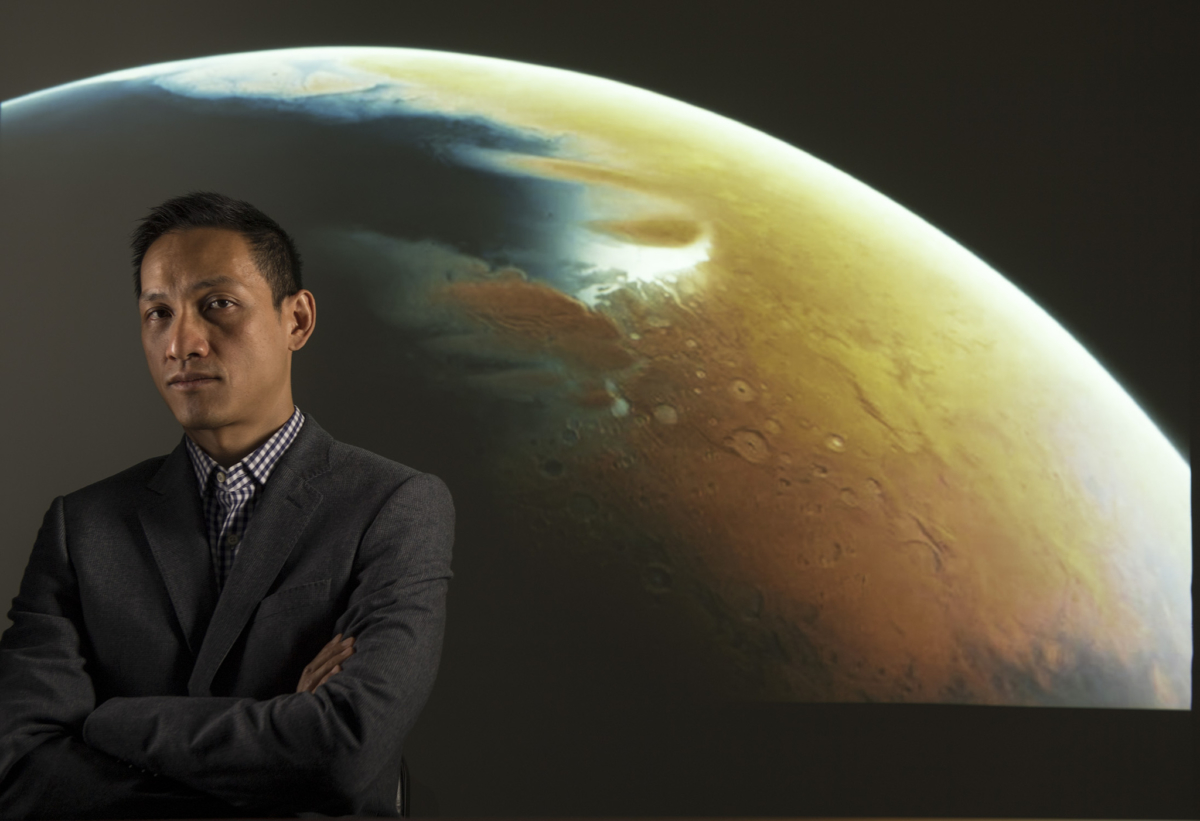
Rutgers University Astrobiologist Nathan Yee.
Credit: Nick Romanenko
Implications for humans on Mars
Meanwhile, that data gathered by NASA’s Curiosity rover impacts the possibility of human exploration on the Red Planet.
“New data from NASA’s Curiosity rover indicates there might be some oxygen-forming chemicals absorbed in Martian soil that are behind fluctuations in oxygen levels throughout the seasons on Mars,” notes Rutgers astrobiologist, Nathan Yee.
Breathe and survive
“If scientists can extract oxygen-forming chemicals in the Martian soil, then perhaps humans could use that as a source of oxygen to breathe and survive there – and, more importantly, use it to burn rocket fuel for the return trip to Earth,” said Yee. “More research on the sources of oxygen will be vital for the potential of future human exploration on the Red Planet.”
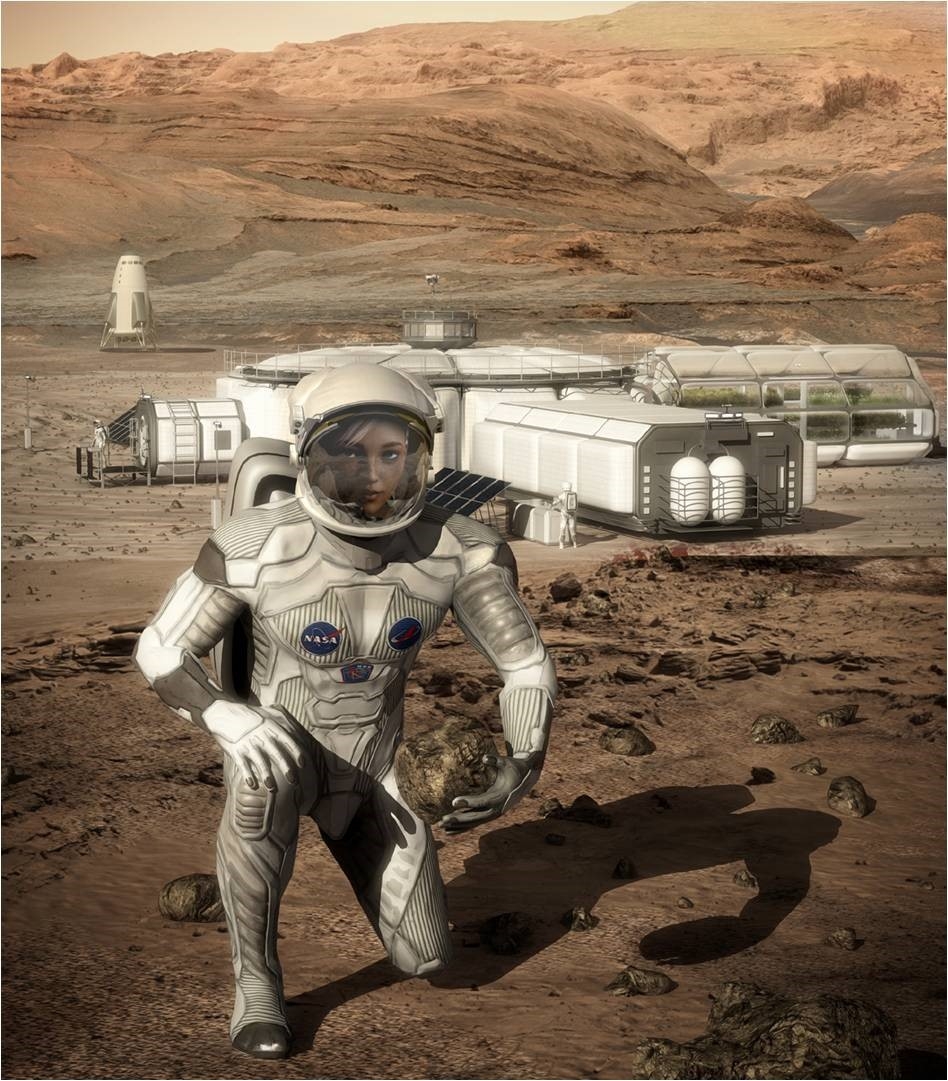
Credit: Bryan Versteeg via Explore Mars
Yee is a professor of geomicrobiology and geochemistry at Rutgers–New Brunswick’s Department of Earth and Planetary Sciences, and is a co-investigator at Rutgers ENIGMA, a NASA-funded research team focused on discovering how proteins evolved to become the catalysts of life on Earth.
For detailed information on the curious Curiosity finding, go to this paper — Seasonal Variations in Atmospheric Composition as Measured in Gale Crater, Mars –published on November 12 in the Journal of Geophysical Research: Planets. It can be found here at:
https://agupubs.onlinelibrary.wiley.com/doi/epdf/10.1029/2019JE006175

