Archive for the ‘Space News’ Category
 Author:
  December 9th, 2019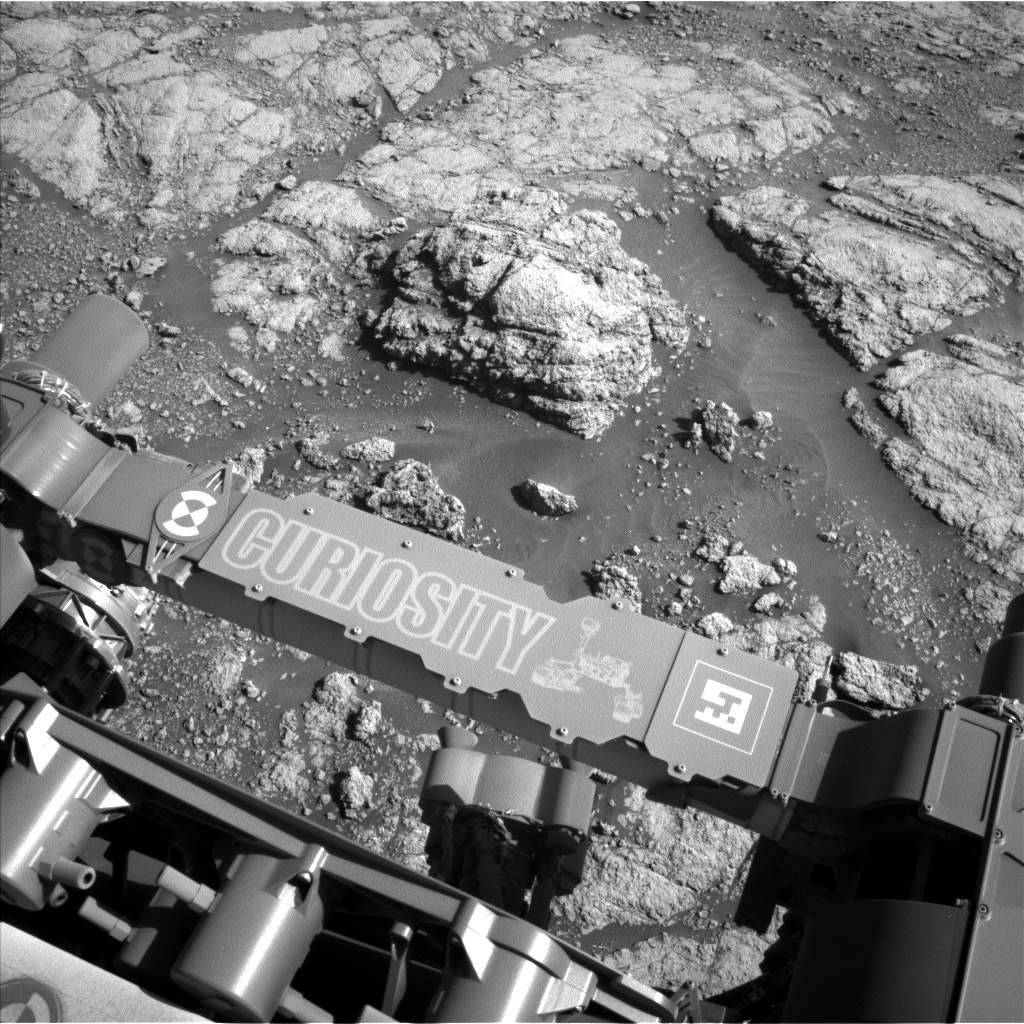
Curiosity Left B Navigation Camera photo acquired on Sol 2609, December 8, 2019.
Credit: NASA/JPL-Caltech
NASA’s Curiosity Mars rover is now performing Sol 2610 tasks.
Reports Susanne Schwenzer, a planetary geologist at The Open University in the U.K., Curiosity’s rich workspace includes bedrock, pebbly areas and a brighter float rock of a kind which has been observed frequently in the vicinity.
“Thus, lots of variety…and a three-sol plan to fill.”
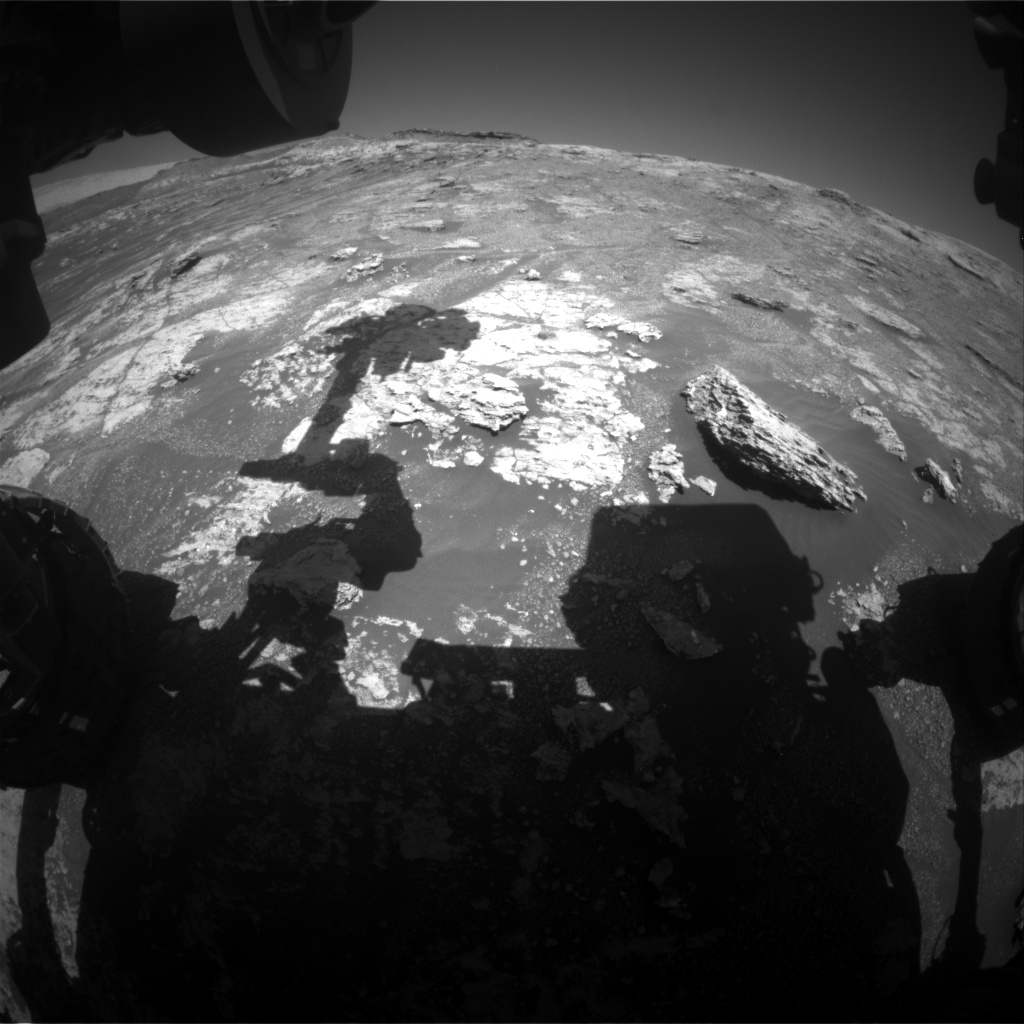
Curiosity Front Hazard Avoidance Camera Left B image taken on Sol 2609, December 8, 2019.
Credit: NASA/JPL-Caltech
Difference in color
The robot’s recent plan made good use of the rock variety in the workspace. Its Alpha Particle X-Ray Spectrometer (APXS) will investigate two targets: “Scotnish” is a target which will be measured overnight after use of the Dust Removal Tool (DRT) of the area.
“Gretna Green” is a touch and go target measured in standoff mode, because it is a small brighter float rock.
“It will be interesting to see how the difference in color – mainly albedo – translates to chemistry,” Schwenzer notes. The robot’s Mars Hand Lens Imager (MAHLI) is documenting the same rocks as APXS, and in addition will image “Smiddyhill” in dog’s eye mode to get up close with the sedimentary textures.
“The scientists back on Earth are eagerly waiting to have a look at those images to understand the depositional conditions and also to correlate the rocks between the current investigations area at Western Butte,” Schwenzer reports.
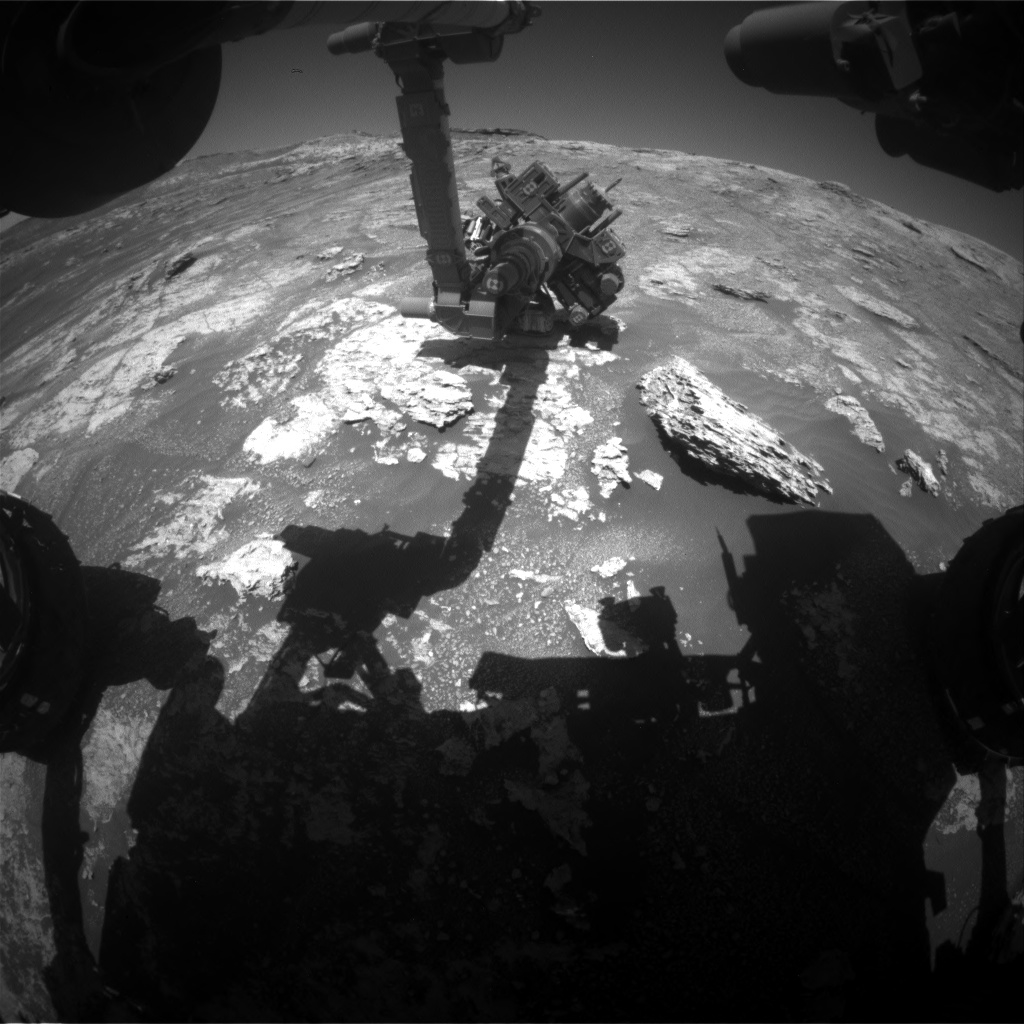
Curiosity Front Hazard Avoidance Camera Left B image taken on Sol 2609, December 8, 2019.
Credit: NASA/JPL-Caltech
Repertoire of targets
Meanwhile, Curiosity’s Chemistry and Camera (ChemCam) is busy with three targets. “First, it is also investigating Gretna Green, and then adds a bedrock target named “Skaill” and a pebbly target called “Stoneypath” to its repertoire,” Schwenzer adds.
The rover’s Mastcam adds to the feast with several large mosaics, looking at the pediment ahead, an area close to the rover for sand ripple studies and a target called “White Hills” for more sedimentary studies. There are also two multispectral investigations and the documentation of the ChemCam targets in Mastcam’s plan.
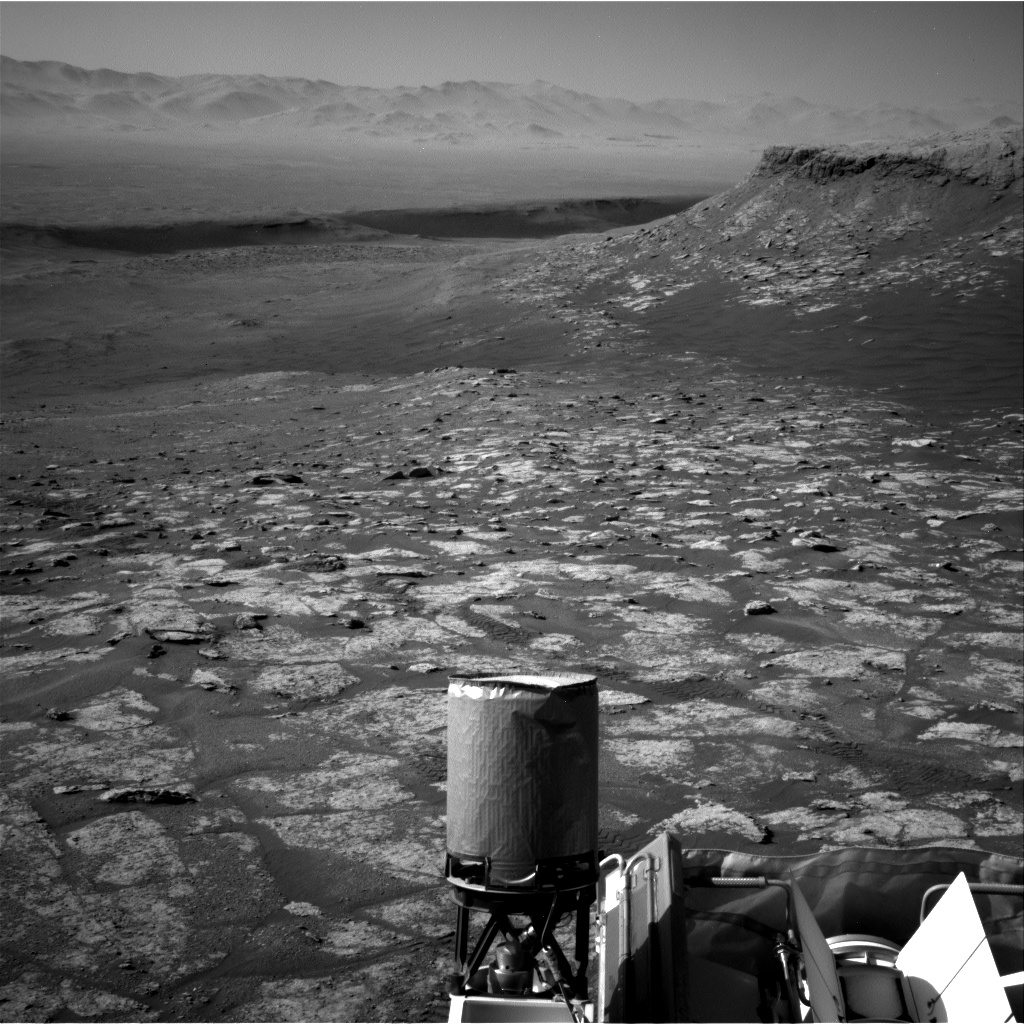
Curiosity Right B Navigation Camera image taken on Sol 2609, December 8, 2019.
Credit: NASA/JPL-Caltech
Looking forward
This was to keep Curiosity busy over last weekend, Schwenzer adds, and the rover is to study those images and data to correlate them with previous investigations, and also looking forward to the top of the butte.
Concludes Schwenzer, talking of looking forward: “The planned drive is designed to get a block of rock into the workspace, which the planning team anticipates could allow us correlations not only around Western Butte, but also to Central Butte.”
 Posted in
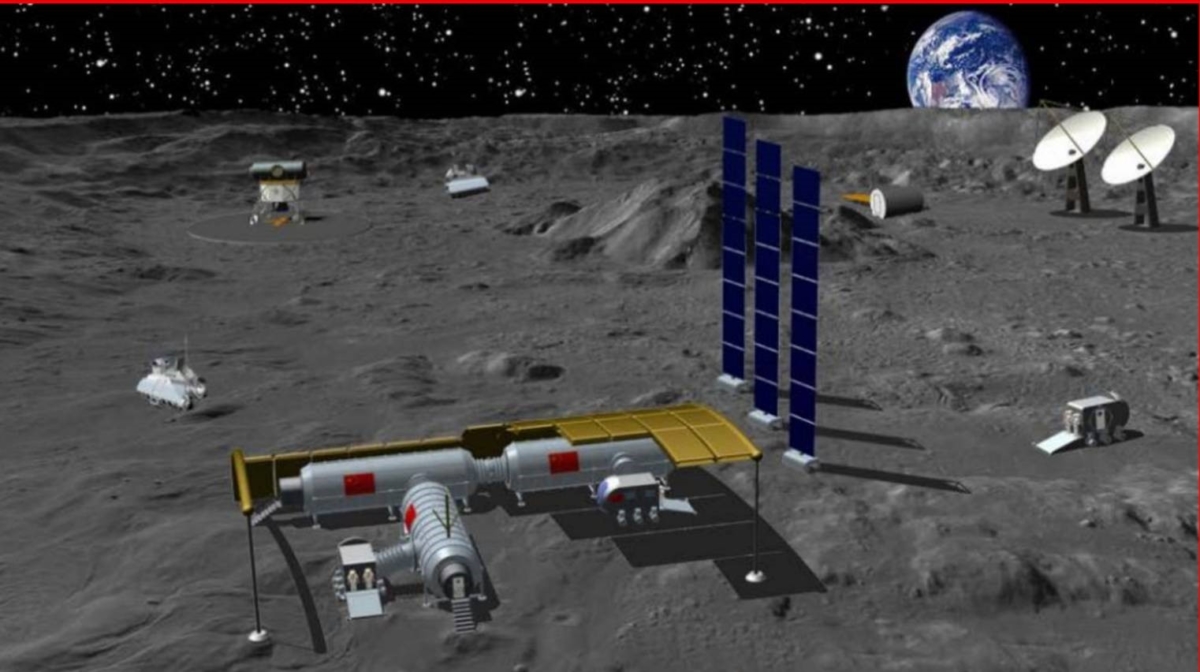
Chinese Lunar Exploration Program (CLEP) paving the way for a human mission to the Moon.
Courtesy: James Head
China’s space exploration future includes paving the way for a human mission to the Moon, and carrying out an upcoming, aggressive robotic investigation of Mars.
James Head of the Department of Earth, Environmental and Planetary Sciences at Brown University in Providence, Rhode Island, recently provided an overview titled “Space Exploration in China: The Rise of the Chinese Space Science and Exploration Community.” It was delivered during a recent virtual meeting of the Mars Exploration Program Analysis Group (MEPAG).
The ultimate objective of the Chinese Lunar Exploration Program (CLEP) is to pave the way for a human mission to the Moon. Such a mission may occur in the 2020s-2030s, Head noted. The country’s Moon exploration effort consists of three phases: orbiting the Moon; landing and roving; and returning samples, followed by preparation for human exploration.

China’s Mars Orbiter, Lander, Rover effort.
Credit: China Aerospace Technology Corporation
Mars rover
Turning his attention to China’s emerging Mars exploration agenda, Head offered insight into the country’s launch next year of its Mars 2020 Mission, an Orbiter-Lander-Rover initiative.

Credit: CCTV/Screengrab Inside Outer Space
Head reported that the China Mars 2020 Mission Payloads involve six rover instruments:
-Topography Camera
-Navigation camera
-Rover-based Martian Subsurface Penetrating Radar (RMSPR)
-Mars Surface Composition Detector Multispectral Camera
-Mars magnetic field detector
-Mars climate detector
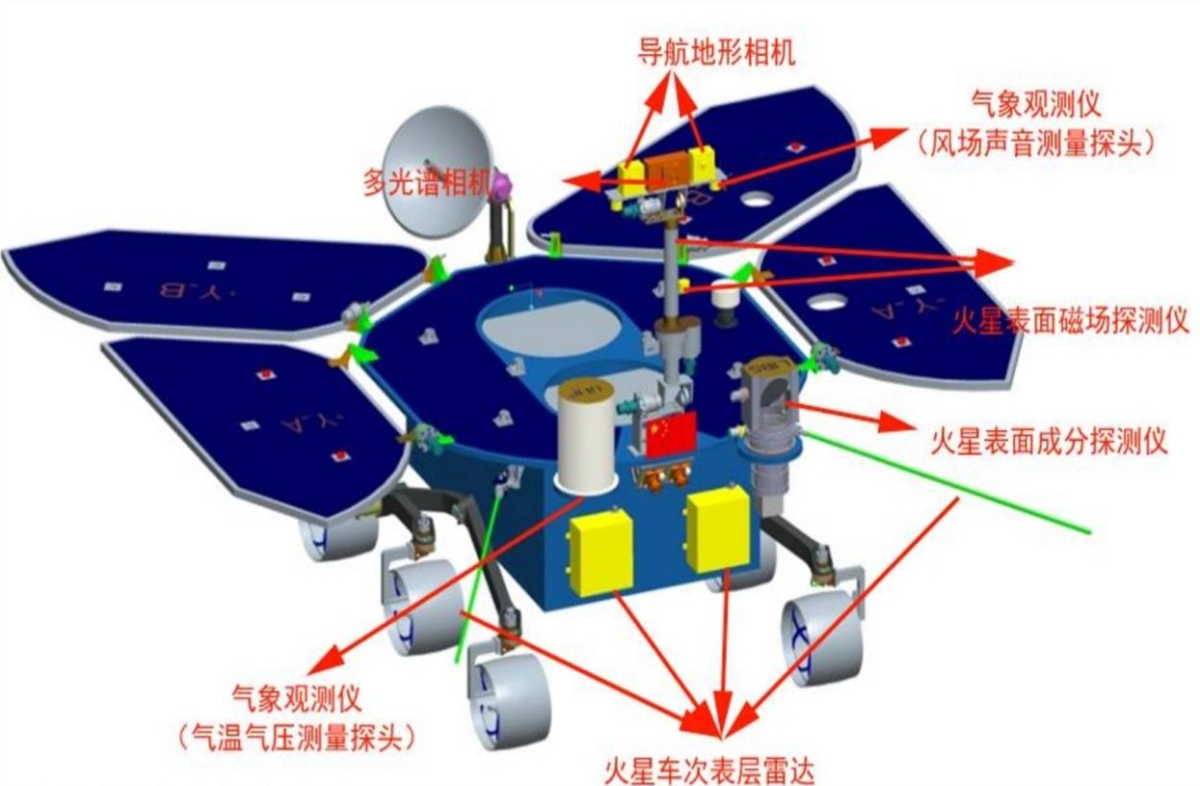
China’s Mars rover.
Courtesy: James Head
As for the scientific mission of the Chinese Mars rover, it involves topography and geological structure detection of the rover exploration area; soil structure and water ice detection; surface elements, minerals and rock types detection; and atmosphere physical characteristics and surface environment detection.
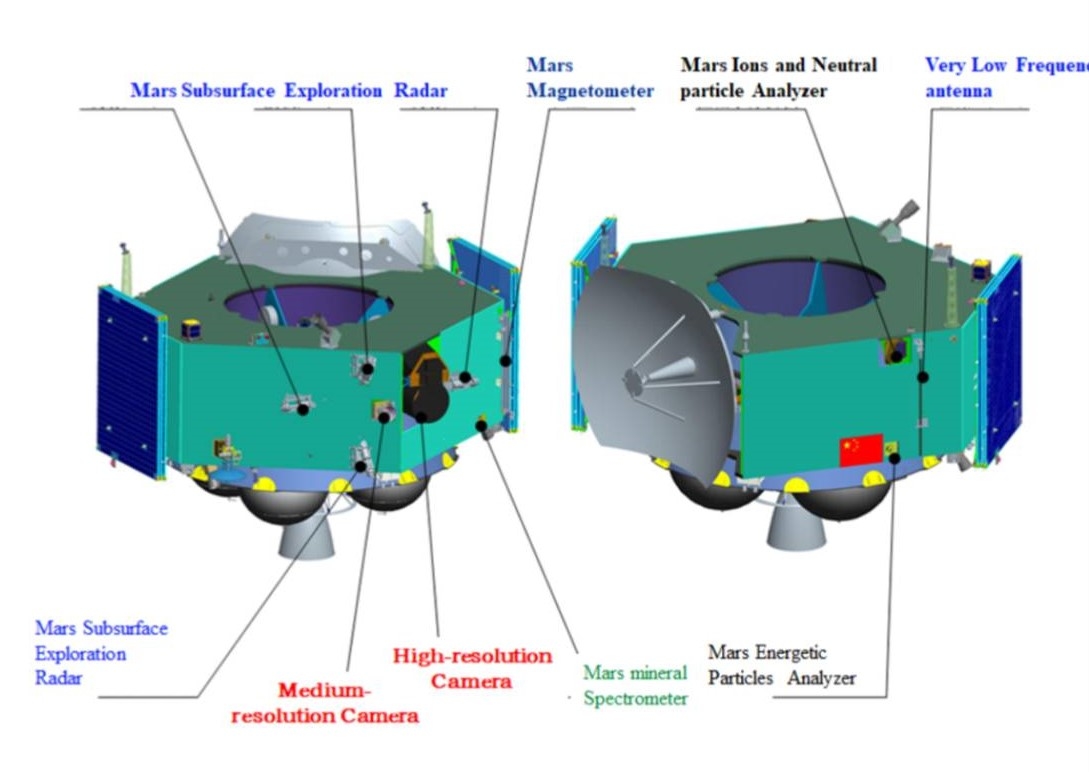
China’s Mars orbiter.
Courtesy: James Head
Red planet orbiter
China’s Mars orbiter carries seven instruments:
-Mars Orbiter Scientific Investigation Radar (MOSIR)
-Medium-resolution Camera
-High-resolution Camera
-Mars mineral Spectrometer
-Mars Magnetometer
-Mars Ions and Neutral particle Analyzer
-Mars Energetic Particles Analyzer
As for the scientific mission of the planet-circling orbiter, Head explained it would study the Mars atmosphere, ionosphere and exploration of interplanetary environment; carry out Mars surface and underground water ice detection; study Mars soil type distribution and structure detection; assess Mars topographic and geomorphologic features and their variation detection; and investigate and analyze Mars surface composition.

China’s Mars landing regions.
Courtesy: James Head
Landing regions
Regarding the selection of China’s robotic Mars landing site, two regions have been identified that represent a wide array of scientific sleuthing, including appraising possible habitats of life.
Lastly, Head pointed out that China has proposed a Mars simulation and training base that covers 95,000 square kilometers, situated in the Qaidam Basin, a Mars-like arid desert region on the Qinghai-Tibet plateau.
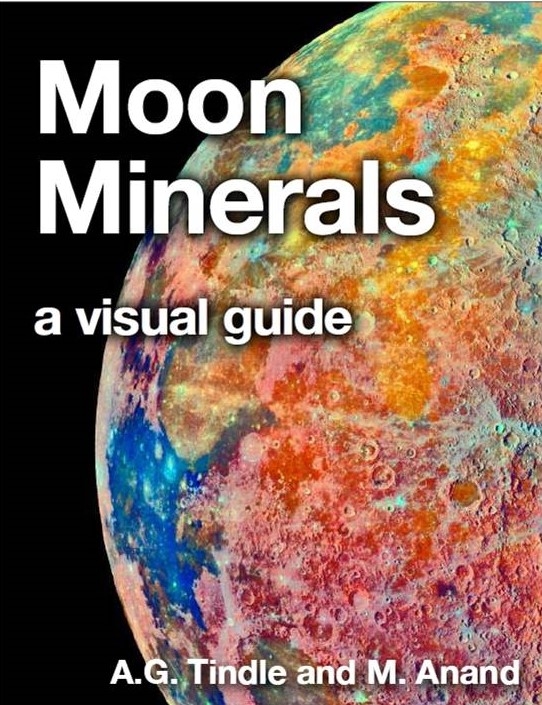
A comprehensive and easy to follow visual guide of minerals that have been reported in lunar samples is now available.
One of the aims of making this book freely available to the worldwide community is to support the research of current and future generations of planetary mineralogists, reports Andy Tindle and Mahesh Anand.
Anand is a Professor in Planetary Science and Exploration in the School of Physical Sciences at The Open University. Tindle is a Visitor to the School of Planetary Sciences at The Open University.

Harrison (Jack) Schmitt collecting a sample at Station 5 (Camelot
Crater) during the second extra-vehicular activity (EVA) of the
Apollo 17 mission in December 1972.
Credit: NASA
On-line collection
Virtual microscope work at the Open University began in 1993 and has culminated in the on-line collection of over 1000 samples available via the virtual microscope website, explains Tindle and Anand.
Why this book is needed is to answer a few basic questions like:
What are the minerals found in Moon rocks?
What do they look like and what are their sizes and abundances?
What does analysis of those minerals tell us?
The iBook version can be downloaded from the Apple Book store at:
https://books.apple.com/book/id1490354553
If you download the iBook, you will be able to use the interactive elements of the Virtual Microscope that are embedded in the iBook version.
A PDF version is available at the OpenLearn website:

Credit: XTEND
A symbolic event on the Moon is being proposed, timed for the opening ceremony of the Olympic Games, either in 2024 in Paris (France) or in 2026 in Milan-Cortina (Italy).
The Moon Village Association (MVA) discussed the concept during the 3rd Moon Village Workshop and Symposium held December 5-8 in Japan.
“This proposition is considered an achievable target, since by the early 2020s it will be possible to deliver multiple payloads to the Moon and operate them on its surface,” explains a MVA press statement. “Several of the members of the MVA are stakeholders in planned Moon missions scheduled for the period leading to 2026.”

Leap of Faith: Visionary artist, Pat Rawlings, saw an International Lunar Games back in 1995. Artwork done for NASA depicts Moon pole vaulting records of more than 30 meters being set in the 21st century. The Moon’s one sixth gravity would be an excellent environment for athletic competitions that are hampered by Earth’s stifling gravity.
Credit: Pat Rawlings/NASA
Pilot case
Giuseppe Reibaldi, President of the Moon Village Association, explains that “showcasing Olympic Games on the Moon will be for the public a concrete example of the implementation of the Moon Village, and a demonstrative pilot case of Earth-based activities that can be carried over onto the Moon, in an innovative new manner.”
The Moon Village Association was created in 2017 as a non-governmental organization (NGO) based in Vienna. MVA’s goal is the creation of a permanent global informal forum for stakeholders like governments, industry, academia and the general public interested in the development of the Moon Village.
For information on the Moon Village Association visit:

Courtesy: Jack Burns. Univ. of Colorado, Boulder
The Moon’s farside is an attention grabber…for many reasons.
For good measure, enter the Farside Array for Radio Science Investigations of the Dark ages and Exoplanets, shortened to enlightened shorthand: FARSIDE.
This concept is to place a low radio frequency interferometric array on the farside of the Moon, blueprinted by Jack Burns of the University of Colorado, Boulder and Gregg Hallinan of the California Institute of Technology.
Research tasks
As noted in the NASA proposal, FARSIDE would enable near-continuous monitoring of the nearest stellar systems in the search for the radio signatures of coronal mass ejections and energetic particle events, and would also detect the magnetospheres for the nearest candidate habitable exoplanets.
Simultaneously, FARSIDE would be used to characterize similar activity in our own solar system, from the Sun to the outer planets, including the hypothetical Planet Nine.
As outlined, FARSIDE, among a bevy of duties, would enable an abundance of additional science ranging from sounding of the lunar subsurface to characterization of the interstellar medium in the solar system neighborhood.

Commercial lunar lander
As a new NASA-funded “Probe Study Final Report,” the idea focuses on the instrument, a deployment rover, the lander and base station that consists of 128 dipole antennas deployed across 6 miles (10 kilometers) of the lunar landscape by a rover, and tethered to a base station for central processing, power and data transmission to the proposed NASA Lunar Gateway, or an alternative relay satellite.

Courtesy: Jack Burns, University of Colorado, Boulder

FARSIDE uses the Lunar Gateway, or similar Lunar asset, for communication with Earth.
Credit: Jack Burns, Univ. of Colorado, Boulder
FARSIDE requires transportation to the lunar surface, assumed to be completed through the use of a commercial lunar lander.
According to the study report, the Blue Origins Blue Moon Lander was selected as a reference lander for the design. The total mission cost estimate for FARSIDE, after applying NASA- and JPL standard cost reserves of 30% during development and 15% during operations is roughly $1.3 billion.
A report on the concept notes that: “In the past decade, significant investments have been made by commercial companies to develop the capability to deliver payloads to the surface of the Moon, with some companies now on the horizon of success. NASA shows strong support of these companies through the Commercial Lunar Payload Services Program (CLPS), which recently awarded the first contract to three companies for payload delivery with a launch target in 2021.”

An artist’s impression of a habitable planet experiencing a coronal mass ejection (CME) from its host star, an active M dwarf. Detecting coronal mass ejections, energetic particle events and the magnetospheres of candidate habitable planets is a key science goal for the FARSIDE array. Credit: Chuck
Carter/Caltech/KISS
Sky noise
The lunar FARSIDE initiative benefits from radio frequency interference from Earth, plasma noise from the solar wind, and other interfering issues.
The study report notes that the lunar farside is the only location within the inner solar system from which “sky noise” limited observations can be carried out at frequencies to fulfill the promise of FARSIDE.
This study may be of interest to the lunar science community, notes Burns of the University of Colorado, Boulder, since it describes “how the array of low frequency radio dipole antennas might also be used to probe the subsurface on the lunar farside and as stations for seismic activity.”
Take a look at this unique approach that benefits from using the farside of the Moon, and sent to the NASA-funded Astrophysics Probe study group at:
https://smd-prod.s3.amazonaws.com/science-red/s3fs-public/atoms/files/FARSIDE_FinalRpt-2019-Nov8.pdf
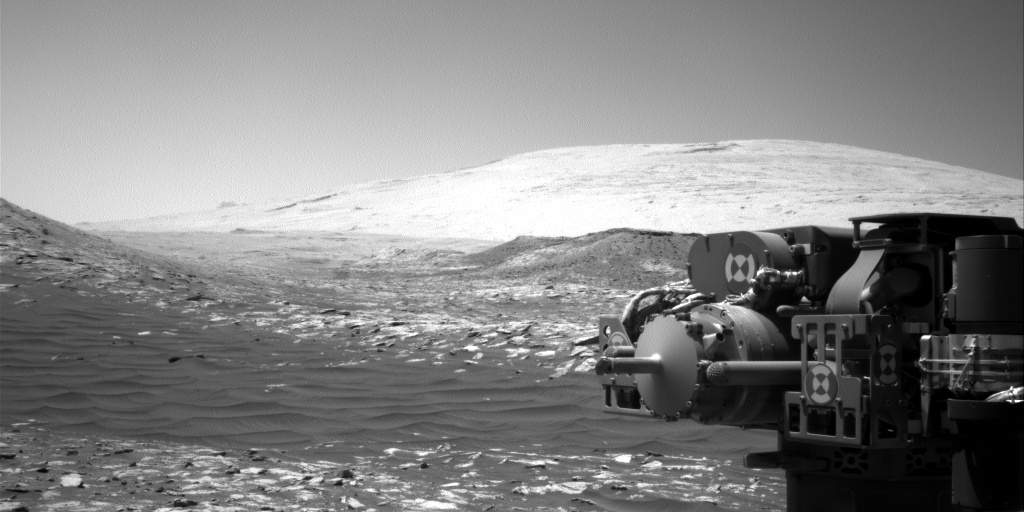
Curiosity Right B Navigation Camera image acquired on Sol 2605, December 4, 2019.
Credit: NASA/JPL-Caltech
NASA’s Curiosity Mars rover is now carrying out Sol 2606 tasks.
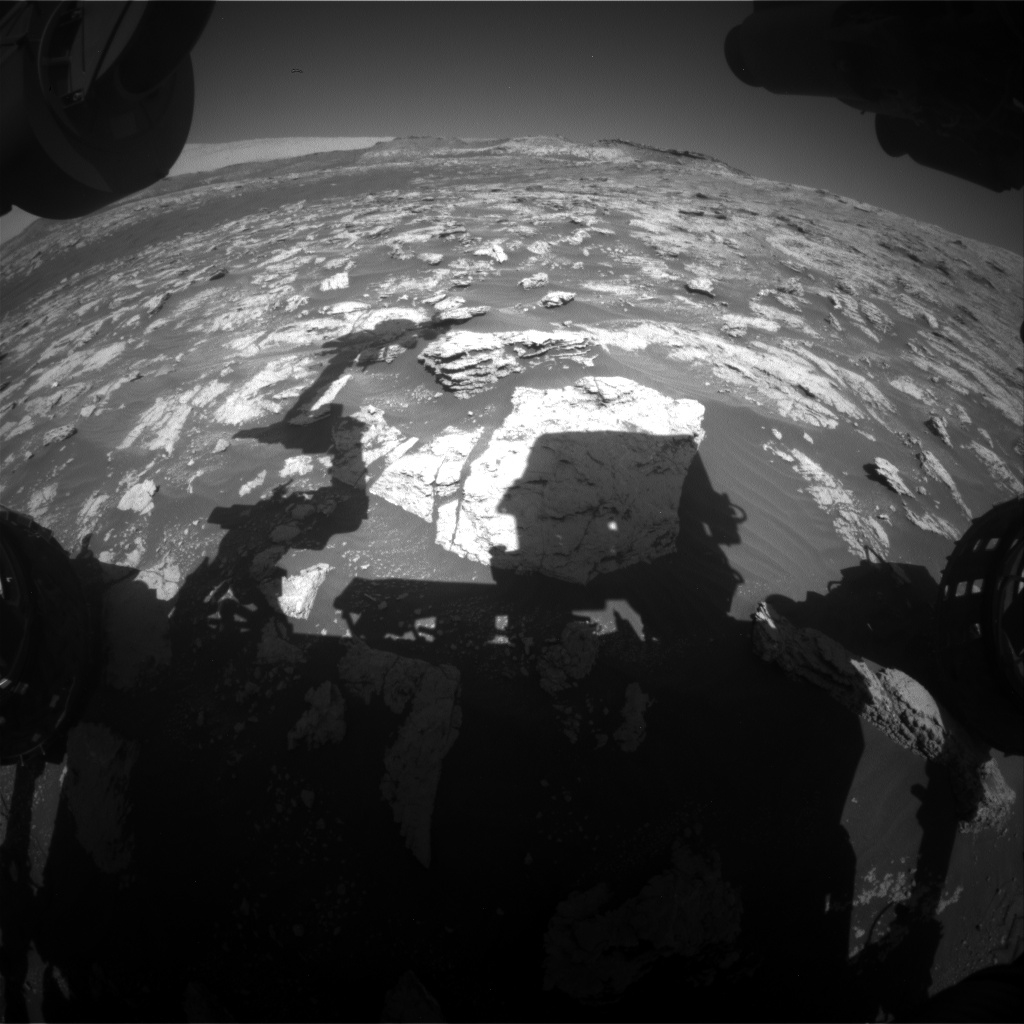
Curiosity Front Hazard Avoidance Right B Camera photo taken on Sol 2605, December 4, 2019.
Credit: NASA/JPL-Caltech
The Mars robot’s science team recently faced some tough decisions reports Scott Guzewich, an atmospheric scientist at NASA’s Goddard Space Flight Center in Greenbelt, Maryland.
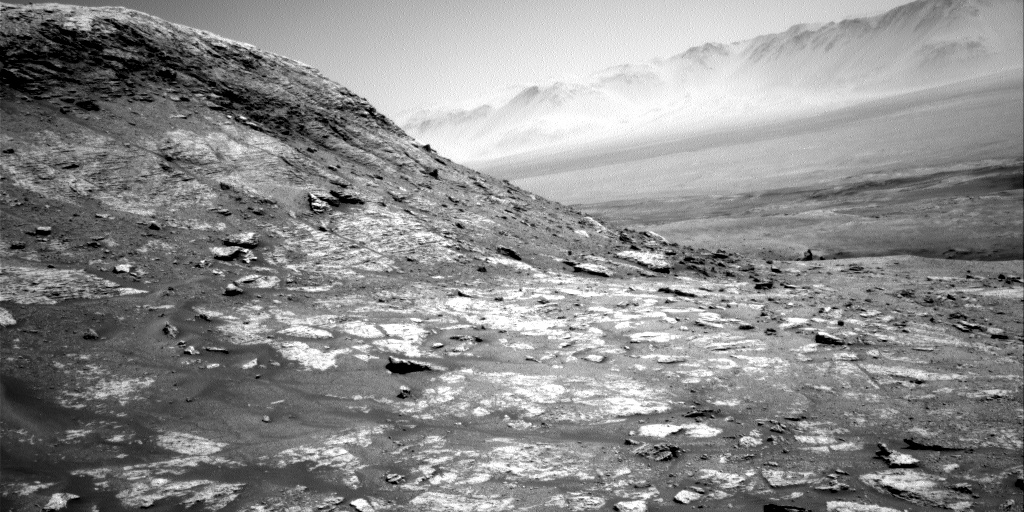
Curiosity Right B Navigation Camera image taken on Sol 2605, December 4, 2019.
Credit: NASA/JPL-Caltech“The geologists had to choose between investigating a plethora of interesting rock targets in the workspace…or limit the observations at this location in favor of continuing to drive uphill to get a better view of Western Butte.”
“The geologists had to choose between investigating a plethora of interesting rock targets in the workspace…or limit the observations at this location in favor of continuing to drive uphill to get a better view of Western Butte.”
Rock targets
After some discussion, Guzewich adds, it was decided to perform a “touch-and-go,” where Curiosity’s arm studied rock targets “Staxigoe” and “Totegan” with the Alpha Particle X-Ray Spectrometer (APXS) and the Mars Hand Lens Imager (MAHLI), and performed some additional remote sensing science with Mastcam and Chemistry and Camera (ChemCam), and then drive during the mid-afternoon.
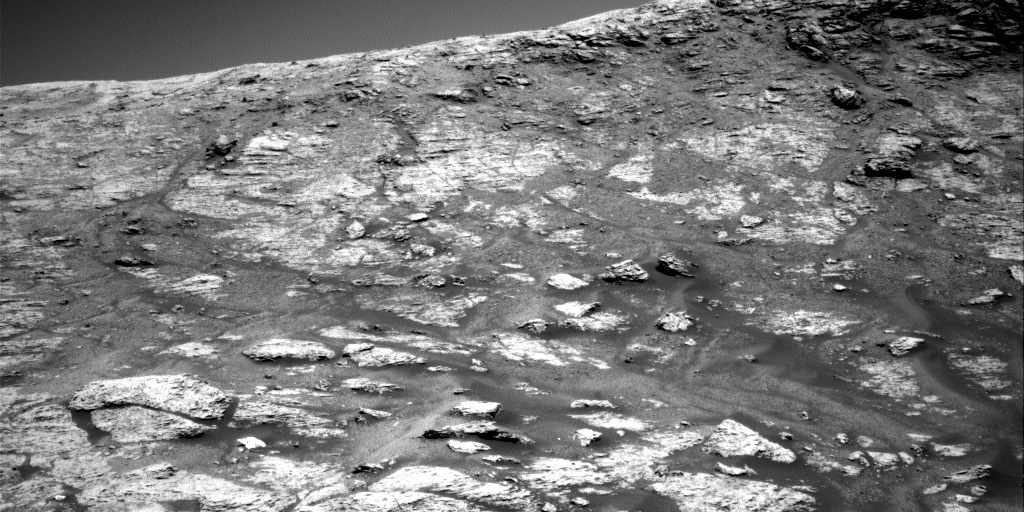
Curiosity Right B Navigation Camera image taken on Sol 2605, December 4, 2019.
Credit: NASA/JPL-Caltech
Clever geometry
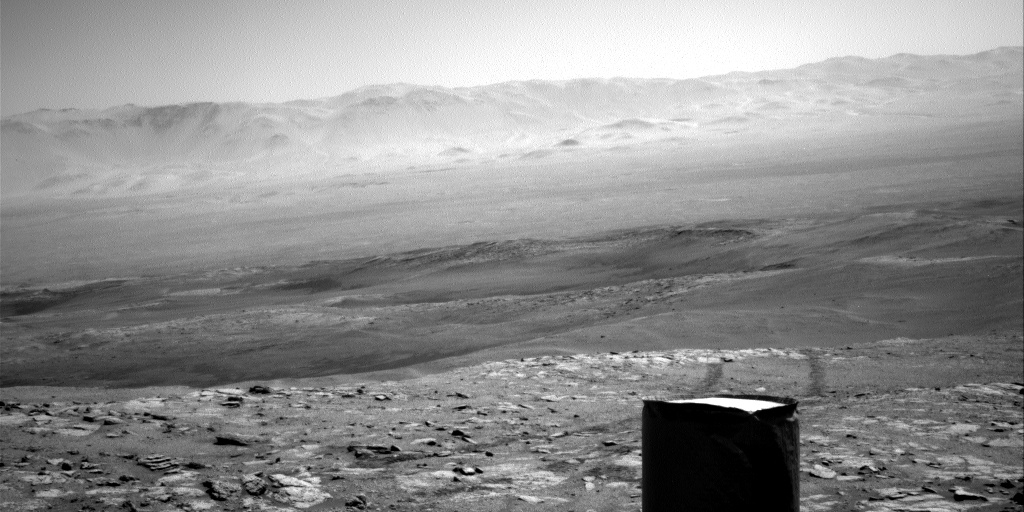
In addition to routine observations with the Rover Environmental Monitoring Station (REMS) and Dynamic Albedo of Neutrons (DAN) instrument, the plan included Mastcam observations of atmospheric dust opacity (how much dust is in the atmosphere above us) and a Navcam movie to observe water ice clouds.
Curiosity Right B Navigation Camera image taken on Sol 2605, December 4, 2019.
Credit: NASA/JPL-Caltech
“This Navcam movie uses some clever geometry to calculate the height of clouds above the surface based on the shadows they cast on Mt. Sharp,” Guzewich points out. “We’re currently in the colder, cloudy winter season on Mars and will be for months to come!”
Credit: NASA/JPL-Caltech/Univ. of Arizona
New road map
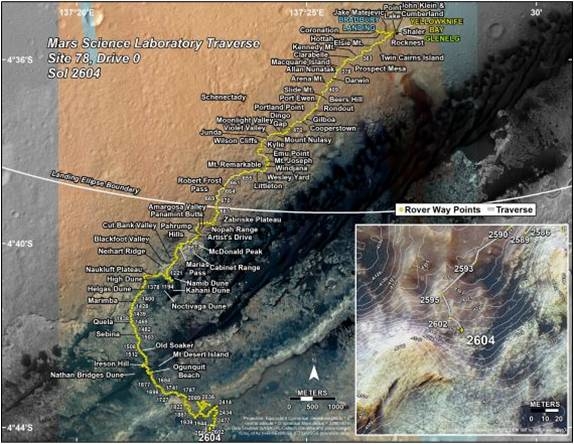
Meanwhile, a new map shows the route driven by Curiosity through the 2604 Martian day, or sol, of the rover’s mission on Mars (December 4, 2019).
Numbering of the dots along the line indicate the sol number of each drive. North is up. The scale bar is 1 kilometer (~0.62 mile).
From Sol 2602 to Sol 2604, Curiosity had driven a straight line distance of about 40.76 feet (12.42 meters), bringing the rover’s total odometry for the mission to 13.38 miles (21.54 kilometers).
The base image from the map is from the High Resolution Imaging Science Experiment Camera (HiRISE) in NASA’s Mars Reconnaissance Orbiter.
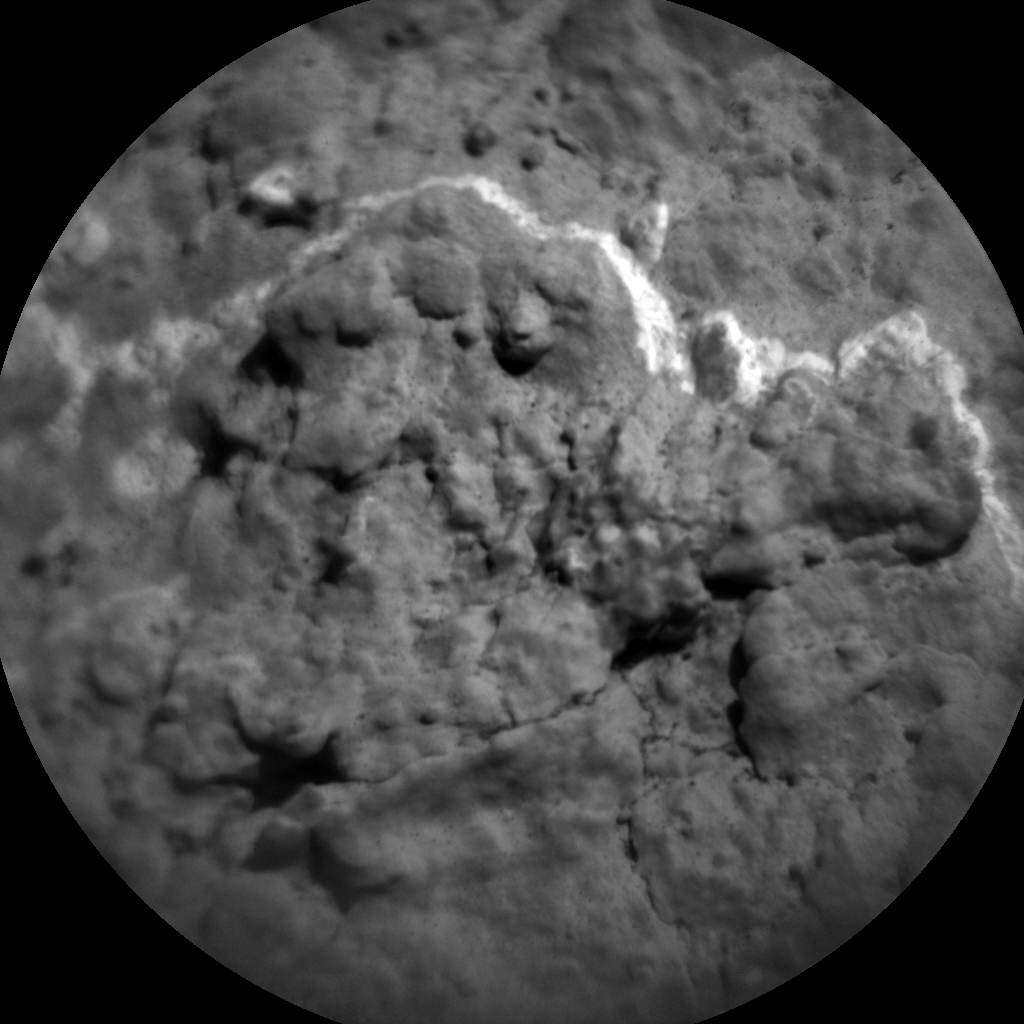
Curiosity Chemistry & Camera (ChemCam) Remote Micro Imager (RMI) photo acquired on Sol 2605, December 4, 2019.
Credit: NASA/JPL-Caltech/LANL

Curiosity Mars Hand Lens Imager (MAHLI) photo produced on Sol 2604, December 3, 2019.
Credit: NASA/JPL-Caltech/MSSS
NASA’s Curiosity Mars rover is now closing out Sol 2604 duties.

Curiosity Left B Navigation Camera image acquired on Sol 2604, December 3, 2019.
Credit: NASA/JPL-Caltech
Ashley Stroupe, Mission Operations Engineer at NASA’s Jet Propulsion Laboratory, reports on the robot’s activities under a 2-sol plan that involved working the rover’s robotic arm and also a drive.
Use of the Mars Hand Lens Imager (MAHLI) and the Alpha Particle X-Ray Spectrometer (APXS) is on the to-do list on a target named “Run Well” “so that we can compare the compositions of the Western Butte with what we saw at the Central Butte, Stroupe notes.
Local rocks
After stowing the arm, Mars researchers have a science block with a survey of local rocks with Curiosity’s Chemistry and Camera (ChemCam) and Mastcam. Then the plan calls for a drive to another laminated block roughly 50 feet (15 meters) away with the intent to do contact science.

Curiosity Left B Navigation Camera image taken on Sol 2602, December 1, 2019.
Credit: NASA/JPL-Caltech
“After the drive, and before we do our post-drive arm unstow and post-drive imaging, we are doing a sun update to reset the rover’s attitude estimate, which keeps our ability to point back at Earth,” Stroupe adds.

Curiosity Mast Camera Left image acquired on Sol 2602, December 1, 2019.
Credit: NASA/JPL-Caltech/MSSS
Software selecting
On the second sol of the plan, the rover will do some AEGIS (Autonomous Exploration for Gathering Increased Science) observations using that specialized software. “Can’t wait to see what AEGIS picks to look at!,” Stroupe says.
Also on tap is some standard environmental observations – dust devil survey and movie and a Navcam line-of-sight observation to look at the atmospheric opacity, Stroupe concludes.

Curiosity Left B Navigation Camera image taken on Sol 2602, December 1, 2019.
Credit: NASA/JPL-Caltech
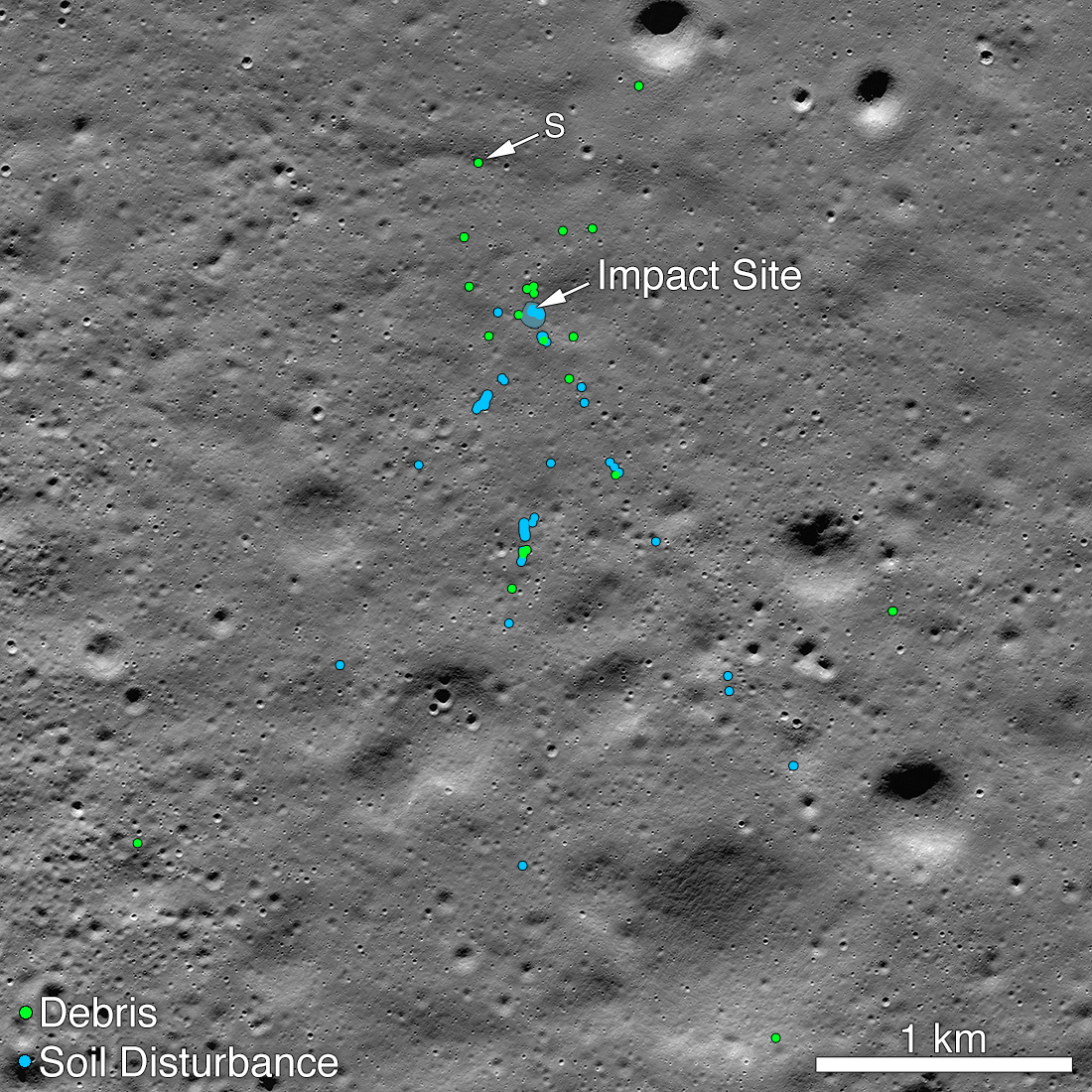
India’s Vikram impact point and associated debris field. Green dots indicate spacecraft debris (confirmed or likely). Blue dots are disturbed soil, likely where small bits of the spacecraft churned up the regolith. “S” indicates debris identified by eye-sharp Shanmuga Subramanian.
Credit: NASA/GSFC/Arizona State University
India’s Vikram lunar lander crash site has been found. Its impact point and debris field imaged after the craft augured into the Moon on September 7th India time (September 6 in the United States).
Spotting the crash site was NASA’s Lunar Reconnaissance Orbiter (LRO), and the craft’s high-powered LROC system.
The Chandrayaan 2 Vikram lander was targeted for a highland smooth plain about 373 miles (600 kilometers) from the lunar south pole. Unfortunately the Indian Space Research Organization (ISRO) lost contact with Vikram lander/rover shortly before the scheduled touchdown.
Amazing achievement
“Despite the loss, getting that close to the surface was an amazing achievement,” notes Arizona State University’s Mark Robinson, leader of the LROC system that’s onboard LRO.
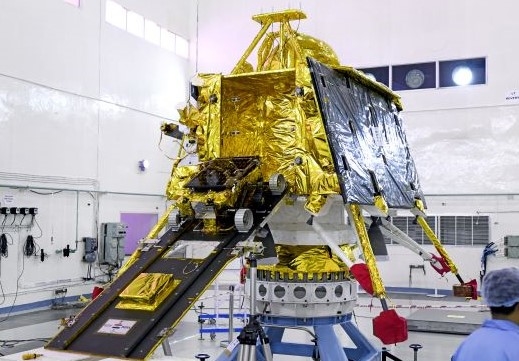
Pre-launch photo shows India’s Pragyan rover mounted on the ramp projecting from out of the sides of Vikram lunar lander. Vikram and the rover were scheduled on September 6 to land on the near the Moon’s south polar region – but crashed onto the lunar surface.
Credit: ISRO
Identifying the crash site was not easy.
The LROC team released the first mosaic of the site that was acquired months ago on September 26, “and many people have downloaded the mosaic to search for signs of Vikram,” Robinson notes in a website posting.
Shanmuga Subramanian contacted the LRO project with a positive identification of debris. After receiving this tip the LROC team confirmed the identification by comparing before and after images, Robinson said.
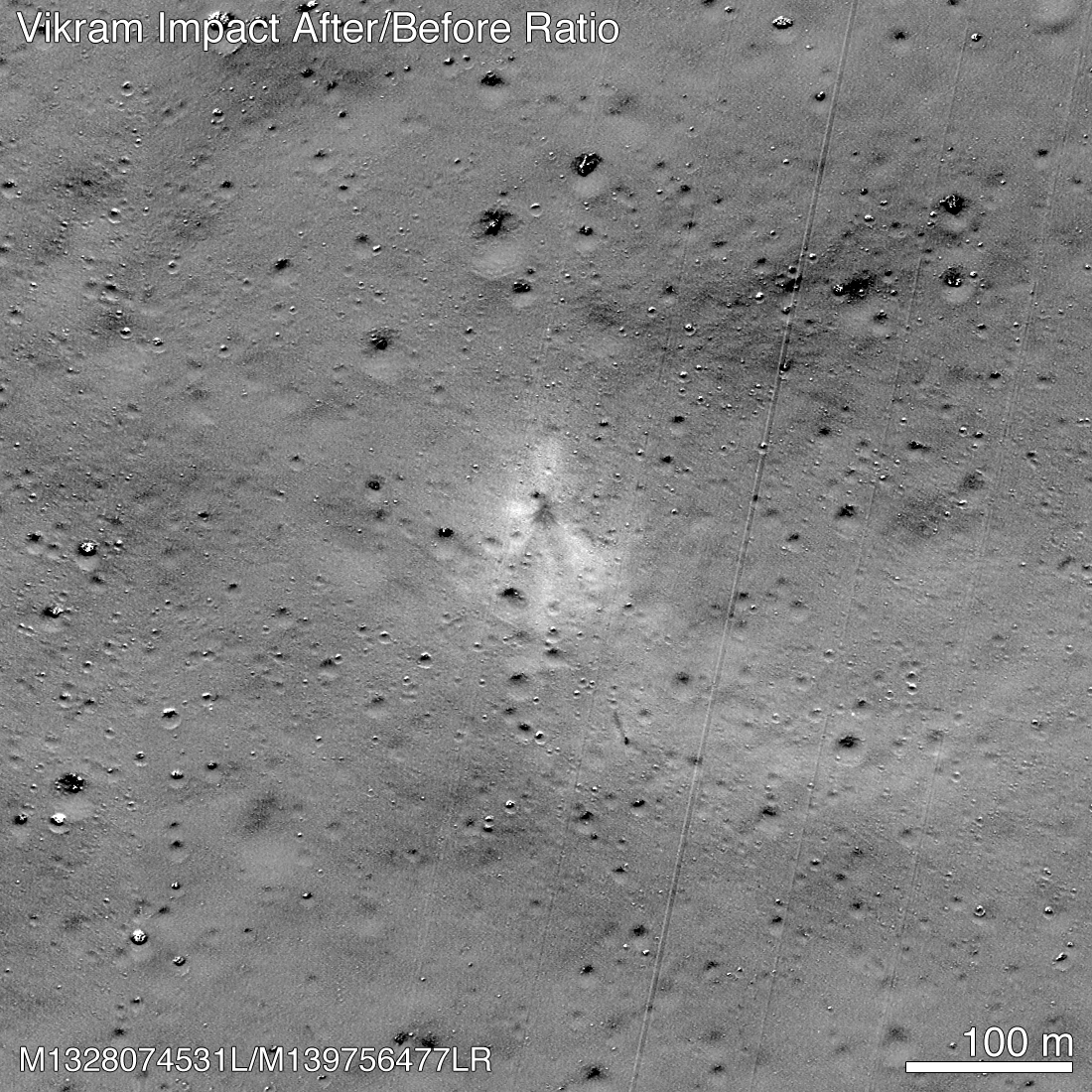
India’s lunar lander impact point is near center of image and stands out due to the dark rays and bright outer halo. Note the dark streak and debris about 100 meters to the south, south east of the impact point. Diagonal straight lines are uncorrected background artifacts.
Credit: NASA/GSFC/Arizona State University
Tough to spot
When the images for the first mosaic were acquired by LRO, the impact point was poorly illuminated and thus not easily identifiable. Two subsequent image sequences were acquired on October 14, 15 and November 11.
The LROC team scoured the surrounding area in these new mosaics and found the impact site (70.8810°S, 22.7840°E, 834 m elevation) and associated debris field, Robinson reports.
The November mosaic from LRO had the best pixel scale (0.7 meter) and lighting conditions (72° incidence angle).
For a full account of the finding, go to:

Credit: CCTV/Screengrab Inside Outer Space
China’s large radio telescope is wrapping up testing and commissioning work – an effort that took place over the past three years. One of its assignments is the search for extraterrestrial intelligence (SETI), among other scientific tasks.
Located in southwest China’s Guizhou Province, the Five-hundred-meter Aperture Spherical Telescope (FAST) began its operation in September 2016.
Pulsar detections
China Central Television (CCTV) reports that FAST has so far detected and identified 99 pulsars, more than 30 of which are faster millisecond pulsars. The search for extraterrestrial life and other scientific targets is also under way.
“In the process of observing signals from celestial bodies, we also collect signals that might be emitted by humans or extraterrestrial intelligence,” explains Zhu Ming, director of the scientific observation and data division at the FAST operations and development center.

Credit: CCTV/Screengrab Inside Outer Space
“However, this is a huge amount of work since most signals we see, 99 percent of them, are various noises, so we need to take our time to identify the signals we want in the noises,” Zhu said.
Sensitivity
A recent user training session was organized, bringing together more than 100 astronomers from across China to discuss their experiences and discoveries during the trial operation of FAST.
Li Kejia, a researcher from the Kavli Institute for Astronomy and Astrophysics, Peking University explains the FAST is now mainly used to measure the performance of pulsar timing system, to directly measure the existence of gravitational waves.
“The sensitivity of FAST is very high, so the accuracy of the data measured is very good. FAST has a promising future in terms of gravitational wave detection,” Li told CCTV.

Credit: CCTV/Screengrab Inside Outer Space
Increasing observation modes
Researchers using FAST — the world’s largest single-dish radio telescope — have increased the facility’s observation modes from three to more than 10. Also underway is research and development work on new receiving equipment.
“I hope that in the next three years, we can further improve the reliability of FAST, and increase its effective observation time to 50 percent. Since it’s already about three times as sensitive as the second largest telescope in the world, so a 50 percent effective observation time is already very remarkable,” said Jiang Peng, chief engineer of the FAST project in the CCTV video report.
Go to this CCTV video clip about FAST at:

Alcohol in Space – Past, Present and Future by Chris Carberry, McFarland & Company, Inc., Publishers, Jefferson, North Carolina; 2019; softcover, 217 pages, $29.95.
Just in time for cheering on the holidays!
This book is a genuine treasure, focused on the making and consumption of alcohol throughout history…with a new upshot – the growing role of alcohol production in low Earth orbit (LEO) — or should it be libation Earth orbit? — and beyond!
Featuring 7 chapters, this volume includes a brief history of alcohol and society, booze in science fiction, retro-flections of drinking in space, space beer, wine, whiskey and innovation, as well as human settlement and farming in space.
Chris Carberry is the CEO of the non-profit organization Explore Mars, Inc. and has done a superb amount of research in writing this book, one that is chock-full of non-teetotale tales. “Yes, to drink where no one has drunk before,” he writes, pointing to the space-born Romulan ale, a special, high-speed sauce of Star Trek.
“As commercial space activities accelerate, this subject (both positive and negative aspects) will become more and more relevant as private individuals bring human customs, vices, and ceremonies into space,” the author writes in the book’s preface.
A foreword written by Andy Weir, author of The Martian and other science fiction works, offers his own cocktail considerations of the topic at hand. “One of the more common questions I get asked by fans of The Martian is, ‘Could Mark Watney have made vodka from some of those potatoes?’ Who knows what the future holds? Well, maybe Chris Carberry does. Kick back, grab your drink of choice, and enjoy this book about two of my favorite subjects.”
The author’s writing style is witty and informative. “It may not be the Restaurant at the End of the Universe,” Carberry explains, but Club 90 South in Antarctica might double for what an early Mars saloon may look and feel like.
Alcohol is present naturally in space, Carberry points out, and even an “intoxicating cloud” of alcohol tagged W3(OH). “Clearly, humanity will not be tapping these massive supplies of alcohol that are scattered around the universe anytime soon. If we want to acquire sustainable supplies of alcohol for our own use in space, we will either need to manufacture it in space or ship it from Earth at great cost.”
Lastly, there’s an exceptional set of chapter notes that demonstrates the rigor the author has taken to document the data contained in this volume.
Alcohol in Space – Past, Present and Future is an intoxicating book, so imbibe and behold…but read responsibly.
For more information on this book, go to:

