Archive for the ‘Space News’ Category
 Author:
  December 21st, 2019
President Donald Trump signs S.1790, the National Defense Authorization Act for Fiscal Year 2020 on, Friday, Dec. 20, 2019 at Joint Base Andrews. The act directed the establishment of the U.S. Space Force as the sixth branch of the armed forces.
Credit: Airman 1st Class Spencer Slocum, 11th Wing Public Affairs
U.S. President Trump has signed the 2020 National Defense Authorization Act and with it, directed the establishment of the U.S. Space Force as the sixth branch of the armed forces.
The U.S. Space Force (USSF) will be stood-up over the next 18 months.

U.S. Air Force Col. Nick Hague completed his first spacewalk, March 22, 2019.
Credit: NASA
In signing ceremonies at Joint Base Andrews, Maryland on December 20th, President Trump said:
“With my signature today, you will witness the birth of the Space Force, and that will be now officially the sixth branch of the United States Armed Forces. That is something really incredible. It’s a big moment. That’s a big moment, and we’re all here for it. Space…going to be a lot of things happening in space. Because space is the world’s newest warfighting domain. Amid grave threats to our national security, American superiority in space is absolutely vital. And we’re leading, but we’re not leading by enough. But very shortly, we’ll be leading by a lot.
The Space Force will help us deter aggression and control the ultimate high ground.”
“It was nearly half a century from Kitty Hawk to the creation of the Air Force. And now it’s 50 years after Apollo 11 that we create the Space Force,” Trump added. “With today’s signing, I will proudly appoint General Jay Raymond the first Chief of Space Operations. And he will become the very first member of the Space Force. And he will be on the Joint Chiefs. He will be on the Joint Chiefs, which we’re now expanding by one position. That’s a very powerful position. So, General Raymond, congratulations, and thank you for you everything you’ve done.”

General Jay Raymond the first Chief of Space Operations and first member of the Space Force.
Strategic imperative
“We are at the dawn of a new era for our Nation’s Armed Forces. The establishment of the U.S. Space Force is an historic event and a strategic imperative for our Nation. Space has become so important to our way of life, our economy, and our national security that we must be prepared as a Nation to protect it from hostile actions,” said Secretary of Defense, Mark Esper.
“Our Military Services have created the world’s best space capabilities. Now is the time for the U.S. Space Force to lead our Nation in preparing for emerging threats in an evolving space environment. This new service will help ensure we are postured to deter aggression, defend our national interests and outpace potential adversaries.”

Necessary and essential step
“Space is critical to our nation’s economic interests, national security, and way of life,” said Chairman of the Joint Chiefs of Staff, Gen. Mark A. Milley.
“In military operations, space is not just a place from which we support combat operations in other domains, but a warfighting domain in and of itself. Our adversaries are building and deploying capabilities to threaten us, so we can no longer take space for granted. The U.S. Space Force is the necessary and essential step our Nation will take to defend our national interests in space today and into the future,” Milley said.
“The launch of the U.S. Space Force propels the nation into a new era,” said Secretary of the Air Force, Barbara M. Barrett. “An agile, lean and technologically-advanced force of talented professionals will now singularly focus on protecting our U.S. national interests and security in space.”
Gen. Jay Raymond, Chief of Space Operations and Commander, U.S. Space Command adds: “The U.S. Space Force will deliver the capabilities U.S. Space Command needs to control and exploit space for national advantage.”

X-37B Air Force space plane.
Credit: Boeing/Inside Outer Space Screen Grab
Space Capabilities
The new, independent U.S. Space Force will maintain and enhance the competitive edge of the Department of Defense (DOD) in space while adapting to new strategic challenges.
According to a newly released fact sheet issued by Space Force Public Affairs:
Spacelift operations at the East and West Coast launch bases provide services, facilities and range safety control for the conduct of DOD, NASA and commercial space launches. Through the command and control of all DOD satellites, satellite operators provide force-multiplying effects — continuous global coverage, low vulnerability and autonomous operations. Satellites provide essential in-theater secure communications, weather and navigational data for ground, air and fleet operations and threat warning.
Ground-based and space-based systems monitor ballistic missile launches around the world to guard against a surprise missile attack on North America. A global network of space surveillance sensors provide vital information on the location of satellites and space debris for the nation and the world. Maintaining space superiority is an emerging capability required to protect U.S. space assets from hostile attacks.
Go to this video of President Donald Trump speaking at the signing ceremony for S.1790, the National Defense Authorization Act for Fiscal Year 2020 at:
https://www.dvidshub.net/webcast/22527
Here is a new Space Force video:
 Posted in
Courtesy LaunchStuff/Inside Outer Space Screengrab
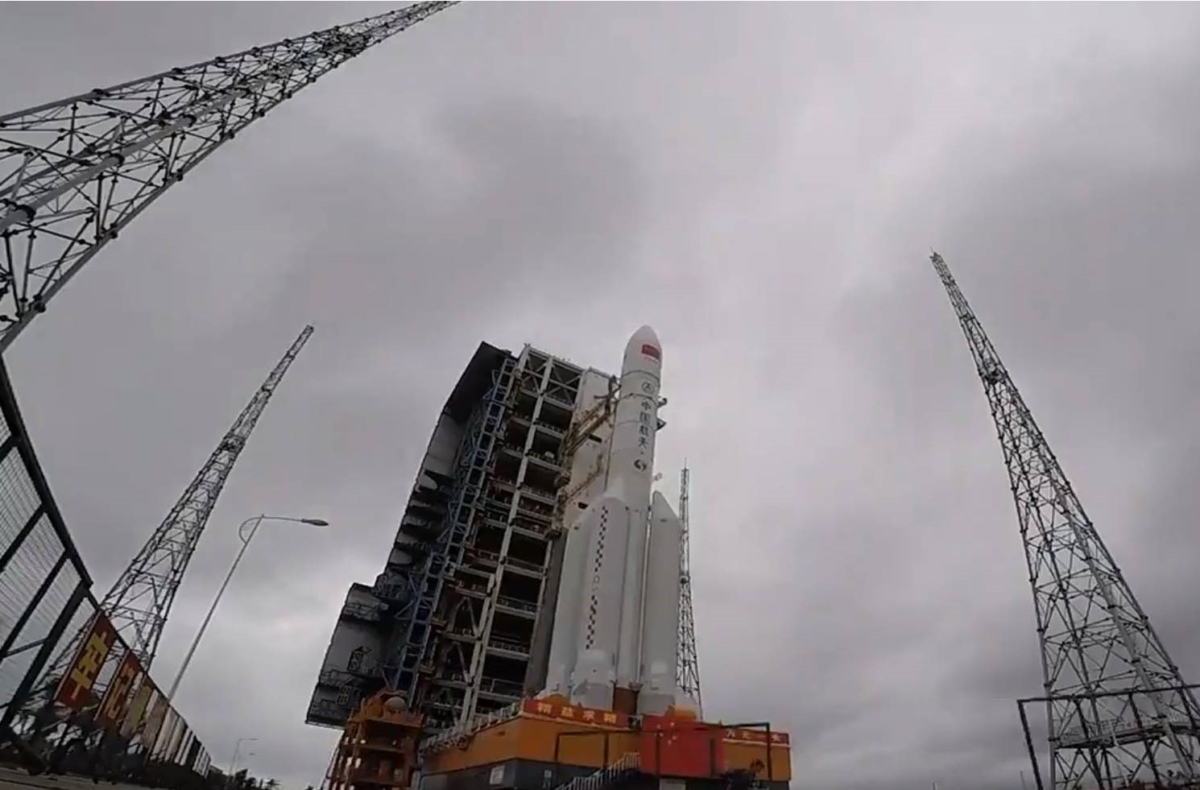
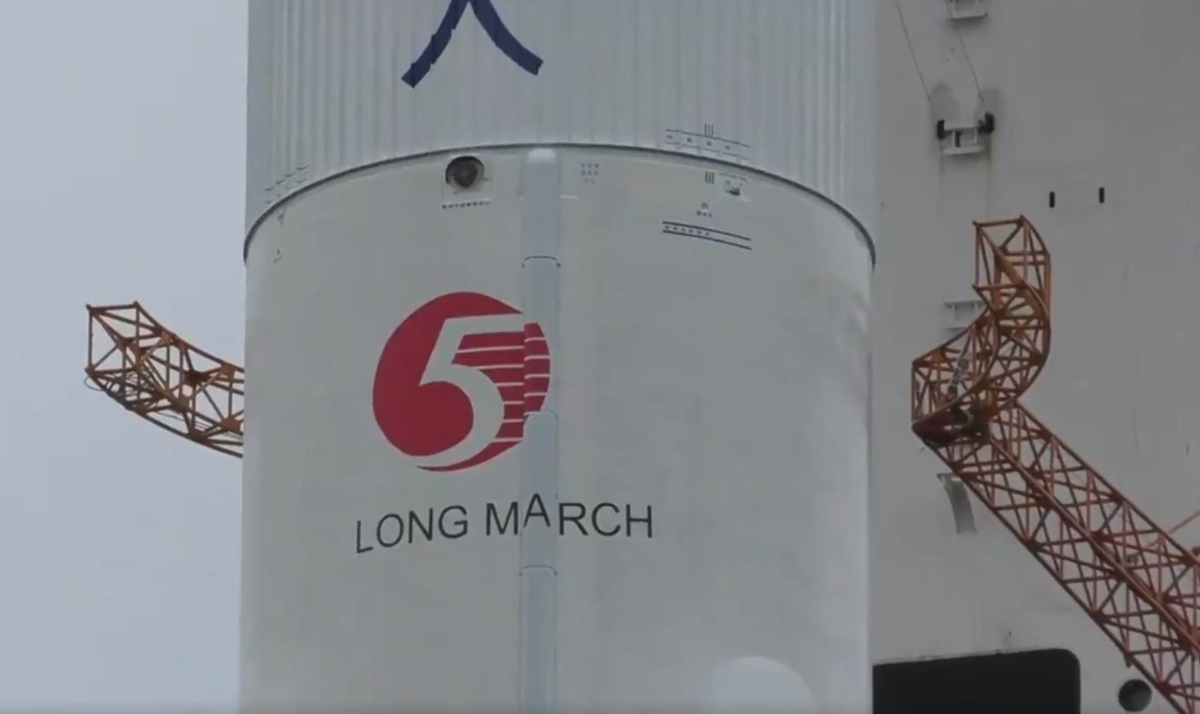
China’s Long March-5 booster is being readied for its third flight at the Wenchang Space Launch Center in south China’s Hainan Province.
The carrier rocket, coded as Long March-5 Y3, is planned to be launched around the end of December, according to the China National Space Administration (CNSA). A LaunchStuff twitter posting pegs the liftoff as slated for December 27th.

Courtesy LaunchStuff/Inside Outer Space
Quality assurance
In a newly posted China Central Television (CCTV) video, Wu Yanhua, deputy head of CNSA reports that engineers and scientists are convinced that all of the work — whether in terms of technology or quality assurance — have been completed. “Next, we will fill it with fuel at the launching area and run some tests,” Wu said.
Courtesy LaunchStuff/Inside Outer Space
The upcoming third Long March-5 takeoff follows a mishap of this booster-class on July 2, 2017. An intensive investigation was carried out to identify why the rocket failed less than six minutes after liftoff.
Critical launch
The Long March 5 booster is essential for China’s future space station, Moon and Mars exploration plans.

China’s space station scheduled to be operational in 2020’s.
Photo credit: CMSA
“If the flight is successful, it will be tasked with a series of key missions including launching China’s first Mars probe, the Chang’e-5 lunar probe and a core module for the manned space station,” Wu told CCTV. A modified version of the rocket, Long March-5B, will be used to construct China’s space station.
Go to this LaunchStuff posted video showing the booster being readied for flight at:

Curiosity Mast Camera Left photo of “Blackwaterfoot” taken on Sol 2618, December 18, 2019.
Credit: NASA/JPL-Caltech/MSSS
NASA’s Curiosity Mars rover is now wrapping up Sol 2620 tasks.
“All dressed up…and no data to (touch and) go on,” reports Michelle Minitti, a planetary geologist at Framework in Silver Spring, Maryland
Curiosity handlers were anxiously awaiting the images from the end of the rover’s drive of 66 feet (20 meters) further up “Western Butte,” as they anticipated having both the bedrock that covers this part of the butte and an intriguing dark block, Minitti adds, possibly shed from a layer higher up on the butte, in the robot’s workspace.

Curiosity Left B Navigation Camera photo acquired on Sol 2620, December 20, 2019.
Credit: NASA/JPL-Caltech
“However, the two communication passes that were to deliver the data we needed to plan observations in the workspace only delivered a fraction of the expected data,” Minitti notes.
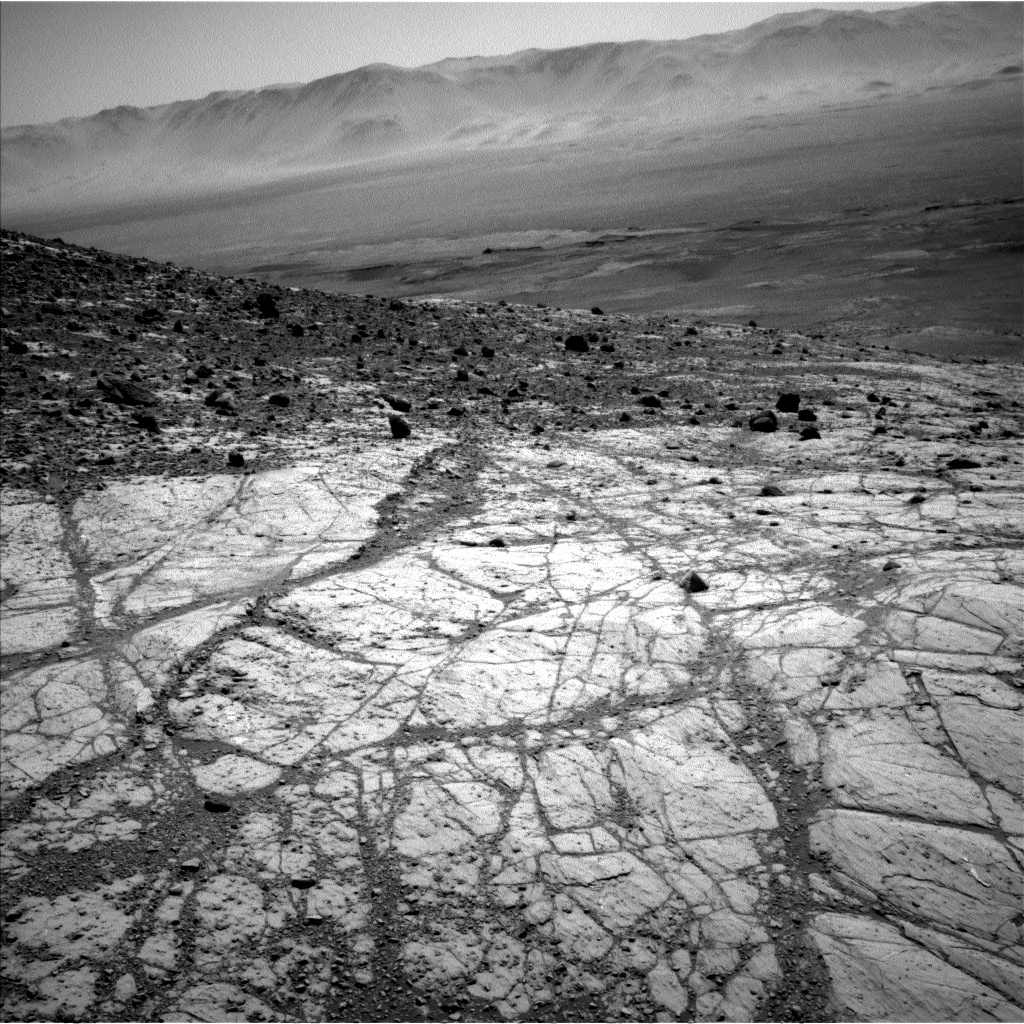
Curiosity Left B Navigation Camera image taken on Sol 2618, December 18, 2019.
Credit: NASA/JPL-Caltech
Settling in
The dearth of images meant that researchers could not target the Chemistry and Camera (ChemCam), Mars Hand Lens Imager (MAHLI), or Alpha Particle X-Ray Spectrometer (APXS)…or plan a drive.
“Thus, we settled into our home for the end of 2019 and did our best to fill the 11 sols covered by this plan despite our downlink challenges,” Minitti reports.
“When we plan a large number of sols at one time,” Minitti points out, “we cannot fill each sol with many activities, as it is very complicated to build and verify such a plan, and it increases the chances something will go wrong that will then impact all subsequent planned activities.”
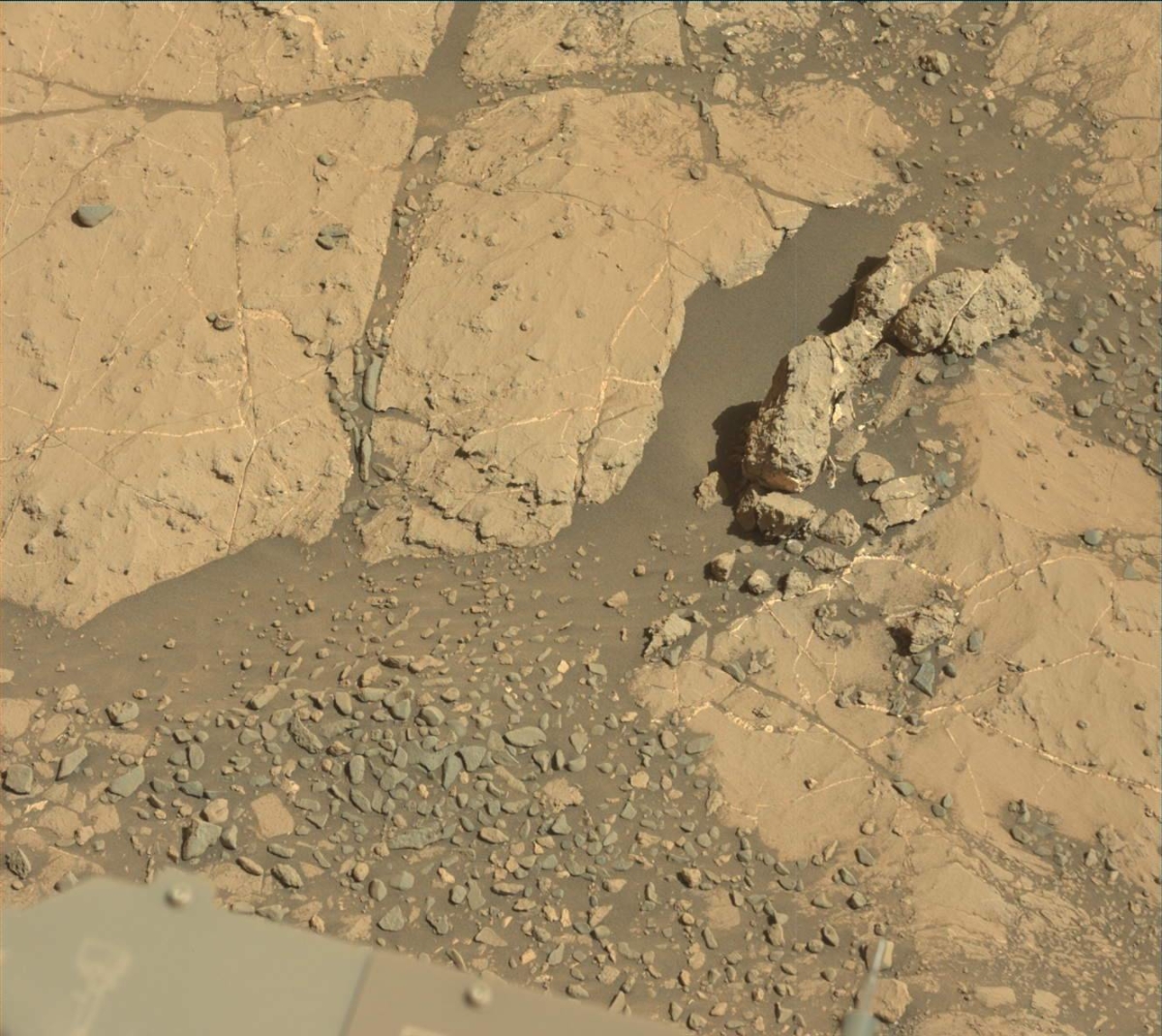
Curiosity Mast Camera Right image taken on Sol 2618, December 18, 2019.
Credit: NASA/JPL-Caltech/MSSS
Low risk plan
To build a long but lower risk plan, scientists utilize sols that include only Rover Environmental Monitoring Station (REMS) data acquisition. For this plan, Sols 2622 to 2625 and 2627 to 2630 will be REMS-only sols. REMS will keep going on the other sols, too, giving scientists an unbroken record of Martian weather through the end of the year.
Sols 2620, 2621 and 2626 mark the few sols of the plan when the rover will be a bit more active.
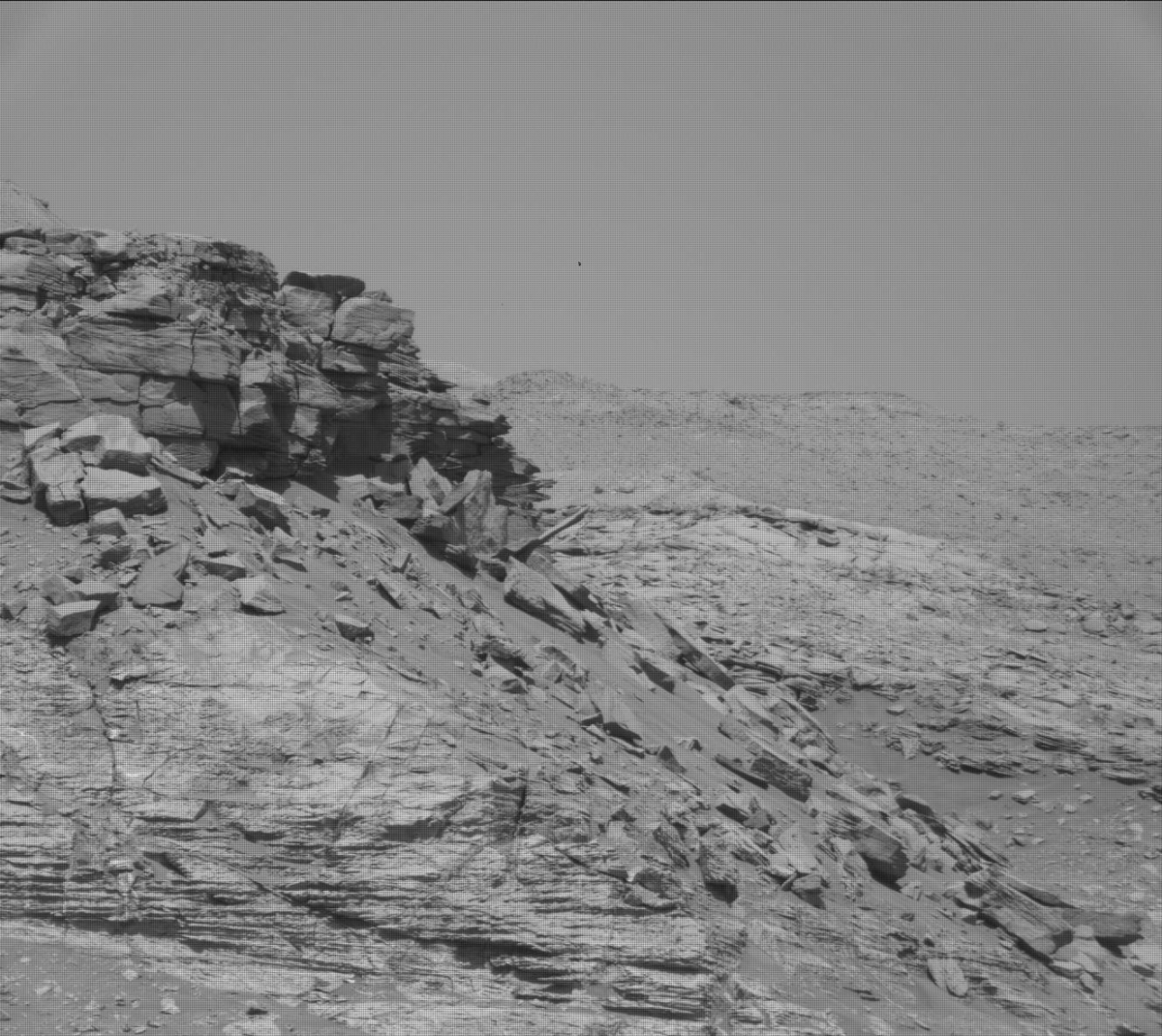
Curiosity Mast Camera Right image taken on Sol 2618, December 18, 2019.
Credit: NASA/JPL-Caltech/MSSS
Nice view
“On Sol 2620, we fit in activities that could be planned with the little targeting data we had. Mastcam was able to plan a multispectral observation of the dark block in the workspace, named “Blackwaterfoot,” two images of the target “Ayrshire” for the purposes of change detection, and a large mosaic of the “Greenheugh Pediment,” of which we have a particularly nice view from the topside of the butte,” Minitti says.
Curiosity’s ChemCam was able to plan two untargeted observations in the workspace using its autonomous target selection capability. No targeting data are required to look at the sky, so Mastcam and Navcam team up for observations of atmospheric dust load, dust devils and clouds.
These activities will finish by the time planning was slated to start today, Minitti reports, giving the operations team one last chance to recover from any issues and keep Curiosity on track up for a productive end to December.
From Sol 2620 into 2621, APXS will measure atmospheric argon, and then the robot’s Chemistry & Mineralogy X-Ray Diffraction/X-Ray Fluorescence Instrument (CheMin) will attempt to clean out some previously used cells that have sample powder stubbornly stuck in them.
Atmospheric methane
On Sol 2626, Dynamic Albedo of Neutrons (DAN) will ping the ground beneath us with passive and active measurements, ChemCam will carry out several calibration activities, Mastcam will image Ayrshire again to look for changes since Sol 2620, and then Mastcam and Navcam will acquire another round of observations of atmospheric dust load, dust devils and clouds.
From Sol 2626 into 2627, the rover’s Sample Analysis at Mars (SAM) Instrument Suite will measure atmospheric methane.

Curiosity Front Hazard Avoidance Camera Right B photo acquired on Sol 2619, December 19, 2019.
Credit: NASA/JPL-Caltech
Parking spot
Late in a recent planning day, a subsequent communication pass brought Mars scientists the full view of our parking spot.
“The workspace is as promising as we had hoped! Studying it will be quite the way to start off 2020,” Minitti adds.
Please note that dates of planned rover activities described are subject to change due to a variety of factors related to the Martian environment, communication relays and rover status.

Recurrent Slope Linae on the Palikir Crater walls on Mars.
Credit: NASA/JPL/University of Arizona
Those perplexing recurring slope lineae (RSL) on Mars might be explored in the future by a Pop-Up Flat Folding Explorer Rover.
The idea was detailed at the recent American Geophysical Union’s Fall Meeting held in San Francisco.

NASA Mars Reconnaissance Orbiter’s HiRISE image of recurring slope lineae in Melas Chasma, Valles Marineris. Arrows point out tops and bottoms of a few lineae.
Credit: NASA/JPL-Caltech/University of Arizona
According to an abstract overview by Kalind Carpenter and his colleagues, definitive confirmation of current liquid water activity on Mars would be a major step in establishing the present day habitability of Mars and the possibility of extant life. RSL’s are one of the most intriguing targets for exploring current water activity on the Red Planet.
Carpenter is a robotics engineer in the Robotic Vehicles and Manipulators Group at the Jet Propulsion Laboratory in Pasadena, California.
Steep slopes
RSL have been identified as seasonally dependent streaks that darken and grow downward on steep slopes.
“Currently, they are best explained as intergranular briny water flows percolating through the top layers of the regolith, but orbital observations cannot provide a definitive confirmation,” Carpenter and his project teammates noted.

Features called recurrent slope lineae (RSL) have been spotted on some Martian slopes in warmer months. Some scientists think RSL could be seasonal flows of salty water. Red arrows point out one 0.75-mile-long (1.2 kilometers) RSL in this image taken by NASA’s Mars Reconnaissance Orbiter.
Credit: NASA/JPL-Caltech/Univ. of Arizona
While the features are indeed intriguing, landing and probing near RSL presents a number of challenges to traditional mission architectures “including stringent planetary protection requirements of a Mars special region mission.”
Spacecraft sterilization
Enter the Pop-Up Flat Folding Explorer Rover (PUFFER).

Mobile Instruments for Mars Exploration includes the Pop-Up Flat Folding Explorer Rover (PUFFER).
Credit: NASA/JPL-Caltech
Two versions were noted at the AGU gathering, devices capable of traversing greater than 50 degree slopes and able to be cleaned to a greater then “log 7 reduction in bioburden” – a spacecraft sterilization standard.
The rover concept would be equipped with the Thermal and Electrical Conductivity Probe and/or a miniature version of the Tunable Laser Spectrometer to characterize RSL and establish habitability.
Having multiple PUFFER agents increases the communication range of the field survey by using individual PUFFERs as repeaters.
Go with the flow
The exploration rover would be able to gauge the permafrost freeze-thaw cycle that drives the underlying RSL processes at sites on Mars and characterize the chemical makeup of the flows.
“This will inform on the period of liquid phase and the available chemicals for biological processes,” according to Carpenter and his colleagues.
Overall, the Mobile Instruments for Mars Exploration (MIME) mission concept addresses fundamental NASA priorities of searching for life and habitable areas in our solar system.
Modern-day habitability?
On Mars, present day habitability is still fundamentally tied to finding liquid water.

NASA Curiosity rover on the Red Planet prowl since August 2012 and assessing the habitability of Mars.
Credit: NASA/JPL-Caltech/MSSS
The currently operating Curiosity rover has provided abundant evidence of Mars habitability 3-4 billion years ago in the active lacustrine system of Gale Crater – the robot’s exploration site.
MIME would pursue evidence for modern day liquid flows, and hence modern day habitability.
“A confirmed detection of liquid activity near the surface of Mars would intensify the already robust debate about the suitability of exploring Mars not only for signatures of past life, but also for signatures of extant life,” Carpenter and colleagues explained at the AGU.
NASA’s Curiosity Mars rover is now wrapping up Sol 2619 duties.
New imagery from the robot includes these picturesque photos:

Curiosity Front Hazard Avoidance Camera Right B image taken on Sol 2619, December 19, 2019.
Credit: NASA/JPL-Caltech

Curiosity Left B Navigation Camera photo acquired on Sol 2618, December 18, 2019.
Credit: NASA/JPL-Caltech
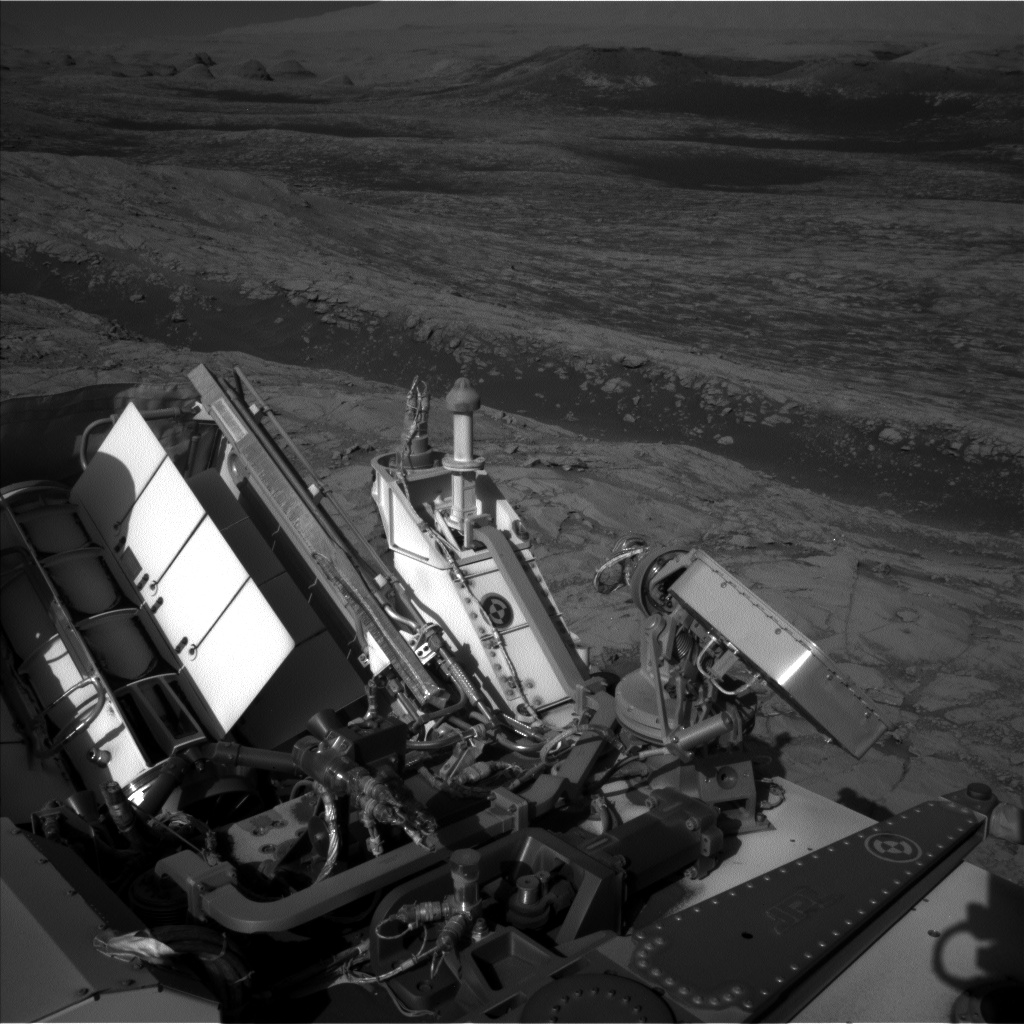
Curiosity Left B Navigation Camera photo acquired on Sol 2618, December 18, 2019.
Credit: NASA/JPL-Caltech
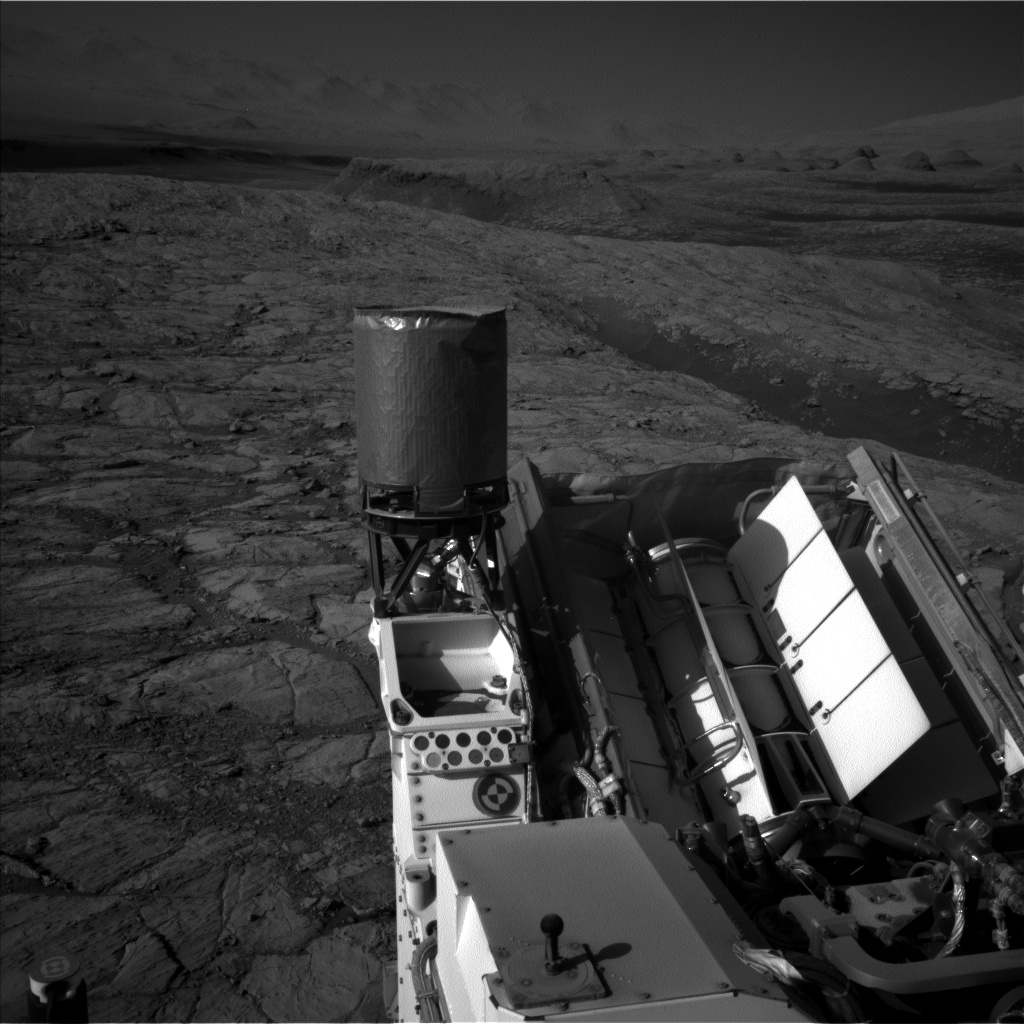
Curiosity Left B Navigation Camera photo acquired on Sol 2618, December 18, 2019.
Credit: NASA/JPL-Caltech
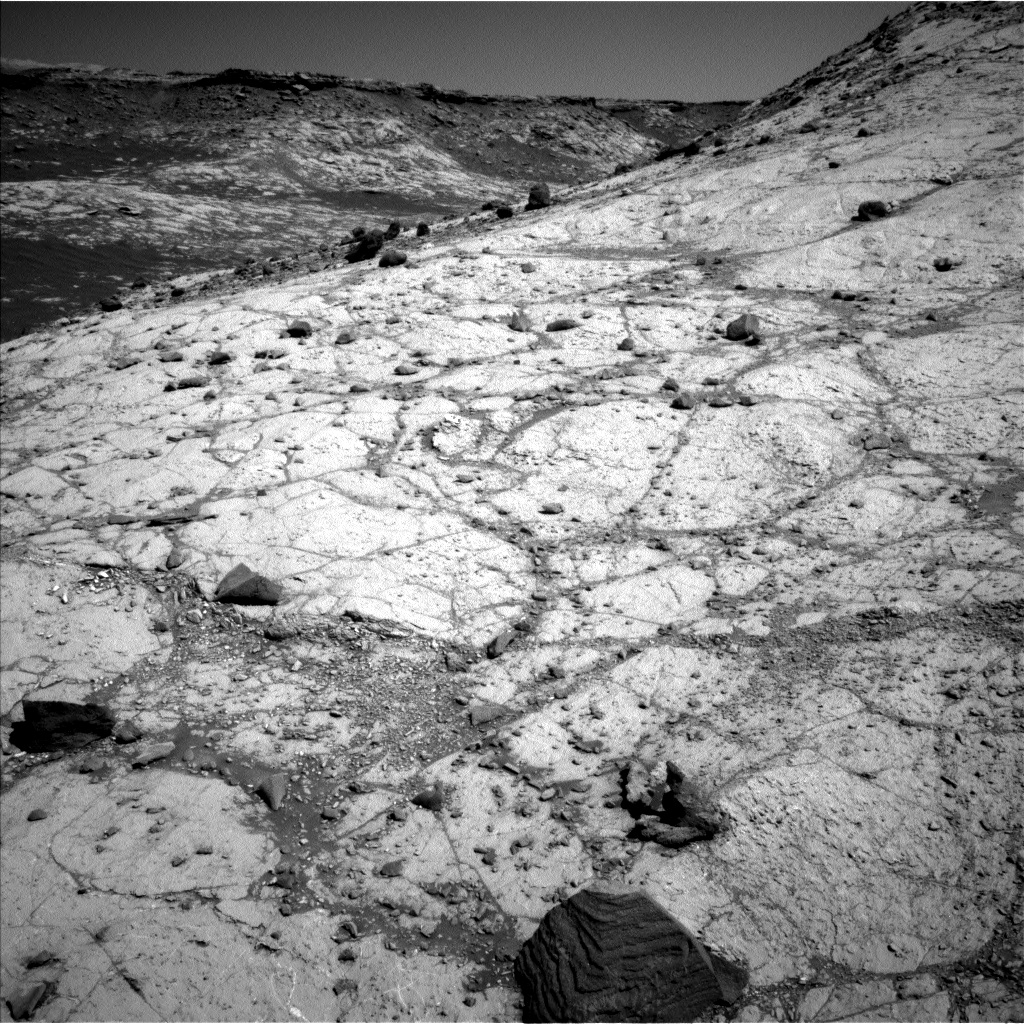
Curiosity Left B Navigation Camera photo acquired on Sol 2618, December 18, 2019.
Credit: NASA/JPL-Caltech
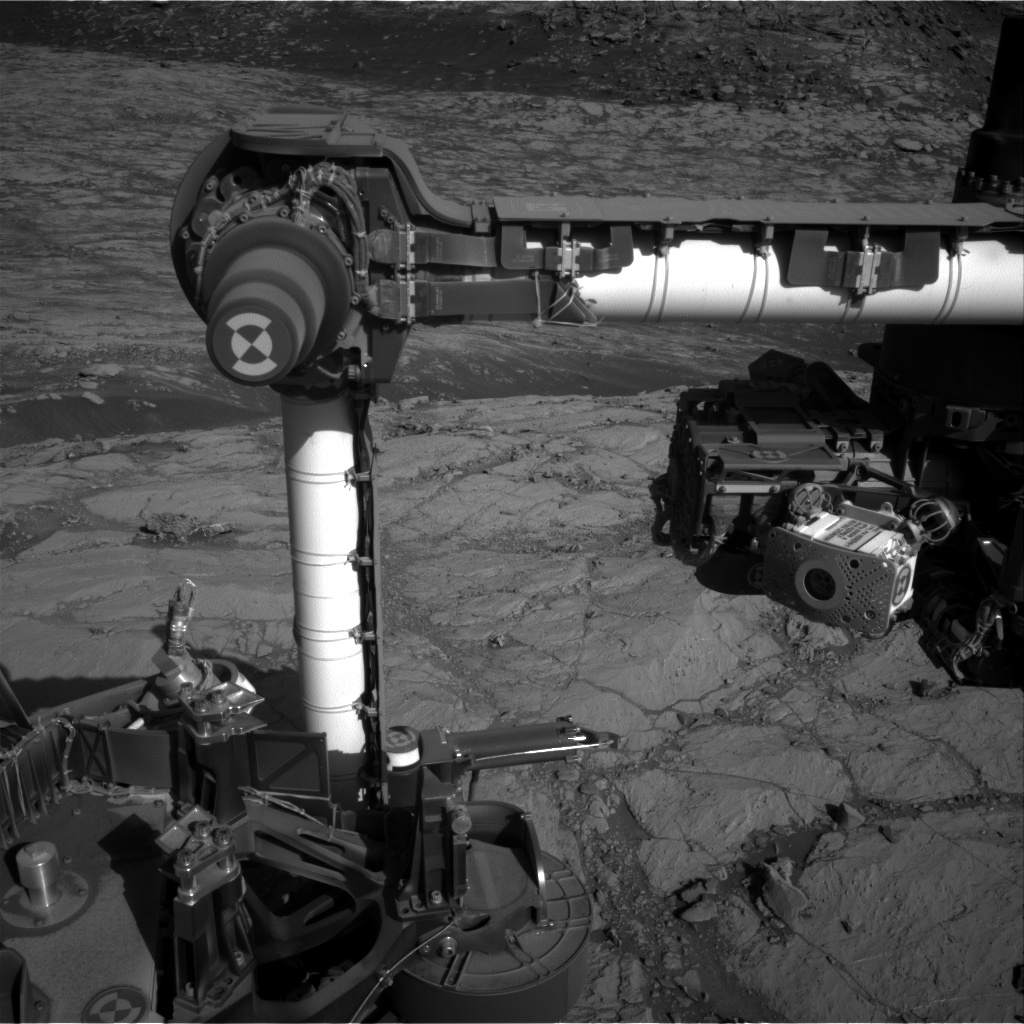
Curiosity Right B Navigation Camera image taken on Sol 2618, December 18, 2019.
Credit: NASA/JPL-Caltech
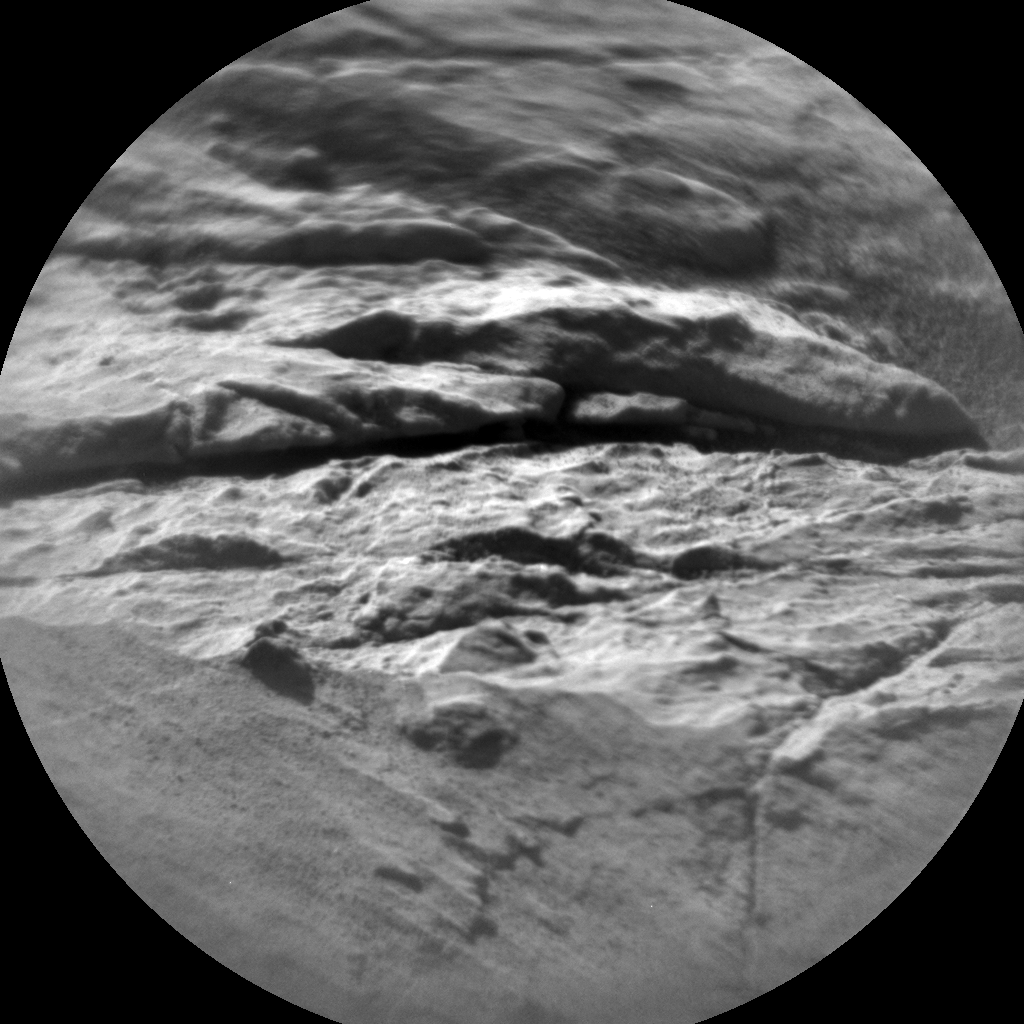
Curiosity Chemistry & Camera Remote Micro Imager (RMI) photo taken on Sol 2618, December 18, 2019.
Credit: NASA/JPL-Caltech/LANL
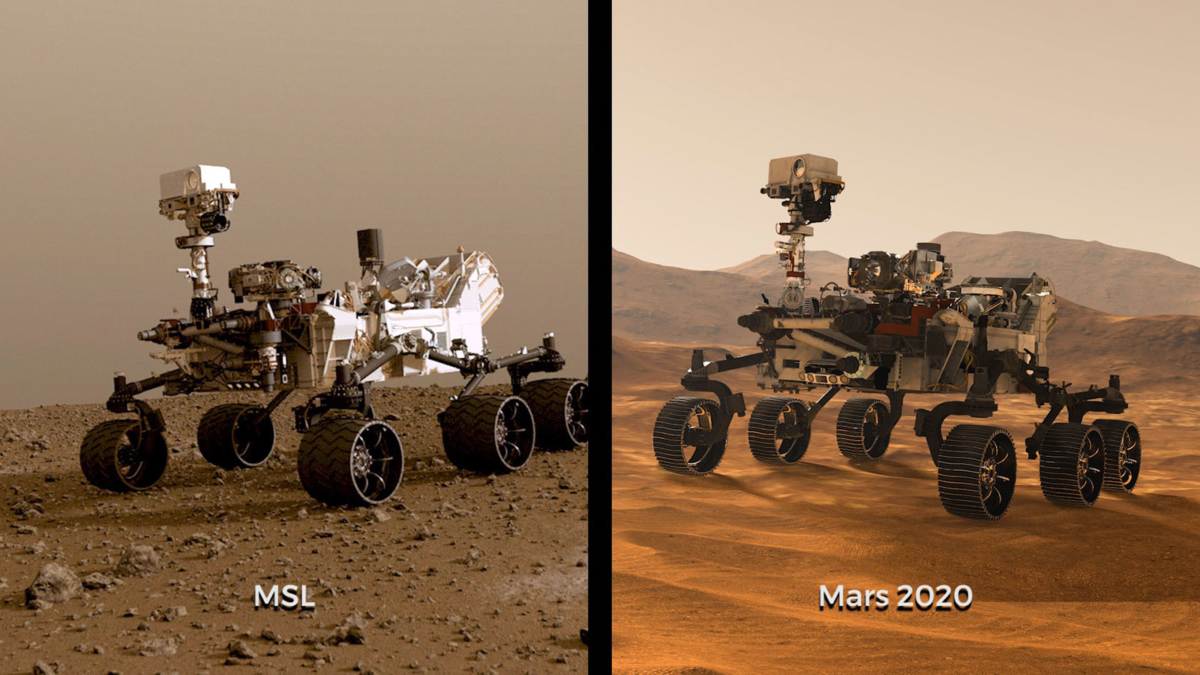
Curiosity contrasted to Mars 2020 rover.
Credit: NASA/JPL-Caltech

Credit: NASA/JPL-Caltech

Navcam right image looking south-southeast with light colored mudstone in the foreground. One of the darker colored, loose blocks that sit on top of the light rock in the top right of the image is the robot’s planned end of drive location. Also note the dark, relatively resistant layer of cap rock on the hill behind.
Credit: NASA/JPL-Caltech
The nominal plan for Curiosity was to do a touch (contact science) and go (drive), as well as science observations with instruments located on the rover’s mast, reports Lucy Thompson, a planetary geologist at University of New Brunswick, Fredericton, Canada.

Curiosity Left B Navigation Camera image acquired on Sol 2617, December 17, 2019.
Credit: NASA/JPL-Caltech
“However, we made a decision early on during planning to forgo the contact science in order to try and optimize the drive, hopefully resulting in some different looking rocks being in the workspace for the following plan,” Thompson adds.
Driving up in elevation
The robot has been driving up in elevation greater than 984 feet (300 meters) through a thick sequence of predominantly lighter colored, fine grained mudstones with minor sandstones, interpreted to have been deposited in a lake environment, Thompson points out.

Curiosity Left B Navigation Camera image acquired on Sol 2618, December 18, 2019.
Credit: NASA/JPL-Caltech

Curiosity Rear Hazard Avoidance Camera Right B photo taken on Sol 2617, December 17, 2019.
Credit: NASA/JPL-Caltech
“We have been observing from a distance a layer of darker colored, resistant rock, capping the top of several hills (or buttes) for some time now,” Thompson reports, “and such a layer occurs at the top of ‘Western Butte,’ the hill we have been climbing for the last week.
Cap rock
Mars researchers have been hoping that the rover’s drive will put a block of this dark rock in front of Curiosity, so that the robot can use both arm- and mast-mounted instruments to investigate the cap rock.

Curiosity Right B Navigation Camera image acquired on Sol 2617, December 16, 2019.
Credit: NASA/JPL-Caltech
“The geologists on the team are excited to investigate this different looking material to see how the composition and texture differs from the dominant, light colored mudstones we have been driving over for the last several years, and what this can tell us about the geological history of this area,” Thompson notes. “We also want to compare it to other resistant, dark colored, coarse grained sandstones overlying the mudstones that we encountered earlier in the mission.”

Curiosity Mast Camera Right photo acquired on Sol 2616, December 16, 2019.
Credit: NASA/JPL-Caltech/MSSS
Unusual hollowed out area
To make sure that researchers are continuing to document the textures and chemistry of the rocks beneath the rover’s wheels, two rock targets on the typical lighter colored bedrock were chosen for investigation with Chemistry and Camera (ChemCam) and Mastcam; “Kelvingrove” and “Keithick.”

Curiosity Left B Navigation Camera image taken on Sol 2616, December 16, 2019.
Credit: NASA/JPL-Caltech
Additionally, the Mastcam is slated to image an unusual hollowed out area in the workspace (“Barra Fan”) and an area with interesting textures, close to the planned end of drive location (“Hells Glen”).
Treasure trove of goodies?
“We will also acquire some longer distance Mastcam mosaics of the ‘Greenheugh Pediment’ (which we hope to start investigating next year) and an area behind the rover to look at the relationships of some of the different units we have previously encountered,” Thompson adds.
Standard Rover Environmental Monitoring Station (REMS), Dynamic Albedo of Neutrons (DAN) passive and active and Radiation Assessment Detector (RAD) activities were also planned.
“The team is excited to see what the workspace will have to offer after the drive,” Thompson concludes, “a treasure trove of goodies for Curiosity to enjoy over the holiday season?”
NASA’s Curiosity Mars rover has just started Sol 2617 operations.
New imagery from the robot includes these scenic photos:

Curiosity Front Hazard Avoidance Camera Left B image taken on Sol 2616, December 15, 2019.
Credit: NASA/JPL-Caltech

Curiosity Left B Navigation Camera image acquired on Sol 2616, December 16, 2019.
Credit: NASA/JPL-Caltech

Curiosity Left B Navigation Camera image acquired on Sol 2616, December 16, 2019.
Credit: NASA/JPL-Caltech

Curiosity Left B Navigation Camera image acquired on Sol 2616, December 16, 2019.
Credit: NASA/JPL-Caltech
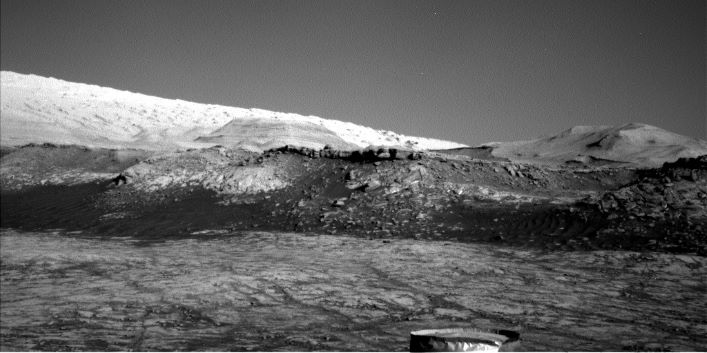
Curiosity Left B Navigation Camera image acquired on Sol 2616, December 16, 2019.
Credit: NASA/JPL-Caltech

Curiosity Left B Navigation Camera image taken on Sol 2616, December 16, 2019.
Credit: NASA/JPL-Caltech

China’s champion – long duration Yutu-2 rover.
Credit: CNSA/CLEP
China’s farside rover – Yutu-2 – has broken the longevity record for working on the Moon.
China Global Television Network (CGTN) reports the robot rolled by the previous record set by the Soviet Union’s Lunokhod-1.
Lunokhod 1 was the first roving remote-controlled robot to land on another world, operating in the Sea of Rains starting November 17, 1970. The operations of Lunokhod officially ceased on October 4, 1971, the anniversary of Sputnik 1. Lunokhod had traveled 6.5 miles and had transmitted more than 20,000 TV pictures and more than 200 TV panoramas.

Soviet Union’s Lunokhod Moon rover. Lunokhod 1 was the first roving remote-controlled robot to land on another world.
Courtesy LRO website/Arizona State University
Yutu-2 has been working on the Moon for over 11 months, since January 3 of this year.
China’s Chang’e-4 mission, a rover-lander duo, touched down on the floor of the 110-mile-wide (186 kilometers) Von Kármán Crater, which lies within the South Pole-Aitken Basin.
CGTN reports that Yutu-2 will continue working on the Moon.
Earlier this month, China’s Chang’e-4 lander and the Yutu-2 rover ended their work for the 12th lunar day, switching to dormant mode for the lunar night, reported the Lunar Exploration and Space Program Center of the China National Space Administration (CNSA).
At that time, the wheeled rover had chalked up over 1,132 feet (345 meters) of travel, noted CNSA.

Curiosity Front Hazard Avoidance Camera Right B image showing the view towards the top of Western Butte. Photo taken on Sol 2614, December 13, 2019. Credit: NASA/JPL-Caltech
NASA’s Curiosity Mars rover is now performing Sol 2615 tasks.
The rover is keeping up the pace on the Western Butte, reports Catherine O’Connell, a planetary geologist at the University of New Brunswick, Fredericton, New Brunswick, Canada.
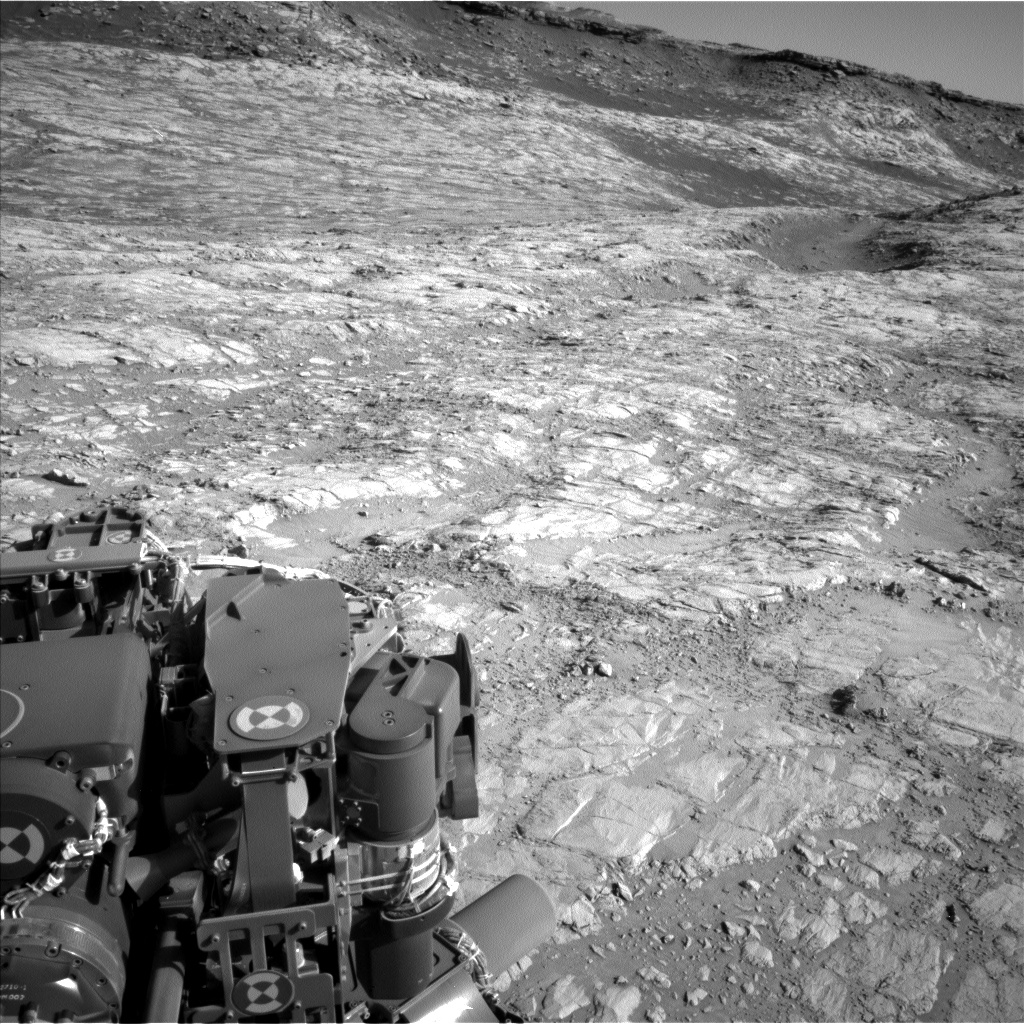
Curiosity Left B Navigation Camera image taken on Sol 2613, December 13, 2019.
Credit: NASA/JPL-Caltech
A recently planned 3-sol weekend script has been developed.
“Usually, the first day of a weekend plan is chock full of contact science, with evening and overnight analyses on a couple of different targets,” O’Connell notes, using the robot’s Alpha Particle X-Ray Spectrometer (APXS) and the Mars Hand Lens Imager (MAHLI), plus Chemistry and Camera (ChemCam) on several targets in the workspace, followed by a drive on the second sol.
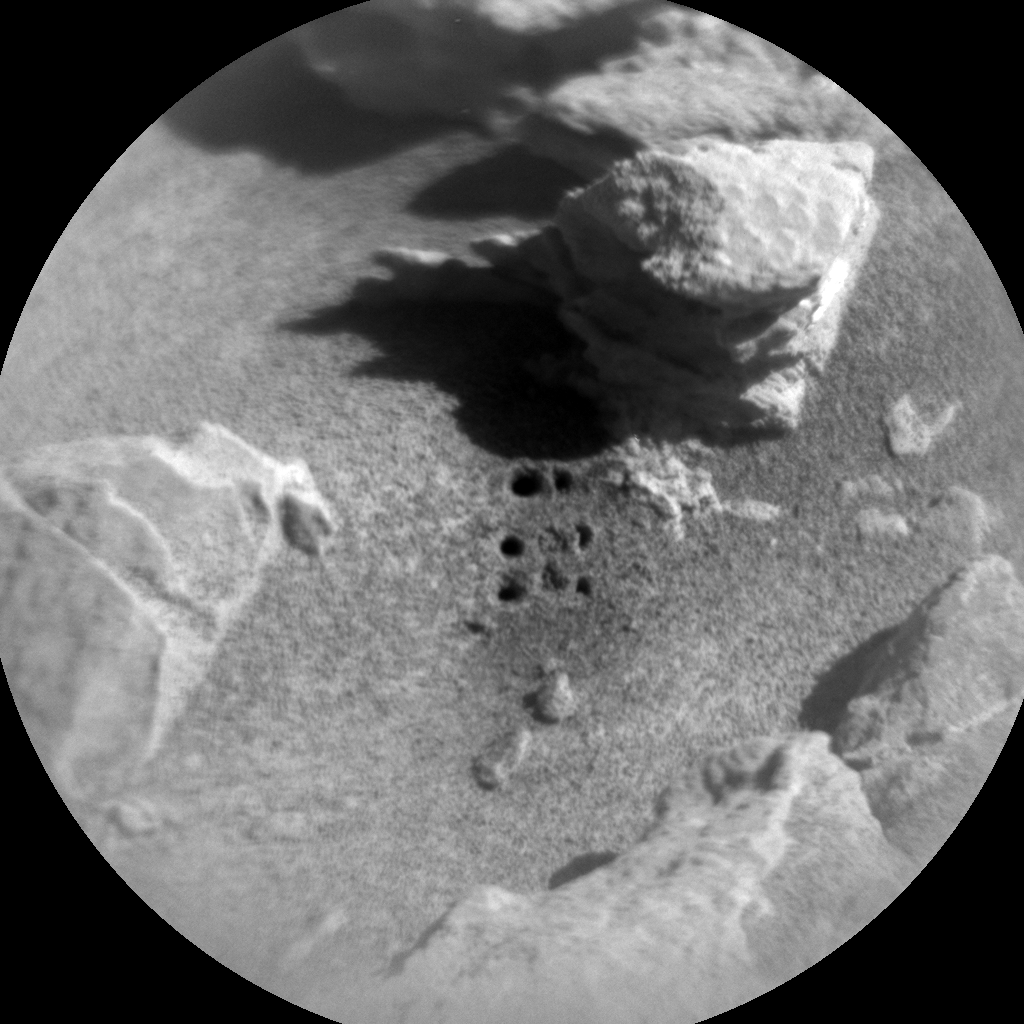
Curiosity Chemistry & Camera Remote Micro Imager (RMI) photo acquired on Sol 2614, December 14, 2019.
Credit: NASA/JPL-Caltech/LANL
Methane daytime experiment
“This weekend will be unusual, as the entire first day of the plan will be dedicated to the Sample Analysis at Mars (SAM) instrument. SAM will run a daytime experiment to investigate methane levels in the atmosphere. This rare experiment is a chance to get some exciting science observations, but we’ll need time after the experiment to analyze the data; we don’t expect to have any takeaways right away,” O’Connell explains.

ChemCam team members at Los Alamos National Laboratory plot use of laser-induced breakdown spectroscopy (LIBS) device on Curiosity Mars rover.
Credit: LANL
The SAM experiment is very power intensive, O’Connell adds, “so we are skipping our usual contact science here in favor of a more pared down science plan.”
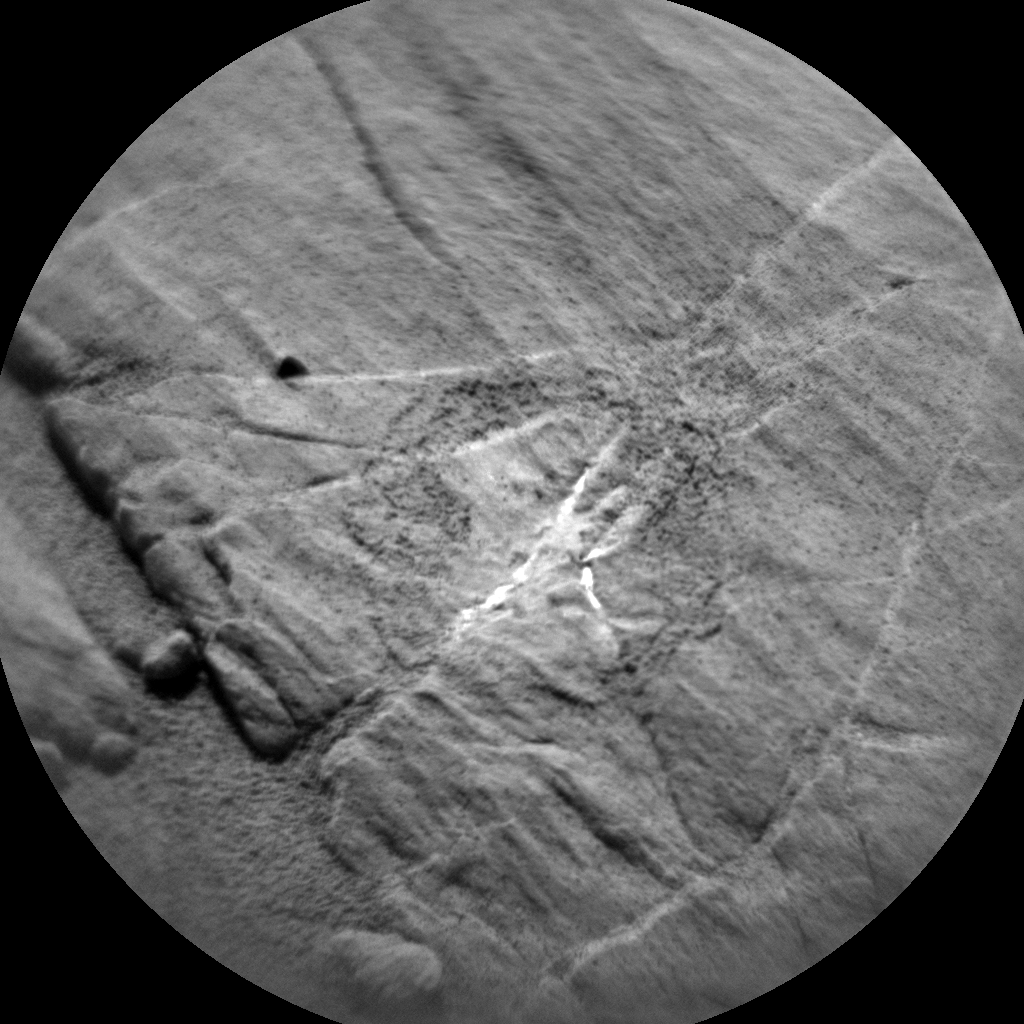
Curiosity Chemistry & Camera Remote Micro Imager (RMI) photo acquired on Sol 2614, December 14, 2019.
Credit: NASA/JPL-Caltech/LANL
Move on up
Curiosity science members are eager to keep moving up Western Butte (one of a series of hills in this area).
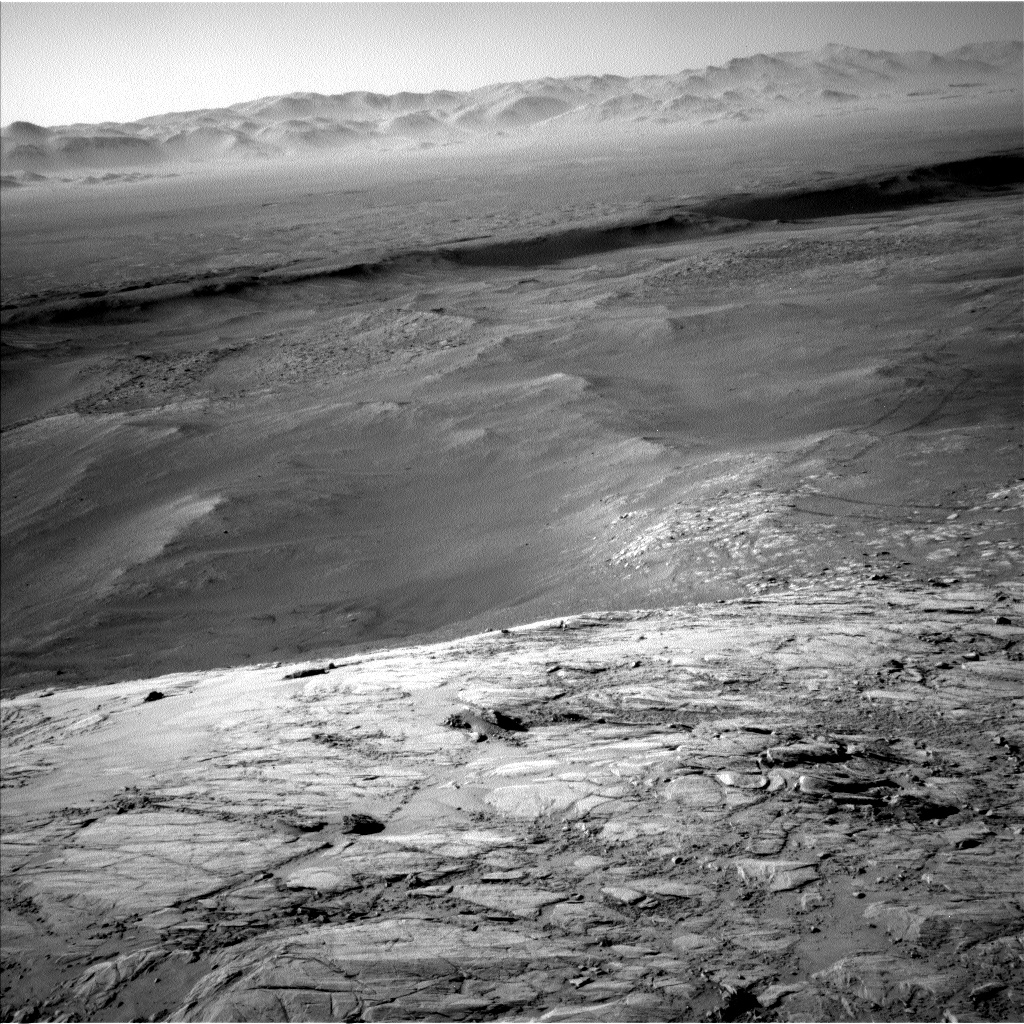
Curiosity Left B Navigation Camera image taken on Sol 2613, December 13, 2019.
Credit: NASA/JPL-Caltech
“We are traversing rocks which are stratigraphically higher than those we have previously crossed, and everyone is eager to see what lies ahead,” O’Connell points out. “So rather than stay here too long, the geology theme group (GEO) opted to drive onwards, after a short early morning analysis (an aptly named “Touch and Go” analysis) on the target “North Esk” with MAHLI and APXS. ChemCam and Mastcam will investigate two bedrock targets “Bruces Haven” and “Aultbea” and then we drive roughly [72 feet] 22 meters further up the side of the Butte.”
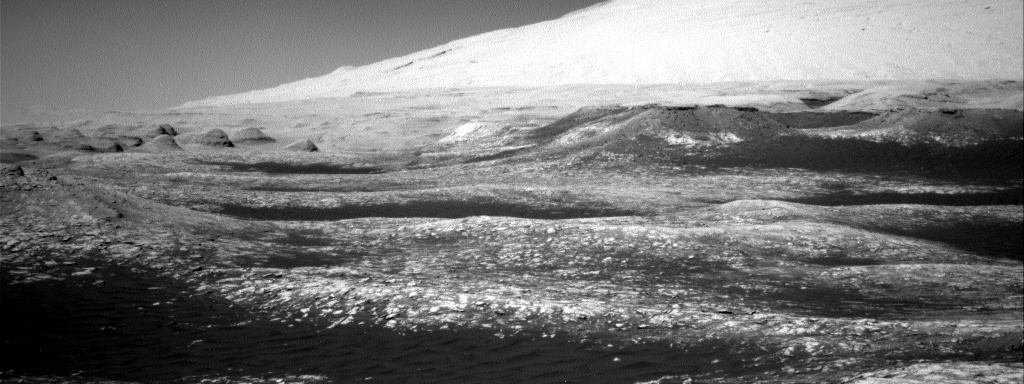
Curiosity Right B Navigation Camera photo taken on Sol 2614, December 14, 2019.
Credit: NASA/JPL-Caltech
New stratigraphic highs
O’Connell observes that as the robot climbs higher up the Butte, the views just keep getting better.
“Mastcam is going to image both along the Western Butte, and the top of the Butte and beyond, to a horizon that we hope to reach next year. Once the drive ends, Mastcam and Navcam will image the workspace to help us choose targets next week,” O’Connell reports.
In addition to the SAM experiment, the environmental theme group (ENV) planned activities to monitor dust and atmospheric conditions in Gale crater, and routine Dynamic Albedo of Neutrons (DAN) and Rover Environmental Monitoring Station (REMS) activities.
“Climbing up the side of this Butte and reaching new stratigraphic highs has made for an exciting week, with everyone keen to see where the preceding day’s drive has brought us,” O’Connell concludes.
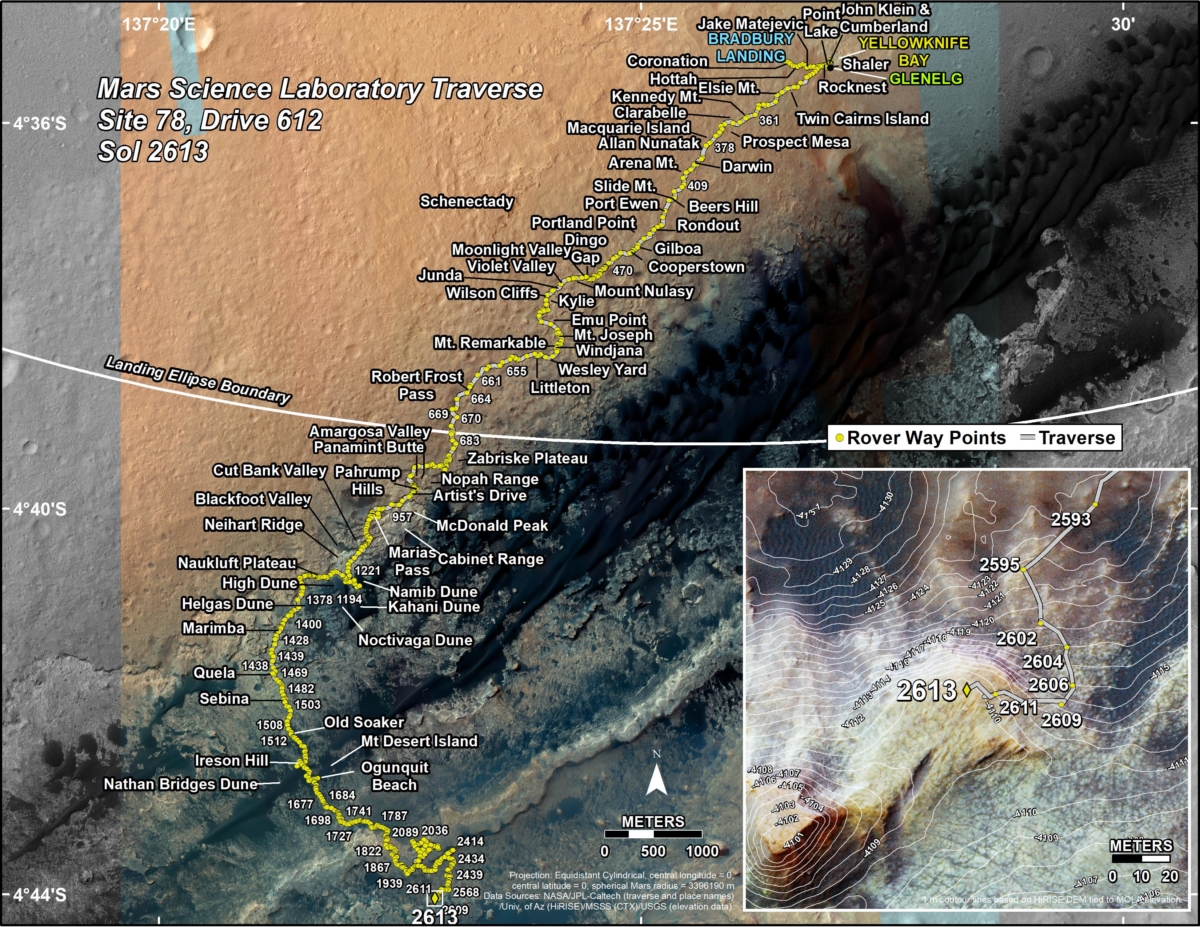
Credit: NASA/JPL-Caltech/Univ. of Arizona
New road map
Meanwhile, a new road map shows the route driven by Curiosity through the 2613 Martian day, or sol, of the rover’s mission on Mars (December 13, 2019).
Numbering of the dots along the line indicate the sol number of each drive. North is up. The scale bar is 1 kilometer (~0.62 mile).
From Sol 2611 to Sol 2613, Curiosity had driven a straight line distance of about 33.39 feet (10.18 meters), bringing the rover’s total odometry for the mission to 13.43 miles (21.61 kilometers).
The base image from the map is from the High Resolution Imaging Science Experiment Camera (HiRISE) in NASA’s Mars Reconnaissance Orbiter.

Curiosity Right B Navigation Camera image taken on Sol 2613, December 12, 2019.
Credit: NASA/JPL-Caltech
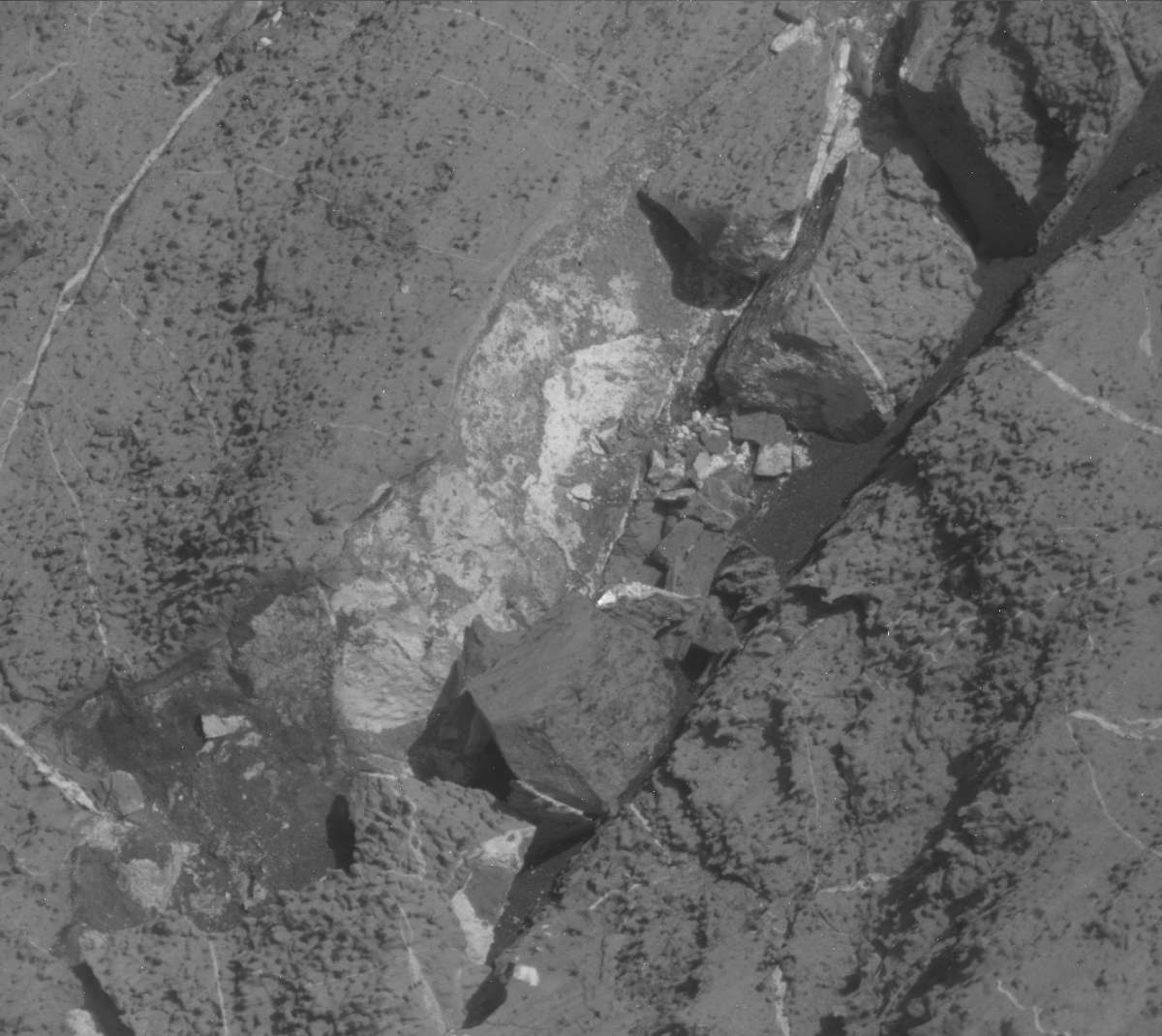
Curiosity Mast Camera Right image acquired on Sol 2613, December 12, 2019.
Credit: NASA/JPL-Caltech/MSSS
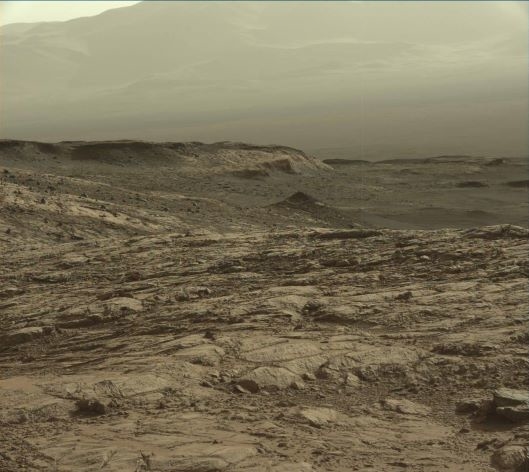
Curiosity Mast Camera Left photo taken on Sol 2611, December 11, 2019.
Credit: NASA/JPL-Caltech/MSSS
NASA’s Curiosity rover on Mars is now performing Sol 2613 duties.
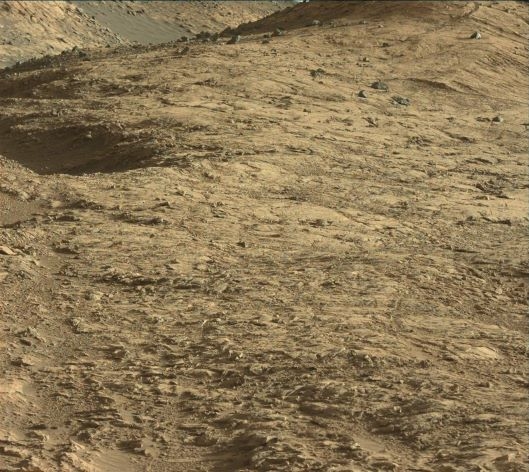
Curiosity Mast Camera Left photo taken on Sol 2611, December 11, 2019.
Credit: NASA/JPL-Caltech/MSSS
“Curiosity is approaching another unconformity—or maybe it is a distant part of the same one. A large sloping surface called Greenheugh pediment looms ahead, past Western Butte,” reports Roger Wiens, a geochemist at Los Alamos National Laboratory in New Mexico. “Part of the exploration of Central and Western buttes is to determine their relationship to the unconformity.”
Wiens explains that, in a sedimentary environment, the principle of “superposition” specifies that lower rock layers were deposited earlier than the layers above them.
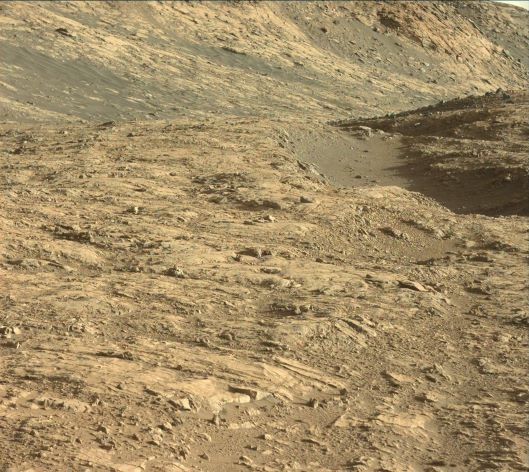
Rock record
“In other words, time effectively moves forward when traversing “up-section” (traversing to higher rock layers). That’s the direction that Curiosity has been moving,” Wiens adds, “so the rover is exploring rocks laid down more and more recently, though still a long time ago.”
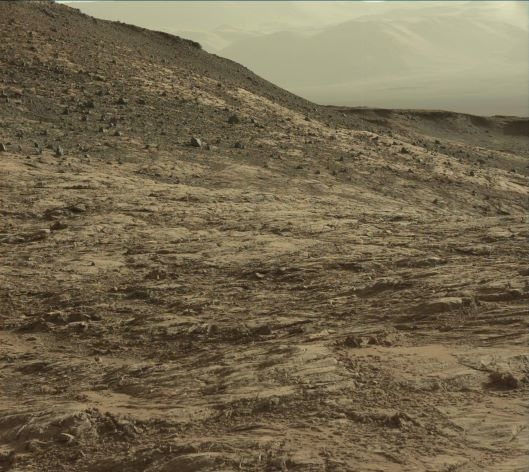
Curiosity Mast Camera Left photo taken on Sol 2611, December 11, 2019.
Credit: NASA/JPL-Caltech/MSSS
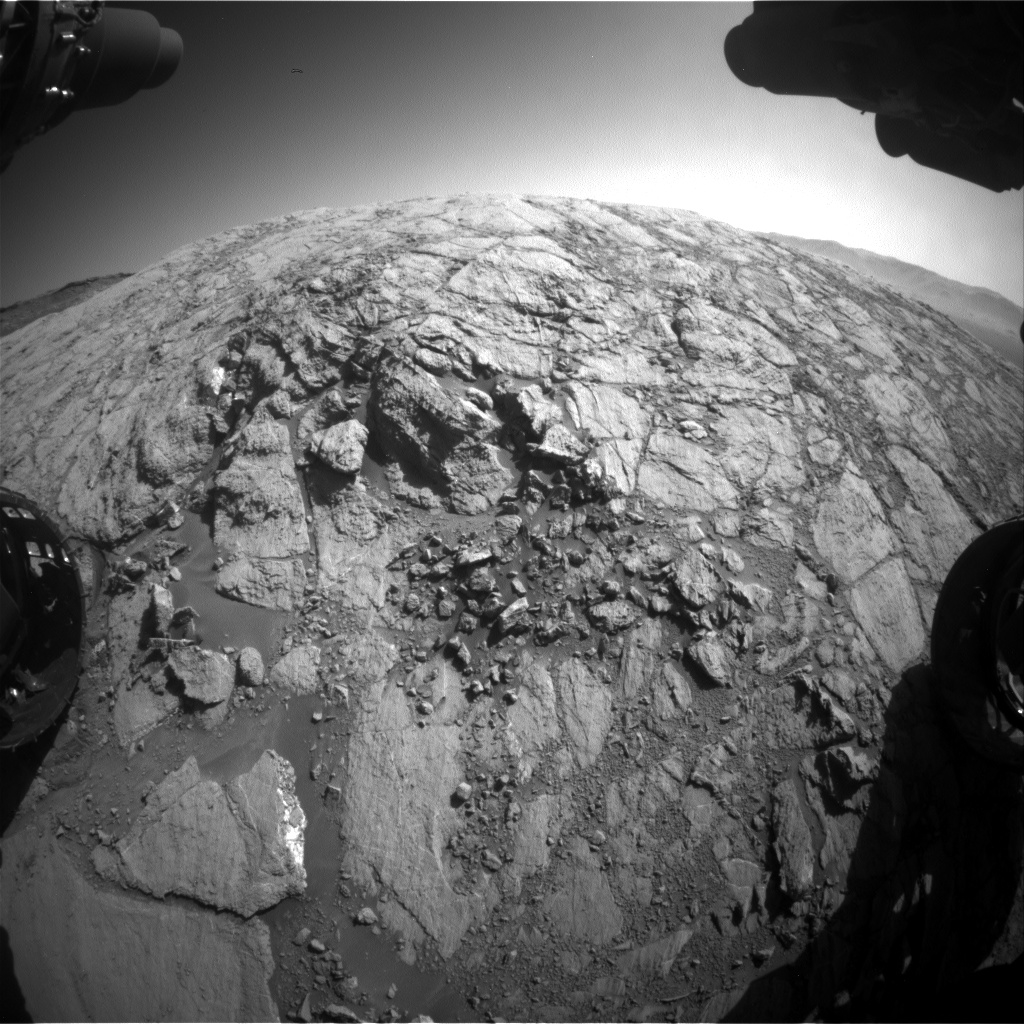
Curiosity Front Hazard Avoidance Camera Right B image acquired on Sol 2612, December 11, 2019.
Credit: NASA/JPL-Caltech
Sometimes the rock record has an abrupt change due to missing rock layers that weathered or washed away before the next rock layer was deposited, Wiens explains. “The abrupt change in rock layers is called an unconformity.”

