Archive for the ‘Space News’ Category
 Author:
  February 27th, 2020
Curiosity Mars Hand Lens Imager photo produced on Sol 268, February 26, 2020.
Credit: NASA/JPL-Caltech/MSSS
NASA’s Curiosity Mars rover is now carrying out Sol 2688 tasks.
The rover is on the move, reports Abigail Fraeman, a planetary geologist at NASA’s Jet Propulsion Laboratory.
“Over the last couple of weeks, the Curiosity science team engaged in a series of long debates about where we should go after we completed our analyses of the Hutton sample,” Fraeman notes. “Our first option was to drive downhill and rejoin the strategically planned route that skirts the base of the Greenheugh pediment. The second option was to head the other way and drive uphill onto the top of pediment capping unit.”

Curiosity Mars Hand Lens Imager photo produced on Sol 268, February 26, 2020.
Credit: NASA/JPL-Caltech/MSSS
Potentially passable route
Fraeman explains that Mars researchers had always planned to drive on top of the Greenheugh pediment at some point, “but the rover wouldn’t reach the access points identified from orbit for months, or possibly even years.”
While Curiosity was completing the drill campaign at Hutton, rover drivers working with surface properties scientists discovered a “potentially passable route” onto the top of the Greenheugh pediment that was accessible from our current location.

Curiosity Mast Camera Left photo taken on Sol 2686, February 26, 2020.
Credit: NASA/JPL-Caltech/MSSS
“So as a team we had to consider were the science benefits worth trying to drive onto the pediment now, or we should wait until later as originally planned? In the end, we decided the science rationale to ascend now were so compelling, it was worth going for it,” Fraeman points out.
Steep slopes
The focus of a recent plan is to execute the first of several drives that will take the robot to the top. Curiosity planners don’t expect to encounter slopes much greater than 25 degrees early on, Fraeman says, but subsequent drives will require the rover to ascend slopes of 30 degrees or more.

Curiosity Mast Camera Left photo taken on Sol 2686, February 26, 2020.
Credit: NASA/JPL-Caltech/MSSS
“We’ve never driven up slopes this steep with Curiosity before, and we don’t actually know if the rover will be able to make it all the way up and over,” Fraeman adds. “However, all of our analysis shows this attempt won’t put any unusual risk on the vehicle hardware, so there’s no reason we can’t try!”

Curiosity Mars Hand Lens Imager photo produced on Sol 2687, February 27, 2020.
Credit: NASA/JPL-Caltech/MSSS
Fraeman concludes: “Exploring Mars is always exciting, but for me, this has been a particularly fun and exciting time to be a part of the Curiosity science team. I love the feeling of exploring and venturing into the unknown. We don’t know if we’ll be able to make it onto the pediment capping unit here, but we know we’ll discover something completely new if we do reach the top.”
 Posted in

Mission Extension Vehicle-1 (MEV-1) closes in on the Intelsat 901 (IS-901) spacecraft.
Credit: Northrop Grumman
The first docking of the Mission Extension Vehicle-1 (MEV-1) to the Intelsat 901 (IS-901) spacecraft in order to provide life-extension services has been accomplished.
The February 25 event marks the first time two commercial satellites have docked in orbit and the first time that mission extension services will be offered to a satellite in geosynchronous orbit.
MEV-1 was launched Oct. 9, 2019 to dock with the Intelsat 901 satellite, a fully operational communication satellite that is running low on fuel.

The first time two commercial satellites have docked in orbit.
Credit: Northrop Grumman
What now?
The combined spacecraft stack will now perform on-orbit checkouts before MEV-1 begins relocating the combined vehicle to return IS-901 into service in late March.
MEV-1 will provide five years of life extension services to the IS-901 satellite before returning the spacecraft to a final decommissioning orbit. MEV-1 will then move on to provide mission extension services to a new client spacecraft.

Ground testing of docking technique.
Credit: Northrop Grumman/Space Logistics Services
Mechanical docking system
MEV-1 was designed and built at the Northrop Grumman’s Dulles, Virginia, facility and utilizes a low-risk mechanical docking system that attaches to existing features on the client satellite.
According to a Northrop Grumman statement, once docked, MEV takes over the attitude and orbit maintenance of the combined vehicle stack to meet the pointing and station keeping requirements of the customer.
MEV is designed for multiple docking and undockings and can deliver over 15 years of life extension services. The company is scheduled to launch its second Mission Extension Vehicle, MEV-2, later this year, which is contracted to provide service to a different Intelsat satellite.

Curiosity Front Hazard Avoidance Right B Camera image acquired on Sol 2686, February 26, 2020.
Credit: NASA/JPL-Caltech
NASA’s Curiosity Mars rover is now performing Sol 2687 duties.
“We’re wrapping up our Hutton drill campaign literally at the tail end,” reports Scott Guzewich, an atmospheric scientist at NASA’s Goddard Space Flight Center in Greenbelt, Maryland.

Curiosity Left B Navigation Camera image taken on Sol 2686, February 26, 2020.
Credit: NASA/JPL-Caltech
A recent plan focused on studying those drill “tailings” (gray material surrounding the drill hole with the rover’s Chemistry and Camera (ChemCam), Mastcam, Mars Hand Lens Imager (MAHLI), and the Alpha Particle X-Ray Spectrometer (APXS).

Curiosity Mars Hand Lens Imager (MAHLI) photo produced on February 24, 2020, Sol 2684.
Credit: NASA/JPL-Caltech/MSSS
Lunar gray
This phase of the drill campaign, Guzewich adds, helps compare the Sample Analysis at Mars (SAM) Instrument Suite and the Chemistry & Mineralogy X-Ray Diffraction/X-Ray Fluorescence Instrument (CheMin) laboratory analyses with the data from remote sensing instruments of the same material from the drill hole.
“It’s always interesting to see that Mars’ red color is sometimes literally only skin-deep and underneath can be much more of a lunar gray,” Guzewich points out.

Curiosity Mast Camera Right image taken on Sol 2685, February 24, 2020.
Credit: NASA/JPL-Caltech/MSSS
Additional observations
“We also packed in a few additional observations of some nearby rock targets,” Guzewich notes, “including an intriguing fin-like structure sticking out of the ground nearby called ‘Dunbartonshire.’”
The plan calls for looking at this feature also with MAHLI and APXS on the second night of a recently scripted 2-sol plan.

Curiosity Mast Camera Right image taken on Sol 2685, February 24, 2020.
Credit: NASA/JPL-Caltech/MSSS
Lastly, on the plan is a dust devil movie. Curiosity has been unable to do much additional long-distance imaging work at its current location due to the cliff surrounding the robot on three sides blocking its view in most directions, Guzewich concludes.

Curiosity Mast Camera Right image taken on Sol 2685, February 24, 2020.
Credit: NASA/JPL-Caltech/MSSS

Curiosity Mars Hand Lens Imager photo produced on Sol 2686, February 26, 2020.
Credit: NASA/JPL-Caltech/MSSS

Rocky Mountain Star Stare (RMSS) is an annual star party sponsored by the Colorado Springs Astronomical Society. Circle this year’s gathering: June 17 – 21, 2020.

Credit: Colorado Springs Astronomical Society
Located on 35 acres of land, RMSS’s “Starry Meadows” is conveniently located just over two hours southwest of Colorado Springs (outside of Gardner, CO), between the Sangre de Cristo and Wet mountain ranges, at an altitude of 7,600 feet above sea level.

Credit: RMSS
RMSS annually plays host to 300+ amateur and professional astronomers, family and friends.
Speakers
This year, I am very pleased to take part as a speaker to highlight my latest book, Moon Rush – The New Space Race.
I’ll be joining these distinguished speakers:
Harrison Schmitt walked on the Moon in December 1972 as the Lunar Module Pilot of Apollo 17. One of the twelve Moon-walkers, he is the last person to step on the Moon and the only scientist-astronaut to do so.
Timothy Cichan is the Space Exploration Architect at Lockheed Martin, where he leads a multi-disciplinary team of engineers who figure out how to help astronauts and robots visit the Moon, asteroids, and Mars.
Victoria Hamilton of the Southwest Research Institute is a planetary geologist interested in the mineralogy and histories of planetary bodies. She is a co-Investigator on the NASA OSIRIS-REx and Lucy missions.
For more information on this year’s Rocky Mountain Star Stare (RMSS), go to:

Curiosity Mars Hand Lens Imager photo produced on Sol 2684, February 24, 2020.
Credit: NASA/JPL-Caltech/MSSS
NASA’s Curiosity Mars rover is now carrying out Sol 2685 tasks.
Susanne Schwenzer, a planetary geologist at The Open University, Milton Keynes, U.K., reports that Mars scientists are still in the middle of the Hutton drill campaign.
“This gives us lots of things to do, but power constraints restrict what we can achieve each planning. But, we’ll get this all done, we just need to be patient,” Schwenzer adds.

Curiosity Mars Hand Lens Imager photo produced on Sol 2684, February 24, 2020.
Credit: NASA/JPL-Caltech/MSSS
Portioning and dumping
A recent focus of planning was to progress with the drill activities, mainly dealing with the remainder of the portioning and then dumping the samples and getting the robot’s Alpha Particle X-Ray Spectrometer (APXS) overnight on it. “There was a lot of discussion how to play that ‘power tetris’ once again,” Schwenzer notes.
First, arm movements were required to carry out further portioning of the sample, and then dump the sample. Mastcam, APXS and the Mars Hand Lens Imager (MAHLI) were tasked to document the chemistry and textures of the dump pile.

Dump pile. Curiosity Mars Hand Lens Imager photo produced on Sol 2684, February 24, 2020.
Credit: NASA/JPL-Caltech/MSSS
Document the buttes
Documenting the area far and near is one of the priorities for Chemistry and Camera (ChemCam) and Mastcam. Planning also involved two Remote Micro Imager (RMI) telescope mosaics to document the buttes around the rover, named “South Esk 2” and “Glenrothes 2,” and there is a further RMI mosaic, named “Moray Firth.”

Curiosity Chemistry & Camera Remote Micro Imager (RMI) telescope photo taken on Sol 2684, February 23, 2020.
Credit: NASA/JPL-Caltech/LANL
“The latter is especially looking at the capping material of the butte – and the contact to the underlying rocks,” Schwenzer explains. “All those images will serve to investigate the sedimentary features of the area and understand if wind or water reformed these rocks. With the opportunity to image the buttes from three dimensions, there is great opportunity to get behind all the details.”
Sedimentary structures
Schwenzer reports that Mastcam is joining the imaging campaign, with one single frame stereo image to join previous mosaics, and two mosaics: a 9×1 of the target “Craiglaw Point,” which is to document the sedimentary structures at this location.

Curiosity Chemistry & Camera Remote Micro Imager (RMI) telescope photo taken on Sol 2684, February 23, 2020.
Credit: NASA/JPL-Caltech/LANL
Mastcam is also joining the RMI sedimentology campaign with a 3×1 of the target “Morav Firth.” There are also images to document the ChemCam activities.
“ChemCam is busy documenting the chemistry in the area of the Hutton drill hole as there is a lot of diversity in the rocks,” Schwenzer adds. The targets in the new plan will investigate three targets: “Glen Rosa,” “Glen Quaich” and “Glen Shira.”
Lastly, Curiosity’s Dynamic Albedo of Neutrons (DAN) and Rover Environmental Monitoring Station (REMS are also busy doing their regular measurements.
“A lot to do, even for a three-sol [Sol 2683-2685] plan,” Schwenzer concludes.

Eight Years to the Moon – The History of the Apollo Missions by Nancy Atkinson, Page Street Publishing Company; July 2019; Hardback; 240 pages, $35.00
There was a literary landslide of books tied to the 50th anniversary of the Apollo 11 mission in 1969.
But author Nancy Atkinson has written a truly impressive, behind-the-scenes look at the epic adventure that was Project Apollo. As a space journalist, she burned up significant shoe leather talking with the men and women who made the triumph of landing the first humans on the Moon a reality. The volume includes 30 new interviews and contains over 100 full-color photographs and scads of black and white images, many of them I’ve never seen before.
As the title suggests, the chapters of this large format book run from 1961 to 1969, with the final chapter dedicated to Apollo 11, followed by an epilogue detailing Apollo 12-17.
Atkinson writes that each of the missions leading up to Apollo 11 had their own unique characteristics: “the successes and accomplishments, the problems in preparations, all the step-by-step processes that needed to be learned and mastered in simulations, the personalities of the crew and everyone involved. And the quick sequence of missions – five within nine months – meant there wasn’t time to bask in any successes. Instead, there was urgency and intensity.”
The author’s impeccable research exposed an Apollo 11 anomaly. The details and documentation about this glitch were lost for nearly fifty years. You’ll have to read the book for details!
As noted in Apollo 9’s Russell “Rusty” Schweickart’s foreword in the book – “Apollo 50th Anniversary and the Cosmic Perspective” – it took over 400,000 people to make it possible to get to the Moon.
“While the stories in Eight Years to the Moon are just a sampling of the 400,000 stories that are out there, this sampling comes at a deeper level that has not generally been heard, and provides an intuitive view of those who worked on the myriad bits and pieces of Apollo,” Schweickart writes.
There are insights from dozens of Apollo experts in the book that offer fresh accounts of doing things that had never been done before that led to the conquering Apollo 11 mission.
This is an outstanding and well-written book that is a must-have for any person trying to fully appreciate the incredible project Apollo endeavor.

Curiosity Mast Camera Left image taken on Sol 2676, February 15, 2020.
Credit: NASA/JPL-Caltech/MSSS
NASA’s Curiosity Mars rover is now performing Sol 2682 tasks.
Curiosity has kicked off her fifth Mars Year, reports Michelle Minitti, a planetary geologist at Framework in Silver Spring, Maryland.
The robot had a successful and busy schedule last weekend, operating both the Chemistry & Mineralogy X-Ray Diffraction/X-Ray Fluorescence Instrument (CheMin) and the Sample Analysis at Mars (SAM) Instrument Suite. The work is focused on the mineralogy, chemistry and isotopic composition of the “Hutton” drill sample.

Curiosity Chemistry & Camera Remote Micro Imager (RMI) telescope photo acquired on Sol 2681 February 20, 2020
Credit: NASA/JPL-Caltech/LANL

Curiosity Chemistry & Camera Remote Micro Imager (RMI) photo acquired on Sol 2680, February 19, 2020.
Credit: NASA/JPL-Caltech/LANL
Second batch
“Based on the weekend’s results, SAM elected to analyze a second batch of Hutton to gain insight into its volatile and organic contents. Preparing for the SAM analysis and the analysis itself will take up the bulk of the power in our three sol plan, but we still had enough power left for additional science observations both near and far from the rover,” Minitti adds.
The rover’s Chemistry and Camera (ChemCam) was slated to fire up its laser to acquire chemistry across a vein and the bedrock adjacent to it (“Salt Pan Bay”) and from the interior wall of the “Hutton” drill hole.

Curiosity Mast Camera Right image taken on Sol 2680, February 19, 2020.
Credit: NASA/JPL-Caltech/MSSS

Curiosity Mast Camera Right image taken on Sol 2680, February 19, 2020.
Credit: NASA/JPL-Caltech/MSSS
Distant imaging
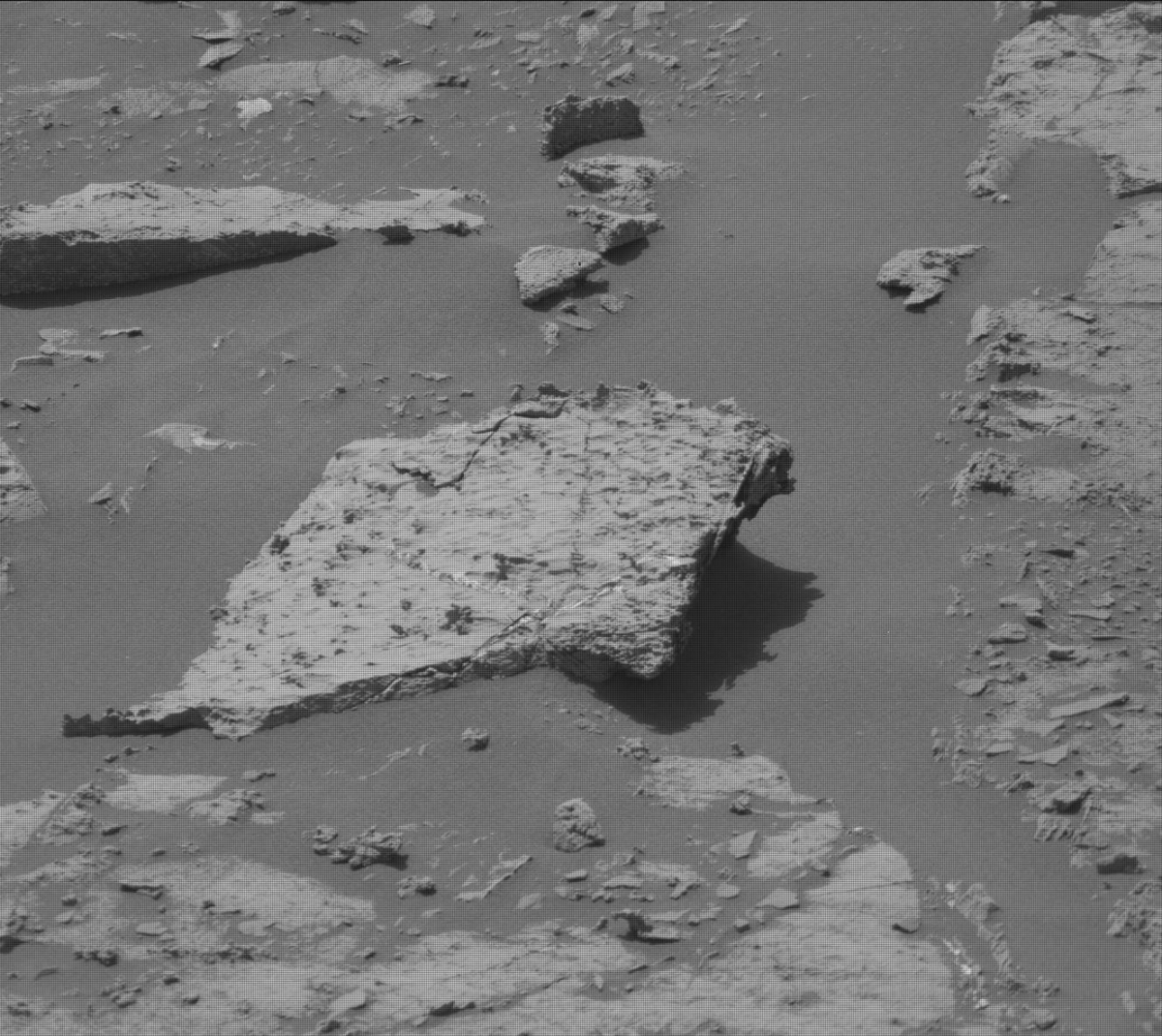
ChemCam was also scheduled to use the Remote Micro Imager (RMI) telescope to acquire a ten image mosaic along the top of “Western Butte” (here dubbed “South Esk”) and a five image mosaic across a more distant butte (“Glenrothes”).
The robot’s Mastcam was called upon to cover the near- and mid-field with two large stereo mosaics that connect to the extensive and more distant mosaics Mars researchers now have of the “Glen Torridon” terrain that’s been explored by Curiosity over the last year.
Curiosity Mast Camera Right image taken on Sol 2680, February 19, 2020.
Credit: NASA/JPL-Caltech/MSSS
“The stereo data help us visualize the structural relationships between the many rock types around the rover,” Minitti notes.
Curiosity Rear Hazard Avoidance Camera Left B photo taken on Sol 2681, February 20, 2020.
Credit: NASA/JPL-Caltech
Dust devils, clouds
The rover’s Navcam was slated to scan the skies near midday on Sol 2680 for dust devils, and then Navcam and Mastcam were to acquire images and movies later in the afternoon on Sol 2681 to assess the dust load in the atmosphere and look for clouds.
Also, Curiosity was set to perform Rover Environmental Monitoring Station (REMS) and Radiation Assessment Detector (RAD) measurements to keep tabs on the weather and radiation within Gale Crater.

Curiosity Front Hazard Avoidance Camera Left B image acquired on Sol 2681, February 20, 2020.
Credit: NASA/JPL-Caltech

The U.S. Geological Survey’s (USGS) Astrogeology Science Center has released locations of more than a thousand cave-entrance candidates on Mars. The dots indicate the location of possible caves in the Tharsis region on Mars.
Credit: USGS
Strategies to explore for present life on Mars are blossoming as researchers are actively doubling-down in furthering the search for extant life on the Red Planet.

An international group of experts recently met in Carlsbad, New Mexico to discuss what next in the effort to determine if life has been, or is now, resident on the Red Planet.
Credit: Barbara David
And for good reason: New research approaches, including improved knowledge of Mars’ geologic diversity and history, better appreciation of life in extreme environments here on Earth, and sharp focus on top-notch measurement methods to detect and confirm Martian life – all of this has bolstered search tactics.
A recently held international confab of experts tackled the “what next” in life on Mars investigations and gathering at the National Cave and Karst Research Institute in Carlsbad, New Mexico.
Check out my new Space.com story:
Scientists eye the Martian underground in search for alien life
The subsurface offers a protected, and possibly habitable, environment.

Credit: ESA – P.Carril
Research using an artificial neural network has shown that some asteroids that are now thought not dangerous can impact the Earth in the future.
Astronomers at Leiden University in The Netherlands have used a supercomputer, integrating the orbits of the Sun and its planets forward in time for 10,000 years. They then traced the orbits back in time while launching asteroids from the Earth’s surface.
Library of asteroids
During the backwards calculation, they included the asteroids in the simulations in order to study their orbital distributions at today’s date. The result: they acquired a database of hypothetical asteroids for which the researchers knew the space rocks would land on the Earth’s surface.

Credit: Hefele, John D., et al.
Astronomer and simulation expert Simon Portegies Zwart explains: “If you rewind the clock, you will see the well-known asteroids land again on Earth. This way, you can make a library of the orbits of asteroids that landed on Earth.”
The library of asteroids then served as training material for the neural network.
Hazardous objects
According to a Leiden University press statement, the first set of calculations was performed on the new Leiden super computer ALICE. The neural network runs on a simple laptop.
The researchers labeled their method Hazardous Object Identifier (HOI), which means ‘hi’ or ‘hello’ in Dutch.
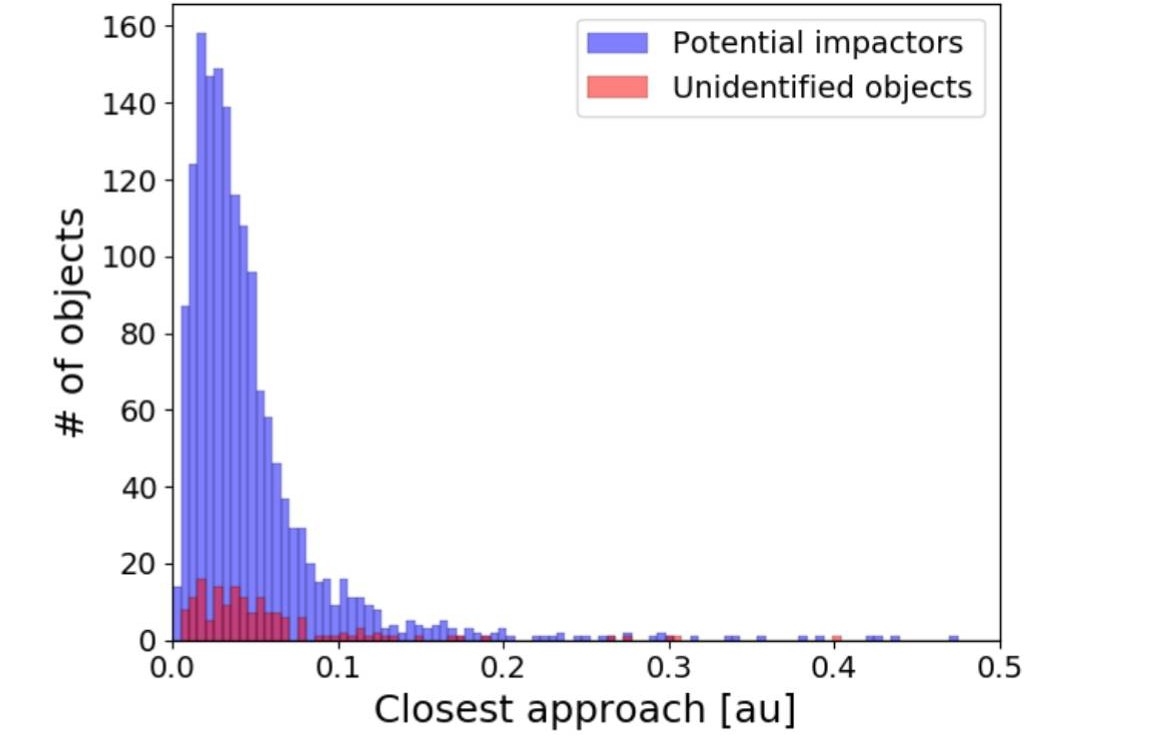
The neural network can recognize well-known near-Earth objects. In addition, HOI also identifies a number of hazardous objects that were not previously classified as such. For example, HOI discovered eleven asteroids that, between the years 2131 and 2923, come closer than ten times the Earth-Moon distance and are larger than a hundred meters in diameter.
Credit: Hefele, John D., et al.
That these asteroids have not previously been identified as potentially dangerous is because the orbit of these asteroids is so chaotic, explains the press statement. “As a result, they are not noticed by the current software from space organizations, which is based on probability calculations that use expensive brute force simulations.”
The tricky part
The research is only a first exercise, Zwart notes. “We now know that our method works, but we would certainly like to delve deeper in the research with a better neural network and with more input. The tricky part is that small disruptions in the orbit calculations can lead to major changes in the conclusions.”
The research team says they hope in the future an artificial neural network can be used to detect potentially hazardous objects. Such a method is much faster than the traditional methods currently in use by space organizations. By noticing asteroid on a collision course earlier, the researchers say, organizations can sooner think of a strategy to prevent impact.

Earth has been on the receiving end of several incoming objects resulting in human injury.
Credit: NASA
Go to their paper — “Identifying Earth-impacting asteroids using an artificial neural network” — in the journal Astronomy and Astrophysics, Volume 634, February 2020, by going to:
https://www.aanda.org/articles/aa/full_html/2020/02/aa35983-19/aa35983-19.html

Farside photo from Yutu-2 rover.
Credit: CNSA/CLEP
On the farside of the Moon, China’s Chang’e-4 lander and Yutu-2 rover have resumed work for the 15th lunar after “sleeping” during the extremely cold night.

China’s Chang’e-4 lander as viewed by Yutu-2 rover.
Credit: CNSA/CLEP
According to the Xinhua News Agency the lander woke up at 6:57 a.m. Tuesday (Beijing time), and the rover at 5:55 p.m. Monday.
Reportedly, both are in normal working order.
On a roll
The wheeled Yutu-2 or Jade Rabbit-2 rover has traveled a little over 1,204 feet (367.25) meters with a plan to drive northwest and then southwest to continue its scientific exploration.
The Chang’e-4 mission was launched on December 8, 2018, making the first-ever soft landing within the Von Kármán crater, a large lunar impact feature that is located in the southern hemisphere on the farside of the Moon.

Chang’e-5 lunar lander.
Credit CCTV Video News Agency/Inside Outer Space screengrab
Next up
China’s next Moon exploration mission is slated to be the Chang’e-5, a multi-staged effort to rocket lunar samples back to Earth later this year. According to Chinese news services, Chang’e-5 is comprised of four parts including the orbiter, ascender, lander, and Earth reentry module.
Chinese engineers are completing work on the Chang’e-5 lunar mission for a launch later this year. If successful, this robotic spacecraft would attempt the first lunar sample return to Earth in over 40 years.

Apollo 17 mission in December 1972 surveyed the Taurus-Littrow highlands and valley area.
Credit: NASA
The former Soviet Union successfully executed three robotic sample return missions: Luna 16 returned a small sample (101 grams) from Mare Fecunditatis in September of 1970; February 1972, Luna 20 returned 55 grams of soil from the Apollonius highlands region; Luna 24 retrieved 170.1 grams of lunar samples from the Moon’s Mare Crisium (Sea of Crisis) for return to Earth in August 1976.
The last samples from the Moon to reach Earth came via the Apollo 17 mission in December 1972.
For a behind-the-scenes look at getting China’s Chang’e-5 ready for its lunar mission, go to this CCTV-Plus video:
https://www.youtube.com/watch?v=V-2AuPQf5gw
Also, this video is informative:
http://cd-pv.news.cctvplus.com/2016/1231/8039831_Preview_1806.mp4

