Archive for the ‘Space News’ Category
 Author:
  May 21st, 2020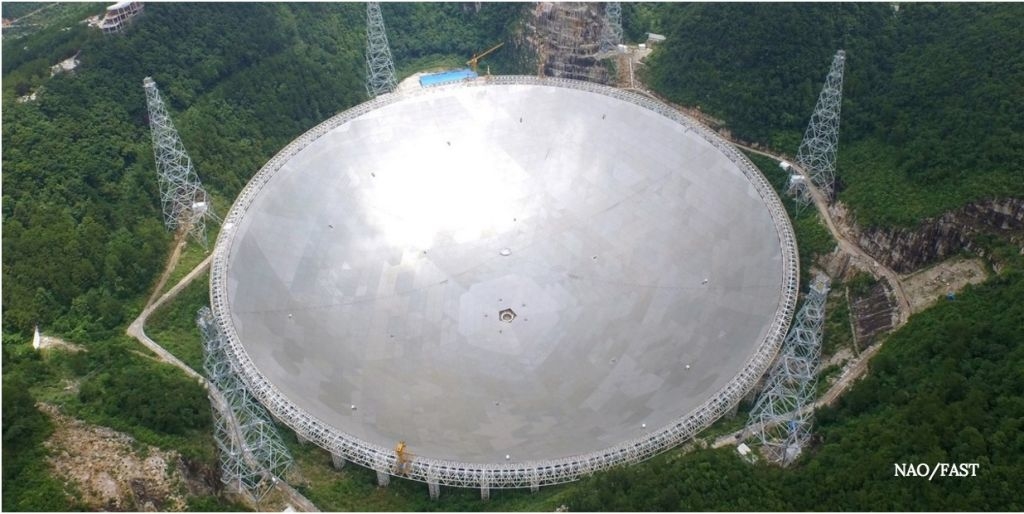
The Five-hundred-meter Aperture Spherical radio Telescope (FAST) in southwest China’s Guizhou Province.
(Image: © NAO/FAST)
Researchers using China’s new Five-hundred-meter Aperture Spherical radio Telescope (FAST) telescope — the largest single-dish telescope in the world — are piecing together a technological strategy to carry out a major and sweeping search for extraterrestrial intelligence.
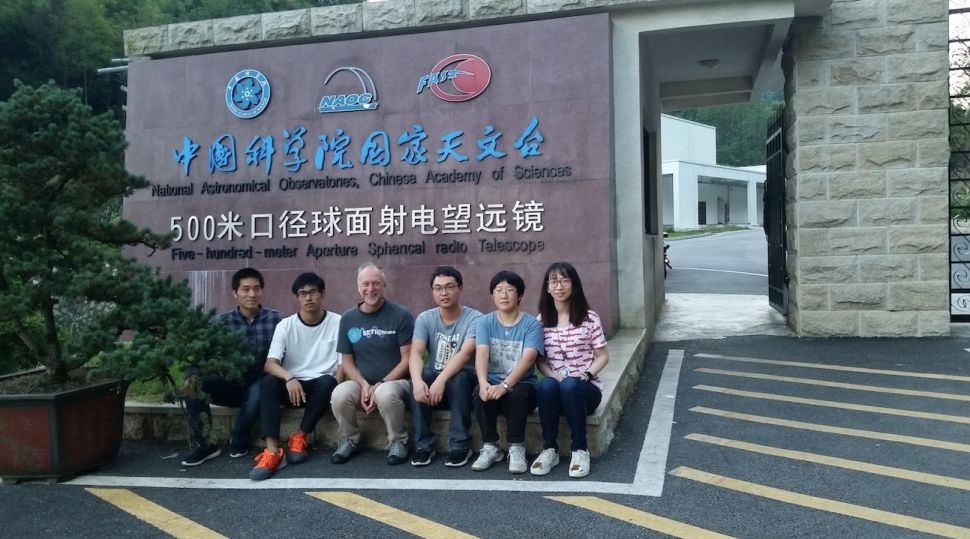
The search for extraterrestrial intelligence (SETI) is an international, collaborative affair. SETI scientist Dan Werthimer of the University of California, Berkeley, co-authored a recent paper on China’s SETI program with the Five-hundred-meter Aperture Spherical Radio Telescope (FAST). He is shown here with other FAST SETI collaborators, including the paper’s lead author, Zhi-Song Zhang, to his left. (Image credit: Dan Werthimer)
What are the consequences of China first claiming they have found other star folk and how would such a Chinese claim be verified? Might there be an unofficial race between nations to declare a signal breakthrough?
For more details, go to my newly posted Space.com story:
Ready, SETI, go: Is there a race to contact E.T.?
https://www.space.com/seti-race-alien-life-search-china.html
 Posted in

This image is a view of the Sample Analysis at Mars (SAM) inlet before dropping off the “Glasgow” drill sample.
Photo taken by Curiosity Mast Camera Left on Sol 2765, May 17, 2020.
Credit: NASA/JPL-Caltech/MSSS
NASA’s Curiosity Mars rover is now performing Sol 2769 tasks.
Curiosity is still busy at “Glasgow” with the rover’s Sample Analysis at Mars (SAM) Instrument Suite analyzing the drill sample in an upcoming plan, reports Susanne Schwenzer, a planetary geologist at The Open University, Milton Keynes, in the U.K.

This image shows the ChemCam target “Gutcher” and was taken by Curiosity Chemistry & Camera Remote Micro-Imaging (RMI) camera on Sol 2768 May 20, 2020.
Credit: NASA/JPL-Caltech/LANL
“This takes a lot of the rover’s power, thus other activities have to wait just a little,” Schwenzer explains. “But we are all looking forward to what SAM will find, so patience isn’t a problem at all!”
Mineralogy questions
Questions those SAM analysis can answer, from a mineralogist point of view are: “How much water does this sample release when heated?” and “How much sulphur does this sample release?” – both of which are very important additions to the information we get for mineralogy from the robot’s Chemistry & Mineralogy X-Ray Diffraction/X-Ray Fluorescence Instrument (CheMin) and for chemistry from ChemCam and APXS.
Despite the power going mostly to SAM, there are two ChemCam activities planned.

Curiosity Chemistry & Camera Remote Micro-Imaging (RMI) camera photo taken on Sol 2768 May 20, 2020.
Credit: NASA/JPL-Caltech/LANL
Target “Glenapp” will be used for ChemCam pointing test. “Since the instrument is looking at tiny, tiny things on Mars, the team is going to use this activity to even better understand the accuracy with which the laser hits its target,” Schwenzer notes.
The second target, “Bowhill,” is a float rock that could come from the pediment, at least that’s how it looks to today’s planning team.
“ChemCam will investigate it, so we can be sure by comparing the chemistry of the pediment rocks and this one,” Schwenzer reports.

Curiosity Front Hazard Avoidance Camera Right B image acquired on Sol 2768, May 20, 2020.
Credit: NASA/JPL-Caltech
Curiosity’s Mastcam is slated to document ChemCam targets, looking at “Glowhill,” “Gutcher,” “Thistle Street,” “Lochbuie,” and “Glasgow.”

Curiosity Rear Hazard Avoidance Camera Left B photo taken on Sol 2768, May 20, 2020.
Credit: NASA/JPL-Caltech
Sand patch
The robot’s Mastcam will also investigate a sand patch near the rover to add to the science on modern sediments that the team has been doing throughout the mission.
And then Mars researchers start to “stare into the distance,” Schwenzer says.

Curiosity Mast Camera Right image taken on Sol 2767, May 19, 2020.
Credit: NASA/JPL-Caltech/MSSS

Curiosity Right B Navigation Camera photo acquired on Sol 2768, May 20, 2020.
Credit: NASA/JPL-Caltech
On the schedule is a Navcam line of sight, and Navcam suprahorizon and zenith movies, and then a look for dust devils, too, Schwenzer concludes. All this will allow the Rover Environmental Monitoring Station (REMS) team to assess the status of the atmosphere and its dust load.

Credit: Scaled Composites
Burt Rutan is a legendary American aerospace designer and entrepreneur noted for his innovations and dynamism, from creating light, strong, unusual-looking, energy-efficient aircraft to his sub-orbital spaceplane design, the SpaceShipOne. That craft in 2004 became the first privately funded spacecraft to enter the realm of space, winning the Ansari X-Prize that year for achieving the feat twice within a two-week period.

Pioneering SpaceShipOne on display at the Smithsonian’s Air and Space Museum in Washington, D.C.
Credit: NASM/Eric Long
In reaction to watching a Hollywood-style video of the upcoming SpaceX/NASA May 27th Demo-2 mission four times, —https://www.youtube.com/watch?v=KkiRBcDaRrY — the now retired Rutan says he remembers what NASA did during its first decade and had to comment, sharing with Inside Outer Space this communiqué.

NASA astronauts Robert Behnken and Douglas Hurley in preparation for their upcoming flight to the International Space Station on NASA’s SpaceX Demo-2 mission.
Credit: NASA
Rutan had four comments on the Demo-2 mission:
1)
“The present situation is not exciting, it’s embarrassing. This mission will represent the first time that America will launch humans to space in nine years. Hmmmm……. exactly the same time period it took America to go from the 10-minute sub-orbital flight of Alan Shepard to a round trip to the surface of the Moon,” Rutan said.
“Media coverage of Demo-2 will likely focus on the tremendous technical breakthroughs and the huge bravery of the two NASA astronauts. But they might not point out the embarrassment of the last nine years. Today’s media seems to never do the research on their stories,” he added.
2)
“Compare the Demo-2 mission to the two-place Gemini program which developed the rendezvous tasks needed for Apollo. Gemini/Titan flew ten manned space flights, the first in March 1965 and the tenth in November 1966. I will be impressed with the performance of today’s NASA/SpaceX/Boeing efforts only when they significantly beat the flight rate Gemini achieved (a manned space flight every two months) 50+ years ago,” Rutan noted.

Credit: SpaceX/Screengrab
3)
“Now, let’s count the new important breakthroughs and capabilities of space launch that have been achieved the last half century: 1) Reuse of the rocket booster’s first stage. This huge breakthrough was accomplished only because SpaceX funded the effort, was willing to take the risk it might not work (a risk that NASA and Boeing were not willing to take) and pressed on in spite of multiple failures. 2) ……crickets………,” Rutan added.
4)
“I cannot fail to comment on the selection of the mission name,” Rutan points out. “One might think America’s first space mission that finally frees us from paying exorbitant fees to Russia to launch our astronauts on their rocket design that first flew [piloted] in 1967, would command a better name than ‘Demo-2.’ Hell, this is an important milestone, not just some numbered ‘test demo.’ The guy responsible for the name of this mission should be looking for another job, and not one requiring creative marketing skills,” Rutan remarked.

Credit: NASA
Market share
In closing comments, Rutan said that no one familiar with what was done back then can be proud of our current situation.
“That said, I am now optimistic about the space future because it might finally be driven by real competition among those who do it for profit. The incentive for market share will result in things being done in the most dollar-efficient and quickest possible way,” Rutan suggested.
“Left only to Government, I might not live to see another Moon landing and my six great grandchildren might not live to see us colonize another planet to protect our species from another extinction that would occur due to asteroid/comet impact on Earth,” Rutan concluded.

A new freely-available anthology released by the European Astrobiology Institute (EAI) delves into probing questions about microbial life on Mars and elsewhere to all the way to the Fermi Paradox: Where are they?
The anthology, titled Strangest of All (a nod to H. G. Wells’s War of The Worlds), was edited by the author, editor and scientist Julie Novakova – an award-winning Czech author of science fiction and detective stories.
The book contains reprint science fiction stories by G. David Nordley, Geoffrey Landis, Gregory Benford, Tobias S. Buckell, Peter Watts and D. A. Xiaolin Spires, plus a bonus story by the editor.
Strangest of All is the first of major outreach projects coming from the EAI.
The anthology can be downloaded for free in several formats.
Go to:
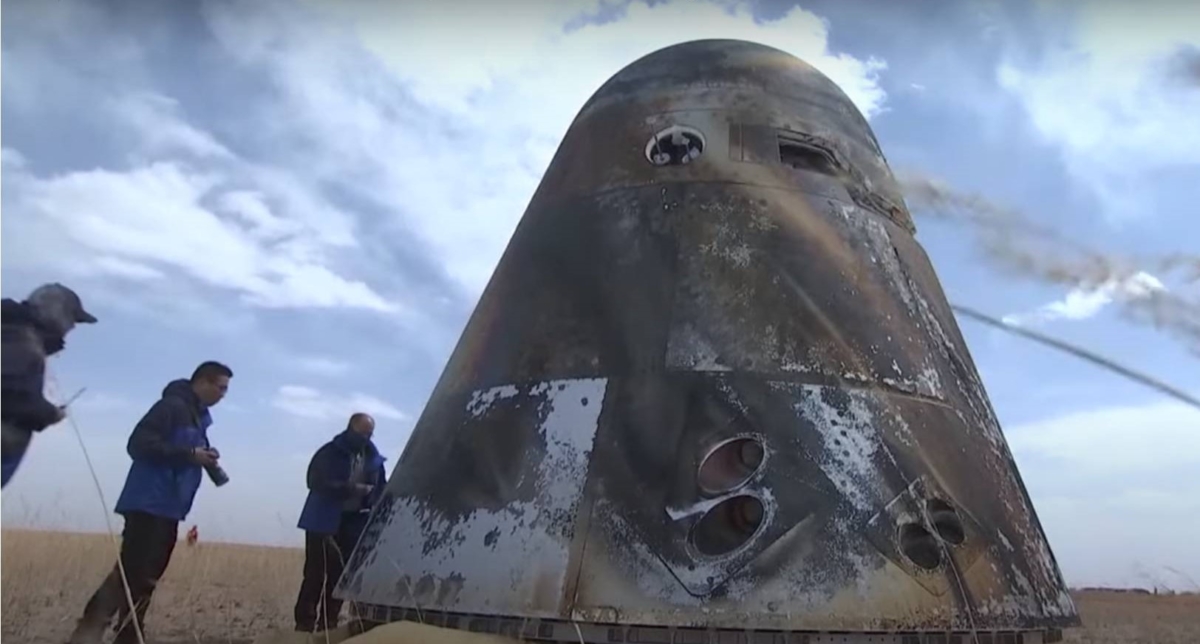
The return capsule of the trial version of China’s new-generation manned spaceship.
Credit: CCTV/Inside Outer Space screengrab
China space officials are detailing use of the country’s new-generation spacecraft to support human missions to the Moon.
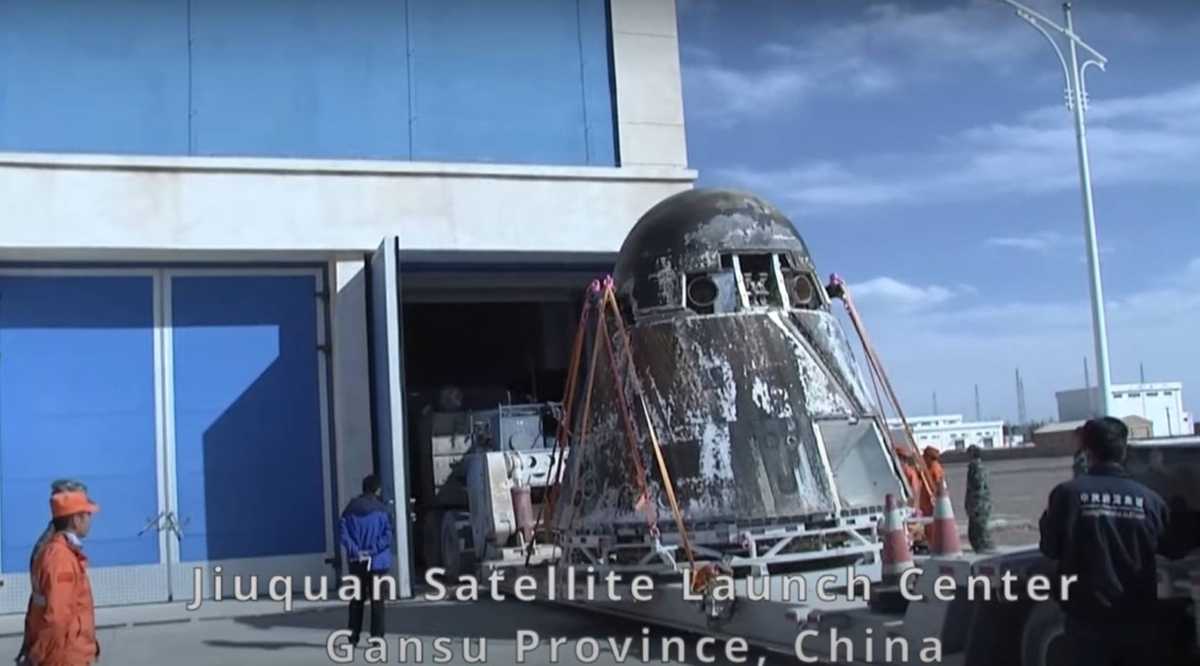
The return capsule of the trial version of China’s new-generation manned spaceship is under intensive study after touching down at the Dongfeng landing site, Inner Mongolia Autonomous Region, China, on May 8, 2020.

Credit: CCTV/Inside Outer Space screengrab
The spacecraft was first transported to the Jiuquan Satellite Launch Center and then to Beijing, reports China Central Television (CCTV).
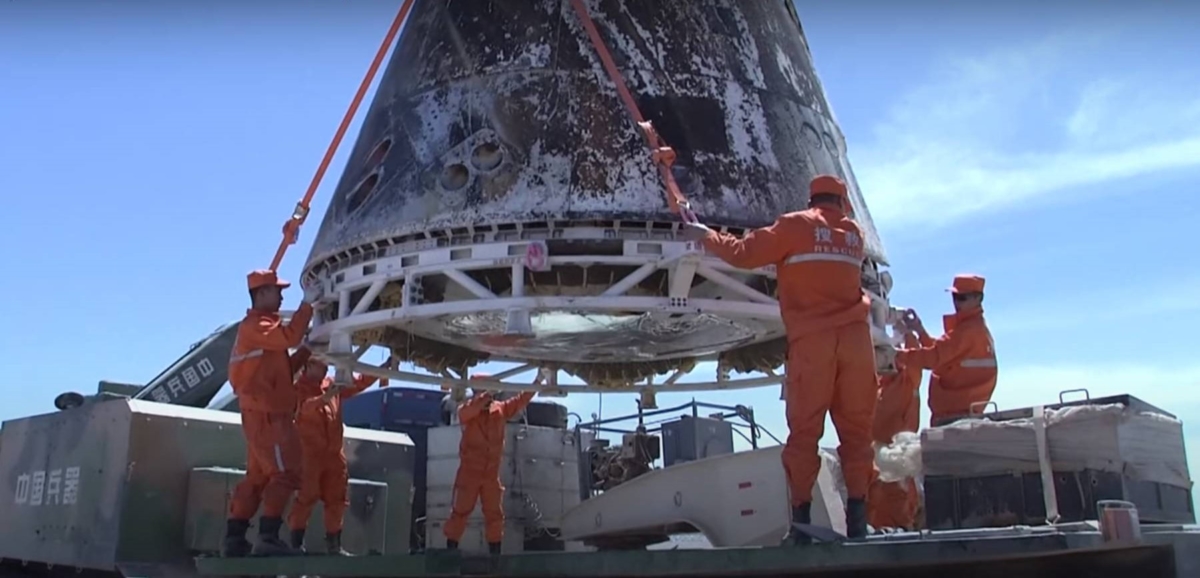
Credit: CCTV/Inside Outer Space screengrab
Follow-up development
Scientists at the Fifth Academy under the China Aerospace Science and Technology Corporation (CASC) — the place where the capsule was developed and produced – are collecting and analyzing the capsule for follow-up development of China’s new-generation manned spacecraft.
Credit: CCTV/Inside Outer Space screengrab
“We have experienced a lot of setbacks and hard work,” said Yang Feng, Party branch secretary of the general department of manned spaceflight testing center in the Fifth Academy under CASC.
Credit: CCTV/Inside Outer Space screengrab
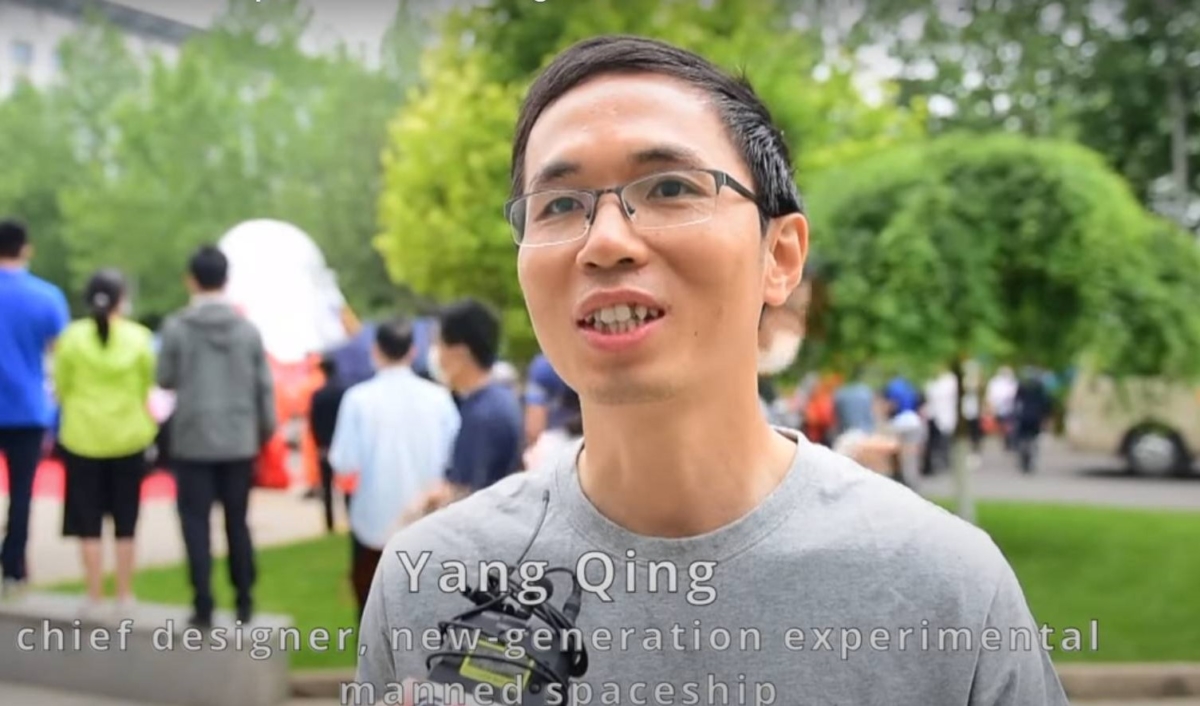
“The spaceship, including the return capsule, was made by ourselves…it has returned to the place where it came into being, and I am very happy,” said Yang Qing, chief designer of the new-generation experimental manned spaceship.
Credit: CCTV/Inside Outer Space screengrab
Thermal-protective coating
The new thermal-protective material adopted on the return capsule for the first time has withstood the high temperature caused by its reentry into the earth atmosphere.
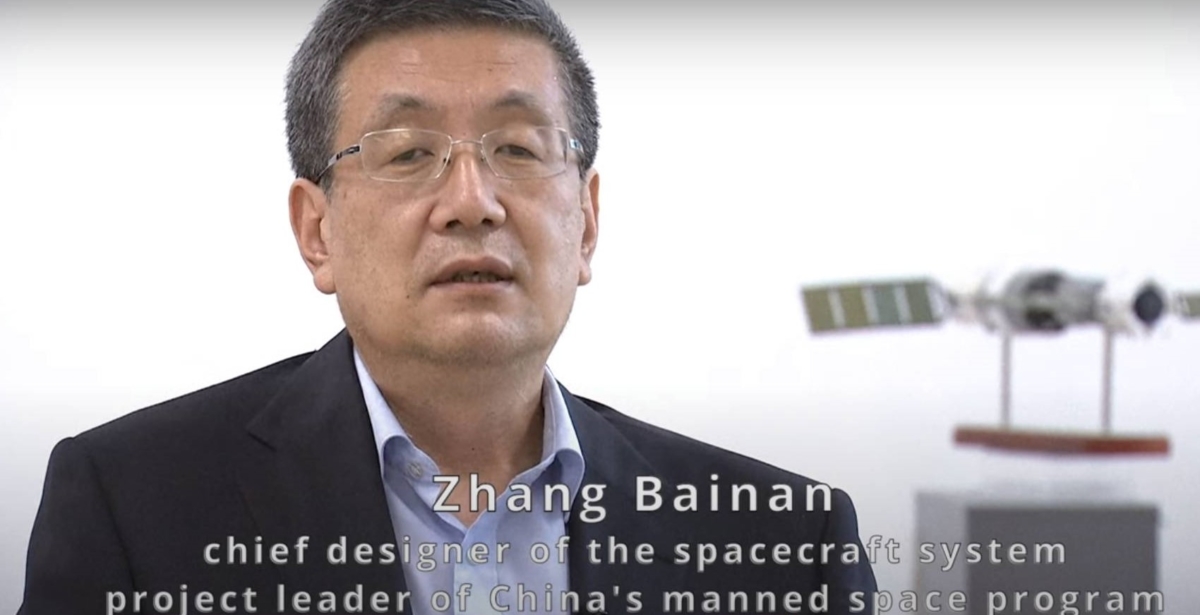
Zhang Bainan, Chief Designer of the Spacecraft System Project Leader of China’s Manned Space Program and also project leader of the new-generation experimental manned spaceship, paid much attention to the situation of the thermal-protective coating bottom.
“This thermal-protective material is of our own intellectual property rights, and it worked particularly well in integrity, much better than before. We will do detailed analysis for these materials,” Zhang said.

Credit: CCTV/Inside Outer Space screengrab
Space experiment results
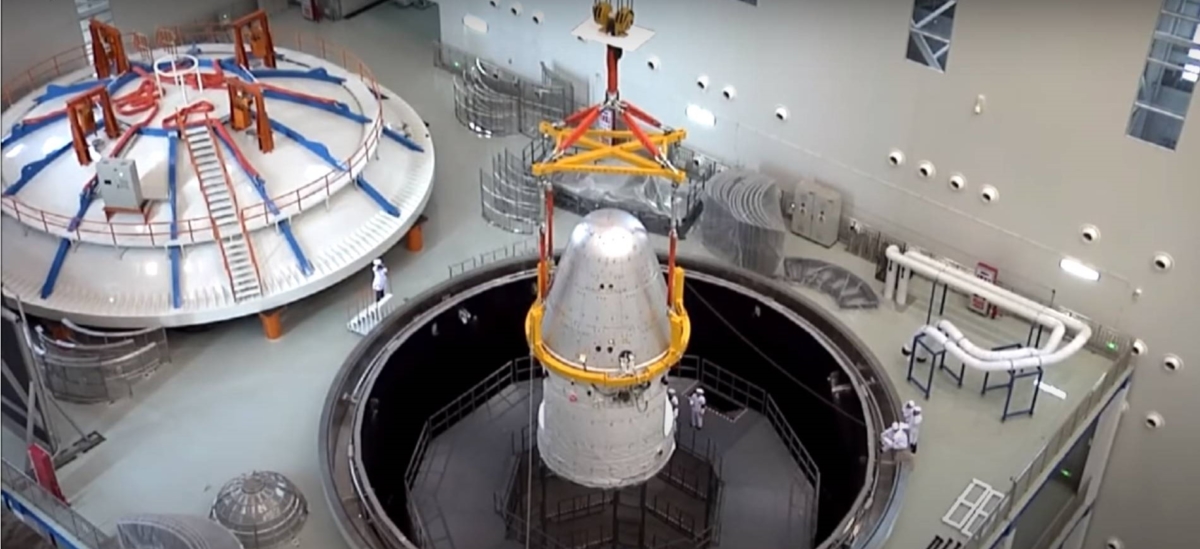
Next, scientists will conduct professional inspection on the appearance of the capsule, collect and analyze relevant data to verify the return capsule’s reusable performance. Meanwhile, they will also conduct research on the space experiment results brought back by the capsule, so as to provide further technological base for the overall plan of the new-generation manned spacecraft.

Credit: CCTV/Inside Outer Space screengrab
“We will verify the deformation of the metal structure to confirm whether it is reusable. We will also take a sample of the ablated thermal-protective material outside and conduct an electrical test on the whole cabin to confirm the reusable performance of the electronic equipment in the cabin,” said Liu Yan, electricity chief designer of the new-generation experimental manned spaceship.
Credit: CCTV/China National Space Administration (CNSA)/Inside Outer Space screengrab
Lunar ambitions
“The new-generation spacecraft can not only offer transportation services for building the space station, but also realize the goal of manned lunar landing. It is designed for the manned lunar landing mission,” explained Zhang. “Now we are keeping pace with the U.S., instead of always following it like before.”
Go to this China Central Television (CCTV) video titled “China’s new crewed spacecraft is designed for lunar missions,” at:
https://youtu.be/Hz63YRlU0Rs?list=PLpGTA7wMEDFjz0Zx93ifOsi92FwylSAS3
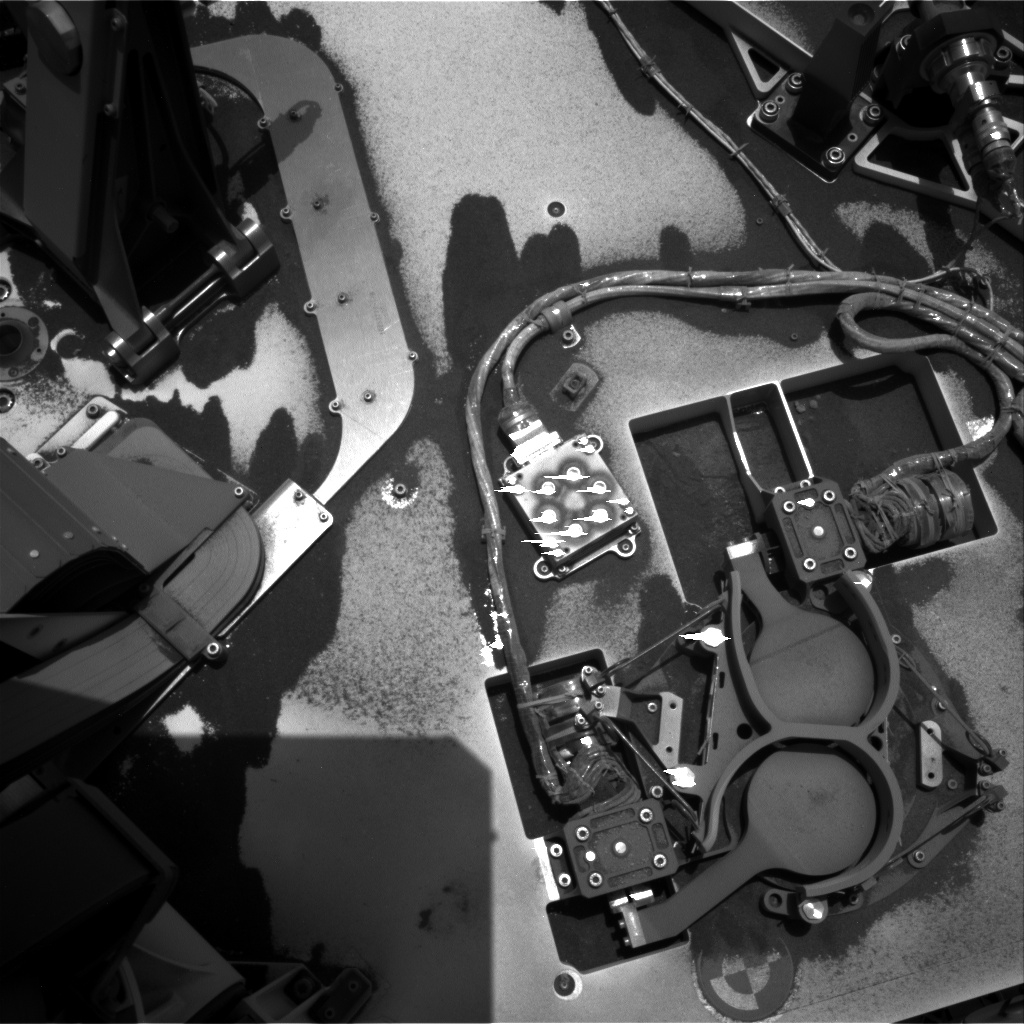
Curiosity Right B Navigation Camera Sol 2764 May 16, 2020. Credit: NASA/JPL-Caltech
NASA’s Curiosity Mars rover is now performing Sol 2768 tasks.
Reports Sean Czarnecki, a planetary geologist at Arizona State University in Tempe, Curiosity is at the “Glasgow” drill site, and preparing to deliver more sample material from Glasgow to the rover’s Sample Analysis at Mars (SAM) Instrument Suite in the near future.
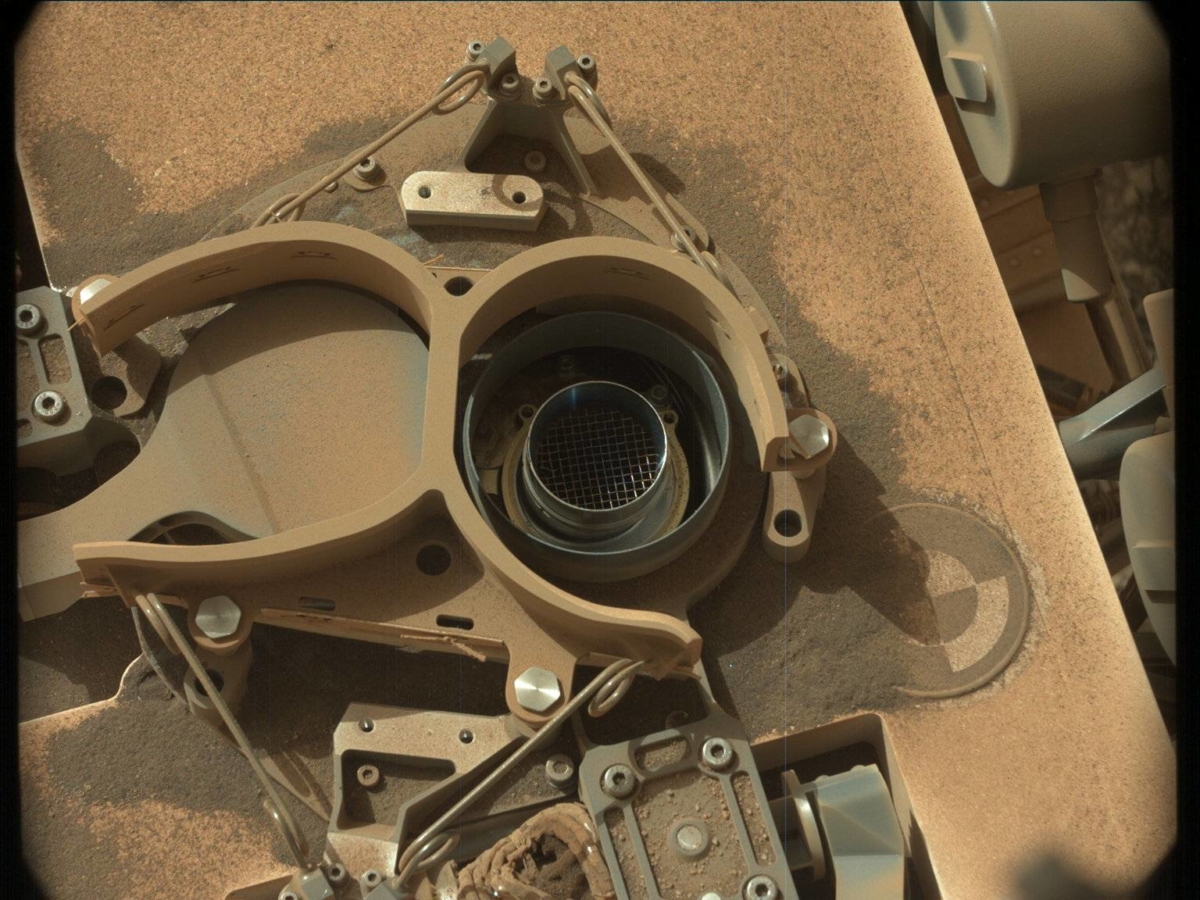
Curiosity Mast Camera Left Sol 2765 May 17, 2020.
Credit: NASA/JPL-Caltech/MSS
Take a break
“The SAM analysis will use a lot of power, so we’re limiting our power use in this plan to let the batteries charge up,” Czarnecki adds. “Even the most curious field geologists have to take a break every day to eat lunch and Curiosity does the same, although with a considerably more energy dense meal! But just like a geologist on lunch break, Curiosity is still making some useful science observations of the surrounding rocks!”
Czarnecki explains that the rover’s Mastcam will take stereo images of “Western Butte,” then its Chemistry and Camera (ChemCam) will measure the geochemistry of “Loch Olabhat 2” followed by a Mastcam image of this target.
In the background, the rover’s Radiation Assessment Detector (RAD), Dynamic Albedo of Neutrons (DAN) and Rover Environmental Monitoring Station (REMS) will continue to monitor the environmental characteristics of the robot’s current location.
Getting it ready
In an earlier report, Fred Calef, a planetary geologist at NASA’s Jet Propulsion Laboratory, notes that, after a successful SAM preconditioning (rover-speak for “getting it ready”), the rover delivered some “Glasgow” drill sample into the instrument.
“The first experiment will be an ‘evolved gas’ one. This is where we bake the rocks causing them to release gases from within the minerals in the sediments. These gases will be flowed to two of the three instruments which make up SAM (a mass spectrometer and tunable laser spectrometer) to measure the composition of the gas. The temperature at which gases are released gives us further insight into the composition of the sample, and allows scientists to look at how water is stored within minerals,” Calef adds.
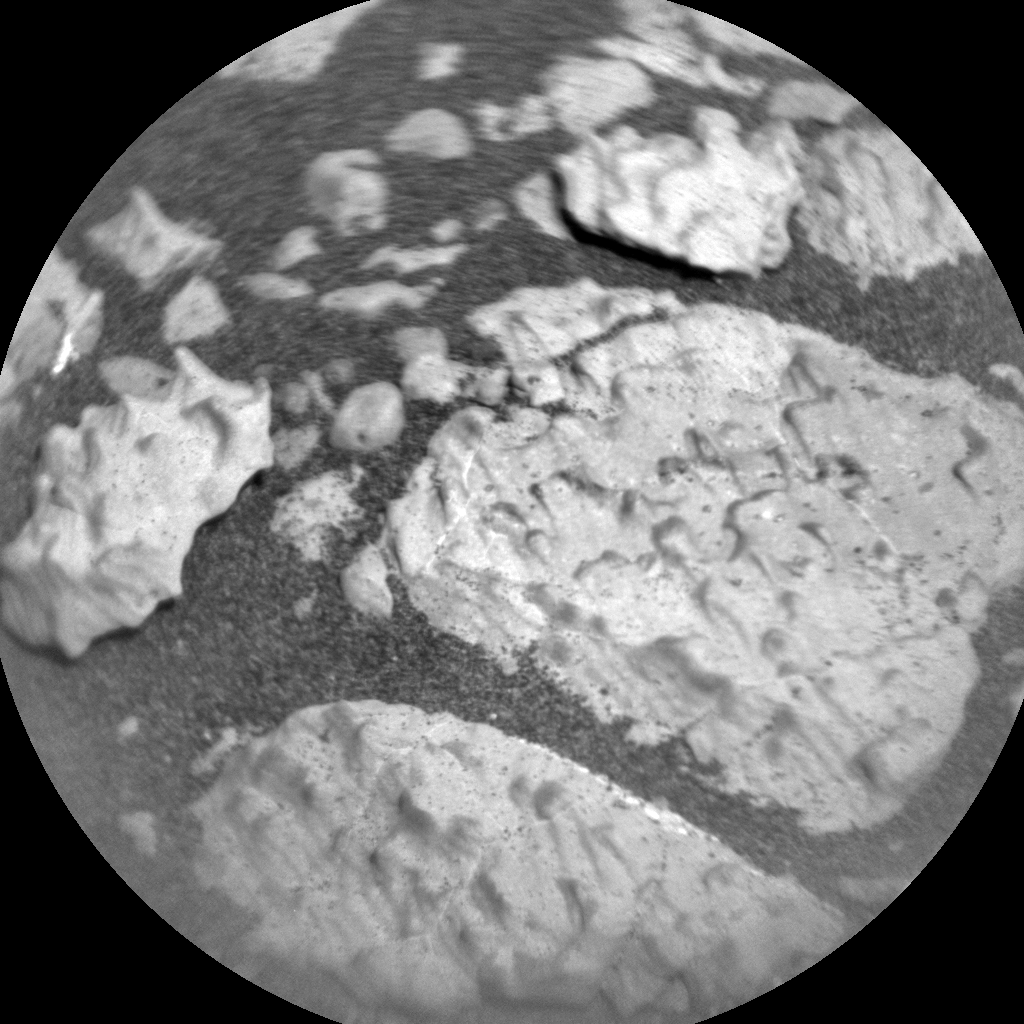
Curiosity Chemistry & Camera Remote Micro-Imaging (RMI) camera photo taken on Sol 2767, May 19, 2020.
Credit: NASA/JPL-Caltech/LANL
Mineral flavors
“Since the rover didn’t have a whole lot of power, and SAM is energy intensive, we only had a few other observations,” Calef explains.
A large Mastcam mosaic was taken on the first sol covering the Greenheugh pediment as well as other Mastcam imaging for looking at dust in the air (line-of-sight extinction and solar tau) and a ChemCam passive sky observation.
Concludes Calef: “Looking forward to seeing what mineral ‘flavors’ we find!”
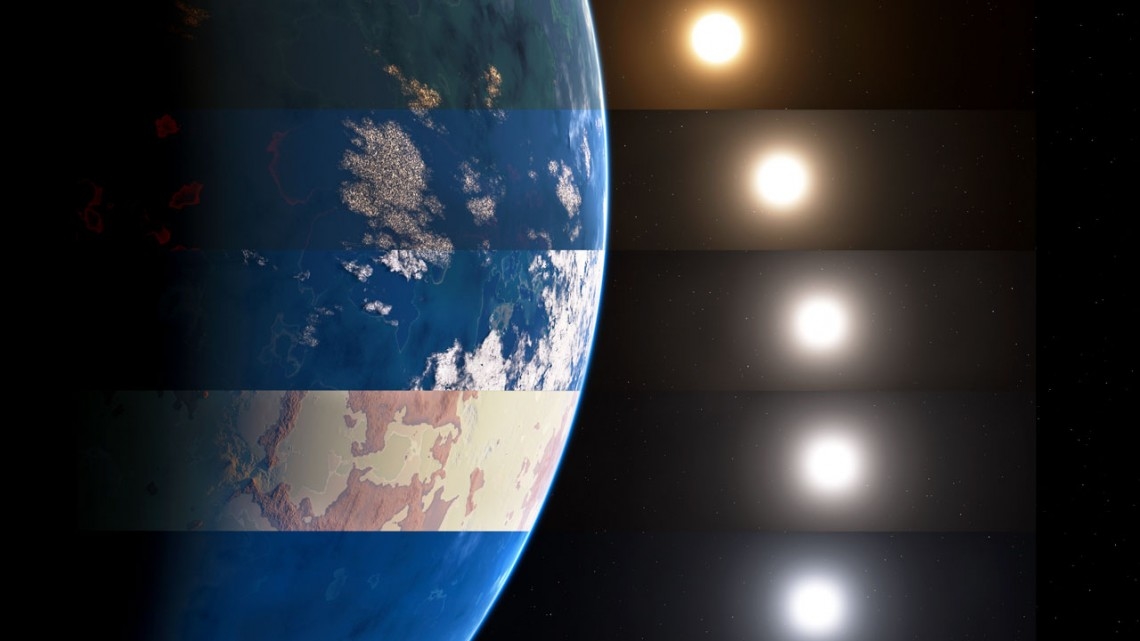
In this artistic rendering, different kinds of suns are shown as they interact with various Earth-like surfaces in distant solar systems. The combinations create an array of climates. In the search for exoplanets, astronomers can be guided by color for possible habitable planets.
Credit: Jack Madden/Cornell
Large ground- and space-based telescopes will be able to observe Earth-like planets in the near future.
Cornell astronomers have developed an environmental color “decoder” – to tease out climate clues for potentially habitable exoplanets in galaxies far away.
The researchers see their work as helping to spot different planetary surfaces that are strongly influenced by climate, atmospheric composition, and remotely detectable spectra – a way to model potentially habitable rocky exoplanets.
Reflected light
“We looked at how different planetary surfaces in the habitable zones of distant solar systems could affect the climate on exoplanets,” said Jack Madden who works in the lab of Lisa Kaltenegger, associate professor of astronomy and director of Cornell’s Carl Sagan Institute.
“Reflected light on the surface of planets plays a significant role not only on the overall climate,” Madden said, “but also on the detectable spectra of Earth-like planets.”
Madden and Kaltenegger are co-authors of “How Surfaces Shape the Climate of Habitable Exoplanets,” released May 18 in the Monthly Notices of the Royal Astronomical Society.
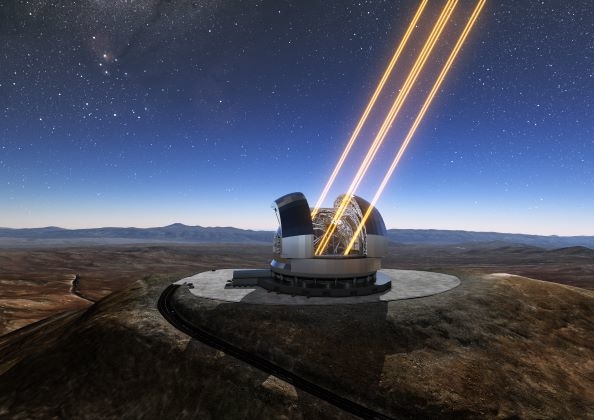
This artist’s rendering shows the Extremely Large Telescope in operation on Cerro Armazones in northern Chile. The telescope is shown using lasers to create artificial stars high in the atmosphere.
Credit:
ESO/L. Calçada
Calculate a climate
In their research, they combine detail of a planet’s surface color and the light from its host star to calculate a climate. For instance, a rocky, black basalt planet absorbs light well and would be very hot, but add sand or clouds and the planet cools; and a planet with vegetation and circling a reddish K-star will likely have cool temperatures because of how those surfaces reflect their suns’ light.
Madden said forthcoming instruments like the Earth-based Extremely Large Telescope will allow scientists to gather data in order to test a catalog of climate predictions.
“There’s an important interaction between the color of a surface and the light hitting it,” Madden said. “The effects we found based on a planet’s surface properties can help in the search for life.”
The Brinson Foundation and the Carl Sagan Institute supported this research.
To read “How Surfaces Shape the Climate of Habitable Exoplanets,” released May 18 in the Monthly Notices of the Royal Astronomical Society, go to:
https://academic.oup.com/mnras/article/495/1/1/5733176
Note: Article based on Cornell Chronicle story by Blaine Friedlander

Credit: NASA
Enroll today to be part of the summer 2020 class of the Commercial Space Studies program, hosted by the International Space University-Center for Space Entrepreneurship (ISU-CSE) at Florida Tech in Melbourne, Florida.
The 2020 program now features a unique hybrid online structure that will enable a healthy balance of distance learning with two weeks of on on-site learning on the Space Coast and expeditions to space industry destinations.

Credit: Commercial Space Studies program
Practical training
This space-focused, multidisciplinary program is only graduate-level certificate of its kind in the U.S. and provides rigorous, practical training in the nuances of space finance, policy, management, technology and entrepreneurship.
Master’s students and young professionals from around the world will gain valuable academic and real-world insight to spark economic innovation in the fast-emerging commercial space industry.
More details and registration at:

China’s Flexible Inflatable Cargo Re-entry Vehicle.
Credit: CCTV/Inside Outer Space screengrab
China’s recent triumph in testing an unpiloted new-generation crew capsule included a technology development failure. A Flexible Inflatable Cargo Re-entry Vehicle was also onboard the Long March 5B booster and was to return to Dongfeng landing field in Inner Mongolia Autonomous Region.

Credit: CCTV/Inside Outer Space screengrab
The device, flown for the first time, is intended to eventually deliver to Earth hardware and science experiments ejected from China’s future space station.
However, the vehicle operated abnormally during its transit to the ground. Experts have been analyzing the relevant data to help reveal what went wrong, according to the China Manned Space Agency.

Credit: CCTV/Inside Outer Space screengrab
Similarities to NASA design
It appears that China based their design on NASA’s Inflatable Reentry Vehicle Experiment (IRVE-3), explains Dr. F. McNeil (Neil) Cheatwood, NASA Senior Technologist for Planetary Entry, Descent, and Landing at the space agency’s Langley Research Center in Hampton, Virginia.
“Same diameter, cone angle, pink thermal protection system…even the smaller minor diameter for our outermost torus,” Cheatwood told Inside Outer Space.

NASA’s Inflatable Reentry Vehicle Experiment (IRVE-3)
Credit: NASA
Technology demonstrator
On July 23, 2012, a Black Brant XI sounding rocket launched the IRVE-3 payload, encased in a nose cone, from NASA’s Wallops Flight Facility on Virginia’s Eastern Shore. The rocket soared 288 miles (463 kilometers) up and released IRVE-3 into space.
The technology demonstrator inflated, reentered the atmosphere, and fell safely back to Earth — cameras and temperature and pressure sensors monitoring its performance all the way down.
After a total flight of 20 minutes — from launch to splash down — it landed in the Atlantic about 100 miles (160 kilometers) east of Cape Hatteras, North Carolina.

In a pre-flight test, engineers check out the Inflatable Reentry Vehicle Experiment (IRVE-3) in the Transonic Dynamics Tunnel at NASA’s Langley Research Center in Hampton, Va.
Credit: Sean Smith, NASA
Materials development
IRVE-3 is part of the Hypersonic Inflatable Aerodynamic Decelerator (HIAD) Project within the Game Changing Development Program, under the wing of NASA’s Space Technology Mission Directorate. The HIAD Project is based at NASA’s Langley Research Center and has been conducting materials development and flight tests since 2004.
NASA’s Cheatwood is the HIAD Project principal investigator.

After Long March 5 boost into space, China’s Flexible Inflatable Cargo Re-entry Vehicle was to land in Inner Mongolia Autonomous Region. Credit: CCTV/Inside Outer Space Screengrab
Publicly available information
“In one article, the Chinese cite a 2014 start for their development,” Cheatwood says. “For reference, IRVE-II flew in 2009 and IRVE-3 in 2012. And we got the idea for our HIAD technology from the Russians before that…but ours is a very different implementation.”
Based on published descriptions of the Chinese reentry attempt, it appears that they used publicly available information to build a vehicle similar in design to IRVE-3. However, the Chinese were unable to recreate the success of NASA’s flight, Cheatwood notes.

China’s Flexible Inflatable Cargo Re-entry Vehicle operated abnormally during its transit to the ground.
Credit: CCTV/Inside Outer Space screengrab
“Without further information about the as-built vehicle and the flight data,” Cheatwood adds, “we can only speculate as to why their vehicle failed.”
Next NASA flight test
As for NASA’s continued HIAD development, things are proceeding for a next flight test.
“This time we’ll be coming in from low Earth orbit at about 3 times the velocity of IRVE-3. That gives us an order of magnitude more energy to manage. We are a secondary payload on NOAA’s Joint Polar Satellite System-2, launch, scheduled for March 2022,” Cheatwood points out.

Curiosity Right B Navigation Camera image taken on Sol 2762, May 14, 2020.
Credit: NASA/JPL-Caltech
NASA’s Curiosity Mars rover has started Sol 2763 operations.
Ryan Anderson, a planetary geologist at USGS Astrogeology Science Center in Flagstaff, Arizona reports that there was a hiccup with the Sample Analysis at Mars (SAM) instrument in Monday’s plan.
The issue prevented it from running the “preconditioning” steps to get ready for sample analysis.
But after studying the issue the SAM team reported that everything looks ok.
The re-plan called for trying again with SAM preconditioning on the afternoon of sol 2763, “so that we can go ahead with a SAM analysis of the “Glasgow” drill sample over the weekend,” Anderson explains.

Curiosity Right B Navigation Camera image taken on Sol 2762, May 14, 2020.
Credit: NASA/JPL-Caltech
Keeping busy
While SAM gets ready, Anderson continues, the other instruments are keeping busy: Sol 2763 starts with Navcam images of the rover deck and a movie to watch for dust devils. Navcam and Mastcam will then look at the atmosphere to the north, toward the crater rim.
The robot’s Chemistry and Camera (ChemCam) has two active observations, one of a bedrock target called “Ballagan,” and one of a vein called “Carlin_Tooth.” Mastcam will then do a “tau” measurement, looking at the Sun to measure dust in the atmosphere.

“Glasgow” drill site. Curiosity Mast Camera Right photo taken on Sol 2761, May 13, 2020.
Credit: NASA/JPL-Caltech/MSSS
Rover deck monitoring
“On Sol 2764, we’ll repeat the rover deck monitoring and the north-facing images with Navcam and Mastcam, plus a Navcam movie facing north to watch for clouds, and a larger Navcam dust devil movie,” Anderson notes. “Mastcam will then take pictures of the two ChemCam targets from Sol 2763, followed by some stereo mosaics. These extend a previous mosaic to capture more images of some interesting bedrock fractures and lineations. Finally, Mastcam will repeat its tau observation of the Sun,” he concludes.

Curiosity Front Hazard Avoidance Camera Left B image acquired on Sol 2762, May 14, 2020.
Credit: NASA/JPL-Caltech

