Archive for the ‘Space News’ Category
 Author:
  June 16th, 2020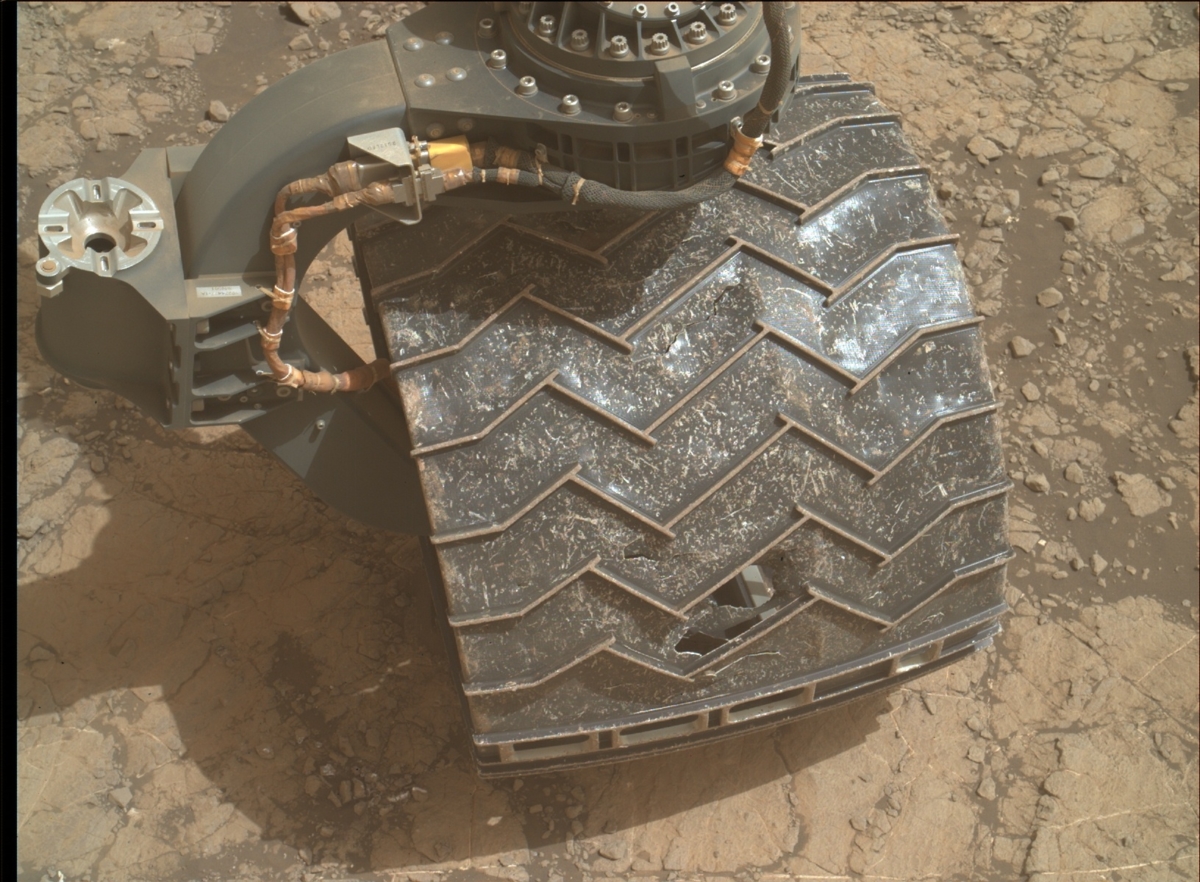
Curiosity Mars Hand Lens Imager photo produced on Sol 2793, June 14, 2020.
Credit: NASA/JPL-Caltech/MSSS
NASA’s Curiosity Mars rover is now performing Sol 2795 tasks.
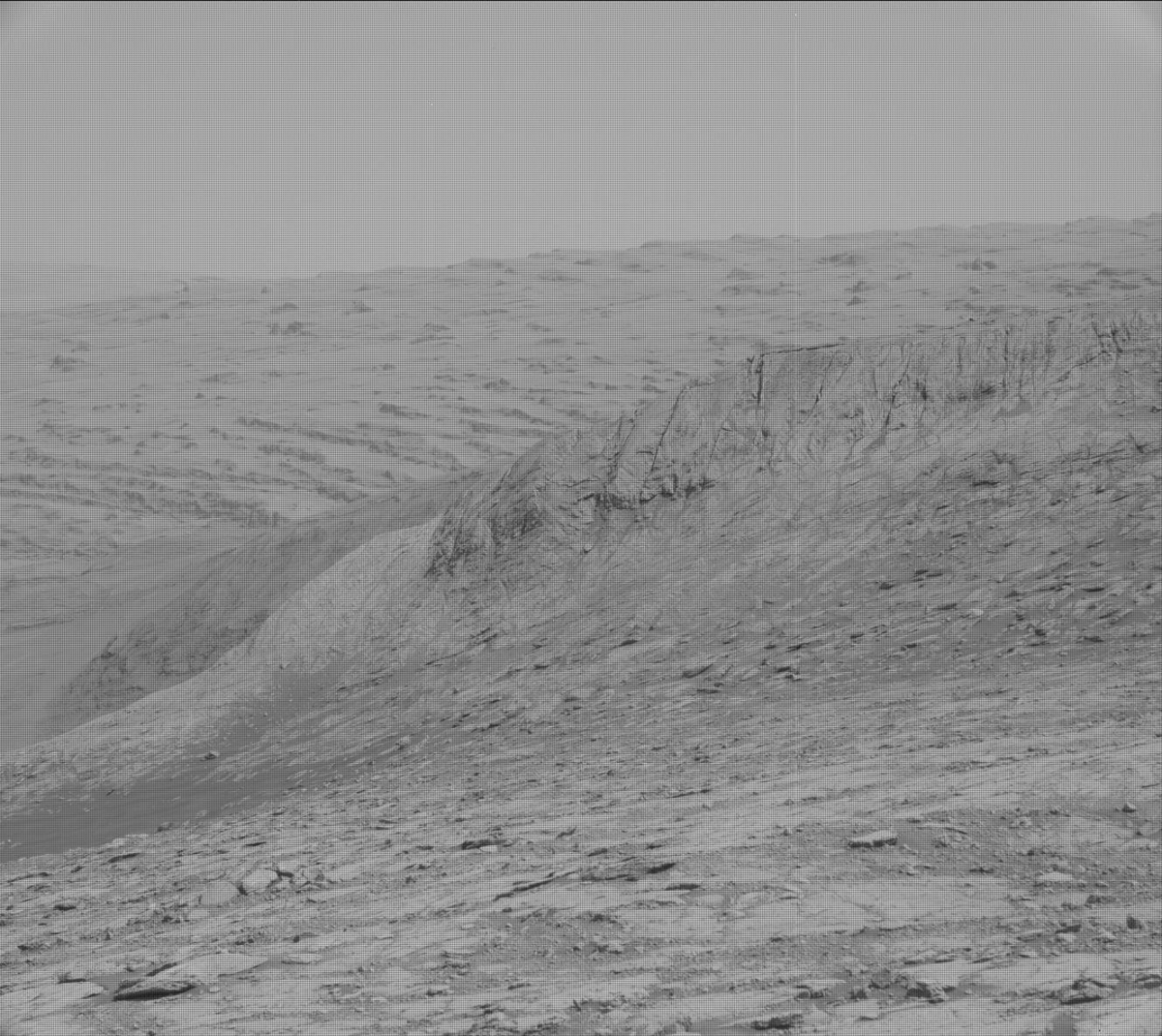
Bloodstone Hill – Curiosity Mast Camera Left image acquired on Sol 2793, June 14, 2020.
Credit: NASA/JPL-Caltech/MSSS
Reports Kristen Bennett, a planetary geologist at the USGS Astrogeology Science Center in Flagstaff, Arizona:
“A few months ago, Curiosity drove up on top of the ‘Greenheugh pediment’ to investigate the capping unit that is visible on top. After Curiosity drove off the pediment, the rover has been driving along the base of the pediment scarp and is about to reach the eastern edge. An interesting feature that is located at the eastern edge of the pediment is called ‘Bloodstone Hill’ – a light-toned mound that the team has been observing in long distance images for the entire mission.”
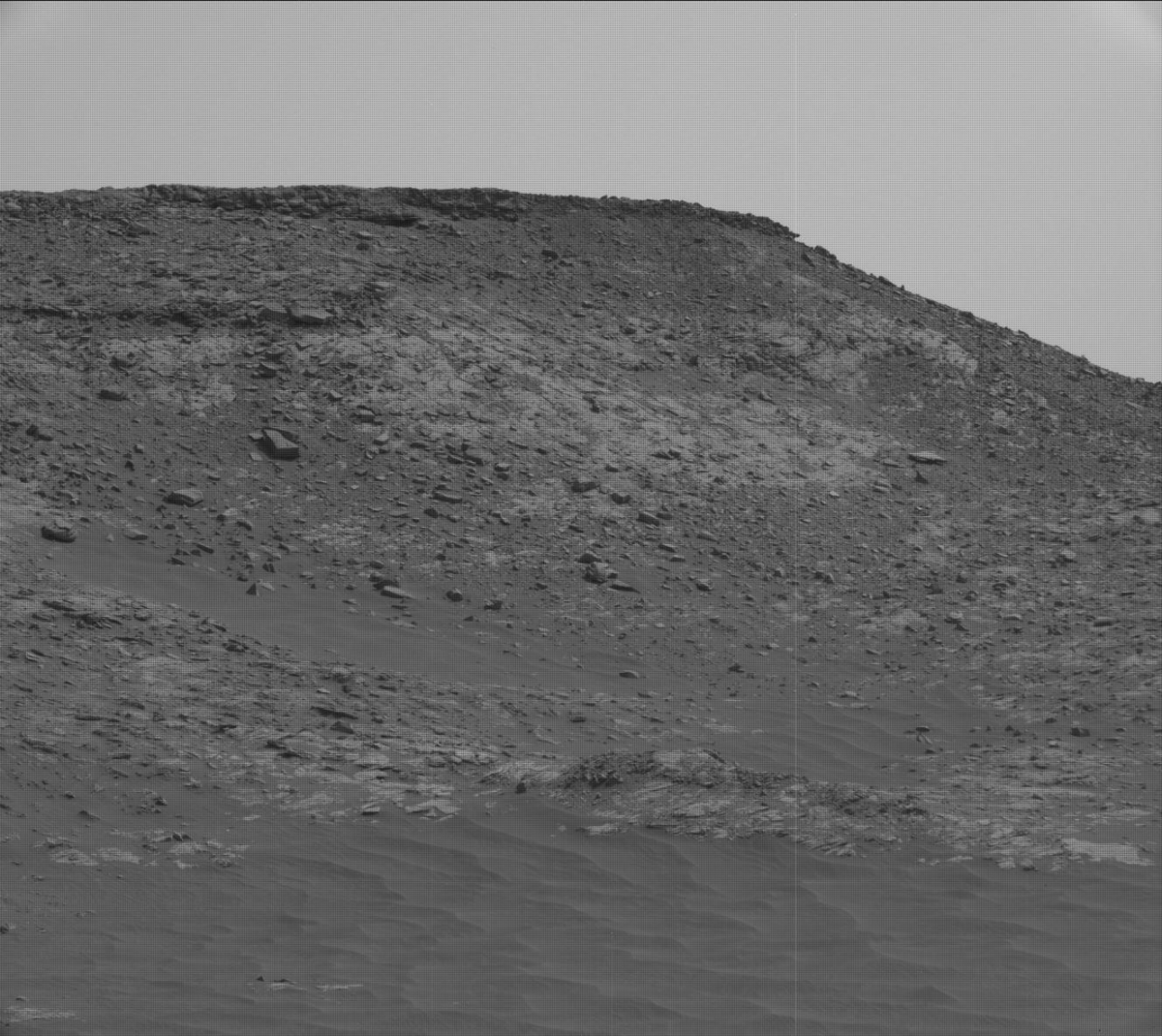
Curiosity Mast Camera Left image acquired on Sol 2793, June 14, 2020.
Credit: NASA/JPL-Caltech/MSSS
Questions raised
Bennett adds that Bloodstone Hill was even visible from Curiosity’s landing site!
“This light-toned mound is located right at the edge of the pediment, although it does not appear to have the pediment capping unit on top. Bloodstone Hill caught the team’s attention because it is so bright, which raises many questions,” Bennett explains.
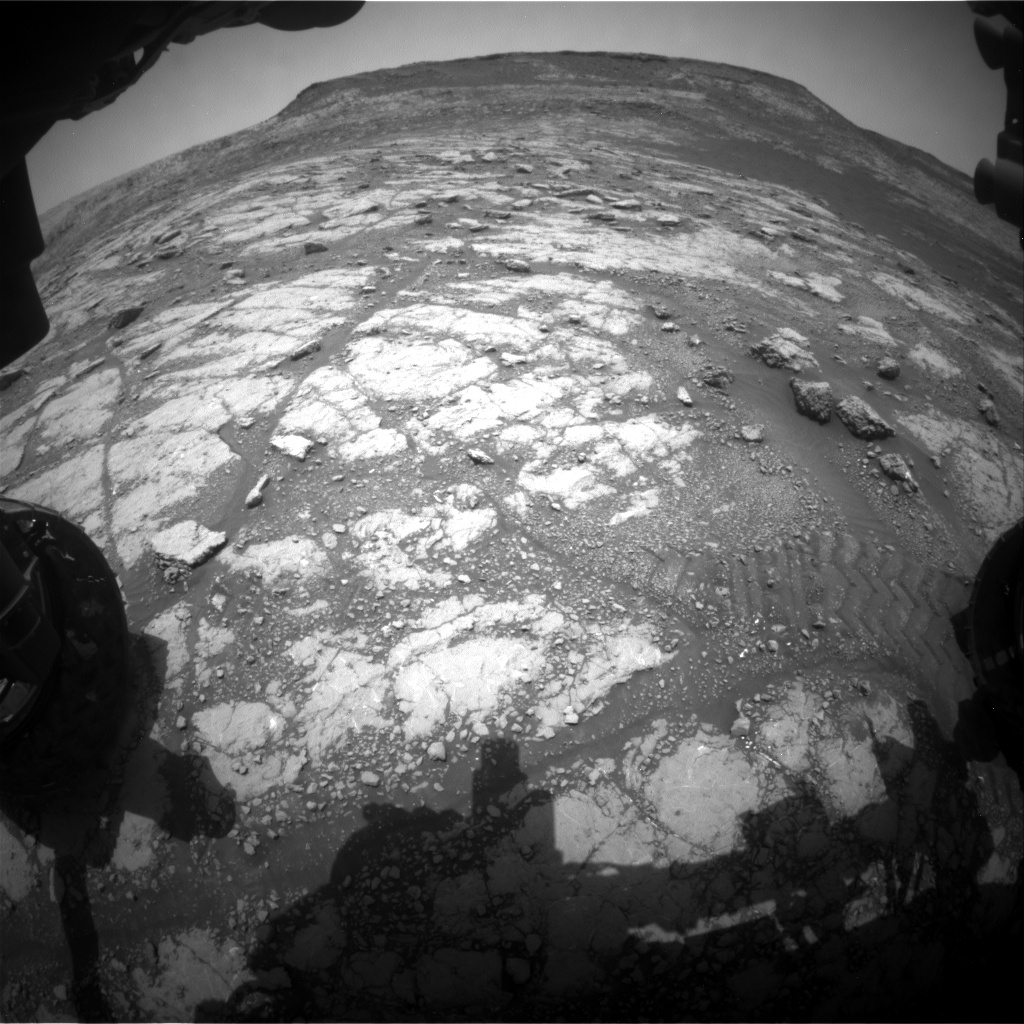
Curiosity Front Hazard Avoidance Camera Left B image taken on Sol 2794, June 15, 2020.
Credit: NASA/JPL-Caltech
Is it bright because it is covered in dust…a different mineralogy…a different alteration history?
“Now Curiosity is approaching Bloodstone Hill, and we can start answering some of these questions,” Bennett says.
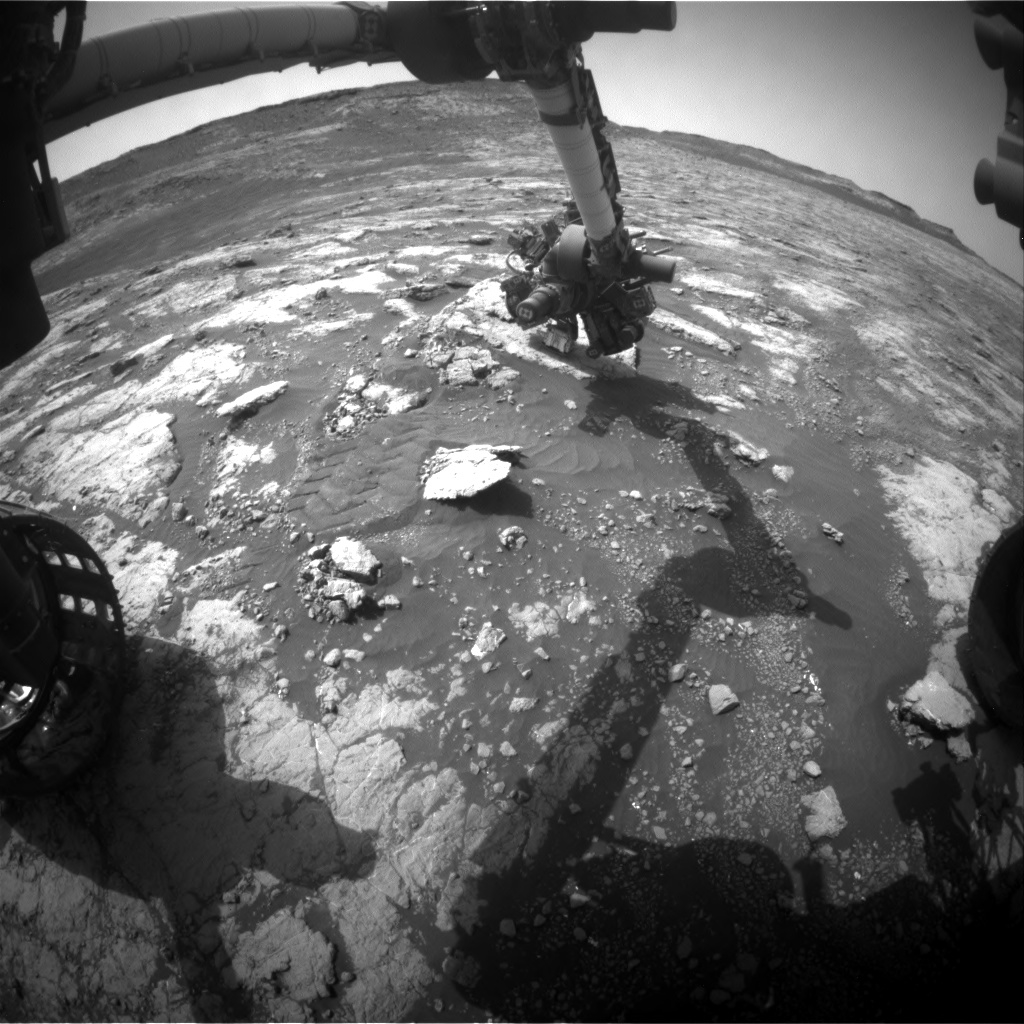
Curiosity Front Hazard Avoidance Camera Left B photo taken on Sol 2793, June 14, 2020.
Credit: NASA/JPL-Caltech
Multispectral mosaic
A new plan has as the main event a long drive that will place Curiosity close to the base of Bloodstone Hill.
Another important piece of the plan is the Mastcam multispectral mosaic that will be taken of Bloodstone Hill.
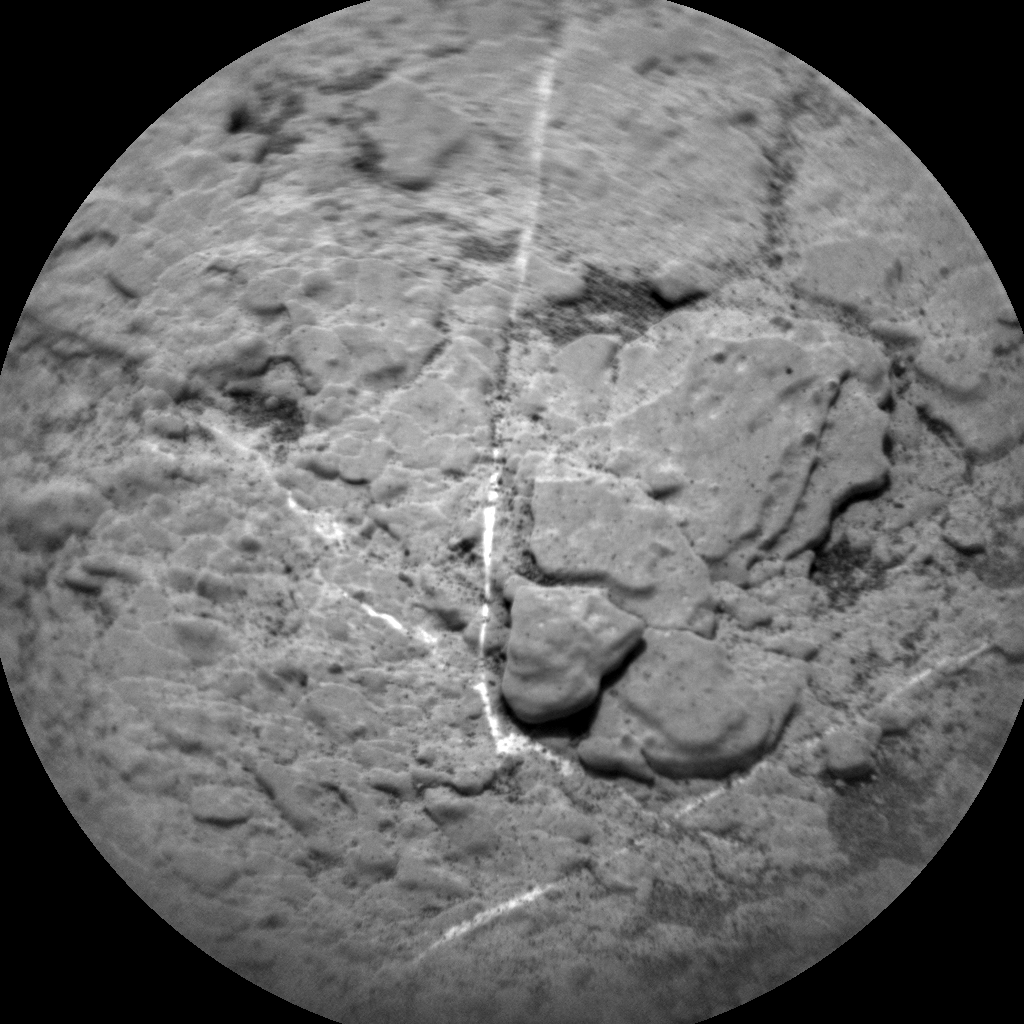
Curiosity Chemistry & Camera Remote Micro-Imager (RMI) photo acquired on Sol 2794, June 15, 2020.
Credit: NASA/JPL-Caltech/LANL
“As we approach this feature,” Bennett continues, “the team is gathering more data that will help us plan our investigation at this location. Multispectral observations can help identify variations in color and/or mineralogy across the outcrop. If the multispectral mosaic reveals any interesting variations, we can target those areas once we arrive at Bloodstone Hill.”
Nodule-rich bedrock
Additionally, several other Mastcam observations in the plan will document fractures or troughs between bedrock patches as well as the contact between the pediment capping unit and the strata below.
Credit: NASA/JPL-Caltech/Univ. of Arizona
The rover’s Chemistry and Camera (ChemCam) will also target “Earlish” to investigate the chemistry of nodule-rich bedrock in this area.
Lastly, a Mars Descent Imager (MARDI) image will be taken after the drive to document the terrain underneath the rover, Bennett concludes.
New road map
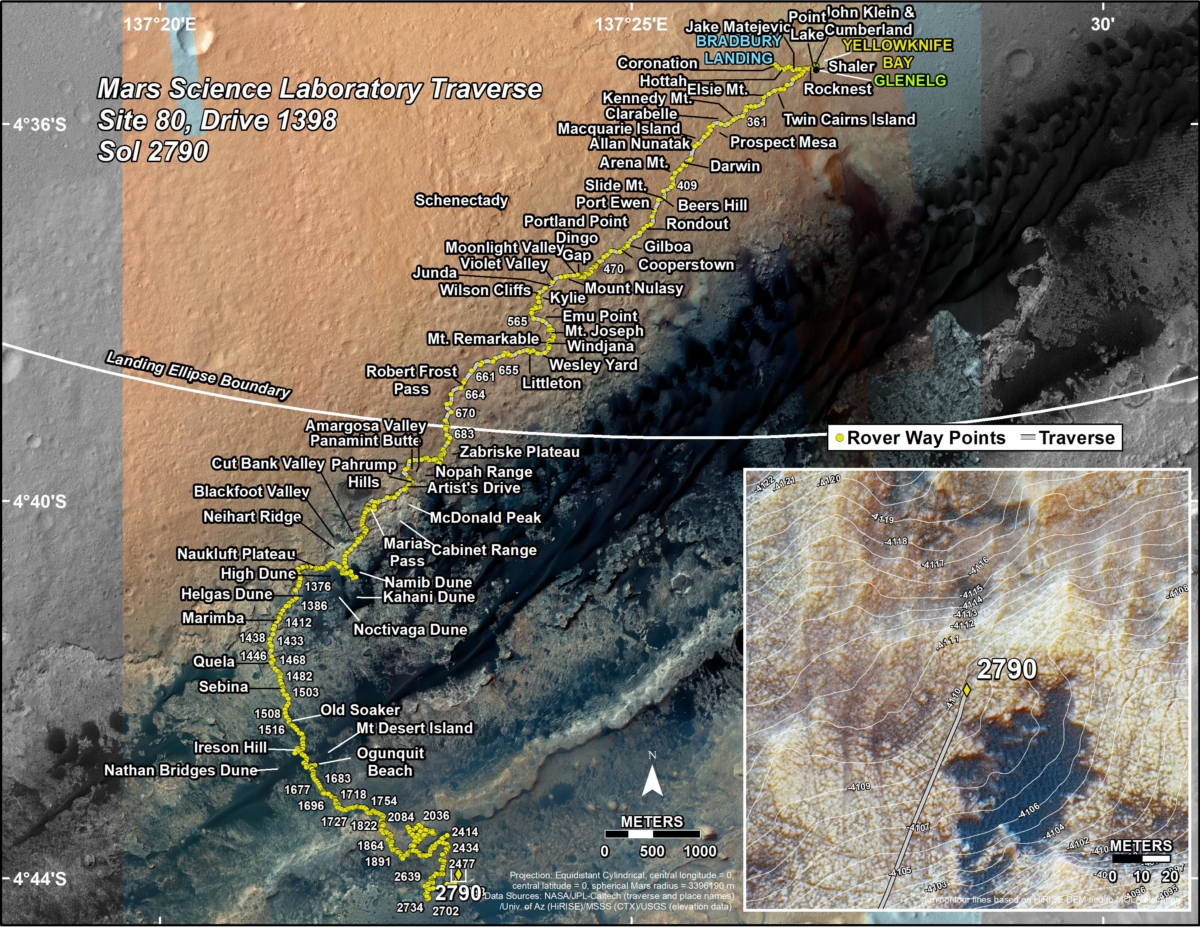
A newly issued map shows the route driven by NASA’s Mars rover Curiosity through the 2790 Martian day, or sol, of the rover’s mission on Mars (June 12, 2020).
Numbering of the dots along the line indicate the sol number of each drive. North is up. The scale bar is 1 kilometer (~0.62 mile).
From Sol 2788 to Sol 2790, Curiosity had driven a straight line distance of about 308.42 feet (94.01 meters), bringing the rover’s total odometry for the mission to 13.97 miles (22.48 kilometers).
The base image from the map is from the High Resolution Imaging Science Experiment Camera (HiRISE) in NASA’s Mars Reconnaissance Orbiter.
 Posted in
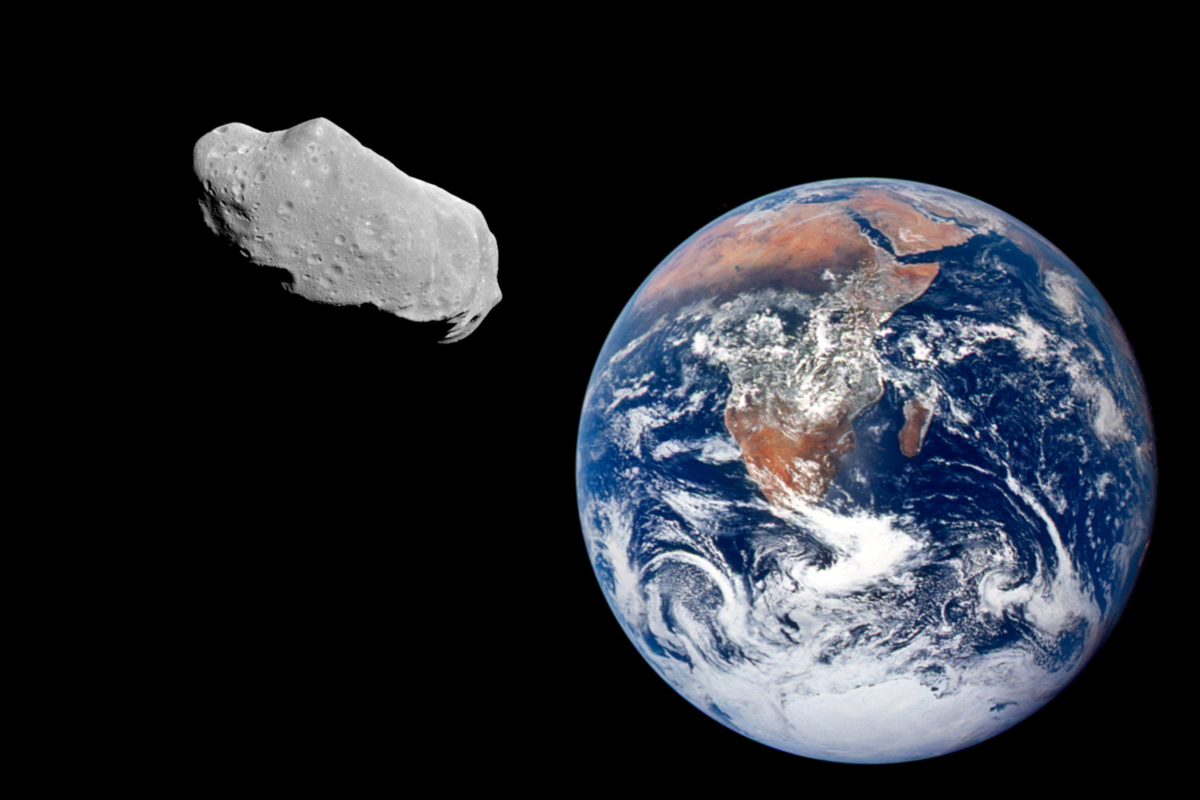
Credit: DOD photo illustration
All the emergency preparedness activities now underway due to the coronavirus – do they offer insight into our readiness for an incoming near Earth object impactor?

Experts have held tabletop exercises to help coordinate responses to potential strikes by dangerous asteroids and comets. (Image credit: The Aerospace Corporation, via NASA/FEMA)
I contacted several asteroid experts as well as an authority on emergency preparedness for advice on how best to handle the storm before the calm.
Go to my new Space.com story:
How the coronavirus pandemic can help us prepare for an asteroid impact
Go to:
https://www.space.com/asteroid-impact-coronavirus-pandemic-lessons.html

Date: Thursday, June 18, 2020
Time: 11:00 AM EST; 5 PM CEST
Space Café -Special – this is a For All Moonkind and SpaceWatch.Global’s webinar featuring global space experts on special topics.
Join the conversation about race with diverse perspectives from within and outside the US space community.
More equal future
Hosted by Michelle Hanlon, co-founder of For All Moonkind and Co-Director of the Center for Air and Space Law at the University of Mississippi School of Law, this conversation on Race in Space features:
Jarard Williams: a recent graduate of the University of Mississippi School of Law will share his research in a presentation entitled “The Dark Star: Black Representation in Space.”
Yvette Butler: who is joining the law faculty at the University of Mississippi this summer will consider recent events, discuss how we got here, and more importantly, how to engage in the present moment to both assure a more equal future and prevent the extension of racism with humans into space.
Kevin Myrick: Co-Founder of Synergy Moon, an official Google Lunar Xprize team, will talk about how space can help race relations and promote equality and justice.
Specific actions
Each panelist will suggest specific actions that can be taken by individuals to combat systemic racism. The audience will have the opportunity to ask questions.
For All Moonkind is working to build the foundation upon which successful and sustainable human communities may thrive in space, starting with a recognition of human heritage in space, and a reconfirmation of all human rights in space.
SpaceWatch.Global is a Switzerland-based digital magazine and portal for those interested in space and the far reaching impact of the space sector.
This Space Café WebTalk will be conducted in English.
For free registration, go to:

Curiosity Left B Navigation Camera image taken on Sol 2791, June 12, 2020.
Credit: NASA/JPL-Caltech
NASA’s Curiosity Mars rover is now performing Sol 2792 duties.

Curiosity Right B Navigation Camera image taken on Sol 2791, June 12, 2020.
Credit: NASA/JPL-Caltech
Reports Michelle Minitti, a planetary geologist at Framework in Silver Spring, Maryland: “Akin to a road trip where you want to make good time but do not want to miss the notable sights along the way, Curiosity is fitting in scientific sightseeing along her drive east toward sulfate-bearing horizons identified in Mt. Sharp long before Curiosity started exploring Gale crater in 2012.”

Curiosity Left B Navigation Camera image taken on Sol 2791, June 12, 2020.
Credit: NASA/JPL-Caltech
Stop-worthy attraction
The stop-worthy attraction on Sol 2790, Minitti adds, was an apparent landslide, which littered the slopes up to the “Greenheugh pediment” with a variety of dark gray blocks from that bedrock layer.

Curiosity Mast Camera Left photo acquired on Sol 2790, June 11, 2020.
Credit: NASA/JPL-Caltech/MSSS

Curiosity Mast Camera Left photo acquired on Sol 2790, June 11, 2020.
Credit: NASA/JPL-Caltech/MSSS

Curiosity Mast Camera Left photo acquired on Sol 2790, June 11, 2020.
Credit: NASA/JPL-Caltech/MSSS

Curiosity Mast Camera Left photo acquired on Sol 2790, June 11, 2020.
Credit: NASA/JPL-Caltech/MSSS

Curiosity Mast Camera Left photo acquired on Sol 2790, June 11, 2020.
Credit: NASA/JPL-Caltech/MSSS
“To learn more about how the pediment, and the bedrock it once covered, eroded through time, the team planned two Mastcam mosaics from the base of the landslide,” Minitti explains. “One large mosaic will cover the landslide itself, dubbed ‘Munlochy,’ and the second, smaller mosaic will capture ‘Cowie Harbour,’ layered outcrops on lower flanks of a butte that was once connected to the Greenheugh pediment.”
Pebble-lined troughs
The plan also scheduled Mastcam to image a collection of large blocks (“Yamspath Law”) sitting among pebble-lined troughs dividing the bedrock of this part of the Glen Torridon region, further contributing to the investigation of how the terrain the rover is driving on evolved to the state the robot finds it today.
With all of the Mastcam imaging, there was only time for one Chemistry and Camera (ChemCam) raster on the target “Muness,” one of the dark gray blocks brought downhill by the landslide.
“Fortunately, we knew we got additional chemistry data from the bedrock covered by the landslide in the two post-drive automated ChemCam rasters from the previous plan,” Minitti notes.
Sand patch
“We will get two more such automated ChemCam rasters after our next drive, which will take us slightly north around a sand patch that stands in our way of direct progress east,” Minitti points out.
“Before and after the drive, we will acquire numerous images and movies of the skies above us to monitor the amount of dust in the atmosphere and look for clouds and dust devils,” Minitti concludes.

Credit: NASA/JPL-Caltech/Univ. of Arizona
New road map
Meanwhile, a new rover road map shows the route driven by Curiosity through the 2788 Martian day, or sol, of the robot’s mission on Mars (June 10, 2020).
Numbering of the dots along the line indicate the sol number of each drive. North is up. The scale bar is 1 kilometer (~0.62 mile).
From Sol 2786 to Sol 2788, Curiosity had driven a straight line distance of about 273.85 feet (83.47 meters), bringing the rover’s total odometry for the mission to 13.91 miles (22.38 kilometers).
The base image from the map is from the High Resolution Imaging Science Experiment Camera (HiRISE) in NASA’s Mars Reconnaissance Orbiter.

Mars Reconnaissance Orbiter’s HiRISE image pinpoints Curiosity rover.
Credit: NASA/JPL/UArizona

Mars Reconnaissance Orbiter’s HiRISE image. Credit: NASA/JPL/UArizona

Credit: CCTV/Inside Outer Space screengrab
The return capsule of the trial version of China’s new-generation manned spaceship was opened in Beijing recently, with the interior arrangements now being shown to the public.

Credit: CCTV/Inside Outer Space screengrab
The craft landed safely on May 8 at the Dongfeng landing site and is designed for transportation of both astronauts and cargo.

Credit: CCTV/Inside Outer Space screengrab
The right side of the vehicle carried nearly 1,000 pieces of supplies to verify the spaceship’s cargo capacity. The left side of the craft was configured as a living area for astronauts, with a folding table and a toilet.

Credit: CCTV/Inside Outer Space screengrab
Split design
“The entire work area for astronauts in the future will not include the racks and cargo bags on the right side which were designed for test this time,” said Tian Zheng, deputy chief designer of the general assembly of the new-generation manned test spaceship under the China Academy of Space Technology.

Credit: CCTV/Inside Outer Space screengrab
“The space inside is about 13 cubic meters,” Tian explained, “which is larger than that of previous ones. According to our plan, it’s big enough for six to seven astronauts.”

Credit: CCTV/Inside Outer Space screengrab
Cargo
The cargo onboard China’s new-generation spacecraft prototype was revealed during a ceremony held by the China Manned Space Engineering Office and the China Aerospace Science and Technology Corporation.

Credit: CCTV/Inside Outer Space screengrab
The spacecraft transported scientific experiments, seeds, Chinese herbal medicine, the national flags of Pakistan and Argentina, and some youth science test items.
The spacecraft was launched by a Long March-5B launch vehicle from the Wenchang Space Launch Center, Wenchang, Hainan Province, China, on May 5, 2020.

Credit: CCTV/Inside Outer Space screengrab
On orbit, the capsule was used for China’s first on-orbit leakage and collision detection experiment and to test 3D printing in space.

Credit: CCTV/Inside Outer Space screengrab
Independently developed by China, the 3D printer automatically completed the task of printing two samples, a hive-shaped part and a logo of China Aerospace Science and Technology Corporation (CASC), during space flight, confirming the scientific research purpose of 3D printing composite materials in a microgravity environment.

Credit: CCTV/Inside Outer Space screengrab
A special film material was used to achieve a strong adhesion with composite interface. Even when it bore a huge impact while the capsule returned, the sample part and the substrate remained firmly bonded.

Credit: CCTV/Inside Outer Space screengrab
According to the research and development team, the 3D printing system, its work process was entirely automatically controlled, achieved several technological breakthroughs.
“The completion of 3D printing in space is actually to achieve space manufacturing. We are the first to use a continuous filament reinforced composite material, principally because the composite material is the main load-bearing structure material of the spacecraft,” explains Chen Yi, deputy head technologist, space 3D printing system project, China Academy of Space Technology Corporation (CAST), China Aerospace Science and Technology Corporation (CASC).

Chen Yi, deputy head technologist, space 3D printing system project, China Academy of Space Technology Corporation (CAST), China Aerospace Science and Technology Corporation (CASC). Credit: CCTV/Inside Outer Space screengrab
The researchers will further compare and analyze the samples printed in space and on Earth, evaluating the molding quality of 3D printing in space. “The completion of 3D printing in space is actually to achieve space manufacturing. We are the first to use a continuous filament reinforced composite material, principally because the composite material is the main load-bearing structure material of the spacecraft,” adds Chen.
To view the China Central Television (CCTV) video showing the split design of China’s new-generation manned spaceship, go to:
Also go to this Inside China’s new crewed spacecraft video at:

Griffin lander deploys NASA VIPER.
Credit: Astrobotics
Astrobotic has been selected by NASA to deliver the Volatiles Investigating Polar Exploration Rover, or VIPER, to the south pole of the Moon in 2023.
The private company, will provide an end-to-end delivery for VIPER on board the company’s Griffin lunar lander through a $199.5 million contract awarded under the NASA Commercial Lunar Payload Services program, or CLPS.

VIPER on the prowl.
Credit: NASA
VIPER is a mobile robot that will go to the south pole of the Moon to get a close-up view of the location and concentration of water ice that could eventually be harvested to sustain human exploration on the Moon, Mars — and beyond.

VIPER hardware being tested.
Credit: NASA/JSC
Resource mapping
VIPER represents the first resource mapping mission on another celestial body.
Pittsburgh, Pennsylvania-based Astrobotic will be responsible for end-to-end services for delivery of VIPER, including integration with its lander, launch from Earth, and landing in a polar region on the Moon.
Video at:
https://s3.amazonaws.com/astrobotic-assets/Astrobotic_Griffin_Surface_01.mp4

NASA cover artwork credit: Alberto Bertolin/Jacobs Technology Inc.
After LM – NASA Lunar Lander Concepts Beyond Apollo, John Connolly (Editor) 2019; 277-pages, Free NASA PDF.
This NASA-published volume traces the history of human lunar lander concepts developed since Apollo’s Lunar Module (LM).
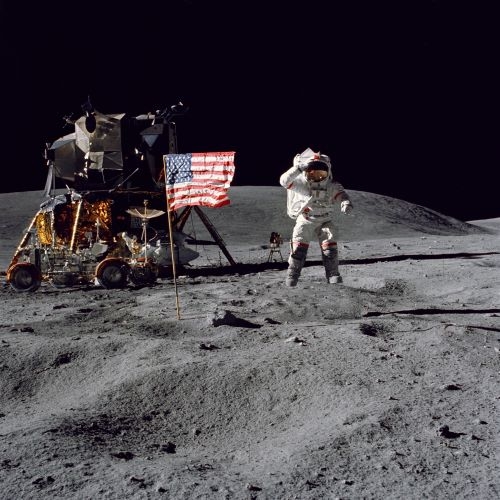
Credit NASA
Editor John Connolly has spent 33 years at NASA, primarily leading development of lunar surface systems, including landers. Given the details provided in this book, his bookshelves are surely bowed by the number of study volumes he has collected and gone through!
This notable volume tells the story of physics, technology, and the desire to return humans to the lunar surface through technical descriptions, imagery and looks at subsystems of more than 100 lunar lander concepts created by NASA and its contractors since the Apollo program.

The concepts are grouped by the human exploration timelines that defined the post-Apollo period, starting post-Apollo and continuing through the Space Exploration Initiative and the Vision for Space Exploration, and concluding with the many lander designs created to support NASA’s Constellation program.
Readers will better appreciate the common “trades” that are explored in crewed landing systems, including propellant types, pressurized volumes, structural mass fractions, mass margins, crew size, and special accommodations for ergonomics and other human factors.
“There is a reason why the Apollo LMs, and many of the subsequent lunar lander designs featured in this book, look the way they do – their shape and form is a response to the simple physics that governs the tasks they are asked to perform,” Connolly explains.
As this document was being compiled in 2019, NASA has once again begun planning a return to the Moon, and new lunar lander designs are being generated.
Compared to Apollo, Connolly notes, crews are projected to be larger and stay times longer.
“However, it is expected that the landers will look much like the designs in this document,” he adds, because lunar lander design is a response to the simple physics that governs the tasks they are asked to perform.

Lander Design Analysis Cycle-4
Credit: NASA
“Design is also a living thing. New crewed lander designs will continue to emerge up until the point that humans return to the Moon, and even beyond, Connolly writes. “New players from different countries and commercial providers will create new designs based on new technologies and new requirements.”
“Until some breakthrough technology or new physics principle is created, each lander will respond to the current physics of lunar landing,” Connolly explains in the concluding pages of the volume.
“There may come a time, generations from now, when future engineers are paging through a digital copy of this catalog and reflecting on the early work of lunar lander designers. “Those Apollo guys were really smart, given that they started with nothing as a reference. The Lunar Module – now THAT was a great lunar lander design.”
After LM – NASA Lunar Lander Concepts Beyond Apollo is free to the public and available for download at:
https://ntrs.nasa.gov/archive/nasa/casi.ntrs.nasa.gov/20190031985.pdf

Curiosity Left B Navigation Camera image taken on Sol 2787, June 8, 2020.
Credit: NASA/JPL-Caltech
NASA’s Curiosity Mars rover is now carrying out Sol 2788 duties.

Curiosity Front Hazard Avoidance Camera Right B photo acquired on Sol 2787, June 8, 2020.
Credit: NASA/JPL-Caltech
Mars researchers are evaluating where best Curiosity should next wheel, reports Lucy Thompson, a planetary geologist at University of New Brunswick; Fredericton, New Brunswick, Canada.
Recent deliberations involved where to drive in order to maximize the view out of the front window to make planning the next drive easier, Thompson explains.

Curiosity Mast Camera Right image taken on Sol 2786, June 7, 2020.
Credit: NASA/JPL-Caltech/MSSS

Curiosity Mast Camera Right image taken on Sol 2786, June 7, 2020.
Credit: NASA/JPL-Caltech/MSSS
Also, trying to place Curiosity in a position where researchers will be able to image an interesting feature that from orbit “appears as though it may be a landslide that originated from the edge of the pediment cliff to the north,” Thompson adds.
Bedrock transition to pebbles
Discussions also centered on which of the features in the robot’s immediate workspace to analyze with the Chemistry and Camera (ChemCam) instrument: bedrock, diagenetic features (the physical and chemical changes occurring in sediments between the times of deposition and solidification), pebbles or veins?
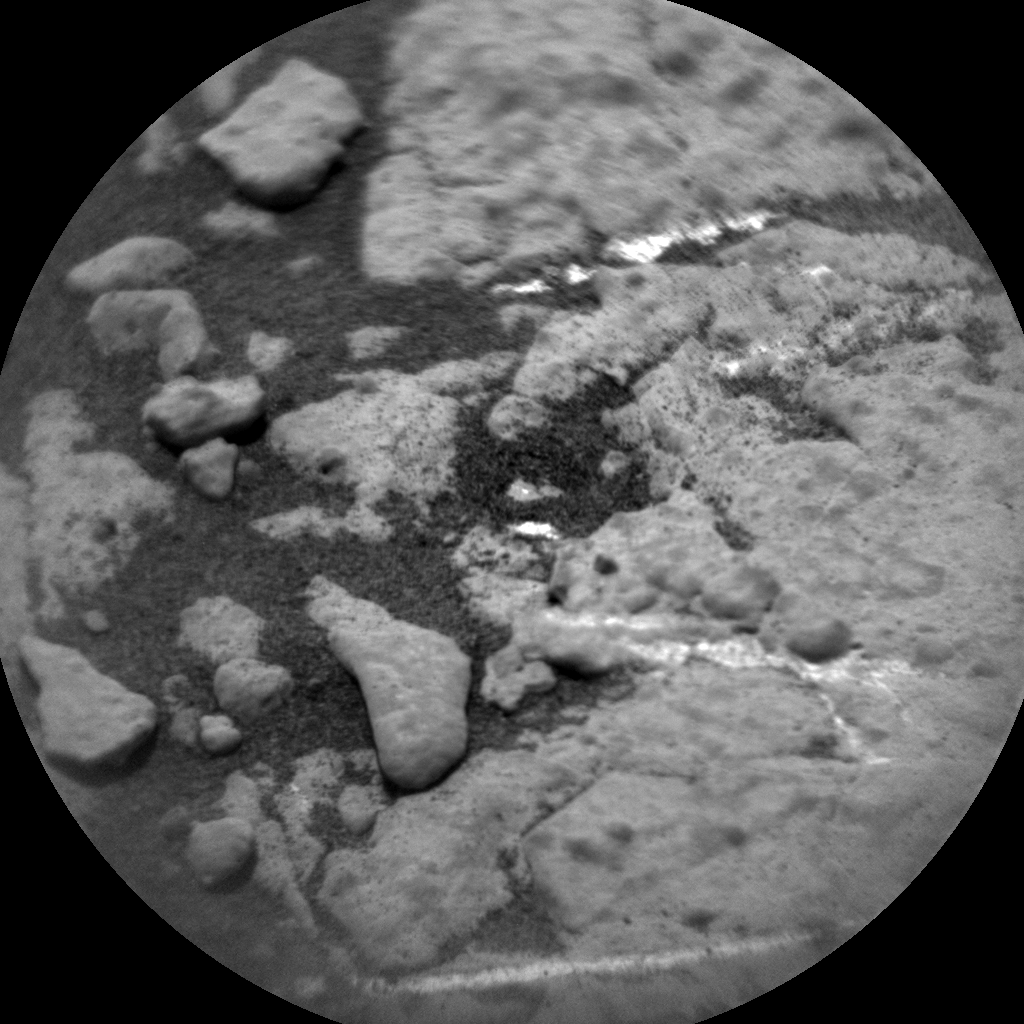
Curiosity Chemistry & Camera image acquired on Sol 2787, June 8, 2020.
Credit: NASA/JPL-Caltech/LANL
“The rover planner engineers managed to plan a drive that satisfied both mobility goals, and after much deliberation, the science team decided to use ChemCam to investigate the chemistry of the bedrock and a pebble in the workspace, all in one observation (‘Outer Golden Pot’),” Thompson notes.
The Laser Induced Breakdown Spectroscopy (LIBS) raster will transition from bedrock onto a dark grey pebble.
Dark-colored coatings
“I had noticed some blocks with interesting dark-colored coatings in our drive direction imaging last Friday,” Thompson says, and one such block recently ended up just off to the right of the rover.

Navcam left image of the area to the right of the rover with the “Dunkeld” rock target in the middle of the image (slightly darker, triangular shaped rock).
Taken on Sol 2786, June 7, 2020.
Credit: NASA/JPL-Caltech
“Although we will not get chemistry on this block (“Dunkeld”), Mastcam will image the block, and lighter-colored veins and fractured rock around it to get a higher-resolution look,” Thompson reports.
The rover’s Mastcam will also capture the ChemCam target in more detail, as well as mosaics of the possible landslide feature (“Munlochy”), the pediment cliff off to the right (north) of the rover, and a 15 x 8 frame, 360° mosaic, Thompson adds.
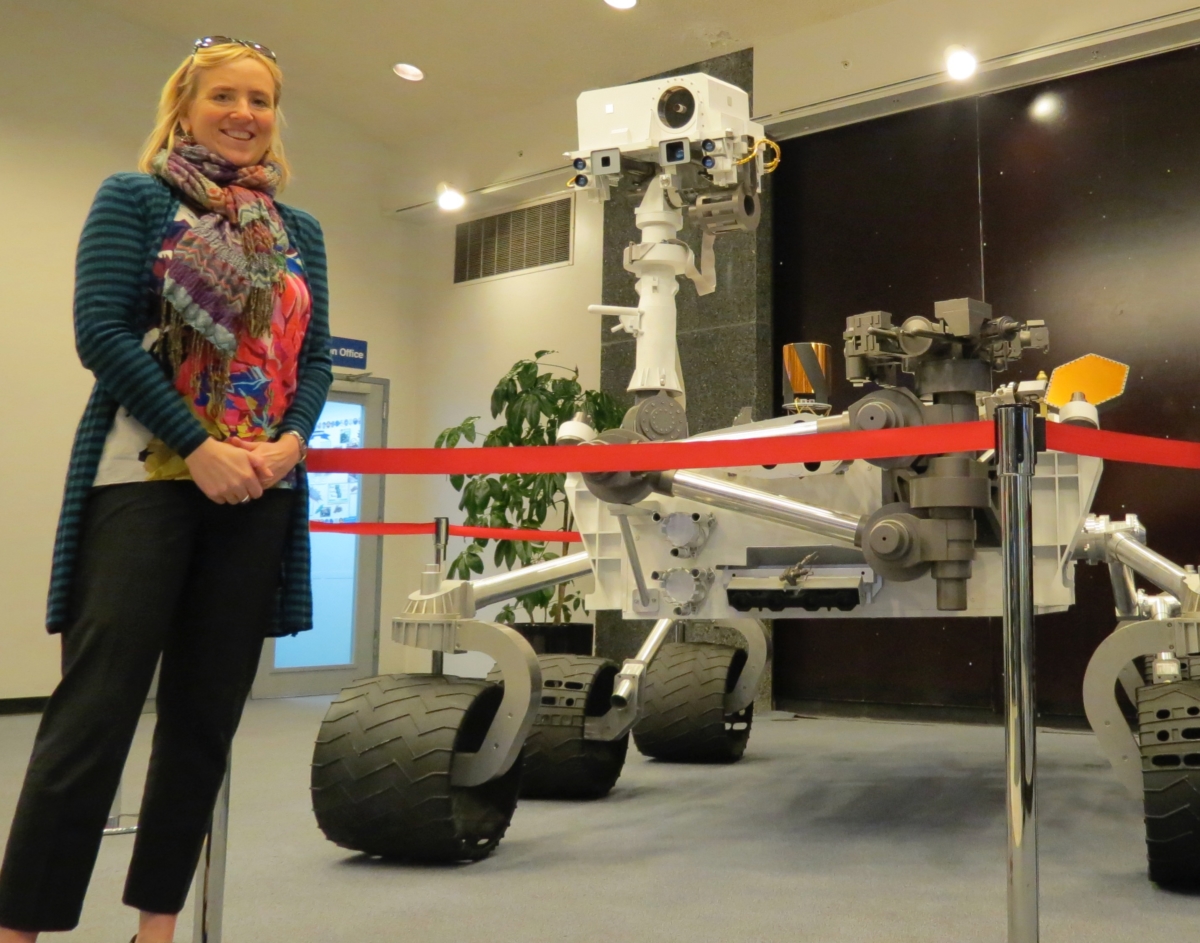
Lucy Thompson, a planetary geologist at University of New Brunswick; Fredericton, New Brunswick, Canada.
Dust devil surveys
The environmental science group planned a suite of activities including three large Navcam dust devil surveys, a Navcam dust devil movie, and Navcam deck monitoring.
The standard Rover Environmental Monitoring Station (REMS), Dynamic Albedo of Neutrons passive (DAN) and Radiation Assessment Detector (RAD) activities are also included.
Also planned is a Sample Analysis at Mars (SAM) Instrument Suite Electrical Baseline Test (EBT) designed to monitor SAM’s electrical functions will execute during the overnight.
Thompson notes that she did analyze the data downlinked from weekend observations looking at the typical bedrock chemistry (“Heather Island”) and helped identify the “Dunkeld” target. “It is always a thrill to see the new view after a drive, and today did not disappoint.”

NASA’s Origins, Spectral Interpretation, Resource Identification, Security-Regolith Explorer (OSIRIS-REx) spacecraft.
Credit: NASA/Goddard/University of Arizona
NASA’s OSIRIS-REx spacecraft has been making close-up observations of asteroid Bennu. Those images contain the first evidence of thermal fracturing of rocks on an airless body.
Thermal fracturing or thermal stress weathering occurs as rocks heat and cool each day, and mechanical stresses build up that can cause cracks to develop and grow. Over time the cracks grow larger and cause the rock to disaggregate or split into multiple pieces.
Planetary Science Institute (PSI) research scientist Jamie Molaro explains: “This is the first time evidence for thermal fracturing has been definitively observed on an object without an atmosphere.”

NASA’s OSIRIS-REx Finds Heat, Cold Fracturing Rocks on Asteroid Bennu
Examples of disaggregation (top) and linear fractures (bottom) in boulders of varying sizes on Bennu.
Credit: NASA/Goddard/University of Arizona
The research findings have been published in a Nature Communications paper.
Piece of a puzzle
“Like any weathering process, thermal fracturing can cause the evolution of boulders and planetary surfaces over time; from changing the shape and size of individual boulders, to producing pebbles or fine-grained regolith, to breaking down crater walls,” Molaro said in a PSI statement.
“How quickly this occurs relative to other weathering processes tells us how quickly the surface has changed. It is one piece of a puzzle that tells us what the planetary surface used to be like, and what it will be like millions of years from now,” Molaro explains. “We don’t have good constraints yet on breakdown rates from thermal fracturing, but we can get them now that we can actually observe evidence for it for the first time in-situ.”
The Planetary Science Institute is headquartered in Tucson, Arizona.
PSI’s Molaro is lead author of the paper “In situ evidence of thermally induced rock breakdown widespread on Bennu’s surface” published June 9, 2020 and can be found at:
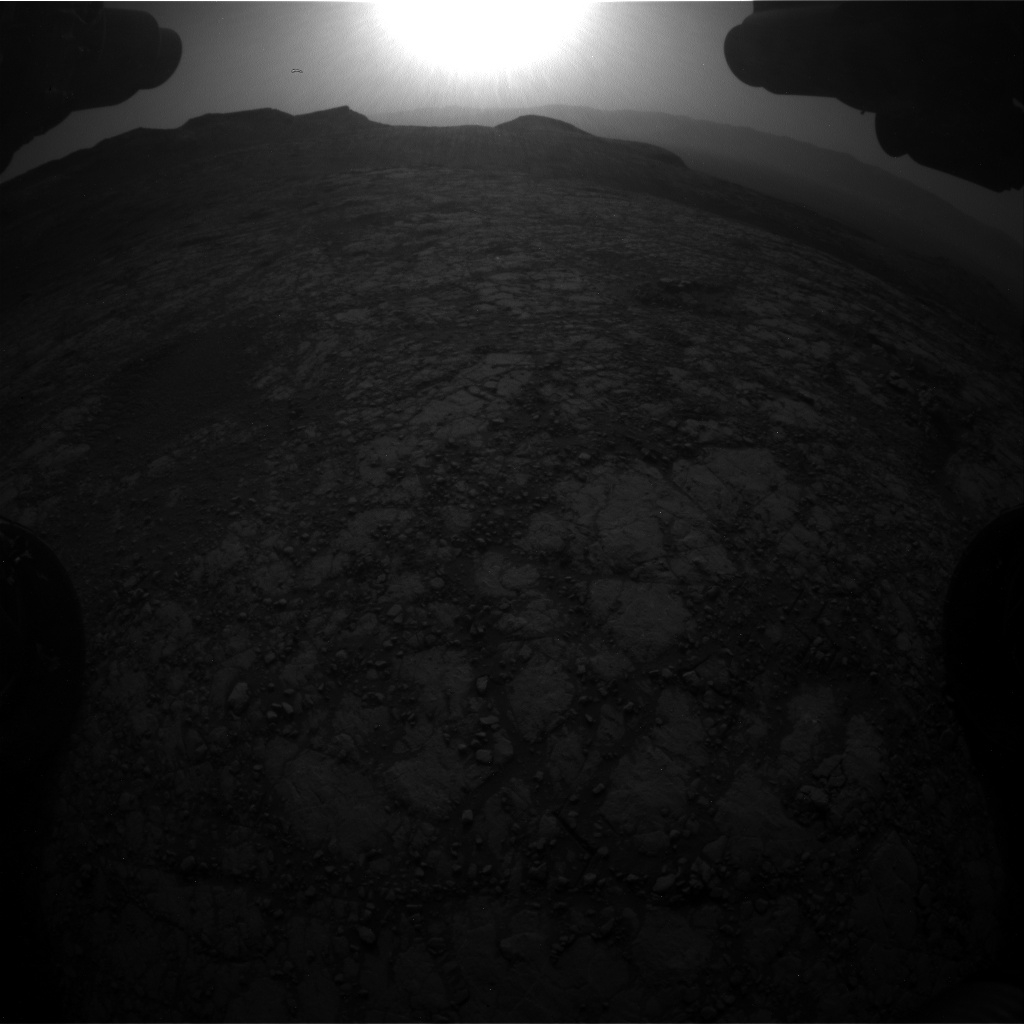
Curiosity Front Hazard Avoidance Camera Right B photo taken on Sol 2786, June 7, 2020.
Credit: NASA/JPL-Caltech
NASA’s Curiosity Mars rover is now performing Sol 2783 tasks.
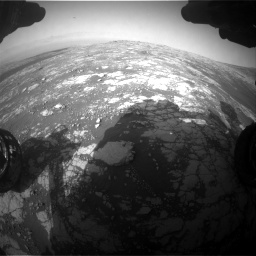
Curiosity Front Hazard Avoidance Camera Right B photo taken on Sol 2786, June 7, 2020.
Credit: NASA/JPL-Caltech
“Curiosity is continuing her trek towards the sulfate-bearing unit while studying the local bedrock and environment along the way,” reports Vivian Sun, Planetary Geologist at NASA’s Jet Propulsion Laboratory. The previous drive placed Curiosity in front of several bedrock exposures which will be analyzed extensively before the rover continues driving in a scheduled three-sol plan.
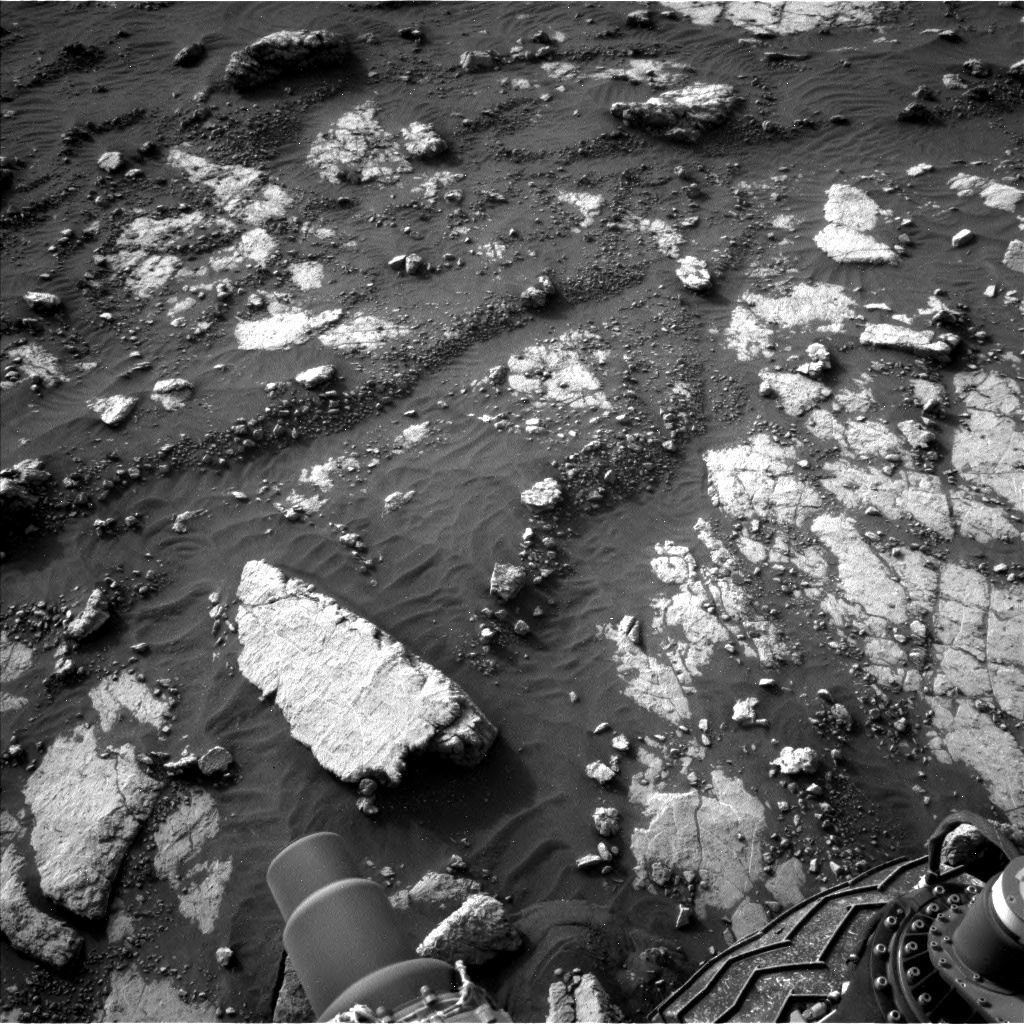
A stone slab, “Heather Island,” is visible at the bottom left of this image taken by Left Navigation Camera onboard NASA’s Mars rover Curiosity on Sol 2783.
Credit: NASA/JPL-Caltech
Star of the plan
The “star of the plan” is the “Heather Island” target which will be studied by four of the rover’s instruments, Sun adds.
First, the rover’s Chemistry and Camera (ChemCam) will take an extended 20-point raster observation across Heather Island. Having more ChemCam data points on this target will enable better comparison with the high-resolution Mars Hand Lens Imager (MAHLI) imaging that comes next, and will help Mars researchers better understand small-scale chemical variations in the bedrock.
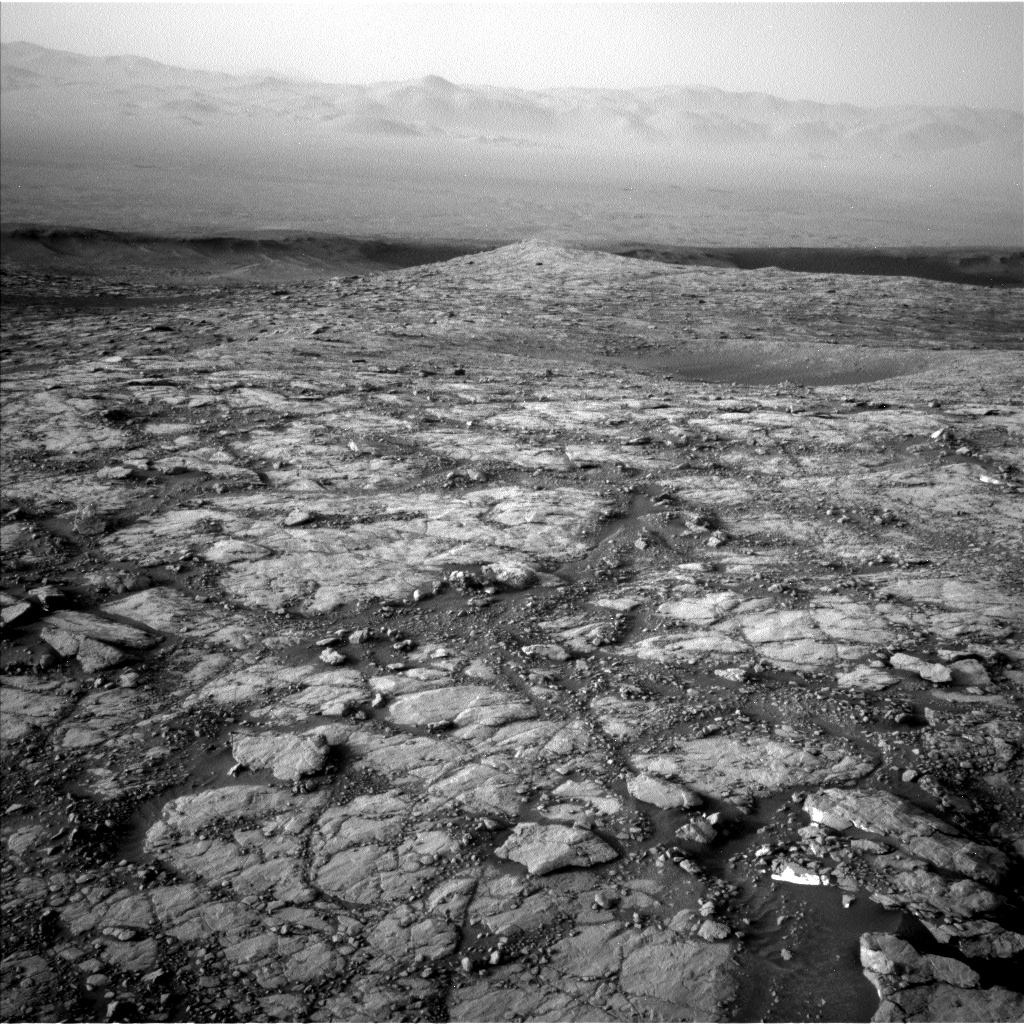
Curiosity Left B Navigation Camera image acquired on Sol 2786, June 7, 2020.
Credit: NASA/JPL-Caltech
“The rover will then use the Dust Removal Tool (DRT) to clear dust from Heather Island’s surface,” Sun notes, so that the robot’s Alpha Particle X-Ray Spectrometer (APXS) can better measure the composition of the underlying bedrock.
Credit: NASA/JPL-Caltech/Univ. of Arizona
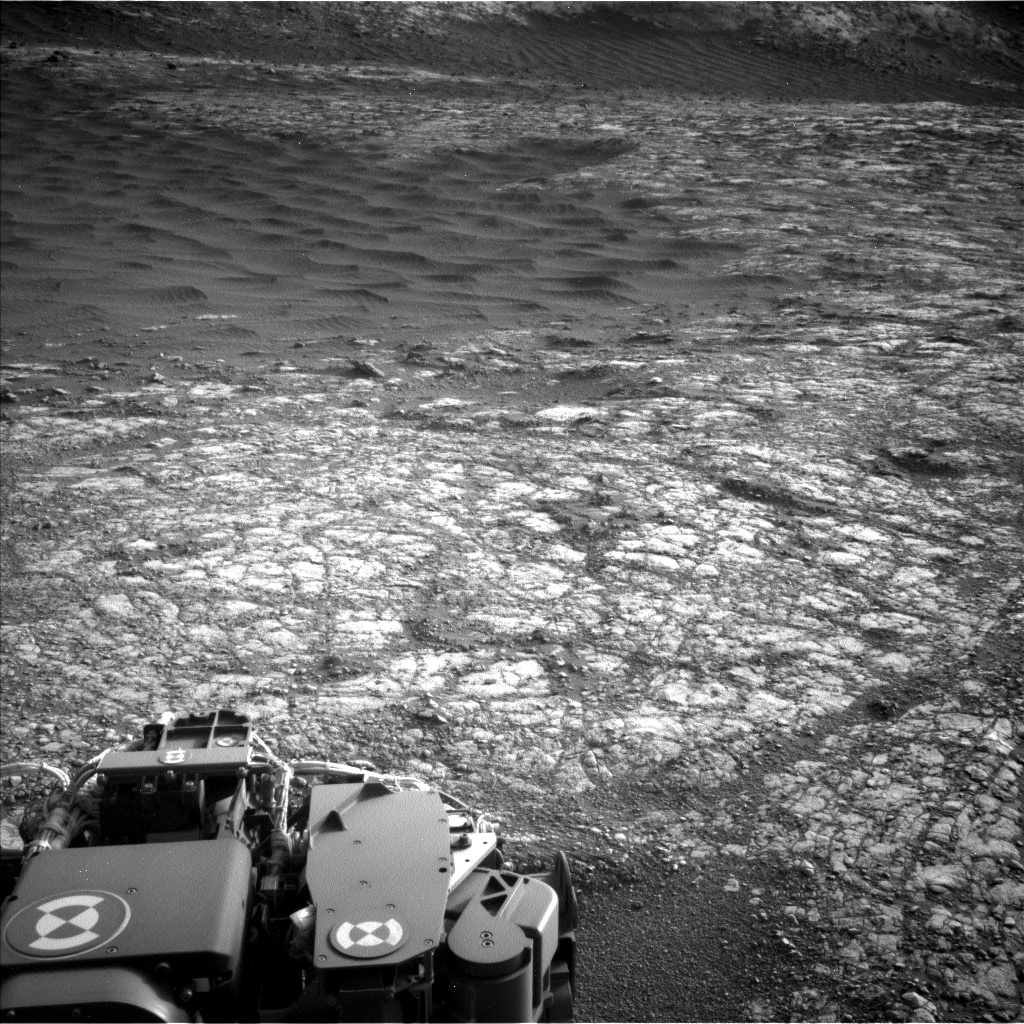
Curiosity Left B Navigation Camera image acquired on Sol 2786, June 7, 2020.
Credit: NASA/JPL-Caltech
Same target – different aspects
On the plan is using Curiosity’s Mastcam to take a multispectral observation over the same spot.
“This is really a great opportunity to leverage the unique capabilities of multiple instruments to characterize different aspects of the same target,” Sun reports.
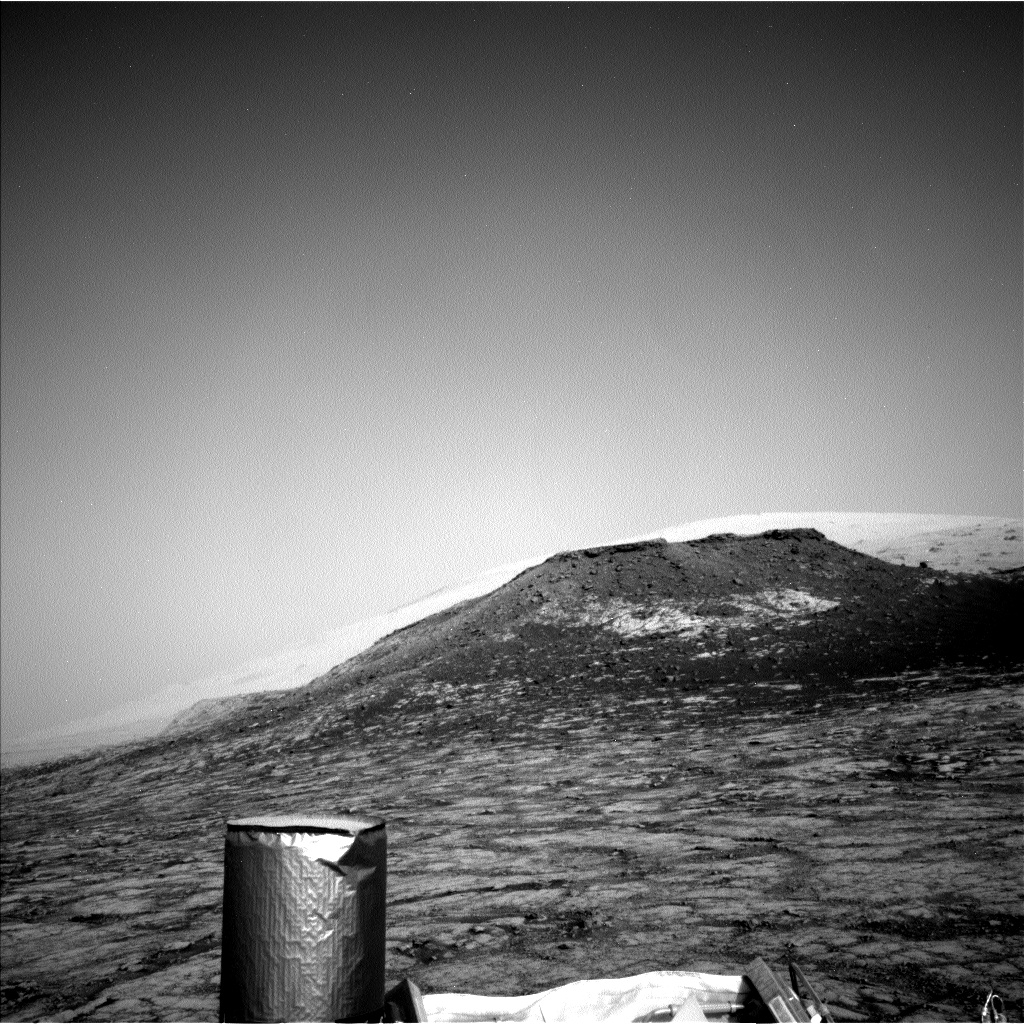
Curiosity Left B Navigation Camera image acquired on Sol 2786, June 7, 2020.
Credit: NASA/JPL-Caltech
The rest of the plan is also packed with other observations.
ChemCam will observe “Glame,” a nodular target that will add to a scientific characterization of nodular features in this region.
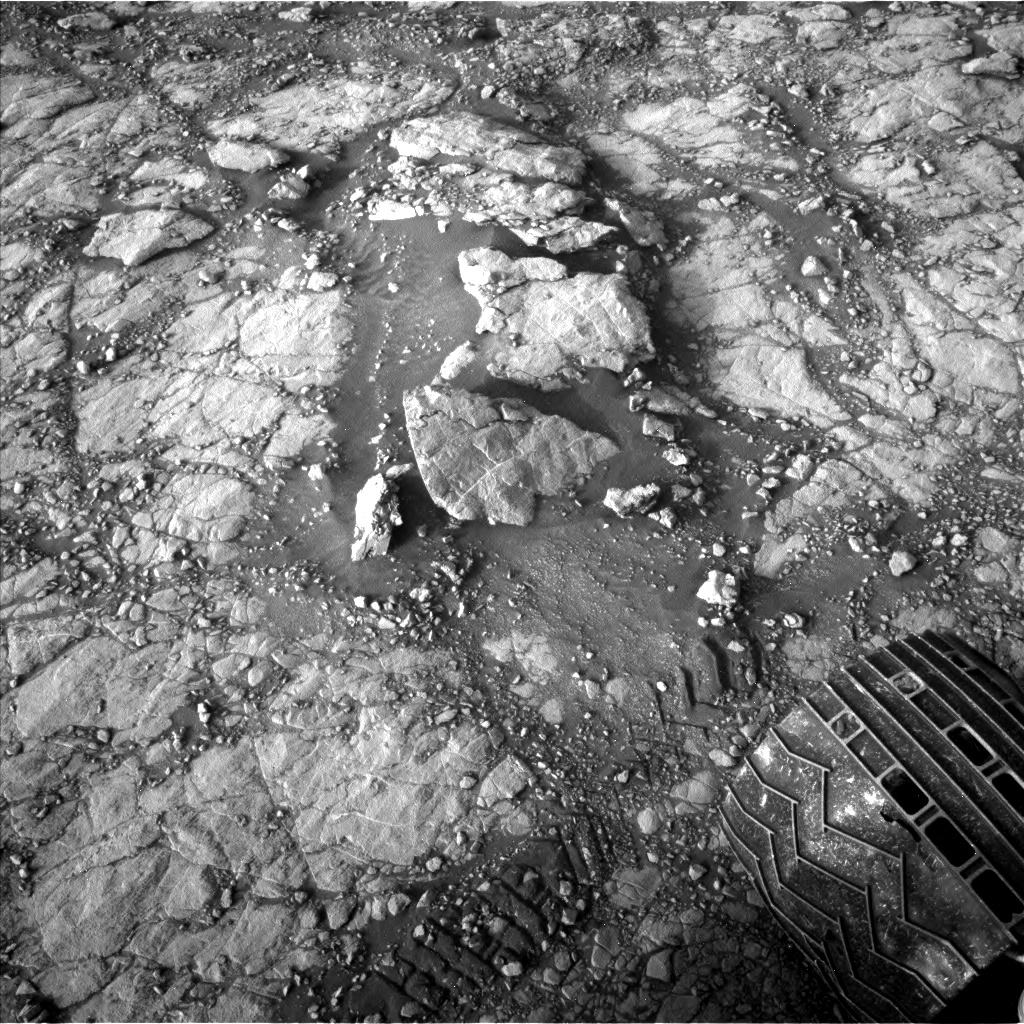
Curiosity Left B Navigation Camera image acquired on Sol 2786, June 7, 2020.
Credit: NASA/JPL-Caltech
Bedrock targets
Mastcam will also keep busy with four mosaics focused on the pediment and local landscape, and a suite of atmospheric monitoring activities and dust devil observations are also included throughout the plan.
“Curiosity will then drive and take two post-drive ChemCam observations using the AEGIS mode,” Sun concludes, “which will autonomously select bedrock targets at our next stop so that we can get a head start on characterizing the next location.”
New road map
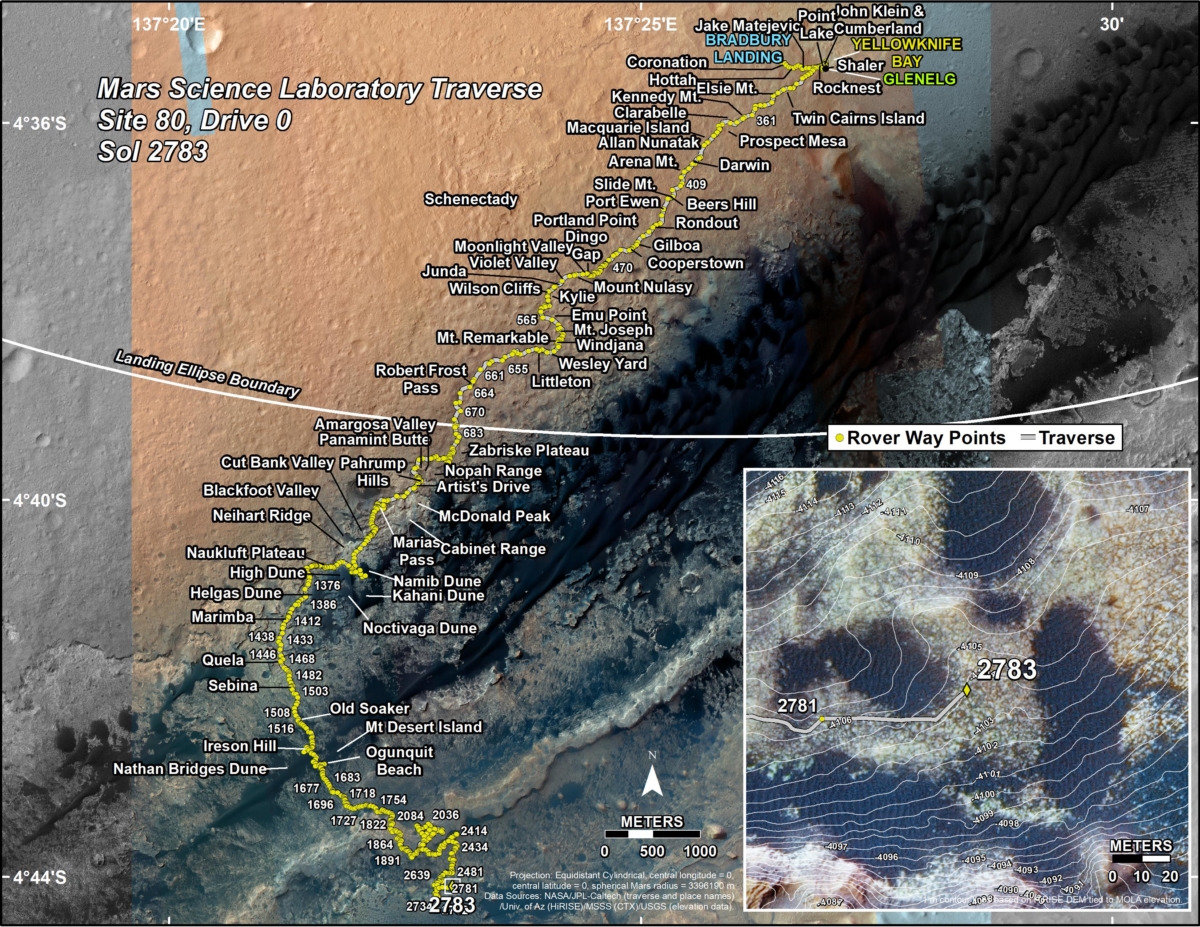
Meanwhile, a new Curiosity road map shows the route driven by the robot through the 2783 Martian day, or sol, of the rover’s mission on Mars (June 5, 2020).
Numbering of the dots along the line indicate the sol number of each drive. North is up. The scale bar is 1 kilometer (~0.62 mile).
From Sol 2781 to Sol 2783, Curiosity had driven a straight line distance of about 168.85 feet (51.47 meters), bringing the rover’s total odometry for the mission to 13.82 miles (22.24 kilometers).
The base image from the map is from the High Resolution Imaging Science Experiment Camera (HiRISE) in NASA’s Mars Reconnaissance Orbiter.
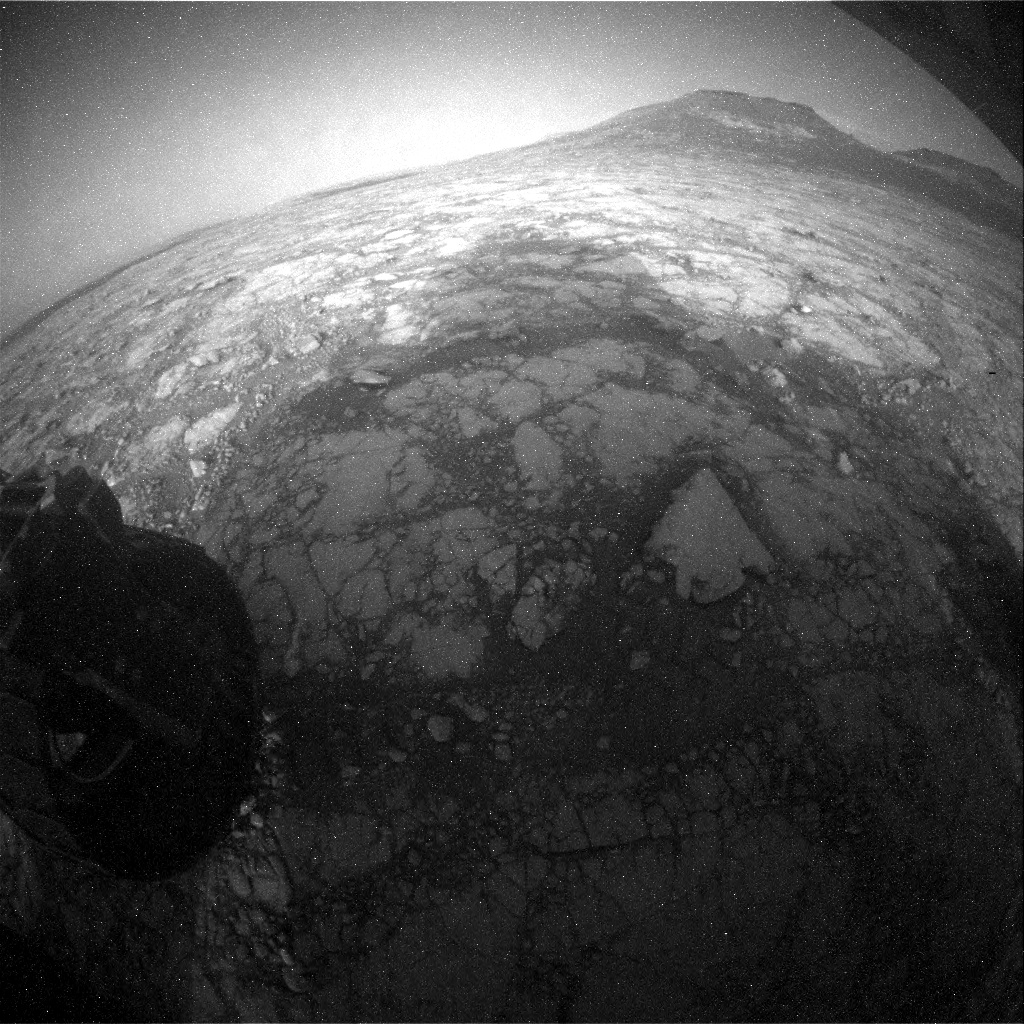
Curiosity Rear Hazard Avoidance Camera Right B image taken on Sol 2786, June 7, 2020.
Credit: NASA/JPL-Caltech

