Archive for the ‘Space News’ Category
 Author:
  July 16th, 2020
Credit: NASA
NASA’s Office of Inspector General (OIG) released today a report: NASA’s Management of the Orion Multi-Purpose Crew Vehicle Program.
Among the findings, the OIG found that Orion has continued to experience cost increases and schedule delays. Since the cost and schedule baseline was set in 2015, the program has experienced over $900 million in cost growth through 2019, a figure expected to rise to at least $1.4 billion through 2023.

Ambitious goal
Since 2006, NASA has been developing the Orion Multi‐Purpose Crew Vehicle (Orion) to transport astronauts beyond low Earth orbit. With the announcement of the Artemis Program in May 2019, NASA set the ambitious goal of using Orion to return humans to the Moon by 2024. As of July 2020 Orion has flown three test flights but none with astronauts on board.
The OIG also found that NASA’s exclusion of more than $17 billion in Orion‐related costs has hindered the overall transparency of the vehicle’s complete costs. Both federal law and NASA policy call for a Life Cycle Cost estimate for all major science and space programs costing more than $250 million, and for the Agency Baseline Commitment (ABC) to be based on all formulation and development costs.

Artist rendering of Lockheed Martin-built Orion spacecraft in deep space.
Credit: Lockheed Martin
Tailored approach
The Orion Program received approval from the NASA Associate Administrator, the OIG reports notes, to deviate from those requirements, resulting in exclusion of $17.5 billion in Orion‐related costs from fiscal year (FY) 2006 to FY 2030 due to the Agency’s tailored approach to program management and cost reporting.
Although these exclusions have been approved, the tailoring of these cost reporting requirements significantly limits visibility into the total amount spent on development and production efforts.
To read the full report — NASA’s Management of the Orion Multi-Purpose Crew Vehicle Program – go to:
 Posted in

Curiosity Left B Navigation Camera photo taken on Sol 2822, July 14, 2020.
Credit: NASA/JPL-Caltech
NASA’s Curiosity Mars rover is now performing Sol 2824 tasks.
“Curiosity continues its cross-country trek today, looking for our next drill site,” reports Sean Czarnecki, a planetary geologist at Arizona State University in Tempe.

Mars Hand Lens Imager photo produced on Sol 2822, July 14, 2020.
Credit: NASA/JPL-Caltech/MSSS
A recently drawn up plan includes a long drive that should put the rover within view of potential drill targets.

Curiosity Left B Navigation Camera photo acquired on Sol 2823, July 15, 2020.
Credit: NASA/JPL-Caltech
Clay-rich rocks
“It is hoped that the region we are driving to will be a good opportunity to sample the clay-rich rocks of Glen Torridon one last time,” Czarnecki adds. “Of course we are still filling in some science observations around the long drive.”

Curiosity Front Hazard Avoidance Camera Right B image taken on Sol 2823, July 15, 2020.
Credit: NASA/JPL-Caltech
Before driving, the plan calls for Chemistry and Camera (ChemCam) observations of targets “Tollcross” and “Sasainn” as well as a Mastcam image mosaic of target “Thirl Moor.”

Curiosity Chemistry & Camera Remote Micro Imager (RMI) photo acquired on Sol 2823, July 14, 2020.
Credit: NASA/JPL-Caltech/LANL

Curiosity Chemistry & Camera Remote Micro Imager (RMI) photo acquired on Sol 2823, July 15, 2020.
Credit: NASA/JPL-Caltech/LANL

Curiosity Right B Navigation Camera photo taken on Sol 2823, July 15, 2020.
Credit: NASA/JPL-Caltech
Clouds and dust devils
“After the long drive, we will have untargeted ChemCam observations of two additional targets,” Czarnecki notes, a Dynamic Albedo of Neutrons (DAN) active measurement, and the robot’s Navcam will look for clouds and dust devils.
DAN, Rover Environmental Monitoring Station (REMS) and Radiation Assessment Detector (RAD) will work overtime making environmental observations before, during, and after the drive, Czarnecki concludes.

Credit: NASA/JPL-Caltech/Univ. of Arizona
New road map
This map shows the route driven by NASA’s Mars rover Curiosity through the 2822 Martian day, or sol, of the rover’s mission on Mars (July 15, 2020).
Numbering of the dots along the line indicate the sol number of each drive. North is up. The scale bar is 1 kilometer (~0.62 mile).
From Sol 2820 to Sol 2822, Curiosity had driven a straight line distance of about 7.26 feet (2.21 meters), bringing the rover’s total odometry for the mission to 14.27 miles (22.96 kilometers).
The base image from the map is from the High Resolution Imaging Science Experiment Camera (HiRISE) in NASA’s Mars Reconnaissance Orbiter.

Credit: ISEC
A just-released study underscores the promising outcome from establishing a “Galactic Harbour” anchored in developing space elevator technology.
The International Space Elevator Consortium (ISEC) has issued “Space Elevators are the Transportation Story of the 21st Century – A Primer for Progress in Space Elevator Development.”

Credit: ISEC
New paradigm
The study suggests that a new paradigm has emerged, reinforced by some key viewpoints:
— Space elevators can be accomplished because we now have a material
— Space elevators enable interplanetary missions
— Fast transit to Mars (as short as 61 days)
— Space elevators can move massive amounts of cargo (180,000 MTs/year to GEO-beyond)
— Space Elevators are Earth friendly; no rocket exhaust to contribute to global warming and no additional space debris

Credit: Obayashi Corporation of Tokyo, Japan
Appropriate architecture
“Two of our messages are pretty straightforward,” explains Peter Swan, President of ISEC. “The Space Elevator will change the way we do interplanetary (and GEO for missions such as Space Solar Power). The future needs an appropriate architecture for space access, containing two major components – Space Elevator permanent transportation infrastructure and rocket portals.”
Some conclusions from the ISEC appraisal are stimulating.

Courtesy: Sky Line
For one, the Space Elevator is closer than you think, reports the ISEC. Galactic Harbours will enable robust missions to Moon and Mars. Also, only Space Elevators can deliver the requirements of logistics equipment and supplies to the Moon and Mars. Indeed, Colonization on Mars cannot happen without the logistics support of Space Elevators, the group explains.
For more information on the International Space Elevator Consortium (ISEC) and its reports, go to:
https://www.isec.org/studies/#TransportStory
These reports are available at no cost. Hardcopy versions are available for purchase at Lulu.com.

Curiosity Mars Hand Lens Imager photo taken on Sol 2822, July 14, 2020.
Credit: NASA/JPL-Caltech/MSSS
NASA’s Curiosity Mars rover is now conducting Sol 2822 duties.
The rover continues to drive towards a next potential drill location, the first planned pit stop on its summer road trip, reports Mariah Baker, a planetary geologist at the Center for Earth & Planetary Studies, Smithsonian National Air & Space Museum in Washington, D.C.
By the time Curiosity arrives at the designated drill area, the robot will have travelled over 14 miles (23 kilometers) since landing on Mars in August 2012.

Curiosity Mars Hand Lens Imager photo taken on Sol 2822, July 14, 2020.
Credit: NASA/JPL-Caltech/MSSS
Jagged rocks
“But driving across the rocky Martian surface isn’t always easy; sharp obstacles and jagged rocks have caused some minor damage to the rover’s wheels over the years,” notes Baker.
In order to check on the condition of the wheels and track their degradation over time, the team periodically images them with the Mars Hand Lens Imager (MAHLI) camera. “As it happens, we are due for a new set of wheel images, so today’s “drive” is a bit unique: the rover will only travel a little over a meter, just enough to image one full rotation of the wheels.”

Curiosity Mars Hand Lens Imager photo taken on Sol 2822, July 14, 2020.
Credit: NASA/JPL-Caltech/MSSS
Bedrock targets
Before this unusually short drive, Curiosity is slated to acquire data on the local geology; bedrock targets “Cateran Trail” and “Cowal Way” will be targeted with the Chemistry and Camera (ChemCam) instrument and imaged with Mastcam for documentation purposes.
Mastcam will also capture stereo mosaics of nearby features of interest named “Fife Coastal Path” (a rock fracture) and “Glenfinnan Viaduct” (tilted rocks).
Baker adds that the robot’s Navcam will also be used to image sediment that has accumulated on the rover deck.

Curiosity Mars Hand Lens Imager photo taken on Sol 2822, July 14, 2020.
Credit: NASA/JPL-Caltech/MSSS
Strategic path
After the wheel imaging, standard post-drive images will be acquired with Hazcam, Navcam, and Mastcam. There will also be two ChemCam Autonomous Exploration for Gathering Increased Science (AEGIS) observations and two larger Mastcam mosaics, one of the rover’s target drill area and one of a more distant geologic contact.
Lastly, three observations (two with Navcam and one with Mastcam) will be used to monitor dust activity in Gale crater.
“Although our wheels have suffered some damage over the years, they’re still very capable of taking us where we need to go and we continue to make good progress on our strategic path,” Baker concludes. “We expect to arrive at our designated drill location by the weekend, and we will be back on the road once our drill is complete!”

Credit: Wan, W.X., Wang, C., Li, C.L. et al.
China’s Tianwen-1 Mars spacecraft appears slated for a July 23 launch date (the opening of the launch window).
The Mars probe has been transported to Wenchang Satellite Launch Center on Hainan Island. It is set to be launched atop a Long March 5 carrier rocket in the coming days, with arrival at Mars seven months later.
The mission will study the Red Planet with a combination of orbiter and lander/rover.

China’s Mars landing regions.
Courtesy: James Head
Candidate landing site: Utopia Planitia
In a just published Nature Astronomy paper — “China’s first mission to Mars” – details about the mission are outlined, among them:
The Tianwen-1 probe has a mass (including fuel) of about 5 tons.

China’s Mars orbiter, lander, rover effort.
Credit: China Aerospace Technology Corporation
The orbiter will provide a relay communication link to the rover, while performing its own scientific observations for one Martian year. The orbit during the scientific observation stage is a polar elliptical orbit 165 miles x 746 miles (265 km × 12,000 kilometers).
The Tianwen-1 probe is expected to reach Mars around February 2021 and the scientific observation phase will start in April 2021.

Viking 2 Image of Mars Utopian Plain.
Credit: NASA/JPL-CalTech
The lander/rover will perform a soft landing on the Martian surface some 2–3 months after arrival of the spacecraft, with a candidate landing site in Utopia Planitia. It is the Martian region where the NASA Viking 2 lander touched down on September 3, 1976.
Scientific instruments
The roughly 530 pound (240 kilograms) solar-powered rover is nearly twice the mass of China’s Yutu lunar rovers, and is expected to be in operation for about 90 Martian days.
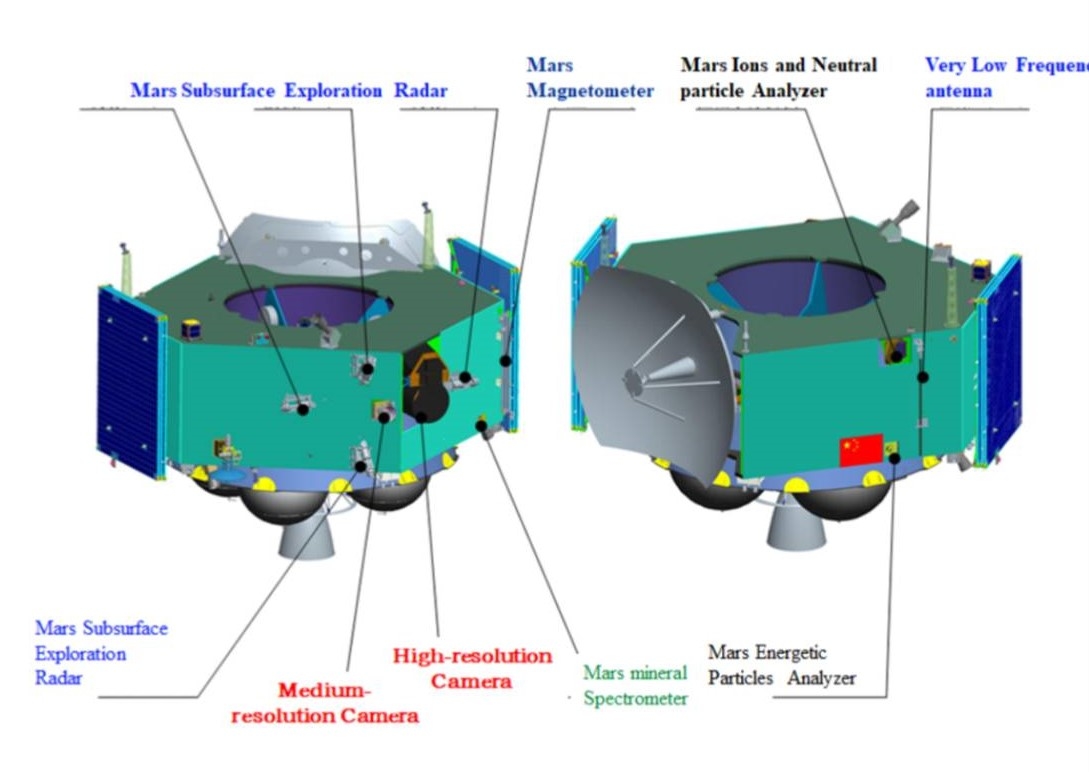
China’s Mars orbiter.
Courtesy: James Head
There are 13 scientific payloads in the Tianwen-1 mission in total.
The seven instruments on board the orbiter comprise two cameras, the Mars-Orbiting Subsurface Exploration Radar, Mars Mineralogy Spectrometer, Mars Magnetometer, Mars Ion and Neutral Particle Analyzer, and Mars Energetic Particle Analyzer.
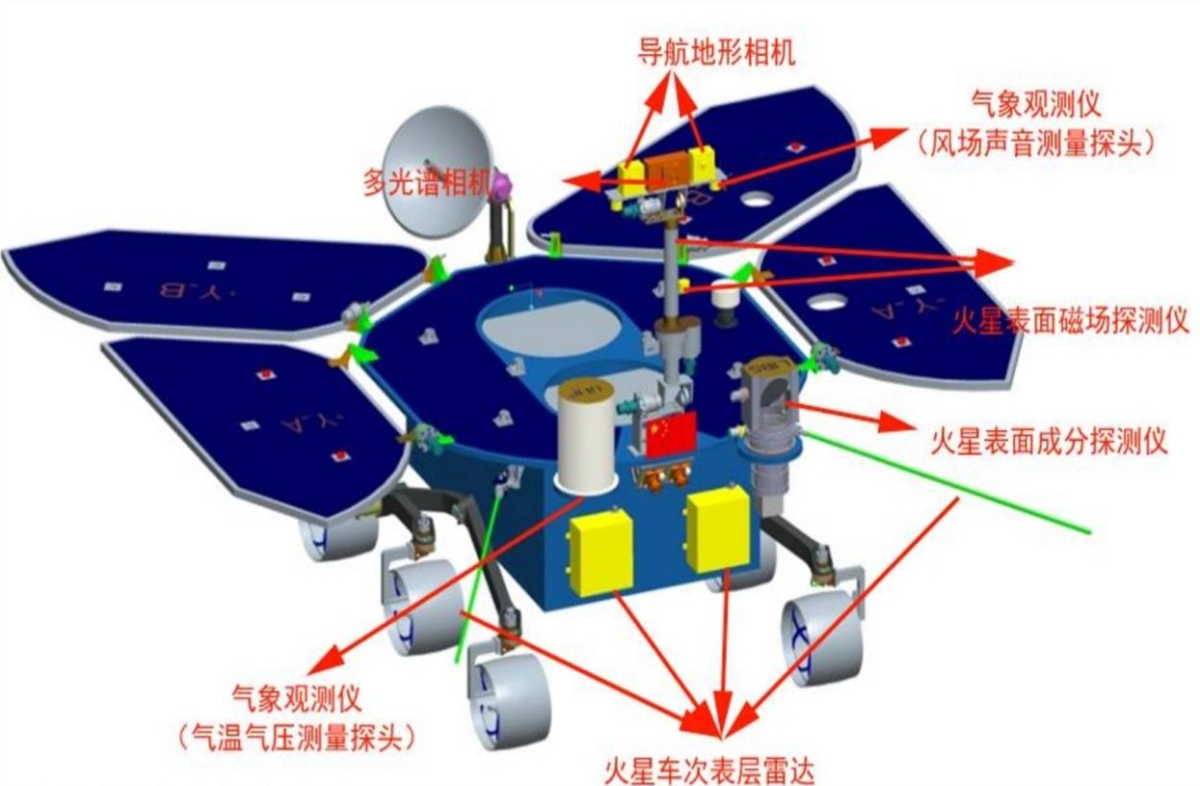
China’s Mars rover.
Courtesy: James Head
The six instruments installed on the rover comprise the Multispectral Camera, Terrain Camera, Mars-Rover Subsurface Exploration Radar, Mars Surface Composition Detector, Mars Magnetic Field Detector, and Mars Meteorology Monitor.
Comprehensive mission

China’s Mars mission elements.
Credit: CCTV/Inside Outer Space screengrab
According to the paper’s authors, “Tianwen-1 is going to orbit, land and release a rover all on the very first try, and coordinate observations with an orbiter. No planetary missions have ever been implemented in this way. If successful, it would signify a major technical breakthrough. Scientifically, Tianwen-1 is the most comprehensive mission to investigate the Martian morphology, geology, mineralogy, space environment, and soil and water-ice distribution.”
To read the full Nature Astronomy paper — China’s first mission to Mars – go to:
NASA’s Curiosity Mars rover is now performing Sol 2822 duties.
Here are some newly relayed images from the robot:

Curiosity Right B Navigation Camera image taken on Sol 2821, July 13, 2020.
Credit: NASA/JPL-Caltech

Curiosity Right B Navigation Camera image taken on Sol 2821, July 13, 2020.
Credit: NASA/JPL-Caltech

Curiosity Right B Navigation Camera image taken on Sol 2821, July 13, 2020.
Credit: NASA/JPL-Caltech

Curiosity Front Hazard Avoidance Camera Right B photo acquired on Sol 2821, July 13, 2020.
Credit: NASA/JPL-Caltech

Curiosity Chemistry & Camera Remote Micro-Imager (RMI) photo taken on Sol 2821, July 13, 2020.
Credit: NASA/JPL-Caltech/LANL

Curiosity Mast Camera Right image taken on Sol 2820, July 12, 2020.
Credit: NASA/JPL-Caltech/MSSS

Credit: NASA/JPL-Caltech/Univ. of Arizona
Road map
This map shows the route driven by NASA’s Mars rover Curiosity through the 2816 Martian day, or sol, of the rover’s mission on Mars (July 8, 2020).
Numbering of the dots along the line indicate the sol number of each drive. North is up. The scale bar is 1 kilometer (~0.62 mile).
From Sol 2813 to Sol 2816, Curiosity had driven a straight line distance of about 139.21 feet (42.43 meters), bringing the rover’s total odometry for the mission to 14.18 miles (22.83 kilometers).
The base image from the map is from the High Resolution Imaging Science Experiment Camera (HiRISE) in NASA’s Mars Reconnaissance Orbiter.
I can see clearly now…there’s dust on Mars!

Image Credit: NASA/JPL-Caltech
Comparative images from NASA’s InSight Mars lander from Sol 10 to Sol 578 show that the spacecraft is quite dusty.
Robotic arm-mounted, Instrument Deployment Camera (IDC) images taken on December 7, 2018, Sol 10 and recent July 12, 2020, Sol 578 photos reveal the coating of Mars dust.
InSight landed on the Red Planet on November 26, 2018.

Image Credit: NASA/JPL-Caltech
Power decrease
“They do look dusty, don’t they! It was a little jolting to see the new images, although I shouldn’t really have been surprised,” said Bruce Banerdt, Principal Investigator for the InSight Mission to Mars at Jet Propulsion Laboratory.
“We have been monitoring the output from the arrays continuously since the beginning of the mission, and the power decrease has been pretty consistent with our model predictions,” Banerdt told Inside Outer Space.”

InSight’s first full selfie on Mars comprised of 11 photos stitched together to make this mosaic, created on December 6, 2018 (Sol 10).
Credit: NASA/JPL-Caltech
Cleaning event?
Banerdt said the InSight team is always hoping for a cleaning event, as was the experience on numerous occasions by earlier Mars rovers, Spirit and Opportunity, but so far InSight has not experienced one.
“Even so, we have a pretty hefty energy survival margin with the current array conditions,” Banerdt added.
“Our models of dust accumulation predict that we can easily last through our prime mission, and should be able to last through at least an additional Mars year under a normal range of weather conditions, although we have tighter and tighter energy margins as the arrays get less efficient due to dust coverage,” Banerdt said.

Yuanwang-6 tracking ship.
Credit: PLAN
China’s space tracking ship Yuanwang-6 has set sail on multiple spacecraft monitoring missions.
The Xinhua news agency reports that Yuanwang-6 will carry out missions in the Pacific Ocean, the Indian Ocean and the Atlantic Ocean – the first time for a Yuanwang ship to perform missions in the three oceans during a single voyage.
The ship has completed an overhaul, maritime calibration tests, equipment precision appraisals and two satellite maritime monitoring missions this year.
China’s Mars orbiter, lander, rover effort.
Credit: China Aerospace Technology Corporation
Mars mission
It is likely this ship will be in position for duties associated with China’s Tianwen-1 Mars mission that constitutes an orbiter, lander, and rover.
China’s Mars mission elements.
Credit: CCTV/Inside Outer Space screengrab
China plans to launch its first Mars probe between July 20 and 25, according to the China Global Television Network (CGTN).
To reach Mars in 2021, the spacecraft will be lofted by a Long March 5 Y4 carrier rocket.
China’s Mars landing regions.
Courtesy: James Head
Regarding the selection of China’s robotic Mars landing site, two regions have been identified that represent a wide array of scientific sleuthing, including appraising possible habitats of life.
The lander/rover will perform a soft landing on the Martian surface some 2–3 months after arrival of the spacecraft, with a candidate landing site in Utopia Planitia.

Space is Open for Business – The Industry That Can Transform Humanity by Robert C. Jacobson; Self-published, Release Date: July 2020; Available by pre-order.
The space industry is experiencing a renaissance, led by private companies who have pushed the boundaries and continue innovating at a rapid pace, explains space investor and entrepreneur, Robert C. Jacobson.
The author underscores the fact that we are “in the middle of a critical turning point: the NewSpace revolution needs public interest, increased investment, improved government policy, and widespread collaboration to propel forward and reach its full potential.”
Divided into seven parts, the reader will enjoy Jacobson’s thoughtful guide to the evolving space industry, such as “Investing in the Cosmos,” “Joining the Movement,” and “The Blueprint of Evolution.” The book offers insightful looks at many of the space entrepreneurs of today that are indeed shaping NewSpace.
“Space is, in fact, a culmination of many disciplines, and it works in tandem with various industries,” the author explains. “The sector’s growth depends on merging different fields with cutting-edge technologies, fantastical ideas with logical applications.”
I found this volume an uplifting read. In addition, Jacobson offers a “non-exhaustive list” of the immediate, necessary changes needed to propel NewSpace forward and achieve its unlimited potential. Culled together are a series of key steps to do so.
“Smart policy, technology and innovation adoption, increased space-entrepreneurship, and timing will all affect the industry’s trajectory,” writes Jacobson.
Space is the unlimited business plan, the author believes. Space can transform the world in ways not possible by the bounds of terrestrial business endeavors. If you can dream it, it may be possible in this space-future.
The book concludes with a comprehensive set of references that adds to this book’s unique contribution to the evolving and expansive world of NewSpace.
For more information on Space is Open for Business – The Industry That Can Transform Humanity go to:

Curiosity Left Navigation Camera image acquired on Sol 2817, July 9, 2020.
Credit: NASA/JPL-Caltech
NASA’s Curiosity Mars rover is now carrying out Sol 2819 tasks.
Last Wednesday, Curiosity successfully drove a whopping 336 feet (102.5 meters) over 159 minutes, reports Abigail Fraeman, a planetary geologist at NASA’s Jet Propulsion Laboratory.
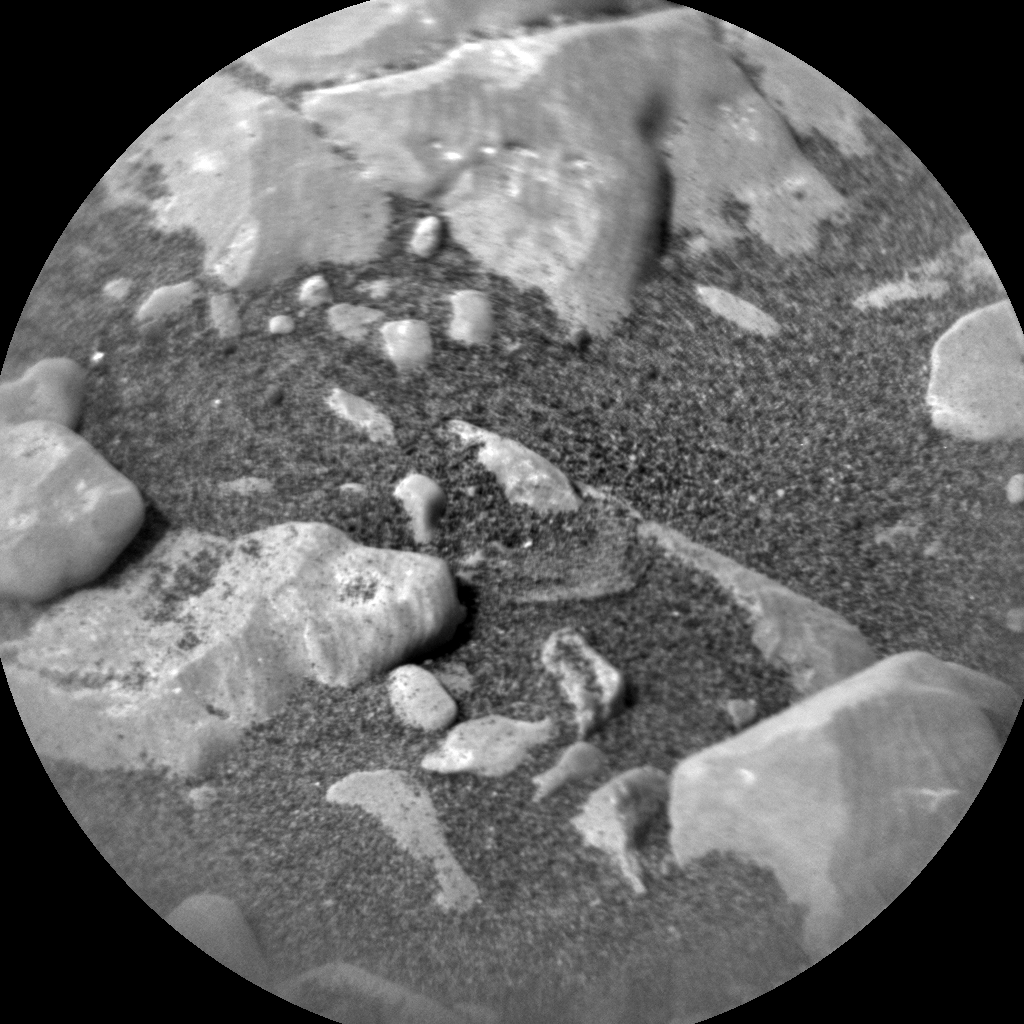
Curiosity Chemistry & Camera image taken on Sol 2818, July 10, 2020.
Credit: NASA/JPL-Caltech/LANL
“This isn’t the longest drive Curiosity’s ever completed (the record is 142.5 meters on sol 665), but it did set a record for the longest drive ever planned from our quarantined dining room tables and couches,” Fraeman adds.
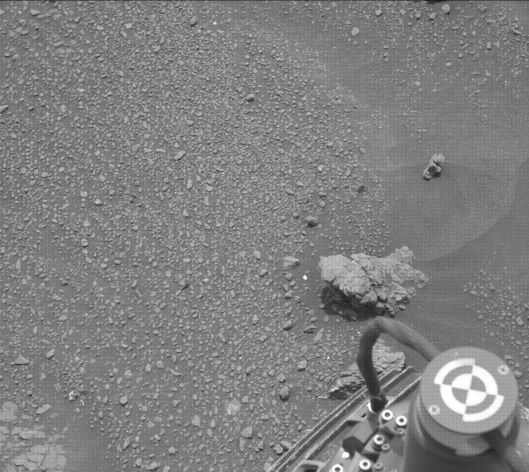
Curiosity Mast Camera Left image taken on Sol 2817, July 9, 2020.
Credit: NASA/JPL-Caltech/MSSS
Great progress
“We’re making great progress on our summer road trip towards the sulfate unit, and are getting very close to our first ‘rest stop.’ While I have fond memories of pulling over at the Delaware House during my many trips up and down the east coast of the U.S. as a child, Curiosity’s rest stop will be a location in the clay unit that we might decide to drill in order to collect one last clay-rich sample we leave the area,” Fraeman explains.
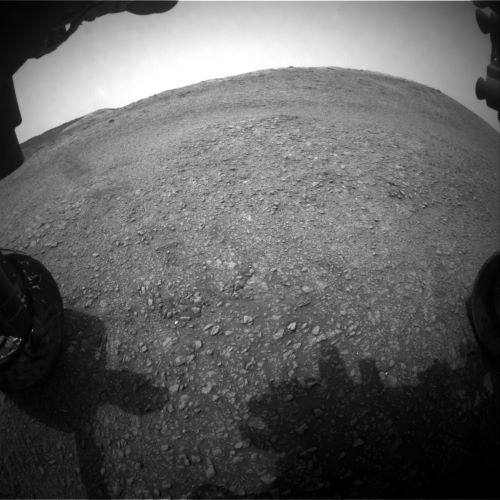
Curiosity Front Hazard Avoidance Camera Left B photo acquired on Sol 2818, July 10, 2020.
Credit: NASA/JPL-Caltech
A new plan calls for the robot to drive another roughly 105 feet (32 meters) on the second sol of the weekend’s plan.
Pebbly workspace
Before that, Curiosity will collect Chemistry and Camera (ChemCam) observations on targets named “Reivers Route,” “Moray Coastal Trail,” and “West Highland Way,” and take some Mastcam mosaics.
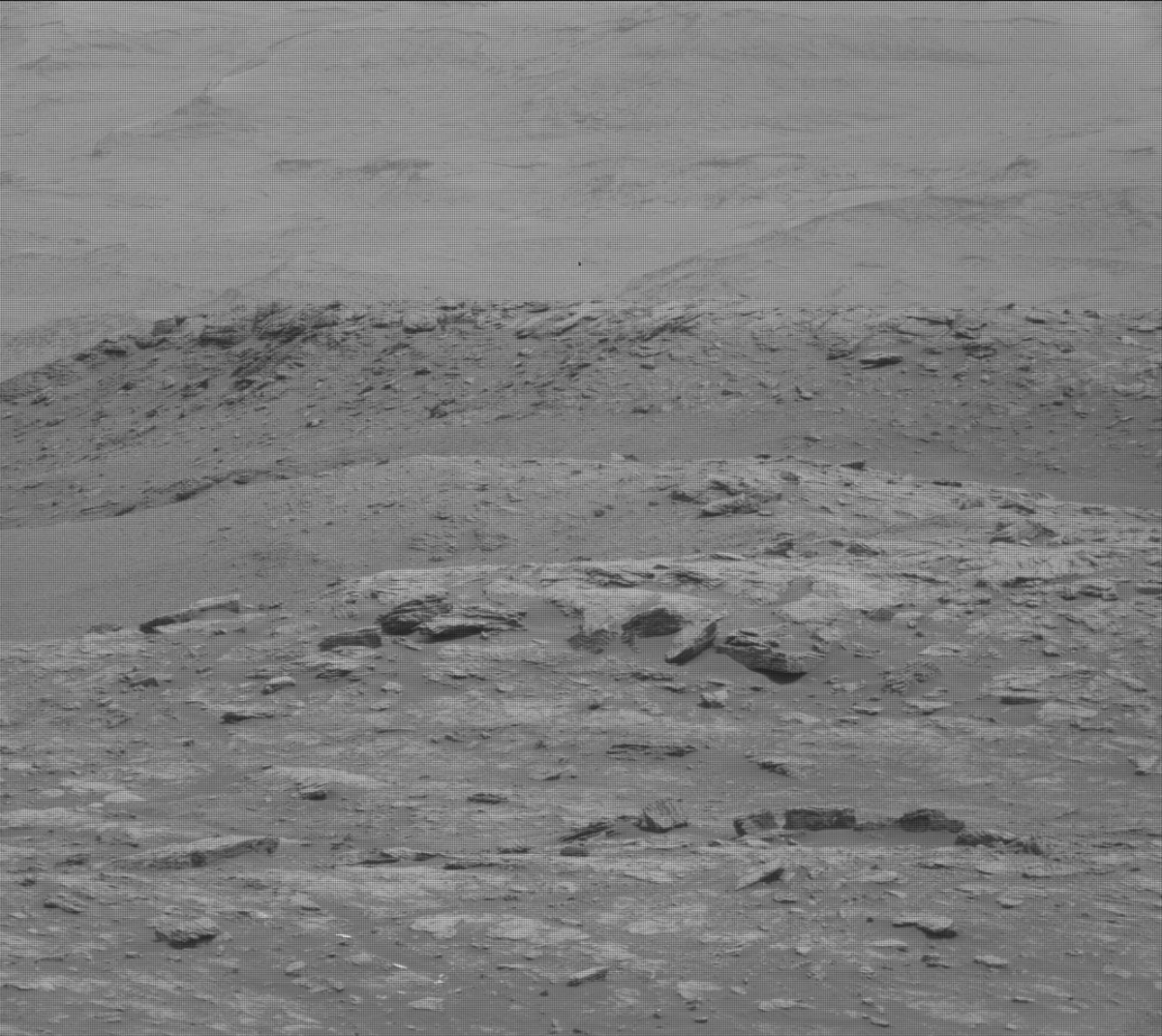
Curiosity Mast Camera Right image taken on Sol 2817, July 9, 2020.
Credit: NASA/JPL-Caltech/MSSS
Also on the plan is use of the Alpha Particle X-Ray Spectrometer (APXS) and Mars Hand Lens Imager (MAHLI) data from a target named “Kintyre Way,” which is one of the larger rocks in the pebbly workspace in front of the rover.
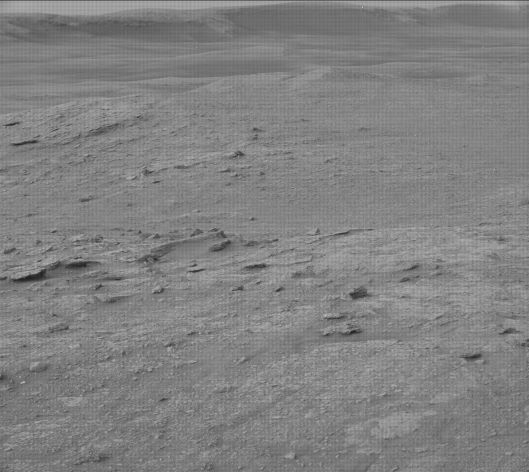
Curiosity Mast Camera Left image taken on Sol 2817, July 9, 2020.
Credit: NASA/JPL-Caltech/MSSS
Lastly, Curiosity will collect the usual suite of observations to measure the environmental conditions, Fraeman concludes, and image the ChemCam calibration targets after the drive on the third sol of the weekend plan, Sols 2819-2821.

