Archive for the ‘Space News’ Category
 Author:
  July 25th, 2020
Anti-satellite painting by William K. Hartmann
In this Arms Control and International Security (ACIS) paper, Christopher Ashley Ford, Assistant Secretary for International Security and Nonproliferation discusses his long-standing efforts to find effective forms of arms control in outer space.
Future prospects
The paper also offers the reasons such efforts have failed in the modern era, before exploring what prospects there yet may be for international efforts to reduce risk, increase transparency and predictability, and head off the dangers of an outer space arms race.

A highly modified F-15A scored a direct hit on a U.S. satellite in this Sept. 13, 1985 test shot over Edwards Air Force Base, California.
Credit: Edwards Air Force Base
This series paper characterizes both the Russian federation and the People’s Republic of China (PRC) as rushing to weaponize the space domain.
The Papers are produced by the Office of the Under Secretary of State for Arms Control and International Security.
To access the July 24, 2020 paper — Arms Control in Outer Space: History and Prospects – go to:
Also, go to this special briefing by Christopher A. Ford on the U.S.-Russia Space Security Exchange at:
 Posted in

Image of layered block named “Mary Anning” — possible next drill target — taken by Curiosity’s Left Navigation Camera on Sol 2829.
Credit: NASA/JPL-Caltech.

Mary Anning.
Courtesy: Biodiversity Heritage Library
NASA’s Curiosity Mars rover is now carrying out Sol 2832 tasks.

Curiosity Front Hazard Avoidance Camera Right B image taken on Sol 2831, July 23, 2020.
Credit: NASA/JPL-Caltech
Reports Michelle Minitti, a planetary geologist at Framework in Silver Spring, Maryland: “Our drive in the last plan successfully placed at what we hope is our next drill site, the large, lovely, layered block. (photo at left). It is always exciting to name a new drill target, but the new name, ‘Mary Anning,’ is particularly special.
Minitti explains that Mary Anning spent her life scouring the seaside cliffs near Lyme Regis, along the southern coast of England, for fossils. “She uncovered innumerable samples, most notably the first full Ichthyosaur and the first Plesiosaur.”
But as all too often occurs in society, Minitti adds, “Mary Anning’s gender and societal status led her groundbreaking work and discoveries to be dismissed by the scientific establishment or, worse, appropriated by men. Let Mary Anning’s name on Mars remind us to include everyone in the endeavor of exploration.”

Curiosity Right B Navigation Camera photo taken on Sol 2831, July 23, 2020.
Credit: NASA/JPL-Caltech
Drilling next week
Curiosity Mars teams have played a role in planning the five sols that will accomplish the work necessary to attempt drilling next week, Minitti notes.
The robot’s Chemistry and Camera (ChemCam) will measure the chemistry of both the primary and back up Mary Anning drill targets, in addition to “Carter Fell,” another target on the large bedrock slab the rover will drill.

Curiosity Chemistry & Camera Remote Micro-Imager (RMI) photo acquired on Sol 2831, July 23, 2020.
Credit: NASA/JPL-Caltech/LANL
Gauge its hardness
The Alpha Particle X-Ray Spectrometer (APXS) will also analyze the chemistry of the primary Mary Anning target, the Mars Hand Lens Imager (MAHLI) will image the target in detail, and then rover planners will push the drill bit into the drill target to gauge its hardness and test its ability to withstand the force of the drill activity.
Imaging of region
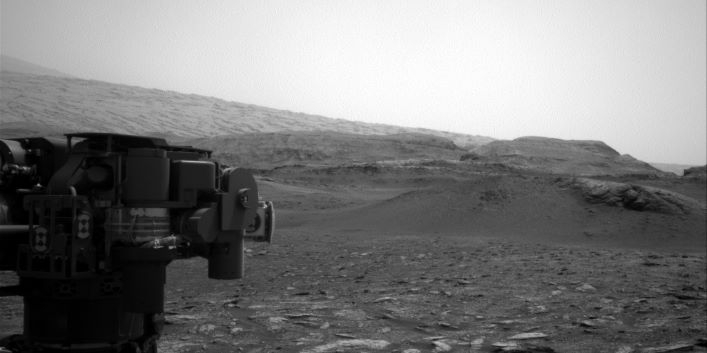
Curiosity Right B Navigation Camera photo taken on Sol 2831, July 23, 2020.
Credit: NASA/JPL-CaltechImaging of region
“Mastcam will acquire a 360 degree panoramic mosaic of our surroundings, which documents the context of our drill location within the Glen Torridon region and facilitates planning for more detailed imaging of the region,” Minitti reports. “Since the workspace is obviously of interest, Mastcam will also acquire a detailed stereo mosaic that covers the workspace.”

Curiosity Mast Camera Left image acquired on Sol 2829, July 21, 2020.
Credit: NASA/JPL-Caltech/MSSS
Curiosity’s Chemistry & Mineralogy X-Ray Diffraction/X-Ray Fluorescence Instrument (CheMin) will conduct an empty cell analysis, Minitti adds, and the Sample Analysis at Mars (SAM) Instrument Suite will test out analysis techniques, each in preparation for analyzing the next drill sample.

Curiosity Right B Navigation Camera photo taken on Sol 2830, July 22, 2020.
Credit: NASA/JPL-Caltech
Skyward looks
“Even as our attention is drawn to the rocks around us, dust storm season swirls about Curiosity, warranting our attention on the skies as well. ChemCam will turn its spectrometers skyward in passive mode to observe a wide area of the sky in order to measure concentrations of minor gases (especially oxygen and water) and dust,” Minitti points out.
Combinations of Navcam and Mastcam will monitor the amount of dust in the atmosphere early in the morning, around midday, and later in the afternoon; Navcam will also look for dust devils around midday and clouds early in the morning.
Long plan
Also on tap, the Radiation Assessment Detector (RAD) and the Dynamic Albedo of Neutrons (DAN) are slated to make dozens of measurements across four sols.
The rover’s Rover Environmental Monitoring Station (REMS) will make regular measurements of Martian weather conditions throughout the plan, Minitti concludes. “It is the lone star of the show on the final sol of the plan, dutifully working away as the rest of the instruments take a much needed break at the end of the long plan.”

NASA’s Artemis program.
Credit: NASA
The White House National Space Council has released a report on Deep Space Exploration and Development in consultation with the Council’s members and its Users’ Advisory Group. It describes the rationale and purpose for the Administration’s new direction in space.
Whole of government approach
“‘A New Era for Deep Space Exploration and Development’ represents a comprehensive, whole-of-government approach to this Administration’s ambitious space exploration efforts, providing a vision for a sustained human presence on, and the robust commercial development of, the Moon and Mars,” said Executive Secretary of the National Space Council, Scott Pace.

Credit: NASA
“This report describes how and why the United States will proceed with deep space exploration,” Pace adds in a press statement, “delineating the strategic interests and specific programs that underpin America’s position as the world’s leader among spacefaring nation.”
Report highlights
The newly issued report delves into the commercialization of low-Earth orbit; returning to the Moon to stay; extending a human presence to Mars; the potential for deep space science; and education and the U.S. workforce.
The success of American space exploration and development in this new era, the report stresses, will require a whole-of-government approach.
Five primary government roles are crucial to executing the vision described in the report:
— Promote a secure and predictable space environment for the long-term sustainability of space activities;
— Support the development of commercial activity and industry in space;
— Support research and development of new space technologies;
— With commercial and international partners, create infrastructure needed for space exploration and development; and
— Support advanced space research by public and private sector U.S. research communities.

Credit: Blue Origin/Blue Moon
Commercial firms
The report explains that, “as soon as possible, and in accordance with the
Executive Order on “Encouraging International Support for the Recovery and Use of Space Resources”, commercial firms should take over routine operations to provide consumables like water, hydrogen, oxygen, and utilities such as power and communications. The transition to private sector responsibilities will represent an important step beyond space exploration to development and industrialization.”

Credit: JAXA
International partners
“As the United States journeys into deep space again,” the report explains, “it will do so with commercial and international partners as they are willing to participate and capable of participating.”
“At the frontiers of exploration, the United States will continue to lead, as it has always done, in space. If humanity does have a future in space, it should be one in which space is the home of free people,” the report concludes.
For the full report, go to:

A Long March-5 Y4 rocket departs from the Wenchang spacecraft launch site on the coast of southern China’s island province of Hainan.
Credit: CCTV/Inside Outer Space screengrab
China’s Mars mission Tianwen-1 is now en route for a targeted landing in May 2021, reportedly within the southern part of the Utopia Planitia – a relatively flat area selected for a safe touchdown spot and for scientific payoff.
The Mars mission is an all-in-one attempt to orbit the Red Planet, dispatch a lander that will then release a six-wheel solar-powered rover.

Credit: CCTV/Inside Outer Space screengrab
Seven-month sojourn
A Long March-5 Y4 rocket, China’s largest launch vehicle, lofted the spacecraft with a mass of about 5 tons on July 23 from the Wenchang Spacecraft Launch Site on the coast of southern China’s island province of Hainan at 12:41 p.m. (Beijing Time).

Outbound for Mars. Image of the release of China’s Tianwen-1 spacecraft.
Credit: CCTV/Inside Outer Space screengrab
About 36 minutes later, the Tianwen-1 spacecraft was sent into the Earth-Mars transfer orbit, embarking on a nearly seven-month sojourn to the Red Planet, according to the China National Space Administration (CNSA).
The craft is expected to enter the orbit of Mars around February 2021. Afterwards, it will spend two to three months surveying select landing sites using a high-resolution camera to prepare for the landing in May.

Credit: CCTV/Inside Outer Space screengrab
Orbiter, rover
China’s Xinhua news agency reports that, after the landing, the rover will be released to conduct scientific exploration with an expected lifespan of at least 90 Martian days (about three months on Earth), and the orbiter, with a design life of one Martian year (about 687 days on Earth), will relay communications for the rover while conducting its own scientific tasks.
Chinese space engineers and scientists have chosen a relatively flat region in the southern part of the Utopia Planitia, a large plain, as the potential landing zone. Earlier research suggests that this region may be an underground, water ice-rich zone. This possible site might be at the edge of an ancient ocean or lake in the early history of Mars.

“The reason we selected this place is that it has both the conditions for a safe landing and scientific research value. The place has not been investigated by other countries, so the scientific data can be shared with other countries to enrich the world’s understanding of Mars,” Geng Yan, an official at the Lunar Exploration and Space Program Center of the CNSA, reports Xinhua.
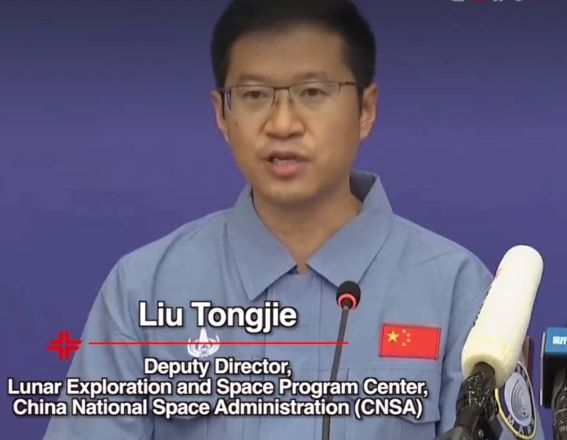
In a post-launch press conference, Liu Tongjie, spotlighted the southern part of the Utopia Planitia as the Tianwen-1 landing zone.
Transfer-orbit
Zhang Xueyu, commander of launching site headquarters of the Mars probe mission, declared the success of the launch mission. “As the information from the Aerospace Flight Control Center indicates, the Long March-5 Y4 rocket is flying normally. The Mars probe has accurately entered the orbit. Now I declare a complete success of the launch mission of China’s first Mars probe,” he said.
China’s CCTV noted the remarks of He Rongwei, chief commander of the Mars probe mission from the China Academy of Space Technology (CAST).
“The rocket performs very well and targets accurately, which has sent the Mars probe into the Earth-Mars transfer orbit precisely,” He said. “It should be said that our first Mars probe has a perfect start.”

Yuanwang-6 tracking ship.
Credit: PLAN
Tracking ships
Meanwhile, three space tracking ships of China’s Yuanwang fleet completed maritime monitoring of the country’s first Mars probe launch in the Pacific Ocean Thursday.
Xinhua reports that about six minutes after the liftoff, the Yuanwang-6 tracking ship detected and locked onto its targets, and carried out measuring of the rocket, and control and monitoring of the Mars spacecraft. The other two tracking ships, Yuanwang-5 and Yuanwang-7, then took turns to complete their missions.
The monitoring process lasted nearly 30 minutes.
As scheduled, Xinhua reports, the Yuanwang-5 and Yuanwang-7 tracking ships will return to China, while Yuanwang-6 will sail to its next mission area for satellite monitoring.
Go to these China Central Television (CCTV) videos that detail the launch and mission of Tianwen-1:
https://youtu.be/LC9CDUK660c?list=PLpGTA7wMEDFjz0Zx93ifOsi92FwylSAS3
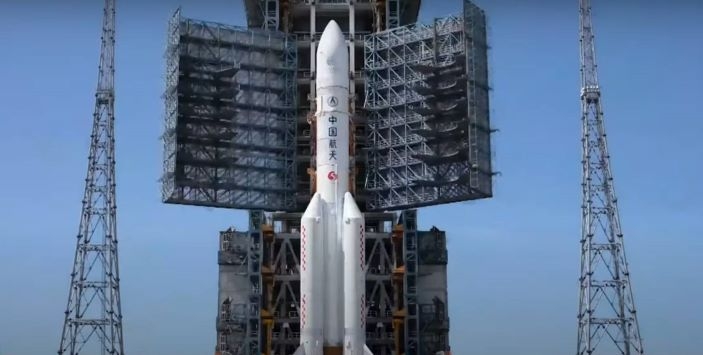
Credit: CCTV/Inside Outer Space screengrab
China’s first Mars exploration mission, known as “Tianwen-1” appears to have a targeted Thursday liftoff expected between just after midnight and 3 a.m. Eastern Daylight Time, assuming the weather cooperates.
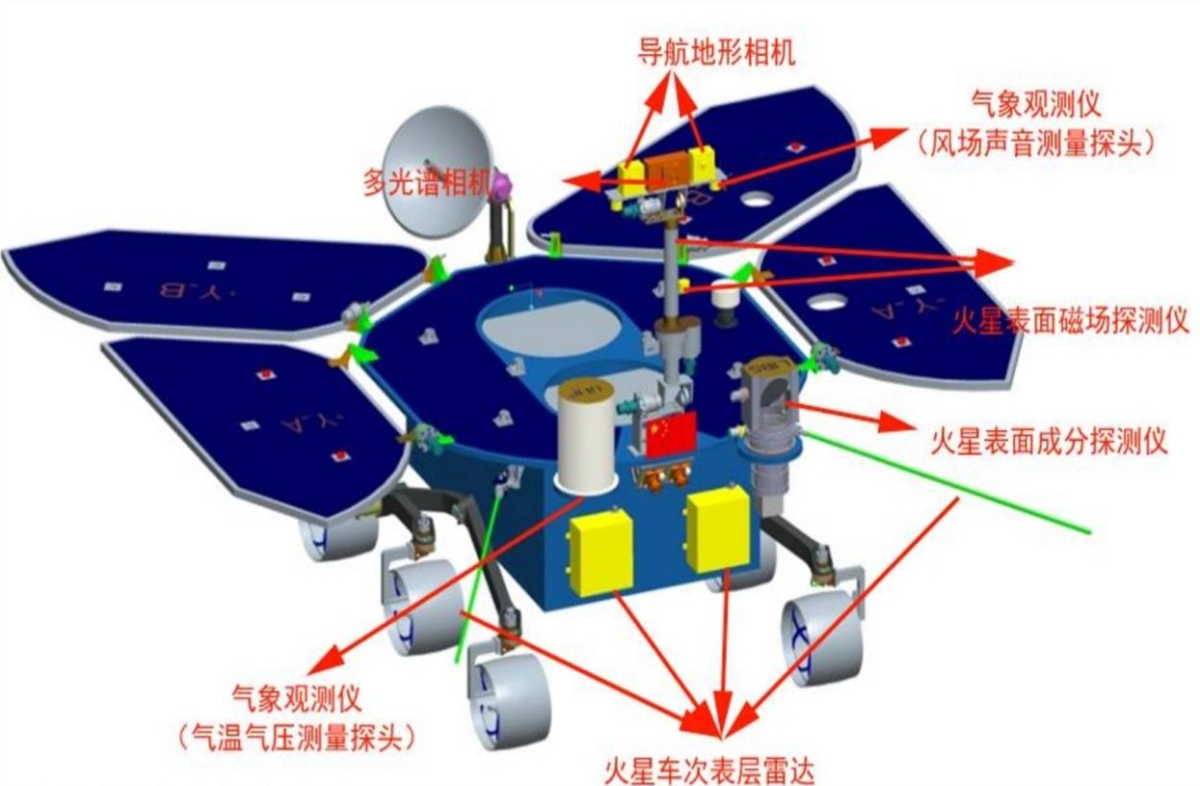
China’s Mars rover.
Courtesy: James Head
Meanwhile, more details on China’s Mars rover have been reported.
The rover will work for over 90 days on Mars. The robot is equipped with a 2 foot (60 centimeters)-high mast that supports two panorama cameras on its top to avoid obstacles when moving forward, as well as a multispectral camera to identify minerals.

Credit: CCTV/Inside Outer Space screengrab
Tilting solar panels
China’s Mars rover also has four “wings” – solar panels to provide power. The rover can adjust the angles of its solar panels to receive more solar power, according to Liu Tongjie, deputy director of the Moon Exploration and Space Engineering Center of the China National Space Administration (CNSA).
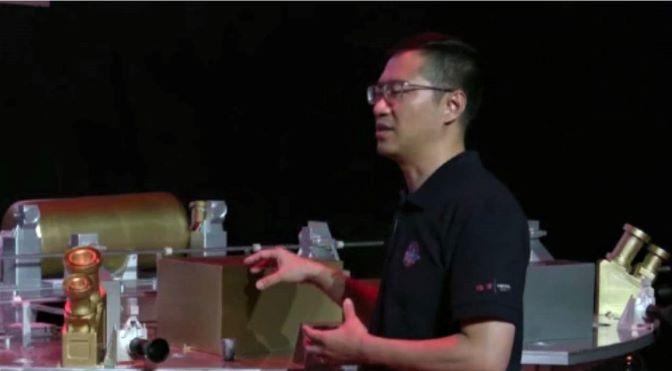
Liu Tongjie, deputy director of the Moon Exploration and Space Engineering Center of the China National Space Administration (CNSA).
Credit: CCTV/Inside Outer Space screengrab
“As Mars receives less solar energy than the Earth and the Moon, the area [of its solar panels] is larger. It can angle its solar panels according to the direction of the sunlight. The more vertical the angle is, the more solar energy it will receive,” Liu told China Central Television (CCTV).
Other instruments onboard include a detection radar, magnetometer and meteorological instruments.
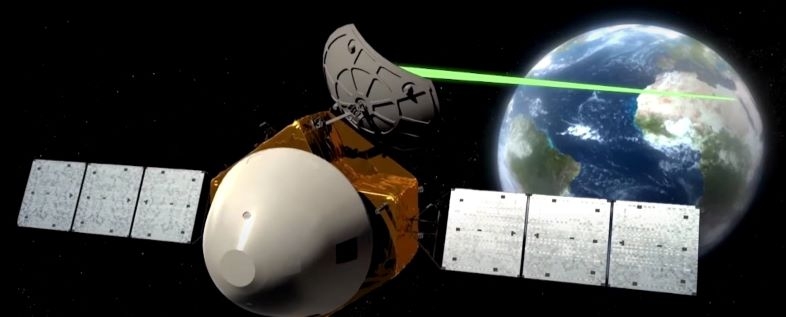
Credit: CCTV/Inside Outer Space screengrab
Subsurface studies
The Red Planet rover can detect the ingredients of soil 33 feet (10 meters) underneath the surface of Mars and of ice 328 feet (100 meters) below the surface.
The rover can move at a speed of 200 meters per hour on Mars’ surface.
Liu said the thin atmosphere of the Mars poses challenges to the rover and the landing platform during their landing process.

Credit: Wan, W.X., Wang, C., Li, C.L. et al.
Landing process
“The density of the Mars atmosphere is relatively low. It is equivalent to one percent of the Earth’s standard atmosphere. So we have to equip the landing platform with parachutes, which is more complex and difficult,” said Liu.
The landing process takes only seven to eight minutes. During this period, the landing platform can only rely on itself, Liu explained.
Why do humans want to explore Mars?
Go to this informative video at:

Curiosity Left B Navigation Camera image taken on Sol 2829, July 21, 2020.
Credit: NASA/JPL-Caltech
NASA’s Curiosity Mars rover is now performing Sol 2830 tasks.

Curiosity Left B Navigation Camera image taken on Sol 2829, July 21, 2020.
Credit: NASA/JPL-Caltech
Reports Ryan Anderson, Planetary Geologist at USGS Astrogeology Science Center in Flagstaff, Arizona: “Our weekend observations of the target Breamish showed some interesting chemistry results (which always make our scientists exclaim “O frabjous day! Callooh! Callay!”)”

Curiosity Left B Navigation Camera image taken on Sol 2829, July 21, 2020.
Credit: NASA/JPL-Caltech
The plan on Sol 2829 was set to start off with some follow up observations: The robot’s Mastcam will take a multispectral image of Breamish, and its Chemistry and Camera (ChemCam) will analyze it a second time.
“Mastcam will document the repeat observation of Breamish as well as the autonomously selected ChemCam targets from the weekend,” Anderson adds. Mastcam will also take a mosaic of an interesting cross-bedded block named “Mercat Cross.”

Curiosity Left B Navigation Camera image taken on Sol 2829, July 21, 2020.
Credit: NASA/JPL-Caltech
Expected drill location
In the afternoon of Sol 2829, the plan called for a short drive or “bump” to an expected drill location called “Mozie Law.”
From that new location, the plan called for collecting the usual post drive images, including a Mars Descent Imager (MARDI) image of the ground beneath the rover and a Mastcam “clast survey” image of the ground nearby.

Curiosity Left B Navigation Camera image taken on Sol 2829, July 21, 2020.
Credit: NASA/JPL-Caltech
Calibration target
On Sol 2830, the plan tags Curiosity’s ChemCam to analyze two computer-selected rock targets and Navcam will take a look at the rover deck.

Curiosity Front Hazard Avoidance Camera Right B image acquired on Sol 2829, July 21, 2020.
Credit: NASA/JPL-Caltech
“Mastcam will look at the Sun to measure the dust in the atmosphere, and the plan will wrap up with a late afternoon ChemCam measurement of the titanium calibration target on the rover to monitor temperature-related changes in the signal,” Anderson reports.
As always, dates of planned rover activities are subject to change due to a variety of factors related to the Martian environment, communication relays and rover status.

Curiosity Chemistry & Camera Remote Micro-Imager (RMI)photo taken on Sol 2829, July 21, 2020.
Credit: NASA/JPL-Caltech/LANL

“Breamish” is the rock just above Curiosity’s name plate in this Left Navigation Camera image acquired on Sol 2824.
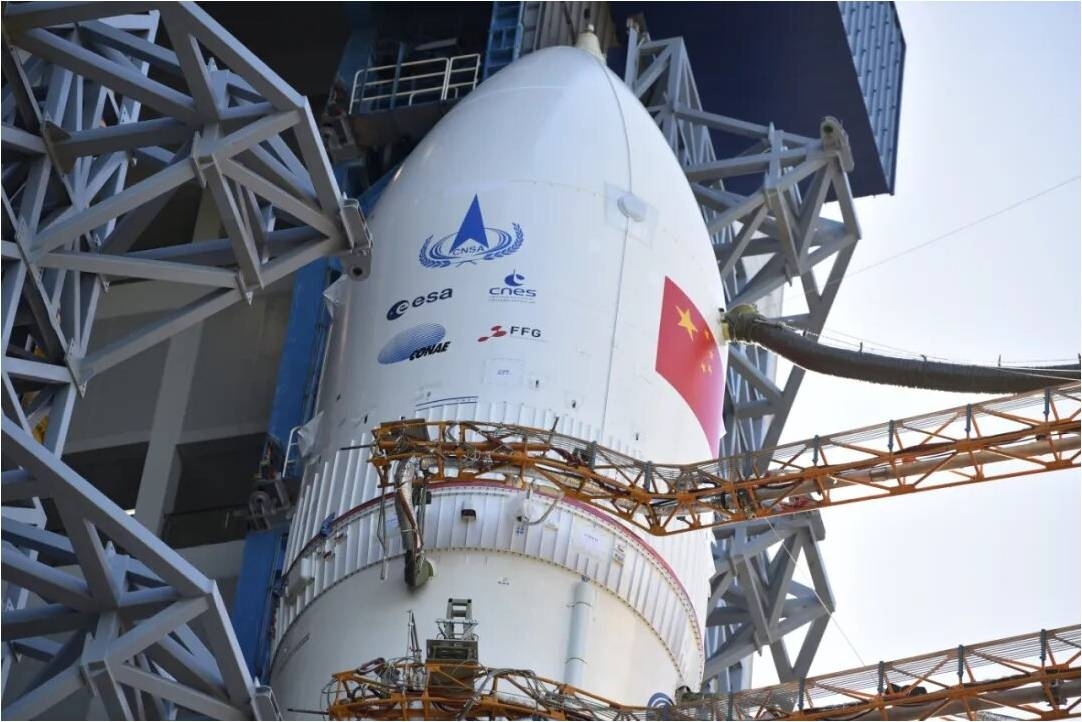
Long March fairing features logos of other space agencies involved in the Mars mission.
Credit: CNSA
Following the completion of multiple integrated rehearsals, China is ready for the launch of its first orbiter, lander, rover Mars exploration mission. Tianwen-1 is scheduled for liftoff in late July or early August, according to the China National Space Administration (CNSA).
Speculation is that the liftoff may occur July 23, the opening of the launch window.
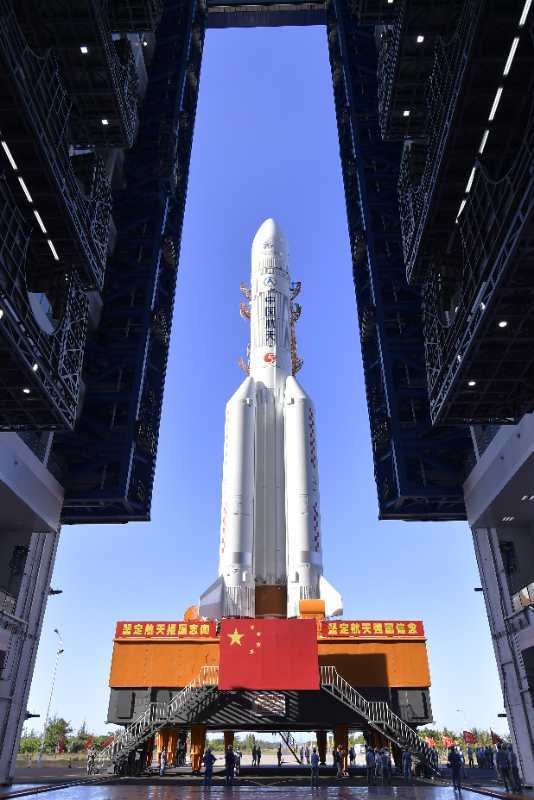
Credit: CCTV
Last Friday, the fourth Long March-5 rocket — coded as Long March-5 Y4 — was vertically transported to the launching area at the Wenchang Space Launch Center in south China’s Hainan Province.
China’s bid to explore Mars is also one that involves several other nations for tracking, orbital relay of data, and science instrument support.
For details on other space agencies involved in China’s reach for the Red Planet, go to my new Space.com story:
China’s Tianwen-1 Mars rover mission gets a boost from international partners
https://www.space.com/china-mars-mission-tianwen-1-international-partners.html

Robotic arm investigation of “Breamish.” Curiosity Left B Navigation Camera photo taken on Sol 2826, July 18, 2020.
Credit: NASA/JPL-Caltech
“Curiosity has arrived near her next drill location and will spend the weekend analyzing a series of interesting targets in our workspace,” reports Mark Salvatore, a planetary geologist at the University of Michigan.

Curiosity Mars Hand Lens Imager (MAHLI) photo produced on Sol 2826, July 18, 2020.
Credit: NASA/JPL-Caltech/MSSS
“The rover will also acquire a series of high-resolution color images, both to identify a suitable drill location in the near-field and to continue its characterization of other geologic units nearby and along the rover’s drive route. These imaging efforts will mostly take place on the first day of the three-day weekend plan,” Salvatore adds.

Curiosity Right B Navigation Camera image taken on Sol 2825, July 17, 2020.
Credit: NASA/JPL-Caltech
Rock target
Overnight on the first night, the plan calls for Curiosity to make a series of Alpha Particle X-Ray Spectrometer (APXS) chemistry measurements on the target named “Breamish,” a platy rock target with some interesting color variations.

Curiosity Right B Navigation Camera image taken on Sol 2825, July 17, 2020.
Credit: NASA/JPL-Caltech
The second day will be dominated by Sample Analysis at Mars (SAM) Instrument Suite activities. As these activities are power-intensive, Curiosity will mostly be sleeping during its down time to recharge its batteries, Salvatore points out.
Chemical trends with depth
The third day’s science block will include a series of Chemistry and Camera (ChemCam) Laser Induced Breakdown Spectroscopy (LIBS) laser ablation measurements of different rock targets, including the Breamish target, a slanted platy rock named “Harthope,” and an effort to acquire evidence for chemical trends with depth on the target named “Back Bay.”

Curiosity Right B Navigation Camera image taken on Sol 2825, July 17, 2020.
Credit: NASA/JPL-Caltech
The next morning, Curiosity will acquire some early morning environmental images to look for clouds and to measure the atmospheric dust content.
“That will conclude Curiosity’s science efforts for the weekend,” Salvatore concludes, “and will prepare us well for next week’s planned drilling activities!”
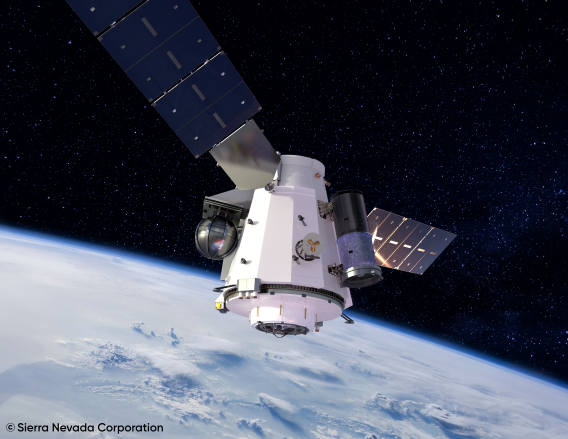
Shooting Star transport vehicle.
Credit: SNC
The Sierra Nevada Corporation (SNC) has been awarded a contract by the Defense Innovation Unit (DIU) to repurpose the company’s Shooting Star transport vehicle as an Unmanned Orbital Outpost – essentially a scalable, autonomous space station for experiments and logistics demonstrations.
DIU is a Department of Defense organization that contracts with commercial companies to solve national security problems.
“The current Shooting Star is already designed with significant capabilities for an orbital outpost and by adding only a few components we are able to meet Department of Defense (DoD) needs.” said former NASA space shuttle commander and retired USAF pilot Steve Lindsey, now senior vice president of strategy for SNC’s Space Systems business area.

Shooting Star attached to Dream Chaser.
Credit: SNC
Core structure
SNC’s Shooting Star transport vehicle serves as the core structure for the proposed design.
Shooting Star is a 16-foot attachment to Dream Chaser developed for NASA Commercial Resupply Services 2 (CRS-2) missions to provide extra storage for payloads and to facilitate cargo disposal upon re-entry into Earth’s atmosphere. However, the transport vehicle’s unique design also offers free-flyer and satellite capabilities for large payloads with high-power capacity. It can also support logistics services to low-Earth orbit (LEO) and cislunar destinations.

Shooting Star.
Credit: SNC
Future outposts
According to a SNC statement, the proposed orbital outpost will be initially established in low Earth orbit with guidance, navigation and control for sustained free-flight operations to host payloads and support space assembly, microgravity, experimentation, logistics, manufacturing, training, test and evaluation.
Future outposts may be based in a variety of orbits including, medium-Earth orbit, highly elliptical orbit, geosynchronous Earth orbits (GEO) to include GEO transfer orbits, and cislunar orbits.
For more information, go to this Breaking Defense story by Theresa Hitchens: “Sierra Nevada Wins DIU Contract For Experimental Space Station”
https://breakingdefense.com/2020/07/sierra-nevada-wins-diu-contract-for-experimental-space-station/
Update: In a SpaceNews story from Jeff Foust, he notes that three companies are studying “Orbital Outpost” space station concepts for the Defense Department.
Along with SNC, study monies were also awarded to Nanoracks and Arkisys.
Go to the SpaceNews complete story at:
https://spacenews.com/three-companies-studying-orbital-outpost-space-station-concepts-for-defense-department/

Credit: CCTV
The fourth Long March-5 rocket, to be used to launch China’s first Mars exploration mission — the Tianwen-1 — was vertically transported to the launching area at the Wenchang Space Launch Center in south China’s Hainan Province on Friday.

A Long March-5 Y4 rocket was vertically transported to the launch area at Wenchang Space Launch Center in S China’s Hainan on Friday. Note the European (ESA), the French (CNES), Argentine (CONAE) and Austrian (FFG) space agency logos in addition to that of the China National Space Agency (CNSA).
Long March-5 Y4, is planned to be launched in late July or early August, according to the China National Space Administration. Speculation has it that liftoff is slated for July 23, the opening of the launch window.
China’s Xinhua news agency reports it took about two hours to vertically transport the large rocket to the launching area of the center Friday morning. Final examinations and tests will be conducted on the rocket before the launch.

Credit: CCTV/Inside Outer Space Screengrab
This is the first time the Long March-5 carrier rocket, currently China’s largest launch vehicle, will be put into “practical use” after three experimental launches, the Xinhua story adds. The rocket is expected to send the Tianwen-1 Mars probe into an Earth-Mars transfer orbit, which is also the first such mission to be carried out by China’s carrier rocket.
The Mars mission is indeed ambitious, aiming to complete orbiting, landing and roving in one mission, and to obtain scientific exploration data on the Red Planet.

Credit: CCTV/Inside Outer Space Screengrab
According to Li Benqi, command member for the Long March-5 Y4 rocket launching mission, in an interview with China Central Television (CCTV): “Testing for all the technical items on the rocket, the Mars rover and the launching area has been completed so far,” Li explained. “While the rocket is at the launching area, our preparations are focused on filling fuel into the rocket and ensuring a good final state of the rocket and the rover. Then we’ll enter the launching procedures.”
Ge Xiaochun, chief engineer, China National Space Administration told CCTV: “The Mars probe is the first step of China’s planetary exploration project. The coming launching mission has been highly recognized and supported by the international community.”
Ge said that “the vertical transport of the rocket to the launching area has shown that we have made good preparations for the launching mission. We will stick to the strict and careful working attitude in the coming days.”

Credit: CCTV/Inside Outer Space Screengrab
Long Lehao, carrier rocket expert, China Academy of Launch Vehicle Technology, told CCTV: “The rocket will simultaneously carry the Mars orbiter, lander and rover into space. Such a comprehensive launching mission for Mars exploration will also be the first in the world, so we’re looking forward to it.”

China’s Mars landing regions.
Courtesy: James Head
Candidate landing site: Utopia Planitia
In a just published Nature Astronomy paper — “China’s first mission to Mars” – details about the mission are outlined, among them:
The Tianwen-1 probe has a mass (including fuel) of about 5 tons.
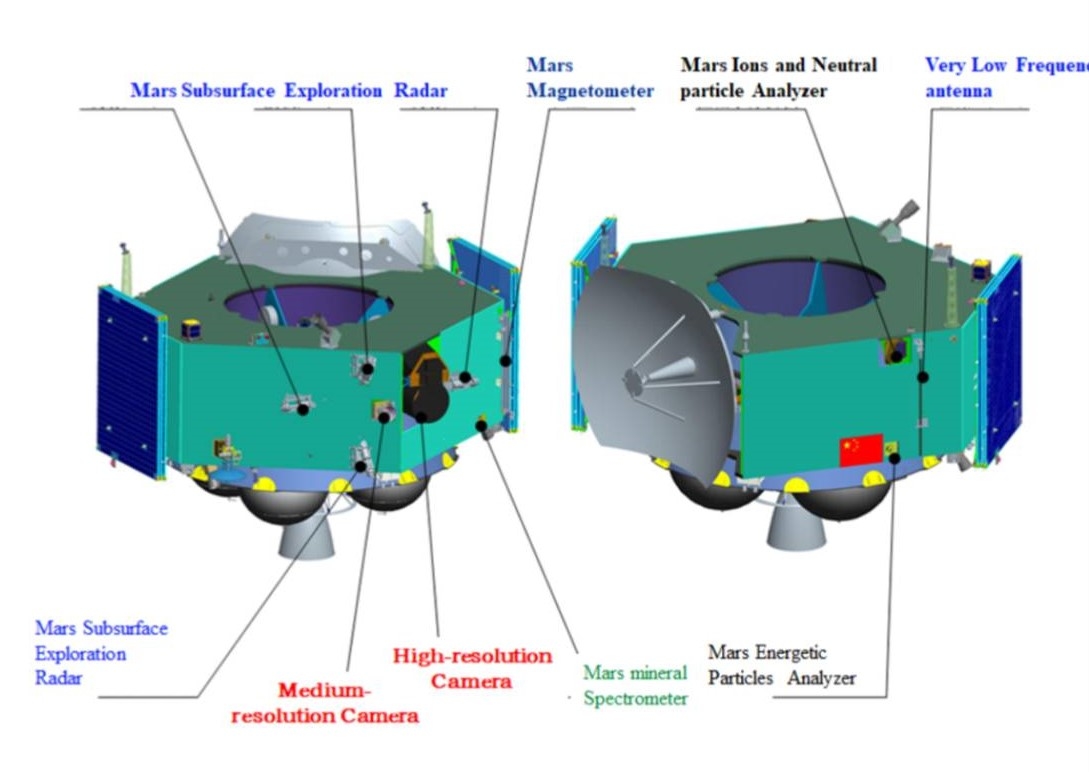
China’s Mars orbiter.
Courtesy: James Head
The orbiter will provide a relay communication link to the rover, while performing its own scientific observations for one Martian year. The orbit during the scientific observation stage is a polar elliptical orbit 165 miles x 746 miles (265 km × 12,000 kilometers).
The Tianwen-1 probe is expected to reach Mars around February 2021 and the scientific observation phase will start in April 2021.
China’s Mars rover.
Courtesy: James Head
The lander/rover will perform a soft landing on the Martian surface some 2–3 months after arrival of the spacecraft, with a candidate landing site in Utopia Planitia. It is the Martian region where the NASA Viking 2 lander touched down on September 3, 1976.
Scientific instruments
The roughly 530 pound (240 kilograms) solar-powered rover is nearly twice the mass of China’s Yutu lunar rovers, and is expected to be in operation for about 90 Martian days.
There are 13 scientific payloads in the Tianwen-1 mission in total.
The seven instruments on board the orbiter comprise two cameras, the Mars-Orbiting Subsurface Exploration Radar, Mars Mineralogy Spectrometer, Mars Magnetometer, Mars Ion and Neutral Particle Analyzer, and Mars Energetic Particle Analyzer.
The six instruments installed on the rover comprise the Multispectral Camera, Terrain Camera, Mars-Rover Subsurface Exploration Radar, Mars Surface Composition Detector, Mars Magnetic Field Detector, and Mars Meteorology Monitor.

China’s Mars mission elements.
Credit: CCTV/Inside Outer Space screengrab
Comprehensive mission
According to the paper’s authors, “Tianwen-1 is going to orbit, land and release a rover all on the very first try, and coordinate observations with an orbiter. No planetary missions have ever been implemented in this way. If successful, it would signify a major technical breakthrough. Scientifically, Tianwen-1 is the most comprehensive mission to investigate the Martian morphology, geology, mineralogy, space environment, and soil and water-ice distribution.”
To read the full Nature Astronomy paper — China’s first mission to Mars – go to:
https://www.nature.com/articles/s41550-020-1148-6
Also, go to this CGTN video of the rocket roll out at:

