Archive for the ‘Space News’ Category
 Author:
  August 6th, 2020
Curiosity Front Hazard Avoidance Camera Right B image of “Mary Anning” taken on Sol 2844, August 6, 2020.
Credit: NASA/JPL-Caltech
NASA’s Curiosity Mars rover is now carrying out Sol 2844 duties.

The Sample Analysis at Mars tool is called SAM. SAM is made up of three different instruments that search for and measure organic chemicals and light elements that are important ingredients potentially associated with life.
Credit: NASA/JPL-Caltech
Reports Sean Czarnecki, a planetary geologist at Arizona State University in Tempe, a recent plan called for Curiosity to drop off some of its newly acquired “Mary Anning” drill sample to the Sample Analysis at Mars (SAM) Instrument Suite for Evolved Gas Analysis (EGA).
“During EGA, SAM bakes the powdered rock sample at up to 900°C (1652°F),” Czarnecki reports. “This releases, or ‘evolves,’ volatile compounds which are then measured.”

Curiosity Chemistry & Camera Remote Micro-Imager (RMI) photo acquired on Sol 2843, August 5, 2020.
Credit: NASA/JPL-Caltech/LANL
Surrounding countryside
In addition, Navcam will image the area in front of the rover and look for dust devils, Mastcam will take two stereo mosaics of the surrounding countryside, and Dynamic Albedo of Neutrons (DAN), Radiation Assessment Detector (RAD) and the Rover Environmental Monitoring Station (REMS) will continue to monitor the environment at this site.
Czarnecki adds that Curiosity is celebrating 8 years on Mars, landing on the Red Planet on August 5, 2012. “Since Curiosity is turning 8, we expect that celebrations in Gale Crater will include games like “Pin the Mast on the Rover” and “Red Rover” (“Red rover, red rover, send Perseverance on over!”) while enjoying treats from SAM’s bakery!”
Since its touchdown, the robot has driven slightly over 14 miles.

Strata at Base of Mount Sharp: This image, taken back when NASA’s Curiosity rover was at the base of Mount Sharp on March 24, 2014, indicates the rover’s approximate location as of July 30, 2020 – about 3 1/2 miles away (about 5 1/2 kilometers).
Credit: NASA/JPL-Caltech/MSSS
Postcards from Mars
Back on Earth, the MSL team is also celebrating with a retrospective in the form of 8 Martian postcards, such as a dust storm selfie, a descriptive tour of Gale Crater, a Martian cloud movie, and much more! You can see this striking selection of images from the past 8 years here:
“Thank you for following Curiosity’s journey for the last 8 years,” Czarnecki concludes. “We look forward to a ninth year and more of exciting exploration and discovery!”

Curiosity Left B Navigation Camera image taken on Sol 2843, August 5, 2020.
Credit: NASA/JPL-Caltech
Awaiting first results
In an earlier report from Catherine O’Connell-Cooper, a planetary geologist at University of New Brunswick; Fredericton, New Brunswick, Canada, a recent plan also saw some drill sample delivered to the robot’s Chemical and Mineralogy (CheMin) instrument, with Mars researchers eagerly awaiting the first results of that analysis.
“Today we planned a Sample Analysis at Mars (SAM) preconditioning activity to get ready for sample drop off to SAM and analysis later in the week, O’Connell-Cooper explains, “which will catalogue the composition and check for traces of organic molecules in these rocks.”

Curiosity Right B Navigation Camera image acquired on Sol 2843, August 5, 2020.
Credit: NASA/JPL-Caltech
Power-hungry instrument
Because SAM is a very power-hungry instrument, scientists are budgeting most of their energy across this week around the SAM activities.
As the “precon” activity takes up most of our available energy today, the geology theme group (GEO) limited itself to re-imaging the drill hole using the Chemistry and Camera (ChemCam), Mastcam and Navcam, O’Connell-Cooper adds.
This will allow Mars researchers to refine targeting of the drill hole by ChemCam, the Alpha Particle X-Ray Spectrometer (APXS), and Mars Hand Lens Imager (MAHLI) in future plans, when power is not as constrained as it is right now!

Curiosity Right B Navigation Camera image acquired on Sol 2843, August 5, 2020
“We squeezed every last bit of power available for today’s planning, so that the environmental theme group (ENV) were able to get in some monitoring activities, looking for dust devils and dust in the atmosphere, as well as standard REMS (weather) and DAN activities,” O’Connell-Cooper concludes.
 Posted in

Best space and sci-fi books for 2020
By Space.com Staff
https://www.space.com/28973-best-space-books.html


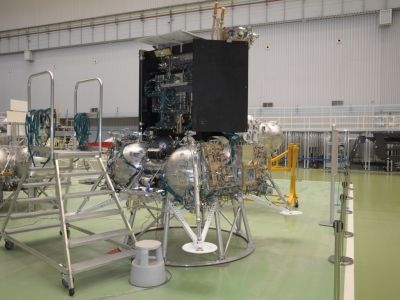
Luna 25 Moon lander. Credit: Roscosmos
Progress is being reported on readying Russia’s Luna-25 spacecraft.
Last month, flight units of Russian scientific instruments were delivered from the Space Research Institute to NPO Lavochkin – part of Roscosmos, the Russian space agency. Russian space industry specialists have started installing them on the Luna-25 spacecraft.
The Russian lunar landing vehicle includes nine instruments: eight Russian and one developed by the European Space Agency.
ESA’s contribution to Luna 25 includes PILOT-D, a demonstrator terrain relative navigation system.
Credit: ESA
South pole exploration
The Russian instruments are meant to research the composition, structure and physico-mechanical properties of lunar polar regolith, dust and plasma exosphere around the Moon’s south pole. To date, no spacecraft have been to this region, eyed by many nations as a site for future Moon bases.
Luna-25 is expected to launch in October 2021.
The project is being implemented at the request of the Russian Academy of Sciences — part of the Federal Space Program of 2016-2025 — and is financed by Roscosmos.
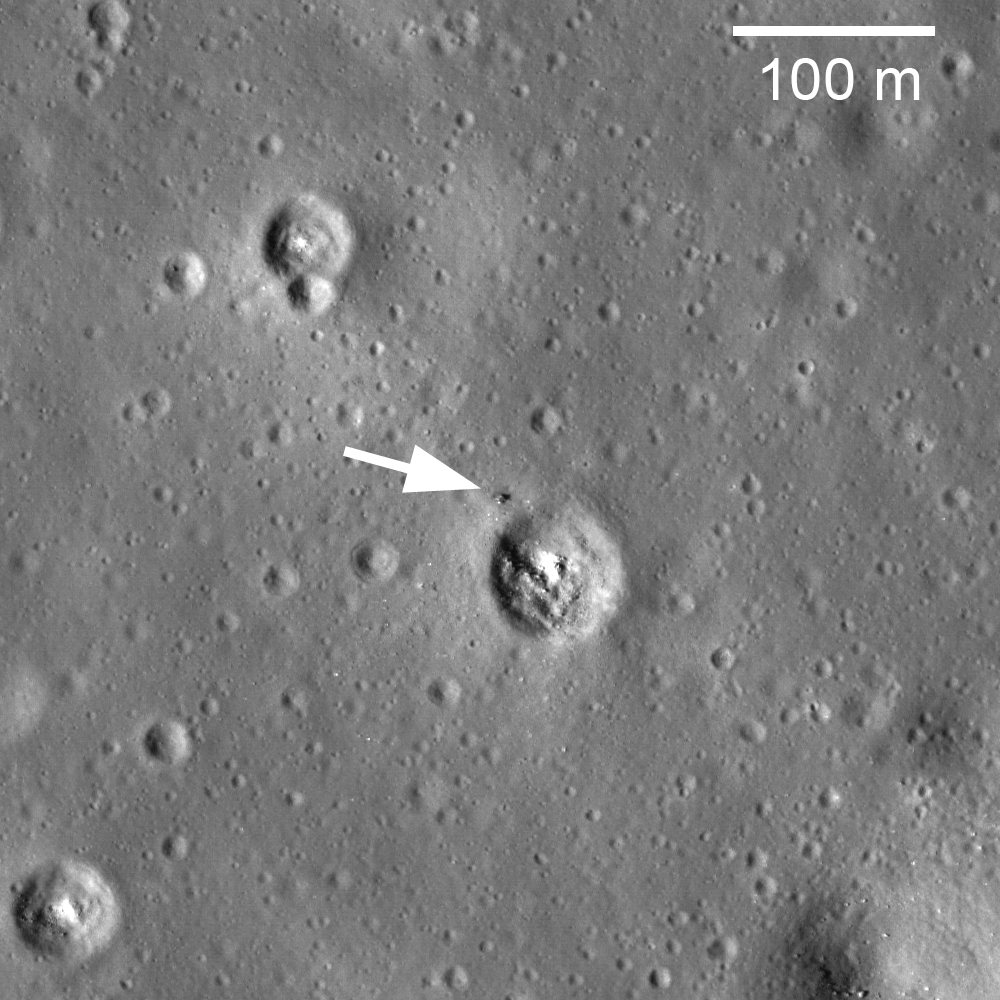
NASA’s Lunar Reconnaissance Orbiter used its powerful LROC system to image Luna 24 sitting near the edge of a large crater.
Credit: NASA/Goddard/Arizona State University
Return to flight
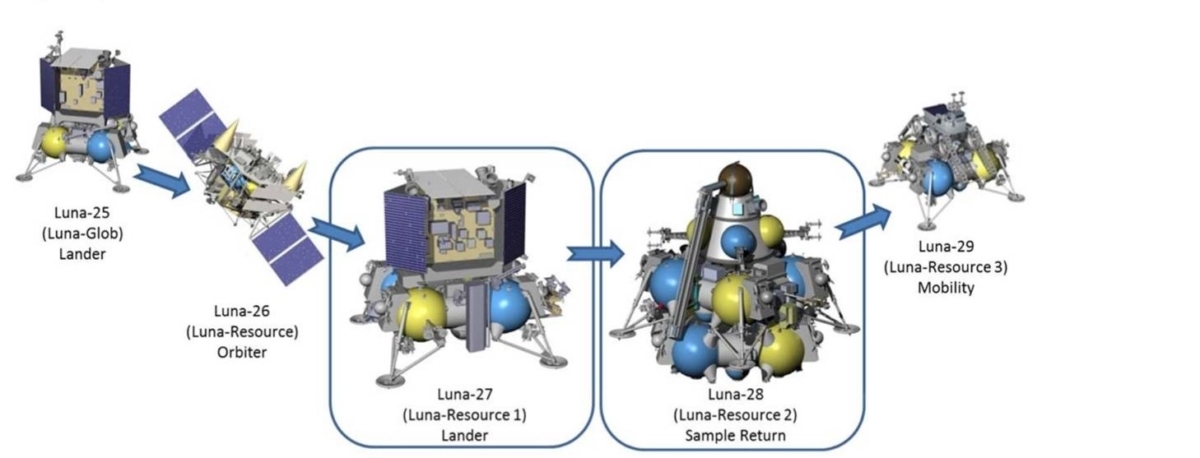
Luna-25 is the opening moonshot of a reactivated Russian lunar program that includes an orbiter and lobbing lunar materials back to Earth.
ESA has been developing the Package for Resource Observation and in-Situ Prospecting for Exploration, Commercial exploitation and Transportation (PROSPECT) – a lunar drilling and sample analysis package to be installed on Russia’s Luna 27 mission.
The last of the Luna series of spacecraft was the mission of the Luna 24 probe in 1976. It was the third Soviet mission to retrieve and rocket back to Earth lunar surface samples. The first two were returned by Luna 16 in 1970 and Luna 20 in 1972.

Curiosity Front Hazard Avoidance Camera Left B image taken on Sol 2842, August 4, 2020.
Credit: NASA/JPL-Caltech
NASA’s Curiosity Mars rover is now performing Sol 2842 tasks.
The robot is carrying on with its drill campaign at the “Mary Anning” site, reports Rachel Kronyak, a planetary geologist at NASA’s Jet Propulsion Laboratory.

The Chemical and Mineralogy instrument, or CheMin for short, performs chemical analysis of powdered rock samples to identify the types and amounts of different minerals that are present.
Credit: NASA/JPL-Caltech
The meat of a recently scripted plan focuses on dropping off a powdered drill sample to the rover’s onboard Chemistry & Mineralogy X-Ray Diffraction/X-Ray Fluorescence Instrument (CheMin). This device is used to tell scientists all about the mineralogical composition of the latest drill hole.
In addition, the plan calls for about an hour’s worth of remote science activities to help document the rover’s surroundings.

This image of “Maybole” target was taken by Left Navigation Camera on July 16, 2020, Sol 2824.
Credit: NASA/JPL-Caltech

Curiosity Chemistry & Camera Remote Micro Imager (RMI) photo taken on Sol 2842, August 4, 2020.
Credit: NASA/JPL-Caltech/LANL

Curiosity Chemistry & Camera Remote Micro Imager (RMI) photo taken on Sol 2842, August 4, 2020.
Credit: NASA/JPL-Caltech/LANL

Curiosity Chemistry & Camera Remote Micro Imager (RMI) photo taken on Sol 2841 August 3, 2020.
Credit: NASA/JPL-Caltech/LANL
Stereo mosaic
“To kick off the science block, Mastcam will take a meaty 53-frame stereo mosaic pointed at the fractured intermediate unit to the southeast,” Kronyak notes. “This mosaic will document a large portion of our surroundings and will also help the science team plan our drive path once we finish up our drilling activities at Mary Anning.”
Also on the plan, the Chemistry & Camera (ChemCam) will shoot its laser at the target “Bishop’s Palace,” which exposes some nice small-scale layering and possible diagenetic features – the physical and chemical changes occurring in sediments between the times of deposition and solidification.
Layered outcrop
ChemCam will also use its Remote Micro Imager (RMI) to take a long-distance mosaic of the “Maybole” target.
Maybole is a partially exposed, layered outcrop at the top of a nearby hill, Kronyak points out. “In fact, we purposely planned for a few frames to overlap between the long-distance RMI and Mastcam mosaics so that the lighting conditions between the two mosaics match up. This overlap will allow for nice comparisons between the two mosaics to be made.”

Curiosity Right B Navigation Camera image taken on Sol 2841, August 3, 2020.
Credit: NASA/JPL-Caltech
Atmospheric monitoring
Towards the end of the science block, Curiosity’s Mastcam will take a documentation image of the ChemCam target Bishop’s Palace.
Also planned are several atmospheric monitoring activities with Navcam. Later in the sol, a Mars Descent Imager (MARDI) image is set to continue a change detection campaign at the robot’s current location, Kronyak concludes.

Curiosity Rear Hazard Avoidance Right B Camera image acquired on Sol 2842, August 4, 2020.
Credit: NASA/JPL-Caltech
Credit: CCTV/Inside Outer Space screengrab
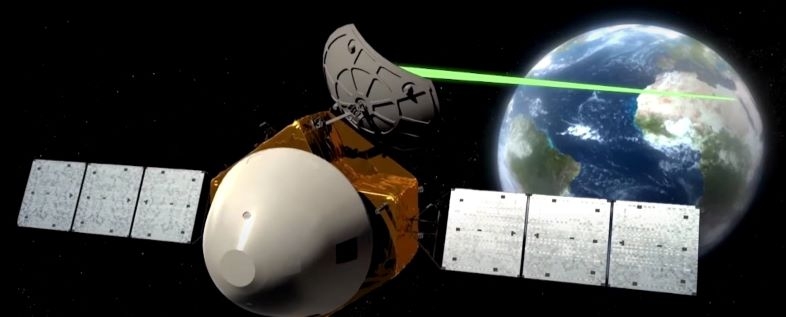
The China National Space Administration reports that its Tianwen-1 Mars probe carried out its first mid-course correction maneuver on Sunday morning.
China Daily reports that the maneuver was completed over a 20-second period of time using the spacecraft’s 3000 Newton engine.
During the probe’s seven-month spaceflight toward Mars, it will make several mid-course corrections and deep-space maneuvers to make sure it is precisely aimed at the planet.
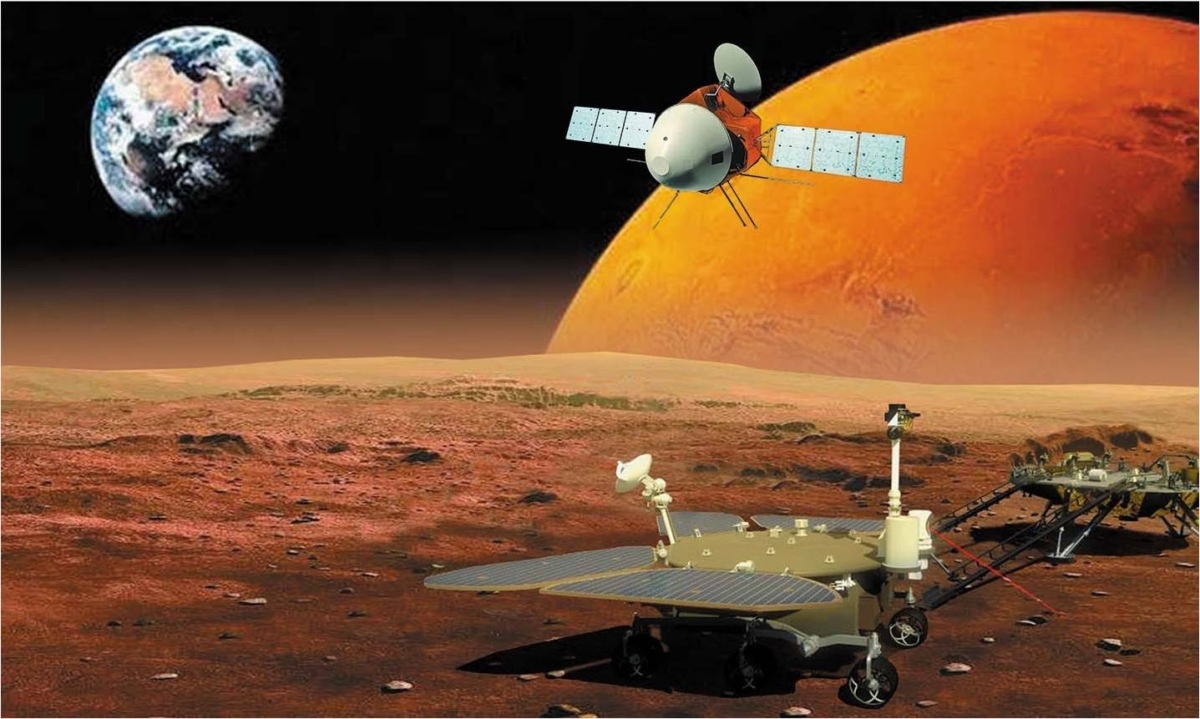
Three-in-one spacecraft
China launched Tianwen-1, the country’s first independent Mars mission, on July 23 from the Wenchang Space Launch Center in South China’s Hainan province.
The five-metric ton Tianwen-1 is a three-in-one spacecraft – an orbiter, a lander, and a rover.
The spacecraft has begun to conduct its scientific operations as the Mars Energetic Particle Analyzer, mounted on the orbiter, has been activated and transmitted data back to the ground control.
It is the first of the 13 scientific apparatus on the probe to start operating and will be the longest working device during the journey toward the Martian gravitational field.
At present, Tianwen-1 is moving toward the Mars at a speed of about 186,411 miles (300,000 kilometers) per day until it reaches the farthest spot on the Mars, which is about 400 million kilometers away from the Earth.
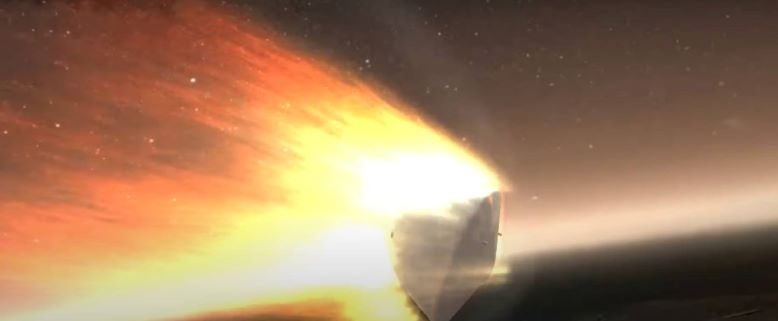
Credit: CCTV/Inside Outer Space screengrab
Candidate landing zone
After the probe enters orbit around Mars in February, Tianwen-1 will circle the Red Planet for two and a half months to investigate the candidate landing zone before dispatching the lander.
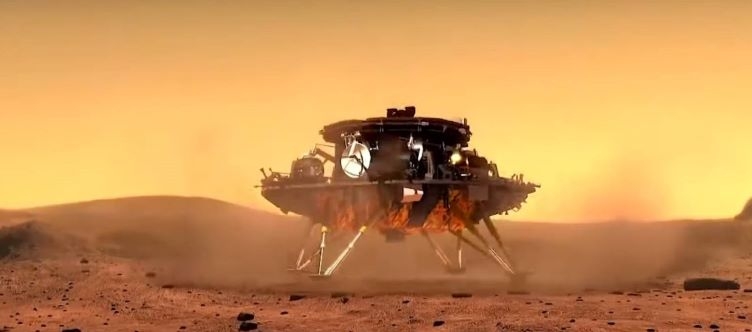
Credit: CCTV/Inside Outer Space screengrab
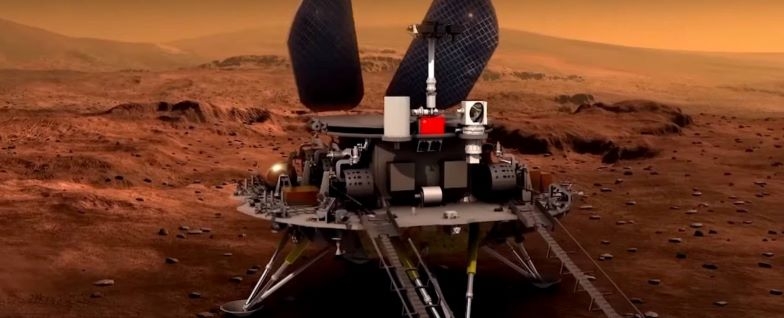
Credit: CCTV/Inside Outer Space screengrab
The landing has been scheduled to take place around May in the southern part of Mars’ Utopia Planitia, according to the China National Space Administration (CNSA).
Go to this XhinuaVideo at:
Also, view these CCTV-Plus videos at:
NASA’s Curiosity Mars rover is now performing Sol 2839 tasks.
New imagery from the robot shows the results of drilling into the target Mary Anning and a few views of the rover’s surroundings:

Curiosity Mast Camera Right image taken on Sol 2838, July 31, 2020.
Credit: NASA/JPL-Caltech/MSSS

Curiosity Mast Camera Right image taken on Sol 2838, July 31, 2020.
Credit: NASA/JPL-Caltech/MSSS

Curiosity Left B Navigation Camera photo acquired on Sol 2839, August 1, 2020.
Credit: NASA/JPL-Caltech

Curiosity Right B Navigation Camera photo acquired on Sol 2839, August 1, 2020.
Credit: NASA/JPL-Caltech

Curiosity Right B Navigation Camera photo acquired on Sol 2839, August 1, 2020.
Credit: NASA/JPL-Caltech

Curiosity Right B Navigation Camera photo acquired on Sol 2839, August 1, 2020.
Credit: NASA/JPL-Caltech
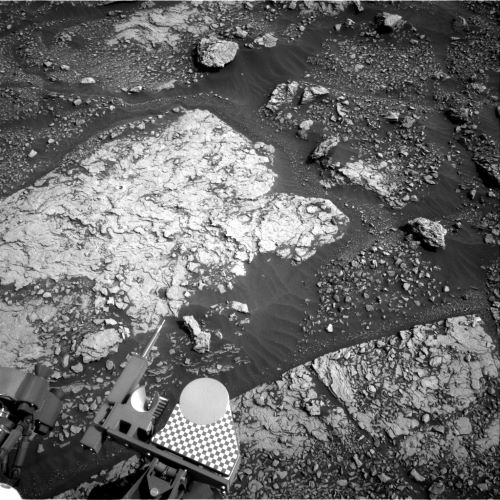
Drill target – Mary Anning. Curiosity Right B Navigation Camera image taken on Sol 2838, July 31, 2020.
Credit: NASA/JPL-Caltech
NASA’s Curiosity Mars rover is now performing Sol 2838 tasks.
“This past week, while Curiosity has been preparing to drill its next rock target, the Perseverance rover mission has been preparing to launch to Mars,” reports Melissa Rice, a planetary geologist at Western Washington University in Bellingham, Washington.
Due to a minor issue with the rover’s arm, the drill sequence for the Mary Anning target did not execute, Rice explains, but team members expect to see the new drill hole shortly.

Curiosity Front Hazard Avoidance Camera Left B image acquired on Sol 2838, July 31, 2020.
Credit: NASA/JPL-Caltech

Curiosity Front Hazard Avoidance Camera Left B image acquired on Sol 2838, July 31, 2020.
Credit: NASA/JPL-Caltech

Curiosity Front Hazard Avoidance Camera Left B image acquired on Sol 2838, July 31, 2020.
Credit: NASA/JPL-Caltech
Re-do drill activities
“Perhaps Curiosity is just a humble, conscientious rover that did not want to steal any glory from Perseverance on its launch day,” Rice adds.
For sol 2838, the re-do of the drill activities will use most of Curiosity’s available resources, Rice adds, but there is also some time available for atmospheric monitoring activities.
“These will include a Mastcam observation of the sky to observe the high levels of dust that are expected in this season on Mars. Looking up seems like the appropriate thing to on this day, as Perseverance starts hurtling towards Mars’ skies,” Rice reports.

Credit: ULA
Launch reflections
“I have been reflecting this week about Curiosity’s launch, which was nearly nine years ago now, but still feels as vivid in my memory as yesterday. I was lucky enough to witness that launch in from the Kennedy Space Center in Florida with the Mars Science Laboratory team – I was just a graduate student at the time,” Rice notes.
“While I had only recently started collaborating on the mission, Rice says, “many of the colleagues surrounding me on the bleachers had been working tirelessly to design, build and test Curiosity for nearly a decade.”
Skyscraper full of explosives
“Imagine devoting so many years of your career to a project, and then strapping your delicate creation to a skyscraper full of explosives and pointing it towards the sky…that’s essentially what a spacecraft launch is!”
There was a palpable tension leading up to the final countdown, Rice recalls. There was pin-drop silence as the clock reached zero. “I was completely shocked at just how loud it was during liftoff. The Atlas V rocket seemed to shake the whole Earth, and I felt the sound hit my chest like a wall.”

Curiosity Mars Hand Lens Imager photo produced on Sol 2838, July 31, 2020.
Credit: NASA/JPL-Caltech/MSSS

Curiosity Right B Navigation Camera image taken on Sol 2838, July 31, 2020.
Credit: NASA/JPL-Caltech
Sensory overload
“But even more noise came from the screaming mass of scientists and engineers surrounding me,” Rice says, “who were clapping, yelling, jumping and hugging. I tried to keep my eyes on Curiosity for as long as I could, but several times I had to look away because the flames were too bright – it felt like I was staring directly at the Sun. That sensory overload just doesn’t come across when you watch a rocket launch on TV.”
For their launch, the Perseverance team stayed home to keep each other safe during the present pandemic, Rice adds, “and they watched the launch from many hundreds of individual screens. But their excitement was no less than what we felt in November 2011 – and their screams at liftoff, following that tense silence beforehand, reverberated through living rooms across the globe.”
Rice concludes: “Safe travels, Perseverance! We can’t wait for you to join us on Mars!”

Curiosity Front Hazard Avoidance Camera Left B image of “Mary Anning” taken on Sol 2834, July 26, 2020.
Credit: NASA/JPL-Caltech
NASA’s Curiosity Mars rover is just now starting to perform Sol 2836 tasks.
“A little inside joke among rover scientists, going back to previous rover missions, is the refrain ‘well, if we see a dinosaur bone, we’ll stick around,’” reports Fred Calef, a planetary geologist at NASA’s Jet Propulsion Laboratory.

Mary Anning.
Courtesy: Biodiversity Heritage Library
While, sadly, there is (checks notes) zero chance of finding dinosaur bones on Mars, Calef adds, “our search for Martian organics is something we’re here to do!”

Curiosity Right B Navigation Camera image acquired on Sol 2833, July 26, 2020.
Credit: NASA/JPL-Caltech
Scouring the outcrop
“Following in the footsteps of the renowned paleontologist Mary Anning, we’ve been scouring the outcrop, like she did at the limestone and shale ‘Blue Lias’ cliffs in England, and today will crack the outcrop with our ‘rock hammer’ (drill) and see what mysteries are captured within,” Calef explains.
As “Keeper of the Maps,” Calef also gets to add a dot on the team’s drill targets map, which always makes his day.
Next drill sample
“After a short discussion about the results from our weekend observation on the target ‘Mary Anning,’ the science team concurred that this place is geologically similar to the ‘Glen Etive’ drill location, and would be suitable for our next drilled sample,” Calef reports.

To help characterize the pre-drill surface, the rover is slated to take a full multispectral Mastcam image of the Mary Anning, as well as a Chemistry and Camera (ChemCam) Z-stack and 5×1 observation.

Curiosity Rear Hazard Avoidance Camera Right B photo taken on Sol 2834, July 26, 2020.
Credit: NASA/JPL-Caltech
Two additional targets, “Ayton” and “Carriden,” will be observed with ChemCam and Mastcam to characterize the outcrop.
“We’ll also expand the Mastcam color imaging of the workspace in front of the rover,” Calef notes, “document two Autonomous Exploration for Gathering Increased Science (AEGIS) targets with Mastcam, and a Mars Descent Imager (MARDI) image of the surface.”

Curiosity Mast Camera Right image taken on Sol 2833, July 26, 2020.
Credit: NASA/JPL-Caltech/MSSS
During recent science planning, Curiosity rover geologist Rebecca Williams said, “We’re drilling on Mars and launching to the red planet this week. It’s all very exciting!”

Curiosity Mast Camera Right image acquired on Sol 2833, July 25, 2020.
Credit: NASA/JPL-Caltech/MSSS
“I can’t agree more! When the new rover images come down…I hope you find some exciting things in them. And if you see a plesiosaur tail or pterosaur wing-tip, please let us know,” Calef concludes.
Dates of planned rover activities described are subject to change due to a variety of factors related to the Martian environment, communication relays and rover status.

Credit: CCTV-Plus/Inside Outer Space screengrab
China Academy of Space Technology has built a testing ground to prepare for China’s first Mars mission. The ground was renovated from a site which was initially used to simulate the Moon’s surface for two Chinese lunar rovers.

Credit: CCTV-Plus/Inside Outer Space screengrab
The testing ground comes complete with sand and stones to simulate various scenes on Mars surface.

Rover modes
As explained in a CCTV-Plus video, staff members used silicon carbides on the Earth, and washed them with water to make sure they are clean enough.

Credit: CCTV-Plus/Inside Outer Space screengrab
“On this site, we mainly test all its working modes. We tested normal working mode and also its malfunction mode to see how it gets out of trouble when malfunction occurred. In fact, our testing ground served as an examination room before the final launch mission,” said Jia Yong, an expert of China Aerospace Science and Technology Corporation.

Credit: CCTV
China’s Mars rover is very similar to the country’s lunar rovers, but larger in size.
“We must improve the autonomy of the rover. Besides, the environmental conditions of the Mars surface are probably more complicated than the Moon. A result we can directly perceive through the eyes is that the rover is moving sideways, just like a crab, a feat the lunar rover incapable of,” Teng Baoyi, deputy chief designer of China Aerospace Science and Technology Corporation, in the CCTV-Plus interview.

Credit: CNSA
Difficult mission
In a related interview with CCTV, Liu Tongjie, deputy director of the Lunar Exploration and Space Program Center under the China National Space Administration (CNSA) said the Tianwen-1 mission – consisting of an orbiter, lander and a rover — is extremely difficult.
The spacecraft is expected to enter Mars orbit around February 2021. Afterwards, it will spend two to three months surveying potential landing sites by using a high-resolution camera to prepare for the landing in May.
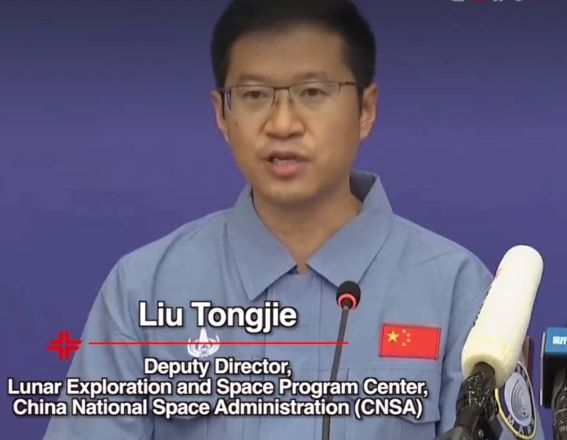
In a post-launch press conference, Liu Tongjie, spotlighted the southern part of the Utopia Planitia as the Tianwen-1 landing zone.
The Tianwen-1 orbiter carries with it seven science instruments while the rover carries six.
When the probe arrives in February next year, “we will not let it land on the surface of the Mars immediately. First, we will let it carry out some preliminary explorations on the orbit of the Mars, making some trial operations and explorations. Then we will find a better window for it to make its landing into the atmosphere of the Mars,” said Liu.

Credit: CGTN/Inside Outer Space screengrab
Northern hemisphere
The landing spot for the probe was carefully picked in accordance with the terrain of Mars.
“From what we’ve learned so far, the southern hemisphere of Mars is mountainous, while more plains are seen on the northern hemisphere. So we choose to make the landing on the latter. Right now we’ve picked the Utopia Planitia,” Liu said.

China’s Mars landing regions.
Courtesy: James Head
Mars sample return
After the landing, the rover will be released to conduct scientific exploration with an expected lifespan of at least 90 Martian days (about three months on Earth), and the orbiter, with a design life of one Martian year (about 687 days on Earth), will relay communications for the rover while conducting its own scientific tasks.
As reported by the China Global Television Network (CGTN) China officials have suggested that if the Tianwen-1 and later this year the Chang’e-5 Moon sample return mission go well, China could attempt to return samples from Mars beginning around 2030.
Also go to this XinhuaVideo on what science tasks China’s Mars mission is to carry out, focused on what the surface of Mars is made of.
Go to:

Covid-19 virus illustration.
Credit: CDC/Science Photo Library

The Red Planet as seen by Europe’s Mars Express.
Credit: ESA/D. O’Donnell – CC BY-SA IGO
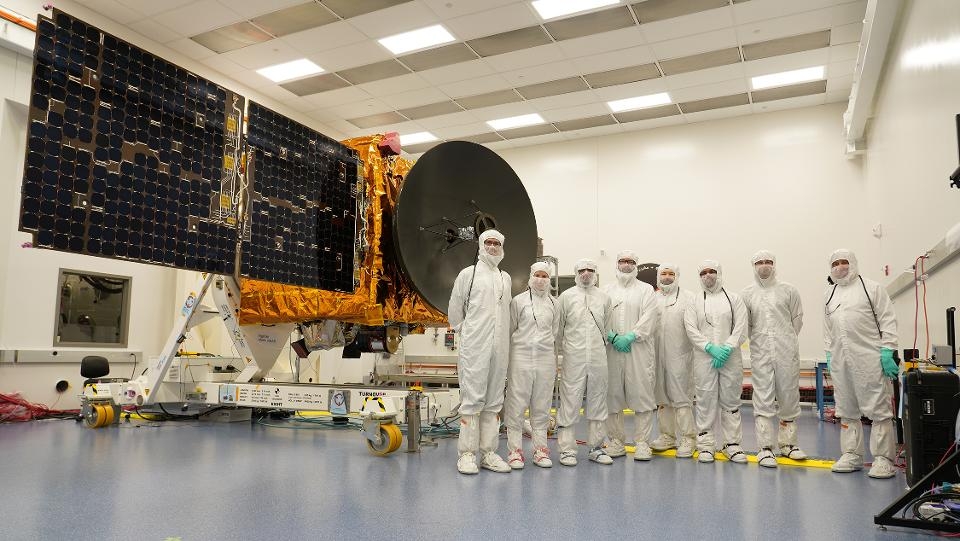
UAE’s Hope Mars orbiter.
Credit: Mohammed Bin Rashid Space Center

China’s three-in-one mission: An orbiter, lander, and rover.
Credit: Wan, W.X., Wang, C., Li, C.L. et al.

NASA’s Perseverance rover.
Credit: NASA/JPL-Caltech
Now en route to Mars is China’s Tianwen-1 probe. Joining that long march to the Red Planet is the United Arab Emirates (UAE) Hope orbiter. Lastly, NASA’s Perseverance rover is ready for sendoff on July 30th.
In readying this trio of spacecraft, engineers and test technicians endured the COVID-19 crisis. Indeed, the pandemic greatly complicated each spacecraft’s journey to their respective launch pads.
Forward contamination
Is there any worry about sending the coronavirus to the surface of Mars?
Even the UAE’s orbiter could experience a troubled insertion into Mars orbit, plowing into the Red Planet – Earth to Mars forward contamination.
For an answer, I asked noted astrobiologist, Penny Boston, Senior Advisor for Science Integration at NASA’s Ames Research Center.
Viruses are fragile
“COVID 19 is a virus. It only infects the cells of mammals or birds, as is true of all coronaviruses. To my knowledge, no mammals or birds are currently on their way to Mars…or about to be on their way to Mars. Viruses don’t successfully hang out in rocks or etc., they require living hosts. Viruses are far more fragile than bacteria, not to mention extremophile bacteria,” Boston responded.
“The ionizing radiation environment of the Martian surface will be highly effective at ripping apart the puny single stranded RNA of Covid-19 with its thin protein coat,” Boston added. “Ionizing radiation will thoroughly penetrate through all of the spacecraft on Mars or going to Mars. Therefore, there is essentially a zero chance of viruses remaining intact in the Mars environment, including on the inside of spacecraft.”

