Archive for the ‘Space News’ Category
 Author:
 October 7th, 2020
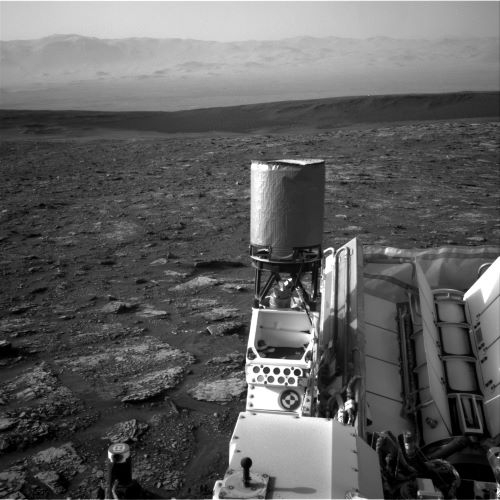
Curiosity Right B Navigation Camera photo taken on Sol 2904, October 7, 2020.
Credit: NASA/JPL-Caltech
NASA’s Curiosity Mars rover is now carrying out Sol 2905 tasks.
Over last weekend, the rover successfully performed arm diagnostic duties, reports Michelle Minitti, a planetary geologist at Framework in Silver Spring, Maryland.
“This news gave Curiosity the green light to move – ever so slightly forward – from her double drill workspace at “Mary Anning” toward our next drill site near the ‘Ayton’ target, Minitti adds.
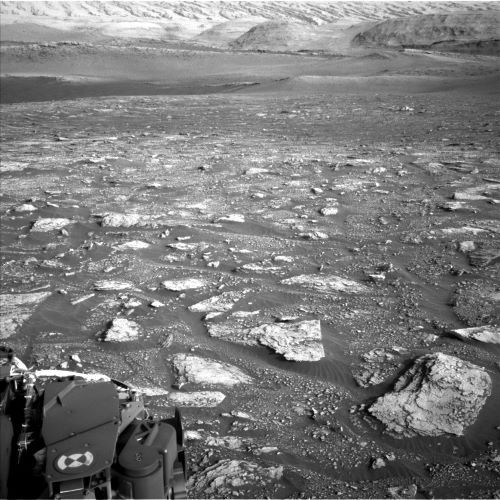
Curiosity Left B Navigation Camera image acquired on Sol 2904, October 7, 2020.
Credit: NASA/JPL-Caltech
Short drive
Ayton itself and the immediate area around it have been the subject of many analyses, from the Mars Hand Lens Imager (MAHLI) to the Alpha Particle X-Ray Spectrometer (APXS), Chemistry & Camera (ChemCam) to Mastcam since the robot arrived at the Mary Anning drill site.
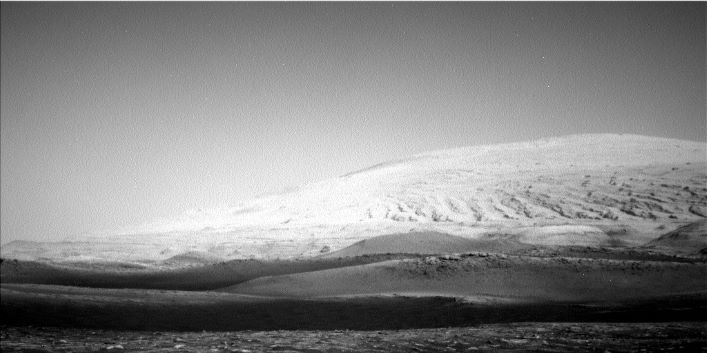
Curiosity Left B Navigation Camera image acquired on Sol 2904, October 7, 2020.
Credit: NASA/JPL-Caltech
“The team thought the prominent dark gray nodular features in this area warranted a more detailed look with a drill sample,” Minitti notes. “Bumping toward Ayton was the main focus of the plan, but Curiosity will keep busy both before and after the short drive.”
Diagnostic data
A recently scripted plan has the rover gathering more diagnostic data from the arm by testing out a few more systems on the turret and arm. After stowing the arm, Mastcam will acquire a couple of mosaics that have otherwise been occluded by the position of the arm during the diagnostic activities of the last several sols.
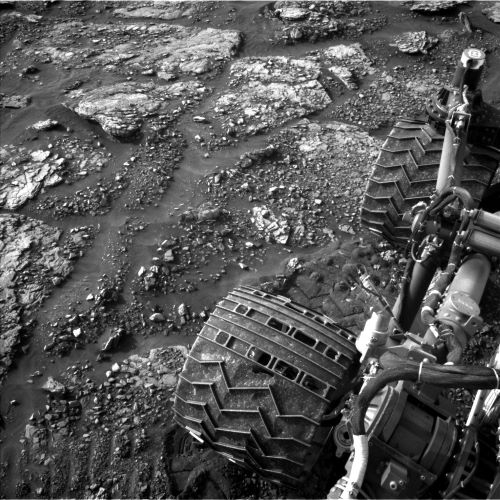
Curiosity Left B Navigation Camera image acquired on Sol 2904, October 7, 2020.
Credit: NASA/JPL-Caltech
Mastcam is set to image “Skelmorlie” in stereo.
“This sand target has been imaged several times to track the wind-induced changes,” Minitti points out, so the plan calls for a last time look to document those changes before Curiosity’s position changes.
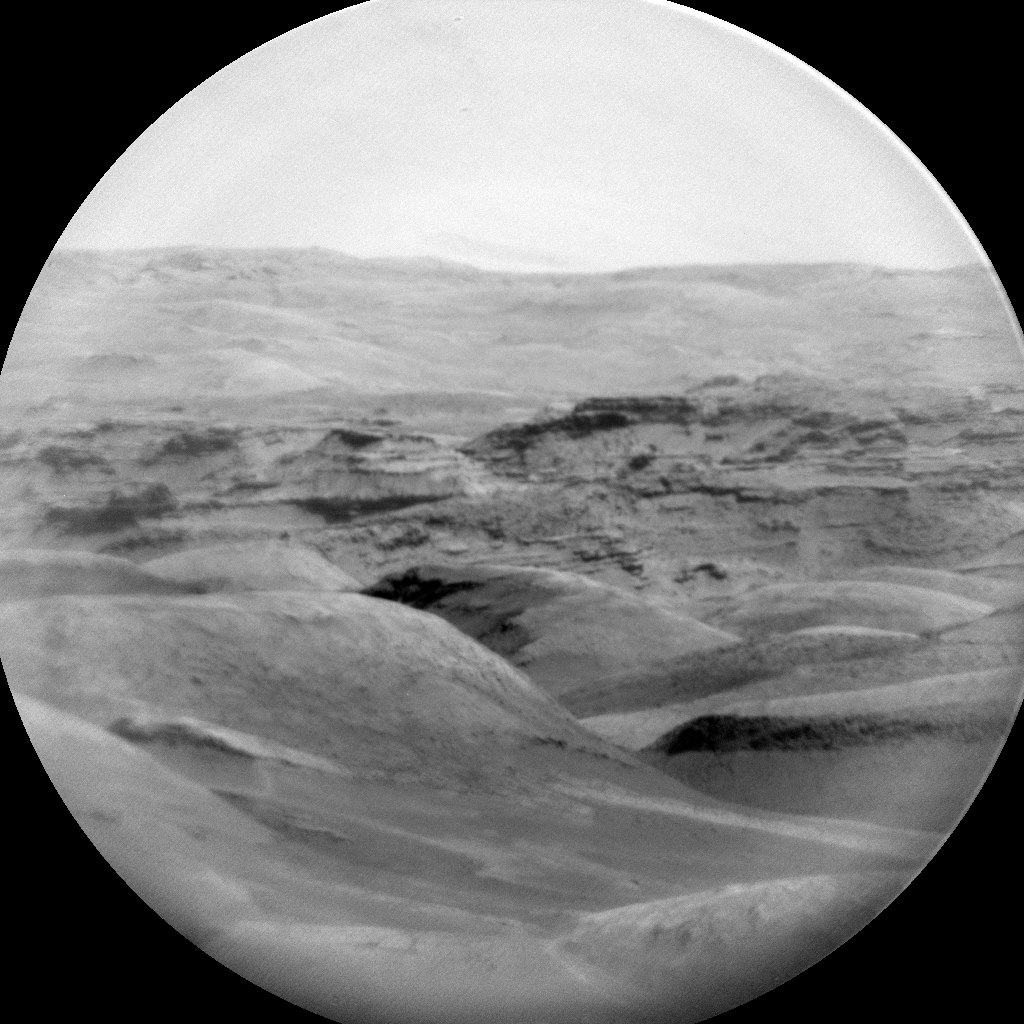
A slice of the “Housedon Hill” area east of the rover taken by Curiosity’s Chemistry & Camera Remote Micro-Imager (RMI) telescope on Sol 2900, October 2, 2020.
Credit: NASA/JPL-Caltech/LANL
Wind action
“Another change detection observation will be acquired at “Upper Ollach,” a trough in the sand just off the left of the Mary Anning slab. The trough has changed dynamically under the competing forces of our drilling at Mary Anning and the slow, relentless action of the wind,” Minitti says.
Mastcam will also acquire four stereo images from the left side of the workspace, the last part of the Mary Anning site that has been hidden by the arm.
The robot’s ChemCam gets in on the imaging action by adding to the mosaic of images from the “Housedon Hill” area east of the rover.
“With the arm free to move, MAHLI will take care of a couple of systematic check outs of the instrument. The first check out is courtesy of Mastcam, with three Mastcam images aimed at the MAHLI cover. The second check out is done by MAHLI herself in a series of images of the sky, some with the cover closed and some with the cover open. These are called sky flat images, which image a bland portion of the sky to track the amount of dust on the MAHLI cover and the MAHLI front lens,” Minitti reports.
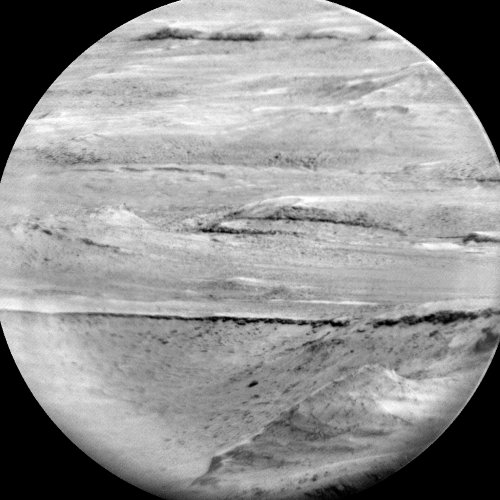
Curiosity Chemistry & Camera Remote Micro-Imager (RMI) telescope photo acquired on Sol 2904, October 6, 2020.
Credit: NASA/JPL-Caltech/LANL
Dust devils
After Curiosity bumps forward toward Ayton, the robot will turn its attention to the sky again the next sol, Minitti says.
“Navcam and Mastcam will measure the amount of dust in the atmosphere, Navcam will shoot a movie looking for dust devils spinning across Gale crater, and ChemCam will acquire passive spectra of the atmosphere. ChemCam will also pick up a systematic measurement of their titanium calibration target,” Minitti concludes. “Here’s to a (slightly) new world!”
 Posted in


Credit: CCTV Video News Agency/Inside Outer Space
China’s preparations for construction of that nation’s space station is picking up speed, striving to complete the plan for on-orbit construction of their orbiting outpost around 2022.

Hao Chun, director of the China Manned Space Engineering Office.
Credit: CCTV/Inside Outer Space screengrab
“In the two years from next year to the year after that, 11 missions will be conducted to complete the on-orbit construction of the Chinese space station. Subsequent missions will be carried out in high density. Astronauts will stay in orbit for long periods and carry out larger-scale space science experiments and technical experiments,” said Hao Chun, director of the China Manned Space Engineering Office in a recent China Central Television (CCTV) interview.
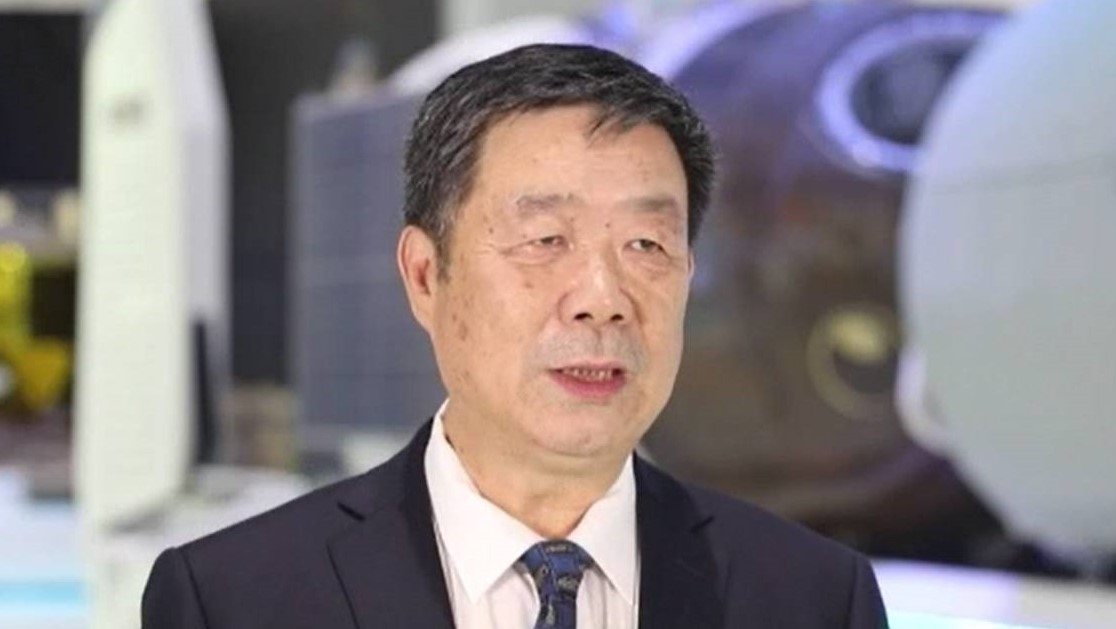
Zhou Jianping, chief designer of China’s manned space program.
Credit: CCTV/Inside Outer Space screengrab
Plans and steps
The pace of space station construction is soon to quicken. China started the full-range development of its space station a decade ago.
“We have also been actively and steadily advancing this work in accordance with our plan and steps,” said Zhou Jianping, chief designer of China’s manned space program. “So far, we have made comprehensive breakthroughs in the development of key technologies. Next year, we will start the third step of manned spaceship project…the full execution of the space station construction,” Zhou added.

Prototype of the Tianhe core module. China’s space station is expected to be operational around 2022.
Credit: CCTV/Inside Outer Space screengrab
At present, the “core capsule” is undergoing various ground-based experiments and tests to identify and control risks, assure the quality of the products, and solve problems in the ground-based development, explained Yang Hong, chief designer of China’s space station system with the China Academy of Space Technology in the CCTV video.

Yang Hong, chief designer of China’s space station system with the China Academy of Space Technology.
Credit: CCTV/Inside Outer Space screengrab
One after another
According to plan, the Tianhe core module, Wentian experimental module and Mengtian experimental module will be launched in quick succession to form the basic structure of the space station in orbit.
During this period, China will also launch four Shenzhou piloted spacecrafts and four Tianzhou cargo spacecrafts, to facilitate the astronaut crew rotation and cargo replenishment.

Credit: CCTV/Inside Outer Space screengrab
“This is our first time to build such a big spaceship in line with the principle of steadiness, reliability and safety. After our core module is in orbit, we will launch cargo spacecraft and manned spacecraft one after another. We will further test our key technologies of the space station, including further verification of the technologies for the astronauts’ extravehicular activities,” reported Zhou.

Huang Weifen, chief designer of China Astronaut Research and Training Center.
Credit: CCTV/Inside Outer Space screengrab
Crew training
Since March 2017, astronaut training for space station duties have been underway.
As the duration of each mission is about three to six months, higher requirements have been raised for the astronauts’ physical and mental qualities, knowledge, and emergency response capabilities, according to CCTV.

“We have arranged for astronauts to participate in nearly a hundred engineering development and experimental activities, including man-spaceship, man-spaceship-ground, and man-spaceship-station-ground joint tests, underwater verification experiments for extravehicular activities, and efficacy evaluations,” said Huang Weifen, chief designer of China Astronaut Research and Training Center.

Credit: CCTV/Inside Outer Space screengrab
Third batch of astronauts
At this moment, all astronaut crews have been selected to perform the four missions during the space station construction phase.
“We have comprehensively considered many factors including the astronauts’ flight experience, current situation, their ages and psychological compatibility, and subsequent development,” Huang told CCTV. “Then, we have collectively coordinated four flight crews, with each crew consisting of three people, and the astronauts who had performed flight missions were assigned as commanders.”
On October 1, the third batch of 18 selected astronauts joined the astronaut team, including seven space pilots, seven space flight engineers, and four load experts.
They are expected to participate in various missions during the operational phase of China’s space station.

Dusty denizen of deep space.
Credit: NASA/Jeff Williams
NASA’s Artemis Program to return astronauts to the Moon faces a great number of challenges. Among them is dealing with lunar dust.
A new report emphasizes that fact and also details next steps to help counter the true grit and grime of Moon exploration in coming years.
Credit: NASA
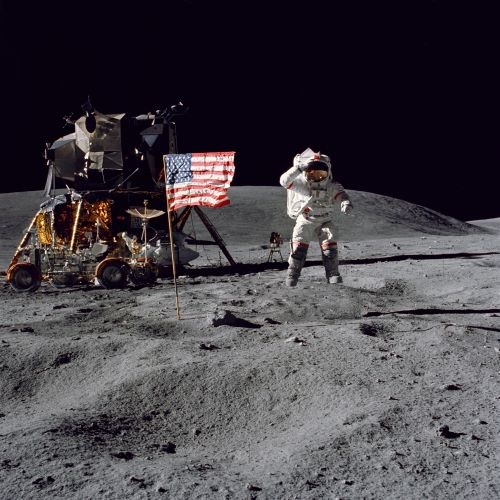
Contrasted to the Apollo human excursions on Earth’s celestial companion in 1969-1972, Artemis crews will spend considerably more time outside of their lunar landing vehicles and eventual encampments than the “dusty dozen” Apollo-era astronauts.
The report’s findings, observations, and recommendations stem from a “Lunar Dust and Its Impact on Human Exploration” workshop held February 11 – 13, 2020 that brought together leading experts in Houston, Texas.

Dust-up on the Moon. Apollo 17 commander Eugene Cernan prepares to doff lunar dust-covered space suit.
Credit: NASA
Ever present, intrusive dust
A major discovery of Apollo 11 — and the five succeeding moonwalking missions was that the surface of the Moon was covered by a several inch layer of fine dust.
“This dust layer had a negative impact on the health and wellbeing of the astronauts, and on their lunar equipment and instruments, including their spacesuits, helmets, and habitats. Surface operations and crew health were impeded by the ever present and intrusive dust,” explains the new report.
In summary, the report concludes that the dust problem “is an agency and industry concern affecting most mission subsystems and it must be addressed.”

Credit: NASA
In particular, the report continues, it is crucial that measurements and experiments be taken and carried out on the lunar surface by precursor landers to find out dust characteristics “that will influence hardware design, and provide toxicology data to safeguard crew health.”
High priority
A set of issues flagged in the report are considered “Very High Priority,” specifically:
— Characteristics of the finest fraction of the lunar soil are not well understood. The knowledge gap increases with decreasing particle size. Further, there is deficient knowledge of the variation in dust characteristics (e.g., chemical composition and mineralogy) and other characteristics of tiny particles across lunar geological regions.
— There is uncertainty in the electrical charging properties of the lunar surface and individual particles.
— Little knowledge exists about the electrical charge characteristics of regolith particles on and above the lunar surface due to the interactions with the solar wind plasma, photoemission, and secondary electron emissions.
— There has been little discussion of cabin and spacesuit (e.g., Lunar lander, Gateway) air cleaning systems.

— There is insufficient information with regard to the effect of lunar dust deposition on optical or thermal surface performance.
— While gaps exist, NASA’s Lunar Airborne Dust Toxicity Assessment Group provides significant toxicological data to guide setting a crew permissible exposure limit for dust exposure on short-term lunar missions.
— There appears to be little coordinated discussions across the agency to identify the impact of lunar dust on mechanisms, seals, connectors, and solar panels, nor are there cleaning systems identified.
— No industry-standard set of NASA requirements and oversight mechanisms exist for the manufacturing, quality control, and validation of lunar dust simulants, material that mimics Moon dust.
For each of these issues, the report fleshes out specific recommendations.
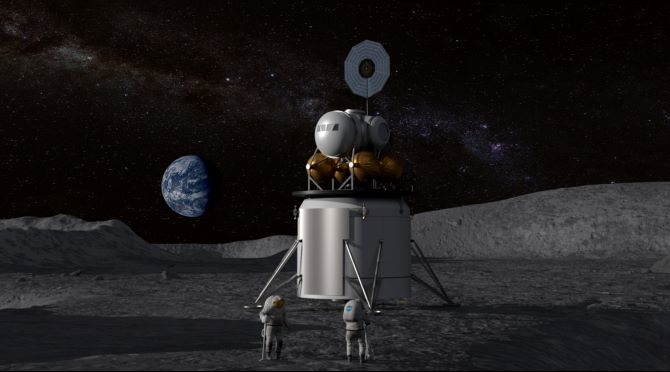
Credit: NASA
Safe levels of exposure
In wrapping up the new report’s observations, it underscores lessons learned from Apollo. For one, it became apparent that the effects of the dust on the human body, and on safety-critical equipment, had been underestimated.
In the future, the report stresses, these problems may become amplified over longer stays and any health and safety effects of lunar dust could be intensified by handling and recycling of dust in habitat life support systems, or through on-location water extraction or other operational processes, to the detriment of the crews.
“An important outcome of new investigations,” the report notes, “will be an understanding of acute versus chronic dust exposures, and establishing safe levels of exposure for long-term stays.”
The goal for future missions to the Moon, the report concludes, is to design spacecraft hardware that will operate properly and able to mitigate dust so that the crew members stay productive and healthy.
To read the full 40+ page document — Lunar Dust and Its Impact on Human Exploration: A NASA Engineering and Safety Center (NESC) Workshop – go to:
https://ntrs.nasa.gov/citations/20205008219
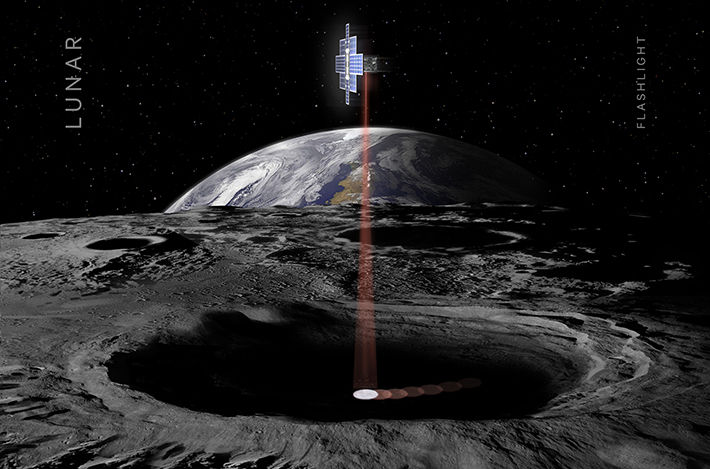
Moon orbiting Lunar Flashlight.
Credit: NASA/JPL
A set of diminutive, high-tech probes have these rousing names: Lunar IceCube, Lunar Flashlight, LunaH-Map and Lunar Trailblazer.
While the missions have differing observational and measurement strategies as they orbit the Moon, each spacecraft provides a unique perspective on lunar water distribution.
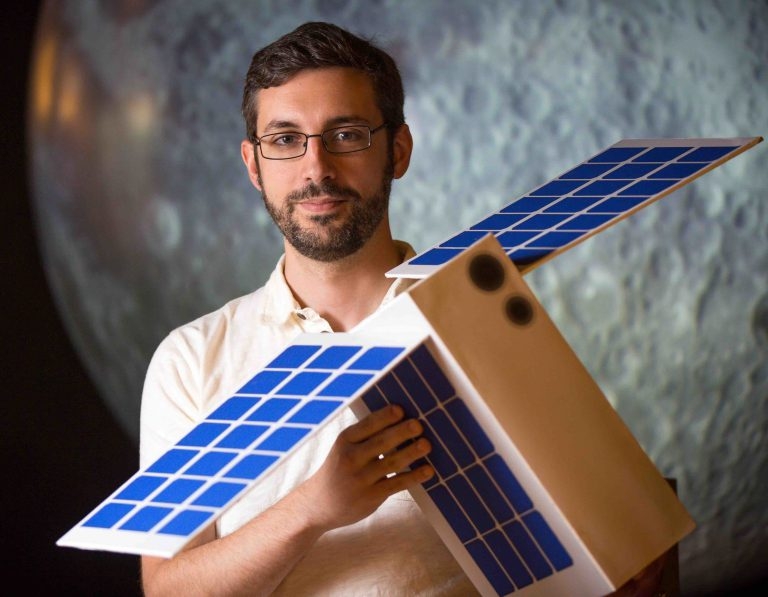
LunaH-Map probe and principal investigator Craig Hardgrove of Arizona State University’s School of Earth and Space Exploration.
Credit: ASU
On one hand, researchers are confident the Moon’s polar regions are enhanced in volatiles. Still, there remain some unknown unknowns about the form and physical distribution of these volatile species.
For more information on these missions and the task ahead, go to my new Space.com story at:
Tiny moonbound spacecraft have very big goals – A coming suite of small probes will help scientists better understand the Moon’s stores of water ice.
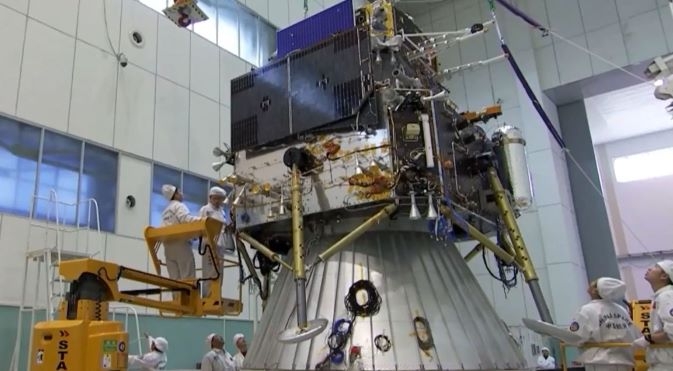
Chang’e-5 lunar sample mission is readied by technicians for possible late November takeoff.
Credit: CCTV via Andrew Jones
The Wenchang Spacecraft Launch Site located in Wenchang City of south China’s Hainan Province is ramping up preparations for the launch of the Chang’e-5 lunar probe.
The reported preferred candidate landing region for China’s next robotic mission is the Rümker region, located in the northern Oceanus Procellarum. The touchdown area is geologically complex and known for its volcanic activity.

Apollo 15 image captures landing locale of China’s Chang’e-5 Moon lander – the Mons Rümker region in the northern part of Oceanus Procellarum.
Credit: NASA
The robotic mission goal is to land on the Moon then haul back to Earth some 4 pounds (2 kilograms) of lunar regolith, possibly from as deep as 6.5 feet (2 meters) below the Moon’s surface.
Back in 2014, China’s Chang’e 5-T1 served as a test flight to validate the atmospheric re-entry design of the sample return capsule that will carry lunar collectibles.
Wenchang sendoff
Meanwhile, the pace is picking up in readying the Long March-5 rocket to hurl Chang’e-5 to the Moon.

China’s Chang’e-5 robotic sample return mission.
Credit: CNSA/CLEP
At present, the first stage and the interstage section of the Long March-5 carrier rocket are being tested, according to China Central Television (CCTV). The remaining parts of the booster will be transported by sea and land will then be assembled.
Wenchang is the youngest and the first coastal space launch site in China, among China’s four space launch sites.

Following a circumlunar voyage in 2014, a return capsule parachuted to Earth. This test was a prelude to China’s Chang’e-5 lunar mission being readied for its return sample mission now scheduled for 2020.
Courtesy: China Space
Ambitious venture
China is preparing the Chang’e-5 lunar mission for liftoff, perhaps toward the end of November. This ambitious venture is focused on collecting and returning lunar specimens back to Earth by robotic means – a task last done in 1976 by the former Soviet Union.
The Chang’e-5 mission is comprised of four parts: the orbiter, lander, ascender, and Earth reentry module containing the lunar specimens.

China plans to launch the ambitious Chang’e 5 lunar sample return mission later this year. (Image credit: Used with permission: Loren Roberts/The Planetary Society at https://www.planetary.org/)
In many ways, but on a smaller scale, Chang’e-5’s step-by-step trek mirror those of the Apollo human landing program architecture– suggesting a scalable approach to planting Chinese footprints on the Moon.
If the mission is successful, China would become the third nation to grab, stash, and haul back to Earth select lunar samples.
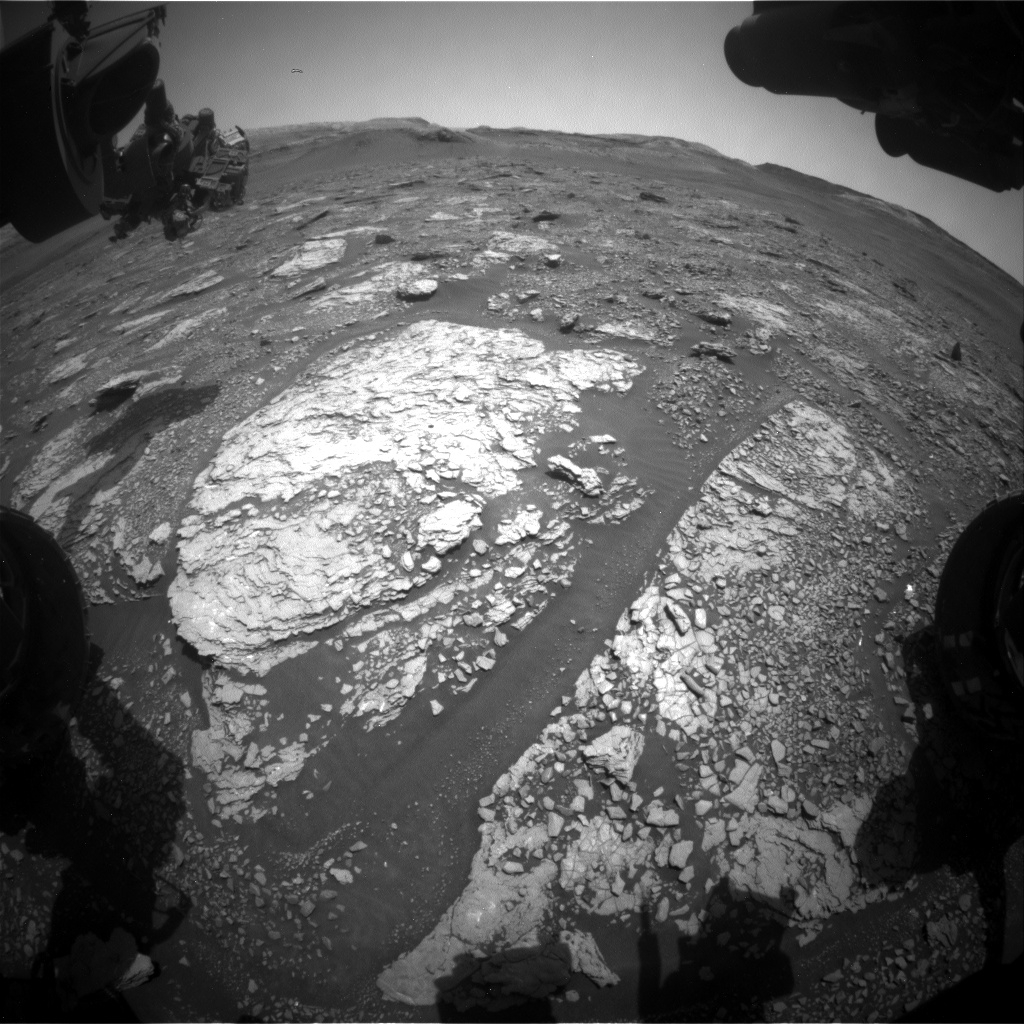
Front Hazcam image showing the current workspace with the two Mary Anning drill holes on the bedrock slab (just left of center), and Mount Sharp in the distance. The rover arm is extended out in the top left of the image, with the Alpha Particle X-Ray Spectrometer (APXS) sensor head pointing to the right. Image taken on Sol 2899, October 1, 2020.
Credit: NASA/JPL-Caltech
NASA’s Curiosity Mars rover is now performing Sol 2901 tasks.
Reports Lucy Thompson, a planetary geologist at University of New Brunswick; Fredericton, New Brunswick, Canada: “The first order of business for this three-sol plan [2901-2903] is to continue with arm diagnostic activities that could give Curiosity the all clear to bump to the next drill target at this location in the coming week.”
Thompson adds that all this still leaves plenty of time, power and data volume to plan a number of science activities.
These include continued characterization of the composition of the rock and soil at this location, with Chemistry and Camera (ChemCam) Laser Induced Breakdown Spectroscopy (LIBS) on “Skaw Beach” (soil target), “Wart” (resistant features in the bedrock) and “Balallan” (bedrock), accompanied by Mastcam documentation imaging.
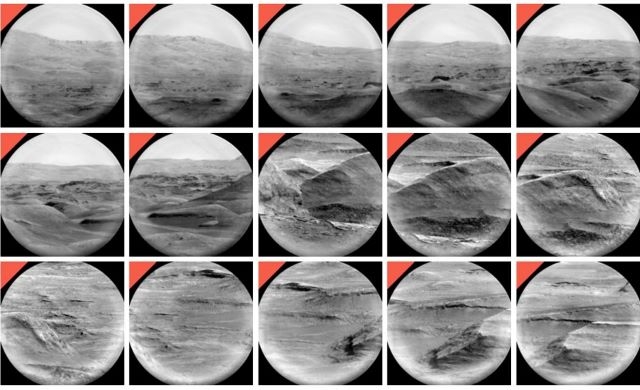
Partial mosaic taken by Curiosity’s Chemistry & Camera Remote Micro-Imager (RMI) telescope Sol 2900 October 2, 2020
Credit: NASA/JPL-Caltech/LANL
Ongoing mosaic
ChemCam will also capture some more Remote Micro-Imager (RMI) telescopic frames to add to the ongoing mosaic of the distant “Housedon Hill” area on Mount Sharp.
“The RMI mosaic will help the geologists on the team discern structures and textures within the rocks exposed in this area of Mount Sharp,” Thompson says, “which in turn might help us better understand their geological history.”
Change detection campaign
As well as studying the ancient processes that formed the rocks in Gale crater, Curiosity also monitors the current environment.
Such activities in this plan include Mastcam imaging of the nearby “Upper Ollach” sand and pebble target “as part of an ongoing change detection campaign to monitor movement of loose material by the wind,” Thompson notes.
The robot’s Mastcam will also image the crater rim, and along with Navcam, the sky, to monitor dust and opacity of the atmosphere.
A Navcam movie will also be acquired to record any dust devil activity.
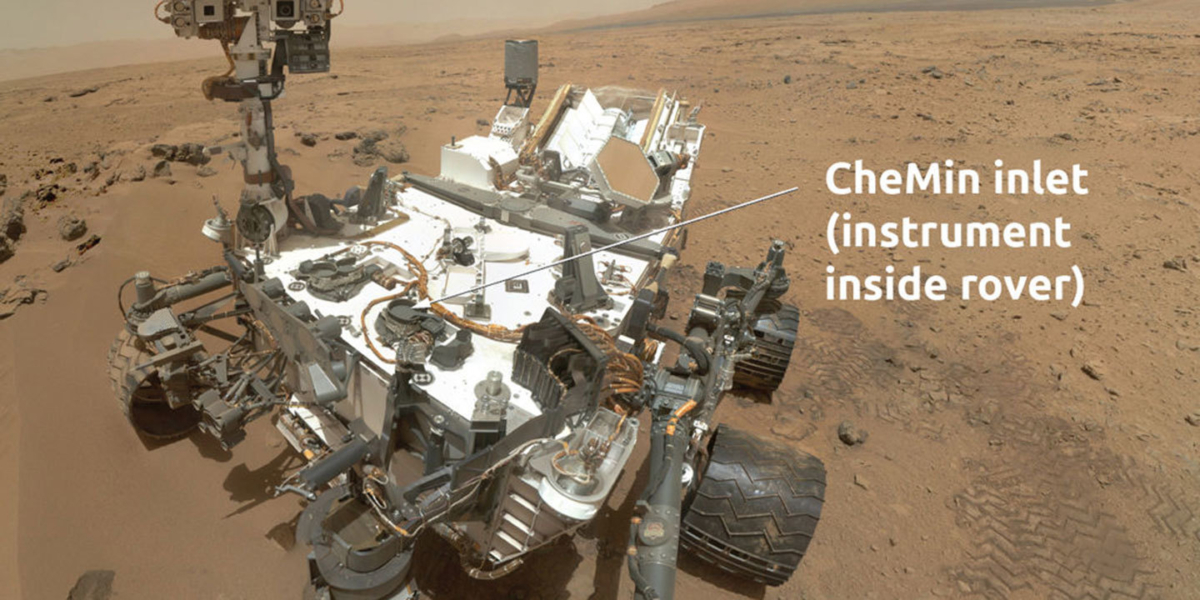
The Chemical and Mineralogy instrument, or CheMin for short, performs chemical analysis of powdered rock samples to identify the types and amounts of different minerals that are present.
Credit: NASA/JPL-Caltech
Next drilling
Finally, there is a Chemistry & Mineralogy X-Ray Diffraction/X-Ray Fluorescence Instrument (CheMin) empty cell and clean up activity on the last sol, in preparation for the rover’s next drill campaign.
Lastly, standard Rover Environmental Monitoring Station (REMS), Radiation Assessment Detector (RAD) and Dynamic Albedo of Neutrons (DAN) passive and active measurements are also planned, Thompson concludes.

Credit: ICON
ICON is an Austin, Texas-based advanced construction technologies company using 3D printing robotics, software and advanced materials.
The group has turned its attention to Moon-construction concepts drawing upon a Small Business Innovation Research (SBIR) Strategic Fund Increase (STRATFI) contract through the U.S. Air Force-managed AFVentures’ “Open Topic” process as well as NASA dollars.

Credit: ICON/Inside Outer Space Screen grab
3D printing with materials found on the Moon, adds the firm, is a sustainable and versatile solution to off-world construction.
Design freedom
In 2018, ICON was the first company in America to secure a building permit to construct a 3D printed home. The organization currently works in Mexico, Haiti, El Salvador, and Bolivia, funding more than 1,400 homes for families in need.
The Vulcan is ICON’s 3D printer designed specifically to produce resilient single-story buildings faster, more affordably, and with more design freedom, according to the group.

Credit: ICON/Inside Outer Space screengrab
Sustainable lunar habitat
“Building humanity’s first home on another world will be the most ambitious construction project in human history and will push science, engineering, technology, and architecture to literal new heights,” said Jason Ballard, Co-founder and CEO of ICON in a press statement.
In moving forward, ICON has established a research and development effort to further “Project Olympus” and the “Olympus Construction System,” and has teamed with the Bjarke Ingels Group (BIG) and SEArch+ LLC (Space Exploration Architecture).
The ICON Project Olympus team is eyeing a sustainable lunar habitat, outfitted with robust structures that provide thermal, radiation, and micrometeorite protection, better than metal or inflatable habitats can offer, according to members of the new partnership.
Go to this informative video on Project Olympus at:

NASA’s Artemis return humans to the Moon by 2024 program.
Credit: NASA
NASA is starting to define an Internet-like architecture, known as LunaNet, detailing needed space communications relay and navigation services to support the space agency’s Artemis program and its planned missions to the Moon.
LunaNet would involve position, navigation, and timing (PNT) services in support of lunar missions.
Conceptually, the LunaNet architecture embodies three types of networks: the lunar relay network, the lunar surface network, and the Earth network.
Numbers of nations are now cooperating in a vast effort to expand the sphere of human presence to the Moon and beyond. In the next decade, scores of missions will be launched to orbit or land on the Moon and begin to establish a sustained presence there.

The NASA Artemis program will send the first woman and the next man to the Moon by 2024 and develop a sustainable human presence on the Moon by 2028.
Credit: NASA
LunaNet is envisioned as supporting lunar missions – national and international, governmental and commercial – beginning in 2020.
Initial interest
“Two missions are driving NASA’s initial interest in relay services,” explains Andrew Petro of NASA Headquarters. “One is a science mission to the farside of the Moon, planned for launch as early as the second quarter of 2024. A second mission that might make use of relay services is a planned human exploration mission to near the South Pole of the Moon in 2024.”
Petro adds that, beyond these two early missions, the demand for relay services is likely to exist for additional lunar missions undertaken by NASA and by others.

Phase 1 LunaNet.
Credit: NASA

LunaNet, 2nd phase.
Credit: NASA
“Communications relay and navigation service capabilities could become part of an infrastructure enabling general expansion of robotic and human activities on the Moon,” Petro says.
Sphere of human presence
Numbers of nations are now cooperating in a vast effort to expand the sphere of human presence to the Moon and beyond. In the next decade, scores of missions will be launched to orbit or land on the Moon and begin to establish a sustained presence there.
LunaNet would provide services for various Moon-related activities, such as lunar science orbiters, lunar exploration orbiters, lunar surface mobile and stationary systems, Moon and Earth orbiters that provide relay and PNT service to lunar systems, lunar ascent and descent vehicles, and associated Earth ground stations and control centers.

Credit: NASA
LunaNet is envisioned as a network defined by a framework of frequency bands, communication and PNT protocols, and interfaces to support an open, scalable, interoperable network-of-networks for missions to use in cislunar space.
Incremental phases
As now seen, LunaNet would be implemented in a series of incremental phases driven by major phases of human exploration and scientific discovery missions:
(1st Phase) Now-2024 – early robotic missions and crewed missions leading to the return of humans to the Moon. Initial LunaNet capability will become operational. At least one lunar relay will be launched to enable farside robotic landers and science missions and support the southern polar site.
(2nd Phase) 2024-2028 – expansion of scientific capabilities and establishment of a sustainable human presence. The number of surface sites and missions will increase. LunaNet services and capacity will expand as more service providers join.
(3rd Phase) Beyond 2028 – sustained scientific and human lunar capabilities. The cislunar region will be used to conduct Mars analog missions to prepare for eventual human missions to Mars. LunaNet will continue to expand capacity and coverage as required to meet mission needs and will act as an analog for the Mars Network, MarsNet.

Lunar south pole – future Moon base location.
Credit: NASA
Landing accuracy
In 1969, Apollo 11 overshot its intended landing site by several kilometers due to simplistic understanding of the uneven lunar gravity field. A few months later, Apollo 12 landed roughly 590 feet (180 meters) from its target, the NASA robotic Surveyor 3 lunar lander, due to rapid improvements in understanding, modeling, and analysis.
At a projected lunar south pole base station — where multiple missions will land, assemble infrastructure, and explore the surrounding region — a surface wireless network will be deployed to interconnect fixed and mobile surface users.
Concepts for a lunar base will require repeatable high landing accuracy with an error less than 330 feet (100 meters) and eventually, less than 33 feet (10 meters), according to LunaNet planners.

Curiosity Front Hazard Avoidance Camera Left B image taken on Sol 2899, October 1, 2020.
Credit: NASA/JPL-Caltech
NASA’s Curiosity Mars rover is now performing Sol 2899 tasks.
Tomorrow on Mars, scientists are celebrating 2,900 sols on Mars with the Curiosity Rover, reports Ashley Stroupe, Mission Operations Engineer at NASA’s Jet Propulsion Laboratory.
The priority in a recently scripted two-sol plan (Sol 289902900) is the completion of the back-to-back atmospheric measurements by the Sample Analysis at Mars instrument (SAM).
Methane content
“SAM will be analyzing the methane content of the nighttime Mars atmosphere using its tunable laser spectrometer. This will help to fill in our understanding of the seasonal changes in the atmosphere,” Stroupe explains.

Curiosity Right B Navigation Camera photo acquired on Sol 2899, October 1, 2020.
Credit: NASA/JPL-Caltech
In addition to the very power-intense SAM activity, Mars researchers were also able to squeeze in some additional remote science observations on the second sol of the plan.
Mosaic of Housedon Hill
The robot’s Chemistry and Camera (ChemCam) added several frames to the ongoing Remote Micro-Imager (RMI) mosaic of the target “Housedon Hill” (a.k.a. Housedon) – a target on the higher levels of Mount Sharp – in order to better understand the geology.
“These frames will be added to the dozens already taken,” Stroupe says. “We also planned a Mastcam clast survey, and will take images to look for changes in the workspace during the time we have been parked at ‘Mary Anning.’”

Curiosity Chemistry & Camera Remote Micro-Imager (RMI) telescope image acquired on Sol 2898, September 30, 2020.
Credit: NASA/JPL-Caltech/LANL
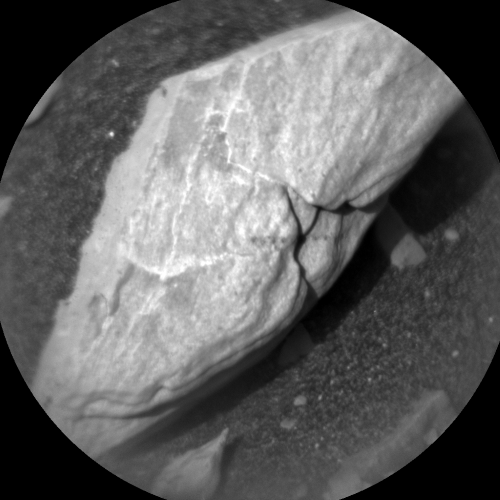
Curiosity Chemistry & Camera Remote Micro-Imager (RMI) telescope image acquired on Sol 2898, September 30, 2020.
Credit: NASA/JPL-Caltech/LANL
The second sol also includes a short set of environmental observations, including a short Navcam dust devil movie, a Navcam line-of-sight, and a Mastcam basic tau.
“And with all that, we made sure we still had enough power for the rover planners to add some additional arm diagnostics to the plan,” Stroupe concludes.

Credit: CCTV
A third group of Chinese astronauts has been selected for the nation’s coming space station mission, the China Manned Space Agency reported on Thursday morning.
The 18 new astronauts – 17 men and one woman – are in three groups:
— seven will become spacecraft pilots and were chosen from aviators from the People’s Liberation Army Air Force.
— another seven will turn into spaceflight engineers, former researchers or technicians in aeronautics, astronautics and other related fields.
— the last four will be mission payload specialists selected from those involved in space science and applications for China’s piloted space program.

Credit: CCTV
According to a report in China Daily, before this new selection, China had 21 astronauts from two generations. Among them, 11 have taken part in spaceflight during six missions.
The selection for the third-generation team began in April 2018, culling down the group from roughly 2,500 applicants.

Credit: CMS/CCTV/Inside Outer Space screengrab
Multi-module station
According to government plans, the nation will start putting together its first crewed space station around 2021.
Marking the first step, a Long March 5B will put the station’s core module into orbit that year. Next, other components and astronauts will be ferried to the core module to assemble the station.

Credit: CCTV/Inside Outer Space screengrab
The multimodule station, named Tiangong, or Heavenly Palace, will be mainly composed of three components — a core module attached to two space labs — having a combined weight of more than 90 metric tons, according to the China Academy of Space Technology.
The space station is expected to be built and become fully operational around 2022 and is set to operate for about 15 years, the academy said.

U.S. concerns
Yesterday, a China Task Force released a detailed policy blueprint to counter the growing global threat of the Chinese Communist Party (CCP). This Task Force was comprised of 15 members representing 11 committees in the U.S. House of Representatives.
The CCP is looking to become a space superpower, notes the document that also discussed China’s space station efforts.
“If the PRC [People’s Republic of China] succeeds in its efforts to launch its first long-term space station module in 2022, it will have matched the U.S.’ nearly 40-year progression from first human spaceflight to first space station module in less than 20 years. The CCP is vocal about plans to establish a human base on the Moon. The U.S. should be concerned about the technological innovations and leadership role for the CCP that could come from missions crewed by PRC-nationals to the Moon,” the report says.
To review the task force document, go to:

