Archive for the ‘Space News’ Category
 Author:
  October 4th, 2020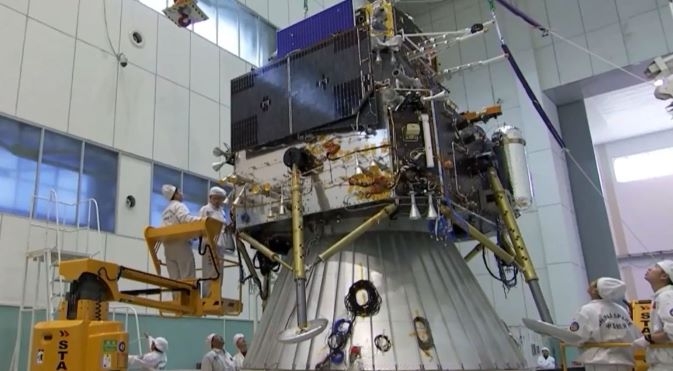
Chang’e-5 lunar sample mission is readied by technicians for possible late November takeoff.
Credit: CCTV via Andrew Jones
The Wenchang Spacecraft Launch Site located in Wenchang City of south China’s Hainan Province is ramping up preparations for the launch of the Chang’e-5 lunar probe.
The reported preferred candidate landing region for China’s next robotic mission is the Rümker region, located in the northern Oceanus Procellarum. The touchdown area is geologically complex and known for its volcanic activity.

Apollo 15 image captures landing locale of China’s Chang’e-5 Moon lander – the Mons Rümker region in the northern part of Oceanus Procellarum.
Credit: NASA
The robotic mission goal is to land on the Moon then haul back to Earth some 4 pounds (2 kilograms) of lunar regolith, possibly from as deep as 6.5 feet (2 meters) below the Moon’s surface.
Back in 2014, China’s Chang’e 5-T1 served as a test flight to validate the atmospheric re-entry design of the sample return capsule that will carry lunar collectibles.
Wenchang sendoff
Meanwhile, the pace is picking up in readying the Long March-5 rocket to hurl Chang’e-5 to the Moon.

China’s Chang’e-5 robotic sample return mission.
Credit: CNSA/CLEP
At present, the first stage and the interstage section of the Long March-5 carrier rocket are being tested, according to China Central Television (CCTV). The remaining parts of the booster will be transported by sea and land will then be assembled.
Wenchang is the youngest and the first coastal space launch site in China, among China’s four space launch sites.

Following a circumlunar voyage in 2014, a return capsule parachuted to Earth. This test was a prelude to China’s Chang’e-5 lunar mission being readied for its return sample mission now scheduled for 2020.
Courtesy: China Space
Ambitious venture
China is preparing the Chang’e-5 lunar mission for liftoff, perhaps toward the end of November. This ambitious venture is focused on collecting and returning lunar specimens back to Earth by robotic means – a task last done in 1976 by the former Soviet Union.
The Chang’e-5 mission is comprised of four parts: the orbiter, lander, ascender, and Earth reentry module containing the lunar specimens.

China plans to launch the ambitious Chang’e 5 lunar sample return mission later this year. (Image credit: Used with permission: Loren Roberts/The Planetary Society at https://www.planetary.org/)
In many ways, but on a smaller scale, Chang’e-5’s step-by-step trek mirror those of the Apollo human landing program architecture– suggesting a scalable approach to planting Chinese footprints on the Moon.
If the mission is successful, China would become the third nation to grab, stash, and haul back to Earth select lunar samples.
 Posted in
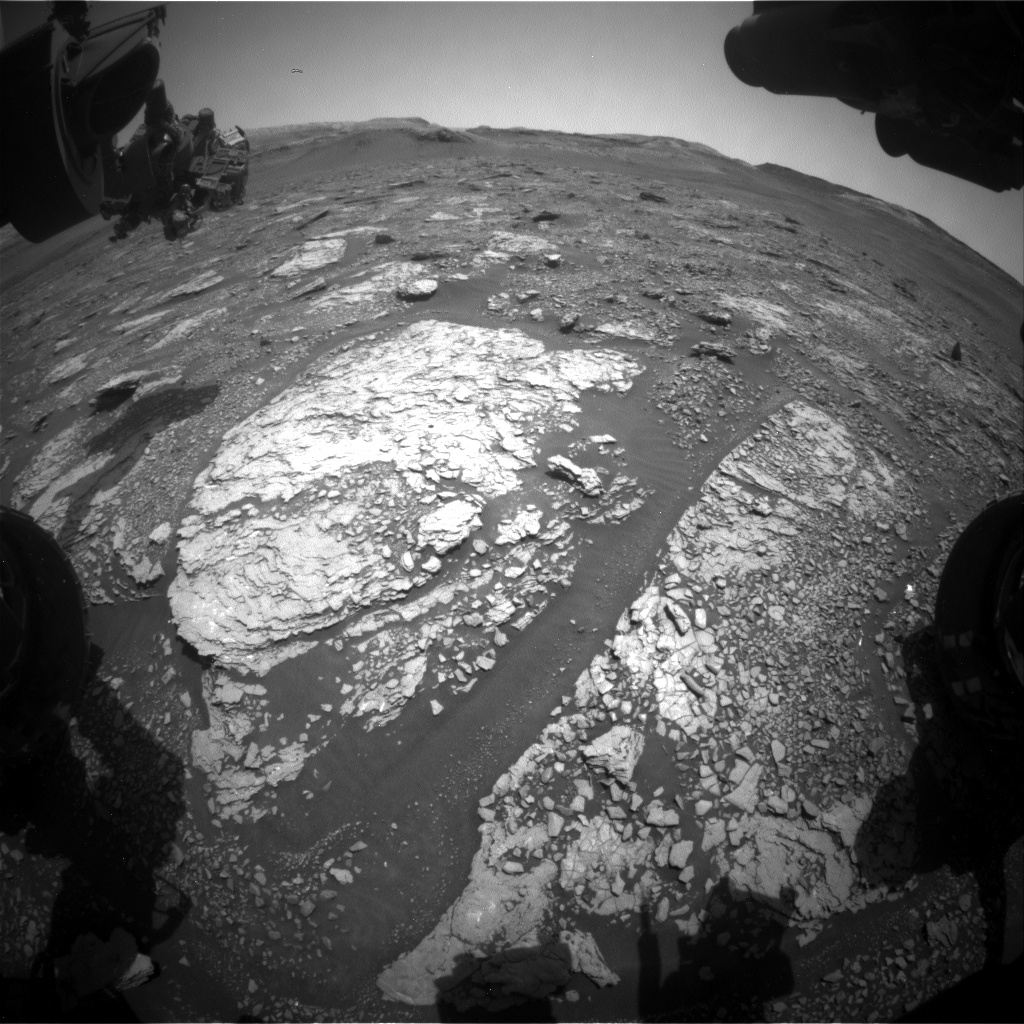
Front Hazcam image showing the current workspace with the two Mary Anning drill holes on the bedrock slab (just left of center), and Mount Sharp in the distance. The rover arm is extended out in the top left of the image, with the Alpha Particle X-Ray Spectrometer (APXS) sensor head pointing to the right. Image taken on Sol 2899, October 1, 2020.
Credit: NASA/JPL-Caltech
NASA’s Curiosity Mars rover is now performing Sol 2901 tasks.
Reports Lucy Thompson, a planetary geologist at University of New Brunswick; Fredericton, New Brunswick, Canada: “The first order of business for this three-sol plan [2901-2903] is to continue with arm diagnostic activities that could give Curiosity the all clear to bump to the next drill target at this location in the coming week.”
Thompson adds that all this still leaves plenty of time, power and data volume to plan a number of science activities.
These include continued characterization of the composition of the rock and soil at this location, with Chemistry and Camera (ChemCam) Laser Induced Breakdown Spectroscopy (LIBS) on “Skaw Beach” (soil target), “Wart” (resistant features in the bedrock) and “Balallan” (bedrock), accompanied by Mastcam documentation imaging.
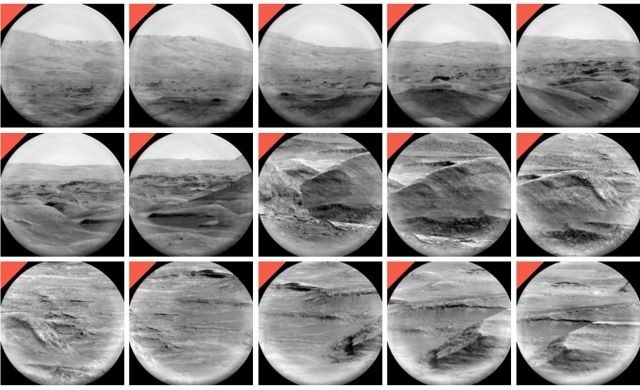
Partial mosaic taken by Curiosity’s Chemistry & Camera Remote Micro-Imager (RMI) telescope Sol 2900 October 2, 2020
Credit: NASA/JPL-Caltech/LANL
Ongoing mosaic
ChemCam will also capture some more Remote Micro-Imager (RMI) telescopic frames to add to the ongoing mosaic of the distant “Housedon Hill” area on Mount Sharp.
“The RMI mosaic will help the geologists on the team discern structures and textures within the rocks exposed in this area of Mount Sharp,” Thompson says, “which in turn might help us better understand their geological history.”
Change detection campaign
As well as studying the ancient processes that formed the rocks in Gale crater, Curiosity also monitors the current environment.
Such activities in this plan include Mastcam imaging of the nearby “Upper Ollach” sand and pebble target “as part of an ongoing change detection campaign to monitor movement of loose material by the wind,” Thompson notes.
The robot’s Mastcam will also image the crater rim, and along with Navcam, the sky, to monitor dust and opacity of the atmosphere.
A Navcam movie will also be acquired to record any dust devil activity.
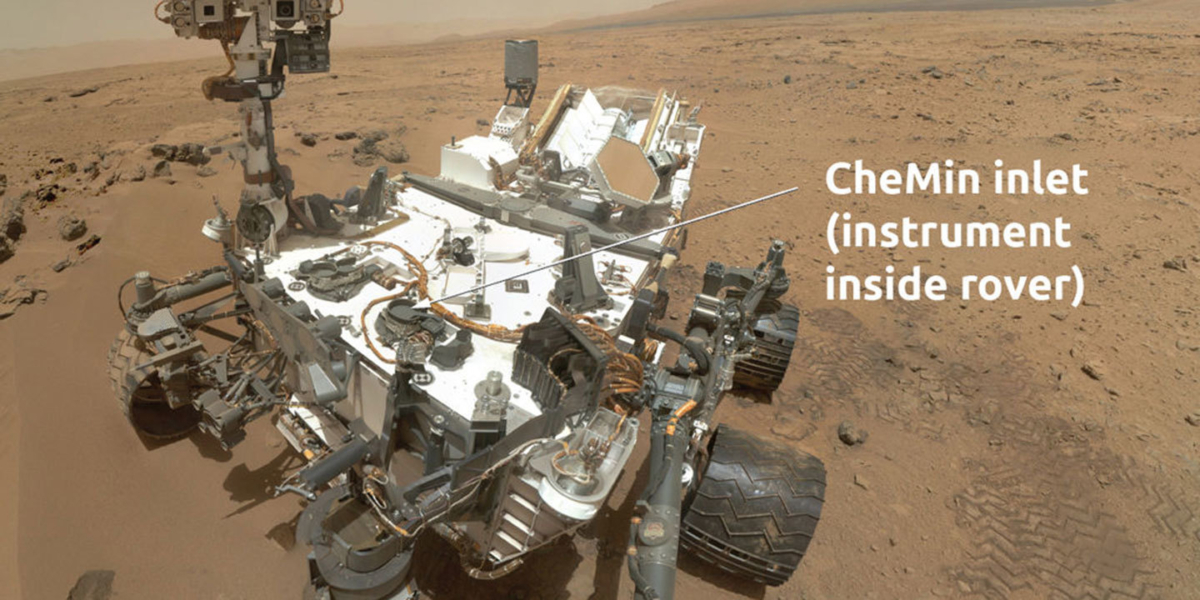
The Chemical and Mineralogy instrument, or CheMin for short, performs chemical analysis of powdered rock samples to identify the types and amounts of different minerals that are present.
Credit: NASA/JPL-Caltech
Next drilling
Finally, there is a Chemistry & Mineralogy X-Ray Diffraction/X-Ray Fluorescence Instrument (CheMin) empty cell and clean up activity on the last sol, in preparation for the rover’s next drill campaign.
Lastly, standard Rover Environmental Monitoring Station (REMS), Radiation Assessment Detector (RAD) and Dynamic Albedo of Neutrons (DAN) passive and active measurements are also planned, Thompson concludes.

Credit: ICON
ICON is an Austin, Texas-based advanced construction technologies company using 3D printing robotics, software and advanced materials.
The group has turned its attention to Moon-construction concepts drawing upon a Small Business Innovation Research (SBIR) Strategic Fund Increase (STRATFI) contract through the U.S. Air Force-managed AFVentures’ “Open Topic” process as well as NASA dollars.

Credit: ICON/Inside Outer Space Screen grab
3D printing with materials found on the Moon, adds the firm, is a sustainable and versatile solution to off-world construction.
Design freedom
In 2018, ICON was the first company in America to secure a building permit to construct a 3D printed home. The organization currently works in Mexico, Haiti, El Salvador, and Bolivia, funding more than 1,400 homes for families in need.
The Vulcan is ICON’s 3D printer designed specifically to produce resilient single-story buildings faster, more affordably, and with more design freedom, according to the group.

Credit: ICON/Inside Outer Space screengrab
Sustainable lunar habitat
“Building humanity’s first home on another world will be the most ambitious construction project in human history and will push science, engineering, technology, and architecture to literal new heights,” said Jason Ballard, Co-founder and CEO of ICON in a press statement.
In moving forward, ICON has established a research and development effort to further “Project Olympus” and the “Olympus Construction System,” and has teamed with the Bjarke Ingels Group (BIG) and SEArch+ LLC (Space Exploration Architecture).
The ICON Project Olympus team is eyeing a sustainable lunar habitat, outfitted with robust structures that provide thermal, radiation, and micrometeorite protection, better than metal or inflatable habitats can offer, according to members of the new partnership.
Go to this informative video on Project Olympus at:

NASA’s Artemis return humans to the Moon by 2024 program.
Credit: NASA
NASA is starting to define an Internet-like architecture, known as LunaNet, detailing needed space communications relay and navigation services to support the space agency’s Artemis program and its planned missions to the Moon.
LunaNet would involve position, navigation, and timing (PNT) services in support of lunar missions.
Conceptually, the LunaNet architecture embodies three types of networks: the lunar relay network, the lunar surface network, and the Earth network.
Numbers of nations are now cooperating in a vast effort to expand the sphere of human presence to the Moon and beyond. In the next decade, scores of missions will be launched to orbit or land on the Moon and begin to establish a sustained presence there.

The NASA Artemis program will send the first woman and the next man to the Moon by 2024 and develop a sustainable human presence on the Moon by 2028.
Credit: NASA
LunaNet is envisioned as supporting lunar missions – national and international, governmental and commercial – beginning in 2020.
Initial interest
“Two missions are driving NASA’s initial interest in relay services,” explains Andrew Petro of NASA Headquarters. “One is a science mission to the farside of the Moon, planned for launch as early as the second quarter of 2024. A second mission that might make use of relay services is a planned human exploration mission to near the South Pole of the Moon in 2024.”
Petro adds that, beyond these two early missions, the demand for relay services is likely to exist for additional lunar missions undertaken by NASA and by others.

Phase 1 LunaNet.
Credit: NASA

LunaNet, 2nd phase.
Credit: NASA
“Communications relay and navigation service capabilities could become part of an infrastructure enabling general expansion of robotic and human activities on the Moon,” Petro says.
Sphere of human presence
Numbers of nations are now cooperating in a vast effort to expand the sphere of human presence to the Moon and beyond. In the next decade, scores of missions will be launched to orbit or land on the Moon and begin to establish a sustained presence there.

LunaNet would provide services for various Moon-related activities, such as lunar science orbiters, lunar exploration orbiters, lunar surface mobile and stationary systems, Moon and Earth orbiters that provide relay and PNT service to lunar systems, lunar ascent and descent vehicles, and associated Earth ground stations and control centers.

Credit: NASA
LunaNet is envisioned as a network defined by a framework of frequency bands, communication and PNT protocols, and interfaces to support an open, scalable, interoperable network-of-networks for missions to use in cislunar space.
Incremental phases
As now seen, LunaNet would be implemented in a series of incremental phases driven by major phases of human exploration and scientific discovery missions:
(1st Phase) Now-2024 – early robotic missions and crewed missions leading to the return of humans to the Moon. Initial LunaNet capability will become operational. At least one lunar relay will be launched to enable farside robotic landers and science missions and support the southern polar site.
(2nd Phase) 2024-2028 – expansion of scientific capabilities and establishment of a sustainable human presence. The number of surface sites and missions will increase. LunaNet services and capacity will expand as more service providers join.
(3rd Phase) Beyond 2028 – sustained scientific and human lunar capabilities. The cislunar region will be used to conduct Mars analog missions to prepare for eventual human missions to Mars. LunaNet will continue to expand capacity and coverage as required to meet mission needs and will act as an analog for the Mars Network, MarsNet.

Lunar south pole – future Moon base location.
Credit: NASA
Landing accuracy
In 1969, Apollo 11 overshot its intended landing site by several kilometers due to simplistic understanding of the uneven lunar gravity field. A few months later, Apollo 12 landed roughly 590 feet (180 meters) from its target, the NASA robotic Surveyor 3 lunar lander, due to rapid improvements in understanding, modeling, and analysis.
At a projected lunar south pole base station — where multiple missions will land, assemble infrastructure, and explore the surrounding region — a surface wireless network will be deployed to interconnect fixed and mobile surface users.
Concepts for a lunar base will require repeatable high landing accuracy with an error less than 330 feet (100 meters) and eventually, less than 33 feet (10 meters), according to LunaNet planners.

Curiosity Front Hazard Avoidance Camera Left B image taken on Sol 2899, October 1, 2020.
Credit: NASA/JPL-Caltech
NASA’s Curiosity Mars rover is now performing Sol 2899 tasks.
Tomorrow on Mars, scientists are celebrating 2,900 sols on Mars with the Curiosity Rover, reports Ashley Stroupe, Mission Operations Engineer at NASA’s Jet Propulsion Laboratory.
The priority in a recently scripted two-sol plan (Sol 289902900) is the completion of the back-to-back atmospheric measurements by the Sample Analysis at Mars instrument (SAM).
Methane content
“SAM will be analyzing the methane content of the nighttime Mars atmosphere using its tunable laser spectrometer. This will help to fill in our understanding of the seasonal changes in the atmosphere,” Stroupe explains.

Curiosity Right B Navigation Camera photo acquired on Sol 2899, October 1, 2020.
Credit: NASA/JPL-Caltech
In addition to the very power-intense SAM activity, Mars researchers were also able to squeeze in some additional remote science observations on the second sol of the plan.
Mosaic of Housedon Hill
The robot’s Chemistry and Camera (ChemCam) added several frames to the ongoing Remote Micro-Imager (RMI) mosaic of the target “Housedon Hill” (a.k.a. Housedon) – a target on the higher levels of Mount Sharp – in order to better understand the geology.
“These frames will be added to the dozens already taken,” Stroupe says. “We also planned a Mastcam clast survey, and will take images to look for changes in the workspace during the time we have been parked at ‘Mary Anning.’”

Curiosity Chemistry & Camera Remote Micro-Imager (RMI) telescope image acquired on Sol 2898, September 30, 2020.
Credit: NASA/JPL-Caltech/LANL
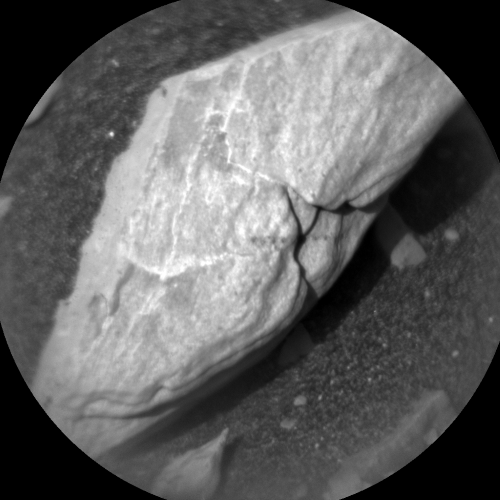
Curiosity Chemistry & Camera Remote Micro-Imager (RMI) telescope image acquired on Sol 2898, September 30, 2020.
Credit: NASA/JPL-Caltech/LANL
The second sol also includes a short set of environmental observations, including a short Navcam dust devil movie, a Navcam line-of-sight, and a Mastcam basic tau.
“And with all that, we made sure we still had enough power for the rover planners to add some additional arm diagnostics to the plan,” Stroupe concludes.

Credit: CCTV
A third group of Chinese astronauts has been selected for the nation’s coming space station mission, the China Manned Space Agency reported on Thursday morning.
The 18 new astronauts – 17 men and one woman – are in three groups:
— seven will become spacecraft pilots and were chosen from aviators from the People’s Liberation Army Air Force.
— another seven will turn into spaceflight engineers, former researchers or technicians in aeronautics, astronautics and other related fields.
— the last four will be mission payload specialists selected from those involved in space science and applications for China’s piloted space program.

Credit: CCTV
According to a report in China Daily, before this new selection, China had 21 astronauts from two generations. Among them, 11 have taken part in spaceflight during six missions.
The selection for the third-generation team began in April 2018, culling down the group from roughly 2,500 applicants.

Credit: CMS/CCTV/Inside Outer Space screengrab
Multi-module station
According to government plans, the nation will start putting together its first crewed space station around 2021.
Marking the first step, a Long March 5B will put the station’s core module into orbit that year. Next, other components and astronauts will be ferried to the core module to assemble the station.

Credit: CCTV/Inside Outer Space screengrab
The multimodule station, named Tiangong, or Heavenly Palace, will be mainly composed of three components — a core module attached to two space labs — having a combined weight of more than 90 metric tons, according to the China Academy of Space Technology.
The space station is expected to be built and become fully operational around 2022 and is set to operate for about 15 years, the academy said.

U.S. concerns
Yesterday, a China Task Force released a detailed policy blueprint to counter the growing global threat of the Chinese Communist Party (CCP). This Task Force was comprised of 15 members representing 11 committees in the U.S. House of Representatives.
The CCP is looking to become a space superpower, notes the document that also discussed China’s space station efforts.
“If the PRC [People’s Republic of China] succeeds in its efforts to launch its first long-term space station module in 2022, it will have matched the U.S.’ nearly 40-year progression from first human spaceflight to first space station module in less than 20 years. The CCP is vocal about plans to establish a human base on the Moon. The U.S. should be concerned about the technological innovations and leadership role for the CCP that could come from missions crewed by PRC-nationals to the Moon,” the report says.
To review the task force document, go to:

Cuff checklist on the final Apollo 17 moonwalk in 1972. On the bottom of the last page he had written some crib notes to jog his memory for his famous departure speech.
Courtesy: RR Auction
An upcoming auction by Boston-based RR Auction will feature a special Apollo 17 item from the late Gene Cernan.
The Apollo 17 mission to the Moon took place December 7–19, 1972.
Cernan wore a cuff checklist on his wrist for the duration of the final Apollo 17 moonwalk, exposing it to the lunar environment for 7 hours and 15 minutes.

Moonwalker Gene Cernan during 3rd excursion. Note cuff checklist.
Credit: NASA
The cuff checklist is a comprehensive guide for the moonwalking activity, offering preparation procedures, simplified maps of traverse routes and landmarks.
Online bidding
Among the more than 500 auction items: Skylab full-scale training mockup of the Multiple Docking Adapter (MDA) was used to train the Skylab astronauts before their missions, a MIT-built Lunar Traverse Gravimeter, like that used on Apollo 17, and an Apollo-era Marquardt R-4D Rocket Engine.
Online bidding for the Space Exploration and aviation sale from RR Auction will begin October 8 and conclude October 15.
For more information, go to:
https://rrauction.com/preview_itemdetail.cfm?IN=4001
Also, go to this video featuring Cernan describing his Apollo 17 experience and the role of his cuff checklists at:

Japan Aerospace Exploration Agency (JAXA) Martian Moons eXploration (MMX) mission
The Japan Aerospace Exploration Agency (JAXA) Martian Moons eXploration (MMX) mission is to be launched in 2024.
Onboard that craft will be a German-French rover slated to land on the Martian moon Phobos and explore its surface for approximately three months.
Prepatory landing tests for the rover’s touchdown on the Martian moon is underway at the German Aerospace Center (Deutsches Zentrum für Luft- und Raumfahrt; DLR).

Rover testing.
Credit: DLR
Impact testing
Using a first preliminary development model, and using the Landing and Mobility Test Facility in Bremen, technicians are appraising the 55-pound (25-kilograms) rover’s design and its ability to withstand an impact on the moon’s surface – after a roughly 130 to 328 feet (40 to 100 meters) free fall onto the moon.

Drop testing underway.
Credit: DLR
Phobos has roughly two thousandths of Earth’s gravity at its surface.
“The exact location of the landing on the surface of Phobos is a matter of chance and we are using these analyses to prepare for the various possible scenarios,” explains Michael Wrasmann from the DLR Institute of Space Systems.
The findings of the experiments will help the researchers to define the design of the MMX Rover in more detail.
Driving orientation
“In 2021, we plan to test a significantly more representative structural model equipped with all the components of the motion system,” adds Markus Grebenstein from DLR’s Robotics and Mechatronics Center (RMC) in Oberpfaffenhofen.

Artwork depicts rover wheeling about on Phobos.
Credit: DLR (CC-BY 3.0)
“This consists of four wheels attached to movable legs and a foldable mechanism at the rear of the rover. If the rover lands on its side, this mechanism will bring it into a position where it can autonomously move into the final driving orientation and deploy its solar panels,” Grebenstein notes in a DLR press statement.

Phobos awaits exploration. Image taken by European Space Agency’s Mars Express orbiter.
Credit: ESA/DLR/FU Berlin/CC BY-SA 3.0 IGO
Moons of Mars – origins?
The JAXA MMX mission is scheduled for a 2024 liftoff, with insertion into Mars orbit in 2025.
MMX is targeted to explore Mars’ two moons Phobos and Deimos. It has long been speculated that the moons might be asteroids captured by the Red Planet or may have formed as a result of the collision of a larger body with Mars.
The landing of the MMX rover on Phobos as part of the mission is planned for late 2026 or early 2027.
The machinery will spend some 100 days analyzing the surface properties of the Martian moon in detail, contributing to solving the scientific puzzle concerning its origin.

Volker Hessel with pills of the type being sent into space.
Photo: University of Adelaide
The launch of Northrop Grumman’s Antares rocket is slated to occur later this week, delivering NASA science investigations, supplies and equipment to the International Space Station.

Antares rocket is slated for Thursday, Oct. 1 liftoff from the mid-Atlantic Regional Spaceport’s Pad-0A at NASA’s Wallops Flight Facility on Wallops Island, Virginia.
Credit: NASA
One payload: 60 pills to test how they cope with the rigors of space radiation and microgravity.
The University of Adelaide is investigating how pharmaceutical tablet formulations do in space, first within the ISS, then next year, how tables cope outside the ISS.
Materials used in the tablets being tested — packaged in blister packs as they would be available commercially — include Ibuprofen as a pharmaceutical active ingredient and vitamin C, and “excipients” – a pharmacologically inert, adhesive substance, as honey, syrup, or gum arabic, used to bind the contents of a pill or tablet.

Lunar base dispensary?
Credit: ESA/Foster + Partners
Lunar pharmacy?
“The tablets which were made at the University of Adelaide, will be exposed to the microgravity and cosmic rays found in the harsh environment of space for six months before returning to Earth where we will test what effect the space environment has had on them,” says Volker Hessel, Research Director of the Center for Sustainable Planetary and Space Resources in a University of Adelaide press statement.
“We only used ingredients from materials that are only available on the Moon, and in so doing we are making the first steps towards autonomous on-board pharmaceutical manufacturing.”
The ability to produce drugs in space and on-demand could be of benefit to pharmaceutical companies here on Earth as well.
The experiment is being done by University of Adelaide, in collaboration with Space Tango, and Alpha Space.

NASA’s pioneering Pioneer Venus mission.
Credit: NASA
Scientists diving back into decades-old data collected by NASA’s Pioneer Venus spacecraft mission have found evidence for phosophine in the clouds of Venus – considered a potential biosignature for life.
Pioneer Venus went into orbit around Venus in December 1978. The spacecraft made a destructive plunge into the planet’s atmosphere on October 8, 1992.
Re-examine data
The recent ground-based data about phosphine in Venus’ clouds inspired researchers to re-examine data obtained from the Pioneer-Venus Large Probe Neutral Mass Spectrometer (LNMS) to search for evidence of phosphorus compounds.
The LNMS obtained masses of neutral gases (and their fragments) at different altitudes within Venus’ clouds.

Venus in ultraviolet taken by NASA’s Pioneer-Venus Orbiter in 1979 indicating that an unknown absorber is operating in the planet’s top cloud layer.
Credit: NASA
Habitable zone?
Published mass spectral data correspond to gases at altitudes of 50-60 km, or within the lower and middle clouds of Venus – which has been identified as a potential habitable zone.
“We find that LMNS data support the presence of phosphine; although, the origins of phosphine remain unknown,” the investigators report.
“We believe this to be an indication of chemistries not yet discovered, and/or chemistries potentially favorable for life. Looking ahead, and to better understand the potential for disequilibria in the clouds, we require a sustained approach for the exploration of Venus,” they write.
Go to their paper at:
https://arxiv.org/ftp/arxiv/papers/2009/2009.12758.pdf
Also, refer to this paper — Venus’ Spectral Signatures and the Potential for Life in the Clouds — led by Sanjay S. Limaye of the University of Wisconsin at:

