Archive for the ‘Space News’ Category
 Author:
  October 12th, 2020
GIMBAL/“Tic Tac”
Credit: DOD/U.S. Navy/Inside Outer Space screengrab
Last August, the Navy established an Unidentified Aerial Phenomena (UAP) Task Force assigned the duty of coming to grips with the nature and origins of aerial happenings on the idea that they could potentially pose a threat to U.S. national security.
UAPs have become top dog in the bizarre and baffling inventory of strangeness.

Credit: Orbitz
And as expected…whatever they are has captured the attention of “I told you so, they’re here” UFO believers.
But there’s a rising call for this phenomenon to be eyed scientifically – even using satellites to be on the lookout for UAPs.
For more details, go to my new Space.com story at:
Scientists call for serious study of ‘unidentified aerial phenomena’
You don’t have to be an alien truther to be curious about recent UAP events.
https://www.space.com/unidentified-aerial-phenomena-scientific-scrutiny
 Posted in
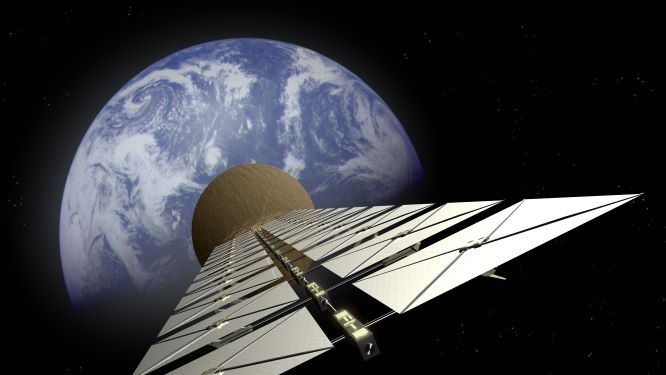
Artist’s impression of a solar power satellite
Credit: European SPS Tower concept
The European Space Agency has opened a new call for ideas for space-based solar power – on the lookout for novel system concepts for applications on Earth, the Moon, or Mars.
“The potential of this concept to contribute to long-term sustainable energy is very high,” explains ESA Engineer Advenit Makaya, who is leading the hunt for ideas.
“Not only would it generate clean energy, it would also be very flexible – it could be integrated into power grids on Earth, but also used for exploration missions,” Makaya explains in a statement regarding the call for ideas.

Credit: ESA
Open space innovation
This call for ideas is the latest to be run by the Discovery element of ESA’s Basic Activities on the Open Space Innovation Platform.
As with all calls for ideas run by ESA Discovery, the most novel ideas will be invited to submit a full proposal for a system study, early technology development activity, or co-funded research.
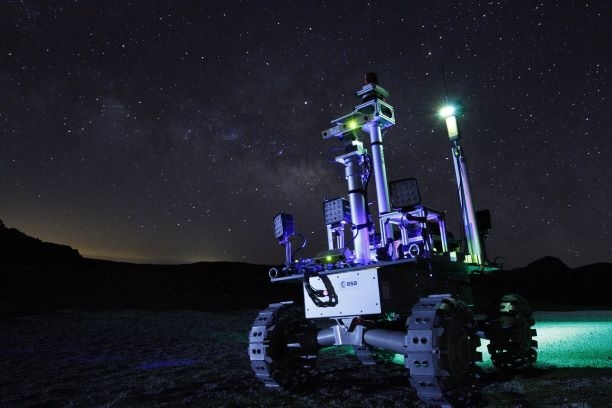
Moon rovers could be powered using solar power satellites, even during the lunar night.
Credit: Fernando Gandía GMV
Wanted: concepts, methods, technologies, ideas
For this Campaign, ESA is specifically looking for new ideas in any of the following categories:
— Novel system concepts for space-based solar power stations for applications on Earth, the Moon, or Mars.
— Novel subsystem concepts or technologies with the potential to substantially increase the technical or economic feasibility of space-based solar power, with regards to any of the points listed in the section above.
— Novel methods of scaling and integrating space-based solar power into energy grids.
— Novel ideas that use the opportunities offered by in-space construction (use of in-space resources, elimination of launch constraints in terms of e.g. mass, size, structural requirements, volume, etc).
— New concepts for precursor in-space demonstrations.
Further information
This Campaign is open for submissions by participants registered in one of ESA’s Member States, Associate Member States or Cooperating States.
The call is open until October 30th, with more information found here:
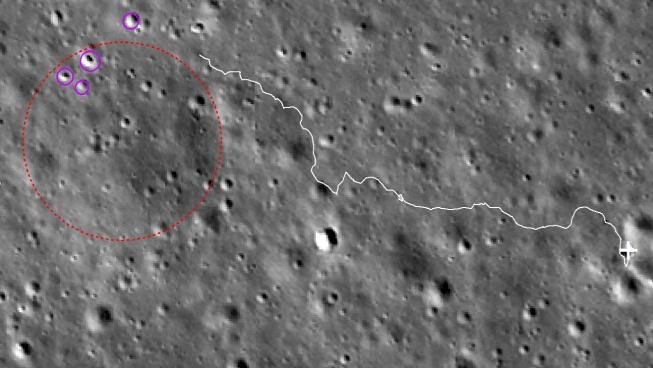
The purple circled area is the closest impact crater with brighter reflectivity, the red circle is the location of the rock block, and the white line is the planned driving path. Image source:
Credit: CCTV/Official Weibo of China Lunar Exploration Project
Sources with China’s Lunar Exploration and Space Program Center of the China National Space Administration state that the country’s Chang’e-4 farside mission has resumed work for the 23rd lunar day.

Chang’e-4 farside mission – lander and Yutu-2 rover
Credit: CNSA/CLEP
A lunar day is equal to 14 days on Earth, and a lunar night is of the same length. That calls for the farside hardware to move into dormant mode during the bitterly cold lunar night.

The location of the rock block to be detected.
Credit: CCTV/Official Weibo of China Lunar Exploration Project
The Chang’e-4 lander woke up at 11:56 a.m. Sunday, Beijing Time. The Yutu-2 rover, or Jade Rabbit-2, woke up at 6:57 p.m. Saturday.
Future duties
According to China’s Xinhua news agency, during the 23rd lunar day, Yutu-2 will move northwest toward a basalt area or impact craters with high reflectivity, both of which are located northwest of the current detection point of the rover.
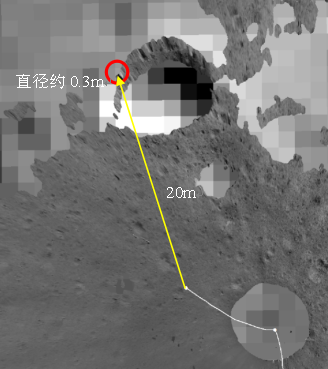
Credit: CCTV/Official Weibo of China Lunar Exploration Project
The wheeled rover will also use an infrared imaging spectrometer onboard to carry out scientific scrutiny of a lunar rock, which has a diameter of roughly a foot across (30 centimeters), according to the center.

Chang’e-4’s farside landing zone.
Credit: NASA/GSFC/Arizona State University
In addition, near noon on the Moon, the plan for the Yutu-2 lunar rover is to carry out panoramic camera ring shooting, infrared imaging spectrometer and neutral atom detector investigations. Also, the rover-carried radar system will perform synchronous detection duties during the driving.
Touching down on the Moon on January 3, 2019, the Chang’e-4 mission has survived about 647 Earth days surveying the lunar landscape.
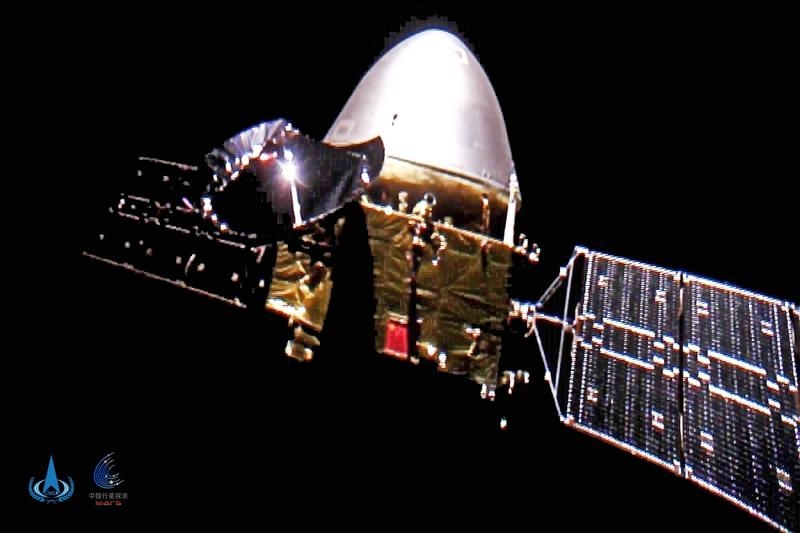
En route China Mars probe Tianwen-1 is seen in this post-launch selfie taken by an ejected micro-camera.
Credit: CNSA/CLEP
China’s Tianwen-1 Mars spacecraft performed a major in-flight trajectory adjustment on Friday night.
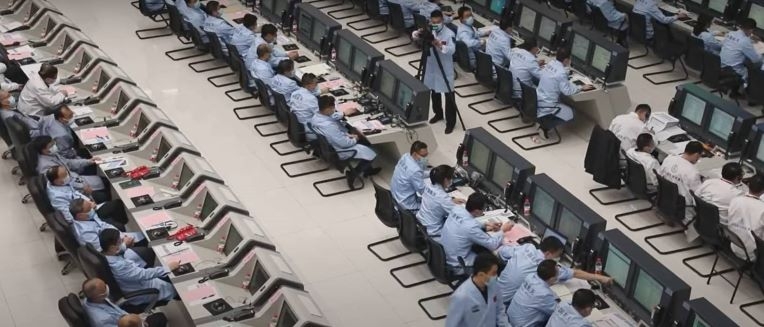
Credit: New China TV/XinhuaVideo/Inside Outer Space screengrab
The roughly eight-minute (480 seconds-plus) main engine burn was commanded by ground controllers at the Beijing Aerospace Control Center.
The Mars probe’s main engine produces 3,000 newtons of thrust power.

Credit: New China TV/XinhuaVideo/Inside Outer Space screengrab
Transfer trajectory
China Daily reports that the craft will continue traveling about four months in an Earth-Mars transfer trajectory toward the red planet and will conduct two to three more orbital corrections before entering Mars’ gravitational field, citing sources at the China National Space Administration.
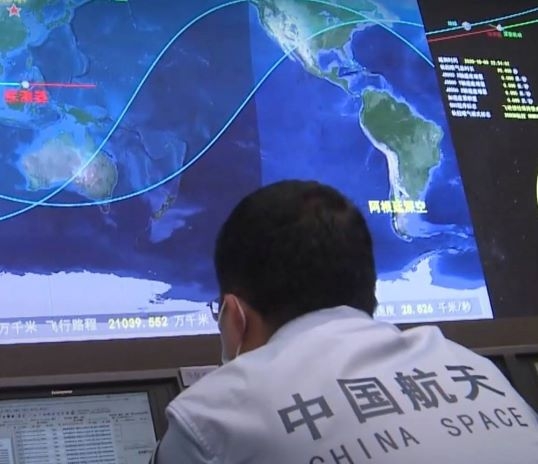
Credit: CCTV Video News Agency/Inside Outer Space screengrab
Tianwen-1 is expected to be captured by Mars’ gravity at the beginning of 2021.
“The biggest challenge in tonight’s operation was that the 3,000-newton-thrust engine would need to work for a relatively long period of time under very high pressure and temperature,” said Rao Wei, project manager for Tianwen-1 at China Academy of Space Technology, adding that the long-distance control and tracking was also a major challenge, reports China Daily.
By Friday night, Tianwen-1 had traveled more than 210 million kilometers, Rao said, adding that the spacecraft is in good condition. The probe has previously performed two midcourse orbital corrections.
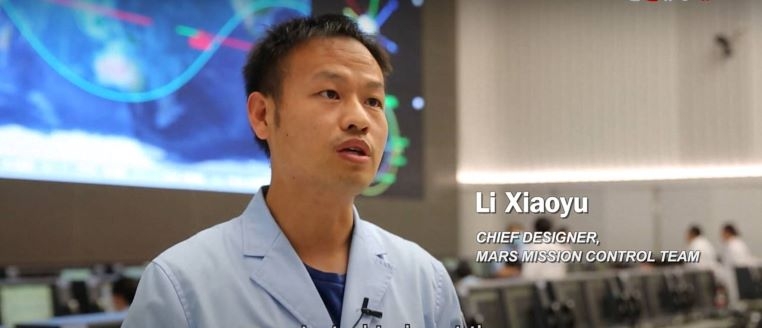
Credit: CCTV Video News Agency/Inside Outer Space screengrab
Orbital inclination
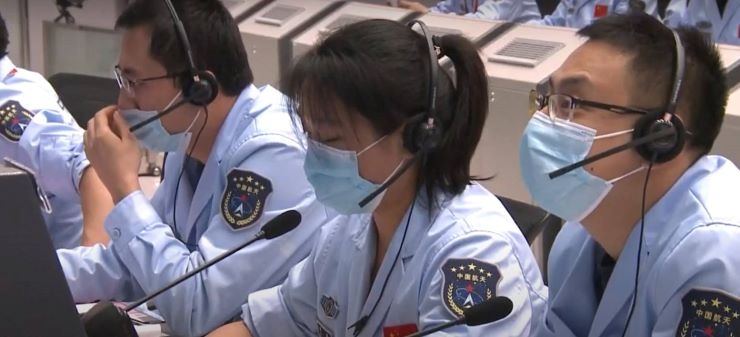
Li Xiaoyu, chief designer, Mars Mission Control Team, told China Central Television (CCTV): “According to the time sequence of the flight procedure, we started to input these instructions and data in batches from three days before the maneuver.”
Credit: CCTV Video News Agency/Inside Outer Space screengrab
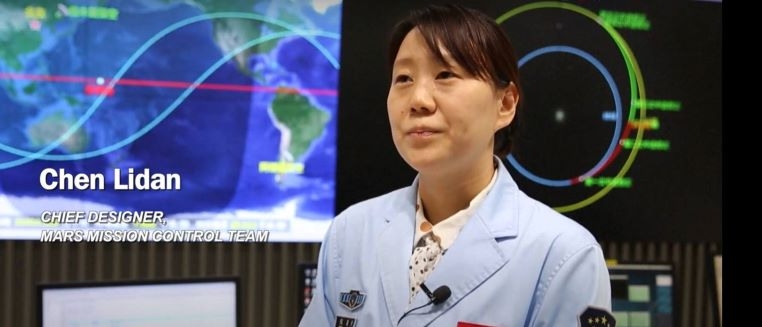
The current orbital inclination of Mars is about 1.8 degrees, said Chen Lidan, a chief designer of Mars Mission Control Team. “For the current orbit of Tianwen-1, the inclination is about 1 degree. That is to say, the mission is getting farther from Mars while it is flying, so we have to adjust the inclination, mainly to adjust orbital inclination.”
Credit: CCTV Video News Agency/Inside Outer Space screengrab
Cui Xiaofeng, head, Mars Mission Control Team, added that the main tasks in the flight progress are self-checks of the various equipment on the probe, including the lander segment. “The self-check can confirm that they are in normal working condition, so that the subsequent work is able to be correctly implemented,” Cui said in a XinhuaVideo interview.

Credit: CCTV Video News Agency/Inside Outer Space screengrab
May landing
China launched Tianwen-1 on July 23 from the Wenchang Space Launch Center in Hainan province.
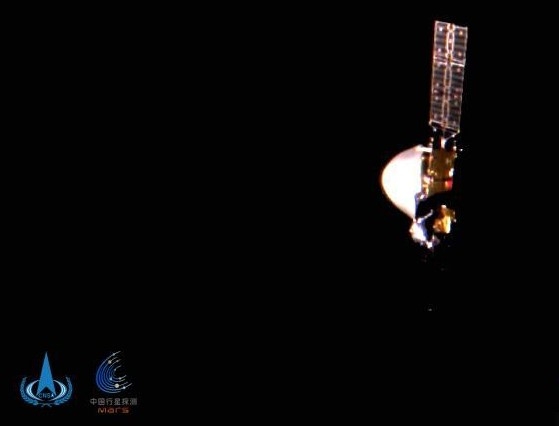
China Mars probe Tianwen-1 is seen in this post-launch selfie taken by ejected micro-camera.
Credit: CNSA/CLEP
The 5-metric-ton spacecraft is a three-in-one vehicle, consisting of an orbiter, lander, and rover.
After locking into Mars orbit in February, the mission’s key objective is to soft-land the lander/rover around May 2021 on the southern part of Mars’ Utopia Planitia.
Go to these videos that spotlight China’s Tianwen-1’s latest maneuver at:
New China TV
https://www.youtube.com/watch?v=ByjyafqFN0U
CCTV Video News Agency
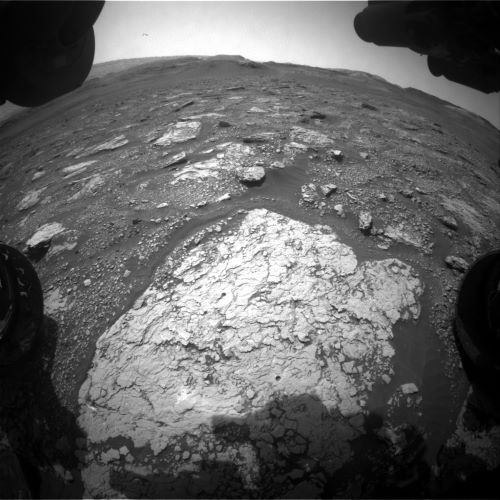
Curiosity Front Hazard Avoidance Camera B photo taken on Sol 2905, October 7, 2020.
Credit: NASA/JPL-Caltech
NASA’s Curiosity Mars rover is now performing Sol 2906 duties.
“After a successful bump to our next planned drill location, Curiosity is poised to start its thorough investigation of this interesting geologic region,” reports Mark Salvatore, a planetary geologist at the University of Michigan.
“The team decided to perform a more detailed characterization of this location because of the presence of dark gray nodular features observed in this region. So, after maneuvering into position, Curiosity is ready to begin its characterization of the block in front of us and to prepare for drilling in the near future,” Salvatore adds.
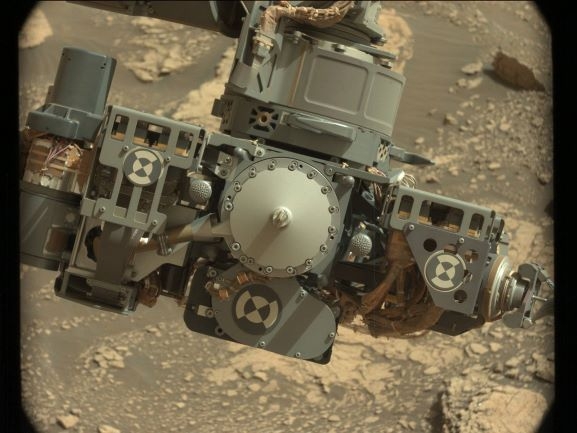
Curiosity Mast Camera Right image taken on Sol 2904, October 7, 2020.
Credit: NASA/JPL-Caltech/MSSS
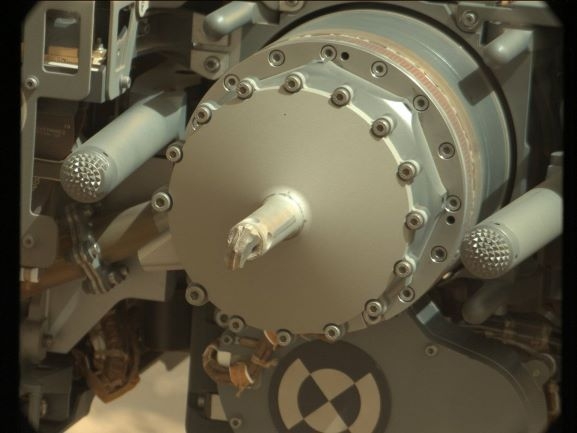
Curiosity Mast Camera Right image taken on Sol 2904, October 7, 2020.
Credit: NASA/JPL-Caltech/MSSS
Brush off, next drill target
After a day of characterizing this location, Curiosity will brush off the drill target with its Dust Removal Tool (DRT) and expose the cleaned surface for subsequent observations before drilling.
Curiosity’s observations will include Chemistry and Camera (ChemCam) Laser Induced Breakdown Spectroscopy (LIBS) observations of the selected drill location (named “Groken”) and two areas of an adjacent block of bedrock material (named “Hella” and “Great Skua”).
“These two additional LIBS chemistry observations will help to understand any potential lateral and vertical variations in geochemistry,” Salvatore explains, “as these targets are located very close to each other but on different sedimentary layers of the same unit.”
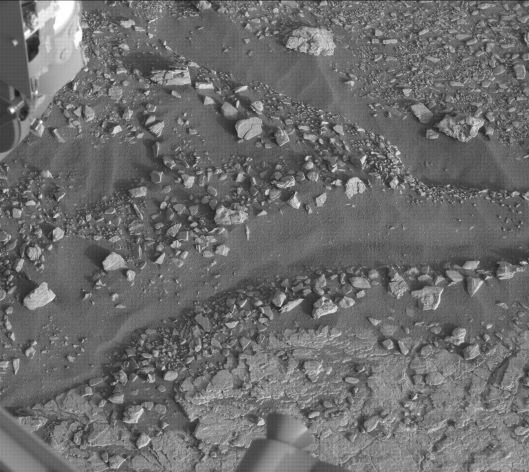
Curiosity Mast Camera Left image acquired on Sol 2904, October 7, 2020.
Credit: NASA/JPL-Caltech/MSSS
Additional observations during this science plan include a Mastcam multispectral image of the brushed drill target (to characterize its reflectance signature and to see how it might differ from its surroundings and, eventually, its drilled interior), a high-resolution Mastcam mosaic of a nearby sediment patch to characterize any disturbances to it after drilling, and a long-distance image mosaic using the ChemCam Remote Micro-Imager (RMI).
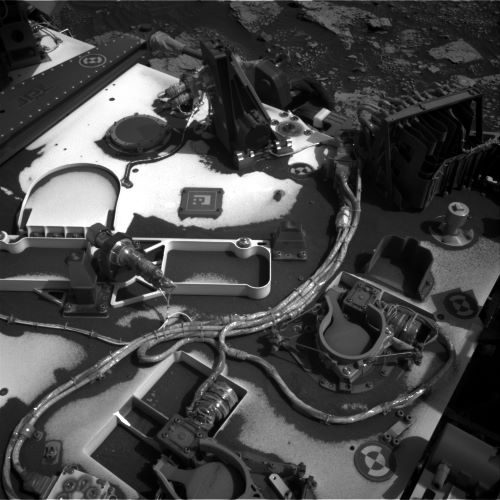
Curiosity Right B Navigation Camera photo taken on Sol 2905, October 7, 2020.
Credit: NASA/JPL-Caltech
“Groking” in a strange land
The science team recently had some fun in selecting the name “Groken” for the location planned for the next drill target.
“The verb “to grok” comes from Robert Heinlein’s science fiction novel ‘Stranger in a Strange Land,’ which follows a human raised on Mars who returns to Earth to learn about human culture,” Salvatore points out.
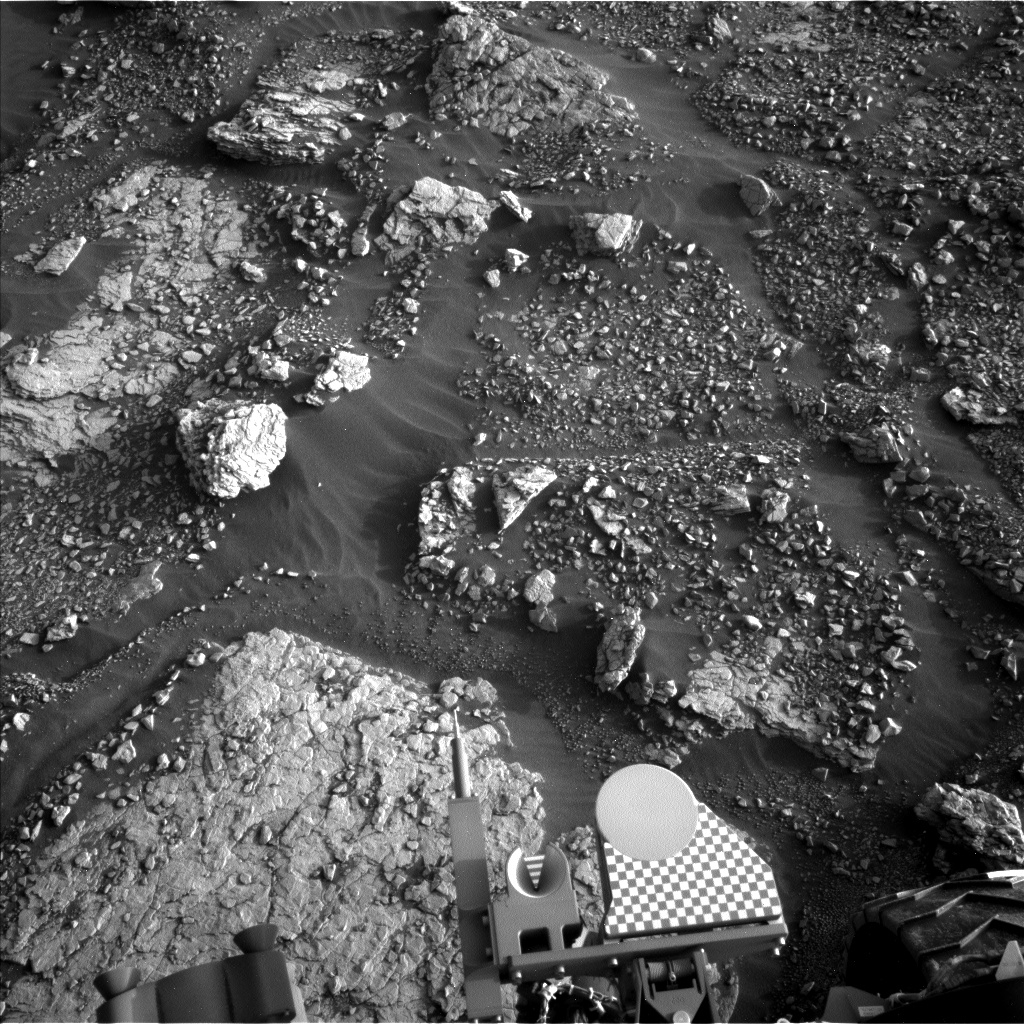
In this Navcam image, the selected drill location is located near the sand-free “point” of the large bedrock block just below the rover hardware at the bottom of the image. Credit: NASA/JPL-Caltech.
Broadly, “to grok” means to understand a topic deeply, intuitively, and empathetically, Salvatore adds, which has been the goal of the Curiosity rover mission since the beginning.
“We’re hoping that our study of the Groken drill target,” Salvatore concludes, “will allow us to grok the ancient history of Mars in a little more detail!

Venus in ultraviolet taken by NASA’s Pioneer-Venus Orbiter in 1979 indicating that an unknown absorber is operating in the planet’s top cloud layer.
Credit: NASA
All that recent press about the history of Venus and it possibly being a life-supporting world has received additional attention. But this time, Earth’s Moon plays center stage.
Yale astronomers suggest that NASA Artemis lunar crews might collect billions of bits of Venus likely to have crashed on the Moon.
Venusian meteorites mixed in within the lunar terrain – how would they get there?
The researchers said asteroids and comets slamming into Venus may have dislodged as many as 10 billion rocks and sent them into an orbit that intersected with Earth and Earth’s Moon.

Don Mitchell, a retired researcher, matched his computer science skills with a passion for old spacecraft data to reveal never-before-seen details in the former Soviet Union’s Venera-13 lander images taken on the surface of cloud-veiled Venus.
Credit: Don Mitchell
A new study – “Lunar Exploration as a Probe of Ancient Venus” — details the theory, one that has been accepted by the Planetary Science Journal.
Detectable amounts
Yale astronomers Samuel Cabot and Gregory Laughlin write that if Venus’ atmosphere was at any point thin and similar to Earth’s, then asteroid impacts transferred potentially detectable amounts of Venusian surface material to the lunar regolith.
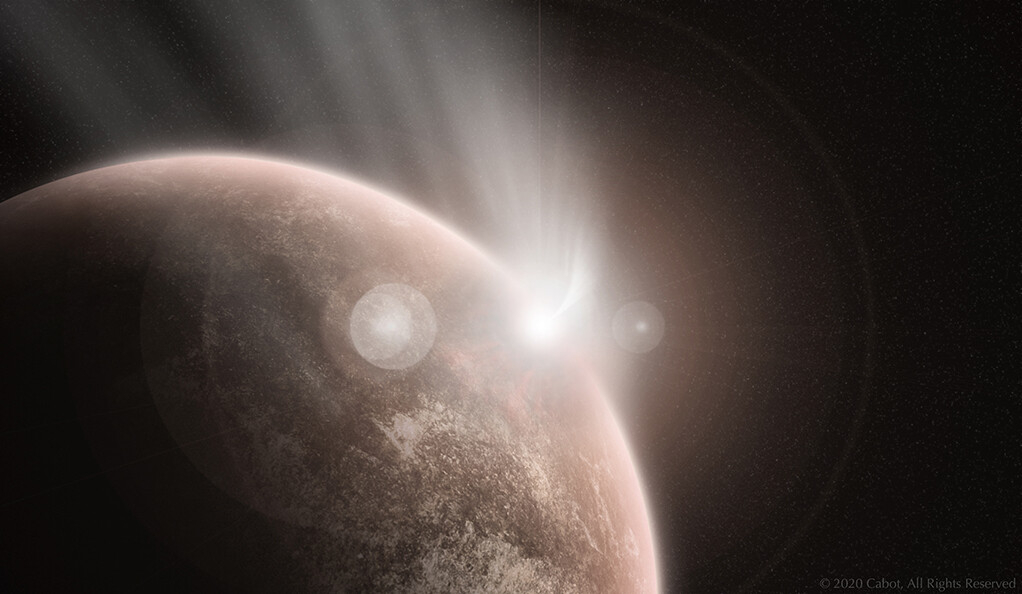
A comet strikes ancient Venus. Credit: Illustration by Sam Cabot
Laughlin and Cabot cited two factors supporting their theory, according to a Yale University press statement.
— Asteroids hitting Venus are usually going faster than those that hit Earth, launching even more material.
— A huge fraction of the ejected material from Venus would have come close to Earth and the Moon.
Important processes
Three important processes work in favor of recovering Venusian meteorites on the Moon, the Yale researchers state in their research paper.
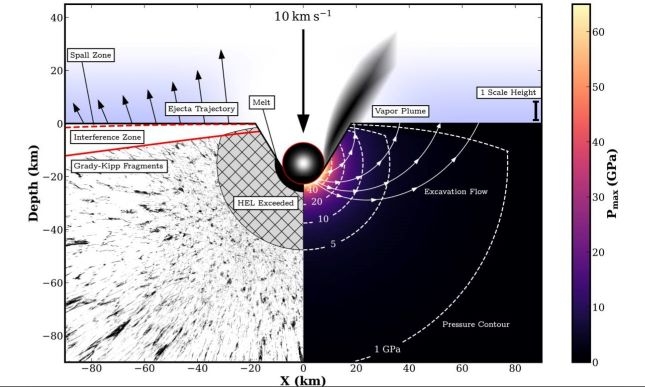
Credit: Cabot/Laughlin
“First, much of the ejected material is minimally shocked, due to shock-wave interference and spallation. Second, meteorite fragments are likely to survive their impact on the Moon, given their relatively low impact-velocities. They are even more likely to survive oblique impacts. Finally, the Moon’s regolith is relatively shallow. It is amenable to excavation, particularly in existing craters; although excavation of the deeper mega-regolith presents a more challenging scenario.”
Escape travel
Cabot told Inside Outer Space that Venus meteorites on the Moon would tell you more so about its past atmosphere and geology from billions of years ago, rather than what it is like today.
“These meteorites would have come from asteroid or comet impacts on Venus a long time ago, when the planet had a thin atmosphere like Earth’s,” Cabot said. “Today, Venus has a much thicker atmosphere, and if there was an impact then it would be much more difficult for rocks to escape and travel to the Moon.”

Credit: NASA
Near horizon
Given renewed lunar exploration on the near horizon, “we posit that meteorite acquisition and identification will answer an important outstanding question about the history of Venus,” Cabot and Laughlin explain in their paper.
“Our findings indicate that in situ analysis or sample return missions, with particular focus on zircon-grains and oxygen isotope fractionation, have a high potential of identifying ancient Venusian meteorites,” they conclude.
To access their paper, “Lunar Exploration as a Probe of Ancient Venus,” go to:
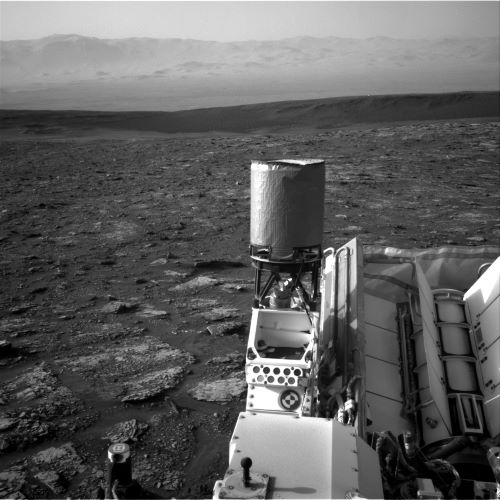
Curiosity Right B Navigation Camera photo taken on Sol 2904, October 7, 2020.
Credit: NASA/JPL-Caltech
NASA’s Curiosity Mars rover is now carrying out Sol 2905 tasks.
Over last weekend, the rover successfully performed arm diagnostic duties, reports Michelle Minitti, a planetary geologist at Framework in Silver Spring, Maryland.
“This news gave Curiosity the green light to move – ever so slightly forward – from her double drill workspace at “Mary Anning” toward our next drill site near the ‘Ayton’ target, Minitti adds.
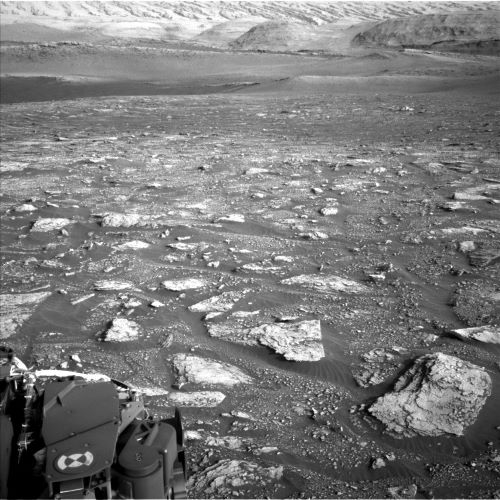
Curiosity Left B Navigation Camera image acquired on Sol 2904, October 7, 2020.
Credit: NASA/JPL-Caltech
Short drive
Ayton itself and the immediate area around it have been the subject of many analyses, from the Mars Hand Lens Imager (MAHLI) to the Alpha Particle X-Ray Spectrometer (APXS), Chemistry & Camera (ChemCam) to Mastcam since the robot arrived at the Mary Anning drill site.
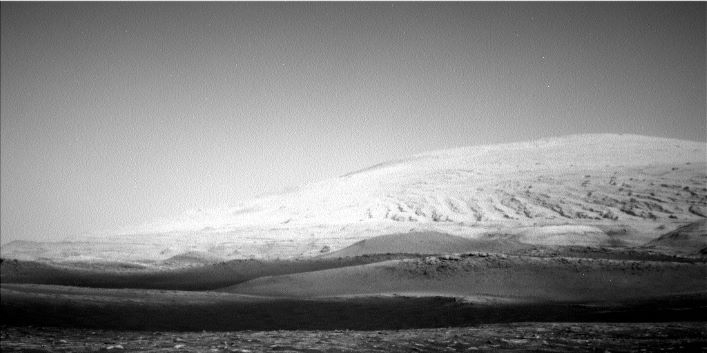
Curiosity Left B Navigation Camera image acquired on Sol 2904, October 7, 2020.
Credit: NASA/JPL-Caltech
“The team thought the prominent dark gray nodular features in this area warranted a more detailed look with a drill sample,” Minitti notes. “Bumping toward Ayton was the main focus of the plan, but Curiosity will keep busy both before and after the short drive.”
Diagnostic data
A recently scripted plan has the rover gathering more diagnostic data from the arm by testing out a few more systems on the turret and arm. After stowing the arm, Mastcam will acquire a couple of mosaics that have otherwise been occluded by the position of the arm during the diagnostic activities of the last several sols.
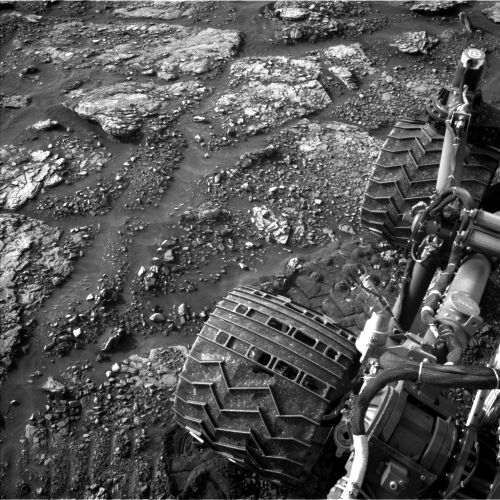
Curiosity Left B Navigation Camera image acquired on Sol 2904, October 7, 2020.
Credit: NASA/JPL-Caltech
Mastcam is set to image “Skelmorlie” in stereo.
“This sand target has been imaged several times to track the wind-induced changes,” Minitti points out, so the plan calls for a last time look to document those changes before Curiosity’s position changes.
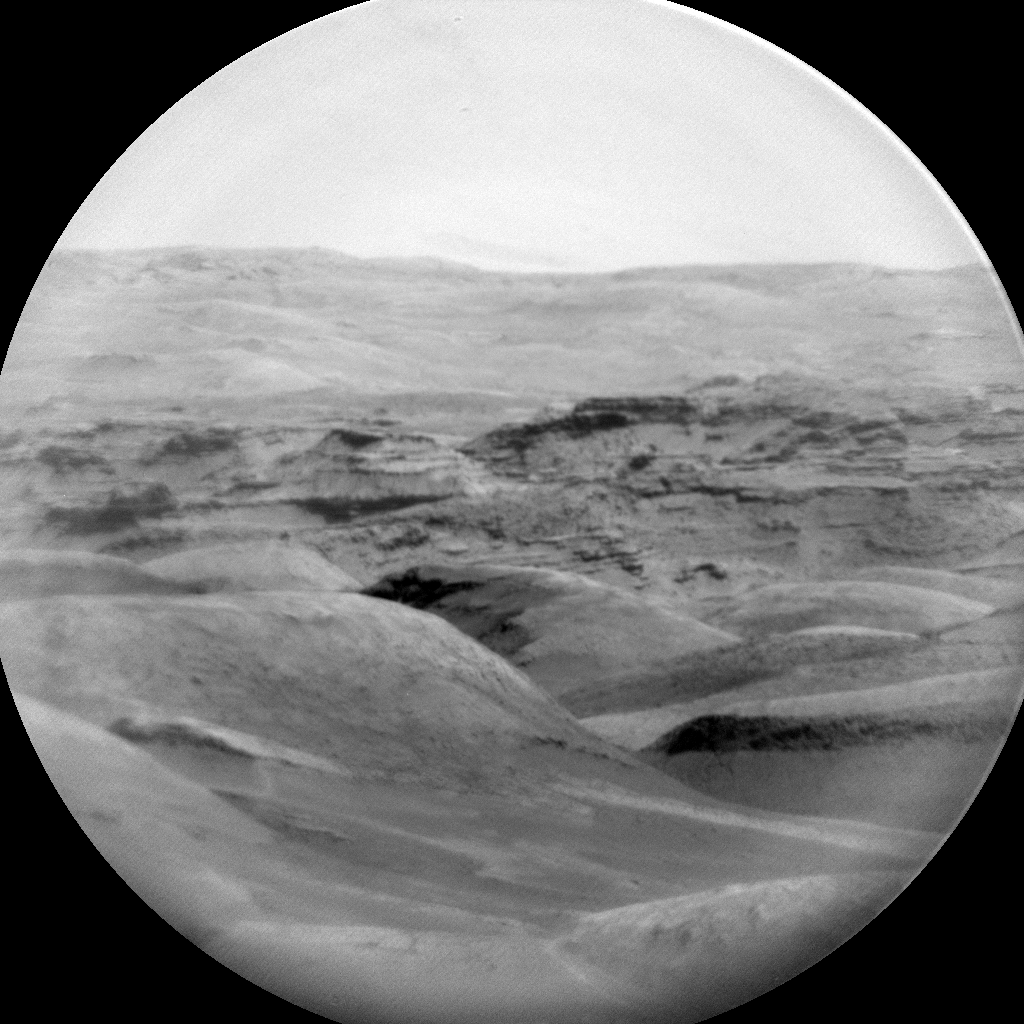
A slice of the “Housedon Hill” area east of the rover taken by Curiosity’s Chemistry & Camera Remote Micro-Imager (RMI) telescope on Sol 2900, October 2, 2020.
Credit: NASA/JPL-Caltech/LANL
Wind action
“Another change detection observation will be acquired at “Upper Ollach,” a trough in the sand just off the left of the Mary Anning slab. The trough has changed dynamically under the competing forces of our drilling at Mary Anning and the slow, relentless action of the wind,” Minitti says.
Mastcam will also acquire four stereo images from the left side of the workspace, the last part of the Mary Anning site that has been hidden by the arm.
The robot’s ChemCam gets in on the imaging action by adding to the mosaic of images from the “Housedon Hill” area east of the rover.
“With the arm free to move, MAHLI will take care of a couple of systematic check outs of the instrument. The first check out is courtesy of Mastcam, with three Mastcam images aimed at the MAHLI cover. The second check out is done by MAHLI herself in a series of images of the sky, some with the cover closed and some with the cover open. These are called sky flat images, which image a bland portion of the sky to track the amount of dust on the MAHLI cover and the MAHLI front lens,” Minitti reports.
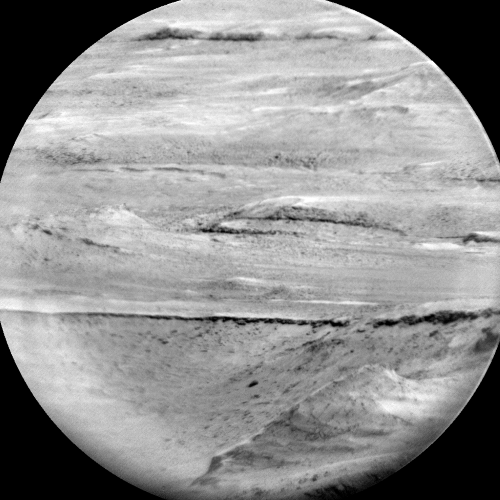
Curiosity Chemistry & Camera Remote Micro-Imager (RMI) telescope photo acquired on Sol 2904, October 6, 2020.
Credit: NASA/JPL-Caltech/LANL
Dust devils
After Curiosity bumps forward toward Ayton, the robot will turn its attention to the sky again the next sol, Minitti says.
“Navcam and Mastcam will measure the amount of dust in the atmosphere, Navcam will shoot a movie looking for dust devils spinning across Gale crater, and ChemCam will acquire passive spectra of the atmosphere. ChemCam will also pick up a systematic measurement of their titanium calibration target,” Minitti concludes. “Here’s to a (slightly) new world!”

Credit: CCTV Video News Agency/Inside Outer Space
China’s preparations for construction of that nation’s space station is picking up speed, striving to complete the plan for on-orbit construction of their orbiting outpost around 2022.

Hao Chun, director of the China Manned Space Engineering Office.
Credit: CCTV/Inside Outer Space screengrab
“In the two years from next year to the year after that, 11 missions will be conducted to complete the on-orbit construction of the Chinese space station. Subsequent missions will be carried out in high density. Astronauts will stay in orbit for long periods and carry out larger-scale space science experiments and technical experiments,” said Hao Chun, director of the China Manned Space Engineering Office in a recent China Central Television (CCTV) interview.

Zhou Jianping, chief designer of China’s manned space program.
Credit: CCTV/Inside Outer Space screengrab
Plans and steps
The pace of space station construction is soon to quicken. China started the full-range development of its space station a decade ago.
“We have also been actively and steadily advancing this work in accordance with our plan and steps,” said Zhou Jianping, chief designer of China’s manned space program. “So far, we have made comprehensive breakthroughs in the development of key technologies. Next year, we will start the third step of manned spaceship project…the full execution of the space station construction,” Zhou added.

Prototype of the Tianhe core module. China’s space station is expected to be operational around 2022.
Credit: CCTV/Inside Outer Space screengrab
At present, the “core capsule” is undergoing various ground-based experiments and tests to identify and control risks, assure the quality of the products, and solve problems in the ground-based development, explained Yang Hong, chief designer of China’s space station system with the China Academy of Space Technology in the CCTV video.

Yang Hong, chief designer of China’s space station system with the China Academy of Space Technology.
Credit: CCTV/Inside Outer Space screengrab
One after another
According to plan, the Tianhe core module, Wentian experimental module and Mengtian experimental module will be launched in quick succession to form the basic structure of the space station in orbit.
During this period, China will also launch four Shenzhou piloted spacecrafts and four Tianzhou cargo spacecrafts, to facilitate the astronaut crew rotation and cargo replenishment.

Credit: CCTV/Inside Outer Space screengrab
“This is our first time to build such a big spaceship in line with the principle of steadiness, reliability and safety. After our core module is in orbit, we will launch cargo spacecraft and manned spacecraft one after another. We will further test our key technologies of the space station, including further verification of the technologies for the astronauts’ extravehicular activities,” reported Zhou.

Huang Weifen, chief designer of China Astronaut Research and Training Center.
Credit: CCTV/Inside Outer Space screengrab
Crew training
Since March 2017, astronaut training for space station duties have been underway.
As the duration of each mission is about three to six months, higher requirements have been raised for the astronauts’ physical and mental qualities, knowledge, and emergency response capabilities, according to CCTV.

“We have arranged for astronauts to participate in nearly a hundred engineering development and experimental activities, including man-spaceship, man-spaceship-ground, and man-spaceship-station-ground joint tests, underwater verification experiments for extravehicular activities, and efficacy evaluations,” said Huang Weifen, chief designer of China Astronaut Research and Training Center.

Credit: CCTV/Inside Outer Space screengrab
Third batch of astronauts
At this moment, all astronaut crews have been selected to perform the four missions during the space station construction phase.
“We have comprehensively considered many factors including the astronauts’ flight experience, current situation, their ages and psychological compatibility, and subsequent development,” Huang told CCTV. “Then, we have collectively coordinated four flight crews, with each crew consisting of three people, and the astronauts who had performed flight missions were assigned as commanders.”
On October 1, the third batch of 18 selected astronauts joined the astronaut team, including seven space pilots, seven space flight engineers, and four load experts.
They are expected to participate in various missions during the operational phase of China’s space station.

Dusty denizen of deep space.
Credit: NASA/Jeff Williams
NASA’s Artemis Program to return astronauts to the Moon faces a great number of challenges. Among them is dealing with lunar dust.
A new report emphasizes that fact and also details next steps to help counter the true grit and grime of Moon exploration in coming years.
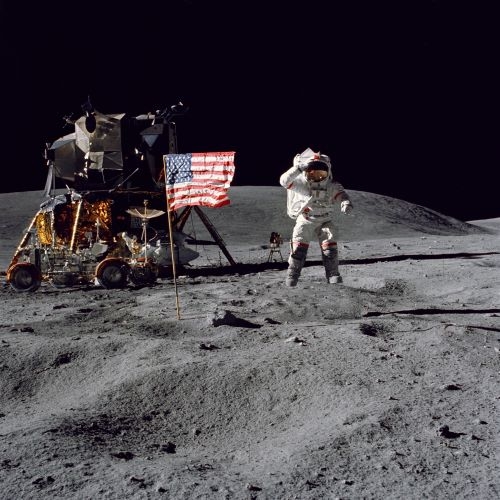
Credit: NASA
Contrasted to the Apollo human excursions on Earth’s celestial companion in 1969-1972, Artemis crews will spend considerably more time outside of their lunar landing vehicles and eventual encampments than the “dusty dozen” Apollo-era astronauts.
The report’s findings, observations, and recommendations stem from a “Lunar Dust and Its Impact on Human Exploration” workshop held February 11 – 13, 2020 that brought together leading experts in Houston, Texas.

Dust-up on the Moon. Apollo 17 commander Eugene Cernan prepares to doff lunar dust-covered space suit.
Credit: NASA
Ever present, intrusive dust
A major discovery of Apollo 11 — and the five succeeding moonwalking missions was that the surface of the Moon was covered by a several inch layer of fine dust.
“This dust layer had a negative impact on the health and wellbeing of the astronauts, and on their lunar equipment and instruments, including their spacesuits, helmets, and habitats. Surface operations and crew health were impeded by the ever present and intrusive dust,” explains the new report.
In summary, the report concludes that the dust problem “is an agency and industry concern affecting most mission subsystems and it must be addressed.”

Credit: NASA
In particular, the report continues, it is crucial that measurements and experiments be taken and carried out on the lunar surface by precursor landers to find out dust characteristics “that will influence hardware design, and provide toxicology data to safeguard crew health.”
High priority
A set of issues flagged in the report are considered “Very High Priority,” specifically:
— Characteristics of the finest fraction of the lunar soil are not well understood. The knowledge gap increases with decreasing particle size. Further, there is deficient knowledge of the variation in dust characteristics (e.g., chemical composition and mineralogy) and other characteristics of tiny particles across lunar geological regions.
— There is uncertainty in the electrical charging properties of the lunar surface and individual particles.
— Little knowledge exists about the electrical charge characteristics of regolith particles on and above the lunar surface due to the interactions with the solar wind plasma, photoemission, and secondary electron emissions.
— There has been little discussion of cabin and spacesuit (e.g., Lunar lander, Gateway) air cleaning systems.
— There is insufficient information with regard to the effect of lunar dust deposition on optical or thermal surface performance.
— While gaps exist, NASA’s Lunar Airborne Dust Toxicity Assessment Group provides significant toxicological data to guide setting a crew permissible exposure limit for dust exposure on short-term lunar missions.
— There appears to be little coordinated discussions across the agency to identify the impact of lunar dust on mechanisms, seals, connectors, and solar panels, nor are there cleaning systems identified.
— No industry-standard set of NASA requirements and oversight mechanisms exist for the manufacturing, quality control, and validation of lunar dust simulants, material that mimics Moon dust.
For each of these issues, the report fleshes out specific recommendations.
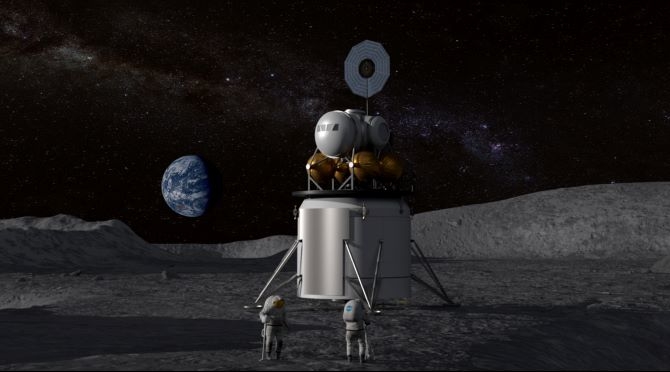
Credit: NASA
Safe levels of exposure
In wrapping up the new report’s observations, it underscores lessons learned from Apollo. For one, it became apparent that the effects of the dust on the human body, and on safety-critical equipment, had been underestimated.
In the future, the report stresses, these problems may become amplified over longer stays and any health and safety effects of lunar dust could be intensified by handling and recycling of dust in habitat life support systems, or through on-location water extraction or other operational processes, to the detriment of the crews.
“An important outcome of new investigations,” the report notes, “will be an understanding of acute versus chronic dust exposures, and establishing safe levels of exposure for long-term stays.”
The goal for future missions to the Moon, the report concludes, is to design spacecraft hardware that will operate properly and able to mitigate dust so that the crew members stay productive and healthy.
To read the full 40+ page document — Lunar Dust and Its Impact on Human Exploration: A NASA Engineering and Safety Center (NESC) Workshop – go to:
https://ntrs.nasa.gov/citations/20205008219
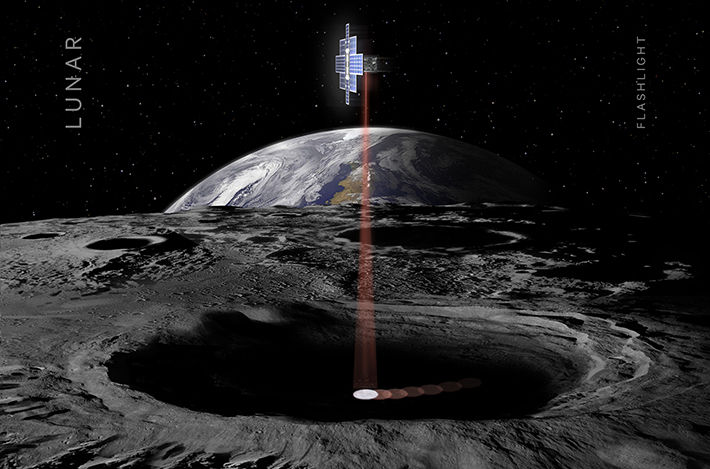
Moon orbiting Lunar Flashlight.
Credit: NASA/JPL
A set of diminutive, high-tech probes have these rousing names: Lunar IceCube, Lunar Flashlight, LunaH-Map and Lunar Trailblazer.
While the missions have differing observational and measurement strategies as they orbit the Moon, each spacecraft provides a unique perspective on lunar water distribution.
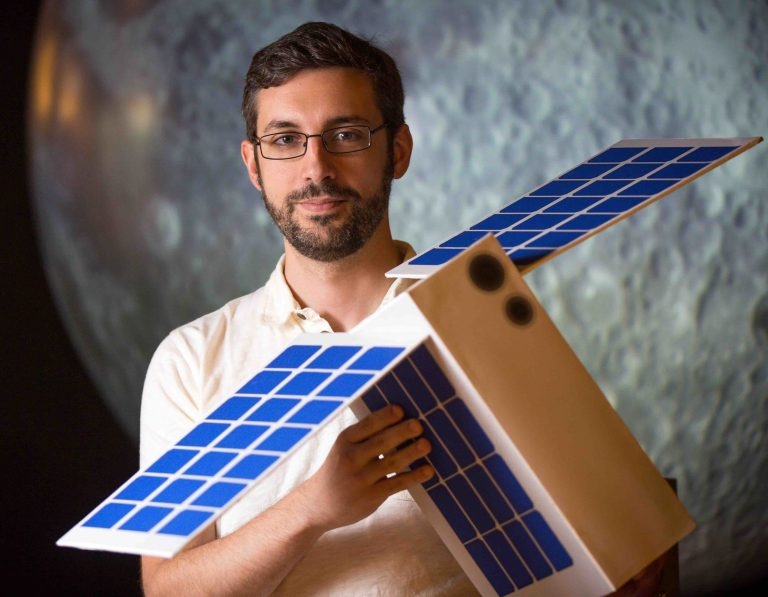
LunaH-Map probe and principal investigator Craig Hardgrove of Arizona State University’s School of Earth and Space Exploration.
Credit: ASU
On one hand, researchers are confident the Moon’s polar regions are enhanced in volatiles. Still, there remain some unknown unknowns about the form and physical distribution of these volatile species.
For more information on these missions and the task ahead, go to my new Space.com story at:
Tiny moonbound spacecraft have very big goals – A coming suite of small probes will help scientists better understand the Moon’s stores of water ice.

