Archive for the ‘Space News’ Category
 Author:
  October 18th, 2020
Mars Society’s Robert Zubrin
Credit: Mars Society/Inside Outer Space screengrab
In closing remarks today of the 2020 Mars Society Virtual Convention, society leader Robert Zubrin zeroed in on “planetary protectionists” versus “frontierists.”

Credit: Elon Musk/SpaceX
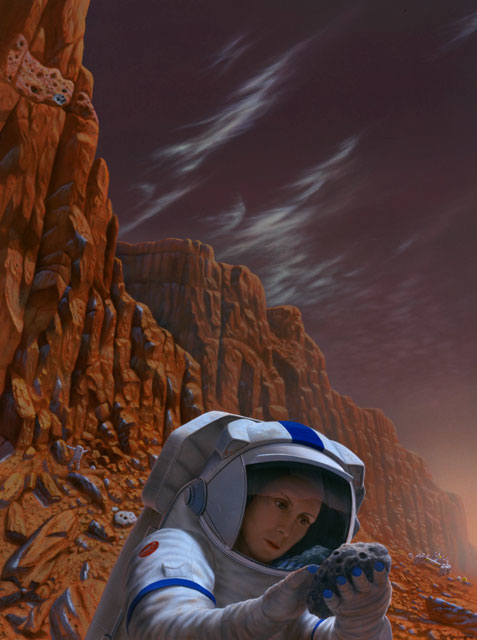
Zubrin said there is “need to loosen the bonds of this thing that calls itself the planetary protection program but is really a bureaucracy-in-ignorance protection program.” They, the planetary protection group, have installed themselves in various bureaucracies, he said, and “want to use this to expand their power and are crippling the space program.”
Credit: NASA/Pat Rawlings
Furthermore, the planetary protection people, Zubrin said, “have so distorted and inverted the priorities…that they are a tremendous impediment.”
Vision to be realized
Zubrin said the frontierists are “quick to recognize that the planetary protection bureaucracy is fatal to their aspirations.”
“There’s a vision to be realized. It’s now closer than ever,” Zubrin said. He noted that the virtual meeting from October 15-18 drew over 100,000 people that viewed one session or another from around the world – thus making the meeting 10 times larger than any space conference in history, he said.
“This has been an epic event,” Zubrin said.
For Zubrin’s closing remarks, including talking points on SpaceX’s Elon Musk and Starship plans, looking for life on the Red Planet, the Outer Space Treaty of 1967, robotic versus human exploration, along with the technical challenges ahead, go to the last day of the 2020 Mars Society Virtual Convention at:
https://youtu.be/7F3RVIljLac?t=6
Zubrin’s closing comments begin at: 3:10:12/3:30:42
 Posted in

Illustration of the Gateway. Built with commercial and international partners, NASA says the Gateway is critical to sustainable lunar exploration and will serve as a model for future missions to Mars.
Credit: NASA
Mike Griffin previously served as NASA Administrator (2005-2009). He spoke during the Mars Society’s “Rising Together to Mars” meeting, offering a set of what he termed “provocative comments.”
Prevent stupid
Provocative comment #6: “We need to prevent stupid,” Griffin said.

Four Lunar Orbital Platform-Gateway Near Rectilinear Halo Orbit types, multiple revolutions in a rotating Earth-Moon frame.
Credit: NASA/JSC

Mike Griffin speaks to Mars Society attendees.
Credit: Mars Society/Inside Outer Space screengrab
“Space professionals need to speak up when stupid is being advocated. So if you’re going to go to the Moon and if you view that as a step along the way to Mars, as I do, then publicly-offered architectures, such as use of a Lunar Gateway and near-rectilinear halo orbits and such clap trap — invented because the deep space vehicle Orion, in its current incarnation doesn’t have enough total impulse to get itself in and out of lower lunar orbit or better lunar orbit — architectures like that need to be labeled as stupid and set aside…we need to prevent stupid and advocate smart.”
To view Griffin’s remarks, view them at:
https://youtu.be/0j4brmQri4k?t=75
Go to: 1:17:06/4:16:43
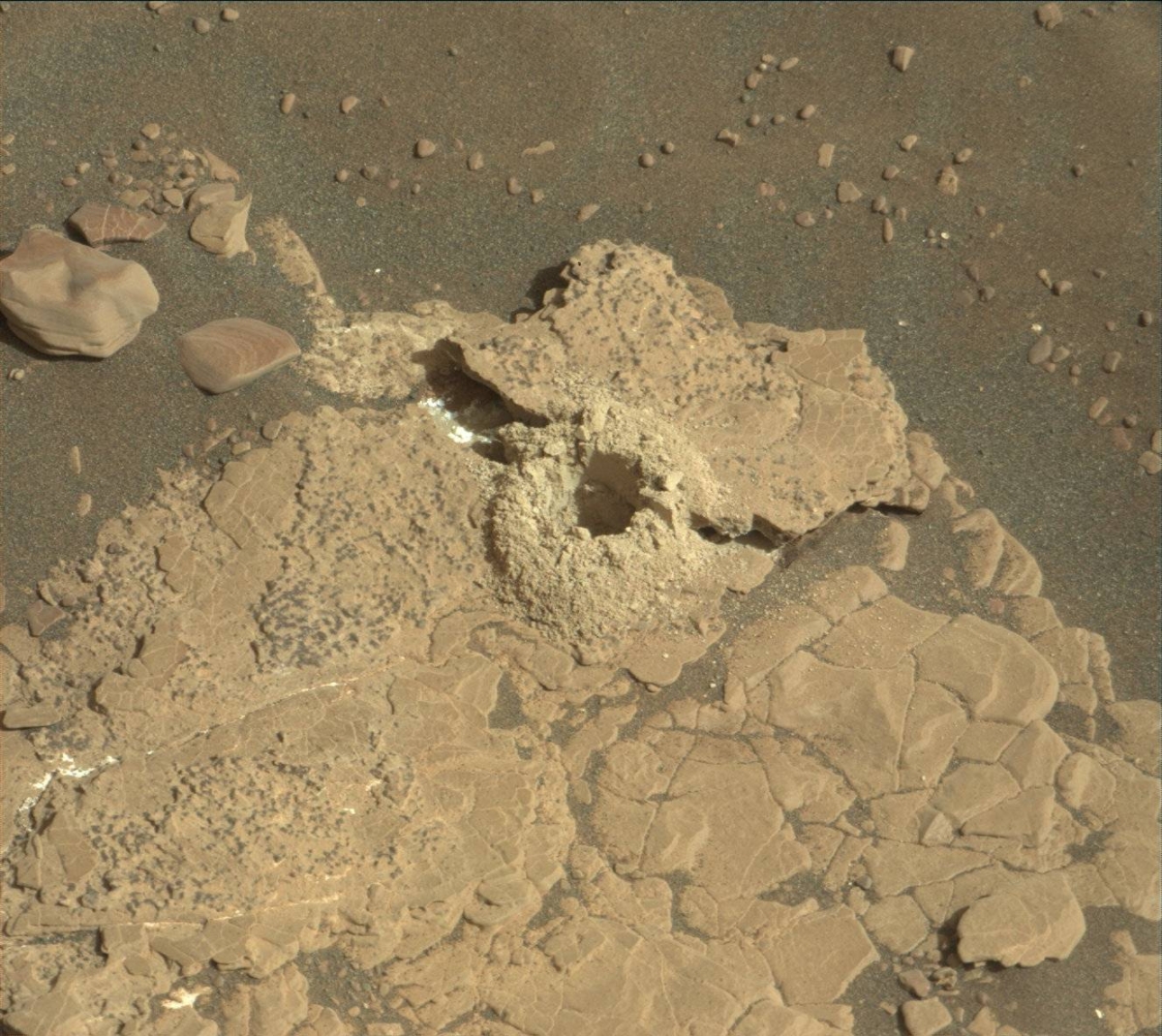
Curiosity’s latest drill hole, “Groken” in the nodule-laden section of rock. Nodules are the dark areas in the image.
Credit: NASA/JPL-Caltech
NASA’s Curiosity Mars rover is now conducting Sol 2914 tasks.
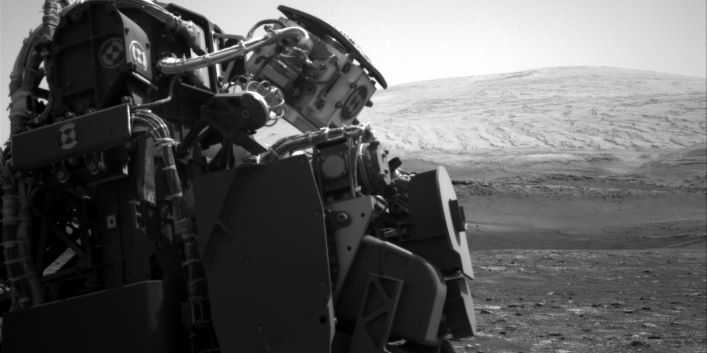
Curiosity Right B Navigation Camera photo taken on Sol 2913, October 16, 2020.
Credit: NASA/JPL-Caltech
Curiosity is mostly chilling out this weekend while researchers continue to investigate the latest drill hole, “Groken,” reports Ashley Stroupe, a mission operations engineer at NASA’s Jet Propulsion Laboratory.
The sample collected comes from a nodule-rich corner of rock.
“In the process of drilling, Curiosity broke the rock, which can sometimes happen when we are close to an edge, but still collected enough sample to perform detailed analyses,” Stroupe adds.
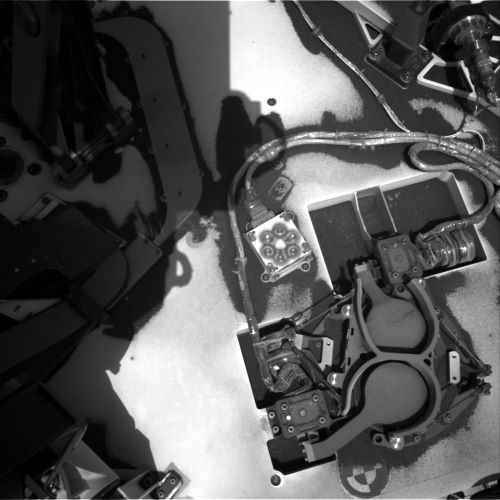
Curiosity Right B Navigation Camera photo taken on Sol 2913, October 16, 2020.
Credit: NASA/JPL-Caltech
Strong signal
In a plan last week, sample was delivered to robot’s Chemistry & Mineralogy X-Ray Diffraction/X-Ray Fluorescence Instrument (CheMin) for analysis in order to determine the composition of the nodules, Stroupe explains.
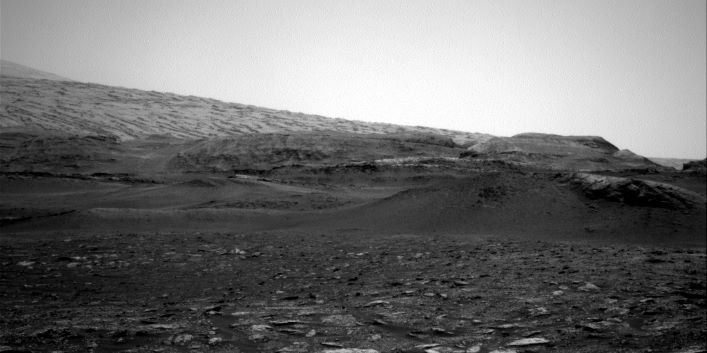
Curiosity Right B Navigation Camera photo taken on Sol 2913, October 16, 2020.
Credit: NASA/JPL-Caltech
“The preliminary results look good – we have a full cell and a strong signal,” Stroupe notes. The top priority is to do more CheMin analysis on the sample and improve the data before deciding whether to deliver sample to the robot’s Sample Analysis at Mars (SAM) Instrument Suite.
This meant the rover planners had a day off before resuming the sampling campaign activities next week.

Curiosity Chemistry & Camera Remote Micro-Imager (RMI) photo acquired on Sol 2913, October 16, 2020.
Credit: NASA/JPL-Caltech/LANL
Local variability
In addition to CheMin, Chemistry and Camera (ChemCam) and Mastcam are also being targeted on the area around the drill hole – on “Villians,” “Vond,” and “Clibberswick” – to support the investigation into the nodules by examining local variability.
ChemCam is also taking more high resolution Remote Micro-Imager (RMI) telescope images of the “Housedon Hill” area “to help us test hypotheses and inform where we should go in the Mt. Sharp sulfate unit,” Stroupe reports.
Storm season
“As we’re now fully into the windy and dust storm season at Gale Crater, we’ve tasked Curiosity with a lot of environmental observations,” Stroupe explains.
Atmospheric observations include standard Mastcam crater rim extinction, cloud movies, zenith movies, and taus (dust opacity measurements), as well as Navcam line of sight imaging and a suprahorizon movie.
“We’re keeping a sharp eye out for dust devils with both Navcam and Mastcam dust devil movies. Lastly, we’re looking at local changes with Mastcam deck monitoring and change detection on the ‘Upper Ollach’ trench target,” Stroupe concludes.
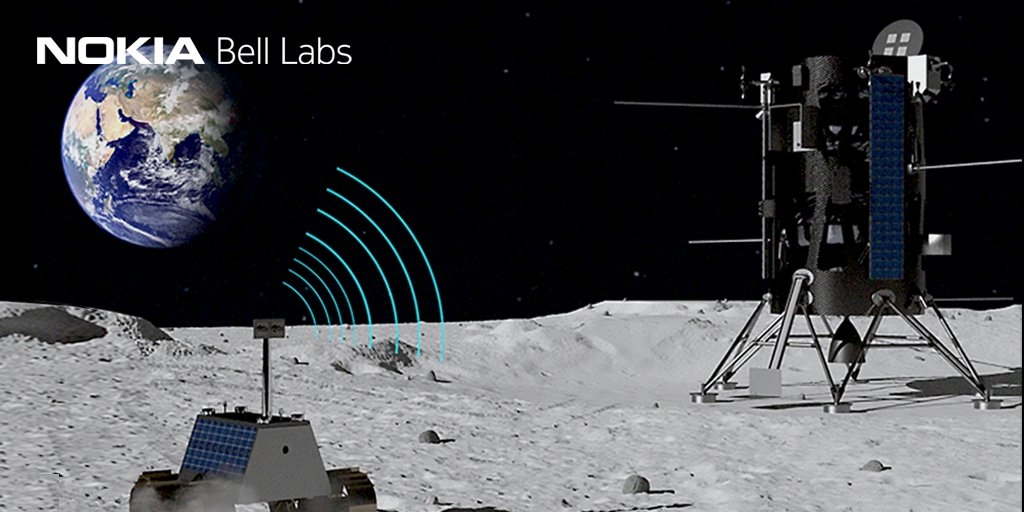
Credit: Nokia/Bell Labs
Nokia’s Bell Labs is working under a new $14.1 million NASA Tipping Point award to deploy the first LTE/4G (Long-Term Evolution) communications system in space. The system could support lunar surface communications at greater distances, increased speeds, and provide more reliability than current standards.
According to Bell Labs, the first wireless network on the Moon would start with 4G/LTE technologies and evolve to 5G.
Bell Labs is partnered with Intuitive Machines of Houston, a group that also was awarded a $41.6 million Tipping Point award to develop a small, deployable hopper lander capable of carrying a 2.2-pound (1-kilogram) payload more than 1.5 miles (2.5 kilometers). This hopper could access lunar craters and enable high-resolution surveying of the lunar surface over a short distance.
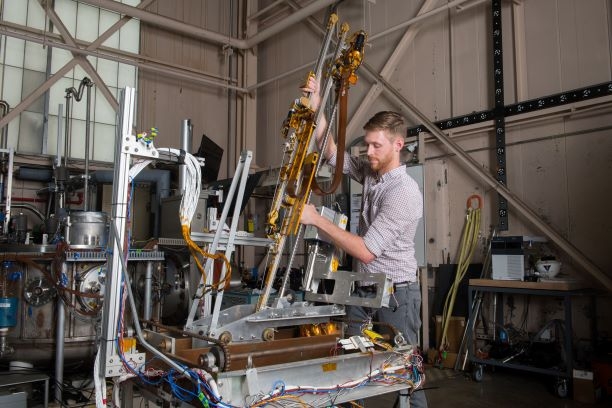
NASA has selected Intuitive Machines to deliver a drill combined with a mass spectrometer to the Moon.
Credit: NASA
Back in April, Intuitive Machines (IM) engineers selected an area in Oceanus Procellarum near Vallis Schröteri as the landing site for its upcoming IM-1 lunar mission with an anticipated launch date in
October 2021.
On October 16, NASA also selected IM to deliver the Polar Resources Ice Mining Experiment (PRIME-1) drill, combined with a mass spectrometer, to the Moon by December 2022. The ice drilling mission is the Houston-based company’s second Moon contract award under NASA’s Commercial Lunar Payload Services (CLPS) initiative.

Credit: Intuitive Machines
High-definition streaming
According to Bell Labs, the communications network will be keyed to data transmission applications, including the control of lunar rovers, real-time navigation over lunar geography, & streaming of high definition video.
The mission critical Long-Term Evolution network is specially designed to withstand the extreme temperature, radiation and vacuum conditions of space, as well as vibration impact during launch and landing on the lunar surface.
“This fully integrated cellular network meets the stringent size, weight and power constraints of space payloads in the smallest possible form factor,” reports Bell Labs. “This mission will validate the future of other operational deployments and the potential for human habitation on the Moon.

Curiosity Mast Camera Right image taken on Sol 2910, October 13, 2020.
Credit: NASA/JPL-Caltech/MSSS
NASA Curiosity Mars rover is now carrying out Sol 2912 duties.

Curiosity Mast Camera Right image taken on Sol 2910, October 13, 2020.
Credit: NASA/JPL-Caltech/MSSS
Curiosity has been hard at work, taming the “Groken,” the 29th successful drill hole on Mars, reports Catherine O’Connell-Cooper, a planetary geologist at the University of New Brunswick.
A recent plan saw the Mars science team transition into the analysis part of a drill campaign sol path.
“We have practiced this quite a bit now, having drilled six holes in the past 9 months, three of which are on the bedrock slab in front of us,” O’Connell-Cooper says.

Curiosity Front Hazard Avoidance Camera Right B image taken on Sol 2911, October 14, 2020. Photo shows three successful drill holes on the same bedrock slab. “Groken” is the furthest away, at the top of the slab. “Mary Anning 3” is closest to the front of the image, and “Mary Anning 1” is in the center of the bedrock. Credits: NASA/JPL-Caltech.
Credit: NASA/JPL-Caltech
The sample will be delivered to the robot’s Chemistry & Mineralogy X-Ray Diffraction/X-Ray Fluorescence Instrument (CheMin) to determine the mineralogical composition of the specimen.
Close approach
O’Connell-Cooper underscores the close approach between Earth and Mars that occurred on Oct. 6th. Mars was a mere 38.6 million miles from Earth (closest approach in 15 years, not to be beaten until 2052) and full opposition on Oct. 13th. “Mars and Curiosity feel almost close enough to touch!”
While the Curiosity rover is currently closer to home than at any point in her mission, “we will still have to wait until the weekend for the results,” O’Connell-Cooper adds. “As we wait, ChemCam [Chemistry and Camera] is documenting the drill hole, and some additional bedrock targets here, along a fracture in the drilled bedrock (“Fladdabister” and “Glendaruel”) and on a neighboring bedrock slab (“Melby Fish Beds”).”
The rover’s Mastcam will document the ChemCam targets, in addition to taking images of the CheMin inlet before and after the sample is dropped off, and a tau (atmospheric opacity) measurement for the environmental group, O’Connell-Cooper concludes.
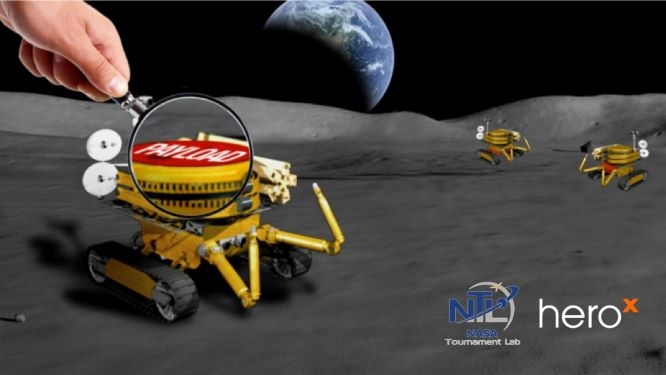
Credit: NASA/HeroX
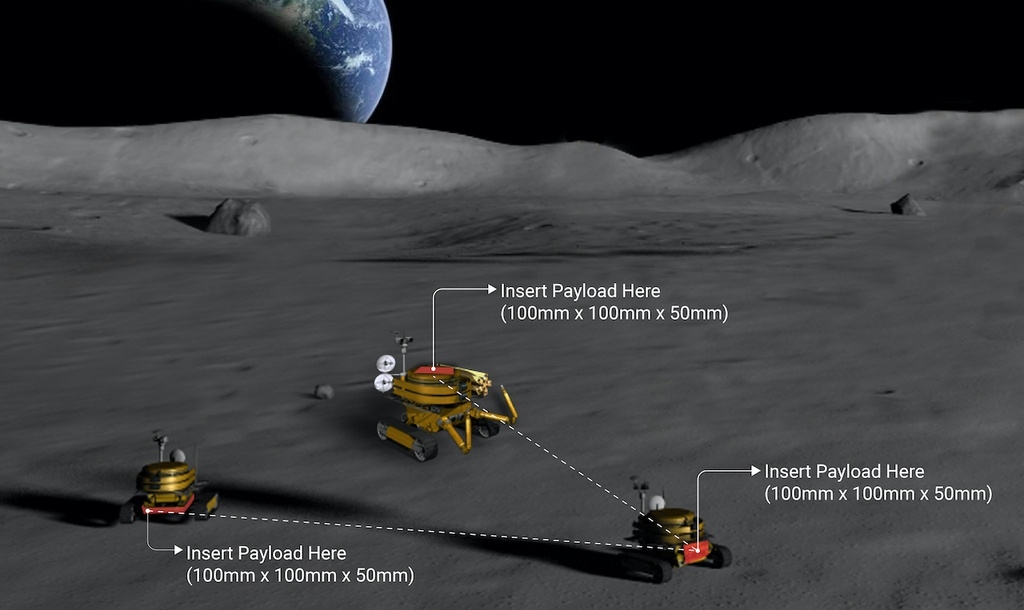
There’s a new challenge on the table – developing miniature payload prototypes that can be sent to the Moon – to fill in the gaps in our lunar knowledge.
Back in April of this year, fourteen teams were recognized and rewarded for their innovative approaches to miniature payload development.
But now there’s a larger agenda in the shaping of micro-payloads for the Moon; five of the teams will rely on crowdsourcing to recruit new team members and fill any resource gaps they might have.
Insert payload here
Credit: NASA/HeroX
The teams recruiting new members have indicated the expertise they are seeking in their respective project description. Those teams are as follows:
— Puli Lunar Water Snooper
— M.E.G.A.M.A.N. (Moon Element Gas Absorption to Mark Abundant Nodes)
— Lunar Radiation Characterization
— Moon soil resources from seismic waves
— Adaptable Science Box for Lunar Rovers
Roomba®-sized rovers
Announced today, the teams in this second phase competition will have the opportunity to win $800,000 in development funds and prizes and potentially see their payloads deployed on the Moon.
Imagine a rover the size of your Roomba® crawling across the lunar landscape.
Small rovers developed by NASA and commercial partners provide greater mission flexibility and allow researchers to collect key information about the lunar surface.
However, existing science payloads are too big, too heavy, and require too much power for these rovers and new, miniaturized payload designs are needed.
Payloads need to be similar in size to a new bar of soap to fit cleanly inside the rover (maximum external dimensions: 100mm x 100mm x 50mm).
More efficient payloads
“Smaller, more efficient payloads provide us with greater mission flexibility,” said Andrew Shapiro, Manager of Technology Formulation for the Space Technology Office at NASA JPL.
“Ultimately, the information gathered by these miniature rovers and their payloads,” Shapiro added, “will inform our near-term mission designers and help us prepare for long-term habitation on the Moon.”

Moon base design.
Credit: ESA/P. Carril
To get involved, visit the Teams tab of the challenge and see the teams that are recruiting new members and what capabilities and areas of expertise those different teams need.
New team members must be aged 18 or older and may originate from any country, as long as United States federal sanctions do not prohibit participation (some restrictions apply).
Give a tiny bot a new set of tools to explore the Moon. Share your ideas for a mini-payload to make lunar exploration more effective.
Working with NASA on this competitive journey is HeroX – a social network for crowdsourcing innovation and human ingenuity, co-founded in 2013 by serial entrepreneur, Christian Cotichini and XPRIZE Founder and Futurist, Peter Diamandis.
For detailed information regarding the first phase of the tournament – and the who’s who regarding the already selected 14 teams, go to:
https://www.herox.com/NASApayload/community
NASA is set to launch their “Honey I Built the NASA Payload, The Sequel” challenge on the HeroX website today at:
https://www.herox.com/NASAPayload2

The Magic and Menace of SpaceShipOne by Brian Binnie; Black Sky Enterprise; 500 pages; October 4, 2020; Ordering information at: https://brianbinnie.net/
This is an extraordinary book and it is a true, “can’t put it down” volume. Binnie is a former United States Navy officer and test pilot for SpaceShipOne, the experimental spaceplane created by aeronautical pioneer, Burt Rutan, and his innovative company, Scaled Composites.
On October 4, 2004, with Binnie at the controls of SpaceShipOne, he flew the second suborbital flight in one week’s time to capture the $10 million Ansari X Prize flight purse. That pioneering passage of space and time marked a new era of commercial space flight. How the author claimed his rocket ride into the history books is an entrancing story.
“Spaceships are dangerous things. There are no intentions implied to suggest otherwise,” Binnie writes. And that’s found well before the main text, carried on the “All rights reserved” page.
The author is far from being reticent, scripting an absorbing, humbling and tell-all account of his following Rutan’s “Looking Up… Way Up” credo to his own insights of “Looking Down…Way Down.”
By way of 47 chapters and scads of edifying sidebars, the author steers the reader through a saga of volatile technical challenges encountered in his career, doing so in humorous, often self-effacing writing style.
There’s great historic content in the chapter, “Rotary Unraveled,” describing his 1999 copilot experience in flying Rotary Rocket’s Roton vehicle, built to be a single stage to orbit spaceship.
The three-and-a-half years it took to pull off the milestone-making SpaceShipOne program spared no one, Binnie notes, and by the end, those involved were left exhausted.
Binnie writes in admiring detail about his colleague, Mike Melvill, the person that, among a number of flight test duties, flew SpaceShipOne on its first flight past the edge of space in June 2004, months later to pilot the first competitive flight in the Ansari X Prize competition.
“Burt’s spaceship, like many of his aeronautical designs, was elegant. Simple. Tidy. Reusable. And very, very clever. You could say it was magic,” Binnie points out.
In detailing his December 17, 2003 flight — the craft’s first powered trip skyward that ended in a skid off the runway — he dryly recalls: “There was magic in the air. That is, until I crashed SpaceShipOne,” he explains “And as the grating, grinding noise gradually subsided, the only sound left in the cockpit duly recorded — but thankfully muted in the Discovery Channel documentary — was me practicing my French,” Binnie explains.
Once again, the reader will find this book revealing and riveting.
As Binnie makes clear, this volume was created entirely by an author that has had forty years of “wrestling with recalcitrant machinery” doing its best to be lethal, but proving to be useful training.
That said, he adds “if you’ve got no fears, you’ve got no dreams.”
For more information on this book, go to:

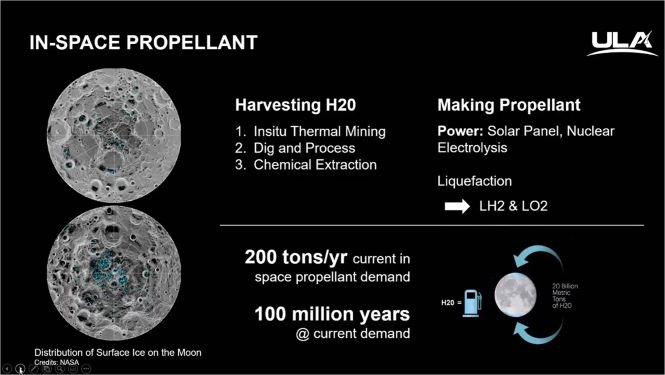
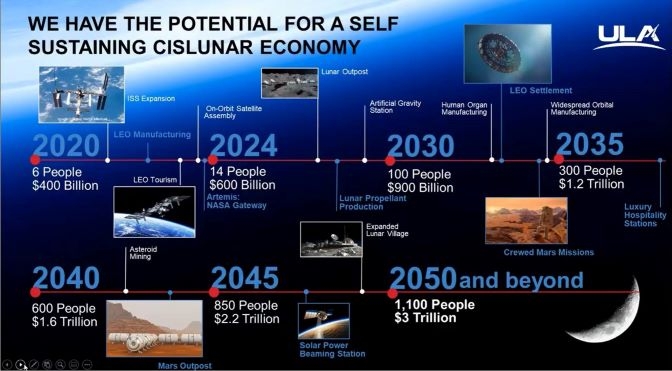
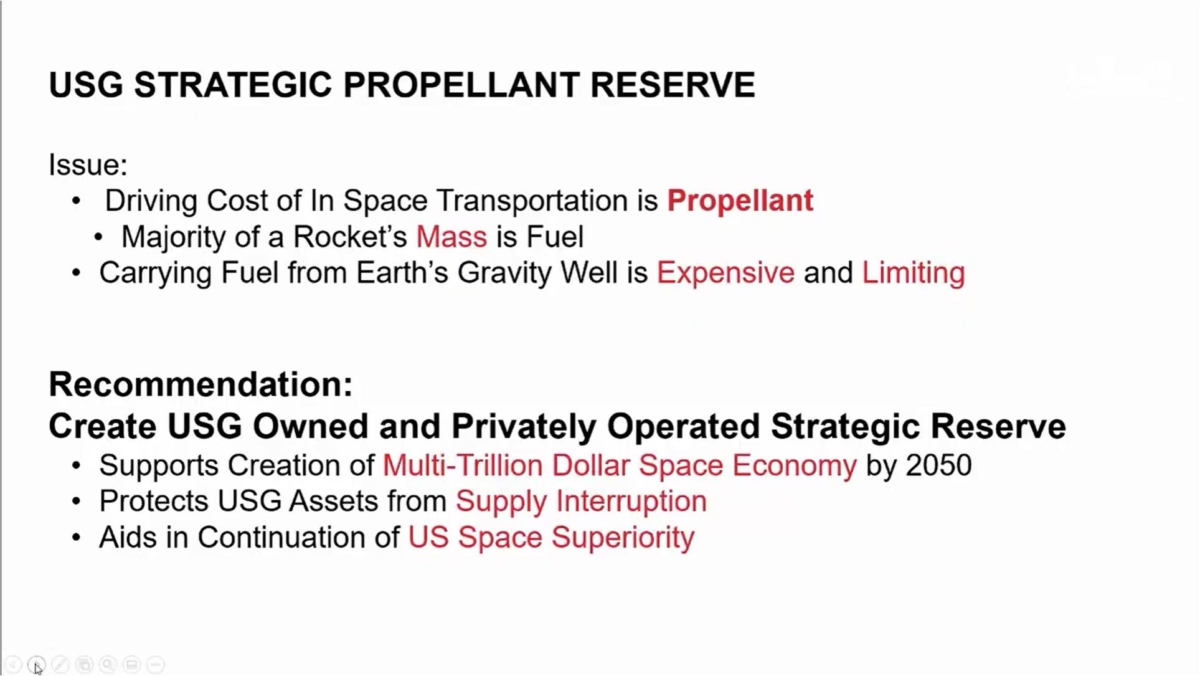
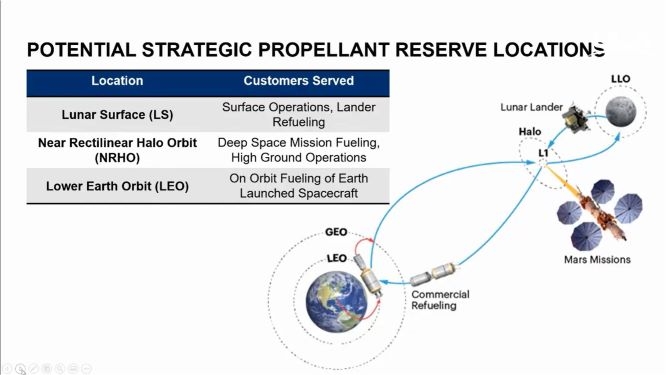
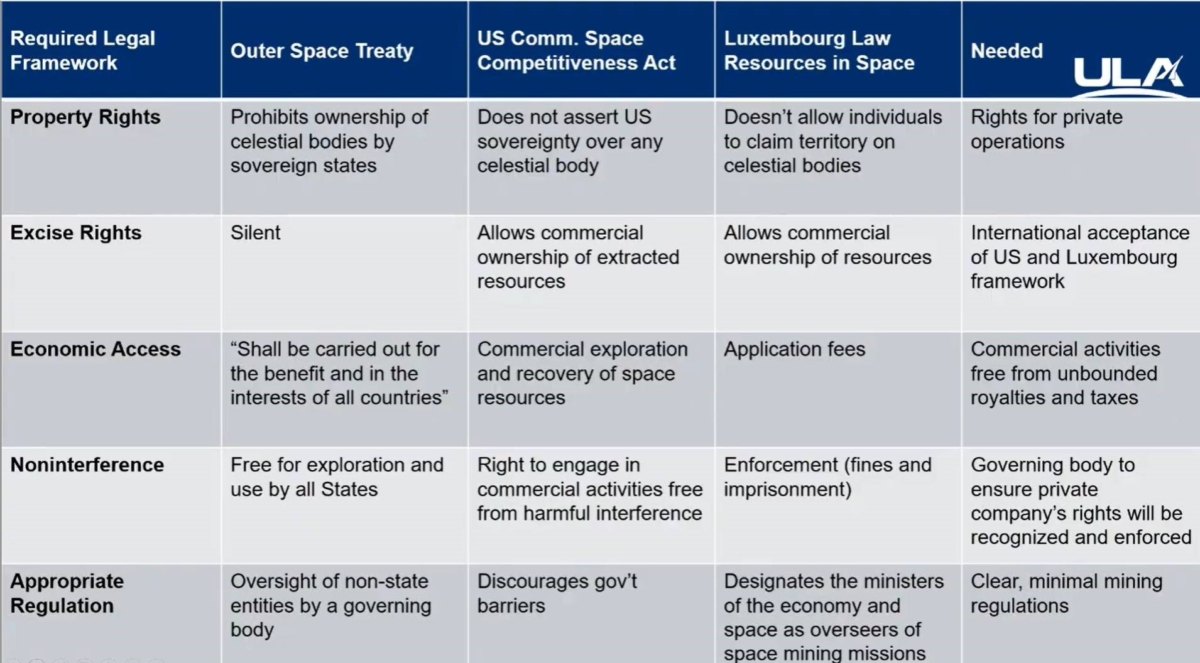
How to open up and establish a sustainable cislunar economy has been blueprinted by Tory Bruno, CEO of the United Launch Alliance (ULA).
Credit: ULA/Inside Outer Space screengrab
Bruno rolled out a ULA assessment during a webinar hosted by the Beyond Earth Institute. The institute is exploring the criteria and definitions of a community beyond Earth.
Bruno said the ULA appraisal has been given to the U.S. National Space Council for consideration.
Credit: ULA/Inside Outer Space screengrab
The intent is to move away from a definition that would include cramped space habitats as suitable for thriving human communities.
During the program, Bruno discussed critical infrastructure elements that will enable the emergence of the cislunar economy that will eventually include large scale off-world communities.
Credit: ULA/Inside Outer Space screengrab
Credit: ULA/Inside Outer Space screengrab

Credit: ULA/Inside Outer Space screengrab
Credit: ULA/Inside Outer Space screengrab
To view the program, go to:
https://www.youtube.com/watch?v=d5mPfbyzdF0
Also, go to this informative paper — Defining the Goal: What is a Community Beyond Earth? The October 2020 BE Report by the Beyond Earth Institute — at:
https://beyondearth.org/wp-content/uploads/2020/10/BE-Paper-on-Definitions-10-13-20.pdf
Credit: Blue Origin/Inside Outer Space screengrab
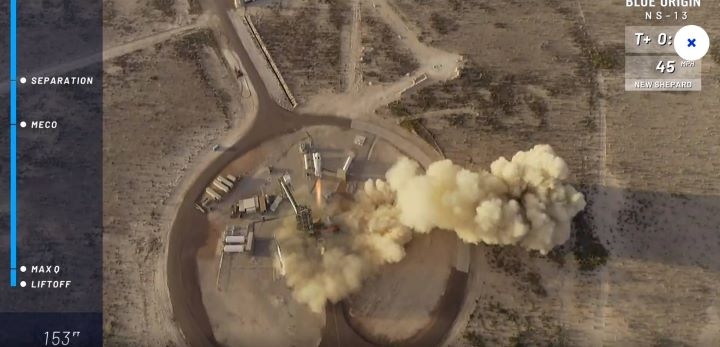
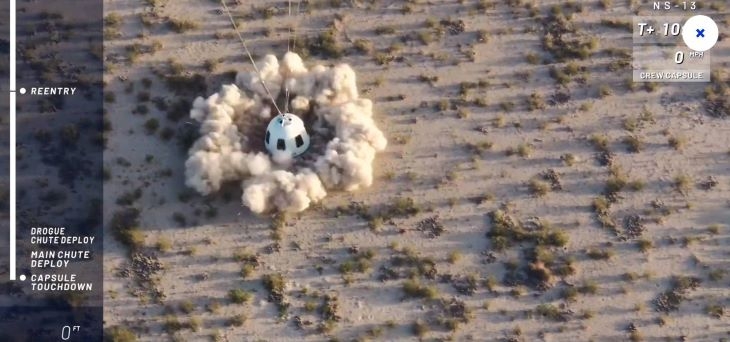
Blue Origin’s New Shepard program completed today from a West Texas spaceport the 13th mission to space and back.
The firm — backed by Amazon.com mogul, Jeff Bezos — reports that the mission marked the 7th consecutive flight for this particular vehicle – a record.

NASA Deorbit, Descent, and Landing Sensor Demonstration.
Credit: Blue Origin
In a company statement, Blue Origin notes that there were 12 payloads onboard including the Deorbit, Descent, and Landing Sensor Demonstration under the NASA Tipping Point partnership.
That lunar landing sensor demo was the first payload to be mounted on the exterior of a New Shepard booster and tested technology designed to achieve high accuracy landing. “This will enable long-term lunar exploration, as well as future Mars missions,” the company explained in a press statement.
Credit: Blue Origin/Inside Outer Space screengrab
Mission highlights
Here are some key takeaways from today’s mission:
— 7th consecutive successful flight to space and back for this New Shepard vehicle (a record – previous booster completed 5 consecutive successful flights before retirement).
— 13th consecutive successful crew capsule landing (every flight in program).
— The crew capsule reached an apogee of 346,964 feet above ground level.
— The booster reached an apogee of 346,563 feet.
— The mission elapsed time was 10 min 9 sec and the max ascent velocity was 2,232 mph.
— Onboard the vehicle, tens of thousands of postcards from Blue Origin’s nonprofit, Club for the Future.
Go to launch video replay at:
https://www.youtube.com/watch?v=O97dPDkUGg4
Also, go to this Blue Origin video on the NASA lunar landing experiment at:
Learn how the @NASA lunar landing sensor demo on #NewShepard tests precision landing tech for future missions to the Moon in support of #Artemis. This is the first payload to fly on the exterior of a New Shepard booster. Watch: pic.twitter.com/vrUzLGadgS
— Blue Origin (@blueorigin) October 13, 2020

My favorite Venusian, David Grinspoon.
Photo: Courtesy D. Grinspoon
A global team of researchers using ground-based observatories announced September 14 the detection of phosphine gas wafting about in the clouds of Venus.
On Earth, this gas is only made industrially – or by microbes that thrive in oxygen-free environments. The detection has given rise to the thought of extraterrestrial “aerial” life on hostile Venus.

Venus in ultraviolet taken by NASA’s Pioneer-Venus Orbiter in 1979 indicating that an unknown absorber is operating in the planet’s top cloud layer.
Credit: NASA
This promising find begs the question: Now what?
I discussed this issue with astrobiologist David Grinspoon, a senior scientist at the Planetary Science Institute and an expert on surface-atmospheric interactions on terrestrial planets, such as Venus.
Go to my new SpaceNews story at:
Is Venus a living hell? Conversation with astrobiologist David Grinspoon
https://spacenews.com/is-venus-a-living-hell-conversation-with-astrobiologist-david-grinspoon/

