Archive for the ‘Space News’ Category
 Author:
  November 28th, 2020
Credit: NASA
The growing interest in extractable resources on the Moon may have a problem: there ain’t enough to go around.
Toss in for good measure the lack of international policies or agreements to decide “who gets what from where.”
A team of researchers believe tensions, overcrowding, and quick exhaustion of resources to be one possible future for lunar mining projects.
These views are fleshed out in a paper recently published in the Philosophical Transactions of the Royal Society A.

Room for conflict
“A lot of people think of space as a place of peace and harmony between nations. The problem is there’s no law to regulate who gets to use the resources, and there are a significant number of space agencies and others in the private sector that aim to land on the Moon within the next five years,” said Martin Elvis, astronomer at the Center for Astrophysics | Harvard & Smithsonian and the lead author on the paper, “Concentrated lunar resources: imminent implications for governance and justice.”

The South Pole-Aitken Basin on the lunar farside.
Credit: NASA/GSFC/University of Arizona
“We looked at all the maps of the Moon we could find and found that not very many places had resources of interest, and those that did were very small. That creates a lot of room for conflict over certain resources,” Elvis adds in a Center for Astrophysics press statement.
Robust protection?
On one hand, while treaties do exist — like the 1967 Outer Space Treaty—prohibiting national appropriation—and the 2020 Artemis Accords—reaffirming the duty to coordinate and notify — neither is meant for robust protection, the researchers contend.
Tony Milligan, a Senior Researcher with the Cosmological Visionaries project at King’s College London, and a co-author on the paper said the biggest problem is that everyone is targeting the same sites and resources: states, private companies, everyone. “But they are limited sites and resources. We don’t have a second moon to move on to. This is all we have to work with,” he adds.

Dusty denizen of deep space.
Credit: NASA/Jeff Williams
Local measures
Alanna Krolikowski, assistant professor of science and technology policy at Missouri University of Science and Technology (Missouri S&T) is also a co-author on the paper. In her view a framework for success already exists and, paired with good old-fashioned business sense, may set policy on the right path.
“While a comprehensive international legal regime to manage space resources remains a distant prospect, important conceptual foundations already exist and we can start implementing, or at least deliberating, concrete, local measures to address anticipated problems at specific sites today,” Krolikowski said.

Image of Erlanger crater near the Moon’s north pole was captured by NASA’s Lunar Reconnaissance Orbiter. Only the upper rims of the crater, which measures about 10 kilometers wide, ever receive sunlight. Perhaps lurking deep within the crater are quantities of water ice – but how much? Credit: NASA/GSFC/Arizona State University
Scant resource locations
The researchers make the case that there is a risk that resource locations on the Moon will turn out to be more scant than currently believed.
“We need to go back and map resource hot spots in better resolution. Right now, we only have a few miles at best. If the resources are all contained in a smaller area, the problem will only get worse,” said Elvis. “If we can map the smallest spaces, that will inform policymaking, allow for info-sharing and help everyone to play nice together so we can avoid conflict.”
To access the paper – “Concentrated lunar resources: imminent implications for governance and justice,” (One contribution of 16 to a discussion meeting issue “Astronomy from the Moon: the next decades”) go to:
https://royalsocietypublishing.org/doi/10.1098/rsta.2019.0563
 Posted in

Credit: New China TV/Inside Outer Space screengrab
China’s Chang’e-5 mission remains on track for dispatching its lunar lander/ascender to descend within the northwest region of Oceanus Procellarum, also known as the Ocean of Storms. The craft is to land near Mons Rümker, a volcanic complex in the northern region of Oceanus Procellarum.
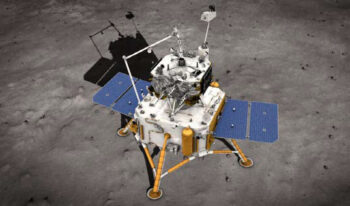
China’s Chang’e-5 lunar mission will attempt to haul back to Earth samples of the Moon.
Credit: CNSA/CLEP
Within 48 hours, a robotic arm of the lander-ascender will be extended to scoop up rocks and regolith on the Moon’s surface and a drill will bore into the ground.

Credit: CCTV/CNSA/Inside Outer Space screengrab
“We plan to sample 15 times and collect a total of two kilograms of lunar soil,” said Liu Jiangang, chief dispatcher of Chang’e-5 mission Beijing base in a recent interview with
China Central Television (CCTV).

Ascender departs lunar surface with samples. Credit: New China TV/Inside Outer Space screengrab
“In fact, the entire stay on the lunar surface, including sampling, scientific explorations, image formation and the preparation for the take-off, is only 48 hours. The time planned for the sampling alone will be about 20 hours,” Liu said.

Orbiter and ascender rendezvous and dock above the Moon. Credit: New China TV/Inside Outer Space screengrab
Back to Earth
The ascender will depart the lunar surface with its specimens then dock with the orbiter-returner for transfer of the samples. This will be followed by the returner heading back to Earth when the geometric relationship between Earth and the Moon is suitable.

Reentry capsule heads for Earth landing.
Credit: CCTV/Inside Outer Space screengrab
The returner, with the samples on board, will then reenter the atmosphere and land at Siziwang Banner in north China’s Inner Mongolia Autonomous Region in mid-December.

Fiery reentry for capsule carrying lunar samples.
Credit: CCTV/Inside
“In the process of returning, we will make six landing forecasts at different times to grasp the returning situation in real time to ensure the smooth recovery,” said Liu.

Map of Rümker region, target of Chang’E-5 sample return mission. Credit: Y. Qian, et al.
Uncertainties
Chang’e-5’s sampling duties are full of uncertainties, according to Peng Jing, deputy chief designer of the Chang’e-5 probe from the China Academy of Space Technology (CAST) under the China Aerospace Science and Technology Corporation.
“We are not sure whether the landing site is made of hard rock or loose soil, so we have developed sampling instruments for different scenarios,” Peng said in a Xinhua news agency story. “We developed two sampling methods, including drilling underground and collecting samples from the lunar surface, to increase the chance of acquiring more diverse samples.”

Carry moonbeams home in a jar?
Onboard China’s Chang’e-5 probe used to encapsulate lunar soil samples. Source: China Aerospace Tourism
The packaging and sealing of the lunar collectibles also required an elaborate design to prevent leakage and contamination. Special care has been taken to avoid contaminating the lunar samples and limiting their scientific value.
Furthermore, the takeoff from the Moon of the ascender will also be a difficult task. Peng said the lander will act as the “launching pad” of the ascender. But the lander might not be horizontal and stable, possibly landing on a slope or complex terrain. “The spacecraft needs to conduct autonomous positioning and attitude determination during takeoff,” Peng told Xinhua.

The PolyU-developed Surface Sampling and Packing System involves two samplers for collecting samples of lunar regolith in loose and sticky form. Device shown is for collecting sticky lunar sample.
Credit: PolyU
Sampling system
China’s Chang’e-5 mission carries a Surface Sampling and Packing System developed by researchers at The Hong Kong Polytechnic University (PolyU).

The PolyU-developed Surface Sampling and Packing System can collect samples of lunar regolith in loose and sticky form. The device shown is for collecting loose lunar samples.

The packaging and sealing system designed and made by PolyU researchers is for sealing the samples in a container.
Credit: PolyU
The system includes two samplers that can withstand 200 °C for collecting samples of lunar regolith in loose and sticky form, two heat-resistant near-field cameras for vision guidance during sample acquisition, and a packaging and sealing system for sealing the samples in a container, according to a PolyU statement.
Following lunar sample acquisition, a robot arm will, through vision guidance, lift the PolyU designed and made container and place it into the Chang’e-5 ascender. The ascender then heads off into lunar orbit, docks with the orbiter and transfers the sample container to the return vehicle for its journey back to Earth. During the rendezvous and docking, there is only a five-centimeter margin of error when controlling the two spacecraft.
The PolyU Surface Sampling and Packing System team is under the leadership of Yung Kai-leung. Readying the hardware was an effort that took from 2011-2017.
Professor Yung said: “The return of samples from the Moon is technically complex. It takes more than six prototype productions through various stages of space qualification procedures in order to complete the project, not to mention the pre-production research, system design, discussions and meetings in collaboration with the China Academy of Space Technology.”
In addition to the PolyU-provided system itself, a high-precision high-resolution 3D mapping and geomorphologic capability was developed by Professor Bo Wu from PolyU’s Department of Land Surveying and Geo-Informatics. Characterization of the Chang’e-5 mission’s touchdown terrain will be vital in selecting the final landing site.
PolyU researchers have an enviable track record, also developing a “Camera Pointing System” for Chang’e-3 in 2013 and for Chang’e-4’s farside landing in 2019. In addition, they developed a Mars Camera for the now en route Tianwen-1 in 2020. The “Surface Sampling and Packing System” will be used for the Chang’e-6 mission as well.
For a newly-released overview, go to this CCTV video at:

Wu Weiren, general designer of China’s lunar exploration program.
Credit: SCIO
Wu Weiren, the chief design engineer of China’s lunar project, said his country plans to build a prototype for a lunar scientific research station.
The prototype, which will consist of multiple detectors operating in lunar orbit and on the lunar surface, would carry out scientific and technological research on the Moon, as well as verify technologies for lunar resource exploration and utilization.

Credit: China Aerospace Science and Technology Corporation (CASC).
Speaking at the Wenchang International Aviation & Aerospace Forum, Wu said that, with the planned prototype, Chinese scientists will seek cooperative counterparts to build an international lunar scientific research station. “It will be likely located on the southern end of the Moon,” he said, according to China’s Xinhua news service and China Global Television Network (CGTN) reports posted today.

Credit: New China TV/Inside Outer Space screengrab
Space maneuvers
Meanwhile, the en route Chang’e-5 lunar probe successfully carried out its second orbital correction at 22:06 on Wednesday, according to the China National Space Administration (CNSA). The spacecraft made its first trajectory correction maneuver on Tuesday.
During the latest maneuver, the probe’s two 150 Newton engines worked for six seconds.
Reportedly, all systems of the probe are in good condition.
Chang’e-5 was sent moonward atop a Long March-5 Y5 carrier rocket, blasting off early on Tuesday morning, November 24, from the Wenchang Space Launch Center located in South China’s Hainan Province.

Apollo 15 image captures landing locale of China’s Chang’e-5 Moon lander – the Mons Rümker region in the northern part of Oceanus Procellarum.
Credit: NASA
Chang’e-5’s lander/ascender is targeted for a touchdown in a large lava plain known as Oceanus Procellarum, or “Ocean of Storms” – a region in the Moon’s northwest corner and visible to the naked eye from Earth. During its 2-day “layover” on the Moon, the plan calls for collecting roughly 4.4 pounds (2 kilograms) of lunar specimens for return to Earth.

Credit: New China TV/Inside Outer Space screengrab
With its lunar collectibles onboard, the ascender will take off and dock with the orbiter-returner in lunar orbit. Following transfer of the samples to the returner, the ascender will separate from the orbiter-returner.

Credit: New China TV/Inside Outer Space screengrab
The sample-carrying capsule will reenter the Earth’s atmosphere and use a speed-reducing skip maneuver, then land under parachute at the Siziwang Banner in north China’s Inner Mongolia.
Go to New China TV video at:
Also go to this CGTN video at:

Credit: Big Ear Radio Telescope
In search for extraterrestrial intelligence circles, the famous “Wow!” signal appears to be a still-standing indication of detecting other starfolk.
Reports Alberto Caballero, an amateur astronomer and one of the founders of The Exoplanets Channel: “As of October 2020, the WOW! Signal remains the strongest candidate SETI signal.”
The Wow! signal was a strong narrowband radio signal received on August 15, 1977 by Ohio State University’s Big Ear radio telescope.
Astronomer Jerry Ehman discovered the anomaly a few days later while reviewing the recorded data – writing on the computer printout “Wow!” He also circled the string 6EQUJ5 representing the signal’s intensity variation over time. The entire signal sequence lasted for the full 72-second window during which Big Ear was able to pick the signal up.

The Big Ear Observatory
Courtesy of North American Astrophysical Observatory
Candidate source
In Caballero’s paper – “An approximation to determine the source of the WOW! Signal” – he reports on his analysis of the thousands of stars in the WOW! Signal region that could have the highest chance of being the real source of the signal, providing that it came from a star system similar to ours.
A candidate source, Caballero surmises, is named 2MASS 19281982-2640123, “an ideal target to conduct observations in the search for potentially habitable exoplanets.”

In red, the two regions where the Wow! signal could have originated.
Source: Alberto Caballero/Pan-STARRS/DR1
Wanted: more information
However, Caballero points out that more information is needed in order to determine that 2MASS 19281982-2640123 is indeed a Sun-like star, he adds.
“Moreover, another 14 potential Sun-like stars in the WOW! Signal region were found in the Gaia Archive, but the estimations on their luminosity were unknown,” Caballero explains.
“In any case, since all these stars are located in the same part of the sky, it is ideal to search for exoplanets in the whole region where the WOW! Signal could have come from,” he concludes.
To read the Caballero paper — “An approximation to determine the source of the WOW! Signal” — go to:
https://arxiv.org/ftp/arxiv/papers/2011/2011.06090.pdf
Also, take a read of: “The Big Ear Wow! Signal – What We Know and Don’t Know About It After 20 Years,” written by Dr. Jerry R. Ehman (Last Revision: February 3, 1998)
Go to: http://www.bigear.org/wow20th.htm
Just for you “SETI whisperers” out there: In late 1997, after almost 40 years of operation, the Big Ear radio ceased operation. The telescope was destroyed in early 1998. An adjacent 9-hole golf course was expanded into 18 holes and about 400 homes were planned for construction on the nearby land owned by those developers.
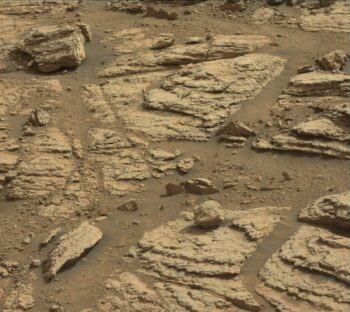
Curiosity Mast Camera Left photo taken on Sol 2951, November 24, 2020.
Credit: NASA/JPL-Caltech/MSSS
NASA’s Curiosity Mars rover is now carrying out Sol 2952 duties.

Curiosity Mast Camera Left image acquired on Sol 2951, November 24, 2020.
Credit: NASA/JPL-Caltech/MSSS

Curiosity Mast Camera Left image taken on Sol 2951, November 24, 2020.
Credit: NASA/JPL-Caltech/MSSS
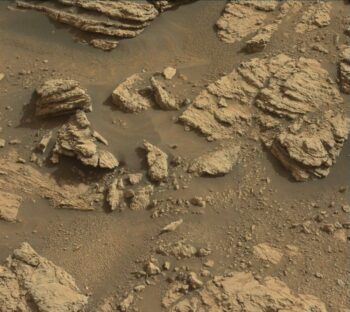
Curiosity Mast Camera Left image taken on Sol 2951, November 24, 2020.
Credit: NASA/JPL-Caltech/MSSS
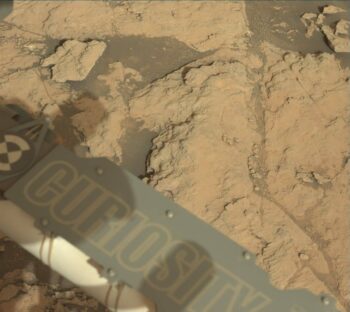
Curiosity Mast Camera Left image taken on Sol 2951, November 24, 2020.
Credit: NASA/JPL-Caltech/MSSS

Curiosity’s Location: Sol 2951. Distance Driven 14.59 miles (23.49 kilometers). Credit:
NASA/JPL-Caltech/Univ. of Arizona

Curiosity rolled up a particularly steep (roughly 20 degrees) slope. Image taken by rover’s Left Navigation Camera on Sol 2950 November 23, 2020
Credit: NASA/JPL-Caltech
NASA’s Curiosity Mars rover is now performing Sol 2952 tasks.

Curiosity Front Hazard Avoidance Camera Left B image acquired on Sol 2951, November 24, 2020.
Credit: NASA/JPL-Caltech
“Our weekend drive stopped a bit shorter than planned when Curiosity played it safe rolling up a particularly steep (~20 degrees) slope,” reports Michelle Minitti, a planetary geologist at Framework in Silver Spring, Maryland. But even with the rover parked at a tilt, we could still accomplish all our desired science at this stage of our drive back up Mount Sharp.”

Curiosity Right B Navigation Camera image taken on Sol 2951, November 24, 2020.
Credit: NASA/JPL-Caltech
Texture and chemistry
A recent plan calls for making another observation of rock texture and chemistry with the robot’s Mars Hand Lens Imager (MAHLI) and Alpha Particle X-Ray Spectrometer (APXS), respectively, of “Saughieside Hill,” part of the bedrock making up the arcuate benches the rover has been traversing over the last couple of weeks.
The Chemistry and Camera (ChemCam) will measure the chemistry of another nearby bedrock target, “Gathersnow Hill,” which sits at the edge of the lip that halted Curiosity’s drive, Minitti explains.
Mastcam is set to image the layered structure of Gathersnow Hill in stereo, and more broadly, will acquire mosaics that capture the structures of the bedrock both behind and ahead of the rover.

Curiosity Left B Navigation Camera image taken on Sol 2951, November 24, 2020.
Credit: NASA/JPL-Caltech
Minitti adds that ChemCam gets in on the imaging action, taking a small Remote Micro-Imager (RMI) mosaic of stratigraphic features in the target “Hamar.”
Drive ahead
“After a roughly 30 meters drive [98 feet], Curiosity will image the area around her with Navcam and Mastcam in preparation for activities over the upcoming American Thanksgiving long weekend,” Minitti says, “as well as the sky with a late day Mastcam image to measure the amount of dust in the atmosphere and a Navcam movie looking for clouds.”
“On Sol 2952, we will acquire an autonomously-targeted ChemCam analysis of the bedrock near the rover at our new post-drive location, a midday Navcam measurement of the amount of dust in the atmosphere, and a Navcam movie looking for clouds,” Minitti reports.

Curiosity Rear Hazard Avoidance Left B Camera image taken on Sol 2950, November 23, 2020.
Credit: NASA/JPL-Caltech
Monitoring extravaganza
On the final sol of the 2951-2953 plan, Mars researchers are slated to have an environmental monitoring extravaganza with a ChemCam passive observation of the sky, Navcam and Mastcam measurements of the amount of dust in the atmosphere, Navcam images and movies to look for dust devils, and an APXS measurement of atmospheric argon,” Minitti adds.
Dynamic Albedo of Neutrons (DAN), Radiation Assessment Detector (RAD), and Rover Environmental Monitoring Station (REMS) measurements run regularly across the three sols of the plan.
“All told, Curiosity will stay as busy as a shopper hitting those early Black Friday deals,” Minitti concludes.

Credit: CAST
China’s Chang’e-5 Moon mission faces a complex set of step-by-step stages to collect and return lunar samples back to Earth.
The craft’s departure atop a Long March-5 Y5 booster from the Wenchang Spacecraft Launch Site occurred at 4:30 a.m. Beijing time.

Credit: CCTV/Inside Outer Space Screengrab
Weighing 8.2 tons, Chang’e-5 consists of an orbiter, a lander, an ascender and a returner.
On track
“According to the report of the aerospace control center, the Long March-5 rocket was in normal flight and the Chang’e-5 spacecraft has accurately entered the preset orbit,” said Zhang Xueyu, director of southwest China’s Xichang Satellite Launch Center and chief director of the Chang’e-5 mission.

Credit: ESA
Chinese Tianlian relay satellites were utilized in the launch of Chang’e-5.
Meanwhile, two space tracking ships from China’s Yuanwang fleet — Yuanwang-5 and Yuanwang-6 — completed their maritime monitoring of the Chang’e-5 probe launch in the Pacific Ocean on Tuesday morning. The maritime monitoring process lasted a total of 1,100 seconds. The two ships sent accurate real-time data to spacecraft control centers in Beijing and Wenchang, according to China’s Xinhua news agency.
Credit: New China TV/Inside Outer Space screengrab
The European Space Agency (ESA) is supporting the mission by tracking the spacecraft during two of the mission’s most critical phases and is providing on-call back-up for China’s own ground stations.
Credit: New China TV/Inside Outer Space screengrab
Next stages
“The next ten stages of Chang’e-5 mission include key orbital corrections, capture of the spacecraft when it reaches the Moon’s orbit, the separation of the orbiter, lander, ascender and returner of Chang’e-5, touching down the Moon’s surface, lunar sampling, lunar surface takeoff, lunar orbit rendezvous and docking, transfer of samples, departing from the Moon’s orbit, returning to Earth and reentering the Earth’s atmosphere,” Xie Jianfeng, chief engineer of the Chang’e-5 mission, told China Central Television (CCTV).
Ascender departs Moon with samples. Credit: New China TV/Inside Outer Space screengrab
Docking of ascender with orbiter-returner. Credit: New China TV/Inside Outer Space screengrab
The lander-ascender is targeted to touch down on the northwest region of Oceanus Procellarum — also known as the Ocean of Storms — on the near side of the Moon in early December.
Rocks and regolith
Following touchdown, within 48 hours, a robotic arm is to scoop up rocks and regolith on the lunar surface. Also a drill will bore into the ground. About 4.4 pounds (2 kilograms) of samples are expected to be collected and sealed in a container in the spacecraft.

Lunar samples head for Earth landing. Credit: New China TV/Inside Outer Space screengrab
With its lunar collectibles onboard, the ascender will take off, and dock with the orbiter-returner in orbit. Following transfer of the samples to the returner, the ascender will separate from the orbiter-returner.
Around December 15 the returner will reenter the Earth’s atmosphere using a skip maneuver, then land under parachute at the Siziwang Banner in north China’s Inner Mongolia Autonomous Region.
Skip reentry. Credit: New China TV/Inside Outer Space screengrab
The entire flight will last more than 20 days.
Only two other countries, the United States via the Apollo program, and the former Soviet Union’s robotic Luna program, have brought samples back from the Moon. If everything goes well, Chang’e-5 would be the first robotic lunar sample return mission since Luna 24 in 1976.
Credit: New China TV/Inside Outer Space screengrab
Milestone mission
“The Chang’e-5 lunar mission is China’s first attempt to retrieve planetary soil sample from an extraterrestrial body and return to Earth. There are many firsts,” said Zhao Huanzhou, deputy chief engineer of Chang’e-5 lunar mission at Beijing Aerospace Flight Control Center in an interview with CCTV. “This mission features the most intensive and demanding control tasks, the most emergency branches and the most fault modes in China’s aerospace history,” Zhao said.

Credit: New China TV/Inside Outer Space screengrab
“We could call it a milestone mission,” said Peng Jing, deputy chief designer of the Chang’e-5 probe from the China Academy of Space Technology under the China Aerospace Science and Technology Corporation. “Its success will help us acquire the basic capabilities for future deep space exploration such as sampling and takeoff from Mars, asteroids and other celestial bodies,” Peng said.
New China TV has released a video detailing the various aspects of the Chang’e-5 lunar sample mission.
Go to:
CCTV Video News Agency has issued this video regarding the Chang’e-5 mission. Go to:
https://www.youtube.com/watch?v=b9J64y3j54o
Credit: CAST
Given success of China’s Chang’e-5 mission to haul back to Earth lunar specimens, the Chinese National Space Administration (CNSA) is establishing procedures to share the material with international colleagues.
Lin Yangting, professor with the Institute of Geology and Geophysics of Chinese Academy of Science, told China Global Television Network that researchers need to hand in proposals for studying the samples beforehand, and follow a series of procedures prescribed by the CNSA.
“Now the procedure is still being discussed, it has not been fixed,” Lin said. “The procedure will be announced on the website of the CNSA…so we will apply for it. We will submit our application with a research proposal. There will be a committee to screen your application and then make the decision if you will get the samples or not.”
China’s Chang’e-5 lunar mission will attempt to haul back to Earth samples of the Moon.
Credit: CNSA/CLEP
ESA exchanges
Liu said that lunar-sample-related exchanges between Chinese scientists and their counterparts from the European Space Agency (ESA) have already begun, and further joint efforts can be realized within a new mechanism.
Roughly three years ago, the CNSA contacted ESA to discuss cooperation between European scientists and Chinese scientists working on lunar samples. “So we have discussed about this many times. And we are going to establish a joint scientist team, and this team will have several working groups. So we will work together on the new lunar samples,” Liu said.
New China TV has released a video detailing the various aspects of the Chang’e-5 lunar sample mission. Go to:
Credit: CAST
(Washington, DC) Today, House Science, Space, and Technology Committee Ranking Member Frank Lucas emphasized the risk the Chinese Communist Party (CCP) poses to American international leadership in science and technology following the launch of the CCP’s Chang’e-5 mission to the Moon.
“The launch of Chang’e-5 is a significant step by China towards their goal of establishing a long-term presence on the Moon. The nation that leads in space will dictate the rules of the road for future technological development and exploration, and the influence of the People’s Liberation Army (PLA) in the CCP’s space program makes China a particularly irresponsible and dangerous candidate. Advancements by the CCP also jeopardize American international competitiveness in science and technology. We can no longer take America’s leadership in space for granted and must continue supporting the men and women of the American space program aspiring to launch crewed missions to the Moon, Mars, and beyond.”
The China Task Force Report, an actionable plan to respond to the Chinese Communist Party’s growing influence, discusses China’s plans for space exploration and recommends that the U.S. ensure its leadership in the commercial space sector and maintain its commitment to human exploration of space: “While the U.S. views space exploration as a way to expand human knowledge, create new technologies, and discover new phenomena, the CCP seeks to establish leadership in space for the purpose of keeping the CCP in power and as a show of economic and national security strength,” the Report reads. “Unlike the U.S., which has a civilian agency (NASA) overseeing space exploration, the PLA manages the People’s Republic of China’s (PRC) space program. The CCP dedicates high-level attention and funding for space while also aggressively attempting to acquire U.S. space startup companies and technology, both through legitimate means and coercion and theft.
“If the PRC succeeds in its efforts to launch its first long-term space station module in 2022, it will have matched the U.S.’ nearly 40-year progression from first human spaceflight to first space station module in less than 20 years,” the report continues. The CCP is vocal about plans to establish a human base on the Moon. The U.S. should be concerned about the technological innovations and leadership role for the CCP that could come from missions crewed by PRC-nationals to the Moon.”


The image above, peeking over the deck of Curiosity with Navcam, gives an impression of the laminated outcrops along the way. Photo taken by Left Navigation Camera onboard NASA’s Mars rover Curiosity on Sol 2947, November 20, 2020.
Credit: NASA/JPL-Caltech
NASA’s Curiosity Mars rover is now performing Sol 2949 tasks.

Curiosity Front Hazard Avoidance Camera Right B image taken on Sol 2949, November 22, 2020.
Credit: NASA/JPL-Caltech
“While it doesn’t rain in Gale crater, Curiosity is quite familiar with wind, and she watches out for the atmospheric phenomena around herself,” reports Susanne Schwenzer, a planetary geologist at The Open University; Milton Keynes, U.K.
“As we are again in the dust storm season, Curiosity monitors the environment even more closely,” Schwenzer notes. A current plan includes a Navcam line of sight imaging activity and Mastcam basic tau – both to watch the opacity in the atmosphere.

Two images from the Mast Camera (Mastcam) on NASA’s Curiosity rover depicting the change in the color of light illuminating the Martian surface since a dust storm engulfed Gale Crater. The left image shows the “Duluth” drill site on Sol 2058 (May 21, 2018); the right image is from Sol 2084 (June 17, 2018).
Credit: NASA/JPL-Caltech/MSSS
“Those are not from the typical cadence of activities Curiosity performs outside the dust storm season but are added especially now due to the potential for increased regional dust activity,” Schwenzer adds. “Curiosity also watches out for dust devils again in this plan. So, while it doesn’t rain at Gale crater, there is still a lot to watch out for!”

Curiosity Left B Navigation Camera image acquired on Sol 2949, November 22, 2020.
Credit: NASA/JPL-Caltech
Portfolio of bedrock targets
On the rocky side, Curiosity will perform an Alpha Particle X-Ray Spectrometer (APXS) measurement on the target ‘Giova,’ which is a bedrock target.

Curiosity Mast Camera Left image taken on Sol 2947, November 20, 2020.
Credit: NASA/JPL-Caltech/MSSS
The robot’s Chemistry and Camera (ChemCam) will look at the same target and add to its portfolio of bedrock targets by investigating the targets ‘Green Blett’ and ‘Gribun.’
“The team decided to focus on the bedrock because we are on the move again, and we are expecting to see changes in the bedrock chemistry as we travel along the landscape,” Schwenzer reports.
On the road again
With so much to look at, Mastcam is really busy in a current plan, imaging several of those outcrops, and taking a larger workspace image, too, Schwenzer says.

Curiosity Mast Camera Left image taken on Sol 2947, November 20, 2020.
Credit: NASA/JPL-Caltech/MSSS
“On top of it all, and to the delight of the mineralogists like me, there also is a multispectral image of the target Giova – to be taken after the [Dust Removal Tool] DRT and APXS activity,” Schwenzer notes. “After so much atmospheric science, geochemistry and imaging for sedimentology, Curiosity gets on the road again, rolling along those beautiful benches and outcrops that have so much to tell about the geologic and geochemical history of Gale crater!”

Curiosity’s Location as of Sol 2943. Distance Driven 14.52 miles (23.37 kilometers).
Credit: NASA/JPL-Caltech/Univ. of Arizona

