Archive for the ‘Space News’ Category
 Author:
  December 3rd, 2020
Chang’e-5 lunar lander flag system.
Credit: CCTV

Credit: CNSA/CLEP
Before China’s Chang’e-5 ascender blasted off into Moon orbit today, a five-star red flag was deployed on the Moon’s surface.
According to China Central Television (CCTV) this is the first time that China has realized the “independent display” of the five-star red flag on the lunar landscape.
The five-star red flag weighs only 1 kilogram and can still “maintain its true colors” under a temperature difference of plus or minus 150 degrees Celsius.

Credit: CNSA/CLEP
“Fabric version”
A lunar flag display system consisted of three parts: the lunar flag, the compression release device, and a small pyrotechnic deployment mechanism – and is about half a meter long.
Unlike the five-star red flag on China’s earlier lunar vehicles — Chang’e-3, Chang’e-4, and Yutu lunar rover that used spraying methods — the “fabric version” of the five-star red flag on Chang’e-5 is a real flag.

China’s Chang’e-4 lander with China flag sprayed on.
Credit: CNAS/CLEP
The five-star red flag that unfolded in the form of a scroll is relatively flat and was designed to be wrinkle-proof.
The scientific research team spent more than a year in selecting materials, and finally selected 20 or 30 fiber materials. A new type of composite material was chosen so that the five-star red flag can withstand the harsh environment of the Moon and does not fade, color, or deform.
“Although this is just a thin five-star red flag, it has a very high technological content,” said Ma Wei, the commander of the five-star red flag display system project, according to CCTV.
 Posted in

Departing ascender imaged by the Chang’e-5 lander.
Credit: CNSA/CLEP
China’s Chang’e-5 ascender vehicle has blasted off from the Moon, successfully positioning its cargo of lunar samples for rendezvous, docking, and transfer to an awaiting orbiter/returner craft.

Ascender liftoff from lunar surface.
Credit: CCTV/Inside Outer Space screengrab
China Central Television (CCTV) reports at 23:10 on December 3 (Beijing time), the 3000 newton-thrust engine of the Chang’e-5 ascender worked for about 6 minutes and successfully hurled the ascender carrying the samples to the scheduled orbit around the Moon.

Credit: CGTN/Inside Outer Space screengrab

Credit: CGTN/Inside Outer Space screengrab

Credit: CGTN/Inside Outer Space screengrab

Ascender is to dock with awaiting orbiter circling the Moon.
Credit: CCTV/Inside Outer Space screengrabBecause there is no navigation constellation at the Moon, CCTV explains, after the ascender takes off, it needed to use its own special sensors to achieve autonomous positioning and attitude determination with the help of ground measurement and control.
Prior to liftoff of the ascender from the Moon, a Chinese flag was deployed from the lander.

Capsule return with Moon samples, landing at Siziwang Banner in north China’s Inner Mongolia Autonomous Region.
Credit: CCTV/Inside Outer Space screengrab
Moon-Earth transfer window
After takeoff, the ascender reportedly went through three stages of vertical ascent, attitude adjustment and orbit injection, and entered the scheduled orbit around the Moon.
Subsequently, the ascender will rendezvous and dock with the orbital assembly waiting around the Moon and transfer the lunar sample to the returner, which will wait for a suitable Moon-Earth transfer window to prepare for its return to Earth.
According to one source, docking with the orbiter will happen on December 6, Beijing Time.
https://twitter.com/i/status/1334523926404362240

Successful sampling of the Moon.
Credit: CNSA/CLEP
China’s Chang’e-5’s ascender is ready for departure from the Moon later today, hauling into lunar orbit a cache of specimens picked up and packaged from the Ocean of Storms.

Landing leg of Chang’e-5 lander.
Credit: CNSA/CLEP
The processes of drilling and packing rocks and soil from beneath the lunar surface finished at 4:53 am on December 2, the China National Space Administration (CNSA) said, and the mechanical arm was still gathering surface samples.

Samples onboard ascender.
Credit: CCTV/Inside Outer Space screengrab
Immediately after the successful lunar touchdown, the Chang’e-5 hardware began the collection work using two methods: drilling and surface collecting. Hauling back to Earth some 4.4 pounds (2 kilograms) of Moon specimens was the goal of the Chang’e-5 mission.
The packaging and sealing work was performed on the Moon to ensure intact samples are not affected by the external environment when returning to Earth.

Drilling into the lunar surface.
Credit: CNSA/CLEP
Smoother than expected
Ren Junjie, a researcher at the National Space Administration’s Lunar Exploration and Space Engineering Center said the entire lunar surface sampling process went smoother than anticipated. In the entire meter sampling process, a dozen samples were carried out. The container for the meter sampling was filled, and the sampling task was finished ahead of schedule.
The Chang’e-5 lunar lander is equipped with multiple payloads including a landing camera, panorama camera, lunar regolith penetrating radar and lunar mineralogical spectrometer, which detects lunar surface topography and mineral composition, as well as the Moon’s shallow subsurface structure.
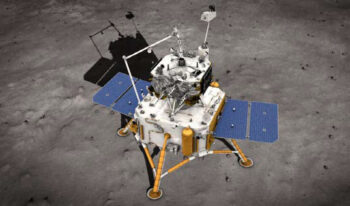
China’s Chang’e-5 lunar mission will attempt to haul back to Earth samples of the Moon.
Credit: CNSA/CLEP
Before the sample drilling process, the lunar regolith penetrating radar analyzed the subsurface structure in the sampling area, offering data reference for sampling.
According to one report, the Chang’e-5 lunar probe was also to directly measure charged lunar dust, expected to reveal the secret of floating lunar dust.

Ascender departs lunar surface with samples. Credit: New China TV/Inside Outer Space screengrab
Express package
After the ascender speeds into lunar orbit using its 3,000-newton-thrust, it will merge with the orbiter and returner combination and deliver the “express package” of lunar specimens to them. The orbiter/returner capsule is in lunar orbit at an average altitude of about 124 miles (200 kilometers).

Autonomous rendezvous and docking between ascender and orbiter.
Credit: CCTV/Inside Outer Space screengrab
The orbiter-reentry combination capsule will then return to Earth orbit, where the pair will break up, and the reentry capsule skims the Earth’s atmosphere to slow down. This series of complicated maneuvers leads to return of the capsule in mid-December, to a preset landing site in the Inner Mongolia autonomous region.

Credit: CCTV/Inside Outer Space screengrab
High hopes
Peng Jing, deputy chief designer of Chang’e-5 probe with the China Academy of Space Technology, said they hold high hopes that the samples collected will open new perspectives for lunar scientists.
“China’s scientists said it requires samples from different (geologic) ages to piece together the full history of the Moon,” Peng told China Central Television (CCTV). “Analysis has shown that the samples we could gather from the designated northwest area of the Ocean of Storms are rather new. Together with the more ancient samples, we could gain a better knowledge of the formation and evolution of the Moon,” he said.
Gao Lei, an official from the China National Space Administration’s lunar exploration program, said the Chang’e-5 mission technologies will also prove to be helpful in similar future operations.
“One of our main missions of planet exploration is sample collecting and their usage. So I think the technologies that we’ve used this time will prove useful for other sample-collecting missions in the future, whether it’s on the Moon, Mars, or other planets,” Gao said.
Go to these new videos for Chang’e-5 mission progress:
http://pv.news.cctvplus.com/2020/1203/8168047_Preview_9665.mp4
Hong Kong University Makes Key Contributions to China’s Lunar Mission

Curiosity Left B Navigation Camera image taken on Sol 2958, December 1, 2020.
Credit: NASA/JPL-Caltech
NASA’s Curiosity Mars rover is now carrying out Sol 2959 tasks.
A recent drive by the wheeled robot of roughly 167 feet (51 meters) placed it in front of good outcrop to study, reports Lauren Edgar, a planetary geologist at USGS Astrogeology Science Center in Flagstaff, Arizona.
Curiosity’s plan involved a “touch-and-go” – an opportunity to do short duration contact science before getting back on the road, Edgar adds. The rover was to acquire Alpha Particle X-Ray Spectrometer (APXS) and Mars Hand Lens Imager (MAHLI) observations of the target “Edinburrie” to systematically characterize bedrock as the robot transitions between stratigraphic units.

Curiosity will make progress to the southeast with a roughly 30 meter drive, towards the bright blocky area seen on the horizon in this Left Navigation Camera photo taken on Sol 2958 December 1, 2020
Credit: NASA/JPL-Caltech
Drive to the southeast
Then Curiosity is to stow its robotic arm, Edgar explains, and have a short science block which contains Chemistry and Camera (ChemCam) and Mastcam observations of a nodular bedrock target named “Bruggs” and a Mastcam tau to monitor dust in the atmosphere.
Curiosity will then continue making progress to the southeast with a drive of roughly 98 feet (30 meters), Edgar adds, towards a bright blocky area seen on the horizon,” Edgar reports. After the drive the rover will acquire imaging to help with context and targeting in an upcoming plan.

Curiosity Front Hazard Avoidance Camera Left B image taken on Sol 2958, December 1, 2020.
Credit: NASA/JPL-Caltech
Also planned is another autonomously selected ChemCam Autonomous Exploration for Gathering Increased Science (AEGIS) target, and a ChemCam calibration activity. And last but not least, scientists will take a standard Mars Descent Imager (MARDI) photo to keep track of the changing terrain beneath the rover, Edgar concludes.

Curiosity Chemistry & Camera Remote Micro-Imager (RMI) photo acquired on Sol 2958, December 1, 2020.
Credit: NASA/JPL-Caltech/LANL
Following its December 1st lunar landing, China’s Chang’e-5 robotic probe has collected a cargo of Moon samples, the China National Space Administration (CNSA) announced Wednesday.

Drilling into lunar surface.
Credit: CCTV/Inside Outer Space screengrab
The lander-ascender combination of Chang’e-5 finished the tasks of Moon sample drilling and packaging at 4:53 am Wednesday utilizing two methods of sampling, including using drills and a mechanical arm to gather specimens.

Sampling of Moon’s terrain.
Credit: CCTV/Inside Outer Space screengrab
About 2 kilograms of samples are expected to be collected and sealed in a container in what scientists have described as a long “sausage-like package.”
Chang’e 5 is expected to work for about two days in a region to the north of Mons Rümker, a mountain overlooking a vast lunar mare called Oceanus Procellarum, or the Ocean of Storms, on the western edge of the Moon’s near side.
Samples onboard ascender.
Credit: CCTV/Inside Outer Space screengrab
Positional adjustment
When the lander-ascender reached an altitude of 1.6 miles (2.5 kilometers) it conducted a rapid positional adjustment and continued approaching the lunar surface.

Headed for landing site and keeping clear of hazards.
Credit: CCTV/Inside Outer Space screengrab
During the engine-assisted process, cameras on the lander-ascender took pictures of the landing site and transmitted them to computers to identify possible hazards on the surface such as large rocks so the craft could maneuver to avoid them.
The lander-ascender suspended its descent when it was about 328 feet (100 meters) from the Moon and hovered for a short time to carry out accurate detection of obstacles before continuing to descend at a slower, steady speed.

Ascender departs the Moon with lunar collectibles.
Credit: CCTV/Inside Outer Space screengrab
Next phase
After the collection and packing operations are completed, a 3,000-newton-thrust engine on the ascender will lift the hardware carrying the specimens to rendezvous and dock with the reentry module. It will transfer the lunar samples to the module.

Bringing the samples back to Earth.
Credit: New China TV/Inside Outer Space screengrab
At the proper time, the returner will then separate from the orbiter and carry the collectibles back to Earth, landing under parachute in north China’s Inner Mongolia.
To relive the Chang’e-5 mission to date, view this collection of videos at:
Also, go to: Simulation facilities applied to prepare for Chang’e-5 mission on Moon

Credit: CCTV
China’s Chang’e-5 spacecraft successfully landed on the near side of the Moon late Tuesday and sent back images, the China National Space Administration (CNSA) announced.
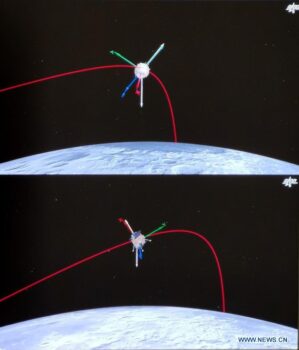
Credit: CCTV
According to China news groups, the spacecraft landed at the preselected landing area near 51.8 degrees west longitude and 43.1 degrees north latitude, citing a CNSA statement.
Chang’e-5 reportedly touched down on the north of the Mons Rumker in Oceanus Procellarum, also known as the Ocean of Storms, on the near side of the Moon.
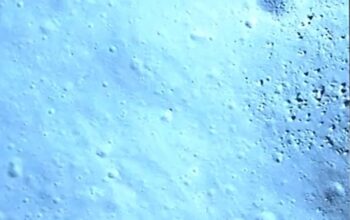
En route to Moon landing image taken by Chang’e-5 lander. Credit: CCTV/Inside Outer Space screengrab
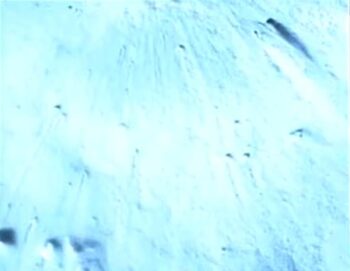
Blast effects from landing engine? Credit: CCTV/Inside Outer Space screengrab
Status checks
Under ground-control, the lander carried out a series of status checks and settings, preparing for around 48 hours of work on the surface of the Moon.
If all goes according to plan, the lander craft will stash about 2 kilograms of lunar samples and seal them in a container.
Following this specimen-stashing, the Chang’e-5’s ascender will take off and dock with the orbiter-returner combination in Moon orbit.
After the samples are transferred to the returner, the ascender will separate from the orbiter-returner.
Ascender departs the Moon with lunar collectibles.
Credit: CCTV/Inside Outer Space screengrab
The returner is then to transfer the lunar collectibles back to Earth, landing at Siziwang Banner in north China’s Inner Mongolia Autonomous Region.

Fiery reentry for capsule carrying lunar samples.
Credit: CCTV/Inside
Kudos
The successful landing of Chang’e-5 was underscored by several U.S. space leaders.
NASA’s Thomas Zurbuchen, Associate Administrator for the Science Mission Directorate noted post-landing: “Congratulations to China on the successful landing of Chang’e 5. This is no easy task. When the samples collected on the Moon are returned to Earth, we hope everyone will benefit from being able to study this precious cargo that could advance the international science community.”
Similarly, Clive Neal, a lunar scientist from Notre Dame said: “Congratulations to our friends and colleagues in China on what has been achieved so far. We all look forward to seeing the first samples returned from the Moon in 44 years. These will represent the first lunar samples returned in the 21st century – and I hope they will not be the last!”
Capsule return with Moon samples, landing at Siziwang Banner in north China’s Inner Mongolia Autonomous Region.
Credit: CCTV/Inside Outer Space screengrab
Go to landing video at New China TV:

Chang’e-5 lander departs orbiter. Credit: CCTV
China’s Chang’e-5 lunar mission — the country’s first attempt to retrieve samples automatically from an extraterrestrial body – is ready for a landing.

Credit: CCTV
The Chang’e-5 probe’s lander and ascender separated from its orbiter and returner at 4:40 a.m. Beijing time on Monday, according to the China National Space Administration (CNSA) on the same day.

Credit: CCTV/Inside Outer Space screengrab
Sealed deal
Getting down and dirty on the lunar surface, then collect Moon samples for return to Earth, is a complex affair.

Credit: New China TV/Inside Outer Space screengrab
“We have never done a whole process of taking and sealing samples,” said Peng Jing, deputy chief designer of the Chang’e-5 probe system of China Academy of Space Technology, also a scientist with China Aerospace Science and Technology Corporation (CASC).
China’s Chang’e-5 lunar mission will attempt to haul back to Earth samples of the Moon.
Credit: CNSA/CLEP
Peng told China Central Television (CCTV) this aspect of the work mainly depends on several complicated structures including drilling, robotically scooping up rocks and regolith on the lunar surface, and then place specimens in a high vacuum sealing device.
Ascender departs the Moon with lunar collectibles.
Credit: CCTV/Inside Outer Space screengrab
“If the air enters the sealed device during this process or during the samples’ transportation, it might pollute the samples,” Peng said.
Lunar liftoff
Another tricky part of the Chang’e-5 mission is the liftoff from the Moon of the ascender.
Ascender liftoff from lunar surface.
Credit: CCTV/Inside Outer Space screengrab
“The main difficulty is that when we first land on the Moon, we would not know how the lander performs beforehand. Besides, the most crucial part during the launch is the fact that the targeted direction needs to be really precise. Only when we have especially designed such a direction and the ascender has entered the target orbit, can it be able to rendezvous with the orbiter-returner combination and conduct further flying processes,” Peng said.
Autonomous rendezvous and docking between ascender and orbiter.
Credit: CCTV/Inside Outer Space screengrab
Autonomous operations
The ascender will autonomously dock with the orbiter-returner combination and poses another tough challenge.

Bringing the lunar goods back to Earth.
Credit: CCTV/Inside Outer Space screengrab
“We need to precisely anticipate the location and speed of the two spacecraft flying at the lunar orbit. Because the probes don’t match in size, our ascender weighs just around 300 to 400 kilograms during docking, while the combination weighs nearly 2,000 kilograms. Any error could knock off the smaller spacecraft, and that would make the docking job much more difficult than before,” Peng said. He added that the docking has a rather high requirement on accuracy, with an error range less than five centimeters.
If all goes according to plan, a successful Chang’e-5 mission would parachute back to Earth roughly 4 pounds (2 kilograms) of lunar collectibles, landing in Siziwang Banner in Inner Mongolia, north China.
Go to this CCTV video detailing the Chang’e-5 mission at:

Overlooks into a lunar pit are to be risky, but guardedly careful stops.
Credit: William Whittaker/PitRanger team
Dotting the moon’s harsh landscape are steep-walled holes known as pits. Also tagged as “skylights,” these features may lead to far-reaching, sub-surface lava tubes that were shaped billions of years ago by a then geologically lively moon.

Skylight opening on a huge lava tube in the Marius Hills region on the moon’s near side.
Credit: NASA/Lunar Reconnaissance Orbiter Camera/Science Operations Center
New technologies are being harnessed that can allow exploration of skylights, lava tubes and caverns on the moon. Underground caves on the moon could double as comfortable domiciles for future expeditionary crews.

Artwork depicts scenario of multiple micro-rover maneuvers to profile a lunar pit.
Credit: William Whittaker/PitRanger team
Go to my new Space.com story at:
Moon pit diver: This tiny rover could explore the lunar underworld
https://www.space.com/tiny-moon-rover-pitranger-explore-lunar-underworld

Curiosity’s Location as of Sol 2951. Distance driven 14.59 miles (23.49 kilometers).
Credit: NASA/JPL-Caltech/Univ. of Arizona
NASA’s Curiosity Mars rover is now performing Sol 2956 tasks.
New imagery from the robot shows its surroundings and ongoing duties.

Curiosity Right B Navigation Camera image taken on Sol 2955, November 28, 2020.
Credit: NASA/JPL-Caltech

Curiosity Front Hazard Avoidance Camera Left B image taken on Sol 2955, November 28, 2020.
Credit: NASA/JPL-Caltech

Curiosity Mars Hand Lens Imager photo produced on Sol 2955, November 28, 2020
Credit: NASA/JPL-Caltech/MSSS

Curiosity Mars Hand Lens Imager photo produced on Sol 2955, November 28, 2020
Credit: NASA/JPL-Caltech/MSSS

Curiosity Mars Hand Lens Imager photo produced on Sol 2955, November 28, 2020
Credit: NASA/JPL-Caltech/MSSS

Curiosity Mast Camera Left imagery taken on Sol 2951, November 24, 2020
Credit: NASA/JPL-Caltech/MSSS
Credit: New China TV/Inside Outer Space screengrab
China’s Chang’e-5 lunar sample return mission has braked itself into Moon orbit on Saturday, one small robotic step to land, collect, and then deliver back to Earth lunar samples.
China’s Chang’e-5 lunar mission will attempt to haul back to Earth samples of the Moon.
Credit: CNSA/CLEP
According to the China National Space Administration (CNSA) after the Moon probe had flown about 112 hours from Earth, an engine on the probe ignited when it was 400 kilometers away from the surface of the Moon and shut down after a burn of 17 minutes.
The orbit period of the craft – comprising an orbiter, a lander, an ascender, and a returner — is roughly eight hours.
After orbiting the Moon three times, which takes about one day, the Chang’e-5 will start braking a second time to enter lunar orbit with a perilune (low point above the Moon) of 200 kilometers, explained Meng Zhanfeng, design director of the Chang’e-5 probe in an interview with China’s China Central Television (CCTV).

Credit: New China/Screengrab
Busy time
Afterward, the Chang’e-5 will face its busiest time.
At a designated time, Chang’e-5’s lander-ascender combination will separate from the orbiter-returner combination. Some China space insiders are suggesting a possible landing time of 4:30 AM, November 30 (Beijing Time).
While the orbiter-returner combination continues traveling along the orbit and prepares for a later docking, the lander-ascender combination will implement a soft landing on the near side of the Moon and carry out automatic sampling as planned.
Ascender departs lunar surface with samples. Credit: New China TV/Inside Outer Space screengrab
Important tasks
“The sampling and preparation for take-off will be carried out within 48 hours after landing on the Moon,” said Liu Jiangang, chief dispatcher of the Chang’e-5 mission Beijing base.
“After taking off, the lander-ascender combination will conduct four remote-control operations to reach a position for docking, then it will dock with the orbiter-returner to transfer the samples. There will be dozens of important tasks that need to be done within a week,” Liu told CCTV.

