Archive for the ‘Space News’ Category
 Author:
  December 17th, 2020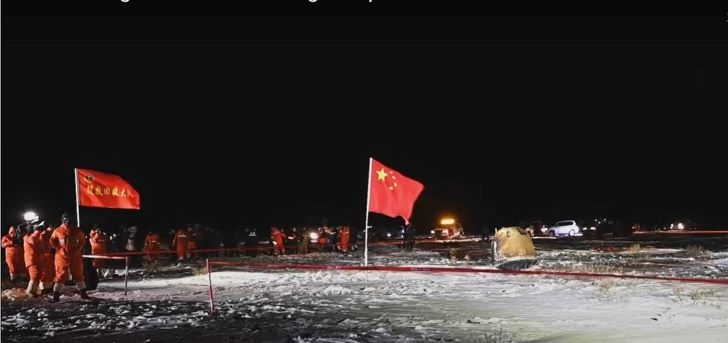
Credit: China Central Television (CCTV)/China National Space Administration (CNSA)/Inside Outer Space screengrab
The Chang’e-5 returner capsule carrying lunar samples is headed for a Beijing laboratory for opening, with an eagerly awaiting research team set to study the fresh Moon specimens.
Given the success of the lunar exploration mission, China space officials say a next step is to cooperate with scientists of other nations to analyze the Moon samples.
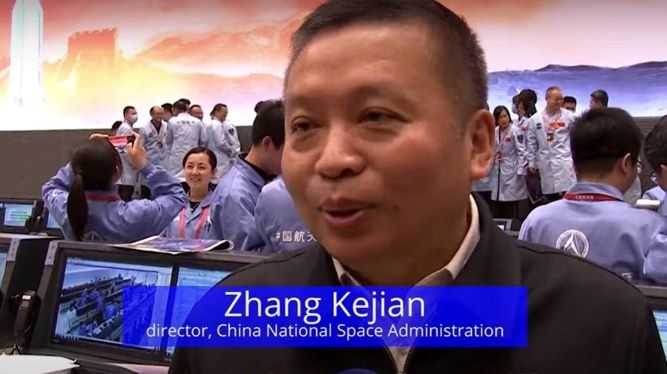
Credit: China Central Television (CCTV)/China National Space Administration (CNSA)/Inside Outer Space screengrab
China is set to establish a lunar sample analysis solicitation, with a team of domestic and foreign scientists organized to consider requests for the samples.
China will be sharing a portion of the lunar rock and soil samples brought back by its Chang’e-5 probe with other countries, said Wu Yanhua, deputy head of China National Space Administration, on Thursday.
Sharing samples
Speaking at a press conference in Beijing, Wu said that while the samples will be mainly used for scientific research, China is prepared to share some of the samples with the rest of the world.
“There are three types of use: The first type, or the main purpose, is for scientific research. The second is to enable the public to see the samples as early as possible. Thus a portion of the samples will be sent to the National Museum as exhibits for the public to enjoy. And the third will be to share samples with other countries and scientists around the world, in accordance with the relevant international cooperation conventions as well as multilateral and bilateral cooperation agreements. We will soon release guidelines on the management of the lunar samples and data. And part of the samples may be used as diplomatic gifts according to precedents set by the United States and Russia,” Wu said.
Zhang Kejian, head of the China National Space Administration (CNSA), declared the Chang’e-5 mission a success. It marks a successful conclusion of China’s current three-step lunar exploration program of orbiting and landing, and bringing back samples, which began in 2004.

Photo taking during surface sampling.
Credit: CCTV/Inside Outer Space screengrab
“Now that the Chang’e-5 probe’s returner has come back with samples of lunar soil, an important step next is that we will carry out extensive cooperation with scientists of other countries in carrying out in-depth studies of the lunar soil,” Zhang said in a China Central Television (CCTV) interview.
The Chang’e-5 mission laid a foundation for future manned lunar and deep space exploration. “China is drawing up plans for future lunar exploration, including constructing a basic version of a scientific research station,” said Pei Zhaoyu, deputy director of CNSA’s Lunar Exploration and Space Program Center.

Return capsule skips through Earth’s atmosphere en route to landing zone.
Credit: CCTV/CNSA/Inside Outer Space screengrab
“We hope to cooperate with other countries to build the international lunar scientific research station, which could provide a shared platform for lunar scientific exploration and technological experiments,” Pei said.
Search and recovery teams
According to the CNSA, under ground control, the return capsule separated from the Chang’e-5 orbiter/returner craft high above the Atlantic. The capsule entered the Earth’s atmosphere and after aerodynamic deceleration, skipped out of the atmosphere. Then the capsule re-entered the atmosphere to perform a second aerodynamic deceleration.
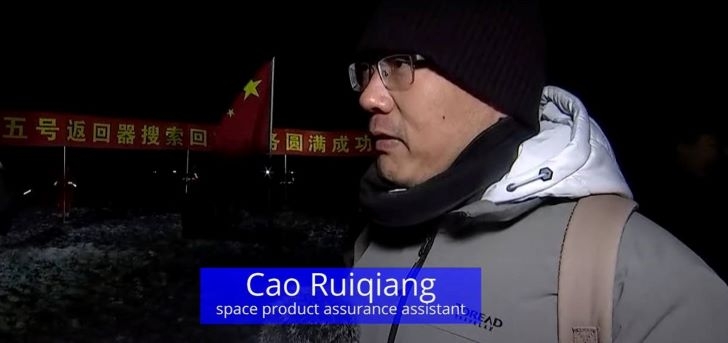
Credit: XinhuaVideo/Inside Outer Space screengrab
At about 6 miles (10 kilometers) above the ground, a parachute opened with the capsule landing in the predetermined area, with search and recovery teams finding the hardware in short order.
An air team in helicopters spotted the capsule using infrared cameras, while a ground team followed in SUVs to reach the snow-covered landing site. Ground teams cordoned off the area, confirmed coordinates, and set up a communication station to connect with Beijing Aerospace Flight Control Center.
“We have just measured the shape of the crater that the returner landed on, which is part of the scientific data collection. Then the returner will be put on ‘new warm coat’ to prevent the remaining propellant inside from being frozen during the transportation to Zhurihe Airport, where the propellant will be expelled from returner,” said Cao Ruiqiang, a space product assurance assistant, in a CCTV interview.
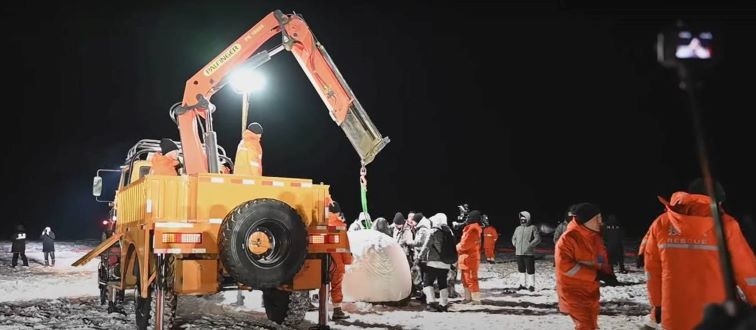
Credit: China Central Television (CCTV)/China National Space Administration (CNSA)/Inside Outer Space screengrab
The Chang’e-5 capsule was loaded onto a truck, and then transported by helicopter and airplane to Beijing.
Lunar lab
Chang’e-5’s return capsule has reportedly brought back 4.4 pounds (two kilograms) of lunar samples. The mission made use of an orbiter, a lander, an ascender and a returner.
The multi-phased mission was launched on November 24. On December 1 its lander-ascender combination touched down north of Mons Rümker in Oceanus Procellarum, also known as the Ocean of Storms, on the near side of the Moon.
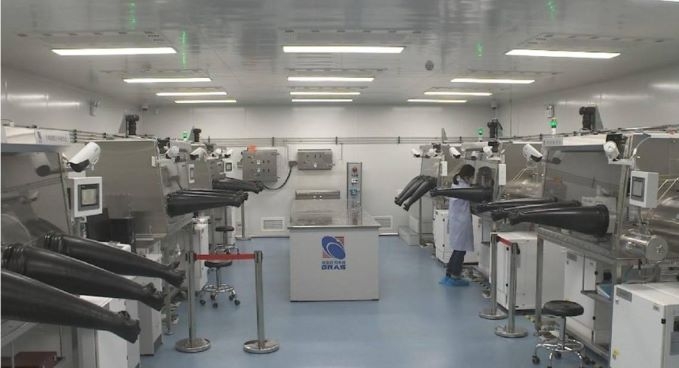
Lunar Sample Laboratory at the National Astronomical Observatory. (NAO)Credit: China Central
Television (CCTV)/Inside Outer Space screengrab
In Beijing, CNSA will transfer the lunar materials to the Lunar Sample Laboratory at the National Astronomical Observatory (NAO) under the Chinese Academy of Sciences, which has been built specially for storage, processing and analysis of the samples.
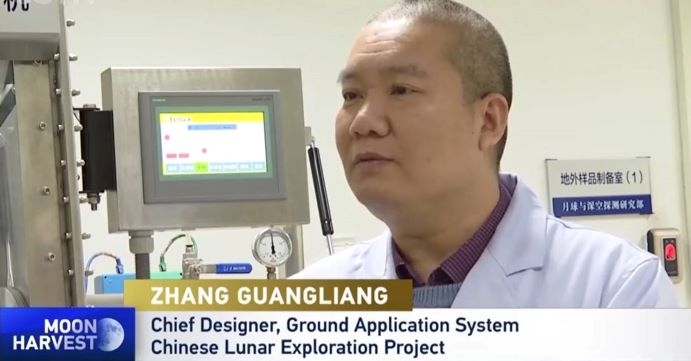
“The biggest challenge is unsealing in the atmosphere the sample package, which is sealed in a vacuum environment [on the moon]. To address that, we have verified several times and designed a special process. We will unpack the samples in a vacuum environment, and transfer them to a nitrogen environment for storage and processing,” said Zhang Guangliang, chief designer of the Ground Application System of Chinese Lunar Exploration Project’s third phase in a CCTV interview.
Credit: CGTN
Analysis methods
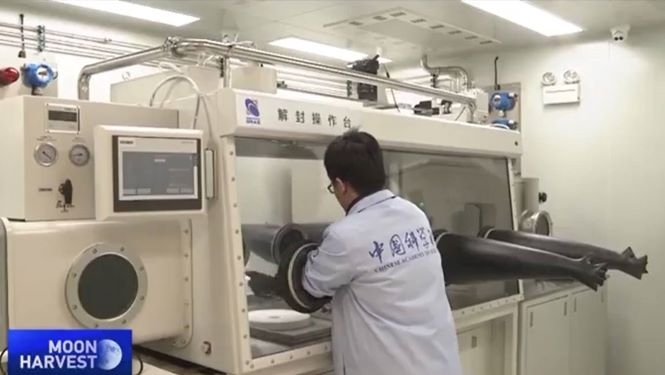
“The first thing we consider is to use some damage-free analysis methods as much as possible, such as observation of optical characteristics under a microscope, and spectral measurement in the laboratory,” said Zhou Qin, also identified as a chief designer of the Ground Application System of Chinese Lunar Exploration Project’s third phase in a CCTV interview.
Credit: CGTN
“Of course, these measurements will be conducted and analyzed under a special environment such as with high purity nitrogen, so as to minimize the impact of the Earth’s environment on lunar samples,” Zhou said. “In addition, we will also do some chemical composition analysis which will cause damage. We will make analysis comprehensively, and try to obtain more useful information with the smallest sample amount.”
To view newly-released videos focused on the Chang’e-5 return capsule go to:
 Posted in

Fresh samples from the Moon delivered by China’s Chang’e-5 return capsule.
Credit: XinhuaVideo/Inside Outer Space screengrab
China has scored a major milestone in space exploration, robotically hauling back samples of the Moon to Earth. It is a feat that has not been duplicated by humans or automated means since 1976.
The Chang’e-5 sample return capsule skyrocketed into the Siziwang Banner in north China’s Inner Mongolia Autonomous Region on December 16 with a search and retrieval team at the ready, fighting bitter cold, snow, and nighttime conditions in order to locate the capsule of lunar collectibles. The capsule landed at 17:59 UTC (December 17, 01:59 local time).

Return capsule parachutes into Siziwang Banner in north China’s Inner Mongolia Autonomous Region.
Credit: CCTV/China National Space Administration (CNSA)/Inside Outer Space screengrab
Upon the capsule’s touchdown, ground crews began securing the location, with other teams assessing the vehicle’s condition and then manipulate the lander and transport it to a protected location.
Chang’e-5’s step-by-step mission to the Moon and back also bolsters that country’s plan to place Chinese astronauts on Earth’s celestial neighbor – as well as bring back specimens from Mars.

Re-entry capsule performed slow-down dips within Earth’s atmosphere.
Credit: CCTV/Inside Outer Space screengrab
Fresh samples
Carrying the world’s freshest lunar samples in over 40 years, China’s Chang’e-5 lunar probe’s returner craft parachuted down on Earth early Thursday (Beijing time), marking a successful conclusion of the country’s three-step lunar exploration program of orbiting and landing, and bringing back samples.
“What a great achievement and a fantastic advance for lunar science,” said lunar researcher, Clive Neal at the University of Notre Dame in Indiana.
Photo taking during surface sampling.
Credit: CCTV/Inside Outer Space screengrab
Explained James Head, a Moon expert at Brown University’s Department of Earth, Environmental and Planetary Sciences in Providence, Rhode Island: “This is an amazing accomplishment by our Chinese colleagues!”
Head said that there are so many outstanding questions derived from the last almost 50 years of analysis of existing lunar samples. Chang’e-5 landed in a never-before visited critical area, he said.
“This is a huge step forward in lunar exploration and understanding of the Moon and planets, including Earth,” Head said “This is also a great ‘rehearsal’ Mars sample return by NASA/ESA and China,” he told Inside Outer Space. “Congratulations to our Chinese colleagues!”

Box indicates Chang’e 5 lander on the basaltic plains of Oceanus Procellarum (“Ocean of Storms”) on December 2, 2020. The lander is the bright spot in the center of the outline. The areas around the lander has been brightened due to the descent engine plume impingement on the surface (similar to what has been observed at other landing sites).
Credit: NASA/GSFC/Arizona State University
Milestone-making mission
The Chang’e-5 mission was comprised of a lander, an ascender, an orbiter and a returner, and was hurled toward the Moon on November 24. Its lander-ascender combination successfully planted itself on the near side of the Moon — north of Mons Rümker (a younger volcanic complex) in Oceanus Procellarum, also known as the Ocean of Storms, on December 1, and then collected roughly 4.4 pounds (2 kilograms) of samples from both the lunar surface and beneath.
The milestone-making mission achieved several firsts for China, including the country’s first lunar sampling, the first liftoff from an extraterrestrial body, the first automated rendezvous and docking in lunar orbit and the first spacecraft carrying samples to re-enter Earth’s atmosphere at high speed.
Go to these new videos from the landing site at:
Xinhua’s Yu Jia reports from the spacecraft’s landing site in Inner Mongolia at:

Nearly home – Chang’e-5 orbiter/returner.
Credit: CNSA/CLEP
China’s Chang’e-5 orbiter/returner completed its second trajectory correction on its Moon-to-Earth transfer voyage Wednesday morning, according to the China National Space Administration (CNSA).
At 9:15 am (Beijing time) two 25 newton thrust engines on the orbiter/returner combination fired for about eight seconds. The CNSA said all systems on the orbiter/returner combination that carries the lunar specimens are in good condition.
Return capsule skips through Earth’s atmosphere en route to landing zone.
Credit: CCTV/CNSA/Inside Outer Space screengrab
Still to come, however, is the critical release of the reentry capsule later today from the orbiter, an action that is staged roughly 3,107 miles (5,000 kilometers) from Earth. The capsule is expected to land at the Siziwang Banner in north China’s Inner Mongolia Autonomous Region with a search and retrieval team at the ready.
Along with its cache of lunar collectibles, the return capsule is toting a variety of plant seeds. According to the Space Breeding Innovation Alliance, its space breeding program was part of the payload consisting of seeds, including rice, orchids, alfalfa and oats. The seeds embarked on the round trip to the Moon on November 24 when the Chang’e-5 mission was launched.
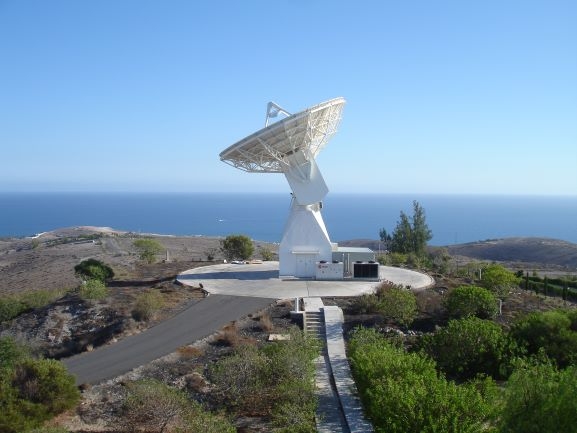
Signal from the orbiter/returner acquired via the 15-meter Maspalomas antenna, operated by the Instituto Nacional de Técnica Aeroespacial (INTA) in Spain.
Credit: ESA/ESOC/INTA
Meanwhile, the European Space Agency (ESA) announced that they have acquired the signal from the orbiter/returner via its Maspalomas ground station in Spain, operated by the Instituto Nacional de Técnica Aeroespacial (INTA). There is a live link from the Maspalomas station that goes via ESA’s European Space Operations Center to a control center in China.

Map notes projected Chang’e-5 reentry capsule trajectory, produced by satellite tracker, Scott Tilley.
Credit: Scott Tilley
Blackout zone
The measurement and control team responsible for locating and recovering the return capsule have set up and tested their tracking devices at the designated landing area. They have had to deal with temperatures as low as minus 30 degrees Celsius, a challenge to the team and their measurement and control devices.

Recovery team at the ready to retrieve return capsule.
Credit: CCTV/Inside Outer Space screengrab
Technician Wang Yuxiang said the Chang’e-5 capsule will enter a blackout zone during its returning, which will pose a loss of signal.
“When the returner is in the blackout zone, our team cannot track its downward signal or judge its position,” Wang said in a China Central Television (CCTV) interview. “In this period, we can only carry out the search using the pre-set points and theoretical trajectories. After the returner gets out of the blackout zone, we can then judge its position based on the amplitude of its signal, and better implement the searching work,” Wang added.

Credit: CCTV/Inside Outer Space screengrab
Retrieval simulations
China’s ground search and retrieval teams have carried out a comprehensive training program, one that simulated various conditions in the search for the return capsule by aerial and ground vehicles.
The team from the Xi’an Satellite Control Center in northwest China has completed setting up and testing their equipment at the designated landing zone. They are responsible for providing fast, accurate measurement and control data to make the search for and retrieval of the landed capsule as efficient as possible.
Take a view of a newly issued video regarding the recovery team awaiting the return capsule at:

Chang’e-5’s orbiter/returner.
Credit: CNSA
China’s ground teams are preparing for the landing of Chang’e-5 probe’s returner at the Siziwang Banner in north China’s Inner Mongolia Autonomous Region.
The return capsule is filled with roughly 4.4 pounds (2 kilograms) of lunar samples gathered from Mons Rümker, an isolated volcanic formation that is located in the northwest part of the Moon’s near side.

Credit: CCTV/Inside Outer Space screengrab
Recovery teams face heavy snow and bitter cold in the region.
“All the preparatory work at the designated landing area for Chang’e-5 probe’s returner is ready, and we are both confident and capable to complete the searching and retrieving mission of the returner successfully,” said Bian Hancheng, a director at the designated landing area for the Chang’e-5 mission in a China Central Television (CCTV) interview.
Ready to head home – Chang’e-5 orbiter/returner.
Credit: CNSA/CLEP
The return capsule will carry out maneuvers within the Earth’s atmosphere to slow down, a final part of the mission that mimics a tossed stone skipping across water.
Credit: CCTV/CNSA/Inside Outer Space screengrab
Search and retrieval
The Global Times — an English-language Chinese newspaper under the People’s Daily — reports that processed radar data will be transmitted to the helicopters and vehicles designated to carry out the search operation and guide them to return capsule. They are also equipped with high-power searchlights to facilitate the search process.

Following a circumlunar voyage in 2014, a return capsule parachuted to Earth. This test was a prelude to China’s Chang’e-5 lunar mission.
Courtesy: China Space
Prior to the capsule’s touchdown, the search and retrieval team have conducted some 30 terrain surveys in frosty night time conditions at the landing region, the Global Times story explains, pinpointing 100 communication towers and more than 2,800 herders’ points, providing valuable information for commanders to make decisions.
Complicated and challenging
The China National Space Administration (CNSA) has stated that all systems on the orbiter/returner combination that carries lunar specimens are currently in good condition. They will separate from each other at a point around 3,106 miles (5,000 kilometers) from Earth.
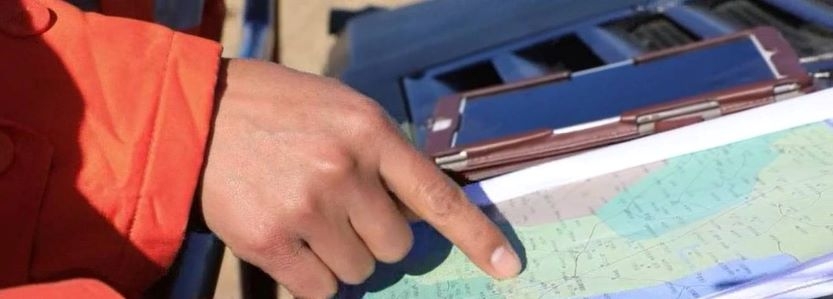
Credit: CCTV/Inside Outer Space screengrab
Map notes projected Chang’e-5 reentry capsule trajectory, produced by satellite tracker, Scott Tilley.
Credit: Scott Tilley
The Chang’e-5 mission involved four components, an orbiter, a lander, an ascender and a returner, and was launched on November 24. The lander-ascender combination touched down on the Moon on December 1.
Chang’e-5 is one of the most complicated and challenging missions undertaken in China’s growing space agenda. Given successful return of its stash of lunar collectibles, it will be the first robotic lunar sample return mission since 1976 – the former Soviet Union’s Luna-24. It collected 170 grams of dust and rock and returned them to Earth.
Go to this newly issued video showcasing the recovery operation at:

NASA’s Curiosity Mars rover is now performing Soll 2971 duties.
Here are some recent images from the Red Planet rover:
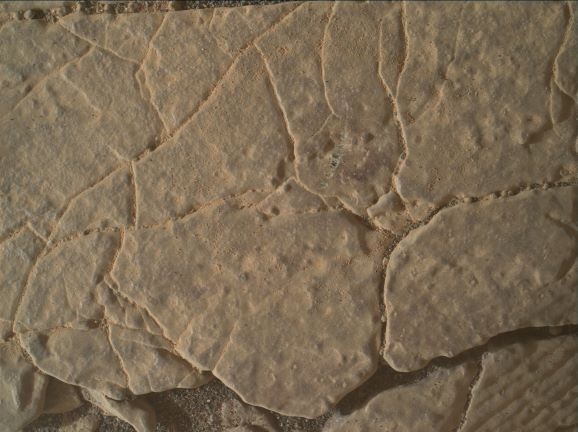
Curiosity Mars Hand Lens Imager photo produced on Sol 2970, December 14, 2020.
Credit: NASA/JPL-Caltech/MSSS
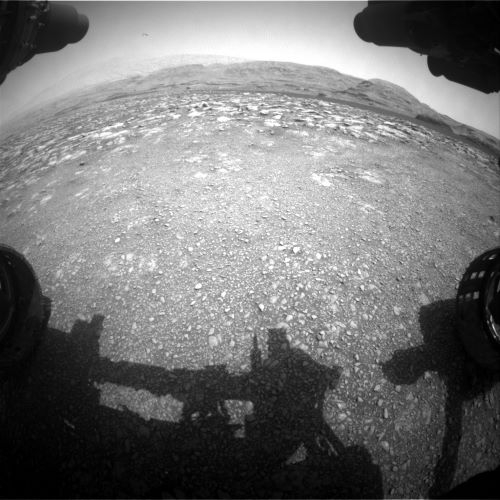
Curiosity Front Hazard Avoidance Camera Right B image taken on Sol 2970, December 13, 2020.
Credit: NASA/JPL-Caltech
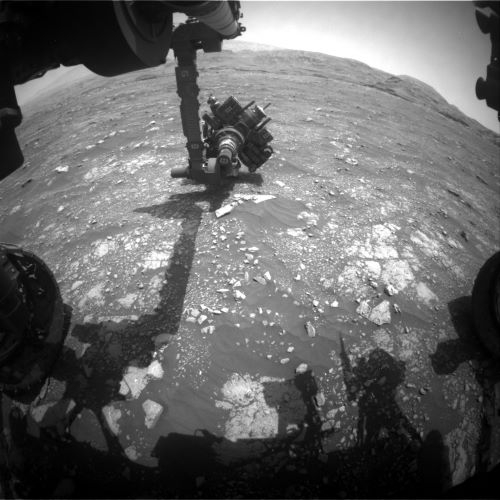
Curiosity Front Hazard Avoidance Camera Left B photo acquired on Sol 2970, December 13, 2020.
Credit: NASA/JPL-Caltech
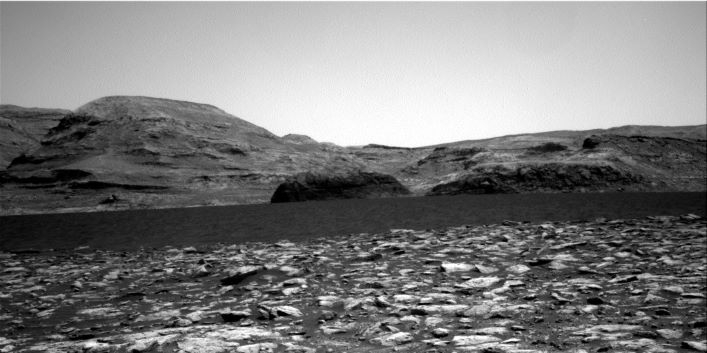
Sand dune ahead. Curiosity Right B Navigation Camera image taken on Sol 2970, December 13, 2020.
Credit: NASA/JPL-Caltech
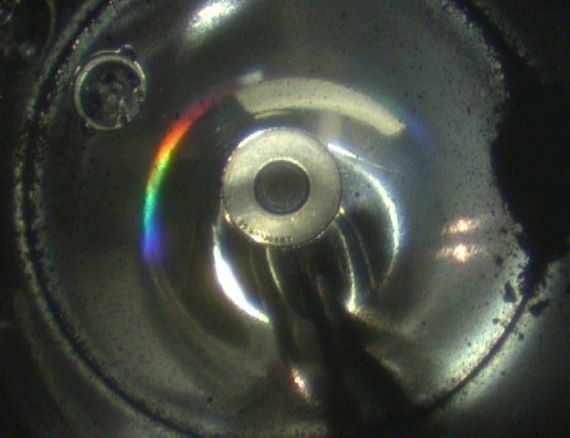
Credit: JAXA
The Japan Aerospace Exploration Agency (JAXA) has confirmed finding samples from asteroid Ryugu inside the re-entry capsule of the Hayabusa2 asteroid explorer.
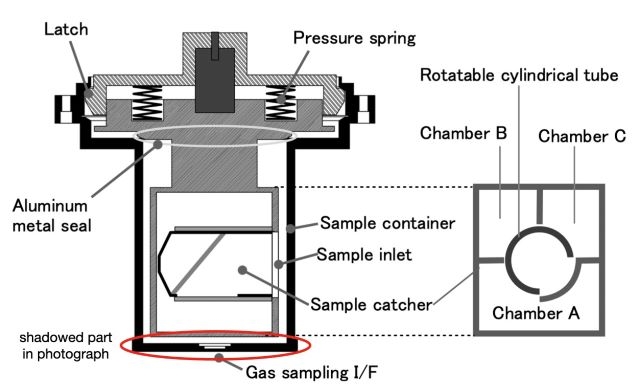
Credit: JAXA
The sample container was opened on December 14, with researchers finding black grains thought to be from Ryugu. This is outside the main chambers, and likely particles attached to the sample catcher entrance.
Hayabusa2’s re-entry capsule was collected in Woomera, Australia on December 6, then delivered to the JAXA Sagamihara Campus on December 8.

Re-entry capsule containing asteroid samples at Woomera, Australia landing site.
“We will continue to open the sample catcher in the sample container, and the curation and initial analysis team will take out the sample and analyze it,” a JAXA statement explains.
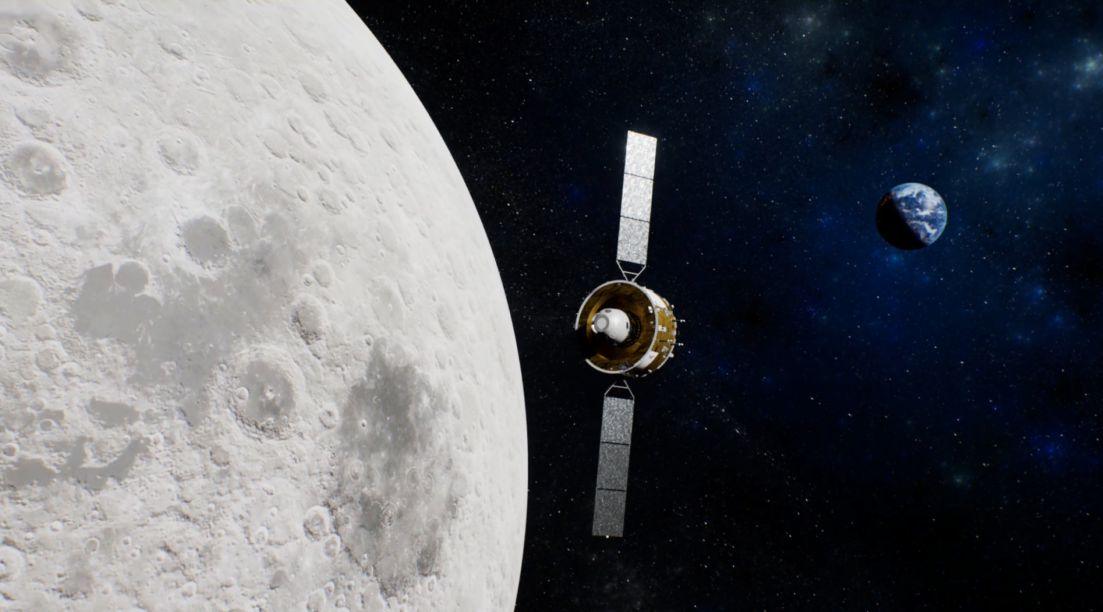
Hauling back the lunar goods, China’s orbiter/returner.
Credit: CNSA/CLEP
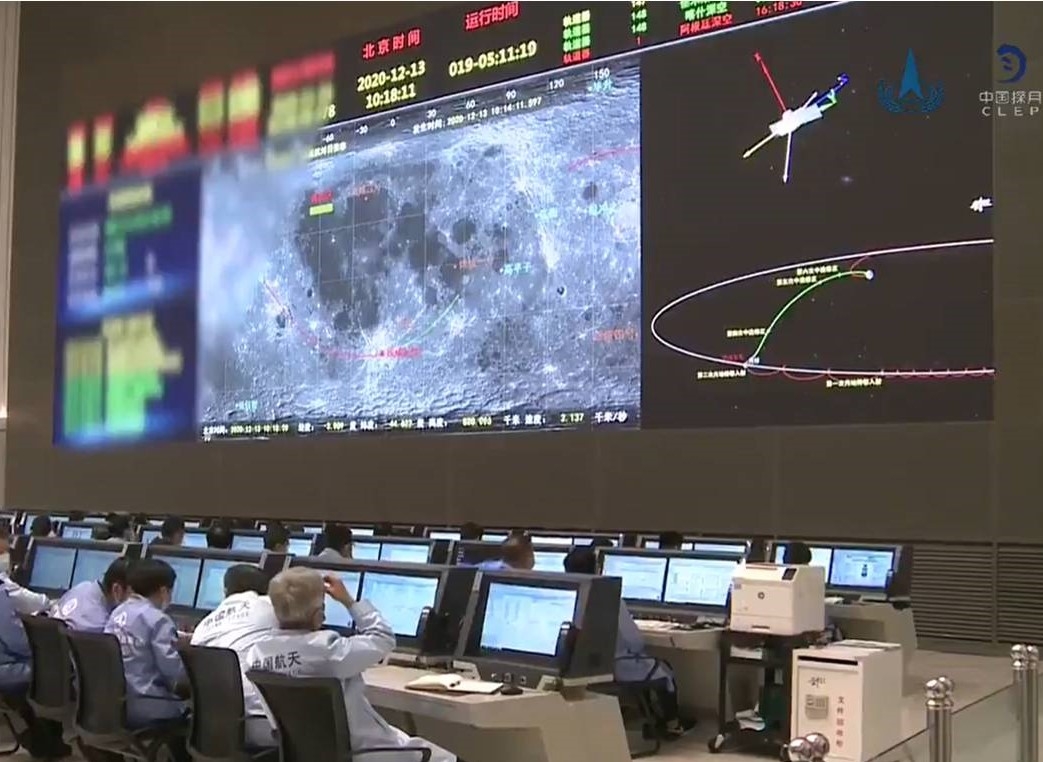
The orbiter/returner of China’s Chang’e-5 mission has attained a Moon-Earth transfer orbit, expected to land on Earth in Inner Mongolia on December 17th.
Credit: CNSA/CLEP
Loaded with lunar samples, the spacecraft conducted its second orbital maneuver at 09:51 on Sunday and entered the Moon/Earth transfer orbit, according to sources with the China National Space Administration (CNSA).
Four 150 newton-thrust engines on the orbiter/returner combination ignited when they were 143 miles (230 kilometers) away from the lunar surface and shut down after 22 minutes, CNSA said in a statement.
Re-entry capsule will perform slow-down maneuvers within Earth’s atmosphere.
Credit: CCTV/Inside Outer Space screengrab
According to real-time monitoring data, the orbiter/returner combination entered the targeted orbit successfully.
Later, the spacecraft combination will make three additional orbit corrections before landing on Earth. When the time is right, the orbiter and returner will separate from one another.
The reentry capsule will perform a series of slow-down maneuvers to return to a preset landing site within the Siziwang Banner in north China’s Inner Mongolia Autonomous Region. If the landing is successful, the lunar samples will be the first batch to be robotically brought to the Earth since 1976 by the former Soviet Union’s Luna-24.
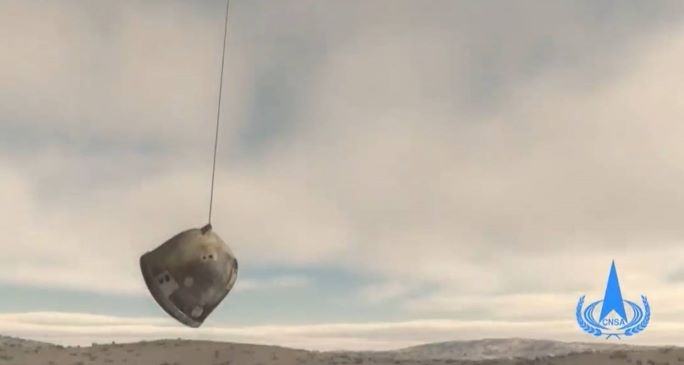
Return capsule expected to touch down within Siziwang Banner in north China’s Inner Mongolia Autonomous Region.
Credit: CCTV/CNSA/Inside Outer Space screengrab
Series of steps
Chang’e 5 has four main components: an orbiter, lander, ascender and reentry capsule.
The spacecraft was launched by a Long March 5 heavy-lift carrier rocket on November 24 at the Wenchang Space Launch Center in Hainan province.
Once in lunar orbit, the probe separated into two parts – the orbiter/reentry capsule combination and the lander/ascender combination on November 30.
Photo taking during surface sampling.
Credit: CCTV/Inside Outer Space screengrab
On December 1, the lander/ascender combination touched down on the Moon, with the duo scooping up and drilling to obtain underground samples from roughly 7 feet (2 meters) beneath the surface, an operation that ended on December 2. All collection and packing processes finished on the night of that day, much sooner than expected. Samples were packed into a vacuum container inside the ascender.

Ascender (left) departs orbiter/returner.
Credit: CCTV/Inside Outer Space screengrab
The ascender activated an engine on December 3 to lift itself into an elliptical lunar orbit to prepare for docking with the orbiter/returner vehicles. It rendezvoused and docked with the orbiter/returner on December 6 and then transferred lunar samples into the returner capsule.
The ascender then separated from the combination and was commanded to impact the Moon on December 8.
Go to these newly issued videos regarding the Chang’e-5 mission:
Heading home – Chang’e-5 orbiter/returner
Credit: CCTV/CNSA/Inside Outer Space screengrab
The China National Space Administration (CNSA) reports that the Chang’e-5 orbiter/returner spacecraft has carried out an orbital maneuver around the Moon, preparing to leave lunar orbit for a trajectory that returns it to Earth.
Following roughly six days in lunar orbit, the orbiter/returner combination completed the movement on Saturday, the first trans-Earth injection maneuver, at 09:54 (Beijing Time), changing from a nearly circular orbit to an elliptical orbit with a perilune (low point) altitude of 124 miles (200 kilometers).
Escape trajectory
Next up for the orbiter/returner combination is another orbital maneuver to escape lunar gravity and enter the Moon-Earth transfer orbit to return to Earth.

China’s Chang’e-5 lunar mission will attempt to haul back to Earth samples of the Moon.
Credit: CNSA/CLEP
The Chang’e-5 mission consists of an orbiter, a lander, an ascender and a returner. It was launched on November 24. Its lander/ascender combination touched down north of Mons Rümker in Oceanus Procellarum, also known as the Ocean of Storms, on the near side of the Moon on December 1st.
Return capsule expected to touch down within Siziwang Banner in north China’s Inner Mongolia Autonomous Region in mid-December.
Credit: CCTV/CNSA/Inside Outer Space screengrab
Stashed within a return capsule – roughly 4.4 pounds (2 kilograms) of precious lunar samples. The capsule is expected to land at the Siziwang Banner in north China’s Inner Mongolia Autonomous Region in mid-December.

Curiosity Left B Navigation Camera image taken on Sol 2967, December 10, 2020.
Credit: NASA/JPL-Caltech
NASA’s Curiosity Mars rover is now performing Sol 2968 tasks.
“Curiosity is making her way to ‘Sands of Forvie,’ the large sand field we’ve been seeing in the orbital images,” reports Ashley Stroupe, a mission operations engineer at NASA’s Jet Propulsion Laboratory.
Rover planners are trying to drive as far as possible and expect to reach the “rubbly unit” that is on the way to Sands of Forvie.
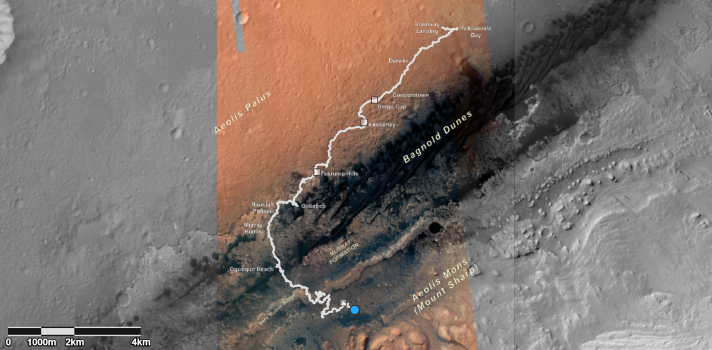
Curiosity’s location on Sol 2965. Distance driven 14.73 miles (23.70 kilometers). Credit: NASA/JPL-Caltech/Univ. of Arizona
“The drive is extending beyond where we can see by making use of guarded driving, allowing the rover to look for hazards and stop if conditions are unsafe.,” Stroupe adds.
The total distance is about 213 feet (65 meters).
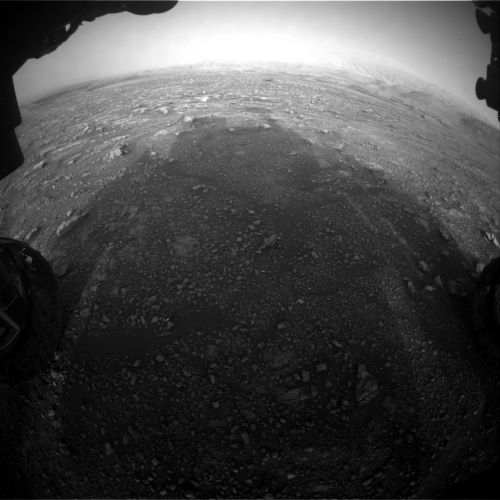
Image taken by Front Hazard Avoidance Camera on December 8, 2020 on Sol 2965. Prior to hitting the road, Curiosity will collect data on a large clast – a fragment of rock, “Dun Eideann,” that is in an otherwise rubbly workspace.
Credit: NASA/JPL-Caltech
Potential meteorites
Prior to hitting the road, Curiosity will collect Mars Hand Lens Imager (MAHLI) and Alpha Particle X-Ray Spectrometer (APXS) data on a large clast – a fragment of rock, “Dun Eideann,” that is in an otherwise rubbly workspace.
“This is part of our regular tracking of compositional changes and will help us characterize the clasts in this area,” Stroupe explains. Also on tap is taking Mastcam multispectral images of “Island Davaar,” and collecting both Mastcam multispectral and Chemistry and Camera (ChemCam) passive spectral data of targets “Obar Dheathaian,” and “Eilean.”

Curiosity Chemistry & Camera Remote Micro-Imager (RMI) photo acquired on Sol 2967, December 10, 2020.
Credit: NASA/JPL-Caltech/LANL
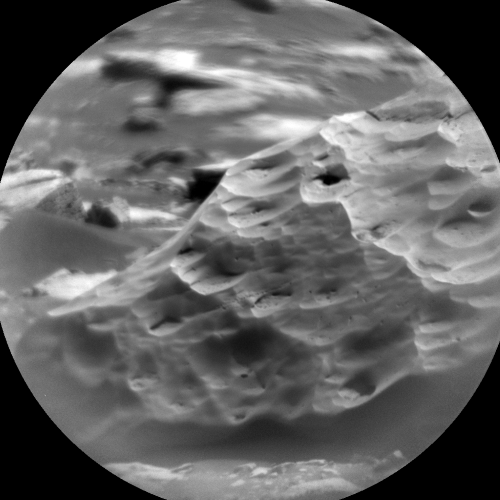
Curiosity Chemistry & Camera Remote Micro-Imager (RMI) photo acquired on Sol 2967, December 10, 2020.
Credit: NASA/JPL-Caltech/LANL
“All three targets are some nearby interesting-looking rocks that potentially could be meteorites,” Stroupe adds.
Distant rocks
On the schedule is taking observations of Shillhope Law with Mastcam and ChemCam Laser Induced Breakdown Spectroscopy (LIBS).
Also Mastcam is slated to take stereo images of the pediment, to get a better sense of its morphology, and distant rocks in areas named “Nairnsire” and “Peerie Minn.”
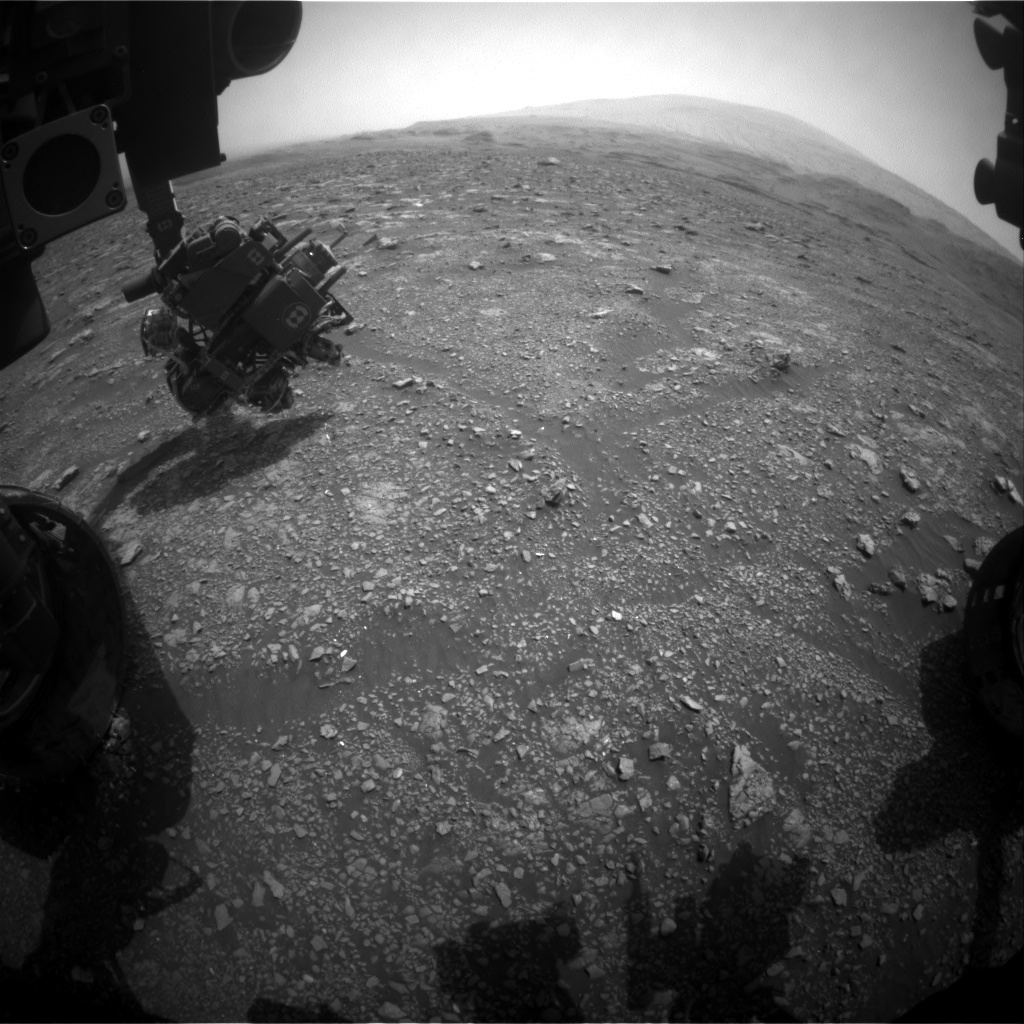
Curiosity Front Hazard Avoidance Camera Left B image taken on Sol 2967, December 10, 2020.
Credit: NASA/JPL-Caltech
“After the drive, on the second sol of the plan, [Sols 2967-2968] we’re doing a lot of untargeted science. We have a lot of environmental observations, predominantly looking for dust devils, and an atmospheric argon measurement by APXS. In addition, we’re letting Curiosity choose her own targets using AEGIS [Autonomous Exploration for Gathering Increased Science]– it is always interesting to see what she finds!”
As always, dates of planned rover activities described in these reports are subject to change due to a variety of factors related to the Martian environment, communication relays and rover status.
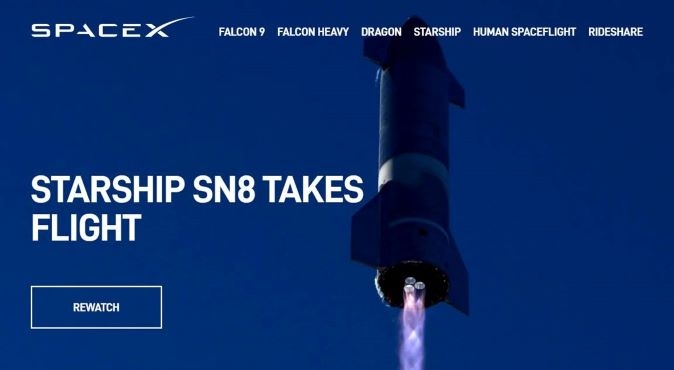
Credit: SpaceX
“Mars, here we come!!”
That’s from SpaceX chief rocketeer, Elon Musk, given the December 9 flight of Starship serial number 8 (SN8) that lifted off from the company’s Cameron County launch pad in South Texas.
SN8 successfully ascended, transitioned propellant, and performed its landing flip maneuver with precise flap control to reach its landing point – but also experienced what’s called a “rapid unscheduled disassembly,” RUD for short.
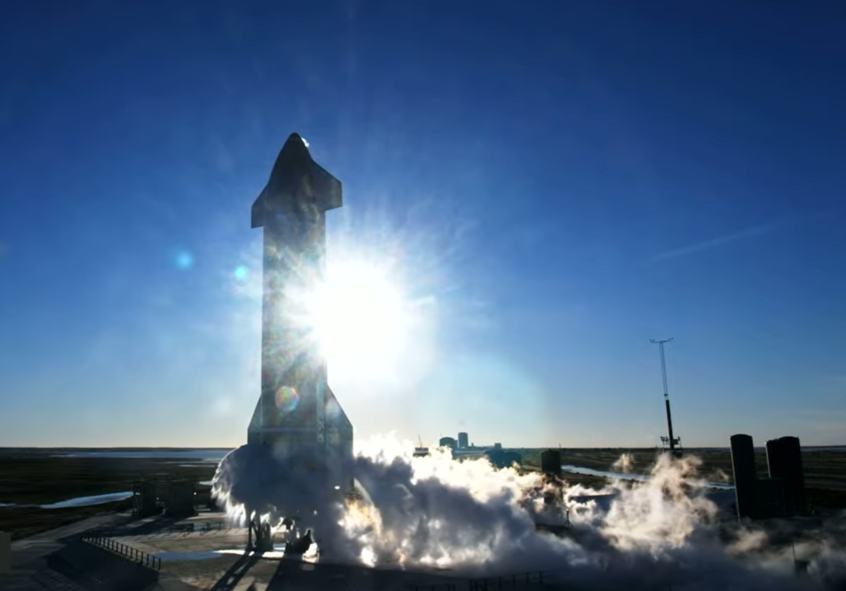
Credit: SpaceX/Inside Outer Space screengrab
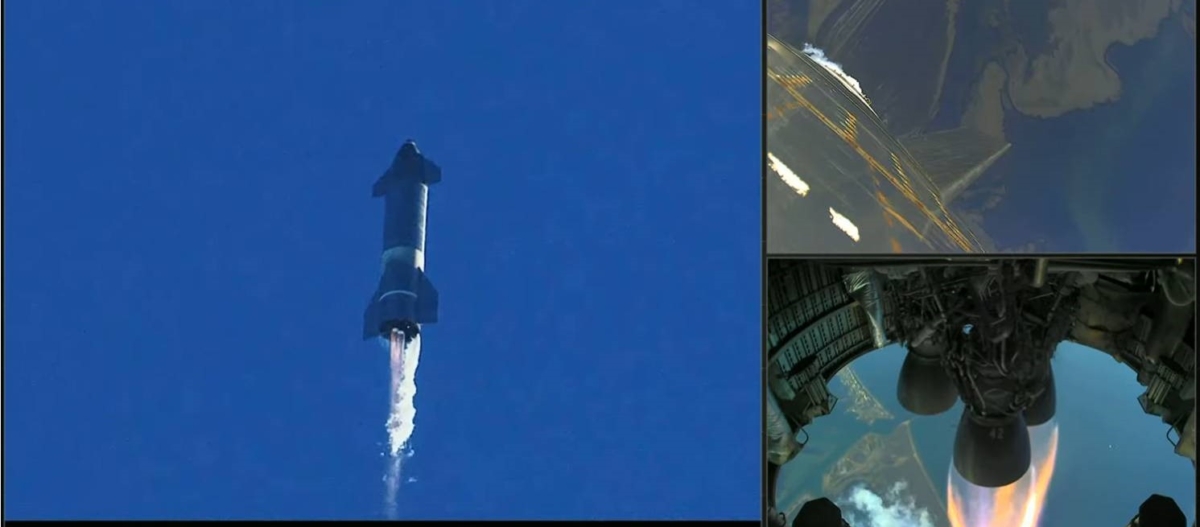
Credit: SpaceX/Inside Outer Space screengrab
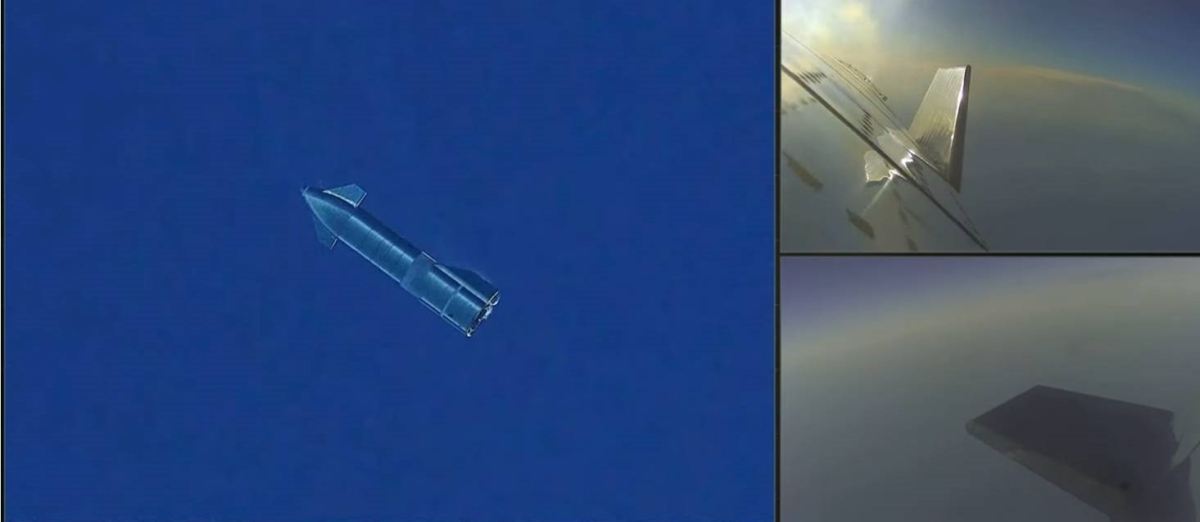
Credit: SpaceX/Inside Outer Space screengrab
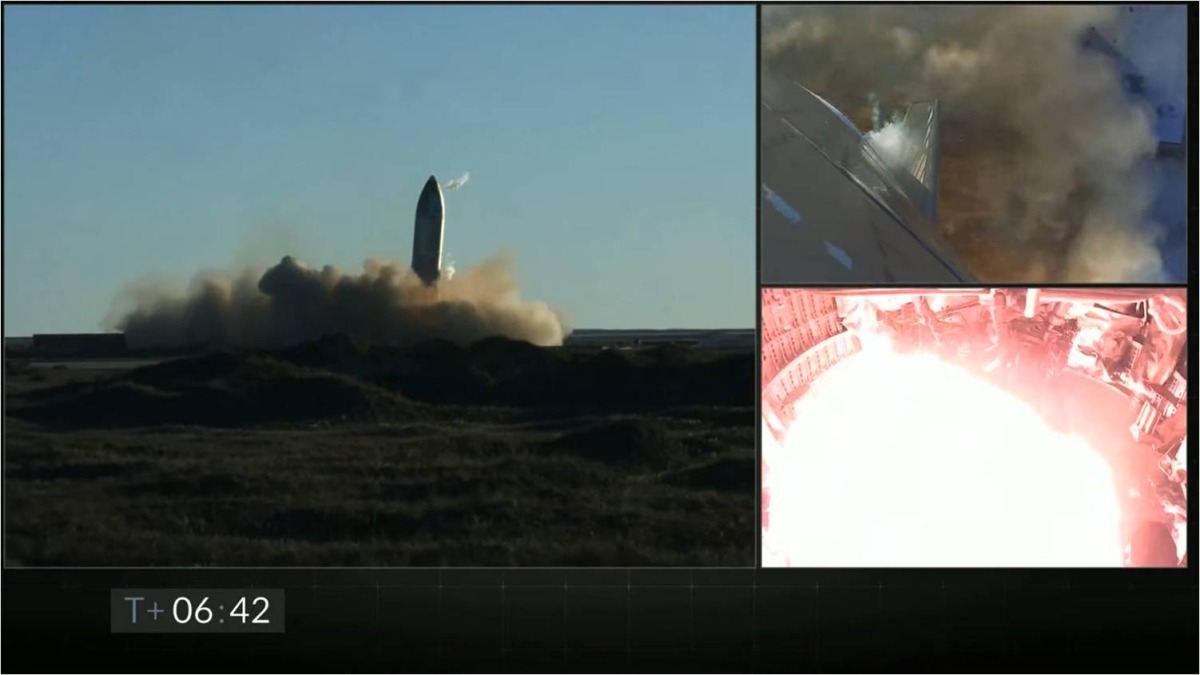
Credit: SpaceX/Inside Outer Space screengrab
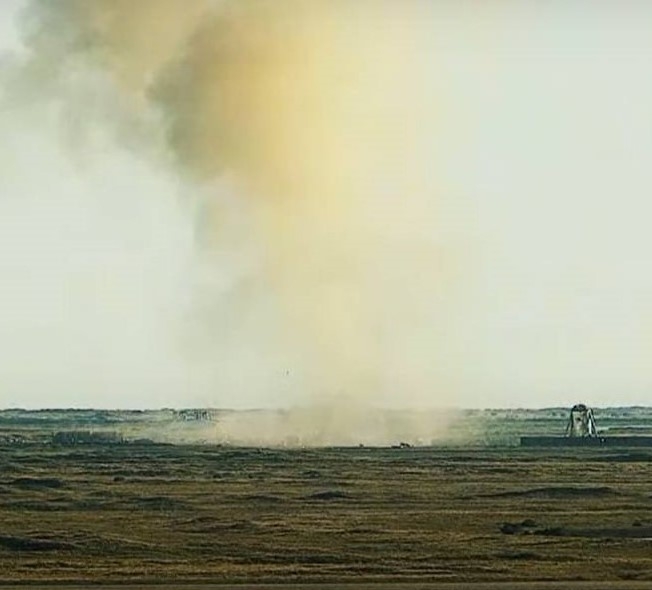
Credit: SpaceX/Inside Outer Space screengrab
Low pressure in the fuel header tank during the landing burn led to high touchdown velocity resulting in a hard, destructive landing.
Serial number 9 (SN9) is up next, a SpaceX posting explains.
Crater in the right spot
Back a few days ago, pre-launch, a Musk twitter said that “probably 1/3 chance of completing all mission objectives.”
In post-flight tweets, Musk said that the engines and the SN8 high altitude flight test did great. “Even reaching apogee would’ve been great, so controlling all way to putting the crater in the right spot was epic!!”
Musk also later tweeted: “Fuel header tank pressure was low during landing burn, causing touchdown velocity to be high & RUD, but we got all the data we needed! Congrats SpaceX team hell yeah!!”
Re-watch yesterday’s test flight here at: https://www.spacex.com/

