Archive for the ‘Space News’ Category
 Author:
  February 5th, 2021
U.S. Air Force Col. Nick Hague completed his first spacewalk, March 22, 2019.
Credit: NASA
A new report suggests that because the US military edge over prospective opponents is eroding, the United States now needs every advantage it can get. Inflicting surprise on our adversaries is one tool for regaining strategic advantage.
Mark Cancian, Senior Advisor to the Center for Strategic and International Studies (CSIS) International Security Program, explains how the United States has used surprise in warfare in the past and how best to do it again in the future.
The new report, Inflicting Surprise: Gaining Competitive Advantage in Great Power Conflicts, highlights several components of a successful surprise, including exploiting adversary vulnerabilities, using intelligence and technology, employing secrecy and deception, and doing the unexpected. The report also contains over a dozen vignettes illustrating potential future surprises.

Anti-satellite painting by William K. Hartmann
Domain of outer space
Regarding the domain of outer space, Cancian notes that a CSIS’s Aerospace Security Project identified four types of weapons that states or even some non-state actors can use to disrupt satellite networks:
— kinetic counter space
— non-kinetic counter space,
— electronic weapons, and
— cyber weapons
The authors of that earlier CSIS report —Harrison, Johnson, and Robinson—also identify how each great power competitor has made advancements in their offensive space capability. The Chinese, for example, have continued to develop anti-satellite weapons since the 2000s. Russia is also making a concerted effort to develop and test new anti-satellite technologies.
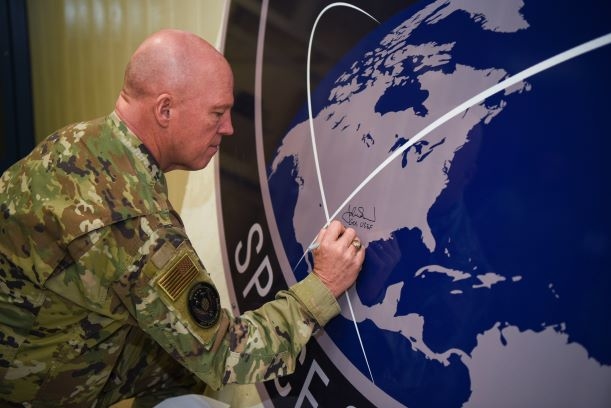
General John Raymond, U.S. Space Force chief of space operations.
Credit: U.S. Air Force photo by Senior Airman Melody Howley
Use space creatively
“In December of 2019, the United States formally established the U.S. Space Force (USSF) as the sixth branch of the armed forces,” Cancian points out. The USSF joined USSPACECOM to enhance U.S. capabilities in space. As Chairman of the Joint Chiefs of Staff, General Mark A. Milley acknowledged: “our adversaries are building and deploying capabilities that threaten us, so we can no longer take space for granted.”
“As with the cyber domain, space has few legal restrictions,” Cancian adds, underscoring a CSIS report noting that “few international norms exist.”
“The major treaty forbids operating nuclear weapons in space but not much else,” Cancian says. “As a result, there is broad scope for operations of all kinds. Space Command is working on ways to use space creatively. Surprise is one operational concept that might fit.”
To read Inflicting Surprise: Gaining Competitive Advantage in Great Power Conflicts, go to:
Also, go to this video at:
 Posted in

Credit: MBRSC/UAE Space Agency
The United Arab Emirates Hope Mars spacecraft is nearing its orbit insertion around the Red Planet on February 9. It is the first arrival of a trio of Mars bound spacecraft; the other two are from China and the NASA Perseverance rover mission.
The mission of the UAE’s Hope orbiter is to build the first full picture of Mars’ climate throughout the Martian year and will include the study of the Martian atmosphere, the relationship between the upper layer and lower layer.
As a result, for the first time, scientists based in over 200 universities globally will have access to a holistic view of the Martian atmosphere at different times of the day, through different seasons.

China’s three-in-one mission: An orbiter, lander, and rover.
Credit: Wan, W.X., Wang, C., Li, C.L. et al.
Tianwen-1
Meanwhile, China’s Tianwen-1 robotic probe is also set to enter Mars orbit around February 10. The China National Space Administration (CNSA) previously said that if everything goes according to schedule, the 5-metric ton probe, consisting of an orbiter, lander, and rover, will conduct a “braking” operation to decelerate its speed and begin its orbiting of the Red Planet.
The mission’s ultimate goal is to soft-land on Mars, and deploy a rover in May 2021 on the southern part of Mars’ Utopia Planitia — a large plain within Utopia.

NASA’s next Mars explorer, the Perseverance rover.
Credit: NASA/JPL-Caltech
Perseverance rover
NASA’s Perseverance Mars rover is the biggest, heaviest, cleanest, and most sophisticated six-wheeled robotic geologist ever launched into space. It is on track for a February 18, direct descent touchdown within Jezero Crater.
The multi-tasked mission has as a major goal searching for signs of ancient life and collect samples that will eventually be returned to Earth.
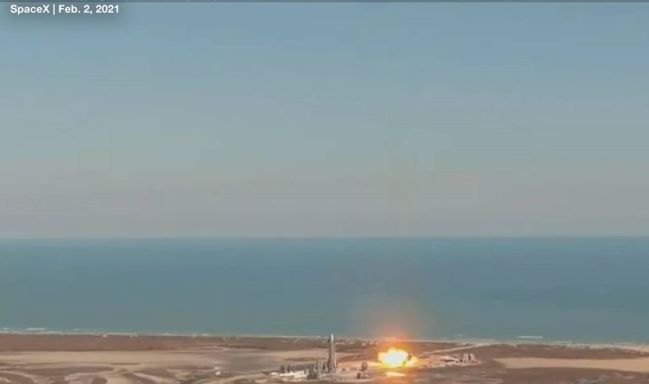
Think of it as methods of reaching extreme altitudes…and attitudes.
The SpaceX Starship prototype departed the company’s Boca Chica facility near Brownsville, Texas on February 2. After carrying out a ballistic ballet of maneuvers, the Serial Number 9 (SN9) rocket crashed into the ground and exploded after roughly six minutes and 26 seconds of flight.
Neighborhood racket

Chalk talk in 1924: Robert Goddard at Clark University in Worcester, Massachusetts.
Credit: NASA
Recall the plight of rocketeer Robert Goddard. He published in 1919 his classic treatise, A Method of Reaching Extreme Altitudes.
A decade later, on July 17, 1929, Goddard launched an 11-foot, 35-pound rocket with reporters at the scene.
Reaching an apogee of 80 feet, the rocket crash landed 171 feet away, its gasoline tank exploding when it hit. The resulting racket was heard two miles away with police summoned to the scene. Goddard considered the test a success, but not the newspapers.
A local Worcester, Massachusetts newspaper anointed the story with the headline: “Moon Rocket Misses Target by 238,799 1/2 Miles!”
Such is progress.
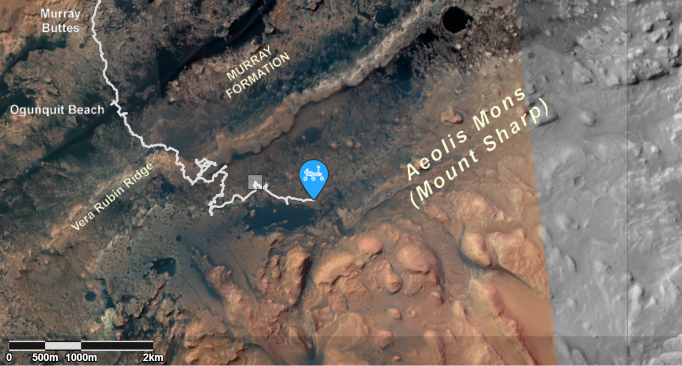
Curiosity’s Location as of Sol 3018 since landing in Gale Crater on Aug. 5, 2012. Distance Driven 15.13 miles (24.35 kilometers).
Credit: NASA/JPL-Caltech/Univ. of Arizona
NASA’s Curiosity Mars rover is just closing out Sol 3020 operations.
Ashley Stroupe, Mission Operations Engineer at NASA’s Jet Propulsion Laboratory, reports the robot is transitioning out of the fractured intermediate unit into a fractured rubbly unit, with rover drivers hoping to minimize wheel wear.
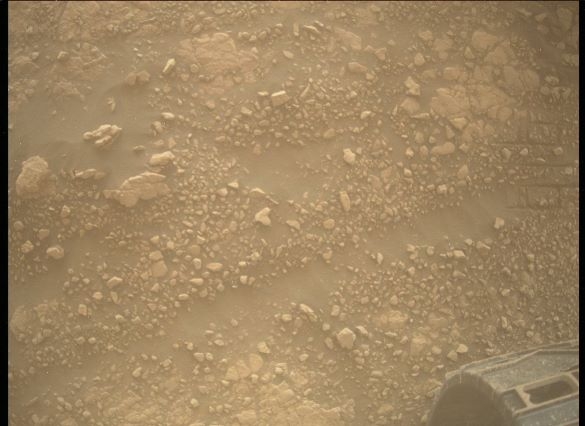
Curiosity Mars Descent Imager (MARDI) image taken on Sol 3018, February 1, 2021.
Credit: NASA/JPL-Caltech/MSSS
A recent Curiosity touch-and-go was carried out, with the science team busily analyzing the results of the triboelectric experiment that Curiosity did over the weekend – a look for the spark of static electricity on Mars.
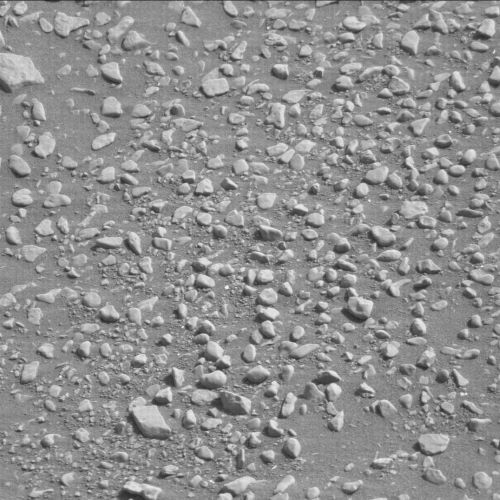
Curiosity Mast Camera Right photo acquired on Sol 3018, February 1, 2021.
Credit: NASA/JPL-Caltech/MSSS
Bedrock composition
A new plan calls for contact science with the Mars Hand Lens Imager (MAHLI) and Alpha Particle X-Ray Spectrometer on a bedrock target named “Lunas,” as part of the regular tracking of bedrock composition and changes.

Curiosity Front Hazard Avoidance Camera Right B image taken on Sol 3019, February 2, 2021.
Credit: NASA/JPL-Caltech
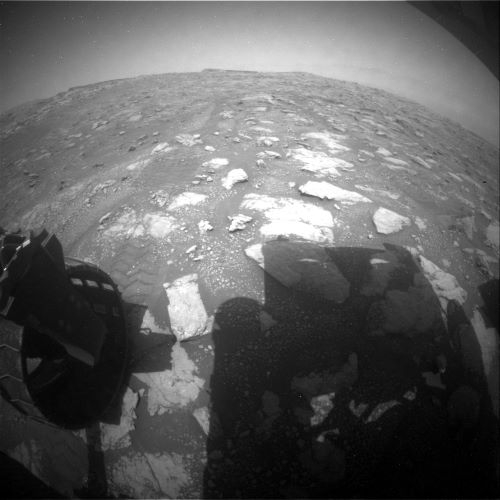
Curiosity Rear Hazard Avoidance Camera Right B photo acquired on Sol 3019, February 2, 2021.
Credit: NASA/JPL-Caltech
“The target was a little tough to pick in order to avoid some discolored areas and the veins and try to get a good representation of the bedrock itself,” Stroupe adds.
After the robot’s arm is stowed, the plan is for the rover to take several targeted science observations, including a Chemistry and Camera (ChemCam) Remote Micro-Imager (RMI) mosaic of the sulfate unit and a large Mastcam mosaic of the contact with the sulfate unit.
Minimize wheel wear
“We are also doing some environment observations,” Stroupe says, “including a crater rim extinction and a long dust devil movie.”
The rover’s drive in the plan is aimed at parking just before it transitions out of the fractured intermediate unit (and before entering the fractured rubbly unit).
“Once we get back into the rubbly unit,” Stroupe points out, “the driving will get a little bit tougher for the Rover Planners, because there are a lot more small and medium sized rocks that we’ll need to avoid to minimize wheel wear.”
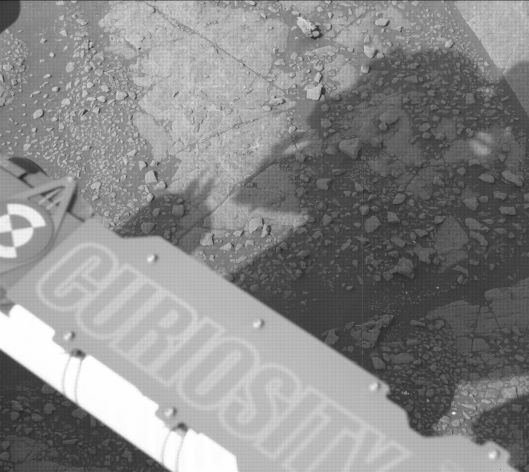
Curiosity Mast Camera Left image taken on Sol 3018, February 1, 2021.
Credit: NASA/JPL-Caltech/MSSS
Short drive
A short drive of about 82 feet (25 meters) of the rover puts the Mars machinery in terrain that is flat and clear of major hazards. “The plan is to park where we can do one last contact science observation of this unit before leaving it behind,” Stroupe adds.
“We are taking advantage of the short distance of the drive and the arm will be unstowed at the parking location. We’ll be taking extra workspace and drive direction imaging at this location as our last look at the unit,” Stroupe reports.
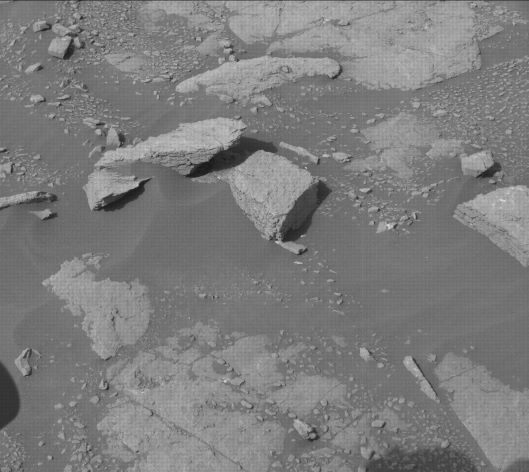
Curiosity Mast Camera Right photo acquired on Sol 3018, February 1, 2021.
Credit: NASA/JPL-Caltech/MSSS
Environmental observations
On the second sol of the plan, Sol 3021, the robot will carry out more of the standard environmental observations, including another dust devil movie and a suprahorizon movie with navcam in the morning, and a long Mastcam sky survey and solar tau in the afternoon.
“We’re also throwing in a late-afternoon Navcam optics monitoring activity to help us track the dust on the cameras,” Stroupe concludes.
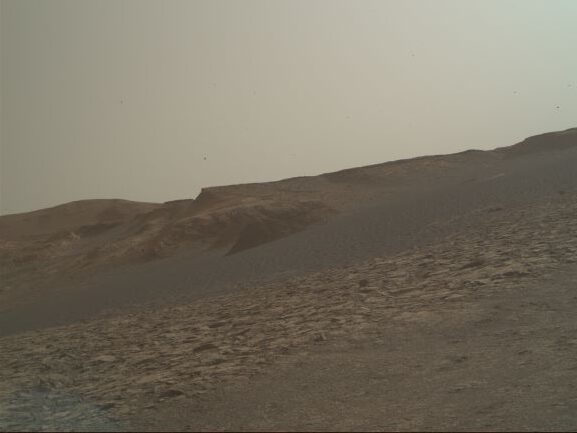
Mars Hand Lens Imager photo produced on Sol 3017, January 31, 2021.
Credit: NASA/JPL-Caltech/MSSS
NASA’s Curiosity Mars rover is now performing Sol 3019 tasks.
Curiosity was slated to attempt a novel experiment to witness the “triboelectric effect” for the first time on Mars, reports Melissa Rice, Planetary Geologist at Western Washington University in Bellingham, Washington.
What’s the triboelectric effect?

Curiosity Right B Navigation Camera image taken on Sol 3018, February 1, 2021.
Credit: NASA/JPL-Caltech
“Certain materials build up an electrostatic charge when they move around, and when that buildup of electricity discharges, it can cause a spark,” Rice explains. “You may know the triboelectric effect as the static cling – and occasional shocks – from clean clothes fresh out of the dryer.”

Curiosity Right B Navigation Camera image taken on Sol 3018, February 1, 2021.
Credit: NASA/JPL-Caltech
Spark above the sands
On Mars, no clothes are tumbling in dryers, Rice adds, “but sand grains are tumbling in the wind, and they could build up a triboelectic charge. When that electricity discharges, it could ionize gases near the surface, which could influence Mars’ atmospheric chemistry,” Rice notes. “If the discharges occur at night, it may be possible to see a spark above the sands. In the likely event we don’t see any flashes of light, we’ll still be able to place constraints on how much this process occurs at Gale.”
The team scoped out a series of Mars Hand Lens Imager (MAHLI) images to be taken at night, staring at the large sand deposit to the south (which Curiosity had recently investigated at the “Sands of Forvie” location.
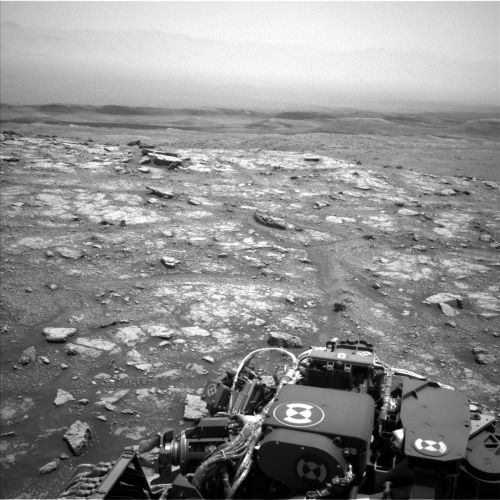
Curiosity Left B Navigation Camera image acquired on Sol 3018, February 1, 2021.
Credit: NASA/JPL-Caltech
“We can’t be certain if the triboelectic effect will be visible to MAHLI,” Rice continues, “but the possibility of capturing it has certainly sparked our curiosity!”
Long drive
In addition to the triboelectric experiment, Rice says the science team also plans to use the Alpha Particle X-Ray Spectrometer (APXS) and MAHLI to study the bedrock target “Neuvic,” Mastcam to take multispectral images of “Neuvic” and the adjacent bedrock target “Vezere,” in addition to panoramic images of the landscape, and Navcam to take movies to search for dust devils.
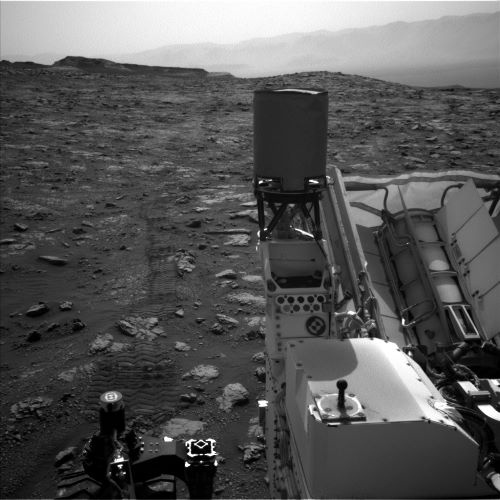
Curiosity Left B Navigation Camera image acquired on Sol 3018, February 1, 2021.
Credit: NASA/JPL-Caltech

Curiosity Left B Navigation Camera image acquired on Sol 3018, February 1, 2021.
Credit: NASA/JPL-Caltech

Curiosity Front Hazard Avoidance Camera Left B image taken on Sol 3018, January 31, 2021.
Credit: NASA/JPL-Caltech
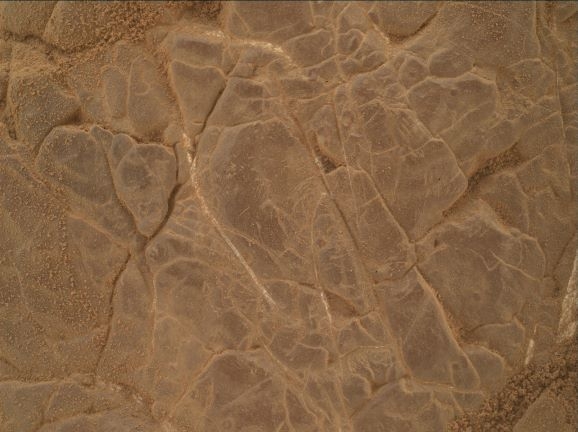
Curiosity Mars Hand Lens Imager photo produced on Sol 3018, February 1, 2021.
Credit: NASA/JPL-Caltech/MSSS
For sol 3018, the team scripted a long drive for Curiosity to the east, making steady progress towards the sulfate-bearing strata of Mt. Sharp, Rice concludes.

Credit: The Agenda with Stephen Cole/Inside Outer Space screengrab
I was delighted to be on The Agenda with Stephen Cole at the China Global Television Network (CGTN).
From CGTN:
“While the plans during the original space race were all about getting boots on the Moon, the new rush to space has tended to feature bigger and more long-term ambitions – like genuine international cooperation and creating a gateway to the next frontier: Mars.”
Mystery available
“However, that’s not to say that our closest space neighbor should be forgotten. ‘The Moon is not a ‘Been there, done that’ place,’ says veteran space journalist Leonard David, “there’s still a lot of mystery available for discovery and the Moon is still revealing itself to us.'”
‘Not that David is limiting our horizons, as he explained to The Agenda with Stephen Cole. He has high hopes for an international mission towards Mars, a planet we could one day call home. “It’s an incredible human drama,” he says.
“The Moon: Why go back?” can be viewed here:
https://newseu.cgtn.com/news/2021-01-31/The-Moon-Why-go-back–Xs5dLvikzS/index.html

Credit: SpaceX
Update: As early as Tuesday, February 2, the SpaceX team will attempt a high-altitude flight test of Starship serial number 9 (SN9) – the second high-altitude suborbital flight test of a Starship prototype from their site in Cameron County, Texas.
According to a new posting from Starship Stalker: “Launch Today – FAA approval, evacuation notice, road closure,” and a Temporary Flight Restriction (TFR) is in place.

SN10 joins SN9 at Texas launch complex.
Credit: SpaceX
This test flight has been delayed by the FAA, with that agency noting that Elon Musk’s SpaceX violated its launch license in an earlier, explosive Starship test, triggering an FAA probe and extra scrutiny.
Flight overview
Meanwhile, SpaceX has issued this overview of the upcoming flight:

SN8 flight.
Credit: SpaceX
“Similar to the high-altitude flight test of Starship serial number 8 (SN8), SN9 will be powered through ascent by three Raptor engines, each shutting down in sequence prior to the vehicle reaching apogee – approximately [6 miles]10 kilometers in altitude.”
“SN9 will perform a propellant transition to the internal header tanks, which hold landing propellant, before reorienting itself for reentry and a controlled aerodynamic descent.”
Aerodynamic control
“The Starship prototype will descend under active aerodynamic control, accomplished by independent movement of two forward and two aft flaps on the vehicle. All four flaps are actuated by an onboard flight computer to control Starship’s attitude during flight and enable precise landing at the intended location. SN9’s Raptor engines will then reignite as the vehicle attempts a landing flip maneuver immediately before touching down on the landing pad adjacent to the launch mount.”

SN8 flight.
Credit: SpaceX
“A controlled aerodynamic descent with body flaps and vertical landing capability, combined with in-space refilling, are critical to landing Starship at destinations across the solar system where prepared surfaces or runways do not exist, and returning to Earth. This capability will enable a fully reusable transportation system designed to carry both crew and cargo on long-duration, interplanetary flights and help humanity return to the Moon, and travel to Mars and beyond.”
Live feed
There will be a SpaceX live feed of the flight test available that will start a few minutes prior to liftoff.
Given the dynamic schedule of development testing, stay tuned to SpaceX and other social media channels for updates as the rocket team moves toward SpaceX’s second high-altitude flight test of Starship.
Go to:
https://www.spacex.com/vehicles/starship/
To watch the Starship Stalker live video of launch preparations, go to:
https://www.starshipstalker.com/live
Also, go to this informative article from The Verge, written by Joey Roulette, detailing the FAA issues that SpaceX encountered:

Examples of each type of anomalous RSL studied: fading, recurrence, incremental lengthening.
Credit: Lark, Huber, Head
On Mars, it looks like there’s a cascading truism about Recurring Slope Lineae – what’s spurring these odd features continue to be a recurring controversy.
Recurring Slope Lineae, RSL for short speak, grow incrementally, fade when inactive and return annually. To be classified as RSL, many streaks in the same site must be observed to incrementally lengthen downslope, fade away, and happen again, roughly in the same location.
There are those that see RSL as granular flows, a product of sand and dust movement. On the other hand, some scientists suggest, the appearance and growth of RSL resemble seeping liquid water.
If water, that has implications for habitability of the Red Planet. RSL may be the result of water or brine seeping through the sub-surface over an impermeable layer; the surface darkens where liquid wicks up.

Examples of collinear RSL, both in Valles Marineris.
Credit: Lark, Huber, Head
Orbital imagery
A new look at RSLs has been led by Laura Lark, a research scientist at Brown University in Providence, Rhode Island. Lark, along with advisors and co-authors, Christian Huber and Jim Head of Brown, authored the paper – “Anomalous recurring slope lineae on Mars: Implications for formation mechanisms” – published in the journal Icarus.
Three types of anomalous RSL, categorized into three types — early faders, collinear RSL, and those which emerge at featureless locations – were investigated using imagery from the powerful High Resolution Imaging Science Experiment (HiRISE) onboard NASA’s Mars Reconnaissance Orbiter. This spacecraft cranks out the only available images that can resolve features as narrow as RSL.
“The role of water in the processes responsible for their formation remains undetermined,” they write. “RSL in close proximity (meters to tens of meters apart) are likely to be expressions of the same underlying processes; therefore, differences in behavior between neighbors can provide new constraints on potential mechanisms for initiation, lengthening and fading.”
The researchers evaluated the feasibility of two specific proposed mechanisms: dry granular flow and flow of liquid through porous regolith.

On extended duty: NASA Mars Reconnaissance Orbiter yields unmatched views of layered materials, gullies, channels, and other science targets and also characterizing possible future landing sites for robotic and human missions.
Credit: NASA
Bottom line: “Our observations are more immediately compatible with the liquid flow mechanism,” they conclude.
What next?
“I don’t believe that any currently proposed dry mechanisms can produce the behavior we report in the paper, seeping liquid could, Lark told Inside Outer Space. “However, this doesn’t rule out a not-yet-imagined dry mechanism and there are other arguments against the existence of liquid seeps,” she added.
As far as what’s next, “that’s the real challenge,” Lark responded.
“In some sense, as long as the formation mechanism of RSL is inconclusive, orbital data is our only option,” Lark said.
Indeed, if RSL might indicate liquid water, “we can’t risk contaminating them with surface-based exploration,” Lark added. “We need to keep thinking about the possible underlying physical process: when do two candidate processes predict different outcomes, and how do those predictions compare to what we observe?”
Lark said that, since a lot of these predictions are time-related, the repeated targeting of RSL sites by the NASA Mars Reconnaissance Orbiter’s HiRISE camera system has been very helpful, “but at some point we’re limited by the orbit of the Mars Reconnaissance Orbiter and by the number of images HiRISE can send back to Earth.”
To access this informative paper — “Anomalous recurring slope lineae on Mars: Implications for formation mechanisms” – go to:
https://www.sciencedirect.com/science/article/pii/S0019103520304711?via%3Dihub
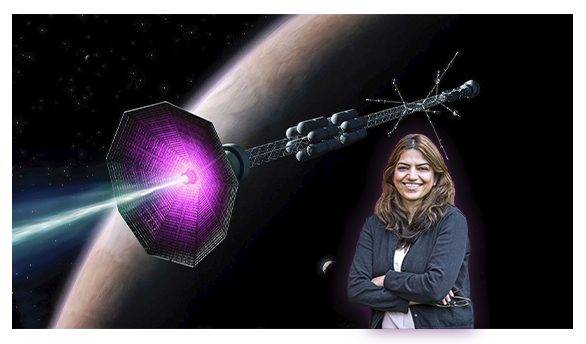
Physicist Fatima Ebrahimi in front of an artist’s conception of a fusion rocket.
Credit: Elle Starkman, PPPL Office of Communications, and ITER
The prospect of propelling humans at greater speeds to Mars and beyond is an upshot from a new concept for a rocket thruster, one that exploits the mechanism behind solar flares.
This new notion would accelerate the particles using “magnetic reconnection,” a process found throughout the universe, including the surface of the sun. It’s when magnetic field lines converge, suddenly separate, and then join together again, producing lots of energy. Reconnection also occurs inside doughnut-shaped fusion devices known as tokamaks.
Long-distance travel
“I’ve been cooking this concept for a while,” said physicist Fatima Ebrahimi, the concept’s inventor at the U.S. Department of Energy’s (DOE) Princeton Plasma Physics Laboratory (PPPL).

The Red Planet as seen by Europe’s Mars Express.
Credit: ESA/D. O’Donnell – CC BY-SA IGO
That faster velocity at the beginning of a spacecraft’s journey could bring the outer planets within reach of astronauts, Ebrahimi said in a PPPL statement.
“Long-distance travel takes months or years because the specific impulse of chemical rocket engines is very low, so the craft takes a while to get up to speed,” Ebrahimi said. “But if we make thrusters based on magnetic reconnection, then we could conceivably complete long-distance missions in a shorter period of time.”
Turn a knob…fine-tune velocity
According to Ebrahimi, there are three main differences between her thruster concept and other devices.
The first is that changing the strength of the magnetic fields can increase or decrease the amount of thrust. “By using more electromagnets and more magnetic fields, you can in effect turn a knob to fine-tune the velocity,” Ebrahimi said.
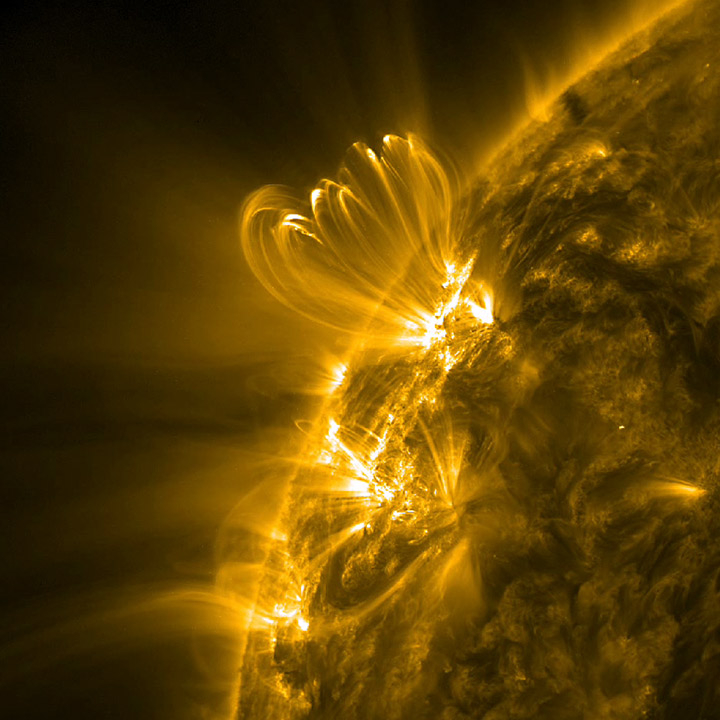
Image of sun shows magnetic reconnection.
Credit: NASA’s Solar Dynamics Observatory, or SDO. NASA’s Living With a Star Program
Second, the new thruster produces movement by ejecting both plasma particles and magnetic bubbles known as plasmoids. The plasmoids add power to the propulsion and no other thruster concept incorporates them.
Third, unlike current thruster concepts that rely on electric fields, the magnetic fields in Ebrahimi’s concept allow the plasma inside the thruster to consist of either heavy or light atoms. This flexibility enables scientists to tailor the amount of thrust for a particular mission.
“While other thrusters require heavy gas, made of atoms like xenon, in this concept you can use any type of gas you want,” Ebrahimi said. Scientists might prefer light gas in some cases because the smaller atoms can get moving more quickly.
Next step
Support for this research came from the DOE Office of Science (Fusion Energy Sciences) and Laboratory Directed Research and Development (LDRD) funds made available through the Office of Science.

Chalkboard physics. Fatima Ebrahimi looks to speedy space travel.
Credit: Fatima Ebrahimi
“This work was inspired by past fusion work and this is the first time that plasmoids and reconnection have been proposed for space propulsion,” Ebrahimi said. “The next step is building a prototype!”
Fatima Ebrahimi’s idea — An Alfvenic reconnecting plasmoid thruster — can be found in the Journal of Plasma Physics here:

Curiosity’s Location as of Sol 3013. Distance Driven 15.03 miles (24.19 kilometers).
Credit: NASA/JPL-Caltech/Univ. of Arizona
NASA’s Curiosity Mars rover is now performing Sol 3015 tasks.

Curiosity Navcam Left image clearly shows the boundary between the smooth and pebbly portion of the unit and the large blocky portion scientists are investigating on a brief “toe dip” into the rubbly area. Photo taken on Sol 3013, January 27, 2021
Credit: NASA/JPL-Caltech
The robot is now sitting on a geological contact within the “fractured intermediate unit” and scientists are investigating the “rubbly” portion of that unit, reports Scott Guzewich, an atmospheric scientist at NASA’s Goddard Space Flight Center in Greenbelt, Maryland.
Curiosity has carried out a brief “toe dip” into the rubbly area.

Curiosity Right B Navigation Camera image taken on Sol 3014, January 27, 2021.
Credit: NASA/JPL-Caltech
Rocks in the workspace
The rover will perform contact science with its Alpha Particle X-Ray Spectrometer (APXS) and Mars Hand Lens Imager (MAHLI) on one of these blocks, termed “Beaupouvet,” and take Mastcam multispectral and mosaic images of it and other rocks in the workspace, Guzewich adds.
The robot’s Chemistry and Camera (ChemCam) is acquiring passive spectra of its calibration target while the team investigates an issue with some observations last week.

Curiosity Right B Navigation Camera image taken on Sol 3014, January 27, 2021.
Credit: NASA/JPL-Caltech

Curiosity Right B Navigation Camera image taken on Sol 3014, January 27, 2021.
Credit: NASA/JPL-Caltech
Sulfate unit
“After contact science, we’ll drive back into the smoother pebbly portion of the unit as we continue to head for the sulfate unit higher on Mt. Sharp,” Guzewich notes. “On the second sol of our plan, we’ll have a sequence of activities to search for and image dust devils. We’ll also look for evening clouds, which typically become more abundant this time of year as we approach the northern hemisphere spring equinox on Mars.”

Curiosity Front Hazard Avoidance Camera Left B image acquired on Sol 3014, January 27, 2021.
Credit: NASA/JPL-Caltech

