Archive for the ‘Space News’ Category
 Author:
  February 26th, 2021
Dmitry Rogozin (center), General Director of the State Corporation Roscosmos, visits JSC NPO Lavochkin Credit: JSC NPO Lavochkin
Dmitry Rogozin, General Director of the State Corporation Roscosmos, visited JSC NPO Lavochkin on February 26 to receive a work-in-progress briefing.

Credit: JSC NPO Lavochkin
Lavochkin, part of the Roscosmos State Corporation, is working on Russia’s next lunar mission, Luna-25, as well as ExoMars-2022. Lavochkin has an impressive and history-making past, producing an array of planetary exploration spacecraft.
Rogozin received an update on the progress of complex electrical tests of Luna-25, carried out in the finishing chamber of a control and measuring station. Also, shown to Rogozin was a test bench for ground testing of the onboard control complex of the Luna-25 spacecraft.
Luna-25’s main task is to develop basic technologies for soft landing within the south pole of the Moon. Liftoff of Luna 25 is scheduled for October 2021.

ExoMars-2022 mission is joint ESA/Roscosmos project. Shown is rover ready to depart Russia-provided landing module and science landing platform.
Credit: Thales Alenia Space/Master Image Programs
Little Cossack
The Roscosmos chief was briefed on the ExoMars-2022 spacecraft – a European/Russian project. Lavochkin is the main contractor and coordinator of the work on the Russian side, as well as the developer and manufacturer of the ExoMars landing module and science landing platform named Kazachok (“Little Cossack”).
The launch of ExoMars-2020 (delayed from the last Earth-to-Mars window due to parachute issues, other testing woes and coronavirus concerns) is September-October 2022.
Go to these Roscosmos videos on Luna-25 and ExoMars (in Russian)
 Posted in

Curiosity Front Hazard Avoidance Camera Left B image acquired on Sol 3041, February 24, 2021.
Credit: NASA/JPL-Caltech
NASA’s Curiosity Mars rover is now performing Sol 3042 tasks.
Reports Mark Salvatore, a planetary geologist at University of Michigan: “Curiosity presses on to the east within Gale Crater, characterizing compositional variations within the underlying bedrock as we continue to march uphill and encounter sedimentary rocks that record the ancient geologic and environmental conditions within the crater.”

Curiosity Right B Navigation Camera image taken on Sol 3041, February 25, 2021.
Credit: NASA/JPL-Caltech
Salvatore adds that, over the past 35 sols, Curiosity has covered more than 1,969 feet (600 meters) of lateral distance as the rover approaches unique compositional transitions observed from orbit.
Regional bedrock
“The science team is continuing to make detailed analyses of the regional bedrock to make sure that we understand these transitions from the ground as well,” Salvatore points out.

A cliff (“Mont Mercou”) is roughly 18 feet tall, Curiosity Mast Camera Right photo taken on Sol 3040, February 23, 2021.
Credit: NASA/JPL-Caltech/MSSS
A recently scripted plan has the robot conducting a touch-and-go Alpha Particle X-Ray Spectrometer (APXS) chemistry analysis on the bedrock target “Manzac” located in front of the rover.
“She will also be acquiring high-resolution images of the path ahead to aid with future planning, making a suite of environmental observations, and collecting ChemCam [Chemistry and Camera] passive spectral data on another interesting bedrock unit in front of the rover named “Tranchecouyere.”

Curiosity Right B Navigation Camera photo acquired on Sol 3041, February 24, 2021.
Credit: NASA/JPL-Caltech
Victim of recent drive
“One additional observation will be acquiring high-resolution color images of the target “Tourtoirac,” located behind the back-right wheel of Curiosity,” Salvatore adds. “This target was a victim to Curiosity’s recent drive, which resulted in this rather large rock tilting onto its side under the pressure of Curiosity’s wheels.”

Target “Tourtoirac” (center right) tilting onto its side under the pressure of Curiosity’s wheels.This image was taken by Left Navigation Camera on Sol 3040.
Credit: NASA/JPL-Caltech.
Salvatore explains that Tourtoirac now sticks up at approximately a 45° angle, which will allow scientists to get a good look at whether there are any well-preserved layers or morphologies that are present along the side of the rock.
“It’s a great bonus observation,” Salvatore concludes, “that might not have been possible had Curiosity driven a few inches in a different direction!”

Credit: CCTV/Inside Outer Space screengrab
China’s Tianwen-1 probe on Wednesday entered a parking orbit around Mars after performing an orbital maneuver, according to the China National Space Administration (CNSA).
Launched on July 23, 2020, Tianwen-1 successfully has completed its third braking at Mars yesterday at 6:29 a.m. (Beijing time). The parking orbit’s farthest point from Mars is 36,660 miles (59,000 kilometers) and the nearest distance from the planet is 174 miles (280 kilometers).
It takes two Martian days for the probe to orbit Mars. While doing so, the multi-part probe (an orbiter, lander/rover) will undertake scientific exploration of Mars from orbit for three months. All of the seven mission payloads on the probe’s orbiter will be gradually activated.

China’s Mars orbiter. All of the seven mission payloads on the probe’s orbiter are being gradually activated. Credit: Zou Yongliao, et al.
According to CNSA, onboard cameras and spectrometers will assess the pre-selected landing site and Martian weather to prepare for a May/June touchdown of the lander/rover.
Entry arc
If all goes according to plan, China’s Mars orbiter will be briefly placed in a deorbit and entry arc to release the landing capsule replete with a rover. The rover will egress from the lander onto the Martian surface a few days after touchdown, following an appraisal of the surrounding terrain.

Credit: Zou Yongliao, et al.

Credit: CCTV/Inside Outer Space screengrab
For at least 92 Martian days, the rover is to make on-the-spot surveys of Mars. Chinese space engineers and scientists have selected candidate landing zones within the relatively flat region in the southern part of the Utopia Planitia.
Go to this informative video on the braking maneuver at:

Skylight opening on a huge lava tube in the Marius Hills region on the lunar near side.
Credit: NASA/Lunar Reconnaissance Orbiter Camera (LROC)/Science Operations Center, Arizona State University
Lunar lava tubes are receiving attention by the European Space Agency – considered an interesting option as long-term shelter for future human visitors to the Moon.

Credit: ESA
Through ESA’s Open Space Innovation Platform, a campaign was initiated calling for novel ideas to address detecting, mapping and exploring caves on the Moon. Also involved is the SysNova initiative, a technology assessment scheme using “technology challenges” and competition to survey a comparatively large number of alternative solutions.
Recently, teams behind two of the studies – one from the University of Würzburg and one from the University of Oviedo – were selected to take part in an ESA Concurrent Design Facility study.
Collapse of cavities
Why lava tubes on the Moon?
The presence of these features on the Moon has been well-documented with cameras on board several lunar orbiting missions. But relatively little is known about the presence and nature of subsurface cavities.
Planetary geologists have identified pits within volcanic areas of the lunar maria, perhaps related to the collapse of cavities such as lava tubes – where lava once flowed under the lunar surface.
Could they be utilized to shield astronauts from cosmic radiation and micrometeorites helping to sustain lunar expeditions? Also, do these features possibly provide access to icy water and other resources trapped underground?

Credit: University of Würzburg
Here are some exploration ideas under study:
— University of Würzburg: exploring the concept of lowering a probe using a tether to explore and characterize the entrance, walls and initial part of lunar lava tubes.
— University of Oviedo: investigated the deployment of a swarm of small robots inside a cave, as well as how to transmit data from the robots to a rover on the Moon’s surface.

Credit: University of Oviedo
Going underground
The bottom line for going underground on the Moon: Given that the Moon’s surface is covered by millions of craters, it also hosts hundreds of very steep-walled holes known as pits.
Like doorways to the underworld, photos of some pits clearly show a cavern beneath the Moon’s surface, suggesting that they are ‘skylights’ into extensive lava tubes that can be as wide as New York’s Central Park, and could extend for great distances under the lunar landscape.

Curiosity Mast Camera Left image taken on Sol 3038, February 21, 2021.
Credit: NASA/JPL-Caltech/MSSS
Count ‘em: There’s now a fleet of Mars explorers busy at work in orbit and on the surface of the Red Planet, observes Scott Guzewich, an atmospheric scientist at NASA’s Goddard Space Flight Center in Greenbelt, Maryland.

Real image shows Perseverance rover being lowered to the floor of Jezero Crater by the Skycrane. Rocket engines kicked up streaks of dust during the touchdown.
Credit: NASA/JPL-Caltech

InSight’s first full selfie on Mars.
Credit: NASA/JPL-Caltech

NASA’s Mars Odyssey orbiter.
Credit: NASA/JPL-Caltech

Mars Reconnaissance Orbiter.
Credit: NASA

Mars Atmosphere and Volatile Evolution (MAVEN) mission.
Credit: NASA/Goddard Space Flight Center

ESA Trace Gas Orbiter at Mars.
Credit: ESA/ATG medialab

ESA’s Mars Express.
Credit: ESA/AOES Medialab

India’s MoM mission to Mars.
Credit: ISRO

China’s Tianwen-1.
Credit: CNSA
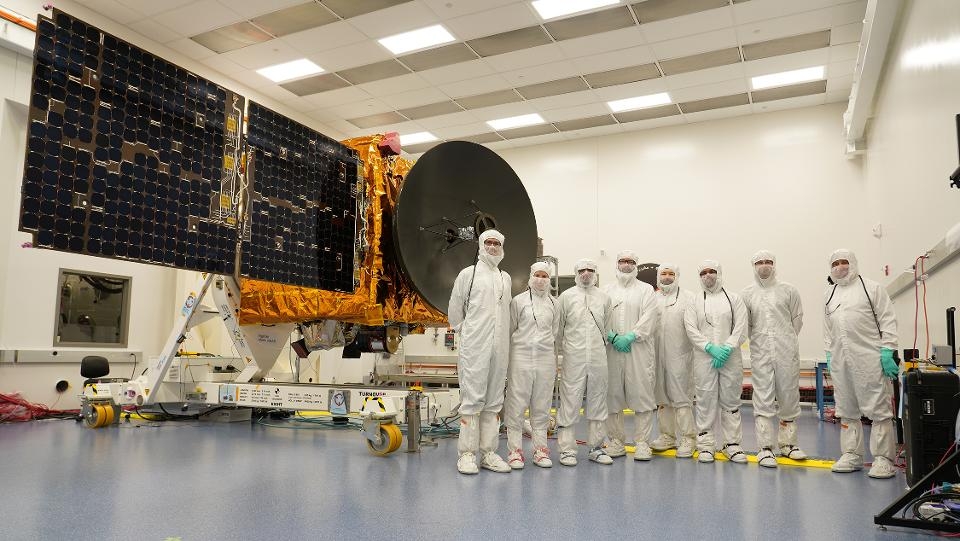
UAE’s Hope Mars orbiter.
Credit: Mohammed Bin Rashid Space Center
Eleven — NASA’s Curiosity, Perseverance, InSight, Odyssey, Mars Reconnaissance Orbiter, MAVEN, Europe’s Mars Express, the Trace Gas Orbiter, India’s Mars Orbiter mission, China’s Tianwen-1, and the UAE’s Hope — spacecraft are now concurrently exploring Mars from the surface and orbit.
“That incredible fleet produces synergistic science discoveries that would not be possible with any one spacecraft in isolation,” Guzewich notes.
Joint observations
Now in Sol 3040, the Curiosity Mars rover is engaged in one such joint observation with Europe’s Trace Gas Orbiter (TGO). TGO studies the chemical composition of the martian atmosphere as Curiosity does with its Chemistry and Camera (ChemCam) through a “passive sky” observation.
“In a passive sky observation, ChemCam looks at the sky at different angles and positions and we are able to learn about the properties of dust, water ice clouds, and measure abundances of atmospheric gases like oxygen,” Guzewich reports. “By combining our work with TGO, we can measure the abundance of such gases from the surface all the way up to the top of the atmosphere!”
Drive to cliff
Outside of this atmospheric observation, a recently scripted plan was a routine touch-and-go.
Scientists selected a representative piece of bedrock in the workspace (“Plazac”) for Mars Hand Lens Imager (MAHLI) and the Alpha Particle X-Ray Spectrometer (APXS) to study and then focused much of their remote sensing science on a fascinating cliff, “Mont Mercou,” that’s roughly 18 feet (5.5 meters) tall. The robot is driving toward this feature over the next several days of planning, Guzewich adds.
Both the robot’s Mastcam and ChemCam were slated to image Mont Mercou.

Curiosity Right B Navigation Camera image taken on Sol 3039, February 22, 2021.
Credit: NASA/JPL-Caltech

Curiosity Left B Navigation Camera view of “Mont Mercou” cliff that can be seen at the top left of this Navcam image. Taken on Sol 3038, February 21, 2021.
Credit: NASA/JPL-Caltech

Credit: NASA/JPL/University of Arizona
The NASA Mars Reconnaissance Orbiter’s HiRISE camera system has spotted the Perseverance Rover on the surface of the Red Planet. Imagery also shows many parts of the descent system that got the safely down.

On the surface. Safe touchdown by Perseverance rover.
Credit: NASA/JPL/University of Arizona
The rover itself sits at the center of a blast pattern created by the hovering skycrane (labeled as “descent stage”) that lowered it there. The skycrane flew off to crash as at a safe distance creating a V-shaped debris pattern that points back toward the rover it came from.
Earlier in the landing sequence, Perseverance jettisoned its heatshield and parachute which crashed in the separate locations.

Perseverance heat shield.
Credit: NASA/JPL/University of Arizona
These foreign objects on the surface of Mars are highly visible now but will become dustier with time and slowly fade into the background over years. HiRISE will continue to image the Perseverance landing site to track the progress of the rover and changes in the other pieces of hardware that accompanied it.
Information provided by Shane Byrne, Deputy Principal Investigator of HiRISE team.

Descent stage crash site.
Credit: NASA/JPL/University of Arizona

Perseverance parachute spotted by NASA’s Mars Reconnaissance Orbiter (MRO).
Credit: NASA/JPL/University of Arizona

Russia’s Luna-25 Moon lander.
Credit: RSC Energia/Roscosmos
Russia is readying its return to the Moon – the launch of the robotic Luna-25.
“For the first time in 45 years, we are to resume exploration of the Moon. In October, the first descent module will be launched from the spaceport Vostochny, Roscosmos corporation CEO Dmitry Rogozin told Russian President Vladimir Putin last Saturday during a briefing on the corporation’s performance in 2020.

Roscosmos corporation CEO Dmitry Rogozin, discusses future space exploration plans with Russian President Vladimir Putin.
Credit: Roscosmos
“More automatic lunar probes will follow. Lastly, a manned program will begin,” Rogozin told Putin.
Luna-25 testing
Acoustic tests of the automatic station Luna-25 were recently conducted at the Scientific and Production Association named after S.A. Lavochkin (part of Roskosmos). Lavochkin is the developer of the lunar-bound spacecraft.

Lunar hardware undergoes testing.
Credit: RSC Energia/Roscosmos
Within the acoustic chamber, the probe was exposed to sound waves in a wide frequency range that mimics forces that will act on the spacecraft during its boost phase from Earth.
After a series of tests, NPO Lavochkin engineers carried out a complete visual inspection of the interplanetary vehicle. Luna-25 has successfully overcome these loads, according to Lavochkin.

A Lunar Orbiter Laser Altimeter (LOLA) topographic map of the southern sub-polar region of the Moon showing the location of Boguslawsky crater [from Ivanov et al., 2015]via NASA Lunar Reconnaissance Orbiter (LROC) website at Arizona State University.
South pole landing
The Luna-25 spacecraft is part of the Luna-Glob project of NPO Lavochkin. The craft is a small demonstration landing station for testing basic soft landing technologies in the circumpolar region and conducting contact studies of the Moon’s south pole.
Luna-25 spacecraft is to be Soyuz-boosted moonward in October 2021. It will reportedly soft land near the lunar south pole at the Boguslavsky crater.

A portion of a new geologic map of the interior of Boguslawsky crater, proposed site of the next Russian mission to the lunar surface [Ivanov et al., 2015] via NASA Lunar Reconnaissance Orbiter (LROC) website at Arizona State University.
Russia is rebuilding a multi-pronged return-to-the-Moon program, one that kick-starts a 21st century round of outreach to Earth’s extraterrestrial neighbor.
There’s a lot riding on success of this Russian rekindling of lunar exploration. For more information, go to my Scientific American story on Russia’s re-launch into exploring the Moon.
“Luna-25 Lander Renews Russian Moon Rush – The former front-runner in the lunar space race aims to rekindle its exploration after nearly half a century.”
Go to:
https://www.scientificamerican.com/article/luna-25-lander-renews-russian-moon-rush/

Chinese President Xi Jinping met space scientists and engineers involved in the Chang’e-5 lunar mission at the Great Hall of the People in Beijing Monday. Xi inspected specimens from the Moon brought back by the return sample mission.
Credit: CCTV/Inside Outer Space screengrab
Chinese President Xi Jinping met space scientists and engineers involved in the research and development of the Chang’e-5 lunar mission at the Great Hall of the People in Beijing Monday. Xi inspected specimens from the Moon brought back by the return sample mission.

Credit: CCTV/Inside Outer Space screengrab
The successful Chang’e-5 lunar mission retrieved about 4 pounds (1,731 grams) of samples. Its lander-ascender combination successfully touched down on the near side of the Moon on December 1, collecting samples from both the lunar surface and beneath.

Chinese President Xi Jinping inspects Chang’e-5 lunar sample return capsule. Zhang Kejian, Director of the China National Space Administration advises President Xi about the mission.
Credit: CCTV/Inside Outer Space screengrab
The ascender later rocketed the specimens off the Moon for transfer to an orbiter/returner for transport back to Earth.
A return capsule containing the lunar collectibles landed in Inner Mongolia Autonomous Region in the early hours of December 17.
Go to this CCTV video at:

Curiosity Mast Camera Left image taken on Sol 3036, February 19, 2021.
Credit: NASA/JPL-Caltech/MSSS
NASA’s Curiosity Mars rover is now performing Sol 3038 duties – and is in “don’t forget me mode” – now joined on the Red Planet by NASA’s Perseverance robot at Jezero Crater.

Credit: NASA/JPL-Caltech/Univ. of Arizona
Curiosity has returned new imagery from its Gale crater locale. Here’s a representative sample showing the rover’s surrounding views:

Curiosity Mast Camera Left photo taken on Sol 3036, February 19, 2021.
Credit: NASA/JPL-Caltech/MSSS

Curiosity Front Hazard Avoidance Camera Left B photo taken on Sol 3037, February 20, 2021.
Credit: NASA/JPL-Caltech

Curiosity Right B Navigation Camera image acquired on Sol 3037, February 20, 2021.
Credit: NASA/JPL-Caltech

Curiosity Mars Hand Lens Imager photo produced on Sol 3037, February 20, 2021.
Credit: NASA/JPL-Caltech/MSSS

Core module of China’s space station.
Credit: CMS/Inside Outer Space screengrab
China is pressing forward on construction of the country’s own space station. To do so, multiple classes of Long March boosters are to be utilized.
First up is lofting the station’s core module, the Tianzhou-2 cargo spacecraft and the Shenzhou-12 piloted spacecraft.
According to China Central Television (CCTV) rendezvous and docking as well as relevant in-orbit verifications of key technologies are scheduled to be completed this year.

China’s space station expected to be completed around 2022.
CMS/Inside Outer Space screengrab
Zero error launch windows
“This is the first time that we will launch multi-type Long March rockets to build a manned space station. The carrier rocket Long March-5B will launch the core module of the space station. Then the Long March-7 carrier rocket will launch the cargo spacecraft. Later, the Long March-2F carrier rocket will carry our astronauts to our space station,” said Mou Yu, director of the General Design Department of the China Academy of Launch Vehicle Technology.
Mou emphasized in a CCTV interview that the launch vehicles used require a high reliability of the pre-launch preparation work for the dynamical and control systems “and the zero error in the launch window.”
To piece together the space station, China will successively launch the Tianhe core capsule, Wentian and Mengtian lab modules. In addition, four Shenzhou crew-carrying spacecrafts and four Tianzhou cargo spacecrafts will also be launched to establish a rotation of astronauts to work on the space station and supply goods to sustain station operations.

Credit: China Military Online
Meanwhile, China’s space tracking ship Yuanwang-3 set sail on Saturday for the Pacific Ocean from a port in east China’s Jiangsu Province for upcoming maritime monitoring missions.
Yuanwang-3 is a second-generation Chinese space tracking ship. It has undertaken more than 90 maritime tracking and monitoring tasks for spacecraft, including the Shenzhou spaceships, Chang’e lunar probes and BeiDou satellites.

