Archive for the ‘Space News’ Category
 Author:
  March 4th, 2021
Core module of China’s space station.
Credit: CMS/Inside Outer Space screengrab
China appears to be on the verge of a one-two punch in both the country’s human space flight program as well as its robotic planetary exploration plans.
Before the end of June, the China National Space Administration (CNSA) notes it anticipates the lofting of the 20-metric-ton core space station module, Tianhe, or Harmony of Heaven.

Credit: CCTV/Inside Outer Space screengrab
Also, China is targeting an attempted landing on Mars in May-June with the Tianwen-1’s lander/rover – the country’s first independent mission to the Red Planet.
Construction begins
The core module of China’s space station is slated for liftoff before the end of June. It will start the construction of the nation’s largest space-based asset, according to the China Manned Space Agency.

China’s space station expected to be completed around 2022.
CMS/Inside Outer Space screengrab
Tianhe is nearly 55 feet (16.6 meters) long and has a diameter of 14 feet (4.2 meters). It has three parts – a connecting section, a life-support and control section along with a resources section.
This module will be central to space station operations. Crews will live there and control the entire facility from inside. The module will also be tasked with hosting scientific experiments.

Credit: CMS/CCTV/Inside Outer Space screengrab
Sequential launches
To piece together China’s space station in rapid fashion, the nation will sequentially launch the Tianhe core capsule, Wentian and Mengtian lab modules. In addition, four Shenzhou crew-carrying spacecrafts and four Tianzhou cargo spacecrafts will also be lofted to establish a rotation of astronauts to work on the space station and supply goods to sustain station operations.

Credit: CCTV/Inside Outer Space screengrab
Four groups of astronauts have been selected for the space station’s construction and are now undergoing training.
The entire station — with a combined weight of more than 90 tons — is expected to become fully operational in 2022 and is set to operate for about 15 years, Chinese space officials have stated.
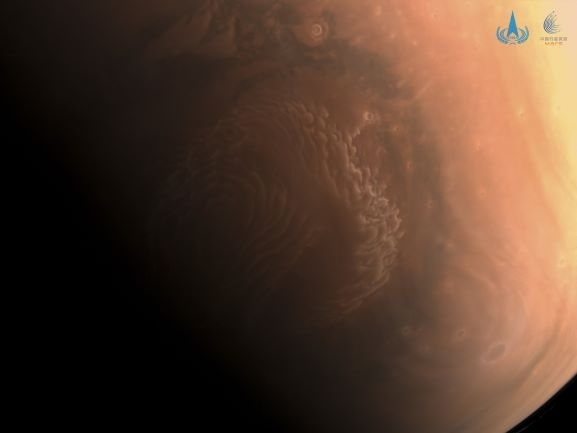
A color image taken by the Tianwen-1 orbiter’s medium-resolution camera is of Mars’ north pole region. Credit: CNSA
Mars probing mission
Meanwhile, China’s Tianwen-1 Mars mission is presently circuiting the Red Planet and is busily imaging the Martian landscape. The 5-metric ton, multi-part probe consists of an orbiter and a landing capsule that carries a rover.
Tianwen-1 entered its preset Mars parking orbit on February 24 and is expected to fly in this orbit for about three months prior to releasing its landing capsule in May or June.

Credit: CCTV/Inside Outer Space screengrab
All of the orbiter’s seven payloads are gradually coming on-line, activated during the probe’s stay in its parking orbit. One early task of the orbiter is to observe and analyze the landforms and weather conditions of the optimal landing site.

Credit: CCTV/Inside Outer Space screengrab
New imagery
Recently released images from the Tianwen-1 orbiter show noteworthy geographical features of the Red Planet, reports Liu Tongjie, deputy director of the Lunar Exploration and Space Program Center under CNSA and spokesman of China’s first Mars exploration mission.

Credit: CCTV/Inside Outer Space screengrab
These images include two panchromatic images and one color image, said the CNSA.
“In the images, Martian landforms such as small craters, mountain ridges and dunes are clearly visible. One of the images captured an impact crater with a diameter of around 620 meters. The lines at the bottom of the crater are clearly seen,” Liu told China Central Television (CCTV).
A color image taken by the orbiter’s medium-resolution camera is of Mars’ north pole region.
“This image shows a large area of Mars at a distance of about 5,000 kilometers. The spiral structure is Mars’ north polar cap. It’s a spiral structure created by years of deposition and ablation — huge dust storms on Mars often originate in the polar regions, the north and south poles. So these locations may serve as vantage points for us to monitor the formation of dust storms,” Li Chunlai, deputy chief designer of China’s first Mars exploration mission and deputy director of the National Astronomical Observatories of China told CCTV.
Go to these CCTV video showing recently-captured images of Mars by the Tianwen-1 orbiter at:
 Posted in

GIMBAL/“Tic Tac”
Credit: DOD/U.S. Navy/Inside Outer Space screengrab
If you are perplexed, befuddled and bewildered about reports of Unidentified Aerial Phenomena and possible visitations of alien craft from afar, there’s opportunity to take action with your own do-it-yourself sky-monitoring gear.
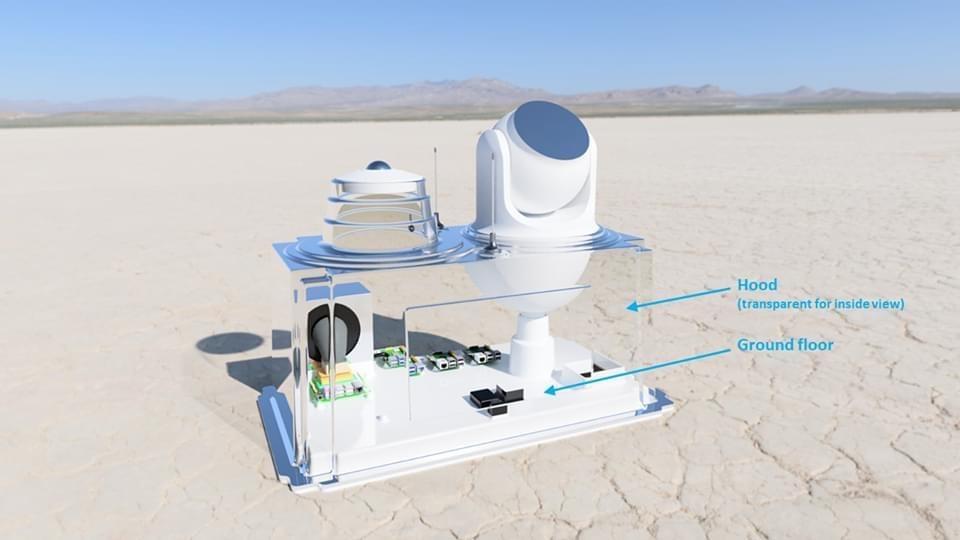
Sky Hub unit consists of consumer grade technology, coupled with a micro computer built for Machine Learning and AI.
Credit: Sky Hub
Given the low-cost nature and capability of today’s consumer grade technology, you too can be at the ready to document out of the ordinary events.
For more information, go to my new Space.com story:
Spotting UFOs: Do-it-yourself sky surveillance comes online
https://www.space.com/spotting-ufos-sky-hub-surveillance

Credit: CCTV/Inside Outer Space screengrab
As China’s Tianwen-1 Mars spacecraft circles the Red Planet, back here on Earth, a trio of names is being weighed for the country’s first Mars rover.
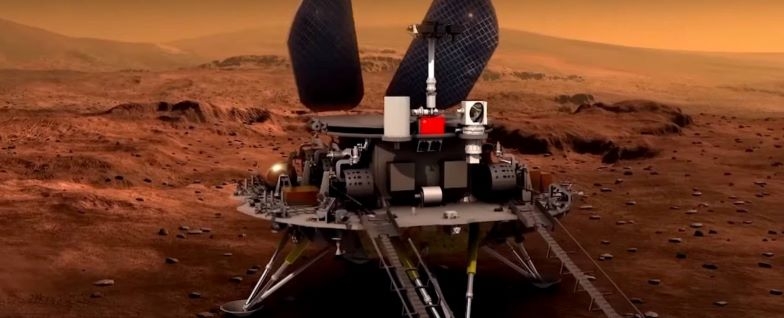
Credit: CCTV/Inside Outer Space screengrab
The suggested names are the product of a 40-day global online poll. They are:
— “Zhurong,” a fire god in ancient Chinese mythology.
— “Nezha,” a Chinese mythological figure.
— “Hongyi,” which means having a broad and strong mind in Chinese.
The China National Space Administration (CNSA) in January unveiled a list of 10 selections for the name after a global naming campaign that kicked off in late July 2020.
Online participants from China and abroad were invited to vote on 10 candidates from January 20 to February 28.

China’s three-in-one mission: An orbiter, lander, and rover.
Credit: Wan, W.X., Wang, C., Li, C.L. et al.
According to the Xinhua news agency, starting today, a panel of experts will also vote for the final candidates. The CNSA will decide the top three names based on public voting and expert opinions.
China launched Tianwen-1 on July 23, 2020. The spacecraft, consisting of an orbiter, a lander and a rover, entered a parking orbit at Mars after performing an orbital maneuver on February 24.
The orbiter is set to unleash its entry vehicle that encapsulates the lander/rover in the May-June time period.
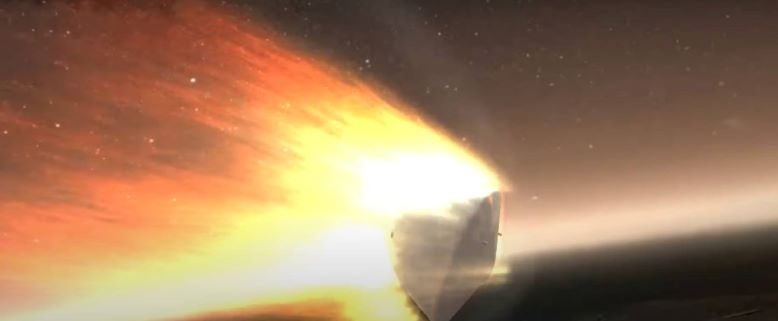
Credit: CCTV/Inside Outer Space screengrab
Walk like an insect, move like a crab
As recently reported by China Central Television (CCTV), the six-wheeled Mars rover is equipped with four cameras of two kinds: one can detect things in distance to plan the route while the other can catch a wider view to avoid obstacles. These two types of cameras would coordinate the robot’s movements, to move forward or to stop.
CCTV adds that the rover is able to walk like an insect to climb out of pits or move sideways like a crab to overcome obstacles.

Credit: Zou Yongliao, et al.
Outfitted with four solar panel wings, those wings are organized in butterfly-fashion and can be easily folded up.
“The rover, highly sensitive to the environment, can automatically suspend the work in severe weathers to protect the equipment and resume work when the weather turns better,” according to CCTV.
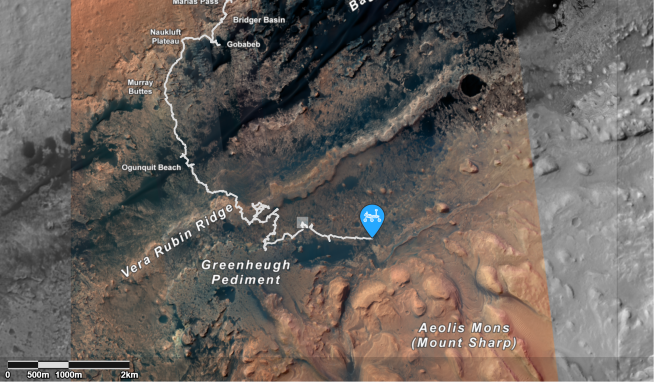
Curiosity as of Sol 3042. Distance Driven 15.35 miles/24.71 kilometers.
Credit: NASA/JPL-Caltech/Univ. of Arizona
NASA’s Curiosity Mars rover is now performing Sol 3046 tasks.
Ken Herkenhoff, a planetary geologist at the USGS Astrogeology Science Center in Flagstaff, Arizona, reports that a recent drive by the robot on Sol 3044 brought it to “an area mostly covered by dark sand, with very few exposed rocks in the arm workspace.”
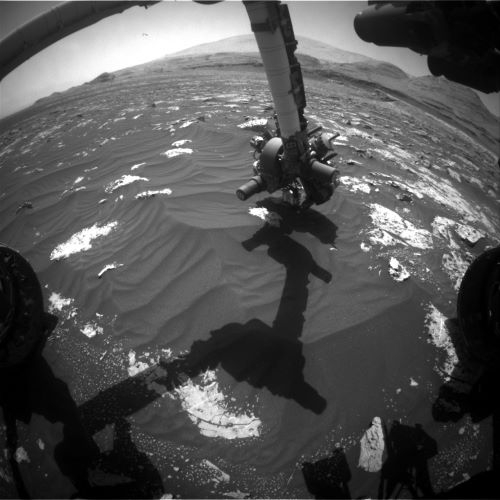
Curiosity Front Hazard Avoidance Camera Right B image taken on Sol 3045, February 28, 2021.
Credit: NASA/JPL-Caltech
Still, any good for contact science?
“Unfortunately, none of the rocks that the arm can reach are large enough to be brushed by the [Dust Removal Tool] DRT, but they don’t look too dust-covered.”
That being the case, researchers decided to plan Mars Hand Lens Imager (MAHLI) images and Alpha Particle X-Ray Spectrometer (APXS) integrations on two of them, “Pazayac” and “Sadillac.”
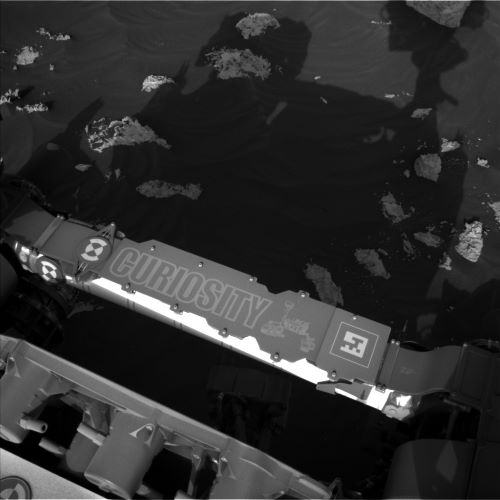
“Pazayac” and “Sadillac” (visible below and right of center in this image taken by Curiosity’s Left Navigation Camera Sol 3042 February 25, 2021.
Credit: NASA/JPL-Caltech
Distant ridges
But first, Navcam will search for clouds and dust devils, the Chemistry and Camera (ChemCam) will acquire Remote Micro-Imager (RMI) mosaics of a nearby rock named “Sourzac” and distant sulfate-bearing outcrops, Herkenhoff notes. Also, the rover’s Mastcam will take an image of Sourzac and stereo mosaics of nearby sedimentary textures and distant periodic ridges.
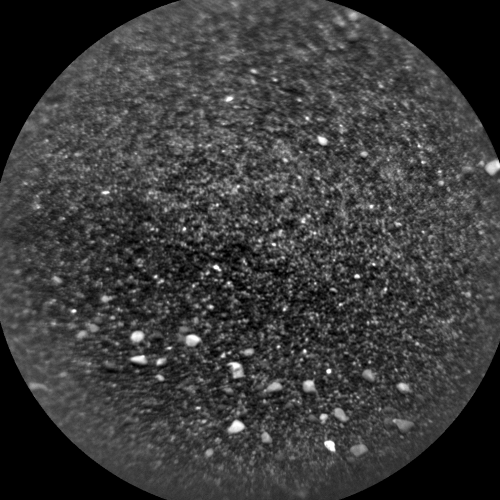
Curiosity Chemistry & Camera Remote Micro-Imager (RMI) photo acquired on Sol 3045, February 28, 2021.
Credit: NASA/JPL-Caltech/LANL
“After the two MAHLI full suites, APXS will be placed on Sadillac for an evening integration, then on Pazayac for an overnight integration,” Herkenhoff adds.
On Sol 3045, Curiosity’s robotic arm was slated to be moved out of the way for ChemCam passive rasters on a rock dubbed “Saussignac,” on Pazayac, and on a soil target named “Sableronne.”
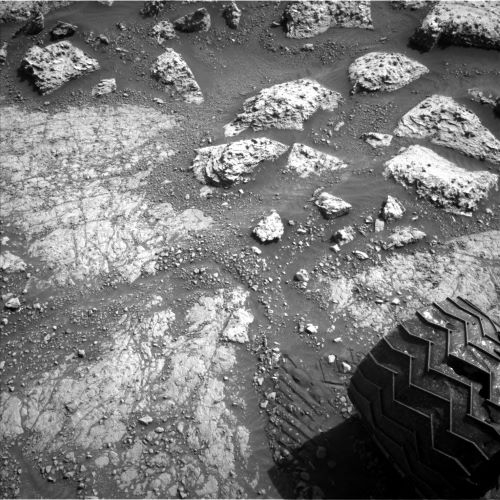
Curiosity Left B Navigation Camera photo taken on Sol 3045, February 28, 2021.
Credit: NASA/JPL-Caltech
Then Mastcam was scheduled to acquire multispectral observations of Saussignac and the contact science targets before the rover drives about 295 feet (90 meters) toward the east-southeast.
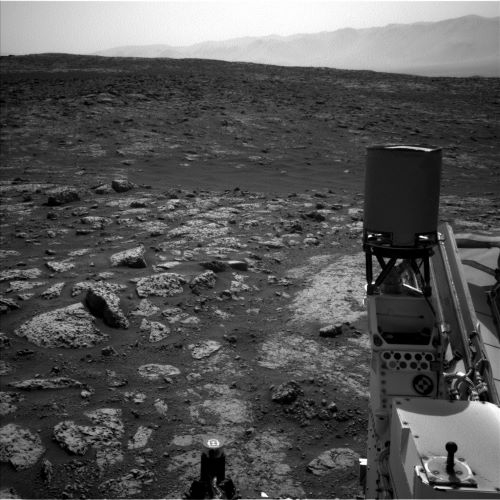
Curiosity Left B Navigation Camera photo taken on Sol 3045, February 28, 2021.
Credit: NASA/JPL-Caltech
Twilight survey
After sunset, Herkenhoff explains, Mastcam is slated to perform a twilight survey of the sky and the Mars Descent Imager (MARDI) was ready to take another twilight image.
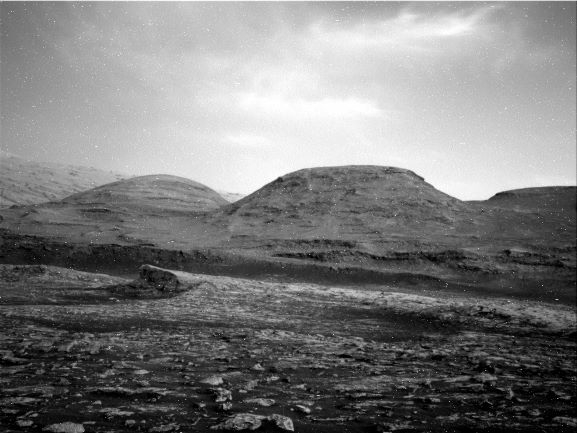
Curiosity Right B Navigation Camera images clouds at Gale crater. Photo taken on Sol 3043, February 27, 2021.
Credit: NASA/JPL-Caltech
“The vehicle will get some well-earned rest on the third sol,” Herkenhoff adds, with only a few atmospheric observations by Mastcam, Navcam and the Rover Environmental Monitoring Station (REMS).
Lastly, early on Sol 3047, Navcam was set to again search for clouds and image the rover deck, and Mastcam will measure the amount of dust in the atmosphere, Herkenhoff concludes.

Yes, in space, everyone can hear a hiss.
Credit: NASA
What does patulas, glue-mastic, Hermetall and Anaterm sealants, sandpaper, foam rubber, fluoroplastic films, alcohol wipes, metal pads, and electrical tape have to do with space?
Also, toss in goggles, respirators, rubber gloves, a drill and a vacuum cleaner.
Cosmonauts are to use these to fix a 2-inch (4.5-centimeter) air leak in the Zvezda intermediate chamber on the International Space Station.

Credit: Aurorasaurus
A citizen science project asks you to keep an eye out for aurora – that complex dance of particles and magnetism between the Sun and Earth.
With the right tools, you can generally capture aurora in photographs. Your camera can even pick up very dim colors of the auroral spectrum that your eyes cannot see.
If you’re on the prowl to capture aurora, consider joining Aurorasaurus. Over the years, collaborations between scientists and interested members of the public — known as citizen scientists — have helped make thousands of important scientific discoveries.

Credit: National Science Foundation
Unique shapes
Aurora can display in many unique shapes, but Aurorasaurus puts them into three main groups:
— discrete arcs
— diffuse glows
— pulsating patches
With the right tools, you can generally capture aurora in photographs. Your camera can even pick up very dim colors of the auroral spectrum that your eyes cannot see.
Public-private partnership
Aurorasaurus is a research project that is a public-private partnership with the New Mexico Consortium supported by the National Science Foundation and NASA (NSSEC), and was designed by researchers from the New Mexico Consortium, NASA, Penn State University, Science Education Solutions, and Ideum.
Check it out at:

Credit: CCTV/Inside Outer Space screengrab
Lunar samples brought back to Earth by China’s Chang’e-5 Moon mission are on display at the National Museum in Beijing.
The exhibit is dubbed “Lunar Sample 001, Witnessing China’s Flying Dream,” featuring a hundred grams of soil.

Exhibit also features the Chang’e-5 sample-carrying capsule.
Credit: CCTV/Inside Outer Space screengrab
Encased in crystal
According to China Central Television (CCTV) the sample is encased in a crystal container resembling a ritual Chinese wine vessel.
That display of Moon specimens stands 38.44 centimeters tall, a nod to the 384,400 kilometers that is the average distance between Earth and the Moon, and 22.89 centimeters wide for the 22.89 days that the Chang’e-5 lunar mission lasted, CCTV reports.
The inside of the container features a hollow sphere representing both the Moon and the Chang’e-5 return capsule that delivered a total of 1,731 grams of lunar samples to a safe touchdown on December 17, 2000. The sphere floats above a frosted dome symbolizing the Earth and a map of China.

Chinese President Xi met space scientists and engineers involved in the Chang’e-5 lunar mission at the Great Hall of the People in Beijing. Xi inspected specimens from the Moon brought back by the return sample mission.
Credit: CCTV/Inside Outer Space screengrab
Prior to public display of the lunar collectibles, Chinese President Xi Jinping met space scientists and engineers involved in the research and development of the Chang’e-5 lunar mission at the Great Hall of the People in Beijing. Xi inspected specimens from the Moon brought back by the return sample mission.

Lunar soil color
“The color of lunar soil is different from that of the Earth soil. It’s charcoal gray, or to be exact, it’s darker. And it also has a peculiar look,” explains Wu Hualiang, from the museum’s exhibit collection and appraisal department.
“Because of gravity, everything on Earth is pulled downward, but the particles of the lunar soil cling onto the side of the container like there is zero gravity. It gives people the feeling of being in outer space,” Wu told CCTV.

Chang’e-5 descent stage seen just before sunset on February 7, 2021.
Credit: NASA/GSFC/Arizona State University
Ocean of Storms
The Chang’e-5 mission to the Moon comprised an orbiter, a lander, an ascender and a returner.
Launched on November 24, 2000, the spacecraft’s lander-ascender combination touched down December 1st on the north of Mons Rümker in Oceanus Procellarum, also known as the Ocean of Storms, on the near side of the Moon.
Go to this CCTV video regarding the display of lunar samples at:

Taking in the view. Note the mini-helicopter.
Courtesy: Daniel Raymer
While the world waits for the unleashing of a mini-helicopter by the recently landed Perseverance Mars rover, a team of aeronautical and space experts are already blueprinting a piloted aircraft. The vehicle is tailor-made for exploration, research, cargo transport, photography, and to link multiple settlements on the Red Planet.

Credit: NASA
“If national governments and certain billionaires have their way, humans will reach Mars sometime in this century and set up permanent bases. Eventually they’ll need a way to get around,” explains Daniel Raymer, president of the design and consulting company, Conceptual Research Corporation in Playa del Rey, California.
Details of the Mars craft are outlined by Raymer and his co-authors in a paper for the American Institute of Aeronautics and Astronautics (AIAA).

Credit: Daniel Raymer, et al. (AIAA-2021-1187)
Crew of two
A two-man vehicle is foreseen developed on the lines similar to the capabilities of the classic “Jeep” of WWII fame. Namely, the aircraft can support a crew of two plus cargo to a total of 500 pounds, carried at least 260 nautical miles.
Flying the vehicle doesn’t require an off-Earth pilot’s license; the flight control system will be capable of fully autonomous operation. Vertical takeoff and landing of the craft is required, “due to the deplorable lack of paved runways on Mars,” the design team reports.

Credit: Daniel Raymer, et al. (AIAA-2021-1187)
When desired, the two-person flyers could “take the stick” and fly the craft using a simplified video game or touchpad controller. Commands can be entered, such as take-off, cruise (direction or destination), climb, descend, turn, altitude hold, or land at a designated spot.
The cabin is sized for a two-person crew and would offer a good field of view, to pick safe landing sites and allow for eye-catching photography.

Credit: Daniel Raymer, et al. (AIAA-2021-1187)
Do the math
“The air is a lot less dense on Mars. But the gravity is a lot lower,” Raymer points out.” Do the math…it turns out that if you can fly on Earth at about 100,000 feet, then you can fly on Mars.” That assumes, of course, that you can get there first, and that you have a motor that can run in an atmosphere with negligible oxygen, bitter cold, and dust storms, he adds.
While there are various modes of propulsion feasible for flight on Mars, it was assumed that electric motors with propellers would be used for wing-borne forward flight. Vertical rockets would be used for takeoff and landing. Use of horizontally installed rockets to assist in acceleration to forward flight speed may be attractive, the design team suggests.
As studied by Raymer and his associates, the Mars airplane design is a viable, “existence proof” concept. Consider the proposed vehicle as “food for thought,” not the final answer. Further work on the idea, they write, could likely lead to an even better design.
Advanced but feasible technologies
As it now stands, the present aircraft design for Mars resulted from an international effort with participants in Brazil, Germany, India, Israel, and Spain, facilitated by Internet meeting software.

Credit: Elon Musk/SpaceX
The overall operational concept for the Mars plane starts with the assumption of a permanent human presence on Mars, with one or more bases on Mars, readily-available electrical energy (solar or nuclear), and large pressurized buildings. “Permanent residents of Mars will need a “Jeep-like” mobility capability for getting around and for delivering cargo where needed,” the study team explains.
The design study results suggest that such a crew-carrying Mars airplane is possible, with the application of advanced but feasible technologies in the post-2030 time frame.
As noted in the AIAA paper, Robert Zubrin, head of the Mars Society, has offered the possibility of relaxing an onerous design requirement for the airplane. “I agree that the lack of paved runways on Mars is deplorable. I will see what I can do about correcting it.”
To read the AIAA paper – “The Raymer Manned Mars Airplane: A Conceptual Design and Feasibility Study” — go to:
http://www.aircraftdesign.com/Raymer_MannedMarsPlane_ASM2021_paper.pdf

August 8, 2020 photo shows a member of the AGM-183A Air-launched Rapid Response Weapon Instrumented Measurement Vehicle 2 test team make final preparations prior to a captive-carry test flight of the prototype hypersonic weapon at Edwards Air Force Base, Calif.
Photo credit: Kyle Brasier, Air Force
Next week, look for a rapid prototyping program dubbed ARRW, short for the AGM-183A air-launched rapid response weapon, to take to the air.
This boost-glide based hypersonic weapon is moving the United States forward in developing hypersonic systems able to travel on extended flights within the upper atmosphere — 80,000 to 200,000 feet — at speeds near and above Mach 5.
Transition into production
Preparations are underway for the first booster flight test next week says Air Force Brig. Gen. Heath A. Collins, program executive officer for weapons and director of the armament directorate at the Air Force Life Cycle Management Center in the Air Force Materiel Command.
“We’re also getting ready to transition into production within about a year on that program, so it will be the first air-launch hypersonic weapon that the Air Force has,” Collins notes.
The U.S. Defense Department has identified hypersonics as one of the highest priority modernization areas, as Russia and China develop their own capable systems.

The U.S. Air Force and Lockheed Martin successfully flight tested the second AGM-183A Air-Launched Rapid Response Weapon (ARRW) on the service’s B-52 Stratofortress out of Edwards Air Force Base, California, on Aug. 8, 2020.
Credit: U.S. Air Force
Hypersonics modernization strategy
Mike White, principal director for hypersonics in the office of the undersecretary of defense for research and engineering, has told attendees of the Air Force Association’s virtual Aerospace Warfare Symposium that a hypersonics modernization strategy has been established that accelerates the development and delivery of transformational warfighting capabilities.
That strategy is being implemented in a highly coordinated set of programs across the military services and agencies, laboratories, as well as working collaboratively with allies, where appropriate.
“We will deliver strike capability to the warfighter in the early-mid 2020s and a layered hypersonic defense capability — first terminal and then glide phase — in the mid-late 2020s. For reusable systems, our goal is to deliver capability in the early to mid-2030s,” White explains.
James Weber, senior scientist for hypersonics at the Air Force Research Laboratory, says that over the last 25 years, DOD has invested some $1.7 billion in hypersonics.

An artist’s rendering depicts a hypersonic vehicle. NASA has been delving into hypersonics, eyeing future jets and lifting body–type space vehicles and reentry vehicles.
Credit: NASA’s Lewis Research Center

Credit: DARPA/DSO
The Defense Sciences Office (DSO) at the Defense Advanced Research Projects Agency (DARPA) has blueprinted a wanted and visionary wish list of new research to enable the fabrication of future space structures – including use of lunar resources to enable those structures.
“Specific technologies of interest include high performance feedstock materials, mass- and energy-efficient off-Earth manufacturing methods, high performance lunar resource utilization capabilities, and new design paradigms that will revolutionize the mass efficiency and precision achievable by future structures,” according to a DARPA/DSO statement.

Credit: DARPA/DSO/Inside Outer Space screengrab
The Novel Orbital and Moon Manufacturing, Materials, and Mass-efficient Design (NOM4D), pronounced “NOMAD,” program was detailed today via a “Proposers Day.”
Why the effort?
First, here’s the issue.
As commercial space companies increase the cadence of successful rocket launches, access to space is becoming more routine for both government and commercial interests. But even with regular launches, modern rockets impose mass and volume limits on the payloads they deliver to orbit. This size constraint hinders developing and deploying large-scale, dynamic space systems that can adapt to changes in their environment or mission.
That’s according to William Carter, program manager for the DARPA’s Defense Sciences Office. NOM4D is intended to flesh out ways that solar arrays, antennas or optics can be designed for the space or lunar environment.

William Carter, program manager for the DARPA’s Defense Sciences Office.
Credit: DARPA/DSO/Inside Outer Space screengrab
Two technical areas
The NOM4D program comprises two technical areas, Carter explains.
“The first plans to develop and demonstrate foundational materials, manufacturing processes, and designs to enable the on-orbit and on-Moon fabrication of robust, resilient, and high-precision structures that will support future off-earth space systems,” Carter points out.
“The second technical area will investigate innovative designs that take advantage of the ability to manufacture in space, yet enable precise, mass-efficient future space structures that withstand maneuvers, eclipses, damage, and thermal cycles inherent to the space and lunar environments,” he adds. “The goal is to do so with mass efficiencies that transcend the limits of today’s stiffness-driven designs.”
Huge space structures
NOM4D is a three-phase, 54-month effort.
As spelled out in NOM4D documentation, the program will also explore opportunities to leverage existing materials on the Moon (e.g., regolith) as a resource for future lunar-derived materials and structures.
Manufacturing on-orbit using Earth- or lunar-derived materials has the potential to obviate many of the limitations associated with current deployment and assembly methods.
For example, huge structures that are greater than 328 feet (100 meters) in diameter require multiple launches that increase complexity as well as the time and cost of deployment.

Earth’s Moon, a dusty denizen of deep space and potential feedstock for the future.
Credit: NASA/Jeff Williams
Lunar feedstock
Past state-of-the-art lunar resource utilization approaches have focused on large infrastructural needs, such as buildings, structural housings, that require high compressive strength rather than high tensile strength/stiffness materials required for spacecraft and/or relaunch of Moon-derived materials structures back into orbit from the lunar surface.
Future inspace and lunar-derived manufacturing will require feedstock that is flexible — capable of being formed into many useful shapes – items that also exhibit high precision in the formed shape, and require minimal energy to convert from the lunar feedstock state into a final rigid mass-efficient part.
Building a precision structure while minimizing the required mass fraction brought from Earth will enable a spectrum of Department of Defense systems to be built using lunar-derived materials.
“For the purposes of understanding the hypothetical use case, proposers may consider fabrication of structures on-orbit or on the lunar surface for relaunch back into orbit as long as the proposed system is consistent with the Outer Space Treaty,” NOM4D documentation explains.

Credit: DAPRA/DSO/Inside Outer Space screengrab
Space ecosphere
“People have been thinking about on-orbit manufacturing for some time, so we expect to demonstrate new materials and manufacturing technologies by the program’s end,” Carter says. “The lunar-surface focus area will be geared more towards trade studies and targeted demonstrations.”

Credit: Karl Strolleis/AFRL/Inside Outer Space screengrab
NOM4D assumes an established “space ecosphere by 2030.” Elements that shore up this vision includes rapid, frequent launch with regularly scheduled lunar visits; mature robotic manipulation tools for building structures in space and routine on-orbit refueling of robotic servicing spacecraft.
Information resources
For more information on the Novel Orbital and Moon Manufacturing, Materials, and Mass-efficient Design (NOM4D) effort, go to:
https://events.sa-meetings.com/ehome/index.php?eventid=602211&
Also, go to this NOM4D Presolicitation (Original) document at:

