Archive for the ‘Space News’ Category
 Author:
  March 9th, 2021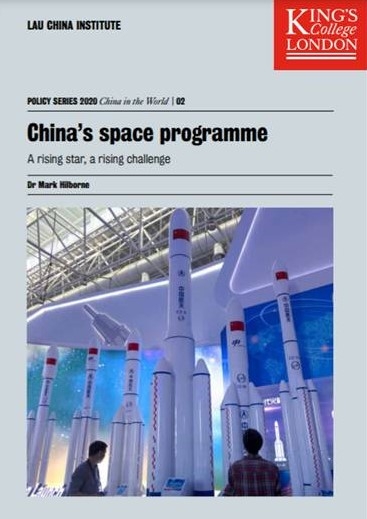
Miscommunication and miscalculation between the U.S. and China in the “Space Race” could have grave consequences for the globe.
That’s the central theme of a new policy paper from the Lau China Institute at King’s College London outlines warns, written by Mark Hilborne, Lecturer, Defense Studies Department and in War Studies Online.
Slow to materialize
Hilborne explains that a greater understanding of China and its ambitions in space has been slow to materialize. However, as it does, “it begins to reveal a highly competitive agenda, with the objective to eclipse the U.S. in space by mid-century clearly laid out, all underpinned by a suite of counterspace capabilities.”
The policy paper adds that there’s a wider challenge to the U.S. across the full spectrum of national power. Nevertheless, the tensions that arise due to competition in space trigger particular sensitivities, “and these will need careful management to avoid space becoming a domain of outright hostility.”
For the full report, go to:
https://www.kcl.ac.uk/lci/assets/ksspplcipolicyno.2-final.pdf
 Posted in

Credit: via Roscosmos
Russia and China have signed a memorandum of understanding to cooperate on constructing an international scientific and research station on the Moon.

Dmitry Rogozin, director general of Roscosmos, Russia’s space agency, puts pen to paper and signed an MOU to cooperate with China on constructing an international scientific and research station on the Moon.
Credit: Roscosmos
China National Space Administration’s (CNSA) Director Zhang Kejian and Dmitry Rogozin, director general of Roscosmos, Russia’s space agency, put pen to paper and signed the MOU via a video conference on Tuesday.
“The state corporation Roscosmos and CNSA … will contribute to cooperation in creating an international lunar research station with an open access for all interested countries and international partners, with the aim of strengthening scientific research interaction, promoting research and using outer space for peaceful purposes in the interests of the entire humankind,” Roscosmos said in a statement.

Video conference to sign agreement on China/Russia cooperation on constructing an international scientific and research station on the Moon.
Credit: Roscosmos
Create a roadmap
According to a posted statement from CNSA, “China and Russia use joint experience and scientific technologies to create a roadmap for building an international research station on the Moon.”
That roadmap, said the CNSA, includes the planning, demonstration, development, implementation and operation of the lunar station. The two nations will also promote the project to the international space community.

Video conference to sign memorandum of understanding.
Credit: Roscosmos
“I also invited my Chinese colleague Zhang Kecan to visit the launch from the Vostochny cosmodrome of our Luna-25 mission,” Rogozin later tweeted. The Luna-25 lunar lander mission is set for liftoff this October.
Research work ahead
The International Scientific Lunar Station is a complex of experimental research facilities created on the surface and/or in the orbit of the Moon, Roscosmos explains.

Credit: NASA
Designed to carry out multidisciplinary and multipurpose research work, the lunar station’s tasks include the exploration and use of the Moon, lunar observations, fundamental research experiments and technology verification with the possibility of long-term robotic operation with the prospect of human presence on the Moon.
The two countries are coordinating future observations taken by Russia’s Luna-Resurs-1 orbiter and China’s Chang’e-7 spacecraft that will survey the south polar region of the Moon. Russia and China are also cooperating in the creation of a joint data center for the exploration of the Moon and deep space.

Japan’s Hayabusa2 is pulling up to Ryugu – a C-type asteroid – for detailed study.
Artwork: Akihiro Ikeshita
Japan’s Hayabusa2 asteroid sample-return mission continues to provide data regarding its returned specimens and the overall performance of the spacecraft.
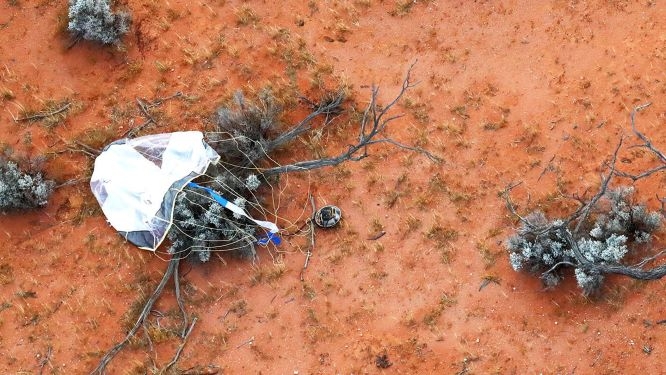
Hayabusa2 sample return capsule recovery in Australia.
Credit: JAXA
Flown by the Japan Aerospace Exploration Agency (JAXA), Hayabusa2 carried out detailed work for a year and a half at near-Earth asteroid 162173 Ryugu.
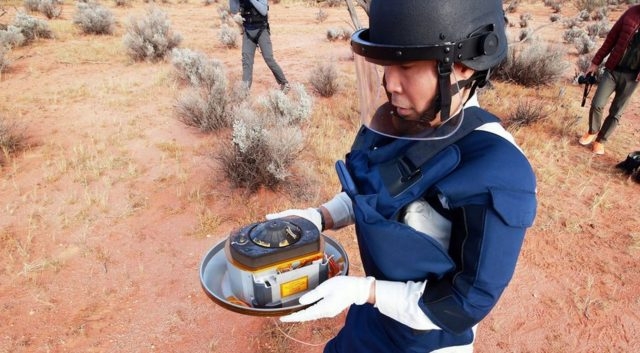
Samples snagged at the space rock were returned to Earth in early December of 2020. The spacecraft’s sample capsule landed and was recovered at the Woomera Test Range in Australia.
A post-flight analysis of the re-entry capsule collected in Australia is being intensely studied for use in designing future missions.
Credit: JAXA
Curation work underway
The amount of Hayabusa2 samples collected from the returned sample catcher exceeded expectations. Researchers from Japan’s Astromaterials Science Research Group (ASRG) are diligently cataloging the bits and pieces brought back to Earth.
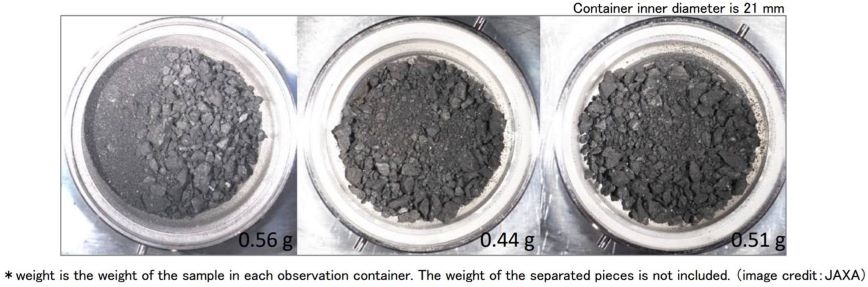
The sample in chamber C was placed in observation containers with weight measurement and optical microscope observations started.
Credit: JAXA

Researchers from Japan’s Astromaterials Science Research Group (ASRG) are diligently cataloging the bits and pieces brought back to Earth from asteroid Ryugu.
Credit: ASRG
In a JAXA-held briefing last week, it was explained that curation work is proceeding with the weight measurement and acquisition of high-definition optical microscope images of the particles and bulk powder sample from asteroid Ryugu, focusing on the particles in chamber C recovered from Hayabusa2s second touchdown point on the space rock.
Re-entry capsule condition
Project experts noted that the condition of each capsule part is generally good, and the on-board equipment is functioning normally after return to the JAXA Sagamihara campus. A detailed analysis of the condition of the return capsule’s heat shield is currently underway.
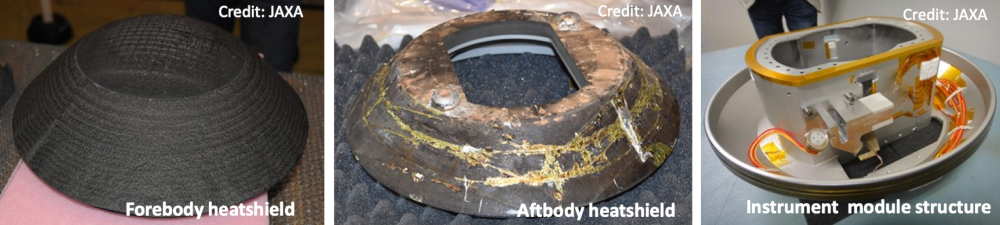
Return capsule parts. Credit: JAXA
In addition, data has been retrieved from the Re-entry Environment Measurement Module (REMM) that was mounted on the re-entry capsule. REMM measured the airframe motion and temperature of each part of the capsule during the high-speed re-entry into the atmosphere.
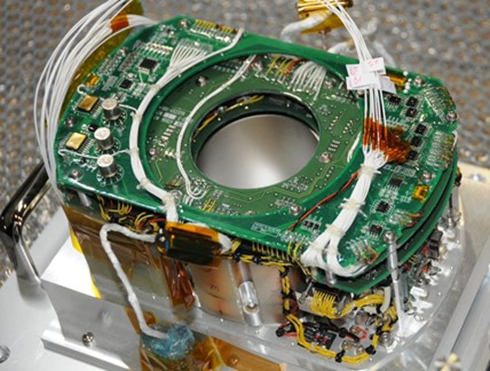
Credit: JAXA
Analysis of the data acquired by REMM confirmed that the inside of the re-entry capsule — including the sample stored in the sampler — maintained a temperature environment that did not greatly exceed room temperature from re-entry to landing. Study of the REMM acquisition data will continue in detail, put to use in the research and development of future re-entry vehicles.
Credit: JAXA
Round-trip names and messages
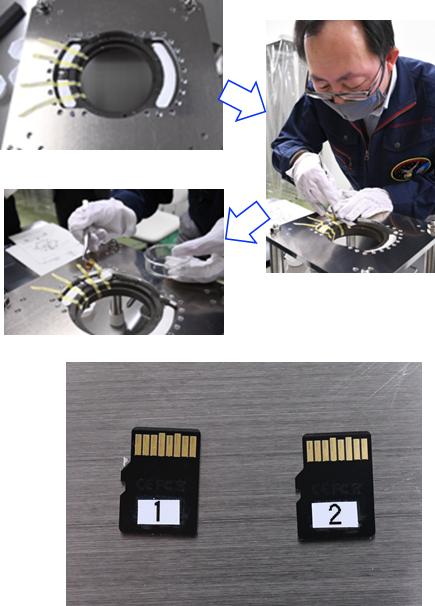
The re-entry capsule was also equipped with memory chips containing electronic files of names and messages that were submitted before launch from people all over the world.
“We removed the two memory chips and were able to read both normally: the virtual round-trip to asteroid Ryugu was completed successfully! We are currently designing a system that will allow everyone to search for written names and messages,” Hayabusa2 researchers said at the March 5 press briefing. A system is being designed to allow participants to search for their written names and messages.
Depending on Covid-19 restrictions, public viewing of the Hayabusa2 re-entry capsule is slated to start this week at the Sagamihara City Museum, followed by a capsule showing at the country’s National Science Museum.

Photo credit: CNSA/CLEP/Jianjun Liu, et al.
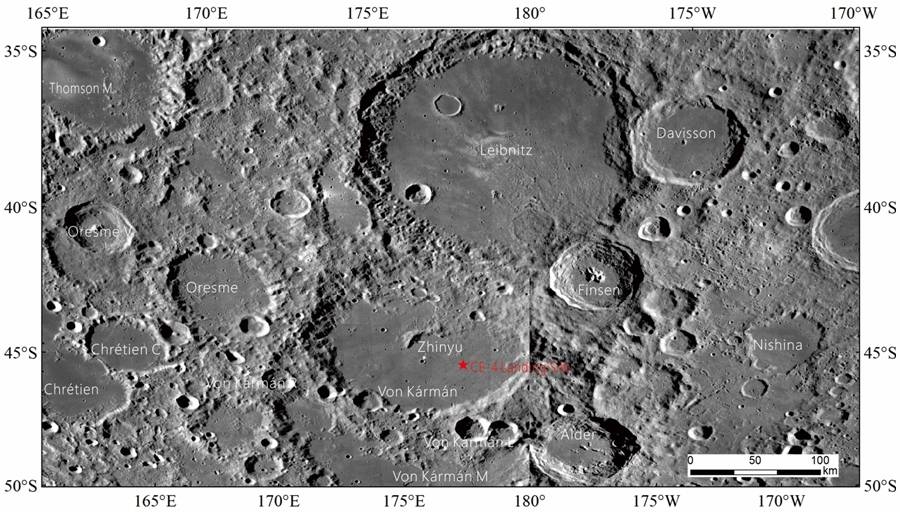
Chang’e-4 landing site.
Credit: CNSA/CLEP

Credit: ISS/NASA
Earth’s Moon hangs there like a celestial nightlight. We have an enduring relationship with this object. But trying to shed daylight on its origins…we remain in the “dark ages.”
Where did our Moon come from? That child-like question would appear simple to answer. But today those are six words that engender debate, scads of peer-reviewed geological papers, and downright tumult in scientific circles.

Credit: NASA
As multiple nations are now engaged in a new round of robotic lunar exploration –with boots to follow – extracting the truth from the Moon about its beginnings is true CSI – Celestial Science Investigation.
A new research paper spotlights the complexities of making out a model for the origin of Earth’s Moon.
Decades of research
Prepared for the forthcoming volume of New Views of the Moon II, a research paper led by Robin Canup of the Planetary Sciences Directorate at Southwest Research Institute in Boulder, Colorado, clarifies the challenges ahead.
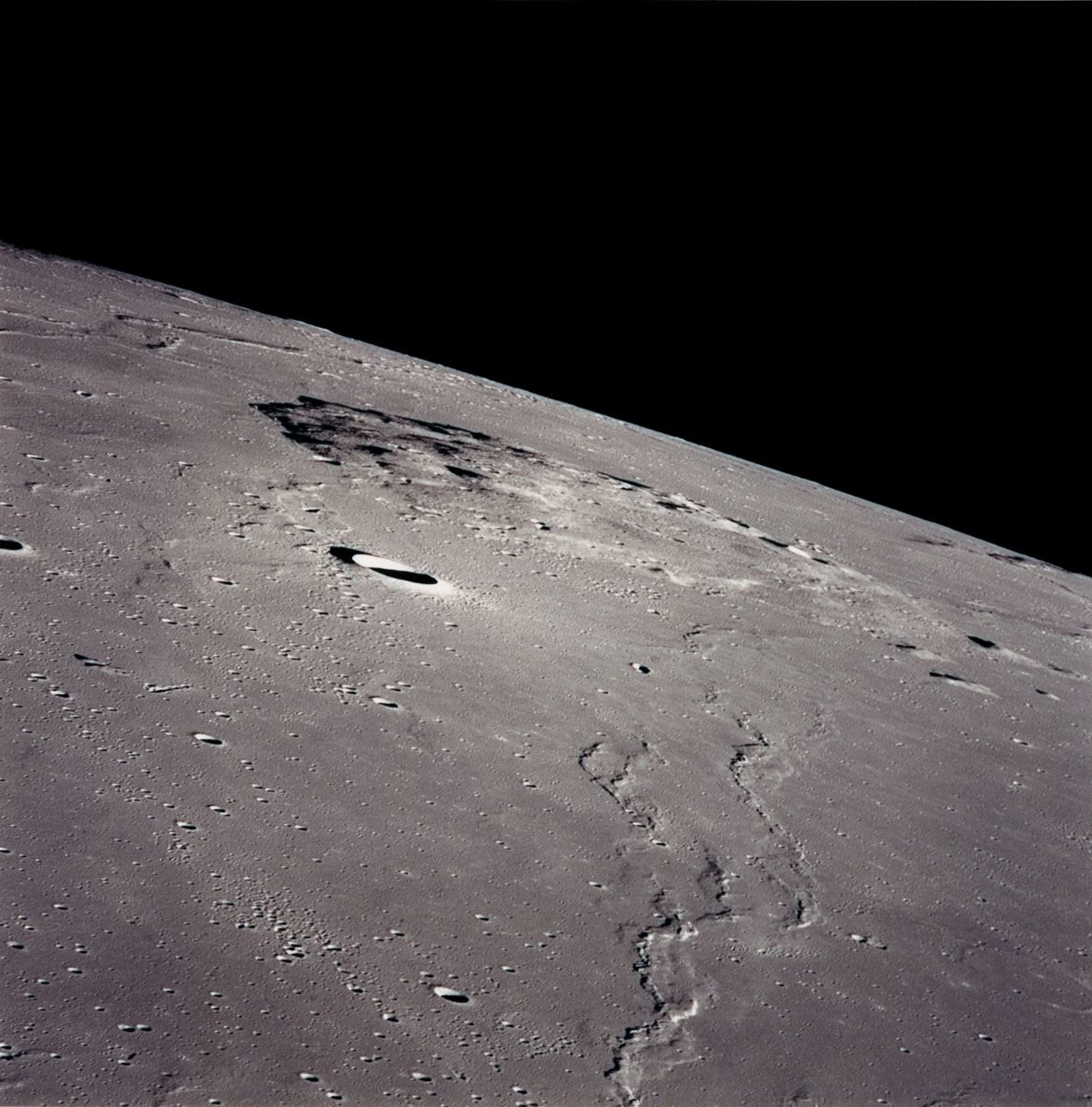
Apollo 15 image of the Mons Rümker region in the northern part of Oceanus Procellarum.
Credit: NASA
First of all, the Earth-Moon system is odd in several respects, Canup and colleagues make clear. The Moon is roughly one-fourth the radius of the Earth. That’s a larger satellite-to-planet size ratio than all known satellites – other than Pluto’s Charon.
Our Moon has a tiny core, perhaps just one-percent of its mass compared to Earth whose core contains nearly 30 percent of its mass.
The Earth-Moon system has a high total angular momentum, implying a speedily spinning Earth when the Moon formed. In addition, the early Moon was hot and at least partially molten with a deep magma ocean.
“Identification of a model for lunar origin that can satisfactorily explain all of these features has been the focus of decades of research,” the research paper notes.
Early Earth and Moon, perhaps created in a different manner than has previously been thought?
Credit: NASA
Impact origin
The lunar research group explains that decades of modeling have shown that large impacts are efficient producers of moons. However, the paper puts forward that the overall likelihood of explaining the particular characteristics of our Earth-Moon system “may be small, even given innovative and diverse impact models.”
Impact origin studies share a common goal, the paper adds, to identify collisional scenarios that can account for the properties of the Earth-Moon system.
A variety of scenarios for a Moon-forming impact are detailed in the paper. How about a roughly Mars-mass impactor that collides with Earth at a low velocity? Perhaps there was a “hit-and-run” impact? What about fender-bender simulations that advocate our planet was on the receiving end of multiple planetary-scale impacts during its final accretion?
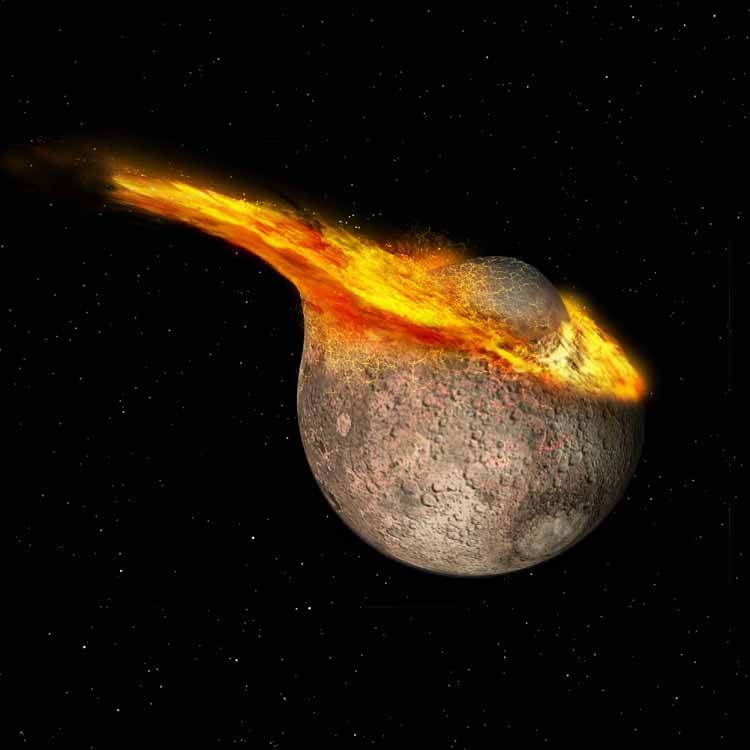
Credit: NASA
Perhaps the Moon did not form by impact, the research team puts forward. That prospect, however, seems very difficult to explain basic characteristics, for one, the Moon’s lack of iron.
“The famous principle of Occam asserts that the simplest explanation for an observation is preferred, or alternatively, that ‘more things should not be used than are necessary,’” the paper points out.
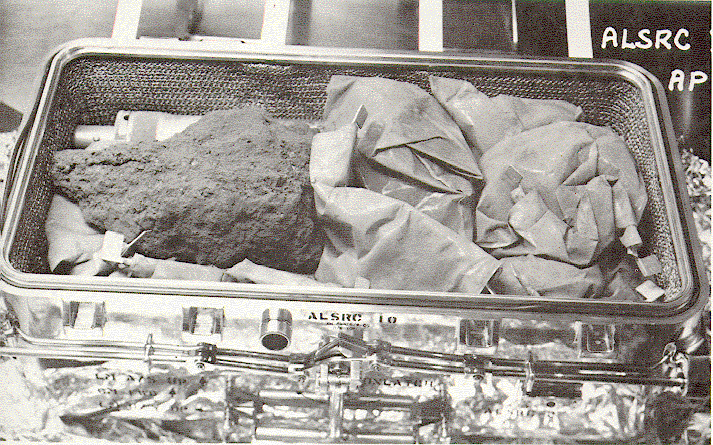
One of the Apollo 16 sample boxes being opened in the Lunar Receiving Laboratory on Earth. The box contains a large rock and many small sample bags.
Credit: NASA/Johnson Space Center
Spirit of Sherlock Holmes
Future work may well rule out many of the models pondered, Canup and her colleagues write. If that’s the case, and in the spirit of Sherlock Holmes, whatever is left, however improbable, will be the solution?
“Perhaps a process that at this time appears constraining may later be understood to be probable. Or perhaps there is a more probable solution that eludes us still,” they add.
Whatever outcome from the detective trail, thanks to the Moon’s accessibility, facts of its detailed composition and physical properties will likely always exceed that of the other planets in the inner Solar System, the researchers conclude.

Moon base design.
Credit: ESA/P. Carril
High precision chemical and isotopic analyses of Moon samples brought back to Earth “have shaken the foundations of the paradigm of lunar formation by a giant impact,” the researchers conclude. “However, a multitude of new concepts have emerged whose details and implications still need to be evaluated. This, together with increasing prospects for further lunar exploration in the near-term, makes this a truly exciting time for lunar origin science.”
To read the entire “Origin of the Moon” research paper by Canup, Kevin Righter, Nicolas Dauphas, Kaveh Pahlevan, Matija Ćuk, Simon Lock, Sarah Stewart, Julien Salmon, Raluca Rufu, Miki Nakajima, and Tomáš Magna, go to:
https://arxiv.org/ftp/arxiv/papers/2103/2103.02045.pdf
Special thanks to Jatan Mehta and his “Moon Monday” newsletter for flagging this new research paper. Moon Monday is available at:
https://moonmonday.jatan.space

Curiosity Mast Camera Left image taken on Sol 3049, March 5, 2021.
Credit: NASA/JPL-Caltech/MSSS
NASA’s Curiosity Mars rover has just begun performing Sol 3052 duties.
Ryan Anderson, a planetary geologist at the USGS Astrogeology Science Center in Flagstaff, Arizona reports that the Mars rover team decided to drive to a drill location closer to the cliff face of “Mont Mercou.”
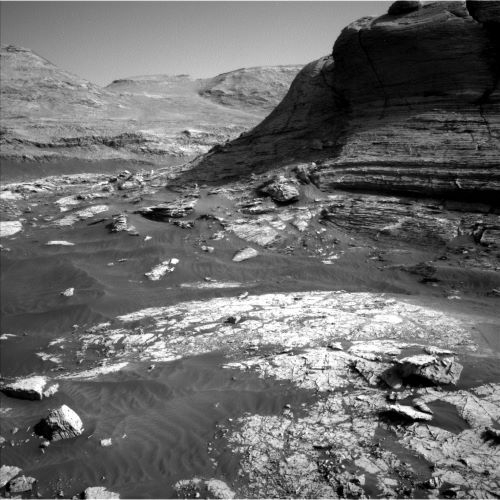
A flat patch of bright outcrop on Mars, a rover drill site imaged by Curiosity’s Left Navigation Camera on Sol 3049.
Credit: NASA/JPL-Caltech
“Before we do that, Mastcam will take a stereo mosaic of the drill site as well as a larger stereo mosaic of the cliff face to get a high-resolution look at the layers exposed there,” Anderson notes.
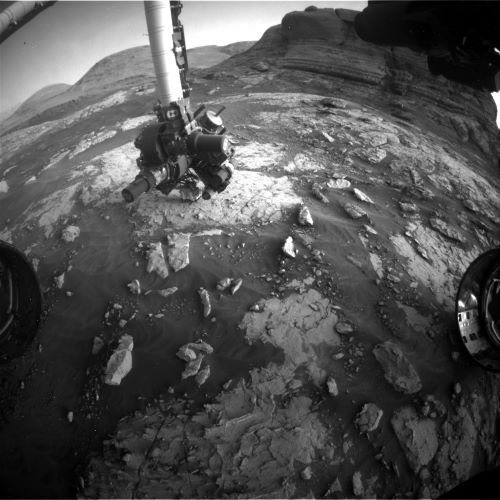
Curiosity Front Hazard Avoidance Camera Right B image acquired on Sol 3051, March 7, 2021.
Credit: NASA/JPL-Caltech
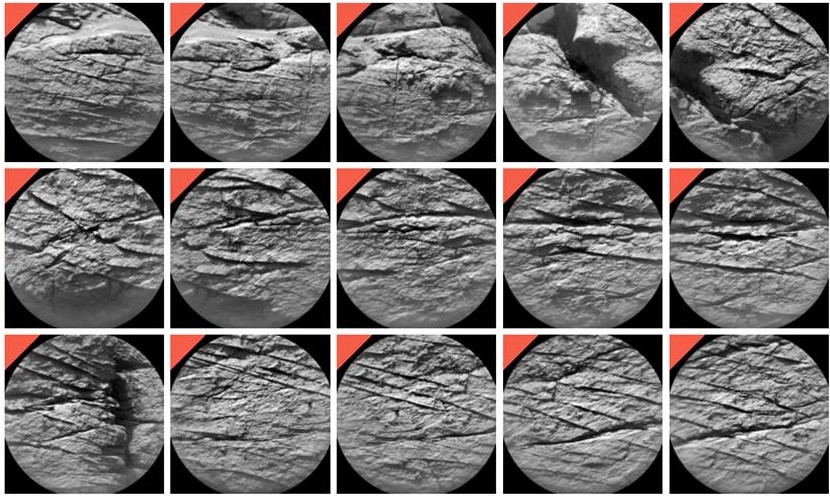
Curiosity Chemistry & Camera Remote Micro-Imager (RMI) photo acquired on Sol 3051, March 6, 2021.
Credit: NASA/JPL-Caltech/LANL
The robot’s Chemistry and Camera (ChemCam) will join in too, with a 20-image mosaic of the top of the cliff.
Series of images
Curiosity’s Mastcam was slated to search for dust devils and measure the amount of dust in the atmosphere on Sol 3051.
In the late afternoon on Sol 3051, the rover’s Mars Hand Lens Imager (MAHLI) was scheduled to collect a series of images of the targets “Montrem” and “Peyrat” and then the Alpha Particle X-Ray Spectrometer (APXS) will measure the composition of both targets, starting in the evening on Peyrat and continuing overnight on Montrem.
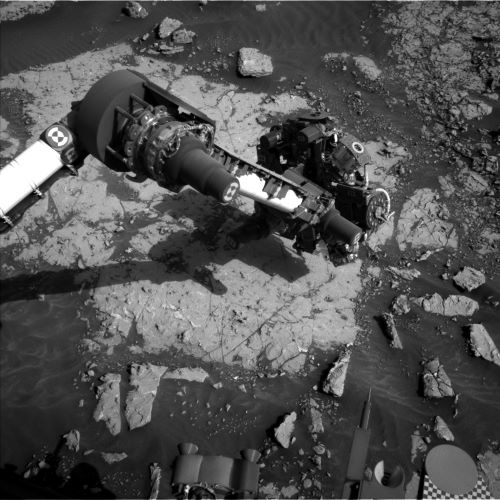
Curiosity Left B Navigation Camera image acquired on Sol 3051, March 7, 2021.
Credit: NASA/JPL-Caltech
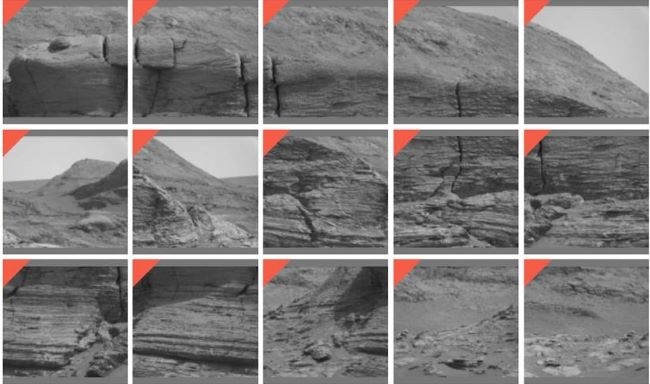
Curiosity Mast Camera Right imagery from Sol 3049, March 5, 2021.
Credit: NASA/JPL-Caltech/MSSS
New location
Sol 3052 will start with Navcam atmospheric observations, followed by ChemCam passive and Mastcam multispectral observations of the brushed spot on Montrem.
Mastcam will also take a stereo mosaic of the target “Grand Brassac” and a nearby butte.
“We will then drive toward Mont Mercou and collect Navcams
and a [Mars Descent Imager] MARDI image from the rover’s new location,” Anderson says.
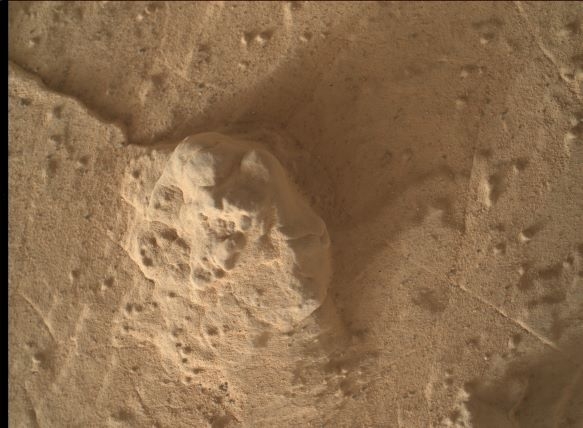
Curiosity Mars Hand Lens Imager photo produced on Sol 3051, March 7, 2021
Credit: NASA/JPL-Caltech/MSSS
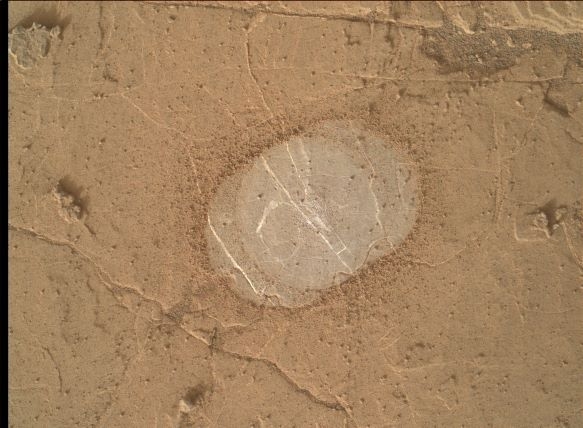
Brushed spot on “Montrem” as seen in this Curiosity Mars Hand Lens Imager photo produced on Sol 3051, March 7, 2021.
Credit: NASA/JPL-Caltech/MSSS
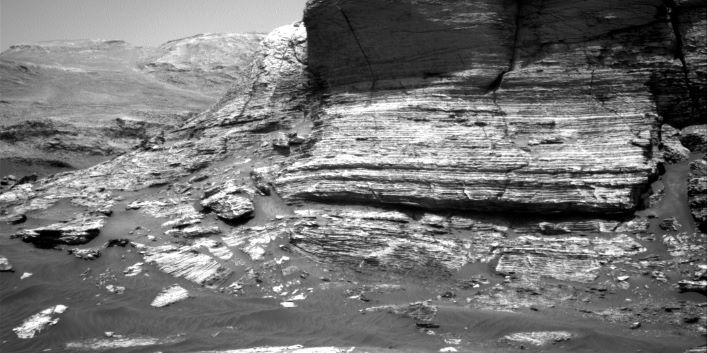
Curiosity Right B Navigation Camera photo taken on Sol 3050, March 5, 2021.
Credit: NASA/JPL-Caltech
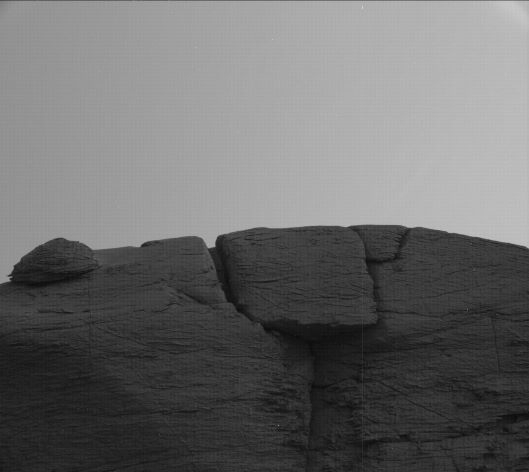
Curiosity Mast Camera Left image taken on Sol 3049, March 5, 2021.
Credit: NASA/JPL-Caltech/MSSS
Overnight between sols 3052 and 3053, the robot’s Sample Analysis at Mars (SAM) Instrument Suite has a calibration activity. On Sol 3053, the plan calls for use of Navcam to watch for clouds, and both Navcam and Mastcam to measure atmospheric dust.
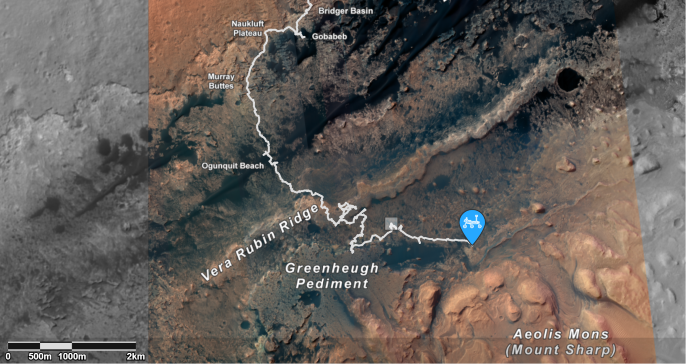
NASA Curiosity Mars rover’s location as of Sol 3049.
Credit: NASA/JPL-Caltech/Univ. of Arizona
NASA’s Curiosity Mars rover at Gale crater is now performing Sol 3050 duties.
New imagery received from the robot show the surrounding views:
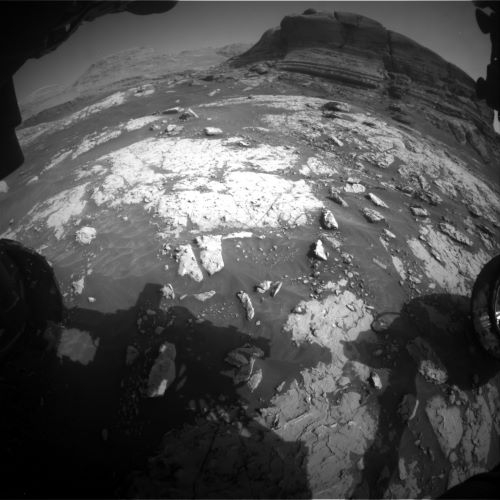
Curiosity Front Hazard Avoidance Camera Left B image taken on Sol 3049, March 5, 2021.
Credit: NASA/JPL-Caltech

Curiosity Left B Navigation Camera photo taken on Sol 3049, March 5, 2021.
Credit: NASA/JPL-Caltech
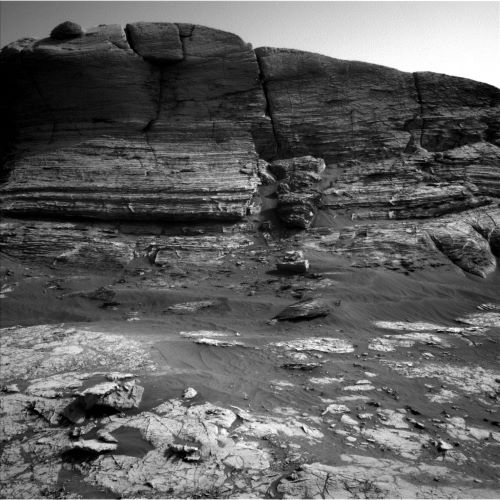
Curiosity Left B Navigation Camera photo taken on Sol 3049, March 5, 2021.
Credit: NASA/JPL-Caltech
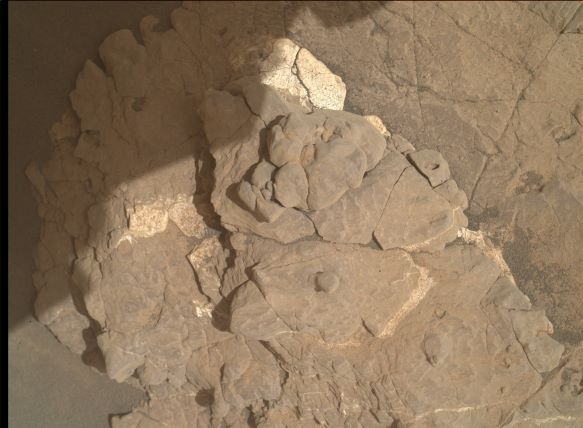
Curiosity Mars Hand Lens Imager photo produced on Sol 3049, March 4, 2021.
Credit: NASA/JPL-Caltech/MSSS
Credit: ISS/NASA
Will the Cold War-era Outer Space Treaty survive in the current geopolitical environment? And if not, then what? Does the success of the NASA Artemis Accords point towards further developments in the near future?

Credit: NASA
A new paper queries how best to fairly allow nations to claim new territory in a way that does not spark war.
Captain Bryant A. Mishima-Baker, Chief of Military Justice at Patrick Air Force Base, Florida, explains that the rapid advancement of space technology by both China and the United States suggests that answers to these questions will become necessary sooner than previously thought.
Go to: “Moon Wars: Legal Trouble in Space and Moon Law” by Captain Bryant A. Mishima-Baker, Chief of Military Justice at Patrick Air Force Base, Florida.
Go to:

SpaceX’s Elon Musk has a visionary space agenda for Mars.
Credit: Rob Varnas
Dangers await humans on Mars as Elon Musk sets his sights on colonization.

Credit: SpaceX
“There really is only one true home for us—and we’re already here,” explains science journalist Shannon Stirone, featured on the March 4th broadcast of CNBC’s “The News with Shepard Smith.”
Go to Stirone’s article — “Mars Is a Hellhole – Colonizing the red planet is a ridiculous way to help humanity” — published in The Atlantic at:
https://www.theatlantic.com/ideas/archive/2021/02/mars-is-no-earth/618133/
For info on her opinion, go to this CNBC link at:
https://www.cnbc.com/2021/03/04/dangers-await-humans-on-mars-as-elon-musk-eyes-colonization.html

Curiosity position as of Sol 3047. Distance driven to date: 15.44 miles (24.85 kilometers).
Credit: NASA/JPL-Caltech/Univ. of Arizona
NASA’s Curiosity Mars rover is now performing Sol 3049 tasks.
“Curiosity continues her climb up toward the lovely cliff of ‘Mont Mercou,'” reports Michelle Minitti, a planetary geologist at Framework in Silver Spring, Maryland.
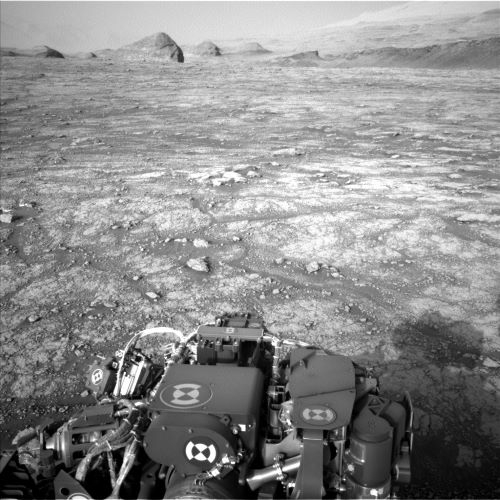
Curiosity Left B Navigation Camera photo acquired on Sol 3047, March 3, 2021.
Credit: NASA/JPL-Caltech
The drive could be the start of the sulfate-rich layers of “Mount Sharp” that the science team have had their eyes on since Gale crater was identified as the robot’s landing site.
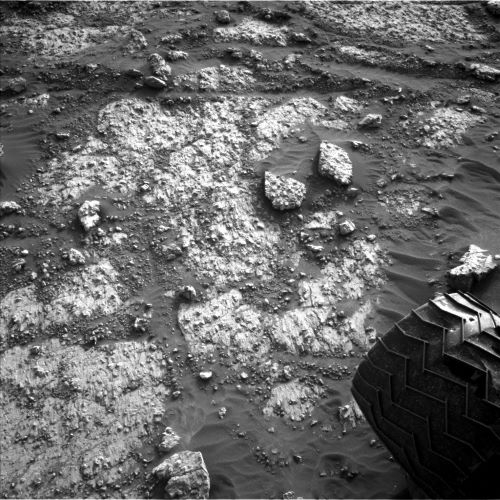
Curiosity rover’s right middle and rear wheels had turned up on some of the lumpier rocks that dot the current terrain (one of which you can just spy under the right middle wheel in the above image)(one of which you can just spy under the right middle wheel in this image taken by Left Navigation Camera taken on Sol 3047.
Credit: NASA/JPL-Caltech.
Ankle turn
“Mountain climbing has its risks, though, and we found that Curiosity had suffered a bit of an ankle turn – as much as a rover has ankles – at the end of the Sol 3047 drive,” Minitti explains.
“The right middle and rear wheels had turned up on some of the lumpier rocks that dot the current terrain, putting us in a not-quite-stable position to unstow the arm,” Minitti adds.
That position has impacted use of the Alpha Particle X-Ray Spectrometer (APXS) and the rover’s Mars Hand Lens Imager (MAHLI) to make close-in study of targets “Valojoulx” and “Marval.”
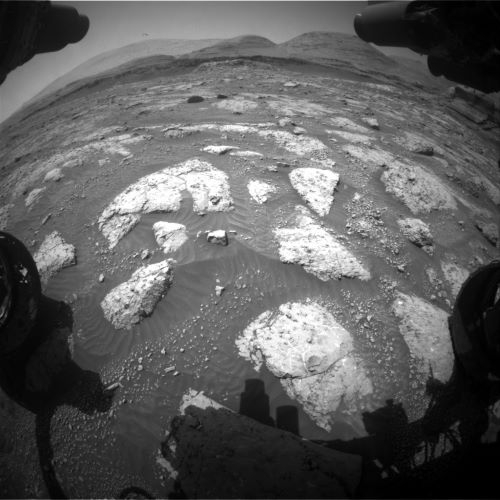
Curiosity Front Hazard Avoidance Camera Right B image taken on Sol 3048, March 3, 2021.
Credit: NASA/JPL-Caltech
The former represents a flatter part of the bedrock in the workspace, and the latter a lumpier, more resistant part of the bedrock, Minitti notes. “The awkward placement of the wheels did not prevent all the non-arm instruments from keeping busy, however!”
Standing proud
Scientists will assess the spectral character of Marval with both Chemistry and Camera (ChemCam) passive and Mastcam multispectral observations.
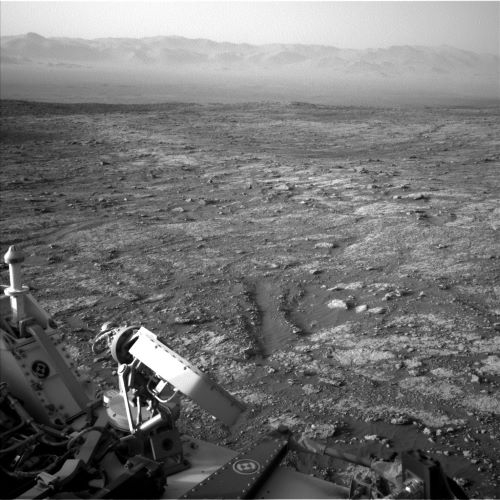
Curiosity Left B Navigation Camera photo acquired on Sol 3047, March 3, 2021.
Credit: NASA/JPL-Caltech
“We will acquire another ChemCam passive on “Chaleix,” a block that is standing proud among the lower-lying bedrock patches around us, thus revealing a vertical face ripe for observation. That vertical face also made an irresistible target for a small Mastcam stereo mosaic,” Minitti explains.
The dramatic buttes above Mont Mercou will be covered by two ChemCam Remote Micro-Imager (RMI) mosaics.
Wheel wiggling
“Right before the rover drivers wiggle our wheels off the troublesome rocks of today’s parking space, Mastcam will acquire a large stereo mosaic of Mont Mercoum,” Minitti adds. “Then, for an encore, Mastcam will acquire another stereo mosaic of Mont Mercou a few meters into our drive to our weekend parking spot. The hope is that not only will each individual stereo mosaic give us a better picture of the structure within the cliff, but the mosaics together can be combined into their own stereo view, adding different perspective and detail of the cliff.”
Also slated is using the robot’s Mastcam to image the sky as well as rocks. On both evenings of the plan, Mastcam will image a swath of sky above Mount Sharp to look for clouds.
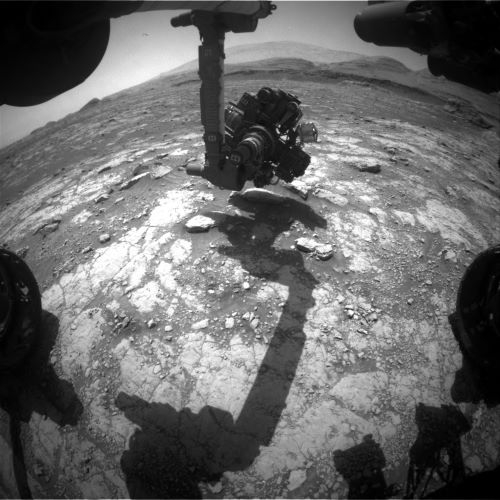
Curiosity Front Hazard Avoidance Camera Right B photo taken on Sol 3047, March 2, 2021.
Credit: NASA/JPL-Caltech
Steady watch
“Not to be outdone, Navcam will also image the sky to look for clouds and dust devils multiple times in the plan,” Minitti says.
Curiosity’s Radiation Assessment Detector (RAD) and the Rover Environmental Monitoring Station (REMS) are to keep steady watch on the environment throughout the plan.
The Dynamic Albedo of Neutrons (DAN) will ping the ground in back of the rover before, during and after a drive, Minitti concludes, keeping steady watch on the state of hydrogen in the subsurface. “Here’s hoping Curiosity lands in a slightly less bumpy spot for the weekend!”

