Archive for the ‘Space News’ Category
 Author:
  April 8th, 2021
Image depicts Space Solar Power Incremental and Demonstrations Research (SSPIDR) project to beam solar power from space to Earth. SSPIDR consists of several small-scale flight experiments that will mature technology needed to build a prototype solar power distribution system.
Credit: Air Force Research Laboratory (AFRL)
A U.S. military space plane is being used to flight validate how best to gather the Sun’s energy for power beaming from Earth orbit. In mid-March, the classified mission of the U.S. Space Force X-37B robotic space plane winged past 300 days in Earth orbit.
Also known as Orbital Test Vehicle-6, the craft carries what is called the Photovoltaic Radio-frequency Antenna Module Flight Experiment, or simply dubbed as PRAM-FX.
PRAM-FX is a Naval Research Laboratory (NRL) experiment that’s investigating transforming solar power into radio frequency (RF) microwave energy. PRAM-FX is a 12-inch square tile that collects solar energy and converts it to RF microwave power.
For more details, go to my new SPACE.com story:
“Space-based solar power getting key test aboard US military’s mysterious X-37B space plane…and some preliminary results are already in” at:
https://www.space.com/x-37b-space-plane-solar-power-beaming
 Posted in

China’s Gaofen-4 spacecraft is prepared for 2015 launch.
Credit: CAST
China has used a geostationary satellite – viewed by some as a powerful spy satellite of Earth – to make seamless maps of major elements of the Moon.
In a paper appearing in Research in Astronomy and Astrophysics, a team of space scientists and Earth observational researchers made use of the Gaofen-4 spacecraft to help understand the origin and evolution of the Moon.
Whole lunar disk
Maps of major elements using the single-exposure image of the whole lunar disk were obtained by China’s high-resolution geostationary satellite.
A spatial resolution of roughly 500-meters was achieved.
“The elemental contents of soil samples returned by Apollo and Luna missions are regarded as ground truth, and are correlated with the reflectance of the sampling sites extracted from Gaofen-4 data,” the paper states.
The Gaofen-4 data products allowed major elements for the Moon’s maria and highlands to be estimated and compared.

Copernicus crater imaged by China’s high-resolution geostationary satellite, Gaofen-4, at four different local times.
Credit: Y. Lu et al.
Powerful telescope
According to the popular satellite tracking website, N2YO.com, Gaofen-4 is outfitted with a powerful telescope to collect nearly continuous imagery of the Asia-Pacific, a capability that could help track foreign naval activity.
“Gaofen 4’s staring imager can spot objects as small as 50 meters (164 feet), a resolution that allows the satellite to see an oil tanker steaming across the ocean. At night, an infrared camera aboard Gaofen 4 can capture less detailed imagery with a resolution of about 400 meters, or 1,300 feet. Gaofen 4 is designed for an eight-year lifetime,” the N2YO.com notes.
Gaofen-4 was launched in December 2015 on a CZ-3B/G2 rocket from China’s Xichang space center.
The spacecraft has also been tagged as supporting disaster response, forestry, earthquake and meteorology applications, and supplements an advanced technology for natural disaster alerts, be they for wild fires, typhoon, along with national security duties.
To view the paper – “Seamless maps of major elements of the Moon: Results from high-resolution geostationary satellite” – go to:
https://iopscience.iop.org/article/10.1088/1674-4527/21/2/31

Beyond: The Astonishing Story of the First Human to Leave Our Planet and Journey into Space by Stephen Walker; HarperCollins Publishers; 512 pages; April 2021; Hardcover: $29.99.
As we celebrate the 60th anniversary of the pioneering flight of “Cosmonaut Number One,” this tell-all book recaptures the remarkable trek of the Soviet Union’s Yuri Gagarin.
The author has written an incredible account, not only revealing details about that first human space sojourn into Earth orbit, but the now-faded Cold War facts about Soviet-U.S. “space race” rivalry. Walker has chronicled Gagarin’s epic flight on April 12, 1961, counterpointing the early years of a just-launched NASA and its fresh set of Mercury astronauts.
“But the way was opened by Yuri Gagarin,” Walker states, “the man who did it first, when he strapped into his little sphere on top of his rocket sixty years ago, and stepped into the beyond.”
One item detailed is the decision-making on whether Gagarin or Gherman Titov would be tapped for that first human spaceflight. The author points out that strain gauges had been placed underneath their night-before-launch mattresses. Those gauges were monitored by a technician and a psychologist, recording any tossing and turning during the night that might impact their piloting skills. Gagarin might have lost his chance to step into the history books “simply by moving in bed too much,” Walker says. Titov would later orbit the Earth in August 1961 – the second person to circle the Earth.
This book is an exhaustive culling together of original research, along with testimony of eyewitnesses that is riveting, well-written and provides little-known details of Gagarin’s heralded flight of 106-minutes. The volume is jam-packed with historical gems; to this day no one knows the exact spots where either Gagarin or his Vostok sphere landed, for example. Both places were originally marked with simple posts which soon disappeared, Walker notes.
“In the immediate aftermath of his flight the Soviet government showered Yuri Gagarin and his family with rewards. A secret decree from the ministry of defense, issued just four days after the Red Square celebrations and only published fifty years later, offers a revealing glimpse into the state’s power and reach over all of their lives; and perhaps too, the relative material poverty of those lives beforehand,” Walker explains.
Divided up into four acts – “Four Months Earlier,” “Decision,” “Final Countdown,” “Launch,” followed by an “Endgame” epilogue, this volume is an extraordinary look at two space superpowers that took major risks to hurl a man into space first, the Americans in the full glare of the press, the Soviets in secretive and deep cover mode.
For more information on this book, go to:
https://www.harpercollins.com/products/beyond-stephen-walker?variant=32231860928546
And also Stephen Walker’s website about the book at:

China’s farside rover images Chang’e-4 lander in the distance.
Credit: CNSA/CLEP
China’s Chang’e-4 mission to the Moon’s farside has survived another cold shock from 14-days of lunar night.
The lander and rover have resumed work for a 29th lunar day.
Reports the Lunar Exploration and Space Program Center of the China National Space Administration (CNSA), The lander woke up at 9:43 p.m. Tuesday (Beijing Time), and the Yutu-2 (Jade Rabbit-2) rover, awoke at 3:54 a.m. Tuesday.

Chang’e-4 farside lander and Yutu-2 rover.
Credit: CNSA/CLEP
The two machines had switched to dormant mode during the lunar night due to the lack of solar power.
They have survived about 825 Earth days on the Moon.

Chang’e-4’s farside landing zone.
Credit: NASA/GSFC/Arizona State University
Lander, rover location
Wheeling about in the northwest of Chang’e-4’s landing site, the rover has traveled roughly 2,240 feet (682.8 meters).
The linear distance between the rover and the Chang’e-4 lander is about 1,493 feet (455 meters), according to a Xinhua news report.
During its 29th lunar day, the rover will continue to move northwest toward the basalt distribution area located about 0.746 miles (1.2 kilometers) away from the rover.

Wu Weiren, chief designer of the lunar exploration program, presents the Chang’e-4 rover.
Credit: CCTV/Screengrab
The equipment aboard the rover, including a panoramic camera, an infrared imaging spectrometer, a neutral atom detector and a radar, will continue to carry out scientific explorations.
The Chang’e-4 probe, launched on Dec. 8, 2018, made the first-ever soft landing within the Von Kármán crater in the South Pole-Aitken Basin on the farside of the Moon on January 3, 2019.
Space station work
Meanwhile, China’s human spaceflight program is pushing forward on readying the Tianhe Core Module for liftoff. That hardware is the foundation element of the Chinese space station expected to be in operation around 2022.

Core module of China’s space station.
Credit: CMS/Inside Outer Space screengrab
This key module — along with its Long March 5B booster — are both at the Wenchang Spacecraft Launch Site in south China’s Hainan Province, expected to be launched in the first half of this year.
A total of 12 Chinese astronauts will enter space in 11 missions launched under China’s manned space program over the next two years, said Yang Liwei, the country’s first astronaut, in a recent China Central Television (CCTV) interview.

China’s space station expected to be completed around 2022.
CMS/Inside Outer Space screengrab
“After we launch the core module, we will send a cargo spacecraft to dock with it. And then we will launch the Shenzhou-12 spacecraft. That’s why I say it is critical this year, as all the flight missions rely on our core module, and it must succeed. The launch of the core module will be a milestone indeed,” Yang added.
Significant and symbolic
“For Experiment Modules I and II that we will launch next year,” Yang said, “they both need to be docked with the core module, which is of significant and symbolic meaning to the whole space station program of China. Only after we launch the space station to outer space, will we truly enter the phase of verification and building of the space station.”

Credit: CMS/CCTV/Inside Outer Space screengrab
This year and next, while China’s space station is being built, Yang said four crewed spaceflight missions will be carried out. “We have chosen the astronauts for the four crews, and are now training them for each of the missions. There will be experienced and new astronauts assigned to each crew, and you will see many familiar faces among them,” he told CCTV.
In total, China’s astronaut corps consists of 34 individuals.
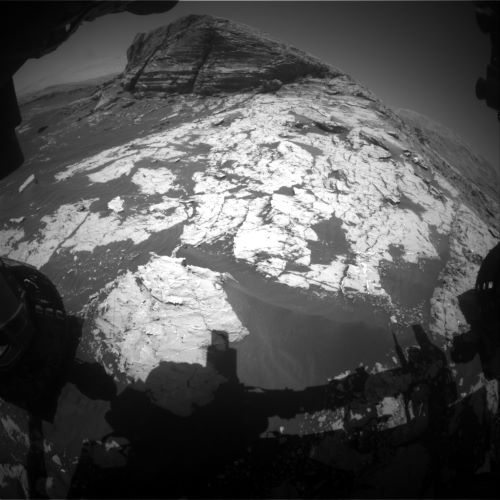
Curiosity Front Hazard Avoidance Camera Left B image taken on Sol 3080, April 5, 2021.
Credit: NASA/JPL-Caltech
NASA’s Curiosity Mars rover at Gale Crater is now performing Sol 3081 tasks.
The robot is on a hunt for its next drill target, reports Mariah Baker, a planetary geologist at the Center for Earth & Planetary Studies, Smithsonian National Air & Space Museum in Washington, D.C.
“Recently, the rover has been investigating the ‘Mont Mercou’ rock outcrop…and now she’s making her way around to the top of the outcrop to find a suitable place to drill,” Baker notes. “But there’s always science to be done along the way!”
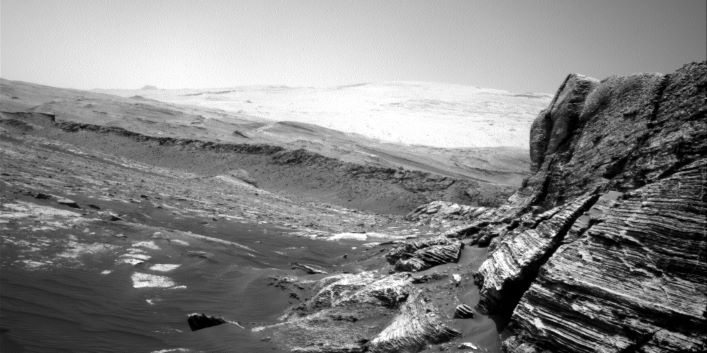
Curiosity Right B Navigation Camera photo taken on Sol 3080, April 5, 2021.
Credit: NASA/JPL-Caltech
New drive
A new plan scoped out two sols of rover activities with a drive in the middle.
The science block on Sol 3081 was to include two Mastcam stereo mosaics of Mont Mercou, as well as Chemistry and Camera (ChemCam) observations on a titanium calibration target.
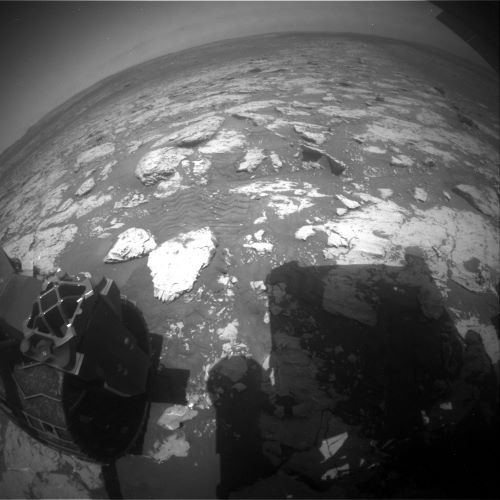
Curiosity Rear Hazard Avoidance Camera Left B image acquired on Sol 3080, April 5, 2021.
Credit: NASA/JPL-Caltech
Navcam and Mastcam images will also be acquired to measure the amount of dust in the atmosphere. “Touch and go” contact science with the Alpha Particle X-Ray Spectrometer (APXS) and Mars Hand Lens Imager (MAHLI) was to be conducted on bedrock target “Orliac” before the rover executes a planned drive of over 60 feet (19-meters), Baker reports.
Next drill spot
After the drive, the rover will acquire standard post-drive images of its next workspace with the Mastcam, Navcam, and Mars Descent Imager (MARDI) cameras.
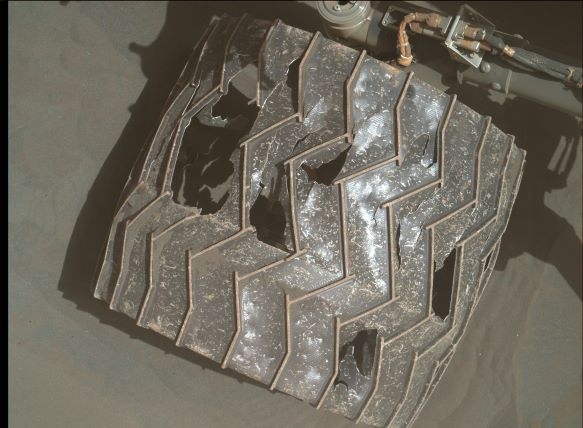
Self-inspection of wheel wear. Curiosity Mars Hand Lens Imager photo produced on Sol 3079, April 4, 2021.
Credit: NASA/JPL-Caltech/MSSS
The untargeted science block on Sol 3082 is planned to include a long Navcam dust devil movie and a single Mastcam image to monitor accumulation of sediment on the rover’s deck, Baker adds.
Both sols (3081-3082) were to include Dynamic Albedo of Neutrons (DAN)
And Rover Environmental Monitoring Station (REMS) measurements, as well as short science blocks around sunset for Navcam and Mastcam cloud imaging.
“In the coming sols,” Baker concludes, “the rover will continue to collect even more data on the local geology and environment as she hunts for our next drill location on Mars!”

Credit: NASA
On Mars, things are looking up for technology demonstrations that can aid future human exploration, not only to scout about the Red Planet – but also sustain human crews there.
NASA’s Perseverance rover has successfully deployed the Ingenuity Mars helicopter. The on-going good news is that the device has survived its first cold Martian night on its own.

NASA’s Ingenuity helicopter can be seen on Mars as viewed by the Perseverance rover’s rear Hazard Camera on April 5, 2021. Credit: NASA/JPL-Caltech
The 4-pound (1.8 kilograms) rotorcraft will be the first aircraft to attempt powered, controlled flight on another planet.
First-things-first
Until the helicopter placed its four legs onto the Martian surface, Ingenuity remained attached to the belly of the wheeled robot, receiving power from Perseverance, which touched down at Jezero Crater on February 18th.
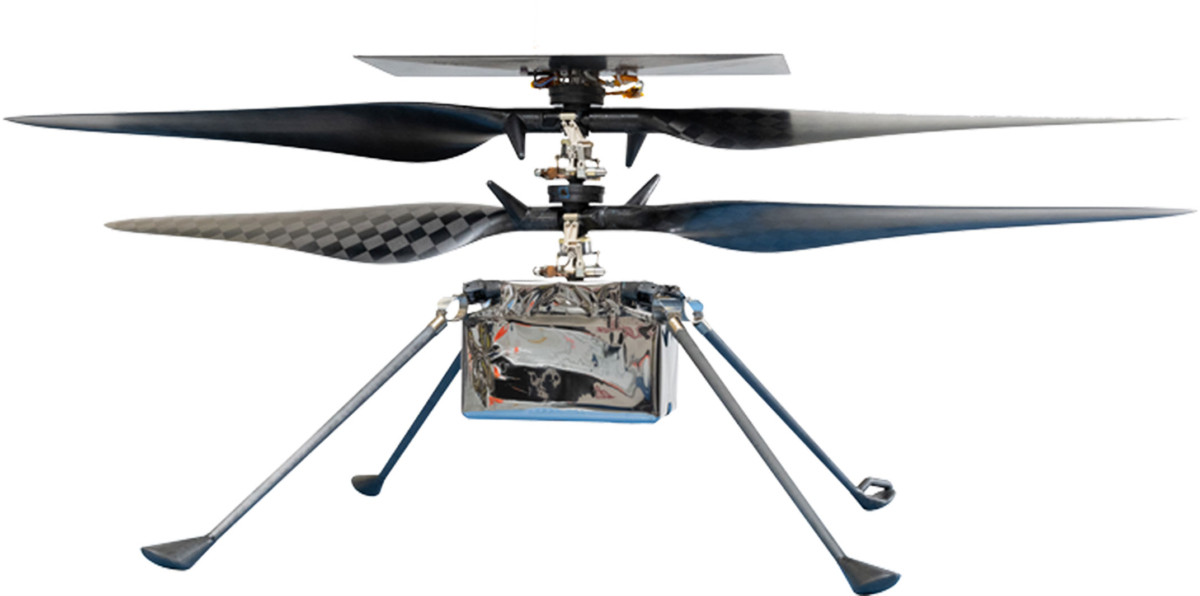
Credit: NASA/JPL-Caltech
In first-things-first fashion, the helicopter’s rotor blades, still stacked in alignment on top of each other, are to be released on April 7th. The blade span is just under 4 feet (1.2 meters).
A solar panel charges Lithium-ion batteries, providing enough energy for one 90-second flight per Martian day.
According to the Jet Propulsion Laboratory (JPL), if all goes well with a set of preflight checks, the mini-helicopter’s first spin-up to lift off will be no earlier than the evening of April 11th.
Ingenuity is the brainchild of JPL’s Bob Balaram. He worked with Simi Valley, California-based AeroVironment engineers from the group’s MacCready Works Advanced Solutions team since the 1990s to fabricate Ingenuity, including the rotor blades, landing gears, and the thermal enclosure for JPL’s avionics, sensors and software systems.

The location where NASA’s Mars 2020 Perseverance rover will observe the Ingenuity Mars Helicopter’s attempt at powered controlled flight at Mars is called “Van Zyl Overlook.” Photo credits: NASA/JPL-Caltech
AeroVironment designed, developed and then later successfully flew a solar unmanned aircraft in the Earth’s stratosphere – the closest air density match to that of the atmosphere of Mars.
Airfield flight tests
Within 30 Martian days, or sols (a Martian day is 24.6 hours), on the surface, Ingenuity is slated to conduct flight tests in the thin atmosphere of Mars from the middle of its 33-by-33-foot (10-by-10-meter) “airfield” – chosen for its flatness and lack of obstructions.
The Perseverance rover will use its suite of cameras to observe the flight characteristics of the solar-powered helicopter from “Van Zyl Overlook.”
With Ingenuity tests under its rotor blades complete, the Perseverance’s scientific exploration of Jezero Crater is to move into high gear.
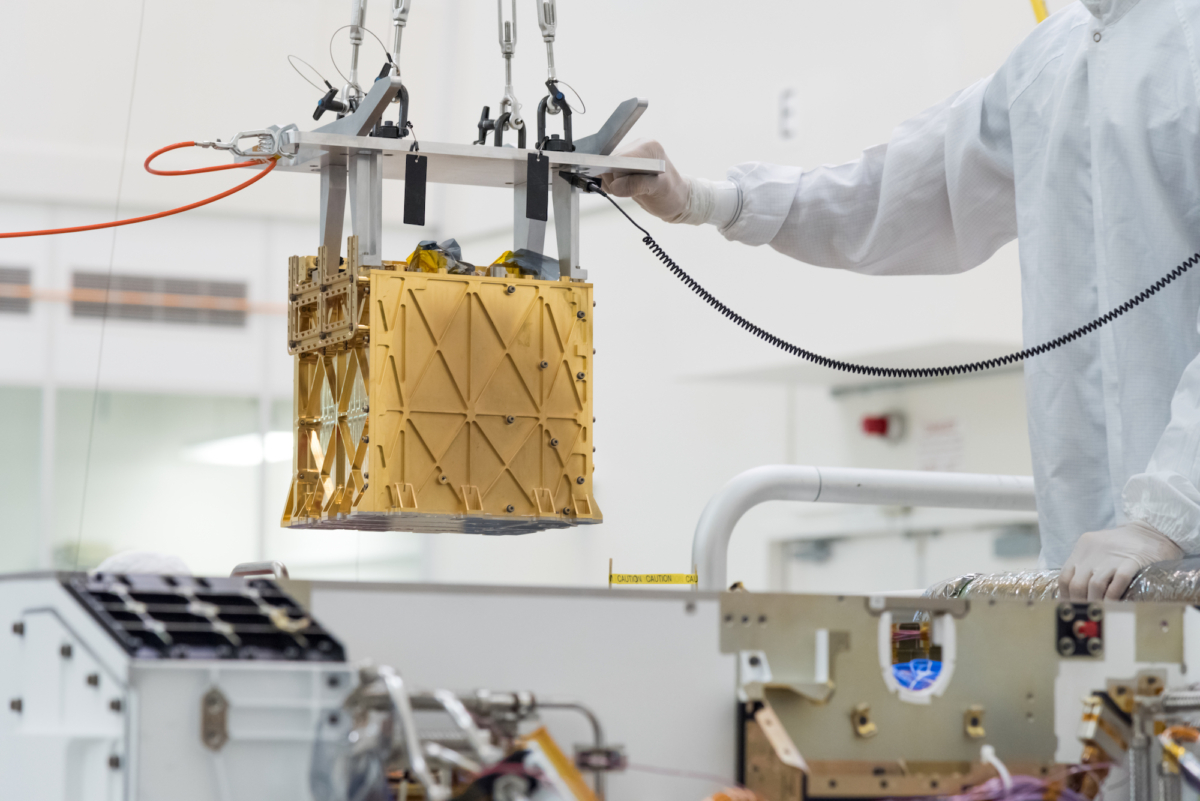
MOXIE installation into Perseverance rover. Credit: R. Lannom/NASA/JPL-Caltech
Enter the “Oxygenator”
Still to come is yet another technology experiment – the Mars Oxygen In-Situ Resource Utilization Experiment, better known as MOXIE.
MOXIE will showcase a way that future explorers might produce oxygen from the thin Martian atmosphere for propellant and for breathing.
The Massachusetts Institute of Technology’s Haystack Observatory, MIT and MIT AeroAstro teams is responsible for overall project leadership, scientific definition, laboratory characterization activities, operations on Mars, and, eventually, interpretation and publication of results.
Haystack’s Associate Director, Michael Hecht, is MOXIE’s principal investigator.
“MOXIE is actually slated to make oxygen for the first time right in the middle of helicopter month, April 17 or thereabouts,” said Hecht. “We’re one of the few instruments allowed to run at that time since the rover doesn’t have to move or deploy anything that could conceivably interrupt its readiness to be a communications link from helicopter to home,” he advised Inside Outer Space.
The size of a car battery, MOXIE weighs 37.7 pounds on Earth, 14.14 pounds on Mars. Approximately one hour of oxygen production per experiment will be scheduled intermittently over the duration of the mission.
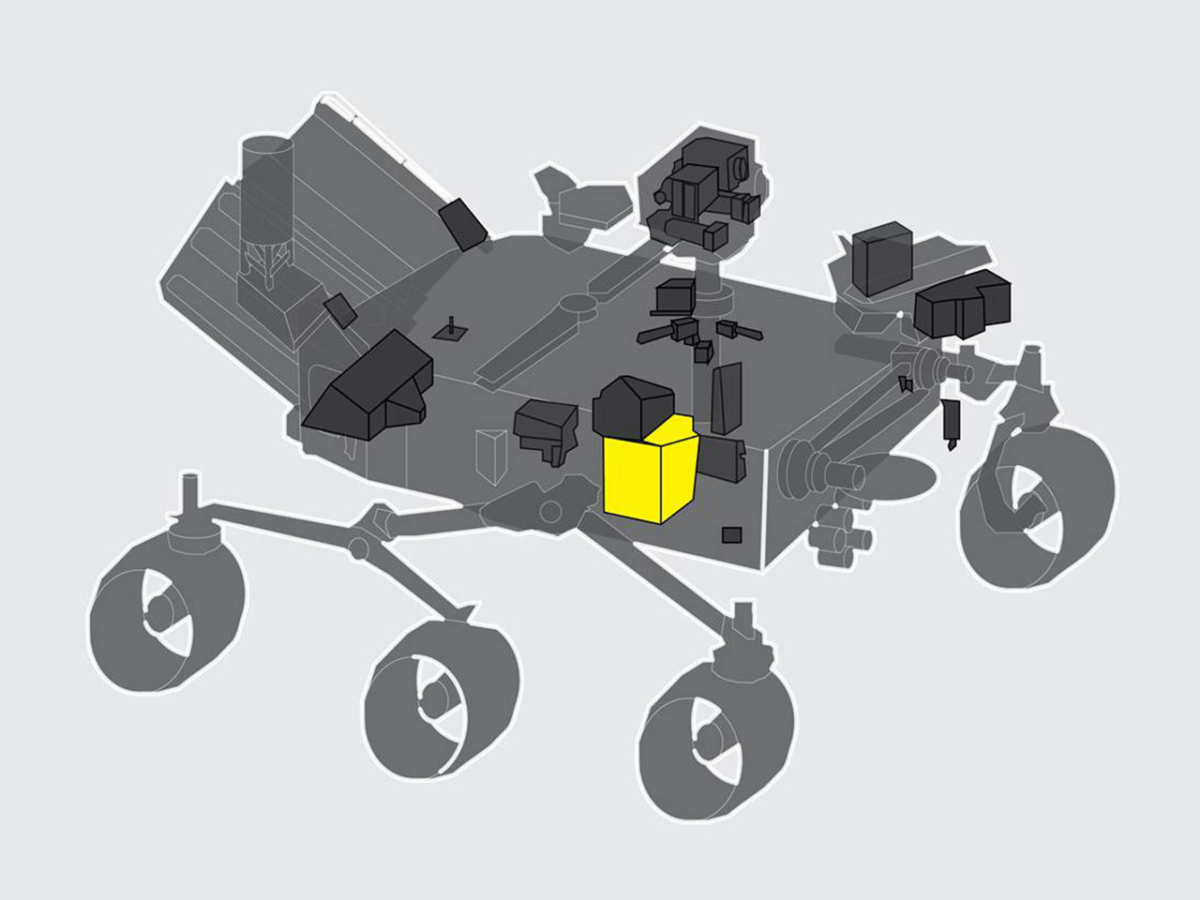
MOXIE location.
Credit: NASA/JPL-Caltech
Make note: oxygen generators that support human missions on Mars must be about 100 times larger – but the experiment breathes life into the prospect of larger units.
Aliveness and health checks
What’s the current status of MOXIE post-landing?
“MOXIE’s aliveness and health checks were successful and we are now looking ahead to our first oxygen production,” says Eric Daniel Hinterman, a member of the MOXIE team at the Massachusetts Institute of Technology.
“The exact date isn’t set but we hope it will be in the near future (i.e. during helicopter phase),” Hinterman told Inside Outer Space. “The helicopter takes first priority during these next few weeks, though, so our schedule is pretty up in the air, pun intended, as a result.”

Starlink satellites visible in a mosaic of an astronomical image.
Courtesy of NSF’s
National Optical-Infrared Astronomy Research Laboratory/NSF/AURA/CTIO/DELVE)
The proliferation of artificial satellites and space debris orbiting the Earths is a rapidly increasing source of artificial night sky brightness.
A new study points to a set of preliminary estimations and concludes that future satellite mega-constellations are expected to increase significantly this light pollution source.
For the study, go to the Monthly Notices of the Royal Astronomical Society: Letters at:
https://doi.org/10.1093/mnrasl/slab030
Also, read this Science magazine article: “Study finds nowhere on Earth is safe from satellite light pollution” at:
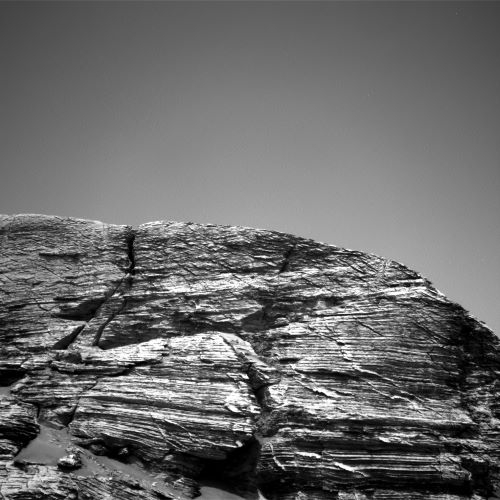
Curiosity Right B Navigation Camera photo taken on Sol 3077, April 2, 2021.
Credit: NASA/JPL-Caltech
NASA’s Curiosity Mars rover is now performing Sol 3078 tasks.
“Curiosity is continuing to make her way around ‘Mont Mercou’ to capture as many angles as possible of the [23-feet] 7-meter tall sedimentary outcrop,” reports Kristen Bennett, a planetary geologist at the USGS Astrogeology Science Center in Flagstaff, Arizona.
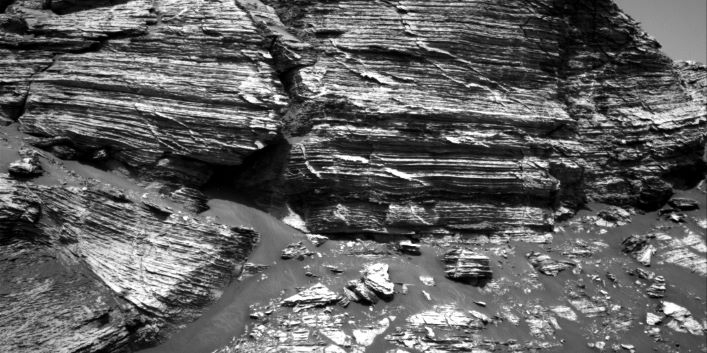
Curiosity Right B Navigation Camera photo taken on Sol 3077, April 2, 2021.
Credit: NASA/JPL-Caltech
The rover recently stopped at a patch of sand, so the science team divided their focus between the sand at the robot’s feet and the outcrop towering above the Mars machinery.
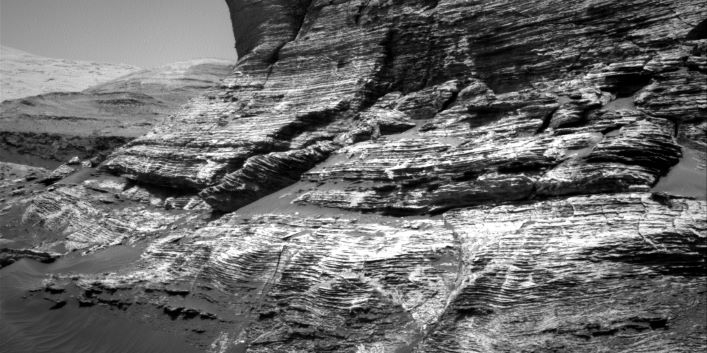
Curiosity Right B Navigation Camera photo taken on Sol 3077, April 2, 2021.
Credit: NASA/JPL-Caltech
Stereo observations
A newly scripted plan includes many images of Mont Mercou. There are several Mastcam mosaics that cover the outcrop, including some stereo observations. There is also a Chemistry and Camera (ChemCam) Remote Micro-Imager (RMI), called “Montpeyroux,” of interesting sedimentary structures that are visible from this side of the outcrop.
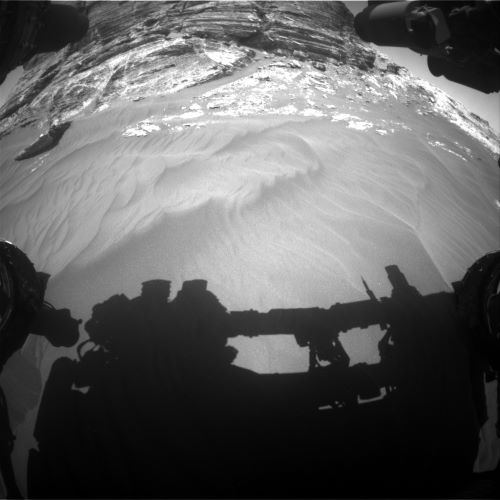
Curiosity Front Hazard Avoidance Camera Right B image acquired on Sol 3077, April 2, 2021.
Credit: NASA/JPL-Caltech
“The plan also focuses on the sand that is in the rover’s workspace. There are two contact science targets: “Scoor” on a ripple crest and “Garve” on a trough,” Bennett adds.
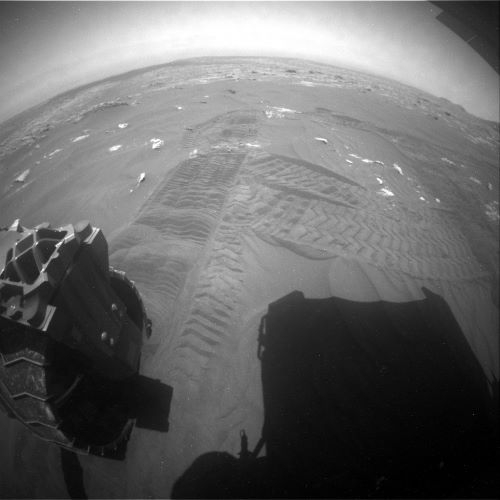
Curiosity Rear Hazard Avoidance Camera Left B photo taken on Sol 3077, April 2, 2021.
Credit: NASA/JPL-Caltech
Curiosity’s Mastcam and Mars Hand Lens Imager (MAHLI) will each take images of these targets, while the Alpha Particle X-Ray Spectrometer (APXS) will focus on Garve.
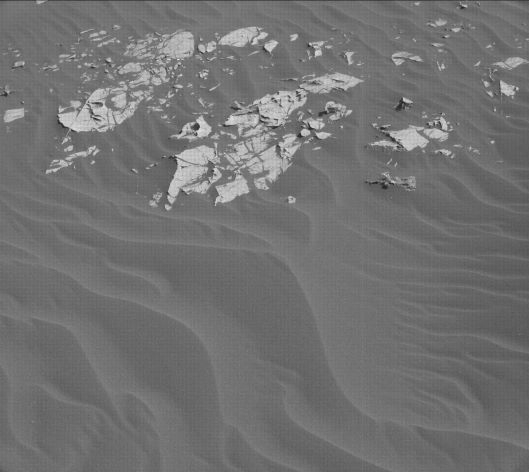
Curiosity Mast Camera Left image acquired on Sol 3076, April 1, 2021.
Credit: NASA/JPL-Caltech/MSSS
Curiosity is set to drive further around Mont Mercou.
“At first the rover will drive just a little bit and use MAHLI to image the wheels as they turn. Next, Curiosity will complete a longer drive to continue circling around to the top of Mont Mercou,” Bennett reports.
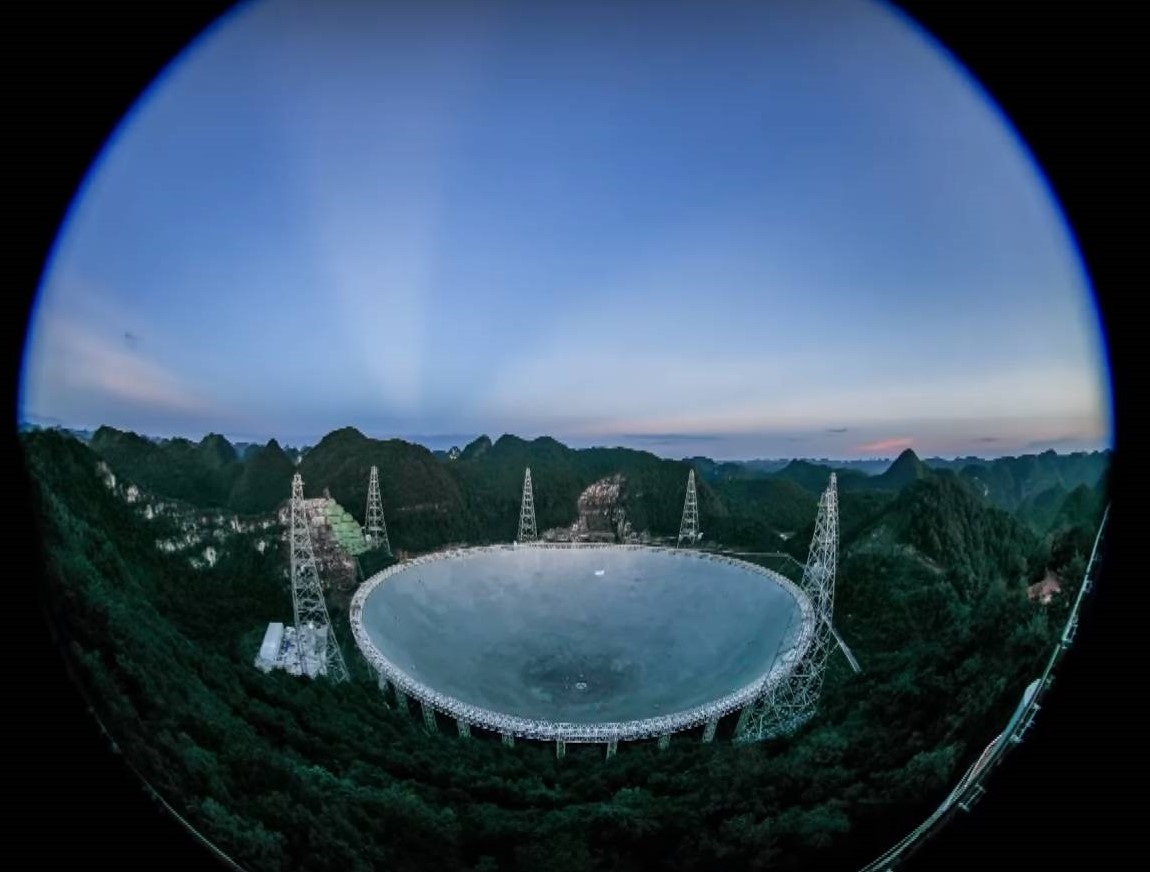
Credit: New China TV/XinhuaVideo/Inside Outer Space screengrab
China’s Five-hundred-meter Aperture Spherical Radio Telescope (FAST), the world’s largest filled-aperture and most sensitive radio telescope, officially opened to the world this week, with the facility set to play a major role in advancing global astronomy.
FAST is also known as “Tianyan” or the “China Sky Eye.”

Credit: CCTV/Inside Outer Space screengrab
In a China Central Television (CCTV) interview, Peng Bo, director of the key laboratory of FAST, said overseas scientists are welcomed to participate in a collaborative way. “It’s normal to assign some open time of the telescope for international users, in order to expand telescopes impact on science outcomes.”

Credit: New China TV/XinhuaVideo/Inside Outer Space screengrab
Observation applications
According to a statement by the National Astronomical Observatories (NAO) under the Chinese Academy of Sciences (CAS), astronomers from around the globe can submit their observation applications for evaluation up until May 15, with the results will be announced on July 20.
Observations by overseas scientists will start in August, said the NAO.
Around 10 percent of FAST’s observation time in the first year, which equates to roughly 450 hours, is expected to be allocated to foreign scientists.

Credit: New China TV/XinhuaVideo/CCTV-Plus/Inside Outer Space screengrab
One Earth, one sky
Peng told CCTV that China is sharing its facilities with the international science community under the principle of “one earth, one sky.”
“Due to the bandwidth limitation, it’s not practical to transfer the huge amount of data from the FAST observatory over the Internet, thus it is encouraged to make direct copies of data with hard disk at the FAST data center,” Peng said in the interview.
“There are many interesting science topics. Nowadays, mainly on pulsars, we may find new types of pulsar, such as the neutral star or black hole binary system,” said Peng.
In an earlier interview with China’s Xinhua news agency, Peng also noted that FAST’s potential to discover an alien civilization will be 5 to 10 times that of current equipment.

The search for extraterrestrial intelligence (SETI) is an international, collaborative affair. SETI scientist Dan Werthimer of the University of California, Berkeley, co-authored a recent paper on China’s SETI program with the Five-hundred-meter Aperture Spherical Radio Telescope (FAST). He is shown here with other FAST SETI collaborators. Credit: Dan Werthimer
“FAST is already doing spectacular science; opening FAST to the international community will make the science even more spectacular,” Dan Werthimer of the University of California, Berkeley’s Astronomy Department and Space Sciences Laboratory told Inside Outer Space.
How was China’s FAST telescope constructed? A glimpse at the world’s largest filled-aperture radio telescope in 100 seconds can be viewed in this GLOBALink video at:
Also, go to these informative videos focused on FAST:

Curiosity’s location as of Sol 3074. Distance driven 15.48 miles (24.92 kilometers).
This map shows the route driven by NASA’s Curiosity rover since landing in Gale Crater on August 5, 2012.
Credit: NASA/JPL-Caltech/Univ. of Arizona
NASA’s Curiosity Mars rover is now performing Sol 3076 tasks.
The robot is continuing its investigation of “Mont Mercou,” the tall outcrop of bedded sedimentary rock, reports Mark Salvatore, a planetary geologist at the University of Michigan.

Curiosity Front Hazard Avoidance Camera Right B image taken on Sol 3075, March 31, 2021.
Credit: NASA/JPL-Caltech
“The science team has been navigating around the base of the cliff after having successfully drilled into the “Nontron” bedrock target,” Salvatore adds. “By imaging the cliff at different viewing geometries, we are able to change both position and illumination conditions, helping us to fully map the observed structures and properties of these sedimentary rocks.”

Curiosity Rear Hazard Avoidance Camera Left B photo acquired on Sol 3075, March 31, 2021.
Credit: NASA/JPL-Caltech
Bedrock material
In a newly orchestrated plan, the team has identified a nodular bedrock target to characterize using the Alpha Particle X-Ray Spectrometer (APXS) instrument on the rover’s arm, which will provide information about the chemical make-up of this bedrock material.
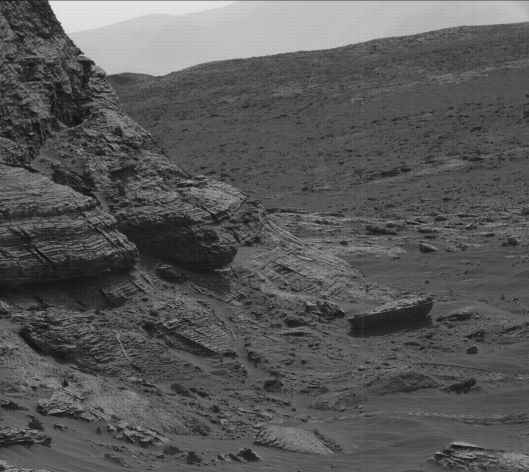
Curiosity Mast Camera Left image taken on Sol 3074, March 30, 2021.
Credit: NASA/JPL-Caltech/MSSS
Curiosity will also be acquiring many images using both the Chemistry and Camera (ChemCam) and Mastcam instruments, as the rover is now on the eastern side of the cliff face.
Cliff face navigation
“Following these observations, Curiosity will then navigate to the western side of the cliff face to perform a similar suite of imaging observations, Salvatore explains.
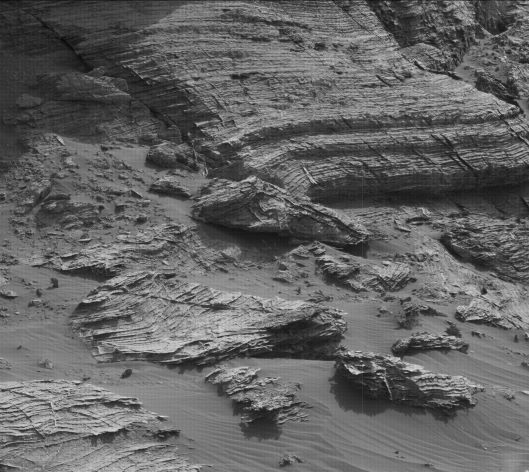
Curiosity Mast Camera Left image taken on Sol 3074, March 30, 2021.
Credit: NASA/JPL-Caltech/MSSS
These rock outcrops, where researchers can see bedding from multiple angles, Salvatore points out, “are a treasure for geologists as we try to unravel the ancient environmental conditions that were once present in Gale crater. The team is cognizant of the value of this outcrop, and so we are making sure to acquire all of the observations that we need before driving away from this location.”

Curiosity Mast Camera Right photo acquired on Sol 3074, March 30, 2021.
Credit: NASA/JPL-Caltech/MSSS

