Archive for the ‘Space News’ Category
 Author:
  May 6th, 2021
Credit: NASA/JPL-Caltech/Univ. of Arizona
NASA’s Curiosity Mars rover at Gale Crater is now performing Sol 3110 duties.
Curiosity recently drove roughly 145 feet (44 meters) on sol 3109, “so we’ve left our scenic view at ‘Bardou’ behind in the rear-view mirror… er… rear Hazcam… er…. actuaaaallllly, to be perfectly precise, front Hazcam since we drove backwards,” reports Abigail Fraeman, a planetary geologist at NASA’s Jet Propulsion Laboratory.
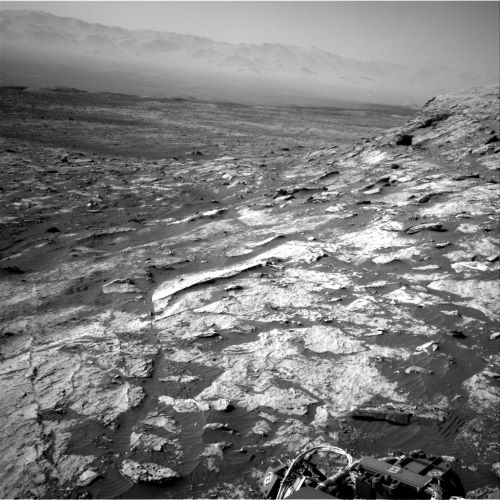
Curiosity Right Navigation Camera Right B photo taken on Sol 3109, May 5, 2021.
Credit: NASA/JPL-Caltech
The Mars machinery now has a new workspace under its wheels, with views of rocks with great textures on the horizon.
Touch and go
A newly scripted plan has a standard “touch and go” sol, meaning the rover will “snap a few photos and laser a rock, squeeze in some quick contact science to analyze the area in front of the rover, and then drive on to our next target all before we need to send the data back so that it arrives on Earth in time for us to see it before making Friday’s plan,” Fraeman explains.
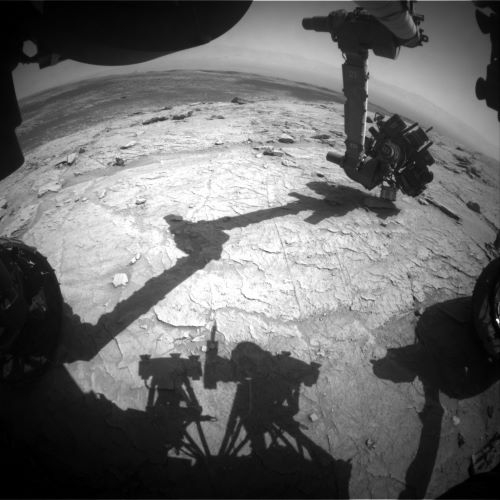
Curiosity Front Hazard Avoidance Right B Camera image acquired on Sol 3109, May 5, 2021.
Credit: NASA/JPL-Caltech
The contact science target in the current plan is a vein named “Gourdon,” with the robot acquiring Chemistry and Camera (ChemCam) Laser Induced Breakdown Spectroscopy (LIBS) data on the same vein on a target named “Molieres.”
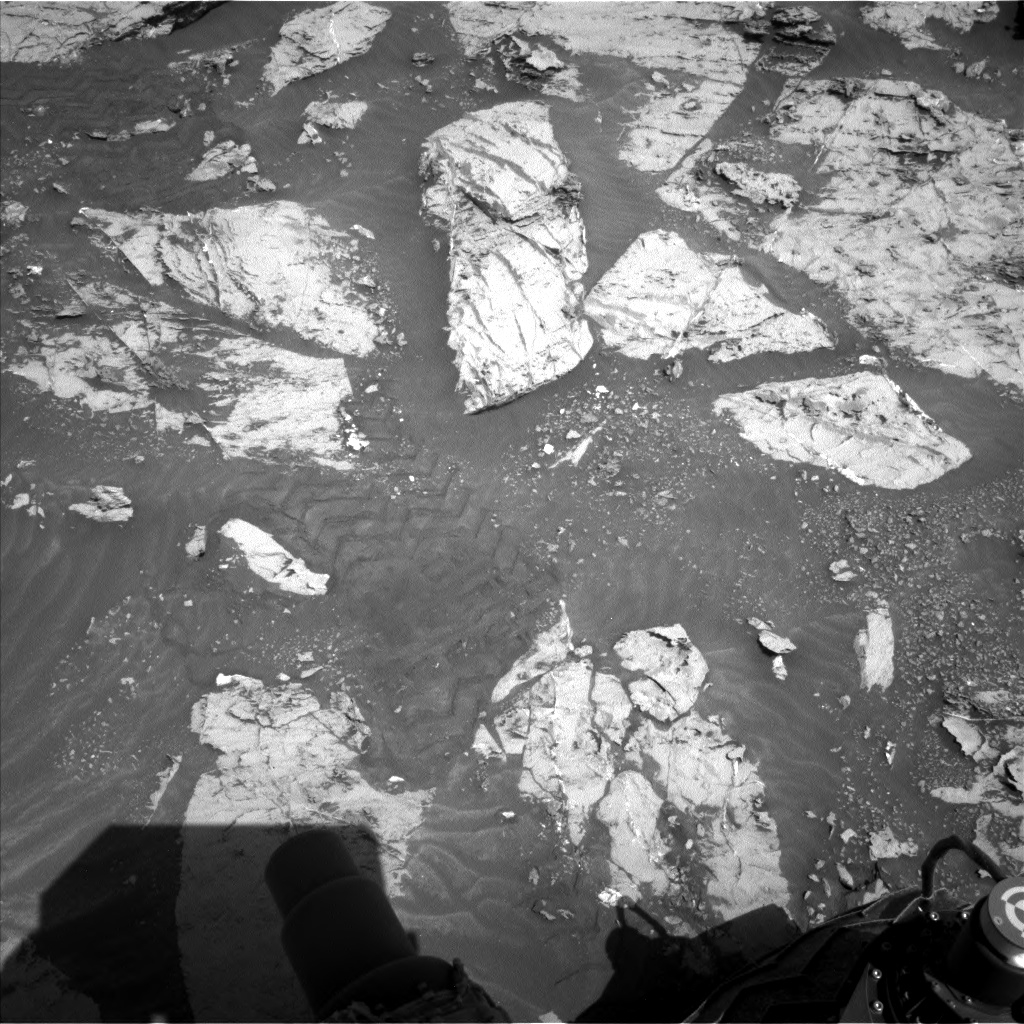
A rock informally described as having tiger stripes captured in this Left Navigation Camera image taken on Sol 3109.
Credit: NASA/JPL-Caltech
Tiger stripes
“We’ll additionally collect ChemCam passive spectral and Mastcam multispectral data on a different vein target named “Pech Du Loup,” and we’ll take several Mastcam images to capture the colors and textures of nearby rocks,” Fraeman adds.

Curiosity Left B Navigation Camera image taken on Sol 3109, May 5, 2021.
Credit: NASA/JPL-Caltech
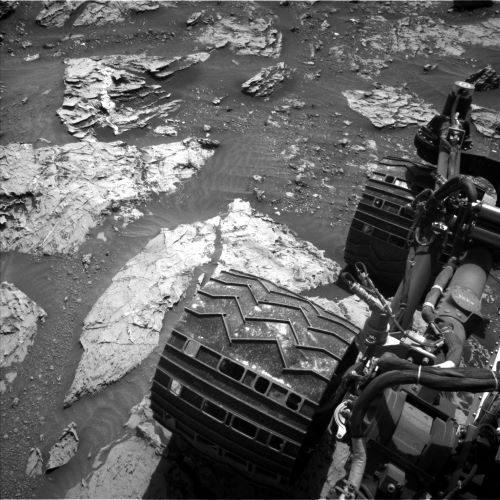
Curiosity Left B Navigation Camera image taken on Sol 3109, May 5, 2021.
Credit: NASA/JPL-Caltech
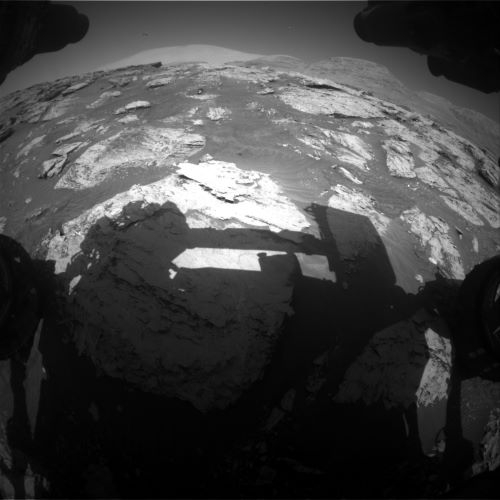
Curiosity Front Hazard Avoidance Right B Camera image acquired on Sol 3109, May 5, 2021.
Credit: NASA/JPL-Caltech
“For our drive, we’re aiming for a target that is located just above a rock the team informally started describing as having tiger stripes,” Fraeman notes. “The apparent stripes are likely caused by veins that jut out at low angles and are more resistant to erosion than the surrounding rock. It should be great fun to get a closer of view of this and the surrounding rocks in Friday’s plan.”
 Posted in

New Shepard reusable booster design has undergone a series of test flights.
Credit: Blue Origin/Screengrab Inside Outer Space
On July 20th, Blue Origin’s New Shepard suborbital vehicle will fly its first astronaut crew to space.
That announcement from the group backed by entrepreneur Jeff Bezos also adds: “We are offering one seat on this first flight to the winning bidder of Blue Origin’s online auction. Starting today, anyone can place an opening bid by going to BlueOrigin.com.”
“This seat will change how you see the world.”

Jeff Bezos, founder of Blue Origin.
Credit: Blue Origin
Auction phases
Details of the three-phase auction are:
May 5-19: Sealed online bidding – you can bid any amount you want on the auction website (no bids are visible)
May 19: Unsealed online bidding – bidding becomes visible and participants must exceed the highest bid to continue in the auction
June 12: Live auction – the bidding concludes with a live online auction

Blue Origin’s crew capsule – a suborbital six-seater craft.
Credit: Blue Origin
Club for the Future
The winning bid amount will be donated to Blue Origin’s foundation, Club for the Future, “to inspire future generations to pursue careers in STEM and help invent the future of life in space,” according to a Blue Origin statement.
The communiqué from Blue Origin also notes:
“On this day 60 years ago, Alan Shepard made history by becoming the first American to fly to space. In the decades since, fewer than 600 astronauts have been to space above the Kármán Line to see the borderless Earth and the thin limb of our atmosphere. They all say this experience changes them.”

Alan Shepard’s liftoff strapped into Freedom 7 Mercury capsule on May 5, 1961.
Credit: NASA
Blue Origin explains that they named their launch vehicle after Alan Shepard to honor his historic flight.
New Shepard has flown 15 successful consecutive missions to space and back above the Kármán Line “through a meticulous and incremental flight program to test its multiple redundant safety systems. Now, it’s time for astronauts to climb onboard,” explains the firm’s statement.
For more information, go to:

The upcoming reentry of China’s Long March-5 rocket body is a reminder of a much larger problem.
China’s big booster tossed the country’s Tianhe space station module into orbit on April 29th. Now satellite and space debris monitoring groups are keeping a close eye on the uncontrolled nose dive to Earth of the large rocket stage. Leftover debris from its fiery fall could reach terra firma.
But over what part of Earth it will reenter is a sketchy predictive pronouncement. Nobody knows for sure of the exact date/time of the rocket body’s demise.
One report has the hardware out of control, tumbling along an elliptical orbit and falling to Earth in a few days, perhaps as early as May 9th.
In short, the rocket body equation adds up to a dilemma.

The Aerospace Corporation’s Center for Orbital and Reentry Debris Studies is presently predicting a reentry time for the CZ-5B rocket body (ID 48275) on May 10th, plus or minus 41 hours.
Artwork: The Aerospace Corporation/CORDS
Magnitude of the problem
“It really isn’t about this one rocket body…because every rocket body in Earth orbit is uncontrolled,” explains T.S. Kelso of CelesTrak, an analytical group that keeps an observant eye on Earth-orbiting objects.
The true magnitude of the problem can be identified by a quick check on CelesTrak.
“It shows there are 2,033 rocket bodies in Earth orbit…at least those that we have orbital data for as there may be more classified ones. Of course, every one of them is uncontrolled. Of the 2,033, 546 belong to the U.S. and only 169 belong to China.
“Maybe we all need to be more responsible and not leave uncontrolled rocket bodies in orbit,” Kelso told Inside Outer Space.

Clutter in the cosmos.
Credit: Used with permission: Melrae Pictures/Space Junk 3D
Where are they?
Who is the worst offender? It is Russia with 1,035 rocket bodies.
“There are another 66 rocket bodies in Earth orbit that we have no data for, because they are classified,” Kelso notes, that is, there are no “where are they?” orbit elements available. “Most we have no idea what orbit they are in, so they could reenter or just run into something else in orbit, pretty much without any warning.”
One of those is from a 1967 launch and eight are from launches in the 1970s, Kelso adds.
Bottom line
Just for 2020 launches, there are still 32 rocket bodies in orbit. China is not doing particularly well, though, since 15 of those are Chinese. Ten of those are U.S., with five of those being for classified launches, Kelso reports.
“The problem is the number should be zero and we all need to start working now to make sure we don’t continue to make this problem worse,” Kelso concludes. “But the bottom line is that we all need to do better to stop leaving things in orbit after their intended use and to find safe ways to remove them.”
Credit: Mars Guy/Steve Ruff
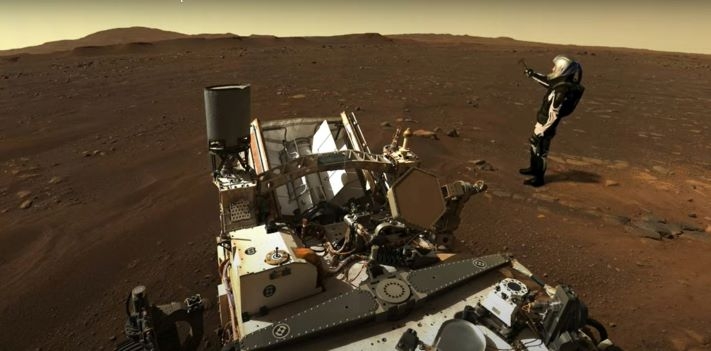
A new Mars Guy video showcases spectacular high resolution images from NASA’s Perseverance rover. They reveal a textbook example of an Earth delta deposit, but this one actually is on the Red Planet.

Credit: Mars Guy/Steve Ruff

Credit: China Central Television (CCTV)/China National Space Administration (CNSA)/United Nations Office for Outer Space Affairs (UNOOSA)/China Manned Space Agency (CMSA)/Inside Outer Space screengrab
China’s bid to build and operate a space station by the close of 2022 involves its use to carry out a suite of scientific experiments. The Tianne core module of the station now circling the Earth is the first and main component of the station.
According to Zhou Jianping, chief designer of China’s manned space engineering project, the country’s orbiting outpost will have onboard nine international scientific experiments, with a second batch of projects to be announced.

Credit: CAST
In selecting the science experiments, China is collaborating with the United Nations Office for Outer Space Affairs, Zhou said in a recent China Central Television (CCTV) interview.

Credit: China Central Television (CCTV)/China National Space Administration (CNSA)/United Nations Office for Outer Space Affairs (UNOOSA)/China Manned Space Agency (CMSA)/Inside Outer Space screengrab
Experiment racks
Zhong Hongen, deputy chief engineer, space application system of China’s Manned Space Flight Project, detailed the use of experiment racks to be utilized on the space station.
“It’s the first time that we have applied experiment racks of advanced international standards to large-scale experiment facilities,” Zhong said in the CCTV video. “The rack is supported by general-purpose technologies with multiple functions. It is constructed with supporting structures for power supply, measurement and control, information recording and cooling.”

Credit: China Central Television (CCTV)/China National Space Administration (CNSA)/United Nations Office for Outer Space Affairs (UNOOSA)/China Manned Space Agency (CMSA)/Inside Outer Space screengrab
Zhong added that it is also the first time that China has operated scientific experiment facilities which weigh 500 kilograms, close to the mass of a medium-sized satellite.
Astronaut participation
As for the experiments that will be carried out in the recently launched core module, they are mainly categorized into two kinds: containerless experiments on material science, and high-quality microgravity scientific experiments.
“Both of these experiments require intensive participation of the astronauts. For instance, after the completion of the experiment on one batch of samples in a rack for containerless material scientific experiment, the astronauts should put new samples into the rack,” Zhong said.

Credit: China Central Television (CCTV)/China National Space Administration (CNSA)/United Nations Office for Outer Space Affairs (UNOOSA)/China Manned Space Agency (CMSA)/Inside Outer Space screengrab
Large-scale facilities
Carrying out these tasks within the core module means China will take a fundamental and critical step in space science application of the space station, Zhong added, underscoring the need to master the key technologies of large-scale space experiment facilities.
Additionally, China will use a space-ground integrated system, designed to bring long-term experiment results to fruition.
Credit: China Central Television (CCTV)/China National Space Administration (CNSA)/United Nations Office for Outer Space Affairs (UNOOSA)/China Manned Space Agency (CMSA)/Inside Outer Space screengrab
Space telescope
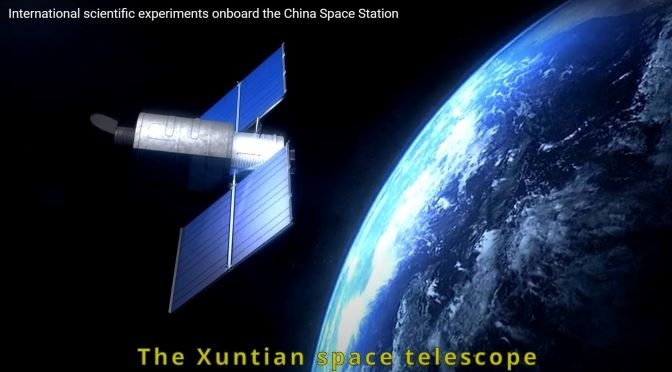
Lastly, Zhong described the Xuntian Space Telescope that’s part of China’s space station.
“They will be two independent spacecraft operating on the same orbit,” Zhong said. “If we need to update the telescope, we can dock it with the space station to let the astronaut enter it and change the optical modules.”
To view this new video credited to: CCTV/China National Space Administration (CNSA)/United Nations Office for Outer Space Affairs (UNOOSA)/China Manned Space Agency (CMSA), go to:
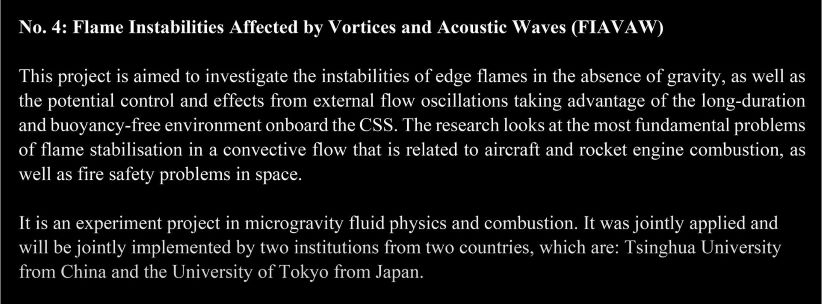
Here are the already selected experiments to be flown on China’s space outpost:




On the scene. NASA’s new robotic Mars explorer, the Perseverance rover.
Credit: NASA/JPL-Caltech
A House Committee on Science, Space, and Technology Space and Aeronautics Subcommittee hearing on April 29th was entitled: “What do Scientists Hope to Learn from NASA’s Mars Perseverance Rover?
Witnesses:
Dr. Michael A. Meyer, Lead Scientist, Mars Exploration Program, National Aeronautics and Space Administration
Dr. Bethany L. Ehlmann, Professor of Planetary Science and Associate Director of the Keck Institute for Space Studies, California Institute of Technology; President, The Planetary Society; Co-Investigator, Mars 2020 Perseverance mission
Dr. Luther Beegle, Principal Investigator of the Mars Perseverance Scanning Habitable Environments with Raman & Luminescence for Organics & Chemicals (SHERLOC) Instrument, Jet Propulsion Laboratory
Dr. Tanja Bosak, Returned Sample Science Co-Lead, Mars 2020 Perseverance Rover; Professor and Lead of the Option in Geology, Geochemistry, and Geobiology, Department of Earth, Atmospheric, and Planetary Sciences, Massachusetts Institute of Technology
Opening statements
Video of the hearing is available at:

Ingenuity Mars rotorcraft – a forerunner of things to come.
Credit: NASA/JPL-Caltech
NASA’s Ingenuity Mars helicopter has shown the “Wright stuff” on the Red Planet. Multiple sorties of the rotorcraft have been so successful that the device is now moving into an operational role supporting the Perseverance rover’s scientific sleuthing ahead.
The future use of airborne tools on Mars is also being tested in the Holuhraun, Iceland lava flow field. This activity is under the wing of the University of Arizona’s Lunar and Planetary Laboratory (LPL) programs.
LPL’s Christopher Hamilton and colleagues have been investigating a next-generation Mars exploration concept, dubbed RAVEN, short for Rover–Aerial Vehicle Exploration Networks. The effort draws upon recent developments in drone technology.

Christopher Hamilton launches a drone during flight tests in the Holuhraun, Iceland lava flow field.
Credit: University of Arizona’s Lunar and Planetary Laboratory
For example, there’s the RAVEN Claw a prototype Unmanned Aerial System (UAS) developed by Honeybee Robotics. It is a sample acquisition device to test new methods of sample characterization and collection within Mars analog environments, like the Highlands of Iceland.
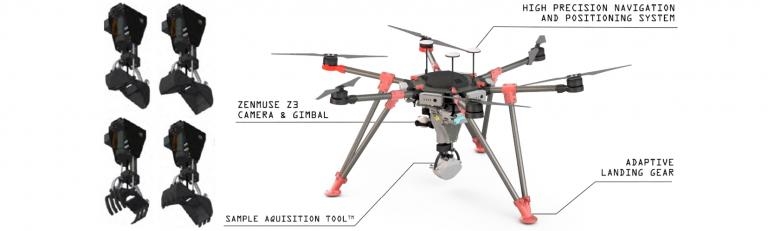
Credit: University of Arizona’s Lunar and Planetary Laboratory/Honeybee Robotics
Maximize scientific output
A $3.1 million NASA grant is geared to develop a new concept combining rovers and unmanned aerial systems to explore areas of the red planet that have been previously inaccessible.

Future human Mars expeditions may use aerial vehicles to enlarge their exploration zones.
Credit: NASA/JPL
According to Hamilton, RAVEN adds an entirely new approach to NASA’s paradigm of planetary exploration, one that traditionally has centered around four steps – flyby, orbit, land and rove.
“With RAVEN, we’re adding ‘fly’ to that list,” Hamilton says. “The concept is geared toward building new technology for two robots to work together on an extraterrestrial body. We are going to look at how a rover and a drone can work together to maximize the scientific output of such a mission.”
For more information on RAVEN, go to:

Credit: China Central Television (CCTV)/China National Space Administration (CNSA)/Inside Outer Space screengrab
With China launching the core module of its space station, the country’s space program officials are detailing plans for its use when fully constructed by the end of 2022.
As of now, 17 nations have confirmed their participation in nine scientific tasks on the station, with China signing agreements with the United Nations Office for Outer Space Affairs on space station cooperation, said Hao Chun, director of the China Manned Space Agency. “We will continue working with the UN’s outer space office to solicit proposals for future scientific collaborations,” he told China Daily.

Credit: China Central Television (CCTV)/China National Space Administration (CNSA)/Inside Outer Space screengrab
Hao also stated that there will be foreign astronauts on the Chinese station.
“A lot of foreign space organizations have told us that they hoped we could open our station to their astronauts. Some foreign astronauts have begun to learn Chinese. We will start selecting foreign participants and preparing for joint flights in due course according to the conditions on the station,” Hao said.

Credit: CGTN/Li Yueyun, Du Chenxin
T-shaped complex
The just-launched Tianhe core module is the largest spacecraft developed by China, with a total length of 16.6 meters, a maximum diameter of 4.2 meters and a take-off mass of 22.5 tons.

Credit: CGTN/Li Yueyun, Du Chenxin
When China’s space station construction is completed, the orbiting complex will be T-shaped, with the core module at the center and a lab capsule on each side. The three-module station will offer astronauts more than 100 cubic meters of room for living and working.
Meanwhile, a variety of videos have been issued by various outlets that spotlight China’s space station endeavors. Go to:

Credit: CCTV/Inside Outer Space screengrab
China’s core space station module is now circling Earth, lofted April 29 by a Long March-5B Y2 carrier rocket from the Wenchang Spacecraft Launch Site on the northeastern coast of south China’s Hainan Province.
Tianhe is the foundational module for China’s first low-Earth orbital space station named Tiangong, which means “heavenly palace” in Chinese. The module is 16.6 meters long with a maximum diameter of 4.2 meters and a takeoff mass of 22.5 tons – billed as the largest spacecraft China has ever developed.

China’s core module now in Earth orbit.
Fast-paced launch schedule
The launch is to be followed by a fast-paced series of cargo and crew launches aimed at completing the construction of the station by the end of 2022. The space-based construction effort requires 11 launches in 2021-2022, including Thursday’s successful launch of the core module, two more module launches, four manned missions and four cargo vessel flights, as reported by China Global Television Network (CGTN).
Three types of Long March carrier rockets will jointly conduct the remaining 10 launch missions.
When completed, China’s orbiting outpost will form a T-shape with Tianhe at the center and two lab capsules, Wentian and Mengtian, on each side, according to Zhou Jianping, chief designer of China’s manned space program.
Bai Linhou, deputy chief designer of the space station at the China Academy of Space Technology (CAST) said that the station could support at most six astronauts at the same time. Regular launches of crewed and cargo spaceships will secure a long-term human presence in Earth orbit to carry out research and services.

Credit: CMS
Crew and cargo
Shortly after the core module’s launch, Li Shangfu, chief commander, flight missions for space station phase of China’s manned space program reported the Long March-5B Y2 rocket had accurately sent Tianhe into a preset orbit, and that the solar panels were working well after unfolding. “Now I announce that the launch mission of the core module Tianhe is a complete success!”
Hao Chun, director of the China Manned Space Engineering Office, told China Central Television (CCTV): “Next, we will launch Tianzhou-2 cargo spacecraft in May and the Shenzhou-12 spacecraft in June. Three astronauts will stay in orbit for three months on the Shenzhou-12 manned spacecraft.”
Hao said in September and October, the Tianzhou-3 cargo craft and Shenzhou-13 crewed spaceship will also be launched to dock with Tianhe, and another three astronauts will then begin their six-month stay in orbit.
After the five launch missions this year, China plans six missions, including the launch of the Wentian and Mengtian lab modules, two cargo spacecraft and two manned spaceships, in 2022 to complete the manufacturing of the space station.

Credit: CCTV/Inside Outer Space screengrab
“It contains two space station modules, the launch mission of Wentian and Mengtian, two cargo spacecraft and two manned spacecraft. The two manned spacecraft, also composed of three astronauts respectively, will stay in orbit for about six months. This is the general arrangement of our missions,” Hao stated.
China’s space station is to operate in low-Earth orbit at an altitude from 211 miles (340 kilometers) to 280 miles (450 kilometers). It has a designed lifespan of 10 years, although it could last more than 15 years with appropriate maintenance and repairs, reports CCTV.
To view videos of the launch and an overview of China’s space station plans, go to:
Credit: China Central Television (CCTV)/China National Space Administration (CNSA).
Credit: New China TV/China Manned Space Agency
Credit: CCTV

Core module of China’s space station.
Credit: CMS/Inside Outer Space screengrab
China is set to loft a key module of the country’s space station on April 29 (Beijing Time) – around 03:00 UTC.
The critical “Tianhe-1” core module will be lofted by a Long March-5B Y2 rocket from the Wenchang Spacecraft Launch Site in south China’s Hainan province. If successful, China will later dispatch a Tianzhou-2 cargo spacecraft to rendezvous and dock with the core module, followed by a three-person crew onboard a Shenzhou-12 spacecraft.

China plans to launch the core module of its space station from Wenchang on April 29 using a Long March-5B Y2 rocket.
A Navigation warning, active from 03:00 – 04:00 UTC, has been issued for two areas to the west of the Philippines. Tracking forward from the launch site shows that the planned orbital inclination is 42°. The initial orbital height will be near 124 miles (200 kilometers).
Credit: Robert Christy (used with permission)
The Long March-7 Y3 launch vehicle is already at Wenchang to launch the Tianzhou-2 cargo spacecraft. Additionally, a Long March-2F launch vehicle and the Shenzhou-12 spacecraft have arrived at the Jiuquan Satellite Launch Center, Gansu Province, China.
Robert Christy at Zarya.info has noted that navigation warnings indicate the inclination of the core module will be 42 degrees.
Must succeed
In a recent China Central Television (CCTV) interview, Yang Liwei, China’s first astronaut and director of the China Manned Space Engineering Office, said that orbiting the core module is critical and must succeed. “The launch of the core module will be a milestone indeed,” Yang added.

Credit: CCTV/Inside Outer Space screengrab
Yang said China is set to send a cadre of 12 astronauts into space in 2021 and 2022 to build China’s orbiting outpost. Crew members for the four crewed flights necessary to piece together and operate the space station have been chosen and are undergoing mission training.
Go to these China Central Television (CCTV) videos about the country’s space station plans:

