Archive for the ‘Space News’ Category
 Author:
  May 13th, 2021
Curiosity Right B Navigation Camera photo taken on Sol 3116, March 12, 2021.
Credit: NASA/JPL-Caltech
NASA’s Curiosity Mars rover at Gale crater is now performing Sol 3117 tasks.
Kristen Bennett, a planetary geologist at USGS Astrogeology Science Center in Flagstaff, Arizona, reports that the robot is finishing up at a stop designed to investigate “diagenetic” features. Those are features that formed after the sediment first was deposited—such as veins and color variations within the bedrock.
A newly scripted plan has the rover full of remote science and contact science before the Mars machinery drives away to continue traveling towards the sulfate unit.

Diagenetic features are visible in this image taken by the Curiosity’s Chemistry & Camera (ChemCam) on Sol 3115.
Credit: NASA/JPL-Caltech/LAN
White vein
“Veins are abundant in this workspace,” Bennett explains, and the rover’s Alpha Particle X-Ray Spectrometer (APXS) and Mars Hand Lens Imager (MAHLI) was set to target a bright white vein near the rover that is called “Busserolles.”
The Chemistry and Camera (ChemCam) instrument has a Laser Induced Breakdown Spectroscopy (LIBS) target on “Quinsac,” which APXS and MAHLI investigated earlier this week.
“ChemCam will also target the feature ‘Razac de Saussignac’ as a passive observation, Bennett adds. “Razac de Saussignac is a fresh rock face with interesting color variations that was broken by the wheel when Curiosity drove over it on the previous drive.”
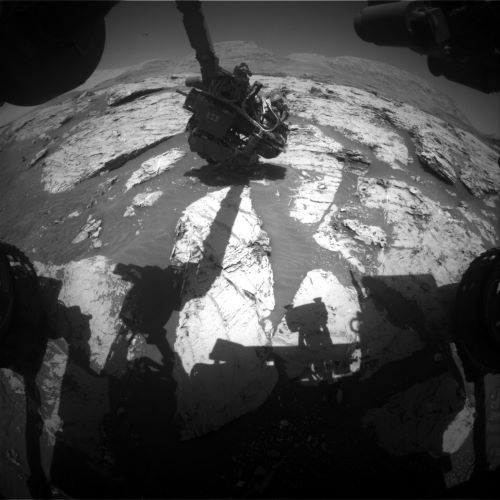
Curiosity Front Hazard Avoidance Camera Right B image acquired on Sol 3116, March 12, 2021.
Credit: NASA/JPL-Caltech
Stability of rocks
The plan now in action also includes a Mastcam mosaic of “Belves” to investigate the stability of the rocks in the Mt. Mercou cliff face and a ChemCam long distance Remote Micro-Imager (RMI) to target potential bedding within the sulfate unit.

Curiosity Right B Navigation Camera photo taken on Sol 3116, March 12, 2021.
Credit: NASA/JPL-Caltech
After the drive, the Mars Descent Imager (MARDI), Bennett concludes, will take a twilight image and there will be several atmospheric observations including a dust devil survey and a cloud observation.
As always, dates of planned rover activities are subject to change due to a variety of factors related to the Martian environment, communication relays and rover status.
 Posted in

Credit: Roscosmos
Russian space technicians are wrapping up testing of the long-delayed Nauka (Science) research module for the Russian segment of the International Space Station.
According to Roscosmos, ground pre-launch processing of Nauka is taking place at the assembly and testing facility of Site 254 at the Baikonur Cosmodrome.
This testing will be followed by the installation of the radiator panels and filling of the thermal control system circuits, as well as the final installation of the European robotic arm (ERA).

Credit: Roscosmos
Also slated is installation of solar array panels, stowage of deliverable cargos and weight check of the module, assembly of the ascent unit, loading the module tanks with propellant components, and final assembly of the integrated launch vehicle.
Cherry-picker crane
The European robotic arm will work with the new Russian airlock, to transfer small payloads directly from inside to outside the International Space Station. This will reduce the set-up time for astronauts on a spacewalk and allow ERA to work alongside astronauts.

Artist’s impression of Europe’s robotic arm, ERA.
Credit: ESA/D.Ducros
Another task for ERA is to transport astronauts like a cherry-picker crane to a position where they can work on the exterior of the ISS, or from one external location to another. This again saves time and effort during spacewalks.
The hardware is to be launched to ISS this summer,
Go to this Roscosmos Media video of Nauka testing at:

Pioneering astronaut, Michael Collins, Apollo 11 command module pilot.
Credits: NASA
Nearly 13,500 people have signed a petition to NASA to name the space agency’s Lunar Gateway the Collins Lunar Gateway – a legacy tribute to the late Apollo 11 astronaut, Michael Collins.
Posted on Change.org, the petition explains:
“The Lunar Gateway will be a space station in orbit around the Moon that will provide staging for all future lunar astronauts in the Artemis Program. Before they descend to the surface of the Moon, they will all pass through the Gateway.”

NASA’s Lunar Gateway.
Credit: NASA/JSC
While Apollo 11’s Michael Collins did not descend to the surface, the petition adds, he remained alone in lunar orbit for nearly 21 and a half hours while Neil Armstrong and Buzz Aldrin visited the Moon’s surface. “He watched as his fellow astronauts descended onto the surface, just as many astronauts will do from the Gateway in the future,” notes the petition.

Credit: Farrar, Straus and Giroux, 1974
Carry the fire
The Collins legacy should be honored by NASA and the space community. “Those who seek to follow his path will be able to honor the legacy he left by living and passing through the Collins Lunar Gateway on the way to blaze their own trails and carry the fire,” the petition concludes.
To view the petition created on April 29, go to:
https://www.change.org/p/nasa-change-the-lunar-gateway-name-to-the-collins-lunar-gateway
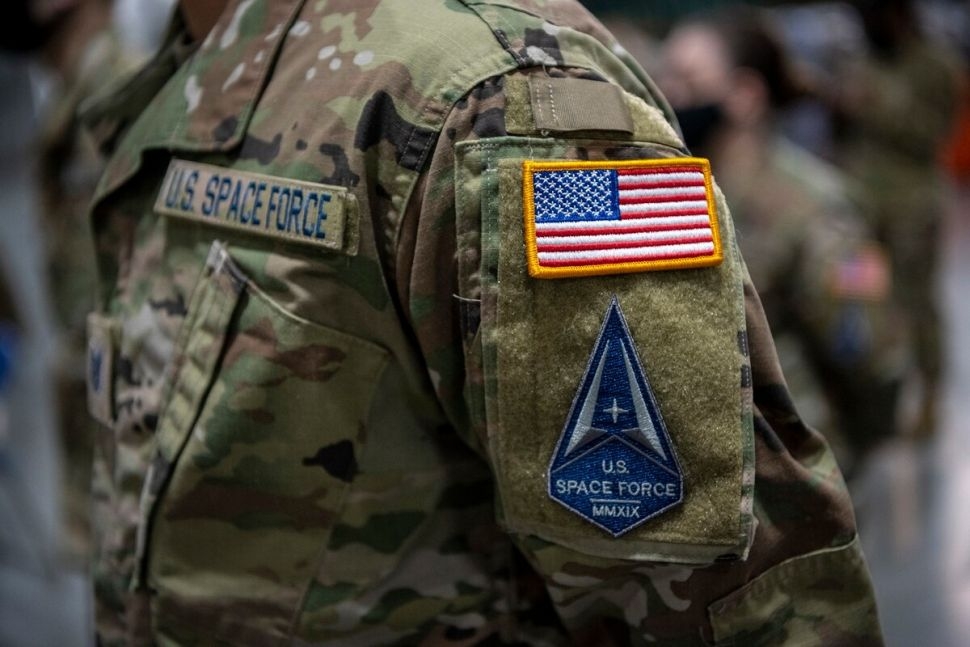
Credit: Nicholas Pilch/U.S. Air Force
Here on Earth, the air, land, and sea are zones of conflict, clashes and combat. There is a growing perception that next up is the ocean of space, transformed into an arena for warfare.
There is ongoing chatter regarding military use of space by various nations. The freshly established U.S. Space Force, for instance, is busily shaping how best to protect U.S. and allied interests in the domain of space, a sector that is increasingly becoming congested, contested and competitive.

Credit: India Defense Research & Development Organization
What conditions could lead to clashes in space? Is such a situation a given – or can they be short-circuited ahead of time? Could nations “slip into” off-planet muscle-flexing, quarreling and actual war-fighting in space that might ignite a fuse that sparks confrontation here on terra firma?
Space.com contacted several leading military space and security experts, asking for their opinions on the current status of the militarization of space.
Go to my new Space.com article here:
“Is war in space inevitable?” at:
https://www.space.com/is-space-war-inevitable-anti-satellite-technoloy

Credit: ISS/NASA
The Springer publishing group is offering an informative free video seminar on the lunar economy.
Stella Tkatchova – a project manager in the European space industry — presents the fundamentals of an emerging lunar economy, including the opportunities and challenges of in-situ resources utilization (ISRU).

Credit: Springer
The author looks into the near future of 2035 and discusses topics like habitation and research on board the Lunar Orbital Platform- Gateway station and in the Moon Village, the collaboration of space agencies with private companies setting the basis for the creation of an emerging lunar economy.
Tkatchova covers the involvement of NewSpace companies in the search for lunar resources, energy supply for habitats and rockets, a robotic space cargo infrastructure, a lunar construction industry and space tourism.

Credit: Moon Village Association/XTEND Design
NewSpace companies
The author argues that NewSpace companies will need to discover, identify and develop emerging lunar space markets and attract Customers, while space agencies will have to define the direct and indirect economic benefits from Lunar exploration to secure political, strategic and financial support. She further argues that ISRU/Lunar exploitation, lunar telecommunications and in-orbit satellite servicing are markets worth exploring and concludes that NewSpace companies will need to discover, identify and develop emerging lunar space markets and attract Customers.
This multi-part video seminar is targeted at space engineers, space economists, planers and politicians working at the vision of an emerging lunar economy.
Go to this Springer link at:

Credit: Robert Christy/Used with permission
China’s Long March-5B big booster stage made a fiery reentry to Earth.
The U.S. Space Force’s 18th Space Control Squadron (SPCS) at Vandenberg Air Force Base, California confirmed the rocket stage reentered Earth’s atmosphere on May 9 and fell into the Indian ocean north of the Maldives.
The Maldives National Defence Force (MNDF) has issued this statement: “Coastguard Squadron is active after receiving reports of rocket debris fallen in the Maldivian waters.”
Remnants of the carrier rocket reentered the Earth’s atmosphere at 10:24 a.m. (0224 GMT) on Sunday, with most of the debris burning up, according to the China Manned Space Engineering Office. After monitoring and analysis, the office said the landing area was located at longitude 72.47 degrees east, latitude 2.5 degrees north over the sea, the vast majority of debris was destroyed by the re-entry process of ablation.

Image courtesy of European Union Space Surveillance and Tracking (EUSST)
Similarly, the EU Space Surveillance and Tracking group also confirmed that the rocket body reentered on 2021-05-09 at 02:32 UTC ±25 min.
For a summary of the booster’s fall to Earth, go to this Robert Christy’s Zarya.info link at:
https://www.zarya.info/Diaries/blog/tracks.php?event=CZ%205B%20Re-entry%20-%202021%20May%209
NASA statement
Meanwhile, newly sworn in NASA Administrator Sen. Bill Nelson released the following statement Saturday regarding debris from the Chinese Long March 5B rocket:
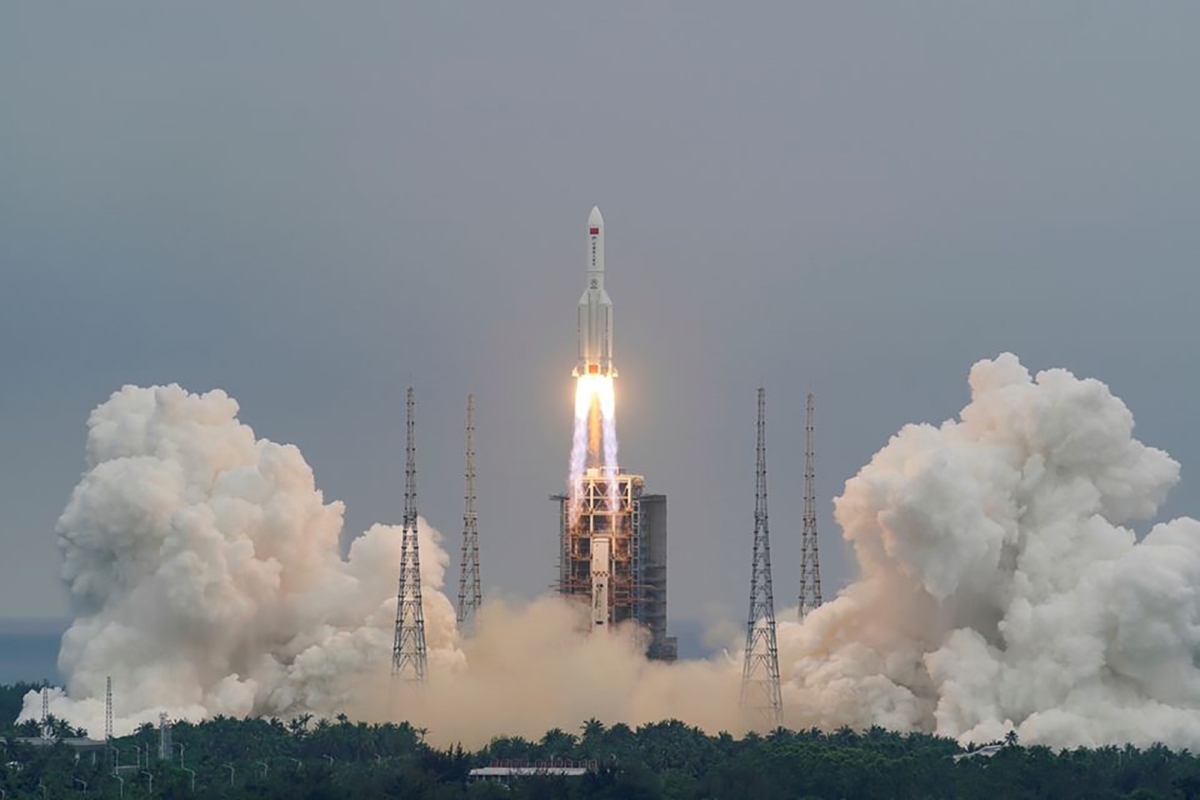
Long March-5B Y-2 carrier rocket liftoff. Credit: CASC
“Spacefaring nations must minimize the risks to people and property on Earth of re-entries of space objects and maximize transparency regarding those operations.
“It is clear that China is failing to meet responsible standards regarding their space debris.
“It is critical that China and all spacefaring nations and commercial entities act responsibly and transparently in space to ensure the safety, stability, security, and long-term sustainability of outer space activities.”

Credit: CCTV/Inside Outer Space screengrab

Wang Wenbin (spokesperson, Ministry of Foreign Affairs).
Credit: CCTV/Inside Outer Space screengrab
Informative videos
You may find these China Central Television (CCTV) videos of interest about the Long March-5B “one-and-half stage” rocket.
Also, here’s another CCTV video of Wang Wenbin (spokesperson, Ministry of Foreign Affairs), discussing the extremely low likelihood of damage to aviation or ground facilities of the Long March-5B Y2 deorbit.
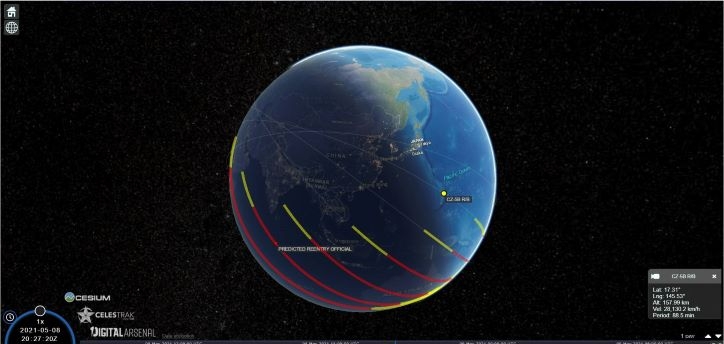
Credit: CelesTrak
The folks at CelesTrak and Digital Arsenal are providing a live view of the evolving decay of China’s Long March-5B rocket body that launched the country’s Tianhe core space station module.
Using the latest data from the 18th Space Control Squadron (18 SPCS) of the U.S. Space Force, the projection shows the position of the rocket body and the corridors where that data shows it might reenter.
The colors are set to show the decaying altitude, starting at yellow below 93.2 miles (150 kilometers) and then red below 90.7 miles (146 kilometers). The current official 18 SPCS predicted reentry point is also shown.
The graphic shows how to switch to real time or where to change the projection from 3D to 2D.

China’s Long March-5 booster departs Wenchang launch site.
Credit: CASC
Debris from a Chinese carrier rocket in the coming days is very unlikely to cause damage, said Wang Wenbin, a Foreign Ministry spokesman, according to a China Daily report.
Regarding the atmospheric reentry of the core stage of the country’s Long March5B heavy-lift booster, Wang said it is highly unlikely that the debris will cause any harm to aircraft activity or ground-based assets and personnel. “As far as I know, this type of rocket has unique designs (to make sure) that most of its parts will be burnt up during the reentry process,” he said.
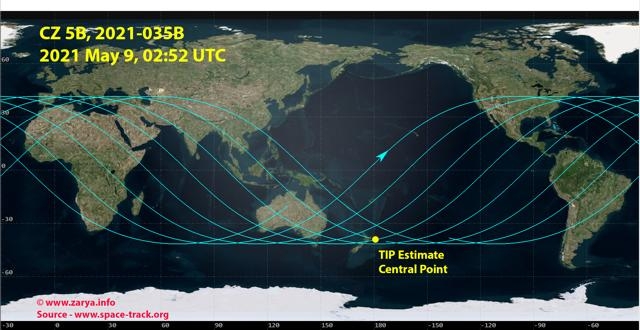
Credit: Bob Christy/used with permission
Estimated window
Bob Christy at Zarya.info reports that the potential impact of China’s 18-ton CZ-5B rocket stage is causing concern.
The two recent CZ 5B stages are the most massive objects to re-enter uncontrollably since the 40 ton Salyut 7/Cosmos 1668 combination came in over South America 1991, Christy adds.
A new map is based on the most recent Trajectory Impact Prediction (TIP) message and shows the ground track during the estimated window for re-entry.
The yellow dot does not represent the impact zone, Christy told Inside Outer Space. Both Space-Track and Aerospace Corporation estimates over the past day have the rocket body most likely falling in the southern hemisphere.

Sol 147 image taken by Opportunity rover. Martian specimens approximately 3-8 mm in size
resembling Puffballs (Basidiomycota), some with stalks or shedding white spore-like material (leprose).
Credit: Rhawn Gabriel Joseph, et al.
UPDATE: Critical review of this research can be found at: “No, NASA photos are not evidence of fungus growing on Mars, sorry
Despite what you might have read, the claims about life on Mars are shoddy and unscientific.”
Life on Mars? According to an international team of researchers there is, in the form of Martian fungi.
Their case makes use of imagery from the NASA Curiosity and Opportunity rovers, as well as photos taken from Mars orbit by the High Resolution Imaging Science Experiment (HiRISE), a super-powerful camera onboard the NASA Mars Reconnaissance Orbiter.
The research paper appearing in Advances in Microbiology is led by Rhawn Gabriel Joseph, Rudolph Schild from Harvard-Smithsonian, and Xinlei Wei, a microbiologist from the Chinese Academy of Sciences.
Harsh environment
They explain that Martian fungi, lichens, moulds, algae and other putative life-forms, would have evolved on and already be adapted to the low temperatures, intermittent availability of water, low amounts of free oxygen, and high levels of radiation that characterize the harsh Martian environment.

Strands that snake across and sometimes rise above the surface. If biological, these specimens
may consist of calcified fungal mycelium or encrusted plasmodium and protoplasmic tendrils punctuated
with fossilized bulbous fruiting bodies (sporangia). Or they may be very unusual abiogenic formations.
Credit: Rhawn Gabriel Joseph, et al.
“What would be surprising is if there was no life on Mars,” the team asserts.
“Similarities in morphology are not proof of life. It is possible that all the specimens presented here are abiotic. We cannot completely rule out minerals, weathering, and unknown geological forces that are unique to Mars and unknown and alien to Earth,” the research paper explains. “However, growth, movement, alterations in location and shape, constitute behavior, and coupled with life-like morphology, strongly support the hypothesis there is life on Mars.”
To read the full paper in Advances in Microbiology – “Fungi on Mars? Evidence of Growth and Behavior from Sequential Images” – go to
China’s Long March-5 booster departs Wenchang launch site.
Credit: CASC
China’s incoming Long March 5 booster core stage is generating lots of speculation – particularly the when, what, and where leftovers might reach the Earth’s surface.
Here are a few down-to-earth factoids provided to Inside Outer Space from T.S. Kelso of CelesTrak, an analytical group that keeps an observant eye on Earth-orbiting objects:
- The CZ-5B core stage is supposed to be around 21 metric tons. That’s about twice the mass of an average school bus or the empty mass of a Boeing 737. Estimates for objects like this are that 20-40% of the mass might survive reentry to the surface.
- The rocket body is in a 41° inclination orbit and the uncertainty being given by the 18th Space Control Squadron that predicts when and where human-made objects will reenter the Earth’s atmosphere is ±900 minutes (15 hours). That’s somewhere between 10 orbits before and after the predicted reentry point (May 9 at 04:25 UTC/00:25 EDT). Essentially, that means it could come down anywhere between 41° N and 41° S latitude.
- Perigee (the lowest point of the orbit) is over the Southern Hemisphere and reentry is expected to occur around perigee, so the reality is that observers in Southern Africa, South America, or Australia might see the reentry—not observers in North America or Europe. But most of the Earth is covered by water and much of those land areas are sparsely populated, so it is more likely to pass without anyone actually seeing. In fact, a Long March-3B rocket body just reentered on May 3 and seems to have gone virtually unnoticed—on the equator in the middle of the Pacific Ocean.
- The likelihood of anyone being injured by this type of event is small but would not be inconsequential if it happened. Yet we have over 2,000 other uncontrolled rocket bodies still in Earth orbit and each of them presents a risk to people on the surface or satellites in orbit.
- We need to be more responsible and stop leaving these objects in orbit after they have completed their job of deploying their satellite(s) to their intended orbits.

The Aerospace Corporation’s Center for Orbital and Reentry Debris Studies is monitoring the rocket stage (ID 48275).
Artwork: The Aerospace Corporation/CORDS
For follow-up reading, go to:
A Space Debris Expert Weighs in on the Massive Chinese Rocket Body Falling Uncontrollably to Earth at:

