Archive for the ‘Space News’ Category
 Author:
  May 22nd, 2021
Credit: CNSA
China’s Zhurong Mars rover is now down and dirty on the Red Planet. The six-wheeled solar-powered rover has slowly trundled off a ramp on the lander to hit the red, sandy soil of Mars, starting its journey to explore the fourth planet from the sun.
The China National Space Administration (CNSA) has stated that according to the telemetry data, Zhurong set its wheels on Martian soil at 10:40 am (Beijing Time) on Saturday.

Artwork depicts China’s Zhurong Mars rover rolling off lander.
Credit: CCTV/Inside Outer Space screengrab
The nearly 530-pound (240 kilogram) robot is now exploring the southern part of Utopia Planitia, a vast plain on the northern hemisphere of Mars. The rover has an expected lifespan of at least 90 Martian days, equal to about three months on Earth.

China’s Mars rover. Credit: Zou Yongliao, et al.
Mobility on Mars
According to China’s Xinhua news service, compared to the country’s Moon rover design, Yutu (Jade Rabbit), Zhurong has a similar speed of about 200 meters per hour, but the height of the obstacles it can surmount increased from 20 centimeters to 30 centimeters. It can climb slopes up to 20 degrees. Zhurong’s six wheels are independently driven, according to its designers.
Relying on an active suspension system, the rover can move itself like an inchworm on the complicated Martian surface with both loose sandy soil and densely distributed rocks, said Jia Yang, deputy chief designer of the Tianwen 1 probe, from the China Academy of Space Technology (CAST). Zhurong can also walk sideways like a crab. Each of its six wheels can turn in any direction, which could be used for avoiding obstacles and climbing slopes.

Credit: CCTV/Inside Outer Space screengrab
Comprehensive coverage
According to a China Central Television (CCTV) video, part of the power generated by the solar panels during the daytime will be used for work, and the rest will be stored in batteries for night use. In addition, the designers installed heat collection windows on the rover, which could absorb solar energy in the daytime and release heat at night to help the rover survive the freezing temperatures which could plunge to over 100 degrees Celsius below zero before dawn.
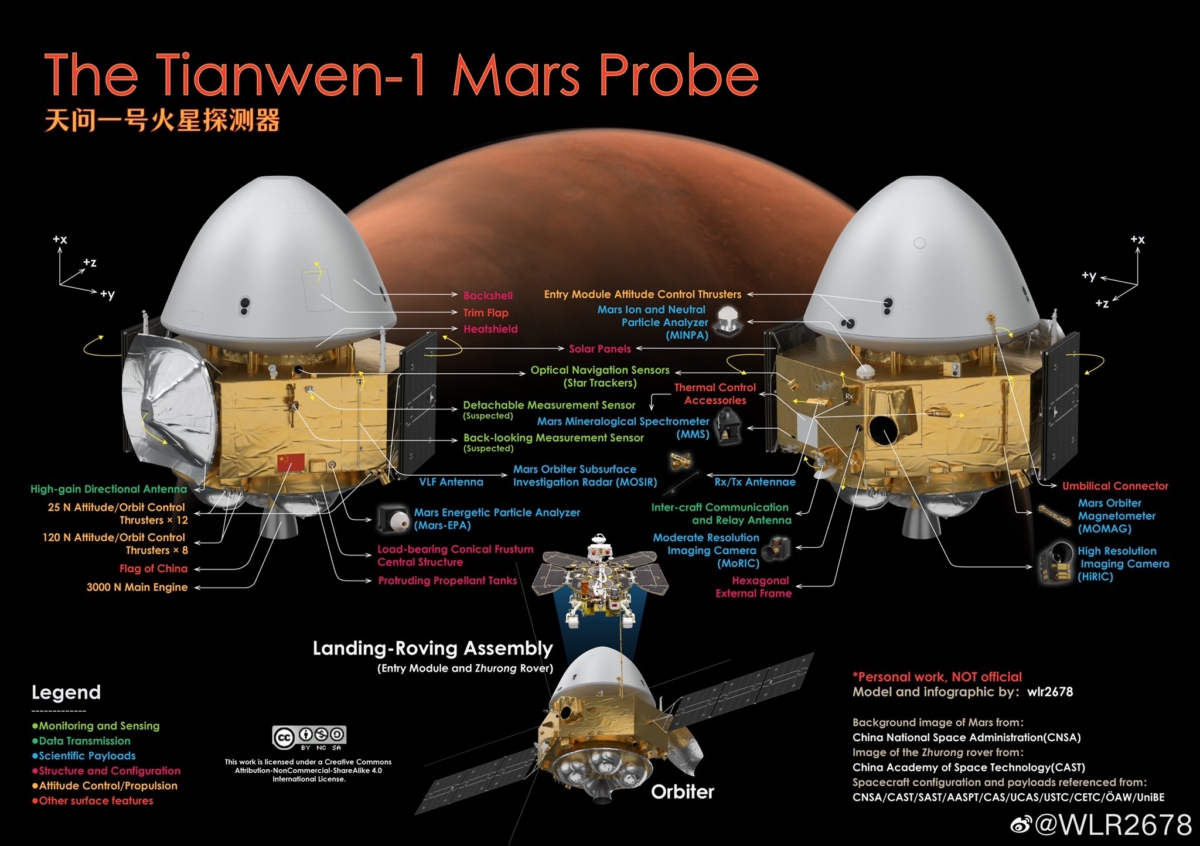
Zhang Yuhua, deputy chief commander, Tianwen-1 probe, Eighth Academy of China Aerospace Science and Technology Corporation told CCTV: “The reason why we need eight days is that the rover needs to capture the clear images of the area where it will touch down. If the assessment came out to be no difficulties, risk-free and safe, we will decide which way to go for the guide rail on the lander, which can stretch to this direction or this direction.”
Credit: Weibo wlr2678
The real Mars-orbiting exploration starts only after the three-month relay communications completes, Zhang said. “We hope we could have a comprehensive covering of Martian topography, landform and environment, and the exploratory data of the radar detecting the Martian subsurface during one Martian year. By doing so, our country will have our own abundant and first-hand data about Martian resources.”
Video resources
China’s Tianwen-1 mission — consisting of an orbiter, a lander, and a rover — was launched on July 23, 2020. The lander carrying the rover touched down on May 15. The orbiter, with a design life of one Martian year (about 687 days on Earth), will relay communications for the rover while conducting its own scientific agenda.
Go to this CCTV video at: https://youtu.be/-dmfvzqusyY
Also, go to New China TV and GLOBALink videos at:
 Posted in

Credit: Roscosmos/Inside Outer Space screengrab
Russia’s robotic return to the Moon is being readied under the framework of the Luna-Glob project. The last in the row of the former Soviet Union’s lunar missions was Luna 24 – a sample return mission in 1976.
The Luna-25 spacecraft is a small demonstration landing station for testing basic soft landing technologies in the circumpolar region and conducting contact studies of the Moon’s South Pole.

Credit: Roscosmos/Inside Outer Space screengrab
When Luna-25 lands on the Moon, it will image the terrain with a European Space Agency (ESA) Pilot-D camera built specifically for landing. The data collected by this camera will be used to prepare for ESA’s next challenge: landing on the Moon with high-precision and avoiding hazards using European technology.
NPO Lavochkin is fully engaged in preparing Luna-25 for launch in the October-November 2021 time frame. Lobbing the craft moonward will be a Soyuz-2/1b booster with a Fregat upper stage.

Credit: Roscosmos/Inside Outer Space screengrab
Main tasks
The main tasks of Luna-25 is to develop soft landing technology; study the internal structure and exploration of natural resources, including water, in the circumpolar region of the Moon; and investigate the effects of cosmic rays and electromagnetic radiation on the lunar surface.
But there’s another set of results Russia’s reintroduction of lunar exploration:
- Luna-Glob project seeks to confirm the technological status of Russia as a state with the capability to deliver payloads to the Moon;
- To create a technological groundwork for the implementation of subsequent lunar missions;
- To provide guaranteed access for Russia to the lunar surface;
- Start exploring the moon with a new quality;
- For the first time in the world, start researching the lunar soil in the South Pole area.

Credit: Roscosmos/Inside Outer Space screengrab
As noted by the Institute of Space Research of the Russian Academy of Sciences (IKI RAS), there are follow-on Russian Moon missions on the books: Luna-26 (or Luna-Resurs-Orbiter), an orbital mission to study Moon from low polar orbit. Luna-27 would be a landing mission (or Luna-Resurs-Lander), designed to study lunar regolith on-the-spot. ESA is working on a drill and a sampling device for this spacecraft.

Russia’s Luna-26 orbiter.
Credit: IKI
Once on the surface of the Moon, Luna-27 will deploy the European Prospect drill that will search for water ice and other chemicals under the surface, together with another Russian instrument. Operating at temperatures of –150 °C and drilling over one meter down, Prospect first needs to penetrate the frozen surface.
The next step after the first three missions is flying a Lunar Polar Sample Return craft (LPSR, or Luna-Grunt) to study polar samples in laboratories here on Earth. Several technological issues are to be solved, such as cryogenic delivery of the Moon’s permafrost from the poles.
A recently issued Roscosmos video (in Russian) shows the testing and preparations underway for Luna-25.
Go to:
Artwork depicts China’s Zhurong Mars rover rolling off lander.
Credit: CCTV/Inside Outer Space screengrab
China’s Zhurong Mars rover is ready to roll off the Tianwen-1 lander that touched down May 15 on the Red Planet.
Meanwhile, the first images from the designated landing spot at the southern part of Utopia Planitia on Mars were released by the China National Space Administration (CNSA).
Also issued was a video taken by a camera on the Tianwen-1 orbiter, showing the cocooned lander/rover being deployed from the orbiter for entry, descent, and landing.

Credit: CNSA
Image details
The first photograph, a black and white image, was taken by an obstacle avoidance camera installed in front of the Mars rover. The image shows that a ramp on the lander has been extended to the surface of Mars. The terrain of the rover’s forward direction is clearly visible in the image, and the horizon of Mars appears curved due to the wide-angle lens.

Credit: CNSA
A second image, in color, was taken by the navigation camera. The rover’s solar panels and antenna are seen unfolded, and the red soil and rocks on the Martian surface are clearly visible in the image.

Credit: CCTV/Inside Outer Space screengrab
On patrol
“Later on, our Mars rover will carry out the mission of patrolling and exploring the Mars surface,” said Zhang Rongqiao, chief designer of China’s Mars exploration mission during a China Central Television (CCTV) interview. “The rover will come down from the lander, check its status and plan the path. Then it will conduct scientific exploration in accordance with our set goals,” Zhang said.
Launched on July 23, 2020, the Tianwen-1 mission consists of an orbiter, a lander and a rover.
Go to these newly released videos by CCTV detailing the Tianwen-1 mission and unleashing the 6-wheeled rover at:

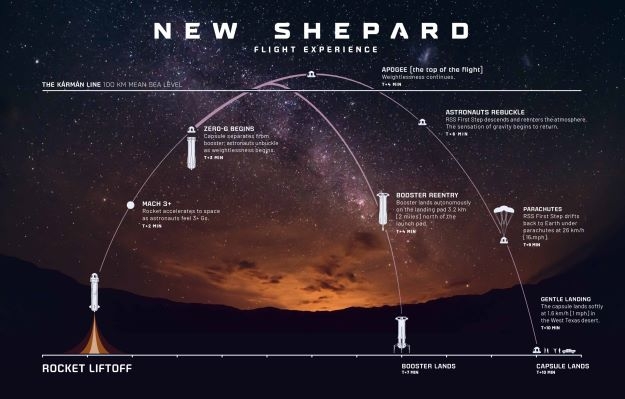
On July 20th, the Blue Origin New Shepard suborbital rocket will fly its first astronaut crew to space.
One seat on the craft is being offering on this first human-carrying flight to the winning bidder of an online auction.
From May 19-June 10, an unsealed online bidding phase is now posted – the current high bid is visible and bidding continues.
Artwork credit: Blue Origin
On June 12 a live auction is to be conducted in which participants must raise their bid limit by June 10 at 5PM EDT to participate in the June 12 live auction.
The winning bid amount will be donated to Blue Origin’s foundation, Club for the Future, to inspire future generations to pursue careers in STEM and help invent the future of life in space.
For more details, go to:
Credit: CCTV/Inside Outer Space screengrab
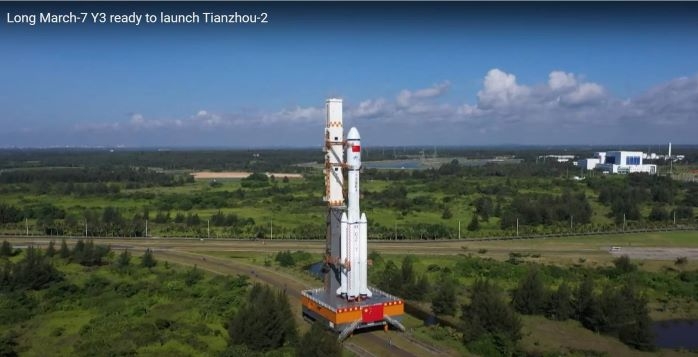
China’s Tianzhou-2 cargo spacecraft is ready for launch, destined to link up with the country’s Tianhe, the core module of China’s space station placed into Earth orbit April 29.
The China Manned Space Engineering Office reports that the now-orbiting core module has completed in-orbit performance, space application checks, and checked out for astronaut accommodation.
Additionally, the Tianhe has entered a planned rendezvous orbit in preparation for receiving the soon-to-launch cargo craft.
After their in-orbit connection, Tianzhou-2 will transfer propellants and place astronaut necessities into the module.
Credit: CGTN
Space schedule
Meanwhile, a Shenzhou-12 spacecraft is being readied, slated to haul three astronauts to the core module in early June. The crew will stay inside the module for three months.
According to China Daily, in September the Tianzhou 3 cargo ship will be lifted to dock with the core module and the next month, another three-crew team will fly the Shenzhou-13 to the module, staying onboard for six months.
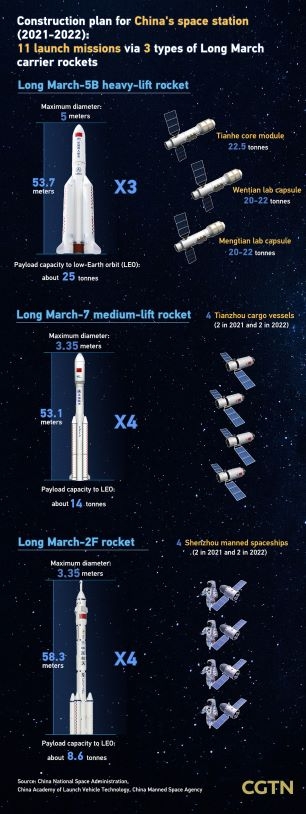
In 2022, two large space labs will be launched to connect with the module. That same year, two manned missions and two robotic cargo flights will be made to continue construction of the Chinese space station, which is scheduled to become complete and start formal operation around the end of next year, China Daily reports.

Credit: CAST
Go to this China Central Television (CCTV) video showing the Long March-7 Y3 rocket, carrying the Tianzhou-2 cargo spacecraft, being transferred to the launch area at the Wenchang Spacecraft Launch Site in south China’s Hainan Province last Sunday.

Credit: GlobalLink/Inside Outer Space screengrab
The world eagerly awaits the first images from China’s Tianwen-1 lander/rover now planted on Mars.
The Tianwen-1 lander/rover touched down at a pre-selected landing area in the southern part of Utopia Planitia, a vast plain on the northern hemisphere of Mars, at 07:18 (Beijing Time) on Saturday.
The lander is expected to deploy a ramp for the rover Zhurong in the coming days before the device rolls out onto Mars and starts its exploring. This six-wheeled robot is built to reconnoiter the Red Planet for at least 90 Martian days.
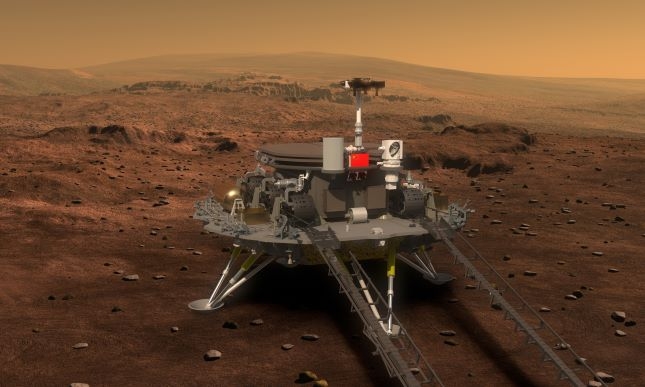
Artwork depicts lander/rover at landing site.
Credit: CAST
Patience required
Meanwhile, the Tianwen-1 orbiter is set to relay data and images from the rover. Patience is required, suggested Zhang Yuhua, deputy chief commander of the Tianwen-1 Mars mission, noting an upcoming orbit correction needed and the process of receiving and sending data from Utopia Planitia back to Earth.
Credit: CCTV/Inside Outer Space screengrab
The orbiter is equipped with a directional antenna used to communicate with the Earth. Now free of the lander and the rover, the orbiter serves as a relay satellite to forward byte-by-byte communications between the landing vehicle and Earth.
Scientific orbit
After the Zhurong rover collects and transmits back information about the Martian surface over the next 90 Martian days, the orbiter will enter a “scientific exploration orbit” to carry out short-distance planet observation for one Martian year (about 687 days on Earth).
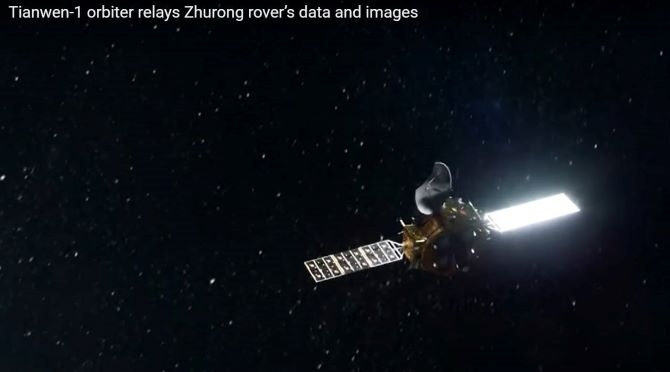
Credit: CCTV/Inside Outer Space screengrab
The orbiter can collect data from the planet at different orbital heights in different phases to piece together a better understanding of the space environment at the Red Planet.
Go to this informative video from China Central Television (CCTV) that details the relaying of data from the surface of Mars back to Earth.
Go to:
Credit: CCTV/Inside Outer Space screengrab
A Chinese cargo craft has been rolled out to its launch pad, headed for linkup with the country’s Tianhe space station module now in Earth orbit.
The Tianzhou-2 cargo vessel sits atop a Long March-7 Y3 booster, one of the 11 missions planed by China to fully outfit the country’s space station by the end of 2022.
Launch of the cargo spacecraft is from the Wenchang Spacecraft Launch Site, Hainan Province, China, on May 20, according to one report.
Credit: CGTN
The 3-person Shenzhou-12 will be launched in June, followed by the Tianzhou-3 cargo vessel and Shenzhou-13 crewed spaceship in September and October respectively.
China lofted the Tianhe core module into Earth orbit on April 29, kick-starting a series of missions over the next two years, including two lab capsules of the space station, four cargo vessel flights and four crewed missions.
To view the rollout of the Long March-7 Y3 booster, go to this China Central Television (CCTV) video at:

Credit: CGTN
The lander of China’s first Mars probe, the Tianwen-1, successfully touched down on the Red Planet Saturday morning, Beijing time, within a landing site region in Utopia Planitia.
The craft’s plummet through the Martian atmosphere lasted about nine minutes due to the specially designed aerodynamic shape of the entry capsule.
“Each step had only one chance, and the actions were closely linked. If there had been any flaw, the landing would have failed,” said Geng Yan, an official at the Lunar Exploration and Space Program Center of the China National Space Administration (CNSA).
Credit: CCTV/CNSA
Credit: CCTV/CNSA
When the velocity of the spacecraft was lowered from 4.8 km per second to about 460 meters per second, a huge parachute covering an area of about 200 square meters was unfurled to continue reducing the velocity to less than 100 meters per second.
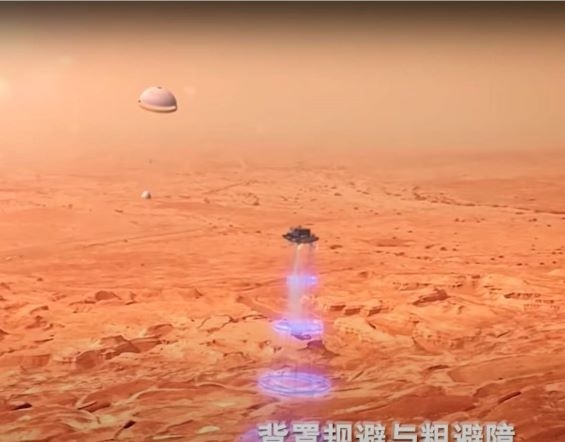
The parachute and the outer shield of the spacecraft were jettisoned, exposing the lander and rover. A retrorocket on the lander was fired to further slow the speed of the craft to nearly zero.
Buffer legs
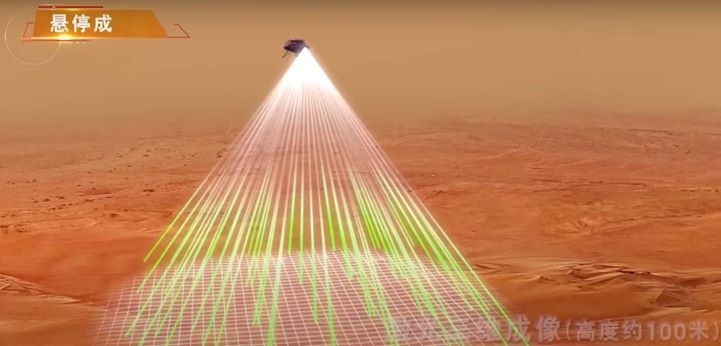
At about 100 meters above the Martian surface, the craft hovered to identify obstacles and measure the slopes of the surface. The craft then selected a relatively flat area and descended slowly, touching down safely on its four buffer legs.
It took ground controllers more than an hour to establish the success of the pre-programmed landing. Reportedly, the rover autonomously unfolded its solar panels and antenna to transmit signals after landing. There is a time delay of more than 17 minutes due to the distance between Earth and Mars.
Credit: CCTV/Inside Outer Space screengrab
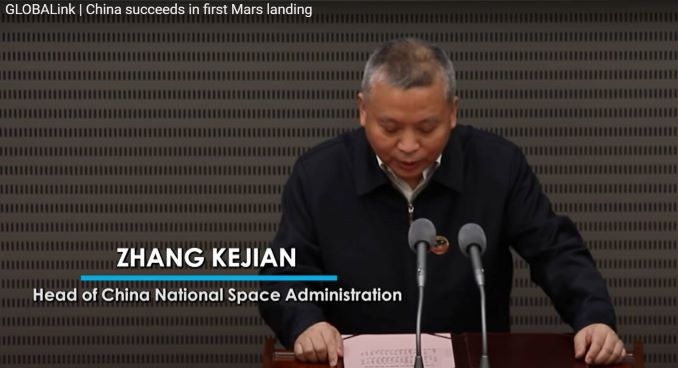
“The Mars exploration mission has been a total success,” declared Zhang Kejian, head of the CNSA, announced at the Beijing Aerospace Control Center.
Roll off of the Zhurong rover from the lander onto Mars is not scheduled to occur for several days, according to reports.
Relay orbit
Tianwen-1 consists of an orbiter, a lander and a rover. Due to the huge distance between Mars and Earth, the Zhurong rover can’t transmit data back to Earth directly, but does so through the orbiter.
In order to transmit data accurately and timely, the Mars-circling orbiter will conduct a braking maneuver in a few days and enter a relay orbit to better complete the relay communication task.
Credit: Weibo wlr2678
“We’re going to conduct the fourth braking near Mars on May 17 and change the orbital period from the current roughly 48 hours to eight hours, which means the orbiter will orbit three times a day. All images captured by the rover on the Mars surface will be sent back to Earth through the orbiter,” said Zhang Yuhua, deputy chief commander of the Tianwen-1 Mars mission.
Rover lifetime
According to the schedule, the rover will transmit data with the orbiter for about an hour a day during its mission on the surface of Mars. The data will be sent back to Earth after the transmission.
Artwork depicts lander/rover at landing site.
Credit: CAST
The rover is designed to work on the planet for at least 90 Martian days.
Tianwen-1 was launched from the Wenchang Spacecraft Launch Site on the coast of southern Chinese island province of Hainan on July 23, 2020.
The name Tianwen — meaning Questions to Heaven — comes from a poem written by the ancient Chinese poet Qu Yuan (about 340-278 BC).
China’s Zhurong rover is named after the god of fire in ancient Chinese mythology, which echoes with the Chinese name of the red planet: Huoxing (the planet of fire).
Video/Graphic resources
A number of videos and a China Global Television Network (CGTN) graphic detail the Tianwen-1 Mars mission.
Go to:
https://news.cgtn.com/event/2021/tianwen1-to-mars/index.html
Credit: Weibo wlr2678
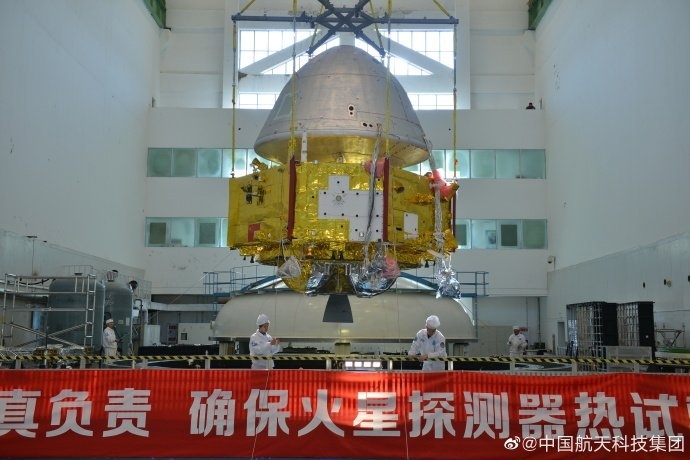
China is ready to take the Mars plunge. The country’s Tianwen-1 orbiter is set to dispatch the Zhurong rover for a fiery entry, descent and landing on the Red Planet – a deployment window that opens May 15 and stretches to May 19, according to the China National Space Administration (CNSA).
The targeted touchdown area is a large plain on Mars known as Utopia Planitia.
Plowing through the thin Martian atmosphere, the lander will enter a hovering stage several hundred feet above the surface as onboard sensors, including a camera system, search for a safe touchdown zone.
Credit: China Aerospace Technology Corporation
Ancient fire god
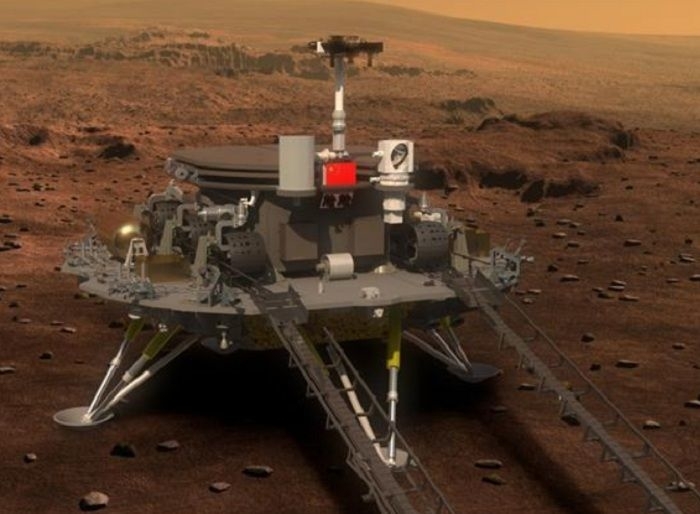
Once down on Mars, the landing craft is to send out the nearly 530 pound (240 kilograms) Zhurong rover. It is named after an ancient fire god of Chinese mythology, built to wheel across the planet for at least 3 Martian months, roughly 92 days on Earth.
The Tianwen-1 mission is China’s first attempt at soft landing on Mars, aimed at achieving “orbiting, landing and roving” all in one mission. If successful, China’s lander/rover would join currently operating NASA Mars machinery, the Curiosity and Perseverance rovers.
Credit: CCTV/Screengrab Inside Outer Space
Landing site
Tianwen-1 was launched on July 23, 2020 and entered Mars orbit on February 10, 2021. The landing window at Utopia Planitia opens from early morning May 15 until May 19, Beijing time.
The Tianwen-1 landing site region, in Utopia Planitia, is in an “extremely interesting area” and complements previous exploration of the margins of the northern lowlands at the NASA Viking-1 and NASA Pathfinder sites, explains James Head, of the Department of Earth, Environmental and Planetary Sciences at Brown University in Providence, Rhode Island.
“It lies within the area thought to be part of potential ancient northern lowland oceans that may have existed in the Noachian and Late Hesperian, and lies topographically below the proposed ‘shorelines’ for both of these candidate oceans,” Head told Inside Outer Space.

This rocky panoramic scene is the second picture of the Martian surface that was taken by Viking Lander 2 shortly after touchdown on Sept. 3, 1976.
Credit: NASA/JPL
Astrobiological interest
The global-scale unit within which Tianwen-1 is targeted is the Vastitas Borealis Formation, Head added, a Late Hesperian-aged unit that is interpreted to be the sedimentary remnant of the ocean proposed to occupy the northern lowlands at that time.
“Thus it not only has extremely high geological interest — do the surface units look sedimentary, is there evidence of wave and water activity, is there any remaining water frozen as ice, etc. — but is also of very obvious astrobiological interest given possible fossils or evidence of biological activity,” Head explained.
China’s Mars rover. Credit: Zou Yongliao, et al.
In September 1976, NASA’s Viking-2 landed in the Utopia basin, in the northern part of the basin, near Mie Crater. At that location, Head noted that the U.S. Mars stationary lander found a wide diversity of features and rocks, including ice contraction crack polygons, frosts and drifts of snow.
“These results bode very well for the high scientific interest of the potential types of terrains that the Tianwen-1 mission will explore,” Head said. Most importantly, China will be able to go “over the horizon,” a very frustrating limitation of the stationary Viking-2 mission, he said.
https://youtu.be/viGy-KnG0mU

Artist’s view of the James Webb Space Telescope (JWST) in space, up and operating tackling a full agenda of space science conquests.
Credit: Northrop Grumman
The U.S. General Accountability Office (GAO) issued today a new report:
“James Webb Space Telescope: Project Nearing Completion, but Work to Resolve Challenges Continues”
The GAO report notes that the cost of the telescope has nearly doubled—to $9.7 billion—since 2009. Its launch, now planned for October 2021, has been delayed over 7 years – and may be delayed again due to less than fully nominal separation of the fairing on two recent Ariane 5 launches, SpaceNews reports. Europe’s Ariane 5 is the booster that will hurl the telescope into space.
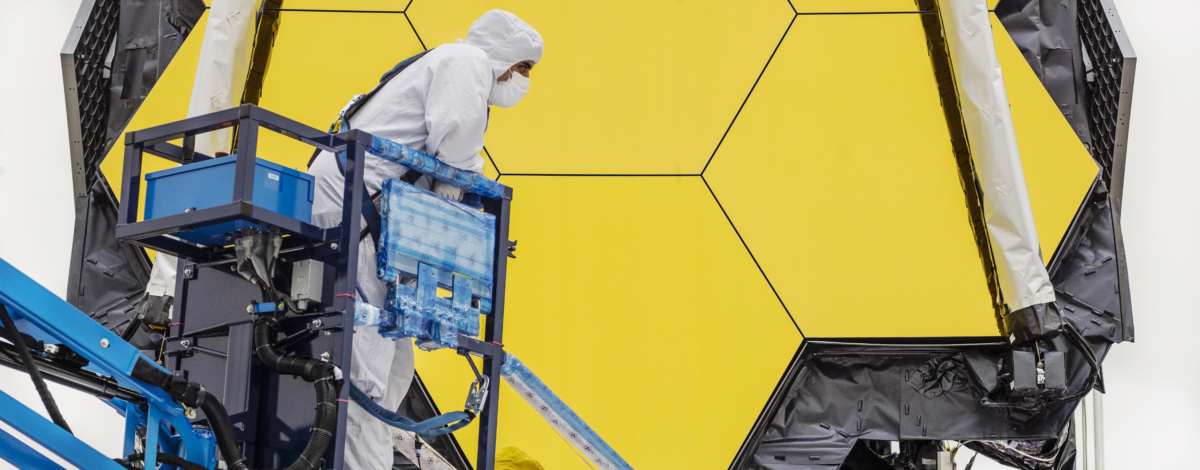
NASA’s James Webb Space Telescope in the clean room at Northrop Grumman, Redondo Beach, California.
Credit: NASA/Chris Gunn
Schedule reserves
“NASA is working to complete the telescope. Activities like strengthening the telescope’s sunshield took longer than expected, cutting into the project’s schedule reserves, i.e., the extra time NASA set aside to account for unforeseen problems. As a result, NASA has less reserve than planned to complete remaining activities,” the GAO report explains.
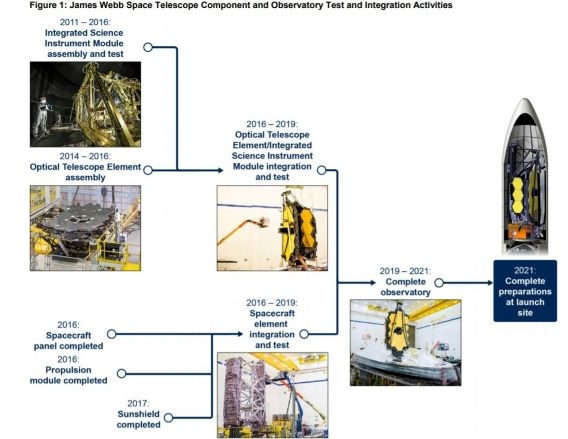
Credit: GAO/NASA
The James Web Space Telescope (JWST) is a large, deployable telescope – one of NASA’s most complex projects and top priorities. It is the scientific successor to the Hubble Space Telescope and is intended to help scientists better understand how galaxies and the universe have evolved and study planets in other solar systems.
Problems discovered during integration and testing caused multiple delays, the GAO report explains, that led NASA to replan the project in June 2018.
To read the newly issued GAO report, go to:
https://www.gao.gov/assets/gao-21-406.pdf
A “highlights” fact sheet can be found here at:

