Archive for the ‘Space News’ Category
 Author:
  June 4th, 2021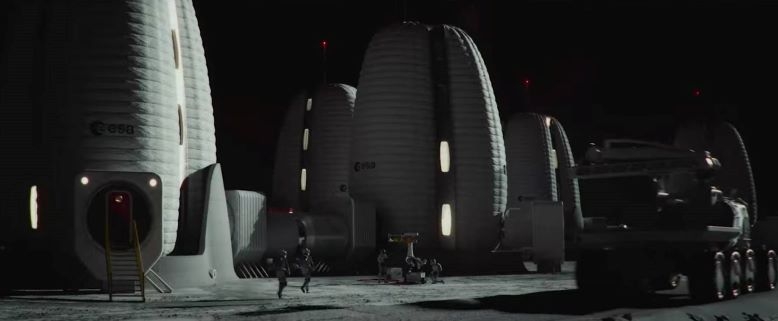
Credit: Skidmore, Owings & Merrill/ESA/Inside Outer Space screengrab
A detailed concept for a lunar habitat, created by one of the world’s leading architectural firms with European Space Agency (ESA) technical support, is currently on show at the Biennale in Venice.
Skidmore, Owings & Merrill, originator of many of the world’s tallest skyscrapers, worked with ESA on a semi-inflatable habitat design which could be part of a long-term vision for an international Moon settlement.
The chosen site of this four-storey semi-inflatable habitat: the rim of Shackleton crater beside the lunar South Pole. Thanks to this proposed location, the settlement will receive near continuous daylight throughout the lunar year, enabling it to achieve self-sufficiency by harnessing sunlight for energy.
Multidisciplinary initiative
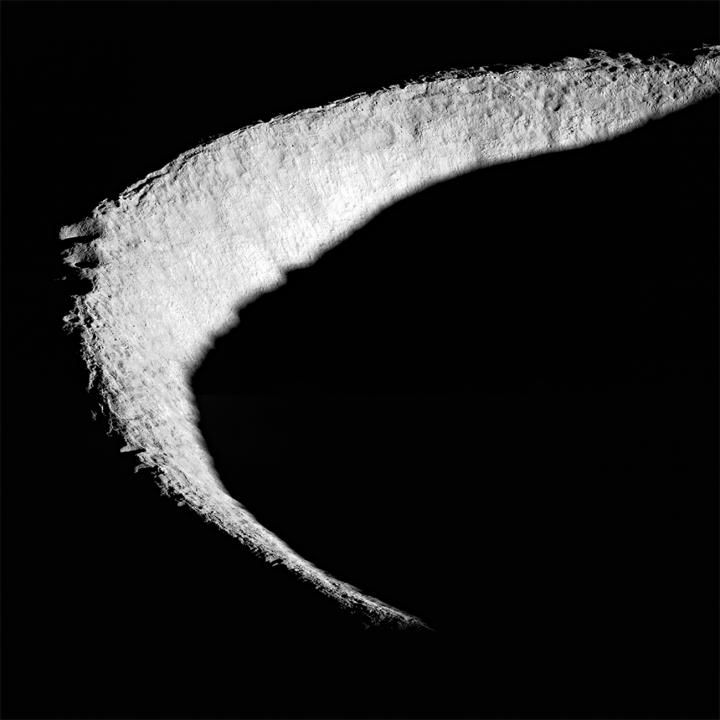
Shackleton Crater, the floor of which is permanently shadowed from the Sun, appears to be home to deposits of water ice.
Credit: NASA/GSFC/Arizona State University
“Life Beyond Earth”, a powerful new installation that brings to life Skidmore, Owings & Merrill and the European Space Agency’s concept of a Moon Village, launched last week at the 17th International Architecture Exhibition of La Biennale di Venezia.
The Moon Village project is the result of a multidisciplinary initiative launched by ESA and was developed in collaboration with MIT AeroAstro Professor and former NASA astronaut , Jeffrey Hoffman.
Go to this engaging video detailing a Moon village at:
 Posted in

To help celebrate the highly anticipated UFO government report expected to be released later this month, the pop culture is also abuzz about the task force findings.
OREO is sending a sign of peace and unity to any extraterrestrials out there with a playful offering of Earth’s number 1 cookie…even building a site on a farm in the heart of the country as part of the flying saucer fanfare.
The OREO Offering” is designd to bring all lifeforms together. Throughout the day, OREO crowdsourced preferences from fans on Twitter to determine cookie flavor, milk type and more to include in the offering.
To roll out the welcome mat for visitors from afar, OREO created a friendly offering on a private farm enabling extraterrestrials to land safely and enjoy a fully stocked site complete with OREO cookies and milk!
A video has been released revealing how it all came together with a playfully mysterious twist (an intricate 3-acre wide design encircling the site of the OREO Offering appears, implying that the brand’s efforts to bring all life forms together may have been successful).
Check out this video at: https://youtu.be/ic1uBV7S6Jc
For a limited time only, OREO is inviting Earthlings everywhere to make their own offerings at home with the release of specially designed packs of cookies.

Lifeforms
“Whether you are a UFO believer or not, it is undeniable that a special connection forms over Earth’s number one cookie and a glass of milk!” said Olympia Portale, senior brand manager of OREO Equity. “With The OREO Offering, we are ready to greet any lifeforms that might be out there. We’ve also created specially designed packs of OREO cookies so our Earthling fans can extend the olive branch to extraterrestrials at home too.”
OREO is also inviting we planet dwellers to make their own offerings at home with the release of specially designed packs of cookies. Fans have a chance to snag the OREO Offering cookies that are available for a limited time starting today, by visiting OREO.com/TheOREOOffering
Simply position a cookie in the center of the specially designed pack and place it within clear view of the night sky to share a sign of peace and unity to any extraterrestrials out there.
Show @OREO your own offerings on social media using #OREOOffering and be sure to say you got them for free from OREO.
OREO Offering packs are only available while supplies last, on a first-come, first-serve basis, with fans just covering the cost of shipping to receive their complimentary pack.
On the other hand, given past governmental studies of UFOs, who knows what this new report will say. I guess that’s just the way the cookie crumbles.
Onward to Venus!
NASA has selected two spacecraft missions to purge knowledge out of Earth’s sister world:
DAVINCI+ (Deep Atmosphere Venus Investigation of Noble gases, Chemistry, and Imaging)

DAVINCI+ Credit: NASA GSFC visualization by CI Labs Michael Lentz and others
VERITAS (Venus Emissivity, Radio Science, InSAR, Topography, and Spectroscopy)
Both missions are expected to launch between 2028 and 2030.
The selection announced yesterday beat out two other candidates, an Io Volcano Observer and TRIDENT that would have explored Triton.
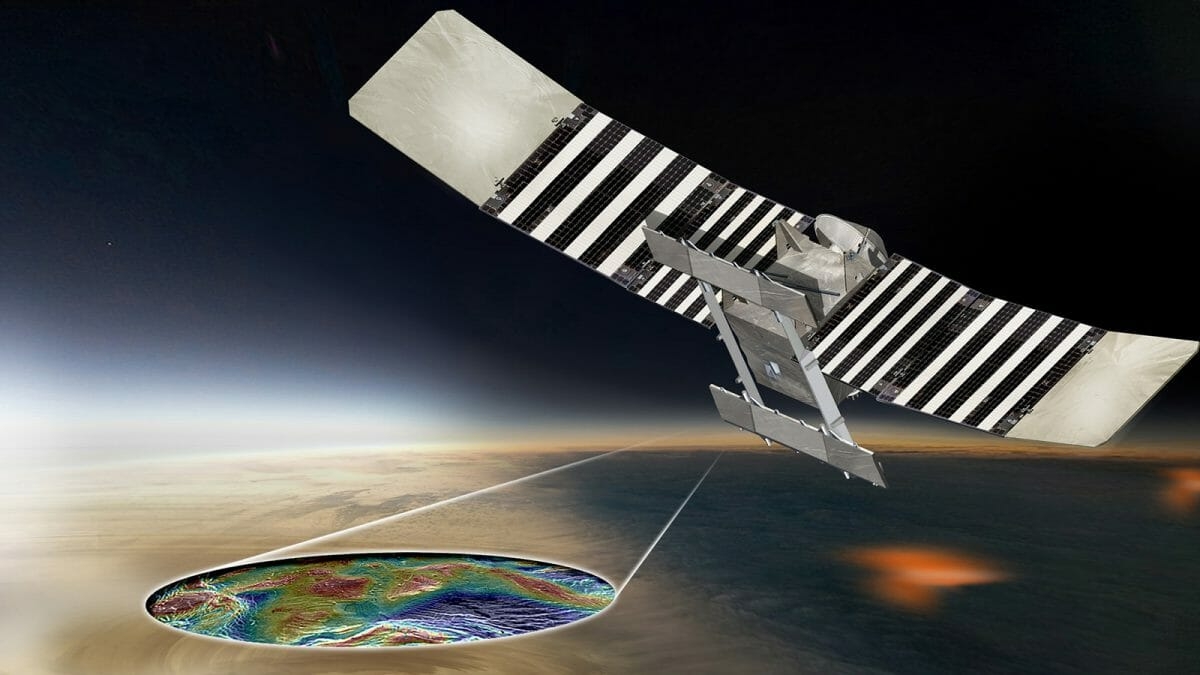
VERITAS Credit: NASA/JPL-Caltech
Life on Venus?
James Garvin, senior fellow & chief Scientist is the DAVINCI+ principal investigator at NASA Goddard Space Flight Center. He tells Inside Outer Space: “Mars is cool but Venus is way hotter.”
You might find my Scientific American story of last year of interest regarding these missions and Venus exploration:
“Is There Life on Venus? These Missions Could Find It – Following a tantalizing discovery, these spacecraft could be headed to Earth’s twisted twin in search of the truth” at:
https://www.scientificamerican.com/article/is-there-life-on-venus-these-missions-could-find-it/
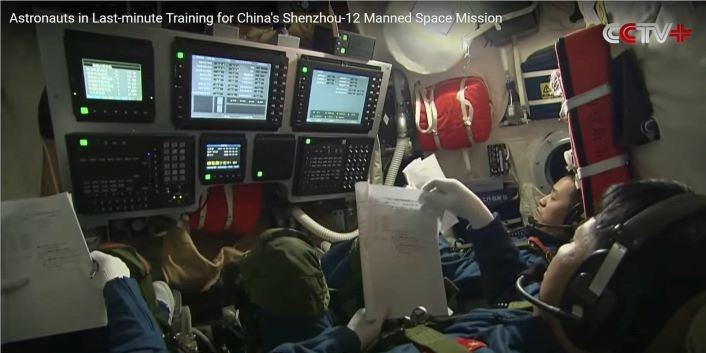
Credit: CCTV/Inside Outer Space screengrab
Astronauts on the upcoming Shenzhou-12 mission will engage in spacewalks outside the Tianhe core module of China’s Tiangong space station, a key figure in the nation’s manned space endeavor said.
China will launch a trio of astronauts on the upcoming Shenzhou XII mission in June to dock with the currently unoccupied Tianhe core module of China’s Tiangong space station.
The automated Tianzhou-2 cargo spacecraft was launched last Saturday evening, docking with the Tianhe core module early on Sunday morning

Credit: CCTV/Inside Outer Space screengrab
Three-month journey
Yang Liwei, the first Chinese in space and now deputy chief planner of the country’s manned space program, told China Central Television (CCTV) on Sunday that during their three-month journey with Tianhe, two of the three-member crew, whose names have yet to be disclosed, will exit from the core module to examine, maintain or repair equipment.
Crew members of the Shenzhou-12 and the next three crewed spaceflights-Shenzhou-13, 14, and 15 were selected from those in the first and second groups of astronauts, Yang said.
Yang added that the Shenzhou-12 crew is all male, but there will be a woman in each of the next three missions.

China’s space station is projected to be completed in late 2022.
Credit: CAST
Flights next year
All astronauts in the next four spaceflights are undergoing intensive training, Yang said.
Shenzhou-13 is slated to fly to Tianhe in October, carrying three astronauts for a six-month mission inside the core module. Shenzhou-14 and Shenzhou-15 are expected to take place in 2022, with each crew team staying in space for half a year.
The piloted missions will depart from the Jiuquan Satellite Launch Center in northwest China.
Go to this CCTV video focused on preparations in readying piloted Shenzhou missions at:

Credit: CCTV/Inside Outer Space screengrab
Details are emerging regarding the docking of China’s newly-launched cargo spacecraft Tianzhou-2 to the Tianhe space station module.
Tianzhou-2 is fully automatic and the spacecraft has a specialized smart cargo managing system to replenish the station, said experts, according to the China Central Television (CCTV).
The Tianzhou-2 cargo spacecraft was lofted Saturday (Beijing time) atop a Long March-7 Y3 rocket, blasting off from the Wenchang Spacecraft Launch Site in south China’s Hainan Province.
The supply ship brought supplies, equipment and propellant to the in-orbit Tianhe space station core module.
“From the moment of launch to the rendezvous and docking, the ground personnel do not participate in the whole process and do not perform calculation simulations. The entire rendezvous and docking process is carried out directly through the spacecraft’s own computer system,” said Liu Zhihui, deputy chief commander of Tianzhou-2 project.

Credit: CCTV/Inside Outer Space screengrab
“Later, we are going to do a tele-operation rendezvous and docking. Astronauts will be able to remotely control our cargo spacecraft to dock with the space station in the core model of the space station. The purpose of this design is that when we conduct flights in the future, our regular docking is automatic docking, but if there is a problem with the automatic system, we will switch to manual docking mode,” said Bai Mingsheng, chief designer of Tianzhou-2 told CCTV.
Supply ship specifics
The length of Tianzhou-2 is 10.6 meters, and its width can reach 14.9 meters after the solar panels are fully deployed. The entire cargo spacecraft is divided into two parts, the rear part is the propulsion cabin, which has a diameter of 2.8 meters, and the front part is its cargo cabin, which can reach 3.35 meters in diameter.
Tianzhou-2 has a total weight of 13.5 tons, and can carry 6.9 tons of payloads, making it currently the world’s most powerful cargo spacecraft. A total of 36 engines are installed on the cargo spacecraft, including 4 orbit-controlled engines. These 4 high-power engines are the guarantee for the process of raising and changing the orbit of the cargo spacecraft.

China’s space station expected to be completed around 2022.
CMS/Inside Outer Space screengrab
Intelligent cargo management
The 6.9-ton cargo list of the Tianzhou-2 includes not only the items for astronauts’ daily needs, but also some hardware equipment for experiments. In the past, due to the huge variety and quantity of cargo, astronauts had to deal with situations where they could not quickly find what they needed. To solve this problem, designer of Tianzhou-2 specially developed an intelligent cargo management system for their convenience.
China first used automatic space docking technology on the Shenzhou-8 unpiloted spacecraft in November 2011. In June 2012, the country used a remote-control system to dock a crewed Shenzhou-9 with Tiangong-1, China’s experimental space lab.
Go to these newly issued videos regarding the Tianzhou-2 mission at:

An impressive new site offers an eyeful to help you spot the SpaceX Starlink satellites.
Using this site, you can find out when the Starlink satellites are expected to be visible at your location.
There are some helpful tips on the site, such as this FAQ:
Why are there only a few satellites in this app? Doesn’t Starlink have hundreds of satellites?
“Yes, there are hundreds of them. Many are in groups of 30-40 satellites, and fly in a “chain” formation. So this app tracks only the first satellite in every “chain” of satellites. That way, when you see the first satellite in a chain, the rest will follow behind in that chain. Otherwise the results page will be very cluttered.”
Go to: https://findstarlink.com/

Credit: Lockheed Martin/GM
A next generation of lunar rovers is being blueprinted, with Lockheed Martin and General Motors (GM) teaming up to extend the exploration range of astronauts performing science tasks on the Moon.
According to a May 26 announcement by the two organizations, not only will these vehicles be equipped to go the distance, they will also be driver optional.
Moon-style, autonomous, self-driving systems would enable the vehicle to operate with or without humans onboard.
A Lockheed Martin-GM rover would be able to preposition itself autonomously near a landing site prior to astronauts arrival, and crews would have the ability to task the rover from the Human Landing System or the orbiting lunar Gateway to conduct science operations without a driver.

Credit: Lockheed Martin/GM/Inside Outer Space screengrab
Chauffeuring astronauts
GM brings to the table state-of-the-art battery-electric technologies and propulsion systems for the lunar rover. Lockheed Martin sees the Moon vehicle as affordable, given digital tools to rapidly fabricate the transportation system.
The Lockheed Martin-GM team envisions autonomously chauffeuring astronauts to the dark regions of the Moon.

Credit: NASA
Other scientific activities that surface mobility can enable include: field geology, sample collection and return, and deploying experiments.
Go to these videos that detail the Lockheed Martin-GM announcement at:

Credit: NASA
The Government Accountability Office (GAO) has issued a new report: NASA Lunar Programs: Significant Work Remains, Underscoring Challenges to Achieving Moon Landing in 2024.
NASA’s planned pace to develop a Human Landing System, says the GAO report, is months faster than other spaceflight programs, and a Moon lander is inherently more complex because it supports human spaceflight.
The GAO study focused in on the Gateway—which NASA is developing to be an outpost orbiting the Moon—in that it relies on power and propulsion technology that has never before been used, and contractor efforts to develop the technology are behind schedule.
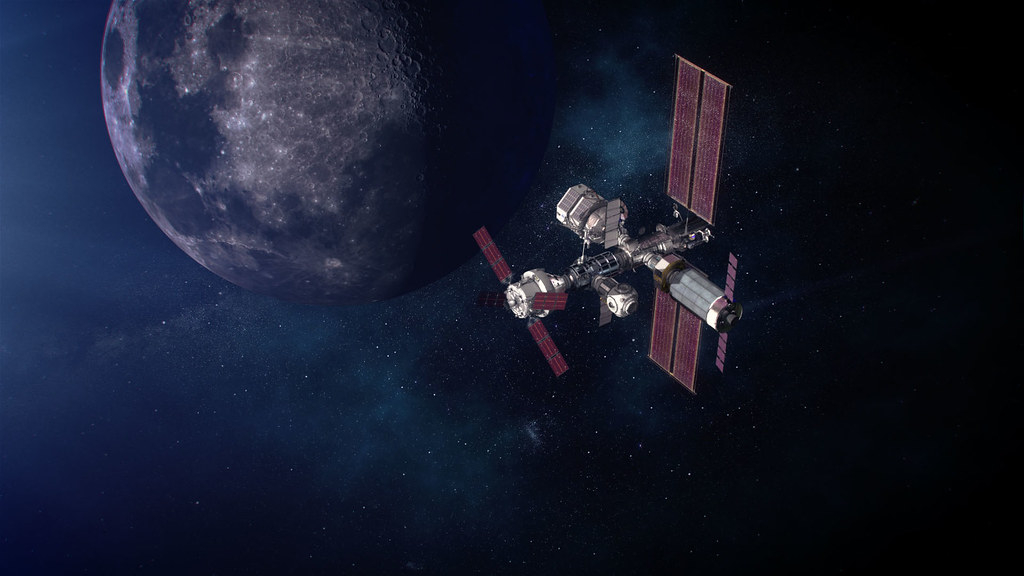
NASA’s Lunar Gateway.
Credit: NASA/JSC
Knowledge gaps
“NASA’s lunar programs face cost, schedule, and technical risks that highlight how difficult it will be for NASA to achieve the ambitious 2024 lunar landing goal,” the report explains. “Specifically, NASA will need to address potential requirements gaps, technology development knowledge gaps, and a pending Artemis III mission decision that affects multiple programs.”

NASA’s Artemis program.
Credit: NASA
“Achieving a lunar landing in 2024 is an ambitious goal, and little is known about the overall cost of NASA’s efforts to do so,” the GAO report adds. “With just over 3 years remaining, NASA lacks insight into the cost and schedules of some of its largest lunar programs in part because some of its programs are in the early stage of development and therefore have not yet established cost and schedule estimates or baselines.
To take a look at this new GAO report, go to:
https://www.gao.gov/assets/gao-21-330.pdf
A highlights document is available at:

Credit: China Central Television (CCTV)/China National Space Administration (CNSA)/Inside Outer Space screengrab
China’s Zhurong Mars rover is scouting about on the Utopia Planitia region of the Red Planet, a site that may offer astrobiological potential.
“There could be fossils there,” explains James Head, professor of geological science at Brown University, adding that the robot could be on the floor of an ancient — billions of years old — ocean.

Credit: CCTV/Inside Outer Space screengrab
Zhurong offers the opportunity that fundamental scientific questions, like the origin of life, can be tackled, Head senses.
Onboard the Mars machinery that began its mission on May 22 is a ground penetrating radar that could detect a frozen ocean below its wheels.

Credit: CNSA
Slow-going
The rover can communicate with Earth for 10 minutes each day via the Tianwen-1 relay orbiter now circuiting Mars.
The 1.85-meter-tall robot is propelled by six wheels and powered by four solar panels. It can move at a slow-going 200 meters an hour on the Martian surface.
Developed by the China Academy of Space Technology in Beijing, the major maker of Chinese spacecraft, Zhurong carries six scientific instruments including a multispectral camera, shallow subsurface radar and meteorological measurer.

Credit: CNSA
High geological interest…in the lowland
The Tianwen-1 landing site region in Utopia Planitia is in an “extremely interesting area” Head recently told Inside Outer Space.
“It lies within the area thought to be part of potential ancient northern lowland oceans that may have existed in the Noachian and Late Hesperian, and lies topographically below the proposed ‘shorelines’ for both of these candidate oceans,” Head said. The global-scale unit within which Tianwen-1 is targeted is the Vastitas Borealis Formation, Head added, a Late Hesperian-aged unit that is interpreted to be the sedimentary remnant of the ocean proposed to occupy the northern lowlands at that time.

Credit: CGTN
“Thus it not only has extremely high geological interest — do the surface units look sedimentary, is there evidence of wave and water activity, is there any remaining water frozen as ice, etc. — but is also of very obvious astrobiological interest given possible fossils or evidence of biological activity,” Head said.
For informative videos focused on China’s Mars rover, go to these newly issued videos:

Credit: Virgin Galactic
Virgin Galactic completed on May 22 its third spaceflight and the first ever spaceflight from Spaceport America, New Mexico.
VSS Unity spaceship completed the first-ever human spaceflight from Spaceport America, New Mexico, with two pilots reaching apogee at 55.45 miles above ground. The flight is a meaningful step toward the opening of commercial space travel.
VSS Unity achieved a speed of Mach 3 after being released from the mothership, VMS Eve, and reached space before gliding to a runway landing at Spaceport America.
On VSS Unity’s flight deck were CJ Sturckow and Dave Mackay, while Kelly Latimer and Michael Masucci piloted VMS Eve.

Credit: Virgin Galactic
Test objectives
According to a Virgin Galactic press statement, the flight fulfilled a number of test objectives, including:
- Carried revenue-generating scientific research experiments as part of NASA’s Flight Opportunities Program.
- Collected data to be used for the final two verification reports that are required as part of the current FAA commercial reusable spacecraft operator’s license.
- Tested the spaceship’s upgraded horizontal stabilizers and flight controls and validated Electromagnetic Interference (EMI) reductions.
Following the flight, Virgin Galactic will conduct a review of all test data gathered and thoroughly inspect the spaceship and mothership. Once the team confirms the results, the company plans to proceed to the next flight test milestone.

Credit: Spaceport America
Important milestone
“Fifteen years ago, New Mexico embarked on a journey to create the world’s first commercial spaceport,’’ said Sir Richard Branson, Virgin Galactic founder. ‘’Today, we launched the first human spaceflight from that very same place, marking an important milestone for both Virgin Galactic and New Mexico.”
To celebrate the first human spaceflight from New Mexico, the Zia Sun Symbol of New Mexico’s state flag was placed prominently on the exterior of the Spaceship. In addition, we flew green chile seeds, which are synonymous with the state’s rich agricultural and culinary history.
To view a Virgin Galactic video spotlighting the flight, go to:

