Archive for the ‘Space News’ Category
 Author:
  June 19th, 2021
Credits: NASA/Greg Shirah
The chances that life took hold on Mars are at least as high as they were on Earth.
A new research paper notes: “Although the habitability of early Mars is now well established, its suitability for conditions favorable to an independent origin of life has been less certain. With continued exploration, evidence has mounted for a widespread diversity of physical and chemical conditions on Mars that mimic those variously hypothesized as settings in which life first arose on Earth.”

Credit: Clark, Kolb, et al.
Early wet Mars remains a prime candidate for its own origin of life, in many respects superior to Earth, the paper explains.
The research paper – “Origin of Life on Mars: Suitability and Opportunities” — is led by Benton Clark and Vera Kolb and appears in the journal Life.
Go to this open access article — Origin of Life on Mars: Suitability and Opportunities – in Life, an international, peer-reviewed, open access journal of scientific studies related to fundamental themes in life sciences at:
https://www.mdpi.com/2075-1729/11/6/539/htm
Dirk Schulze-Makuch, a professor at the Technical University Berlin, Germany, and an Adjunct Professor at Arizona State University and Washington State University reviews the new paper in Air & Space/Smithsonian magazine.
There remains the real possibility that life started first on Mars, and was brought here by meteorites later, adds Schulze-Makuch at:
 Posted in

Credit: CCTV
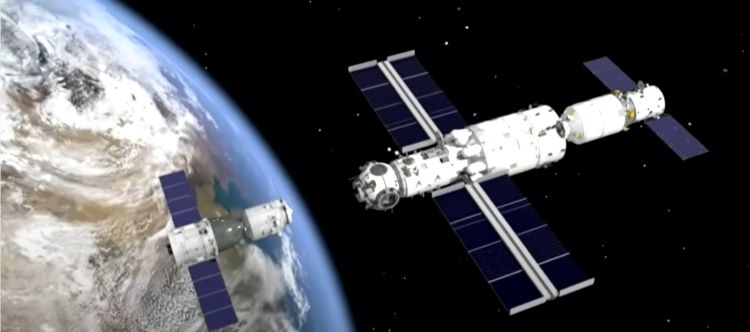
China’s three-person Shenzhou-12 crew is busy at work after spending a night in the Tianhe core module. Chinese astronauts Nie Haisheng, Liu Boming and Yang Hongbo installed Wifi on Friday morning.
In a China Central Television (CCTV) interview, Sun Jun, deputy director of the Beijing Aerospace Flight Control Center said the space trio are setting up various facilities needed, including those for telecommunication, living, cooking and sanitation purposes. Doing so, the crew is laying a basic logistic foundation for long-term, on-orbit life, added Sun.
Credit: CCTV/Inside Outer Space screengrab
“The network in space is connected with the network on Earth. After the Wi-Fi facility is installed, astronauts can communicate smoothly and even have video calls with engineers and with their family members on Earth,” said Sun.

Credit: CCTV/Inside Outer Space screengrab
The crew is unpacking the daily necessities from the cargo ship and is moving more equipment to the core module, tasks that are expected to take about a week. The crew will later carry out space science experiments and on-orbit training, especially to prepare for space walking activities, Sun said.

Credit: GLOBALink/Inside Outer Space screengrab
Spacious home
“I’m envious of their spacious home,” said Yang Liwei, China’s first astronaut to travel into space, congratulating the astronauts of the Shenzhou-12 spaceship upon entering the country’s space station core module.
Shenzhou-12 is China’s seventh crewed mission to space and the first to initiate hands-on construction of China’s space station to be completed late next year.
The Tianzhou-3 cargo craft and the Shenzhou-13 manned spaceship will also be launched later this year to dock with Tianhe, and another three astronauts will then begin a six-month stay in orbit, according to the China Manned Space Agency (CMSA). Based on project plans, the Tianzhou-3 cargo ship will be launched in September to dock with Tianhe, and in October, a Shenzhou-13 three-person team will fly to the module to stay there for six months.

Robotic arm helps on space station construction.
Credit: CCTV/CNSA/Inside Outer Space screengrab
After the five launch missions this year, China plans to have six more missions, including the launch of the Wentian and Mengtian lab modules, two cargo spacecraft and two crewed spaceships in 2022, to complete the construction of the space station.
One of China’s most adventurous space endeavors, the Tiangong (Heavenly Palace) space station will consist of three main components — a core module attached to two space labs — with a combined weight of nearly 70 metric tons. The entire station is set to work for about 15 years.

Credit: CCTV/Inside Outer Space screengrab
Rescue backup
As crews are expected to stay in space for three to six months, there’s a backup rocket and spacecraft ready on the launch pad.
According to Shao Limin, Deputy Technological Manager of the Shenzhou-12 spacecraft at the China Academy of Space Technology, Chinese space engineers are preparing Shenzhou-13 as a backup spacecraft for the Shenzhou-12 space mission, in order to better guarantee astronauts’ safety in the case of any in-space emergency.

Credit: CCTV/Inside Outer Space screengrab
“Shenzhou-13 has been transferred to the launch pad as the backup emergency ship at the same time as we transferred Shenzhou-12,” Shao told CCTV. “If Shenzhou-12 encounters any major problem, “we can launch Shenzhou-13 without crew within 10 days for rescue.”
New videos of space station operations are available from China Central Television (CCTV)/China National Space Administration (CNSA), as well as New China TV/GLOBALink at:

Credit: NASA/JPL-Caltech/ASU
NASA’s Mars Perseverance rover at Jezero Crater is finding a treasure-trove of geological activity. Scientists believe the area was once flooded with water and was home to an ancient river delta.
One major assignment for the rover is exploring for signs of fossilized microbial life.
The robot has imaged “unusual” rocks, and it remains unclear whether these rocks are sedimentary or volcanic.

Mars Perseverance Right Mastcam-Z Camera image acquired on June 13, 2021 (Sol 112). Credit: NASA/JPL-Caltech/ASU
Multiple hypotheses
“We still have multiple working hypotheses, sedimentary and/or igneous, on the types of rocks we are seeing,” says James W. Rice, Jr. of the Mars 2020 Rover Mastcam-Z Science Team at Arizona State University in Tempe.
“There has been no conclusive evidence thus far, but as we continue to bring our whole science payload into use we will figure this out. We have not done any contact science yet but rather have been using remote sensing at this point,” Rice tells Inside Outer Space.

Credit: NASA/JPL-Caltech/ASU
Delta deposit
It’s all very nice looking data, but it is a little early to tell much, adds John Mustard in the Department of Earth Environmental and Planetary Sciences at Brown University in Providence, Rhode Island.
“What I can say is that they have imaged a rock outcrop that looks all-the-world like a delta deposit with flat lying topset with sloping foreset beds,” Mustard says. A foreset bed is one of the main parts of a river delta.
As for volcanism at Jezero Crater, “volcanism is a good partner for microbial life, depending on how they interact, but volcanism can produce warm, nutrient rich waters that microbes adore,” Mustard told Inside Outer Space.

Dust devil: NASA’s Mars Perseverance rover acquired this image using its Left Mastcam-Z camera, acquired on June 15, 2021 (Sol 114).
Credit: NASA/JPL-Caltech/ASU

Space Launch System (SLS) Credit: NASA/MSFC
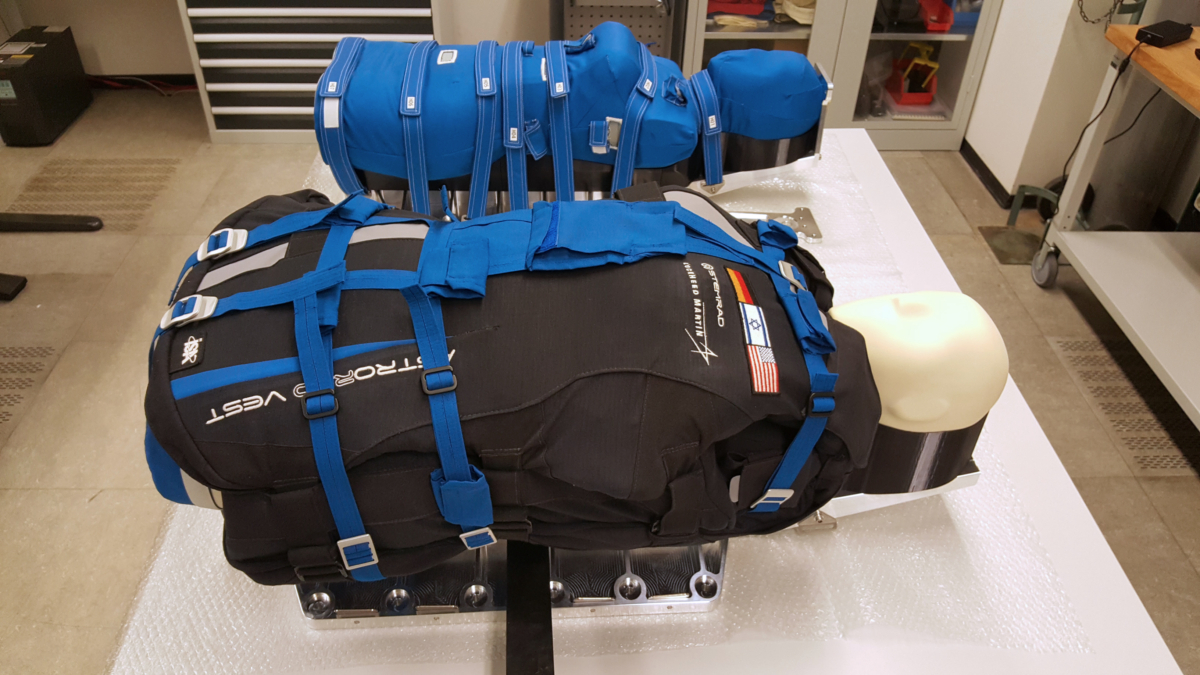
The upcoming Artemis 1 mission will be an uncrewed test of the Orion spacecraft boosted by the maiden flight of the Space Launch System (SLS). On it will be flown a manikin – or in this case a “Moonikin”, instrumented to record acceleration, vibration and radiation throughout the mission.
Credit: NASA
This Moonikin is a male-bodied manikin previously used in Orion vibration tests. He will be accompanied on Artemis I by two model human torsos, called phantoms, made from materials that mimic human bones, soft tissues, and organs of an adult female. Named Zohar and Helga, by the Israel Space Agency (ISA) and the German Aerospace Center (DLR), the phantoms will be supporting an investigation called the Matroshka AstroRad Radiation Experiment (MARE), which will provide data on radiation levels during missions to the Moon.
The final name of the Moonikin will be announced on Tuesday, June 29!
Want to participate in the naming contest?
Go to:
Credit: CMS
China is set to launch three crewmembers on a Shenzhou-12 spacecraft, the first human mission to China’s space station construction site.
Commander Nie Haisheng (Shenzhou-6, Shenzhou-10), Pilot Liu Boming (Shenzhou-7) and Pilot Tang Hongbo (first flight) will liftoff at 9:22 a.m. (Beijing time) on Thursday from the Jiuquan Satellite Launch Center, the China Manned Space Engineering Office announced on Wednesday.

Left to right: Pilot Tang Hongbo, Commander Nie Haisheng, Pilot Liu Boming.
Credit: CCTV/Inside Outer Space screengrab
The crew will stay in orbit for three months.
Auto rendezvous and docking
The Shenzhou-12 spaceship will fly a fast autonomous rendezvous and docking with the now orbiting space station core module Tianhe and form a complex with Tianhe and the cargo craft Tianzhou-2.

Credit: CCTV/Inside Outer Space screengrab
This upcoming crewed mission is among the planned 11 spaceflight missions for 2021 and 2022, including three space station modules, four cargo ships, and four piloted spaceships, in order to complete the construction of China’s space station by the end of 2022.
Challenging spacewalks
The Shenzhou-12 crew will carry out the most challenging series of extravehicular activities ever conducted by China’s space program. While in space, the space trio will test the long-term spaceflight supporting technologies, such as regenerative environment control and life support, the resupply of space station goods and materials, and astronaut health management.
Robotic arm helps on space station construction.
Credit: CCTV/CNSA/Inside Outer Space screengrab
With the support of a robotic arm, the astronauts will carry out the extravehicular activities for relatively longer durations for the first time and perform such operations as extravehicular equipment installation, repair and maintenance.
New landing site
After their three-month mission, the Shenzhou-12 astronauts will test the search and recovery capability of the Dongfeng landing site for the first time.
The landing site has shifted from Siziwang Banner to the Dongfeng landing site in Inner Mongolia Autonomous Region. A regular emergency standby and search mode for that landing site will be initiated for the first time.

Credit: New China TV/GLOBALink/Inside Outer Space screengrab
China launched the space station core module Tianhe on April 29, followed by the Tianzhou-2 cargo ship on May 29 that docked with the Tianhe early on May 30 to deliver 6.9-tons of supplies, equipment and propellant.
A number of videos focused on the Shenzhou-12 mission have been issued by China Central Television (CCTV)/China National Space Administration (CNSA)/New China TV/GLOBALink.
Go to:

Credit: CNSA
China’s Tianwen-1 Mars mission is a precursor to the country attempting a sample return effort at the Red Planet around 2030.
In addition, China also plans to launch a probe to collect samples from a near-Earth asteroid and explore a comet in one mission around 2025 and investigate the more faraway Jovian system after 2030.
Further study of the Moon by China’s Chang’e-6 and Chang’e-7 lunar probes in the coming five years are designed to survey the lunar environment and resources, as well as collect samples from the polar region of the Moon.
An ambitious space agenda was detailed Saturday at a press conference held by China National Space Administration in Beijing.

Credit: CNSA
Mars rover update
After some 30 Martian days on Mars, the Zhurong rover had moved over 260 feet (80 meters) from its landing site by Friday. The rover is slated to head south.

Credit: CCTV/Inside Outer Space screengrab
Liu Jianjun, chief designer of the ground application system of the Tianwen-1 probe, told the China Global Television Network (CGTN): “We selected this particular direction for several reasons. The altitude picks up that way, from the ancient martian ocean to land. And that’s also where we’ll come across some of the most interesting things we care about, like mud volcanoes and sub-surface ice.”

Credit: CCTV/Inside Outer Space screengrab
Weathering the weather
Sun Zezhou, chief designer of the Tianwen-1 probe, said the probe is in “better condition than expected”, and said part of that state comes from a stretch of good weather. “We are lucky in having such good weather, which contributes to the mission’s state.”

Credit: CGTN/Inside Outer Space screengrab
Zezhou told CGTN that the rover will likely run into extreme weather conditions like sandstorms. “But we are all prepared for that.” In case of extreme weather conditions like heavy sandstorms, Zhurong could go into the sleep mode and restart later when conditions become bearable again.
Zhang Rongqiao, chief designer of the Tianwen-1 Mars mission, told China Central Television (CCTV) that Zhurong has taken its first 360-degree panorama.
Go to these newly issued videos from China Central Television (CCTV)/China National Space Administration (CNSA) and GLOBALink/New China TV:
Credit: CCTV/Inside Outer Space screengrab
A projected next week blast off is expected to kick-start China’s space station construction effort in Earth orbit.
This week’s rollout of the three-person Shenzhou-12 spacecraft atop a Long March-2F launch vehicle signals all is go at the Jiuquan Satellite Launch Center.
The China Manned Space Engineering Office said four groups of 16 astronauts are now training for four upcoming piloted space missions over the coming two years.
The imminent Shenzhou-12 takeoff marks China’s first crewed space mission in half a decade.

Credit: CCTV/Inside Outer Space screengrab
Space walks
According to China Central Television (CCTV) interviews with key space officials, building the space station will involve a large number of space walks, which can last for hours. On the ground, training equipment is helping the astronauts to prepare for the mission.
“A standard space walk will last for six to seven hours. To complete the task, efficiency is very important. Of course safety is also very important. We have made new improvements to the space suit to meet the needs of the space station, which will allow astronauts to work more efficiently,” said Zhou Jianping, chief designer of China’s manned space program.
Credit: CCTV/CNSA/Inside Outer Space screengrab
Foreign astronauts
As noted in a CCTV interview, China is also working with global space agencies, including the United Nations’ Outer Space Division. An initial grouping of nine projects from 17 countries have been selected to be onboard the Chinese space station.
Furthermore, joint crewed missions with other nations are also under discussion.
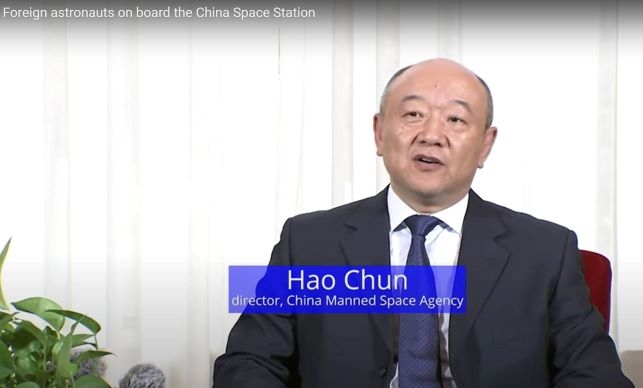
“In the future, there will definitely be foreign astronauts participating in Chinese space flights, while working and living on China’s space station. Foreign astronauts are already learning Chinese, and preparing to participate in Chinese flights,” said Hao Chun, Director of the China Manned Space Agency.
Robotic arm helps on space station construction.
Credit: CCTV/CNSA/Inside Outer Space screengrab
Fast-pace construction
The space station Tiangong will be completed in less than two years. By the end of 2022, it is expected that Chinese astronauts will work and live in the space station for a period of six months per mission.
As stated by the China Manned Space Agency (CMSA), all facilities at the launch site for the takeoff of the trio of crewmen onboard Shenzhou-12 are reportedly in good condition.
Now underway is a functional check of the spacecraft and booster to test the matching between the two. After that, the Shenzhou-12 astronauts will make on-site confirmation and then participate in the full-system launch drill, said Deng Xiaojun, No. 0 commander of the Shenzhou-12 manned mission.
Key elements
China sent into space the Tianhe station core module on April 29, starting a series of key launch missions that aim to complete the construction of the space station by the end of 2022.
The country launched the Tianzhou-2 on May 29, which successfully docked with Tianhe in about eight hours to deliver supplies, equipment and propellant.
Credit: CCTV/CNSA/Inside Outer Space screengrab
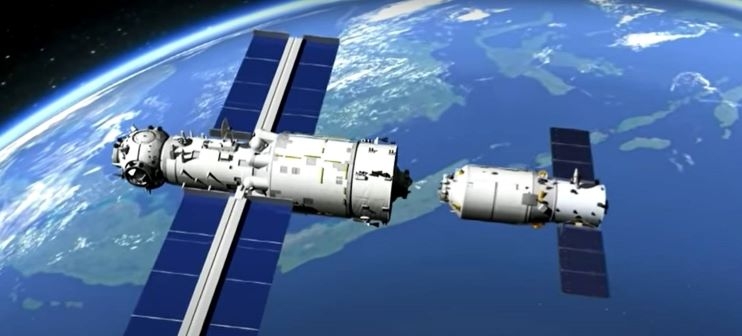
In a recently posted Xinhua news story, both the core module and cargo craft are equipped with independent power supply systems. After docking, the two systems form a connected grid and achieve mutual transmission of electric power.
“The two independent systems work like two smartphones,” said Yu Lei, an engineer in charge of power supply to the Tianzhou-2 project. “They can undergo both separate and mutual charging.”
Power demand
When docking with the space station, Xinhua adds, the Tianzhou-2 supply craft is in sleep mode and has relatively lower power demand. Its solar panels can provide abundant power most of the time, and the surplus is stored to be used for astronaut activities and scientific research that requires higher energy consumption.
“Its solar panels not only fulfill the power demand of Tianzhou-2 directly, but also charge its batteries,” said Wang Zhenxu, a designer of the power supply system of the Tianzhou-2 project.
Three sets of lithium ion batteries power the entire cargo craft when the combination enters the shadow areas. The solar panels work again after it moves into the sunlight, and continue supplying power and charging.

China’s space station is projected to be completed in late 2022.
Credit: CAST
In-orbit life
The core module Tianhe, notes Xinhua, is powered by third-generation flexible GaAs (gallium arsenide) solar panels, which provide high power output, are light, small when folded, have long in-orbit life, and can be repeatedly folded and unfolded.
The thickness of a solar panel is less than one millimeter, only half of the weight per unit area of the traditional solar arrays.
The power area of Tianhe’s solar panels covers 80 square meters, which can provide 20 kilowatts of power to the core module, said Yu Hui, designer of the solar panels. The design life of the solar panels is up to 15 years, and they can work effectively for the space station project, Yu told Xinhua.
For informative videos on China’s station project from CCTV and the China National Space Administration (CNSA), go to:
Credit: NASA/JPL/UArizona
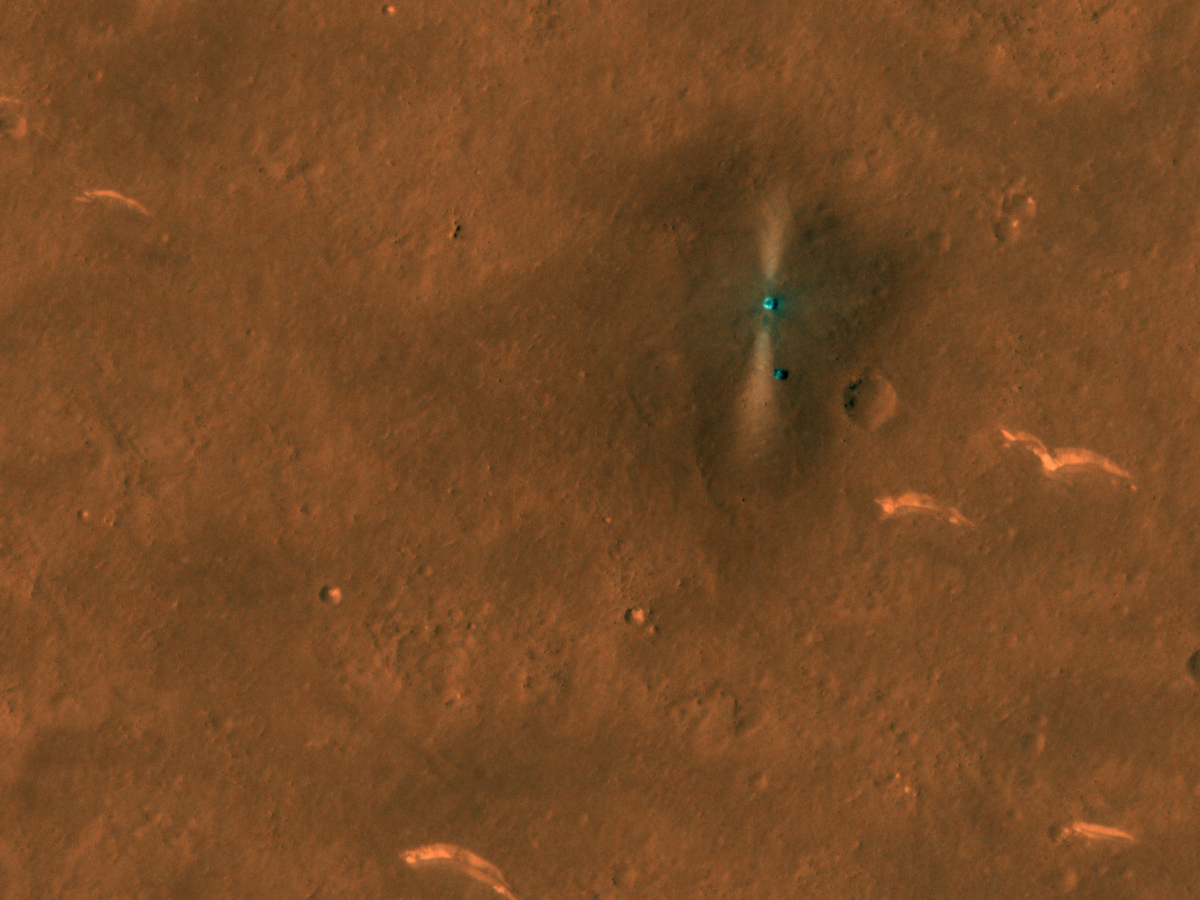
Caught on camera! NASA’s super-powerful Hi-RISE camera on the Mars Reconnaissance Orbiter has imaged China’s Tianwen-1 lander the Zhurong rover in Southern Utopia Planitia.
HiRISE acquired the image on June 6.
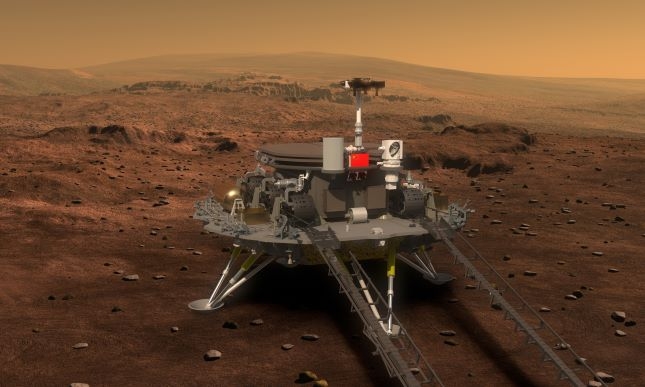
Artwork depicts lander/rover at landing site.
Credit: CAST
“Clearly visible are what we interpret as the lander surrounded by a blast pattern, and the rover itself a bit to the south after it descended from the lander,” according to the HiRISE website at the University of Arizona in Tucson. “The lander’s parachute & backshell as well as its heat shield are also visible.”
This image shows the surrounding terrain to be very typical of southern Utopia Planitia, with a smooth and mostly boulder-free region. The bright curving features are aeolian (windblown) landforms.
China’s Tianwen-1 lander/rover successfully landed on May 14, 2021.

Credit: Scientific Coalition for UAP Studies
Over the past few years, there have been scores of bizarre sightings by U.S. Navy pilots tangling with and tailgated by anomalous objects. Videos and eyewitness accounts of oddball Unidentified Aerial Phenoneman (UAPs) have been outed for public view. So too has Navy radar imagery showing a swarm of UAPs nearby the ocean-going USS Omaha in July 2019.

Credit: DOD/U.S. Navy/Inside Outer Space screengrab
The U.S. Department of Defense is expected to release this month findings from an Unidentified Aerial Phenomena Task Force. It was set up to understand and gain insight into the nature and origins of purported aerial objects. The mission of the task force is to detect, analyze and catalog UAPs that could potentially pose a threat to U.S. national security.
Scientific examination
More important than the Pentagon report is the need to gather solid data that is shared with the scientific community, says Robert Powell, executive board member of the Scientific Coalition for UAP Studies. The group promotes and encourages the rigorous scientific examination of Unidentified Aerospace Phenomena, commonly known as Unidentified Flying Objects (UFOs).
Powell says the organization has publicly called for the release of all unclassified data associated with UAP held by the federal government without compromising national security sources and/or methods. “In addition, we called for the publication of data and research results from various federal agencies in the public domain in order to promote the scientific research and analysis of UAP. We maintain this position and look forward to the release of additional data by the federal government,” he says.

Credit: Orbitz
A nothingburger?
So, cut to the chase of UFOs, UAPs. Will this soon-to-be-issued task force report be a “nothingburger,” as some suggest, or big doings on high temp?
For a variety of views on UAPs/UFOs, take a read of my new Scientific American article “Experts Weigh In on Pentagon UFO Report – The vast majority of examined incidents were not caused by U.S. advanced technology programs, the forthcoming report concludes. So what’s going on?” at:
https://www.scientificamerican.com/article/experts-weigh-in-on-pentagon-ufo-report/
Credit: CCTV/CNSA/Inside Outer Space screengrab
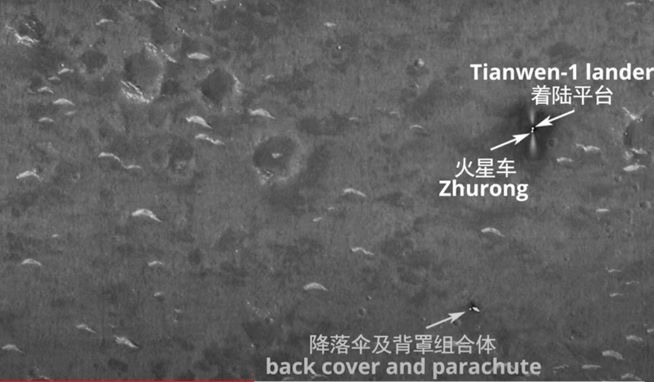
China’s Tianwen-1 Mars orbiter has imaged the touchdown locale of the mission’s lander and Zhurong rover.
In the image, taken by a high-resolution camera installed on the orbiter of at 6 pm on June 2 (Beijing Time), two bright spots are visible in the upper right corner. The larger one is the landing platform, and the smaller one is the Zhurong Mars rover.
The lander carrying the rover touched down in the southern part of Utopia Planitia, a vast plain in the northern hemisphere of Mars, on May 15.
Artwork depicts lander/rover at landing site.
Credit: CAST
The bright spots in the center of the image are the back cover of the entry capsule and the parachute jettisoned during the landing. Another bright spot in the lower left of the image is the heat shield of the entry capsule.
As of June 6, the rover Zhurong has been working on the surface of Mars for 23 Martian days to detect the environment, move around the surface, and carry out scientific exploration.
Rover data
According to China’s Xhinua news agency, “all scientific equipment aboard the rover is turned on to collect data. The orbiter operates in a relay orbit with a cycle of 8.2 hours, providing relay communication for the scientific exploration of the Mars rover.”

Credit: CNSA
With an expected lifespan of at least 90 Martian days (about three months on Earth), the Xhinhua report notes, Zhurong will record the Martian landscape with high-resolution three-dimensional images and analyze the material composition of the planet’s surface. It will also detect its sub-surface structure and magnetic field, search for traces of ice and observe the surrounding meteorological environment.
Go to this just issued video fromChina Central Television (CCTV)/China National Space Administration (CNSA) at:

