Archive for the ‘Space News’ Category
 Author:
  July 7th, 2021
Credit: Uplift Aerospace
A lunar concrete concoction is being appraised as a 21st century building material for use on the Moon.
Utah-based Uplift Aerospace is pioneering what it terms Luna-crete (TM), utilizing lunar regolith to help reduce the cost of construction on Earth’s celestial partner.
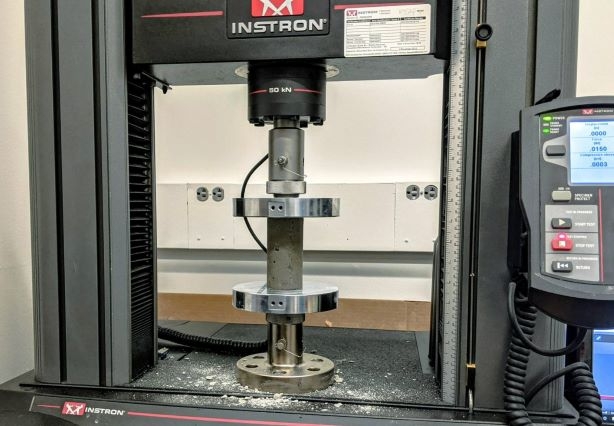
Testing Luna-crete (TM) prototypes for compressive strength.
Credit: Uplift Aerospace
Uplift has received a lunar stimulant — LHS-1 – fabricated by Exolith Lab, which the company used to develop and test its first Luna-crete prototypes. The group is specializing in the development of a mulitiplanetary economy, with one goal of casting sturdy concrete structures on the Moon.
South Pole simulant
Multiple countries, among them China, Russia, as well as the United States, have set their sights on the lunar South Pole. The draw of that location, such as Shackleton crater, is that large reservoirs of ice and other resources might be processed into water, air, and rocket fuel.
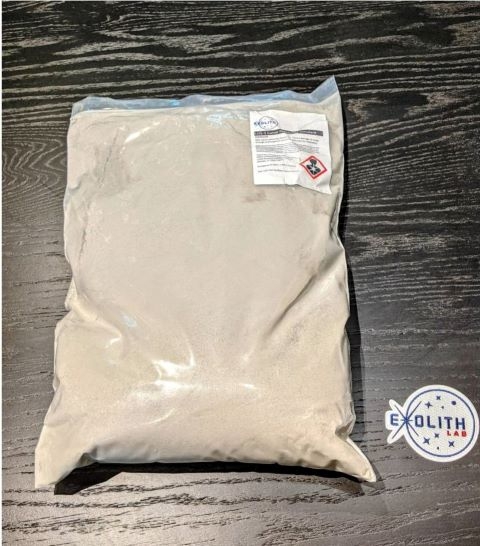
The Luna-crete (TM) prototypes were developed utilizing LHS-1 lunar regolith provided by Exolith Labs.
Credit: Uplift Aerospace

In this multi-temporal illumination map of the lunar south pole, Shackleton crater (19 km diameter) is in the center, the south pole is located approximately at 9 o’clock on its rim. The map was created from images from the camera aboard the Lunar Reconnaissance Orbiter.
Credits: NASA/GSFC/Arizona State University
As follow-up research, Uplift is receiving a South Pole lunar regolith simulant, SP-1, allowing the company and other University partners to better characterize South Pole lunar regolith to optimize a formulation for a durable lunar concrete.
To that end, Uplift awarded a four-month, $30,000 grant last May to Konstantin Sobolev, professor of civil & environmental engineering at the University of Wisconsin-Milwaukee.
Josh Hanes, Uplift Aerospace’s CEO, says that Sobolev’s research will help select the binder and production methods needed to produce lunar concrete suited for the topography and temperature swings of the lunar south pole.
High-fidelity, mineral-based simulant
Exolith Lab is situated in Orlando, Florida, largely funded by the Center for Lunar & Asteroid Surface Science (CLASS) at the University of Central Florida. Exolith Lab develops and produces a variety of Moon, Mars and asteroid regolith (soil) simulants.
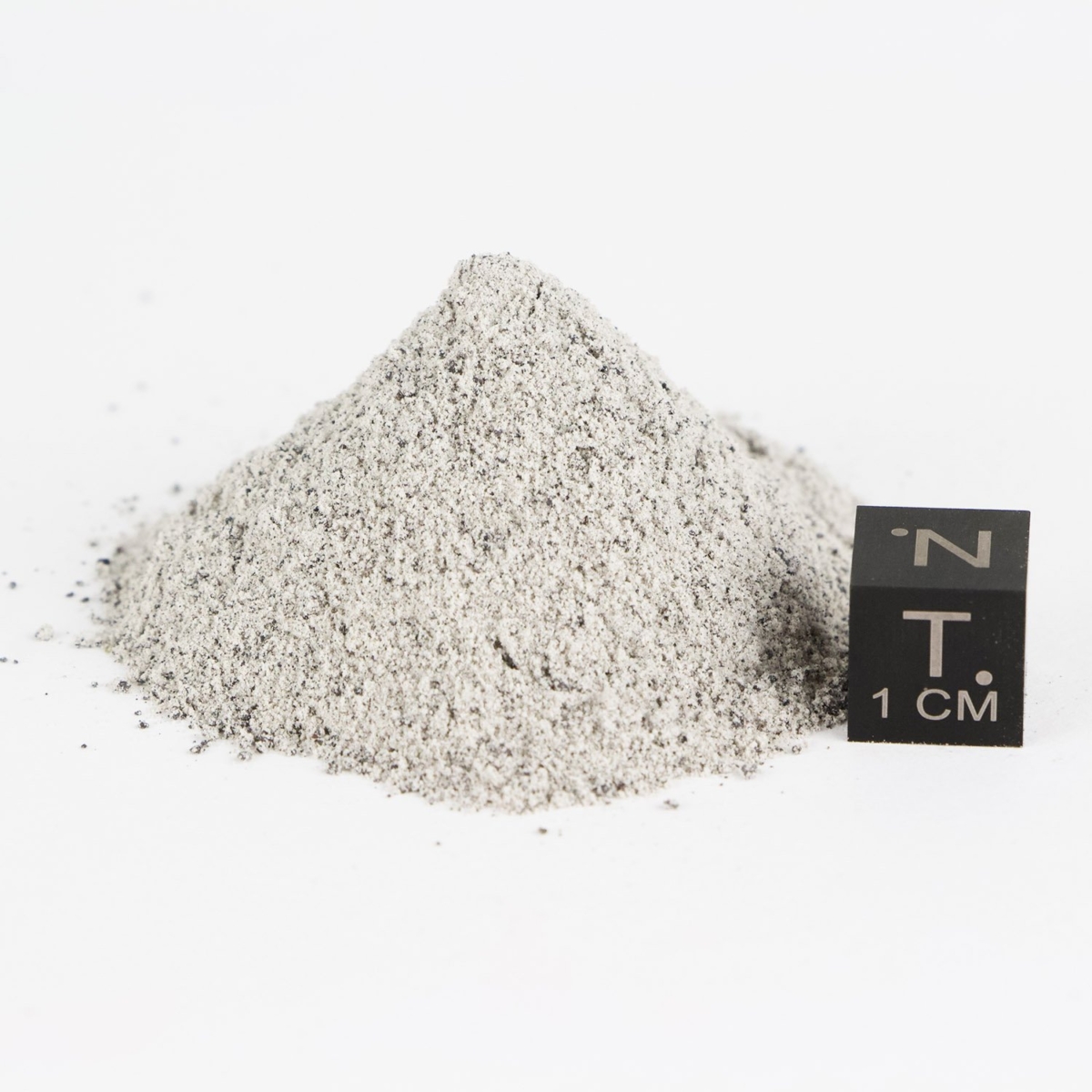
LHS-1: lunar highlands simulant
Credit: Exolith Lab
The LHS-1 lunar highlands simulant has been developed by the CLASS Exolith Lab. It is a high-fidelity, mineral-based simulant appropriate for a generic or average highlands location on the Moon. The simulant accurately captures the texture of lunar regolith by combining both mineral and rock fragments in accurate proportions.
For more information on Uplift Aerospace, go to:
https://www.upliftaerospace.com/
For more details regarding the Exolith Lab, go to:
 Posted in

Crew of Shenzhou-12
Credit: GlobaLink/Inside Outer Space screengrab
Two Chinese astronauts stationed in the Tianhe core module of China’s space station Tiangong carried out their first spacewalks on Sunday.
Liu Boming and Tang Hongbo performed the spacewalks with Nie Haisheng, commander of the mission, staying inside the module and assisted in manipulating the station’s robotic arm that helps the other two astronauts with their extravehicular chores.

Credit: GlobaLink/Inside Outer Space screengrab
Feitian spacesuit
The spacewalking twosome used new-generation homemade extravehicular mobility unit spacesuits called “Feitian,” meaning flying to space.
Their tasks included installing foot restraints and an extravehicular working platform on the mechanical arm. They also lifted a panoramic camera.

Credit: CCTV/Inside Outer Space screengrab
According to China Central Television (CCTV), the extravehicular panoramic camera was initially installed at a lower position on the robotic arm, with a limited vision. A wider perspective of the camera is required for the astronauts to monitor the situation outside the space station, so the astronauts need to install a bracket to lift the camera higher.
More difficult tasks ahead
The spacewalk mission lasted about seven hours outside the cabin.

Credit: CCTV/Inside Outer Space screengrab
“There will be another extravehicular task which will be more difficult,” said Liu Xiangyan, deputy chief designer of the space station system. “But I believe that, through the practice and experience of this task, the astronauts will better complete the next task,” said Liu.
The three astronauts were sent into space aboard the Shenzhou-12 spaceship on June 17. They will inhabit the core module until mid-September before returning to Earth.
Go to these newly issued videos detailing the spacewalk and the robotic arm at:

Credit: NASA/JPL-Caltech/Univ. of Arizona
The NASA Curiosity Mars rover at Gale Crater is now performing Sol 3166 duties.
Lauren Edgar, a planetary geologist at the USGS Astrogeology Science Center in Flagstaff, Arizona, reports: “On Sol 3165 Curiosity carried out a short bump to better position the rover for drilling. The bump went well and we were excited to dive straight into planning today. This plan will cover four days on Earth to account for the Independence Day holiday in the U.S., but it also coincides with a “soliday” on Mars – a day without planning to allow Earth and Mars schedules to sync back up. So we still planned a typical three-sol weekend plan. Well-timed, Mars!”
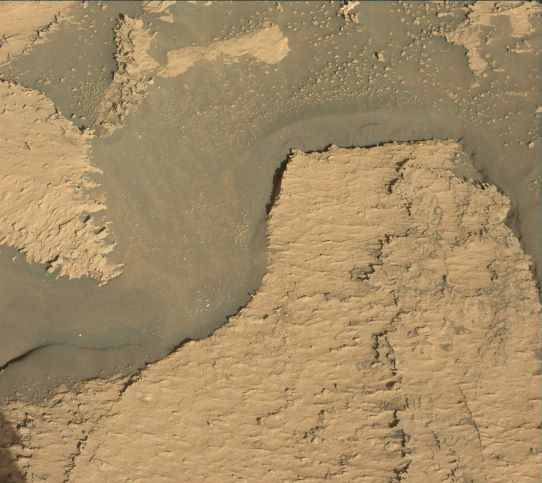
Curiosity Mast Camera Left image taken on Sol 3165, July 2, 2021.
Credit: NASA/JPL-Caltech/MSSS
Identifying future targets
Edgar adds that the plan starts by taking a 360-degree Mastcam mosaic, which will be helpful for documenting the rover’s location, identifying future targets, and looking for changes during the course of the drill campaign.
Then Curiosity’s Chemistry and Camera (ChemCam) will investigate the target “Pontours” that scientists are evaluating as the drill location.
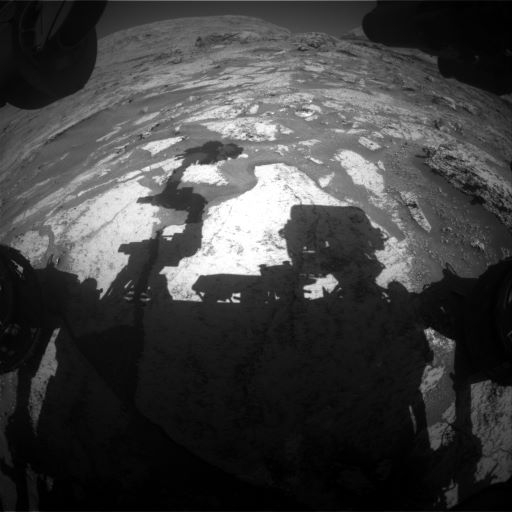
Curiosity Front Hazard Avoidance Camera Right B photo acquired on Sol 3166, July 3, 2021.
Credit: NASA/JPL-Caltech
Next, the plan calls for brushing the “Pontours” target with the Dust Removal Tool (DRT) and use the Mars Hand Lens Imager (MAHLI) and the Alpha Particle X-Ray Spectrometer (APXS) to characterize its texture and chemistry.
Drill and dump
“On the second sol we’ll conduct a drill pre-load test to make sure that the bedrock and hardware can withstand the force of drilling at this location, along with a lot of MAHLI documentation of the intended drill, dump, and portion locations,” Edgar notes.
The Sample Analysis at Mars (SAM) Instrument Suite will also conduct a cross-calibration activity.
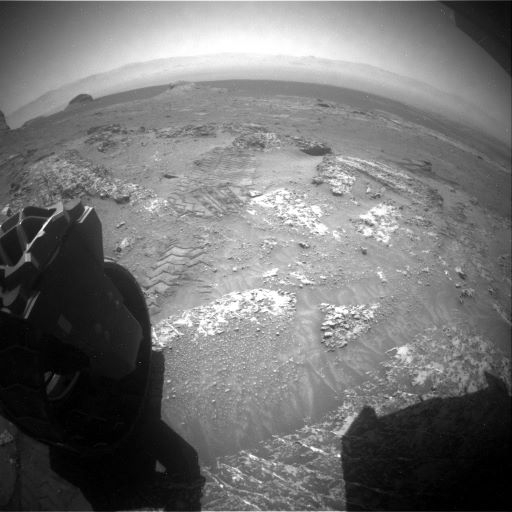
Curiosity Rear Hazard Avoidance Camera Left B image acquired on Sol 3166, July 3, 2021.
Credit: NASA/JPL-Caltech
Nodule-rich target
“The third sol starts with a Navcam sky survey to look at the scattering phase functions of clouds. Later in the morning, Navcam will search for dust devils and Mastcam will monitor the dust content in the atmosphere,” Edgar adds.
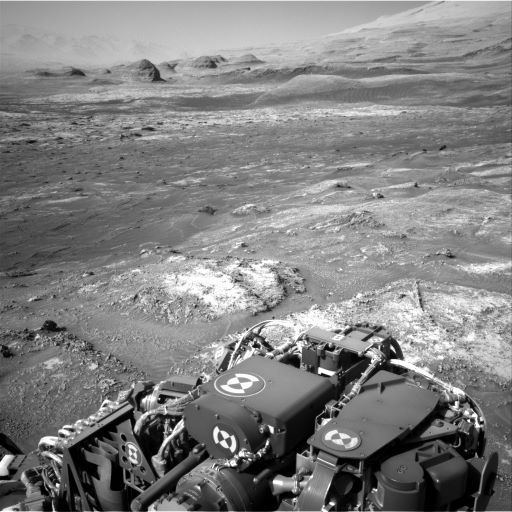
Curiosity Right B Navigation Camera photo taken on Sol 3165, July 2, 2021.
Credit: NASA/JPL-Caltech
“Then we’ll acquire a Mastcam multispectral observation of “Pontours” followed by imaging of a nearby sandy trough named “Lolme” which will be used to track movement before and after drilling,” Edgar reports. Then the robot’s Chemistry & Camera (ChemCam) will assess a nodule-rich target named “Dournazac,” to evaluate the chemistry of these “diagenetic” features – features that formed after the sediment first was deposited.
“There were a lot of other great science observations that were suggested, but it was a challenge to fit everything in today,” Edgar concludes. “Looking forward to seeing the data from this new location and preparing to drill next week!”

The release last week of the Department of Defense Unidentified Aerial Phenomena Task Force has whipped up a blend of reactions from UFO groups to individuals in military, academic and scientific circles.
Labeled as “preliminary,” the unclassified 9-page report was prepared by the Office of the Director of National Intelligence in response to a request by Congress to assess the threat posed by Unidentified Aerial Phenomena, or UAPs for short.

Credit: Scientific Coalition for UAP Studies (SCU)
There were those breathing hard awaiting compelling proof that aliens are here, buzzing through Earth’s airspace while chalking up extraterrestrial mileage points. While the report falls short on that score, what UAPs truly represent remains a head-scratcher.
Space.com reached out to a number of individuals for their take-away messages in reading the UAP Task Force report.
Go to my new Space.com story “Up in the air! US government’s UFO report stirs range of reactions” at:

Credit: CNSA/Inside Outer Space screengrab
The China National Space Administration (CNSA) released on Sunday new photos and videos captured by China’s Mars probe Tianwen-1 during the country’s first landing and roving exploration on the red planet.

Credit: CNSA/Inside Outer Space screengrab
Parachute opening and descending process of the landing rover, the sound of the rover Zhurong leaving the landing platform and its moving process on the Mars’ surface, the perception image of the red planet’s environment, and the ruts of the rover.

Credit: CNSA/Inside Outer Space screengrab
“When we were designing, we wanted to obtain some visual states of the rover, which could be used as a basis for further improvement of the project. Then we designed several parts, including the process of opening the parachute, releasing the canopy and descending,” Rao Wei, deputy chief designer of the Tianwan-1 Probe told China Central Television (CCTV).

Credit: CNSA/Inside Outer Space screengrab
The Zhurong rover drove down from its landing platform to the Martian surface on May 22.

Credit: CCTV/Inside Outer Space screengrab
“According to the telemetry, we can see that the landing point is only three kilometers away from our designed position. In general, the landing position is very accurate and the control system is very good,” said Rao.

Credit: CCTV/Inside Outer Space screengrab
Scientific payloads
At present, the rover Zhurong has been working on the red planet’s surface for 42 Martian days, traveling 236 meters in total, and the orbiter and rover are in good working condition.
“At present, we have a total of six scientific payloads on the Mars rover. Now all of them are on and working normally. I also hope that foreign scientists will join us to do research together and to achieve more results,” said Liu Jizhong, deputy commander of China’s first Mars exploration program.

Credit: CNSA/Inside Outer Space screengrab
China’s Tianwen-1 mission, consisting of an orbiter, a lander, and a rover, was launched on July 23, 2020. The lander carrying the rover touched down in the southern part of Utopia Planitia, a vast plain in the northern hemisphere of Mars, on May 15.
Go to these newly released videos focused on China’s Mars mission at:
“Life is like a box of chocolates. You never know what you’re gonna get” – Tom Hanks in Forrest Gump.
Today’s release of the Pentagon’s Unidentified Aerial Phenomenon Task Force offers these unclassified messages:
“The limited amount of high-quality reporting on unidentified aerial phenomena (UAP) hampers our ability to draw irm conclusions about the nature or intent of UAP.”
The UAP Task Force considered a range of information on UAP described in U.S. military and Intelligence Community reporting, but because the reporting lacked sufficient specificity ultimately recognized that a unique, tailored reporting process was required to provide sufficient data for analysis of UAP events.
Credit: Scientific Coalition for UAP Studies (SCU)
Reports: 2004-2021
The UAP Task Force concentrated its review on reports that occurred between 2004 and 2021, the majority of which are a result of a new tailored process to better capture UAP events through formalized reporting.
Most of the UAP reported probably do represent physical objects given that a majority of UAP were registered across multiple sensors, to include radar, infrared, electro-optical, weapon seekers, and visual observation.

Credit: DOD/U.S. Navy/Inside Outer Space screengrab
Unusual flight characteristics
In a limited number of incidents, UAP reportedly appeared to exhibit unusual flight characteristics. These observations could be the result of sensor errors, spoofing, or observer misperception and require additional rigorous analysis.
There are probably multiple types of UAP requiring different explanations based on the range of appearances and behaviors described in the available reporting. Our analysis of the data supports the construct that if and when individual UAP incidents are resolved they will fall into one of five potential explanatory categories: airborne clutter, natural atmospheric phenomena, U.S. government or U.S. industry developmental programs, foreign adversary systems, and a catchall “other” bin.

FLIR
Credit: DOD/U.S. Navy/Inside Outer Space screengrab
Safety of flight issue
UAP clearly pose a safety of flight issue and may pose a challenge to U.S. national security. Safety concerns primarily center on aviators contending with an increasingly cluttered air domain.
UAP would also represent a national security challenge if they are foreign adversary collection platforms or provide evidence a potential adversary has developed either a breakthrough or disruptive technology.
Consistent consolidation of reports from across the federal government, standardized reporting, increased collection and analysis, and a streamlined process for screening all such reports against a broad range of relevant U.S. government data will allow for a more sophisticated analysis of UAP that is likely to deepen our understanding. Some of these steps are resource-intensive and would require additional investment.

Credit: MUFON
Different explanations
The UAP Task Force report says that multiple types of UAP require different explanations:
Airborne Clutter: These objects include birds, balloons, recreational unmanned aerial vehicles (UAV), or airborne debris like plastic bags that muddle a scene and affect an operator’s ability to identify true targets, such as enemy aircraft.
Natural Atmospheric Phenomena: Natural atmospheric phenomena includes ice crystals, moisture, and thermal fluctuations that may register on some infrared and radar systems.
U.S. Government or Industry Developmental Programs: Some UAP observations could be attributable to developments and classified programs by U.S. entities. The task force was unable to confirm, however, that these systems accounted for any of the UAP reports they collected.
Foreign Adversary Systems: Some UAP may be technologies deployed by China, Russia, another nation, or a non-governmental entity
Other: Although most of the UAP described in our dataset probably remain unidentified due to limited data or challenges to collection processing or analysis, we may require additional scientific knowledge to successfully collect on, analyze and characterize some of them. We would group such objects in this category pending scientific advances that allowed us to better understand them. The UAPTF intends to focus additional analysis on the small number of cases where a UAP appeared to display unusual flight characteristics or signature management.
For the full UAP report, go to:

Credit: CCTV/Inside Outer Space screengrab
China’s space station crew is set to carry out its first spacewalk.
An EVA spacesuit has been taken out of the Tianzhou-2 cargo spacecraft and installed it in the node module of the Tianhe core module of China’s space station.
“The taikonauts will start extravehicular activities in 10 days or so. The ground personnel have already completed preliminary testing and control of the robotic arm in orbit, said Sun Jun, director of the space station mission of the Beijing Aerospace Flight Control Center.

Credit: CCTV/Inside Outer Space screengrab
“The taikonauts will conduct drills on extravehicular missions by collaborating with the robotic arm. It is very complicated to coordinate the work of taikonauts, the robotic arm, the space station and ground personnel. So we have to conduct such drills and tests,” said Sun in a June 23 released China Central Television (CCTV) video.
The EVA spacesuit weighs 265-pounds (120 kilograms). It has only one model, which can be adjusted to the size suiting all taikonauts.

The Tianhe core module, the first and main component of the China Space Station, has two propulsion systems: chemical propulsion that creates thrust from chemical reactions between solid or liquid propellants, and Hall-effect thrusters that generate thrust by accelerating ions using electricity.
Credit: CCTV/Inside Outer Space screengrab
Two propulsion systems
The Shenzhou-12 crew on board the in-construction China orbital facility are astronauts Nie Haisheng, Liu Boming and Tang Hongbo. They are scheduled to conduct two extravehicular activities during their three-month mission.
The Tianhe core module, the first and main component of the China Space Station, has two propulsion systems: chemical propulsion that creates thrust from chemical reactions between solid or liquid propellants, and Hall-effect thrusters that generate thrust by accelerating ions using electricity.
Unboxing packages
Crew members have been busily setting up their home-away-from home, unboxing packages shipped to the station’s Tianhe core module earlier by the Tianzhou-2 cargo spacecraft.
Tianzhou-2 took propellants and over 160 bags, totaling about seven tons, to support the work and dietary needs of the orbiting crew, including living materials, two extravehicular spacesuits and payloads.
With so much packaging to be removed and sorted out, the astronauts are being aided by an intelligent cargo management system.

Credit: CCTV/Inside Outer Space screengrab
QR code
Each item has a QR code. After scanning, shows operating guidelines on a mobile terminal, including what the goods are, their functions, where they should be put or installed, and how to use them.
Next time they need an item, the astronauts can type in the code to find it.
Also, the data on how much cargo is left and the location can be transmitted simultaneously to ground control, according to Li Zhihui, deputy commander-in-chief of the Tianzhou-2 cargo spacecraft system with the China Academy of Space Technology.
“The intelligent system enables both the astronauts and the ground crew to know clearly where the materials are in the space station, ensuring an efficient cargo management,” Li said in a CCTV interview.
A set of new videos detailing EVA preparations, unpacking, and the propulsion system of the Tianhe core module can be viewed at:

Credit: Dhari/Szczepanek
If you are waiting for the Pentagon Unidentified Aerial Phenomenon (UAP) Task Force, here’s a way to prepare yourself: A UFO Travel Calculator.
Rahul Dhari, a mechanical engineer and aviation enthusiast, teamed up with Anna Szczepanek, holder of a PhD in mathematics to create the calculator. You can become an aircraft designer and produce your own UFO and see its performance. You will also be able to see how fast your UFO can reach a chosen destination, and even take part in UFO racing.
Frontier science and engineering
“I believe that my calculator can help in treating the UFO issue less in terms of sci-fi and more as an issue at the frontier of science and engineering,” Dhari told Inside Outer Space.

This type of UFO was seen over the Atlantic Ocean, near Virginia Beach, Virginia (United States) in 2004.
Credit: Dhari/Szczepanek
The site also includes an informative table of contents:
- The story of UFOs
- Components of an aircraft design process
- How to design your UFO?
- Designing your UFO
- Snowball effect and tips for extracting maximum velocity
- Why haven’t we built these yet?
- UFO/UAPs — Hoax or truth? What happens next?
“This week, the Pentagon is about to release its report on UFOs and millions of people (including me) are excited for it,” Dhari added. “This inspired me to build the UFO Travel Calculator that allows you to design your own UFO and see its performance.”
The UFO Travel Calculator is available at:

Mars Reconnaissance Orbiter.
Credit: NASA
NASA’s Mars Reconnaissance Orbiter has taken a second look at China’s Zhurong rover, now rolling across southern Utopia Planitia.
The Chinese Tianwen-1 mission landed on the Red Planet on May 14, 2021.

NASA Mars Reconnaissance Orbiter (MRO) image from June 6 shows China’s rover.
Credit: NASA/JPL/University of Arizona

China’s Zhurong rover wheels to the south, clearly shown in this June 11 image acquired by NASA’s Mars Reconnaissance Orbiter.
Credit: NASA/JPL/University of Arizona

Credit: CCTV/Inside Outer Space screengrab
Using the NASA spacecraft’s powerful High Resolution Imaging Science Experiment (HiRISE) camera system, images of the landing zone were acquired on June 6 and June 11. The landing site remains clearly colored from removal of Martian dust during landing. In comparing the two images, movement of the Zhurong rover toward the south can be seen.
Liu Jianjun, chief designer of the ground application system of the Tianwen-1 probe, recently told the China Global Television Network (CGTN): “We selected this particular direction for several reasons. The altitude picks up that way, from the ancient Martian ocean to land. And that’s also where we’ll come across some of the most interesting things we care about, like mud volcanoes and sub-surface ice.”
Credit: Scientific Coalition for UAP Studies (SCU)
The U.S. Department of Defense is set to release this month insights from a specially-created Unidentified Aerial Phenomena (UAP) Task Force. It was established to provide insight into the nature and origins of purported aerial objects, primarily reported by Navy personnel that exhibit aerial actions tough to explain.
The mission of the task force is to detect, analyze and catalog UAPs that could potentially pose a threat to U.S. national security.
Credit: DOD/U.S. Navy/Inside Outer Space screengrab
Meanwhile, boosted to stratospheric heights are “I told you so” believers that have long-advocated Unidentified Flying Objects (UFOs) are skimming through our skies, piloted by extraterrestrials that are chalking up interplanetary frequent flyer mileage points in the process.
However, are UAPs doing a disservice to UFOs – are they really one in the same phenomenon?
For more information, please go to my new SPACE.com story
“Skies alive with UFOs? Government report on mysterious sightings due soon” at:

