Archive for the ‘Space News’ Category
 Author:
  July 25th, 2021
Apollo Over the Moon in Perspective by Ronald A. Wells (Author), Harrison H. Schmitt (Author), Robert Godwin (Series Editor); CG Publishing/Apogee Books; 230 pages; Soft cover: $29.95
This multi-faceted volume provides exquisite detail and unique looks of the Moon as seen through the Apollo “J” missions – the Apollo 15, 16, and 17 Moon landing sojourns designed for longer stays on Earth’s celestial neighbor, including the first time humans drove a rover across the lunar surface.
As a sequel to his book “Apollo on the Moon in Perspective,” author Ron Wells uses cutting-edge photogrammetry techniques, providing the reader astounding views of some of the most distinctive features of the Moon seen from angles never before possible.

One of the model views from the book looking east across the Hadley Rille area, the landing site of Apollo 15. (Copyright by Apogee Books, 2021; Courtesy of Apogee Books (used with permission).
This book includes a multitude of 3D anaglyphs created painstakingly by the author including features from the lunar far side. 3D anaglyph glasses are provided.
This glossy book also includes a revealing DVD that includes flybys over many of the lunar features derived from 3D models. There are digital terrain model flybys of 40 lunar locations and a brand new unique movie. It is narrated by Apollo 17’s Harrison Schmitt, describing his flight over the Taurus Littrow valley, the site where he would spend three days as the only scientist to walk on the Moon.
This extraordinary volume is dedicated “to the unsung heroes of the Apollo lunar landing missions,” the Command Module Pilots:
Mike Collins, Dick Gordon, Stu Roosa, Al Worden, Ken Mattingly and Ron Evans.
“While their colleagues were exploring the lunar surface, they maintained their lone vigils in orbit, making scientific observations and imaging the Moon in unprecedented detail while waiting for the moonwalkers to return.”
As Schmitt writes in the book’s foreword, underscoring the tenacity of Wells to produce this matchless work, the volume “represents the latest culmination of his never ending search for new knowledge and the means to draw you into that quest with him. Working with him on the last chapter of this book, ‘Colors Across the Moon,’ was both a pleasure and a stimulation of new thoughts about volcanism on the Moon as well as about the evolution of that small planet.”
For more information on this book, go to:
 Posted in

Credit: ESA/Hubble & NASA
Look for a major reveal regarding the search for technological signatures from extraterrestrial civilizations.
To be showcased Monday, the multi-prong Galileo Project also may foster the discovery of — or better scientific explanations for potential new natural atmospheric phenomena, or in some instances terrestrial technology explanations for many of the presently inexplicable Unidentified Aerial Phenomenon (UAPs).
One aspect of searching for UAP is with a network of mid-sized, high-resolution telescopes and detector arrays with suitable cameras and computer systems, distributed in select locations. The data will be open to the public and the scientific analysis will be transparent.

GIMBAL/“Tic Tac”
Credit: DOD/U.S. Navy/Inside Outer Space screengrab
The Galileo Project follows three major avenues of research:
1) Obtain high-resolution, multi-detector UAP images, discover their nature;
2) Search for and carry out in-depth research on “Oumuamua-like” interstellar objects; and
3) Search for potential satellites from extraterrestrial technological civilizations that may be exploring Earth.
International research team

The Galileo Project: “Daring to Look Through New Telescopes” is headed by Avi Loeb of the Harvard Astronomy Department.
Credit; Harvard University
The Galileo Project: “Daring to Look Through New Telescopes” is headed by Avi Loeb of the Harvard Astronomy Department. Loeb is leading an 11-person international research team that includes university astronomers, computer and chemistry experts and research scholars. The effort also includes scientific and philanthropic advisory boards.
According to a fact sheet, the goal of the Galileo Project is to bring the search for extraterrestrial technological signatures of extraterrestrial technological civilizations “from accidental or anecdotal observations and legends to the mainstream of transparent, validated and systematic scientific research.”
As a ground-based project, the new initiative is complementary to traditional SETI, “in that it searches for physical objects, and not electromagnetic signals, associated with extraterrestrial technological equipment.”

This very deep combined image shows the interstellar asteroid ‘Oumuamua at the center of the picture. It is surrounded by the trails of faint stars that are smeared as the telescopes tracked the moving asteroid. This image was created by combining multiple images from ESO’s Very Large Telescope as well as the Gemini South Telescope. The object is marked with a blue circle and appears to be a point source, with no surrounding dust.
Sufficiently anomalous
The existing data on UAP and that interstellar interloper “Oumuamua” are sufficiently anomalous to motivate the collection of additional data on UAP or Oumuamua-like objects “and to test whether such objects may be astro-archeological artifacts or active technological equipment produced by one or more putative, existing or extinct extraterrestrial technological civilizations.
Loeb told Inside Outer Space that the project is based on donations that he had received into my research funds at Harvard with a current total of 1.755 million dollars. “To get all the most ambitious science goals done, we need ten times that level of funding.”
Press conference details
The press conference on Monday, July 26, 2021 at 12 noon EDT, will announce the Galileo Project and its goals.
Below are the links where livestream will be available.
YouTube link:
https://www.youtube.com/channel/UCtDWoZ5lLINstvJvALwKYXA
Facebook event link:
https://business.facebook.com/events/3076366245977223/
For more information on the Galileo Project for the systematic scientific search for evidence of extraterrestrial technological artifacts, go to:

Blue Origin’s first human flight crew celebrate at the landing pad with the New Shepard booster. (July 20, 2021)
Credit: Blue Origin
The U.S. Department of Transportation’s Federal Aviation Administration (FAA) has provided guidelines, eligibility, and criteria for the administration of the FAA Commercial Space Astronaut Wings Program.

Wally Funk receives her astronaut wings from Former NASA Astronaut Jeff Ashby. (July 20, 2021)
Credit: Blue Origin

Credit: Blue Origin
“In order to maintain the prestige of Commercial Space Astronaut Wings, the FAA may further refine the eligibility requirements at any time as it deems appropriate.”
To read the full document, go to:
https://www.faa.gov/documentLibrary/media/Order/FAA_Order_8800.2.pdf

M1 Mobile Autonomous Prospecting Platform (MAPP) rover.
Credit: Lunar Outpost
In late 2022, an Intuitive Machines Nova-C Moon lander is to carry several payloads, including a Nokia LTE/4G communications system to the lunar South Pole – a wireless communications network on the Moon that serves as a communications gateway to Earth.
Nova-C will also carry an M1 Mobile Autonomous Prospecting Platform (MAPP) rover — built by Lunar Outpost, headquartered in Golden, Colorado — that is equipped with Nokia’s LTE/4G user equipment and deployable antennas.
Lunar Outpost’s rover will tote several other commercial and scientific payloads on-board during the mission, scheduled for late 2022.
Long-range, low-latency communications
Once on the lunar surface, MAPP will drive off the lander to study the capabilities of Nokia’s lunar LTE/4G communications system.
According to a Lunar Outpost statement, over the course of its 12-day mission, MAPP will traverse the lunar surface and enable Nokia to collect performance data on its LTE/4G system. The intent is to showcase an effective LTE/4G architecture on the Moon, Nokia, Lunar Outpost, and Intuitive Machines will provide high-throughput, long-range, and low-latency communications on the lunar surface.

Ice-hauling Heavy In-situ Propellant Production Off-world Rover (HIPPO Rover).
Credit: Lunar Outpost
“Intra-lunar communication will be a linchpin for large-scale future efforts on the Moon,” said Justin Cyrus, CEO and founder of Lunar Outpost.
Cyrus also noted that the MAPP rover will serve as the mobility platform for this crucial mission, with the Moon machinery built to take on the temperature range and rough landscape at the lunar south pole.
Lunar Outpost’s Heavy In-situ Propellant Production Off-world Rover (HIPPO Rover) is also in development, able to extract and transport over 660 pounds (300 kilograms) of ice at a time.
For more information about Lunar Outpost and their creative Moon gear, go to:

Credit: Virgin Galactic
Legislation from Senior Ways and Means Democrat would tax space travel for non-scientific research purposes
As the space tourism race continues today, U.S. Rep Earl Blumenauer (D-OR), a senior member of the Ways and Means Committee, previewed a new space tax.
The Securing Protections Against Carbon Emissions (SPACE) Tax Act would create new excise taxes on commercial space flights carrying human passengers for purposes other than scientific research.

New Shepard reusable booster.
Credit: Blue Origin/Screengrab Inside Outer Space
“Space exploration isn’t a tax-free holiday for the wealthy. Just as normal Americans pay taxes when they buy airline tickets, billionaires who fly into space to produce nothing of scientific value should do the same, and then some,” said Blumenauer in a statement. “I’m not opposed to this type of space innovation. However, things that are done purely for tourism or entertainment, and that don’t have a scientific purpose, should in turn support the public good.”
Environmental impact
As this budding space tourism industry takes shape, Blumenauer is particularly concerned about the environmental impact of sending humans into space, particularly when there is no scientific value associated with the launch. The number of trips to space are expected to increase, with Virgin Galactic planning to eventually launch a shuttle of passengers into space, on average, every 32 hours.

Practicing liftoff of commercial space travel, Virgin Galactic visionary, Richard Branson.
Credit: Jack Brockway
While proponents of suborbital space flights point to transatlantic flights as having similar carbon footprints, these flights carry significantly more passengers and travel much farther. The result is space launches accounting for an estimated 60-times greater emissions than transatlantic flights on a per-passenger basis, enough to drive a car around the earth and more than twice the carbon budget recommended in the Paris Climate Agreement.
Researchers are also actively exploring the impact of space launches on accelerating the depletion of stratospheric ozone, which is orders of magnitude greater for rocket engines using alumina-producing solid rocket fuel or black soot-producing kerosene.

Blue Origin’s orbital rocket, New Glenn. Credit: Blue Origin
Per-passenger tax
Blumenauer envisions the SPACE Tax Act to include a per-passenger tax on the price of a commercial flight to space, like that for commercial aviation.

Pay-per-view aboard New Shepard.
Credit: Blue Origin/Inside Outer Space screengrab
It would also include a two-tiered excise tax for each launch into space. The first tier would apply to suborbital flights exceeding 50 miles above the Earth’s surface but not exceeding 80 miles above the Earth’s surface. The second tier, which would levy a significantly higher excise tax, would apply for orbital flights exceeding 80 miles above the Earth’s surface.
Exemptions would be made available for NASA spaceflights for scientific research purposes. In the case of flights where some passengers are working on behalf of NASA for scientific research purposes and others are not, the launch excise tax shall be the pro rata share of the non-NASA researchers.
From Niall McCarthy, Data Journalist at Statista.com:
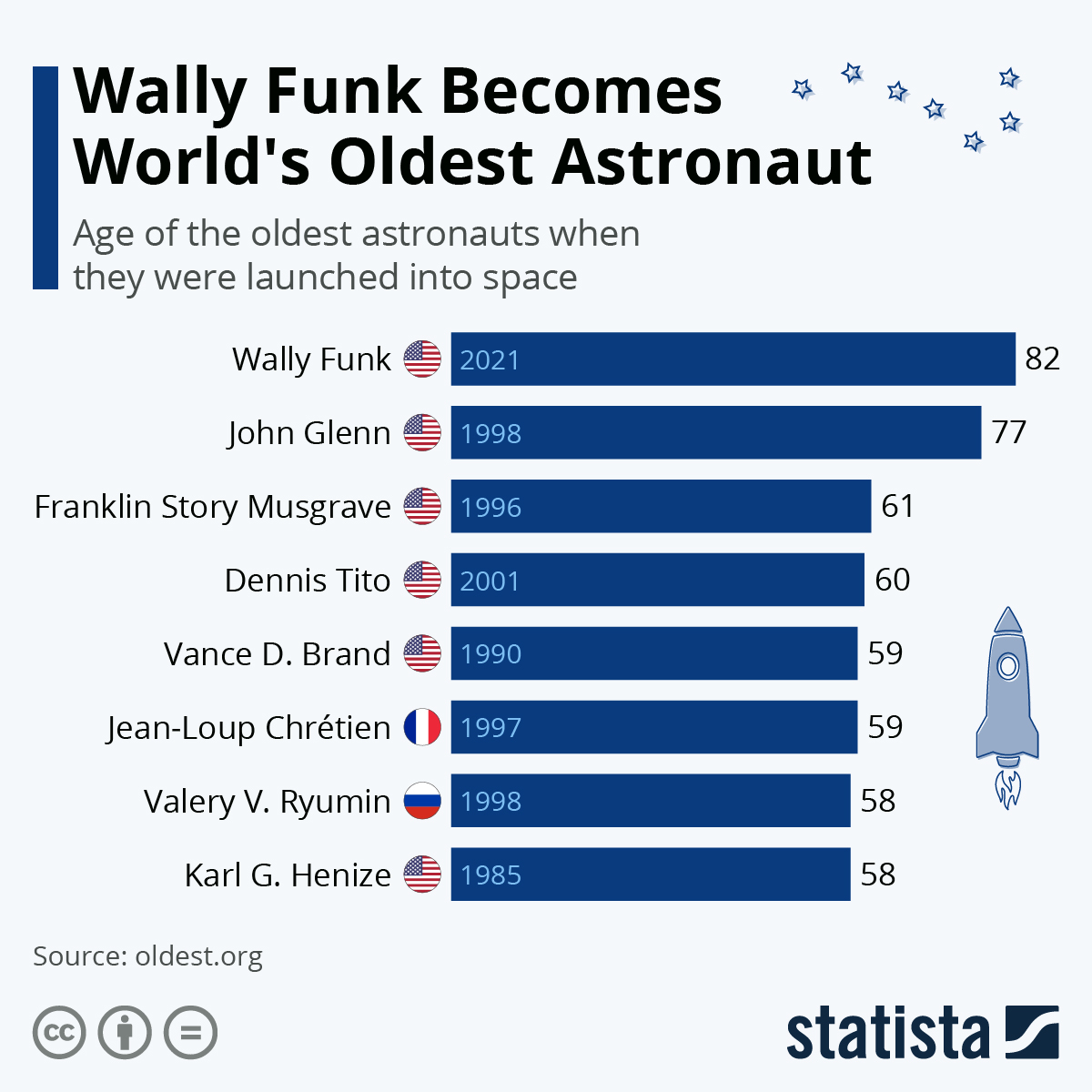
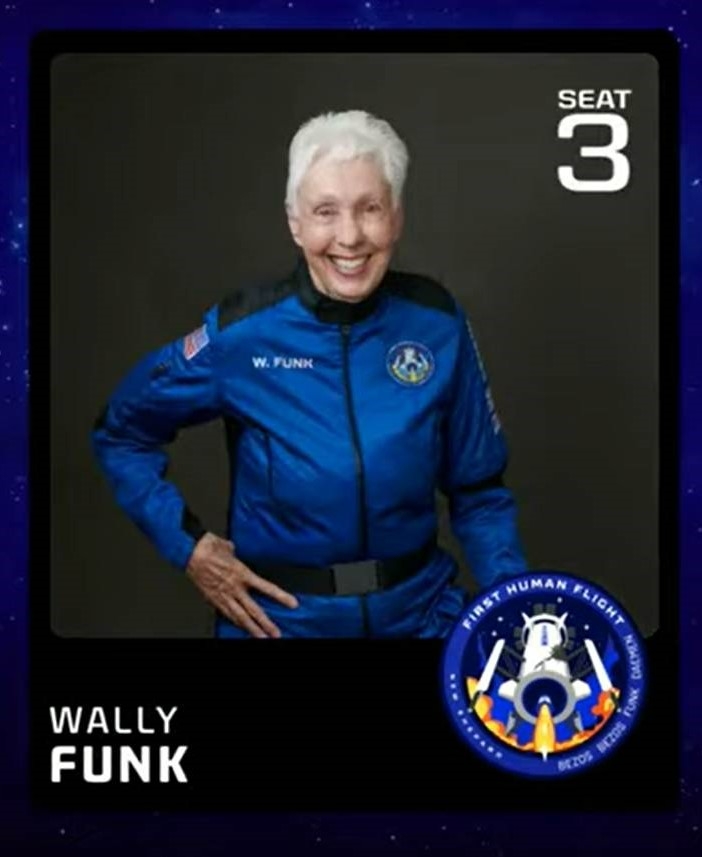
Once denied the chance to go into space by the U.S. government due to her gender back in the 1960s, Wally Funk finally fulfilled her lifelong dream yesterday. Funk is a highly experienced pilot with a whopping 18,600 hours in the cockpit and she was part of Jeff Bezos’ Blue Origin crew that conducted an 11-minute flight yesterday.
Credit: Blue Origin
At 82 years of age, Funk became the oldest person to go into space, breaking a record set by John Glenn in 1998.
After becoming the first American to orbit the Earth in 1962, Glenn retired as an astronaut and became a senator for a number of years. The famed astronaut returned to space in October 1998 when he took part in a mission onboard the Space Shuttle Discovery at the age of 77.
Franklin Story Musgrave is the only astronaut to have flown onboard all five Space Shuttles and he is the third-oldest person to make it into space thanks to a 1996 flight onboard the Shuttle Columbia, according to website oldest.com.

Credit: Chicago Review Press
Book Review: Wally Funk’s Race for Space – The Extraordinary Story of a Female Aviation Pioneer
Blue Origin successfully completed New Shepard’s first human flight today with four private citizens onboard. The crew included Jeff Bezos, Mark Bezos, Wally Funk and Oliver Daemen, who all officially became astronauts when they passed the Kármán Line, the internationally recognized boundary of space.
Go to Blue Origin at:
Replay – New Shepard First Human Flight at:
Replay – First Human Flight Post-Flight Press Conference:

Credit: CCTV/Inside Outer Space screengrab
Three Chinese astronauts, Nie Haisheng, Liu Boming and Tang Hongbo, have worked and lived in the space station core module for a month since the Shenzhou-12 piloted spacecraft was launched into space.
The astronauts have been in good condition after completing their first extravehicular operations, according to the China Manned Space Agency (CMSA). A second spacewalk is scheduled to take place.
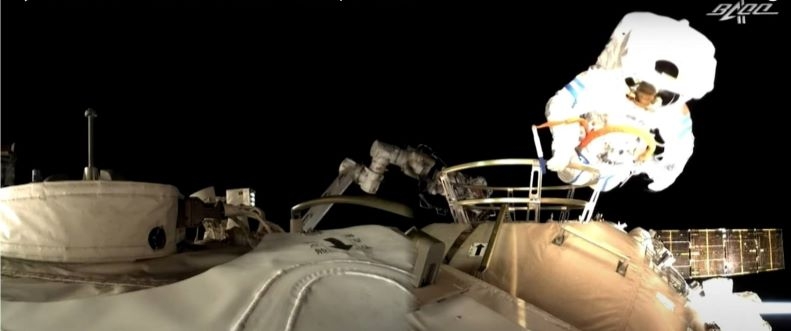
A second spacewalk is scheduled.
Credit: CCTV/Inside Outer Space screengrab
China’s space station is operating smoothly, with the trio of Taikonauts busily carrying out various duties, such as collection of trace elements in the air and performing routine medical examinations.
Exercise regime
According to China Central Television (CCTV), telecommunication facilities on board the core module enable the crew to watch the Xinwen Lianbo (News Simulcast), a domestic news program. Since they are stationed in the core module, the ground support team has been regularly sending them news programs, to keep them up to date on what is occurring on Earth.

Credit: CCTV/Inside Outer Space screengrab
They exercise for about an hour after watching the news, using sports facilities in the core module, such as an exercise bike and a treadmill.
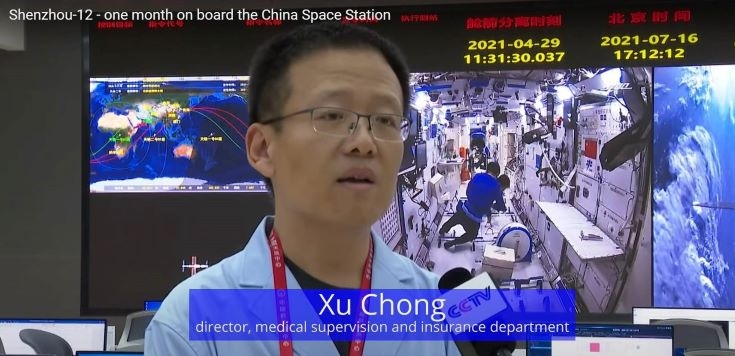
“Their physical fatigue, sleep, eating and drinking water, the whole body metabolism, nutrition, health status, through our comprehensive evaluation, are very good,” Xu Chong, director of the medical supervision and insurance department of China Astronaut Research and Training Center told CCTV.
According to the ground supporting team, the astronauts’ exercise amount and intensity were decided in terms of their own physical conditions. Each of them has their own exercise plan.
Credit: CCTV/Inside Outer Space screengrab
“It’s a daily routine for the astronauts to do exercise. We have formulated different exercise plans for each of the three astronauts, with a training intensity reaching 60 to 80 percent of their maximum capacity. That’s a medium to high intensity for them. As they stay longer in space, we have to increase the intensity of their exercise plans, so that they are able to maintain the physiological effects against weightlessness,” said Li Yinghui, the deputy chief designer of the astronaut system with China Astronaut Research and Training Center.
Space experiments
Starting Saturday, the space travelers put on heart rate and rhythm recording devices as part of experiments in space medicine. For the first time ever, China’s space station used a scientific research cabinet that is capable of conducting space medicine and space life science experiments, setting a total of 49 space experiment projects.

Credit: CCTV/Inside Outer Space screengrab
During the Shenzhou 12 mission in space, the astronauts will complete 14 of them.
“We set three aims for these 14 experimental projects. The first one is that the mission needs the technologies that are able to support advanced development, so the projects were set for making technical reserves to support the mission,” said Li.
“The second one is to set sights on the leading edge, so as to obtain new discoveries and new explorations. The third one is to continuously accumulate long-term flight data,” Li told CCTV.
For a video update on China space station operations issued by CCTV/China National Space Administration (CNSA), go to:

China has had a long-standing interest in reusable space planes. This photo represents one concept under evaluation. No images released have shown the reusable suborbital carrier that flew late last week.
Courtesy: Jean Deville/China Aerospace Blog
China has flown a reusable suborbital carrier, a craft that touched down at an airport in Alxa League in north China’s Inner Mongolia Autonomous Region.
Launched on Friday from the Jiuquan Satellite Launch Center in northwest China’s Gobi Desert, the maiden flight of the prototype of a reusable suborbital aerospace plane was declared successful. The suborbital vehicle landed horizontally at the Alxa Right Banner Airport.
The craft was developed by the China Aerospace Science and Technology Corporation (CASC). “The development of reusable space transportation technology is an important symbol of China’s transition to a major space power,” CASC said in a statement.

China’s Alxa Right Banner Airport
Credit: Flightsim.to
Little detail has been made available about the vehicle, its design and overall capabilities. CASC did not say how high the plane flew, or elaborate on its flight path.
Orbital space plane
In a China Daily story, they explained that in September 2020, the company flight-tested a reusable experimental orbital spacecraft from the Jiuquan center. It did not publish detailed information, photos or videos about that test.

Artwork depicts a notional Chinese space plane design.
Credit: CNSA
“China Aerospace Science and Industry Corp, another space contractor, is also working on a reusable aerospace plane and plans to put it to commercial flight by 2030,” China Daily reports. “The company said it has conducted a key flight test by a conceptual demonstration prototype to verify the propulsion shift mechanism between ramjet and rocket engine.”
Designers have said that such a vehicle can be used in a wide range of operations, China Daily adds, such as space tourism, astronaut commuting, satellite deployment, cargo transportation and emergency rescue.

Courtesy: Jean Deville/China Aerospace Blog
Lengthy runway
In related news, NPR has published sets of photos taken by commercial satellites showing construction underway of buildings at a remote airfield supporting a three-mile-long runway. The growing airfield is on the edge of China’s former nuclear weapons test range at Lop Nur.
China’s orbital space plane is believed to have landed at this airfield.
Go to these NPR stories:
Satellite Photos Show China Expanding Its Mysterious Desert Airfield
New Chinese Space Plane Landed At Mysterious Air Base, Evidence Suggests

Credit: NASA/JPL-Caltech/Univ. of Arizona
NASA’s Curiosity Mars rover at Gale Crater is now performing Sol 3179 tasks.
Reports Susanne Schwenzer, a planetary geologist at The Open University; Milton Keynes, U.K., the rover’s Alpha Particle X-Ray Spectrometer (APXS) and Mars Hand Lens Imager (MAHLI) have been looking at the drill fines of the “Pontours” drill hole – the robot’s 32nd drill hole.
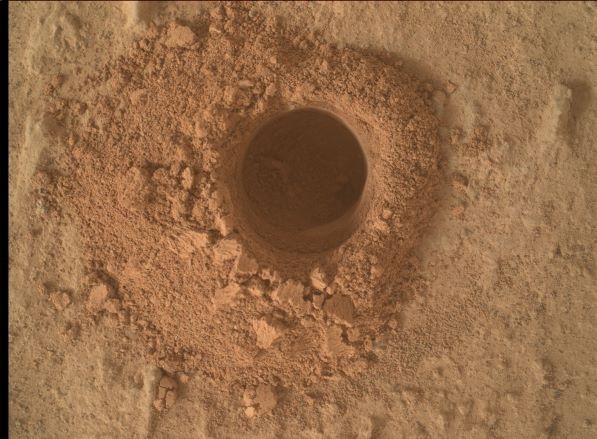
Curiosity Mars Hand Lens Imager photo acquired on Sol 3178, July 15, 2021.
Credit: NASA/JPL-Caltech/MSSS
Curiosity is sitting in an “exciting and very interesting looking area,” Schwenzer adds. “Around the drill site, we have spotted many different textures and colors; and as we know from being on Mars for over 3100 sols now, different colors and textures may mean interesting discoveries.”

Curiosity Mars Hand Lens Imager photo acquired on Sol 3178, July 15, 2021.
Credit: NASA/JPL-Caltech/MSSS
Colorful features
The decision was made for Curiosity to investigate the more reddish features spotted on a rock close to the rover with its Chemistry and Camera (ChemCam), investigating a target called “Belcayre.” There are also darker features on the same rock.
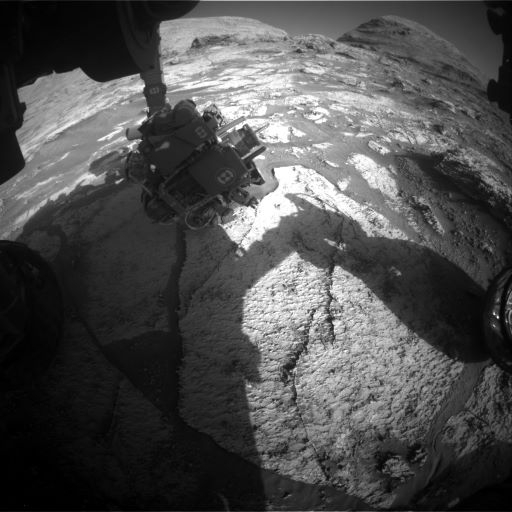
Curiosity Front Hazard Avoidance Camera Left B image taken on Sol 3178, July 15, 2021.
Credit: NASA/JPL-Caltech
The robot’s Mastcam is targeting “La Bastide” as well, adding multispectral information to the dataset. Mastcam is also targeting “Lempzours,” which is a resistant feature in the distance. “The mosaic will expand an existing mosaic to give us even more information on the many textures in this scene,” Schwenzer concludes.

Curiosity Right B Navigation Camera image taken on Sol 3177, July 14, 2021.
Credit: NASA/JPL-Caltech
Methane spikes
Meanwhile, an intriguing research paper has been published – “Mars Methane Sources in Northwestern Gale Crater Inferred from Back-Trajectory Modeling” — work led by Yangcheng Luo of the California Institute of Technology.
“During its five years of operation, the Sample Analysis at Mars (SAM) Tunable Laser Spectrometer (TLS) on board the Curiosity rover has detected six methane spikes above a low background abundance in Gale crater. The methane spikes are likely the consequence of nearby surface emission,” Luo and colleagues write.
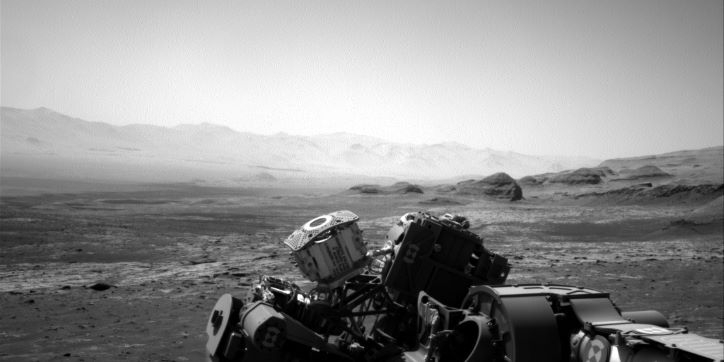
Curiosity Right B Navigation Camera image taken on Sol 3177, July 14, 2021.
Credit: NASA/JPL-Caltech
The paper notes that almost all of the methane in the present-day Earth’s atmosphere can be traced back to biological origins.
“This may invoke a coincidence that we selected a landing site for Curiosity that is located next to an active methane emission site. Another possibility that does not invoke the coincidence is the existence of fast methane removal mechanisms that are unknown to date.”
To read the full paper, “Mars Methane Sources in Northwestern Gale Crater Inferred from Back-Trajectory Modeling,” go to:
Credit: Axiom Space
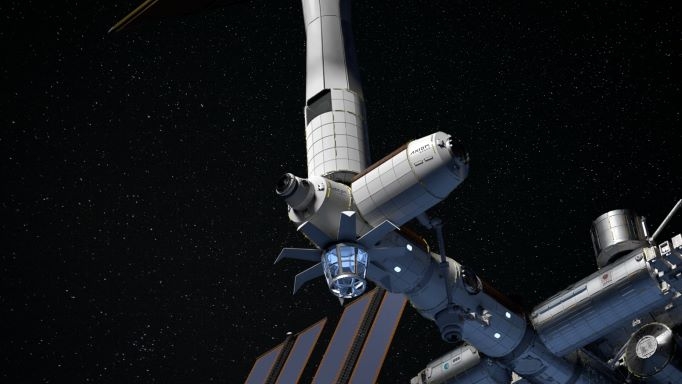
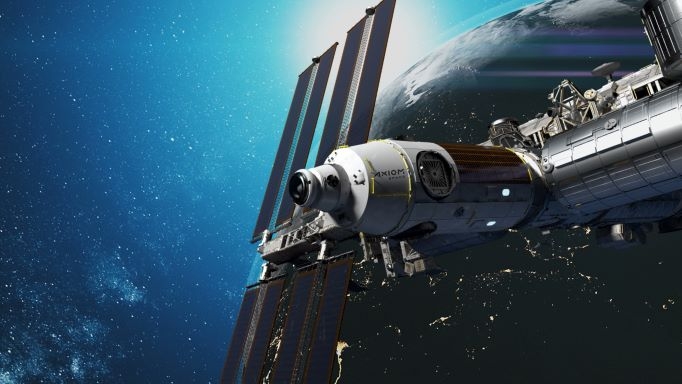
Thales Alenia Space in Rome and Axiom Space of Houston, Texas have signed the final contract for the development of two key pressurized elements of Axiom Space Station – the world’s first commercial space station.
Scheduled for launch in 2024 and 2025 respectively, the two elements will originally be docked to the International Space Station (ISS), marking the birth of the new Axiom Station segment.
Axiom Station will serve as a central hub for research, manufacturing and commerce in Low Earth Orbit (LEO), expanding the usable and habitable volume of the ISS, attached to the ISS Node 2 module, built also by Thales Alenia Space.
Credit: Axiom Space
Free-flying lab
When the ISS is decommissioned, the Axiom modules will detach and operate as a free-flying, next-generation commercial space station, a laboratory and residential infrastructure in space that will be used for microgravity experiments in-space manufacturing, critical exploration life support testing, and hosting both private and professional institutional astronauts.
The first two elements to be launched will accommodate up to 4 people each.
The welding activities of the primary structure of the first module will start in September 2021, with the assembly process concluding in 2022.
The first module will arrive at Axiom facilities in Houston in July 2023, where Axiom will integrate and outfit the core systems and certify it for flight prior to shipping to the launch facility.
For more information on Axiom Space, go to:

