Archive for the ‘Space News’ Category
 Author:
  April 5th, 2026
A cinematic shot for the mind. Steven Spielberg’s Disclosure Day movie, set for release this June.
Image credit: Universal Pictures/Concept Arts
For sure the truth is reportedly out there. But in the case of flying saucers and unidentified anomalous phenomena what’s truly going on seems elusive to down-to-Earth explanation.
“The appetite for disclosure is likely to never be satisfied,” explains one expert.
But “disclosure” — in whatever form it takes — could indeed ignite a possible powder keg of implications.
Likely to strike a match to an explosive, eye-opening encounter with the truth is Steven Spielberg’s Disclosure Day movie, set for release this June.
Space.com reached out to a diversity of experts on the topic, obtaining a wide swath of swing and sway.
For more information, go to my new Space.com story – “Disclosure day: If ET made contact, how would we handle the news?” – at:
 Posted in

Image credit: GAO
On the Horizon: Three Science and Technology Trends That Could Affect Society.
The Government Accountability Office (GAO) examined how these three technologies could evolve over the next decade. These transformative technologies are trending toward maturity and may need congressional attention over the next 10 years.
These technologies are:
- Neural implants for human augmentation.
- General purpose robots.
- Orbital debris removal technologies.
Orbital debris

Image credit: GAO
GAO reports that there are more than 15,000 pieces of orbital debris currently tracked, with more than a million pieces that are too small to track but can still damage satellites and other spacecraft that provide important services.
Technology is in development to actively remove, relocate, or repurpose large, non-tumbling debris. This could reduce the risk of a catastrophic cascade of collisions, but would not eliminate it because small or tumbling debris constitute the vast majority of dangerous debris.
Legal difficulties
Further development and use of novel technologies may be hampered by possible legal difficulties posed by the Outer Space Treaty.

Image credit: GAO
Policymakers could consider a variety of options, including supporting targeted research to fill technological gaps or initiating legal analyses to develop solutions to legal difficulties.
GAO is not making recommendations but has identified several policy considerations for the Congress and others to weigh as these technologies continue developing.

Image credit: GAO
Read the full report — On the Horizon: Three Science and Technology Trends That Could Affect Society – go to:
https://www.gao.gov/assets/gao-26-108079.pdf
Also, go to video at:

NASA and National Geographic have been collaborating with the four-person Artemis II crew. During the mission, the astronauts will act as photographers for the magazine, videographers for social media, and filmmakers for a National Geographic documentary.
Now you can take a tour of NASA’s new ride to the Moon.
Go to this National Geographic website at:
https://www.nationalgeographic.com/science/article/artemis-ii-astronauts-tour-orion

Image credit: Lockheed Martin
Once the Artemis II crew is beyond the defensive environments of Earth’s atmosphere and magnetic field, they are subject to space radiation.
While en route to and from the moon, the Artemis II crew will be vigil, eyeing radiation monitoring detectors, listening for caution and warning alarms, and they would be outfitted with active dosimeters – a device for measuring and checking exposure to doses of radiation, such as X-rays or gamma rays.
Hot spot
The Artemis crew riding in their Orion spacecraft is relatively highly shielded. However, dealing with a worrisome solar event, Artemis flight rules would have the astronauts establish a shelter utilizing central stowage bays emptied of contents.

Tucked inside their Orion spacecraft, the Artemis II crew is seen in a pre-launch rehearsal.
Image credit: NASA/Mark Sowa
Doing so would create a lower dose region within capsule confines. Stowage from the central bays would be moved to a known “hot spot” within Orion, to help reduce the dose rate exposure of the four-person crew. “
“If an event is particularly bad,” explains one expert, “there are some places in the capsule, such as storage bays and down by the toilet, that the crew can go to.”

An inside artistic look at the four-seater Orion spacecraft, measuring roughly 16.5 feet (5 meters) in diameter and standing 10.8 feet (3.3 meters) tall that can be converted into a storm shelter.
Image credit: NASA’s Space Radiation & Analyses Group (SRAG)
For more details, go to my new Space.com story – “What will happen if Artemis 2 astronauts get hit by a solar storm during NASA’s ambitious moon mission?” – at:

Image credit: CCTV/Inside Outer Space screengrab
The first Kinetica-2 launch vehicle (LiJian-2 Y1) was launched from the “Dongfeng Commercial Space Innovation Experimental Zone” at the Jiuquan Satellite Launch Center, China, on March 30, 2026.
According to official sources, the mission “The Global Capital of Textile” successfully placed into their target orbits: the Qingzhou prototype cargo spacecraft, also known as the New March 01 Technology Demonstration Satellite, the New March 02 Satellite, and TS 01 Educational Satellite.
According to CAS Space, Kinetica-2 is 53 meters tall, has a 4.2-metre payload fairing, and is “capable of delivering 8 metric tons to a 500 km Sun-Synchronous Orbit (SSO) or 12 metric tons to a 200 km Low Earth Orbit (LEO)”.
Milestone
Lian Jie, deputy chief designer of Lijian-2 Y1 carrier rocket, told China Central Television (CCTV): “In the future, the Lijian-2 Y1 carrier rocket will realize our ‘cluster one-piece recovery.’ By that I mean that traditionally, we recover the core stage of the rocket, but now, we fasten the boosters together with the rocket’s core stage as one piece,” said Lian.
Saving the booster separations, this approach also helps reduce risks that may occur during the rocket’s ascent phase, said Lian.
“Saving the step of booster separation, our Lijian-2 Y1 carrier rocket is highly reliable in its powered flight phase, because we reduce the number of times of separations,” Lian added.
Lian said the successful launch of the Lijian-2 Y1 carrier rocket marks a milestone in China’s commercial rocket development.
Cargo spacecraft test
The prototype for China’s next-generation, lower-cost cargo spacecraft, is in Earth orbit following its launch atop the Lijian-2 Y1 carrier rocket on Monday.

Image credit: CCTV/Inside Outer Space screengrab
The Qingzhou Cargo Spacecraft Test Vehicle is a prelude to the launch of a full model, designed as a lightweight, agile and cost-effective freighter to resupply China’s Tiangong Space Station.
The prototype spacecraft now in orbit weighs 4.2 tons. It carries 27 projects with a total payload of 1.02 tons, and will conduct in-orbit tests at altitudes ranging from 125 miles to over 370 miles (200 to 600 kilometers).
Light Ship
Qingzhou translates to “light ship” and was developed by the Innovation Academy for Microsatellites of the Chinese Academy of Sciences.
According to CCTV, the Qingzhou test vehicle’s structure features a main pressurized module for crew supplies and science experiments, and an unpressurized aft section capable of carrying external payloads and space exposure experiments.
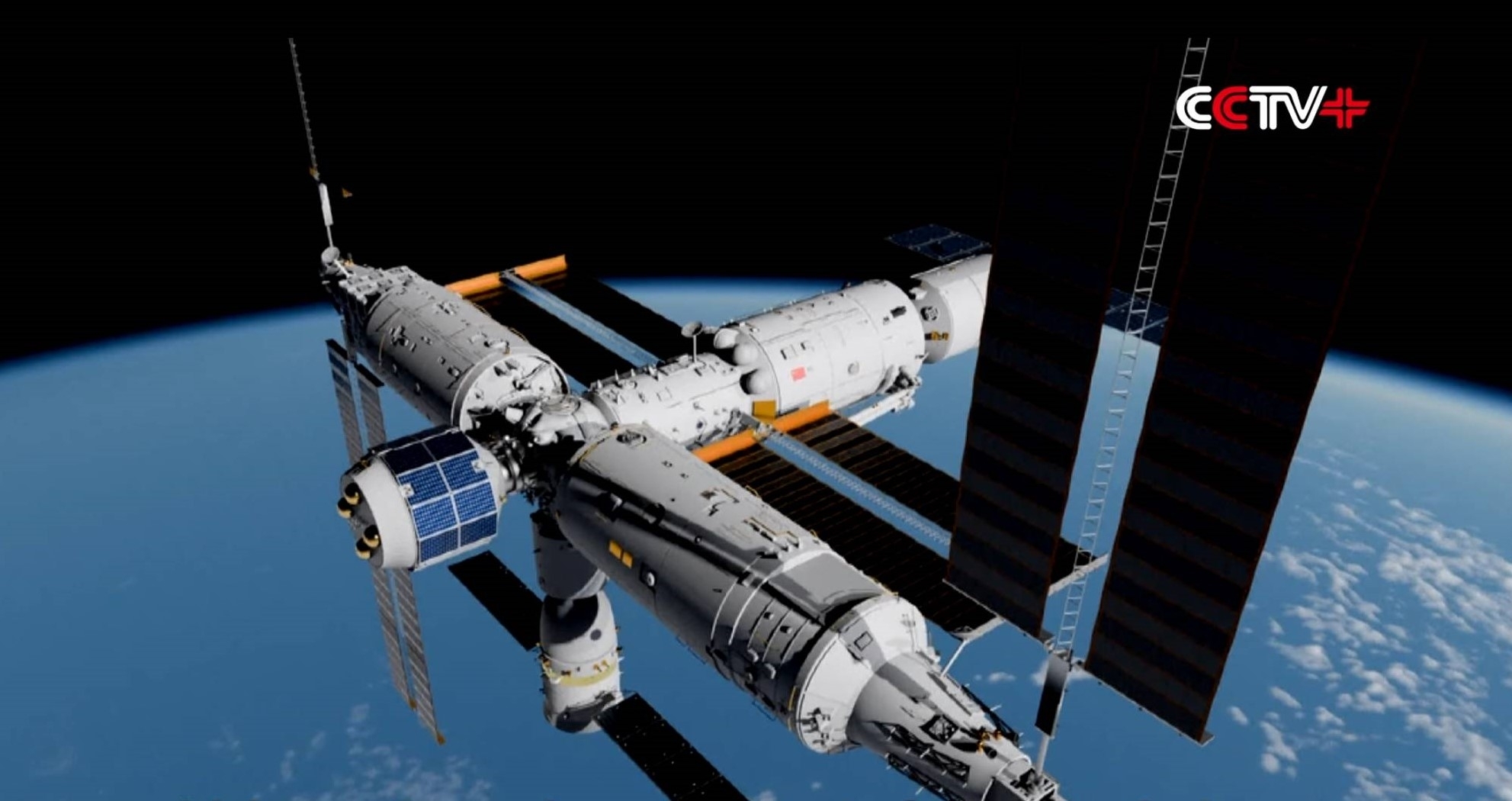
Artwork depicts Qingzhou cargo spacecraft (left) docked to Chinese space station, leading to growth of the orbiting outpost.
Image credit: CCTV/Inside Outer Space screengrab
The vehicle’s available volume for cargo is 27 cubic meters. For the storage of special supplies, the spacecraft is equipped with five modular “space refrigerators” — temperature-controlled containers each with a volume of 60 liters.
CCTV adds that Qingzhou is seen as a lower-cost complement to China’s existing Tianzhou cargo spacecraft, which has been carrying out delivery missions to the Tiangong Space Station.
Go to these CCTV videos at:
https://www.facebook.com/reel/1710498954059747
https://www.facebook.com/reel/1469872668196092
Also, go to this CAS Space (Beijing Zhongke Aerospace Exploration Technology Co., Ltd.) video at:
https://youtu.be/ZieEGm6jDjg?list=PLpGTA7wMEDFjz0Zx93ifOsi92FwylSAS3

Earth’s sun can toss out powerful solar storms that can impact Artemis II astronaut travel to and from the moon. NASA’s Solar Dynamics Observatory captured this solar flare event on October 3, 2024.
Image credit: NASA/SDO
The upcoming flight of Artemis II will hurl the astronaut crew outward to the moon, far beyond the shielding cocoon of Earth’s magnetic field. This first piloted sojourn of the Artemis program, a 10-day outing, is the first human passage over that distance since Apollo-era moonwalker flights ended in December 1972.
Forecasting skills
Tucked inside their Orion spacecraft, the Artemis II crew is seen in a pre-launch rehearsal.
Image credit: NASA/Mark Sowa
To support the flight, there has been a sharpening of space weather forecasting skills, an ability to better gauge the sun’s conniptions and to help assure crew safety if a hazardous uptick in solar action rears its energetic head.
“I think we’re feeling optimistically confident right now,” explains a space weather expert.
For more details, go to my new Space.com story – “Could bad space weather endanger the Artemis 2 moon astronauts?” – at:

Image credit: PBS
Life Unearthed with Ariel Waldman is a docu-series that begins streaming on the Public Broadcasting Service (PBS) network. The series starting April 1 reveals Earth’s ecosystems through radical shifts in scale—from microscopic wildlife to the planet’s most iconic animals—and even the possibilities of life beyond Earth.
Waldman is a National Geographic Explorer, filmmaker and author. For over a decade, she has served as an advisor to NASA on astrobiology, human spaceflight, and advanced technologies.

Image credit: PBS
This series journeys from the deepest roots beneath our feet to the distant possibilities of life on icy moons beyond our atmosphere.
For more information on this informative series, go to:

SpaceX’s Gwynne Shotwell Aims to Put AI on the Moon
Inside a sprawling Texas factory, SpaceX is building its most powerful rockets yet, with the goal of returning humans to the moon. At the center of it all is Gwynne Shotwell. Find out how she became one of the most influential figures in space in this week’s TIME cover story.
Go to:
a3b19620b2c8773c8702fd101f

Image credit: CCTV/Inside Outer Space screengrab
A Chinese aerospace startup has demonstrated in space a flexible robotic arm to advance orbital refueling technology.
The test was done onboard a Yuxing 3-06 satellite, lofted on March 16 via a Kuaizhou-11 Y7 rocket from the Jiuquan Satellite Launch Center in northwest China.
Key enabler
The company, Sustain Space, views orbital refueling as a key enabler for extending a spacecraft’s lifespan. The arm was developed by a team led by Tsinghua University’s Shenzhen International Graduate School.
According to China Central Television (CCTV), the test paves the way for Yuxing 3-06 – labeled a “space refueling station,” to replenish other satellites in orbit, manage space debris, and provide other in-orbit services.
In-orbit simulations
Sustain Space announced this week that the spacecraft completed a series of in-orbit simulations using its flexible manipulator. Those operations included an autonomous programmed refueling simulation, a ground-controlled refueling simulation and a vision-guided servo refueling simulation.

Image credit: CCTV/Inside Outer Space screengrab
Reportedly, a representative from Sustain Space told KhabarAsia that a next phase would involve actual propellant transfer between cooperative spacecraft.
Space debris removal
Based in Taicang, China, Sustain Space was founded in 2022. Its activities are focused on space debris removal, as well as on-orbit spacecraft refueling, life extension, and in-orbit repair and manufacturing.
The state-run Xinhua news service made note that China had previously conducted similar experiments. In January 2025, the country launched a test satellite, Shijian-25, primarily for verifying satellite fuel replenishment and life extension service technologies.
Go to video of the arm at:

Image credit: White House
NASA Administrator Jared Isaacman:
“To return Americans to the Moon, NASA is shifting to an iterative, execution-focused approach – just as we did during Apollo.
We are standardizing rocket architecture, embedding NASA expertise across industry, and increasing launch cadence to support sustained lunar operations.
Demand signal
We are sending a demand signal for crewed missions beyond Artemis V, with at least two providers capable of bringing astronauts to the surface every 6 months.

Image credit: NASA
The goal is not just to reach the Moon, but to stay.
America will never give up the Moon again.”
Skyfall on Mars
“NASA is building [the Space Reactor-1] SR-1 Freedom, a nuclear electric propulsion spacecraft, launching to Mars in 2028.
We are proud to announce this during the 250th year of the United States, the mission’s name reflects the spirit of American innovation and exploration.
This mission will bring America’s nuclear power capabilities to space and deliver the Skyfall payload of Ingenuity class helicopters to explore the Red Planet.
Nuclear power and propulsion will be the key to undertaking crewed missions to Mars and exploring the outer solar system.”

Illustration of AeroVironment’s new “Skyfall” helicopter concept that could deploy six scouts to Mars.
Image credit: AeroVironment
For more details, go to these “Ignition” presentations:
NASA’s Plan for The Moon
https://youtube.com/watch?v=yIlTwwJv1Ac
NASA’s Plan for Science and Discovery
https://youtube.com/watch?v=BYH6W9iCs2E
Ignition: NASA News Conference (March 24, 2026). Go to video replay at:

