Archive for the ‘Space News’ Category
 Author:
  August 23rd, 2021
Credit: NASA
Rocket Lab announced today it will begin final mission design and start manufacturing two interplanetary Photon spacecraft for a low-cost NASA science mission to Mars.
The Escape and Plasma Acceleration and Dynamics Explorers (ESCAPADE) mission will orbit two Rocket Lab-built Photon spacecraft around Mars to understand the structure, composition, variability, and dynamics of Mars’ unique hybrid magnetosphere. The mission will also support crewed exploration programs like Artemis through improved solar storm prediction.
The ESCAPADE mission is led by the University of California Berkeley Space Sciences Laboratory.
Innovative mission
“ESCAPADE is an innovative mission that demonstrates that advanced interplanetary science is now within reach for a fraction of traditional costs, and we’re proud to make it possible with Photon,” said Rocket Lab’s founder and CEO, Peter Beck.
To be launched to Mars in 2024, and following deployment from a NASA-provided commercial launch vehicle, the pair of Photons will conduct an 11-month interplanetary cruise before inserting themselves into elliptical orbits around Mars to begin the science phase.
 Posted in

Credit: NASA/JPL-Caltech/University of Arizona/Inside Outer Space screengrab
NASA’s ingenuity Mars Helicopter acquired a series of color images during its 12th aerial escapade.

Artist’s concept of NASA’s Ingenuity Mars Helicopter flying through the Red Planet’s skies. Credit: NASA/JPL-Caltech
The autonomous mini-helicopter flew over the South Seitah region of the Red Planet, chalking up a round trip flight that carried it nearly 33 feet in altitude for 169 seconds, traveling a total of 1,475 feet.
These images were produced by the craft’s high-resolution color camera mounted in the helicopter’s fuselage and pointed approximately 22 degree below the horizon.
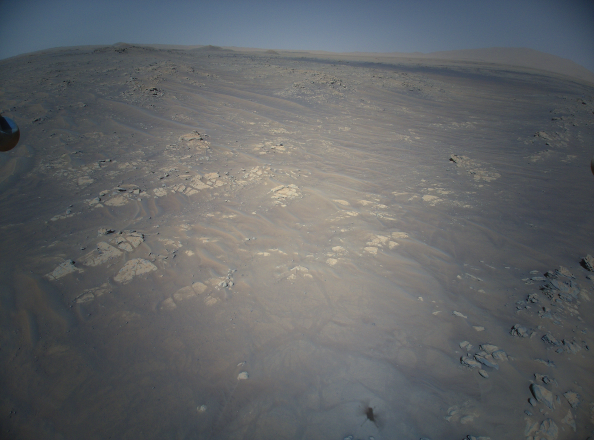
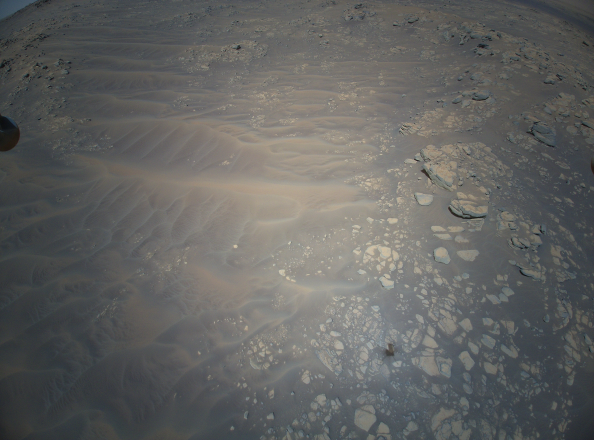
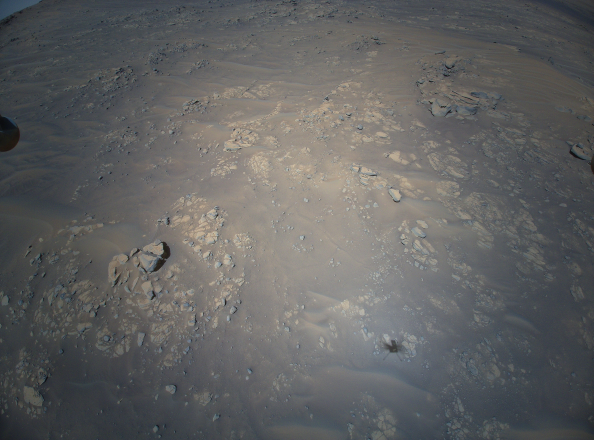
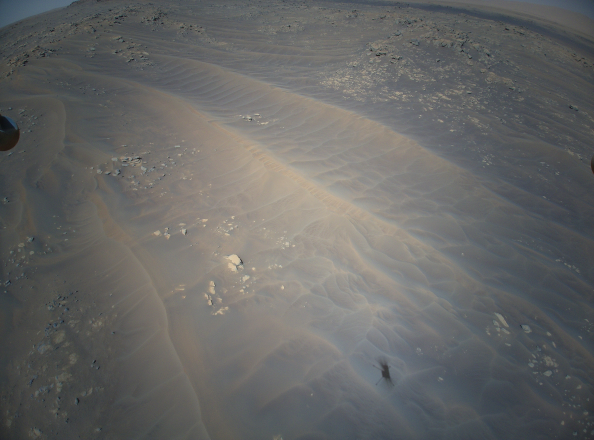
Selected photos show Ingenuity’s scouting abilities acquired on August 16, 2021, Sol 174 of the Perseverance rover mission.
Image credits: NASA/JPL-Caltech

Courtesy: Gallup
The prospect that some Unidentified Flying Objects (UFOs) are alien spacecraft is up eight points since 2019. Indeed, more Americans are taking UFOs seriously than just two years ago.
A new Gallup poll has found when asked which of two theories better explains UFO sightings, 41% of adults now believe some UFOs involve alien spacecraft from other planets, up eight points from 33% in 2019.
Half of Americans, down from 60% in 2019, remain skeptical, saying all UFO sightings can be explained by human activity or natural phenomena. Another 9% are unwilling to venture a guess.

UAPs/UFOs
Lydia Saad, Director of U.S. Social Research at Gallup also reports:
“The recent change spans a period when UFOs have received significant coverage in mainstream news publications. This includes a spate of articles in 2019 focused on leaked footage of mysterious flying objects taken by Navy pilots. While the Department of Defense has not suggested these or any UFOs involve alien visitors, the Navy has acknowledged the leaked video is authentic, and in 2020, it commissioned a task force to study “unidentified aerial phenomena” (UAP).”
The latest Gallup results are based on a telephone poll conducted July 6-21, with a random sample of –1,007—adults, ages 18+, living in all 50 U.S. states and the District of Columbia.
The poll was conducted less than a month after the Office of the Director of National Intelligence issued its preliminary report on UAPs, stating that the various types of incidents examined likely fall into one of five categories: “airborne clutter, natural atmospheric phenomena, [U.S. government] or U.S. industry development programs, foreign adversary systems and a catchall ‘other’ bin.” The 2019 survey was conducted Aug. 1-14, several months after the Navy UFO footage was first leaked.

Credit: DOD/U.S. Navy/Inside Outer Space screengrab
Net effect
This new Gallup poll also found:
Belief up more among college-educated than those with no college education. Adults 55 and older more likely than younger adults to be skeptical.
The new poll also shows men moving ahead of women in believing that some UFOs have been alien visitors to Earth. Forty-four percent of men now take this position, up from 34% in 2019. By contrast, 38% of women currently hold this view, little changed from 33%.
Middle-aged adults’ belief in visits by alien spacecraft increased the most of all age groups, rising 13 points to 45%. Their views now match those of adults aged 18 to 34, while contrasting with the 37% of adults 55 and older.
The net effect of these UFO-alien spacecraft findings, the Gallup poll indicates, is that college graduates have gone from being the least likely educational group to believe this in 2019 to being on par with adults who have no college education today. Adults with some college experience (but no degree) remain the most likely to be persuaded.
Bottom line
“With more mainstream news coverage of UFOs in recent years, and the government taking sightings more seriously, the idea that UFOs could be alien spacecraft doesn’t seem as far-fetched to Americans as it did even two years ago,” Saad adds. “Meanwhile, the government seems more focused on determining if the threat is coming from foreign governments rather than other planets, and half of Americans continue to presume there is an Earth-based explanation for all such sightings.”
For more information on this Gallup poll, go to:
https://news.gallup.com/poll/353420/larger-minority-says-ufos-alien-spacecraft.aspx

Russia’s Luna-25 Moon lander.
Credit: RSC Energia/Roscosmos
The Russian robotic Moon lander – Luna-25 – has slipped from an October liftoff to May 2022.
“The shift to the second launch window was caused by the need to further confirm the declared characteristics of Luna-25 devices, assemblies and propulsion system, revealed during ground testing, in conditions as close as possible to outer space that can be achieved on Earth,” Russia’s Roscosmos has stated.
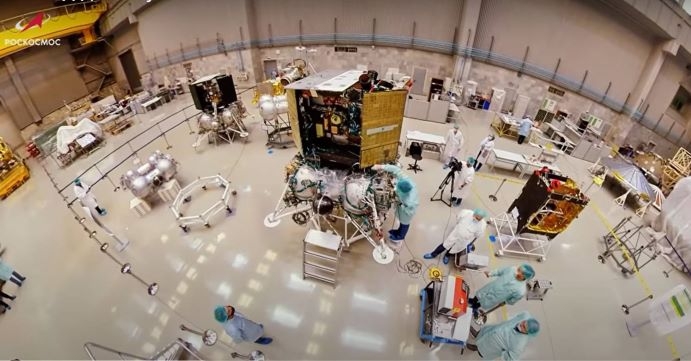
Credit: Roscosmos/Inside Outer Space screengrab
The Luna-25 is a product of NPO Lavochkin (part of Roscosmos).
Additional testing needed
The currently completed tests, which are critically important for ground-based experimental development of the spacecraft, revealed the need for additional research, Roscosmos added. “There is a need to carry out checks to ensure the required reliability of the first Russian mission to the Moon.”

Credit: Roscosmos/Inside Outer Space screengrab
In addition, as part of the preparation of the Luna-25 mission, it is planned to implement additional measures taking into account the recommendations after the analysis of the recent Nauka module launch results, Roscosmos said.
South pole probing
Luna-25 opens a long-term Russian lunar program, which includes missions to study the Moon from orbit and surface, collect and return lunar soil to Earth, as well as construct a visited lunar base, in cooperation with the Chinese National Space Administration within a large-scale project to create an International Scientific Lunar Station.

Lunar hardware undergoes testing.
Credit: RSC Energia/Roscosmos
The Luna-25 mission’s main task is to develop basic soft landing technologies in the Moon’s circumpolar region and conduct contact studies of a given region of the Moon’s south pole.

Credit: New China/GLOBALink/Inside Outer Space screengrab
For the second time during their mission, Chinese astronauts have completed spacewalks and returned inside the space station core module, Tianhe.
The China Manned Space Agency (CMSA) on Friday declared the extravehicular activity a success.
Taikonauts Nie Haisheng and Liu Boming performed the EVAs with Tang Hongbo staying inside the station’s core module to monitor and support his colleagues.
Liu and Tang performed the first EVAs on July 4, in cooperation with Nie from inside the Tianhe core module.

Tang Hongbo stayed inside the station’s core module to monitor and support his spacewalking colleagues.
Credit: CCTV/CNSA/Inside Outer Space screengrab
Improvements and modifications
“For our second EVA mission, we had taken some lessons drawn from the first EVA mission and made some improvements and modifications, said Chen Shanguang, deputy chief designer of the China Manned Space Program in an interview with China Central Television (CCTV).
“So the mission was performed perfectly, saving much time from the schedule. The taikonauts gave a perfect performance in their operation, and the ground command did a perfect job, too. The mission was a complete success. So we are very happy,” Chen said.

Credit: CCTV/CNSA/Inside Outer Space screengrab
“We are moving forward in practicing our extravehicular activities out of the space station. With the experience from the first extravehicular activities, our astronauts are more skilled and predictable. Second, we also improved the workflow according to the results of the first extravehicular activities, making it more efficient when the operation tasks remain unchanged. Based on these two points, they could do a better job,” said Liu Weibo, deputy chief designer of the astronaut system under the China Astronaut Research and Training Center.
New suits
During the spacewalk, the astronauts installed a pump, oriented the external panoramic camera and tested new EVA spacesuits.

Credit: CCTV/CNSA/Inside Outer Space
Outfitted in their Feitian, new-generation homemade extravehicular mobility unit spacesuits that literally means “flying to space,” the two astronauts also completed installing the foot restraints and extravehicular working platform on the mechanical arm, the China Manned Space Agency (CMSA) said.

Credit: CCTV/CNSA/Inside Outer Space
The Shenzhou-12 space flight is China’s seventh crewed mission to space and the first during the construction of the country’s space station. It is also the first in nearly five years after the country’s last manned mission.
The trio of astronauts flew into space aboard the Shenzhou-12 spaceship on June 17. The three-person crew is scheduled to return to Earth in mid-September.
Go to these videos focused on the 2nd spacewalk and what tasks were done at:
Credit: CCTV/CNSA/Inside Outer Space screengrab
China’s Zhurong Mars rover has been snooping around Utopia Planitia for several months with researchers discussing early findings by the robot.
Due to the Mars solar conjunction, that is expected to impact communication from mid-September to late October 2021, the Tianwen-1 orbiter will remain in a relay communication orbit and continue to relay communications from the Zhurong rover.

China’s Zhurong Mars rover.
Credit: CCTV/Inside Outer Space screengrab
Martian atmosphere
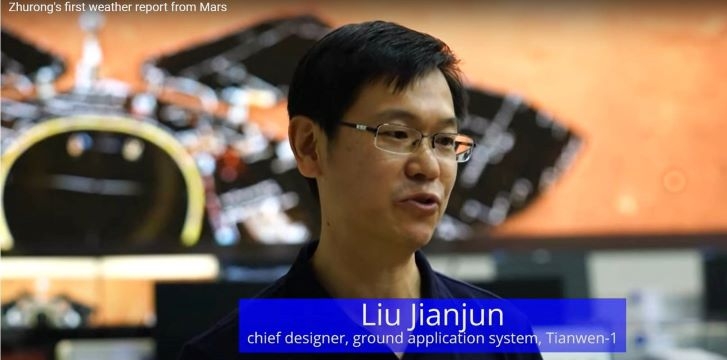
“According to our measurement, the Martian atmosphere has a pressure of around 800 pascals. What does 800 pascals suggest? We used to believe that the pressure on Mars was about 1 percent of that on Earth, but our measurement this time says it’s 1/120,” Liu Jianjun, chief designer, ground application system for China’s Tianwen-1 Mars mission told China Central Television (CCTV).
“Around noon, the temperature was between minus 20 to minus 10 degrees Celsius,” said Liu. “Another question people might be interested in is that if there is wind on Mars and how hard it blows. We measured the wind speed, which was two to eight meters per second, something we call a breeze. The maximum speed on record was 10 meters a second, so basically a breeze,” he said.

Credit: CNSA/Inside Outer Space screengrab
Existence of an ancient ocean?
The 13 scientific devices mounted on Tianwen 1’s orbiter and Zhurong rover have generated more than 420 gigabytes of primary data.
“Hopefully, by providing these data to our scientists, we can get a deeper understanding of the geology of Mars,” Liu said, “and then even see if we can find evidence of the existence of an ancient ocean in the Utopia Planitia, a question that interests many people.”
The rover’s magnetic environment meter mainly measures what the magnetic environment is like on Mars. A surface composition detector basically measures what elements are in the rocks, soil, and dunes on Mars, said Liu.
Go to these newly issued videos from CCTV/China National Space Administration (CNSA) at:

Crew of Shenzhou-12
Credit: GlobaLink/Inside Outer Space screengrab
Chinese taikonauts now stationed in the Tianhe core space station module are soon to carry out another round of spacewalking chores.
The China Manned Space Agency (CMSA) announced on Tuesday the extravehicular activities for a second time will occur within the next few days.
This Shenzhou-12 crew — Nie Haisheng, Liu Boming and Tang Hongbo — have now been onboard the country’s first space station for two months. They will remain in Earth orbit for another month before their return to terra firma. They entered the Tianhe module on June 17.
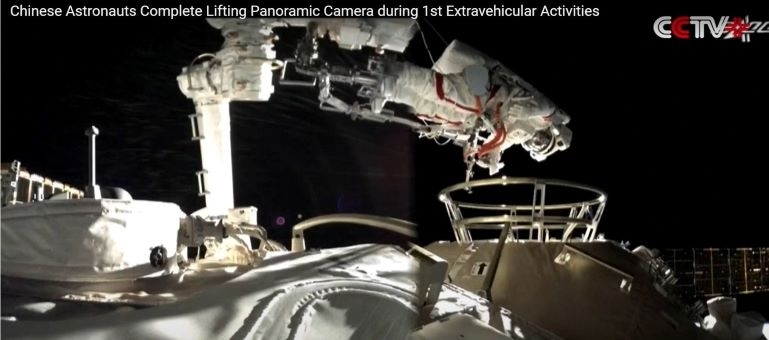
Credit: CCTV/Inside Outer Space screengrab
Next supply ship
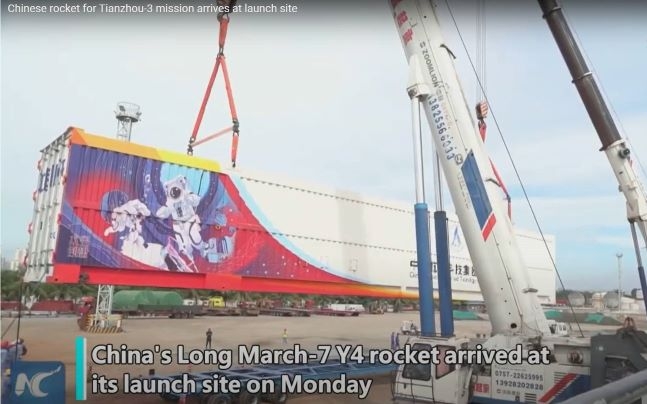
Meanwhile, a Long March-7 Y4 rocket has arrived at its launch site in southern China’s Hainan Province and is now being readied to boost the Tianzhou-3 supply craft.
New China TV/Inside Outer Space screengrab
The booster, alongside the Tianzhou-3 cargo craft, were transported to the Wenchang Spacecraft Launch Site, and will be assembled and tested there at that location, the China Manned Space Engineering Office (CMSEO) said on Monday.
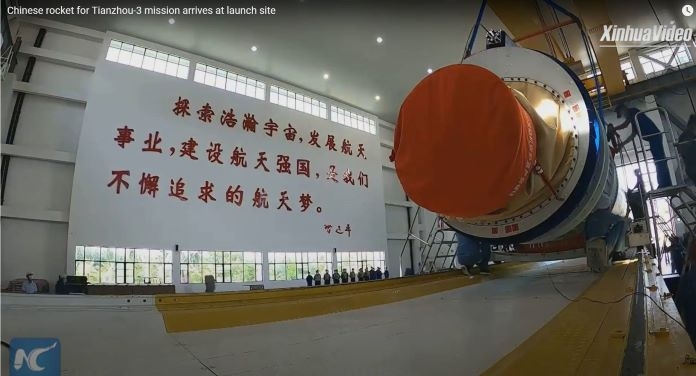
Credit: CCTV/Inside Outer Space screengrab
Additionally, the piloted Shenzhou-13 spacecraft and its carrier rocket are also undergoing preparations at the Jiuquan Satellite Launch Center in northwest China, CMSEO reported.
Go to these new videos: The Long March-7 Y4 rocket’s arrival at:
Chinese astronauts have recently completed assembly of a space centrifuge onboard the station’s core module at:

Credit: NASA
New research suggests Earth’s Moon is far from a bone dry world.
The Imaging Infrared Spectrometer (IIRS) instrument onboard India’s Chandrayaan-2 lunar orbiter has found the presence of both hydroxyl ions (OH) and water molecules (H2O) on the lunar surface.
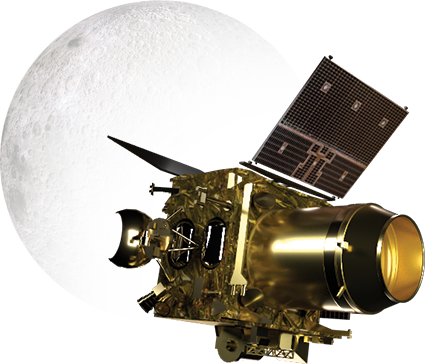
Chandrayaan 2 Orbiter.
Credit: ISRO
The assessment has further quantified the amount of water molecules present on regions of the Moon the instrument imaged, and sorts out places on the lunar landscape that are water-rich and those locales scant in hydration.

Credit: Prakash Chauhan, et. al
Space weathering
Appearing in the journal Current Science, “Unambiguous detection of OH and H2O on the Moon from Chandrayaan-2 Imaging Infrared Spectrometer reflectance data using 3 μm hydration feature,” the lead author of the work is Prakash Chauhan of the Indian Institute of Remote Sensing, Indian Space Research Organization (ISRO).
Chauhan and colleagues point to space weathering – the solar wind or charged solar particles that bombard the lunar terrain – as the source of the water.
To access this paper, go to: https://www.currentscience.ac.in/Volumes/121/03/0391.pdf
In the shadows
Meanwhile, another piece of research suggests that the shadows cast by the roughness of the Moon’s surface create small cold spots for water ice to accumulate even during the ruthless lunar daytime.

Credit: NASA
Previous computer models suggested any water ice that forms during the lunar night should quickly burn off as the Sun climbs overhead.
However, in a new study, JPL scientist Björn Davidsson and co-author Sona Hosseini, a research and instrument scientist at JPL, suggest that shadows created by the “roughness” of the lunar surface provide refuge for water ice, enabling it to form as surface frost far from the Moon’s poles. They also explain how the Moon’s exosphere (the tenuous gases that act like a thin atmosphere) may have a significant role to play.
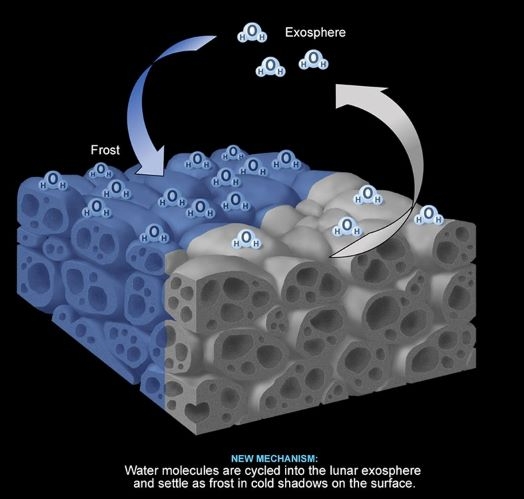
Credit: Björn Davidsson/Sona Hosseini
Strong influence
“This challenges our understanding of the lunar surface and raises intriguing questions about how volatiles, like water ice, can survive on airless bodies,” Davidsson said in a JPL statement.
In their research paper – “Implications of surface roughness in models of water desorption on the Moon” – they report that surface roughness substantially increases the capability of the Moon to retain water on its sunlit hemisphere at any latitude, and within 45 degrees of the poles, at any time of the lunar day.
“Hence, we show that lunar surface roughness has a strong influence on lunar water adsorption and desorption. Therefore, it is of critical importance to take account of surface roughness to get an accurate picture of the amount of water on the Moon’s surface and in its exosphere,” the researchers conclude.
To access this research, go to the Monthly Notices of the Royal Astronomical Society, Volume 506, Issue 3, September 2021 at:
https://doi.org/10.1093/mnras/stab1360
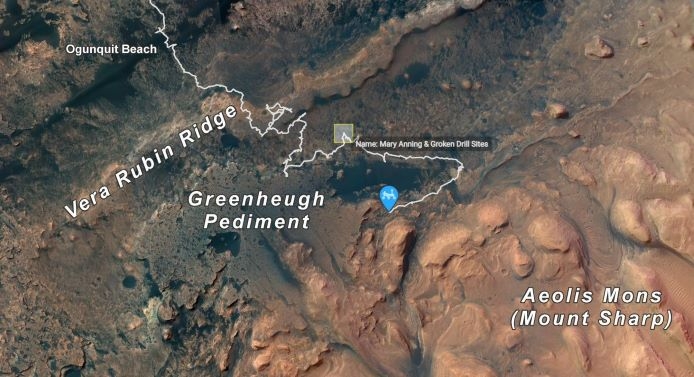
Credit: NASA/JPL-Caltech/Univ. of Arizona
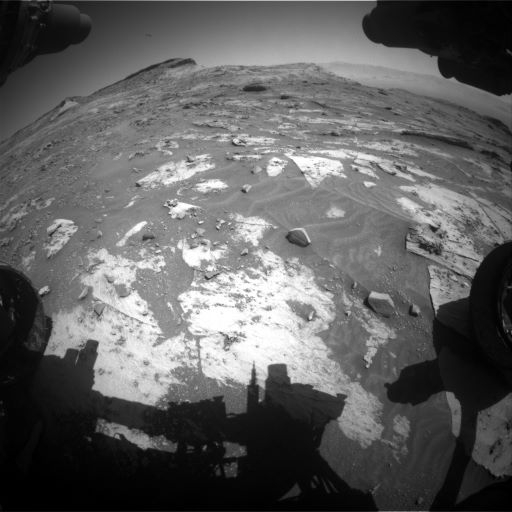
Curiosity Front Hazard Avoidance Camera Right B image taken on Sol 3207, August 14,2021.
Credit: NASA/JPL-Caltech
NASA’s Curiosity rover at Gale Crater is now performing Sol 3208 tasks.
The robot continues its climb up Mt. Sharp, navigating towards the southwest. Here are some recently taken images of the rover’s surroundings:

Curiosity Mast Camera Left image acquired on Sol 3206, August 13, 2021.
Credit: NASA/JPL-Caltech/MSSS
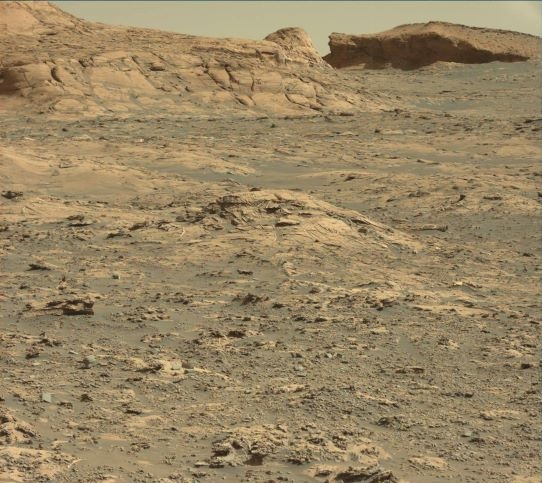
Curiosity Mast Camera Left image acquired on Sol 3206, August 13, 2021.
Credit: NASA/JPL-Caltech/MSSS
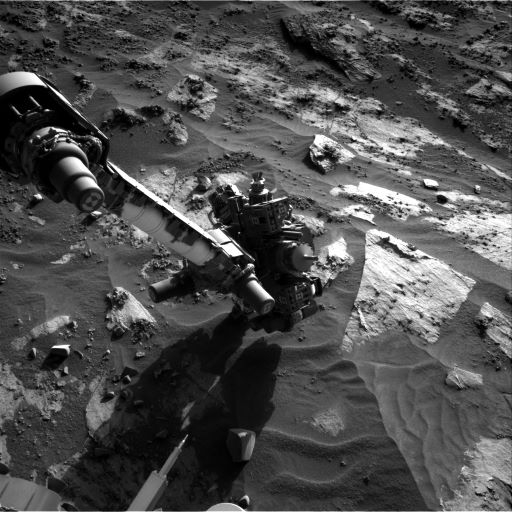
Curiosity Right B Navigation Camera image taken on Sol 3208, August 15, 2021.
Credit: NASA/JPL-Caltech
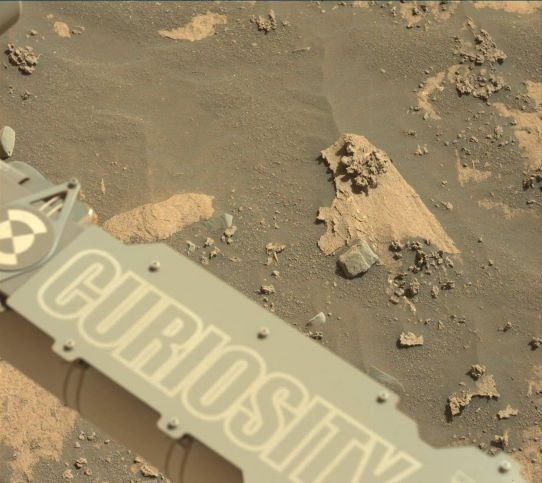
Curiosity Mast Camera Left image acquired on Sol 3206, August 13, 2021.
Credit: NASA/JPL-Caltech/MSSS
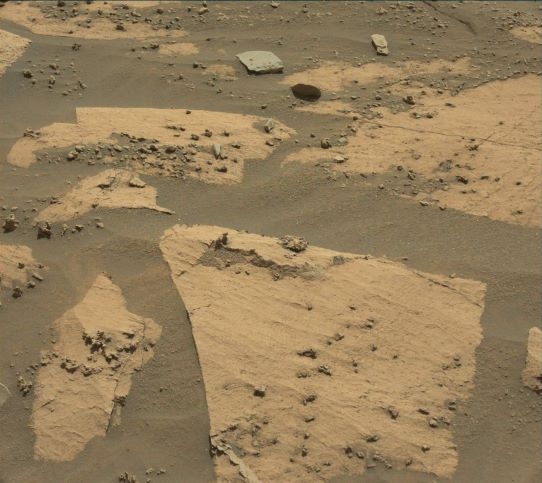
Curiosity Mast Camera Left image acquired on Sol 3206, August 13, 2021.
Credit: NASA/JPL-Caltech/MSSS
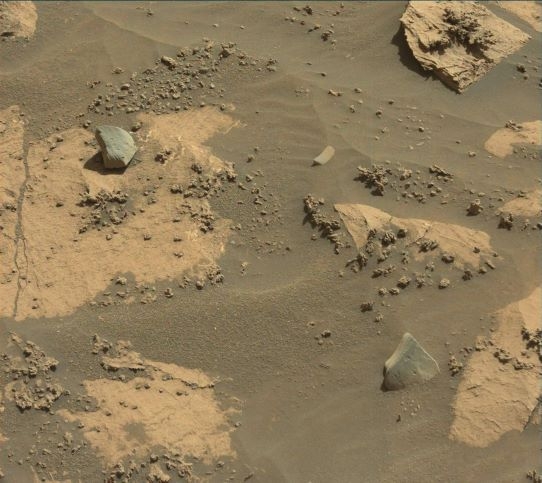
Curiosity Mast Camera Left image acquired on Sol 3206, August 13, 2021.
Credit: NASA/JPL-Caltech/MSSS
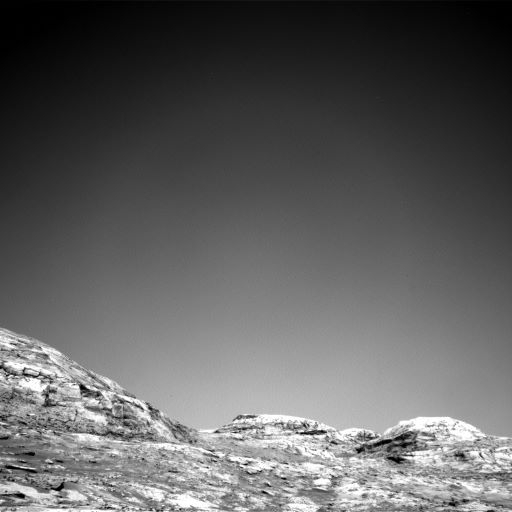
Curiosity Right B Navigation Camera image taken on Sol 3208, August 15, 2021.
Credit: NASA/JPL-Caltech
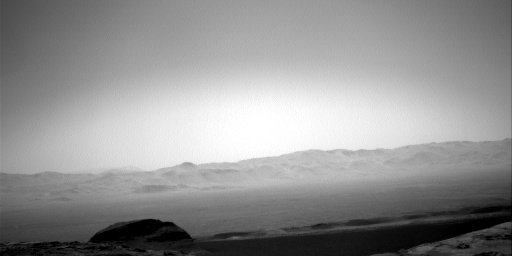
Curiosity Right B Navigation Camera image taken on Sol 3208, August 15, 2021.
Credit: NASA/JPL-Caltech
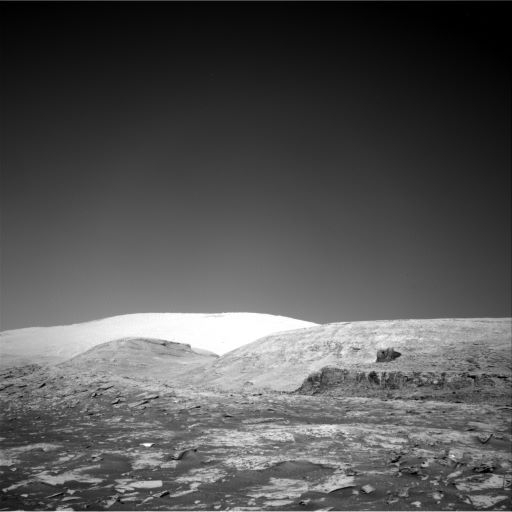
Curiosity Right B Navigation Camera image taken on Sol 3208, August 15, 2021.
Credit: NASA/JPL-Caltech

Curiosity Front Hazard Avoidance Camera Left B image taken on Sol 3206, August 13, 2021.
Credit: NASA/JPL-Caltech
NASA’s Curiosity Mars rover at Gale Crater is now performing Sol 3207 duties.
“Curiosity continues her climb up Mt. Sharp, navigating her way towards the southwest,” reports Mark Salvatore, a planetary geologist at the University of Michigan.
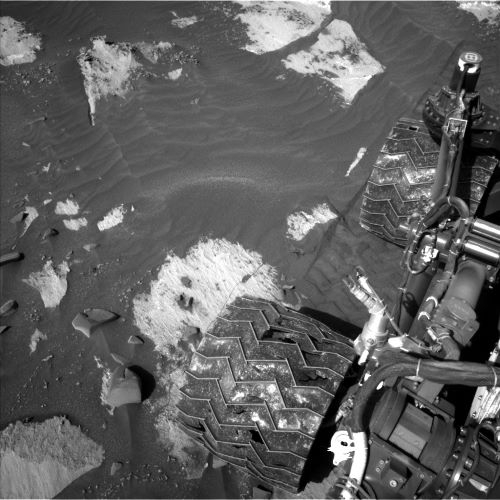
Curiosity Left B Navigation Camera image acquired on Sol 3206, August 13, 2021.
Credit: NASA/JPL-Caltech
Transition region
In the previous plan, Curiosity traveled approximately 131 feet (40 meters) through fairly rocky terrain that coincides with the transition region between the clay-bearing bedrock that the robot has been exploring for the past few years and the overlying sulfate-bearing materials.
“The science team is carefully characterizing this compositional transition both laterally and vertically, hoping to identify key evidence for environmental transitions along the way,” Salvatore adds.
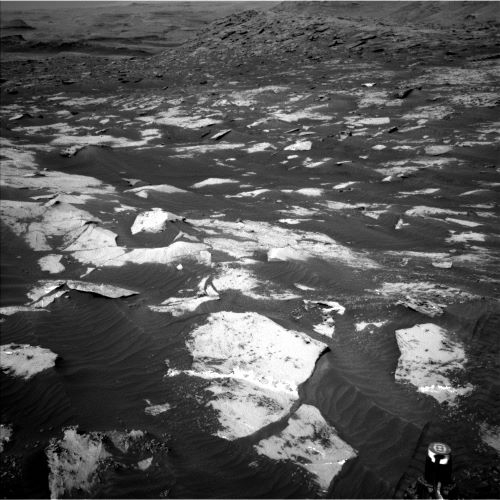
Curiosity Left B Navigation Camera image acquired on Sol 3206, August 13, 2021.
Credit: NASA/JPL-Caltech
“The current transition zone was one of the main reasons why NASA and the scientific community selected Gale crater as the Curiosity landing site,” Salvatore points out.
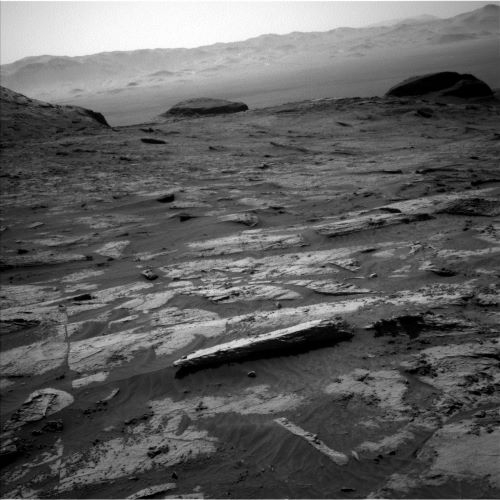
Curiosity Left B Navigation Camera image acquired on Sol 3206, August 13, 2021.
Credit: NASA/JPL-Caltech
Environmental history
Spectral evidence from the Compact Reconnaissance Imaging Spectrometer for Mars (CRISM) instrument on NASA’s Mars Reconnaissance Orbiter showed a clear compositional transition here that might be indicative of significant environmental change recorded in the rock record.
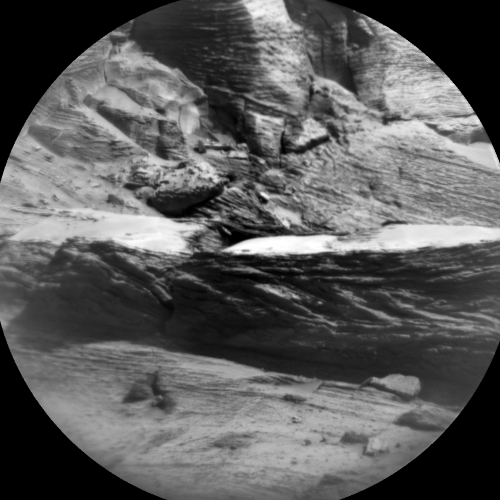
Curiosity Chemistry & Camera Remote Micro-Imager photo taken on Sol 3206, August 13, 2021
Credit: NASA/JPL-Caltech/LANL
Salvatore says that “Curiosity is now in a position to begin understanding and unraveling this environmental history!”
In the current plan, Curiosity will be acquiring local and long-distance imagery, as well as some compositional measurements of local bedrock and diagenetic features (the process of chemical and physical change in deposited sediment during its conversion to rock).
The plan will end with a rover drive of roughly 82 feet (25 meters) to the southwest “as we continue our way through this transition zone,” Salvatore concludes.

