Archive for the ‘Space News’ Category
 Author:
  August 31st, 2021
Credit: CNSA/Inside Outer Space screengrab
China’s Tianwen 1 Mars mission – both the orbiter and Zhurong rover – will suspend operations for about 50 days starting in mid-September.
“During that time, the Earth, Mars and the sun will almost be in a straight line and the distance between Earth and Mars will be farthest,” said Zhang Rongqiao of the China National Space Administration (CNSA). “The Sun’s electromagnetic radiation will greatly affect the communication between the rover, the orbiter and ground control.”
The rover had been operating on the Red Planet for 100 days as of Monday, while the orbiter has been circling Mars since February.

Credit: CCTV/Inside Outer Space Screengrab
Data gathering
As of Monday, the six-wheeled solar-powered rover has traveled over 3,490 feet (1,064 meters) across the southern part of the Utopia Planitia. The robot’s scientific payloads have garnered around 10 gigabytes of primary data since its touchdown in mid-May, the CNSA said.
After they resume operation in early November, the rover will continue traveling southward toward an ancient coastal area on Utopia Planitia, a large plain within the largest known impact basin in the solar system.

Topography around the Zhurong Rover, as observed by the High Resolution Imaging Science Experiment aboard NASA’s Mars Reconnaissance Orbiter.
Credit: NASA/JPL/UArizona
The orbiter will enter a new Mars orbit to carry out a remote-sensing global survey of the Red Planet and will continue relaying signals between Zhurong and Earth, Zhang said.
The Zhurong rover has outlived its three-month life expectancy with all of its predetermined tasks completed.
Go to this China Central Television (CCTV) News Agency video focused on the rover at:
 Posted in

Credit: Inspiration4/St. Jude
Children’s Research Hospital
SpaceX is targeting September 15 for Falcon 9’s launch of the Inspiration4 crew, the first all-civilian human spaceflight mission to orbit.
Once in orbit, the crew will perform research experiments on human health and performance, which will have potential applications for human health on Earth and during future spaceflights.
Biomedical data collected for the Inspiration4 mission will be made accessible for research purposes through an open data repository funded and overseen by the Translational Research Institute for Space Health (TRISH) at Baylor College of Medicine in Texas.
High orbit
The three-day mission will target approximately a 357 mile (575 kilometers) high orbit, flying farther from Earth than any human spaceflight since the Hubble Space Telescope repair missions.

Credit: SpaceX/Inspiration4
Inspiration4’s goal is to inspire humanity and raise money for St. Jude Children’s Research Hospital.
Jared Isaacman, 38, is commander of the Inspiration4 mission. An American entrepreneur, philanthropist, and civilian pilot, Isaacman is the CEO and Chairman of Shift4 Payments. Isaacman donated the three mission seats alongside him to crew members who will represent the mission pillars of leadership, hope, generosity and prosperity.
The three other crew members are:
- Hayley Arceneaux, 29, a pediatric cancer survivor and physician assistant at St. Jude’s Children’s Research Hospital, the youngest American ever to go to space, and the first with a prosthesis.
- Chris Sembroski, 41, a U.S. Air Force veteran and Lockheed Martin aerospace industry data engineer.
- Sian Proctor, 51, a geosciences professor and science communicator at South Mountain Community College in Phoenix, Arizona.
For more information on the mission, go to:

Asteroids: How Love, Fear, and Greed Will Determine Our Future in Space by Martin Elvis; Yale University Press; 312 pages; Hardcover; Publish date, June 8, 2021; $30.00.
This is a timely book…about the future of exploiting asteroids and our future in space.
Martin Elvis is an astrophysicist at the Center for Astrophysics | Harvard & Smithsonian and serves up a unique perspective about purported “trillionaires” making their heavenly fortune mining asteroids.
“By starting from the basic motivations that make asteroids appealing to those who would exploit them – love, fear, and greed – my hope is to give the reader a fuller perspective of the whole issue,” Elvis explains in the book’s preface.
Divided into 10 sections, the author sets the scene, dives into motive and means and concludes with the opportunity, taking a long look at making space safe for capitalism. The book includes an impressive notes section, guiding the reader to further investigate a wide-range of topics.
A valuable starting-gun, and a well written read, is an opening primer on asteroids. There’s also attention paid to the pros and cons of the UN Outer Space Treaty as Elvis asks: “Is the mining of space resources creating property, or is it theft?” Eventually, the author adds, he is confident that asteroid mining will start to pay off. “We should think about what kind of future we want as we craft laws and build the governance structures that will guide our expansion into the Solar System.”
Martin Elvis has provided an important framework for assessing how humankind should look at the vast riches likely available via asteroids – and how these resources can utilized in the near-term for wealth creation in our Solar System.
This book offers priceless insights that are needed as multiple nations – the U.S., China, Japan in particular – have begun, or soon will be, making up-close investigations of various breeds of space rocks, for immediate scientific gain and perhaps future profit motive.
For more information on this book, go to:

Credit: NASA
On Mars, pit craters and cave skylights would be effectively shielded from the damaging ultraviolet radiation (UV) on the Martian surface. Furthermore, the attenuated UV irradiance in cavernous spaces remains stable at least in a 10 million year timescale.
Additionally, the radiation environment offered by voids on the Red Planet may represent favorable environments for habitability.
Those are a few takeaway messages from new research by D. Viúdez-Moreiras at the Centro de Astrobiología (CSIC-INTA) & National Institute for Aerospace Technology (INTA) in Madrid, Spain.
Preserved evidence of life
“Caves and their entrances have been proposed as habitable environments and regions that could have preserved evidence of life, mostly due to their natural shielding from the damaging ionizing and non-ionizing radiation present on the surface. However, no studies to date have quantitatively determined the shielding offered by these voids on Mars,” explains Viúdez-Moreiras.
The just-published paper presents for the first time the UV radiation environment in typical void geometries found to date on Mars.

Illustrative void captured by the Mars Reconnaissance Orbiter’s HiRISE camera northeast of Arsia Mons on the Red Planet. Cavernous spaces are expected in many of these voids.
Credit: MRO/HiRISE/University of Arizona
“The intermediate radiation environment between the damaging radiation on the surface and the permanent darkness of a hypothetical cave offered by voids on Mars may represent favorable environments for habitability without constraining the type of energy source for potential as-yet unknown Martian organisms,” Viúdez-Moreiras reports.
Surface hazards
The researcher notes that the thin Martian atmosphere offers poor protection against ionizing and UV radiation, and, together with the lack of a planetary-scale magnetic field to filter ionizing radiation, allows high levels of radiation to reach the Martian surface.
“The radiation levels on Mars represent an additional difficulty for the survival of life on the surface, at least based on the present knowledge, in addition to the degradation of possible organic molecules produced by biogenetic or abiotic processes,” Viúdez-Moreiras points out.
The subsurface of Mars would not only be shielded from radiation fluxes, but also offer protection against small-scale meteorite impacts wind processes and extreme weather such as the dust storms that typically impact the Martian surface.

Location of candidate caves in the Tharsis region on Mars.
Credit: USGS
Small features
However, Viúdez-Moreiras flags the fact there are difficulties in detecting these small features in the Mars topography, preventing a wide number of pit craters and cave entrances being discovered to date.
Possible cave entrances based on skylights on Mars have been observed from orbit by NASA’s Mars Odyssey Thermal Emission Imaging System (THEMIS) in the Tharsis region. Also, imagery analyzed from NASA’s Mars Reconnaissance Orbiter (MRO), Mars Odyssey and Mars Global Surveyor of Elysium Mons has resulted in the detection of thirty-two skylight candidates.
Viúdez-Moreiras concludes that pit craters and cave skylights “present strong interest from an astrobiological perspective in terms of potential habitability and regions that could have preserved evidence of life, given the protection these environments offer against the hazards on the surface of Mars, such as UV radiation.”

Mars expedition probes the promise that Mars was a home address for past, possibly life today.
Credit: NASA
Needed: More data, modeling work
“Pit craters and cave skylights, which are intermediate in terms of UV radiation between the damaging levels present on the Martian surface and the permanent darkness of a hypothetical cave, may offer environments favorable for the habitability and preservation of organic molecules in locations that would be relatively easy to access by surface missions.”
Viúdez-Moreiras suggests that further modeling work and more data from current and future missions would be necessary to appraise the habitability of these environments.
To read the full paper in the journal Icarus – “The ultraviolet radiation environment and shielding in pit craters and cave skylights on Mars” – go to:
https://www.sciencedirect.com/science/article/pii/S0019103521003171

This is a black and white image of Temptation Hill. There are large boulders embedded on the sandy hill. There are other smaller hills in the background. “Temptation Hill,” the base of which is peppered with large “popcorn” nodules, large enough to be visible in this image taken by Curiosity’s Right Navigation Camera on Sol 3219 on August 26, 2021.
Credit: NASA/JPL-Caltech
NASA’s Curiosity Mars rover at Gale Crater is now performing Sol 3221 duties.
Reports Catherine O’Connell-Cooper, a planetary geologist at the University of New Brunswick; Fredericton, New Brunswick, Canada: “Recent workspaces have featured two types of textures – one smooth, one rougher with small nodules or grains apparent.”

Curiosity Front Hazard Avoidance Camera Left B image acquired on Sol 3220, August 27, 2021.
Credit: NASA/JPL-Caltech
In the last plan, the rover’s Alpha Particle X-Ray Spectrometer (APXS) and Mars Hand Lens Imager (MAHLI) investigated the rougher material in the target “Smailholm.”
Shoot the laser
A recently scripted plan has the robot brushing and analyzing the smoother material in the target “Saltopus” with APXS, MAHLI and Mastcam.

Curiosity Left B Navigation Camera image taken on Sol 3220, August 27, 2021.
Credit: NASA/JPL-Caltech
The Chemistry and Camera (ChemCam) is slated to shoot the Laser Induced Breakdown Spectroscopy (LIBS) laser at Saltopus, and an example of the smoother material at “Stainton.”

Curiosity Chemistry & Camera (ChemCam) Remote Micro-Imager (RMI) photo taken on Sol 3220, August 27, 2021.
Credit: NASA/JPL-Caltech/LANL
“Mastcam will image the appropriately named ‘Temptation Hill,’ the base of which is peppered with large ‘popcorn’ nodules,” O’Connell-Cooper notes. “These are just out of reach, tempting us to swing over that way and spend some time there, but we are on a tight deadline, with our next drill campaign starting – so images will have to suffice!”

Curiosity Right B Navigation Camera photo acquired on Sol 3220, August 27, 2021.
Credit: NASA/JPL-Caltech
33rd hole
Curiosity has a mission guideline to drill roughly every 82 feet (25 meters) of elevation gain.

Curiosity Right B Navigation Camera photo acquired on Sol 3220, August 27, 2021.
Credit: NASA/JPL-Caltech
“Our last drill campaign was just six weeks ago, when we drilled at Pontours on sol 3170, but this weekend’s plan sees us gearing up to drill again, since we are now 25 meters higher,” O’Connell-Cooper adds.
“This weekend’s plan marks the first sol (“sol Zero”) of this drill campaign, as we get ourselves into position over the desired bedrock target,” O’Connell-Cooper reports. The robot is to wheel itself a short 49 feet (15 meters) to some promising looking bedrock, “whose chemical composition and physical properties will be assessed in the next plan to make sure we can safely drill our thirty-third hole on Mars!”

NASA’s Curiosity Mars rover used its Mastcam to capture this 360-degree view near “Rafael Navarro Mountain.”
Credit: NASA/JPL-Caltech/MSSS
NASA’s Curiosity Mars rover at Gale Crater is now performing Sol 3220 duties.

Curiosity Front Hazard Avoidance Camera Left B image taken on Sol 3219, August 26, 2021.
Credit: NASA/JPL-Caltech
Ryan Anderson, a planetary geologist at the USGS Astrogeology Science Center in Flagstaff, Arizona reports that the robot should be about 23 feet (7 meters) from its next drill location.

Curiosity Front Hazard Avoidance Camera Left B image taken on Sol 3219, August 26, 2021.
Credit: NASA/JPL-Caltech
Texture change
“We’ve noticed a change in the texture of the rocks over the last few drives,” Anderson adds, “so we are eagerly collecting data as we approach the drill site to help understand what caused the change.”
A Sol 3219 plan called for Alpha Particle X-Ray Spectrometer (APXS) and Mars Hand Lens Imager (MAHLI) observations of the target “Smailholm” followed by a Chemistry and Camera (ChemCam) measurement on the bedrock target “Dunlop.”

Curiosity Left B Navigation Camera image acquired on Sol 3219, August 26, 2021.
Credit: NASA/JPL-Caltech
“ChemCam will also use its telescope to take a long distance mosaic of the layers on “Rafael Navarro Mountain.” Mastcam will then document the area around targets Dunlop and Smailholm, and collect two more mosaics covering a layered outcrop named “Dunnideer” and the layers at the base of the more distant “Siccar Point.” After that, we’ll drive and collect all the usual post-drive images,” Anderson notes.

Curiosity Left B Navigation Camera image acquired on Sol 3219, August 26, 2021.
Credit: NASA/JPL-Caltech
Watching for clouds
On Sol 3220, the plan calls for the rover’s Navcam to make several observations, measuring the amount of dust in the atmosphere and watching for clouds and dust devils. Mastcam will also make an atmospheric dust measurement, Anderson reports.

Curiosity Left B Navigation Camera image acquired on Sol 3219, August 26, 2021.
Credit: NASA/JPL-Caltech
After the atmospheric observations, ChemCam will autonomously target a patch of bedrock and analyze it. Overnight APXS will measure the atmospheric composition and ChemCam will run some passive calibration activities.

Curiosity Left B Navigation Camera image acquired on Sol 3219, August 26, 2021.
Credit: NASA/JPL-Caltech

Curiosity Right B Navigation Camera photo taken on Sol 3219, August 26, 2021.
Credit: NASA/JPL-Caltech

Webb is folded as it will be for launch.
Credit: NASA/Chris Gunn
The James Webb Space Telescope (JWST) has successfully completed its final tests out at Northrop Grumman’s facilities in California and is being prepared for shipment to its launch site at Europe’s Spaceport in French Guiana.
Shipment operations have now begun, including all the necessary steps to prepare Webb for a safe journey through the Panama Canal to its launch location in French Guiana, on the northeastern coast of South America. After crossing through the Panama Canal, JWST docks in Pariacabo harbour in Kourou. From there, it will be transported by a dedicated truck to Europe’s Spaceport.

Image courtesy of ArianeSpace.com
The telescope is the product of an international partnership between NASA, the European Space Agency (ESA) and the Canadian Space Agency (CSA).

Credit: ESA
Grand unfolding
Following launch via an Ariane 5 booster before year’s end, JWST will take one month to fly to its intended orbital location in space nearly one million miles away from Earth, slowly unfolding as it goes.
Sunshield deployments will begin a few days after launch.
Once the observatory has cooled down and stabilized at its frigid operating temperature, several months of alignments to its optics and calibrations of its scientific instruments will occur.
Scientific operations are expected to commence approximately six months after launch.

Credit: NASA
NASA intentions to “reboot” human exploration of the Moon gets a kick-start by the launch of a toaster oven–sized CubeSat, slated to be boosted from New Zealand by Rocket Lab’s Electron rocket and its Lunar Photon upper stage/spacecraft.
Targeted for liftoff this October is the Cislunar Autonomous Positioning System Technology Operations and Navigation Experiment, thankfully called CAPSTONE for short.
Tipping the scales at a modest 55-pounds CAPSTONE is no lightweight when it comes to its assignments.
For more information, go to my new Space.com story at:
https://www.space.com/capstone-cubesat-moon-mission-october-2021-launch-prep

Credit: Leslie Kean
Leslie Kean is a veteran investigative reporter who has spent over 20 years delving into the once-taboo topic that remains unexplained – Unidentified Flying Objects (UFOs). They are now established as real, she says. Furthermore, despite observations of highly advanced technologies, we have no idea what they are or where they come from.

While she has never seen a UFO, her own close-encounters with hundreds of government documents, aviation reports, radar data, case studies with corroborating physical evidence, along with interviewing dozens of high-level officials and aviation witnesses from around the world have bolstered her belief that UFOs are worthy of scientific study. “I believe we may have finally arrived at the threshold of a new paradigm,” Kean senses.
Go to my new Space.com story:
“The new reality of UFOs: An interview with journalist Leslie Kean – The past few years have seen a big change in how UFOs are perceived, both by the public and by government officials” at:
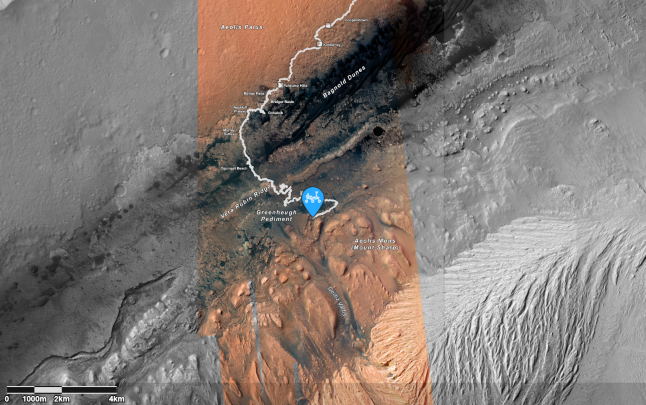
Curiosity’s Location as of Sol 3216. Distance Driven 16.32 miles/26.27 kilometers.
Credit: NASA/JPL-Caltech/Univ. of Arizona
NASA’s Curiosity Mars rover at Gale Crater is now performing Sol 3217 tasks.
Ken Herkenhoff, a planetary geologist at USGS Astrogeology Science Center in Flagstaff Arizona, reports that the robot’s Sol 3216 drive went well, placing the rover in an area of bright bedrock partly covered by dark sand.
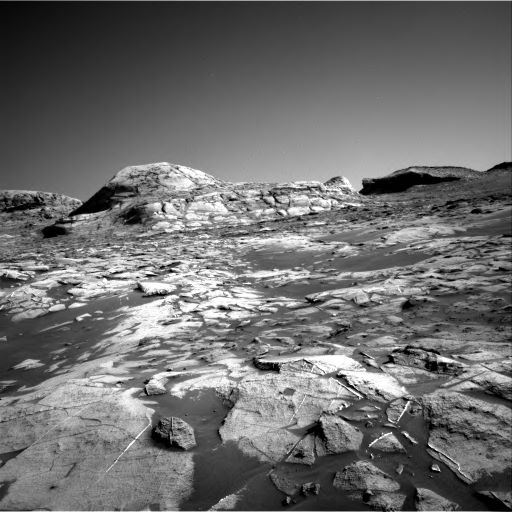
Curiosity Right B Navigation Camera image taken on Sol 3216, August 23, 2021.
Credit: NASA/JPL-Caltech
The top priority for the recently scripted plan is to continue making good progress toward the next potential drill target, “so we worked to optimize the drive distance.” The required drive duration didn’t leave much time for other activities.
“We had to make some difficult choices between various scientific observations,” Herkenhoff adds, “but ultimately were able to plan both contact science and some important remote sensing activities.”
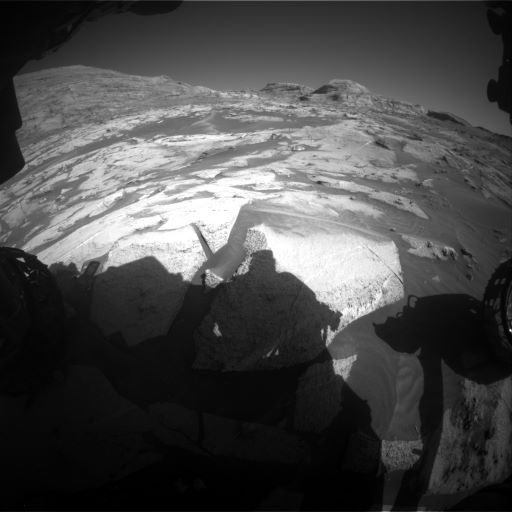
Curiosity Front Hazard Avoidance Camera Left B photo acquired on Sol 3216, August 23, 2021.
Credit: NASA/JPL-Caltech
Bedrock target
On the first sol of a 2-sol plan (3217-3218) the rover’s Alpha Particle X-Ray Spectrometer (APXS) was to be placed on a bedrock target named “Spiggie” for a short integration.
Then the Mars Hand Lens Imager (MAHLI) was to take images of Spiggie from 25 and 5 centimeters above the target before the arm is stowed.
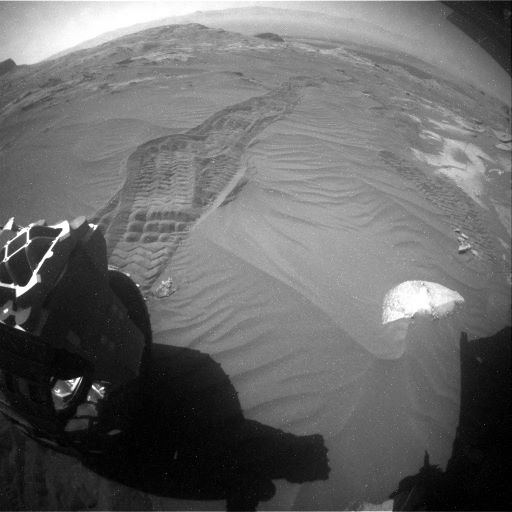
Curiosity Rear Hazard Avoidance Camera Left B image taken on Sol 3216, August 23, 2021.
Credit: NASA/JPL-Caltech
Squeezed into the plan was a Chemistry and Camera ChemCam) Laser-Induced Breakdown Spectrometer (LIBS) observation of another bedrock target called “Dagon Stone” and a Right Mastcam image of the same target, plus an 18×4 Mastcam stereo mosaic of Rafael Navarro Mountain toward the southeast.
“This Mastcam mosaic had to be planned today because we expect to drive away from the mountain,” Herkenhoff notes.
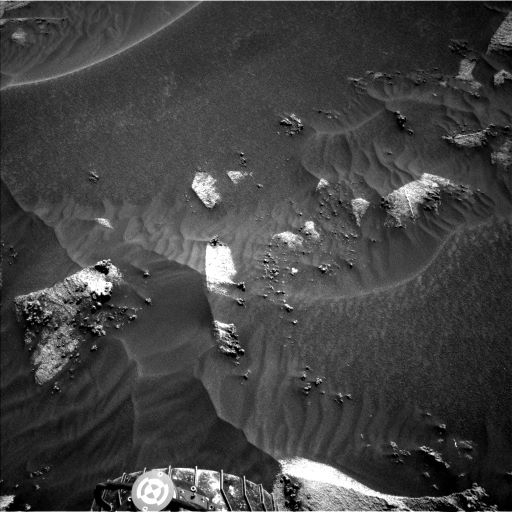
Curiosity Left B Navigation Camera image taken on Sol 3216, August 23, 2021.
Credit: NASA/JPL-Caltech
Twilight image
After a drive of roughly 187-feet (57-meters) and the standard post-drive imaging, the Mars Descent Imager (MARDI) will acquire another twilight image of the ground behind the left front wheel.
Overnight, Curiosity’s Chemistry & Mineralogy X-Ray Diffraction/X-Ray Fluorescence Instrument (CheMin) is slated to vibrate its inlet funnel in an attempt to remove a speck of debris left on the inlet screen after the last drill sample was delivered to CheMin, Herkenhoff points out.
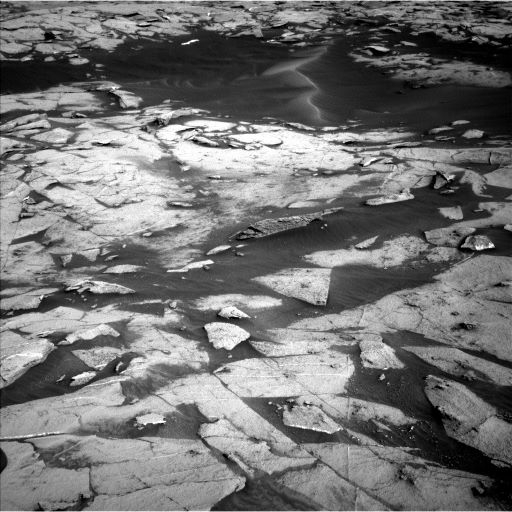
Curiosity Left B Navigation Camera image taken on Sol 3216, August 23, 2021.
Credit: NASA/JPL-Caltech
Shoot the laser
“Planning the second sol was much less constrained, and it was easy to schedule Navcam dust devil survey and line-of-sight extinction observations, along with ChemCam untargeted activities,” Herkenhoff adds.
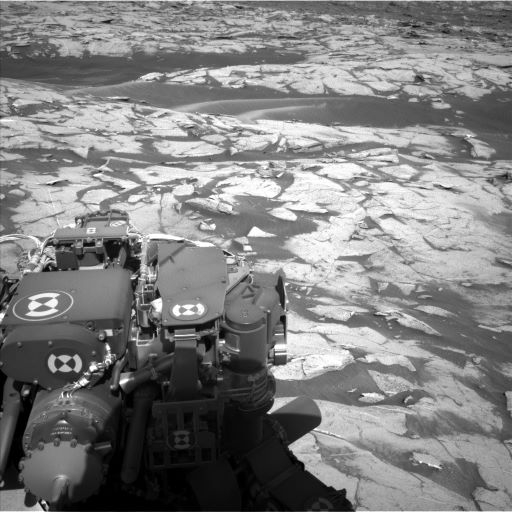
Curiosity Left B Navigation Camera image taken on Sol 3216, August 23, 2021.
Credit: NASA/JPL-Caltech
The Autonomous Exploration for Gathering Increased Science) autonomous targeting system (AEGIS)software will be used to autonomously select a ChemCam LIBS target and shoot the laser at 5 points across that target.
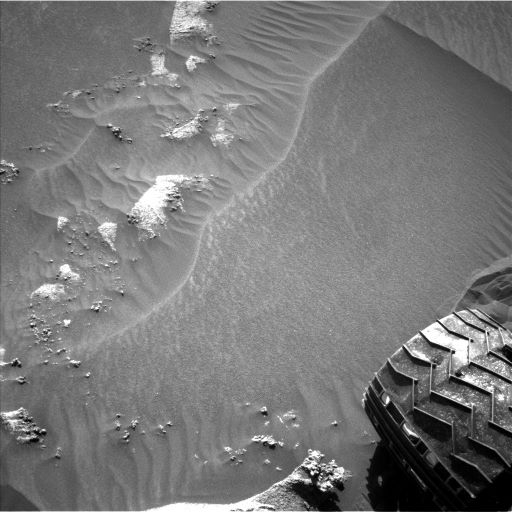
Curiosity Left B Navigation Camera image taken on Sol 3216, August 23, 2021.
Credit: NASA/JPL-Caltech
ChemCam will also measure the spectral reflectance of several calibration targets to improve the calibration of ChemCam passive (no laser) observations.
“While we couldn’t fit everything into this plan that we desired,” Herkenhoff concludes, “it’s still a good plan and I look forward to seeing the results!”

