Archive for the ‘Space News’ Category
 Author:
  September 26th, 2021
Ready for her close-ups, Russian actress Yulia Peresild. Credit: Roscosmos/Inside Outer Space
Lights…camera…action!
That’s the upcoming scene onboard the International Space Station as Roscosmos commander Anton Shkaplerov, actress Yulia Peresild and movie director Klim Shipenko are ready for liftoff on October 5.
A Soyuz-2.1booster with the Soyuz MS-19 crewed spacecraft and ISS-66 expedition crew is scheduled to takeoff from Launchpad 31 of the Baikonur Cosmodrome.
The trio is flying to the ISS to make a scripted, feature film in space, with the production’s working title called “Challenge.”
Off-planet plot
The film reportedly is focused on a female doctor, who by force of dramatic circumstances has one month to prepare for the flight and go to the ISS to complete an important task.
This movie is part of a joint scientific and educational project of Roscosmos, Channel One and Yellow, Black, White studio.
“The project will show that spaceflights are gradually becoming available not only for professionals, but also for a wider range of people,” according to Roscosmos. “For example, similar accelerated training of film cast will be needed in the future to send other specialists to orbit, including doctors and scientists.”

Actress Yulia Peresild, Roscosmos commander Anton Shkaplerov, and movie director Klim Shipenko, ready for liftoff on October 5. Credit: Roscosmos/Inside Outer Space screengrab
Taking their seats
The first day of training sessions at Baikonur Cosmodrome took place on September 19. Under the supervision of Roscosmos, the team tried on Sokol KV-2 spacesuits, leak tested them and took their seats in the Soyuz MS-19 spacecraft, familiarizing themselves with the cargo placement in the living compartment and the descent capsule, worked equipment they will use onboard the ISS.
Additionally, the expedition participants trained on manual docking of the Soyuz MS crewed spacecraft to the Russian segment of the ISS, checked stowage with scientific equipment for space experiments, and practiced ballistic operations and other preparatory procedures.

Credit: Yellow, Black and White studio
They also visited the Baikonur Cosmodrome to complete prelaunch training.
TV/Film credits
Russian actress Yulia Peresild and award-winning director Klim Shipenko are reportedly in thumbs-up condition for the upcoming liftoff.
Shipenko directed Russia’s highest-ever grossing film Son of a Rich and 2019’s box office hit TEXT.
Yulia Peresild’s screen debut was the role of Natasha Kublakova in the television series Land, later acting in various drama film roles such as The Bride and The Edge.
Go to this Roscosmos video (in Russian) at:
 Posted in

The Sol 3247 drive went as planned, crushing and breaking nodules as shown above and right of center in this Navcam image.
Curiosity Left B Navigation Camera image taken on Sol 3247, September 24, 2021.
Credit: NASA/JPL-Caltech
NASA’s Curiosity Mars rover at Gale Crater is now performing Sol 3248 duties.
A Sol 3247 drive of the robot went as planned, crushing and breaking nodules as part of its duties, reports Ken Herkenhoff, a planetary geologist at the USGS Astrogeology Science Center in Flagstaff, Arizona.

Curiosity Left B Navigation Camera image acquired on Sol 3247, September 24, 2021.
Credit: NASA/JPL-Caltech
Fresh surfaces
“The fresh surfaces exposed by the rover wheels are high-priority contact science targets,” Herkenhoff adds, “but because solar conjunction is approaching, the arm will not be used in this 3-sol weekend plan [Sols 3248-3250] to ensure that it is in a safe configuration before we stand down from tactical operations while Mars goes behind the Sun as seen from Earth.”

Curiosity Left B Navigation Camera image acquired on Sol 3247, September 24, 2021.
Credit: NASA/JPL-Caltech
Even though Mars will not pass directly behind the Sun, radio communications between Mars and Earth will be unreliable due to interference from the Sun’s corona, Herkenhoff points out. “However, remote sensing observations can be planned for this weekend, so the rover will be busy!”

Curiosity Left B Navigation Camera image acquired on Sol 3247, September 24, 2021.
Credit: NASA/JPL-Caltech
Disturbed nodules
The Sol 3248 plan starts with a Chemistry and Camera (ChemCam) Laser Induced Breakdown Spectroscopy (LIBS) observation of “Wolf Stone” to sample the chemical composition of a nodule that appears to have been scratched by the rover wheel.

Curiosity Front Hazard Avoidance Camera Left B image taken on Sol 3247, September 24, 2021.
Credit: NASA/JPL-Caltech
ChemCam and Mastcam will also measure the spectral reflectance of a cluster of disturbed nodules called “Helmsdale Boulder Beds” that is likely to be the target of contact science observations after solar conjunction, Herkenhoff adds.
Curiosity’s Mastcam will then acquire stereo images of three dark sandy targets named “Sandness Coast” that will be imaged again after solar conjunction to look for changes due to winds.

Curiosity Rear Hazard Avoidance Camera Right B photo taken on Sol 3247, September 24, 2021.
Credit: NASA/JPL-Caltech
Clouds and dust
“Mastcam and Navcam will observe the sun and sky early and late in the afternoon, then early the next morning (Sol 3249) to look for clouds and measure changes in the amount of dust in the atmosphere,” Herkenhoff notes.

Curiosity Left B Navigation Camera image acquired on Sol 3247, September 24, 2021.
Credit: NASA/JPL-Caltech
ChemCam’s Remote Micro Imager (RMI) telescope and Mastcam will also acquire mosaics of the cliff toward the west when it will be nicely illuminated early in the morning.

Curiosity Left B Navigation Camera image acquired on Sol 3247, September 24, 2021.
Credit: NASA/JPL-Caltech
“Later that morning, Navcam will search for dust devils and ChemCam will fire its laser at ‘Clashach,’ another nodule that appears to have been scratched by the wheels,” Herkenhoff points out. “Then ChemCam will measure the composition of the atmosphere and Mastcam will acquire a 7×2 stereo mosaic of the nearby nodular bedrock.”

Curiosity Left B Navigation Camera image acquired on Sol 3247, September 24, 2021.
Credit: NASA/JPL-Caltech

Curiosity’s Location as of Sol 3247. Distance driven to date: 16.39 miles/26.38 kilometers.
Credit: NASA/JPL-Caltech/Univ. of Arizona
Rover deck
Overnight, the rover’s Chemistry & Mineralogy X-Ray Diffraction/X-Ray Fluorescence Instrument (CheMin) will analyze the cell that contained the most recent drill sample to confirm that the cell is now empty.
On Sol 3250, Curiosity’s Navcam will search for dust devils and image the rover deck to enable comparison with images taken after conjunction, to look for changes in the distribution of sand and dust on top of the rover.
Credit: Concept art by Vladimir Vustyansky
Earth’s Moon is being eyed as an on-location locale for operating unique and novel observatories.
The just-concluded NASA Innovative Advanced Concepts (NIAC) symposium was the setting for reviewing several NIAC-backed studies.
Robot deployed wire mesh
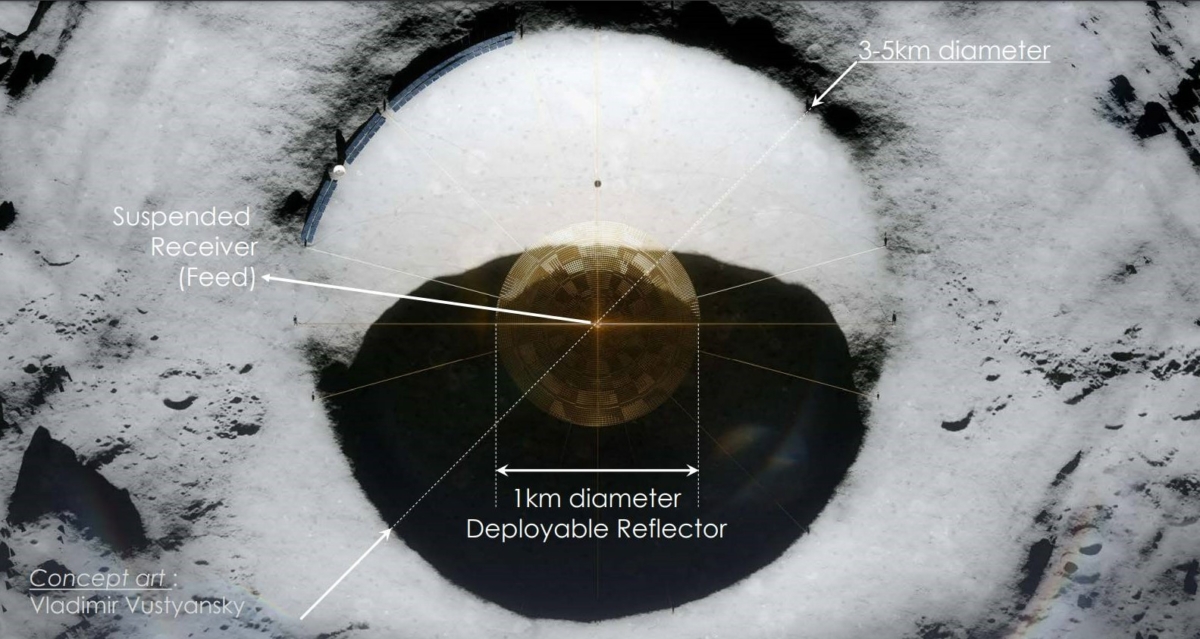
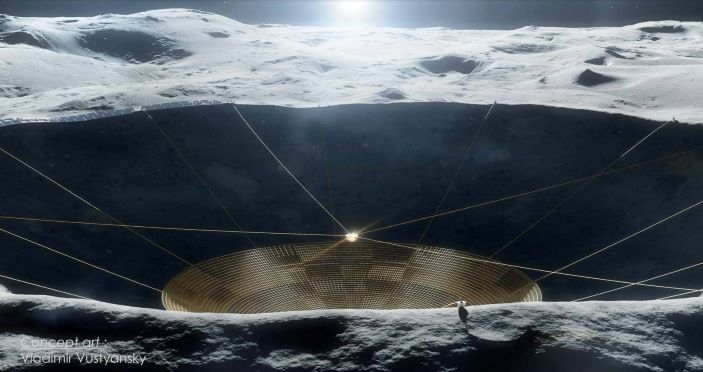
One concept outlined at NIAC is the Lunar Crater Radio Telescope (LCRT) on the Far-Side of the Moon, explained by Saptarshi Bandyopadhyay of NASA’s Jet Propulsion Laboratory.
This proposal centered on deploying a wire mesh using wall-climbing robots in a 3 to 5 kilometer diameter crater, with a suitable depth-to-diameter ratio, to form a parabolic reflector with a one kilometer diameter.
A selected crater must have several attributes: No boulders or outcrops; a complete crater rim; and a level surface outside the crater.
Credit: Concept art by Vladimir Vustyansky
Physical shield
“The Moon acts as a physical shield that isolates a far-side lunar-surface telescope from radio interference from sources on the Earth’s surface,” Bandyopadhyay said, “the ionosphere, Earth-orbiting satellites, and the Sun’s radio emission during the lunar night.”
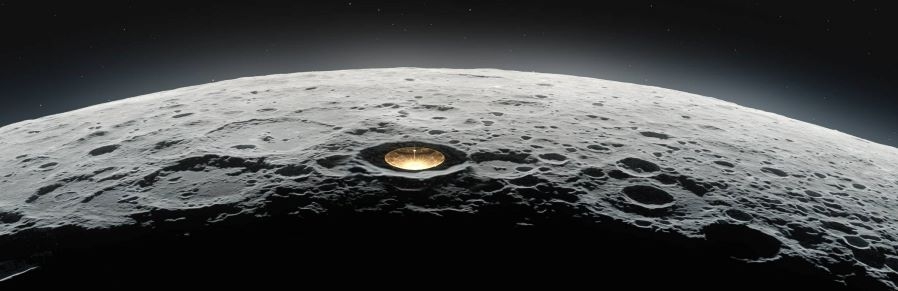
LCRT will be the largest filled-aperture radio telescope in the Solar System; larger than the former Arecibo telescope and China’s Five-hundred-meter Aperture Spherical radio Telescope (FAST), Bandyopadhyay said.
Credit: Saptarshi Bandyopadhyay, et al.
LCRT’s science objective is to track the evolution of the neutral intergalactic medium before and during the formation of the first stars. The concept would observe the universe in, so far unexplored, 10−100m radio wavelengths.
Several key conclusions underscored during the NIAC virtual gathering was the cost of the LCRT, narrowed down to 4 alternatives. These range from an option that costs below $1 billion but has moderate risks, to an option that costs $4-5 billion and could potentially be launched with existing present-day technology.
Credit: Ronald Polidan, et al.
FarView
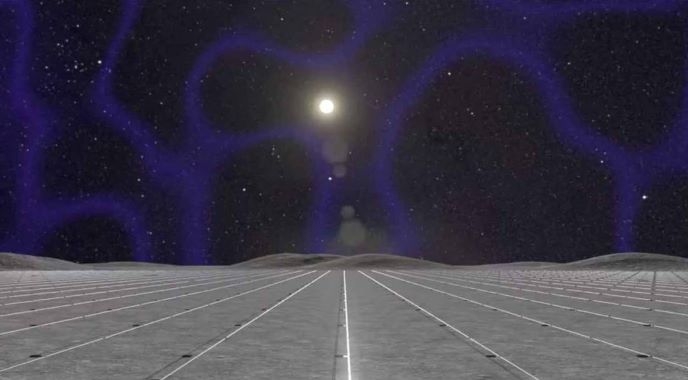
Another Moon-situated NIAC-supported proposal is the FarView – an observatory fabricated on the Moon as a far side radio observatory.
Ronald Polidan of Lunar Resources, Inc. of Houston, Texas and the University of Colorado Boulder’s Jack Burns launched this new research effort to lay the groundwork for a one-of-a-kind lunar radio astronomy observatory: a network of hundreds of miles of antennas put in place on the far side of the Moon using materials reaped from the lunar surface.
Sparse array
FarView will be a sparse array of roughly 100,000 dipole antennas populating an approximately 20×20 kilometer area of lunar real estate. On-site manufacturing of almost all system elements for the radio array, including power generation and energy storage systems is projected.
The dipole antennas would be placed 60 meters apart in rows to create the observatory.
FarView science is focused upon detailed investigation of the unexplored Cosmic Dark Ages using the highly red shifted hydrogen 21-cm line and identifying the conditions and processes under which the first stars, galaxies, and accreting black holes formed.
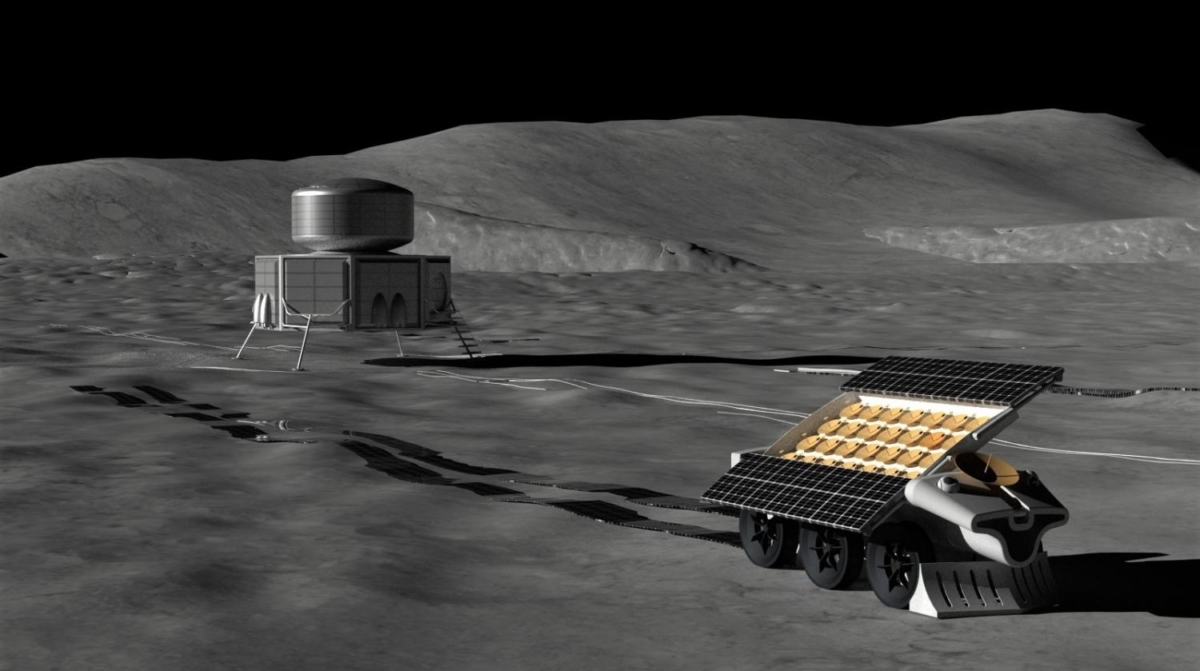
Robot lays out an antenna on the lunar surface.
Credit: Lunar Resources
First-of-its-kind
No equivalent observatory exists today. This radio telescope will be the first-of-its-kind at this scale and sensitivity and will open a new window (low frequency radio) into the early universe, analogous to the detection of gravitational waves by the Laser Interferometer Gravitational-Wave Observatory (LIGO) and the details of the cosmic microwave background (CMB) by Planck, a European Space Agency space-based observatory.
FarView measurements cannot be made from Earth due to Earth-generated radio noise and the ionosphere.
“FarView will be evolvable and long-lived using in-situ manufacturing techniques and occasional system upgrades from Earth. It will be of lower cost and longer lifetime than a complete antenna array launched from Earth,” Polidan pointed out.

Credit: NASA
It is dubbed FLOAT, short for Flexible Levitation on a Track.
This concept is geared to build the first railway system on the Moon, one that provides reliable, autonomous, and around-the-clock payload transport across the lunar landscape.
Magnet robots
What’s envisioned is use of scads of unpowered, individually-controllable, meter-scale levitating magnet robots over a flexible track. Their task is to perform essential, but repetitive, transportation tasks between a lunar base, in-situ resource mining/refining sites, lunar landers, and other outposts.
JPL’s Ethan Schaler showcased the idea at the 2021 NASA Innovative Advanced Concepts (NIAC) symposium.

Credit: JPL/Ethan Schaler/NIAC
Flexible film track
Using the FLOAT, up to 240,000 kilograms a day of material could zip across 1 to 10 kilometers of hostile terrain.
Schaler said that this levitating proposal would counter existing lunar base transport concepts that require significant site preparation and substantial infrastructure, or consume operational life of sophisticated robots
FLOAT consists of unpowered magnetic robots that levitate over a 3-layer flexible film track, unrolled directly onto the lunar topside, requiring minimal preparation to avoid major on-site construction.
The thin-film solar panel generates power. The track’s graphite layer enables robots to passively float over tracks using diamagnetic levitation. The flex-circuit layer generates electromagnetic fields to controllably propel robots along tracks.
An added bonus is that the robots have no moving parts and support payload delivery from point to point.
Lunar temperature
“So the beauty of FLOAT is that we can actually operate at any lunar temperature, from approximately -170 degC in permanently shadowed craters to +130 degC in bright daylight,” Schaler told Inside Outer Space. Diamagnetism (which is the phenomenon used for levitation) is actually independent of temperature, he said, unlike levitation through flux pinning with superconductors (which have to be kept at very cold temperatures).
“Magnetic field strength does increase at lower temperatures, so hauling ice around (or out of) a permanently shadowed crater actually gets easier as we get colder, but our magnets will operate up to their Curie temperatures (roughly 320 degC) before becoming demagnetized,” Schaler said.
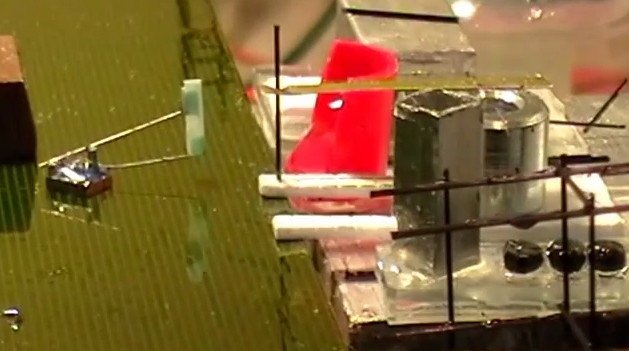
SRI International’s “Diamagnetic Micro Manipulation (DM3) system.”
Credit: SRI
Scaling up DM3 technology
FLOAT builds on SRI International’s “Diamagnetic Micro Manipulation (DM3) system,” Schaler said. The Moon-application concept scales up DM3 technology to meter-scale robots and km-scale tracks operating in the lunar environment.
SRI is developing DM3 technology to reliably control thousands of micro-robots for smart manufacturing of macro-scale products in compact, integrated systems.
For a video, go to:
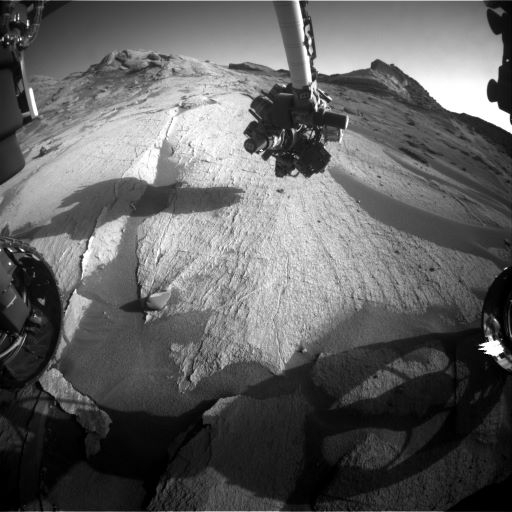
Curiosity Front Hazard Avoidance Camera Left B image taken on Sol 3245, September 22, 2021.
Credit: NASA/JPL-Caltech
NASA’s Curiosity Mars rover at Gale Crater is now performing Sol 3246 duties.
Reports Mark Salvatore, a planetary geologist at the University of Michigan, a recently scripted two-sol (3246-3247) plan will wrap up the robot’s drilling activities at the Maria Gordon drill location before it continues the drive up-section and towards the southwest.
“On the first sol of the plan, Curiosity will primarily be performing arm activities to further characterize the recently dumped drill sample and the drill hole,” Salvatore adds.
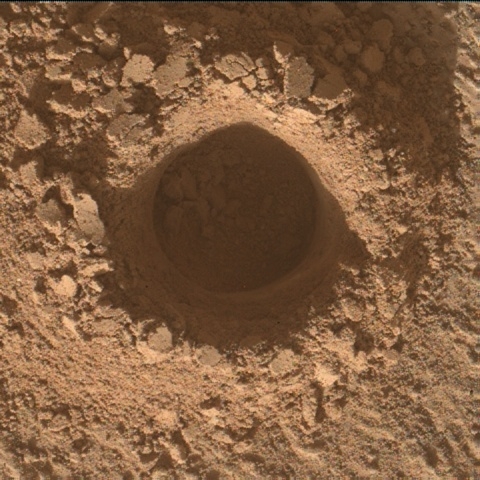
Curiosity Mars Hand Lens Imager photo produced on Sol 3245, September 22, 2021.
Credit: NASA/JPL-Caltech/MSSS
Daytime and evening imaging will occur using the Mars Hand Lens Imager (MAHLI) camera on the end of the arm.
Overnight, the Alpha Particle X-Ray Spectrometer (APXS) instrument will be used to characterize the chemistry of the drill tailings.
Drill dump pile
On the following sol, the team has planned a series of Mastcam mosaics and a long-distance Chemistry and Camera (ChemCam) image mosaic, in addition to a Mastcam multispectral image on the drill dump pile.
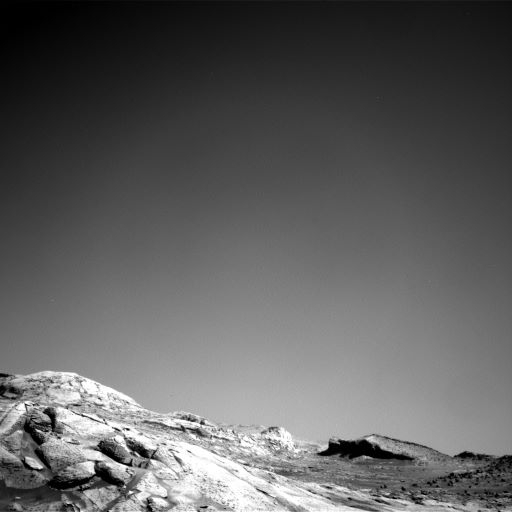
Curiosity Right B Navigation Camera image taken on Sol 3245, September 22, 2021.
Credit: NASA/JPL-Caltech
“Following this suite of science activities, Curiosity will drive away from this drill location and towards a region that contains a high abundance of nodules in the bedrock,” Salvatore notes. “Curiosity will use a driving technique designed to better prepare the nodular surface for additional investigations.”
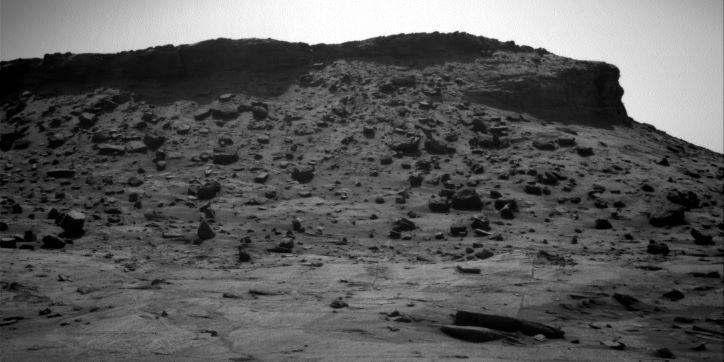
Curiosity Right B Navigation Camera image taken on Sol 3245, September 22, 2021.
Credit: NASA/JPL-Caltech
Nodular targets
Salvatore explains that, once Curiosity reaches her intended target at the end of the drive, she will perform a series of small maneuvers designed to crush any nodular targets on the surface before turning back around and putting herself in position to analyze the surface.
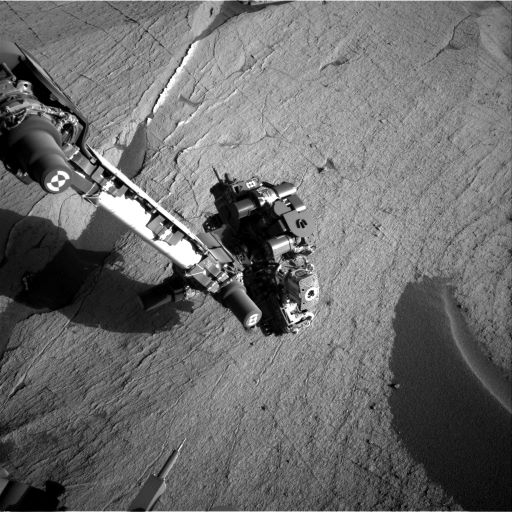
Curiosity Right B Navigation Camera image taken on Sol 3245, September 22, 2021.
Credit: NASA/JPL-Caltech
“If successful, we hope that this technique will result in better preparing the surface for additional imaging and compositional analyses, beyond what is commonly performed by Curiosity during normal imaging and surface analysis campaigns,” Salvatore concludes.
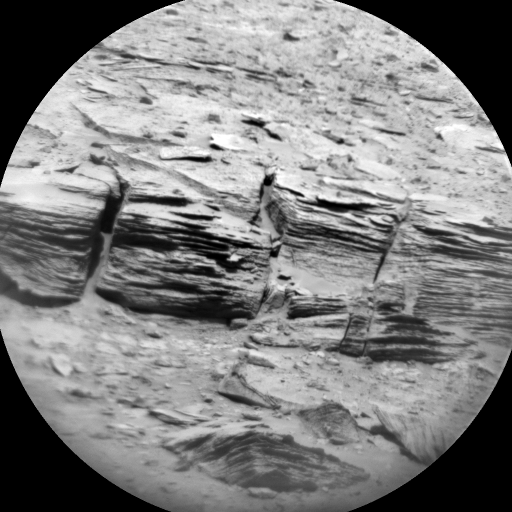
Curiosity Chemistry & Camera Remote Micro Imager (RMI) taken on Sol 3245, September 22, 2021.
Credit: NASA/JPL-Caltech/LANL

International Space Station – showing its age.
Credit: NASA
NASA’s Future in Low Earth Orbit: Considerations for ISS Extension & Transition, a House Space & Aeronautics Subcommittee Hearing, was held Tuesday, September 21, 2021.
“Now, after more than 20 years of continuous operations, the ISS is beginning to show its age,” said Subcommittee Ranking Member Brian Babin in an opening statement.
Cracks and leaks
“Cracks and leaks are popping up, solar arrays were recently upgraded, and the spacesuits necessary for spacewalks need to be replaced. The first segments of the ISS have a design life of roughly 15 years with a safety factor of two, meaning that with appropriate life extension measures the segments can reasonably be expected to last to 2028,” Babin said. “While no law prevents NASA from operating the ISS as long as it deems necessary, it is past time to have a conversation about the future of the ISS and our presence in low Earth orbit.”

Credit: NASA/ESA/Thomas Pesquet
Written testimony
- Robyn Gatens, Director, International Space Station, NASA: https://republicans-science.house.gov/sites/republicans.science.house.gov/files/2021-09-21%20Testimony%20Gatens.pdf
- Kathleen “Kate” Rubins, NASA Astronaut: https://republicans-science.house.gov/sites/republicans.science.house.gov/files/2021-09-21%20Testimony%20Rubins.pdf
- Jeffrey Manber, Chief Executive Officer, Nanoracks, LLC: https://republicans-science.house.gov/sites/republicans.science.house.gov/files/2021-09-21%20Testimony%20Manber.pdf
- Todd Harrison, Senior Fellow and Director of the Aerospace Security Project, Center for Strategic and International Studies: https://republicans-science.house.gov/sites/republicans.science.house.gov/files/2021-09-21%20Testimony%20Harrison.pdf
- Captain William Shepherd (USN, Ret), former Astronaut, NASA: https://republicans-science.house.gov/sites/republicans.science.house.gov/files/2021-09-21%20Testimony%20Shepherd.pdf
To view the entire hearing, go to this video at:

Credit: NASA/JPL/UArizona
A super-powerful camera on NASA’s Mars Reconnaissance Orbiter has captured new imagery of slope streaks on the Red Planet. The sharp-shooting High Resolution Imaging Science Experiment (HiRISE) snagged a set of new dark streaks.
Slope streaks are common in the tropics of Mars. Once thought to be caused by flowing water, most scientists now believe that they are avalanches of dust, explains HiRISE team member Paul Geissler of the U.S. Geological Survey.
“They are typically darker than their surroundings and often fan outwards downslope. This suggests that the dust sediment is sticky, so that the avalanche broadens as it flows downhill,” Geissler explains on the HiRISE website at the University of Arizona.
Time scales
“Slope streaks are known to fade over time, but the slope streaks at this monitoring site in Arabia Terra go beyond that. Here, old slope streaks appear to be brighter than the surrounding terrain,” Geissler adds.

Comparative HiRISE images taken in 2008 and in 2019 show very few changes in the dark and bright streaks.
Credit: NASA/JPL/UArizona
Comparing HiRISE images taken in 2008 and in 2019 show very few changes in the dark and bright streaks.
“We can see three new dark streaks in our more recent image,” Geissler says. “These were the only changes spotted among the hundreds of streaks observed in the monitoring site, suggesting that new streak formation and fading take place on time scales of at least decades.”

Credit: Aaron Ahles, et al.
As humankind stretches out beyond Earth, a critical requirement for outposts and settlements on the Moon and Mars is the use of on-the-spot resources to create pressurized, human-rated habitats. Those distant domiciles need to be low mass (high tensile strength), must be highly reliable (high toughness) and can be easily fabricated.
The cost of hauling materials from Earth is viewed as prohibitive.
A new study suggests that Mother Nature has supplied the raw ingredients for construction purposes – in the form of an iron-nickel alloy typical of iron meteorites and M-type asteroids.
Iron-nickel (Fe–Ni) meteorites harvested on the Moon and Mars — after collection, melting and casting – can be used to create metallic sheets which can be welded into pressurized structures, at low energy and infrastructure costs.
The research into this extraterrestrial home-away-from-home idea is led by Aaron Ahles, Jonathan Emery and David Dunand of Northwestern University in Evanston, Illinois.

NASA’s Mars Exploration Rover Opportunity found an iron meteorite on Mars, the first meteorite of any type ever identified on another planet. The pitted, basketball-size object is mostly made of iron and nickel. Readings from spectrometers on the rover determined that composition
Credit: NASA/JPL/Cornell
Melting, purifying, and casting
“Extraterrestrial settlements and colonies, on planetary surfaces or in orbit, require pressurized habitats and rockets made from materials with high tensile strength (to minimize mass) and toughness (to resist fracture). Beyond early small outposts, in-situ resource utilization (ISRU) is favored, as the cost of materials transportation from Earth becomes rapidly prohibitive,” the researchers explain in their paper – “Mechanical properties of meteoritic Fe–Ni alloys for in-situ extraterrestrial structures” – appearing in a recent issue of the journal, Acta Astronautica.
They conclude that Fe–Ni meteorites can credibly be used after melting, purifying, and casting to create metal sheets that can be welded into pressurized habitats on the surfaces of the Moon and Mars or in orbit.
So far, NASA rovers have identified 15 metallic meteorites on Mars, the team notes, ranging from a few centimeters to over a meter in size, and from tens of grams to hundreds of kilograms in mass. The 12 metric ton mass of a metallic shell requires 20–30 iron-nickel meteorites, of the size/mass observed by NASA rovers on the surface of Mars, Ahles and his colleagues say.

Psyche spacecraft sidles up to M-type asteroid 16-Psyche Credit: NASA/ASU
Psyche mission
An additional impetus for the study of binary Fe–Ni alloys is the Psyche mission, soon to be launched by NASA.
That spacecraft will analyze the composition of the M-type asteroid 16-Psyche suspected to be the exposed Fe–Ni core of an early planetary body or a metal-stony asteroid whose surface is covered with metal by “ferrovolcanism” from its metallic core.
Certain weight classes loaded with nickel that are found in M-type asteroids and iron-nickel meteorites “show mechanical properties well suited for tensile load-bearing applications on Mars, on the Moon or in orbit, in particular for pressurized shells for habitats or rockets,” the researchers report.
To access the paper — “Mechanical properties of meteoritic Fe–Ni alloys for in-situ extraterrestrial structures” — go to:
https://www.sciencedirect.com/science/article/pii/S0094576521004781

NASA VIPER rover.
Credit: NASA
NASA’s Volatiles Investigating Polar Exploration Rover (VIPER) is headed for the near western edge of Nobile crater. That site was selected in a review of 15 locales, then down to four spots, with the Nobile site a final pick.
VIPER is a resource-mapping mission and while on the Moon, VIPER will get a close-up view of the location and concentration of ice and other resources.

Nobile crater is labeled and a box is drawn around the area VIPER will explore. Credit: NASA’s Scientific Visualization Studio/Ernie Wright
The intent is that the automated rover will assist in pushing forward lunar science and human exploration as part of Artemis missions.

The Earth rises above the terrain of the Nobile region. From this vantage point, the Earth appears upside-down.
Credit: NASA’s Scientific Visualization Studio/Ernie Wright
Scientists and mission operators will leverage near real-time Earth-to-Moon communications and work together to drive the rover along an unexplored region of the Moon’s South Pole.

A close-up view of the area that will be explored by VIPER, showing a nominal traverse route and highlighting permanently shadowed regions that may contain water ice and other volatiles.
Credit: NASA’s Scientific Visualization Studio/Ernie Wright
The rover will be delivered to the Moon’s surface in late 2023 under the Artemis program and part of the agency’s Commercial Lunar Payload Services initiative.
Astrobotic of Pittsburgh is the commercial carrier that will deliver VIPER to the Moon.
During its 100-Earth-day mission, the approximately 1,000-pound rover will roam several miles and use its four science instruments to sample various soil environments.

Credit: CCTV/Inside Outer Space screengrab
Another step toward China’s space station program has been successfully accomplished. The country’s Tianzhou-3 cargo spacecraft was launched on Monday, delivering supplies to the construction site of the Tiangong orbital outpost.
The craft docked with the country’s space station’s core module Tianhe at 10:08 pm on Monday, 6.5 hours after its launch, according to the China Manned Space Engineering Office. The cargo ship docked onto Tianhe’s backward facing port using the automatic fast docking process.

Credit: CCTV/Inside Outer Space screengrab
Multiple launches
A Long March-7 Y4 rocket hurled the Tianzhou-3 spaceward, blasting off from the Wenchang Spacecraft Launch Site in the southern island province of Hainan.
Prior to the launch, on September 18, the Tianzhou-2 cargo craft separated from the rear docking port of Tianhe core module and docked with its front docking port – making way for the newer supply craft.

Credit: CCTV/Inside Outer Space screengrab
China launched its space station core module Tianhe on April 29. The country plans to complete the verification of key technologies and the in-orbit construction of the space station through multiple launches within two years. The Earth-circling facility is slated to be completed by the end of 2022.
Five tons of cargo
The Tianzhou-3 cargo spacecraft has been fine-tuned for its mission to deliver supplies and prepare for the following Shenzhou-13 crewed mission next month.
“Compared with its predecessor Tianzhou-2, Tianzhou-3 is also fully loaded with nearly five tons of cargo including more than 200 packages,” said Yang Sheng, general chief designer of the cargo spacecraft system of the China Academy of Space Technology under the China Aerospace Science and Technology Corporation.
“According to the plan, the Shenzhou-13 crew will stay in orbit for six months, and we have to make an adjustment accordingly to the supplies delivered by Tianzhou-3 to ensure their healthy stay in orbit during this period,” Yang told China Central Television (CCTV).

Credit: CCTV/Inside Outer Space screengrab
Construction project
Cheng Tangming, chief designer of the Long March-7 carrier rocket told CCTV that the space station construction is in full swing.
“This was the fifth launch for the construction project, which will be followed by seven other launches to be completed next year. We will turn into the next launch mission right away,” Cheng said.
On Sept 18, the Tianzhou-2 cargo craft separated from the rear docking port of Tianhe and docked with its front docking port.
At this stage of station construction, the rendezvous and docking of Tianzhou-3 and the Tianhe core module required the rocket to be launched within a short and pre-calculated time frame.

Docking of Tianzhou-3 cargo spacecraft with core module.
Credit: CNSA/China Media Group/CCTV/Inside Outer Space screengrab
“The deviation of the rocket entering orbit must not exceed four seconds. This is a very high accuracy requirement,” said Zhang Borong, designer-in-charge of the orbit of Long March-7 rockets. “Only if the launch is accurate on time, can the cargo spacecraft effectively dock with the space station. There are very high requirements for the launch time, the orbit entry time, and the accuracy and position of the orbit entering process.”

Credit: CCTV/Inside Outer Space screengrab
Propellant carried by Tianzhou-3 will be used for the combination of the space station core module Tianhe and cargo crafts, and its engines will be used by the core module for attitude and orbit control, and regular in-orbit maintenance, so as to ensure safe operation of the combination, said Yang.
In addition, engineers have also developed an intelligent cargo management system to facilitate astronauts in finding their items. A QR code is printed on the surface of each of the 40-plus lockers installed in the 40-cubic-meter cargo. By scanning the code, astronauts will easily identify what’s inside.
Fast automated rendezvous
Shortly after takeoff, Xu Xiaoping, deputy chief designer of the cargo spacecraft system at the Fifth Academy of China Aerospace Science and Technology Corporation (CASC), said the newly launched cargo vehicle will go through multiple steps before docking with the already orbiting core module and Tianzhou-2 supply vehicle.

Credit: CCTV/Inside Outer Space screengrab
“We will continue this fast automated rendezvous and docking of ours. We started to give the instruction for rendezvous and docking about 15 minutes after the spacecraft entered the orbit just now. After about 45 minutes, we may start the first orbital transfer. Through a total of six orbital transfers, we will finish the remote-controlled, automated instruction in three hours and 45 minutes. After another three hours, we may start our capture of the docking mechanisms. About 15 minutes after the capture step, the docking will be completed in success. Then we will do some settings for its postures. Then the Tianzhou-3 spacecraft can form a combination with the core module and Tianzhou-2 to operate in orbit,” Xu said in a CCTV interview.

Credit: CCTV/Inside Outer Space screengrab
The Wenchang Spacecraft Launch Site has carried out 13 launch missions since 2016. And the launching of the Tianzhou-3 cargo spacecraft will be the 14th.
“China’s space missions have evolved from single tasks to big projects, such as the space station construction involving the participation of two launch sites, Jiuquan and Wenchang, three types of rockets, space station, cargo spacecraft, Shenzhou spacecraft and other spacecraft, which is a very complicated systematic project. For us, it is an unprecedented project,” Mao Wanbiao, deputy director of Xichang Satellite Launch Center, told CCTV.

China’s space station is projected to be completed in late 2022.
Credit: CAST
A number of videos have been issued focused on the Tianzhou-3/Long March-7 Y4 launch.
Go to:

