Archive for the ‘Space News’ Category
 Author:
  October 1st, 2021
Credit: Boeing
That enigmatic U.S. military X-37B robotic space drone has now chalked up more than 500 days circling the Earth.
The Orbital Test Vehicle (OTV-6) is also called USSF-7 for the U.S. Space Force, and was launched on May 17, 2020 by an Atlas-V 501 booster.
OTV-6 is the first to use a service module to host experiments. The service module is an attachment to the aft of the vehicle that allows additional experimental payload capability to be carried to orbit.

Credit: Boeing
Primary agenda: classified
While the Boeing-built robotic space plane’s on-orbit primary agenda is classified, some of its onboard experiments were identified pre-launch.
One experiment onboard the space plane is from the U.S. Naval Research Laboratory (NRL), an investigation into transforming solar power into radio frequency microwave energy. The experiment itself is called the Photovoltaic Radio-frequency Antenna Module, PRAM for short.

X-37B Air Force space plane.
Credit: Boeing/Inside Outer Space Screengrab
Along with toting NRL’s PRAM into Earth orbit, the X-37B also deployed the FalconSat-8, a small satellite developed by the U.S. Air Force Academy and sponsored by the Air Force Research Laboratory to conduct several experiments on orbit.
In addition, two NASA experiments are also onboard the space plane to study the effects of the space environment on a materials sample plate and seeds used to grow food.

Technicians tend Air Force X-37B space plane after tarmac touchdown.
Credit: U.S. Air Force
Previous flights
OTV-1: launched on April 22, 2010 and landed on December 3, 2010, spending over 224 days on orbit.
OTV-2: launched on March 5, 2011 and landed on June 16, 2012, spending over 468 days on orbit.
OTV-3: launched on December 11, 2012 and landed on October 17, 2014, spending over 674 days on-orbit.
OTV-4: launched on May 20, 2015 and landed on May 7, 2015, spending nearly 718 days on-orbit.
OTV-5: launched on September 7, 2017 and landed on October 27, 2019, spending nearly 780 days on-orbit.
OTV-1, OTV-2, and OTV-3 missions landed at Vandenberg Air Force Base, California, while the OTV-4 and OTV-5 missions landed at Kennedy Space Center, Florida.
There is no word on when and where OTV-6 will return to Earth.
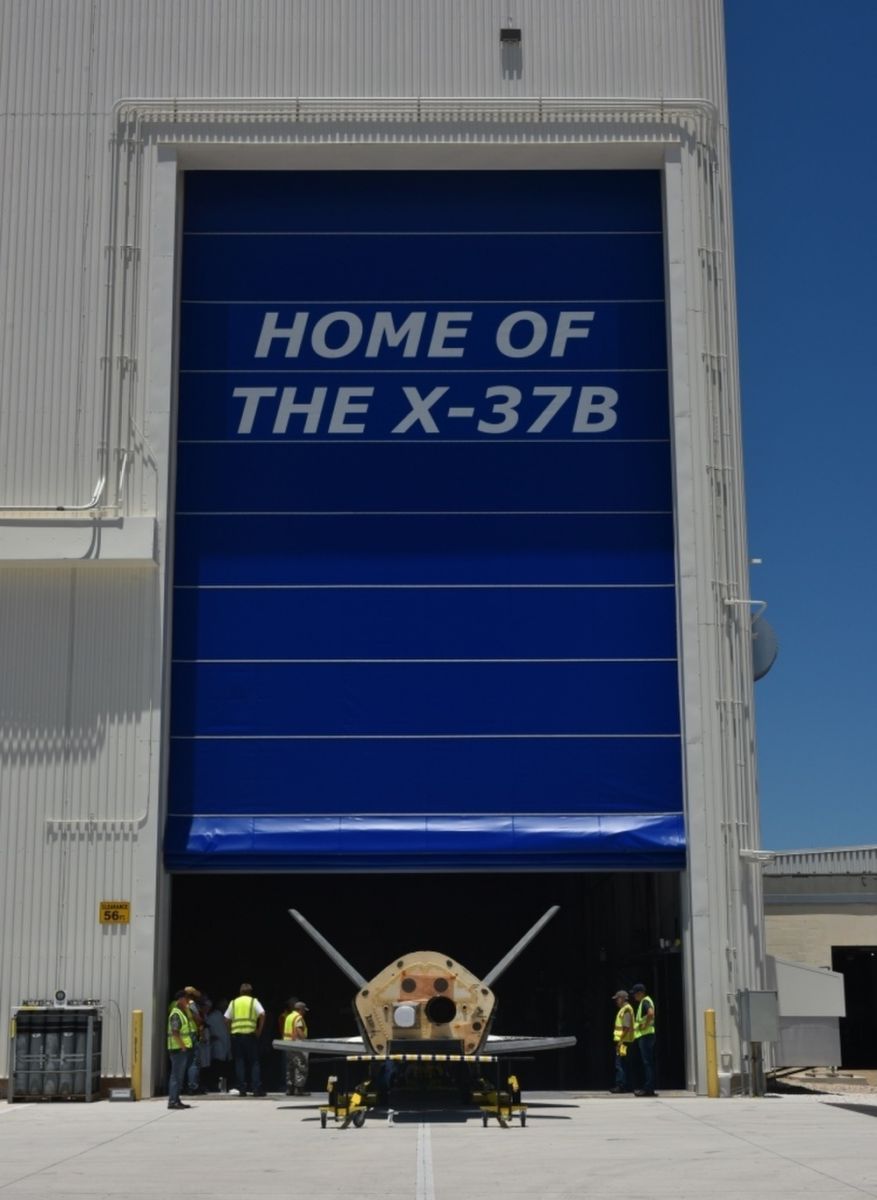
X-37B hangar at Kennedy Space Center.
Credit: Michael Martin/SAF
According to a Boeing fact sheet, “the X-37B is one of the world’s newest and most advanced re-entry spacecraft, designed to operate in low-earth orbit, 150 to 500 miles above the Earth. The vehicle is the first since the Space Shuttle with the ability to return experiments to Earth for further inspection and analysis. This United States Air Force unmanned space vehicle explores reusable vehicle technologies that support long-term space objectives.”
Delta 9
The X-37B program is flown under the wing of a U.S. Space Force unit called Delta 9, established and activated July 24, 2020.
“Delta 9 Detachment 1 oversees operations of the X-37B Orbital Test Vehicle, an experimental program designed to demonstrate technologies for a reliable, reusable, unmanned space test platform for the U.S. Space Force,” according to a fact sheet issued by Schriever Air Force Base in Colorado.
“The mission of Delta 9 is to prepare, present, and project assigned and attached forces for the purpose of conducting protect and defend operations and providing national decision authorities with response options to deter and, when necessary, defeat orbital threats,” the fact sheet explains. “Additionally, Delta 9 supports Space Domain Awareness by conducting space-based battlespace characterization operations and also conducts on-orbit experimentation and technology demonstrations for the U.S. Space Force.”
 Posted in

Credit: CCTV/Inside Outer Space screengrab
Making its public debut is China’s next-generation crewed spacecraft.
The once flown capsule is on display at the Airshow China 2021 in Guangdong Province’s Zhuhai City.
This craft is larger than the now-in-use Shenzhou spacecraft. China space officials say the new vehicle extends the qualities of reliability and safety, and will be reusable.

Huang Kewu, deputy head of the manned lunar exploration general department at the Fifth Research Institute of the China Aerospace Science and Technology Corporation (CASC).
Credit: CCTV/Inside Outer Space screengrab
Moon exploration capsule
In a China Central Television (CCTV) interview, Huang Kewu, deputy head of the manned lunar exploration general department at the Fifth Research Institute of the China Aerospace Science and Technology Corporation (CASC) said:

Credit: CCTV/Inside Outer Space screengrab
“The new generation of manned spacecraft is designed to meet the needs of our manned lunar exploration and space station operations in the future. The new generation of manned space transportation vehicle, which has been tested, could carry six to seven astronauts, while our Shenzhou spacecraft could only take three astronauts.”
With a launch mass of 21.6 tons, the next-generation piloted spacecraft is China’s largest return and reentry spacecraft launched with the largest amount of propellant. Some of the new technologies were successfully tested in its first flight in May of last year.

China’s next-generation piloted spaceship undergoes landing test using airbags.
Credit: CCTV/Inside Outer Space screengrab
Test flight
The prototype next-generation spacecraft was hurled into orbit by a Long March-5B launch vehicle from the Wenchang Space Launch Center, Wenchang, Hainan Province, China, on May 5, 2020. The craft landed safely on May 8 at the Dongfeng landing site and is designed for transportation of both astronauts and cargo.
The right side of the vehicle carried nearly 1,000 pieces of supplies to verify the spaceship’s cargo capacity. The left side of the craft was configured as a living area for astronauts, with a folding table and a toilet.
The experimental spaceship flew in orbit for two days and 19 hours, during which it carried out a series of space science and technology experiments, reported the China Manned Space Agency (CMSA).

Post-flight condition of China’s next-generation spaceship.
Credit: CCTV/Inside Outer Space screengrab
“We have achieved significant breakthroughs in thermal protection and precision control for the return and reentry, as well as in engine design and undamaged landing,” Huang told CCTV.
“The achievements in manned space transportation technologies have enabled us to take a leap from lagging behind the pacemakers to running beside them, and this lays a sound technological foundation for our future manned lunar spacecraft,” said Huang.
Go to this CCTV video at:
https://pv.news.cctvplus.com/2021/1001/8230227_PREVIEW_20211001180050702.mp4
Go to these Inside Outer Space stories at:
China’s New-gen Spaceship – First Inside Look (Updated)
https://www.leonarddavid.com/chinas-new-gen-spaceship-first-inside-look/
China’s New-generation Spaceship Readied for Return Home
https://www.leonarddavid.com/chinas-new-generation-spaceship-readied-for-return-home/
China’s New Spaceship: Space Station and Human Moon Exploration Plans
https://www.leonarddavid.com/chinas-new-spaceship-space-station-and-human-moon-exploration-plans/

A new study appraises the wide swath of space technology trends and strategic financial insights – including space health, off-planet construction to private spaceflight, space solar power and space settlement.
The 240-page case study is the work of SpaceTech Analytics (STA), a strategic analytics agency focused on markets in the space exploration, spaceflight, space medicine, and satellite tech industries.
The study is targeted for investors, entrepreneurs, and stakeholders with the goal to raise the education level of those who are not already space technology experts.

Credit: STA
Key takeaways
In an STA press statement, some of the study takeaways include the following:
— Small satellites are actively expanding in the SpaceTech market. Small satellites are very light and may mass as little as 30 kg. Unfortunately, it is not generally affordable and reasonable to launch one small satellite. However, launching dozens or hundreds of satellites reduces costs significantly, which makes launches more accessible. On January 24th 2021, SpaceX set a record and launched 143 satellites on a single rocket for $57M on a Falcon 9.

Credit: Astrobotic
— Today, commercial space transportation is the primary means of delivery to Earth orbit. Soon, this will include commercial in-space transportation systems and their support infrastructure. There are commercial in-space transportation companies now. Today, one can book payload delivery to the Moon on expendable commercial lunar landers with Astrobotic for $1.2M per kilogram.
— Space is becoming relatively more accessible and affordable, allowing smaller countries to launch satellites with less effort and fewer resources. As a result, many countries in Africa, Latin America, and Asia have begun developing space technologies. For example, Kenya and Bahrain have joined the list of countries operating satellites.
Lunar resources
The study also provides insights into tapping the Moon’s resources and underscores that space medicine is a new frontier sector. Takeaways include:

Using local resources on the Moon can help make future crewed missions more sustainable and affordable.
Credit: RegoLight, visualization: Liquifer Systems Group, 2018
— Potential lunar resources may encompass materials that can be processed such as volatiles and minerals and geologic structures such as lava tubes that together might enable lunar habitation. The industrial development of asteroids involves extracting raw materials on asteroids and space bodies in the asteroid belt and especially in near-Earth space (in terms of velocity to get to them).
— Space Medicine is a new frontier sector along with longevity. Long-duration spaceflight needs to be investigated more thoroughly. It is known that weightlessness influences muscle loss, bone loss, renal dysfunction, cardiovascular system, immune system, as well different neurological disorders and behavioral health. This will likely change in the coming era of space tourism.
To access this detailed, informative study, go to:
https://analytics.dkv.global/spacetech/SpaceTech-Industry-2021-Q3-Report.29:09.pdf

Credit: CNSA/CLEP
China’s lander and Yutu-2 rover have worked for 1,000 Earth days on the lunar farside, according to the Lunar Exploration and Space Program Center of the China National Space Administration (CNSA).

Chang’e-4 lander and Yutu-2 rover. Images of each other taken by the respective machinery.
Credit: CNAS/CLEP
The lander, rover, and payloads are reportedly in good condition.
As of Wednesday, Yutu-2 has traveled 2,754 feet (840 meters) and obtained 3,632.01 gigabytes (GB) of data.

Credit: CNSA/CLEP
The Chang’e-4 probe, launched on December 8, 2018, making the first-ever soft landing within the Von Kármán Crater in the South Pole-Aitken Basin on the Moon’s farside on January 3, 2019.

Von Kármán crater as viewed by NASA’s Lunar Reconnaissance Orbiter.
Credit: NASA/GSFC/Arizona State University

Credit: Piplsay
Over the past few years, UFOs have earned air time on primetime news and Unidentified Aerial Phenomenon (UAPs) have appeared in front-page stories published by The New York Times.
Question: What has happened in the last few years to bring these kinds of stories back to mainstream national attention?
A recent panel held as part of a two-day Future Security Forum co-hosted by Arizona State University (ASU) and New America on Sept. 13 and 14 explored this topic.

Credit: DOD/U.S. Navy/Inside Outer Space screengrab
Serious reports
ASU has released a press statement on the meeting, detailing aspects the segment on UFOs/UAPs:
“For a long time the feeling of the military between 1947 and roughly 1953 was this is a very tense post-war moment, the beginning of the Cold War. … It seemed very possible that foreign adversaries like the Soviets had developed craft that could easily outmaneuver us and travel several times faster than the speed of sound, and so it was a very real concern that there were things in our airspace that we couldn’t account for,” said Gideon Lewis-Kraus, 2017 national fellow at New America and staff writer for The New Yorker.
“But the point was serious reports were coming in from credible people, people like military pilots, civilian pilots. There were hundreds of these (reports) coming into the Air Force every year. So, the feeling was something had to be done about the fact that all of these strange sightings were happening.”

GOFAST
Credit: DOD/U.S. Navy/Inside Outer Space screengrab
Countervailing tendencies
Lewis-Kraus added that, on the other hand, the U.S. wanted to project a powerful image of itself and not acknowledge things that it didn’t understand — UFOs — were entering its airspace, causing American officials’ opinions on the matter to split.
“There was also the feeling that we could not show that we were ignorant of stuff going on in our airspace, we couldn’t show that there were repeated incursions into our airspace, potentially by adversaries that we couldn’t account for — and especially in the early moments of the Cold War, we never wanted to project that kind of weakness,” Lewis-Kraus said.
“So, there were two countervailing tendencies among officials. There was the feeling we should take weird things seriously because it’s the only way we’re going to learn there’s stuff going on that’s beyond our ken, and on the other hand, we need to prevent people from taking weird things too seriously or it’ll look like no one’s minding the store.”

Credit: Amazon
Mainstream media
These differing approaches on addressing UFO sightings ultimately culminated in congressional hearings in the 1960s and the publication of a report, “Scientific Study of Unidentified Flying Objects,” which dismissed the phenomenon, despite the government still keeping track of UFO sightings unbeknownst to the general public.
“To some extent, the history of this time shows that UFO conspiracy theories aren’t totally wrong to believe that there was in fact a concerted effort to get people not to take this stuff seriously, and it worked. After about 1970, that’s when you start seeing the mainstream media making fun of these things — you see most official announcements making fun of these things,” Lewis-Kraus said.
“But at the same time, behind the scenes, you still have people taking it seriously because the concerns about potential national security implications never went away. So, the decision was in public we still need to project strength, we need to show we know what’s going on and that we’re never left puzzled by flying enigmas.”
One possible reason that stories of UFO sightings are now appearing on mainstream outlets more frequently is because of increased interest among a new generation of officials.
“There’s no reason to believe that our high-ranking government officials, both elected and in the military, are prone to have more reasonable, rational beliefs than the rest of us,” Lewis-Kraus said. “The sort of cynical answer is well, lots of people are interested in UFOs, so this [is] a matter of a few kind of ‘UFO nuts’ who managed to end up in positions of power where they could fund UFO studies.”

Credit: DARPA
Drone swarms
Another reason for the increase in dialogue around UFO sightings: the widespread adoption and deployment of drone technology.
“It’s no surprise that this has coincided with the early years of widespread drone deployment, and increasingly over the last couple years, there’s definitely some evidence that at least some of these mysterious UFO sightings over our carrier groups probably represented drone swarms,” Lewis-Kraus said.
“And so then the balance that had set the taboo in motion began to shift, that all of the sudden it seemed less important for us to emphasize that we knew everything that was going on in the air and a little bit more important for us to say, ‘Look, if we’re hearing weird things from our pilots, we might need to concede our puzzlement in public in order to make sure that we are getting good information from the people who are on the front lines to tell us what’s going on.’”
But the government’s ambivalence about publicizing UFO sightings is unlikely to change anytime soon.
“There’s always this question of to what extent do you want to leave yourself open and vulnerable by saying that you don’t know what’s going on,” he said. “And I think that the UFO story is a great case study in why exactly we would admit uncertainty and ambivalence and why we would hide that uncertainty and ambivalence.”
Go to this YouTube at:
Go to: 4:27:20

I am very pleased to report that the SPACE 3.0 Foundation, a 501(c)(3) charitable organization in Bethesda, Maryland, has awarded a “One Small Step” grant to Leonard David of Space Data Resources and Information.
The grant is centered on performing select oral history interviews focused on entrepreneurial and commercial space activities for the Foundation’s Space Business & Commerce Archives.
“While NASA has done an excellent job at documenting its activities and actions via oral histories with key management, staff, and the astronauts and program managers, there remains a great need to capture the experiences and perspectives of space entrepreneurs and visionaries,” said Scott Sacknoff, the Foundation’s chair, in a statement.
This is the first “One Small Step” grant recipient focused on performing oral histories in this area, Sacknoff added.

Funded projects
Other projects funded by SPACE 3.0 in recent months include: a grant to the New Mexico Museum of Space History to digitize human spaceflight films from the 1960s, the acquisition of 50,000+ high-resolution images from the human spaceflight program for its space archives, and digitization of the privately published magazine, Space World, which ran from 1960-1988.
SPACE 3.0 has reserved funds to award more grants this calendar year and also is seeking sponsors for the collection of additional oral histories to be performed.
For more information on the Foundation, go to:
https://www.spacecommerce.org/

Remote viewing – image of low, sandy hills. There are higher hills in the horizon. This image was taken by Left Navigation Camera onboard NASA’s Mars rover Curiosity on Sol 3247 September 24, 2021.
Credit: NASA/JPL-Caltech
NASA’s Curiosity Mars rover at Gale Crater is now performing Sol 3251 duties.
Reports Michelle Minitti, a planetary geologist at Framework in Silver Spring, Maryland: “Solar conjunction is once again upon us – the time when the Sun comes between Mars and Earth in their orbital dances and precludes reliable communication between us and our robotic friends.”

Curiosity Front Hazard Avoidance Camera Left B image taken on Sol 3251, September 28, 2021.
Credit: NASA/JPL-Caltech
Since landing in August 2012, this will be the fifth conjunction Curiosity has experienced, “and such a regular, cosmic event like conjunction provides the perfect time to reflect,” Minitti adds, “where were we the last time Mars, Earth and the Sun aligned like this?”

Curiosity Right B Navigation Camera photo taken on Sol 3250, September 27, 2021.
Credit: NASA/JPL-Caltech
Scrapbook memories
Minitti says that looking back over what Curiosity researchers were up to around each conjunction “is very much like looking through a scrapbook of memories.”

Curiosity Left B Navigation Camera image acquired on Sol 3251, September 28, 2021.
Credit: NASA/JPL-Caltech
- First conjunction, starting on Sol 236 (April 2013), fresh off the excitement of finding evidence of a habitable environment in our first drill sample “John Klein,” and still feeling the relief of having survived a major fault with the A side computer. Curiosity runs on the B side computer to this day.
- Second conjunction, on Sol 1004 (May 2015), we had just passed the Sol 1000 milestone and had completed walkabout exploration (on our beat up wheels) of “Pahrump Hills,” the lowest exposed section of Mount Sharp. There we collected three samples of the mudstone-dominated Murray formation. We parked for conjunction at a contact between the Murray formation and another major formation, the Stimson, an aeolian sandstone deposit. Curiosity has continued to encounter variations of both formations throughout her exploration of Gale.
- Third conjunction started on Sol 1756 (July 2017), and we found ourselves sitting on the Murray formation just north of “Vera Rubin Ridge,” looking up at its enticing layering and color variations. Leading up to that point, we had sampled our way across the Stimson-capped “Naukluft Plateau,” maneuvered through the Stimson-capped “Murray Buttes,” and were systematically sampling the Murray formation when the drill fell out of commission. The loss of the ability to drill and deliver sample to the Chemistry & Mineralogy X-Ray Diffraction/X-Ray Fluorescence Instrument (CheMin) and the Sample Analysis at Mars (SAM) Instrument Suite was a blow, but the team, to borrow from our sister rover, persevered to continue building the story of the rocks of Gale with the rest of the payload.
- Fourth conjunction on Sol 2506 (August 2019), Mars investigators had made it up and down Vera Rubin Ridge multiple times and into the clay-bearing “Glen Torridon” region. Our multiple traverses across the ridge were not just for exploration. Since the previous conjunction, the engineers invented a new way to use the drill to once again allow us to collect samples. We revisited terrain to gather samples where it was not previously possible, and gratefully sampled our way into Glen Torridon, We acquired sample #22, the clay-bearing “Glen Etive” sample, right before conjunction. In the midst of all the exploration and sampling, Curiosity also survived a near-global dust storm!
- Fifth conjunction upcoming has the rover sitting just a few meters away from its 33rd drill hole, ”Maria Gordon,” in the shadow of the western side of the “Greenheugh Pediment.” We successfully “summited” the northern edge of the pediment since last conjunction, allowing us to cross over, sample, and analyze yet another (but higher!) Murray-Stimson contact.

Curiosity Right B Navigation Camera photo taken on Sol 3251, September 28, 2021.
Credit: NASA/JPL-Caltech
“We hope to climb up onto the pediment again as we make our way from the clay-rich rocks of the Glen Torridon region toward the anticipated sulfate-rich layers of Mount Sharp above,” Minitti notes. “But for the next few weeks, we will simply pause, look across the view…and appreciate how much we have done and how far we have come.”

Credit: U.S. Space Force
A “No Militarization of Space Act” has been introduced, centered on abolishing the U.S. Space Force.
Calling the Space Force “costly and unnecessary,” Representative Jared Huffman (D-San Rafael) the Act is timed as Congress moves to pass the National Defense Authorization Act (NDAA), the annual bill that authorizes funding for the Pentagon.
“The long-standing neutrality of space has fostered a competitive, non-militarized age of exploration every nation and generation has valued since the first days of space travel,” Huffman says in a statement. “But since its creation under the former Trump administration, the Space Force has threatened longstanding peace and flagrantly wasted billions of taxpayer dollars.”

President Donald Trump signs S.1790, the National Defense Authorization Act for Fiscal Year 2020 on, Friday, Dec. 20, 2019 at Joint Base Andrews. The act directed the establishment of the U.S. Space Force as the sixth branch of the armed forces.
Credit: Airman 1st Class Spencer Slocum, 11th Wing Public Affairs
Taxpayer boondoggle
The lawmaker says that the Space Force has quickly become a taxpayer boondoggle “that adds layers of bureaucracy and waste to an already-bloated defense budget.”
Huffman was joined in the introduction by Representatives Mark Pocan (WI-02), Jesús “Chuy” García (IL-04), Rashida Tlaib (MI-13), and Maxine Waters (CA-43).
This legislation is endorsed by Taxpayers for Common Sense, National Taxpayers Union, Peace Action, R Street Institute, and Demand Progress.

General Jay Raymond the first Chief of Space Operations and first member of the Space Force.
Bureaucratic confusion
The U.S. Space Force was established on December 20, 2019 with enactment of the Fiscal Year 2020 National Defense Authorization Act.
Huffman’s website notes that the U.S. military spending topped nearly $704 billion dollars in fiscal year 2021, including $15.5 billion for the Space Force. The Space Force unnecessarily duplicates much of the existing work within the Air Force including that of Space Command, thereby creating “bureaucratic confusion and further waste and risking American and allied national security,” the website adds.
To view H. R. 5335 “To abolish the Space Force as an Armed Force, and for other purposes,” go to:
https://www.congress.gov/117/bills/hr5335/BILLS-117hr5335ih.pdf

Illustration of the EscaPADE spacecraft in orbit around Mars.
Credits: Rocket Lab USA/UC Berkeley
While space officials at NASA, the European Space Agency, as well as planners in China plot out ultra-expensive and complicated missions to return samples from the Red Planet, there are an increasing number of Mars researchers blueprinting low-cost and novel ways to further explore the multifaceted planet.

Next up on Mars? One idea is this Mars aerial craft – the Hexacopter.
Credit: Theodore Tzanetos/NASA/JPL-Caltech
Be it via souped-up helicopters to inexpensive landers and orbiters, they say it’s time to script new ways to gather more data from a variety of places on that remote world.

Part lander, part shock absorber in one is the Small High Impact Energy Landing Device (SHIELD) concept.
Credit: NASA/JPL/Caltech
Go to my new SPACE.com story for more details:
Mars on the cheap: Scientists working to revolutionize access to the Red Planet – The concepts include souped-up Mars helicopters and inexpensive orbiters and landers.
Go to:
https://www.space.com/cheap-mars-exploration-mission-ideas

Credit: USRA/LPI
BTW: NASA’s Mars Exploration Program invites the Mars community, including scientists, engineers, technologists, and industry representatives, to a three-day workshop early next year to share ideas and approaches for low-cost exploration of the Red Planet.
For more information, go to:

As seen in the ultraviolet, Venus image taken by NASA’s Pioneer-Venus Orbiter in 1979.
Credit: NASA
The clouds of Venus are potentially amenable to the growth of microorganisms.
A new study points to photosynthesis that might occur around-the-clock in Venus’ clouds with the middle and lower clouds receiving similar solar energy as Earth’s surface.
Researchers report that photosynthesis may continue through the night due to thermal or infrared energy originating from the surface and the atmosphere.

Credit: Rakesh Mogul, et al.
The study, “Potential for Phototrophy in Venus’ Clouds,” was led by Rakesh Mogul, professor of Biological Chemistry at Cal Poly Pomona. It was published online this week as part of an October 2021 special collection of the journal Astrobiology focused on the possible suitability of Venus’ clouds for microbial life, and the constraints that may prohibit life.
Acceptable range
“Our study provides tangible support for the potential for phototrophy and/or chemotrophy by microorganisms in Venus’ clouds,” said Mogul in a university release.
“The acidity and water activity levels potentially fall within an acceptable range for microbial growth on Earth, while the constant illumination with limited UV suggests that Venus’ clouds could be hospitable for life,” Mogul explains. “We argue that Venus’ clouds, therefore, make a great target for habitability or life detection missions, like those currently planned for Mars and Europa.”
The study also found that after filtering through the Venusian atmosphere, sunlight gets scrubbed of much of the ultraviolet radiation (UV), which is harmful to life, as result of scattering and absorption, providing a benefit like Earth’s ozone layer.

Credit: Rakesh Mogul, et al.
Chemical conditions
Mogul and his team, using new interpretations to refractive index and radio occultation measurements obtained from Venus’ clouds, found that the chemical conditions of Venus’ clouds are potentially hospitable to microorganisms.
“We show that solar irradiances calculated across Venus’ clouds support the potential for Earth-like phototrophy and that treatment of Venus’ aerosols containing neutralized sulfuric acid favor a habitable zone,” the paper explains.

With a targeted launch for fiscal year 2030, NASA’s DAVINCI+ will send a probe to brave the high temperatures and pressures near Venus’ surface to explore the atmosphere from above the clouds to near the surface. During the final leg of its free-fall descent, the probe will capture images and chemistry measurements of the deepest atmosphere on Venus for the first time.
Credits: NASA GSFC visualization by CI Labs Michael Lentz and others
Upcoming missions
Given the set of Venus probes now on the books from NASA, Europe and perhaps Russia, could they help further life detection on that cloud-veiled world?
“The upcoming mass spectral experiments on DAVINCI could really help in detailing the chemical makeup of the clouds; which by inference could tell us more about the habitability-related parameters of acidity, water activity, and etc.,” Mogul told Inside Outer Space. “I think many of the future plans are still in flux, though I believe Rocket Lab is also discussing spectral measures to get chemical information regarding cloud composition. As for life detection at Venus, we’re probably a long ways away!”
The co-authors of the study are Sanjay S. Limaye (University of Wisconsin, Madison), Yeon Joo Lee (Technische Universitat Berlin, Berlin, Germany) and Michael J. Pasillas (Cal Poly Pomona).
To take a look at the paper — “Potential for Phototrophy in Venus’ Clouds” — go to:
https://www.liebertpub.com/doi/full/10.1089/ast.2021.0032

