Archive for the ‘Space News’ Category

Curiosity’s location on Sol 3897. Distance driven to date: 18.89 miles/30.41 kilometers.
Credit: NASA/JPL-Caltech/Univ. of Arizona

NASA’s Curiosity Mars rover at Gale Crater is now performing Sol 3898 duties.

Curiosity’s road trip involves wheeling through the Jau crater cluster.

“Like any road trip, we’re taking frequent stops to take in the sights, and at this spot Curiosity gets to stretch its arm with a touch and go,” reports Alex Innanen, an atmospheric scientist at York University; Toronto, Ontario, Canada. “It reminds me of being on family road trips with my geologist father – we were always pulling over to look at cool rocks!”

Curiosity Left B Navigation Camera photo taken on Sol 3897, July 24, 2023.
Image credit: NASA/JPL-Caltech

Bumpy, ridged surface

The robot’s Alpha Particle X-Ray Spectrometer (APXS) and Mars Hand Lens Imager (MAHLI) are both investigating the bumpy, ridged surface on the side nearest the rover, a target named “Mamore,” backed up with Mastcam images.


Curiosity Left B Navigation Camera photo taken on Sol 3897, July 24, 2023.
Image credit: NASA/JPL-Caltech

Innanen adds that the rover’s Chemistry and Camera (ChemCam) is also looking at this surface, particularly one of the ridges called “Jacunda.” Slightly further afield, Mastcam is also looking at two of the craters in the cluster and a distant rock “Triunfo.”

Curiosity Right B Navigation Camera image acquired on Sol 3897, July 24, 2023.
Image credit: NASA/JPL-Caltech

ChemCam is slated to take a long-distance mosaic of the Gediz Vallis ridge.

Exciting sights ahead

The environmental Mars team is also taking the chance to have a look around.

Curiosity Left B Navigation Camera photo taken on Sol 3897, July 24, 2023.
Image credit: NASA/JPL-Caltech

“We’re looking back over our metaphorical shoulder at a sand sheet for dust devils, and up towards the sun to see how much dust is in the atmosphere,” Innanen explains.  “After our brief and productive stop it’s time for us to hit the road again, knowing that there are always more exciting sights ahead.”

Dates of planned rover activities are subject to change due to a variety of factors related to the Martian environment, communication relays and rover status.

Curiosity Left B Navigation Camera photo taken on Sol 3897, July 24, 2023.
Image credit: NASA/JPL-Caltech

Image credit: Roscosmos/JSC NPO Lavochkina


Roscosmos and JSC NPO Lavochkina both report progress in readying the Soyuz booster complex at the Vostochny Space Center for launch of Russia’s Luna-25 Moon lander.

Late last week, specialists were on task preparing and checking all systems and units before receiving the space rocket. 

Image credit: Roscosmos Television Video/Inside Outer Space screengrab

Launch of the Soyuz-2.1b carrier rocket with the Luna-25 automatic interplanetary station is set for August, with the probe to touch down in the Moon’s south pole region.

Luna-25 mascot.
Image credit: Roscosmos

Luna-25 is Russia’s re-rendezvous with Moon exploration, picking up where the former Soviet Union left off in 1976.


The spacecraft is to try out technology for soft landing, take and analyze the soil and conduct other scientific research, as well as study the upper layer of the surface regolith in the region of the south pole of the Moon, as well as the lunar exosphere.

Credit: SETI Post-detection Hub

If you follow the complex and perplexing world of Unidentified Flying Objects, now tied to the term Unidentified Anomalous Phenomena, we may be inching toward “full disclosure.”

What that means is uncorking the bottle filled to the brim with an elixir of truth, say disclosure activists, that Earth has been on the receiving end of exotic craft of non-earth origin.

Even more, there are allegations of a covert U.S. government reverse engineering program set up to write an operator’s manual on how these surreptitious vehicles function.

Image credit: Yannick Peings, Marik von Rennenkampff/AIAA

The drumbeat that the U.S. Government is ready to spill the beans on alien guests to Earth is louder than ever. But whether it’s next week, next year, next decade, what are the social consequences of contact…or at least some outing of historical records documenting visitors from afar. Are we ready for such a revelation? There appears to be debate on what the ripple effects might be.

To read my new Space.com article – “The US Congress is holding UFO hearings this week. What might we learn?” – go to:

https://www.space.com/ufo-uap-full-disclosure-congressional-hearings

New poll data

Also, a just-issued Ipsos poll shows that Americans’ beliefs and encounters with other-worldly experiences vary.

Up close and personal! Scene from Earth vs. the Flying Saucers circa 1956.
Credit: Columbia Pictures

Ahead of a Congressional hearing on UFOs this week, one in ten Americans report that they have seen an unidentified flying object (UFO), unchanged over time. Four times as many Americans (42%) believe in UFOs.

When it comes to other unexplainable phenomena, about three in ten (28%) report that, at some point, they have woken up from sleep with a sense of a strange presence in the room, and one in four (25%) have seen or believed themselves to have been in the presence of a ghost. Beyond that experience, two in five (39%) believe in ghosts.

For more information on the Ipsos poll, go to:

https://www.ipsos.com/en-us/many-americans-believe-supernatural-ufos

Liftoff of suborbital space tourism, backed by Amazon founder Jeff Bezos.
Credit: Blue Origin

Looking at a range of high-adrenaline activities, experts from ARKA conducted research to find recent thrilling high-risk activities that have captivated the interest of billionaires worldwide.

According to ARKA, a creator of custom boxes, flying around the Moon would be the most expensive and risky activity undertaken by billionaires.

Space treks into Earth orbit is the second most costly activity that has captivated many billionaires. It also ranks as the second most risky activity on the ARKA list. Individuals, such as billionaires Guy Laliberté, Charles Simonyi, Mark Shuttleworth, Dennis Tito, and Richard Garriott have traveled to the Earth’s orbit.

Richard Garriott (far right) aboard the ISS on October 23, 2008.
Image credit: NASA

Blue Origin suborbital space flight comes third on the list of most costly activities that billionaires tried. Although ticket prices are reportedly in the no-lower than $200,000 range, one suborbital seat went for $28 million, the winning bid at a charity auction in June 2021.Although moderately risky, Blue Origin flights have captivating billionaires, including Hamish Harding who recently died on the tragic Titan submersible accident.

The trip to International Space Station (ISS) ranks fourth for both riskiness and expense, offering a once-in-a-lifetime experience. Despite the serious risks and cost of $20 million, trips to the ISS have been taken by 244 people, including billionaires Dennis Tito, Charles Simonyi, Yusaku Maezawato, and Guy Laliberté.

Ill-fated Titan submersible.
Image credit: OceanGate


Scuba diving in the Mariana Trench comes fifth on the list of costly activities that billionaires tried. Although it costs $750,000, which is relatively lower than the previous activities, it’s still considered a high-risk activity. Only 3 individuals, including billionaire James Cameron, have dared to dive deep and uncover the ocean’s mysteries.

The controversial and risky activity of rhino hunting claims the sixth position on the list to attract billionaires. This activity is legally permitted only in Namibia and South Africa. Although the total number of people trying this activity is unclear, 81-year-old Lacy Harber is the only recorded billionaire who has paid $275,000 for the opportunity to hunt an aged black rhino.

Even with the shocking Titan Tour crash, hunting for shipwrecks of the Titanic in the ocean’s depths is only the seventh most costly activity out there. Billionaires like Hamish Harding, Shahzada Dawood, Richard Branson, and Paul Allen have all been hooked by this deep-sea tour to discover long-lost shipwrecks. This very high-risk adventure costs only $250,000.

Image credit: Swoop Antarctica

Ranked eighth on the list of costly activities that billionaires enjoy is exploring the majestic South Pole. It falls into the category of low-risk activities costing $100,000. Many adventurers, including billionaires Hamish Harding, Richard Branson, Jeff Bezos, and Mark Zuckerberg, have enjoyed this journey.

Image credit: Everest Base Camp Trek & Excursion


Ranked ninth on the list of costly activities that billionaires enjoy is climbing Mount Everest. It falls into the category of high-risk activities costing, on average, $55,000. More than 6000 adventurers, including billionaires Mukesh Ambani, Richard Branson, and Bernard Arnault, have enjoyed this journey.

Lastly, shark diving ranks tenth on the list of costly activities that billionaires enjoy. With prices ranging from $5,000 to $7,000, this trip is a relatively affordable option. It presents a moderate level of risk, making it an ideal choice for adrenaline enthusiasts. Billionaires like Mark Cuban have taken on this thrilling experience.

Credit: ARKA

For more information on ARKA, go to:

https://www.arka.com/

Illustration of Artwork of Ingenuity helicopter.
Credit: NASA/JPL-Caltech


For the Ingenuity Mars Helicopter, it is up and at ‘em for flight 53.

The aerial device made its last flight back on April 27.

JPL notes that the craft has an expected flight date of July 22.


The stats for this high-flying run are:

Horizontal flight distance: 666.34 feet (203.1 meters)

Flight time: 136.82 seconds

Flight altitude: 32 feet (10 meters)

Heading: North

Max Flight speed: 5.6 mph (2.5 meters per second)

Goal of flight: Scouting flight

Meanwhile, new black and white as well as color imagery from the craft, acquired on July 14, have been posted.

Image credit: NASA/JPL-Caltech

Image credit: NASA/JPL-Caltech

Apollo 11 footprint on the Moon.
Image credit: NASA

It is tagged as “planetary geoarchaeology” – the study of how cultural and natural processes on Earth’s Moon, on Mars, and across the solar system may be altering, preserving or destroying the material record of space exploration.

In a recent paper appearing in the journal Geoarchaeology, tools and methods are being advocated to study the movement of people into space as a natural extension of human migration here on Earth.

Illustration of NASA astronauts on the lunar south pole carrying out early work to establish an Artemis Base Camp. Credit: NASA

Protect space heritage

The research is led by Justin Holcomb, a postdoctoral researcher at the Kansas Geological Survey, based at the University of Kansas in Lawrence.

Holcomb and colleagues explain that the material record that presently exists on the Moon is quickly becoming at risk of being destroyed if proper attention isn’t paid during today’s fast-paced era of private and governmental space activities.

“We’re trying to draw attention to the preservation, study and documentation of space heritage because I do think there’s a risk to this heritage on the Moon,” Holcomb said in a university statement. “The United States is trying to get boots on the Moon again, and China is as well. We’ve already had at least four countries accidentally crash into the Moon recently. There are a lot of accidental crashes and not a lot of protections right now.”

iSpace lunar crash site.
Image credit: NASA/GSFC/Arizona State University

While there’s need to protect space heritage like those related to the U.S. Apollo missions, Holcomb said that other countries also deserve to have their records protected.

Out of Africa…into space

The idea of planetary geoarchaeological as a new subfield has its roots in the university’s Odyssey Archaeological Research Program.

Odyssey’s goal is to search for evidence of the earliest people to inhabit the Central Great Plains and western portions of the Midwest, and to gain a better understanding of the late Pleistocene and early Holocene paleoenvironments that affected those people.

Odyssey is directed by one of Holcomb’s co-authors, Rolfe Mandel, a university senior scientist and distinguished professor in the Department of Anthropology.

Time traveling here on Earth. Odyssey program.
Image credit: Kansas Alumni magazine

“Human migration out of Africa may have occurred as early as 150,000 years ago, and space travel represents the latest stage of that journey,” Mandel said in the university statement. “Although the Odyssey program is focused on documenting the earliest evidence of people in the Americas, the next frontier for similar research will be in space,” said Mandel.

The first photo from the surface of Mars shows one of the Viking 1 lander’s footpads.
Credit: NASA/JPL

Material footprint

Planetary geoarchaeology can be applied to practically every type of extraterrestrial environment, the research paper explains, provided humans have left behind a measurable record.

There is a growing need, the paper adds, to understand the types of unique site formation processes capable of altering, destroying, or preserving the archaeological record known as space heritage.

Sand trap for Spirit Mars Exploration Rover.
Image credit: NASA

“We feel that all material currently existing on extraterrestrial surfaces is space heritage and worthy of protection,” Holcomb said. “However, some sites, such as the very first footprints on the Moon at Tranquility Base or the first lander on Mars, Viking 1, represent the material footprint of a long history of migration.”

Holcomb points to NASA’s Spirit rover. It became stuck in Martian sand in 2009 and died there in 2010. It risks being completely covered by encroaching sand dunes.

“As planetary geoarchaeologists, we can predict when the rover will be buried, talk about what will happen when it’s buried and make sure it’s well documented before it’s lost,” said Holcomb.

Leftover legacy

How about the graveyard of orbital debris that now encircles the Earth?

Clutter in the cosmos.
Credit: Used with permission: Melrae Pictures/Space Junk 3D

What many call “trash” — bits of material currently in orbit or strewn across the surfaces of the Moon and Mars — Holcomb and other planetary geoarchaeology advocates see that leftover legacy falling under case-by-case decision making.

As for next steps, Holcomb and his research colleagues suggest tracking our material record as it continues to expand, both to preserve the earliest record but also to keep a check on humankind’s impact on extraterrestrial environments.

Credit: For All Moonkind


Perhaps geoarchaeologists should be included in future NASA missions to ensure the protection and safety of space heritage.

For now, geoarchaeologists on Earth can lay the foundation for planetary geoarcheology, Holcomb explains, including support of laws to protect and preserve space heritage, studying the effects extraterrestrial ecosystems have on items space missions leave behind and conducting international discussions regarding space heritage preservation and protection issues.

For more information on the paper — “Planetary geoarchaeology as a new frontier in archaeological science: Evaluating site formation processes on Earth’s Moon” – go to:

https://onlinelibrary.wiley.com/doi/10.1002/gea.21966

Wait a minute!
Image credit: Barbara David

 
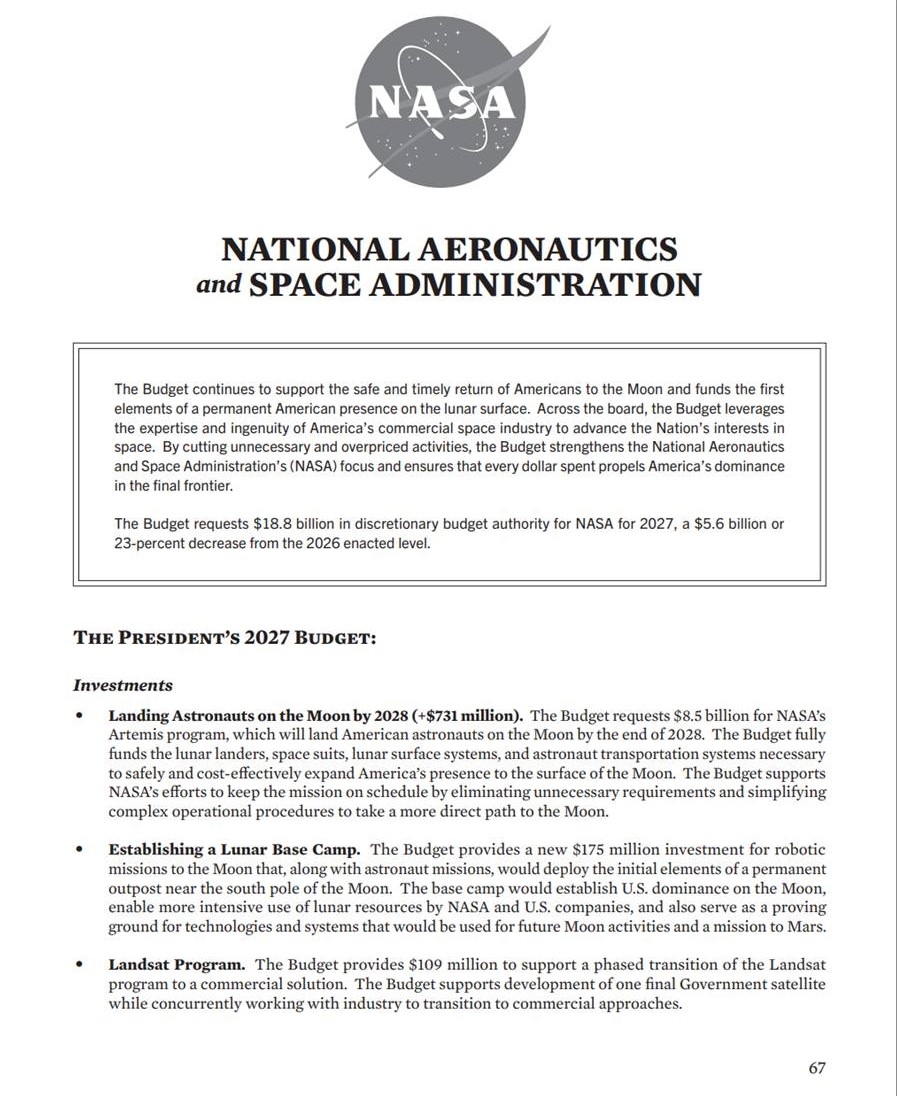
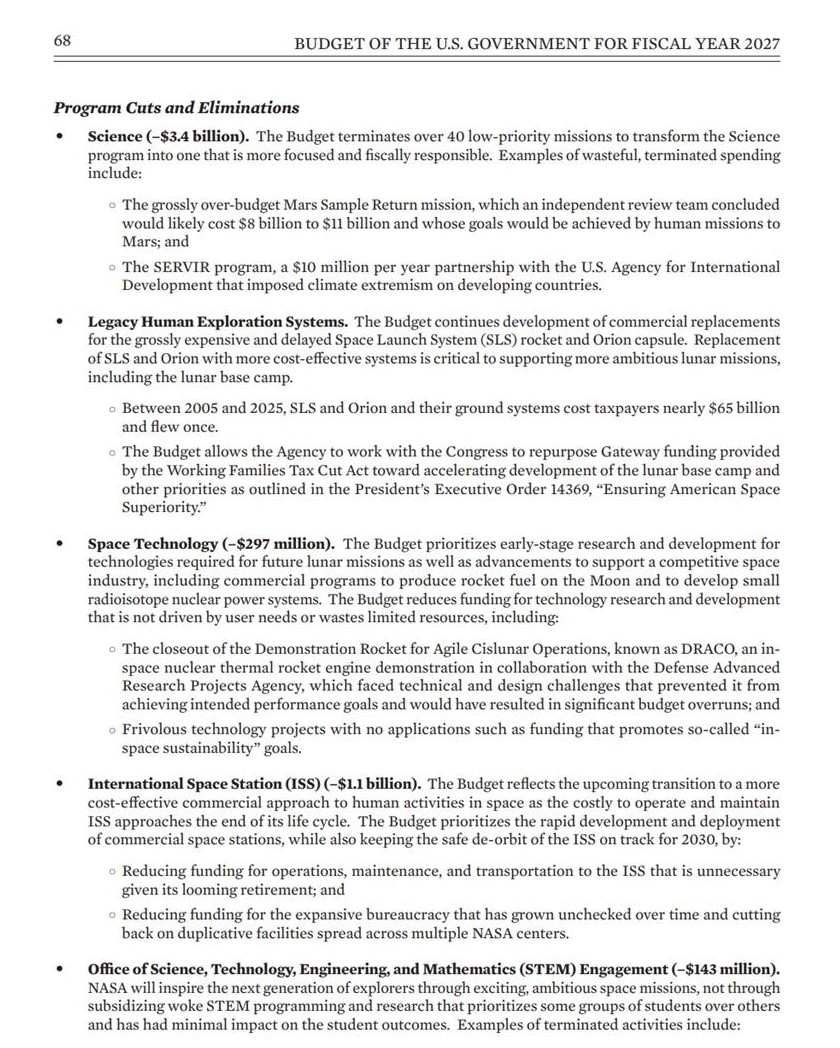
A congressionally mandated study is underway to review NASA’s critical facilities, workforce, and technology – the key ingredients needed for the space agency to apply full-power to its long-term strategic goals and mission objectives, such as back to the Moon…onward to Mars endeavors.
 
 
The National Academies of Sciences, Engineering, and Medicine study is led by Norman Augustine, retired chairman and CEO of Lockheed Martin Corporation.
 
For Augustine it must be partially “déjà vu all over again” – as the saying goes. He led the 1990 Advisory Committee on the Future of the U.S. Space Program. 
 
That December 1990 report is available at:
 
Statement of work
 
Fast forward to today. Augustine leads the Committee on NASA Mission Critical Workforce, Infrastructure, and Technology. In meeting number six, the blue-ribbon group will convene July 27-28 at the NASA Marshall Space Flight Center in Huntsville, Alabama.

Image credit: NASA

 
Lots to discuss…lots to look at including a Lunar Control Area, a Nuclear Thermal Rocket Element Environmental Simulator, as well as work on the Mars Ascent Vehicle and habitation systems.
 
A statement of work explains that committee members “will consider emerging technologies in selected engineering and science disciplines as well as critical facilities needed, and workforce skills required to perform and support the work of the mission directorates, both now and in the future.”

Image credit: NASA


As NASA’s “re-booting” of human exploration of the Moon picks up steam – with an eye on placing the first boot marks on Mars – the committee has a full agenda of action items to discuss.

Image credit: NASA

Image credit: NASA


OSIRIS-REx spacecraft at Bennu.
Credit: NASA/University of Arizona


LITTLETON, Colorado – As NASA’s first mission to collect a sample from an asteroid screams toward Earth, recovery teams are practicing steps needed to assure that those bits of extraterrestrial flotsam safely arrive on Earth for detailed scientific inspection.

Mock sample return capsule is inspected in the field by a recovery team member.
Image credit: Barbara David


The scene is here at the Lockheed Martin Space campus; a sprawling facility populated by major aerospace expertise at the ready for deep diving exploration of the solar system.

It’s a busy time to help prepare for arrival of a spacecraft from afar – NASA’s Origins Spectral Interpretation Resource Identification Security Regolith Explorer, or mercifully shortened to OSIRIS-REx.

Cleanroom procedures are practiced at Lockheed Martin in readiness for Utah landing of OSIRIS-REx capsule containing asteroid material.
Image credit: Leonard David

For more information, go to my new Space.com story – “Asteroid sample incoming: OSIRIS-REx team preps for September landing of Bennu bits – Touchdown will occur in Utah on Sept. 24” at:

https://www.space.com/osiris-rex-sample-return-landing-practice

Image credit: GLOBALink/Inside Outer Space screengrab

China’s Shenzhou-16 crew completed their first spacewalk, installing and adjusting camera devices outside the Tiangong space station, according to the China Manned Space Agency (CMSA).

The taikonaut spacewalkers were mission commander Major General Jing Haipeng and spaceflight engineer Colonel Zhu Yangzhu. Professor Gui Haichao, the mission’s science payload specialist, stayed inside the space station to provide support.

After their eight-hour spacewalk, Jing and Zhu returned to the Wentian science module.

Image credit: CGTN/Inside Outer Space screengrab

Returning in November

While this was the first spacewalk by the crew, this was the 13th spacewalk carried out by Chinese astronauts.

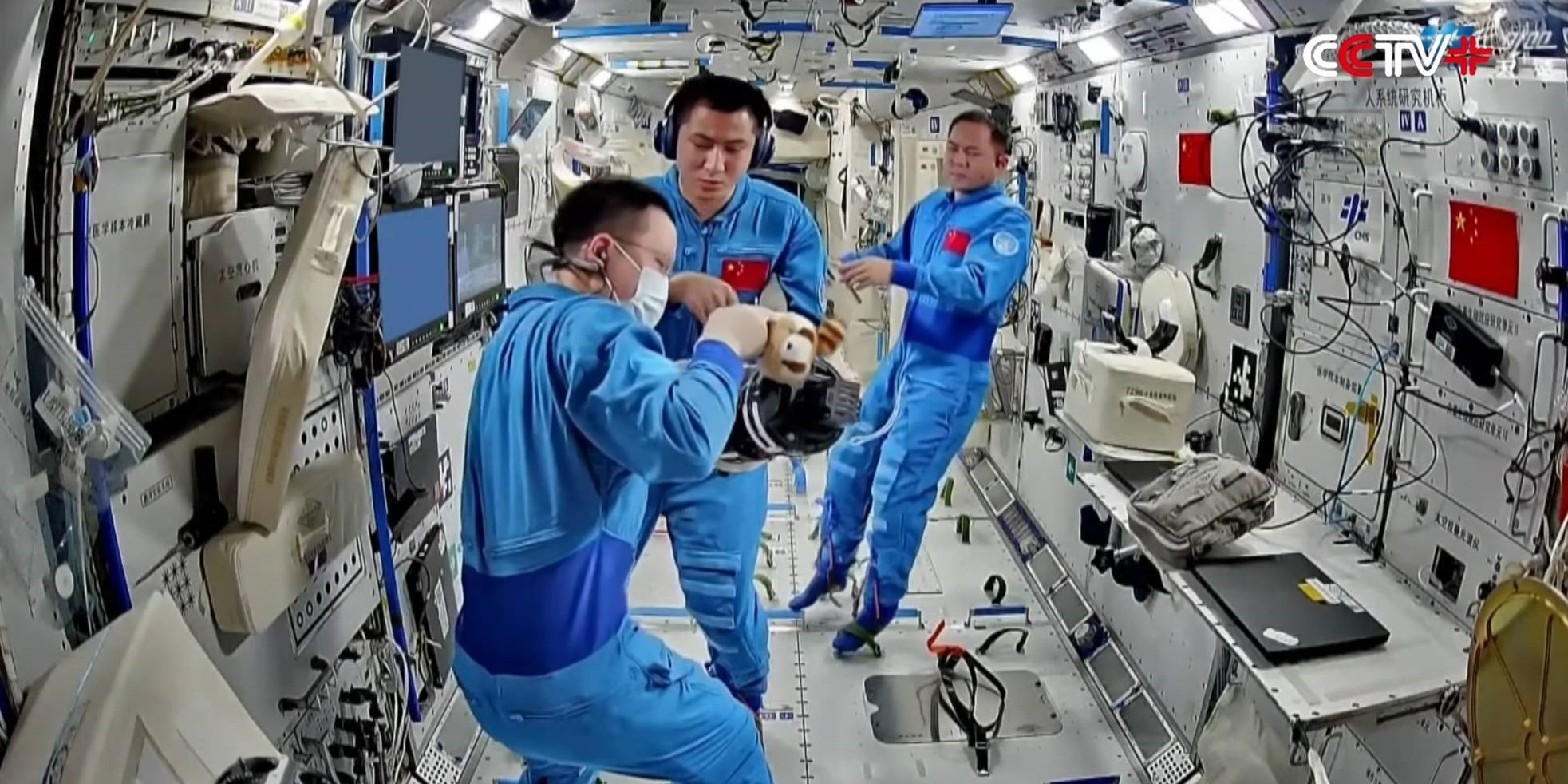
China’s Shenzhou-16 crew.
Image credit: CCTV/Inside Outer Space screengrab

The CMSA said that Jing and Zhu, among tasks, mounted a support frame for a panoramic camera outside the Tianhe core module. The twosome also unlocked and moved two panoramic cameras outside the Mengtian science module.

The Shenzhou-16 trio arrived at China’s Tiangong space station on May 30, expected to remain in Earth orbit for a five-month stint in space, returning to Earth in November.

Go to these videos that highlight the spacewalk and crew activities at:

https://youtu.be/44UwUd31Ld8

https://youtu.be/6JtVxaIhvWk

https://youtu.be/pc0pwaU9Sxw

Image credit: Barbara David


Wait a minute – here we go again!

Next week, the House Oversight Committee’s National Security Subcommittee in Congress will hold a hearing on Unidentified Anomalous Phenomena, or UAP.

The July 26 hearing is titled “Unidentified Anomalous Phenomena: Implications on National Security, Public Safety, and Government Transparency.”

Image credit: Yannick Peings, Marik von Rennenkampff/AIAA

Firsthand accounts

According to a statement the subcommittee hearing “will explore firsthand accounts of unidentified anomalous phenomena (UAP) and assess the federal government’s transparency and accountability regarding UAPs’ possible threats to U.S. national security.”

A key effort of the hearing is to bring transparency to the issue of UAPs.

“The Pentagon and Washington bureaucrats have kept this information hidden for decades, and we’re finally going to shed some light on it. We’re bringing in credible witnesses who can provide public testimony because the American people deserve the truth. We’re done with the cover-ups,” said Rep. Tim Burchett (R-Tenn.).

Show and tell time

Hearing witnesses are:

  • Ryan Graves, Executive Director, Americans for Safe Aerospace
  • Retired Commander David Fravor, Former Commanding Officer, Black Aces Squadron, U.S. Navy
  • David Grusch, Former National Reconnaissance Office officer and representative, Unidentified Anomalous Phenomena Task Force, Department of Defense

Grusch has recently claimed, citing unnamed officials, that the U.S. has retrieved “intact and partially intact” vehicles of non-human origin and that the U.S. federal government maintains a hush-hush recovery program that has stashed away exotic spacecraft, even dead pilots.

Shown at Congressional hearing, Video 1 2021 flyby movie showing a purported UAP.
Credit: Counterterrorism, Counterintelligence, and Counterproliferation Subcommittee/Inside Outer Space screengrab


American public: in the dark

In 2022, at the direction of Congress, the Department of Defense created the All-domain Anomaly Resolution Office (AARO) to investigate UAP reports.

According to the statement, the federal government spends millions of dollars examining UAPs yet refuses to be forthcoming with the American people as it continues to declassify certain videos and studies on various UAP incidents with little clarity on the subject’s origins.”

“The status quo on the part of the U.S. government has been to leave the American public in the dark regarding information about UAPs, refuse to answer questions posed by whistleblowers, avoid the concerns Americans have about the possible threats UAPs pose to our national security and public safety, and default to extreme and unnecessary over-classification,” said Rep. Anna Paulina Luna (R-Fla.).

UAP have been reported by Navy pilots unlike anything they have ever witnessed.
Image credit: Enigma Labs/Lt. Cmdr. Alex Dietrich

Lawmaker Luna added: “If the last few months have taught me anything, it is that this is an issue that matters to Americans. It also impacts the transparency and accountability our government is supposed to grant to the people who it serves. I look forward to bringing this topic to light.”

Image credit: Statista

Solve this mystery

“My goal is to share my experience, but also elevate the voices of other pilots who are seeing UAP every day and deserve answers,” said Ryan Graves in a Americans for Safe Aerospace statement. More than 30 commercial aircrew and military UAP witnesses have approached the Americans for Safe Aerospace, he said, and the group is working to help share their reports with Congress and the All-domain Anomaly Resolution Office.

“It is encouraging to see Congress taking UAP witnesses seriously,” Graves added. “For too long stigma has clouded transparency on this topic, and I am encouraged by the continued pressure from elected officials to solve this mystery.”

The July 26 hearing begins at 10:00 a.m. Eastern Time, open to the public and live-streamed online at:

https://oversight.house.gov/

Image credit: Congressional Record/Inside Outer Space screengrab

UAP disclosure act

On July 13, in the Congressional Record of the U.S. Senate, a “UAP Disclosure Act of 2023” calls for public disclosure of all Federal, State, and local government, commercial industry, academic, and private sector endeavors that have collected, exploited, or used reverse engineer technologies of unknown origin or examined biological evidence of living or deceased non-human intelligence that pre-dates the date of the enactment of this Act.

The term ‘‘non-human intelligence’’ means, according to the Act, any sentient intelligent non-human lifeform regardless of nature or ultimate origin that may be presumed responsible for unidentified anomalous phenomena or of which the Federal Government has become aware.

Up close and personal! Scene from Earth vs. the Flying Saucers circa 1956.
Credit: Columbia Pictures

Object observables

In addition, the Act says that the term ‘‘unidentified anomalous phenomena’’ includes what were previously described as flying discs; flying saucers; unidentified aerial phenomena; unidentified flying objects (UFOs); and unidentified submerged objects (USOs).

The Act also stated that UAP are differentiated from both attributed and temporarily non-attributed objects by one or more of the following observables:

  • Instantaneous acceleration absent apparent inertia.
  • Hypersonic velocity absent a thermal signature and sonic shockwave.
  • Transmedium (such as space-to-ground and air-to-undersea) travel.
  • Positive lift contrary to known aerodynamic principles.
  • Multispectral signature control.
  • Physical or invasive biological effects to close observers and the environment.

To take a look at details of the UAP Disclosure Act of 2023, go to:

https://www.congress.gov/118/crec/2023/07/13/169/120/CREC-2023-07-13-pt1-PgS2953.pdf