Archive for the ‘Space News’ Category
 Author:
  November 13th, 2021
NASA’s Curiosity Mars rover is now carrying out Sol 3296 duties.
New imagery spotlights the intriguing geology at the robot’s current location.
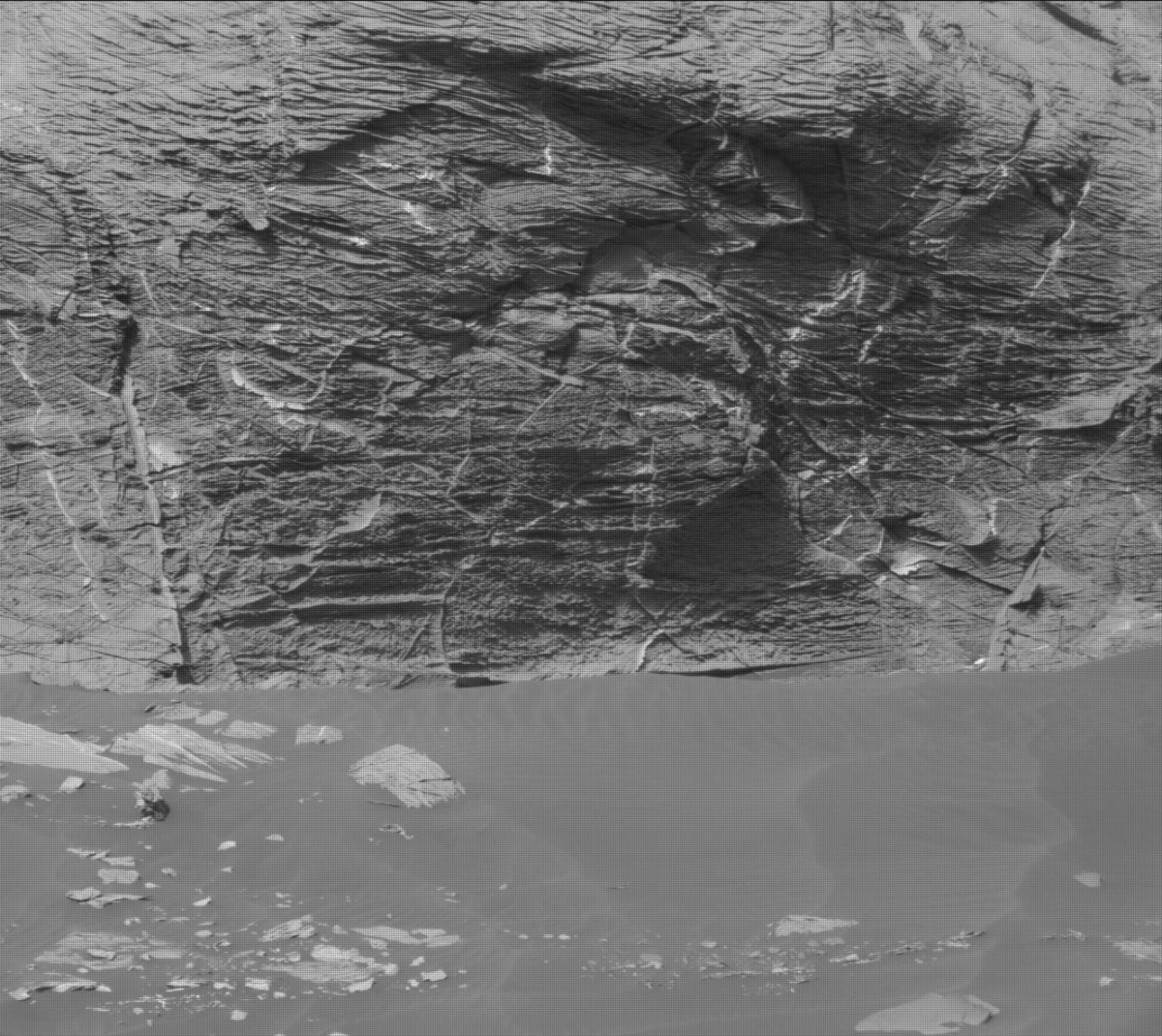
Images taken by Curiosity’s Mast Camera Right on Sol 3294, November 11, 2021.
Credit: NASA/JPL-Caltech/MSSS

 Posted in
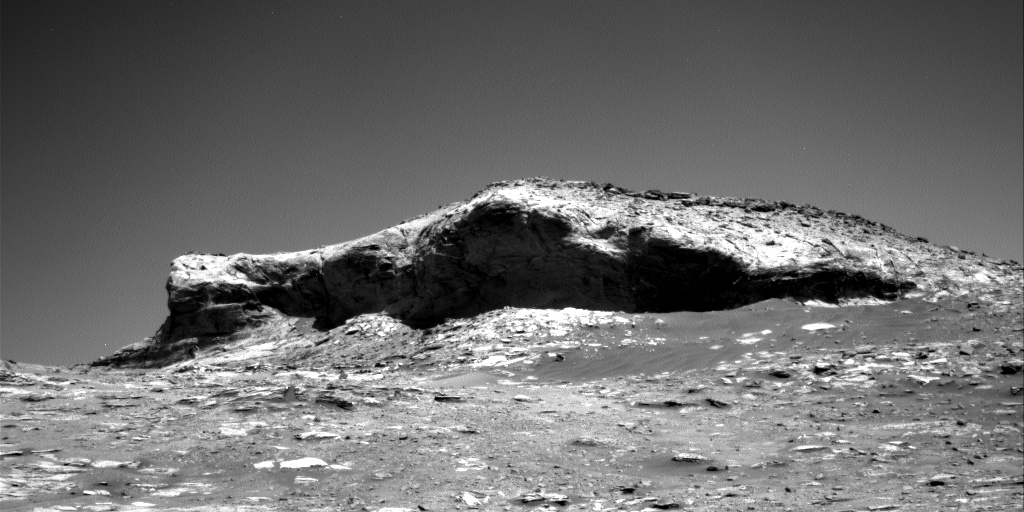
Curiosity Right B Navigation Camera image taken on Sol 3293, November 10, 2021.
Credit: NASA/JPL-Caltech
NASA’s Curiosity Mars rover at Gale Crater is now performing Sol 3295 duties.
The robot is continuing its drill campaign at the Zechstein site reports Mariah Baker, a planetary geologist at the Center for Earth & Planetary Studies at the Smithsonian National Air & Space Museum in Washington, D.C.

Curiosity Right B Navigation Camera image taken on Sol 3293, November 10, 2021.
Credit: NASA/JPL-Caltech
“Even though the original plan already included two hefty science blocks, the rover still had extra energy to spare! In order to take advantage of this excess energy, the team added yet another science block to the plan and strategically positioned it to occur in the morning around 8 AM local Martian time,” Baker explains.
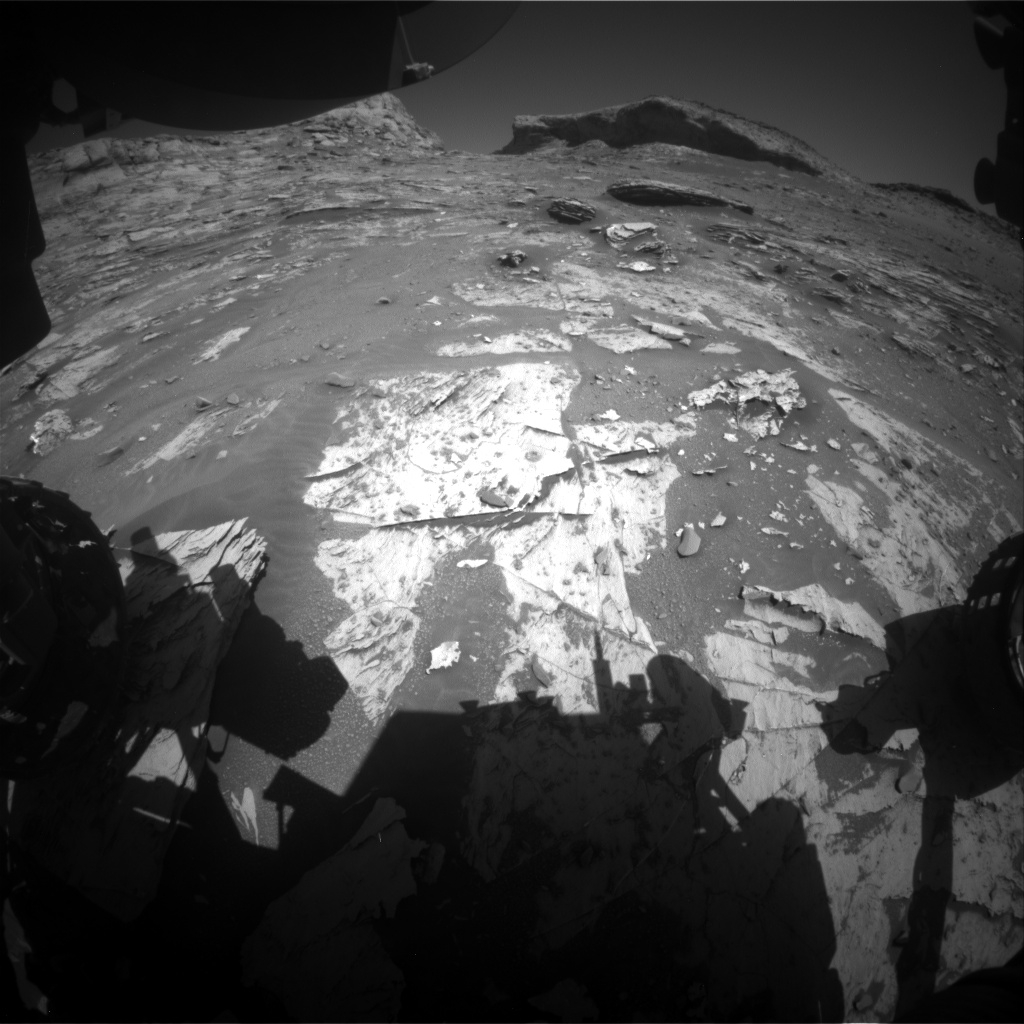
Curiosity Front Hazard Avoidance Camera Left B image acquired on Sol 3293, November 11, 2021.
Credit: NASA/JPL-Caltech
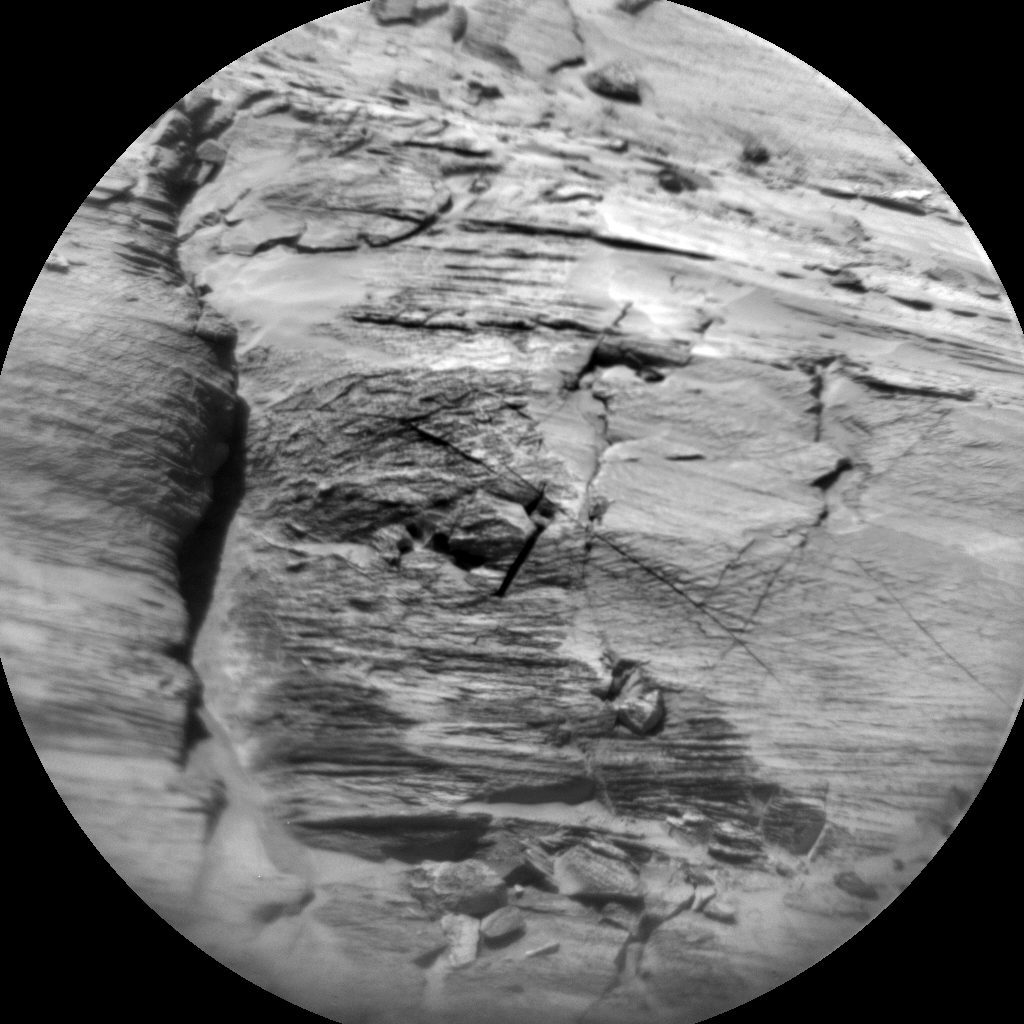
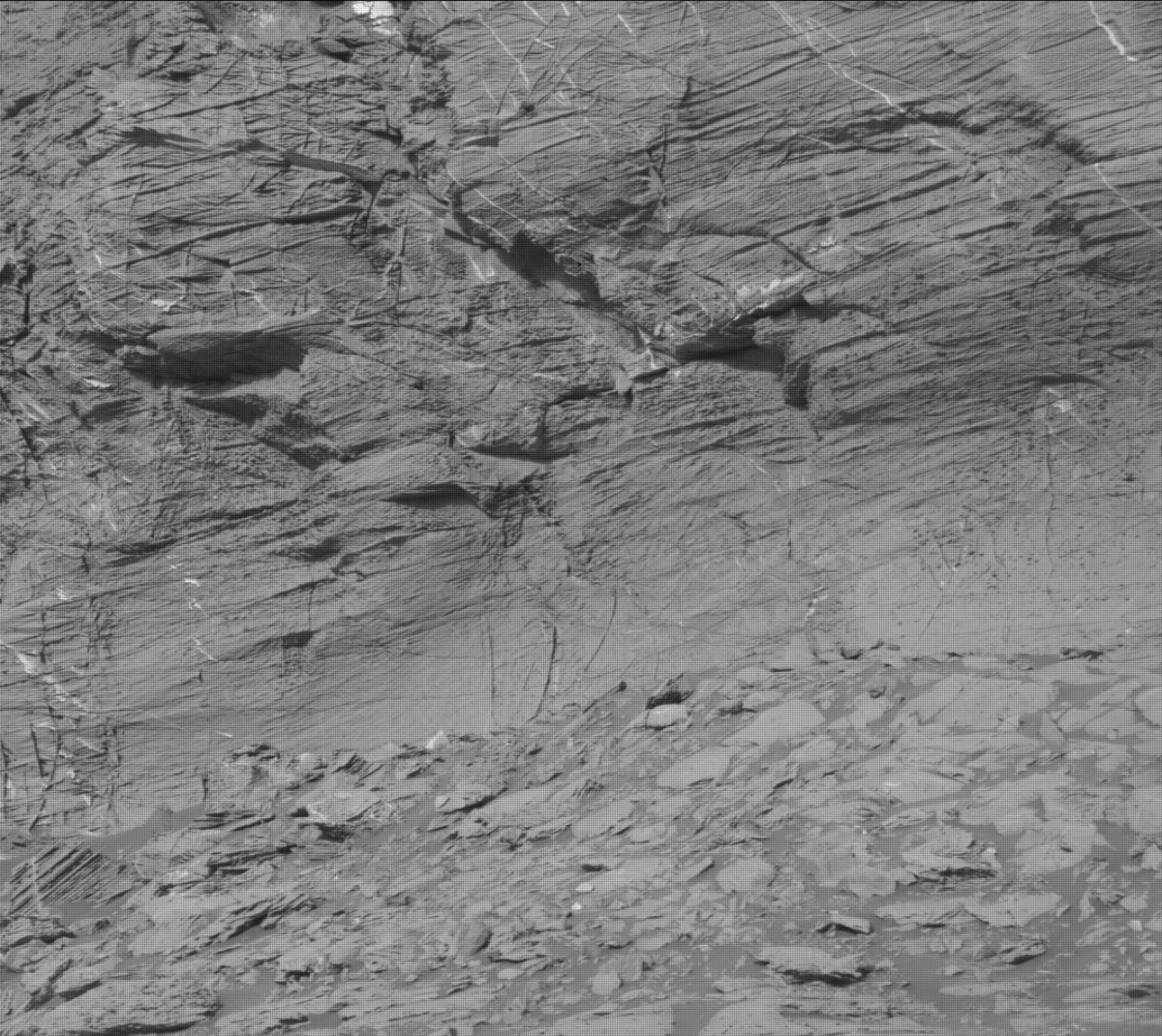
Curiosity Chemistry & Camera (ChemCam) Remote Micro-Imager (RMI) photo acquired on Sol 3294, November 10, 2021.
Credit: NASA/JPL-Caltech/LANL
Better illumination
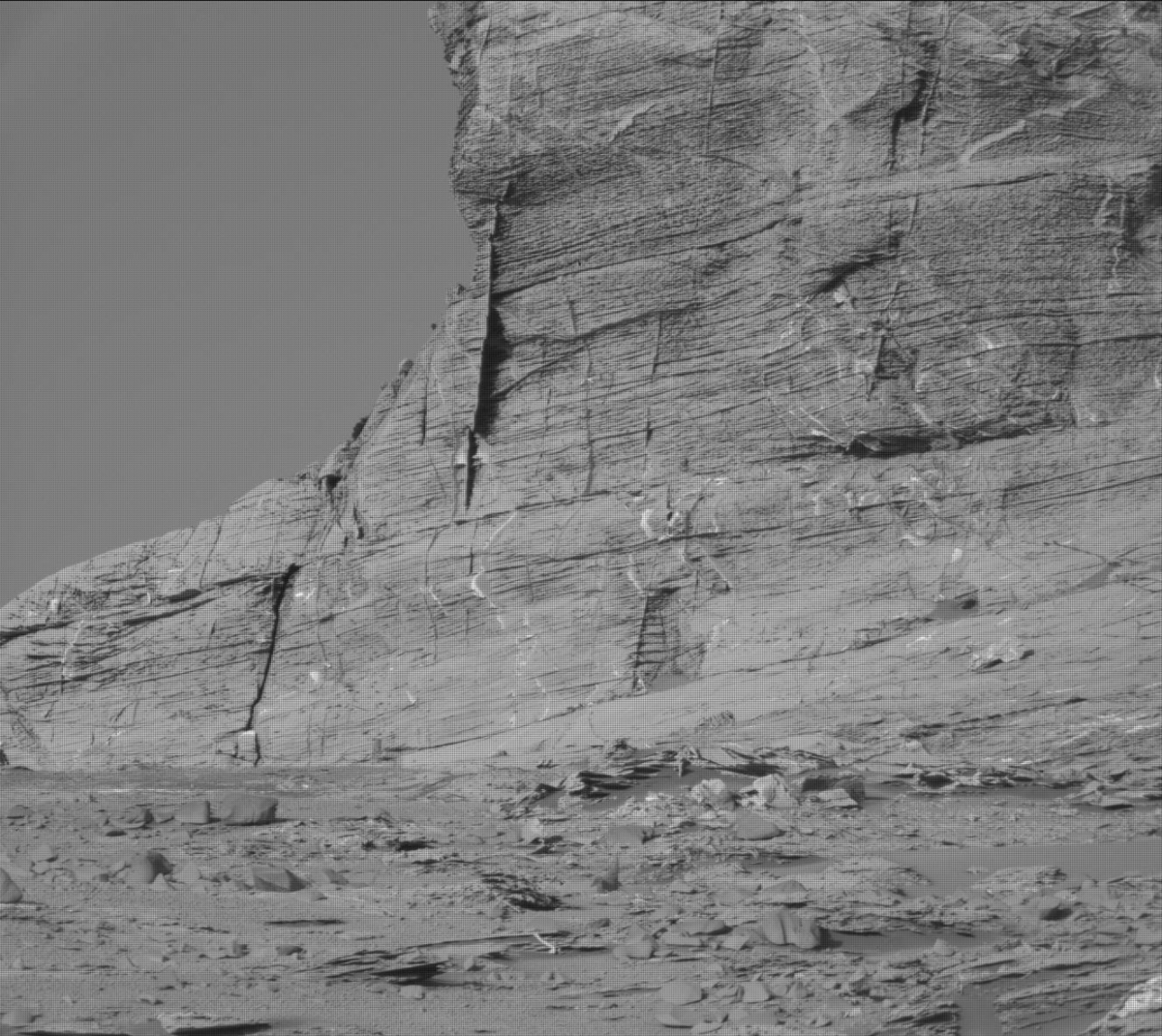
While science blocks typically occur during the middle of the day, this early morning time was desirable because it would provide better illumination for acquiring a Chemistry and Camera (ChemCam) Remote Micro-Imager (RMI) image of a complex rock outcrop nearby.
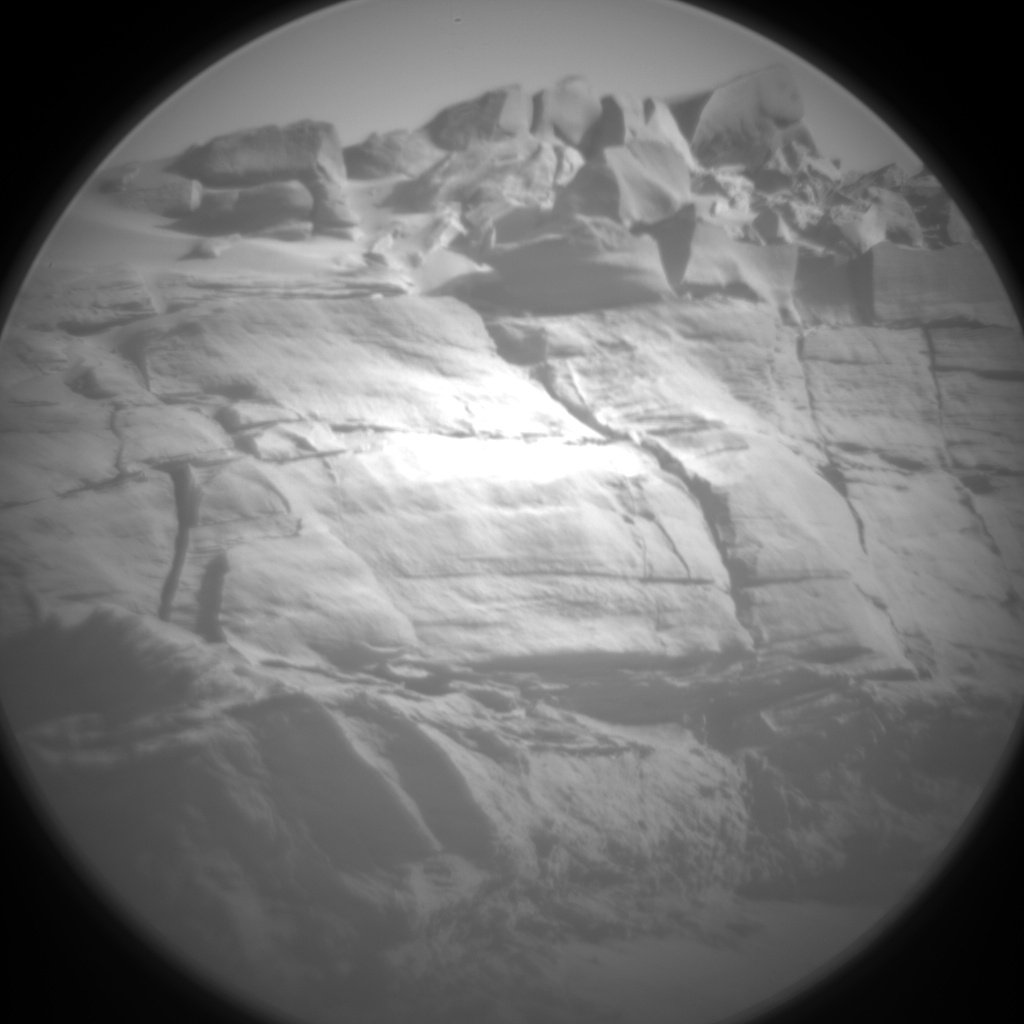
Curiosity Chemistry & Camera (ChemCam) RMI photo acquired on Sol 3294, November 11, 2021.
Credit: NASA/JPL-Caltech/LANL
“Plus, the additional heating needed to operate instruments during the cold morning hours would use up more of the rover’s spare energy,” Baker adds. “In other words, this new morning block was beneficial for both science and operations—a win win!”

Curiosity Chemistry & Camera (ChemCam) Remote Micro-Imager (RMI) photo acquired on Sol 3294, November 11, 2021.
Credit: NASA/JPL-Caltech/LANL
Filled to the brim
The other two science blocks in the plan were also filled to the brim with activities: two Mastcam mosaics were planned on local bedrock including target “Hare Stone,” and a third Mastcam mosaic will provide stereo coverage of a curved sand ripple that can be seen from orbit.

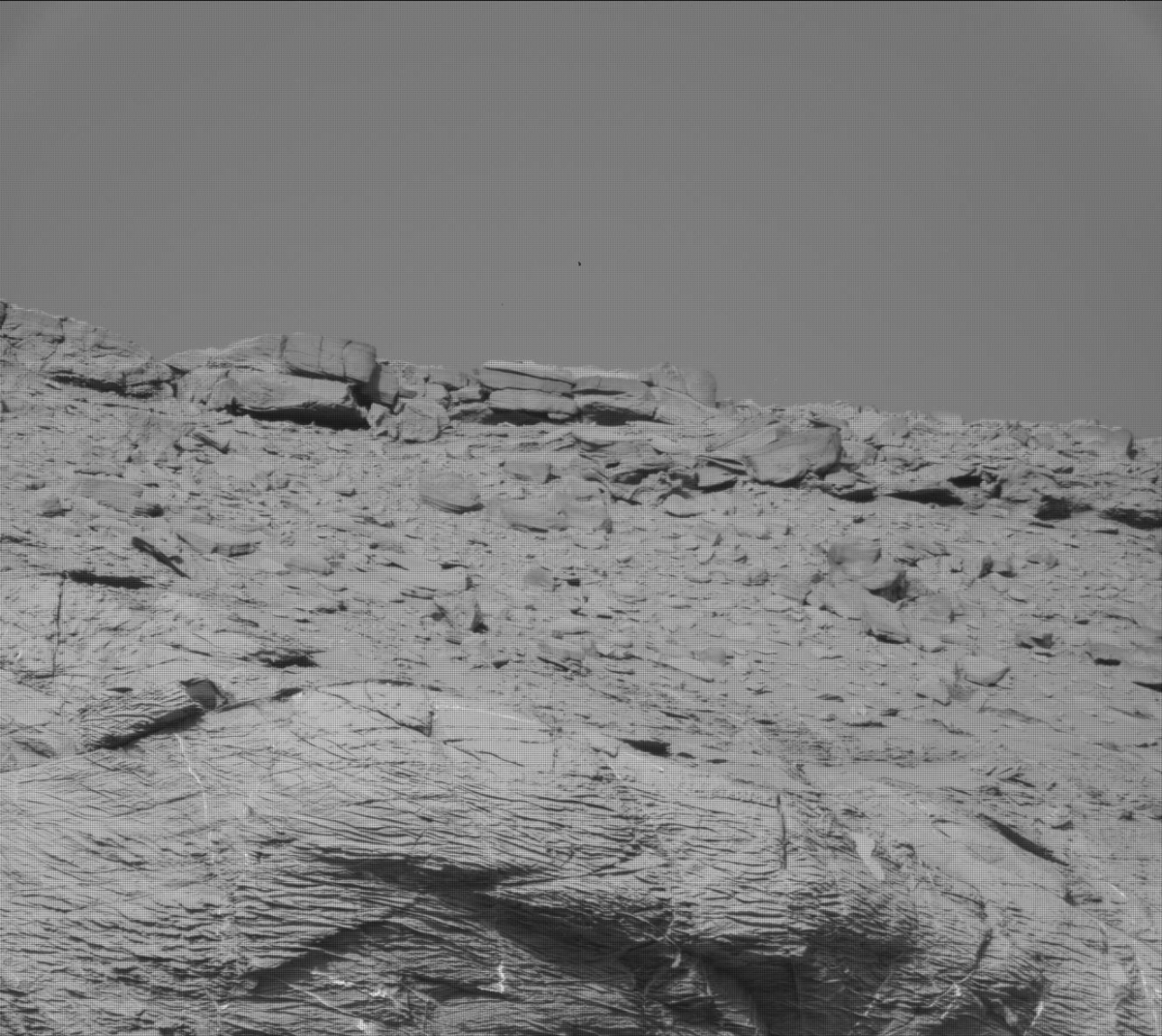
Curiosity Mast Camera imagery taken on Sol 3292, November 9, 2021.
Credit: NASA/JPL-Caltech/MSSS
A ChemCam Passive observation was slated to collect supplementary data on a pebble that was studied previously using the ChemCam Laser Induced Breakdown Spectroscopy (LIBS) capability.
Additional ChemCam LIBS measurements and associated Mastcam documentation images were to be acquired on bedrock targets “Tong Saltings” and “Stack of Handa.”

Curiosity Chemistry & Camera RMI photo shows laser strikes in new drill hole. Taken on Sol 3292, November 9, 2021.
Credit: NASA/JPL-Caltech/LANL
Weekend of science
“A third Mastcam documentation image of the Zechstein drill hole will be used to monitor wind-driven changes in the drill tailings,” Baker reports.
“The rover will also collect a set of environmental Navcam observations including dust devil, suprahorizon, and zenith movies, as well as a line-of-sight image for studying atmospheric dust levels,” Baker concludes. “Even with all the activities planned over the next two sols, the rover is projected to have enough energy entering the plan on Friday for another full weekend of science!”

Credit: NASA
Earth’s cold moon looms as hot property given its prospect of becoming feedstock for humans to not only survive but thrive on that desolate lunar landscape.
And with that promise, there’s also an upsurge of legal issues regarding tapping the Moon’s assets, along with property rights and first-come, first-served dibs on digging out those resources.
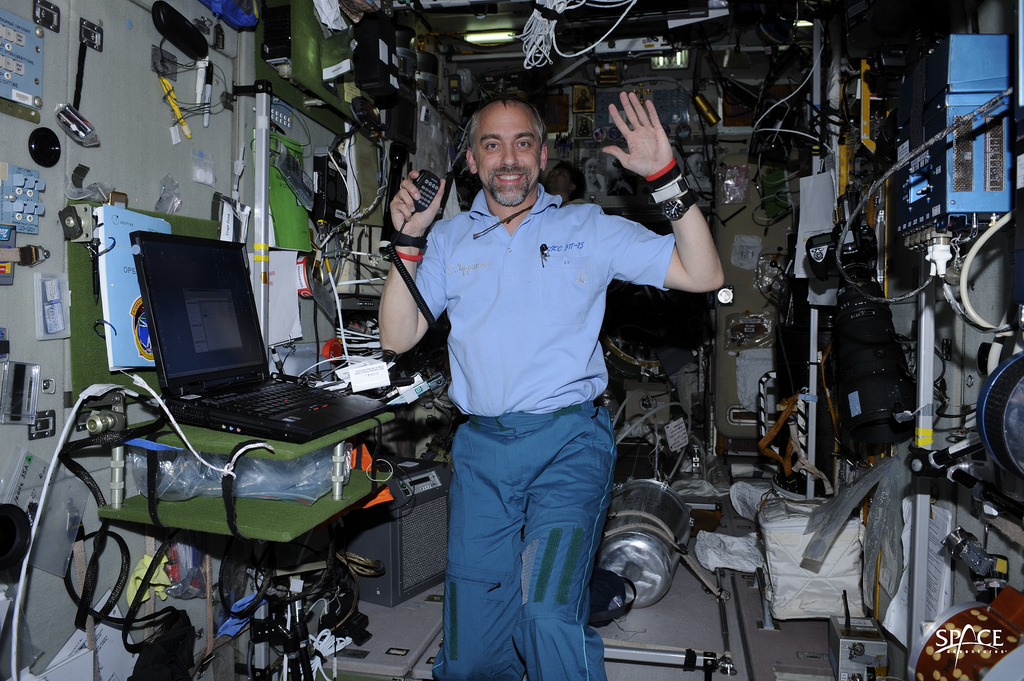
Credit: Space Adventures
All this is 21st century, front-and-center discussion, but add to the dialog decades old questions of who can lay claim to space and, perhaps more pressingly, who owns the moon?
That question was tackled in an October 18 video conversation sponsored by the New York-based Explorers Club.
Go to my new Space.com story – “Who owns the moon? One man’s lunar claim – It’s only slightly tongue in cheek” at:
https://www.space.com/moon-property-rights-lunokhod-2-richard-garriott

SpinLaunch reports it has conducted a successful vertical launch at its Spaceport New Mexico Test Site in October 22, 2021.
The somewhat closed-lipped SpinLaunch was founded by Jonathan Yaney in 2014 to “reimagine” space launch technology and enable the rapid and cost-effective deployment of small satellite constellations into Low Earth Orbit (LEO).
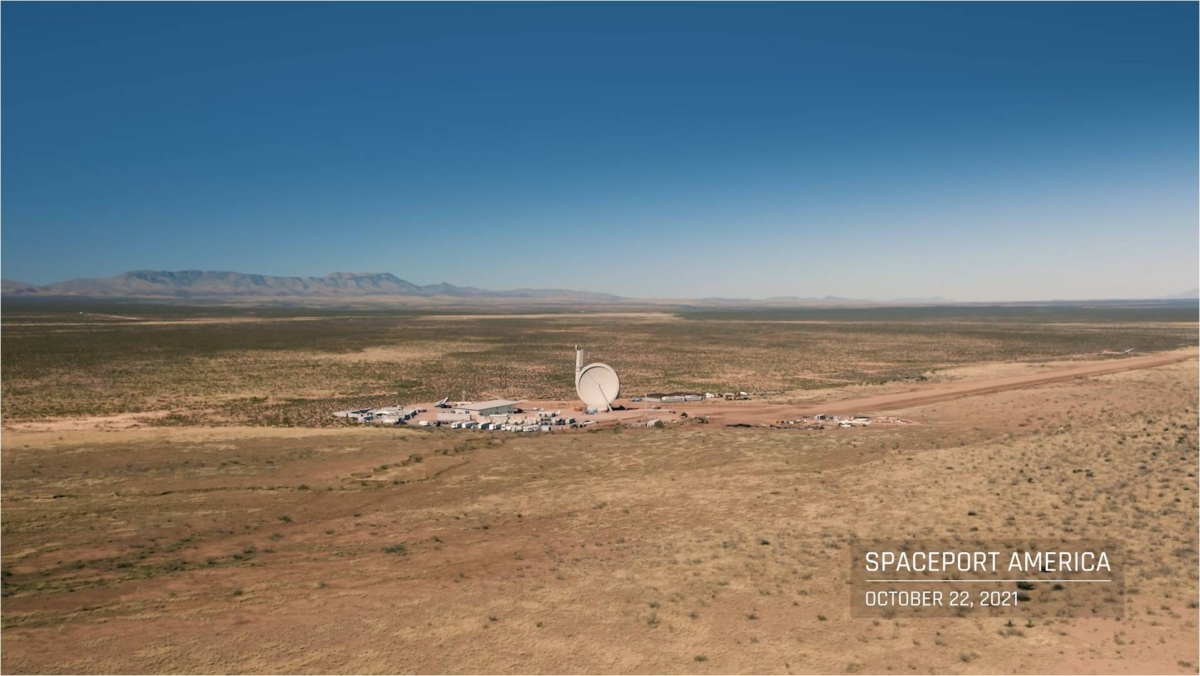
Credit: SpinLaunch/Inside Outer Space screengrab
SpinLaunch uses a novel kinetic launch system.
Flight #1 was a successful horizontal flight – the entire vacuum chamber assembly can rotate to a variety of launch elevations for testing and range flexibility, notes a Tweet from the company.
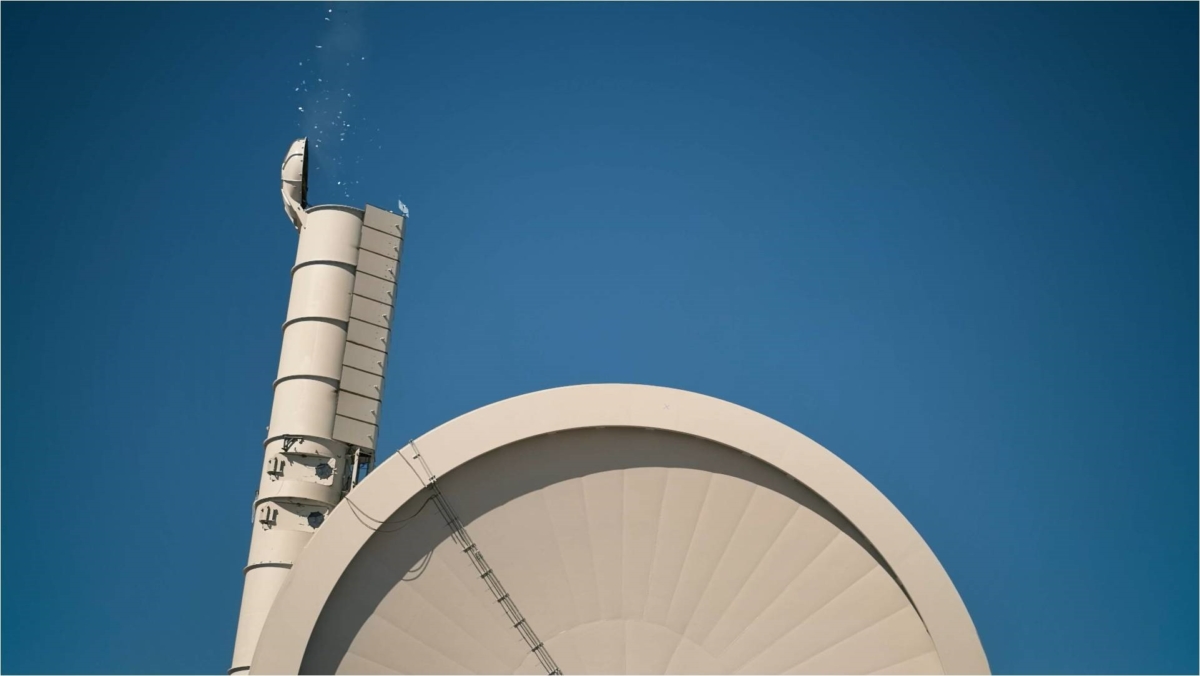
Credit: SpinLaunch/Inside Outer Space screengrab
Headquartered in Long Beach, California, SpinLaunch employs over 200 employees. It is backed by partners including Airbus Ventures, Google Ventures and Kleiner Perkins.
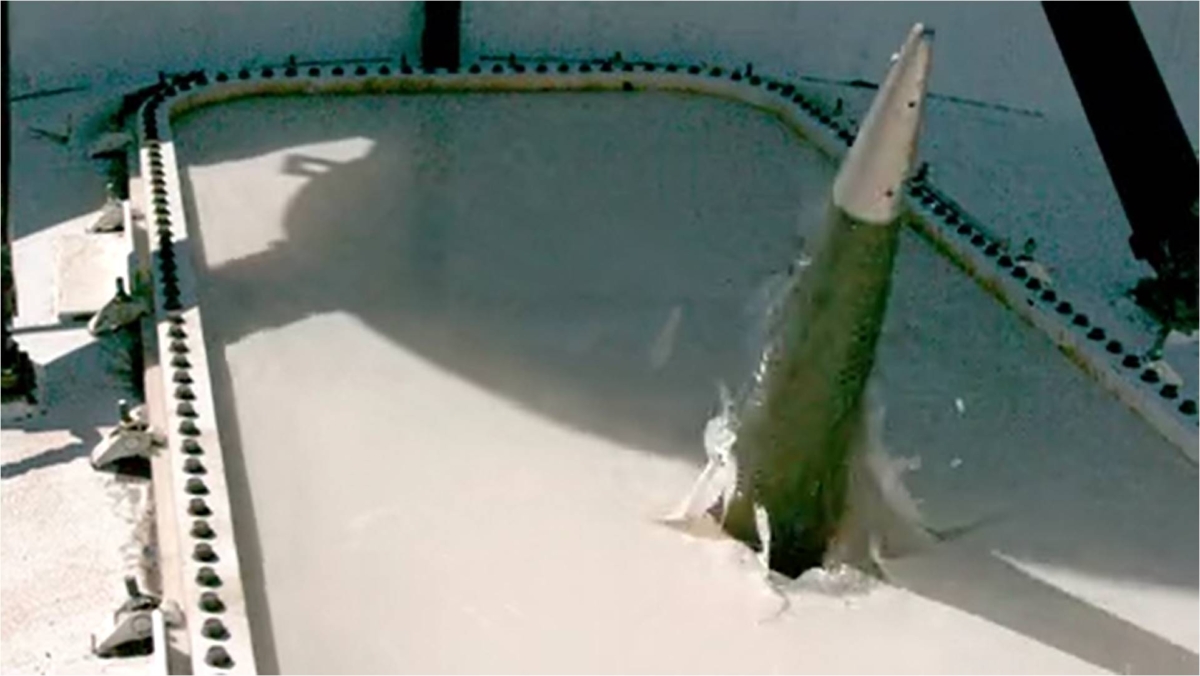
Credit: SpinLaunch/Inside Outer Space screengrab
According to the firm’s website, the company is on target to place satellites in orbit and deliver payloads for spacefaring endeavors by 2025.

Artist’s view of futuristic launch facility for hurling satellites into Earth orbit.
Credit: SpinLaunch
Go to this video gallery that showcases the concept and the October first vertical flight at:
https://www.spinlaunch.com/gallery
Also, ace CNBC space reporter, Michael Sheetz, has written a story on the test flight, here:
https://www.cnbc.com/2021/11/09/spinlaunch-completes-first-test-flight-of-alternative-rocket.html
Lastly, take a read of these past stories on Inside Outer Space:
SpinLaunch: New Investment
https://www.leonarddavid.com/spinlaunch-new-investment/
SpinLaunch: Kinetic Energy-based System for Orbiting Satellites
https://www.leonarddavid.com/spinlaunch-kinetic-energy-based-system-for-orbiting-satellites/
New “Spin” on Launching Small Satellites (Updated)
https://www.leonarddavid.com/new-spin-on-launching-small-satellites/
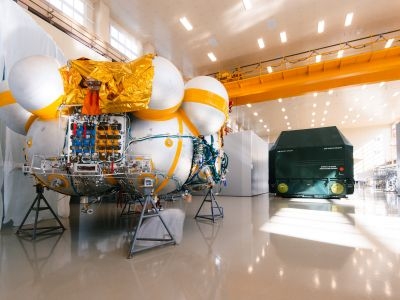
Fregat upper stage. Credit: Roscosmos
Russia’s re-entry into lunar exploration – the Luna-25 – is slowly coming together with a projected launch date apparently sliding from May into July 2022.
Meanwhile, an upper stage “Fregat” designed to launch the Moon probe atop a Soyuz-2.1b booster is being air-shipped to the Vostochny Cosmodrome.

Russia’s Luna-25 Moon lander.
Credit: RSC Energia/Roscosmos
Luna-25 has been produced by NPO Lavochkin and tasked to soft land in the near-polar region and to carry out contact studies of the South Pole of the Moon. The main task of the mission is to develop basic soft landing technologies.
The Fregat upper stage, manufactured by NPO Lavochkin, is used as part of medium-class launch vehicles, hurling payloads on trajectories departing from the Earth. Since 2000, the Fregat upper stage has provided 101 launch campaigns and launched more than 700 spacecraft, both Russian and foreign, into various near-earth orbits and departure trajectories.

Factory floor integration of science instruments on Russia’s Luna-25 Moon mission, originally targeted for an October 2021 sendoff.
Credit: Roscosmos
Follow-on missions
Originally targeted for sendoff in October 2021, Luna-25 opens a long-term Russian lunar program, which includes missions to study the Moon from orbit and surface, collect and return lunar soil to Earth, as well as construct a visited lunar base, in cooperation with the Chinese National Space Administration within a large-scale project to create an International Scientific Lunar Station.
As noted by the Institute of Space Research of the Russian Academy of Sciences, there are follow-on Russian Moon missions on the books: Luna-26 (or Luna-Resurs-Orbiter), an orbital mission to study Moon from low polar orbit. Luna-27 would be a landing mission (or Luna-Resurs-Lander), designed to study lunar regolith on-the-spot. The European Space Agency (ESA) is working on a drill and a sampling device for this spacecraft.
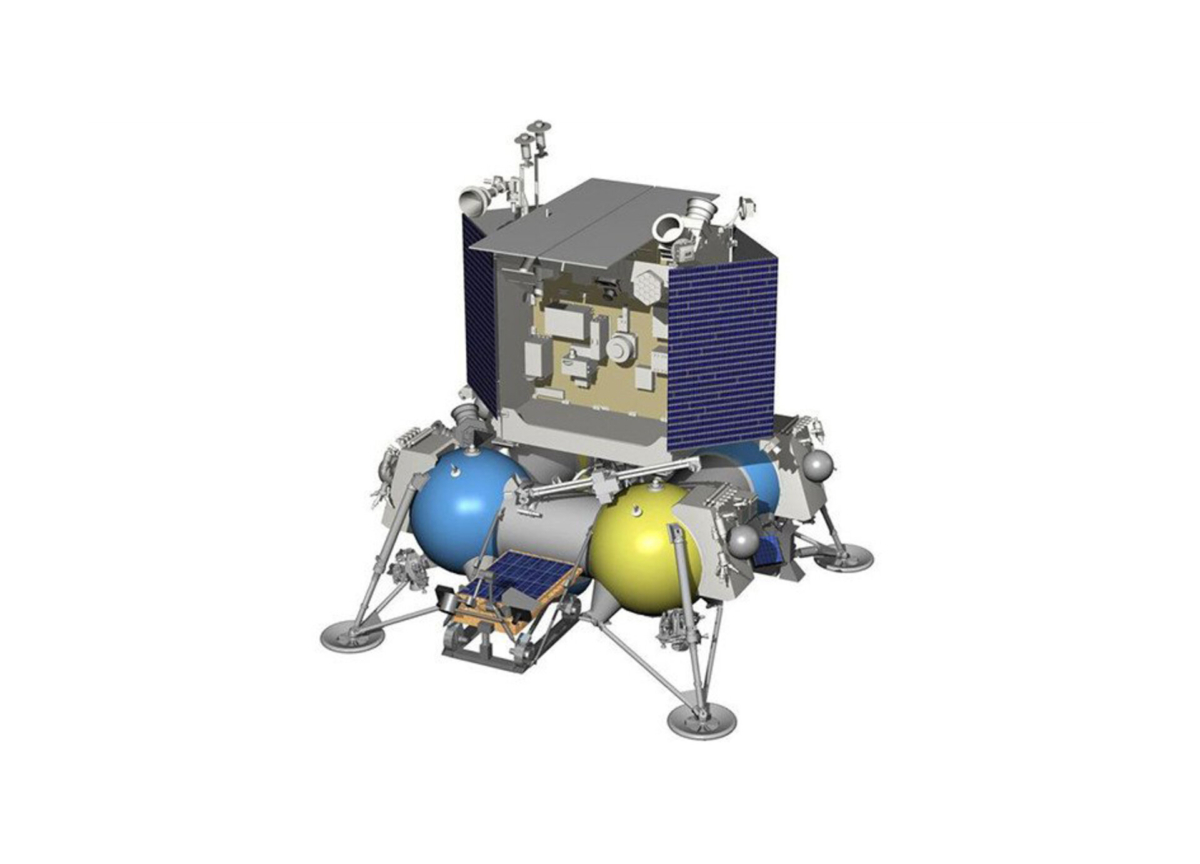
Luna-27
Credit: Roscosmos/ESA
ESA/Russia cooperation
When Luna-25 lands on the Moon, it will image the terrain with a European Pilot-D camera built specifically for landing.
According to ESA, two years after Luna-25, the Luna-26 orbiter will be sent to lunar orbit for remote scientific measurements and as a possible communications relay for the next lander mission. It will transmit data back to ground stations on Earth, including ESA’s ground station network.
The Luna-27 lander will be launched one year after Luna-26 and will be larger than its predecessor Luna-25. It will fly to a challenging landing site closer to the lunar south pole using a European system called Pilot as its main navigation system.
Additionally, Luna-27 will deploy the European Prospect drill that will search for water ice and other chemicals under the surface.
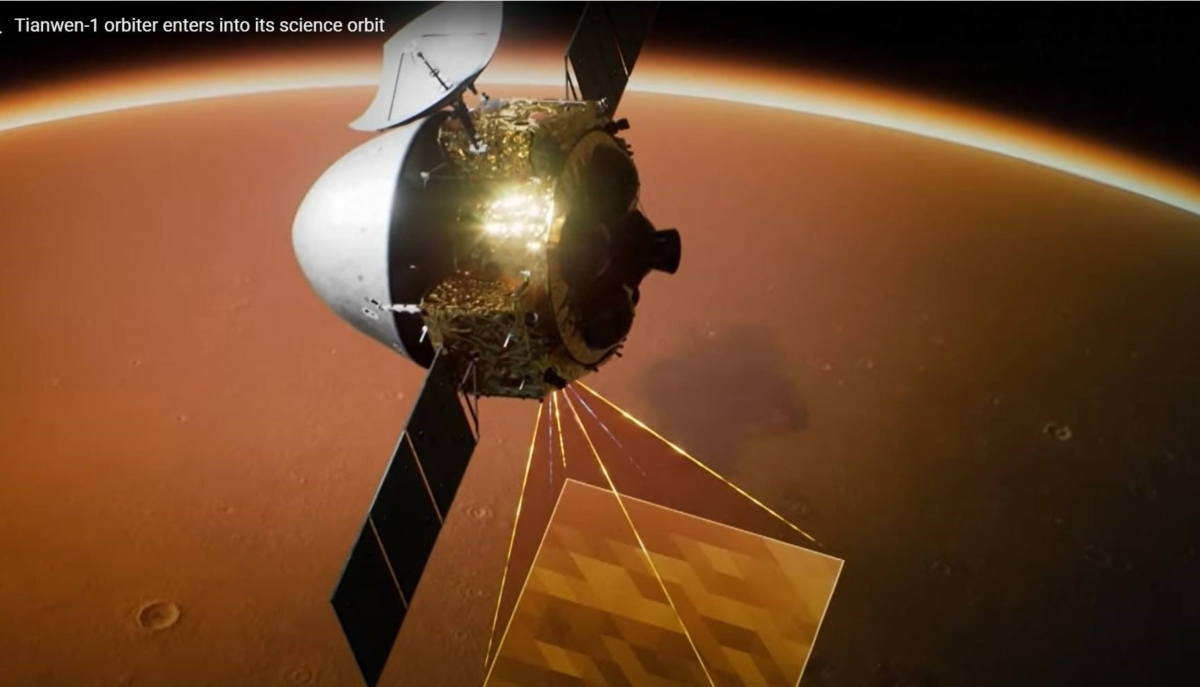
China’s Tianwen-1 Mars orbiter.
Credit: CCTV/Inside Outer Space screengrab
Circling Mars, China’s Tianwen-1 spacecraft has been placed in a new orbit to initiate a global remote sensing sweep of the planet. The orbit change was completed in nearly two hours with four high-power engines pushing the orbiter into a pre-set orbit through a single ignition.
The orbiter is designed to orbit Mars for about two years and has been working since it entered Mars orbit in February 2021.
Tianwen-1 will continue to relay communication between China’s Zhurong Mars rover and Earth in the new orbit.

Credit: Zou Yongliao, et al.
Seven payloads
China National Space Administration (CNSA) has stated that the orbiter’s seven scientific payloads will obtain scientific data relating to morphology and geological structure, surface material composition and soil type distribution, the atmospheric ionosphere and the space environment of Mars.

In a China Central Television (CCTV) interview, Zhu Xinbo, deputy chief designer, Tianwen-1 Mars orbiter, said the orbiter will move between the north and south poles of Mars, and conduct surface sensing at its perigee (lowest point of the orbit) to better observe the Red Planet.
“The camera’s resolution will be greatly improved,” Zhu said.
Zhu said it is estimated that preliminary global data of Mars will be available by June 2022, laying a foundation for subsequent robotic Mars sampling missions.

Zhurong Mars robot. Credit: CNSA
“We can get insightful data about the Mars through the payloads, including magnetic field, topography and subsurface structure,” said Zhu.

Credit: CCTV/Inside Outer Space screengrab
In good condition
To date, CNSA added that the Tianwen-1 spacecraft has worked in orbit for 473 days. Meanwhile the Zhurong rover has operated on the Martian surface for 174 Martian days, accumulating a total distance of 0.7 of a mile (1,253 meters). The two are in good condition and all systems are reportedly working normally.
Before the rover touched down on the Red Planet, the orbiter’s high-resolution camera and medium-resolution camera produced images of the landing area.
“At the end of next year when the orbiter’s designed life comes to an end, we’ll design new missions based on the specific conditions of the orbiter, and will then lower its orbit to extend the segmental arc for closer observation of Mars and obtain more exploratory data,” Zhu said.
Subsurface radar deployment
Onboard the Tianwen-1 orbiter is the Mars Orbiter Subsurface Investigation Radar (MOSIR). MOSIR is intended to search for water ice and liquid water that may be associated with signs of life in the polar layered deposits, Tianwen-1 landing site, and other selected areas.
With its deployment, the subsurface radar will have four antennas, which are about five meters in length. “Electromagnetic waves can be transmitted and received through the four antennas. Then we can explore and get the data about the subsurface structure of Mars, including the distribution of water and ice,” said Zhu.
Go to these newly released videos detailing the orbit change and China’s planning of Red Planet exploration at:
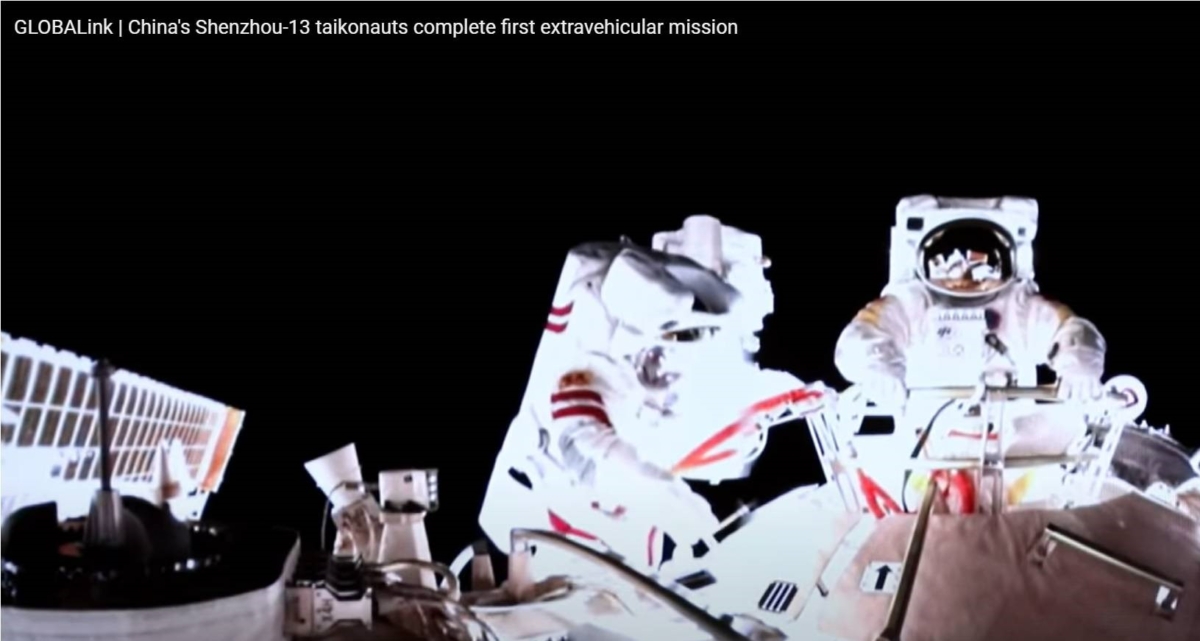
Credit: GLOBALink/Inside Outer Space screengrab
China Taikonauts Zhai Zhigang and Wang Yaping completed their extravehicular activities (EVAs) and returned to the space station core module Tianhe in the early hours of Monday, Beijing time.
The two returned to the core module after 6.5 hours of spacewalking duties. Ye Guangfu remained in the cabin and supported the EVAs.
This was the third extravehicular mission conducted during the construction of China’s space station and the first by the Shenzhou-13 crew.
Zhai’s spacewalk signaled his second time performing an EVA. He completed China’s first spacewalk 13 years ago during the Shenzhou-7 mission. In this more recent outing, he installed “foot stoppers” and then performed the EVAs under the assistance of the station’s robotic arm.
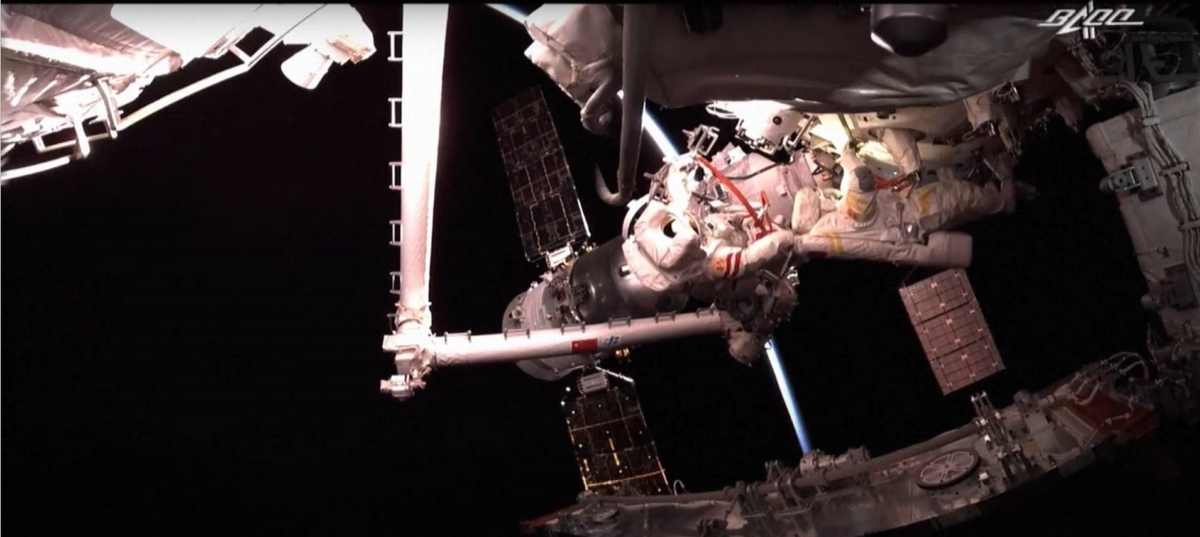
Credit: CNSA/China Media Group/CCTV
Robotic arm work
Following her exit of the Tianhe core module, Wang became China’s first woman astronaut to perform an EVA.
The ground control center and the Shenzhou-13 spacewalkers cooperated closely in installing a suspension device and transfer connectors to the robotic arm.
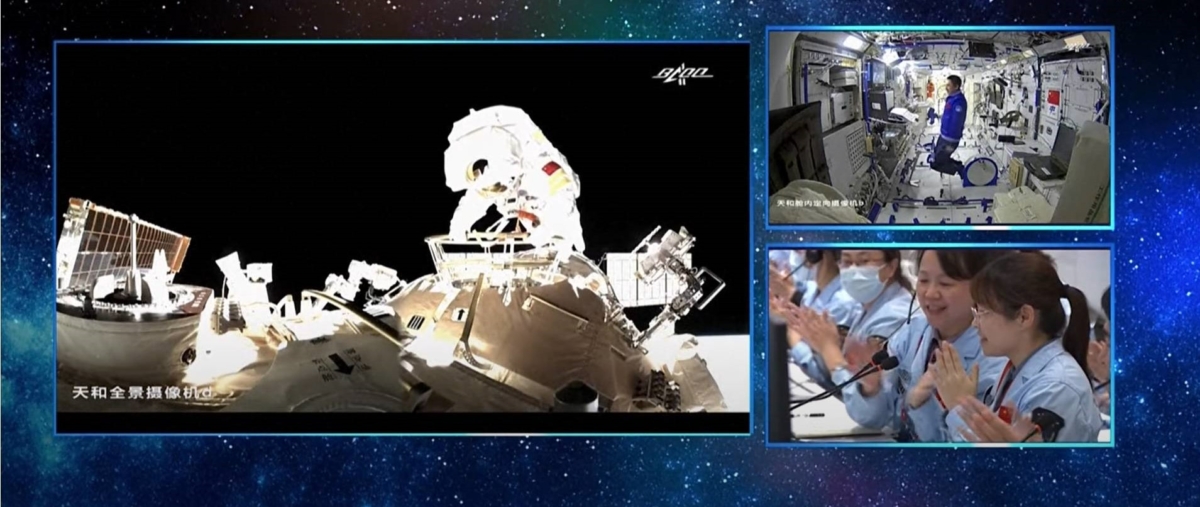
Credit: CNSA/China Media Group/CCTV/Inside Outer Space screengrab
“The device installed this time is mainly used for connecting the upper and lower parts of the robotic arm. We made this to prepare for the two parts to carry out combined operation. After being connected, the two parts can form a 15-meter-long robotic arm, which will have a wider working range,” Tang Zixin, monitor of the robotic arm engineering of the space station system at the China Academy of Space Technology under the China Aerospace Science and Technology Corporation told China Central Television (CCTV).
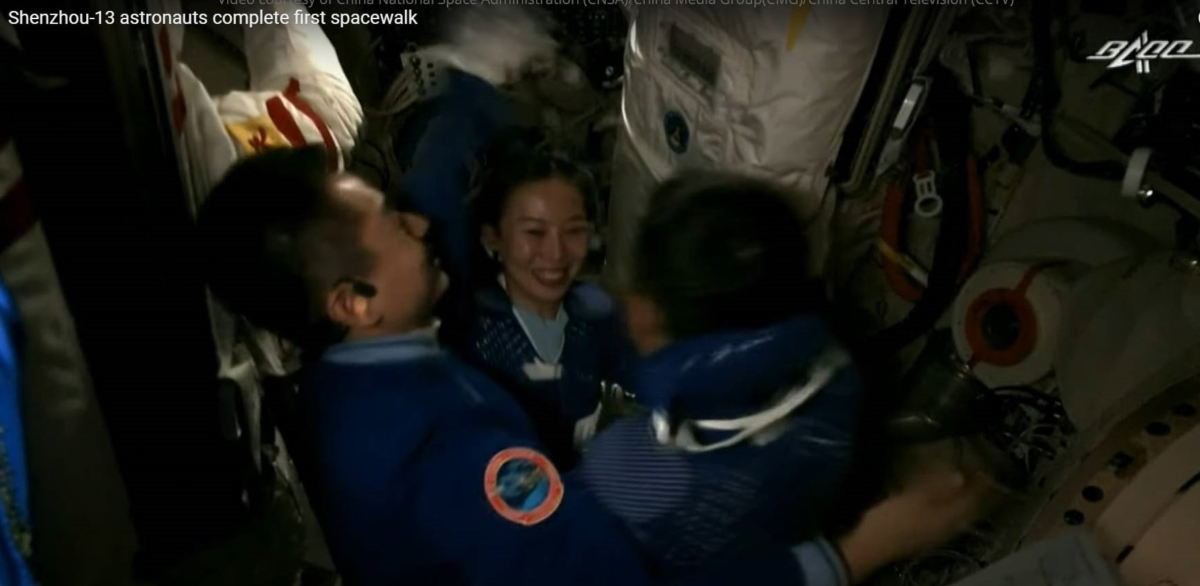
Following two-person EVAs, the trio of taikonauts celebrate.
Credit: CNSA/China Media Group/CCTV/Inside Outer Space screengrab
Station orientation
“This time, the Tianhe core module has two cargo crafts docked at the two ends and a manned spacecraft docked radially. The whole structure has changed a lot. Therefore, to prepare for the EVAs, we made special adjustment involving the flying attitude, solar wings, and tilt angle of communication antenna. The core module’s flying attitude was especially designed for this time’s EVAs. The operation was very precise and accurate,” Zhu Guangchen, deputy chief designer of the space station system at the China Academy of Space Technology under the China Aerospace Science and Technology Corporation told CCTV.
China launched the Shenzhou-13 crew on October 16, the trio of taikonauts on a six-month mission to construct its space station, expected to be completed by the end of next year.

China’s space station scheduled to be operational in 2020’s.
Photo credit: CMSA
New lab modules
China is preparing the launch of two lab modules, Wentian and Mengtian. They will first dock with the space station’s core module in the forward direction and then the mechanical arm will move them to both sides of the core module.
Before this milestone, the Shenzhou-13 crew will use the Tianzhou-2 cargo spacecraft to do a simulative test.
“Tianzhou-2 is now in front of our core module, and then will turn to the side of the core module by the mechanical arm to verify the process of transposition after Wentian module docks with the space station. This is a technique that we must master before the final ‘T’ shape was formed during the assembly phase of the space station,” said Li Xuedong, lead designer of the space station system with the China Aerospace Science and Technology Corporation.

The robotic arm of China’s Tiangong space station seen from Tianhe core module. Credit: Weibo via Twitter
The Tianzhou-2 cargo spacecraft is expected to complete its mission and undock from the space station early next year. After that, the Shenzhou-13 crew will also complete their mission and return to Earth.
When the Shenzhou-14 crew enters the space station, the country will launch the Wentian module that is outfitted with a special airlock capsule, providing a better environment for crew members to carry out spacewalks. That airlock is larger than the one now being used in the core module. It also has more equipment to facilitate EVAs, Li told CCTV.
A number of videos have been issued documenting the recent spacewalk activities. Go to:
NASA’s Curiosity Mars rover at Gale Crater is now carrying out Sol 3290 tasks.
New imagery shows drilling operations on the Red Planet and details of its current surroundings:
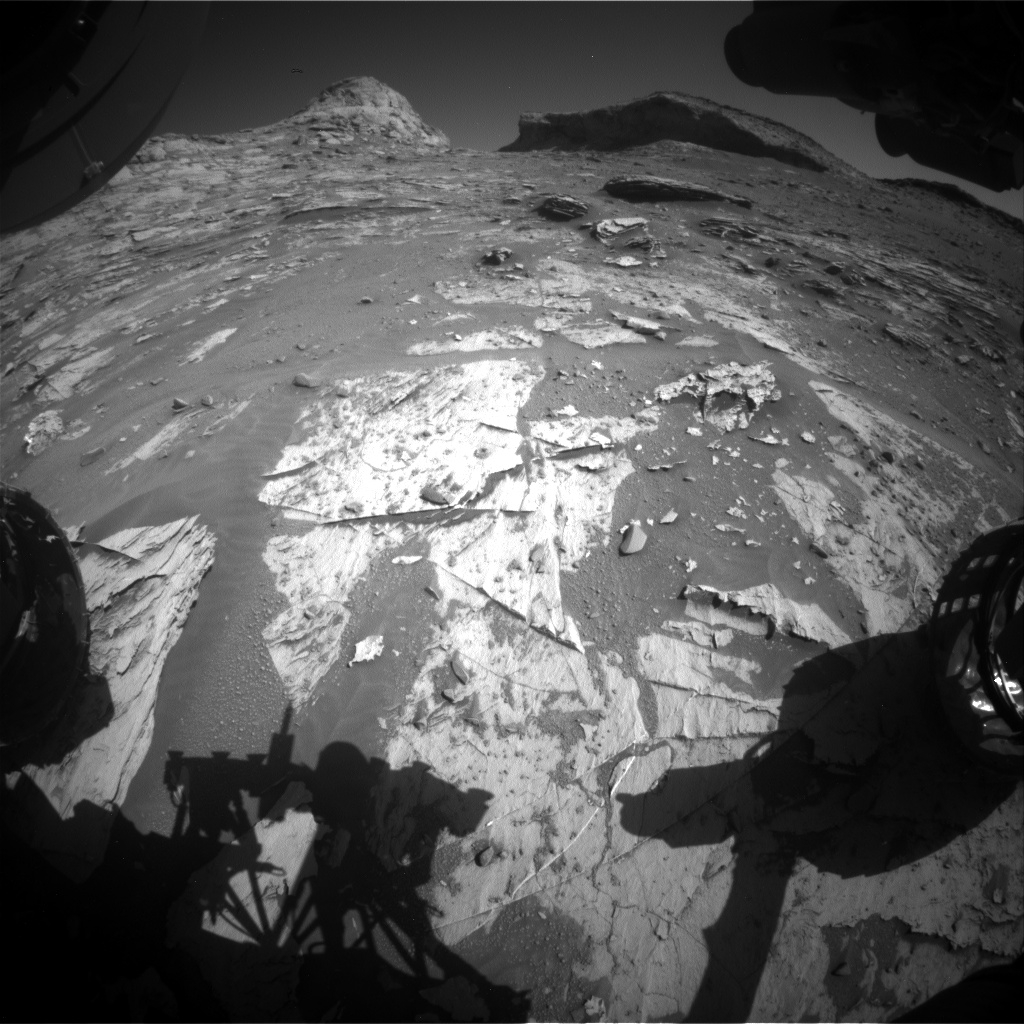
New drill hole (center of image). Curiosity Front Hazard Avoidance Camera Right B photo taken on Sol 3289, November 6, 2021.
Credit: NASA/JPL-Caltech
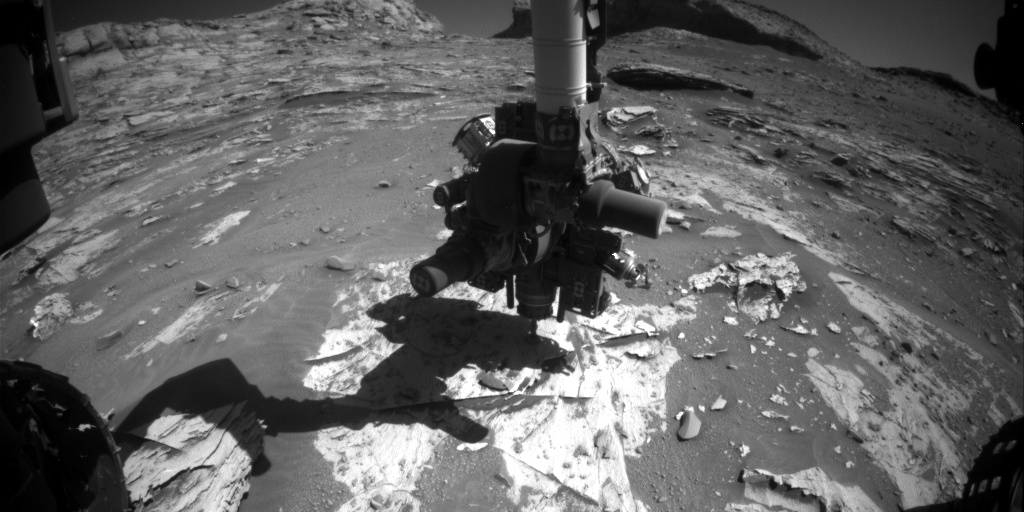
Curiosity Front Hazard Avoidance Camera Left B photo taken on Sol 3289, November 6, 2021.
Credit: NASA/JPL-Caltech
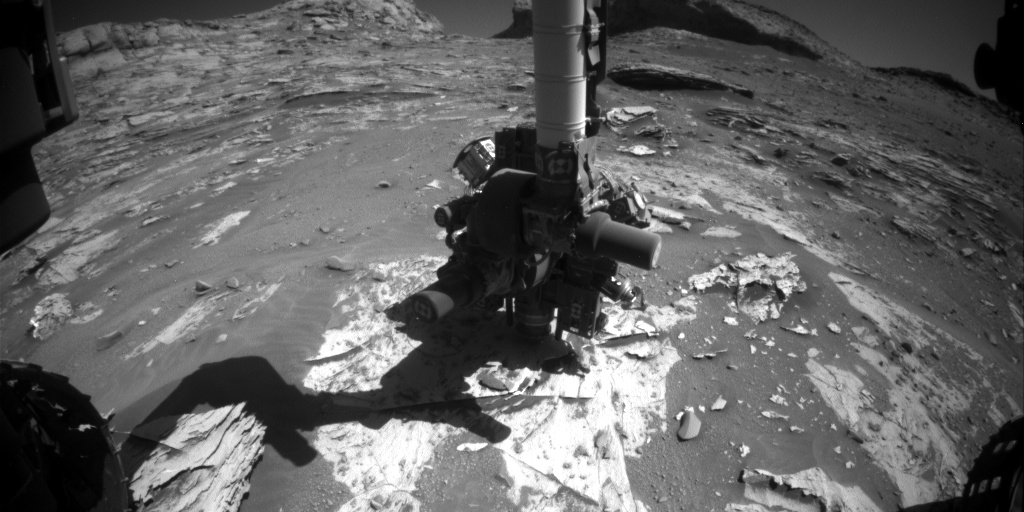
Curiosity Front Hazard Avoidance Camera Left B photo taken on Sol 3289, November 6, 2021.
Credit: NASA/JPL-Caltech
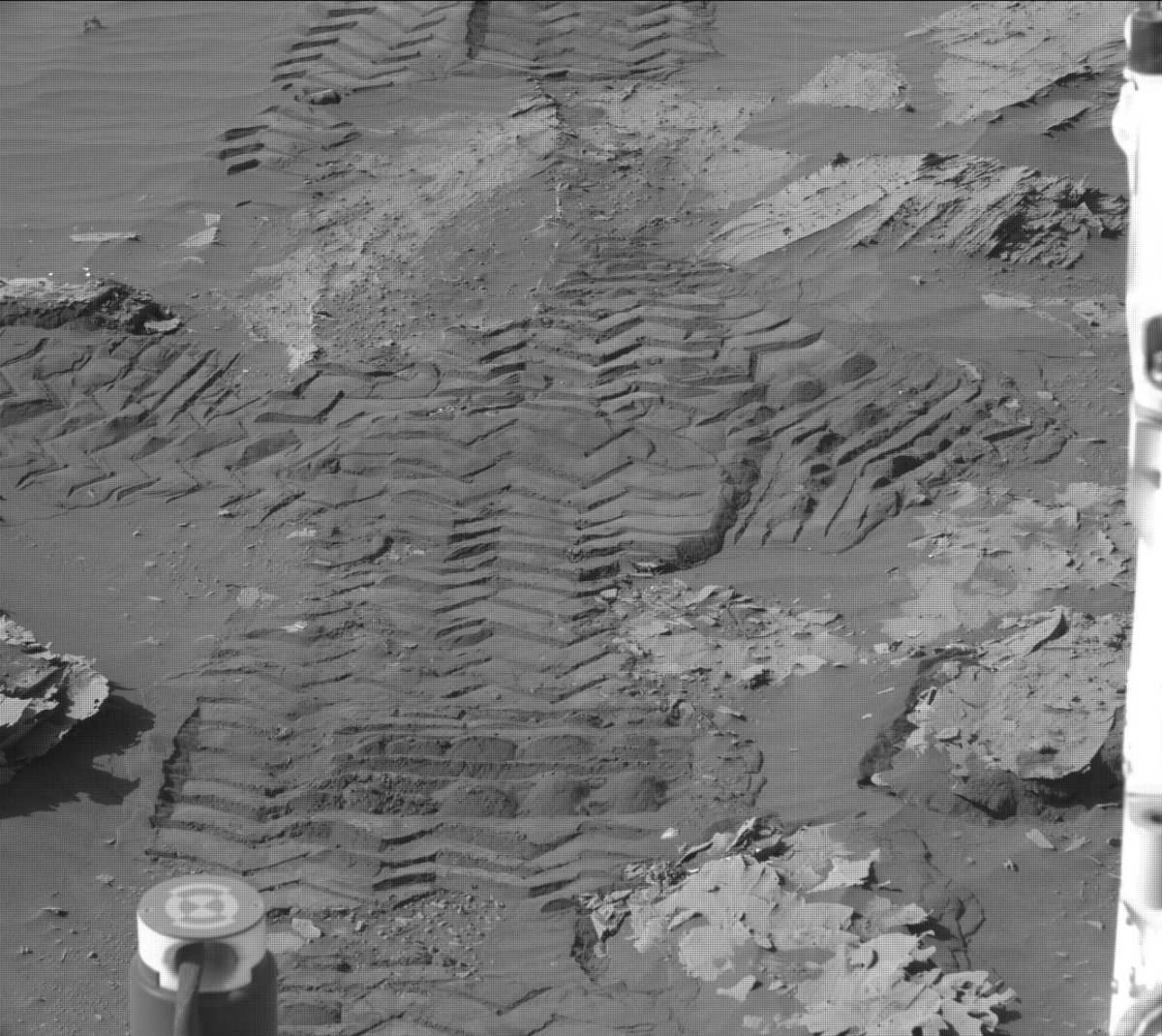
Curiosity Mast Camera Left image acquired on Sol 3288, November 5, 2021.
Credit: NASA/JPL-Caltech/MSSS

Curiosity Mast Camera Left image acquired on Sol 3288, November 5, 2021.
Credit: NASA/JPL-Caltech/MSSS

Curiosity Mast Camera Left image acquired on Sol 3288, November 5, 2021.
Credit: NASA/JPL-Caltech/MSSS
Credit: CCTV/CMSEO
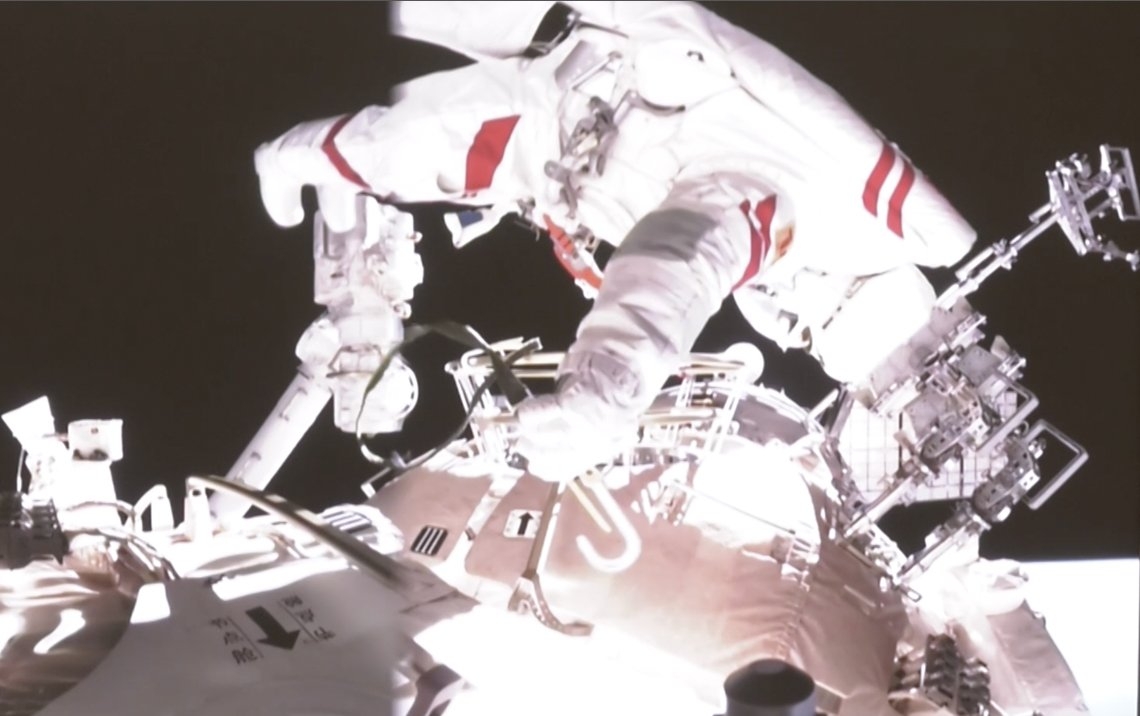
China’s Shenzhou-13 crew are carrying out spacewalking duties on Sunday, using “Feitian” EVA suits for work outside the Tianhe space station core module.
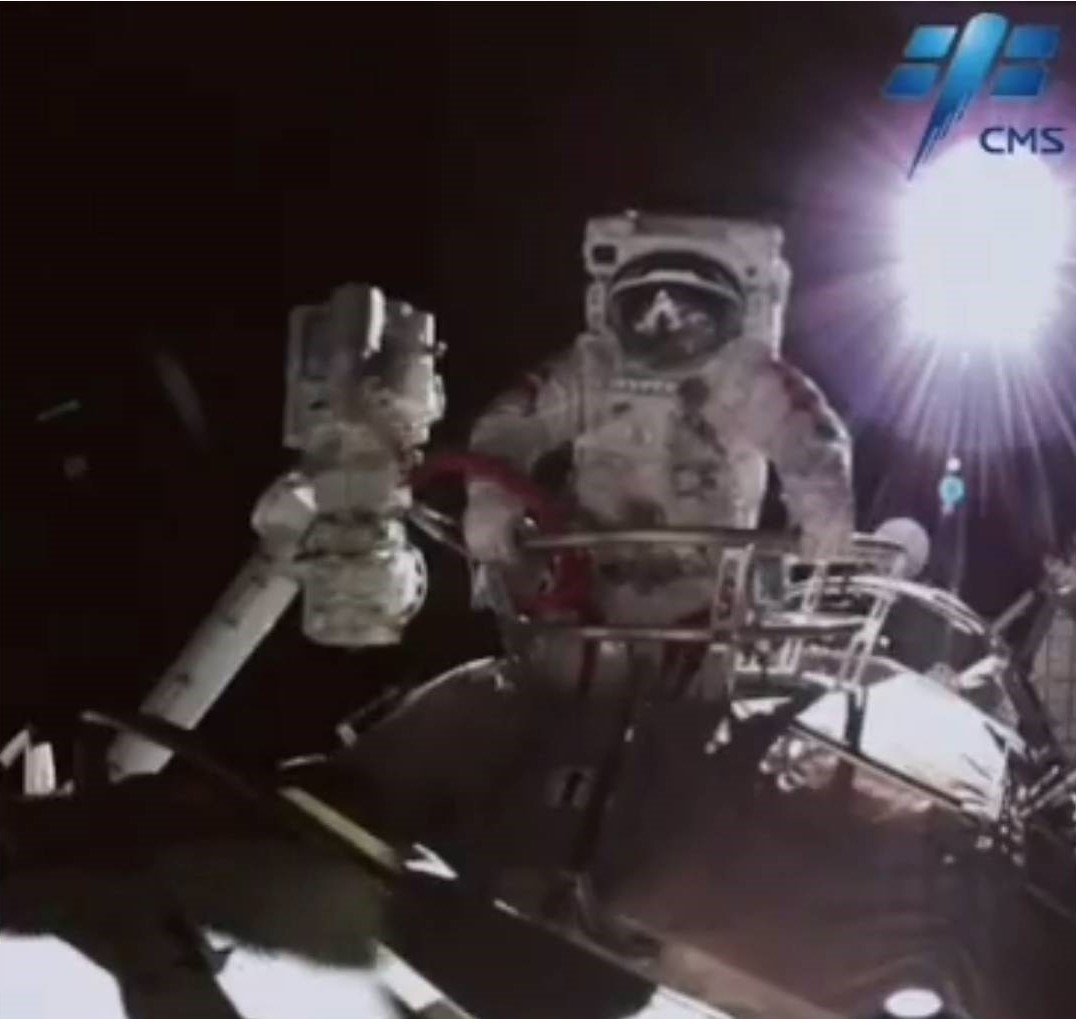
Credit: CMS/Inside Outer Space screengrab
Chinese taikonauts Zhai Zhigang and female colleague Wang Yaping are performing the spacewalks with Ye Guangfu in the cabin supporting the EVAs.
According to the China Manned Space Engineering Office (CMSEO) the spacewalk will last for about 6 hours with Wang becoming the first female taikonaut of China’s space corps to conduct an EVA.
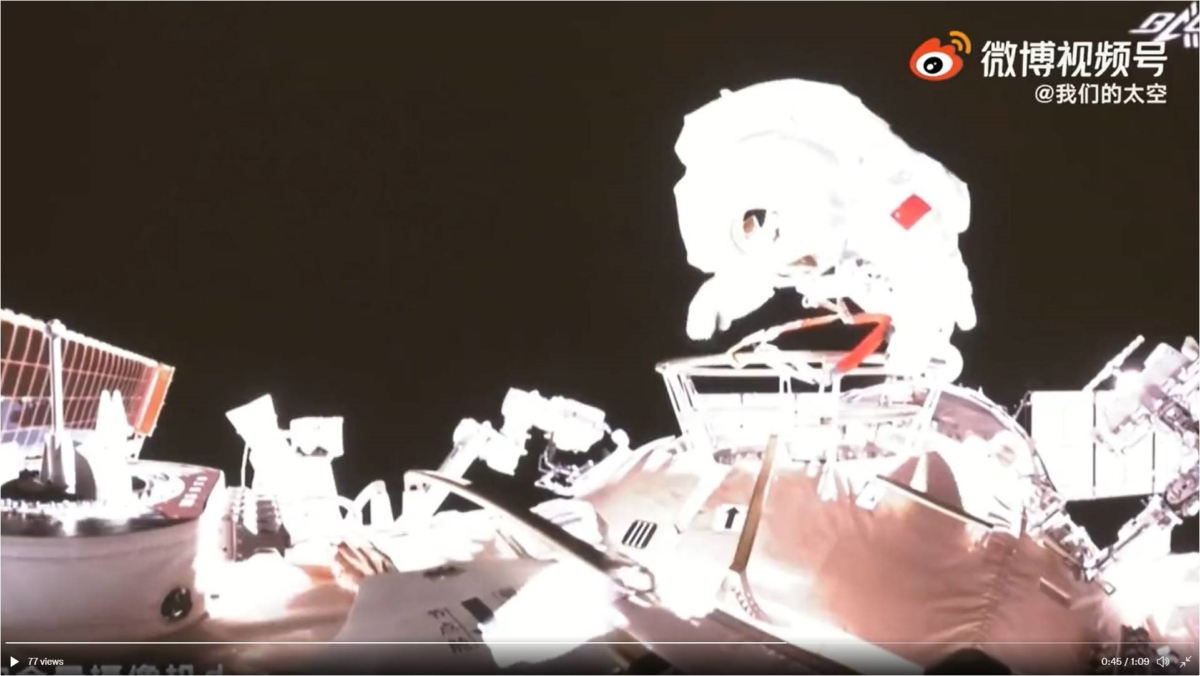
Credit: CCTV/CMSEO/Inside Outer Space screengrab
Emergency practice
Earlier, the three Chinese astronauts in the under-construction Tiangong space station carried out an emergency evacuation exercise on a scenario of a crash caused by space debris.
China Central Television (CCTV) reported that the exercise started with an alarm for the loss of pressure in the space station. Astronaut Zhai Zhigang made judgments about the data of the pressure, while Ye Guangfu responded by opening the emergency gas cylinder to ensure that the pressure in the cabin remained stable.
Wang Yaping and Ye Guangfu soon closed the hatches of the two cargo crafts in a few minutes and evacuated to the return capsule of the Shenzhou-13.

China’s space station is projected to be completed in late 2022.
Credit: CAST
Astronaut safety
“We have data criteria for the emergency management, such as the cabin pressure and its decline rate. The astronauts will open the emergency gas cylinder at first, and check where the leakage happens. If the core module is not leaking, they will go to check the spaceship. The astronauts need to close the hatches after ensuring the spaceship is fine,” said Wang Chunhui, deputy chief designer of astronaut system of the China Astronaut Research and Training Center.
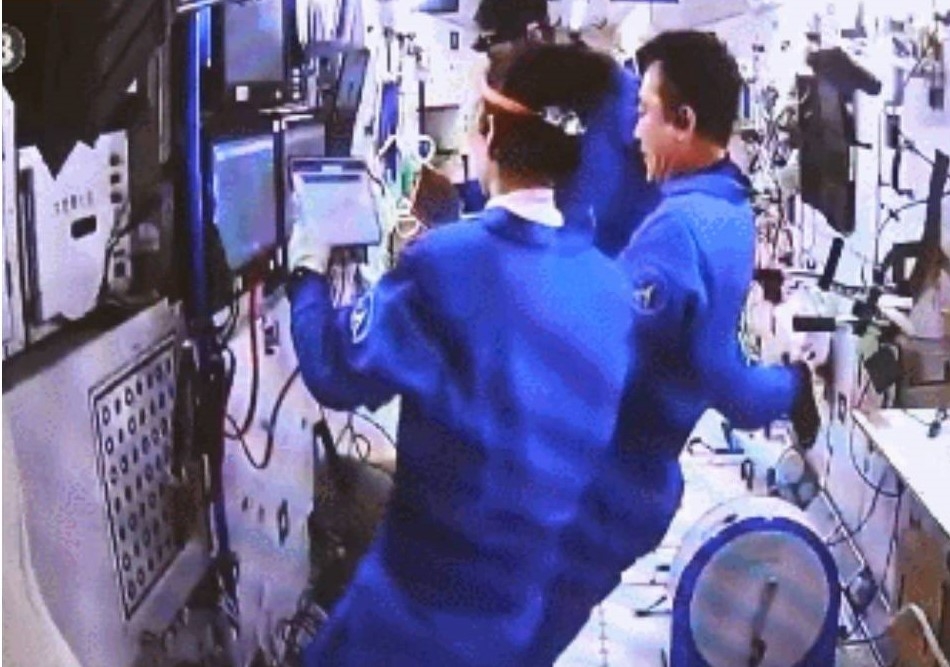
Shenzhou-13 crew conducts an emergency evacuation drill onboard the country’s space station, November 7. 2021. CCCTV/China Media Group
“The design of the space station has set the highest requirements for the astronauts’ safety. We have all emergency preparedness for the pressure loss in the cabin, fire and other situations to ensure the life safety of the astronauts,” Wang told CCTV.
The three Chinese astronauts have been working and living in orbit after entering the core module on October 16.
The combination of China’s space station is formed by the Shenzhou-13 spaceship, Tianhe core module, and cargo craft Tianzhou-2 and Tianzhou-3.
Go to this just-released video via China National Space Administration (CNSA)/China Media Group(CMG)/China Central Television (CCTV) at:
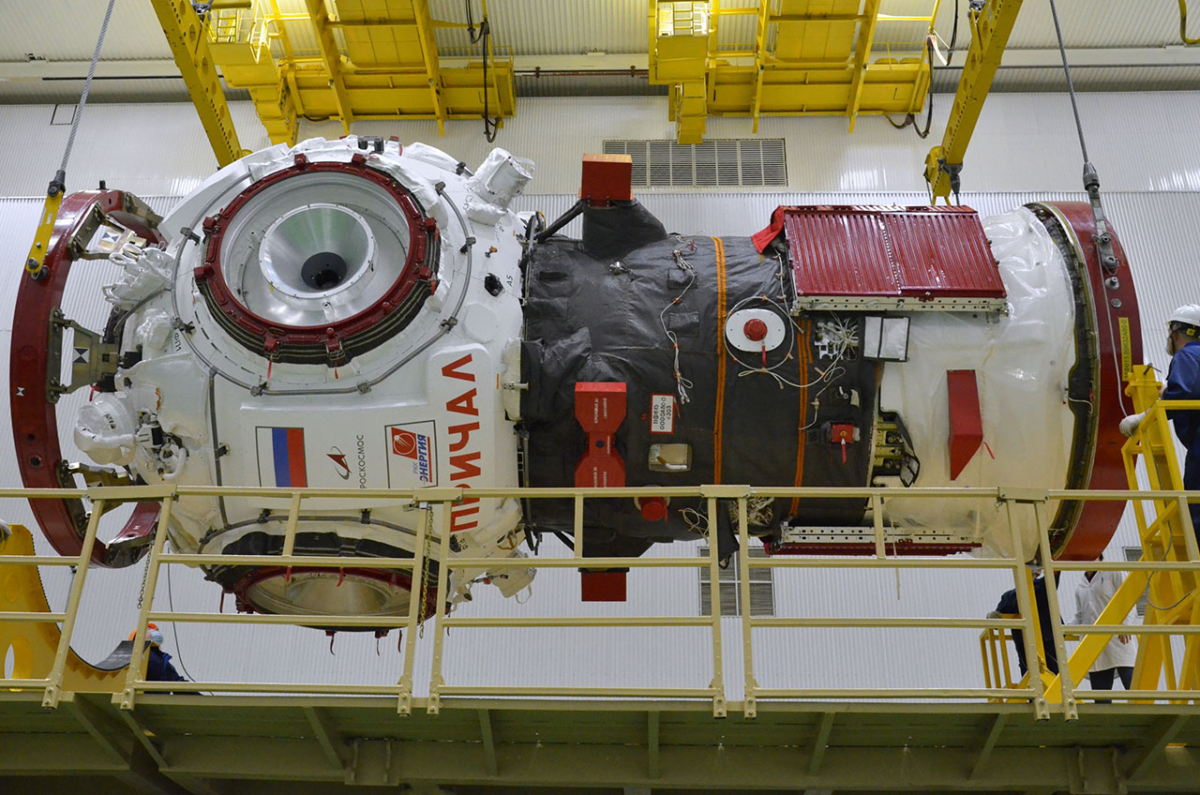
Credit: Roscosmos
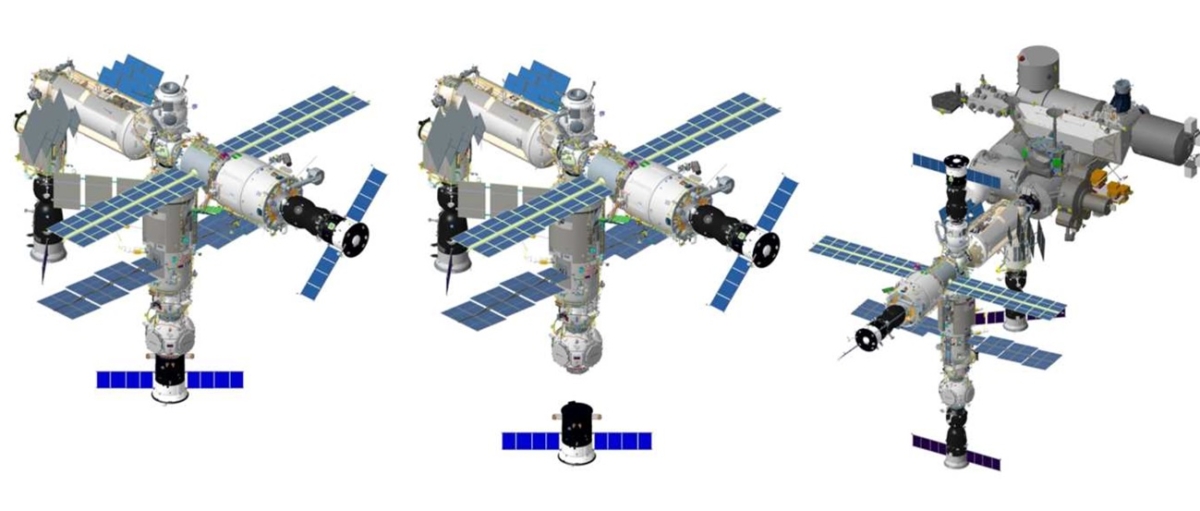
Russia is ready to loft its Prichal nodal module to the International Space Station. The hardware is part of the Progress M-UM transport cargo vehicle, set for departure on November 24, 2021 from the Baikonur launch site.

The developer of the nodal module is the Rocket and Space Corporation Energia named after S.P. Queen (part of the Roscosmos State Corporation). Credit: RKK Energia
The Prichal module is designed to increase the technical and operational capabilities of the Russian segment of the International Space Station. This module is to be docked to the nadir unit of the multipurpose laboratory module “Science.”
Prichal is designed to provide docking of up to five objects, ensuring the possibility of re-docking of products equipped with a re-docking manipulator from the axial port to the side port and vice versa, according to Roscosmos.

Credit: Roscosmos
Credit: Roscosmos

Credit: Roscosmos

