Archive for the ‘Space News’ Category
 Author:
  December 1st, 2021
Vice President Kamala Harris has Convened the Administration’s Inaugural National Space Council Meeting
December 1, 2021 starting at 1:30 PM ET
Go to: https://www.whitehouse.gov/live/
and
https://www.youtube.com/watch?v=o9vAwU4S8rg
NASA is also airing live coverage of the first National Space Council meeting from the U.S. Institute of Peace in Washington, D.C.

Also, the White House Space Framework has been Released.
Go to:
https://www.whitehouse.gov/wp-content/uploads/2021/12/United-States-Space-Priorities-Framework-_-December-1-2021.pdf
 Posted in
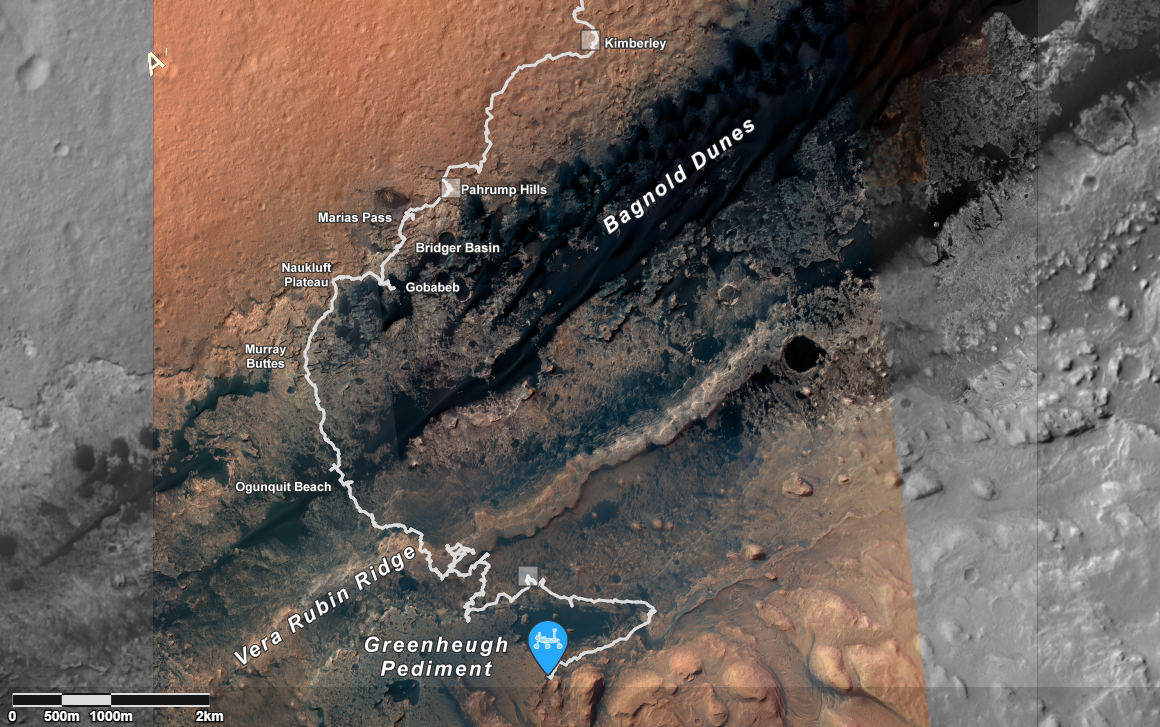
Curiosity’s location as of Sol 3312. Distance driven to date is 16.53 miles/26.61 kilometers.
Credit: NASA/JPL-Caltech/Univ. of Arizona
NASA’s Curiosity Mars rover at Gale Crater is now performing Sol 3313 duties.
Susanne Schwenzer, a planetary geologist at The Open University; Milton Keynes, U.K., reports Curiosity is keeping itself busy exploring Gale crater, and this means having one last look at the Zechstein drill hole and its surroundings.
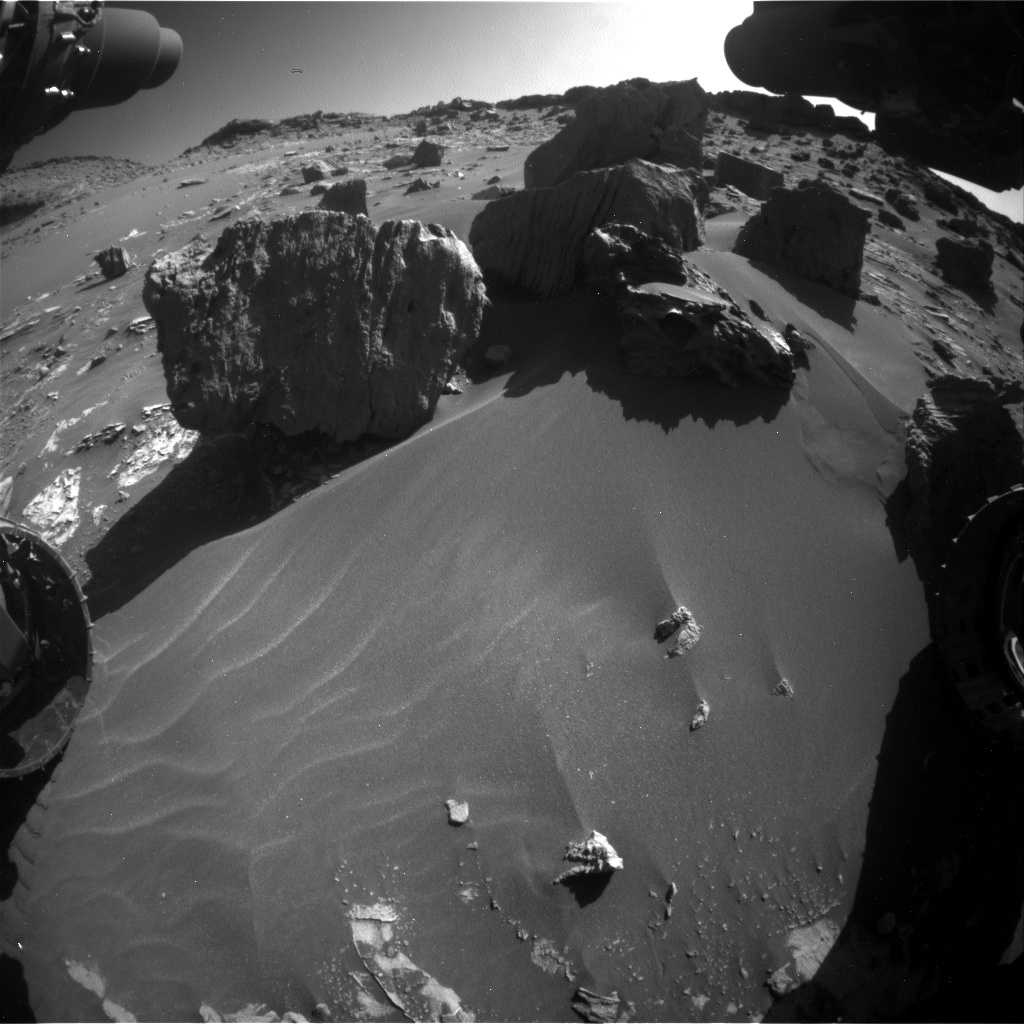
Curiosity Front Hazard Avoidance Camera Right B image taken on Sol 3313, December 1, 2021.
Credit: NASA/JPL-Caltech
The robot’s Mars Hand Lens Imager (MAHLI) is looking at Zechstein and so is the Chemistry and Camera (ChemCam) with a Laser Induced Breakdown Spectroscopy (LIBS) observation, which Mastcam will document.
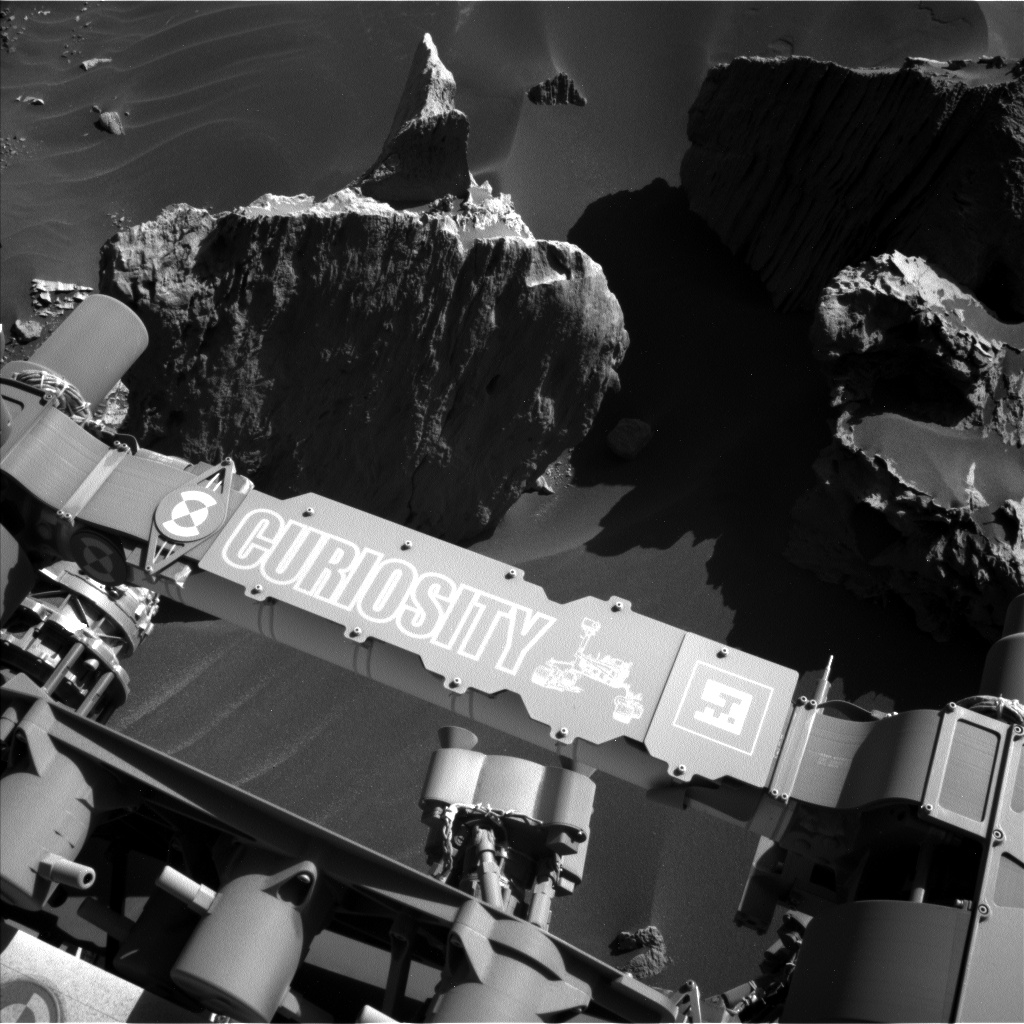
Curiosity Left B Navigation Camera photo acquired on Sol 3313, December 1, 2021.
Credit: NASA/JPL-Caltech
Change detection target
“Mastcam will investigate the target ‘Ardsheal,’ a name which you may have heard before because it is [a] change detection target that we have looked at several times while we were stationary at Zechstein for the drilling,” Schwenzer adds.
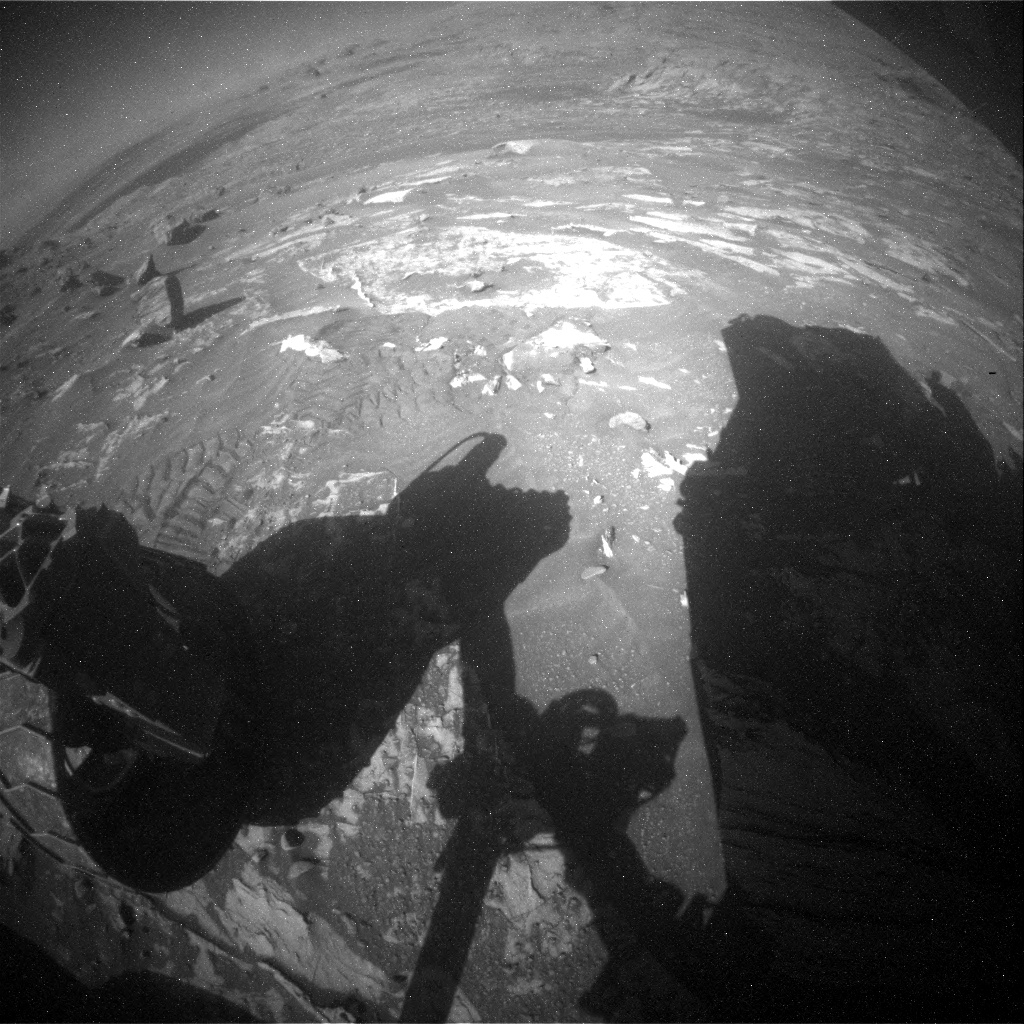
Curiosity Rear Hazard Avoidance Camera Right B image taken on Sol 3313, December 1, 2021.
Credit: NASA/JPL-Caltech
Curiosity’s Mastcam is scripted to also look at the rover deck, which Mars researchers are monitoring in regular intervals.

Curiosity Mast Camera Right image taken on Sol 3312, November 30, 2021.
Credit: NASA/JPL-Caltech/MSSS
“Another regular activity, the atmospheric monitoring, is in the plan again,” Schwenzer points out.
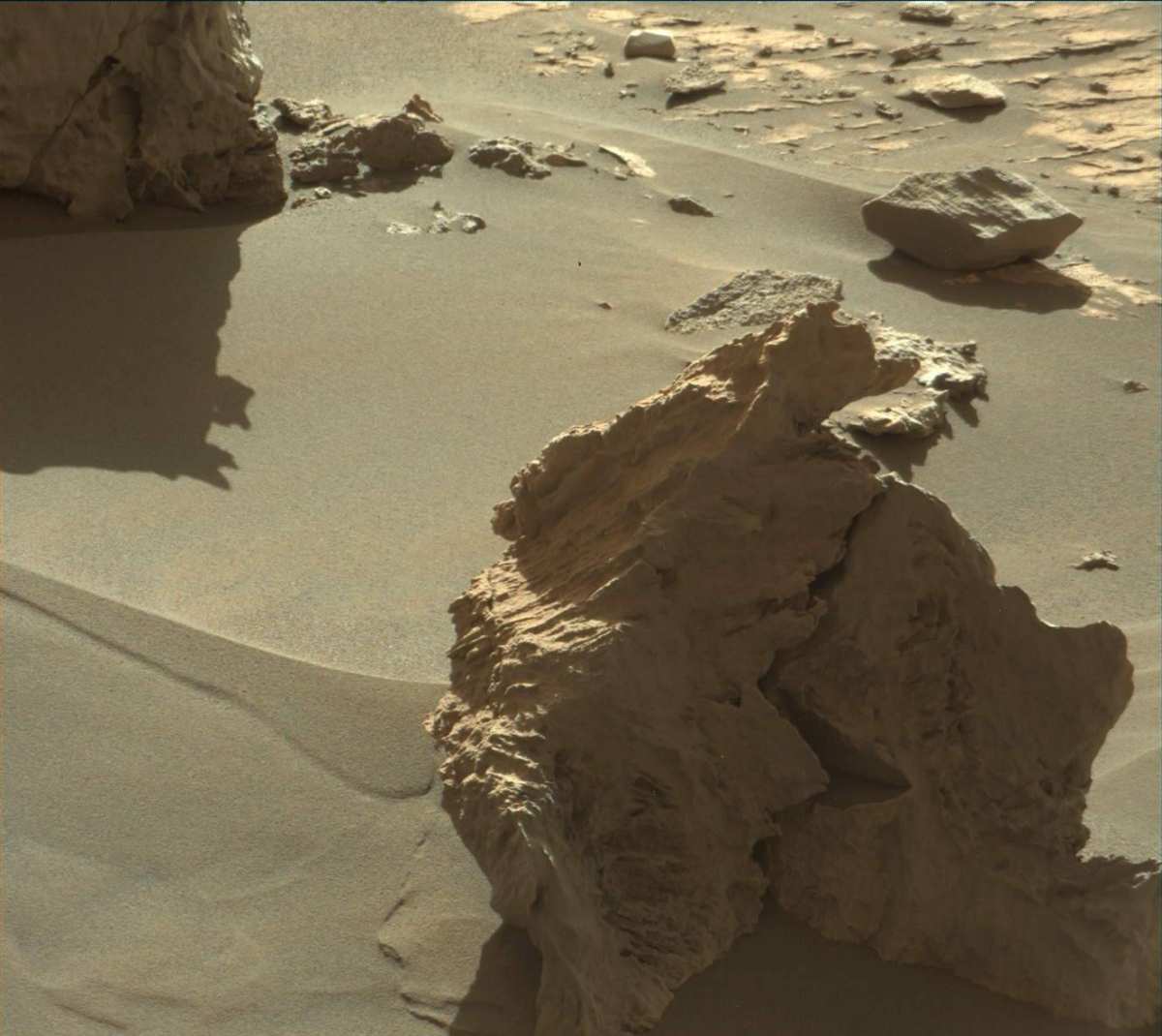
Curiosity Mast Camera Right image taken on Sol 3312, November 30, 2021.
Credit: NASA/JPL-Caltech/MSSS
Interesting features
ChemCam plans a long distance Remote Micro-Imager (RMI) to look at all the highly interesting and variable structures in the landscape.
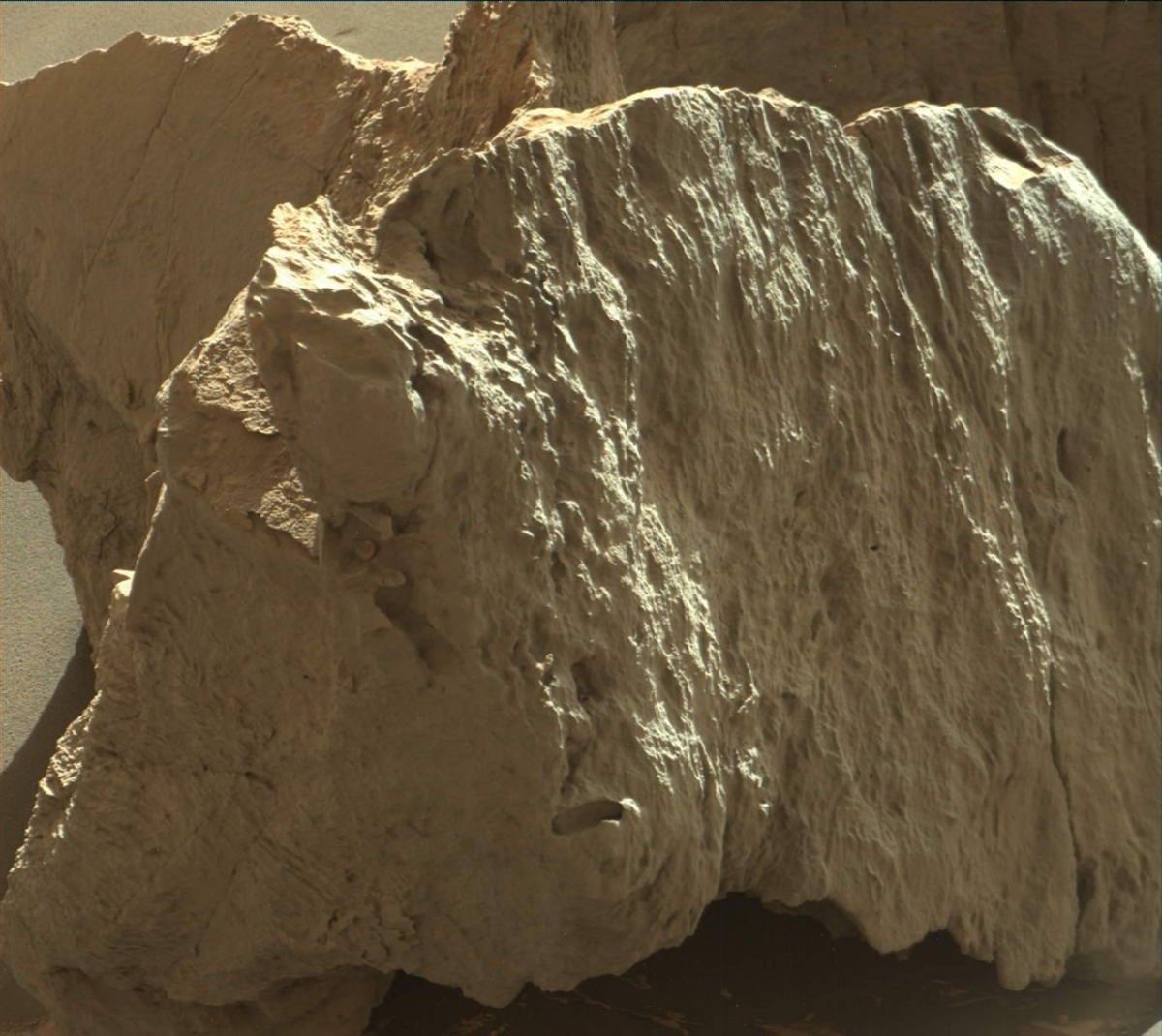
Curiosity Mast Camera Right image taken on Sol 3312, November 30, 2021.
Credit: NASA/JPL-Caltech/MSSS
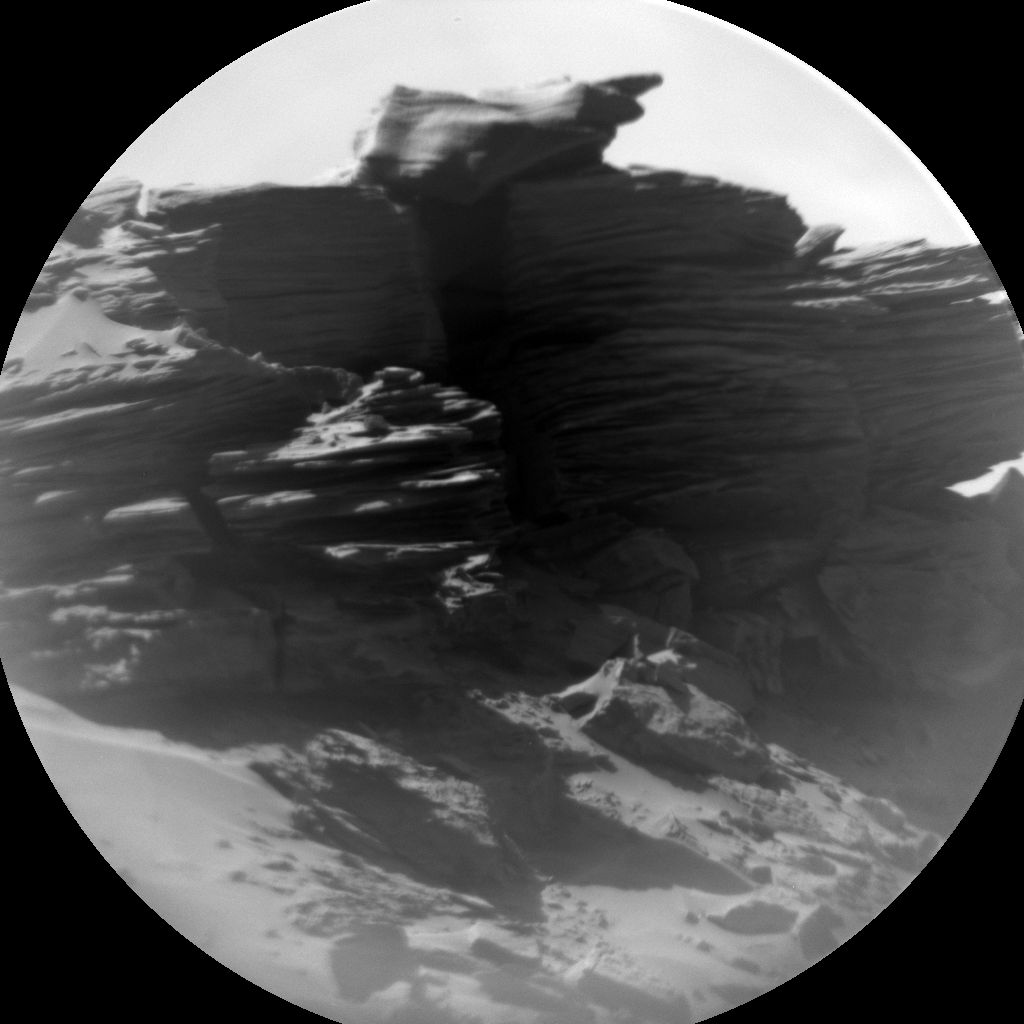
Curiosity Chemistry & Camera Remote Micro-Imager (RMI) photo acquired on Sol 3313, December 1, 2021
Credit: NASA/JPL-Caltech/LANL
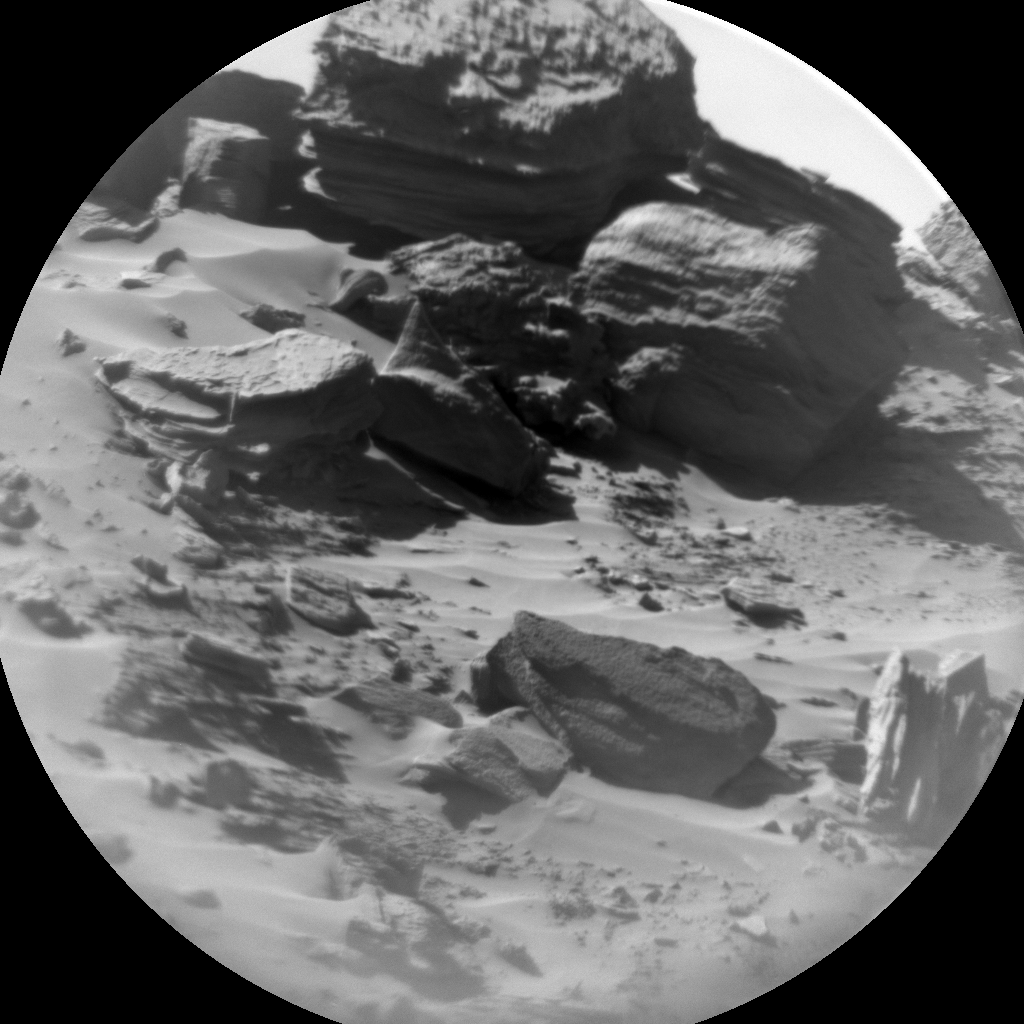
Curiosity Chemistry & Camera Remote Micro-Imager (RMI) photo acquired on Sol 3313, December 1, 2021
Credit: NASA/JPL-Caltech/LANL
“We have been seeing many interesting features lately, including ones such as on the ChemCam RMI,” Schwenzer notes. “Let’s see what the new ones will reveal!”
“There is a drive in the plan, and after the drive Curiosity will look at an area with many boulders to give some context on future investigations,” Schwenzer concludes. Last but not least, the rover’s Mars Descent Imager (MARDI) will obtain a new picture too.

Credit: ESA/Alex Lutkus
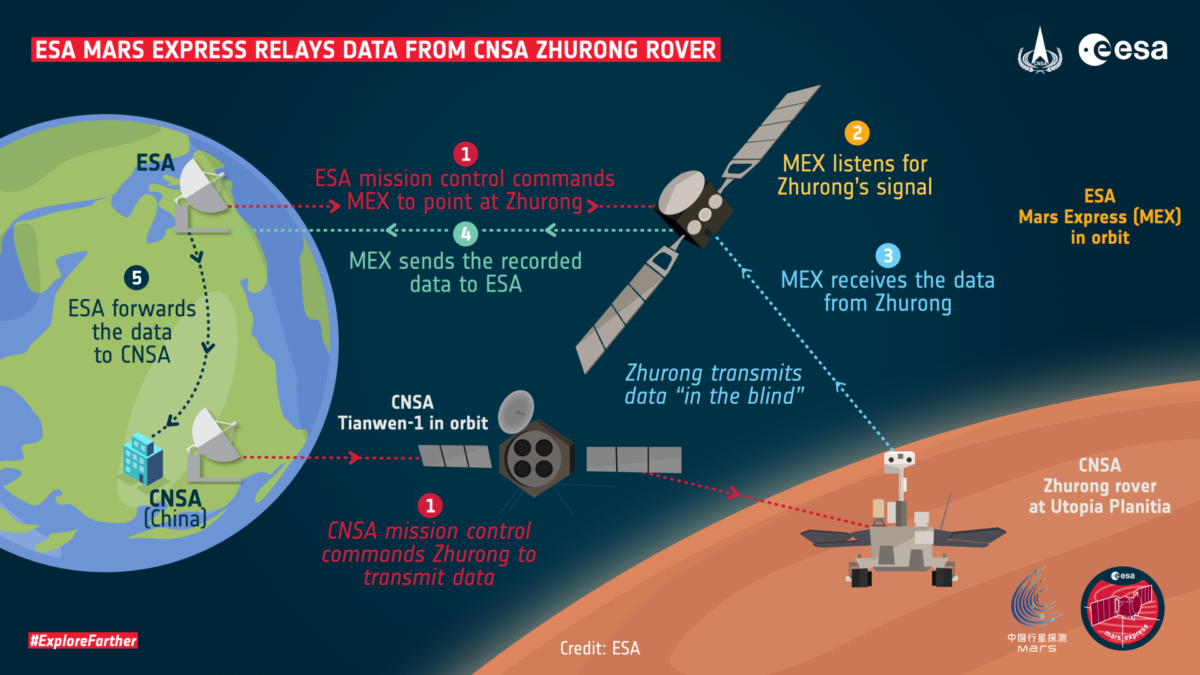
This November, the European Space Agency’s Mars Express spacecraft carried out a series of experimental communication tests with the Chinese (CNSA) Zhurong Mars rover.
Mars Express successfully caught data sent up ‘in the blind’ by the rover and relayed them to Earth where they were forwarded to the Zhurong rover team in China.

Lander and Zhurong Mars rover.
Credit: CNSA/Inside Outer Space screengrab
The experiments culminated in a successful test on November 20, ESA announced today.
Good quality data
“Mars Express successfully received the signals sent by the rover, and our colleagues in the Zhurong team confirmed that all the data arrived on Earth is very good quality.” says ESA’s Gerhard Billig.
Credit: ESA
The data relayed by Mars Express arrived on Earth at ESA’s ESOC space operations centre in Darmstadt, Germany, via deep-space communication antennas. From there, these data were forwarded to the Zhurong team at the Beijing Aerospace Flight Control Center, who confirmed the success of the test.
“We’re looking forward to carrying out more tests in the future,” Billig adds, “to continue to experiment and further improve this method of communicating between space missions.”

Decades of near-Earth space exploration and utilization have resulted in an increasingly congested environment. Indeed, pieces of space debris are a growing threat to space assets, human spaceflight and future access to outer space.
A just-issued report — Policy Options to Address Collision Risk from Space Debris – takes a hard look at the issue, offering recommendations to create improved response strategies.
The report comes from the International Risk Governance Center ( IRGC), a neutral interdisciplinary center based at the École Polytechnique Fédérale de Lausanne (EPFL) in Lausanne, Switzerland.

Credit: CORDS
Limited shared resource
Called for is a “greater and more committed political involvement at the national and international levels,” deemed as instrumental to reducing collision risk from space debris and enabling sustainable space activities. Furthermore, there’s need to recognize that near-Earth space is a limited shared resource.
The report is divided into four chapters: Risk assessment and evaluation; Technology development and implementation; Regulatory requirements and compliance; and Multilevel governance of collision risk.
To read the full report — Buchs, R. (2021)/Policy options to address collision risk from space debris/Lausanne: EPFL International Risk Governance Center – go to:

With an expected launch and return from the ISS in early Summer 2022, Dianna Rae Jewelry is flying a limited number of natural and lab-grown diamonds.
Available for sale to the public, each diamond will be numbered, laser engraved and documented by the American Gem Society Laboratory.
The Diamonds in Space Program are in a pre-sell mode, with the gems that are heading to space made available as loose gems or set into a mounting of your choice.

Cupola and shooting stars
Dianna Rae Jewelry, located in Lafayette Louisiana, is also offering a new line of space jewelry, taking design inspiration from the Space Station cupola, shooting stars and angels.
Prices range from $745 up to $2,000,000. “Natural colored diamonds are also being offered for those who want the rarest diamonds of all, from Earth or space,” according to a press statement. “Every step of the way, you will get to track your diamond’s 10 million mile journey as it makes its way to orbit and back to Earth.”

Credit: Dianna Rae Jewelry
What happens if there is a catastrophic incident?
“We are talking about a rocket explosion, a re-entry failure, something big that makes it impossible to deliver your diamond to you. You will be entitled to a full refund of your purchase price. We have flight insurance on the entire cargo. Typically you would see a refund in 60-90 days pending insurance settlements,” states a company FAQ.
For more information on the Diamonds in Space Program, go to:
Also go to this informative video at:

Credit: NASA/JPL-Caltech/University of Arizona
A pit crater, created by an empty lava tube, has been studied in Mars’ Arsia Mons region.
Using imagery captured in August 2020 by the High-Resolution Imaging Science Experiment, or HiRISE camera onboard NASA’s Mars Reconnaissance Orbiter, researchers appraise the pit at being about 150 feet (50 meters) across.

On patrol – NASA’s Mars Reconnaissance Orbiter (MRO).
Credit: NASA/JPL-Caltech
That measurement suggests it’s likely that the underground tube is also at least this big – much bigger than similar caves on Earth.
The use of lava tubes on Mars as emergency shelters and storage has been advanced in the past. Lava tubes are formed from fast moving lava which later cools and forms roomy caves that might serve various functions for future human expeditions to the Red Planet.

European Space Agency (ESA) astronauts training in terrestrial lava tubes located on Spain’s Canary Island of Lanzarote.
Credit: L. Ricci/ESA
Detailed measurements
Meanwhile, data gleaned by a Radiation Assessment Detector (RAD) on NASA’s Curiosity Mars rover at Gale Crater has found a reduction in radiation when the rover was parked next to a butte on the Red Planet.

From B. Ehresmann, D. M. Hassler, et al. “Natural Radiation Shielding on Mars Measured With the MSL/RAD Instrument”
Designed by the Southwest Research Institute (SwRI) in Boulder, Colorado, RAD has been yielding detailed measurements of the radiation environment on the surface of Mars since Curiosity landed in August 2012.
“We will send astronauts to Mars, and when we do, protecting them from the environment is part of NASA’s responsibility,” said Don Hassler, RAD principal investigator and science program director at SwRI, as reported by the Boulder Daily Camera.
Hassler adds that fully understanding the radiation profile of Mars also raises the potential of fabricating astronaut shelters in lava tubes.

Credit: NASA/JPL/Caltech

Radiation Assessment Detector is also known as RAD.
Credit: NASA/JPL-Caltech/SwRI
For more information on the new RAD findings, go to “Natural Radiation Shielding on Mars Measured With the MSL/RAD Instrument” led by B. Ehresmann at:
https://agupubs.onlinelibrary.wiley.com/doi/abs/10.1029/2021JE006851
NASA’s Curiosity Mars rover at Gale Crater has just begun Sol 3311 operations.
Newly issued imagery shows the current scenery viewed by the robot:

Curiosity Front Hazard Avoidance Camera Right B image taken on Sol 3309, November 27, 2021.
Credit: NASA/JPL-Caltech

Curiosity Mast Camera Right image acquired on Sol 3309, November 27, 2021.
Credit: NASA/JPL-Caltech/MSSS

Curiosity Right B Navigation Camera photo taken on Sol 3309, November 27, 2021.
Credit: NASA/JPL-Caltech

Curiosity Right B Navigation Camera photo taken on Sol 3309, November 27, 2021.
Credit: NASA/JPL-Caltech

Curiosity Right B Navigation Camera photo taken on Sol 3309, November 27, 2021.
Credit: NASA/JPL-Caltech

Curiosity Right B Navigation Camera image taken on Sol 3309, November 26, 2021.
Credit: NASA/JPL-Caltech

Starship and Super Heavy Stack.
Credit: SpaceX
If you are hungry for a fundamental change in the paradigm for NASA science, technology development and testing, along with the human exploration of space, look no further than the SpaceX Starship system.
That’s a leading conclusion from a paper jointly authored by NASA, university and industry researchers, led by Jennifer Heldmann, an astrobiologist at NASA’s Ames Research Center in Silicon Valley.
“Starships flown to the Moon and Mars will provide opportunities to deliver massive cargos and large numbers of people to enable sustained and self-reliant human off-world presence,” the paper suggests, submitted to the National Academies’ next Planetary Science and Astrobiology Decadal Survey.

Credit: SpaceX
Impending Starship flights
The return of many tons of samples from the Moon and Mars to Earth for scientific analysis will be enabled via the Starship system. The types of payloads conjured up by NASA divisions “could be much different than those designed for traditional NASA flight opportunities with their stringent mass and volume constraints,” the paper explains.

SpaceX Starship human lander design to carry NASA astronauts to the surface of the Moon under the Artemis program.
Credit: SpaceX
Also, the paper points out that, in order to take advantage of the impending Starship flights to the surface of the Moon and Mars, “NASA will need to develop a new funding program consistent with the mission timelines for rapid flights planned by SpaceX.”
Prepare payloads now
Heldmann and nearly 25 other specialists add: “To be most effective, planning should begin immediately to prepare for payloads on the first uncrewed Starship flights, likely first to the Moon and then for Mars.”

Starships locked and loaded on Mars.
Credit: SpaceX
Starship missions to the lunar surface can be an “important stepping stone for reaching Mars” both technically and programmatically, the paper points out. Indeed, Earth’s Moon can serve as a testbed and demonstration platform for utilizing on-the-spot resource technologies as well as for Starship operations.
To view the entire paper – “Accelerating Martian and Lunar Science through SpaceX Starship Missions” – go to: http://surveygizmoresponseuploads.s3.amazonaws.com/fileuploads/623127/5489366/111-381503be1c5764e533d2e1e923e21477_HeldmannJenniferL.pdf

Artist concept of the Tianzhou-1 cargo resupply spacecraft.
Credit: CMSE
China’s resupply spacecraft – the Tianzhou series – will open its cargo hatches in the future and carry investigations by government organizations, research institutions, educational institutions, enterprises and industry groups.
The China Manned Space Agency (CMSA) announced that post-completion of the country’s space station — headed for the end of 2022 — two Tianzhou spacecraft are to be launched on average each year.
CMSA explained that any project group pushing the sci-tech frontier, meets the requirement of national development strategy and sci-tech development trend, or is forward-looking, innovative or has industrial development value can submit an application on or before January 15, 2022.

Rollout of Long March-7 Y4 and the Tianzhou-3 cargo spacecraft.
Credit: CCTV/Inside Outer Space screengrab
Application experiments
This is the first time for China’s manned space mission to open its cargo craft payloads to the public, said the CMSA.
Earlier, the CMSA cooperated with the United Nations Office for Outer Space Affairs on the application of China’s space station to provide opportunities to carry out application experiments. There have been nine projects from 17 countries selected, which are in the fields of space life science and biotechnology, space astronomy, and microgravity fluids and combustion.

China’s space station is projected to be completed in late 2022.
Credit: CAST
Tianzhou-3 and Tianzhou-2 were launched on September 20 and May 29 respectively this year. Each transported supplies and materials for the construction of China’s orbiting outpost.

China’s Wang Yaping onboard in-construction Tiangong space station.
Credit: CMSA/Zhai Zhigang/Ye Guangfu
The China Manned Space Agency (CMSA) has released imagery and videos showcasing life onboard the country’s in-construction Tiangong (Heavenly Palace) space station.

Credit: CMSA/Zhai Zhigang/Ye Guangfu
China launched the Shenzhou-13 piloted spaceship on October 16 by a Long March 2F carrier rocket at the Jiuquan Satellite
Launch Center in northwest China’s Gobi Desert.

Credit: CMSA/Zhai Zhigang/Ye Guangfu
The booster hurled three astronauts — Zhai Zhigang, Wang Yaping, and Ye Guangfu – to the orbiting facility to undertake a six-month mission – the nation’s longest crewed space mission so far.
Videos are available here:

